APPENDIX.
Reading edition
Brief Scheme of Classification into Systems by Optical Determinations.
HOMOGENEOUS.
The whole substance shows the same optical character, except in the case of twin crystals when the different portions of the twin are affected differently.
Isotropic
All sections of the substance remain dark during a complete rotation between crossed nicols, and no interference figure is produced by convergent light.
Amorphous
Absence of crystalline form or cleavage.
Isometric
Presence of crystalline form or cleavage.
Anisotropic.
Sections generally show some interference color and extinguish four times, at 90° apart, during complete rotation.
Uniaxial.
Determined by character of interference figures obtained by convergent light from sections which remain dark or nearly so during complete rotation.
All sections show parallel or symmetrical extinction.
Tetragonal
Sections giving interference figures are four- or eight-sided, or show rectangular cleavage.
Hexagonal
Sections giving interference figures are three-, six- or nine-sided, or show cleavage lines intersecting at 60°.
Biaxial
Determined by character of interference figures obtained by convergent light.
Orthorhombic
Extinction is parallel or symmetrical in all sections parallel to ă, [=b] and ć. Color distribution is symmetrical to two lines and to the central point, see p. 48.
Monoclinic
Extinction is only parallel or symmetrical in sections parallel to the ortho axis [=b]; all other sections show extinction angles. Color distribution is only symmetrical to one line or to the central point, see p. 48.
Triclinic
Extinction angles in all sections, although in some minerals these angles may be very small. No symmetry in color distribution, see p. 48.
AGGREGATE.
Not homogeneous, but made up of an aggregation of individuals, all extinguishing at different times.
142
Double Refraction (maximum).[155]
0.287
Rutile
0.179
Dolomite
0.172
Calcite
0.141
Titanite
0.090
Titanite
0.072
Hornblende (basaltic)
0.062
Zircon
0.058
Biotite
0.050
Talc
0.050
Ægirite
0.041
Muscovite
0.037
Epidote
0.036
Chrysolite (Olivine)
0.036
Scapolite (Meionite)
0.034
Tourmaline
0.034
Phlogopite
0.030
Allanite (Orthite)
0.029
Diopside
0.027
Actinolite
0.027
Tremolite
0.024
Hornblende (common)
0.024
Diallage
0.024
Anthophyllite
0.023
Augite
0.021
Sillimanite (Fibrolite)
0.018
Glaucophane
0.017
Tourmaline (precious)
0.016
Cyanite (Disthene)
0.013
Hypersthene
0.013
Scapolite (Marialite)
0.013
Anorthite
0.012
Natrolite
0.011
Chlorite (Clinochlore)
0.011
Andalusite
0.011
Topaz
0.010
Staurolite
0.010
Gypsum
0.010
Enstatite
0.010
Serpentine
0.009
Corundum
0.009
Iolite (Cordierite)
0.009
Quartz
0.008
Topaz
0.008
Kaolin
0.008
Labradorite, Ab1An1
0.008
Oligoclase, Ab4An1
0.008
Albite
0.007
Orthoclase
0.007
Microcline
0.006
Vesuvianite
0.005
Zoisite
0.004
Nephelite (Elæolite)
0.003
Apatite
0.003
Melilite
0.002
Tridymite
0.002
Leucite
0.002
Allanite (Orthite)
0.001
Chlorite (Penninite)
0.001
Vesuvianite
Indices of Refraction (mean).[155]
2.712
Rutile
2.38
Perofskite
2.00
Spinel (Chrome)
1.963
Titanite
1.95
Zircon
1.920
Titanite
1.856
Garnet (Melanite)
1.792
Ægirite
1.78
Allanite (Orthite)
1.78
Garnet (Almandite)
1.766
Corundum
1.751
Epidote
1.75
Garnet (Pyrope)
1.741
Staurolite
1.723
Hypersthene
1.72
Spinel
1.720
Zoisite
1.720
Cyanite (Disthene)
1.719
Hornblende (basaltic)
1.715
Vesuvianite
1.711
Augite
1.699
Zoisite
1.697
Diopside
1.688
Diallage
1.675
Chrysolite (Olivine)
1.665
Enstatite
1.664
Sillimanite (Fibrolite)
1.674
Tourmaline
1.644
Anthophyllite
1.64
Hornblende (common)
1.637
Andalusite
1.635
Apatite
1.632
Glaucophane
1.632
Topaz
1.630
Melilite
1.633
Tourmaline (precious)
1.622
Dolomite
1.621
Actinolite
1.621
Tremolite
1.618
Biotite
1.608
Topaz
1.588
Chlorite (Clinochlore)
1.587
Muscovite
1.582
Anorthite
1.576
Chlorite (Penninite)
1.572
Talc
1.584
Scapolite (Meionite)
1.564
Phlogopite
1.56
Serpentine
1.559
Labradorite, Ab1An1
1.55
Kaolin
1.547
Quartz
1.551
Scapolite (Marialite)
1.601
Calcite
1.541
Oligoclase, Ab4An1
1.54
+ Canada balsam
1.539
Nephelite (Elæolite)
1.539
Iolite (Cordierite)
1.535
Albite
1.525
Gypsum
1.525
Microcline
1.523
Orthoclase
1.509
Leucite
1.503
Haüynite
1.488
Analcite
1.483
Natrolite
1.483
Sodalite
1.477
Tridymite
1.46
Opal
143
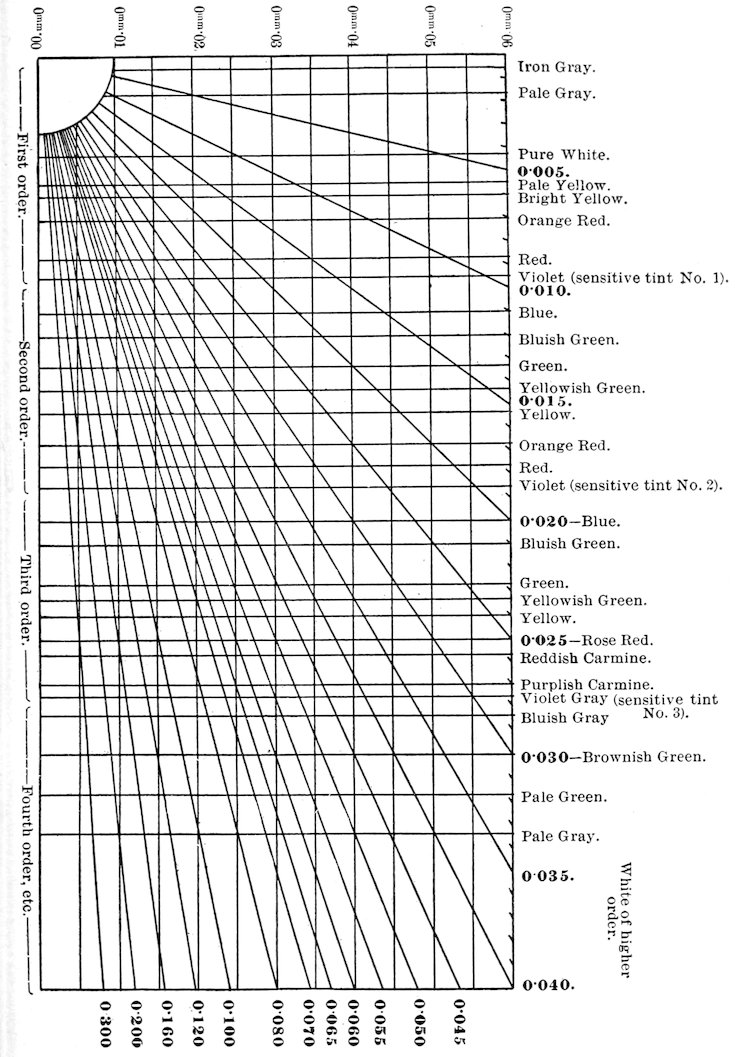
Diagram showing relation between strength of Double Refraction, Interference Colors and Thickness of Section.[156]
144
Order of Consolidation of the Constituent Minerals in Plutonic Rocks.
“There is in plutonic rocks a normal order of consolidation for the several constituents, which holds good with a high degree of generality. It is in the main, as pointed out by Rosenbusch, a law of ‘decreasing basicity.’ The order is briefly as follows:
“1. Minor accessories (apatite, zircon, sphene, garnet, etc.) and iron ores.
“2. Ferro-magnesian minerals—olivine, rhombic pyroxenes, augite, ægirine, hornblende, biotite, muscovite.
“3. Felspathic minerals—plagioclase felspars (in order from anorthite to albite), orthoclase (and anorthoclase).
“4. Quartz, and finally microcline.
“In most rocks such minerals as are present follow the above order. The most important exceptions are the intergrowth of orthoclase and quartz and the crystallization of quartz in advance of orthoclase in some acid rocks, and the rather variable relations between groups 2 and 3 in some more basic rocks. The order laid down applies in general to parallel intergrowths of allied minerals; thus when augite is intergrown with ægirine or hornblende the former mineral forms the kernel of the complex crystal and the latter the outer shell; when a plagioclase crystal consists of successive layers of different compositions the layers become progressively more acid from the center to the margin.
“Certain constituents having variable relations are omitted from the foregoing list. Thus nepheline (elæolite) and sodalite belong to group 3, but may crystallize out either before or after the feldspar.”[157]
145