CHAPTER 15.
Reading edition
ToC
Trench Warfare.
General Principles.
1. Defense may be made in depth by all organizations, down to and including the platoon, or it may be made laterally.
2. The smallest active segment, be it only three men, must have a chief and a second in command, who is responsible for the proper upkeep and defense of the segment. All occupants of active segments must know all instructions which should be simple.
3. Any troops in charge of a portion of trench must never abandon it, no matter what happens, even if surrounded.
4. All ground lost must be retaken at once by immediate counter attack launched by the unit which lost the ground. As a matter of fact a counter attack is difficult for a platoon or company; it is really necessary for it to be made by a battalion.
5. Each company must provide for emplacements for mine throwers to be served by the artillery and for pneumatic guns to be served by their own men.
Instructions to be Issued by Battalion Commander.
1. Disposition of companies in sector assigned (best done by sketch showing sectors assigned to companies).
2. Special orders to companies (concerns field of fire to be obtained not only in own sector, but also in those adjoining it).
3. Improvement of defense. (Brief reports from company commanders to be followed by work being done on order of battalion commander after inspection.)
4. Organization of watching (not sentry duty) (by company commander under supervision of battalion commander).
5. Organization of observation (not sentry duty) (by company commander under supervision of battalion commander).
6. Organization of supply (procuring, routing, etc., of tools, ammunition, food, water, etc.), (by company commander under supervision of battalion commander).
7. Organization of liaison (communication) (runners, telephone, telegraph visual signaling, pigeons, etc., by company commander under the supervision of battalion commander). All telephonic communication must be in code.
8. Organization of supplies to include amounts to be expected daily from the rear.
9. Knowledge of enemy must be imparted to company commanders in order to assist them in making their dispositions.
10. Frequent reports to be made of existing conditions at the front for information of higher commanders.
11. Lateral defense of boyaux must not be overlooked.
12. Wide turning movements are not possible. Enveloping movements are possible only on local attacks against small portions of the hostile line after it has been pierced. All main attacks are confined to purely frontal attacks.
13. The most important obstacle is barbed wire entanglements.
14. Communication (liaison) between and co-ordination and co-operation of, the different elements of a command is of the utmost importance.
15. Artillery co-operates more closely than ever with infantry. Its reconnaissance officers accompany infantry lines in order to obtain information. There is a certain number of artillery observers attached to each battalion of infantry.
The general method of attack is to smother the defense with a torrent of explosive shells, kept up incessantly for one or more days, and shatter the defense so they will offer but slight resistance to the infantry; then rush forward with the infantry and seize the positions while the enemy is demoralized, and consolidate them before reenforcements can be brought up.
The artillery bombardment is necessary to prepare the way for the infantry advance. It has for its objects:
To destroy the hostile artillery, wire entanglements and infantry trenches.
To produce curtains of fire and prevent bringing up reenforcements.
Light guns are assigned to Each Battalion Of Infantry, subject only to orders of regimental and battalion commanders concerned.
Save under exceptional circumstances the light gun is always attached to the Machine Gun Company for the attack.
The essential role of the light gun is to destroy with direct fire the visible machine guns; they are employed separately and not grouped.
The infantry is divided into two classes: Holding troops—and attacking or shock troops. Holding troops are those doing routine or trench duty; shock troops are picked organizations of young and vigorous men and are kept in camps well behind the battle front. Holding troops are two weeks in and two weeks out of the trenches.
All specialist groups, i.e., Machine Gun Companies, etc., are officered, allowing company and battalion commanders to concentrate them, if the situation requires.
They play the normal part in combat if they do not receive special instructions.
Attack of a Defensive Position.
Unity of command in depth must be preserved everywhere, unless there is an imperative reason for doing otherwise.
The front of each regiment should be divided between two or three battalions.
Each battalion commander having to look after a front of from 500 to 600 yards, can exercise efficient control of his command.
In preparing for an assault, seniors must take steps to organize it and make all necessary preparations themselves, and not leave all the responsibility with the juniors.
In the assault each unit must know its special task beforehand, and it should be rehearsed in rear of the line of trenches. Each commander must know the exact time he is to start and must start on time.
The first waves of men are placed at 4 or 5 pace interval. Chief of section can command only a front of 80 to 100 paces and it is necessary to form the section in two (2) waves. The first containing the grenadiers and automatic riflemen, the latter in the center. The second wave contains the riflemen and rifle grenadiers, the latter in the center.
If the terrain is cut up by woods, villages, etc., the proportion of grenadiers may be increased by taking them from the sections in support and the automatic riflemen sent back to the second wave.
If the distance to cross exceeds 300 or 400 yards, the number of automatic riflemen should be increased.
Two or three sections are usually placed abreast on the company front, which thus covers two to three hundred yards.
The support sections follow the leading sections of their company at about 50 yards, marching in two lines, if possible in two lines of squad columns at 20 yard intervals.
The first wave of the support is usually formed of the one-half section of specialists.
The echeloning of the specialists in front is also the most favorable formation to progress by rushes in a terrain cut up by shell holes.
The chief of section is between the two (2) waves of his section.
The captain is usually in front of the support sections.
The support sections are closely followed by a powerful line of machine guns, which are thrown into the fight when needed to reenforce the leading units.
"Trench Cleaners" usually march immediately after the leading sections and may be taken from the support sections. They are armed with pistols, knives and hand grenades.
The captain can use his section complete, or take out the specialists and use them for a particular purpose.
The specialists carry only the weapons of their specialty and have their loads lightened. The ordinary riflemen carry the usual packs and equipment.
Officers no longer lead the assault, but direct it. They are equipped with the rifle and bayonet, the same as the enlisted man.
Each unit of the first wave of the attack is given a definite objective. Different waves must not break upon the first wave.
Fire is opened by the assaulting troops only at short ranges, the advance being protected by a curtain of artillery fire. The advancing line makes use of shell holes and all other available cover.
When the first section reaches its objective it is joined by the half section of riflemen; it immediately organizes the captured ground.
Attacking From Trenches.—The commanders of brigades and battalions, with the commander of the artillery detailed to support them, study on the ground the artillery plan so far as it affects them. Immediately after the advance of the infantry begins, the artillery supporting it commences an intense bombardment with the object of forcing the enemy to take cover. At the moment laid down in the table of artillery fire the barrage lifts clear of the trench and the infantry rush in and capture it. The infantry must be taught that their success depends upon their getting within 75 yards of the barrage before it lifts, in order that they may reach the trenches before the enemy can man them. The secret of a successful assault is exact synchronization of the movements of the infantry with those of the barrage.
The pace of a barrage depends, to a certain extent, on the pace of the infantry, which varies with the condition of the ground, the length of the advance, the number of enemy trenches to be crossed, etc. It may be from 15 to 75 yards per minute. The pace of the barrage should be quicker at first, and should gradually slow down as the men become exhausted, in order to give them time to get close to the barrage and pull themselves together for the final rush.
In an attack each unit must have sufficient driving power in itself to carry it through to its objective and enable it to hold its ground when it gets there. When a number of trenches have to be carried, considerable depth will be required, and the frontage must be reduced. A brigade usually has a front in attack of 250 to 350 yards, but this may be increased to 1,000 or 1,200 yards.
A battalion should have a front of 250 to 350 yards. The battalion must be organized in depth in a series of waves. Two companies are usually put abreast in the first line and the others in the second line. Each company in both lines attacks in column of platoons at about 50 yards' distance, with intervals of three to five paces between men, so there would be eight lines of waves, of two platoons each. The 8th and 16th platoons, the two in rear forming the eighth wave, are usually not employed in the attack, but are left behind as a nucleus to form on in case of heavy casualties.
The front line must not be less than 200 yards from the enemy's front line.
The leading two or three waves are likely to meet machine gun fire, and generally move in extended order. Not more than two waves can be accommodated in one trench. Subsequent waves will move in line or in line of section columns in single file. Russian saps must be run out as far as possible across "No Man's Land" to be opened up immediately after the assault, as approach trenches. Ladders or steps are necessary to assist the leading waves in leaving the trenches, as they must move in lines. Provision must be made for bridges over the first line trenches for the rear waves. In the original assault line will be more suitable for both leading and rear waves. In later stages it is better for the rear waves to move in small and handy columns. In the original assault the distance between waves may be 75 to 100 yards; in later stages they may follow each other at 50 yards.
In the original assault, zero, or the time for the assault to begin, may be fixed for the moment at which our barrage lifts from the enemy front trench, the infantry timing their advance so as to be close under our barrage before it lifts. In the later stages zero must be the moment at which our barrage commences, and this commencement will be the signal for the infantry to leave their trenches. Each wave is assigned its own objective. All watches must be synchronized in order that all units may start off at the appointed time.
The first wave is composed of bombers and rifle grenade men, and attacks the enemy's first line of trenches. It must go straight through to its objective, following the artillery barrage as closely as possible. The second and third waves, composed of riflemen with bayonets and Lewis guns, re-enforce the first wave after the latter has occupied the enemy's first line trench, and attack the second line trench. The fourth wave takes up tools, ammunition and sand bags and assists in consolidating the line. The fifth wave is a mopping-up party to clear the enemy's dugouts. The sixth wave comprises battalion headquarters and has two Lewis guns, kept for a special purpose. The seventh and eighth waves, if used, seize and consolidate the enemy's third line trench.
Bombing squads (1 non-commissioned officer and 8 men) are on the flank of each attacking wave. Battalion bombers are assigned a special task.
All movements must be over the top of the ground. The pace throughout should be a steady walk, except for the last 30 or 40 yards, when the line should break into a steady double time, finishing up the last 10 yards with a rush.
Barrage is continued 20 or 30 minutes after the objective has been reached.
Mopping parties must be trained with great care under selected officers. They should always wear a distinguishing mark. They must at once dispose of any occupants who may have emerged from their dugouts, and picket the dugout entrances.
The ultimate unit in the assault is the platoon. It must be organized and trained as a self-contained unit, capable of producing the required proportion of riflemen, bombers, rifle bombers, Lewis gunners, and carriers, all trained to work in combination.
Assaulting troops should have twelve hours of daylight in the trenches before the assault begins, to enable them to get acquainted with the ground and get some rest. All ranks must be given a hot meal, including hot tea or coffee, before the assault.
Take every precaution to prevent the enemy from realizing that the assault is about to take place. Bayonets must not be allowed to show. No increase in rate of artillery fire. No unusual movements must be made in the trenches, and there must be no indication of the impending assault until the barrage is dropped.
When the trench has been taken, it should be consolidated at once to prevent counterattack. To protect this consolidation, throw out an outpost line, the posts consisting of one non-commissioned officer and 6 riflemen with a Lewis gun, about 150 to 200 yards apart and 100 to 300 yards beyond the line. These posts should be established in shellholes, which are to be converted into fire trenches, protected by wire entanglements, as soon as possible.
Approach trenches toward the enemy should be blockaded and hand and rifle grenadiers posted to guard them. The main captured trench should be converted at once into a fire trench facing the enemy. If it is badly knocked to pieces, a new trench may be constructed 40 or 50 yards in front of the captured line. The commander must reorganize in depth to provide supports and reserves for counterattacks. Situation reports should be sent back frequently. Rough sketches are better than messages.
Tanks follow infantry as closely as possible to deal with strong points. They are employed in sections of four.
Machine guns may be used to provide covering fire for attacking infantry, cover its withdrawal if the attack fails, fill gaps in the assaulting lines, assist in the consolidation of positions and repel counterattacks.
Lewis guns are of great value in knocking out hostile machine guns. They usually move on the flanks of the second wave of assault. Later they are used to back up patrols and to hold the outpost line while the garrison line is being consolidated.
As soon as consolidation begins, wire entanglements should be constructed. Every effort should be made to secure the objective against recapture. Any men available should be used to continue the offensive.
All commanders down to and including company commanders must keep some portion of their command as a reserve. The company commander needs his reserve to work around points which are holding against the leading lines, to protect his flanks in case the companies on his right and left are delayed in their advance and to exploit his success and gain ground to the front. He must keep it well in hand behind the company.
Battalion reserves must start with the assaulting column and get across "No Man's Land" as soon as possible; they must not get out of hand. Such a reserve is usually checked in the vicinity of the enemy's front line trench, where it can be thrown in to assist the advance or extend a flank as needed.
The brigade reserve is kept well in hand just clear of the friendly front line and support trenches. Reserves of companies and battalions must start moving over the top of the ground with the rest of the assaulting troops.
Defense Of Trenches.—The latest methods consist in constructing, supporting and strong points at the most favorable points to be held, such as villages, woods, etc. These are separated by intervals not too great for mutual support. They are of such resisting power that they must be taken before the attack can progress. In the intervals between them fire and communicating trenches are constructed, but these are only held lightly. Dummy trenches may be placed in these intervals. Lines of the various works are so traced that they bring enfilading fire on troops attacking adjacent positions. The lines need not be continuously occupied, but the obstacles extend in an unbroken line along the whole front. Wire entanglements are set in front of important positions in belts 20 feet wide, in two or three rows, each 20 yards apart.
Each supporting point usually is occupied by a battalion, and consists of a series of trenches formed into strong points, each held by a garrison of one or more platoons or a company. The supporting points are from 600 to 800 yards in depth and have a front of 600 to 1,000 yards. The first line of strong points is occupied by one or two companies in firing and cover trenches, while the remainder of the battalion occupies the support and reserve trenches. Bomb-proofs are built along the cover trenches and are connected with the firing trenches. Approach trenches are protected on both flanks by wire entanglements. Strong points in support and reserve trenches are prepared for an all-around defense and divided into two or more separate strong points by wire entanglements.
A body of infantry attacked is to oppose to the assailant its high powered weapons, machine guns, automatic rifles, rifle grenades and hand grenades and to reserve for the counter attack the grenadiers and riflemen. There is always one line upon which the resistance must be made with the greatest energy; for its defense the following methods have been found successful. Machine guns should be placed where they can secure the best flanking fire, and every one put out of action should immediately be replaced by an automatic rifle. If machine gun barrage fire is to play its role successfully at the moment of assault, the guns must survive the bombardment. Their protection is secured by placing them under shelter during the bombardment and making their emplacements as nearly invisible as possible. They should be echeloned in depth as far as practicable. They are generally placed in re-entrants of the firing trenches and cover the intervals between the adjoining supporting and strong points. Where the ground will permit they are often placed in concealed positions 20 to 30 yards in front of the trenches, to break up attacks made by hostile infantry. Not too many should be placed in the front line, and they should be echeloned in depth so as to confuse their disposition. The value of machine guns depends on the possibility of using them suddenly for brief periods, and in using them as long as they are effective. Machine guns disposed for flanking fire must be well covered by grenadiers; this is also true of automatic rifles.
Automatic rifles, rifle grenades and hand grenades are used to constitute a barrage to keep back the enemy. The entire front should be defended by a barrage of hand grenades, while the barrage of automatic rifles and rifle grenades is superposed farther to the front, up to 400 yards.
All riflemen and those grenadiers not employed in forming barrages are reserved to make a counterattack.
Companies on the second line operate on similar principles; machine guns, automatic rifles and rifle grenades are arranged so as to cover every portion of the first line that might be invaded. After a short preparation by fire from these, the grenadiers and riflemen make the counterattack.
The captains in charge of the two lines are responsible for the arrangement of the machine guns, automatic rifles and rifle grenades, the distribution of barrages and the distribution of groups for the counterattack. The real strength of the defense consists, not in holding the fire and cover trenches, nor even the support trenches, but in holding the supporting and strong points until the counterattack can be launched.
Liaison.—The question of liaison in battle is of the utmost importance, and complete co-ordination of the different arms is absolutely necessary. Each battalion sends an officer or non-commissioned officer and a cyclist to the colonel, and each colonel sends a soldier to the battalion commander.
The principal means of communication are the telephone, telegraph, wireless, aeroplane, mounted messengers, autos and motorcycles; and at the front runners, visual signals, rockets and carrier pigeons.
Each battalion commander is connected by telephone with each company commander, with the artillery observers, with the artillery commander, with his own colonel and with the adjacent battalions on either side.
The signallers of assaulting companies move with the company commander. All signallers should be given a special training in repeating a message several times to a known back station which may not be able to reply forward.
At the commencement of the assault the pigeons and pigeon carriers must be kept back at battalion headquarters, and sent forward as soon as the position has been gained.
Runners can be relied upon when all other means fail. They must be trained with their companies. Runners should be lightly equipped and wear a distinctive mark. They must be familiar with all the principal routes to all the principal centers within their battalion sector. The quicker they go the safer they are. Company and platoon runners must go forward with their respective commanders. Messages to be carried long distances will be relayed. Never send a verbal message by a runner; ignore any received; all messages must be written.
Company and battalion commanders must be prepared to assist artillery liaison officers in getting their messages back. Liaison officers must be exchanged by all the assaulting battalions with the battalion on either flank.
Trench Orders.—(Battalion): Trenches are usually divided into a certain number of bays; the number of men to defend these bays depends upon the length of trench allotted to each company. Each section is detailed to guard a certain number of bays.
Non-commissioned officers and men must always wear their equipment by day and night. Every company will "Stand To" arms daily one-half hour before dusk and one-half hour before dawn, and will remain until dismissed by the company commander.
The enemy's trenches are so close that it is very important for the men to have their rifle sights always at battle sight, so that there will be no necessity to alter their sights in case of alarm. By night all bayonets are to be fixed and half of the men on duty in the trenches are to be sitting on the firing platform with their rifles by their side. In case of attack, especially at night, it should be impressed upon the men that they fire low.
Section commanders are responsible that the men under their command have sufficient standing room for the purpose of firing over the parapet. They must have a clear field of fire, and not only be able to see the enemy trenches but the ground in the immediate vicinity of their trench. When making new trenches parapets should be at least five feet thick at the top in order to be bullet proof.
Repairs or alterations of the parapet should be reported at once by the section commander to the platoon commander, who will report it to superior authority. Repairing of trenches, fatigue, etc., will be carried on either by day or night according to company arrangement. Certain hours will be allotted for these tasks and no man is to be employed upon any kind of work out of these hours. No man should leave his post in the trenches at any time without the permission of the non-commissioned officer in charge of that post. At night there should be at least one sentry post to each ten yards of parapet. At night, double sentries should be posted if possible, and no sentry should be kept on duty for longer than an hour at a time. The arrangement should be such that when one sentry is doing his last half hour, his comrade will be doing his first half hour.
Sentries at night should always have their rifles resting on the parapet, ready to fire at a moment's notice. As few sentries as possible should be posted by day, so as to give as much rest as possible to the remainder of the men.
By day any existing loop-holes may be used by a sentry for observation purposes, but this must be strictly prohibited at night, when the sentry must look over the parapet. If a sentry is continually fired at, the section commander will post him in another position, but not too far from his original position. There is no excuse for a man going to sleep on sentry duty; if he is sick he should report the fact to the non-commissioned officer, who will report to superior authority.
An armed party of the enemy approaching the trench under a flag of truce should be halted at a distance, ordered to lay down their arms, and the matter at once reported to the company commander. If the party fails to halt when ordered to do so, or does not convey a flag of truce, they should be fired upon. An unarmed party should be halted in the same way. It is not necessary to challenge at night; open fire at once. This is modified only by special instructions.
Men especially picked for listening patrols and sharp-shooters will be given special privileges. All loud talking must be checked at night by officers and non-commissioned officers. All working parties must wear their equipment and carry their rifles. All picks and shovels will be returned after use to the company store room. Ration parties and parties carrying materials for repairs, etc., need not wear their equipment or carry rifles; they should be accompanied by a fully armed non-commissioned officer as an escort. Not more than 20 men are to be away from the company at one time; one non-commissioned officer and four men per platoon.
Rifles must be kept clean and in good condition while in the trenches. They will be cleaned every morning during an hour appointed by the company commander for the purpose. Platoon commanders will be responsible that section commanders superintend this work. All rifles except those used by sentries are to be kept in racks during the day.
Trenches must be kept in sanitary condition. Platoon commanders will be responsible for the latrines in their sections of the trenches. All water for drinking and cooking is to be taken from a water cart or tank provided for this purpose.
Stretcher bearers will be stationed at a place designated by the commanding officer. No soldier will be buried nearer than 300 yards from the trenches.
In every platoon a non-commissioned officer will be detailed for duty by day; he will do no night duty. He will post the day sentries and see that they are on the alert and carry out their orders correctly. He will be responsible for the cleanliness of his lines and will frequently visit the latrines. He will see that all loose ammunition is collected.
The platoon commander will always send a non-commissioned officer to draw rations and he will be responsible for their delivery.
The passing along of messages by word of mouth will not be used. All messages should be written.
Special instructions will be issued as to precautions against gas.
Selection of Site.
(a) Fire trench should be selected with due regard to tactical requirements and the economy of men.
(b) Every fire trench should have a good field of fire, at least 250 yards.
(c) The trenches should have the best possible cover.
(d) The forward position on a slope for the first line has the best advantage. The support trench should be on the reverse slope from 100 to 600 yards in rear of the first line to prevent direct observation and to be practically free from artillery fire. The reserve trench is usually from ½ to 1 mile in rear of the first line. Remember that the first line, the support line, and the reserve line are all fire trenches. Do not put them on a crest.
(e) The communicating trenches (boyaux) should be zigzagged, wide and deep, and should follow the low ground. The longest straight trench should not exceed thirty paces. The angle made by each turn should be less than 140 degrees.
(f) The fire trenches should have salients and re-entrants so as to flank the wire entanglements. The bays are usually 27 feet long with 9 feet of traverse.
(g) There are two problems in the siting of trenches, one for those to be constructed under fire and another for those that will be constructed without any danger from fire. Trenches built under fire are usually made by connecting up individual shelters made by the front line when forced to halt. Trenches built under quiet conditions can be laid out according to the best possible plan.
Trench Construction.
Several kinds of difficulties face the trench digger: Sand, clay, water and bullets. In order to overcome them he must be familiar with the general arrangement of a trench, the principles which govern its construction and the standard trench as it has been worked out in the present war at the cost of thousands of lives.
General Arrangement.—A position is a combination of trenches, consisting of: The fire trench, or first line, nearest the enemy; the cover trench, just behind the first line, where all but sentinels of the fire trench garrison are held in dugouts or shelters; the support trench, from 150 to 200 yards in rear of the cover trench, and the reserve, from 800 to 1,200 yards still further to the rear.
The support trench is placed far enough from the first line to prevent the enemy from shelling both trenches at once. By a concentration of artillery fire and a determined advance of the hostile infantry the first line may be captured. The support trench must be so organized that it will then act as a line of resistance upon which the enemy's advance will break. Lieutenant Colonel Azan of the French army says: "As long as the support trenches are strongly held, the position is not in the hands of the enemy."
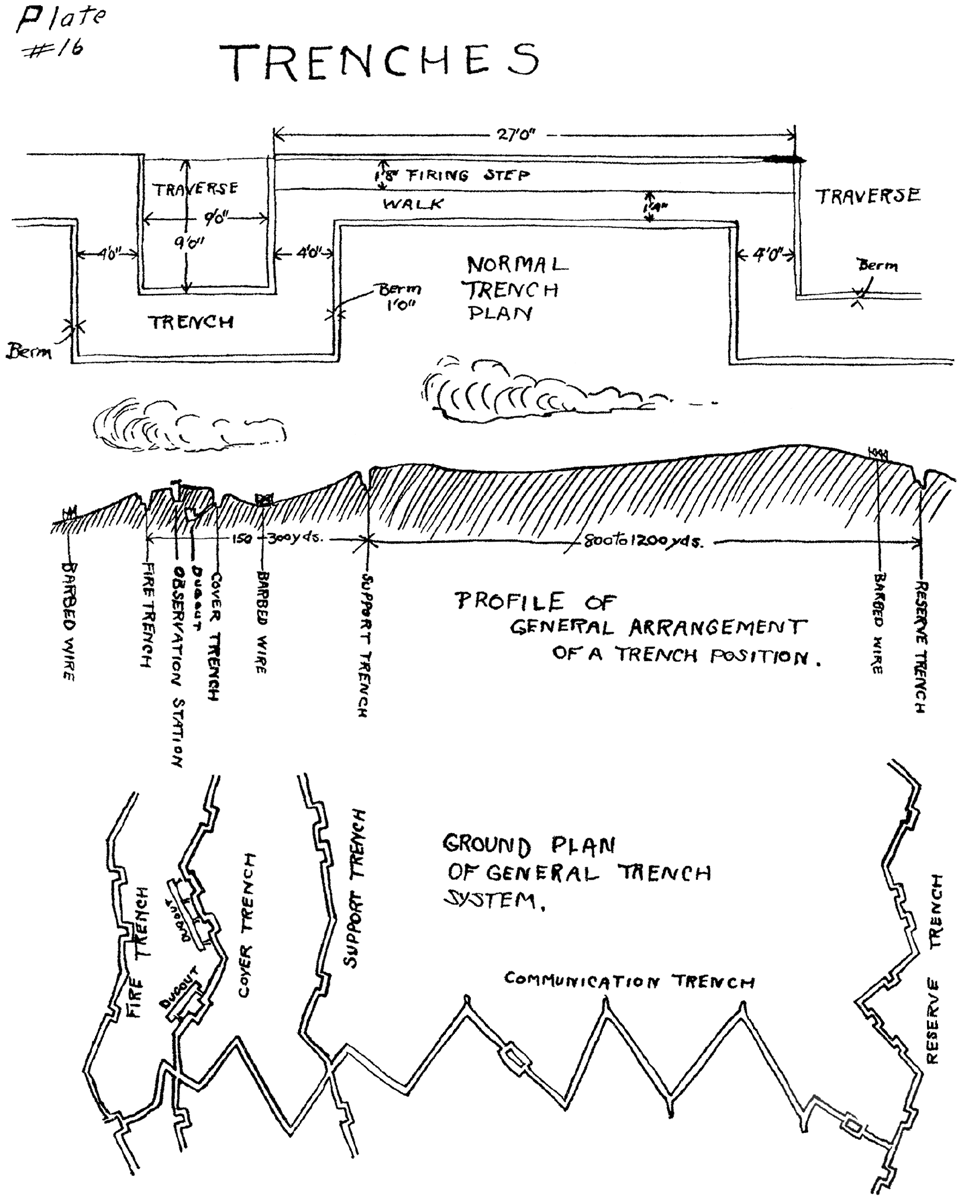
The reserve is usually a strong point, so organized that it can maintain independent resistance for several days if necessary, should the enemy obtain control of adjacent areas.
Where possible trenches should be on reverse slopes, with the exception of the first line; but usually the outline of a trench is determined in actual combat, or is a part of hostile trench converted. Under these circumstances it cannot be arranged according to tactical ideals.
Artillery and the automatic gun are the determining factors in trench warfare to-day. The effect of artillery fire must be limited in its area as far as possible, and trenches are, therefore, cut by traverses, which are square blocks of earth not less than nine feet square, left every 27 feet along the trench. They should overlap the width of the trench by at least one yard, thereby limiting the effect of shell burst to a single bay, the 27-foot length of firing trench between two traverses. Sharp angles have the same effect as traverses, but angles of more than 120 degrees cannot be utilized in this way.
The sides of the trench are kept as nearly perpendicular as possible, to give the maximum protection from shell burst and the fall of high angle projectiles. The parados, the bank of earth to the rear of the trench, has been developed during the war to give protection from flying fragments of shells exploding to the rear, and to prevent the figure of a sentinel from being outlined through a loop-hole against the sky. The berm, a ledge or shelf left between the side of the trench and the beginning of the parados, has come into general use in order to take the weight of the parados off the earth at the immediate edge of the trench, and so prevent the reverse slope from caving in easily under bombardment or heavy rain.
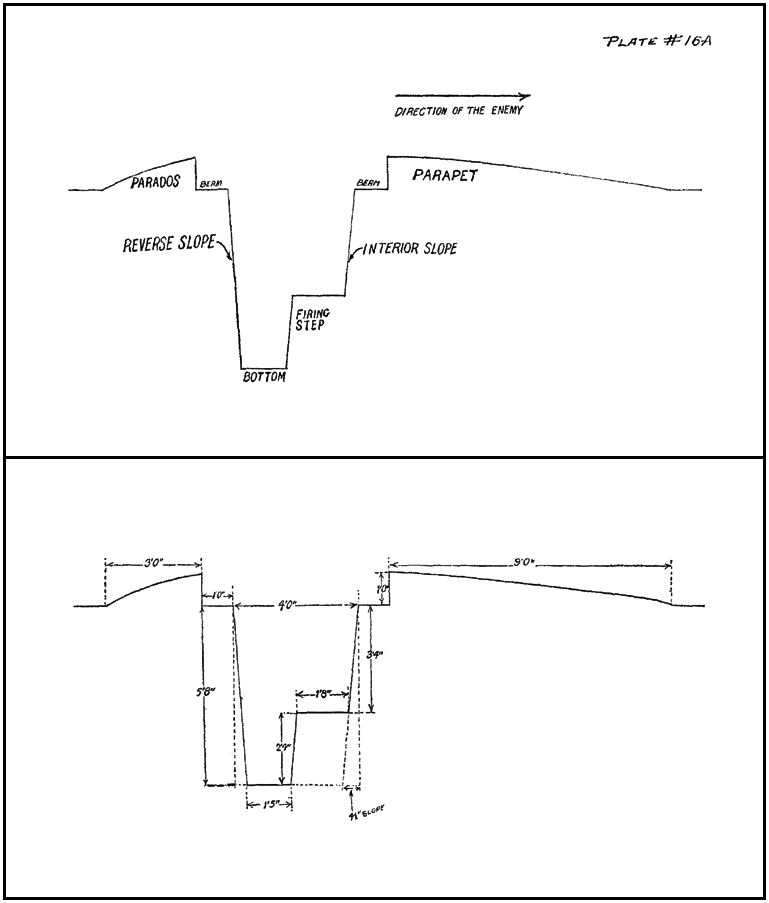
Automatic guns have made it necessary to break the line of the trench at every opportunity, in order to secure a flanking fire for these arms. Auto-rifles and machine guns have tremendous effectiveness only in depth, and flanking fire gives them their greatest opportunity.
Trench Construction.—The methods of building trenches are the same whether the work is carried on under fire or not. In an attack, upon reaching the limit of advance, the men immediately dig themselves in, and later connect these individual holes to make a continuous line of trench.
Most of the digging must be done at night, and must be organized to obtain the most work with the least confusion. There are three ways of increasing the efficiency of the men. In the first of these, squad shifts, the squad leader divides his men into reliefs and gives each man a limited period of intensive work. Reliefs may be made by squads or by individuals. The second way of increasing efficiency is to induce competition among the man and squads, thus making the work a game in which each soldier's interest will be aroused in the effort to do better than the others. The third method is to assign a fixed amount of work to each man. An average task, which all ought to accomplish in a given time, is found by experience, and those who finish before their time is up are relieved from further work during that shift, and allowed to return to their shelters.
Continual care must be used to check up the tools on hand, as the men are prone to leave them where they were working rather than carry them back and forth to work. Each unit must guard its property from appropriation by neighbors on its flanks.
System of Laying Out Trenches.—The trace of the trench is first staked out, particularly at traverses and corners when the work is to be done at night. Measurements should be exact, and the men should be required to line the limits of each trench so as not to exceed them in digging. All sod should be taken up carefully and used on the parapet for concealment or on the berm to make a square back wall for the dirt of the parapet. If possible this should be done with the parados wall, so as to make it as inconspicuous as possible from the front.
Men should begin to dig at the center of the trench and throw the dirt as far out on the sides as possible, so that as they go deeper the earth can be thrown just over the berm. The slope of the sides will be kept steep and the men prevented from widening the trench as they dig. In sandy soil the sides of the trench should be allowed to reach their angle of repose (which is wider at the top than required), then the trench walls supported with revettments to the proper width, which are filled in behind with sand. Always dig to full depth before beginning to revet, as it is impossible to dig deeper afterwards without loosening the revetting.
Revettments.—Every trench at points needs support, and this revetting may be done with any of the following materials: Sod; corduroy of logs laid lengthwise; sand bags (size 20 in. x 10 in. x 5 in.); galvanized iron; chicken wire and cloth made in a frame about six feet long; hurdles, wicker mats made by driving three-inch stakes into the ground, leaving uprights as high above the ground as the depth of the trench, then weaving withes and slender saplings between the uprights; expanded metal; gabions, cylindrical baskets made like hurdles except that the stakes are driven in a circle; fascines, bundles of faggots about 10 inches in diameter by 9 feet long. The faggots are laid together on a horse or between stakes driven in the ground, then "choked," or bound tightly together, by a rope 3 feet 8 inches long with loops at each end, tightened with two stiff levers. The bundle is then bound with wire at intervals of two feet. The circumference of a fascine should be 25 inches.
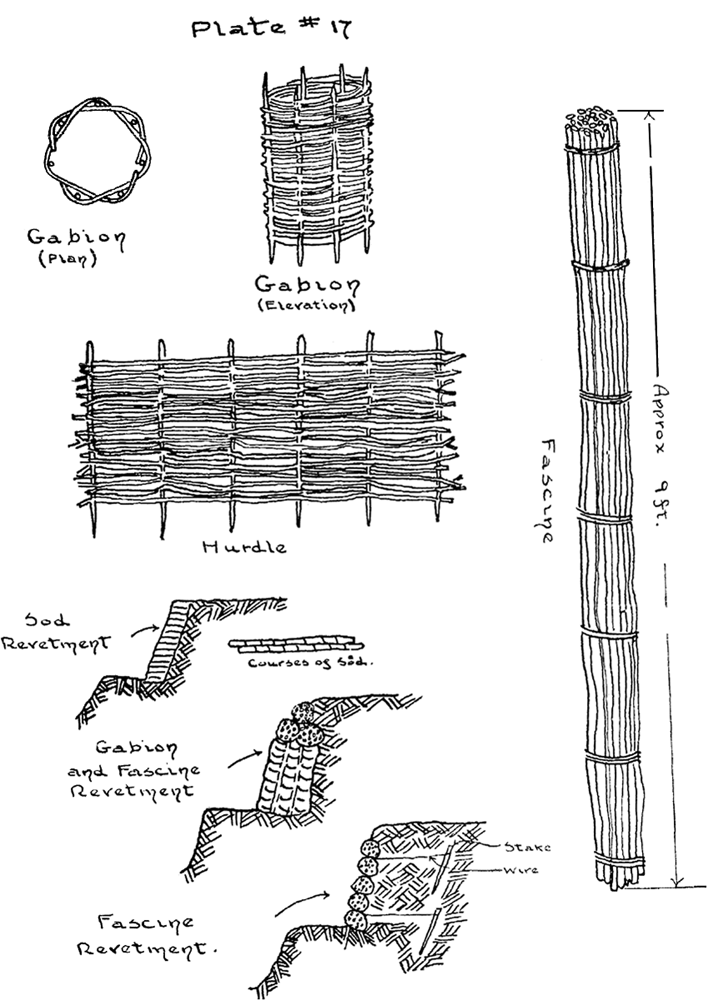
Capt. Powell of the C.E.F. found during 18 months' service in the trenches, that a separate construction for the bottom and firing step from that of the parapet made repair much simpler when the trench was damaged by shell fire. The upper part of the trench usually suffers most, while the bottom section, if unattached, often remains intact and the drainage system needs only to be cleared out. If the portion above the firing step is one piece with that below, however, the whole trench has to be reconstructed.
There is nothing more important than the supports used to keep revetting in place. With sods, sand bags, concrete and gabions, a proper arrangement in the first place will make other support unnecessary.
Sod should be placed carefully, with a slope of not more than one inch on four, with the vegetation uppermost. This type is least affected by rain.
Sand Bags should be used like brickwork, laid in alternate headers (binders) and stretchers. Their use should be confined as far as possible to emergency and repair work, because after a few weeks the bags rot and cannot be moved about. If the trench wall has been demolished by artillery fire, the particles of cloth make digging out the bottom of the trench a very difficult matter.
Concrete Work has been used extensively by the Germans, but the chips fly like bullets under shell explosion, and the concrete cracks and disintegrates in severe weather. It is used in the bottom of trenches for drainage and for the firing step.
Gabions may be set into the wall of the trench and filled with earth, or used at corners to prevent the wearing down of the edge, which reduces the protective effect of the trench. Set in at a slight angle they will hold the side without further re-enforcement.
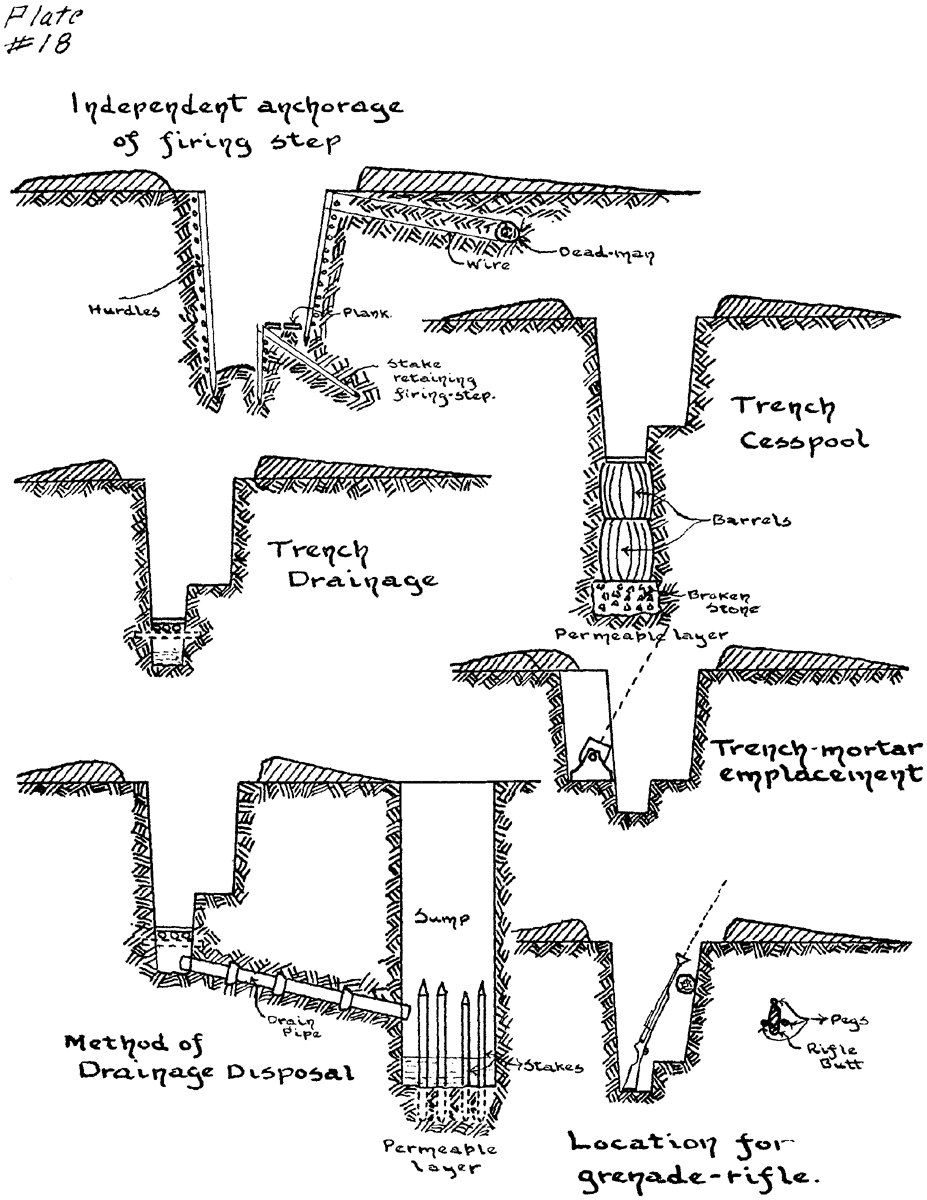
With the other forms of revetting some secondary support is required. This is usually furnished by sinking stakes into the bottom of the trench and securing their upper ends to a "dead man"—a stake or log sunk in the ground more than three feet away. The tendency is to sink the dead men too near to the trench, and to attach too many wires to one of them. It is important to sink the stakes at least one foot below the bottom of the trench. By digging holes for them instead of driving them in directly, the sides of the trench need not be disturbed by the concussion of driving the stakes. This is especially important in sandy soils. Stakes should be placed about two feet apart. Dead men should be buried deeply enough to prevent cutting by shell explosions.
Trench Armament.—A few machine guns are set in concealed emplacements along the trench to cover important salients. The automatic rifle is used over the parapet. Besides these there is the rifle grenade and trench mortar. The rifle grenade has a simple emplacement. After securing the proper elevation, the butt of the rifle is placed between posts or blocks of wood and the muzzle rested against a log on the wall of the trench. A trench mortar emplacement is dug in the rear wall of the trench, or a shell hole is utilized, care being taken to conceal it from aerial observation.
Loopholes.—Loopholes are still much in use for observation, but they are employed less and less for firing, as they are difficult to conceal from the enemy and almost useless when the enemy is close. They should cut the parapet diagonally, not directly to the front, and should be concealed by vegetation and by a curtain over the opening when they are not in use. Sheet steel plates with small peep holes are used on the parapet. They are set up with a slope to the rear to deflect bullets.
Trench Bottoms.—In clay or hard soil special arrangements must be made for drainage. Where possible the trench should have a convex surface and should be smooth. A rough bottom means delay in reliefs, and possible injuries. Where trenches are used for long periods board walks should be constructed. Under these drains or sink holes can be placed to collect water. A sink hole may be constructed by digging a pit filled with small stones, or a barrel may be sunk into the ground and filled with stone. Where there is not sufficient slope to carry off the water, or at the lowest point of a drainage system, a water hole should be dug in front of the trench large enough to handle the drainage water.
Communication Trench (or Boyau).—Running to the rear and joining the different parallel resistance trenches are communication trenches or boyaux. These are for transportation of men and material as well as for communication. Communication trenches should be made wide enough to allow travel for men with loads, should be at least seven feet deep and as smooth as possible on the bottom. Rough places will delay traffic. They are dug with turns every 20 or 30 yards to prevent their being swept by gun fire. When boyaux are built by night sharp zig-zag corners should be used, or the angles will not be acute and protection will be lost. During daylight when the directions can be seen, the construction may be a serpentine curve, with no stretch of more than 30 yards visible from one point.
Boyaux are sometimes used for lateral defence and often emplacements for automatic guns are arranged to cover stretches of them. Bombing stations are placed near by to protect the guns and to clear the boyau of the enemy. At these points the boyau is left straight for a short distance in front. Where provision is made for lateral or frontal defence by rifle fire, firing steps are constructed. If this is inconvenient for movement along the boyau, individual emplacements must be made in the side wall for firing. Sentry posts are dug at right angles to the boyau.
Arrangements for passage of men moving in opposite directions may be made by extending short spurs at the corners, enlarging the boyau at the bends, digging niches or passing points here and there, or constructing island traverses with the boyau running around on each side.
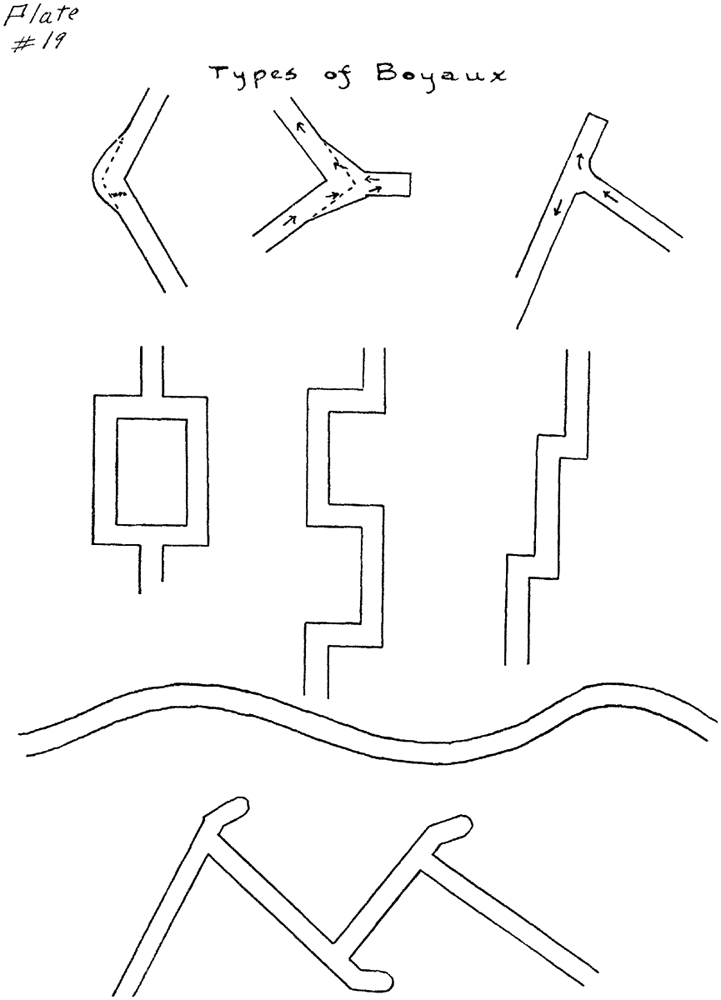
Every boyau should be marked where it meets a trench with a sign indicating the place and trench. Without this messengers, reliefs and re-enforcements may easily be lost in the maze of trenches.
Latrines should be run out about 20 feet from boyaux at points directly in rear of lateral trenches. If possible they should be placed so that men cannot enter them without passing near the platoon leaders. This will prevent men from leaving the front line, under the pretense of going to latrines, during bombardments or mining operations. The trench leading to a latrine should be constructed like a boyau, and the pit should be close to the side nearest the enemy, to give the best possible protection from shell fire. There are three types of trench latrines: Deep boxes which are covered and have rough seats; short straddle trenches or trenches equipped with a single horizontal bar, and portable cans, used where the ground or the limited space make it impossible to dig pits. These cans should be emptied daily into holes behind the trenches, which are covered after the cans are emptied into them.
Urinals should be separate from the latrines. They may be either holes about three feet deep filled with stone, troughs with a covered pit at the end, or portable cans.
Shelters. For the protection of men not actually on duty three forms of shelters are used. The splinter-proof is a form of light shelter whose covering affords protection only against splinters. These are usually on the reserve line. About 12 inches to 20 inches of earth over a roof of logs or planks will afford protection from splinters and shrapnel. Curved sheets of iron may also be used. The deep shelter or bomb-proof is a chamber constructed by digging from the surface and constructing a roof. To protect against eight-inch shells the top of the chamber should be twenty feet below the surface. Heavy beams or sections of railroad iron are laid across the roof. Above them is a layer of earth several feet thick; then another layer of timber extending to undisturbed ground on the sides with concrete, crushed stone, metal, etc., above to make a percussion surface for exploding projectiles that penetrate the upper layer of earth. This layer fills in the rest of the space to the level of the ground.
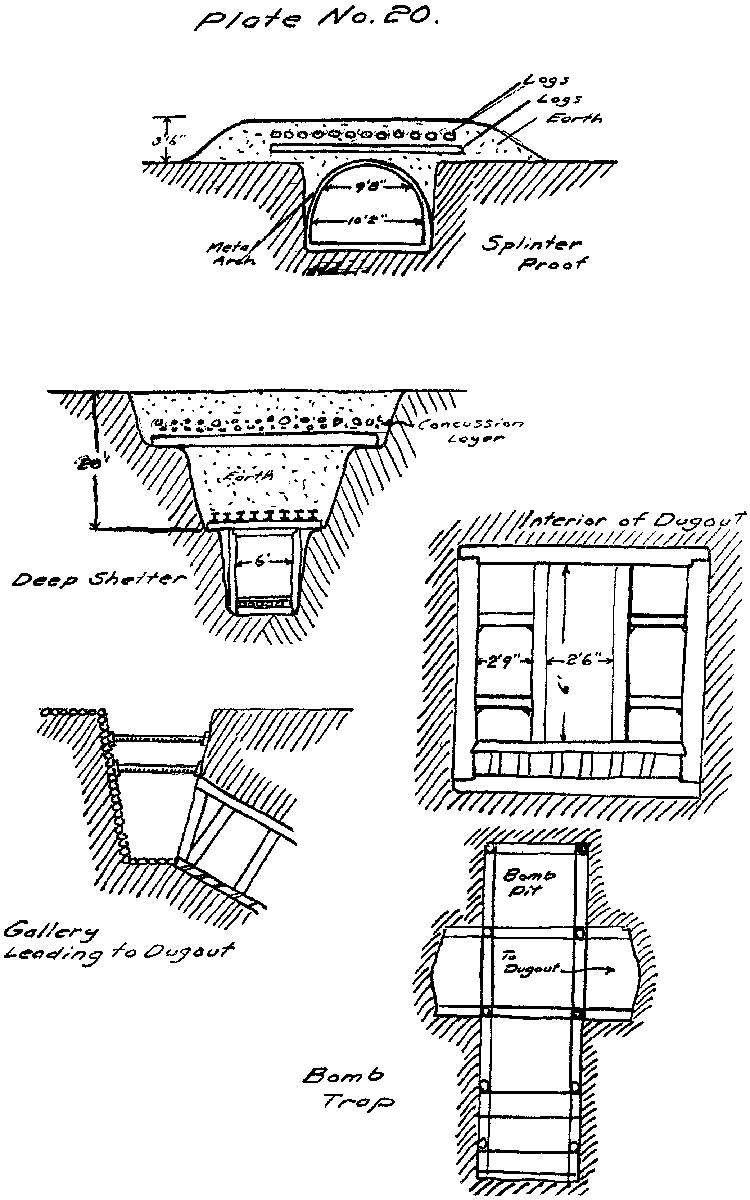
Shelters should not exceed six feet in width, but can be of any length. This will prevent the crushing in of the roof timber by the explosion of a projectile buried in the upper layer of earth. The principles of constructing shelters will be considered under "Dugouts," as they are similar for the two types.
Dugouts are chambers tunnelled into the ground with twenty feet or more of undisturbed earth above them. They are used in the cover trenches and sometimes in the first line. Enough of them must be built to shelter the garrison of each sector, allowing one man per yard of front. They must also be built for machine gun and trench mortar detachments.
Sentries must be stationed in observation posts which command the ground in front of each dugout. They must be connected with the dugouts by telephone or speaking tube.
Position.—Dugouts must always be on the side of the trench toward the enemy. This prevents flying shells from falling into the entrances. They should connect with lateral trenches, not with boyaux, as men at the entrance obstruct traffic through the boyaux.
Entrances and exits must be well concealed, with not less than five feet of head cover. This should be provided with a bursting layer. All dugouts must have at least two openings, one on the opposite side of the traverse or angle from the other. It is well to have an exit behind the parados leading to a surprise position for a machine gun and bombers. All openings must have a sill 6 inches to 8 inches high, to prevent water from entering the dugout.
Galleries leading to dugouts should be built at an incline of 45 degrees. Their dimensions should be 2 feet 6 inches by 6 feet. Frames are of squared timber. The sill and two side posts should be not less than 6 inches square, and the frames in the passageways 2 feet 6 inches by 4 feet 6 inches. They must be placed at right angles to the slope of the gallery, with distance pieces between uprights. In treacherous soil the frames rest on sills. Steps in the passageway are 1 foot broad and 1 foot high.
Bomb-traps, extensions of the gallery about 3 feet long, should be dug beyond the point where the entrance to the dugout chamber leads off from the gallery. These will catch bombs thrown in from the surface and protect the chamber from the effects of their explosion.
Interior. The standard section is 6 feet by 8 feet, to allow for bunks on each side. Frames of 6 by 6 timber spaced 2 feet 6 inches apart support the sides and roof. Roof planking should be 2 inches thick, and the sides should be covered with 1-½ inch plank or corrugated iron. Two shovels and two picks for emergencies should always be kept in each dugout. The construction of the chamber should be that of a very strong box, so that it will stand strain, if necessary, from within as well as from without.
Depots for Supplies must be near the headquarters of the platoon, company, battalion and regiment. Shelters may be made with ammunition boxes set into the side of the trench. Places should be provided for the following: Food, ammunition for rifles and auto-rifles, grenades, rockets, tools and other supplies. Places must also be arranged in the front line for ammunition, rockets and hand and rifle grenades.
Telephones. Communication is established as speedily as possible with the various units. In the forward trenches wires do not last long under bombardment and fire left open along the side of the trench, where quick repairs can be made. All soldiers must be taught to respect these wires and to care for them when they are found under foot or hanging. Conduits are dug for wires to battalion and regimental headquarters, and these are fairly safe from shell fire.
Departure Parallel. In preparing for an advance upon the enemy, a straight line trench without traverses, and with steps at the end for exit to the surface, is built in front of the first line trench. This line of departure is generally brought within about 200 yards of the hostile line by means of saps, short trenches run out from the front line to the new parallel. Since this line of departure can be seen by the enemy, it is sometimes better to construct steps in the front line trench itself, or when possible to build a Russian sap. This is a tunnel very near the ground, which can be broken through at a moment's notice when troops are ready to advance.
Machine Gun Emplacements.—Shell-holes with a good field of fire and emplacements along boyaux are the best location for machine guns. Few guns are placed in the front line, and these only at strong points in the line, which command a maximum field of effectiveness. Shell-holes may be imitated for machine gun emplacements, but in any case they should be connected by underground passage with the trenches. Thus when trenches are destroyed by bombardment the machine guns remain intact. The field of fire for each machine gun should be carefully determined and marked by three stakes, one for the position of the gun, the other two for the limits of the field of fire. Using these as guides, the gun can be fired correctly at night. During the day it is never left in place nor fired from its actual emplacement.
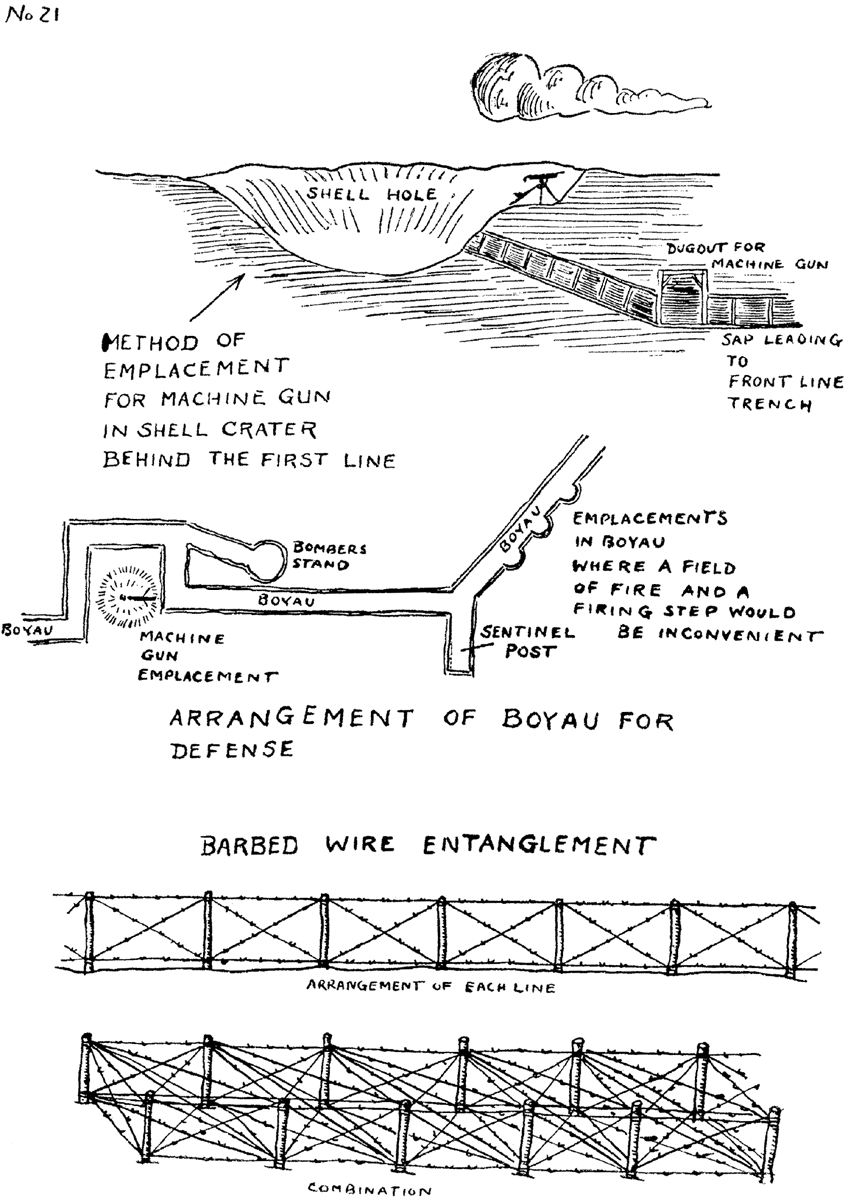
Listening Posts.—These stations are usually carried out to the edge of the entanglements nearest the enemy. The listening station must be large enough for half a squad, and often has an automatic rifle and grenade thrower. There should be not more than two posts for each battalion. They are not occupied during the day. They are hard to defend and easily captured by a raiding party which cuts the wire to one of the flanks and comes in from the rear. The boyau leading to the post should be zig-zagged. The post itself should be deep enough for good head cover.
Wire Entanglements.—The object of the entanglement is not to stop completely the advance of the enemy, but to delay him at close range under machine gun, auto rifle and rifle fire, and within range of grenades and bombs. Entanglements should be concealed as much as possible from the enemy's trenches and from aerial observation. If possible, they should be placed on a reverse slope or in a dead angle. They should be from 50 to 100 yards in front of the trench, so that artillery fire directed upon the trench will not be effective on the wire. At the same time the wire must not be far enough advanced so that the enemy's raiding parties can cut the entanglements.
Wire entanglements are classified as high entanglements, low entanglements and loose wire.
High Entanglements are strung on metal or wood posts about four feet high, both wire and posts being painted for camouflage. The driving of posts must be muffled, and metal screw posts are used when near the enemy's line. Posts are placed in two parallel lines, two yards apart, spaced alternately so that the posts in one line are opposite the middle of the interval in the other.
Tracing Entanglements is done by a sergeant followed by two stake placers, two holders and two drivers, who in turn are followed by men attaching wire. Two men carry each roll of wire, and each pair (there are twelve pairs in all) strings one wire. A panel between stakes is composed of four strands. Each wire should be wrapped around each post. The same arrangement of panels should run between the two lines of posts. The entanglements are in three lines about 20 yards apart, the nearest being 20 yards from the front line trench. The entanglement nearest the enemy should be constructed first, so that men always work nearest their own trenches. All wire entanglements should be at all points commanded by the flanking fire of machine guns. High entanglements (known as abatis) may be made by felling trees toward the enemy, and similar entanglements made of brushwood are useful in emergency.
Low Entanglements are formed of pickets two feet high, 2-½ inches in diameter, wired in all directions. Vegetation renders the entanglement invisible from the enemy and from aerial observation. This type may also be placed in shallow excavations which are concealed from the enemy and partly protected from artillery fire. Sharpened stakes, with their points hardened by fire, driven obliquely into the ground, may also be used.
Loose Wire in the form of loops of small diameter fastened to stakes, or wire laid along the ground and attached at the ends, or spirals of barbed wire in racks, is used for entanglements. It is reported that this form is coming into considerable use, but the details have not been published. Such entanglements are much harder to locate by aerial observation.
The following are a number of criticisms made by Lieut. Henri Poire of the French army, detailed as instructor at Plattsburg, upon the system of field works constructed by the 17th and 18th Provisional Training Regiments. The ground was of loose sand, with some gravel at a depth of about six feet.
1. Dimensions of trenches as laid out were not followed.
Bottom of trenches behind firing steps too narrow.
Firing step too deep. It should never be more than 3 feet 4 inches below berm of parapet.
Parapet much too thin in most cases. It should be at least three feet thick.
Communication trenches (boyaux) generally too narrow.
Islands in communication trenches should never be less than 10 x 12 yards—otherwise one shell will demolish the entire passageway.
2. Revettment work not well anchored. In some cases too many wires from supports fastened to one dead man. Another fault is that dead men were not buried deeply enough in the ground, nor far enough back from the trench. In one case a dead man (a stake) supported all four sides of an island in a communication trench. The destruction of this post would have completely blocked every passage around the island. Furthermore, dead men rot quickly and tend to break off. It is necessary, therefore, to have a number of them, each holding only a portion of the weight. All projecting branches and irregularities along a trench should be removed by occupying troops.
3. Too many loop-holes. Except for snipers, riflemen and automatic riflemen fire over the parapet.
4. Machine gun loop-holes not wide enough. They should not be less than 36 inches wide. There must be vegetation planted in front and a curtain hung over the loop-holes to prevent detection. The growing plants in front will be easily swept away at the first discharge.
5. Remember never to imitate shell-holes until after a real bombardment by the enemy.
6. The dugouts made were never deep enough and afforded no protection. In fact it would be far better to have none than to be caught inside when a shell exploded in a shallow one, because the confinement of the explosion would intensify the effect.
7. Shelters were all too wide. Six feet is the maximum.
The platoon headquarters dugout should be of the same width as the trench, not over three feet, but as long as necessary. Company headquarters is six feet wide and of whatever depth required.
8. In digging, not enough care was used to conceal the fresh earth from the enemy. Make false emplacements to utilize this dirt; also dig dummy trenches about one foot deep, leaving the sides sharp so that they will show clearly on aerial photographs.
9. In using plants as camouflage, distinct care must be exercised not to put growing plants too freely nor to place them where they never existed. The actual ground conditions must be copied.
10. Some latrines were not arranged with the stools close beneath the wall nearest the enemy. This caused the loss of protection, which it is imperative to consider, as many casualties occur here.
11. Too many listening posts. They are easily captured by hostile fighting patrols. There should never be more than two listening posts to a battalion.
12. The observation stations in many instances had no good field of fire or were outlined against the sky on the crest of some rise. The site for an observation post should always be placed over the crest and have a good field of fire for use in case of attack.
Occupation.
I. Relief in the Trenches.
The Two Main Classes Of Relief: General Relief. Applied to the relief of a whole position manned by a division or more. Executed when large units are going to "full rest" in the rear or being removed from one part of the front to another. Executed in the same way as interior relief; i.e., by successive relief of the battalions involved. Interior Relief. Applied to the relief of one sector or portion of a sector manned by a brigade or less.
General Principles Of Relief: Interior relief is executed about once every six days; more frequently when the stay in the trenches is particularly arduous, less frequently when it is unusually comfortable. The battalion is the relieving unit. "It is advisable to arrange the relief between units which have friendly relations to one another; e.g., battalions of the same regiment; and, so far as possible, to assign each unit to the same trenches on each relief. This promotes continuity of effort. Relief is executed at night; the hour must be varied; secrecy is imperative. Prompt execution is essential, to prevent fatigue of the troops and congestion of the boyaux.
The Mechanism Of Relief: Reconnaissance, 24 hours in advance, by the captain of each relieving company, accompanied by his platoon leaders and non-commissioned officers. He ascertains: The plan of occupation; i.e., the dispositions and duties of the unit to be relieved. The shelter accommodations. Work being done and proposed. Condition of the wire and other defences. The available water supply. Artillery support. Communications. The location, amount and condition of stores. Danger points. All available information of the enemy; his habits, location of his snipers, what work he is doing. The ways and means of liaison, both lateral and from front to rear. To the success of this reconnaissance, the closest co-operation between all officers of the companies relieving and relieved, is indispensable. The march from billets to the trenches: Transportation, by auto-trucks and wagons, is utilized to a point as near the lines as possible, to carry the packs of the men, the auto rifles, extra ammunition and other heavy equipment. When the distance is great the men themselves should be carried by auto-truck; this saves time and fatigue. The men will carry rifles loaded and locked, full cartridge belts, gas masks, and all other lighter equipment, with rations for 24 hours at least. Grenades will be secured in the trenches. Electric torches will be carried by company and platoon commanders. The strictest discipline must be maintained. On arrival within sight of the enemy, noise and smoking (or other lights) will be prohibited. Guides, from the company to be relieved, will meet the relieving company promptly at a point definitely agreed upon in advance. The march through the boyaux (communicating trenches): Distance; often as much three or four miles. Order of march: company in single file, captain at the head; each platoon leader at the head of his platoon; a non-commissioned officer at rear of each platoon. The column must be kept closed up. Each man must consider himself a connecting file, guiding on the head, and behave accordingly. A guide should accompany the commander of the last platoon. Rate of march: roughly, about 40 yards per minute. It takes 250 men about 20 minutes to pass a given point. Route and right of way: The first line and support trenches will never be used as roads. Separate boyaux should, if possible, be assigned to the troops relieving and relieved. In no case will one company cross the path of another. In case of two columns meeting, one moving forward, the other to the rear, the former has the right of way. No man of the unit in occupation will leave his post until he has actually been relieved and has transmitted all orders and information relative to that post. Liaison must be established, immediately on arrival, with the units on the flanks and with headquarters in the rear. Captains must make sure that their runners are thoroughly acquainted with the routes of communication. As soon as relief is accomplished both captains will report that fact to their respective commanders. The relieving commander then inspects his trenches. He ascertains that all his watchers are at their posts and that the balance of his men know their posts and duties and are prepared to assume them quickly. The duties of the relieved commander are: To turn over his sector thoroughly policed and in good condition as regards its construction and the new work, if any, in progress. To turn over his supplies in good condition and fully accounted for. After reporting the relief, to march his men back to billets as promptly and secretly as possible, in column of files, platoon leaders in the rear of their platoons, a non-commissioned officer and guide at the head of each. On the evening preceding relief, to send his cooks back to billets so that his men may be provided with a hot meal immediately on arrival.
If an attack occurs during the march through the boyaux, to or from relief, the company affected occupies the nearest defensive position and at once notifies its battalion commander. If an attack occurs during the actual process of relief, the senior officer present takes command.
II. The Stay in the Trenches.
The Four Objects Of A Trench Commander: Security of his sector. Protection of his troops. Constant and accurate observation. A continuous offensive.
His Plan Of Defense: General principles of defense: Arrangement in depth. The most dependable defense is in prearranged counter attacks. The system of defense must react like a helical spring. Tenacity of defense. Each unit must be prepared to hold its post to the last extremity. Orders to withdraw will never be obeyed unless unmistakably valid. All ground lost must be retaken at once in counter attack by the unit which lost it. Apportionment of responsibility. Each active segment must have a commander responsible for its defense, upkeep and sanitation, and the discipline and instruction of his men. Basis: The plan of defense turned over by the preceding commander. This will usually suffice for the first 24 hours after relief. General information of the enemy's lines, dispositions, and intentions, based chiefly on aerial photographs.
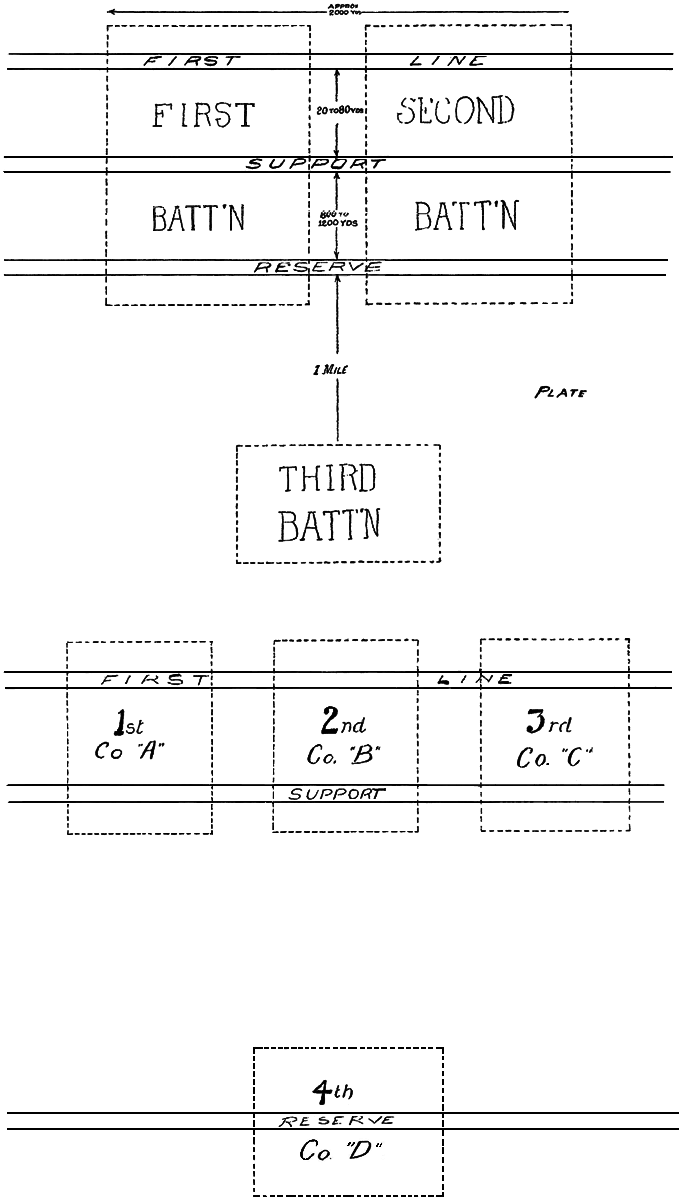
Organization Of Defense: Allocation of front. (The front of an American battalion will average about 1,000 yards.) Diagrams: A. The Regiment. B. The Battalion. C. The Company. D. The Platoon. Distribution of effectives. Determined chiefly by the terrain and by 3. Employment of the several arms: Machine guns. Crew of 8 men per gun. (Furnished by detachments of a machine gun company.) Located by the infantry commander, in concealed emplacements behind the first line, to deliver successive barrages from flanking positions. Effective range: up to 700 yards. Automatic rifles. Crew of 3 men per rifle. Usually posted to enfilade the entanglements of the first line. They concentrate the fire effect of from 7 to 10 riflemen. Effective range: up to 300 yards. Rifle Grenadiers. Located near enough to first line to hold the enemy trenches under fire and deliver effective barrages near the mouths of our own communicating trenches. Should be located near observation posts so that their fire can be promptly corrected. Trench mortars. Located similarly to (c). Manned by riflemen. Bombers. One supply man to each 2 grenadiers. Used for protection of auto-rifles, in counter attacks, for protection of communicating trenches and fighting in close quarters. Riflemen. Posted to deliver frontal fire. Grouped according to the plan of counter attacks. As many men as possible should be instructed in the use of the enemy's weapons.
Liaison: By telephone. Quickest and most accurate. Maintained between each platoon and its company headquarters, and between adjoining companies. Especially subject to destruction in bombardment. Wireless and ground telegraphy are used only between brigade and division headquarters. By runners ("liaison agents"). Five detailed from each company to battalion headquarters; one sent to each adjoining company headquarters; one from each platoon to company headquarters; four or five on duty at each platoon headquarters; five from each machine gun company to battalion headquarters. Messages sent by them should, if practicable, be written and signed, and should be receipted for by the addressee. By rockets and flares. Quickest means of liaison with the artillery in rear. Domestic (message carrying) grenades. Dogs and carrier pigeons. Sent out to the rear from battalion headquarters. One searchlight—with a radius of 3 miles—is furnished to each company. Noise. Klaxon signals, etc., give warning of gas attacks.
Observation: Observers: Must be men of infinite patience, keen hearing and eyesight. They are located behind the first line in positions combining good view with concealment. Each is provided with a panoramic map, made from aeroplane photographs, of the enemy's trenches. On this must be promptly noted every slightest change in the trace, height of parapet, etc., of the enemy's line. Such notes greatly assist in locating machine gun emplacements. Each observer will also record in a note book everything of importance, with the time observed. A report of changes, with an abstract of observer's notes, is forwarded daily to regimental headquarters. Watchers (sentinels): Stationed, one near the door of each dugout, in the first line, support and intermediate trenches. They must be carefully concealed. They must watch over the parapet (never through slits or loopholes) so as to have unrestricted view. They are furnished with signal rockets and flares for prompt communication with the artillery, and have authority to use them. Double sentinels are posted at night. Listening Posts: Located, usually in shell holes, just inside the entanglements. Connected with front line by tunnels. Protected from grenades by heavy gratings, when possible, and by concealment. Occupied by 4 men (1 in command), in 3 reliefs. Usually occupied only at night unless our trenches are on a reverse slope. Chief function is protection of the entanglements. Microphone Posts.—Installed usually behind the first line. Intercept the enemy's telephone and ground-telegraph messages and any loud conversation in his trenches. Fixed Patrols.—Generally remain in shell holes in front of our entanglements. Reconnoitering Patrols: Composed of from 3 to 5 men, commanded by a non-commissioned officer. Sent out at night only. The company commander must promptly notify commanders of adjoining companies of the dispatch of these patrols, their time of departure, route and probable time of return. Men should be assigned to this duty by roster.
Trench Work: Constant battle with the elements, care for drainage, revettment, sanitation and storage. Repair of the effects of bombardment. New work, for better security, communication and observation. Work in the open. Usually consists of repair or rearrangement of wire entanglements, digging new listening posts, etc. Effected by parties detailed by roster. They are guarded by fighting patrols, composed like reconnaissance patrols. Their best protection is in silence and concealment. Adjoining companies must be notified of their dispatch, location and probable time of return. This work, like all operations conducted outside the protection of the trenches, offers a valuable tonic to the morale.
Offensive Operations: Sniping: Snipers constitute one of the most dependable and productive agencies of attrition. The best shots of the company are especially trained and assigned for this duty exclusively. They operate in pairs and post themselves to cover any exposed portions of the enemy's trenches, especially his communicating trenches. They should be well supplied with all necessary special equipment; e.g., sniperscopes, telescopic sights, painted headgear, etc. Mining Operations. Raiding: Object of raids: destruction of the enemy's defenses, disturbance of his morale, collection of prisoners and information. The personnel of raiding parties will usually include: A commander and second in command, bayonet men, bombers, engineers, signal men, stretcher bearers. Their numbers and proportions are regulated by the nature and difficulty of the task. Co-ordination with the artillery barrage is the essential of their success. The limit of advance, extent of operations, and time of return will therefore be set in advance and rigidly adhered to.
Role Of The Trench Commander: Inspections: The men will be formally inspected twice daily at the general "stand to" by the company commander. Particular attention will be paid to the health of the men, condition of their feet and their clothing. Each man must have at least one pair of dry socks always available. Arms, gas masks, and other equipments will also be rigidly inspected. Roster: The company commander will carefully supervise the preparation of the duty roster. An obviously equal distribution of the arduous duties involved in trench life is essential to the maintenance of morale. Reports and Records: (Additional to those already required by regulations.) Log Book, Report of Casualties, Wind Report (daily), Bombardment Report (daily), Intelligence Report, which will include observer's notes and changes (twice daily), and a daily report of Work completed and Undertaken. "One principle which the trench commander should never forget is the necessity for his frequent presence in the midst of his men. * * * Direct contact with the troops on as many occasions as possible is the most certain way to gain their confidence."
Duties of the Company Commander.
To inspect the sector his company is to occupy, one day in advance of occupying it.
To assign segments to the platoons.
To prepare a plan of defense.
To connect by liaison with the companies on his flanks.
To have an agent or runner at Battalion Headquarters.
To prepare a plan for counter attacks.
To report to the Battalion Commander when his company has taken up its position: Its situation. Security. Liaison. State of position left by predecessor. Defense of sector. Plan of counter attacks.
To inspect the trenches frequently to see that everything is in proper condition and that his men are in jubilant spirits.
To have platoon guides report to Battalion Headquarters on the date for the relief of his company and act as guides to the company that relieves him.
To keep a special log book in which the following are kept: Work completed by his unit. Work under way. Work proposed.
Turn over to his successor: Measures taken for security. Plan of attacks. Plan of counterattacks.
Have one officer on duty at all times.
"Stand to" will take place one (1) hour before daylight, and all available men will attend. There will be a thorough inspection. Rapid loading will be practiced. The firing position of every man will be tested to see if he can hit the bottom of our wire. Gas helmets will be inspected.
Time table—allot hours of work, rest and meals.
Supplies—make timely requisitions for them—be especially watchful about meals and rations—have no delays.
To have one watcher and one relief on duty near Company Headquarters at all times.
To get a good field of fire to the front and cover the sectors of each company on flanks.
(Subject to change) Red Rocket-Artillery Barrage wanted. White Rocket Gas Attack.
To report twice daily all changes in wind direction.
To report to Battalion Commander when relieved.
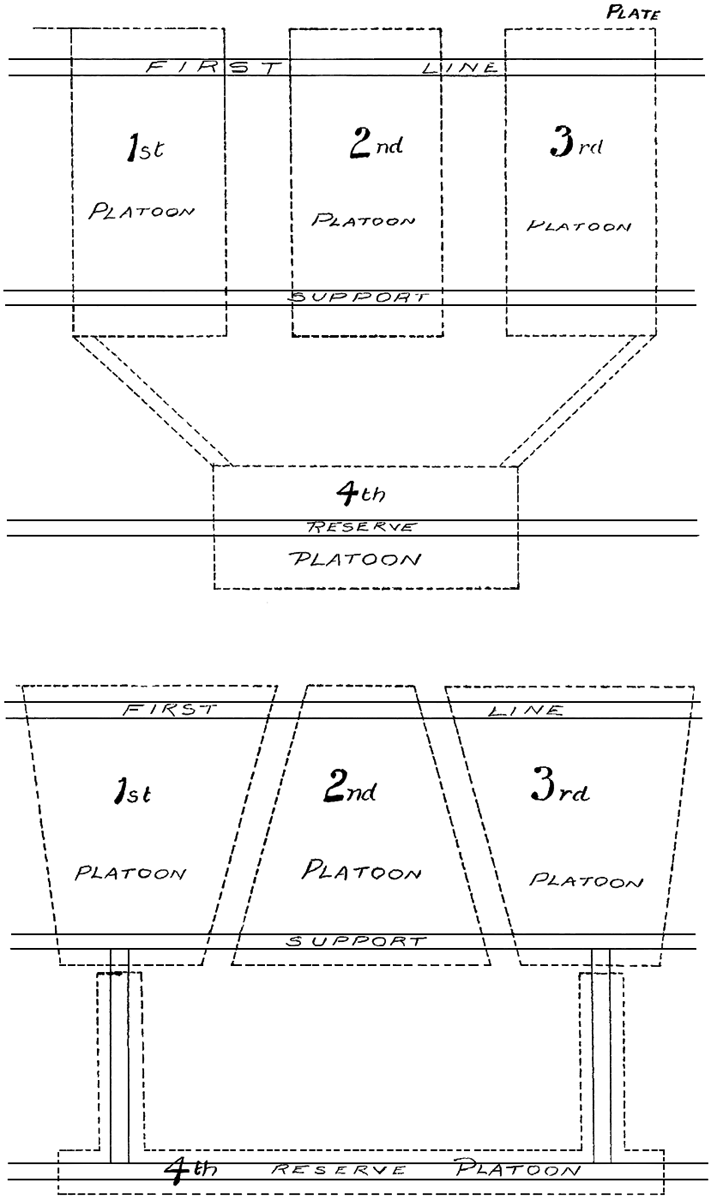
Duties of Platoon Leaders as Officers on Duty with Company.
Report with old officer at company headquarters.
Make frequent inspections of all trenches occupied by company.
Visit each Listening Post; at least once during tour of duty.
Visit all sentinels and receive their reports.
See that one non-commissioned officer per platoon is on duty.
Receive reports of non-commissioned officers after they have posted sentinels.
At end of tour hand over to new officer all orders, a report of work in progress, and any useful information.
Report with new officer at Company Headquarters on completion of tour.
To report anything unusual to Company Headquarters.
To send dead and wounded to dressing station trenches.
To send patrols to front at night.
Duties of Platoon Leaders.
Must accompany company commander on inspection of trenches one day previous to occupying them.
Make necessary reliefs for his men in his segment.
Make a plan of defense and counterattack for his position or approve the one left there.
Establish sniping posts and arrange reliefs.
Establish Listening Posts and arrange reliefs.
Assign non-commissioned officer to duty with platoon and arrange relief.
Instruct every man as to his place in case of attack.
Establish liaison with platoons on both flanks; and one runner to Company Headquarters.
Have one platoon guide report to Company Headquarters on day his platoon is to be relieved.
On completion of posting his platoon, report to his company commander.
Turn over to platoon relieving him all orders and data pertaining to his position.
Be especially attentive to rigid military discipline; i.e., every soldier to be neat; equipment must be clean at all times; to render the required salute when not observing or firing at the enemy.
Have one non-commissioned officer on duty at all times.
To inspect rifles, equipment and latrines twice daily. To have at least one latrine in working order at all times. To have a sentry on duty at each platoon dugout at all times. Establish one Observation Post in daytime.
In Front Line Trenches: No smoking or talking to be allowed at night. Every man to wear his equipment except packs. Have rifle within reaching distance. All reliefs to be within kicking distance of soldier on duty.
Inspect at "Stand to" and report results to Company Headquarters, especially if each man has 170 rounds of ammunition and necessary grenades and bombs.
To be especially attentive to sanitation and care of the men's feet.
To have one (1) watcher and relief on duty at all times near platoon dugouts.
To get a good field of fire to his front and to cover the sector of each platoon on his flanks.
Make requisition for material.
To see that all of his men are properly fed.
Report to company commander when relieved.
Must know what every man is doing at all times.
Duties of Non-Commissioned Officer on Duty (Each Platoon).
To make frequent inspections of the position occupied by his platoon.
To be responsible that each soldier knows his duties.
To report anything of special importance to officer on duty.
On being relieved to report with the new non-commissioned officer to the officer on duty.
After posting sentinels to report "All is Well" to officer on duty.
Explain to his sentinel his duties, the position of Section and Platoon Commanders and of sentries on either side; and to caution his sentries when friendly patrols are out, the probable time and place of return.
Bayonets will always be fixed in front line trenches.
At night time to have double sentinel.
To see that each sentinel in daytime has a periscope.
Rifles to be loaded; no cartridge shall be in the chamber except when necessary to shoot.
To report to Company Headquarters any change in direction of wind.
Patrols.
Usual orders about patrols.
Always go out at night via the Listening Post; tell the men in the Listening Post your mission and probable time of return.
Sentinels.
To sound Klaxon horn on approach of gas attack.
To report immediately to non-commissioned officer on duty any change in direction of wind.
In cold weather to work bolt frequently to keep it from freezing.
At night to challenge only in case of necessity, and then only in a low tone. Challenge "Hands up."
Number of posts depends on assumed nearness of enemy and local conditions. Normally one per platoon by day and three double sentinels per platoon at night.
Relief kept close at hand. Report "All is Well," or otherwise, when officer passes.
Screened from observation.
Remain standing unless height of parapet renders this impossible.
Machine Guns.
Non-commissioned officer and one (1) watcher on duty at all times.
Except in emergency they will not be fired from their regular emplacements.
Unless emplacements are well concealed, guns will not be mounted except between evening and morning "stand to."
Before dusk each gun will be sighted on some particular spot either in front of or behind the enemy's line.
Range cards will be prepared and kept with each gun.
Snipers.
Sniping Post consists of one (1) observer and one (1) rifleman with relief of two (2) men posted close by.
Sniping post should be well concealed.
Daily report from each post, of Any work done by enemy. Enemy seen; place, uniform, apparent age, physique, equipment. Any other information of interest.
Sniper to be appointed from each section.
Must be intelligent, alert, good scout, good shot, courageous.
Snipers should spend 24 hours in trenches with those of command which theirs is to relieve, before relief takes place.
No night work required of these men since they must be constantly on the alert during the day.
Organization of a Platoon—Rifle Company—Table No. 7
PLATOON
Platoon Headquarters 1 Lieut. 1 Sgt. 4 Privates.
1st Section 2d Section 3d Section 4th Section
Hand Bombers Rifle Grenadiers Riflemen Auto-Riflemen
3 Teams, each 1 Team of 1 Sgt. 1 Sgt. and 2 Corps.
1 Leader 6 Grenadiers 2 Squads of 8 men each 4 Teams, each
1 Thrower 3 Carriers (May be subdivided) 1 Gunner
1 Carrier 4 Extra riflemen [R] 2 Carriers
1 Scout
2 Corps. 2 Corps. 1 Sgt. and 2 Cpls. 1 Sgt. and 2 Cpls.
4 Pvts. 1st Cl. 1 Pvt. 1st Cl. 6 Pvts. 1st Cl. 4 Pvts. 1st Cl.
6 Pvts. 6 Pvts. 12 Pvts. 8 Pvts.
Total—12 Total—9 Total—21 Total—15
Suggested Organization of Platoon in Close Order and for Administration.
1st Squad 2d Squad 3d Squad 4th Squad 5th Squad 6th Squad 7th Squad
Bomber Section (less 1 bomber team) ½ Auto Rifle Section i.e., Cpl and 2 teams ½ Auto Rifle Section i.e., Cpl and 2 teams Grenadier Section 1 Rifle Squad 1 Rifle Squad 1 Bomber Team plus 4 extra riflemen [S]
1 Corp 1 Cpl. 1 Cpl. 1 Cpl. 1 Cpl. 1 Cpl. 1 Cpl.
7 Pvts. 6 Pvts. 6 Pvts. 7 Pvts. 7 Pvts. 7 Pvts. 7 Pvts.
(Extra Cpl. in File Closers)
Right Guide—Automatic Gun Sgt. Left Guide—Rifle Sgt. Chief of Platoon—Lieut. File closer or acting 1st Sgt.—Sgt.-Asst.
Note.—If desirable the 4 mechanics and 4 privates (signalmen) who are not assigned to platoons regularly, can be used to fill the blank files in the 2d and 3d squads.
Deployments.
General Principles:
(a) The following plans for deployment are not to be regarded as rigid. The positions of the various squads depends upon tactical considerations.
(b) The platoon in attack will be used only for accomplishment of its offensive mission. Moppers-up, additional carriers, etc., will be furnished by other organizations.
Being in line, to form single skirmish line to the front. 1. As skirmishers (so many) paces, guide right (left or center). 2. March. Executed as described in pars. 206 and 208, i.d.r. Normal interval to be ordered, 4 or 5 paces. This formation to be regarded as exceptional.
Being in column of squads, to form single skirmish line. Same command as in (A). Executed as described in para 207 and 208, i.d.r.
Being in line to form double skirmish line to the front (i.e., to take the "Formation for Attack" in the diagram.) 1. In two lines. 2. As skirmishers (so many) paces, guide right (left or center). 3 March. Executed according to the principles in pars. 206 and 208, i.d.r., except that at the command March the even-numbered squads stand fast while the odd-numbered squads form the first line by deploying on the base squad as in the case of deployment in single line. Similarly, the even-numbered squads form the second line by deploying on their base squad after the odd-numbered squads have moved forward about 20 paces.
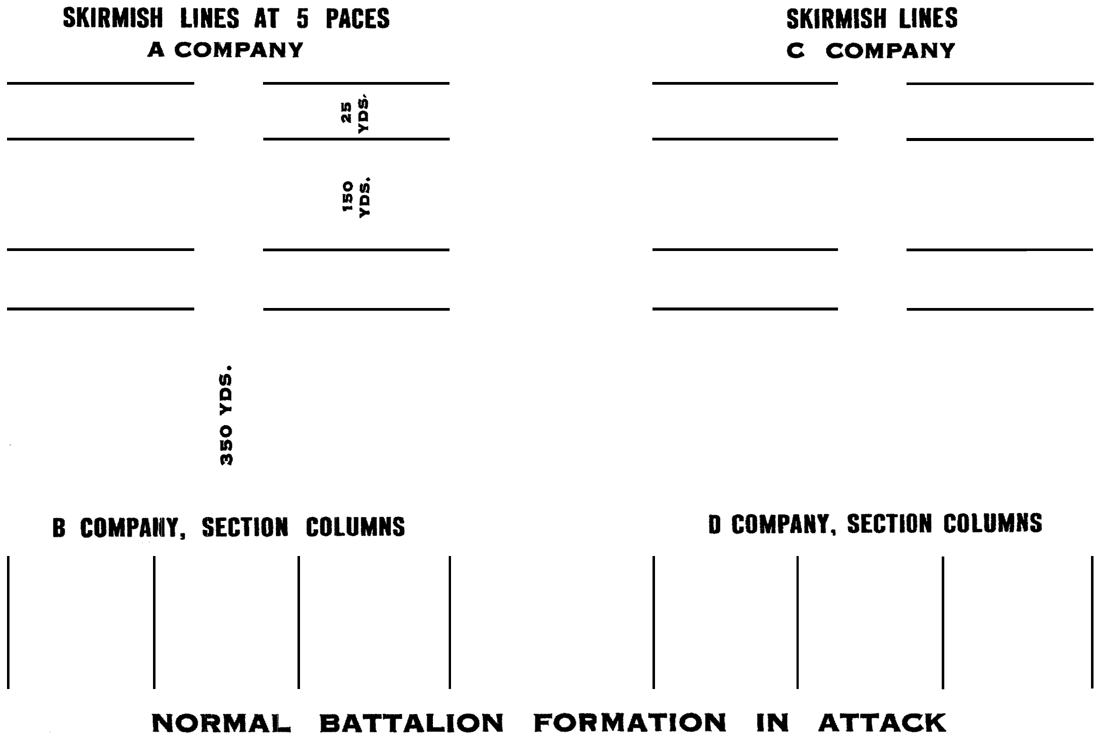
Being in line or column of squads to deploy in line of squad columns in one or two lines. Use same commands and execute in same manner as described in (A), (B), (C), except that in the command "Squad Columns" is substituted for "as skirmishers," and in the execution each corporal on approaching the line forms his squad in "squad column" instead of deploying it as skirmishers. E.G. 1. In two lines—2. Squad columns (so many) paces, Guide right (left or center)—3. March. This gives a "Formation of Approach" as the French describe it, or as an "Artillery Formation" as the British describe it; which may be used directly or indirectly (by means of echelons) for advancing when not liable to infantry fire.
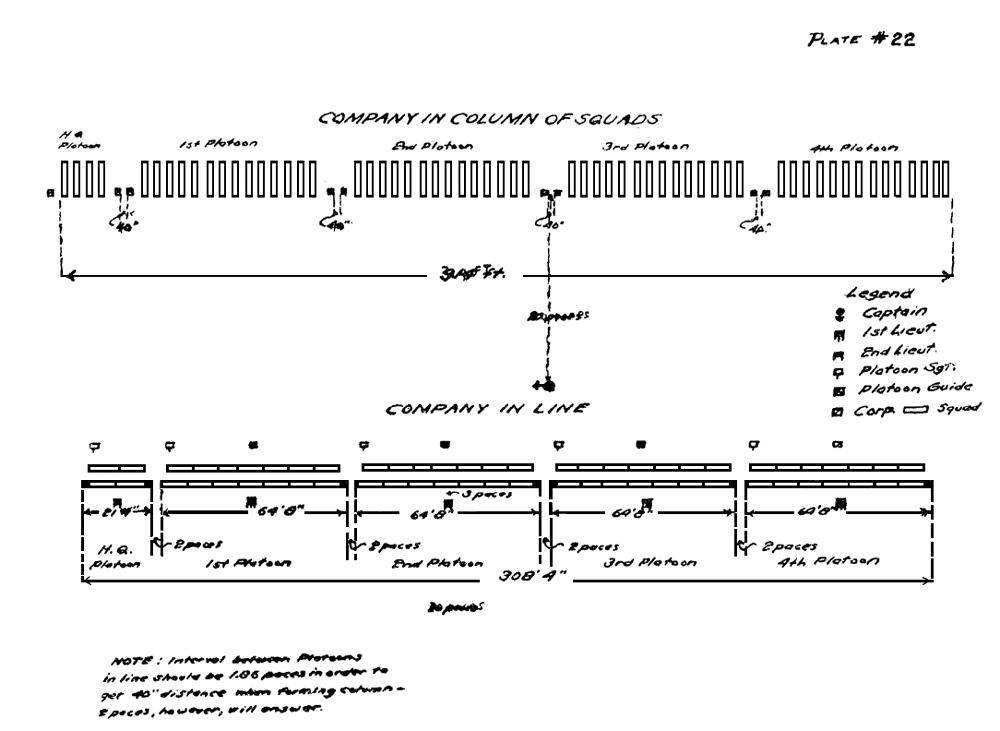
Being in above formation to vary the intervals. 1. Squad columns (so many) paces, 2. Guide right (left or center). Executed in the same manner as similar movement described in i.d.r. 126.
General Principles of the Platoon Formation in the Assault of Fortified Positions in Trenches. (Points of Resistance, Etc.).
1. The platoon is now a complete fighting unit within itself. It contains riflemen, bombers, auto-riflemen, and rifle grenadiers. With this combination the platoon commander has, under his immediate control, all the different kinds of fire available to the infantry.
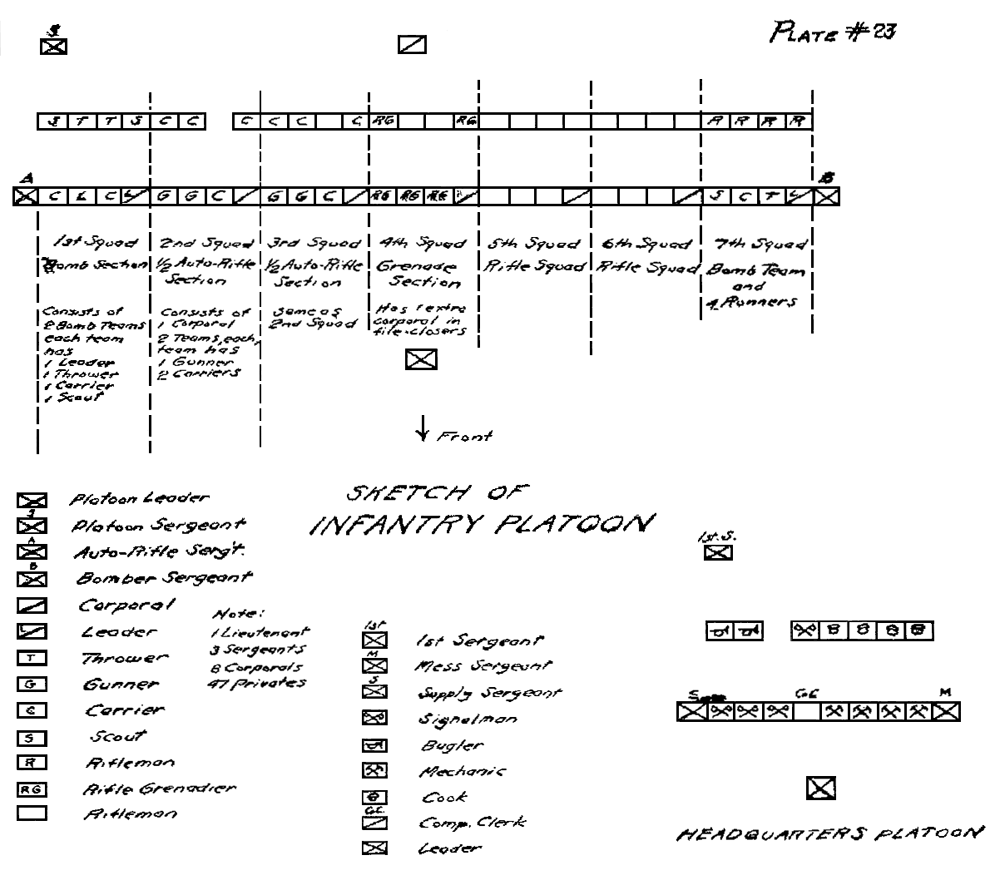
2. This formation was developed so that the platoon commander could meet the different contingencies that arise from being opposed by points of resistance in a "Trench-to-Trench" attack or the "Semi-Open-Warfare;" that is the secondary stage of a push.
3. When strong opposition develops, the principle on which the platoon works is to develop or surround the point of resistance, the platoon acting either alone or in conjunction with neighboring platoons. The four different kinds of fire are then used to their best advantages to silence or diminish the enemy fire thus making this manoeuvre possible.
4. In order to obtain success it is first necessary to impress on the officers and men that the primary advantage of the entire formation is its mobility, and the scope it gives to the initiative of the platoon section, squad and team leaders. In studying this formation it is first necessary to free the mind of all parade ground formations and to feel that there is nothing to hinder any desired movement of the sections, so long as the movement is not contrary to the operation orders for the attack. Until this idea is grasped thoroughly no progress can be made.
5. There is no typical or "normal formation." The one given at the beginning of this instruction here is a drill or parade ground formation, and while it may be used under actual conditions of warfare, it is simply utilized at this time as a basis from which the necessary variations may be worked out. In an attack, every platoon in the battalion may use a different formation.
6. The formation to be used is decided upon after a careful study of air-photographs. As far as possible all points of resistance are picked out and the best method of meeting the situations that may arise are then considered. The platoon is then arranged so as to best facilitate this manoeuvre. It must be realized that there will be other platoons on the flanks and in the rear, and their dispositions must be studied with a view of their probable bearing on the points of resistance.
7. In order to know how to get results it is first necessary to have a very clear conception of the uses and limitations of the different weapons in the platoon.
Briefly they can be used in the following ways:
The auto-rifles open up a point blank fire on the strong point as soon as it is discovered. Their function is to either draw the fire of the enemy or to silence him by a hit or forcing him to take cover. Their work may be compared to the work of the field artillery in a barrage. They cover the movement of the infantry across the open. The auto rifles so place themselves at such points that their line of fire will in no way interfere with the manoeuvre of the commander of the platoon or the remaining units of the platoon interfere with the effective use of the auto rifles of the platoon.
The rifle grenadiers advance at once just as close as possible, but at all costs to within effective grenade range. They then take cover in shell holes, trenches, etc., and open up a rapid fire. They are the long distance howitzers of the platoon and are very valuable. By a well placed grenade the whole resistance may be overcome. This section usually works around a flank.
The riflemen work up by squad as far as practicable and to a flank, when an opportunity presents itself, the squad opens fire in such a manner as to protect advance of other squads or teams.
The bombers endeavor to get well around behind the enemy and taking advantage of cover get to within bomb range. They may be compared to the close range howitzers or trench mortars.
When all four sections are in action at proper ranges, the opposition can probably last but a short time, and as soon as the machine guns cease fire the platoon, especially the riflemen, go after the remainder of the garrison with the bayonet.
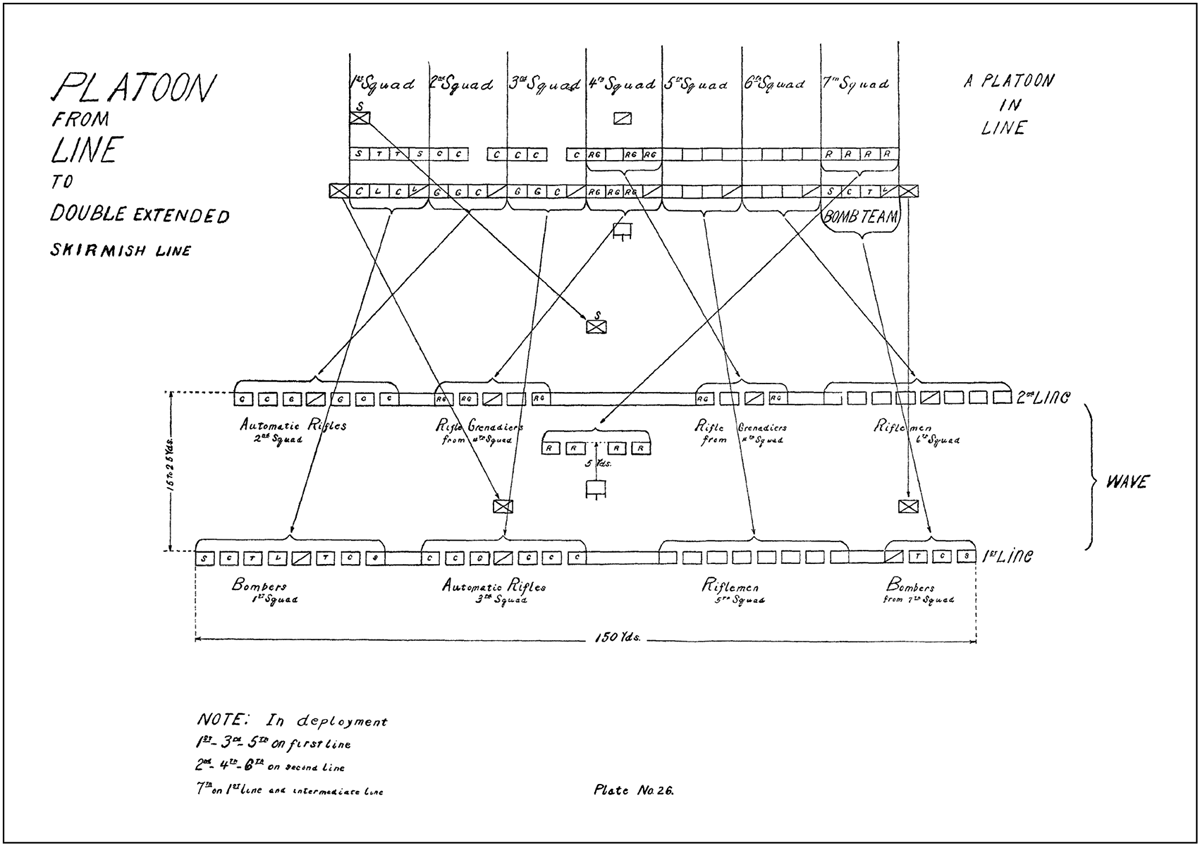
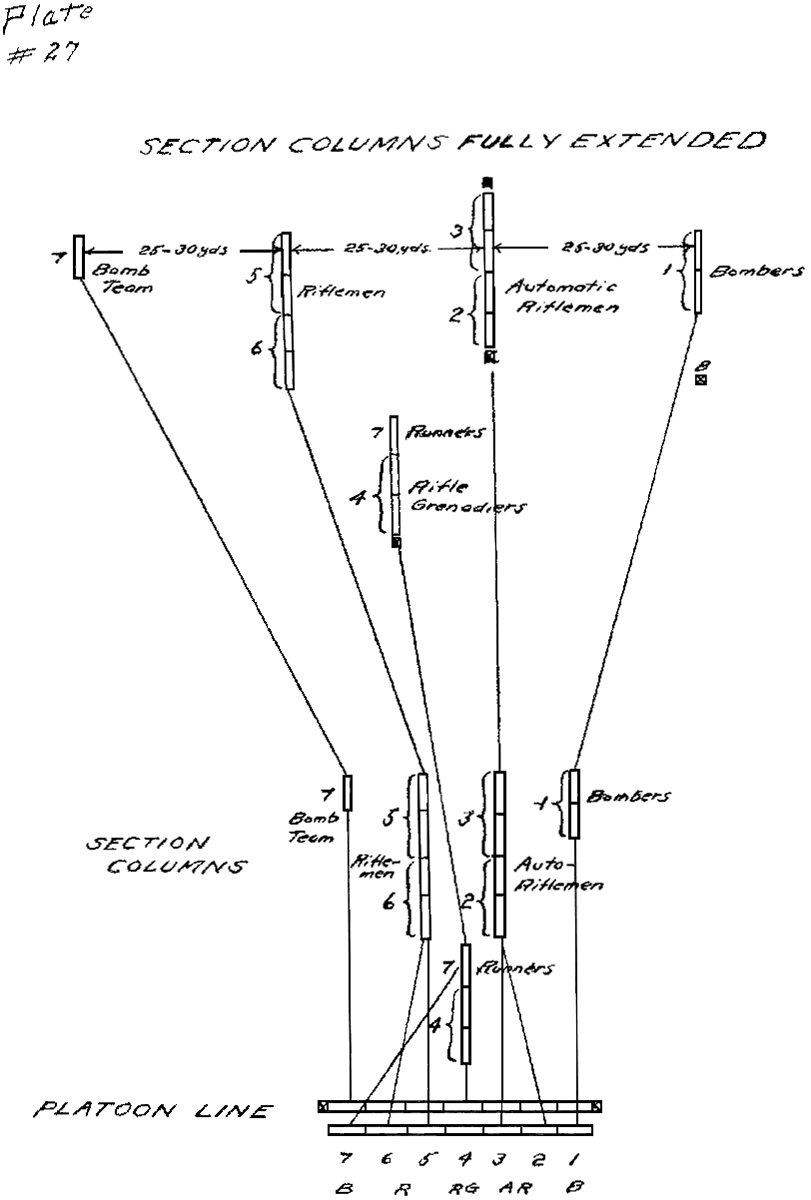
It may happen that the barrage put up will so demoralize the enemy that the riflemen can advance before his machine guns are even put out of action. This operation allows the rifle men to get in with the bayonet, if the resistance is not sooner overcome.
When the different sections are getting to their places, they usually find enough shell holes or old trenches to obtain cover. They should not move as entire sections, but as small groups of three or four at a time.
8. After the encircling movement has once begun, the platoon commander loses all control, and the action is then conducted by the section, squad or team leaders. They must be trained to act on their own initiative, as further orders are rarely practicable.
The resistance will finally be overcome, either because the enemy will retreat or surrender under the menace of encirclement, or by the losses caused by our fire or by the attack at close range of our bombers or else by the final assault with the bayonet led by our riflemen.
It must be remembered that under an artillery barrage it is never possible to issue verbal orders, so the sections must be trained to understand and obey the arm signals of its officer, or more often to work without orders.
9. A sequence of command must be arranged in each section, squad and team down to the last man.
Remarks Regarding The Forming Of Wave From Close Order.
The sketch of deployment attached is an illustration of one of the formations that may be adopted. It is given as an example. Any other wave formation may be practically as easily formed up. The platoon commander simply calls out the squads he wants in the first line.
It must not be imagined that this transition from close order to extended is done in the field when actually under fire or as a result of surprise.
Before the platoon goes into an attack it is all arranged so as to allow it to be changed with ease from column of sections at extended intervals (formation for approach) to the wave formation decided upon. This arrangement is made when the platoon is miles to the rear.
When the change is made from column of sections to the wave formation there must be no crossing of sections as they go to their places.
Some of the Many Questions a Platoon Commander Should Ask Himself on Taking Over a Trench, and at Frequent Intervals Afterwards.
1. I am here for two purposes: To hold this line under all circumstances, and to do as much damage as possible to the enemy? Am I doing all I can to make this line as strong as possible? Am I as Offensive as I might be with organized snipers, sniperscopes, rifle grenades, catapults, etc., and patrols?
2. Do I connect up all right with the platoons on my right and left? Do I know the position of my nearest support?
3. Does every man know his firing position and can he fire from it, over the parapet, at the foot of the wire?
4. Where are my S.A.A. and bomb stores? Are they under cover from the weather?
5. Do all my men know their duties in case of attack—bombers especially?
6. Are all my rifles and ammunition clean and in good order? Have all the men got rifle covers? Are the magazines kept charged?
7. Is my wire strong enough?
8. Are my parapets and traverses bullet-proof everywhere?
9. Where are my sally ports?
10. Where are my listening posts? Are my listening patrols properly detailed?
11. What points in front particularly require patrolling at night?
12. Are my sentries in their right places? Are they properly posted by N.C.O's.? Have they received proper instructions?
13. Have I got the S.O.S. message in my pocket, and do I know the orders regarding its use?
14. Are the trenches as clean and as sanitary as they might be? Are live rounds and cases properly collected? Are my bags for refuse and empties in position?
15. Are my trenches as dry as I might make them?
16. Am I doing all I can to prevent my men getting "Trench Feet"?
17. How can I prevent my parapets and dugouts from falling in?
18. Have I got at least one loophole, from which men can snipe, for every section? Have I pointed out to Section Commanders the portion of the enemy's trench they are responsible for keeping under fire, and where his loopholes are?
19. Have my men always got their smoke helmets on and are they in good order?
20. Are the arrangements, in case of gas attack, complete and known to all ranks?
21. Are the orders as to wearing equipment carried out?
22. Are my men using wood from the defences as firewood?
23. Are my men drinking water from any but authorized sources?
24. I am here for two purposes: To hold this line under all circumstances, and I do as much damage as possible to the enemy? Am I doing all I can to make this line as strong as possible? Am I as Offensive as I might be with organized snipers, sniperscopes, rifle grenades, catapults, etc., and patrols?
Defensive Measure Against Gas Attacks.
I. Introduction.
A. General Considerations:
In the absence of suitable means of protection the poison gases used in war are extremely deadly and the breathing of only very small quantities of them may cause death or serious injury. This being the case, it is essential that not the slightest time should be lost in putting on the anti-gas device on the gas alarm being given.
It cannot be too strongly insisted on that the measures to meet hostile gas attacks afford perfect protection, and if they are carried out properly no one will suffer from gas poisoning.
The whole basis of protecting troops against gas lies (a) in keeping the appliances in perfect working order; (b) in learning to adjust them rapidly under all conditions, and (c) in ensuring that every man is given immediate warning. These results can only be attained:
By frequent and thorough inspection of all protective appliances.
By thorough instruction and training in their use.
By every man understanding and complying with all standing orders on the subject of defense against gas.
If these are effectually carried out, there is nothing to fear from hostile gas attacks. Officers must impress this on their men, as an important object of all anti-gas instruction should be to inspire complete confidence in the efficacy of the methods which are adopted.
B. Nature of Gas Attacks:
(1) Gas Clouds:
This method of making a gas attack is entirely dependent on the direction of the wind. The gas is carried up to the trenches compressed in steel cylinders. These are dug in at the bottom of the trench and connected with pipes leading out over the parapet. When the valves of the cylinders are opened, the gas escapes with a hissing sound, which, on a still night, can frequently be heard at a considerable distance. It mixes with the air and is carried by the wind towards the opposing trenches, spreading out as it goes forward. A continuous wave of gas and air is thus formed, the color of which may vary:
Because of the weather conditions. In very dry air it may be almost transparent and slightly greenish in color, while in damp weather it forms a white cloud.
Because it may be mixed with smoke of any color.
A cloud attack can only take place when there is a steady but not too strong wind blowing from the enemy's lines towards our own. A wind between 4 and 8 miles an hour is the most likely condition. An 8-mile wind will carry the gas cloud twice as quickly as a man walks rapidly.
Gas attacks may occur at any time of the day, but are most likely to be made during the night or in the early morning.
Gentle rain is without appreciable effect on a gas attack, but strong rain washes down the gas. Fogs have hardly any effect and may, in fact, be taken advantage of to make an attack unexpectedly. Water courses and ponds are no obstruction to a gas cloud.