CHAPTER 15. (continued 2)
Reading edition
The gas used by the enemy is generally a mixture of chlorine and phosgene, both of which are strongly asphyxiating. The gases are heavier than air, and therefore, tend to flow along the ground and into trenches, shelters, craters and hollows. The gas cloud may flow round slight eminences, thus leaving patches of country which remain free from gas.
Chlorine and phosgene strongly attack the mucous membranes of the respiratory organs, causing bad coughing. In strong concentrations of gas, or by longer exposure to low concentrations, the lungs are injured and breathing becomes more and more difficult and eventually impossible, so that the unprotected man dies of suffocation. Death is sometimes caused by two or three breaths of the gas. Even when very dilute, chlorine can be recognized by its peculiar smell, which is like chloride of lime, but stronger and more irritating.
Both chlorine and phosgene also exert a strongly corrosive action on metals, so that the metal parts of arms must be carefully protected by greasing them.
The speed with which the gas cloud approaches depends entirely on the wind velocity. Gas attacks have been made with wind velocities varying from 3 to 20 miles per hour, i.e., from 1-½ to 10 yards per second. In a 9-mile wind, the gas would reach trenches 100 yards distant in 20 seconds.
Gas attacks have been made on fronts varying from 1 to 5 miles; their effects at points up to 8 miles behind the front trenches have been sufficiently severe to make it necessary to wear helmets.
(2) Gas Projectiles:
The use of these is not entirely dependent on the direction of the wind. In gas projectiles such as shells, hand grenades, and trench mortar bombs, a part or the whole of the explosive charge is replaced by a liquid which is converted into gas by the explosion. The explosive force and noise of detonation of these projectiles is less than that of the ordinary kind, and a large number of them are usually discharged into a comparatively small space. After the explosion, the irritant chemicals form a small gas cloud, though some may sink to the ground and remain active for a considerable time.
For using gas shells, the best condition is calm, or a wind of low velocity.
Gas projectiles can be used in all types of country. Woods, bushes, corn fields and clumps of buildings may hold the gas active for a considerable time.
Two kinds of shell gases are used by the enemy, viz., lachrymators, which mainly affect the eyes, and poison gases, which may affect the eyes and are just as deadly as the gases used in the form of clouds.
(1) Tear, Or Lachrymatory Shells:
These shells on explosion drive the liquid chemical which they contain into the air as a mist. They cause the eyes to water strongly and thereby gradually put men out of action.
Their actual smell may be slight. Large concentrations of lachrymators begin to affect the lungs and cause sickness, coughing and general irritation.
(2) Poison Shells:
Besides the comparatively harmless lachrymators the enemy also uses projectiles which contain a gas, the action of which is very similar to that of phosgene. Because of their slight detonation, these shells are liable to be mistaken for blinds, but they emit large quantities of a gas which attacks the lungs strongly and is very dangerous, and even in slight cases may cause serious after effects.
(3) Smoke:
The enemy may make use of smoke, either in the form of a cloud or emitted from shells and bombs. Smoke may be used with gas or between gas clouds; it may also be used alone to distract attention from a real discharge of gas, to cover the advance of infantry, or merely as a false gas attack.
(4) Mine And Explosion Gases:
The poisonous gases which occur in mines, and which are formed in large quantities when high explosive goes off in an enclosed space, e.g., from a direct hit in a shelter, or on the explosion of a charge in a mine, are not protected against by the ordinary anti-gas appliances. The chief of these gases is carbon monoxide. Protection against such gases will not be considered in these notes.
Officers are held responsible that all the anti-gas appliances for protecting their men are maintained in perfect condition, and that all ranks under their command are thoroughly trained in the use of these appliances and in all other measures which may affect their safety against gas.
Summary of Protective Measures:
Provision to each man of individual protective devices.
Arrangement for the inspection of those appliances and training in their use and instruction in all other measures of gas defense.
Provision of protected and gas-proof shelters.
Weather observations to determine periods when the conditions are favorable to a hostile gas attack.
Arrangement of signals and messages; for immediate warning of a gas attack.
Provision of appliances for clearing gas from trenches and shelters.
C. Protection of Shelters:
(1) Methods Of Protection:
Protection of dugouts, cellars, buildings, etc., is given if all entrances are closed by well-fitting doors or by blankets sprayed with hypo. solution. Practically no gas passes through a wet blanket, and the protection depends on getting a good joint at the sides and bottom of a doorway, so as to stop all draughts. This can be effected by letting the blanket rest on battens, fixed with a slight slope, against the door frame. The blanket should overlap the outer sides and a fold should lie on the ground at the bottom. A pole is fastened to the blanket, which allows the latter to be rolled up on the frame and causes it to fall evenly.
Wherever possible, particularly where there is likely to be movement in and out of the shelter, two blankets fitted in this way but sloping in opposite directions should be provided. There should be an interval of at least three feet between the two frames, and the larger this vestibule is made the more efficient is the dugout.
When not in use, the blankets should be rolled up and held so that they can be readily released, and should be sprayed occasionally with water or a little Vermorel sprayer solution.
If the blankets became stiff from a deposit of chemicals, they should be sprayed with water.
All ranks must be taught how to use gas-proof dugouts, e.g., how to enter a protected doorway quickly, replacing the blanket immediately, and carrying in as little outside air as possible.
The protection afforded by these means is just as complete against lachrymatory gases as it is against cloud gas and poisonous shell gases.
(2) Shelters Which Should Be Protected:
The following should always be protected:
Medical aid posts and advanced dressing stations; Company, Battalion and Brigade Headquarters; signal shelters and any other place where work has to be carried out during a gas attack.
In addition to the above, it is desirable to protect all dugouts, cellars and buildings within the shell area, particularly those of artillery personnel. It should be noted, however, that the protection of dugouts for troops in the front line of trenches is usually inadvisable on account of the delay involved in getting men out in time of attack. It is desirable to protect stretcher bearers' dugouts with a view to putting casualties in them.
D. Protection of Weapons and Equipment:
Arms and ammunition and the metal parts of special equipment (e.g., telephone instruments) must be carefully protected against gas by greasing them or keeping them completely covered. Otherwise, particularly in damp weather, they may rust or corrode so badly as to refuse to act. A mineral oil must be used for this purpose. The following in particular should be protected:
(1) Small Arms And S.A.A.
Machine guns and rifles must be kept carefully cleaned and well oiled. The effects of corrosion of ammunition are of even more importance than the direct effects of gas upon machine guns and rifles.
Ammunition boxes must be kept closed. Vickers belts should be kept in their boxes until actually required for use. The wooden belt boxes are fairly gas-tight, but the metal belt boxes should be made gas-tight by inserting strips of flannelette in the joint between the lid and the box.
Lewis magazines should be kept in some form of box, the joints of which are made as gas-tight as possible with flannelette.
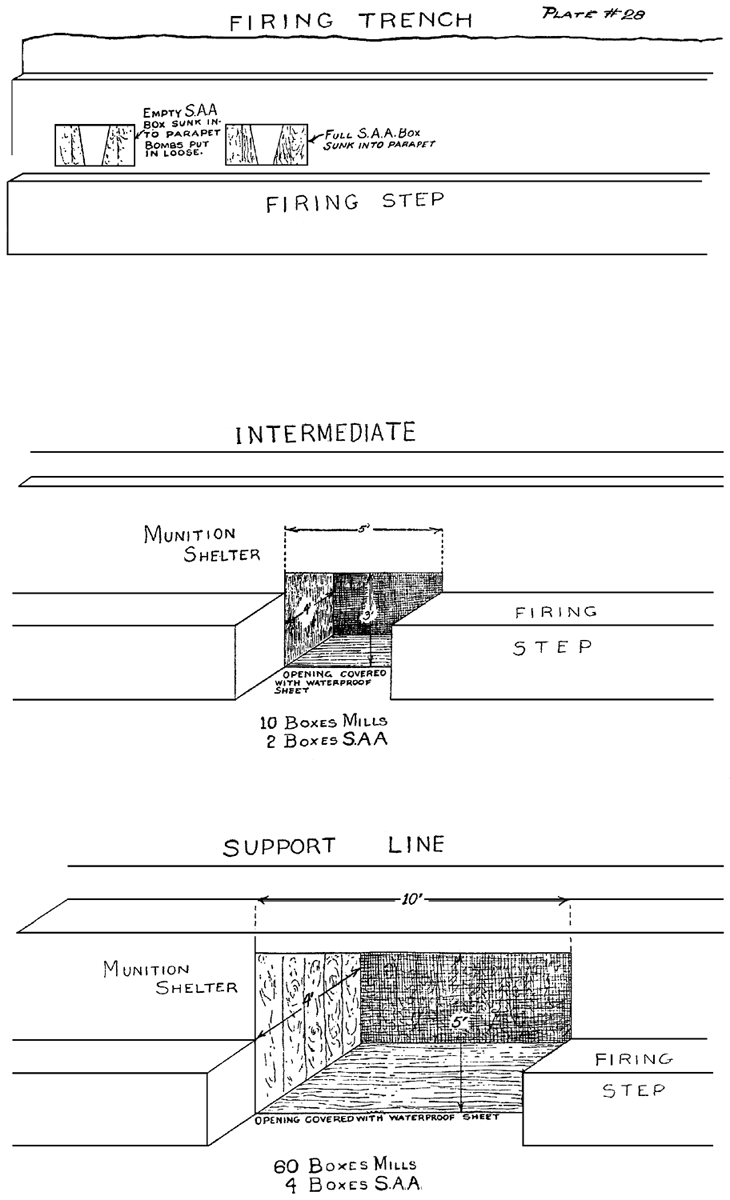
A recess should be made, high up in the parapet if possible, for storing ammunition and guns. A blanket curtain, moistened with water or sprayer solution, will greatly assist in keeping the gas out.
(2) Hand And Rifle Grenades:
Unboxed grenades should be kept covered as far as possible. All safety pins and working parts, especially those made of brass, should be kept oiled to prevent their setting from corrosion by the gas.
(3) Light Trench Mortars And Their Ammunition:
As far as the supply of oil permits, the bore and all bright parts of light trench mortars and their spare parts should be kept permanently oiled. When not in use, mortars should be covered with sacking or similar material.
Unboxed ammunition should be kept covered as far as possible and the bright parts oiled immediately after arrival. Ammunition which has been in store for some time should be used up first.
Sentries must be prepared to give the alarm on the first appearance of gas, as a few seconds delay may involve very serious consequences. Signals must be passed along by all sentries as soon as heard.
The earliest warning of a gas attack is given:
By the noise of the gas escaping from the cylinders.
By the appearance of a cloud of any color over the enemy's trenches. If the attack takes place at night, the cloud will not be visible from a distance.
By the smell of the gas in listening posts.
Action To Be Taken In The Trenches On Gas Alarm: Respirators to be put on immediately by all ranks (a helmet, if no box respirator is available). Rouse all men in trenches, dug-outs and mine shafts, warn officers and artillery observation posts and all employed men. Artillery support to be called for by company commanders by means of prearranged signals. Warn battalion headquarters and troops in rear. All ranks stand to arms in the front trenches and elsewhere where the tactical situation demands. Blanket curtains at entrances to protected shelters to be let down and carefully fixed. Movement to cease except where necessary.
Action To Be Taken In Billets And Back Areas: All men in cellars or houses to be roused. The blanket curtains of protected collars, etc., to be let down and fixed in position. Box respirators to be put on immediately, the gas is apparent.
H. Action During a Gas Attack:
(1) Protective Measures:
There should be as little moving about and talking as possible in the trenches. Men must be made to realize that with the gas now used by the enemy, observance of this may be essential for their safety.
When an attack is in progress, all bodies of troops or transport on the move should halt and all working parties cease work until the gas cloud has passed.
If a relief is going on, units should stand fast as far as possible until the gas cloud has passed.
Supports and parties bringing up bombs should only be moved up if the tactical situation demands it.
If troops in support or reserve lines of trenches remain in, or go into, dug-outs, they must continue to wear their anti-gas appliances.
Officers and N.C.O's must on no account remove or open up the masks of the box respirators or raise their helmets to give orders. The breathing tube may be removed from the mouth when it is necessary to speak, but it must be replaced.
Men must always be on the look-out to help each other in case an anti-gas device is damaged by fire or accident. When a man is wounded, he must be watched to see that he does not remove his respirator or helmet until he is safely inside a protected shelter; if necessary, his hands should be tied.
Men must be warned that if they are slightly gassed before adjusting their respirators or helmets they must not remove them. The effect will wear off.
(2) Tactical Measures:
From the point of view of protection against gas, nothing is gained by men remaining in unprotected dug-outs or by moving to a flank or to the rear. It is, therefore, desirable that on tactical and disciplinary grounds all men in the front line of trenches should be forbidden to do these things. In support or reserve lines where there are protected dug-outs, it is advisable for men to stay in them unless the tactical situation makes it desirable for them to come out.
Nothing is gained by opening rapid rifle fire unless the enemy's infantry attacks. A slow rate of fire from rifles and occasional short bursts of fire from machine guns will lessen the chance of their jamming from the action of the gas and tends to occupy and steady the infantry.
It should be remembered that the enemy's infantry cannot attack while the gas discharge is in progress and is unlikely to do so for an appreciable time—at least 10 minutes—after it has ceased. It is, in fact, a common practice for the enemy infantry to retire to the second and third line of trench whilst gas is being discharged. There is, therefore, no object in opening an intense S.O.S. barrage of artillery on "No man's land" during the actual gas cloud and it is advisable that the warning to the artillery of a gas attack should be a signal differing from the ordinary S.O.S. signal, as the latter may have to be sent later if an infantry attack develops.
It must be remembered that smoke may be used by the enemy at the same time as, or alternately with, the gas and that under cover of a smoke cloud he may send out assaulting or raiding parties. A careful look-out must, therefore, be kept; hostile patrols or raiders may be frustrated by cross-fire of rifles and machine guns and should an assault develop the ordinary S.O.S. procedure should be carried out.
I. Precautions Against Gas Shells:
Owing to the small explosion which occurs with these shells, they are liable to be mistaken for blinds, and even when the gas is smelt men may not realize its possibly dangerous character at once and so may delay putting on respirators or helmets until too late. Men sleeping in dug-outs may be seriously affected unless they are roused. Men in the open air are unlikely to be seriously affected by poison gas shells, provided they put on respirators or helmets on first experiencing the gas. The following points should therefore be attended to:
(i.) All shells which explode with a small detonation or appear to be blind should be regarded with particular attention; the respirator or helmet should be put on at the first indication of gas and blanket protection of shelters adjusted.
(ii.) Arrangements must be made for giving a Local alarm in the event of a sudden and intense bombardment with poison gas shells, but care must be taken that this alarm is not confused with the main alarm. Strombos horns must on no account be used to give warning of a gas shell bombardment.
(iii.) All shelters in the vicinity of an area bombarded with poison gas shells must be visited and any sleeping men roused.
(iv.) Box respirators or helmets should continue to be worn throughout the area bombarded with poison gas shells until the order is given by the local unit Commander for their removal.
Lachrymatory or "tear" shells are frequently used by the enemy for the purpose of hindering the movements of troops, for preventing the bringing up of supports, or for interfering with the action of artillery. Owing to the deadly nature of poison gas shells, however, the precautions given in paragraph 60 above, must be taken for all gas shells. The goggles are intended for use after lachrymatory bombardments only, in cases where the irritant gas persists in the neighborhood.
K. Action Subsequent to a Gas Attack:
1. General:
The most important measure to be taken after a cloud gas attack is to prepare for a further attack. The enemy frequently sends several successive waves of gas at intervals varying from a few minutes up to several hours and it is therefore necessary to be on the alert to combat this procedure. The following measures should be adopted as soon as the gas cloud has passed:
Removal of respirators.—Anti-gas fans should be used to assist in clearing the trenches of gas, so as to admit of respirators being removed. Respirators and helmets must not be removed until permission has been given by the Company Commander.
A sharp look out must be kept for a repetition of the gas attack, as long as the wind continues in a dangerous quarter.
2. Movement:
Owing to the enemy gas sometimes causing bad after effects, which are intensified by subsequent exertion, the following points should be attended to:
No man suffering from the effects of gas, however slightly, should be allowed to walk to the dressing station.
The clearing of the trenches and dugouts should not be carried out by men who have been affected by the gas.
After a gas attack, troops in the front trenches should be relieved of all fatigue and carrying work for 24 hours by sending up working parties from companies in rear.
Horses which have been exposed to the gas should not be worked for 24 hours if it can be avoided.
3. Clearing Dugouts And Other Shelters:
It is essential that no dugout be entered after a gas attack event with box respirators or helmets adjusted, until it has been ascertained that it is free from gas. The only efficient method of clearing dugouts from gas is by thorough ventilation. The older method of spraying is not efficient.
An appreciable quantity of gas may be retained in the clothing of men exposed to gas attacks and also in bedding, coats, etc., left in shelters. Precaution should, therefore, be taken to air all clothing.
4. Ventilation:
Natural Ventilation.—Unless a shelter has been thoroughly ventilated by artificial means, as described below, it must not be slept in or occupied without wearing respirators, until at least 12 hours after a gas attack. It must not be entered at all without respirators on for at least 3 hours. The above refers to cloud gas attacks. In the case of gas shell bombardments the times cannot be definitely stated, as they depend on the nature of the gas used and the severity of the bombardment. With lachrymatory gases the times after which shelters can be used without discomfort may be considerably longer than those mentioned above.
Ventilation by Fire.—All kinds of shelters can be efficiently and rapidly cleared of gas by the use of fires. Shelters with two openings are the easiest to ventilate and where possible, dugouts with only one entrance should have a second opening made, even a very small one, to assist in ventilation.
In dugouts provided with a single exit at the end of a short passage, the best results are obtained if the fire is placed in the center of the floor of the dugout and at a height of about 9 inches.
In dugouts provided with a single exit at the end of a long and nearly horizontal passage, the best results are obtained if the fire is placed about one-third of the distance from the inner end of the passage.
In dugouts provided with two or more exits, the fire should be placed at the inner end of one of the exit passages.
In general, 1 pound of dry wood per 200 cubic feet of air space is sufficient for clearance of any gas. The best fuel is split wood, but any fuel which does not smoulder or give off thick smoke can be used. The materials for the fire, e.g., the split wood, newspaper, and a small bottle of paraffine for lighting purposes, should be kept in a sand bag, enclosed in a biscuit tin provided with a lid. An improvised brazier should be kept ready for use.
The fire must be kept burning for at least ten minutes and the atmosphere in the shelter should be tested from time to time.
Ventilation by Fanning.—Dugouts can be ventilated by producing air currents in them by means of special anti-gas fans.
If no anti-gas fans are available, ventilation can be assisted by flapping with improvised fans such as sand bags, ground sheets, etc.
5. Cleaning Of Arms And Ammunition:
Rifles and machine guns must be cleaned after a gas attack and then re-oiled. Oil cleaning will prevent corrosion for 12 hours or more, but the first available opportunity must be taken to dismantle machine guns and clean all parts in boiling water containing a little soda. If this is not done, corrosion continues slowly even after oil cleaning and may ultimately put the gun out of action.
After a gas attack, S.A.A. should be carefully examined. All rounds affected by gas must be replaced by new cartridges immediately and the old ones cleaned and expended as soon as possible.
All hand and rifle grenades exposed to the gas should have their safety-pins and working parts cleaned and re-oiled.
All bright parts of light trench mortars, together with all accessories and spare parts exposed to the gas, must be cleaned and wiped dry as soon as possible after the attack and in any case within 24 hours, after which they should be thoroughly coated afresh with oil. The same applies to ammunition which may have been exposed to the gas.
Ammunition which, for any reason, had not been oiled, must be cleaned and oiled and expended as soon as possible.
For details regarding the cleaning of guns and artillery ammunition and signal equipment, see paragraphs 116 and 123.
6. Treatment Of Shell Holes:
In the neighborhood of shelters or battery positions where gas from shell holes is causing annoyance, the holes and the ground round them should be covered with at least a foot of fresh earth. Shell holes so treated should not be disturbed, as the chemical is not thereby destroyed and only disappears slowly.
Concealment From Aerial Observers.
A.
An aeroplane cannot conduct reconnaissance at a height of less than 5,000 feet without being within easy range of anti-aircraft artillery; nor of less than 2,000 feet without coming into range of machine-gun and rifle fire.
To be observed from such heights, objects on the ground must be distinguished by: Motion. Color contrast. Line contrast, or Shadows.
B. Concealment:
On warning of hostile aircraft, troops on the march should withdraw to the side of the road (if possible, into shade), or lie down flat in the road and remain motionless. If it is necessary to continue the march, this should be done in broken detachments, which are far less distinct than continuous column. Troops in a trench should crouch down in the shadowy side and remain motionless. Faces should never be turned up, as the high lights on cheek-bones and foreheads then show up distinctly. Bright metal on arms, equipment and headgear must be kept covered.
Artillery wagon-trains, etc., should if possible be halted promptly on warning. When halted, their neutral coloring protects them.
Trenches are best concealed: By avoiding, in construction, a too regular outline, and following as far as possible the contours of the ground. By coloring the parapet and parados to match the ground. This may be done most quickly by painted canvas; if the latter is not available, by planting or strewing the loose earth with surrounding herbage. In this work care must be taken not to make the covering itself too conspicuous by brightness or monotony of coloring. By covering the trench itself, where convenient, with a thin material, colored like the parapet and parados. By avoiding all overt movement of troops in the trenches under observation.
Buildings, e.g., ammunition dumps, hangars, etc., can be completely concealed by being painted the color of the ground they stand on and fitted with canvas curtains, similarly painted and stretched from the eaves to the ground at a horizontal angle of 35 degrees. These curtains completely eliminate shadows.
Success in each work of concealment by camouflage is best assured by the assistance of an aeroplane observer to test and correct it.
Orders Governing Intrenchment Problems at Second Plattsburg Training Camp.
Headquarters Plattsburg Training Camp, Plattsburg Barracks, New York. September 22, 1917.
Divisional Entrenching Problem.
General Situation:
The Salmon river forms the boundary line between two states, the "Blue" on the north and the "Red" on the south. War has been declared and the Red Army is mobilizing near Keeseville. Mobilization by the first Blue Army at Plattsburg has been completed.
Special Situation, Blue:
Our advanced troops are holding the line of the Salmon river against strong detachments of the Red Army. The commanding general of the Blue Army has decided to establish a second position on the line, Bluff Point to the bend (248) in the Saranac river.
The following order is issued by the Division Commander:
Headquarters, 101st Div., Plattsburg, N.Y. 23 Sept., '17, 9:00 a.m.
Field Orders, No. 1.
1. Our advanced troops are holding the line of the Salmon river.
2. This division and 1 Brigade 102 Division will entrench along the line: Bluff Point—Chateaugay Branch Railroad—Saranac River (248).
3. (a) The Chief of Artillery will prepare the positions, and lines of communication for his Brigade, determine his sectors, and submit his plan of action.
(b) The 1st Brig. and 2 Bns. 267th Inf. will entrench the sector, Saranac River (248) to Sand Road, exclusive. The 2nd Brig. will entrench the sector Sand Road to Bluff Point, both inclusive. The supports will entrench on the line, Saranac River (182)—Cliff Haven.
(c) The Reserve—1 Brig. 102 Div. less 2 Bns., will construct crossings on the Saranac River—under direction of the Chief of Engineers, and prepare them for defense.
(d) The Chief of Engineers will supply tools for entrenching and lay out the lines of entrenchments. He will repair the following trunk roads: Peru Road, Sand Road, Lake-Shore Road; and construct a transverse trunk line road from Pulp Mill to O'Connell's Farm, and the necessary tram lines. The Engineer Depot for stores and material will be established at Plattsburg Barracks.
(e) The Chief Signal Officer will establish necessary lines of communication, utilizing equipment at Plattsburg Barracks, Central Station. Aero Squadron at Chazy.
4. (a) The Chief Medical Officer will establish his dressing stations in the Butts of the rifle range and in ravine on O'Connell's Farm. A field hospital will be established at the Lozier Works.
(b) Ammunition train and supply train will be parked in the Fair Ground. Ammunition distributing stations at railroad spurs, Plattsburg Barracks, and O'Connell's Farm. The Division Ordnance Officer will locate the Ammunition Dumps along transverse trunk line road.
(c) Field trains, until further orders, at north end of Plattsburg Barracks Reservation. Distributing point, Plattsburg Railroad Station—Regimental Supply Stations: Saranac River 182; intersection Peru Road and Rifle Range Road, Sand Hole in Rifle Range, Sand Road on O'Connell's Farm, Ravine on O'Connell's Farm.
(d) The commander of trains will establish traffic regulations for all roads.
5. Messages to Statistical Office.
Wolf, Major General.
Official copy: J.A. Baer, Genl. Staff, Chief of Staff.
Copies to: Brig. and Regt. Commanders. C. of E. Div. Q.M. C.S.O. C.M.O. Div. O.O. C. of Tr.
Headquarters, 1st Brigade, 101st Division, Plattsburg Barracks, N.Y. 23rd Sept., 1917, 6 p.m.
Field Orders, No. 1.
1. Strong detachments of the Red Army, now mobilizing at Keeseville, are south of the Salmon River. Our advance troops are holding the line of the Salmon River.
2. Our division and one brigade, 102nd Division, will entrench and occupy the line Bluff Point-Chateaugay Branch (D. & H.R.R.), Saranac River (248). This brigade, reinforced by two Battalions, 267th Infantry, will entrench and occupy the sector, Saranac River (248), Sand Road, exclusive.
3. (a) The 1st and 2nd Battalions, 267th infantry will entrench and occupy the sector from the Saranac River to a point 600 yards east.
(b) The 266th Infantry, the sector from a point 600 yards east of the Saranac River, connecting with the trenches of the 267th Infantry, to a point 100 yards east of Peru Road.
(c) The 265th Infantry, the sector from a point 100 yards east of the Peru Road, and connecting with the trenches of the 266th Infantry, to the Sand Road exclusive.
(d) The Brigade Machine Gun Battalion will organize and maintain strong points along line regimental reserves. The C.O. of this organization will, at once, consult with the regimental commanders relative to preparation of machine gun emplacements and probable need for re-enforcements within their respective sectors.
(e) The Brigade Signalmen will establish telephonic communications between Brigade and Regimental Headquarters.
4. (a) The regimental commanders and senior officers of the two battalions, 267th Infantry, will at once report to the Chief Engineer of the Division for plan of entrenchments in their respective sectors.
(b) Tools and materials for entrenching will be supplied at the trench sites.
5. Messages to Brigade Headquarters near Peru Road, east Savoy Hotel.
Goodrich, Brigadier General, Commanding.
Official copy: Wm. Kirby, Major of Cavalry, U.S.R., Adjutant.
Copies to: C.O., 265th Infantry. C.O., 266th Infantry. C.O., 1st and 2nd Battalions, 267th Infantry. C.O., Brigade M.G. Co. Headquarters, 101st Division.
Headquarters, 1st Battalion, 265th Infantry Plattsburg Barracks, N.Y. Oct. 16, 1917.
Field Orders, No. 1.
Blue print of trenches; scale 24 inches equals 1 mile.
1. The enemy strongly occupies a line of trenches immediately South of the Chateaugay Branch Railroad, the center of their line being about opposite the center sector of our first line of trench, Sand Road-Target Range Fence, their line of trenches being within 50 yards of the railroad at that point, and then retiring slightly from the railroad to the East and West.
The 264th Infantry occupies the section of trenches directly to the East of us and the 266th Infantry occupies the section of trenches directly to the West of us.
2. This battalion will take up a defensive position in the nearly completed line of trenches, Sand Road-Target Range Fence, and as rapidly as possible complete the trench system in the following order of work:
Deepen all trenches to at least three feet.
Construct latrines.
Provide cover.
Revet work previously done.
3. a. Front lines, i.e., fire, communicating and support trenches: Company "B" will occupy the East sector, i.e., Sand Road to Belgium Boyau, inclusive, including Slum Boyau and the salient at South end Reserve Trench immediately in rear of East end of Support trench.
Company "C" will occupy the Central sector, i.e., from East sector (Belgium Boyau, exclusive), to Cardona Boyau, inclusive, including Poire Boyau.
Company "A" will occupy the West sector, i.e., from Central sector (Cardona Boyau, exclusive), to and including salient near Southwest corner of Target Range Fence.
b. Reserve Line: Company "D" will occupy the line from the Target Range Fence on the West to a point 165 yards East of the Verdun Salient, one-half of the Company occupying the sector, Target Range Fence, to a point 75 yards East of the Rams Horn Boyau, including Rams Horn Boyau, and the other half of the Company occupying the sector from a point 75 yards East of the Rams Horn Boyau to a point 165 yards East of the Verdun Salient.
c. Machine Guns: Headquarters, 1st Platoon and 1st Platoon Machine Gun Company, will report to the Commanding Officer, Company "A," for assignment to the shell craters (converted) and dugouts (constructed for machine guns), four in all, in the West sector.
Headquarters, 2nd Platoon and Third Section (2nd Platoon) Machine Gun Company, will report to the Commanding Officer, Company "C," for assignment to the shell crater (converted), and dugout (constructed for machine gun), two in all, in the Central sector. Fourth section (2nd Platoon), Machine Gun Company, will report to the Commanding Officer, Company "B," for assignment to the shell crater (converted), two in all, in the East sector.
d. Trench Mortars: Two trench mortars have been assigned to the Central sector and the Commanding officer, Company "C," is charged with the construction of emplacements therefor and the manning of them.
4. a. Dressing stations have been established in the Butts of the rifle range and in ravine on O'Connell's Farm.
b. Ammunition distributing points are located at Plattsburg Barracks and O'Connell's Farm.
c. Regimental supply stations are located at Saranac River (182), intersection Peru Road and Rifle Range Road, Sand Hole in Rifle Range, Sand Road on O'Connell's Farm, and Ravine on O'Connell's Farm.
5. Battalion Headquarters are located in dugout in Support trench (West Tremont), midway between Rams Horn and Poire Boyaux, to which place messages will be sent.
Boschen, Captain, 56th Infantry, Commanding.
Copies to: C.O., 265th Infantry. C.O., Companies A, B, C and D. C.O., M.G. Company. C.O., Headquarters Company. R.S.O.
Hdqtrs. 1st Batt., 265th Infty., Plattsburg Bcks., N.Y., Oct. 17, 1917.
Field Orders, No. 2
Dispositions: The assignment of companies to sectors is as announced in Field Orders No. 1, these headquarters. Company commanders are charged with the details of occupation of the trenches and the proper disposition of the "specialists" (bombers, grenadiers, auto-riflemen, etc.), directing particular attention to the active and passive areas of their sectors.
Fields Of Fire: Company commanders must arrange for and obtain the best fields of fire in their own sectors, and provide for protection of visible areas in adjoining sectors by lateral fire.
Improvements Or Changes In Trenches: Company commanders before making any changes or improvements in trenches will render to battalion headquarters brief recommendations of changes desired. These recommendations will be submitted at 11.00 a.m. and 3.00 p.m., after which hours the battalion commander will inspect and if deemed necessary will be ordered.
Organization For Watching And Observation: Each company commander will organize a system for watching the enemy by day and will establish look-out posts for this purpose; this system will be augmented at night by patrols if necessary. The watching of the enemy must be continuous and long occupation of the sector will not warrant any laxity.
Organization For Supply: Company commanders will make the necessary details for obtaining supplies; these details to be in charge of Mess or Supply Sergeants and will not exceed three squads for each lettered company. Food: Machine guns details and members of the Medical Corps assigned to each sector are attached to the lettered companies for rations. Cooked food will be at the Food Station at 6.00 a.m., 11.50 a.m. and 5.00 p.m. daily, and will be distributed at that point. Company commanders will detail the Mess Sergeant, with an appropriate detail (about 2 squads) to proceed to Food Station, which is located at the wire entanglement on the west side of the Target Range about 400 yards north of Brigade Headquarters. The details mentioned above will proceed via trenches, leaving same at junction of Tipperary trench and Rams Horn boyau in the following order: Co. D: Detail will clear junction Rams Horn boyau and Tipperary trench at 5.40 a.m., 11.10 a.m. and 4.40 p.m. Co. A: Detail will clear junction Tremont trench, and Rams Horn boyau at 5.30 a.m., 11.00 a.m. and 4.30 p.m., proceeding via Rams Horn boyau. Co. B: Detail will clear junction Tremont trench, and Poire boyau at 5.35 a.m., 11.05 a.m. and 4.55 p.m., proceeding via Poire boyau and Tipperary trench. Co. C: Detail will clear junction Tremont trench and Slum boyau at 5.40 a.m., 11.10 a.m. and 4.40 p.m., proceeding via Slum boyau and Tipperary trench. These details will return to their respective sectors via the indicated routes, moving in reverse order at five-minute intervals, and company commanders will make necessary arrangements for distribution of food within their respective sectors. Company commanders will cause the necessary police after each meal to insure sanitary condition of trenches. Food containers will be held in company until the next meal hour when they will be returned to the Food Station. Water: Water wagon will be at the Food Station from 10.00 a.m. to 4.30 p.m. daily. Containers for water will be furnished by Regimental Supply Officer at the Food Station. All men will carry full canteens of water when entering the trenches. Company commanders will detail the Mess Sergeant, with an appropriate detail (about 2 squads), to proceed to the Food Station to procure water in containers; these details will proceed via the routes indicated in paragraph 5, section "e": Co. D, 2.00 p.m.; Co. A, 2.05 p.m.; Co. B, 2.10 p.m.; Co. C, 2.15 p.m. These details will return to their respective sectors in reverse order at five-minute intervals. Miscellaneous: Details for obtaining tools, ammunition, trench supplies, etc., will be arranged for as required. Requisitions for miscellaneous supplies required will be submitted by company commanders to the Regimental Supply Officer not later than 3.00 p.m., October 17, 1917.
Organization For Liaison: The Signal Officer will establish necessary telephonic communications. Each organization will detail one runner to report to the battalion commander at regimental headquarters at 8.00 a.m. Four runners will be detailed for duty with each company headquarters and one runner will be detailed for duty with each platoon headquarters. These runners should be lightly equipped and wear a distinctive mark. At least two men per section must be able to act as guides to all company headquarters of the battalion. Verbal messages will not be sent by runners; all messages must be written. Company commanders, or their representatives, will report daily at battalion headquarters at 5.00 p.m. There must be accurate communication between platoons in company, and companies in battalion, in order to insure co-ordinated action.
Defense: Immediately after the occupation of the trenches, company commanders will make a careful estimate of all tactical situations presented in their sectors and will plan for a stubborn defense. Care must be exercised in providing for defense in depth and lateral defense. The front line trenches of each sector will be held until actually entered by the enemy, and no sector will be abandoned until the occupants are actually forced out. The main line of resistance will be the support trenches (Tremont) and special attention must be given to the preparation for defense. If the front line trenches of any sector be captured by the enemy there will be no withdrawal from any other sector of the front line trenches for the purpose of establishing a continuous line in the support trench. The company commander of the reserve will organize parties for counterattacks and these parties will be held in readiness at convenient points to insure prompt movement to the front. Continuous occupation of the trenches without fire action must not cause a feeling of security and result in being surprised by the enemy.
Stand To: "Stand to" will take place at 5.00 a.m. and 5.00 p.m., daily. At this formation every available man will be present. Rifles, ammunition, equipment, clothing, etc., will be inspected. Rapid loading will be practiced. The firing position of every man will be tested to see whether he can hit the bottom edge of our wire. Gas helmets and respirators will be inspected if worn. After "stand to" in the morning and before "stand to" in the evening rifles will be thoroughly cleaned and oiled.
Trench Orders: Current "Trench Standing Orders" recently published from Brigade Headquarters are in force. During the occupation of the trenches it will be assumed that, the trenches are under the observation and fire of the enemy and all movement in the trenches will be conducted accordingly. All movements of troops, either individuals or groups, will be via the trenches at all times. No one will be allowed to go overland between trenches or to enter the trenches by the flank. All persons will enter the trenches from the reserve trenches and no visitors will be allowed in the trenches except on passes issued from the Regimental Headquarters. Commanding officers, Companies A and B, are responsible for the posting of the necessary sentinels along the flanks of the position (during the day), with instructions covering the provisions contained in paragraph 9, sections "b" and "c."
Reports: Company commanders will submit by 1.00 p.m., October 18, 1917, a report showing the dispositions and plan of defense of their respective sectors. Frequent reports of information obtained and any change of conditions at the front will be made to battalion headquarters when necessary.
Boschen, Captain, 56th Infantry, Commanding.
Copies to: C.O. 265th Infty. C.O. Cos, A, B, C and D. C.O. M.G. Co. C.O., Hdq. Co. R.S.O.
Company Organization (in Detail):
Company Headquarters:
1 Captain, commanding company, 1 First Lieutenant (senior), second in command, 1 First Sergeant, armed with pistol, 1 Mess Sergeant, armed with rifle, 1 Supply Sergeant, armed with rifle, 1 Corporal, company clerk, armed with rifle, 4 Mechanics, armed with rifle, 5 Wagoners (from Supply Company), 4 Cooks, armed with rifle, 2 Buglers, armed with pistol, 4 Privates, first class, company agent and signalmen.
Equipment: 15 rifles, 5 pistols, 8 automatic rifles (for replacement), 40 trench knives (to be distributed as needed), 2 bicycles. Following from Supply Company: 1 rolling kitchen, 4-mule; 1 combat wagon, 4-mule; 1 ration and baggage wagon, 4-mule; 1 ration cart, 2-mule; 1 water cart, 2-mule; 16 mules, draft.
4 Platoons, each organized as follows (numbered 1 to 4 in company):
Headquarters:
1 First Lieutenant; 1st and 4th Platoons commanded by First Lieutenants; 2nd and 3rd Platoons commanded by Second Lieutenants, armed with pistol.
1 Sergeant, assistant to platoon commander, armed with pistol and rifle.
Equipment: 1 rifle, 2 pistols.
1st Section: Bombers and rifle grenadiers:
1 Sergeant, armed with pistol and rifle,
3 Corporals, armed with pistol and rifle, 1 trained as rifle grenadier; remainder trained as bombers,
6 Privates, first class, 2 armed with pistol and rifle, and remainder with rifle only; 1 trained as rifle grenadier, and remainder as bombers.
12 Privates, armed with rifles; 4 trained as rifle grenadiers, remainder trained as bombers.
Equipment: 22 rifles, 6 pistols.
2nd Section: Riflemen:
2 Corporals, armed with pistols and rifles, 3 Privates, first class, armed with rifle, 7 Privates, armed with rifle, Equipment: 12 rifles, 2 pistols.
3rd Section: Riflemen:
2 Corporals, armed with pistol and rifle, 3 Privates, first class, armed with rifle, 7 Privates, armed with rifle. Equipment: 12 rifles, 2 pistols.
4th Section: Auto-riflemen:
1 Sergeant, armed with pistol and rifle, 1 Corporal, armed with pistol and rifle, 3 Privates, first class; 1 armed with rifle, 2 armed with pistols; auto-rifle gunners, including 1 extra, 6 Privates, armed with rifle. Equipment: 9 rifles, 4 pistols, 2 auto-rifles.
Note.—Sections numbered from 1 to 16 in company.
Personnel:
Commissioned:
Captain 1
First Lieutenants 3
Second Lieutenants 2
Total 6
Enlisted:
First Sergeant 1
Mess Sergeant 1
Supply Sergeant 1
Sergeants 12
Corporals 33
Mechanics 4
Wagoners (from Supply Company) (5)
Cooks 4
Buglers 2
Privates, first class 64
Privates 128
Total 250
Equipment:
Rifles 239
Pistols 69
Auto rifles 16
Trench knives 40
Bicycles 2
From Supply Company:
Rolling kitchen, 4-mule 1
Combat wagon, 4-mule 1
Ration and baggage wagon, 4-mule 1
Ration cart, 2-mule 1
Water cart, 2-mule 1
Mules, draft 16
Trench Standing Orders.
1. Duties.—A. One officer per company and one non-commissioned officer per platoon will always be on duty. During their tour of duty they will not be in their dugouts. They will frequently visit all trenches occupied by their units. Every listening post will be visited at least once by an officer during his tour of duty.
B. The officer and non-commissioned officer on duty will, when his tour of duty is completed, turn over to the officer or non-commissioned officer relieving him all orders, a report of the work in progress, if any, and any other information of use.
C. At night the officer and non-commissioned officer on duty will frequently patrol the trench line, to see that the sentries are alert and to receive any reports they may desire to make.
D. The-non-commissioned officer coming on duty will go round and post new sentinels with the non-commissioned officer coming off duty.
E. The length of the tour of duty will depend upon the number of officers and non-commissioned officers on duty. Normally each tour should be, by night, two hours; by day, four hours. This may be modified, however, so that all officers and non-commissioned officers will have an equal amount of this duty while in the trenches.
F. Non-commissioned officers, after posting sentinels, will report "all is well" or otherwise to the officers on duty.
G. No man will be detailed for a duty in the trench without being given suitable warning of this duty and be informed at which hour he will come on duty.
H. The Company Commander will be responsible for sending any report required by Battalion Headquarters.
2. Sentries.—A. The number of sentry posts required will depend on the assumed propinquity or distance of the enemy, strength of obstacles, ease with which sentry posts can be re-enforced and other local conditions. Normally by day this should be one sentinel for each platoon and at night three double sentinels for each platoon. There must be sentries enough to insure alarm being given promptly in case of attack and that local resistance is sufficient until help can arrive.
B. The next relief will remain within an easy distance of the sentry on post, usually in shelters provided for this purpose.
C. Every sentry is to be regularly posted by a non-commissioned officer who will explain to him his duties and ascertain that the sentry is aware of the position of the section and platoon commanders and of the sentries on either side, and whether there are any patrols or working parties out in front.
D. Every sentinel will report when an officer passes his post, "All is well," or otherwise.
E. Every sentinel by day will be provided with a head-cover to blend with the ground (this may be improvised), and while observing the ground to the front will remain perfectly still. An empty sand bag or some other suitable material may be utilized for this purpose.
3. Patrols.—A. It is the duty of all the troops holding the front lines to establish a command of the ground in front of their parapet up to the enemy's wire. This can be done by extended and constant patrolling by night and reconnaissance by day so that the ground is thoroughly well known to as large a portion as possible of officers and men and so no enemy can move or remain in his front by night or day without detection. One of the particular duties of these patrols is to observe the condition of the wire entanglements.
B. Every patrol must have definite orders as to its mission; broadly speaking, patrols may be divided into two classes: (1) reconnoitering patrols, (2) fighting patrols.
C. The first duty of reconnoitering patrols is to obtain the information for which they are sent out. They fight only in self-defense or if any especially favorable opportunity arises to inflict loss upon the enemy without prejudice to their mission. They usually consist of two to six men, under an officer or non-commissioned officer.
D. Fighting patrols are sent out for the express purpose of causing loss or damage to the enemies by such means as engaging the enemy's patrols or working parties, or by raiding saps, listening posts or trenches. For identification purposes they should always endeavor to secure at least one prisoner. Their strength depends upon the resistance they are likely to meet with.
E. Company commanders are responsible for the orders given to patrols, subject to any instructions which may be issued by higher authority. They are also responsible that all troops, whom it concerns, including companies on both flanks, are warned when and where patrols will be out, length of time they will be out, and of the points to which they will return.
F. Information gained by patrols is of little value unless transmitted quickly to those whom it concerns. Patrol reports will be made out by the commander of the patrol immediately upon his return and sent at once to the company commander unless orders to the contrary have been given.
4. Stand To.—A. "Stand to" will take place one-half hour after a relief has been posted and one-half hour before being relieved. At this parade every available man will be present. Rifles, equipment, clothing, etc., will be inspected. Firing steps will be tested as soon as practicable after reliefs have been posted to see that each man can fire on the foot of the nearest part of the wire entanglement which he is required to cover by his fire. The same procedure will be gone through at the "stand to" one-half hour before being relieved. Other "stand tos" may be ordered in the discretion of the company commander. These should be sufficiently often to insure that every man turns out promptly and knows his place in case of attack.
5. Machine Guns.—A. The concealment of machine gun emplacements is important. Consequently, it is only at night or in case of attack that machine gun crews will occupy their defense emplacements. At night guns should take up other position than their defense emplacements and fire a stated number of rounds in order to test out the guns and mislead the enemy as to their numbers and real emplacements, after which they will at once go back to their defense emplacements.
B. The guns and their crews will be tactically under the orders of the company commander in whose sector they are located, but no alteration will be made by him in their disposition or arcs of fire; he will, however, bring before the senior machine gun instructor any suggestions for improvements in machine gun dispositions for defense.
C. Two men per gun will always be on duty with the guns.
D. Range cards will be prepared and kept with each gun.
E. Officers and non-commissioned officers in charge of guns will remain in close proximity to the guns. They will frequently inspect their guns, emplacements, etc. They are responsible for cleanliness and maintenance of the emplacements.
F. Machine gun commanders are responsible for guns always being ready for action, and that emplacements are clear of all material except such as is required for the service of the guns; that embrasures or loopholes are kept clear of all obstructions which may interfere with fire or view.
6. Reliefs.—A. Reconnaisance. Prior to taking over the line of trenches the company commander, accompanied by his senior First Lieutenant and First Sergeant, will reconnoiter the trenches.
B. Points to be noted by the company commanders. The following points will be specially noted by company commanders before taking over trenches:
Plan of occupation (number of men holding lines to be taken over, their distribution and duties).
Shelter accommodations.
Work being done and proposed.
Conditions of the wire and defenses generally.
Information as to the enemy, his habits, snipers, and the work he is doing, etc.
Water supply.
Artillery support.
Communications.
Danger points.
Location and condition of stores.
Liaison.
7. Guides.—A. Arrangements will be made between the company commanders of the incoming and outgoing companies as to the rendezvous where guides will be provided by the latter to conduct the incoming troops to the trenches.
B. One guide per platoon, one for each company and one for battalion headquarters will be provided. These guides must know the exact spot where they will meet the relief troops and the best way to conduct the units to the particular section of the trench they will occupy.
8. Smoking and Talking.—A. After leaving the rendezvous there will be no smoking and talking until arrival in trenches. Strictest march discipline will be enforced on the way to and from the trenches.
9. Procedure on Arrival at Trenches.—A. The troops being relieved will not leave the trenches until the relieving troops are in position and the new sentries have been posted, all trench stores have been handed over and receipted for, and orders to move have been received from the Company Commander.
B. Platoon commanders will at once personally see that all sentinels are properly posted, that the non-commissioned officer is on duty, that every man knows his place in case of attack, and that both flanks of his platoon are in liaison with the adjoining platoon.
C. When reliefs are completed, Platoon Commanders will report to that effect to the Company Commander.
D. Men will not be dismissed until the Company Commander has received the reports from all of his Platoon Commanders that everything is in order.
10. Log Books.—A. Each Company Commander will keep a log book in which will be entered:
Work done.
Number of men working.
Hours worked.
Any information obtained from sentries, patrols, or other sources.
They will also enter in this book a list of any trench stores that come into their possession.
11. Equipment.—A. Equipment will be worn in the front trenches. Haversacks, packs, and trench tools need not be worn, these will be left in the shelters. In support and reserve trenches, they will be worn at the discretion of the Company Commander.
B. Ration and carrying parties will wear equipment and carry rifles unless otherwise ordered.
C. Pieces will be assumed to be loaded and locked at all times.
D. In the firing trenches bayonets will be fixed at night.
E. Non-commissioned officers and men of the firing line will at all times be in possession of their rifles and bayonets. The rifles of men in the support and reserve trenches or dugouts will be where they can be quickly seized, even in the dark.
12. Stretcher Bearers.—A. Stretcher bearers will be stationed at a point designated by the Company Commander.
13. Discipline.—A. Sleeping in the firing trenches will not be permitted.
B. No man will enter the firing trench, except in discharge of his duty, unless so ordered by his Company or Platoon Commander.
C. Sentries will remain standing unless the height of the parapet renders this impossible.
D. Saluting and standing at attention, etc., will be as carefully adhered to as when in camp except that sentinel will not let this interfere with their duties.
14. Rations and Cooking.—A. Cooking will be done in the rear of the reserve at a point to be designated.
B. Company Quartermaster Sergeants will accompany ration parties, which will be limited in size to the actual needs for bringing up cooked rations from the point where cooking is done, to the trenches. At no time should this exceed ten per cent of the effective strength of the unit from which sent.
C. Care will be taken that as little noise as possible be made by these carrying parties.
15. Sanitation.—A. The importance of strict attention to sanitation will be impressed upon all ranks.
B. The commanding officer of each unit is responsible for sanitation in his sector. He will make frequent inspections of latrines, refuse pits and trenches to ascertain that no unsanitary conditions exist.
C. Latrines will be constructed in the trenches, excreta kept covered at all times and such disinfectants as may be provided will be used at regular intervals. When filled within eighteen inches of the top, pits will be filled with earth and labeled.
D. Urinal cans will be provided and men required to use these cans and contents will be emptied as often as necessary into deep pits at least one hundred yards from the trenches. Empty tin cans, particles of food and other refuse will be collected in receptacles kept in the trenches for that purpose and carried to the rear and buried in pits. This is usually done at night.
Emergency Dumps for Companies (Material).
1. Any large shell crater will do for these or holes can be dug 10' x 10' x 5' deep.
Contents Of Dump.
10 rolls barbed wire.
8 coils French accordion wire.
30 long screw stakes.
50 short screw stakes.
4 prepared wire blocks (gooseberries).
Stores For Company.
100 very flares.
6 S.O.S. rockets.
2 verminal sprayers.
1 strombos horn. (gas alarm)
rubber boots.
periscopes.
200 revolver ammunition.
1 log book.
1 set maps.
1 set air photos.
1 defense scheme.
2. These are taken over and signed for. Each dugout must have a gas blanket and some form of gas alarm (usually empty shell case.)
Stores At Battalion Headquarters.
1 strombos horn.
2 verminal sprayers.
300 very flares.
20 S.O.S. rockets.
500 revolver ammunition.
50 ground flares.