B O O K V I. THE TERRITORY OF NEW MEXICO AND THE STATE OF CALIFORNIA; AS PARTS OF THE UNITED STATES OF NORTH AMERICA. (continued 2)
Reading edition
All the grants of land in California, except pueblo or village lots and some grants north of the bay of San Francisco, subsequent to the independence of Mexico, and after the establishment of that government in California, were made by the different political governors. These personages possessed the exclusive faculty of making grants of eleven leagues or sitios to individuals, which were valid when sanctioned by the Territorial Deputation; but colonization grants to Empresarios or contractors, required the sanction of the Supreme National Authorities.
The supposition, usually entertained, that the mission lands were grants held as the actual fee-simple property of the church, or of the mission establishments as corporations, is entirely erroneous. All the missions in Upper California, established under the direction of the Spanish Viceroyal Government and partly at its expense, never had any other right than that of occupation and use, the whole property being either resumable or otherwise disposable, at the will of the crown or its representatives. The right of the Supreme Powers to remodel these establishments at pleasure, and convert them into towns and villages, subject to the known policy and law which governed settlements of that kind, was a fundamental principle controling them from the beginning.
After the secularization of the missions the principal part of the church lands were cut off by private grants. Some of them still retain a portion of their original territory, but others have been converted either into villages and subsequently granted in the usual form in lots to individuals and heads of families, or have become private property. A few are either absolutely at our government's disposal now, or, being rented at present for a term of years, will become so when the tenant's contracts expire.
The gold of California is a modern disclosure, though, probably, it is not altogether a modern discovery. There are documents in existence which show that it was known to the Mexican government; and, as far back as 1790, a certain Captain Shelvocke obtained in one of the ports, a black mould which appeared to be mingled with golden dust. Specimens of California gold were exhibited privately by the authorities in the city of Mexico not long before the late war; and a memoir prepared by the congressional representative, imparts the fact that it had been taken in considerable quantities from placeres in the neighborhood of Los Angeles. It is very likely that the rulers of the Mexican Republic were not anxious to add to the allurements which were already enticing our people to her distant province, and silence was therefore preserved in relation to its mineral wealth.
California has, at least, illustrated one great moral truth which the avaricious world required to be taught. When men were starving though weighed down with gold,—when all the necessaries of life rose to twice, thrice, tenfold, and even fifty or a hundred times their value in the Atlantic States,—that distant province demonstrated the intrinsic worthlessness of the coveted ore, and the permanent value of every thing produced by genuine industry and labor. It is to be hoped, therefore, that the new State will not degenerate into a mere mining country, or be forever a prey to that feverish excitement in the pursuit of sudden wealth which is fed or frustrated by the contemptible accidents of luck.
The rapid development of the country is almost unparalleled in national history; and now that a substantial government and union with our confederacy are secured, it remains to be seen how the social problem of California will be solved, and whether it possesses any other elements than those of gold and men for the creation of a great maritime State on the shores of the Pacific. Wonderful order has been preserved in spite of the anomalous condition of the immigrants; yet refined woman must be content to cast her lot in that remote but romantic region, and, by her benign influence, soften, enlighten, and regulate a society which is formed almost exclusively of men. In the course of time steam will open rapid communications with the east, and travellers will not be compelled to pass either the desert or those more southern regions where the mouldering ruins of Casas Grandes denote the ancient seat of Indian civilization. The iron bands of railways, the metallic wires of the telegraph, and the gold of California will then bind the whole grand empire of the west in a union, which social sympathies, commercial interests, national policy, and a glorious history will make everlasting.
T H E E N D.
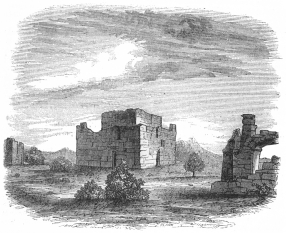
RUINS OF A CASA GRANDE.

APPENDIX. METEOROLOGICAL OBSERVATIONS IN CALIFORNIA
Mr. T. Butler King was furnished by Surgeon General Lawson, United States Army, with the following thermometrical observations:
At San Francisco, by Assistant Surgeon W. C. Parker, for six months, embracing the last quarter of 1847, and the first quarter of 1848. The monthly mean temperature was as follows: October, 57°; November, 49°; December, 50°; January, 49°; February, 50°; March, 51°.
At Monterey, in latitude 36° 38´ north, and longitude 121° west, on the coast, about one degree and a half south of San Francisco, by Assistant Surgeon W. S. King, for seven months, from May to November inclusive. The monthly mean temperature was: May, 56°; June, 59°; July, 62°; August, 59°; September, 58°; October, 60°; November, 56°.
At Los Angeles, latitude 34° 7´, longitude west 118° 7´, by Assistant Surgeon John S. Griffin, for ten months, from June, 1847, to March, 1848, inclusive. The monthly mean temperature was: June, 73°; July, 74°; August, 75°; September, 75°; October, 69°; November, 59°; December 60°; January, 58°; February, 55°; March, 58°. This place is about forty miles from the coast.
At San Diego, latitude 32° 45´, longitude west 117° 11´, by Assistant Surgeon J. D. Summers, for the following three months of 1849, viz: July, monthly mean temperature, 71°; August, 75°; September, 70°.
At Suttersville, on the Sacramento river, latitude 38° 32´ north, longitude west 121° 34´, by Assistant Surgeon R. Murray, for the following months of 1849. July, monthly mean temperature 73°; August, 70°; September, 65°; October, 65°.
These observations show a remarkably high temperature at San Francisco during the six months from October to March, inclusive; a variation of only eight degrees in the monthly mean, and a mean temperature for the six months of fifty-one degrees.
At Monterey we find the mean monthly temperature from May to November, inclusive, varying only six degrees, and the mean temperature of the seven months to have been 58°. If we take the three summer months the mean heat was 60°. The mean of the three winter months was a little over 49°; showing a mean difference, on that part of the coast, of only 11° between summer and winter.
The mean temperature of San Francisco, for the three winter months, was precisely the same as at Monterey—a little over 49°.
As these cities are only about one degree and a half distant from each other, and both situated near the ocean, the temperature at both, in summer, may very reasonably be supposed to be as nearly similar as the thermometer shows it to be in winter.
The mean temperature of July, August, and September, at San Diego, only 3° 53´ south of Monterey, was 72°. The mean temperature of the same months at Monterey was a little over 59°; showing a mean difference of 13°.
At Los Angeles, 40 miles distant from the coast, mean temperature for the three summer months was 74°; of the three autumn months, 67°; and three winter months, 57°. At Suttersville, 130 miles from the sea, and 4° north of Los Angeles, mean temperature of August, September and October, was 67°. Mean temperature of same months at Monterey, 59°; making a difference of 8° between the coast and the interior, on nearly the same parallel of latitude.
APPENDIX No. 2.
The following statement of the amount of California gold deposited at all the United States Mints, comprising those of Philadelphia, New Orleans, Charlotte, and Dahlonega, from the opening of the mines, or discovery of the metal, until the 30th of the month of September, 1851, is taken from the memoranda of Robt. Patterson, Esq., of Philadelphia, son of the late Director of the Mint.
Philadelphia. New Orleans. Charlotte. Dahlonega. Total
For the year 1848 44,177 1,124 45,301
"""1849 5,481,439 669,921 6,151,360
"""1850 31,667,505 4,575,567 30,025 36,273,097
9 months of 1851 31,300,105 6,310,462 12,805 70,925 37,694,297
Totals $68,493,226 $11,557,074 $12,805 $100,950 $80,164,055
The total production of California gold since its discovery is doubtless over one hundred millions of dollars in value, which, according to official data in my possession, is equal to nearly one half the total coinage of this country in gold, silver, and copper, since its separation from Great Britain. To the $80,164,055 received at the U. S. Mints, as shown above, must be added large amounts received here, and consumed by jewellers, dentists, &c.; considerable amounts shipped from San Francisco directly to other countries; the gold coinage and circulation in California itself, including the $50 pieces stamped by the U. S. Assayer; the shipments received here since the 1st of October, amounting, in New York alone, to about $5,000,000, and all the gold dust now in the hands of miners and merchants on the Pacific side. It will be a fair estimate, therefore, to set down the entire production, up to the close of 1851, at $120,000,000, at least.