NOTE BY THE COMMITTEE OF PUBLICATION.
Stephen Salisbury translation
The Publishing Committee are glad of the opportunity to print another paper from the pen of Professor Valentini. His previous contributions have been favorably received by some of the most competent judges. He is always ingenious and suggestive, taking care to sustain his views by adequate collateral information, and leaving an impression of earnestness and thoroughness, even though the reader should not be able always to see the way through his bold inferences to the important conclusions deduced from them.
It seems apparent that new phases of opinion respecting the position in the world’s history held by the races occupying the central portions of the American Continent may be looked for in the near future. Or rather, perhaps, it may be claimed that vestiges of ancient and independent culture, of revolutions, conquests, and changing dynasties, extending back to a remote period of time, which have hitherto simply excited and bewildered travellers and explorers, bid fair to be subjected to tests and comparisons derived from wider and closer observation, for which the means are accumulating, and from which definite results are anticipated.
It is remarkable how one tidal wave of investigation after another has, at different eras, invaded and receded from these regions, carrying from them more or less of the fragments of their architectural, monumental, and pictorial records—the sources of doubtful and unsatisfactory interpretation. The Spanish chroniclers; the scientists of the period of Humboldt and his contemporaries; the French government and the learned societies of France, uniting their efforts to render effective the honest but undisciplined enthusiasm of Brasseur de Bourbourg; all have experienced a subsidence of interest arising mainly from a want of success in yielding a sufficiently plausible solution of a mysterious subject. The death of Brasseur, the fall of Maximilian, and the political distractions of the French government and people, are not alone the causes of suspended action on the part of the learned bodies of France. They deemed it prudent to discredit the judgment and correctness of their own agent. One at least of Brasseur’s Commission publicly disavowed responsibility for his opinions; and his attempt to interpret 48the Codex Troano by means of the alphabet of Bishop Landa was pronounced by themselves to be a failure.
How signally the explorations of Del Rio, of Dupaix, of Galindo, and of De Waldeck, failed to make a permanent impression on the public mind! How soon the illustrated narrative of Stephens became in a measure disregarded, and even his reliableness questioned! How completely the nine ponderous folios of Lord Kingsborough’s extensive collection fell dead from the press, until the great work to which he had devoted his life and his entire fortune sold in the market for less than a single useless production of Increase or Cotton Mather! We have seen the elaborate and learned essays of Gallatin upon Mexican civilization slumbering with the long sleep of the Ethnological Society; the Geographical Society cautious about travelling out of the routes of regular expeditions; even the sardonic “Nation,” assumed arbiter in literature, politics, and science, and always ready for caustic criticism, hesitating to venture far beneath the surface of these important inquiries. The ill-fated Berendt has perished in the midst of his unfinished labors; and, lastly, one of the most purely philosophical investigators of Indian habits and history reasons in a direction opposed to the antiquity and extent of aboriginal civilization.
If there is to be a renewal of interest in Mexican archæology, and a revived consciousness of something more to be gained from the relics of culture among the early races of this continent (a meaning in its mystical remains that has not been developed), our Society may claim its share in the re-kindling or fostering of the newly excited impulse. In saying this we do not overlook the preparation which recent studies of the general condition of prehistoric races has created for such investigations; but, in this particular field, it has had the fortune to draw special attention to certain regions and opportunities of research. This has been due to the earnest and liberal exertions of one of its members, who, some years since, passed a winter in Yucatan, and has kept up a correspondence with friends and acquaintances there.[26] He embodied his observations and experiences in a report on behalf of the Council rendered in 1876. He has since endeavored to promote the operations of Dr. and Mrs. Le Plongeon in the actual field, and has assisted in preparing the papers of Professor Valentini for our publications, providing illustrations in all cases when practicable. The Report of the Council in the present number of “Proceedings” is largely devoted to an account, by the writer[27] of a visit to the city of Mexico, and his observations upon the country and its history. More than twelve years ago, in January, 1868, a generous member of the Society[28] had the forethought to establish a department of the library composed of books relating to Spanish America, beginning with the gift of Lord Kingsborough’s mammoth publication, and others, for the 49specialty of antiquities, and accompanied by a pecuniary foundation for future growth. The importance of a provision for this particular purpose becomes daily more conspicuous as attention is directed to that portion of the continent.
It is gratifying to perceive that such movements, with the greater activity in publishing its “Anales” on the part of the Museo Naçional de México, and the issue of such publications as that of Prof. Rau by the Smithsonian Institution,[29] and the private work of Mr. Short,[30] are not without their influence.
The scheme, which, although not fully matured, we have reason to believe a real one, of sending an expedition to some of the original Mexican provinces for a thorough exploration, at the cost of a wealthy citizen of New York, the results to be printed in the North American Review, may be regarded as one of the fruits of the “Renaissance.”
S. F. Haven,
For the Committee.
Introductory Remarks.
In the ensuing discussion an attempt is made to explain the so-called “Katunes of Maya history.”
The Manuscript which bears this name is written in the Maya language, and its discovery is of comparatively recent date. At its first publication in 1841 it could not fail to attract the attention of all those who were engaged in the study of ancient American history, because it unveiled a portion of the history of Yucatan, which had been till then entirely unknown and seriously missed. At that date only a scanty number of data, loosely described, and referring to an epoch removed from the Spanish conquest of the Peninsula by only a few decades, had appeared as the sole representatives of a long past, in which the builders of the ruined cities undoubtedly must have lived an eventful life, not to be counted by a few generations, but by a long and hardly calculable number of centuries. This vacuum of time the manuscript promised to fill out. Though it did not offer a history conceived in the common acceptation of the 50word, the brief epitome of events which it presented, began by telling us of the arrival of foreigners from distant lands, who, step by step succeeded in conquering the Maya soil and who were brought into significant connection with the name as well as the fall of cities now lying in ruins over the whole country.
As to the authenticity of the events reported, they have been received by many students with a confidence and faith rarely manifested when discoveries of such importance are brought to light. As to the form in which they were presented, the author seemed to exhibit neither the skill of a professional nor the clumsiness of an occasional forger. If on the one hand the gaps he left betrayed a defective memory, this circumstance should be held rather as an indication of his credibility. The material from which his information was derived, we might add, was extensive, and much of it was probably lost when he gave the account at a later period of his life.
The events communicated being in themselves of the highest interest, rose in importance from the fact that they were arranged in successive epochs. A chance was thereby given to calculate the long space of time that intervened between the arrival of the ancient and of the modern conquerors. This difficult task was attempted by the fortunate discoverer himself, Señor Juan Pio Perez, of Yucatan, accompanied by a learned discussion on ancient Maya chronology. His calculation furnishes the sum of 1392 years, the first initial date to be assigned to the year 144 A. D., and the last to 1536 A. D.
When, some years ago we undertook to examine the argument of Señor Perez we were not at all astonished by the great antiquity of the date he had drawn from the Maya Manuscript. For, nearly at the same time, we had reached similar results in an attempt made to utilize certain records which Ixtlilxochitl (1590), and Veytia (1760), (Kingsborough Collection, Vols. 8 and 9), have left regarding the earliest chronology of the Nahuatl tribes. By adopting a more 51rational method of computation than these Mexican writers had followed, we were unable to withstand the conclusion, that the Nahuatl people who were immediate territorial neighbors of the Mayas, considered the year 258 A. D. the earliest date of their arrival on and occupancy of the Mexican soil. Thus we had reached in this line of investigation very nearly the same results with the Nahuatl as Señor Perez with the Maya chronology, and the suspicion began to dawn upon us that these two neighboring people might, possibly, have stood in a still closer than a mere territorial connection.
These results, however, were only of a very problematical nature. They were derived from written reports, which, after all, could not be regarded as unquestionable authority. But they received a strong confirmation from a discovery we made later on the so-called Mexican Calendar Stone. In our discussion of this monument we believe that we have given ample proof of the fact, that its principal zone contains a sculptured record, showing a series of numerical symbols, from the computation of which the year 231 A. D. resulted as that which the Nahuatls had accepted as the first date of their national era.
Records presented in stone and compiled by the nation whose history they convey, must always be considered the most authentic evidence of historical truth. Now, were we also so fortunate as to possess some Maya monument, similar to the Mexican Calendar Stone, and were we also able to decipher it, we should thereby have the means for determining whether Maya chronology extended back to an epoch different from that of the Nahuatl, or to one identical with it. That such a monument once existed we have no doubt. That it may still exist, we have no reasonable grounds for denying the possibility. It remains, however, still to be discovered and to be interpreted. But since the fortunate discovery has not yet been made, we must rest satisfied for the present with conclusions derived from extant written records. The only manuscript of this character thus far 52brought to light, is that said to have been found at Mani,[31] which was translated by Señor Perez from the Maya language, and accompanied by a very valuable chronological interpretation.
Since the close revision we undertook of the latter, brought out very striking coincidences of early Maya dates with those of the Nahuatl, and especially with that indicated on the Calendar Stone, we thought it worth while to reprint the manuscript, to discuss its contents again, and to arrange them under new points of view. Regarded by itself, the manuscript, indeed, might seem of only doubtful value in settling an important chronological question. But the comparison of its earliest date with that of the Nahuatl monument will enhance the value of each of them, because they may be considered as corroborative of each other.
THE MAYA MANUSCRIPT.
Maya. Translation.
Lai u tzolan Katun lukci ti cab ti yotoch Nonoual cante anilo Tutul Xiu ti chikin Zuiua; u luumil u talelob Tulapan chiconahthan. This is the series of “Katunes” that elapsed from the time of their departure from the land and house of Nonoual, in which were the four Tutul Xiu, lying to the west of Zuina, going out of the country of Tulapan.
§1. Cante bin ti Katun lic u ximbalob ca uliob uaye yetel Holon Chantepeuh yetel u cuchulob: ca hokiob ti petene uaxac Ahau bin yan cuchi, uac Ahau, can Ahau cabil Ahau, cankal haab catac hunppel haab; tumen hun piztun oxlahun Ahau cuchie ca uliob uay ti petene caukal haab catac hunppel haab tu pakteil yetel cu ximbalob lukci tu luumilob ca talob uay ti petene Chacnouitan lae, u añoil lae 81. §1. Four epochs were spent in travelling, before they arrived here with Holonchantepeuh and his followers. When they began their journey toward this island, it was the 8th Ahau, and the 6th, 4th and 2d were spent in travelling; because in the year of the 13th Ahau they arrived at this island, making together eighty-one years they were travelling, between their departure from their country and their arrival at this island of Chacnouitan.
81 años. Years 81.
53§ 2. Vaxac Ahau, uac Ahau, cabil Ajau kuchci Chacnouitan Ahmekat Tutul Xiu hunppel haab minan ti hokal haab cuchi yanob Chacnouitan lae: lai u habil lae. § 2. The 8th Ahau, the 6th Ahau; in the 2d Ahau arrived Ajmekat Tutul Xiu, and ninety-nine years they remained in Chacnouitan.
99 años. Years 99.
§ 3. Laitun uchci u chicpahal tzucubte Ziyan-caan lae Bakhalal, can Ahau, cabil Ahau, oxlahun Ahau oxkal haab cu tepalob Ziyan-caan ca emob uay lac: lai u haabil cu tepalob Bakhalal chuulte laitun chicpahci Chichen Itza lae. § 3. In this time also took place the discovery of the province of Ziyan-caan or Bacalar, the 4th Ahau and 2d Ahau, or sixty years, they had ruled in Ziyan-caan when they came here. During these years of their government of the province of Bacalar occurred the discovery of Chichen-Itza.
60 años. Years 60.
§ 4. Buluc Ahau, bolon Ahau, uuc Ahau, ho Ahau ox Ahau, hun Ahau uac kal haab cu tepalob Chichen Itza ca paxi Chichen Itza, ca binob cahtal Champutun ti yanhi u yotochob ah Ytzoab kuyen uincob lae. § 4. The 11th Ahau, the 9th, 7th, 5th, 3d and 1st Ahau, or 120 years, they ruled in Chichen-Itza, when it was destroyed, and they emigrated to Champoton, where the Itzaes holy men, had houses.
120 años. Years 120.
§ 5. Vac Ahau, chucuc u luumil Chanputun, can Ahau, cabil Ahau, oxlahun Ahau, buluc Ahau, bolon Ahau, uuc Ahau, ho Ahau, ox Ahau, hun Ahau, lahca Ahau, lahun Ajau, uaxac Ahau, paxci Chanputun, oxlahun kaal haab cu tepalob Chanputun tumenel Ytza uincob ca talob u tzaclé u yotochob tu caten, laix tun u katunil binciob ah Ytzaob yalan che yalan aban yalan ak ti numyaob lae; lai u habil cuchinbal lae. § 5. The 6th Ahau they took possession of the territory of Champoton; the 4th Ahau, 2d, 13th, 11th, 9th, 7th, 5th, 3d, 1st, 12th, 10th and 8th, Champoton was destroyed or abandoned. Two hundred and sixty years the Itzaes reigned in Champoton, when they returned in search of their homes, and they lived for several katunes under the uninhabited mountains.
260 años. Years 260.
§ 6. Vac Ahau, can Ahau, ca kal haabcatalob u heↄob yotoch tu caten ca tu zatahob Chakanputun: lay u habil lae. § 6. The 6th Ahau, 4th Ahau, after 40 years, they returned to their homes once more and Champoton was lost to them.
40 años. Years 40.
§ 7. Lai u katunil cabil Ahau. u heↄci cab Ajcuitok Tutul Xiu Vxmal. Cabil Ahau, oxlahun Ahau, buluc Ahau, bolon Ahau, uuc Ahau, ho Ahau, ox Ahau, hun Ahau, lahca Ahau, lahun Ahau, lahun kal haab cu tepalob yetel u halach uinicil Chichen Itza yetel Mayalpan: lay u habil lae. § 7. In this Katun of the 2d Ahau, Ajcuitok Tutul Xiu established himself in Uxmal; the 2d Ahau, the 13th, 11th, 9th, 7th, 5th, 3d, 1st, the 12th and 10th Ahau, equal to 200 years, they governed in Uxmal, with the governors of Chichen Itza and of Mayapan.
200 años. Years 200.
54§ 8. Lai u katunil buluc Ahau, bolon Ahau, uac Ahau, uaxac Ahau, paxci u halach uinicil Chichen Itza tumenel u kebanthan Hunac-eel, ca uch ti Chacxib chac Chichen Itza tu kebanthan Hunac-eel u halach uinicil Mayalpan ichpac. Cankal haab catac lahun piz haab, tu lahun tun uaxac Ahau cuchie; lai u haabil paxci tumenel Ahzinteyutchan yetel Tzunte-cum, yetel Taxcal, yetel Pantemit, Xuchu-cuet, yetel Ytzcuat, yetel Kakaltecat lay u kaba uinicilob: lae muctulob ahmayal panob lae. § 8. These are the Katunes 11th, 9th and 6th Ahau (sic). In the 8th Ahau the governor of Chichen-Itza was deposed, because he murmured disrespectfully against Hunac-eel. This happened to Chacxibchac of Chichen-Itza, governor of the fortress of Mayapan. Ninety years had elapsed, but the 10th year of the 8th Ahau was the year in which he was overthrown by Ajzinte-yut-chan, with Tzunte-cum, Taxcal, Pantemit, Xuch-ueuet, Ytzcuat and Kakaltecat; these are the names of the seven Mayalpanes.
90 años. Years 90.
§ 9. Laili u katunil uaxac Ahau, lai ca binob u pâ ah Vlmil Ahau tumenel u uahal-uahob yetel ah Ytzmal Vlil Ahau; lae oxlahun uuↄ u katunilob ca paxob tumen Hunac-eel: tumenel u ↄabal u naatob; uac Ahau ca ↄoci: hunkal haab catac can lahun pizi: lai u habil cu xinbal. § 9. In the same Katun of the 8th Ahau they attacked Chief Ulmil, in consequence of his quarrel with Ulil, Chief of Yzamal; thirteen divisions of troops he had when he was routed by Hunac-eel; in the 6th Ahau the war was over, after 34 years.
34 años. Years 34.
§ 10. Vac Ahau, can Ahau, cabil Ahau, oxlahun Ahau, buluc Ahau, chucuc u luumil ich pâ Mayalpan, tumenel u pach tulum, tumenel multepal ich cab Mayalpan, tumenel Ytza uinicob yetel ah Vlmil Ahau lae; can kaal haab catac oxppel haab: yocol buluc Ahau cuchie paxci Mayalpan tumenel ahuitzil ↄul, tau cah Mayalpan. § 10. In the 6th Ahau, 4th, 2d, 13th and 11th Ahau, the fortified territory of Mayapan was invaded by the men of Itza, under their Chief Ulmil, because they had walls, and governed in common the people of Mayalpan; eighty-three years elapsed after this event, and at the beginning of the 11th Ahau Mayalpan was destroyed by strangers of the Uitzes, Highlanders, as was also Tancaj of Mayalpan.
83 años. Years 83.
§ 11. Vaxac Ahau lay paxci Mayalpan lai u katunil uac Ahau, can Ahau, cabil Ahau, lai haab cu ximbal ca yax mani españoles u yaxilci caa luumi Yucatan tzucubte lae, oxkal haab pâaxac ich pâ cuchie. § 11. In the 8th Ahau, Mayalpan was destroyed; the epochs of the 6th, 4th and 2d Ahau elapsed, and at this period the Spaniards for the first time arrived, and gave the name of Yucatan to this province, sixty years after the destruction of the fortress.
60 años. Years 60.
55§ 12. Oxlahun Ahau, buluc Ahau, uchci mayacimil ich pâ yetel nohkakil: oxlahun Ahau cimci Ahpula: uacppel haab u binel ma ↄococ u xocol oxlahun Ahau cuchie, ti yanil u xocol haab ti lakin cuchie, canil kan cumlahi pop, tu holhun Zip catac oxppeli, bolon Ymix u kinil lai cimi Ahpula; laitun año cu ximbal cuchi lae ca oheltabac lay u xoc numeroil años lae 1536 años cuchie, oxkal haab paaxac ich pâ cuchi lae. § 12. The 13th and 11th Ahau, pestilence and small pox were in the castles. In the 13th Ahau, Chief Ajpula died; six years were wanting to the completion of the 13th Ahau; this year was counted toward the east of the wheel, and began on the 4th “Kan.” Ajpula died on the 18th day of the month Zip, in the 9th Ymix; and that it may be known in numbers, it was the year 1536, sixty years after the destruction of the fortress.
§ 13. Laili ma ↄococ u xocol buluc Ahau lae lai ulci españoles kul uincob ti lakin u talob ca uliob uay tac luumil lae; bolon Ahau hoppci cristianoil uchci caputzihil: laili ichil u katunil lae ulci yax obispo Toroba u kaba, heix año cu ximbal uchie. § 13. Before the termination of the 11th Ahau, the Spaniards arrived, holy men from the east came with them when they reached the land. The 9th Ahau was the commencement of baptism and Christianity; and in this year was the arrival of Toroba (Toral), the first bishop.
1544 años. 1544 A. D.
Note.—This Manuscript has also an introduction and close, which Señor Perez has not published, because the dates specified occurred in the Spanish epoch, and consequently were of no interest to the Maya student.
History of the Manuscript.
In the interest of authenticity it is much to be regretted that neither the name of the author, his residence, nor the date when the Manuscript was written, are known to us, and we are also ignorant of other matters of moment; whether the Manuscript is an original or a copy, or how often copied, or by what family or person it may have been preserved before it came into the hands of Don Juan Pio Perez. That Yucatecan gentleman had retired from Mérida, the capital, to the District of Peto, to devote himself to his favorite studies, the ancient language and the history of his nation. The unusual interest that he showed in this direction, united to his influential position as first officer of 56the district, enabled him to obtain many small manuscript documents known to have been written by the natives in their vernacular language, the Maya, soon after the time of the conquest, which, for the most part, contained historical reminiscences of the time of the supremacy of their ancestors. Among these manuscripts there was a so-called Chilam Balam Calendar, which, in the form of an appendix, contained, besides, the outlines of the primitive history of Yucatan. It was, indeed, but a brief epitome of historical events, accompanied by the corresponding dates. But its value consisted in the circumstance that these dates were catalogued according to successive epochs; and it required only slight inspection to disclose the fact that they extended back to a period not very distant from our Christian Era.
This was a discovery to the learned world as welcome as any that could be made. It was unique in its kind. All attempts, thus far, had vainly sought to learn something about the history of the builders of those palaces and temples with whose ruins the peninsula was covered at the date of the arrival of the Spaniards, and which pointed to a long past and to the unceasing activity of a numberless population, which, while it was skilled in the most important branches of art and industry, and familiar with a luxury such as only ancient Asia and India had displayed, was yet governed by a despotic and hierarchical power. The native, when asked whose work the ruins were, would answer nothing but that they owed their origin to men who, in ancient times, had immigrated from far distant countries.
The Manuscript disclosed at once the history of these strange immigrants, showed the progressive march of the conquest, and the contemporaneous foundation of the largest cities then in ruins, and furnished in the Maya language the chronology of each event and its corresponding epoch. By means of his extensive antiquarian knowledge Señor Perez made an exact translation of this Manuscript into Spanish, and afterwards undertook a critical interpretation 57of its contents, and accompanied the whole with an introductory explanation of the system of ancient Maya chronology.
In the midst of these labors he was surprised by the arrival of the celebrated American traveller and archæologist, John Lloyd Stephens, and was induced to entrust to him a copy of the MSS. and interpretations to be embodied in his work on Yucatan, in order to bring them more fully before the world. His wishes were scrupulously complied with, and the Spanish translation has been rendered into literal English by Mr. Stephens in “Incidents of Travel in Yucatan,” vol. I., Appendix, pages 434–459, and vol. II., Appendix, pages 465–469.
Mr. Albert Gallatin, who, of all American students, has made himself most thoroughly acquainted with what remains of the historical elements of the Nahuatl and Maya people, has brought together the results of his investigations in a lecture published in the “Transactions of the American Ethnological Society,” New York, 1858, vol. I., pages 104–114. The information therein contained attests an entire familiarity with the method pursued by Señor Perez in his commentary, without, indeed, undertaking any severe criticism of it. In our opinion Mr. John L. Stephens and Mr. Gallatin are the only Americans who have recognized Señor Perez’s merits in an unequivocal manner, and have brought them to the knowledge of the world.
This is all we could learn about the Manuscript, nor have we been able to form a supposition, much less to discover in the text itself any clue to the source from which the unknown Maya author could have drawn his data. At the end of the Manuscript Señor Perez gives his opinion that the whole was written from memory, because it must have been done long after the conquest, and after Bishop Landa had publicly destroyed much of the historical picture-writing of the Mayas by an auto-da-fé, and because the whole narration is so concise and condensed that it appears more like an index than a circumstantial description of events.
58These opinions of Señor Perez might cast a well grounded suspicion on the authenticity of the manuscript. We shall try to remove such doubts, at once, by presenting the following considerations. We do not believe that Bishop Landa succeeded in burning the entire treasures of Maya literature at the notorious auto-da-fé in the town of Mani in 1561. The authorities[32] to which we have access describe the number of the destroyed objects so precisely that we have every reason to confide in their correctness. We read of 5,000 idols of different size and form, 13 large altar stones, 22 smaller stones, 197 vessels of every form and size, and lastly of 27 rolls (sic) on deerskin covered with signs and hieroglyphics, given to destruction at that time and place. We may believe that the terrorism exercised by Bishop Landa had a powerful influence on the minds and on the newly converted consciences of the natives, and the Bishop no doubt used every possible means to get into his hands as much as he could of what he considered to be “cabalistic signs and invocations to the devil.” But we can never believe that these 27 rolls represented the entire Maya literature, collected for hundreds of years with the greatest care and held sacred by the natives. Such a wholesale destruction would have been an impossibility. We could refer to a similar occurrence that took place in Mexico; and though Bishop Zumarraga has the bad reputation of having destroyed all the picture treasures of the Nahuatls by an auto-da-fé, there were notwithstanding so many of them in existence soon after his time in the possession of native families that Ixtlilxochitl, Tezozomoc, and others, were able to build up their detailed accounts of the primitive history of their country from these original sources. Possibly numbers of them may have been preserved among the Maya tribes, for only under such favorable conditions could Cogolludo, Villagutierre and Lizana have obtained 59the valuable information and material which form the chief interest of their labors and researches, and which enabled also Pio Perez in the year 1835, to discover material from which to interpret so complete a description of the system of Maya chronology. Nay, even, we have a suspicion that Bishop Landa may have laid aside the most important part of these records, or what was the most intelligible to him, for we cannot comprehend how he would have been able without these pictures before his eyes to present in his work the symbols for the days so correctly, and also those for the months, or how otherwise he could have written his work in Spain, so far removed from all sources of information and from consultation with the natives.
No reason, therefore, exists why the Maya author should not have remained in possession of some painting, which exhibited the annals of his forefathers. If, however, he was compelled to write his “Series of Katunes” from memory, there is no reason for not relying on the accuracy of his retentive faculties alone. The noble Indians, and he belonged undoubtedly to this class, were very particular in training their sons to learn by heart songs expressing the glorious deeds of their ancestors. It is a fact attested by the Spanish chroniclers, that these songs were recited publicly in the temples and on solemn religious occasions. They were the only kind of positive knowledge with which we know the brains of the Indian pupils were burdened. In either case, therefore, the accuracy of the written Maya report needs not be doubted, at least not on the grounds alleged. Had it been composed in the Spanish language instead of Maya, we should have viewed this circumstance with a more critical eye. But as the native under Spanish rule expressed it in his native language, this kind of loyalty appears to us to give a certain warranty of dealing with a man who described the traditions of his oppressed race, and who wished to perpetuate its memory by handing down to posterity the principal events of the past history of his nation.
60At this place, we should not like to omit pointing out an interesting suggestion which the clear headed and sagacious author, Señor Eligio Ancona[33] made in his before mentioned work, that Bishop Landa and the author of the Manuscript agree so often in their mention of historic dates, in the manner as well as the matter, as to lead to the idea that both drew their information from the same source. Whatever be its origin, we agree with the views of Señor Perez, that, in spite of the deficiency and breaks occurring in the Manuscript, it deserves critical attention as the only document thus far discovered that gives information of the early history of Yucatan.
Elements of Maya Chronology.
It is impossible to understand the Manuscript before obtaining a knowledge of the division of time prevalent in Yucatan before the Spanish Conquest. Señor Perez has the incontestable merit of having been the first to lay before the world not only the chief points of the system but also all the technical details. Before his time but little was known of Maya chronology. From the great historic works of Torquemada, Herrera and Cogolludo, we learn only that the Mayas, in conformity with the Mexicans, held that the solar year was composed of 360 days, and when these were passed they added 5 days more as a correction. We are told that both nations divided their years into 18 months, and their months into twenty days each. As to the longer periods of time, however, we hear of certain differences. While the Mexicans had an epoch of 6152 years which they divided into 4 smaller periods, the so called Tlapilli, each of 13 years, the Mayas counted a great epoch of 260 years, the so called Ahau Katun, subdivided into 13 smaller periods each of 20 years, with the simple name Ahau. This period of 20 years was according to Cogolludo[34] subdivided again into what he calls lustra of 5 years each, but he does not give the native name of this division.
62The discovery of the Manuscript, no doubt, induced Señor Perez to make a systematic and detailed sketch of the early native chronology of his country. We shall mention only the most interesting and important of his details and refer the reader for the rest to Stephens’ work already mentioned. The names of the 20 days in the month are as follows:—
1 Kan.
2 Chicchan.
3 Quimij.
4 Manik.
5 Lamat.
6 Muluc.
7 Oc.
8 Chuen.
9 Eb.
10 Been.
11 Gix.
12 Men.
13 Quib.
114 Caban.
215 Edznab.
316 Cavac.
417 Ahau.
518 Ymix.
619 Yx.
720 Akbal.
63The 18 months were as follows:—
1 Pop (16th of July.)
2 Uoo (5th of August)
3 Zip (25th of August).
4 Zodz (14th of September).
5 Zeec (4th of October).
6 Xal (24th of October).
7 Dze-yaxkin (13th of November).
8 Mol (3d of December).
9 Dchen (23d of December).
10 Yaax (12th of January).
11 Zae (1st of February).
12 Quej (21st of February).
13 Mac (13th of March).
14 Kankin (2d of April).
15 Moan (22d of April).
16 Pax (12th of May).
17 Kayab (1st of June).
18 Cumkū (21st of June).
As the table shows their year began with the first day of the month Pop, which corresponded to the 16th of July in our calendar, when, as Señor Perez observes, the sun was almost vertical over the Peninsula. The day itself was called Kin, Sun, the month U, Moon, and the 5 intercalary days were called nameless days, Xona-Kaba-Kin, not-name-Sun.
In the arrangement of their yearly calendar the Mayas proceeded as follows: Like the Mexicans they used a combination of the numbers 1 to 13, with the names of the 20 days of the month. They called the first day of the month Pop (our 16 July) 1 Kan, the second 2 Chicchan, the third 3 Quimij, and so on. The fourteenth day was called 1 Caban, the fifteenth 2 Edznab, and the last or twentieth day 7 Akbal. The first day of the second month followed in correct numerical sequence with the name 8 Kan, the second with the name 9 Chicchan. Thus repeating the 20 names of the days with the above combination of numbers from 1 to 13 they reached the 360th day with the name 9 Akbal. Then followed the intercalary week of 5 days bearing the names 10 Kan, 11 Chicchan, 12 Cimij, 13 Manik, and 1 Lamat.
The second year begins with 2 Muluc. In the same manner going on with the combination the first day of the third year was 3 Hix, then followed 4 Cavac, 9 Kan, 10 Muluc, 11 Hix, 12 Cavac, 13 Kan, 1 Muluc, 2 Hix, and so on. At the end of the 52d year the above-mentioned combination was exhausted, 64for the 53d year began again with the day 1 Kan.
Names of the Months. Pop. Uoo. Zip. Zodz. Zeec. Xul. Dze-yaxkin. Mol. Dchen. Yeax. Zac. Quej. Mac. Kankin. Moan. Pax. Kayab. Cumkū.
Names of the Days. 1 2 3 4 5 6 7 8 9 10 11 12 13 14 15 16 17 18
Kan, 1 8 2 9 3 10 4 11 5 12 6 13 7 1 8 2 9 3
Chicchau, 2 9 3 10 4 11 5 12 6 13 7 1 8 2 9 3 10 4
Quimij, 3 10 4 11 5 12 6 13 7 1 8 2 9 3 10 4 11 5
Manik, 4 11 5 12 6 13 7 1 8 2 9 3 10 4 11 5 12 6
Lamat, 5 12 6 13 7 1 8 2 9 3 10 4 11 5 12 6 13 7
Muluc, 6 13 7 1 8 2 9 3 10 4 11 5 12 6 13 7 1 8
Oc, 7 1 8 2 9 3 10 4 11 5 12 6 13 7 1 8 2 9
Chuen, 8 2 9 3 10 4 11 5 12 6 13 7 1 8 2 9 3 10
Eb, 9 3 10 4 11 5 12 6 13 7 1 8 2 9 3 10 4 11
Been, 10 4 11 5 12 6 13 7 1 8 2 9 3 10 4 11 5 12
Gix, 11 5 12 6 13 7 1 8 2 9 3 10 4 11 5 12 6 13
Men, 12 6 13 7 1 8 2 9 3 10 4 11 5 12 6 13 7 1
Quib, 13 7 1 8 2 9 3 10 4 11 5 12 6 13 7 1 8 2
Caban, 1 8 2 9 3 10 4 11 5 12 6 13 7 1 8 2 9 3
Edznab, 2 9 3 10 4 11 5 12 6 13 7 1 8 2 9 3 10 4
Cavac, 3 10 4 11 5 12 6 13 7 1 8 2 9 3 10 4 11 5
Ahau, 4 11 5 12 6 13 7 1 8 2 9 3 10 4 11 5 12 6
Ymix, 5 12 6 13 7 1 8 2 9 3 10 4 11 5 12 6 13 7
Yk, 6 13 7 1 8 2 9 3 10 4 11 5 12 6 13 7 1 8
Akbal, 7 1 8 2 9 3 10 4 11 5 12 6 13 7 1 8 2 9
The following year must begin with 2 Muluc.
Each week had 5 days Kan 10
Chicchan 11
Quimij 12
Manik 13
Lamat 1
It is to be observed here that this arrangement of a calendar of epochs agrees with that in use in the interior of Mexico. There, the numbers from 1 to 13 were combined with four names, Tecpatl, Calli, Tochtli and Acatl, which they had taken, like the Mayas, from the names for the 20 days of the month; and both calendars represent the first days of their weeks of five days as occurring upon the 1st, 6th, 11th and 16th days of the month. From this system 65Señor Perez arrives at the division into great epochs of 52 years used in Mexico as well as in Yucatan. This statement appears hazardous in the highest degree when compared with the statements made by the before-mentioned authorities. They claim for Yucatan an epoch of 20 and 260 years respectively; and Landa, who wrote with the first impressions of the conquest still fresh in his mind, and whose information came directly from the natives themselves, agrees with them. Without doubt Señor Perez must have been aware of this contradiction. After he had developed in §7 the so-called epoch of the Mayas of 52 years he makes us acquainted with this national Maya epoch, though, as we shall presently learn, he disagrees with the Maya writers as to the time of its duration. His statement is: §8. “The Yucatecans, besides the great cycle of 52 years, employed still another great cycle, which had reference to certain portions of it, in order to date the main epoch, and the most notable events of their history. Each of these cycles contained 13 periods, of 24 years each, making together 312 years. Each period, or Ahau-Katun was divided into two parts. The first of these parts of 20 years was enclosed in a square (sic), and was called on that account amaytun, lamayte or lamaytun. The second part of 4 years formed, so to speak, a pedestal for the first part, and was called chek oc Katun, or lath oc Katun, which signifies a chair or pedestal. These years were considered intercalary, and were held to be unlucky years. They were called u yail Jaab, and the same was the case with the 5 intercalary days to which they corresponded. The separation of the 20 years from the following 4 years gave rise to the erroneous idea that the Ahaues consisted of twenty years only, an error which has prevailed almost universally among those who have written upon this subject. But if they had counted the years which compose a period, and had taken notice of the positive declarations of the manuscript to the effect that the Ahaues consisted of 24 years 66divided as above stated, they would not have misled their readers on this point.”
Señor Perez continues:—
“It is an incontrovertible fact that those Maya periods, epochs or ages, took their name from Ahau Katun, for they began to be counted from the day which bore the name Ahau, the second day of those years, which began with the name Cavac. But as these days and numbers were taken from years which had run their course, the periods of 24 years could never maintain an arithmetical order, but succeeded each other according to the following arrangement of numbers: 13, 11, 9, 7, 5, 3, 1, 12, 10, 8, 6, 4, 2. As the Indians considered the number 13 the initial number, it is probable that some remarkable event had happened in that year, because, when the Spaniards arrived in the Peninsula, the Indians then counted the 8th as the 1st, that being the date at which their ancestors came to settle there; and an Indian writer proposed that they should abandon that order also, and begin counting from the 11th, solely because the Conquest had happened in that Ahau. Now, if the 13th Ahau Katun began on a second day of the year, it must be that year which began on 12 Cavac, and the 12th of the series. The 11th Ahau would commence in the year of 10 Cavac, which occurred after a period of 24 years, and so on with the rest; taking notice that after the lapse of years we come to the respective number marked in the course of the Ahaues which is placed first; proving that they consisted of 24, and not, as some have believed, of 20 years.”
From the heading (§8), “Of the Great Cycle of 312 years, or Ahau Katunes,” as well as of the text just quoted, it is apparent that Señor Perez intended to establish the fact that the ancient Maya cycles were composed of 24 and 312 years respectively. He does so in manifest contradiction to the prevalent opinion that they consisted of 20 and 260 years. We do not understand the reasons why he should have come to this conclusion. It grew out 67neither from the facts alleged nor from the connection into which he wove them together. The peculiar circumstance of having, in his commentary references, four years intercalated in succession to the usual cycle of twenty years, and included in a square, to serve as a “pedestal” to the former, is not capable of shedding new light upon the question and causing us to distrust authorities on which we were accustomed to rely. The other reason, which stands second in his order of forming premises for his conclusion, is said to be the undeniable fact, that those periods took their name of Ahau Katun, because they began to be counted from the day Ahau, which was the second day of those years that began in Cavac. Of this incontrovertible fact the readers are not elsewhere informed. The information, however, which we are able to give is that according to all we have been able to gather on the Maya Calendar, a period, or a single year, commencing with a day named Ahau, has never existed in their system of counting. They always commenced it with the words Kan, Muluc, Hix, Cavac. If there existed any exceptional ground for changing an old established method of dating, the reason should have been stated, for it is preposterous to assume that the first day of a great cyclical period should have taken its name from any other day of the year’s calendar than from the four above named. Nor do we understand the reason why, just here, the topic of the succession of the numbers 13, 11, 9, 7, 5, 3, 1, 12, 10, 8, 6, 4, 2, was introduced. Could it have been with the intention of showing that this singular enumeration of alternating Ahaues, which we shall hereafter speak of, occurred only in cycles of 24 years, and that therefrom a proof might be derived for establishing the pretended cycle of 24 and 312 years? Evidence of this should have been given by a table showing the series, and by still another table in which should be shown that such an alternating succession did not occur in cycles composed of 20 years. Not one single fact can be 68detected in Señor Perez’s text, by which the long established assumption of a 20 years’ cycle has been disproved.
Nevertheless, the data which we possess of the ancient Maya Calendar are not so complete as to disprove emphatically that a cycle of 24 and 312 years respectively was never used by the Maya chronologers.
Without doubt, Yucatan owed its ancient greatness to the success of uniting a rude and scattered population around a number of theocratical centres, where similar forms of worship were maintained. Though the ancient records are wanting, this feature of the Maya system stands out upon the background of dim traditions with great distinctness. After this concentration of tribes, and with the view of regulating worship, a uniform calendar would have been introduced, the main features of which would probably have been a solar year of 365 days, the division of the year into 20 months, and a cyclical period of 20 and 260 years respectively. In the middle of the 11th century great tribal revolutions took place on the high plateaus of Anahuac, by which the lowlands of Yucatan were also affected. An adventurous tribe of the Nahuatl stock possessed itself of one of the principal towns of Yucatan and established its influence and power. Mayapan became the centre of Nahuatl worship. The calendar the invaders brought with them must have been the old honored division of the years into 365 days, with 20 months, and their cyclical period of not 20 but 52 years, and it is also known that about the year 1450, the political union of the Mayas was broken into several smaller divisions, some of which presumably would have held to the ancient cycle of 20 years; others may have adopted the Nahuatl cycle of 52 years, and possibly, may have introduced the cycle of 24 years spoken of by Señor Perez. Political schism was likely to have generated also a hierarchical one, and each newly formed body of priests, in whose hands the custody and composition of annals fell, would have sought to distinguish themselves from their 69predecessors by innovations, if only of a formal character. Such changes we also observe among the Nahuatls in Anahuac. The period of 52 years, however, seems to have constantly prevailed among them, and also the divisions of the 365 days into 18 months of 20 days each.
We find, for instance, that one of the Nahuatl tribes begins its annals with December 9, another selects December 26, another January 9, and others January 12, February 4, and February 22. We also know that a different calculation prevailed among these tribes in beginning their annals. The State of Colhuacan began its chronology with a year 1 Calli, the State of Mexico with 2 Acatl, others with 1 Tochtli, and seemingly the most ancient calculation began with the year 1 Tecpatl. Thus we have a historical basis for our assertion that the Nahuatl as well as the Maya tribes did not conform to a uniform rule in beginning their first year’s date, in their chronological epochs, or in the division of their cyclical epochs.
In spite of this diversity, so perplexing to modern chronologists, the Aztecs and the Mayas were both governed by the same general principle in arranging their calendars. Both nations recognized the fact that in the past their solar year had numbered only 360 days; and they preserved in the words nemotemi and xona-kaba-kin, the remembrance of a not to be forgotten effort exerted by their ancestors to correct the primordial solar year of 360 days into one of 365 days. Both nations conscientiously kept on dividing the year into 18 months, and each of the months into 20 days, and with both the number 13 returns as a basis governing the calendar of years as well as that of periods.[35]
We notice, moreover, that both nations omit to count the 20 days of the month in the succession of the figures 1–20, 70but after the thirteenth day they again begin with the number 1, and the 20th day therefore was figured with the number 7, and also that the Mexicans counted their smallest period with 13 years, the so-called tlapilli, and upon its quadruple the cycle of 52 years was based. The lesser Maya or Ahau period is 20 years, while the greater or Ahau Katun is 260 years or 13 times the smaller. Señor Perez’s lesser period of 24, and the greater one of 312 years show the same method and calculation (13 × 24 = 312).
This conformity between the early calendars of Central America should not escape the observation of the future historical enquirer. He will be compelled to adopt a very remote period of time when both nations, differing so entirely in their language, dwelt in peace, connected by the strong bands of a hierarchical power. One of these two nations, it is clear, must have invented it. Hence the question arises, was it original with the immigrating Nahuatl tribes who came from the higher northern countries as is reported, and did they succeed in forming such a consolidation with the Maya races as to mingle both under the same hierarchical government, or did the contrary take place? The most prevalent opinion makes the Nahuas the inventors of the general system of chronology, but later students begin to express themselves in favor of its Maya origin. On a more fitting occasion we are desirous to present our reasons for taking the latter view.
Before passing from these chronological speculations to the discussion of the Maya Manuscript, we wish to state briefly our idea of the origin of the system of reckoning by alternating Ahaues. [See page 66]. We promised to return to this subject, and shall now endeavor to give a solution to this chronological problem differing from that of Señor Perez. A passage in Bishop Landa’s work, determined our decision. After a previous and positive assertion that the lesser Ahau period consisted of 20 years, Landa continues, ... “The order in which they computed 71their dates and made their prophecies by the aid of this computation (of 20 years) was arrived at by having two idols, dedicated to two of these characters (Ahaues). To the first idol, which stands with a cross marked above the circle, they paid homage by making him offerings and sacrifices, in order to obtain an immunity from the calamities to come in these 20 years, but after ten of these years had passed they offered nothing but incense and worship. When the twenty years of the first were fully passed they began to 72occupy themselves with the presages of their second idol and to offer sacrifices to him, having taken away their first idol to replace it by the second, in order to worship it in the coming ten years.”[36]
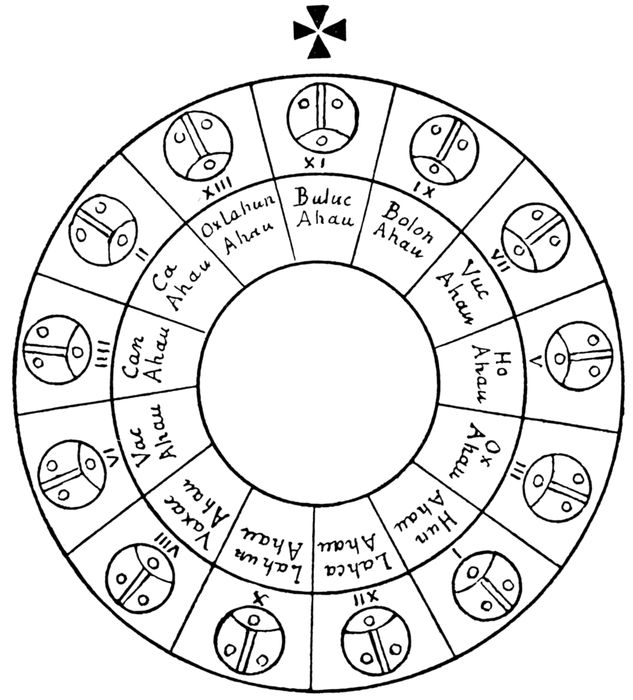
AHAU KATUN. [Above we give a reproduction of a Maya Ahau Katun wheel taken from that in Landa’s “Las cosas de Yucatan,” § XL., in order that his explanation may be understood.]
“The Indians say, for example, that the Spaniards arrived at the City of Mérida in the year of the nativity of our Lord and Master 1541, which was precisely the first year of Buluc Ahau (11 Ahau), the same that we find placed at the top of the instrument[37] below the cross, and which also indicates that they arrived in the month Pop, which is the first in their year. Had the Spaniards not come as they did, then they would have placed the Idol of Bolon Ahau (9 Ahau), offering homage to it, and continuing to refer to the prognostics of Buluc Ahau, till the year 1561; and then they would take it from the temple and put in its place that of Vuc Ahau (7 Ahau), all the while continuing to refer to the prognostics of Buluc Ahau, for ten years more, and the same with the others until the tour was made. In this way they made up their Katuns of twenty and ten years, worshipping them according to their superstitions and juggleries, which were in such great numbers that there were more than enough to deceive that simple people, and there is reason for astonishment when one knows what kind of things in nature and experience belong to the Demon.”
Whoever is acquainted with the awkwardness and literary negligence of Landa’s writing will not be astonished that in 73his statement he left out something which a more careful writer would have expressed, and placed at the head of his explanation. The wanting statement, however, can be supplied. It will be noticed that Landa in his text only refers to two Ahau Idols worshipped in the temple. But this number must have been 13, as is evident from the 3d Idol Vuc Ahau, mentioned afterwards in the statement with which he finished his description, in order not to always repeat the same thing of the ten other idols which are painted on the wheel. Let us then take the statement of Landa supplemented by what we have said above as to the questionable nomenclature of these Ahaues as they appear in the row of numbers 13, 11, 9, 7, 5, 3, 1, 12, 10, 8, 6, 4, 2. Landa’s description gives us to understand that the lapse of twenty years was always required before the new combination of two idols was presented to the worshippers, and which had not before been seen in the temple in company with the former Idols. For example: When Idol 3 was placed in the temple, Idol 2 took a first place among the worshippers. Indeed, Idol 2 was in the temple with Idol 1, but Idol 3 was not with Idol 1, nor Idol 4 with Idol 2. If such a combination repeating itself after 20 years, represented a space of time familiar to the Mayas, it is natural that it should receive the name Ahau or period of the god,[38] and that it should receive its name from the number of the Idol presiding at the expiration of this space of 20 years. If therefore in the rotation of the circle Idols 2 and 3 passed out of the temple, the combination, or what is the same, the space of 20 years, during which they had ornamented the temple will have borne the name 2 Ahau, on the ground that Idol 2 had preceded 74it. The second combination, then, would follow when the presidency of Idol 4 would have finished its term, and in this way the row 2, 4, 6, 8, 10, 12, 1, 3, 5, 7, 9, 11, 13, may have had its origin.
Now, it is true that the order in which these numbers stand is different from that transmitted to us, which begins with 13 and is followed by 11 and 9. The reverse of this method of reckoning may possibly be accounted for in this way: An epoch unknown to us may have occurred when the Maya chroniclers desired to review past events and bring them into order. Counting backwards from such a date they would have called the first period of twenty years not the 13th, nor, according to our above statement, the 1st, but the 2d Ahau. Consequently the period after the expiration of the great cycles of 260 years would have been called the 13th Ahau, though properly speaking it should have been the 2d Ahau. An historical epoch for such reckoning backward is known to have occurred. It occurred again in the year 1542, when the conquest of Yucatan by the Spaniards took place. It appears that the Mayas in that year declared their 13th Ahau period to be at an end, from 1522 to 1542; consequently a back reckoning, according to this system of the Mayas, gave a 2d Ahau for the period of 1502–22, a 4th Ahau for that of 1482–1502, and going on in the same way of reckoning the year 1282 would have represented the expiration of the 13th Ahau.
The circle of Landa exemplifies this manner of counting. He starts from the 13th Ahau, counting from left to right. But if we count in the opposite direction we should obtain the row of numbers 2, 4, 6, 8, &c., as we have shown above. If we refer to the striking discovery on the Mexican Calendar stone[39] that the days upon that circle are not counted 75towards the right but towards the left, and generalize it as a rule to be adopted also for the chronological cycles of the Mayas, we should come to the conclusion that the Mayas in some of their former chronological epochs counted their Ahaues in that natural order. Who shall say that the reversed counting did not originate from a misunderstanding on the part of the Spaniards? We do not claim to have finally disposed of the question. Every new attempt will be a welcome addition to the cause, for each new investigator is obliged to descend deeper into the dark mine where Maya history lies buried.
Señor Perez’s Translation of the Manuscript.
Señor Perez is thus far the only interpreter of the Maya Manuscript, and his Spanish text found a skilful translator in Mr. John L. Stephens. Neither the Spanish text nor the special chronological analysis of each paragraph composed by Señor Perez, have hitherto been made public; we owe the possession of both these documents to the kindness of our friend, Dr. Carl Hermann Berendt, lately deceased, who, during his long residence in Yucatan, was occupied in amassing a large collection of matters relating to Maya literature and history, in original form or in authentic copies. In comparing the Spanish with the English translations, it seems that many things, not clear in the first, had been made more intelligible in the last. It is evident that Señor Perez sought to translate the Maya text as literally 76and faithfully as he could into the Spanish language, otherwise his text would have been more fluent and finished. The abruptness of expression, and the frequent ellipses in the construction of its sentences, show that the Maya idiom has been faithfully rendered. Such a course increases the interest, and at the same time it creates confidence in the correctness of the translation. Dr. Berendt, the profound scholar of the Maya language, wrote us as follows on March 14, 1873: “I have several times undertaken to translate this manuscript myself, but have always given up the task. The manifold doubts which the original text leaves open seem to me correctly solved by Señor Perez, and it always appeared to me that I might indeed make another but not a better translation. The small changes in the text of Stephens, of which you speak, I do not believe were introduced merely from a love of his own expressions. I believe that he first came to an understanding with Perez, and sought only to assist the better comprehension of the manuscript for the benefit of the public at large.”
It is to be hoped that the differences of translation of the manuscript spoken of above, and to which Señor Eligio Ancona[40] draws attention, will be critically investigated and finally decided by the coming generation of scholars in Yucatan. The sons of the country should be the born judges of the language and the spirit of the literary relics of the indigenous race. Recent investigations have shown that this language was split into sixteen dialects, which were spoken by as many tribes, whose territories extended far beyond the present area of the Yucatecan peninsula.[41] Like all languages, these Maya idioms have undergone changes during the last three or four centuries. To understand and 77explain their now obsolete elements, must be left exclusively to the native scholar.
Discussion of the Manuscript.
It will now be our task to endeavor to clear away such doubts as may arise in regard to the chronological interpretation of the Maya Manuscript. These doubts have reference, first, to the choice of the method to be pursued in reckoning the Ahaues either at 24 or at 20 years. Second, as to the manner of filling up certain gaps which the author has left open in the chronological sequence of the Ahau period; and finally, after building again this chronological structure in its logical order, we must adapt the dates expressed in Ahaues to the current language of our Christian chronological era.
In order to avoid troublesome reference to the text of the preceding pages, we shall repeat the English translation, and for better convenience, shall present two or more sections together. To demonstrate Señor Perez’s system and method of counting, we shall give the translation of the Spanish text, as communicated by Dr. Berendt, without undertaking to make any special criticisms of it.
This is the series of Katuns that elapsed from the time of their separation from the land and house of Nonoual, in which were the four Tutul Xiu, lying to the west of Zuina, going out of the country of Tulapan.
With these few words the Maya author states his purpose. He wishes to enumerate the Katuns or periods of time from the beginning of the history of his nation to the arrival of the Spanish conquerors. He tells us that his nation lived in a land called Tulapan, which was westerly from another called Zuina, and that from thence, under the lead of four chiefs, the Tutul Xiu, they had immigrated into this new country, Yucatan.
78
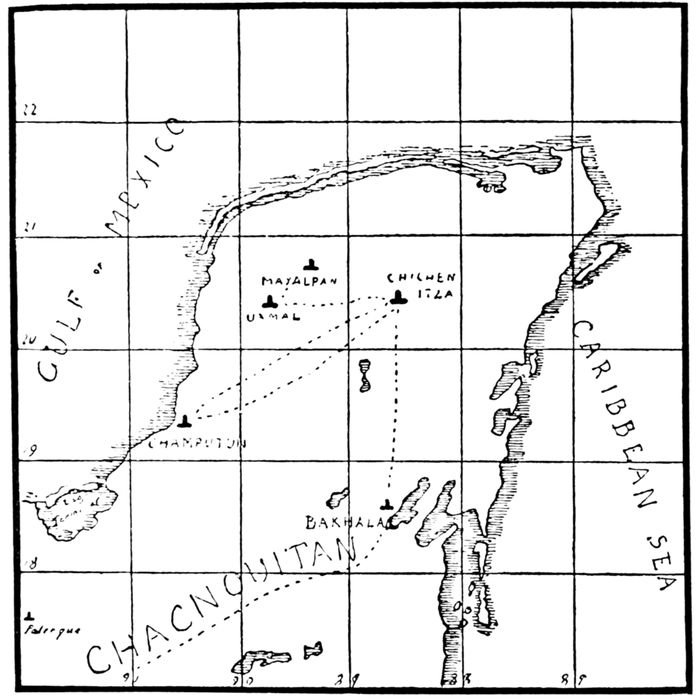
[Map showing the movement of the Mayas as stated in the Manuscript.]
By Tutul Xiu the author evidently means the name of the reigning family, which, at the arrival of the Spaniards, were considered as the ancient rulers and hereditary lords of Chichen-Itza.[42] In regard to the countries referred to by the names Tulapan and Zuina, we can only say that in Central American traditions the name Tulapan oftentimes returns 79under the form of Tulan. Thus, for example, the Quichés and Cakchiqueles, sister nations of the Mayas, make mention of the above countries in their annals.[43] Upon a closer examination of the text, contained in the so-called “Popol Vuh,” we were unable to detect any grounds for the assumption that these countries or places lay in a distant orient. They probably will turn out to have been, or by the annalists were thought to have been, situated on the northern boundaries of Mexico, on a route of migration ending with the high plateaus of Guatemala.
§1. Four epochs were spent in travelling before they arrived here with Holon Chantepeuh and his followers. When they began their journey towards this island, it was the 8th Ahau, and the 6th, 4th and 2d were spent in travelling, because in the 1st year of the 13th Ahau they arrived at this island, making together eighty-one years they were travelling between their departure from their country and their arrival at this island of Chacnouitan. These are 81 years.
We learn that four Ahau periods had passed the 8th, 6th, 4th and 2d before the wanderers arrived with their leader, Holon Chantepeuh, at the island of Chacnouitan. In the following 13th Ahau they are said to have been already settled there. It is of the highest importance to note that the Maya author here acknowledges that he reckoned each Ahau period as 20 years, and he remains faithful to this method to the end of the manuscript. By this fact alone, we should be compelled to follow the division of 20 years thus established, even if in contradiction to the statements of other chroniclers, which fortunately is not the case.
80As the author treats of the affairs of the Tutul Xiu or the so-called Itza race, and attributes to them the discovery and colonization of Yucatan, it is highly probable that he made use of the annals of the Itzaes, and that they were arranged in periods of just 20 years. If we should be right in this assumption the 20–year period must be regarded as the most ancient ever used in Yucatan.
We cannot fully agree with Señor Perez and his countrymen that the author intended to designate the peninsula of Yucatan when he speaks of the Island of Chacnouitan. This name appears for the first and only time in this manuscript. It is generally acknowledged that the name had never previously been heard of.[44] We should state that the words of the text are always nay ti petene Chacnouitan. If in Maya peten meant only a peninsula, we should take no exceptions. But the fundamental meaning of peten is an island, and as the demonstrative pronoun nay means as well “of this place” as “of that place,” the translation could as well stand for “that distant island.” Whether the island was situated in the ocean or in any of the many inland lakes, the probabilities seem to lie with the latter supposition, for they came by land. Had they come by sea, tradition would have dwelt with some characteristic remark upon such an exceptional case. From the following paragraph it will become still more evident that the Chacnouitan discovered by the Itzaes was neither the whole nor the northern part of Yucatan, 81but a district situated in the southwest of the peninsula.
§2. The 8th Ahau, the 6th Ahau, in the 2d Ahau arrived Ajmekat Tutul Xiu, and ninety-nine years they remained in Chacnouitan—years 99.
§3. In this time also took place the discovery of the Province of Ziyan-caan or Bacalar; the 4th Ahau and the 2d Ahau and the 13th Ahau, or sixty years they had ruled in Ziyan-caan when THEY CAME HERE. During these years of their government of the Province of Bacalar occurred the discovery of the Province of Chichen-Itza. These are years 60.
As the first section closed with the arrival at Chacnouitan, which took place upon the 2d Ahau, it was to be expected that the second section would continue the sequence of Ahaues so as to connect with the necessarily following 13th Ahau. But we see that it begins with the 8th Ahau, follows with the 6th and closes with the 2d Ahau.
Before taking notice of the accounts given in these two paragraphs let us first ascertain what Ahaues were left out between the 2d Ahau, at the end of the first section, and the 8th Ahau, with which the second section begins. According to the rule above given on the alternating Ahaues, the missing ones would be the following: The (13), (11), (9), (7), (5), (3), (1), (12), and (10th) Ahau. Of these nine Ahaues, or 180 years, the author had nothing in mind to tell us. No event of significance appears to have taken place. Perhaps the wanderers had to rest to gather strength before attempting further conquests. Moreover, this time belongs to the most ancient epochs of Maya history, and information regarding it was so dim and so obscure that it appeared to the author as of no account. The chronological sequence thus being established, let us now turn to the contents of the two section, 2 and 3. They begin with the 8th Ahau and close with the 13th Ahau. As to the events happening 82within the 8th, 6th, 4th, 2d and 13th Ahau, they indeed do not appear in the wished for sequence. But the sequence, as will be shown, can be established without making interpolations. It will be noticed that in section 2 the 4th Ahau is not mentioned. After having quoted the 8th and 6th Ahau, the author passes over this 4th Ahau and mentions the arrival of Ajmekat, belonging to the family of the renowned Tutul Xiu, who seems to have led in the conquests of Bacalar and Chichen-Itza, which are recorded in section 3, as happening in the 4th, 2d and 13th Ahau. That these conquests must be counted into the epoch mentioned with the names 8th, 6th, 4th, 2d and 13th Ahau is clearly expressed by the words, “in this time,” so that no mistake can take place as to the intimate connection with the arrival of Ajmekat. We learn moreover that the time which the conquerors remained in the province of Chacnouitan is said to have been 99 years. These 99 or 100 years cover exactly the time represented by the above five Ahaues, and when reading at the end of the 3d paragraph that they had ruled 60 years in Ziyan-caan Bacalar, it becomes clear that these 60 years are not years that follow the 99 years, but that they were the last years of the 99 mentioned. The two sections supplement each other, and from them the following impression is conveyed, that Chacnouitan was the territory situated southwest of the shores of the great lagoon of Bacalar. The wanderers had been waiting during eleven Ahaues, from the 13th to the 4th Ahau, before they made an attack against the possessors of Bacalar. An attempt to take it appears to have been made during the 8th, 6th and 4th Ahaues, and only accomplished in the 2d Ahau, through the arrival or help of Ajmekat, who led them further on to the discovery or conquest of Chichen-Itza, in the 13th Ahau.
The difficulty of interpreting the two sections is removed as soon as we view them in the light of the reasons given, not as two distinct epochs of which the one follows the other, 83as Señor Perez does (see commentary), but as belonging to one and the same epoch from the 8th to the 13th Ahau. It must not be so much questioned what the author ought to have done in order to represent his history in a logical way, and on account of his omissions cast a doubt upon the whole record, as how to use what he has left to construct a system from these elements, and to avail ourselves unhesitatingly of the help of the chronological sequence of Ahaues, which is and will remain the only reliable thread to lead us through and out of the labyrinth.
Commentary of Señor Perez.—“The manuscript informs us that at the 8th Ahau a colony of Toltecs under their leader Holon Chantépeuh, marched out from the city of Tulapan, and that in their wanderings they spent 4 Ahaues, 8, 6, 4, 2, till they came to Chacnouitan, which happened in the first year of the 13th Ahau. To doubt this is not possible, for this statement is the beginning and foundation of all later dates. According to my calculation which I will explain hereafter, it was from the year 144 to 217, which is 97 and not 81 years, as the manuscript reports, for if we compute the Ahaues with 24 years, as we have shown, and include the first year of the Ahau following as the time of their arrival, then the account makes 97 years. They stayed in Chacnouitan with Ajmekat Tutul Xiu during the remaining years of the 13th Ahau, until the 2d Ahau.
These Ahaues, as we have explained, should follow in the order 13, 9, 7, 5, and not 13, 6, 8, 2, for this latter list represents earlier Ahaues, and as they represent different epochs they can only be expressed by the same figures after the expiration of 312 years, thereby clearly showing the error.
It is likewise asserted that they remained 99 years in Chacnouitan, which could not have been true, for this would have made 119 actual years, or only 95 years if we reckon only four Ahaues, without the second, for if we regard the succession we miss the 4th Ahau, which the manuscript has left out. But the manuscript does not count four but five Ahaues, as it reckons an Ahau at 20 years, the five Ahaues less one year make the aforesaid 99 years.”
§4. The 11th Ahau, 9th, 7th, 5th, 3d and 1st Ahau, or 120 years, they ruled in Chichen-Itza, when it was destroyed, and they emigrated to Champutun where the Itzaes, holy men, had houses.
Years 120.
§5. The 6th Ahau they took possession of the territory of Champutun, the 4th Ahau, 2d, 13th, 11th, 9th, 7th, 5th, 3d, 841st, 12th, 10th and 8th, Champutun was destroyed or abandoned. The Itzaes reigned two hundred and sixty years in Champutun when they returned in search of their homes, and they lived for several Katuns in the uninhabited mountains.
Years 260.
§6. The 6th Ahau, 4th Ahau, after 40 years they returned to their homes once more and Champutun was lost to them.
Years 40.
The fourth section, in correct sequence, continues the series from the 13th Ahau when Chichen-Itza was founded. It covers the 11th, 9th, 7th, 5th, 3d, and 1st Ahau, a space of 20 years, in which the wanderers make the new region of Chichen-Itza their metropolis. Enemies, however, whose names are not indicated, destroy the place and oblige them to look elsewhere. They then turn to Champutun (now Champoton, also Potonchan), situated in a southwesterly direction from Chichen-Itza, on the westerly shore of the Peninsula.
The fifth section should begin with the 12th Ahau, but instead it follows the 6th Ahau. Hence the (12th), (10th) and (8th) Ahau are missing. These 60 years may be supposed to be the time required by the exiles to recuperate their strength in order to conquer the new territory of Champoton. In the 6th Ahau then they succeeded in taking Champoton, and they remained there during the 4th, 2d, 13th, 11th, 9th, 7th, 5th, 3d, 1st, 12th, 10th and 8th Ahaus, a full Ahau-Katun epoch of 260 years. They were obliged to leave Champoton in the 8th Ahau, and seemed willing to return to their old home, but determined to reconquer Champoton. We are told in the sixth section that two Katuns or 40 years, were passed in delays and preparations, correctly figured by the 6th and 4th Ahau; that they then made an attempt to reconquer Champoton, failing in which, they were obliged to look about for a new home.
Commentary of Señor Perez to the 4th, 5th and 6th Sections.—They remained in Chichen-Itza and ruled there until it was destroyed, 85when they betook themselves to Champoton. Here they built their houses during the 11th, 9th, 7th, 5th, 3d and 1st Ahaues (sic). If this succession should be stated correctly it would be the 10th, 8th, 6th, 4th, 2d and 13th Ahau, or from the year 452 to 576, A. D., when the 13th Ahau expired. The Ahaues represented the years 432, 456, 480, 504, 528 and 552 A. D.
§5. In the 6th Ahau they took Champoton and held sway there during the following twelve Ahaues until it was destroyed. After this they looked again for a home after they had passed several Katunes in the mountainous regions, which were the 11th, 9th, 7th, 5th, 3d, 1st, 12th, 10th, 8th, 6th, 4th, 2d and 13th Ahaues, making a complete epoch of 312 years. Their coming should not have been stated as the 6th, but the 11th Ahau, according to the explanation.
§6. In the 6th and 4th Ahau they again erected houses after they had lost Champoton, that is after a lapse of 48 years, which requires a connection with the 11th and 9th Ahau. This occurred in the years 888 to 936 A. D., for the 11th Ahau began in 888, the 9th in 912, and ended in the year 936 A. D.
§7. In this Katun of the 2d Ahau, Ajcuitok Tutul Xiu established himself in Uxmal; the 2d Ahau, 13th, 11th, 9th, 7th, 5th, 3d, 1st, 12th and 10th Ahau, equal to 200 years, they governed in Uxmal, with the governors of Chichen-Itza and Mayapan.
The former section closing with the 4th Ahau, this begins with the 2d and is followed in correct succession by the 13th, 11th, 9th, 7th, 5th, 3d, 1st, 12th and 10th, a space of 200 years. In the 2d Ahau, under their leader Ajcuitok, they settled down in a new region at the town of Uxmal. It appears that Chichen-Itza had been rebuilt, and Mayapan newly founded. Rulers resided at both places at peace with the Tutul Xiu at Uxmal.
Commentary of Señor Perez to Section 7.—In the 2d Ahau Ajcuitok Tutul Xiu made a settlement in Uxmal, and reigned there with the Governors of Chichen-Itza and Mayapan during 2d, 13th, 11th, 9th, 7th, 5th, 3d, 1st, 12th and 10th Ahau. A correction of these Ahaues gives us the 7th, 5th, 3d, 1st, 12th, 10th, 8th, 6th, 4th and 2d, and brings them into harmony with the Christian era, to wit: the years 936, 960, 987, 1008, 1032, 1056, 1080, 1104, 1128 and 1152 A. D. The 2d Ahau ended with the foundation and with the completion of 240 years in the year 1176, for the foundation took place in the year 936, when the 7th Ahau just now corrected began.
86§8. These are the Katuns, 11th, 9th and 6th Ahau (sic.) In the 8th the Governor of Chichen-Itza was deposed because he murmured disrespectfully against Hunac-eel. This happened to Chacxibchac of Chichen-Itza, governor of the fortress of Mayalpan. Ninety years had elapsed, but the tenth year of the 8th Ahau was the year in which he was overthrown by Ajzinte-yut-chan with Tzunte-cum, Taxcal, Pantemit, Xuch-cuet, Ytzcuat and Kakaltecat. These are the names of the seven Mayalpanes.
§9. In the same Katun of the 8th Ahau, they attacked King Ulmil in consequence of his quarrel with Ulil, King of Yzamal; thirteen divisions of troops he had when he was routed by Hunac-eel; in the 6th Ahau the war was over after 34 years.
As the foregoing section 7 closed with the 10th Ahau, we should expect section 8 to begin with the 8th Ahau. We read, however, 11th, 9th and 6th Ahau. This sequence is evidently incorrect in itself, because the 9th can never be followed by the 6th Ahau. If the period began with the 11th Ahau, the sequence should follow with the 9th and 7th Ahau. The correct reading of the text, however, will result from the examination of that which follows immediately after this introductory sentence. There we read these words: “In the 8th Ahau the governor of Chichen-Itza was deposed,” etc., and this same 8th Ahau is mentioned again in the sentence that follows, beginning with “Ninety years,” etc. So also it reappears for a third time in section 9, at its beginning. Now, as section 8 was expected to commence with the 8th Ahau, it is more than probable that the author has blundered in some way. We presume that instead of 11th, 9th and 6th, he intended to write 10th, 8th and 6th. The 10th would indicate a reference made to the ending of the last section. The 8th and 6th are those in which all the events described in our two sections occur, for the insulted governor Hunac-eel of section 8 is the same who takes revenge in section 9.
87This difficulty being removed, another arises, how to interpret the words “ninety years elapsed, but the tenth year of the 8th Ahau was the year in which he was overthrown,” etc. This reads as if these ninety years were predecessors of the 8th Ahau. If this were so, they would fall in the 10th, 12th, 1st, 3d and the first half of the 5th Ahau. Of such Ahaues mention is made in the foregoing section 7. But we notice these Ahaues were passed in peace and not in war, as our passage evidently suggests. We cannot help thinking that another blunder is concealed in this phrase, and that the author meant to write nine years. If we write, Nine years had elapsed, but the tenth year of the 8th Ahau was the year in which he was overthrown, the idea of the author seems stated correctly. These nine years, then, would have fallen in the 10th Ahau, with which we proposed to commence section 8, and nine years added to the twenty years of the 8th Ahau, make twenty-nine years, and five more years of the 6th Ahau give those thirty-four years, which, at the end of section 9 are expressly indicated as passed in war. Such is the sense which we give to these two somewhat perplexing sections.
Commentary of Señor Perez to Sections 8 and 9.—The Ahaues 11th, 9th, 6th and 8th passed away, and in the latter the governor Hunac-eel of Mayapan overthrew Chacxibchac, the governor of Chichen-Itza, because he had spoken ill of him, and in the 10th year of the last Ahau, the seven chiefs of Hunac-eel overcame the governor Chacxibchac. If a correction is to be made it should then stand 13th, 11th, 9th and 7th Ahau, or the years 1176, 1200, 1224 and 1248 to the year 1272 A. D. Hence it was the year 1258, the tenth year of the 7th Ahau that Chacxibchac was overcome.
During the 8th Ahau occurred the destruction of the power of King Ulmil, because he had waged war against Ulil of Izamal, and Hunac-eel at the head of 13 divisions overcame Ulmil in the 6th Ahau. [We are unable to give the correction of Señor Perez, as we do not comprehend his text.]
§10. In the 6th Ahau, 4th Ahau, 2d Ahau, 13th Ahau, 11th Ahau the fortified territory of Mayapan was invaded by the men of Itza under their king Ulmil because they had 88walls, and governed in common the people of Mayalpan; eighty-three years elapsed after this event, and at the beginning of the 11th Ahau, Mayalpan was destroyed by strangers of the Uitzes or Highlanders, as was also Tancaj of Mayalpan.
Years 83.
§11. In the 8th Ahau, Mayalpan was destroyed; the epochs of the 6th, 4th, 2d elapsed, and at this period the Spaniards, for the first time arrived, and gave the name of Yucatan to this province, sixty years after the destruction of the fortress.
Years 60.
In section 10 the 6th Ahau follows the 8th correctly, and the 4th, 2d, 13th and 11th Ahaues were passed in internal wars between Chichen-Itza and Mayalpan. In the 11th Ahau a highland people, called Uitze (probably Quiché), unite with the rulers of Chichen-Itza, and they then succeed in destroying Mayalpan. In section 11 another destruction of Mayalpan is reported. As this section begins with the 8th Ahau, and the foregoing ended with the 11th, a gap was left which represents the (9th), (7th), (5th), (3d), (1st), (12th) and (10th) Ahau. This gap undoubtedly means a period of great exhaustion to both contending parties, and as a second destruction of Mayalpan is reported in the 8th Ahau, we may fairly assume that this city had recovered, and in making a last effort to regain supremacy, was finally conquered. We understand the two reported destructions of this city as the heroic and victorious effort of the Maya race to exterminate the foreign Nahuatl invader, who, for a long period succeeded in taking a strong foothold in the country. In the succeeding epochs of the 6th, 4th and 2d Ahau, exhaustion from the war and disintegration must have ensued, for such was the condition in which the Spaniards found the Maya people in the following 13th and 11th Ahaues, which were the last they were allowed to count.
Commentary of Señor Perez to Sections 10 and 11.—In the 6th, 4th, 2d and 11th Ahaues the fortified land of Mayapan is attacked by the men of Itza and their king Ulmil, for it had walls, and the people 89were governed in a community. The place was destroyed by foreigners from the Highlands in the 11th Ahau, and Tancaj of Mayapan was also conquered. The correction of the reckoning gives us the 5th, 3d, 1st, 12th and 10th Ahau. We have stated that the 5th Ahau began in the year 1272, and the others were consequently 1296, 1320, 1344, and 1368, and the 8th Ahau ended in the year 1392 A. D.
In the 8th Ahau Mayapan was destroyed, then followed the Katunes of the 6th, 4th and 2d Ahau, in which latter the Spaniards passed by and gave to the province the name of Yucatan. Hence, the Ahaues begin again their regular course, though it is a contradiction to say in the foregoing section that Mayapan had been destroyed in the 11th Ahau (corrected to the 10th Ahau). It would perhaps have been better to say it had been destroyed for the second time, possibly for the purpose of rebuilding it. The 8th Ahau began in the year 1392, the 6th, 4th and 2d Ahaues fell in the years 1416, 1440 and 1464, which last ended in the year 1488 A. D.
§12. The 13th Ahau, 11th Ahau pestilence and small-pox were in the castles. In the 13th Ahau chief Ajpulà died. Six years were wanting to complete the 13th Ahau. This year was counted towards the east of the wheel, and began on the 4th Kan. Ajpulà died on the 18th day of the month Zip, on the 9th Imix; and that it may be known in numbers it was the year 1536, sixty years after the demolition of the fortress.
§13. Before the termination of the 11th Ahau the Spaniards arrived, holy men from the East came with them when they reached the land. The 9th Ahau was the commencement of baptism and Christianity; and in this year was the arrival of Toroba (Toral), the first bishop, 1544.
After the 11th section had closed with the 2d Ahau, the 12th section correctly begins with the 13th Ahau, and the 13th and last section closed the manuscript with the 11th Ahau, when the government of the Mayas was brought to an end by the arrival of the Spaniards. The particular details contained in these two sections will be discussed hereafter.
Commentary of Señor Perez to Sections 12 and 13.—In the 13th and the 11th Ahaues pestilence and small-pox reigned. In the sixth year, before the expiration of the 13th Ahau, Ajpulà died at the time 90when four Katunes were counted on the east of the wheel. His death happened on the 18th day of the month Zip, on the 9th day Imix. This date is wrong according to my reckoning; for the year 4 Cavac expired at the beginning and not at the end of the epoch, otherwise it would have been the year 4 Muluc. In the first case, the year 4 Cavac was that of 1496, in the other case it would be the year 1506, and never that of 1536, for in that year the 9th Ahau began.[45]
We give, besides, a recapitulation which Señor Perez himself added to his commentary, and for which we are indebted to the kindness of the late Dr. C. Hermann Berendt:—
“From what we have stated it will be seen that by only taking into account the number of epochs which are mentioned in the manuscript, and which elapsed between events, and by restoring this nomenclature according to the progressive series of the Ahaues, it appears that all indicated facts occur within the space of 58 epochs of 24 years each, which makes in all 1392 years to the expiration of the 11th Ahau. If we subtract these years from the year 1536, in which the 11th Ahau expired, 1444 A. D. remains as the year when the Toltecs seem to have arrived to colonize the country.
But if we allow the epochs and their enumeration to stand as they are, and in order to integrate the Ahaues in the sequence above indicated, add those which are missing, we should find that 97 epochs, each of 24 years had passed. The sum of 2328 years, represented by this count, is a space of time of too great magnitude to bring into harmony with Mexican history, and would signify that this country was 40 years older than the foundation of Rome, and 17 years older than the introduction of Greek Olympiads, which is very improbable.
Should any hypercritical person fail to believe in the list of epochs because their succession is incorrect, let him remember that the list has much to render it worthy of belief, though it must be subjected to corrections. Still less ought any one to refuse belief in the historical 91statement of events. The manuscript indicates a traditional origin common to the history of all primitive nations. It is noticeable that no traditions exist to contradict the manuscript, and that it is the only one thus far discovered. The contents of the manuscript might be thus epitomized:—
1. The Toltecs occupied 4 epochs in going from their home to Chacnouitan.
144–217 A. D.
2. They arrived there in the first year of the succeeding epoch, and remained still 4 epochs more with their chieftain, Ajmekat Tutul Xiu.
218–360 A. D.
3. They discovered Ziyan-Caan or Bacalar and ruled therein 3 epochs, till they discovered Chichen-Itza.
360–432 A. D.
4. They remained at Chichen-Itza 6 epochs, till they set out to colonize Champoton.
432–576 A. D.
5. From the discovery of Champoton, which they colonized and ruled until they lost it, 13 epochs elapsed.
576–888 A. D.
6. They remain 2 epochs in the wilderness till they return again to Chichen-Itza.
888–936 A. D.
7. In the following epoch Ajcuitok Tutul Xiu colonized Uxmal, and ruled during 10 epochs in harmony with the governors of Mayapan and Chichen.
936–1176 A. D.
8. Three other epochs pass, and in the 10th year of the following epoch Chacxibchac, ruler of Chichen, was defeated by Hunac-eel, ruler of Mayapan, and his captains.
1176–1258 A. D.
9. In the same epoch of the defeat of the ruler of Chichen they marched against Ulmil, who was king in the same Chichen, because he had waged war against Ulil, king of Izamal, which war Hunac-eel, brought to a close in the following epoch.
1258–1572 A. D.
10. In spite of Ulmil’s defeat this ruler of Chichen planned an invasion of Mayapan. After the lapse of 2 more epochs, and in the third year of that which followed, Mayapan was destroyed in the year 1368 by strangers who came from the mountains.
1272–1392 A. D.
11. Besides the three named epochs, and indeed in the last of them, the Spaniards passed along, who gave to the province the name of Yucatan.
1392–1488 A. D.
12. In the following epoch an epidemic reigned even in the temples and fortified places, and in the 6th year Ajpula died on the 11th of September, 1493.
1488–1512 A. D.
13. In the 11th and last epoch (1536–1576) the conquerors arrived, to wit: in 1527, and in the following the first Bishop came, in the year 1541, and the conquest was completed in 1560 A. D.
Thus much I have been able to bring to light in this matter. But with the help of dates, which I do not possess, and with that of the travels you have made in our country, the information which you have gathered 92must have enlarged your ideas on this subject, and I wish you would be so kind as to communicate them to your most devoted
F. I. JUAN PIO PEREZ.
Peto, April 2, 1842.
Mr. J. Lloyd Stephens.”
Concluding Remarks.
It will be noticed from the text of the Manuscript, that no events are commemorated but such as are connected with war. In this style also the Nahuatl annals were drawn up. With both nations war was recognized as the only fact worthy to be kept in the memory of the coming generations. Nor does the author state whether the country was ruled by kings or an emperor. It is rather suggested (section 7) that the tribes were gathered in groups, with a large town as a centre, and this town was governed by a priest. The words halach uinicil, holy men, were somewhat too freely interpreted with governor by the translator. In regard to the considerable gaps in the sequence of years in the manuscript, we will not longer attribute them to a lack of memory on the part of the author, but to the custom generally observed among the annalists to be regardless of any work of peace performed by the nation; and whenever the question shall be discussed, at what epoch the building of the huge pyramids and temples took place, these dates will contribute to the answer. Periods of peace certainly began with years of great exhaustion; but recovery must have ensued, and the unshaken energy of the people and their leaders must have been directed to the undertaking of works, in which they could exhibit also their taste for pomp and architectural achievements. The gaps, therefore, instead of casting a shadow upon the authority and completeness of the manuscript, may rather be thought to perform the silent office of throwing light into the obscure past of the Maya history. As to the method, however, which we employed in computing 93the omitted periods of Ahaues, we have only to say that it grew out from the nature of the Maya enumeration itself. The two ends of the interrupted series being given, the number of the intervening Ahaues could be easily supplied.
What now remains is, to discover for the restored and completed series of Ahaues the corresponding chronological expressions in our era. We find the total Ahau periods mentioned in the annals were 50. We have thought it necessary to complete twenty more periods, so that we have seventy periods (20×70), or 1400 years. As soon therefore as we know in which year of our era the last or 13th Ahau mentioned in the manuscript fell, we can, by reckoning backward, find the years date of the first Ahau mentioned, to wit: the 8th Ahau, and also determine the dates and events of each of all the other intervening Ahaues. The manuscript fortunately affords us the necessary material for determining with incontestable certainty the years date of the last 13th Ahau. It is the following: we read in the 12th section that Chief Ajpulà died in a year when there were still six years wanting before the expiration of the 13th Ahau, and that the year of his decease was 1536 A. D.
According to this statement the 13th Ahau ended with the year 1542. Bishop Landa (see §41 of his Relacion de las Cosas de Yucatan) confirms the correctness of the above calculation, though he says that the 13th Ahau expired with the year 1541. Landa undoubtedly selects this date of June 10th, 1541, as that of the last decisive victory at T’ho over the Indians, while the author of the manuscript may have had in mind the date when Mérida was officially incorporated as the capital, and a dependency of the Spanish crown, which was January 6, 1542.[46] If we subtract the total number of Ahaues already obtained, and amounting to 1400 years, from the year 1542, we obtain for the first epoch 94named in the manuscript which is the 8th Ahau, or the starting of the conquerors from Tulapan, the years 142–162 of our modern Christian era.
Of all the dates calculated from the manuscript only that of 1542 is well established from a historical point of view, as that when Mérida was declared the future capital of the conquered country. It is represented by the last year of the 13th Ahau. A second date and event, that of the final destruction of Mayapan, is mentioned by Cogolludo, who places it about the year 1420 A. D., which would give (see table, page 96) a 12th or a 10th Ahau period. But the manuscript in §11 gives Vaxac Ahau, or the 8th Ahau, which according to our computation represents the years between 1442 and 1462. Landa agrees with this statement (Relacion de las Cosas de Yucatan, §IX., page 52). “It is now 120 years since Mayapan was destroyed.” Landa wrote in the year 1566, therefore, in his conception Mayapan was destroyed in 1446, which year falls correctly in the 8th Ahau.