Front matter (continued 4)
Reading edition
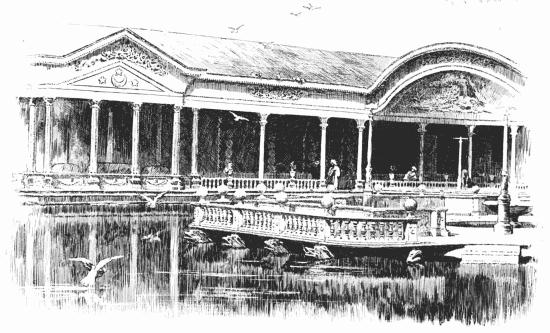
As to his private life, one comes across a trace of it at Choubra. This was Mehemet's summer residence, and the place remains much as it was during his lifetime. The road to Choubra, which was until recently the favorite drive of the Cairenes, is now deserted. The palace stands on the banks of the Nile, three miles from town, and its gardens, which cover nine acres, are beautiful even in their present neglected condition; in the spring the fragrance from the mass of blossoms is intoxicatingly sweet. But the wonder of Choubra is a richly decorated garden-house, containing, in a marble basin, a lake which is large enough for skiffs. Here Mehemet often spent his evenings. Upon these occasions the whole place was brilliantly lighted, and the hareem disported itself in little boats on the fairy-like pool, and in strolling up and down the marble colonnades, unveiled (as Mehemet was the only man present), and in their richest attire. The marbles have grown dim, the fountains are choked, the colonnades are dusty, and the lake has a melancholy air. But even in its decay Choubra presents to the man of fancy—a few such men still exist—a picture of Oriental scenes which he has all his life imagined, perhaps, but whose actual traces he no more expected to see with his own eyes in 1890 than to behold the silken sails of Cleopatra furled among Cook's steamers on the Nile. Mehemet's last years were spent at Choubra, and here he died, in 1849, at the age of eighty-one. As he had forced from Turkey a firman assigning the throne to his own family, he was succeeded by one of his sons.
ISMAIL
In 1863 (after the short reign of Ibrahim, five years of Abbas, and eight of Said), Ismail, Mehemet's grandson, ascended the throne. He had received his education in Paris.
GARDEN-HOUSE AT CHOUBRA, SHOWING PART OF THE LAKE NEAR CAIRO From a photograph by Sebah, Cairo
Much has been written about this man. The opening, in 1869, of the Suez Canal turned the eyes of the entire civilized world upon Egypt. The writers swooped down upon the ancient country in a flock, and the canal, the land, and its ruler were described again and again. The ruler was remarkable. Ismail was short (one speaks of him in the past tense, although he is not dead), with very broad shoulders; his hands were singularly thick; his ears also were thick, and oddly placed; his feet were small, and he always wore finically fine French shoes. There was nothing of the Arab in his face, and little of the Turk. One of his eyelids had a natural droop, and vexed diplomatists have left it upon record that he had the power of causing the other to droop also, thus making it possible for him to study the faces of his antagonists at his leisure, he, meanwhile, presenting to them in return a blind mask. The mask, however, was amiable; it was adorned almost constantly with a smile. The man must have had marked powers of fascination. At the present day, when some of the secrets of his reign are known—though by no means all—it is easy to paint him in the darkest colors; but during the time of his power his great schemes dazzled the world, and people liked him—it is impossible to doubt the testimony of so many pens; European and American visitors always left his presence pleased.
There are in Cairo black stories of cruelty connected with his name. These for the most part are unwritten; they are told in the native cafés and in the bazaars. It does not appear that he loved cruelty for its own sake, as some of the Roman emperors loved it; but if any one rebelled against his power or his pleasure, that person was sacrificed without scruple. In some cases it took the form of a disappearance in the night, without a sound or a trace left behind. This is the sort of thing we associate with the old despotic ages. But 1869 is not a remote date, and at that time the present Emperor of Austria, the late Emperor Frederick (then Crown-Prince of Prussia), the Empress Eugénie, Prince Oscar of Sweden, Prince Louis of Hesse, the Princess of the Netherlands, the Duke and Duchess of Aosta, and other distinguished Europeans, were the guests of this enigmatic host, eating his sumptuous dinners and attending his magnificent balls. The festivities in connection with the opening of the canal are said to have cost Ismail twenty-one millions of dollars. The sum seems large; but it included the furnishing of palaces, lavish hospitality to an army of guests besides the sovereigns and their suites, and an opera to order—namely, Verdi's Aïda, which was given with great brilliancy in Cairo, in an opera-house erected for the occasion. Ismail, like Mehemet, had his splendid dream. He, too, wished to free Egypt from the power of Turkey; but, unlike his grandfather, he wished to take her bodily into the circle of the civilized nations, not as a rival, but as an ally and friend. An Egyptian kingdom, under his rule, was to extend from the Mediterranean to the equator; from the Red Sea westward beyond Darfur. His bold ambition ended in disaster. His railways, telegraphs, schools, harbors, and postal-service, together with his personal extravagance, brought Egypt to the verge of bankruptcy. All Europe now had a vital interest in the Suez Canal, and the powers therefore united in a demand that the Sultan should stop the career of his audacious Egyptian Viceroy. The Viceroy might perhaps have resisted the Porte; he could not resist the united powers. In 1879 he was deposed, and his son Tufik appointed in his place. Ismail left Egypt. For several years he travelled, residing for a time in Naples; at present he is living in a villa near Constantinople. There is a rumor in Cairo that he is more of a prisoner there than he supposes. But this may be only one of the legends that are always attached to Turkish affairs. His dream has come true in one respect at least: Egypt has indeed joined the circle of the European nations, but not in the manner which Ismail intended; she is only a bondwoman—if the pun can be permitted.
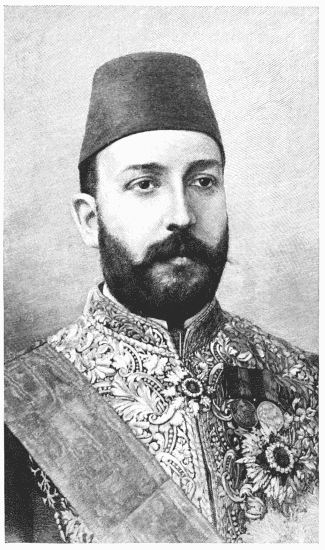
THE KHEDIVE. From a photograph by Sebah, Cairo
THE HAUNTED PALACE
The Gezireh road is to-day the favorite afternoon drive of the Cairenes. It is a broad avenue, raised above the plain, and overarched by trees throughout its course. At many points it commands an uninterrupted view of the pyramids. Two miles from town the Gezireh Palace rises on the right, surrounded by gardens, which, unlike those of Choubra, are carefully tended. It was built by Ismail. Of all these Cairo palaces it must be explained that they have none of the characteristics of castles or strongholds; they are merely lightly built residences, designed for a climate which has ten months of summer. The central hall and grand staircase of Gezireh are superb; alabaster, onyx, and malachite adorn like jewels the beautiful marbles, which came from Carrara. The drawing-rooms and audience-chambers have a splendid spaciousness: the state apartments of many a royal palace in Europe sink into insignificance in this respect when compared with them. Much of the furniture is rich, but again (as in the old house of the Sheykh es Sadat) one finds it difficult to forgive the tawdry French carpets and curtains, when the bazaars close at hand could have contributed fabrics of so much greater beauty. But Ismail's taste was French—that is, the lowest shade of French—as French is still the taste of modern Egypt among the upper classes. It remains to be seen whether the English occupation will change this. During the festivities at the time of the opening of the canal, Ismail's royal guests were entertained at Gezireh. On the upper floor are the rooms which were occupied by the Empress Eugénie, the walls and ceilings covered with thick satin, tufted like the back of an arm-chair, its tint the shade of blue which is most becoming to a blond complexion—Ismail's compliment to his beautiful guest. During these days there were state dinners and balls at Gezireh, with banks of orchids, myriads of wax-lights, and orchestras playing strains from La Belle Hélène and La Grande Duchesse. During one of these balls the Emperor of Austria made a progress through the rooms with Ismail, band after band taking up the Austrian national anthem as the imperial guest entered. The vision of the stately, grave Franz Josef advancing through these glittering halls by the side of the waddling little hippopotamus of the Nile, to the martial notes of that fine hymn (which we have appropriated for our churches under another name, and without saying "By your leave"), is one of the sinister apparitions with which this rococo palace, a palace half splendid, half shabby, is haunted.
CHIEF WIFE OF EX-KHEDIVE ISMAIL, WITH HER PRIVATE BAND From a photograph by Schoefft, Cairo
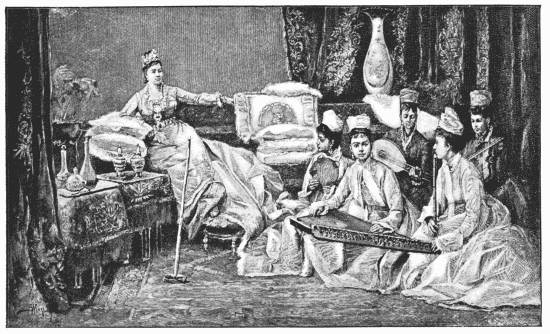
In the garden there is a kiosk whose proportions charm the eye. The guide-books inform us that this ornamentation is of cast-iron; that it is an imitation of the Alhambra; that it is "considered the finest modern Arabian building in the world"—all of which is against it. Nevertheless, viewed from any point across the gardens, its outlines are exquisite. Within there are more festal chambers, and a gilded dining-room, which was the scene of the suppers (they were often orgies) that were given by Ismail upon the occasion of his private masked balls. At some distance from the palace, behind a screen of trees, are the apartments reserved for the hareem. This smaller palace has no beauty, unless one includes its enchanting little garden; such attraction as it has comes from the light it sheds upon the daily life of Eastern women. Occidental travellers are always curious about the hareem. The word means simply the ladies, or women, of the family, and the term is made to include also the rooms which they occupy, as our word "school" might mean the building or the pupils within it. At Gezireh the hareem, save that its appointments are more costly, is much like those caravansaries which abound at our inland summer resorts. There are long rows of small chambers opening from each side of narrow halls, with a few sitting-rooms, which were held in common. The carpets, curtains, and such articles of furniture as still remain are all flowery, glaring, and in the worst possible modern taste, save that they do not exhibit those horrible hues, surely the most hideous with which this world has been cursed—the so-called solferinos and magentas. Besides their private garden, the women and children of the hareem had for their entertainment a small menagerie, an aviery, and a confectionery establishment, where fresh bonbons were made for them every day, especially the sugared rose leaves so dear to the Oriental heart. The chief of Ismail's four wives had a passion for jewels. She possessed rubies and diamonds of unusual size, and so many precious stones of all kinds that her satin dresses were embroidered with them. She had her private band of female musicians, who played for her, when she wished for music, upon the violin, the flute, the zither, and the mandolin. The princesses of the royal house, Ismail's wives and his sisters-in-law, could not bring themselves to admire the Empress of the French. They were lost in wonder over what they called her "pinched stiffness." It is true that the uncorseted forms of Oriental beauties have nothing in common with the rigid back and martial elbows of modern attire. Dimples, polished limbs, dark, long-lashed eyes, and an indolent step are the ideals of the hareem.
The legends of these jewelled sultanas, of the masked balls, of the long train of royal visitors, of the orchids, the orchestras, and the wax-lights, are followed at Gezireh by a tale of murder which is singularly ghastly. Ismail's Minister of Finance was his foster-brother Sadyk, with whom he had lived upon terms of closest intimacy all his life. The two were often together; frequently they drove out to Gezireh to spend the night. One afternoon in 1878 Ismail's carriage stopped at the doorway of the palace in Cairo occupied by his minister. Sadyk came out. "Get in," Ismail was heard to say. "We will go to Gezireh. There are business matters about which I must talk with you." The two men went away together. Sadyk never came back. When the carriage reached Gezireh, Ismail gave orders that it should stop at the palace, instead of going on to the kiosk, where they generally alighted. He himself led the way within, crossing the reception-room to the small private salon which overlooks the Nile. Here he seated himself upon a sofa, drawing up his feet in the Oriental fashion, which was not his usual custom. Sadyk was about to follow his example, when he found himself seized suddenly from behind. The doors were now locked from the outside, leaving within only the two foster-brothers and the man who had seized Sadyk. This was a Nubian named Ishak, a creature celebrated for his strength. He now proceeded to murder Sadyk after a fashion of his own country, a process of breaking the bones of the chest and neck in a manner which leaves on the skin no sign. Sadyk fought for his life; he dragged the Nubian over the white velvet carpet, and finally bit off two of his fingers. But he was not a young man, and in the end he was conquered. During this struggle Ismail remained motionless on the sofa, with his feet drawn up and his arms folded. A steamer lay at anchor outside, and during the night Sadyk's body was placed on board; at dawn the boat started up the river. At the same hour Ismail drove back to Cairo, where, in the course of the morning, it was officially announced that the Minister of Finance, having been detected in colossal peculations, had been banished to the White Nile, and was already on his way thither. Sadyk's body rests somewhere at the bottom of the river. But Ismail's little drama of banishment and the steamer were set at naught when, after he had left Cairo, Ishak the Nubian returned, with his mutilated hand and his story. Such is the tale as it is told in the bazaars. Ismail's motive in murdering a man he liked (he was incapable of true affection for any one) is found in the fact that he could place upon the shoulders of the missing minister the worst of the financial irregularities which were trying the patience of the European powers. It did him no good. He was deposed the next year.
During the spring of 1890 Gezireh awoke to new life for a time. A French company had purchased the place, with the intention of opening it as an Egyptian Monte Carlo. But Khedive Tufik, who has prohibited gambling throughout his domain, forbade the execution of this plan. So the tarnished silks remain where they were, and the faded gilded ceilings have not been renewed. When we made our last visit, during the heats of early summer, the blossoms were as beautiful as ever, and the ghosts were all there—we met them on the marble stairs: the European princes, led by poor Eugénie; the sultanas, with their jewels and their band; Ismail, with his drooping eyelids; and Sadyk, followed by the Nubian.
TUFIK
The present Khedive (or Viceroy) is thirty-eight years of age. Well proportioned, with fine dark eyes, he may be called a handsome man; but his face is made heavy by its expression of settled melancholy. It is said in Cairo that he has never been known to laugh. But this must apply to his public life only, for he is much attached to his family—to his wife and his four children; in this respect he lives strictly in the European manner, never having had but this one wife. He is a devoted father. Determined that the education of his sons should not be neglected as his own education was neglected by Ismail, he had for them, at an early age, an accomplished English tutor. Later he sent them to Geneva, Switzerland; they are now in Vienna. Tufik's chief interest, if one may judge by his acts, is in education. In this direction his strongest efforts have been made; he has improved the public schools of Egypt, and established new ones; he has given all the support possible to that greatest of modern innovations in a Mohammedan country, the education of women. With all this, he is a devout Mohammedan; he is not a fanatic; but he may be called, I think, a Mohammedan Puritan. He receives his many European and American visitors with courtesy. But they do not talk about him as they talked about Ismail; he excites no curiosity. This is partly owing to his position, his opinions and actions having naturally small importance while an English army is taking charge of his realm; but it is also owing, in a measure, to the character of the man himself. One often sees him driving. On Sunday afternoons his carriage in semi-state leads the procession along the Gezireh Avenue. First appear the outriders, six mounted soldiers; four brilliantly dressed saises follow, rushing along with their wands high in the air; then comes the open carriage, with the dark-eyed, melancholy Khedive on the back seat, returning mechanically the many salutations offered by strangers and by his own people. Behind his carriage are four more of the flying runners; then the remainder of the mounted escort, two and two. At a little distance follows the brougham of the Vice-reine; according to Oriental etiquette, she never appears in public beside her husband. Her brougham is preceded and followed by saises, but there is no mounted escort. The Vice-reine is pretty, intelligent, and accomplished; in addition, she is brave. Several years ago, when the cholera was raging in Cairo, and the Khedive, almost alone among the upper classes, remained there in order to do what he could for the suffering people, his wife also refused to flee. She stayed in the plague-stricken town until the pestilence had disappeared, exerting her influence to persuade the frightened women of the lower classes to follow her example regarding sanitary precautions. Tufik is accused of being always undecided; he was not undecided upon this occasion at least. It is probable that some of his moments of indecision have been caused by real hesitations. And this brings us to Arabi.
Arabi (he is probably indifferent to the musical sound of his name) was the leader of the military revolt which broke out in Egypt in 1881—a revolt with which all the world is familiar, because it was followed by the bombardment of Alexandria by the English fleet. Arabi had studied at El Azhar; he knew the Koran by heart. To the native population he seemed a wonderful orator; he excited their enthusiasm; he roused their courage; he almost made them patriotic. The story of Arabi is interesting; there were many intrigues mixed with the revolt, and a dramatic element throughout. But these slight impressions—the idle notes merely of one winter—are not the place for serious history. Nor is the page completed so that it can be described as a whole. Egypt at this moment is the scene of history in the actual process of making, if the term may be so used—making day by day and hour by hour. Arabi has been called the modern Masaniello. The watchword of his revolt was, "Egypt for the Egyptians"; and there is always something touching in this cry when the invaded country is weak and the incoming power is strong. But it may be answered that the Egyptians at present are incapable of governing themselves; that the country, if left to its own devices, would revert to anarchy in a month, and to famine, desolation, and barbarism in five years. Americans are not concerned with these questions of the Eastern world. But if a similar cry had been successfully raised about two hundred years ago on another coast—"America for the Americans"—would the Western continent have profited thereby? Doubtless the original Americans—those of the red skins—raised it as loudly as they could. But there was not much listening. The comparison is stretched, for the poor Egyptian fellah is at least not a savage; but there is a grain of resemblance large enough to call for reflection, when the question of occupation and improvement of a half-civilized land elsewhere is under discussion. The English put down the revolt, and sent Arabi to Ceylon, a small Napoleon at St. Helena. The rebel colonel and his fellow-exiles are at present enjoying those spicy breezes which are associated in our minds with foreign missions and a whole congregation singing (and dragging them fearfully) the celebrated verses. Arabi has complained of the climate in spite of the perfumes, and it is said that he is to be transferred to some other point in the ocean; there are, indeed, many of them well adapted for the purpose. The English newspapers of to-day are dotted with the word "shadowed," which signifies, apparently, that certain persons in Ireland are followed so closely by a policeman that the official might be the shadow. Possibly the melancholy Khedive is shadowed by the memory of the exile of Ceylon. For Tufik did not cast his lot with Arabi. He turned towards the English. To use the word again, though with another signification, though ruler still, he has but a shadowy power.
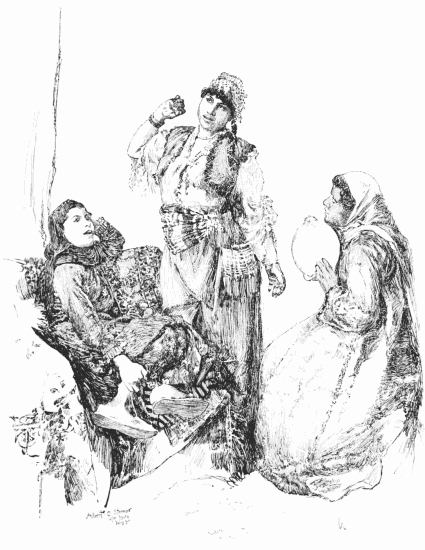
AN EGYPTIAN DANCING-GIRL
THE ARAB MUSEUM
Near the city gate named the Help of God, on the northeastern border of Cairo, is the old mosque El Hakim. Save its outer walls, which enclose, like the mosques of Touloun and Amer, a large open square, there is not much left of it; but within this square, housed in a temporary building, one finds the collection of Saracenic antiquities which is called the Arab Museum.
This museum is interesting, and it ought to be beautiful. But somehow it is not. The barrack-like walls, sparsely ornamented with relics from the mosques, the straight aisles and glass show-cases, are not inspiring; the fragments of Arabian wood-carving seem to be lamenting their fate; and the only room which is not desolate is the one where old tiles lie in disorder upon the floor, much as they lie on broken marble pavements of the ancient houses which, half ruined and buried in rubbish, still exist in the old quarters. Why one should be so inconsistent as to find no fault with Gizeh, where rows of antiquities torn from their proper places confront us, where show-cases abound, and yet at the same time make an outcry over this poor little morsel at El Hakim, remains a mystery. Possibly it is because the massive statues and the solid little gods of ancient Egypt do not require an appropriate background, as do the delicate fancies of Saracenic taste. However this may be, to some of us the Arab Museum looks as if a New England farmer's wife had tried her best to make things orderly within its borders, poor soul, in spite of the strangeness of the articles with which she was obliged to deal. It must, however, be added that the museum will not make this impression upon persons who are indifferent to the general aspect of an aisle, or of a series of walls—persons who care only for the articles which adorn them—the lovers of detail, in short. And it is well for all of us to join this class as soon as our feet have crossed the threshold. For we shall be repaid for it. The details are exquisite.
The Arab Museum has been established recently. Every one is grateful to the zeal which has rescued from further injury so many specimens of a vanishing art. One covets a little chest for the Koran which is made of sandal-wood. It is incrusted with arabesques carved in ivory, and has broad hasps and locks of embossed silver. There are many koursis, or small, stool-like tables; one of these has panels of silver filigree, and fretted medallions bearing the name of the Sultan Mohammed ebn Kalaoon, thus showing that it once belonged to the mosque at the Citadel which was built by that Memlook ruler—the mosque whose minarets are ornamented with picturesque bands of emerald-hued porcelain. The illuminated Korans are not here; they are kept in the Public Library in the Street of the Sycamores. Perhaps the most beautiful of the museum's treasures are the old lamps of Arabian glass. In shape they are vases, as they were simply filled with perfumed oil which carried a floating wick; the colors are usually a pearly background, faintly tinged sometimes by the hue we call ashes of roses; upon this background are ornaments of blue, gold, and red; occasionally these ornaments are Arabic letters forming a name or text. These lamps were made in the thirteenth and fourteenth centuries; the glass, which has as marked characteristics of its own as Palissy ware, so that once seen it can never be confounded with any other, has a delicate beauty which is unrivalled.
HELIOPOLIS
Like the pyramids, Heliopolis belongs to Cairo. On the way thither, one first traverses the pleasant suburb of Abbasieh. How one traverses it depends upon his taste. The most enthusiastic pedestrian soon gives up walking in the city of the Khedive save in the broad streets of the new quarter. The English ride, one meets every day their gallant mounted bands; but these are generally residents and their visitors, and the horses are their own; for the traveller there are only the street carriages and the donkeys. The carriages are dubiously loose-jointed, and the horses (whose misery has already been described) have but two gaits—the walk of a dying creature and the gallop of despair; unless, therefore, one wishes to mount a dromedary, he must take a donkey. But the "must" is not a disparagement; the white and gray donkeys of Cairo—the best of them—are good-natured, gay-hearted, strong, and even handsome. They have a coquettish way of arching their necks and holding their chins (if a donkey can be said to have a chin), which always reminded me of George Eliot's description of Gwendolen's manner of poising her head in Daniel Deronda. George Eliot goes on to warn other young ladies that it is useless to try to imitate this proud little air, unless one has a throat like Gwendolen's. And, in the same spirit, one must warn other donkeys that they must be born in Cairo to be beautiful. Upon several occasions I recognized vanity in my donkey. He knew perfectly when he was adorned with his holiday necklaces—one of imitation sequins, the other of turquoise-hued beads. I am sure that he would have felt much depressed if deprived of his charm against magic—the morsel of parchment inscribed with Arabic characters which decorated his breast. His tail and his short mane were dyed fashionably with henna, but his legs had not been shaved in the pattern which represents filigree garters, and whenever a comrade who had this additional glory passed him, he became distinctly melancholy, and brooded about it for several minutes. There is nothing in the world so deprecating as the profile of one of these Cairo donkeys when he finds himself obliged, by the pressure of the crowd, to push against a European; his long nose and his polite eye as he passes are full of friendly apologies. The donkey-boy, in his skull-cap and single garment, runs behind his beast. These lads are very quick-witted. They have ready for their donkeys five or six names, and they seldom make a mistake in applying them according to the supposed nationality of their patrons of the moment, so that the Englishman learns that he has Annie Laurie; the Frenchman, Napoleon; the German, Bismarck; the Italian, Garibaldi; and the Americans, indiscriminately, Hail Columbia, Yankee Doodle, and General Grant.
In passing through the Abbasieh quarter, we always came, sooner or later, upon a wedding. The different stages of a native marriage require, indeed, so many days for their accomplishment that nuptial festivities are a permanent institution in Cairo, like the policemen and the water-carts, rather than an occasional event, as in other places. One day, upon turning into a narrow street, we discovered that a long portion of it had been roofed over with red cloth; from the centre of this awning four large chandeliers were suspended by cords, and at each end of the improvised tent were hoops adorned with the little red Egyptian banners which look like fringed napkins. In the roadway, placed against the walls of the houses on each side, were rows of wooden settees; one of these seats was occupied by the band, which kept up a constant piping and droning, and upon the others were squatted the invited guests. Every now and then a man came from a gayly adorned door on the left, which was that of the bridegroom, bringing with him a tray covered with the tiny cups of coffee set in their filigree stands; he offered coffee to all. In the meanwhile, in the centre of the roadway between the settees, an Egyptian, in his long blue gown, was dancing. The expression of responsibility on his face amounted to anxiety as he took his steps with great care, now lifting one bare foot as high as he could, and turning it sidewise, as if to show us the sole; now putting it down and hopping upon it, while he displayed to us in the same way the sole of the other. This formal dancing is done by the guests when no public performers are employed. Some one must dance to express the revelry of the occasion; those who are invited, therefore, undertake the duty one by one. When at last we went on our way we were obliged to ride directly through the reception, our donkeys brushing the band on one side and the guests on the other; the dancer on duty paused for a moment, wiping his face with the tail of his gown.
The road leading to Heliopolis has a charm which it shares with no other in the neighborhood of Cairo: at a certain point the desert—the real desert—comes rolling up to its very edge; one can look across the sand for miles. The desert is not a plain, the sand lies in ridges and hillocks; and this sand in many places is not so much like the sand of the sea-shore as it is like the dust of one of our country roads in August. The contrast between the bright green of the cultivated fields (the land which is reached by the inundation) and those silvery, arrested waves is striking, the line of their meeting being as sharply defined as that between sea and shore. I have called the color silvery, but that is only one of the tints which the sand assumes. An artist has jotted down the names of the colors used in an effort to copy the hues on an expanse of desert before him; beginning with the foreground, these were brown, dark red, violet, blue, gold, rose, crimson, pale green, orange, indigo blue, and sky blue. Colors supply the place of shadows, for there is no shade anywhere; all is wide open and light; and yet the expanse does not strike one in the least as bare. For myself, I can say that of all the marvels which one sees in Egypt, the desert produced the most profound impression; and I fancy that, as regards this feeling, I am but one of many. The cause of the attraction is a mystery. It cannot be found in the roving tendencies of our ancestor, since he was arboreal, and there are no trees in the strange-tinted waste. The old legend says that Adam's first wife, Lilith, fled to Egypt, where she was permitted to live in the desert, and where she still exists:
"It was Lilith, the wife of Adam;
Not a drop of her blood was human."
Perhaps it is Lilith's magic that we feel.
THE INUNDATION NEAR CAIRO
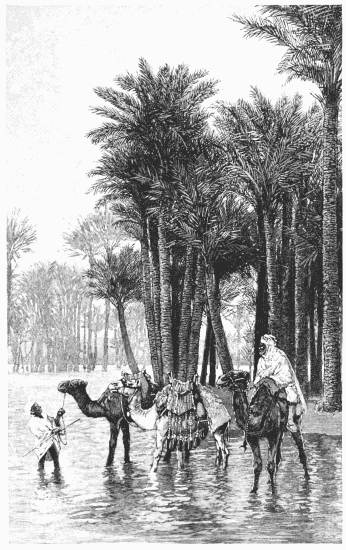
Heliopolis, the City of the Sun, the On of the forty-first chapter of Genesis, is five miles from Cairo. Nothing of it is now left above ground save an obelisk and a few ruined walls. The obelisk, which is the oldest yet discovered, bears the name of the king in whose reign it was erected; this gives us the date—5000 years ago; that is, more than a millennium before the days of Moses. At Heliopolis was the Temple of the Sun, and the schools which Herodotus visited "because the teachers are considered the most accomplished men in Egypt." When Strabo came hither, four hundred years later, he saw the house which Plato had occupied; Moses here learned "all the wisdom of the Egyptians." Papyri describe Heliopolis as "full of obelisks." Two of these columns were carried to Alexandria 1937 years ago, and set up before the Temple of Cæsar. According to one authority, this temple was built by Cleopatra; in any case, the two obelisks acquired the name of Cleopatra's Needles, and though the temple itself in time disappeared, they remained where they had been placed—one erect, one prostrate—until, in recent years, one was given to London and the other to New York. One recites all this in a breath in order to bring up, if possible, the associations which rush confusedly through the mind as one stands beside this red granite column rising alone in the green fields at Heliopolis. No myth itself, it was erected in days which are to us mythical—days which are the jumping-off place of our human history; yet they were not savages who polished this granite, who sculptured this inscription; ages of civilization of a certain sort must have preceded them. Beginning with the Central Park, we force our minds backward in an endeavor to make these dates real. "Homer was a modern compared with the designers of this pillar," we say to ourselves. "The Mycenæ relics were articles de Paris of centuries and centuries later." But repeating the words (and even rolling the r's) are useless efforts; the imagination will not rise; it is crushed into stupidity by such a vista of years. As reaction, perhaps as revenge, we flee to geology and Darwin; here, at least, one can take breath.
Near Heliopolis there is an ostrich yard. The giant birds are very amusing; they walk about with long steps, and stretch their necks. If allowed, they would tap us all on the head, I think, after the fashion of the ostriches in that vivid book, The Story of an African Farm.
FRENCH AND ENGLISH
Gerard de Nerval begins his volume on Egypt by announcing that the women of Cairo are so thickly veiled that the European (i.e., the Frenchman?) becomes discouraged after a very few days, and, in consequence, goes up the Nile. This, at least, is one effort to explain why strangers spend so short a time in Cairo. The French, as a nation, are not travellers; they have small interest in any country beyond their own borders. A few of their writers have cherished a liking for the East; but it has been what we may call a home-liking. They give us the impression of having sincerely believed that they could, owing to their extreme intelligence, imagine for themselves (and reproduce for others) the entire Orient from one fez, one Turkish pipe, and a picture of the desert. Gautier, for instance, has described many Eastern landscapes which his eyes have never beheld. Pictures are, indeed, much to Frenchmen. The acme of this feeling is reached by one of the Goncourt brothers, who writes, in their recently published journal, that the true way to enjoy a summer in the country is to fill one's town-house during the summer months with beautiful paintings of green fields, wild forests, and purling brooks, and then stay at home, and look at the lovely pictured scenes in comfort. French volumes of travels in the East are written as much with exclamation-points as with the letters of the alphabet. Lamartine and his disciples frequently paused "to drop a tear." Later Gallic voyagers divided all scenery into two classes; the cities "laugh," the plains are "amiable," or they "smile"; if they do not do this, immediately they are set down as "sad." One must be bold indeed to call Edmond About, the distinguished author of Tolla, ridiculous. The present writer, not being bold, is careful to abstain from it. But the last scene of his volume on Egypt (Le Fellah, published in 1883), describing the hero, with all his clothes rolled into a gigantic turban round his head, swimming after the yacht which bears away the heroine—a certain impossible Miss Grace—from the harbor of Port Said, must have caused, I think, some amused reflection in the minds of English and American readers. It is but just to add that among the younger French writers are several who have abandoned these methods. Gabriel Charmes's volume on Cairo contains an excellent account of the place. Pierre Loti and Maupassant have this year (1890) given to the world pages about northwestern Africa which are marvels of actuality as well as of unsurpassed description.
The French at present are greatly angered by the continuance of the English occupation of Egypt. Since Napoleon's day they have looked upon the Nile country as sure to be theirs some time. They built the Suez Canal when the English were opposed to the scheme. They remember when their influence was dominant. The French tradesmen, the French milliners and dressmakers in Cairo, still oppose a stubborn resistance to the English way of counting. They give the prices of their goods and render their accounts in Egyptian piasters, or in napoleons and francs; they refuse to comprehend shillings and pounds. And here, by-the-way, Americans would gladly join their side of the controversy. England alone, among the important countries of the world, has a currency which is not based upon the decimal system. The collected number of sixpences lost each year in England, by American travellers who mistake the half-crown piece for two shillings, would make a large sum. The bewilderment over English prices given in a coin which has no existence is like that felt by serious-minded persons who read Alice in Wonderland from a sense of duty. Talk of the English as having no imagination when the guinea exists!
France lost her opportunity in Egypt when her fleet sailed away from Alexandria Harbor in July, 1882. Her ships were asked to remain and take part in the bombardment; they refused, and departed. The English, thus being left alone, quieted the country later by means of an army of occupation. An English army of occupation has been there ever since.
At present it is not a large army. The number of British soldiers in 1890 is given as three thousand; the remaining troops are Egyptians, with English regimental officers. During the winter months the short-waisted red coat of Tommy Atkins enlivens with its cheerful blaze the streets of Cairo at every turn. The East and the West may be said to be personified by the slender, supple Arabs in their flowing draperies, and by these lusty youths of light complexion, with straight backs and stiff shoulders, who walk, armed with a rattan, in the centre of the pavement, wearing over one ear the cloth-covered saucer which passes for a head-covering. Tommy Atkins patronizes the donkeys with all his heart. One of the most frequently seen groups is a party of laughing scarlet-backed youths mounted on the smallest beasts they can find, and careering down the avenues at the donkey's swiftest speed, followed by the donkey-boys, delighted and panting. As the spring comes on, Atkins changes his scarlet for lighter garments, and dons the summer helmet. This species of hat is not confined to the sons of Mars; it is worn in warm weather by Europeans of all nationalities who are living or travelling in the East. It may be cool. Without doubt, æsthetically considered, it is the most unbecoming head-covering known to the civilized world. It has a peculiar power of causing its wearer to appear both ignoble and pulmonic; for, viewed in front, the most distinguished features, under its tin-pan-like visor, become plebeian; and, viewed behind, the strongest masculine throat looks wizened and consumptive.
A MOHAMMEDAN CEMETERY, CAIRO
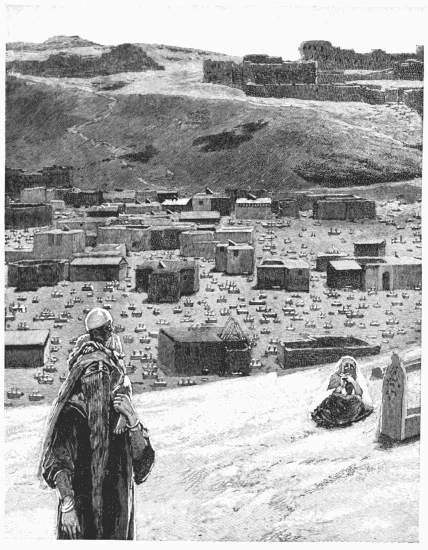
The English have benefited Egypt. They have put an end to the open knavery in high places which flourished unchecked; they have taught honesty; they have so greatly improved the methods of irrigation that a bad Nile (i.e., a deficient inundation) no longer means starvation; finally, they have taken hold of the mismanaged finances, disentangled them, set them in order, and given them at least a start in the right direction. The natives fret over some of their restrictions. And they say that the English have, first of all, taken care of their own interests. In addition, they greatly dislike seeing so many Englishmen holding office over them. But this last objection is simply the other side of the story. If the English are to help the country, they must be on the spot in order to do it; and it appears to be a fixed rule in all British colonies that the representatives of the government, whether high or low, shall be made, as regards material things, extremely comfortable. Egypt is not yet a British colony; she is a viceroyalty under the suzerainty of the Porte. But practically she is to-day governed by the English; and, to the American traveller at least (whatever the French may think), it appears probable that English authority will soon be as absolute in the Khedive's country as it is now in India.
In Cairo, in 1890, the English colony played lawn-tennis; it attended the races; when Stanley returned to civilization it welcomed him with enthusiasm; and when, later, Prince Eddie came, it attended a gala performance of Aïda at the opera-house—a resurrection from the time of Ismail ordered by Ismail's son for the entertainment of the heir-presumptive (one wonders whether Tufik himself found entertainment in it).
In the little English church, which stands amid its roses and vines in the new quarter, is a wall tablet of red and white marble—the memorial of a great Englishman. It bears the following inscription: "In memory of Major-General Charles George Gordon, C.B. Born at Woolwich, Jan. 28, 1833. Killed at the defence of Khartoum, Jan. 26, 1885." Above is a sentence from Gordon's last letter: "I have done my best for the honor of our country."
St. George of Khartoum, as he has been called. If objection is made to the bestowal of this title, it might be answered that the saints of old lived before the age of the telegraph, the printer, the newspaper, and the reporter; possibly they too would not have seemed to us faultless if every one of their small decisions and all their trivial utterances had been subjected to the electric-light publicity of to-day. Perhaps Gordon was a fanatic, and his discernment was not accurate. But he was single-hearted, devoted to what he considered to be his duty, and brave to a striking degree. When we remember how he faced death through those weary days we cannot criticise him. The story of that rescuing army which came so near him and yet failed, and of his long hoping in vain, only to be shot down at the last, must always remain one of the most pathetic tales of history.
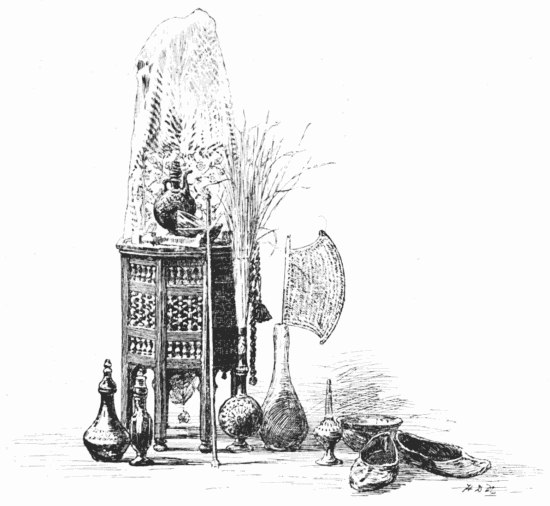
SOUVENIRS
As the warm spring closes, every one selects something to carry homeward. Leaving aside those fortunate persons who can purchase the ancient carved woodwork of an entire house, or Turkish carpets by the dozen, the rest of us keep watch of the selections of our friends while we make our own. Among these we find the jackets embroidered in silver and gold; the inevitable fez; two or three blue tiles of the thirteenth century; a water-jug, or kulleh; a fly-brush with ivory handle; attar of roses and essence of sandal-wood; Assiout ware in vases and stoups; a narghileh; the gauze scarfs embroidered with Persian benedictions; a koursi inlaid with mother-of-pearl; Arabian inkstands—long cases of silver or brass, to be worn like a dagger in the belt; a keffiyeh, or delicate silken head-shawl with white knotted fringe; the Arabian finger-bowls; the little coffee-cups; images of Osiris from the tombs; a native bracelet and anklet; and, finally, a scarab or two, whose authenticity is always exciting, like an unsolved riddle. A picture of these mementos of Cairo would not be complete for some of us without two of those constant companions of so many long mornings—the dusty, shuffling, dragging, slipping, venerable, abominable mosque shoes.
HOMEWARD-BOUND
"We who pursue
Our business with unslackening stride,
Traverse in troops, with care-fill'd breast,
The soft Mediterranean side,
The Nile, the East,
And see all sights from pole to pole,
And glance and nod and bustle by,
And never once possess our soul
Before we die."
So chanted Matthew Arnold of the English of to-day. And if we are to believe what is preached to us and hurled at us, it is a reproach even more applicable to Americans than to the English themselves. One American traveller, however, wishes to record modestly a disbelief in the universal truth of this idea. Many of us are, indeed, haunted by our business; many of us do glance and nod and bustle by; it is a class, and a large class. But these hurried people are not all; an equal number of us, who, being less in haste, may be less conspicuous perhaps, are the most admiring travellers in the world. American are the bands who journey to Stratford-upon-Avon, and go down upon their knees—almost—when they reach the sacred spot; American are the pilgrims who pay reverent visits to all the English cathedrals, one after the other, from Carlisle to Exeter, from Durham to Canterbury. In the East, likewise, it is the transatlantic travellers who are so deeply impressed by the strangeness and beauty of the scenes about them that they forget to talk about their personal comforts (or, rather, the lack of them).
There is another matter upon which a word may be said, and this is the habit of judging the East from the stand-point of one's home customs, whether the home be American or English. It is, of course, easy to find faults in the social systems of the Oriental nations; they have laws and usages which are repugnant to all our feelings, which seem to us horrible. But it is well to remember that it is impossible to comprehend any nation not our own unless one has lived a long time among its people, and made one's self familiar with their traditions, their temperament, their history, and, above all, with the language which they speak. Anything less than this is observation from the outside alone, which is sure to be founded upon misapprehension. The French and the English are separated by merely the few miles of the Channel, and they have, to a certain extent, a common language; for though the French do not often understand English, the English very generally understand something of French. Yet it is said that these two nations have never thoroughly comprehended each other either as nations or individuals; and it is even added that, owing to their differing temperaments, they will never reach a clear appreciation of each other's merits; demerits, of course, are easier. Our own country has a language which is, on the whole, nearer the English tongue perhaps than is the speech of France; yet have we not felt now and then that English travellers have misunderstood us? If this is the case among people who are all Occidentals together, how much more difficult must be a thorough comprehension by us of those ancient nations who were old before we were born?
SOUVENIRS OF CAIRO
The East is the land of mystery. If one cares for it at all, one loves it; there is no half-way. If one does not love it, one really (though perhaps not avowedly) hates it—hates it and all its ways. But for those who love it the charm is so strong that no surprise is felt in reading or hearing of Europeans who have left all to take up a wandering existence there for long years or for life—the spirit of Browning's "What's become of Waring?"
All of us cannot be Warings, however, and the time comes at last when we must take leave. The streets of Cairo have been for some time adorned with placards whose announcements begin, in large type, "Travellers returning to Europe." We are indeed far away when returning to Europe is a step towards home. We wait for the last festival—the Shem-en-Neseem, or Smelling of the Zephyr—the annual picnic day, when the people go into the country to gather flowers and breathe the soft air before the opening of the regular season for the Khamsin. Then comes the journey by railway to Alexandria. We wave a handkerchief (now fringed on all four sides by the colored threads of the laundresses) to the few friends still left behind. They respond; and so do all the Mustaphas, Achmets, and Ibrahims who have carried our parcels and trotted after our donkeys. Then we take a seat by the window, to watch for the last time the flying Egyptian landscape—the green plain, the tawny Nile, the camels on the bank, the villages, and the palm-trees, and behind them the solemn line of the desert.
At sunset the steamer passes down the harbor, and, pushing out to sea, turns westward. A faint crescent moon becomes visible over the Ras-et-Teen palace. It is the moon of Ramadan. Presently a cannon on the shore ushers in, with its distant sound, the great Mohammedan fast.
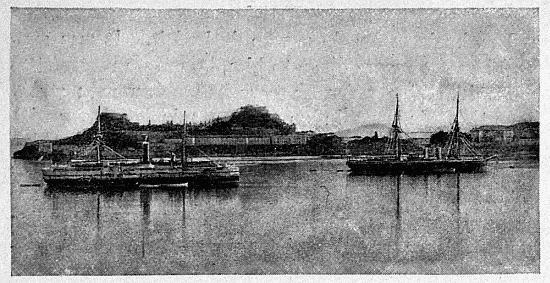
CORFU AND THE IONIAN SEA
Sad eyes! the blue sea laughs, as heretofore.
Ah, singing birds, your happy music pour;
Ah, poets, leave the sordid earth awhile;
Flit to these ancient gods we still adore:
"It may be we shall touch the happy isle!"
—Translated by Andrew Lang.
Not long before Christmas, last year, I found myself travelling from Ancona down the Adriatic coast of Italy by the fast train called the Indian Mail. There was excitement in the very name, and more in the conversation of the people who sat beside me at the table of a queer little eating-house on the shore, before whose portal the Indian Mail stopped late in the evening. We all descended and went in. A dusky apartment was our discovery, and a table illuminated by guttering candles that flared in the strong currents of air. Roast chickens were stacked on this table in a high pile, and loaves of dark-colored bread were placed here and there, with portly straw-covered flasks of the wine of the country. No one came to serve us; we were expected to serve ourselves. A landlord who looked like an obese Don Juan was established behind a bench in a distant corner, where he made coffee with amiability and enthusiasm for those who desired it. It was supposed that we were to go to him, before we returned to the train, and pay for what we had consumed; and I hope that his trust in us was not misplaced, for with his objection to exercise, and his dim little lamp which illuminated only his smiles, there was nothing for him but trust. The Indian Mail carries passengers who are outward-bound for Constantinople, Egypt, and India; his confidence rested perhaps in the belief that persons about to embark on such dangerous seas would hardly begin the enterprise by crime. To other minds, however, it might have seemed the very moment to perpetrate enormities. As we attacked the chickens, I perceived in the flickering glare that all my companions were English. Everybody talked, and the thrill of the one American increased as the names of the steamers waiting at Brindisi were mentioned—the Hydaspes, the Coromandel, the Cathay, the Mirzapore: towards what lands of sandal-wood, what pleasure-domes of Kubla-Khan, might not one sail on ships bearing those titles! The present voyagers, however, were all old travellers; they took a purely practical view of the Orient. Nevertheless, their careless "Cairo," "Port Said," "Bombay," "Ceylon," "Java," were as fascinating as the shining balls of a juggler when a dozen are in the air at the same moment. My right-hand neighbor, upon learning that my destination was Corfu, good-naturedly offered the information that the voyage was an easy one. "Corfu, however, is not what it has been!"
"But, Polly, it is looking up a little, now that the Empress of Austria is building a villa there," suggested a sister correctively.
After this outburst of talk, we all climbed back into the waiting train, and went flying on towards the south, following the lonely, wild-looking coast, with the wind from the Adriatic crying over our heads like a banshee. It was midnight when we reached Brindisi. At present this, the ancient Brundusium, is the jumping-off place for the traveller on his way to the East; here he must leave the land and trust himself to an enigmatical deep. But if he wishes to have the sensation in full force, he must not delay his journey; for, presently, the Indian Mail will rush through Greece and meet the steamers at Cape Colonna; and then, before long, there will be another spurt, and Pullman trains will go through to Calcutta, with a ferry over the Bosporus.
At Brindisi I became the prey of five barelegged boatmen, who, owing to the noise of the wind and the water, communicated with each other by yells. The Austrian-Lloyd steamer from Trieste, outward-bound for Constantinople, which carried the friends I was expecting to meet, was said to be lying out in the stream, and I enjoyed the adventure of setting forth alone on the dark sea in search of her, in a small boat rowed by my Otranto crew. During the transit there was not much time to think of Brundusium, with its memories of Horace and Virgil. But there was another opportunity to reflect upon the question, perplexing to the unskilled mind—namely, Why it is that an American abroad is constantly called upon to praise the wharves, piers, and landing-stages, and with the same breath to condemn as disgraces to civilization the like nautical platforms of his own country, when he is so often obliged, on foreign shores, to embark and disembark by means of a tossing small boat or a crowded tender, whereas at home, with the aid of those same makeshift constructions for whose short-comings he is supposed to blush, he walks on board of his steamship with no trouble whatever?
Early the next morning, awakening on a shelf in a red velvet cupboard, I was explaining to myself vaguely that the cupboard was a dream, when there appeared through the port-hole a picture of such fairy-tale beauty that the dream became lyrical—it began to sing:
"Far and few, far and few,
Are the lands where the Jumblies live!"
At last those famous lines were actualities, for surely this was the sea of the Jumblies, and those heights without doubt were "the hills of Chankly Bore." (There are people, I believe, who do not care for the Jumblies. There are persons who do not care for Alice in Wonderland, nor for Brer Rabbit, when he played on his triangle down by the brook.)
The sea which I saw was of a miraculously blue tint; in the distance the cliffs of a mountainous island rose boldly from the water, their color that of a violet pansy; a fishing-boat with red sails was crossing the foreground; over all glittered an atmosphere so golden that it was like that of sunset in other lands, though the sky, at the same time, had unmistakably the purity of early morning. Later, on the deck, during the broadly practical time of after breakfast, this view, instead of diminishing in attraction, grew constantly more fair. The French novelist of to-day, Paul Bourget, describes Corfu as "so lovely that one wants to take it in one's arms!" Another Frenchman, who was not given to the making of phrases, no less a personage than Napoleon Bonaparte, has left upon record his belief that Corfu has "the most beautiful situation in the world." What, then, is this beauty? What is this situation?
PART OF THE TOWN OF CORFU
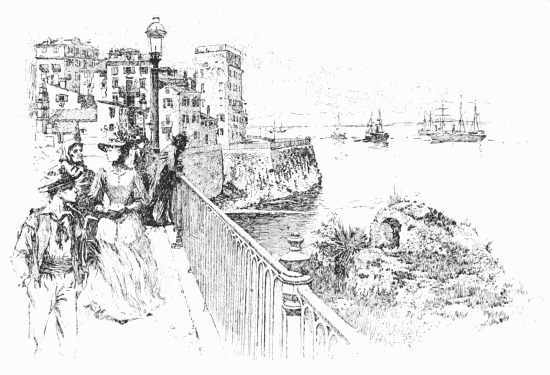
First, there is the long and charming approach, with the snow-capped mountains of Albania, in European Turkey, looming up against the sky at the end; then comes the landlocked harbor; then the picturesque old town, its high stone houses, all of creamy hue, crowded together on the hill-side above the sea-wall, with here and there a bell-tower shooting into the blue. Below is the busy, many-colored port. Above towers the dark double fortress on its rock. And, finally, the dense, grove-like vegetation of the island encircles all, and its own mountain-peaks rise behind, one of them attaining a height of three thousand feet. There are other islands of which all this, or almost all, can be said—Capri, for instance. But at Corfu there are two attributes peculiar to the region; these are: first, the color; second, the transparency. Although the voyage from Brindisi hardly occupies twelve hours, the atmosphere is utterly unlike that of Italy; there is no haze; all is clear. Some of us love the Italian haze (which is not in the least a mist), that soft veil which makes the mountains look as if they were covered with velvet. But a love of this softness need not, I hope, make us hate everything that is different. Greece (and Corfu is a Greek island) seemed to me all light—the lightest country in the world. In other lands, if we climb a high mountain and stand on its bald summit at noon, we feel as if we were taking a bath in light; in Greece we have this feeling everywhere, even in the valleys. Euripides described his countrymen as "forever delicately tripping through the pellucid air," and so their modern descendants trip to this day. This dry atmosphere has an exciting effect upon the nervous energy, and the faces of the people show it. It has also, I believe, the defect of this good quality—namely, an over-stimulation, which sometimes produces neuralgia. In some respects Americans recognize this clearness of the atmosphere, and its influence, good and bad; the air of northern New England in the summer, and of California at the same season, is not unlike it. But in America the transparency is more white, more blank; we have little of the coloring that exists in Greece, tints whose intensity must be seen to be believed. The mountains, the hills, the fields, are sometimes bathed in lilac. Then comes violet for the plains, while the mountains are rose that deepens into crimson. At other times salmon, pink, and purple tinges are seen, and ochre, saffron, and cinnamon brown. This description applies to the whole of Greece, but among the Ionian Islands the effect of the color is doubled by the wonderful tint of the surrounding sea. I promise not to mention this hue again; hereafter it can be taken for granted, for it is always present; but for this once I must say that you may imagine the bluest blue you know—the sky, lapis lazuli, sapphires, the eyes of some children, the Bay of Naples—and the Ionian Sea is bluer than any of these. And nowhere else have I seen such dear, queer little foam sprays. They are so small and so very white on the blue, and they curl over the surface of the water even when the sea is perfectly calm, which makes me call them queer. You meet them miles from land. And all the shores are whitened with their never-ceasing play. It is a pygmy surf.
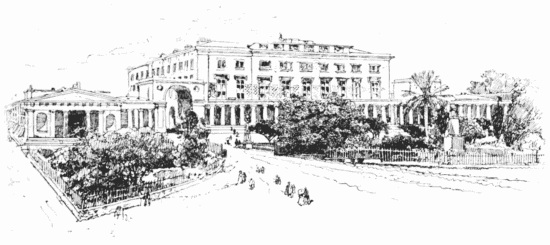
It was eleven o'clock in the morning when our steamer reached her anchorage before the island town. Immediately she was surrounded by small boats, whose crews were perfectly lawless, demanding from strangers whatever they thought they could get, and obtaining their demands, because there was no way to escape them except by building a raft. Upon reaching land one forgets the extortion, for the windows of the hotel overlook the esplanade, and this open space amiably offers to persons who are interested in first impressions a panoramic history of two thousand five hundred years in a series of striking mementos. Let me premise that as regards any solid knowledge of these islands, only a contemptible smattering can be obtained in a stay so short as mine. Corfu and her sisters have borne a conspicuous part in what we used to call ancient history. Through the Roman days they appear and reappear. In the times of the Crusaders their position made them extremely important. Years of study could not exhaust their records, nor months of research their antiquities. To comprehend them rightfully one must indeed be an historian, an archæologist, and a painter at one and the same time, and one must also be good-natured. Few of us can hope to unite all these. The next best thing, therefore, is to go and see them with whatever eyes and mind we happen to possess. Good-nature will perhaps return after the opening encounter with the boatmen is over.
From our windows, then, we could note, first, the Citadel, high on its rock, three hundred feet above the town. The oldest part of the present fortress was erected in 1550; but the site has always been the stronghold. Corinthians, Athenians, Spartans, Macedonians, and Romans have in turn held the island, and this rock is the obvious keep. Later came four hundred years of Venetian control, and I am ashamed to add that the tokens of this last-named period were to me more delightful than any of the other memorials. I say "ashamed," for why should one be haunted by Venice in Greece? With the Parthenon to look forward to, why should the lion of St. Mark, sculptured on Corfu façades, be a thing to greet with joy? Many of us are familiar with the disconsolate figures of some of our fellow-countrymen and countrywomen in the galleries of Europe, tired and dejected tourists wandering from picture to picture, but finding nothing half so interesting as the memory of No. 4699 Columbus Avenue at home. I am afraid it is equally narrow to be scanning Corfu, Athens, Cairo, and the sands of the desert itself for something that reminds one of another place, even though that place be the enchanting pageant of a town at the head of the Adriatic. History, however, as related by the esplanade, pays no attention to these aberrations of the looker-on; its story goes steadily forward. The lions of St. Mark on the façades, and another memento of the Doges—namely, the statue of Count von der Schulenburg, who commanded the Venetian forces in the great defence of Corfu in 1716—these memorials have as companions various tokens of the English occupation, which, following that of Venice, continued through forty-nine years—that is, from 1815 to 1863. Before this there had been a short period of French dominion; but the esplanade, so far as I could discover, contains no memorial of it, unless Napoleon's phrase can stand for one—and I think it can. The souvenirs of the British rule are conspicuous. The first is the palace built for the English Governor, a functionary who bore the sonorous official name of Lord High Commissioner, a title which was soon shortened to the odd abbreviation "the Lord High." This palace is an uninteresting construction stretching stiffly across the water-side of the esplanade, and cutting off the view of the harbor. It is now the property of the King of Greece, but at present it is seldom occupied. While we were at Corfu its ghostliness was enlivened for a while; Prince Henry of Prussia was there with his wife. They had left their yacht (if so large a vessel as the Irene can be called a yacht), and were spending a week at the palace. An hour after their departure entrance was again permitted, and an old man, still trembling from the excitement of the royal sojourn, conducted us from room to room. All was ugly. Fading flowers in the vases showed that an attempt had been made to brighten the place; but the visitors must have been endowed with a strong natural cheerfulness to withstand with success such a mixture of the commonplace and the dreary as the palace presents. They had the magnificent view to look at, and there was always the graceful silhouette of the Irene out on the water. She could come up at any time and take them away; it was this, probably, that kept them alive.
THE PALACE
If the palace is ordinary, what shall be said of another memento which adorns the esplanade? This is a high, narrow building, so uncouth that it causes a smile. It looks raw, bare, and so primitive that if it had a pulley at the top it might be taken for a warehouse erected on the bank of a canal in one of our Western towns; one sees in imagination canal-boats lying beneath, and bulging sacks going up or down. Yet this is nothing less than that University of the Ionian Islands which was founded by the Earl of Guildford early in this century, the epoch of English enthusiasm for Greece, the days of the Philhellenes. Lord Guildford, who was one of the distinguished North family, gave largely of his fortune and of his time to establish this university. Contemporary records speak of him as "an amiable nobleman." But after seeing his touchingly ugly academy and his bust (which is not ugly) in the hall of the extinct Ionian Senate at the palace, one feels sure that he was more than amiable—he must have been original also.
UNIVERSITY OF THE IONIAN ISLANDS
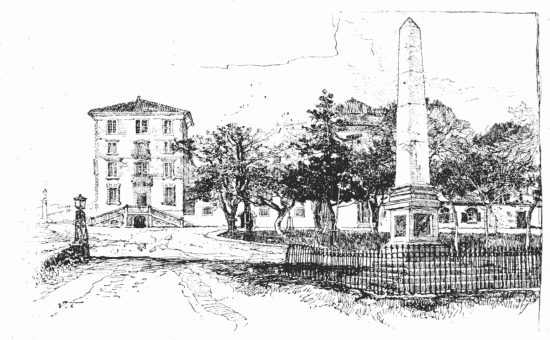
The English are called cold; but as individuals they are capable sometimes of extraordinary enthusiasms for distant causes and distant people. Adventurous travellers as they are, does the charm lie in the word "distant"? The defunct academy now shelters a school where vigorous young Greeks sit on benches, opposite each other, in narrow, doorless compartments which resemble the interior of a large omnibus; this, at least, was the arrangement of the ground-floor on the day of our visit. Although it was December, the boys looked heated. The teachers, who walked up and down, had a relentless aspect. Even the porter, white-haired and bent, had a will untouched by the least decay; he would not show us the remains of the university library, nor the Roman antiquities which are said to be stored somewhere in a lumber-room, among them "fifty-nine frames of mosaic representing a bustard in various attitudes." He had not the power, apparently, to exhibit these treasures while the school exercises were going on, and as soon as they were ended—instantly, that very minute—he intended to eat his dinner, and nothing could alter this determination; his face grew ferocious at the mere suggestion. So we were obliged to depart without seeing the souvenirs of Lord Guildford's enthusiasm; and owing to the glamour which always hangs over the place one has failed to see, I have been sure ever since that we should have found them the most fascinating objects in Corfu.
At the present school the teaching is done, no doubt, in a tongue which would have made the old university shudder. In a letter written by Sir George Bowen in 1856, from one of the Ionian Islands, there is the following anecdote: "Bishop Wilberforce told me that he recently had, as a candidate at one of his ordinations, Mr. M., the son of an English merchant settled in Greece. 'I examined him myself,' said the bishop, 'when he gave what was to me an unknown pronunciation.' 'Oh, Mr. M.,' I said, 'where did you learn Greek?' 'In Athens, my lord,' replied the trembling man." Classical scholars who visit Greece to-day are not able to ask the simplest questions; or, rather, they may ask, but no one will understand them. Several of these gentlemen have announced to the world that the modern speech of Athens is a barbarous decadence. It is not for an American, I suppose, to pass judgment upon matters of this sort. But when these authorities continue as follows: "And even in pronunciation modern Greek is hopelessly fallen; the ancients never pronounced in this way," may we not ask how they can be so sure? They are not, I take it, inspired, and the phonograph is a modern invention. The voice of Robert Browning is stored for coming generations; the people A.D. 3000 may hear him recite "How They Brought the Good News from Ghent to Aix." Possibly the tones of Lord Salisbury and of Mr. Balfour are already garnered and arranged in cylinders for the future orators of the South Seas. But we cannot know how Pindar spoke any more than we can know the song the Sirens sang; the most learned scholar cannot, alas! summon from the past the articulation of Plato.
SMALL TEMPLE, MEMORIAL TO SIR THOMAS MAITLAND
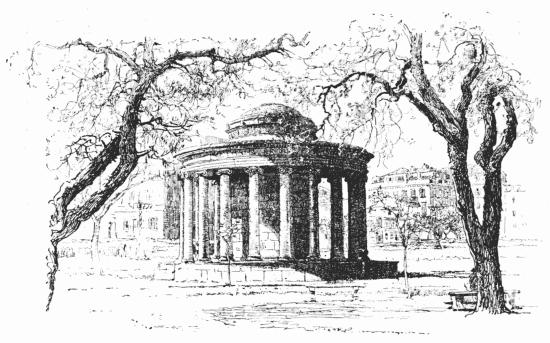
In the esplanade the period of English rule is further kept in mind by monuments to the memory of three of the Lords High—a statue, an obelisk, and (of all things in the world) an imitation of a Greek temple. This temple—it is so small that they might call it a templette—was erected in honor of Sir Thomas Maitland, a Governor whose arbitrary rule gained for him the title of King Tom. The three memorials are officially protected, an agreement to that effect having been made between the governments of Great Britain and Greece. They were never in danger, probably, as the English protection was a friendly one. In spite of its friendliness, the Corfiotes voted as follows with enthusiasm when an opportunity was offered to them: "The single and unanimous will of the Ionian people has been and is for their reunion with the Kingdom of Greece." England yielded to this wish and withdrew—a disinterested act which ought to have gained for her universal applause. Since 1864 Corfu and her sister islands, happily freed at last from foreign control, have filled with patriotic pride and contentment their proper place as part of the Hellenic kingdom.
The esplanade also contains the one modern monument erected by the Corfiotes themselves—a statue of Capo d'Istria. John Capo d'Istria, a native of Corfu, was the political leader of Greece when she succeeded in freeing herself from the Turkish yoke. The story of his life is a part of the exciting tale of the Greek revolution. His measures, after he had attained supreme power, were thought to be high-handed, and he was accused also of looking too often towards that great empire in the North whose boundaries are stretching slowly towards Constantinople; he was resisted, disliked; finally he was assassinated. Time has softened the remembrance of his faults, whatever they were, and brought his services to the nation into the proper relief; hence this statue, erected in 1887, fifty-six years after his death, by young Greece. It is a sufficiently imposing figure of white marble, the face turned towards the bay with a musing expression. Capo d'Istria—a name which might have been invented for a Greek patriot! The Eastern question is a complicated one, and I have no knowledge of its intricacies. But a personal observation of the hatred of Turkey which exists in every Greek heart, and a glance at the map of Europe, lead an American mind towards one general idea or fancy—namely, that Capo d'Istria was merely in advance of his time, and that an alliance between Russia and Greece is now one of the probabilities of the near future. It is unexpected—at least, to the non-political observer—that Hellas should be left to turn for help and comfort to the Muscovites, a race to whom, probably, her ancient art and literature appeal less strongly than they do to any other European people. But she has so turned. "Wait till Russia comes down here!" she appears to be saying, with deferred menace, to Turkey to-day.
These various monuments of the esplanade do not, however, make Corfu in the least modern. They are unimportant, they are inconspicuous, when compared with the old streets which meander over the slopes behind them, fringed with a net-work of stone lanes that lead down to the water's edge. It has been said that the general aspect of the place is Italian. It is true that there are arcades like those of Bologna and Padua; that some of the byways have the look of a Venetian calle, without its canal; and that the neighborhood of the gay little port resembles, on a small scale, the streets which border the harbor of Genoa. In spite of this, we have only to look up and see the sky, we have only to breathe and note the quality of the air, to perceive that we are not in Italy. Corfu is Greek, with a coating of Italian manners. And it has also caught a strong tinge from Asia. Many of the houses have the low door and masked entrance which are so characteristic of the East; at the top of the neglected stairway, as far as possible from public view, there may be handsome, richly furnished apartments; but if such rooms exist, the jealous love of privacy keeps them hidden. This inconspicuous entrance is as universal in the Orient as the high wall, shutting off all view of the garden or park, is universal in England.
STATUE OF CAPO D'ISTRIA
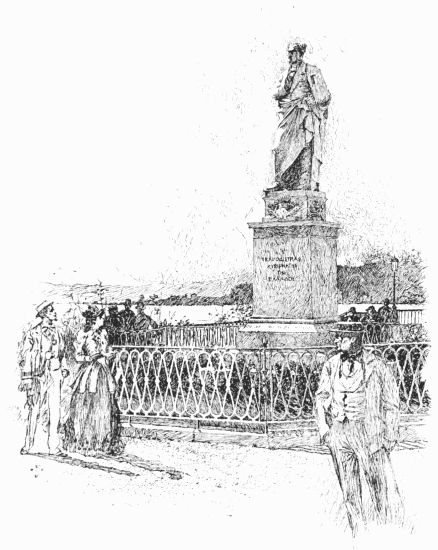
The town of Corfu has 26,000 inhabitants. Among the population are Dalmatians, Maltese, Levantines, and others; but the Greeks are the dominant race. There is a Jews' quarter, and Jews abound, or did abound at the time of my visit. Since then fanaticism has raised its head again, and there have been wild scenes at Corfu. Face to face with the revival of persecution for religious opinions which is now visible in Russia, and not in Russia alone, are we forced to acknowledge that our century is not so enlightened as we have hoped that it was. I remember when I believed that in no civilized country to-day could there be found, among the educated, a single person who would wish to persecute or coerce his fellow-beings solely on account of their religious opinions; but I am obliged to confess that, without going to Russia or Corfu, I have encountered within the last dozen years individuals not a few whose flashing eyes and crimson cheeks, when they spoke of a mental attitude in such matters which differed from their own, made me realize with a thrill that if it were still the day of the stake and the torch they would come bringing fagots to the pile with their own hands.
In spite of these survivals, ceremonial martyrdom for so-called religion's sake is, we may hope, at an end among the civilized nations; we have only its relics left. Corfu has one of these relics, a martyr who is sincerely honored—St. Spiridion, or, as he is called in loving diminutive, Spiro. Spiro, who died fifteen hundred years ago, was bishop of a see in Cyprus, I believe. He was tortured during the persecution of the Christians under Diocletian. His embalmed body was taken to Constantinople, and afterwards, in 1489, it was brought to Corfu by a man named George Colochieretry. Some authorities say that Colochieretry was a monk; in any case, what is certain is that the heirs of this man still own the saint—surely a strange piece of property—and derive large revenues from him. St. Spiro reposes in a small dim chapel of the church which is called by his name; his superb silver coffin is lighted by the rays from a hanging lamp which is suspended above it. When we paid our visit, people in an unbroken stream were pressing into this chapel, and kissing the sarcophagus repeatedly with passionate fervor. The nave, too, was thronged; families were seated on the pavement in groups, with an air of having been there all day: probably Christmas is one of the seasons set apart for an especial pilgrimage to the martyr. Three times a year the body is taken from its coffin and borne round the esplanade, followed by a long train of Greek clergy, and by the public officers of the town; upon these occasions the sick are brought forth and laid where the shadow of the saint can pass over them. "Yes, he's out to-day, I believe," said a resident, to whom we had mentioned this procession. He spoke in a matter-of-fact tone. After seeing it three times a year for twenty years, the issuing forth of the old bishop into the brilliant sunshine to make a solemn circuit round the esplanade did not, I suppose, seem so remarkable to him as it seemed to us. There is another saint, a woman (her name I have forgotten), who also reposes in a silver coffin in one of the Corfu churches. At first we supposed that this was Spiro. But the absence of worshippers showed us our mistake. This lonely witness to the faith was also a martyr; she suffered decapitation. "They don't think much of her," said the same resident. Then, explanatorily, "You see—she has no head." This practically minded critic, however, was not a native of Corfu. The true Corfiotes are very reverent, and no doubt they honor their second martyr upon her appointed day. But Spiro is the one they love. The country people believe that he visits their fields once a year to bless their olives and grain, and the Corfu sailors are sure that he comes to them, walking on the water in the darkness, when a storm is approaching. Mr. Tuckerman, in his delightful volume, The Greeks of To-Day, says, in connection with this last legend, that it is believed by the devout that seaweed is often found about the legs of the good bishop in his silver coffin, after his return from these marine promenades. There is something charming in this story, and I shall have to hold back my hand to keep myself from alluding (and yet I do allude) to a shrine I know at Venice; it is far out on the lagoon, and its name is Our Lady of the Seaweed. The last time my gondola passed it I saw that by a happy chance the high tide had left seaweed twined about it in long, floating wreaths, like an offering.
The name of the national religion of Greece is the Orthodox Church of the East, or, more briefly, the Orthodox Church. Western nations call it the Greek Church, but they have invented that name themselves. The Orthodox Church has rites and ceremonies which are striking and sometimes magnificent. I have many memories of the churches of Corfu. The temples are so numerous that they seem innumerable; one was always coming upon a fresh one; sometimes there is only a façade visible, and occasionally nothing but a door, the church being behind, masked by other buildings. My impressions are of a series of magnified jewel-boxes. There was not much daylight; no matter how radiant the sunshine outside, within all was richly dim, owing to the dark tints of the stained glass. The ornamentation was never paltry or tawdry. The soft light from the wax candles drew dull gleams from the singular metal-incrusted pictures. These pictures, or icons, are placed in large numbers along the walls and upon the screen which divides the nave from the apse. They are generally representations of the Madonna and Child in repoussé-work of silver, silvered copper, or gilt. Often the face and hands of the Madonna are painted on panel; in that case the portrait rises from metal shoulders, and the head is surrounded by metal hair. The painting is always of the stiff Byzantine school, following an ancient model, for any other style would be considered irreverent, and nothing can exceed the strange effect produced by these long-eyed, small-mouthed, rigid, sourly sweet virgin faces coming out from their silver-gilt necks, while below, painted taper fingers of unearthly length encircle a silver Child, who in His turn has a countenance of panel, often all out of drawing, but hauntingly sweet. These curious pictures have great dignity. The churches have no seats. I generally took my stand in one of the pew-like stalls which project from the wall, and here, unobserved, I could watch the people coming in and kissing the icons. This adoration, commemoration, reverence, or whatever the proper word for it may be, is much more conspicuous in the Greek places of worship than it is in Roman Catholic churches. Those who come in make the round of the walls, kissing every picture, and they do it fervently, not formally. The service is chanted by the priests very rapidly in a peculiar kind of intoning. The Corfu priests did not look as if they were learned men, but their faces have a natural and humane expression which is agreeable. In the street, with their flowing robes, long hair and beards, and high black caps, they are striking figures. The parish priest must be a married man, and he does not live apart from his people, but closely mingles with them upon all occasions. He is the papas, or pope, as it is translated, and a lover of Tourguenieff who meets a pope for the first time at Corfu is haunted anew by those masterpieces of the great Russian—the village tales across whose pages the pope and the popess come and go, and seem, to American readers, such strange figures.
THE TOMB OF MENEKRATES
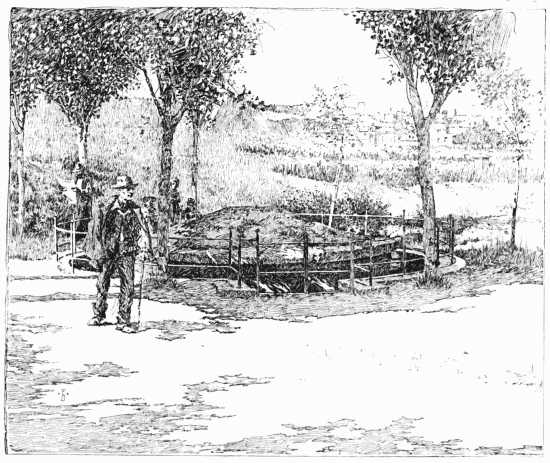
In the suburb of Castrades is the oldest church of the island. It is dedicated to St. Jason, the kinsman of St. Paul. St. Jason's appeared to be deserted. Here, as elsewhere, it is not the church most interesting from the historical point of view which is the favorite of the people, or which they find, apparently, the most friendly. But when I paid my visit, there were so many vines and flowers outside, and such a blue sky above, that the little Byzantine temple had a cheerful, irresponsible air, as if it were saying: "It's not my fault that people won't come here. But if they won't, I'm not unhappy about it; the sunshine, the vines, and I—we do very well together." The interior was bare, flooded also with white daylight—so white that one blinked. And in this whiteness my mind suddenly returned to Hellas. For Hellas had been forgotten for the moment, owing to the haunting icons in the dark churches of the town. Those silver-incrusted images had brought up a vision of the uncounted millions to-day in Turkey, Greece, and Russia who bow before them, the Christians of whom we know and think comparatively so little. But now all these Eastern people vanished as silently as they had come, and the past returned—the past, whose spell summons us to Greece. For conspicuous in the white daylight of St. Jason's were three antique columns, which, with other sculptured fragments set in the walls, had been taken from an earlier pagan temple to build this later church. And the spell does not break again in this part of the island. Not far from St. Jason's is the tomb of Menekrates. This monument was discovered in 1843, when one of the Venetian forts was demolished. Beneath the foundations the workmen came upon funeral vases, and upon digging deeper an ancient Greek cemetery was uncovered, with many graves, various relics, and this tomb. It is circular, formed of large blocks of stone closely joined without cement, and at present one stands and looks down upon it, as though it were in a roofless cellar. It bears round its low dome a metrical inscription in Greek, to the effect that Menekrates, who was the representative at Corcyra (the old name for Corfu) of his native town Eanthus, lost his life accidentally by drowning; that this was a great sorrow to the community, for he was a friend of the people; that his brother came from Eanthus, and, with the aid of the Corcyreans, erected the monument. There is something impressive to us in this simple memorial of grief set up before the days of Æschylus, before the battle of Marathon—the commemoration of a family sorrow in Corfu two thousand five hundred years ago. The following is a Latin translation of the inscription:
"Tlasiadis memor ecce Menecrates hoc monumentum,
Ortum Œantheus, populus statuebat at illi,
Quippe benignus erat populo patronus, in alto
Sed periit ponto, totam et dolor obruit urbem.
Praximenes autem patriis huc venit ab oris
Cum populo et fratris monumentum hoc struxit adempti."
Two thousand five hundred years ago! That is far back. But it is not the oldest date "in the world." Americans are accused of cherishing an inordinate love for the superlative—the longest river, the highest mountain, the deepest mine in the world, the largest diamond in the world; there must always be that tag "in the world" to interest us. When ancient objects are in question we are said to rush from one to the next, applying our sole test; and we drop at any time a tomb or a temple, no matter how beautiful, if there comes a rumor that another has been discovered a little farther on which is thought to be a trifle more venerable. Thus they chaff us—pilgrims from a land where Nature herself works in superlatives, and where there is no antiquity at all. In Italy our mania, exercising itself upon smaller objects than temples, brings us nearer the comprehension (or non-comprehension) of the contemptuous natives. "What hideous" (she called it hee-dee us) "things you do buy!" I heard an Italian lady exclaim with conviction some years ago, as she happened to meet three of her American acquaintances returning from a hunt through the antiquity-shops of Naples, loaded with a battered lamp, a square of moth-eaten tapestry with an indecipherable inscription, and a nondescript broken animal in bronze, without head, tail, or legs, who might have been intended for a dragon, or possibly for a cow. After a while we pass this stage of antiquity-shops. But we never pass the Etruscans, or, rather, I should speak for myself, and say that I never passed them; I was perpetually haunted by them. There was one road in particular, a lonely track which led from Bellosguardo (at Florence) up a steep hill, and I was forever climbing this stony ascent because, forsooth, it was set down on an Italian map as "the old Etruscan way between Fiesole and Volterra," two strongholds of this mysterious people. I was sure that there were tombs with strangely painted walls close at hand, and when there was no one in sight I made furtive archæological pokes with my parasol. In Italy an Etruscan tomb seems the oldest thing "in the world." And at Corfu the unearthed Greek cemetery became doubly interesting when I learned that among the relics discovered there was a lioness couchant, concerning which the highest authorities have said, "After the lions of the gates of Mycenæ, there is no Greek sculpture older than this." (The lioness is now in the vestibule of the palace in the esplanade.) This was exciting, for Mycenæ is a name to conjure with still, in spite of the refusal of the learned to accept, in all their extent, Dr. Schliemann's splendidly romantic theories and dreams. But when one goes on to Egypt, to have searched at all for that enticing "oldest" in Greece appears to have been a mistake. For what is B.C. 1000, which the German authorities say is an approximate date for the Mycenæ relics—what is that compared with King Menes of the Nile, with his B.C. 4400 according to Brugsch-Bey, and B.C. 5000 according to Mariette? And there are rumors of civilized times far older. But if we can bring ourselves to cease our chase after age and turn to beauty, then it is not in the sands of Egypt that we must dig. For beauty we must come to the clear light country of the gods.
But leaving history, some of us suffer greatly nowadays from mental dislocations of another sort. The Mycenæ lions and the grim lioness of Corfu are ascribed with a calmness which seems brutal to "pre-Homeric times." Surely there were no pre-Homeric times except chaos. Surely those were the first days of the world when all the men were sure-footed, and all the women white-armed; when the sea was hollow (it has remained that to this day), and when the heavenly powers interested themselves in human affairs upon the slightest occasion. Leave us our faith in them. It can be preserved, if you like, in the purely poetical compartment of the mind. For there are all sorts of compartments: I have met a learned geologist who turned pale when a mirror was broken by accident in his house; I know a disciple of Darwin who always deprecates instantly any reference to his good health, lest in some mysterious way it should attract ill-luck. It seems to me, therefore, that the dear belief that Homer's heroes began the world may coexist even with the bicycle. (Not that I myself have much knowledge of this excellent vehicle. But, its tandem wheels, swift and business-like, personify the spirit of the age.)
THE ISLET CALLED "THE SHIP OF ULYSSES"
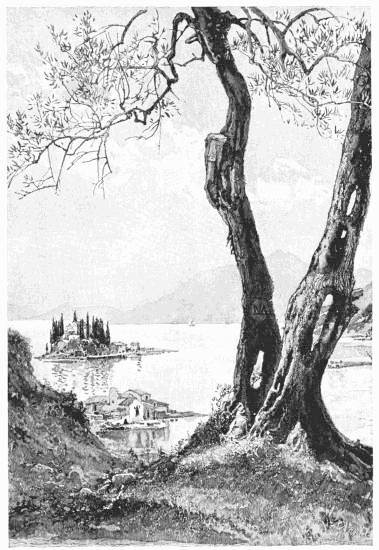
At Corfu one is over one's head in the Odyssey. "The island is not what it has been," said the English lady of the Indian Mail. It is not, indeed! She referred to the days of the Lords High. But the rest of us refer to Nausicaa; for Corfu is the Scheria of the Odyssey, the home of King Alcinous. Not far beyond the tomb of Menekrates, at the point called Canone, we have a view of a deep bay. On the opposite shore of this bay enters the stream upon whose bank Ulysses first met the delightful little maiden—"the beautiful stream of the river, where were the pools unfailing, and clear and abundant water." And also (but this is a work of supererogation, like feminine testimony in a court of justice) we have a view of the Phæacian ship which was turned into stone by Neptune: "Neptune s'en approcha, et, le frappant du plat de la main, le changea en un rocher qu'il enracina dans le sol," as my copy of the Odyssey, which happens rather absurdly to be a French one, translates the passage. The ship, therefore, is now an island; its deck is a chapel; its masts are trees. Of late the belief that Corfu is the Scheria of the Odyssey has been attacked. Appended to the musical translation of the episode of Nausicaa, which was published in 1890, there is the following note: "It will be seen that the writer declines to accept the identification of Corcyra, the modern Corfu, with Scheria. In this skepticism he is emboldened by the protecting shield of the Ajax among English-speaking Hellenists. See Jebb's Homer." It is not possible to contest a point with Ajax. But any one who has seen the gardens and groves of this lovely isle, who has watched the crystalline water dash against the rocks at Palæokastrizza, who has strolled down the hill-side at Pelleka, or floated in a skiff off the coast at Ipso—any such person will say that Corfu is at least an ideal home for the charming girl who played ball and washed the clothes on the shore, king's daughter though she was. To quote the translation:
"Father dear, would you make ready for me a wagon, a high one,
Strong in the wheels, that I may carry our beautiful garments
... to be washed in the river?"
One wishes that this primitive princess could have had another name. Nausicaa; no matter how one pronounces the syllables, they are not melodious. Why could she not have been Aglaia, Daphne, or Artemidora? Standing at Canone and looking across at her shore, one is vexed anew that she should have given her heart, or even her fancy, to Ulysses—a man who was always eating. Instead of Ulysses, we should say Odysseus, no doubt. That may pass. But the sentimental, inaccurate persons who read Homer in English (or French) will not so easily consent to Alkinoos. No; Alcinous (which reminds them vaguely of halcyon) will remain in their minds as the name of the king who lived "far removed from the trafficking nations," among his blossoming gardens in the billowy sea; and to this faith will they cling. The clinging evidently exists at Corfu. One of the most comical sights there is a modern "detached villa," of course English, which might have come from Cheltenham; it is planted close to the glaring road, and over its dusty gate is inscribed imperturbably, "Alcinous Lodge."
VILLAGE OF PELLEKA
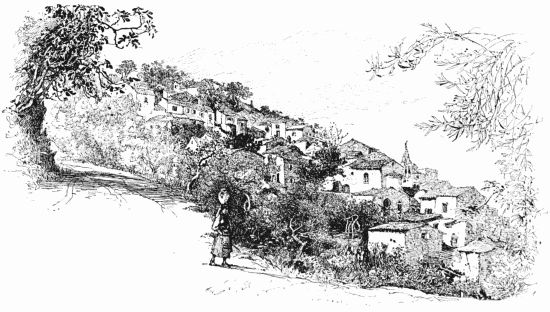
One wonders whether the princesses of to-day (who no longer dry clothes upon the shore) amuse their leisure hours with Homer's recitals concerning their predecessors? One of them, at any rate, has chosen Corfu as a place of sojourn; the Empress of Austria, after paying many visits to the island, has now built for herself a country residence, or villino, at a distance from the town, not far from Nausicaa's stream. The house is surrounded by gardens, and from the terrace there is a magnificent view in all directions; here she enjoys the solitude which she is said to love, and the Corfiotes see only the coming and going of her yacht. I don't know why there should be something so delightful, to one mind at least, in the selection of this distant Greek island as the resting-place of a queen, who takes the long journey down the Adriatic year after year to reach her retreat. The preference is perhaps due simply to fondness for a sea-voyage, and to the fact that a yacht lying at Trieste lies practically at Vienna's door. Lovers of Corfu, however, will not be turned aside by any of these reasons; they will continue to believe that the choice is made for beauty's sake; they will extol this perfect appreciation; they will praise this modern Nausicaa; they will purchase her portrait in photographed copies. When they have one of these representations, they can note with satisfaction the accordance between its outlines and a taste in islands which is surely the best in the world.
The casino of the Empress is not the only royal residence at Corfu. About a mile from the town is the country-house called "Mon Repos," the property of the King of Greece. King George and Queen Olga, with their children, have frequently spent summers here. The mansion is ordinary as regards its architecture—it was built by one of the Lords High. The situation is altogether admirable, with a view of the harbor and town. But the especial loveliness of Mon Repos is to be found in its gardens; their foliage is tropical, with superb magnolias, palms, bananas, aloes, and orange and lemon trees. There are flowers of all kinds, with roses clambering everywhere, and blossoming vines. The royal family who rule, or rather preside over, the kingdom of the Hellenes are much respected and beloved at Corfu. The King, who was Prince William of Denmark—the brother of the Czarina of Russia and of the Princess of Wales—took the name of George when he ascended the throne in 1863. He was elected by the National Assembly. Now that he has been reigning nearly thirty years, and has a grandson as well as a son to succeed him, it is amusing to turn back to the original candidates and the votes; for it was an election (within certain limits) by the people, and all sorts of tastes were represented. Prince Alfred of England, the Duke of Edinburgh, was at the head of the list; but as it had been stipulated that no member of the reigning families of England, France, or Russia should have the crown, his name was struck off. There were votes for Prince Jerome Napoleon. There were votes for the Prince Imperial. There were even votes for "A Republic." But Greece, as she stands, is as near a republic as a country with a sovereign can be. Suffrage is universal; there is no aristocracy; there are no hereditary titles, no entailed estates; the liberty of the press is untrammelled; education is free. Everywhere the people are ardently patriotic; they are actively, and one may say almost dangerously, interested in everything that pertains to the political condition of their country. This interest is quickened by their acute intellects. I have never seen faces more sharply intelligent than those of the Greek men of to-day. I speak of men who have had some advantages in the way of education. But as all are intensely eager to obtain these advantages, and as schools are now numerous, education to a certain extent is widely diffused. The men are, as a general rule, handsome. But they are not in the least after the model of the Greek god, as he exists in art and fiction. This model has an ideal height and strength, massive shoulders, a statuesque head with closely curling hair, and an unruffled repose. The actual Greek possesses a meagre frame, thin face, with high cheek-bones, a dry, dark complexion, straight hair, small eyes, and as for repose, he has never heard of it; he is overwhelmingly,never-endingly restless.