Front matter (continued 3)
Reading edition
It is probably the most graceful tower that has ever been devised. In Cairo the rich fretwork of its decorations and the soft yellow hue of the stone of which it is constructed add to this beauty. Invariably slender, it decreases in size as it springs towards heaven, carrying lightly with it two or three external galleries, which are supported by stalactites, and ending in a miniature cupola and crescent. These stalactites (variously named, also, pendentives, recessed clusters, and honey-combed work) may be called the distinctive feature of Saracenic architecture. They were used originally as ornaments to mask the transition from a square court to the dome. But they soon took flight from that one service, and now they fill Arabian corners and angles and support Arabian curves so universally that for many of us the mere outline of one scribbled on paper brings up the whole pageant of the crescent-topped domes and towers of the East.
The Cairo mosques are said to show the purest existing forms of Saracenic architecture. One hopes that this saying is true, for a dogmatic superlative of this sort is a rock of comfort, and one can remember it and repeat it. With the best of memories, however, one cannot intelligently see all these specimens of purity, unless, indeed, one takes up his residence in Cairo (and it is well known that when one lives in a place one never pays visits to those lions which other persons journey thousands of miles to see). Travellers, therefore, very soon choose a favorite and abide by it, vaunting it above all others, so that you hear of El Ghouri, with its striking façade and magnificent ceiling, as "the finest," and of Kalaoon as "the finest," and of Moaiyud as ditto; not to speak of those who prefer the venerable Touloun and Amer, and the undiscriminating crowd that is satisfied, and rightly, with Aristides the Just—that is, the mosque of Sultan Hassan. For myself, after acknowledging to a weakness for the mosques which are not in the guide-books, which possess no slippers, I confess that I admire most the tomb-mosque of Kait Bey. It is outside of Cairo proper, among those splendid half-ruined structures the so-called tombs of the Khalifs. It stands by itself, its chiselled dome and minaret, a lace-work in stone, clearly revealed. It would take pages to describe the fanciful beauty of every detail, both without and within, and there must, in any case, come an end of repeating the words "elegance," "mosaic," "minaret," "arabesque," "jasper," and "mother-of-pearl." The chief treasures of this mosque are two blocks of rose granite which bear the so-called impressions of the feet of Mohammed; the legend is that he rests here for a moment or two at sunset every Thursday. "How well I understand this fancy of the prophet!" exclaimed an imaginative visitor. "How I wish I could do the same!"
THE GIZEH MUSEUM
One of the great events of the winter of 1890 was the opening of the new Museum of Egyptian Antiquities at Gizeh. This magnificent collection, which until recently has been ill-housed at Boulak, is now installed in another suburb, Gizeh, in one of the large summer palaces built by the former Khedive, Ismail. To reach it one passes through the new quarter and crosses the handsome Nile bridge. Not only are all these streets watered, but the pedestrian also can have water if he likes. Large earthen jars, propped by framework of wood, stand here and there, with the drinking-bottle, or kulleh, attached; these jars are replenished by the sakkahs, who carry the much-loved Nile water about the streets for sale. One passes at regular intervals the light stands, made of split sticks, upon which is offered for sale, in flat loaves like pancakes, the Cairo bread. There are also the open-air cook shops—small furnaces, like a tin pan with legs; spread out on a board before them are saucers containing mysterious compounds, and the cook is in attendance, wearing a white apron. These cooks never lack custom; a large majority of the poorer class in Cairo obtains its hot food, when it obtains it at all, at these impromptu tables. Before long one is sure to meet a file of camels. The camel ought to appreciate travellers; there is always a tourist murmuring "Oh!" whenever one of these supercilious beasts shows himself near the Ezbekiyeh Gardens. The American, indeed, cannot keep back the exclamation; perhaps when he was a child he attended (oh, happy day!) the circus, and watched with ecstasy the "Grande Orientale Rentrée of the Lights of the Harem"—two of these strange steeds, ridden by dazzling houris in veils of glittering gauze. The camel has remained in his mind ever since as the attendant of sultanas; though this impression may have become mixed in later years with the constantly recurring painting (in a dead-gold frame and red mat) of a camel and an Arab in the desert, outlined against a sunset sky. In either case, however, the animal represents something which is as far as possible from an American street traversed by horse-cars, and when the inhabitant of this street sees the identical creature passing him, engaged not in making rentrées or posing against the sunset, but diligently at work carrying stones and mortar for his living, no wonder he feels that he has reached a land of dreams.
A SELLER OF WATER-JUGS, CAIRO. From a photograph by Sebah, Cairo
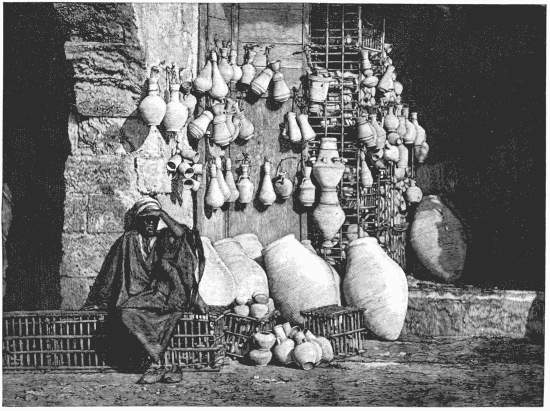
Most of us do not lose our admiration for the Orientalness of the camel. But we learn in time that he has been praised for qualities which he does not possess. He is industrious, but he continually scolds about his industry; he may not trouble one with his thirst, but he revenges himself by his sneer. The smile of a camel is the most disdainful thing I know. On the other side of the Nile bridge one comes sometimes upon an acre of these beasts, all kneeling down in the extraordinary way peculiar to them, with their hind-legs turned up; here they chew as they rest, and put out their long necks to look at the passers-by. But the way to appreciate the neck of a camel is to be on a donkey; then, when the creature comes up behind and lopes past you, his neck seems to be the highest thing in Cairo—higher than a mosque.
Beyond the bridge the road to Gizeh follows the river. Gizeh itself is the typical Nile village, with the low, clustered houses built of Nile mud (which looks like yellow-brown stucco), and beautiful feathery palms with a minaret or two rising above. The palace stands apart from the village, and is surrounded by large gardens. Opposite the central portico is the tomb of Mariette Pasha, the founder of the museum—a high sarcophagus designed from an antique model. Mariette Pasha (it may be mentioned here that the title Pasha means General, and that of Bey, Colonel) was a native of Boulogne. A mummy case in the museum of that town of schools first attracted his attention towards Egyptian antiquities, and in 1850 he came to Egypt. Khedive Said authorized him to found a museum; and Said's successor, Ismail, conferred upon him the exclusive right to make excavations, placing in his charge all the antiquities of Egypt. Mariette used these powers with intelligence and energy, giving the rest of his life to the task—a period of thirty years. He died in Cairo, at the age of sixty-one, in January, 1882. This Frenchman made many important discoveries, and he preserved to Egypt her remaining antiquities; before his time her treasures had been stolen and bought by all the world. A thought which haunts all travellers in this strange country is, how many more rich stores must still remain hidden! The most generally interesting among the recent discoveries was the finding of the Pharaohs, in 1881. The story has been given to the world in print, therefore it will be only outlined here. But by far the most fortunate way is to hear it directly from the lips of the keeper of the museum, Emil Brugsch Bey himself, his vivid, briefly direct narration adding the last charm to the striking facts. By the museum authorities it had been for several years suspected that some one at Luxor (Thebes) had discovered a hitherto unopened tomb; for funeral statuettes, papyri, and other objects, all of importance, were offered for sale there, one by one, and bought by travellers, who, upon their return to Cairo, displayed the treasures, without comprehending their value. Watch was kept, and suspicion finally centred upon a family of brothers; these Arabs at last confessed, and one of them led the way to a place not far from the temple called Deir-el-Bahari, which all visitors to Thebes will remember. Here, filled with sand, there was a shaft not unlike a well, which the man had discovered by chance. When the sand was removed, the opening of a lateral tunnel was visible below, and this tunnel led into the heart of the hill, where, in a rude chamber twenty feet high, were piled thirty or more mummy cases, most of them decorated with the royal asp. The mummies proved to be those of Sethi the First, the conqueror who carried his armies as far into Asia as the Orontes; and of Rameses the Great (called Sesostris by the Greeks), the Pharaoh who oppressed the Israelites; and of Sethi the Second, the Pharaoh of the Exodus, together with other sovereigns and members of their families, princes, princesses, and priests. At some unknown period these mummies had been taken from the magnificent rock tombs in that terrible Apocalyptic Valley of the Kings, not far distant, and hidden in this rough chamber. No one knows why this was done; a record of it may yet be discovered. But in time all knowledge of the hiding-place was lost, and here the Pharaohs remained until that July day in 1881. They were all transported across the burning plain and down the Nile to Cairo. Now at last they repose in state in an apartment which might well be called a throne-room. You reach this great cruciform hall by a handsome double stairway; upon entering, you see the Pharaohs ranged in a majestic circle, and careless though you may be, unhistorical, practical, you are impressed. The features are distinct. Some of the dark faces have dignity; others show marked resolution and power. Curiously enough, one of them closely resembles Voltaire. This, however, is probably due to the fact that Voltaire closely resembled a mummy while living. How would it seem, the thought that beings who are to come into existence A.D. 5000 should be able, in the land which we now call the United States of America (what will it be called then?), to gaze upon the features of some of our Presidents—for instance, George Washington and Abraham Lincoln? I am afraid that the fancy is not as striking as it should be, for New World ambition grasps without difficulty all futures, even A.D. 25,000; it is only when our eyes are turned towards the past, where we have no importance and represent nothing, that an enumeration of centuries overpowers us—a little. But in any case, after visiting Egypt, we all learn to hate the art of the embalmer; those who have been up the Nile, and beheld the poor relics of mortality offered for sale on the shores, become, as it were by force, advocates of cremation.
STATUE OF PRINCE RAHOTEP'S WIFE Gizeh Museum.—Discovered in 1870 in a tomb near Meydoom.—According to the chronological table of Mariette, it is 5800 years old.—From a photograph by Sebah, Cairo.
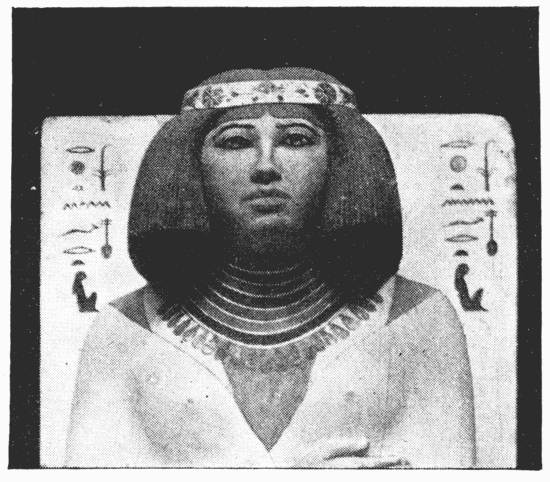
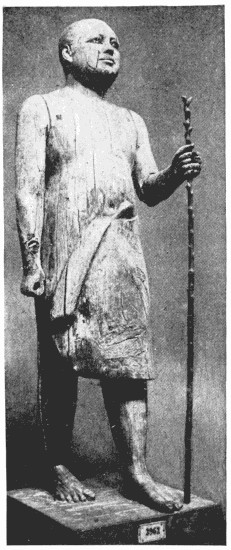
The Gizeh Museum is vast; days are required to see all its treasures. Among the best of these are two colored statues, the size of life, representing Prince Rahotep and his wife; these were discovered in 1870 in a tomb near Meydoom. Their rock-crystal eyes are so bright that the Arabs employed in the excavation fled in terror when they came upon the long-hidden chamber. They said that two afreets were sitting there, ready to spring out and devour all intruders. Railed in from his admirers is the intelligent, well-fed, highly popular wooden man, whose life-like expression raises a smile upon the faces of all who approach him. This figure is not in the least like the Egyptian statues of conventional type, with unnaturally placed eyes. As regards the head, it might be the likeness of a Berlin merchant of to-day, or it might be a successful American bank president after a series of dinners at Delmonico's. Yet, strange to say, this, and the wonderful diorite statue of Chafra, are the oldest sculptured figures in the world.
One is tempted to describe some of the other treasures of this precious and unrivalled collection, as well as to note in detail the odd contrasts between Ismail's gayly flowered walls and the solemn antiquities ranged below them. "But here is no space," as Lady Mary Wortley Montagu would have expressed it. And one of the curious facts concerning description is that those who have with their own eyes seen the statue, for instance, which is the subject of a writer's pen (and it is the same with regard to a landscape, or a country, or whatever you please)—such persons sometimes like to read an account of it, though the words are not needed to bring up the true image of the thing delineated, whereas those who have never seen the statue—that is, the vast majority—are, as a general rule, not in the least interested in any description of it, long or short, and, indeed, consider all such descriptions a bore.
At present the one fault of Gizeh is the absence of a catalogue. But catalogues are a mysterious subject, comprehended only by the elect.
One day when I was passing the hot hours in the shaded rooms of the museum, surrounded by seated granite figures with their hands on their knees (the coolest companions I know), I heard chattering and laughter. These are unusual sounds in those echoing halls, where unconsciously everybody whispers, partly because of the echo, and partly also, I think, on account of the mystic mummy cases which stand on end and look at one so queerly with their oblique eyes. Presently there came into view ten or twelve Cairo ladies, followed by eunuchs, and preceded by a guide. The eunuchs were (as eunuchs generally are) hideous, though they represented all ages, from a tall lank boy of seventeen to a withered old creature well beyond sixty. The Cairo eunuchs are negroes; one distinguishes them always by the extreme care with which they are dressed. They wear coats and trousers of black broadcloth made in the latest European style, with patent-leather shoes, and they are decorated with gold chains, seal rings, and scarf-pins; they have one merit as regards their appearance—I know of but one—they do look clean. The ladies were taking their ease; the muffling black silk outer cloaks, which all Egyptian women of the upper class wear when they leave the house, had been thrown aside; the white face veils had been loosened so that they dropped below the chin. It was the hareem of the Minister for Foreign Affairs; their carriages were waiting below. The most modest of men—a missionary, for instance, or an entomologist—would, I suppose, have put them to flight; but as the tourist season was over, and as it was luncheon-time for Europeans, no one appeared but myself, and the ladies strayed hither and thither as they chose, occasionally stopping to hear a few words of the explanations which the guide (a woman also) was vainly trying to give before each important statue. With one exception, these Cairo dames were, to say the least, extremely plump; their bare hands were deeply dimpled, their cheeks round. They all had the same very white complexion without rose tints; their features were fairly good, though rather thick; the eyes in each case were beautiful—large, dark, lustrous, with sweeping lashes. Their figures, under their loose garments, looked like feather pillows. They were awkward in bearing and gait, but this might have been owing to the fact that their small plump feet (in white open-work cotton stockings) were squeezed into very tight French slippers with abnormally high heels, upon which it must have been difficult to balance so many dimples. The one exception to the rule of billowy beauty was a slender, even meagrely formed girl, who in America would pass perhaps for seventeen; probably she was three years younger. Her thin, dark, restless face, with its beautiful inquiring eyes, was several times close beside mine as we both inspected the golden bracelets and ear-rings, the necklaces and fan, of Queen Ahhotpu, our sister in vanity of three thousand five hundred years ago. I looked more at her than I did at the jewels, and she returned my gaze; we might have had a conversation. What would I not have given to have been able to talk with her in her own tongue! After a while they all assembled in what is called the winter garden, an up-stairs apartment, where grass grows over the floor in formal little plots. Chairs were brought, and they seated themselves amid this aerial verdure to partake of sherbet, which the youngest eunuch handed about with a business-like air. While they were still here, much relaxed as regards attire and attitude, my attention was attracted by the rush through the outer room (where I myself was seated) of the four older eunuchs. They had been idling about; they had even gone down the stairs, leaving to the youngest of their number the task of serving the sherbet; but now they all appeared again, and the swiftness with which they crossed the outer room and dashed into the winter-garden created a breeze. They called to their charges as they came, and there was a general smoothing down of draperies. The eunuchs, however, stood upon no ceremony; they themselves attired the ladies in the muffling cloaks, and refastened their veils securely, as a nurse dresses children, and with quite as much authority. I noticed that the handsomer faces showed no especial haste to disappear from view; but there was no real resistance; there was only a good deal of laughter.
THE WOODEN MAN Gizeh Museum, near Cairo.—According to the chronological table of Marlette, this statue is over 6000 years old.—From a photograph by Brugsch Bey
I dare say that there was more laughter still (under the veils) when the cause of all this haste appeared, coming slowly up the stairs. It was a small man of sixty-five or seventy, one of my own countrymen, attired in a linen duster and a travel-worn high hat; his silver-haired head was bent over his guide-book, and he wore blue spectacles. I don't think he saw anything but blue antiquities, safely made of stone.
Hareem carriages (that is, ladies' carriages) in Cairo are large, heavily built broughams. The occupants wear thin white muslin or white tulle veils tied across the face under the eyes, with an upper band of the same material across the forehead; but these veils do not in reality hide the features much more closely than do the dotted black or white lace veils worn by Europeans. The muffling outer draperies, however, completely conceal the figure, and this makes the marked difference between them and their English, French, and American sisters in the other carriages near at hand. On the box of the brougham, with the coachman, the eunuch takes his place. To go out without a eunuch would be a humiliation for a Cairo wife; to her view, it would seem to say that she is not sufficiently attractive to require a guardian. The hareem carriage of a man of importance has not only its eunuch, but also its sais, or running footman; often two of them. These winged creatures precede the carriage; no matter how rapid the pace of the horses, they are always in advance, carrying, lightly poised in one hand, high in the air, a long lance-like wand. Their gait is the most beautiful motion I have ever seen. The Mercury of John of Bologna; the younger gods of Olympus—will these do for comparisons? One calls the sais winged not only because of his speed, but also on account of his large white sleeves (in English, angel sleeves), which, though lightly caught together behind, float out on each side as he runs, like actual wings. His costume is rich—a short velvet jacket thickly embroidered with gold; a red cap with long silken tassel; full white trousers which end at the knee, leaving the legs and feet bare; and a brilliant scarf encircling the small waist. These men are Nubians, and are admirably formed; often they are very handsome. Naturally one never sees an old one, and it is said that they die young. Their original office was to clear a passage for the carriage through the narrow, crowded streets; now that the streets are broader, they are not so frequently seen, though Egyptians of rank still employ them, not only for their hareem carriages, but for their own. They are occasionally seen, also, before the victoria or the landau of European residents; but in this case their Oriental dress accords ill with the stiff, tight Parisian costumes behind them. Now and then one sees them perched on the back seat of an English dog-cart, and here they look well; they always sit sidewise, with one hand on the back of the seat, as though ready at a moment's notice to spring out and begin flying again.
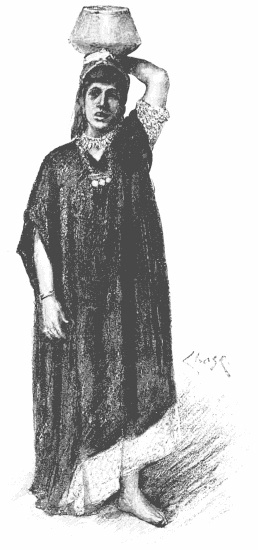
If the figures of the Cairo ladies are always well muffled, one has at least abundant opportunity to admire the grace and strength of the women of the working classes. When young they have a noble bearing. Their usual dress is a long gown of very dark blue cotton, a black head veil, and a thick black face veil that is kept in its place below the eyes by a gilded ornament which looks like an empty spool. Often their beautifully shaped slender feet are bare; but even the poorest are decked with anklets, bracelets, and necklaces of beads, imitation silver or brass. The men of the working classes wear blue gowns also, but the blue is of a much lighter hue; many of them, especially the farmers and farm laborers (called fellaheen), have wonderfully straight flat backs and broad, strong shoulders. Europeans, when walking, appear at a great disadvantage beside these loosely robed people; all their movements seem cramped when compared with the free, effortless step of the Arab beside them.
THE BAZAARS
One spends half one's time in the bazaars, perhaps. One admires them and adores them; but one feels that their attraction cannot be made clear to others by words. Nor can it be by the camera. There are a thousand photographic views of Cairo offered for sale, but, with the exception of an attempt at the gateway of the Khan Khaleel, not one copy of these labyrinths, which is a significant fact. Their charm comes from color, and this can be represented by the painter's brush alone. But even the painter can render it only in bits. From a selfish point of view we might perhaps be glad that there is one spot left on this earth whose characteristic aspect cannot be reproduced, either upon the wall or the pictured page, whose shimmering vistas must remain a purely personal memory. We can say to those who have in their minds the same fantastic vision, "Ah, you know!" But we cannot make others know. For what is the use of declaring that a collection of winding lanes, some of them not more than three feet broad, opening into and leading out of each other, unpaved, dirty, roofed far above, where the high stone houses end, with a lattice-work of old mats—what is the use of declaring that this maze is one of the most delightful places in the world? There is no use; one must see it to believe it.
AN EGYPTIAN WOMAN From a photograph by Abdullah Frères, Cairo
We approach the bazaars by the Mooski, a street which has lost all its ancient attraction—which is, in fact, one of the most commonplace avenues I know. But near its end the enchantment begins, and whether we enter the flag bazaar, the lemon-colored-slipper bazaar, the gold-and-silver bazaar, the bazaar of the Soudan, the bazaar of silks and embroideries, the bazaar of Turkish carpets, or the lane of perfumes felicitously named by the donkey-boys the smell bazaar, we are soon in the condition of children before a magician's table. I defy any one to resist it. The most tired American business man looks about him with awakened interest, the lines of his face relax and turn into the wrinkles we associate with laughter, as he sees the small, frontless shops, the long-skirted merchants, and the sewing, embroidering, cross-legged crowd. The best way, indeed, to view the bazaars is to relax—to relax your ideas of time as well as of pace, and not be in a hurry about anything. Accompany some one who is buying, but do not buy yourself; then you can have a seat on the divan, and even (as a friend of the purchaser) one of those wee cups of black coffee which the merchant offers, and which, whether you like it or not, you take, because it belongs to the scene. Thus seated, you can look about at your ease.
In these days, when every one is rereading the Arabian Nights, the learned in Burton's translation, the outside public in Lady Burton's, even the most unmethodical of writers feels himself, in connection with Cairo, forced towards the inevitable allusion to Haroun. But once within the precincts of the Khan Khaleel, he does not need to have his fancy jogged by Burton or any one else; he thinks of the Arabian Nights instinctively, and "it's a poor tale," indeed, to quote Mrs. Poyser, if he does not meet the one-eyed calendar in the very first booth. But, as has already been said, it is useless to describe. All one can do is to set down a few impressions. One of the first of these is the charming light. The sunshine of Egypt has a great radiance, but it has also—and this is especially visible when one looks across any breadth of landscape—a pleasant quality of softness; it is a radiance which is slightly hazy and slightly golden brown, being in these respects quite unlike the pellucid white light of Greece. The Greeks frown; even the youngest of the handsome men who go about in ballet-like white petticoats and the brimless cap, has the ugly little perpendicular line between the eyes, produced by a constant knitting of the brows. Like the Greek, the Egyptian also is without protection for his eyes; the dragoman wears a small shawl over the fez, which covers the back of the neck and sides of the face, the Bedouins have a hood, but the large majority of the natives are unprotected. It is said that a Mohammedan can have no brim to his turban or tarboosh, because he must place his bare forehead upon the ground when he says his prayers, and this without removing his head-gear (which would be irreverent). However this may be, he goes about in Egypt with the sun in his eyes, though, owing to the softer quality of the light, he does not frown as the Greek frowns. For those who are not Egyptians, however, the light in Cairo sometimes seems too omnipresent; then, for refuge, they can go to the bazaars. The sunshine is here cut off horizontally by thick walls, and from above it is filtered through mats, whose many interstices cause a checker of light and shade in an infinite variety of unexpected patterns on the ground. This ground is watered. Somehow the air is cool; coming in from the bright streets outside is like entering an arbor. The little shops resemble cupboards; their floors are about three feet above the street. They have no doors at the back. When the merchant wishes to close his establishment, he comes out, pulls down the lid, locks it, and goes home. A picturesque characteristic is that in many cases the wares are simply sold here; they are also made, one by one, upon the spot. You can see the brass-workers incising the arabesques of their trays; you can see the armorers making arms, the ribbon-makers making ribbons, the jewellers blowing their forges, the ivory-carvers bending over their delicate task. As soon as each article is finished, it is dusted and placed upon the little shelf above, and then the apprentice sets to work upon a new one. In addition to the light, another thing one notices is the amazing way in which the feet are used. In Cairo one soon becomes as familiar with feet as one is elsewhere with hands; it is not merely that they are bare; it is that the toes appear to be prehensile, like fingers. In the bazaars the embroiderers hold their cloth with their toes; the slipper-makers, the flag-cutters, the brass-workers, the goldsmiths, employ their second set of fingers almost as much as they employ the first. Both the hands and feet of these men are well formed, slender, and delicate, and, by the rules of their religion, they are bathed five times each day.
Mosques are near where they can get water for this duty. For the bazaars are not continuous rows of shops: one comes not infrequently upon the ornamental portal of an old Arabian dwelling-house, upon the forgotten tomb of a sheykh, with its low dome; one passes under stone arches; often one sees the doorway of a mosque. Humble-minded dogs, who look like jackals, prowl about. The populace trudges through the narrow lanes, munching sugar-cane whenever it can get it. Another favorite food is the lettuce-plant; but the leaves, which we use for salad, the Egyptians throw away; it is the stalk that attracts them.
Lettuce-stalks are not rich food, but the bazaars of the people who eat them convey, on the whole, an impression of richness; this is owing to the sumptuousness of the prayer carpets, the gold embroideries, the gleaming silks, the Oriental brass-work with sentences from the Koran, the ivory, the ostrich plumes, the little silver bottles for kohl, the inlaid daggers, the turquoises and pearls, and the beautiful gauzes, a few of them embroidered with the motto, "I do this work for you," and on the reverse side, "And this I do for God." To some persons, the far-penetrating mystic sweetness from the perfume bazaar adds an element also. Here sit the Persian merchants in their delicate silken robes; they weigh incense on tiny scales; they sort the gold-embossed vials of attar of roses; their taper fingers move about amid whimsically small cabinets and chests of drawers filled with ambrosial mysteries. There is magic in names; these merchants are doubly interesting because they come from Ispahan! Scanderoun—there is another; how it rolls off the tongue! We do not wish for exact geographical descriptions of these places; that would spoil all. We wish to chant, like Kit Marlowe's Tamburlaine (and with similar indefiniteness):
"Is it not passing brave to be a king,
And march in triumph through Persepolis?"
"So will I ride through Samarcanda streets,
... to Babylon, my lords; to Babylon!"
THE NILE—COMING DOWN TO GET WATER From a photograph by Sebah, Cairo
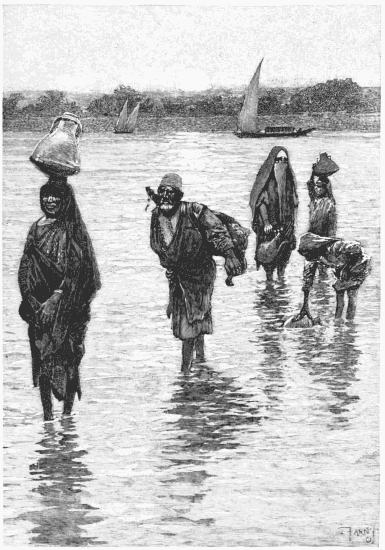
When we leave Cairo we cannot take with us the light of these labyrinths; we cannot take their colors; but one traveller, last May, having found in an antiquity-shop an ancient perfume-burner, had the inspiration of bargaining with these Persians, seated cross-legged in their aromatic niches (said traveller on a white donkey outside), for small packages of sandal and aloes wood, of myrrh, of frankincense and ambergris, of benzoin, of dried rose leaves, and of other Oriental twigs and sticks, for the purpose of summing up, later, and in less congenial climes perhaps, the spicy atmosphere, at least, of the Cairo bazaars. What would be the effect of breathing always this fragrant air? Would it give a richer life, would it tinge the cheek with warmer hues? These merchants have complexions like cream-tinted tea-roses; their dark eyes are clear, and all their movements graceful; they are very tranquil, but not in the least sleepy; they look as if they could take part in subtle arguments, and pursue the finest chains of reasoning. Would an atmosphere perfumed by these Eastern woods clarify and rarefy our denser Occidental minds?
THE NILE
As every one who comes to Cairo goes up the Nile, the river is seldom thought of as it appears during its course past the Khedive's city. This simple vision of it is overshadowed by memories of Abydos, of Karnak and Thebes, and Philæ—the great temples on its banks which have impressed one so profoundly. Perhaps they have over-impressed; possibly the tension of continuous gazing has been kept up too long. In this case the victim, with his head in his hands, is ready to echo the (extremely true) exclamation of Dudley Warner, "There is nothing on earth so tiresome as a row of stone gods standing to receive the offerings of a Turveydrop of a king!" This was the mental condition of a lady who last winter, on a Nile boat, suddenly began to sew. "I have spent nine long days on this boat, staring from morning till night. One cannot stare at a river forever, even if it is the Nile! Give me my thimble."
One is not obliged to leave Cairo in order to see examples of the smaller silhouettes of the great river—the shadoofs or irrigating machines, the rows of palm-trees, the lateen yards clustered near a port, and always and forever the women coming down the bank to get water from the yellow tide. These processions of women are the most characteristic "Nile scene with figures" of the present day. I am not sure but that one of their jars, or the smaller gray kulleh (which by evaporation keeps the water deliciously cool), would evoke "Egypt" more quickly in the minds of most of us than even the portrait of Cleopatra herself on the back wall at Denderah. If one is staying in Cairo after the tremendous voyage is over, one wanders to the banks every now and then to gaze anew at the broad, monotonous stream. It comes from the last remaining unknown territory of our star, and this very year has seen that space grow smaller. Round about it stand to-day five or six of the civilized nations, who have formed a battue, and are driving in the game. The old river had a secret, one of the three secrets of the world; but though the North and South Poles still remain unmapped, the annual rise of its waters will be strange no longer when Lado is a second Birmingham. How will it seem when we can telephone to Sennaar (perhaps to that ambassador beloved by readers of the Easy Chair), or when there is early closing in Darfur?
THE DOCK AT OLD CAIRO From a photograph by Sebah, Cairo
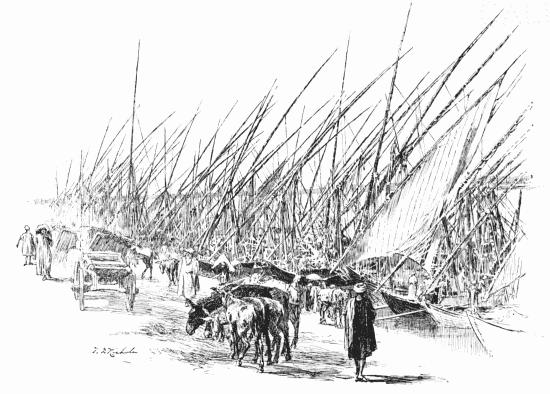
At Cairo, when one rides or drives, one almost always crosses the Nile; but Cairo herself does not cross. Her more closely built quarters do not even come down to the shore. The Nile and Cairo are two distinct personalities; they are not one and indivisible, as the Nile and Thebes are one, the Nile and Philæ.
The river at Cairo has a dull appearance. Its only beauty comes from the towering snow-white sails of the dahabeeyahs and trading craft that crowd the stream. It is true that these have a great charm.
DOMESTIC ARCHITECTURE
In the old quarters this is Arabian. The beauty lies largely in the latticed balconies called mouchrabiyehs, which overhang the narrow roadways. These bay-windows sometimes stud the façades thickly, now large, now small, but always a fretwork of delicate wood-carving. Often from the bay projects a second and smaller oriel, also latticed. This is the place for the water jar, the current of air through the lattices keeping the water cool. An Arabian house has no windows on the ground-floor in its outer wall save small air-holes placed very high, but above are these mouchrabiyehs, which are made of bits of cedar elaborately carved in geometrical designs. The small size of the pieces is due to the climate, the heats of the long summer would warp larger surfaces of wood; but the delicacy and intricacy of the carving are a work of supererogation due to Arabian taste. From the mouchrabiyehs the inmates can see the passers-by, but the passers-by cannot see the inmates, an essential condition for the carefully guarded privacy of the family.
There is in Cairo a personage unconnected with the government who, among the native population, is almost as important as the Khedive himself; this is the Sheykh Ahmed Mohammed es Sadat, the only descendant in the direct line of the Prophet Mohammed now living. He has the right to many native titles, though he does not put them on his quiet little visiting-card, which bears only his name and a mysterious monogram in Arabic. By Europeans he is called simply the Sheykh (the word means chief) es Sadat. The ancestral dwelling of the sheykh shares in its master's distinction. It is pointed out, and, when permission can be obtained, visited. It is a typical specimen of Saracenic domestic architecture, and has always remained in the possession of the family, for whom it was first erected eight hundred years ago. There are in Cairo other Arabian houses as beautiful and as ancient as this. By diplomatic (and mercenary) arts I gained admittance to three, one of which has walls studded with jasper and mother-of-pearl. But these exquisite chambers, being half ruined, fill the mind with wicked temptations. One longs to lay hands upon the tiles, to bargain for an inscription or for a small oriel with the furtive occupants, who have no right to sell, the real owners being Arabs of ancient race, who would refuse to strip their walls, however crumbling, for unbelievers from contemptible, paltry lands beyond the sea. The house of the Sheykh es Sadat may not leave one tranquil, for it is tantalizingly picturesque, but at least it does not inspire larceny; the presence of many servitors prevents that. To reach this residence one leaves (gladly) the Boulevard Mohammed Ali, and takes a narrower thoroughfare, the Street of the Sycamores, which bends towards the south. This lane winds as it goes, following the course of the old canal, the Khaleeg, and one passes many of the public fountains, or sebeels, which are almost as numerous in Cairo as the mosques. A fountain in Arab signification does not mean a jet of water, but simply a place where water can be obtained. The sebeels are beautiful structures, often having marble walls, a dome, and the richest kind of ornament. The water is either dipped with a cup from the basin within, or drawn from the brass mouth-pieces placed outside. Nothing could represent better, I think, the difference between the East and the West than one of these elaborate fountains, covering, in a crowded quarter, the space which might have been occupied by two or three small houses, adorned with carved stone-work, slabs of porphyry, and long inscriptions in gilt, and an iron town pump, its erect slenderness taking up no space at all, and its excellent if unbeautiful handle standing straight out against the sky.
MOUCHRABIYEHS IN THE OLD QUARTER
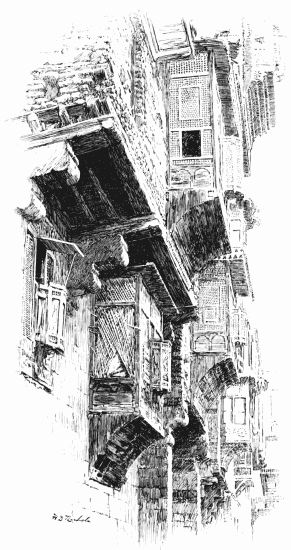
A narrow lane, leaving the Street of the Sycamores, burrows still more deeply into the heart of the quarter, and at last brings us to a porch which juts into the roadway, masking, as is usual in Cairo, the real doorway, which is within. Upon entering, one finds himself in a quadrilateral court, which is open to the sky. An old sycamore shades several latticed windows, among them one which contains three of the smaller oriels; this portion of the second story rests upon an antique marble column. On one side of the column is the low, rough archway leading to the porch; on the other, the high decorated marble entrance of the reception-hall. For in Arabian houses all the magnificence is kept for the interior. In the streets one sees only plain stone walls, which are often hidden under a stucco of mud, more or less peeled off, so that they look half ruined. In the old quarters of Cairo, among the private houses, one obtains, indeed (unless one has an invitation to enter), a general impression of ruin. At the back of the sheykh's court is the stairway to the hareem, the entrance masked by a gayly colored curtain. Across another side extends the private mosque, only half hidden by an ornamented grating. One can see the interior and the high pulpit decked with the green flag of the Prophet. The walls which encircle the court, and which are embellished here and there with Arabic inscriptions, are of differing heights, as they form parts of separate structures which have been erected at various periods through the eight centuries. The place is, in fact, an agglomeration of houses, and some of the older chambers are crumbling and roofless. The central court (which shows its age only in a picturesque trace or two) is adorned with at least twenty beautiful mouchrabiyehs, some large, some small, and no two on the same level. A charm of Saracenic architecture is that you can always make discoveries, nothing is stereotyped; of a dozen delicate rosettes standing side by side under a balcony, no two are carved in the same design.
INTERIOR COURT OF A NATIVE HOUSE, CAIRO From a photograph by Abdullah Frères, Cairo
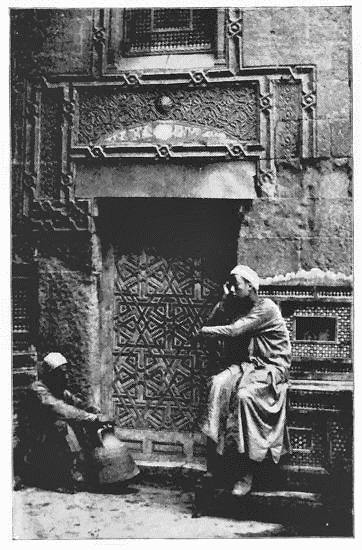
In a room which stretches back to the garden—and which at the time of our visit was empty, save for a row of antique silver-gilt coffee-pots standing on the marble floor—there is a long, low window, like a band in the wall, formed of small carved lattices. The hand of Abbey only, I think, could reproduce the beauty of this casement; but instead of the charming seventeenth-century English girls whom he would wish to place there, realism would demand the hideous eunuchs, with their gold chains and scarf-pins; or else (and this would be better) the dignified old Arab in a white turban who sat cross-legged in the court with his long pipe, his half-closed eyes expressing his disdain for the American visitors. The courtesy of the master of the house, however, made up for his servitor's scorn. The sheykh is a tall man, somewhat too portly, with amiable dark eyes, and a gleam of humor in his face. One scans his features with interest, as if to catch some reflection of the Prophet; but the rays from an ancestor who walked the earth twelve hundred years ago are presumably faint. There is nothing modern in the sheykh's attire; his handsome flowing gown is of silk; he wears a turban, slippers, and an India shawl wound round his waist like a sash. When the air is cool, he shrouds him self in a large outer cloak of fine dark blue cloth, which is lined with white fur. Sometimes Signor Ahmed carries in his hand the Mohammedan rosary. This string of beads appears to be used as Madame de Staël used her "little stick," as the English called it (in Italy, more poetically, they named it "a twig of laurel"). Corrinne must always have this beside her plate at dinner to play with before she conversed, or rather declaimed. Her maid, in confidence, explained that it was necessary to madame "to stimulate her ideas." One often sees the rosary on duty when two Turks are conversing. After a while, their subjects failing them, they fall into silence. Then each draws out his string from a pocket, and they play with their beads for a moment or two, until, inspiration reviving, they begin talking again. One hopes that poor Ahmed Mohammed has not been driven to his string too often as mental support during dumb visits from Anglo-Saxon tourists, who can do nothing but stare at him. The sheykh's reception-hall is forty feet wide and sixty feet long. The ceiling, which has the Saracenic pendentives in the corners and under the beams, is of wood, gilded and painted and carved in the characteristic style which one vainly tries to describe. Travellers have likened it to an India shawl; to me it seemed to approach more nearly the wrong side of a Persian scarf, which shows the many-hued silken ravellings. The effect, as a whole, though extraordinarily rich, is yet subdued. The walls are encrusted with old blue tiles which mount to the top. At one end of the room there is a beautiful wall-fountain. And now comes the other side of the story. To enjoy all this beauty, you must not look down; for, alas! the marble floor is tightly covered with a modern French carpet; chairs and tables of the most ordinary modern designs have taken the place of the old divans; and these tables, furthermore, are ornamented with hideous bouquets of artificial flowers under glass. Finally, the tiles which have fallen from the lower part of the walls have not been replaced by others; a coarse fresco has been substituted. What would not one give to see the sheykh, who is himself a purely Oriental figure, seated in this splendid hall of his fathers as it once was, on one of the now superseded divans, the marbles of his floor uncovered save for his discarded Turkish rugs, the fountain sending forth its rose-water spray, perfume burning in the silver receivers, and no encumbering furniture save piles of brocaded cushions and a jar or two on the gilded shelf.
But we shall never see this. In 1889, 180,594 travellers crossed Egypt by way of the Suez Canal. In this item of statistics we have the reason.
THE PYRAMIDS
For those who have fair eyesight the pyramids of Gizeh are a part of Cairo; their gray triangles against the sky are visible from so many points that they soon become as familiar as a neighboring hill. In addition, they have been pictured to us so constantly in paintings, drawings, engravings, and photographs that one views them at first more with recognition than surprise. "There they are! How natural!" And this long familiarity makes one shrink from arranging phrases about them.
One thing, however, can be said: when we are in actual fact under them, when we can touch them, our easy acquaintance vanishes, and we suddenly perceive that we have never comprehended them in the least. The strange geometrical walls effect a spiritual change in us; they free us from ourselves for a moment, and unconsciously we look back across the past to which they belong, and into the future, of which they are a part much more than we are, as unmindful of our own little cares and occupations, and even our own small lives, as though we had never been chained to them. It is but a fleeting second, perhaps, that this mental emancipation lasts, but it is a second worth having!
One drives to the pyramids in an hour, over a macadamized road. The perennial stories about trouble with the Bedouins belong to the past. Soldiers and policemen guard the sands as they guard the Cairo streets, and the proffer of false antiquities is not more pressing, perhaps, than the demands of the beggars in town. These three pyramids of Gizeh are those we think of before we have visited Egypt. But there are others; including the small ones and those which are ruined, seventy have been counted in twenty-five miles from Cairo to Meydoom, and pyramids are to be seen in other parts of Egypt. The stories concerning Gizeh and the travellers who, from Herodotus down, have visited the colossal tombs, are innumerable. I do not know why the one about Lepsius should seem to me amusing. This learned man and his party, who were sent to Egypt by King Frederick William of Prussia in 1842, celebrated that king's birthday by singing in chorus the Prussian national anthem in the centre of Cheops. The Bedouins in attendance reported outside that they had "prayed all together a loud general prayer."
In connection with the pyramids, the English may be said to have devoted themselves principally to measurements. The genius of the French, which is ever that of expression, has invented the one great sentence about them. So far, the Americans have done nothing by which to distinguish themselves; but their time will come, perhaps. One fancies that Edison will have something to do with it. In the meanwhile modernity is already there. There is a hotel at the foot of Cheops, and one hardly knows whether to laugh or to cry when one sees lawn-tennis going on there daily.
But no matter what lies before us—even if they should pave the desert, and establish an English tramway (or a line of American horse-cars) to the Sphinx—these mighty masses cannot be belittled. There is something in the pyramids which overawes our boasted civilization. In their presence this seems trivial; it seems an impertinence.
THE COPTS
The most interesting of the Coptic churches are at Old Cairo, a mother suburb, where the first city was founded by the conquering Arabian army. Here, ensconced amid hill-like mounds of rubbish, concealed behind mud walls, hidden at the end of blind alleys, one finds the temples of these native Christians, who are the descendants of the converts of St. Mark. The exterior walls have no importance. In truth, one seldom sees them, for the churches are within other structures. Some of them form part of old fortified convents; one is reached by passing through the dwelling-rooms of an inhabited house; another is up-stairs in a Roman tower. You arrive somehow at a door. When this is opened, you find yourself in a church whose general aspect is rough, and whose aisles are adorned with dust and sometimes with dirt. But these temples have their treasures. Chief among them are the high choir screens of dark wood, elaborately carved in panels, and decorated with morsels of ivory which have grown yellow from age. The sculpture is not open-work; it does not go through the panel; it is done in relief. The designs are Saracenic, but these geometrical patterns are interrupted every now and then by Christian emblems and by the Coptic cross. The style of this wood-carving is unique; no other sculpture resembles it. If it does not quite attain beauty, it is at least very odd and rich. There are also carved doors representing Scriptural subjects, marble pulpits, singular bronze candlesticks, brass censers adorned with little bells, silver-gilt gospel-cases, embroidered vestments, silver marriage-diadems, ostrich eggs in metal cases, and old Byzantine paintings, often representing St. George, for St. George is the patron saint of the Copts.
A DONKEY RIDE
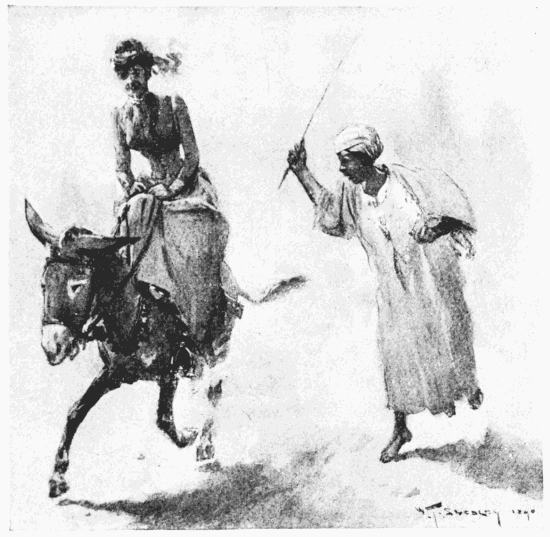
These people esteem themselves to be the true descendants of the ancient Egyptians, as distinguished from the conquering race of Arabians who have now overrun their land. It is a comical idea, but they call upon us to note their close resemblance to the mummies. Early converts to Christianity, they have remained faithful to their belief amid the Mohammedan population all about them. It must be mentioned, however, that they had been pronounced heretics by the Council of Chalcedon before the Arabian conquest; for they had refused to worship the human nature of Christ, revering His divine nature alone. They are the guardians of the Christian legends of Egypt. In a crypt under one of their churches they show two niches. One, they say, was the sleeping-place of Joseph, and the other of the Virgin and Child, during the flight into Egypt. Near Heliopolis is an ancient tree, under whose branches the Holy Family are supposed to have rested when the sunshine was too hot for further travelling.
There are between four and five hundred thousand Copts in Egypt. It may be mentioned here that the Christians of the country, including all branches of the faith, number to-day about six hundred thousand, or one-tenth of the population. The Copts are the book-keepers and scribes; they are also the jewellers and embroiderers. Their ancient tongue has fallen into disuse, and is practically a dead language. They now use Arabic, like all the rest of the nation; but the speech survives in their church service, a part of which is still given in the old tongue, though it is said that even the priests themselves do not always understand what they are saying, having merely learned the sentences by heart, so that they can repeat them as a matter of form. Copts have been converted to Protestantism during these latter days by the American missionaries.
They are not, in appearance, an attractive people. Their convents and churches, at least in Cairo and its neighborhood, are so hidden away, inaccessible, and dirty that they are but slightly appreciated by the majority of travellers, who spend far more of their time among the mosques of Mohammed. But both the people and their ancient language are full of interest from an historical point of view. They form a field for research which will give some day rich results. A little has been done, and well done; but much still remains hidden. It has yet to be dug out by the learned. Then it must be translated by the middle-men into those agreeable little histories which, with agreeable little tunes, agreeable little stories, and agreeable little pictures, are the delight of the many.
KIEF
The large modern cafés of Cairo are imitations of the cafés of Paris. They are uninteresting, save that one sees under their awnings, or at the little tables within, the stambouline in all its glory and ugliness—that is, the heavy black frock-coat with stiff collar, which, with the fez or tarboosh, is the appointed costume for all persons who are employed by the government. The stranger, observing the large number of men of all ages in this attire, is led to the conclusion that the government must employ many thousands of persons in Cairo alone; but probably there is a permitted usage in connection with it, like that mysterious legend—"By especial appointment to the Queen"—which one sees so often in England inscribed over the doors of little shops in provincial High Streets, where the inns have names which to Americans are as fantastic as anything in "Tartarin;" the "White Horse;" the "Crab and Lobster;" the "Three Choughs;" and the "Five Alls."
The native cafés have much more local color than the homes of the stambouline. Outside are rows of high wooden settees, upon which the patrons of the establishment sit cross-legged, their slippers left on the ground below. One often sees a row of Arabs squatting here, holding no communication with each other, hearing nothing, seeing nothing, enjoying for the moment an absolute rest. This period of daily repose, called kief, is a necessity for Egyptians. It has its overweight, its excess, in the smoking of hasheesh, which is one of the curses of the land; but thousands of the people who never touch hasheesh would understand as little how to get through their day without this interregnum as without eating; in fact, eating is less important to them.
The Egyptian often takes his rest at the café. When the American sees Achmet and Ibrahim, who have attended to some of his errands for infinitesimal wages—men whose sole possessions are the old cotton gowns on their backs—when he sees them squatted in broad daylight at the café, smoking the long pipes and slowly drinking the Mocha coffee, it appears to him an inexplicable idleness, an incurable self-indulgence. It is idleness, no doubt, but associations should not be mixed with the subject. To the American the little cup of after-dinner coffee seems a luxury. He does not always stop to remember that Achmet's coffee is, very possibly, all the dinner he is to have; that it has been preceded by nothing since daylight but a small piece of Egyptian bread, and that it will be followed by nothing before bedtime but a mouthful of beans or a lettuce-stalk. The daily rest is by no means taken always at the café. Egyptians also take it at the baths, where, after the final douche, they spend half an hour in motionless ease. For those who have not the paras for the café or the bath, the mosques offer their shaded courts. When there is no time to seek another place, the men take their rest wherever they are. One often sees them lying asleep, or apparently asleep, in their booths at the bazaars. The very beggars draw their rags round them, cover their faces, and lie down close to a wall in the crowded lanes.
AN ARAB CAFÉ From a photograph by Sebah, Cairo
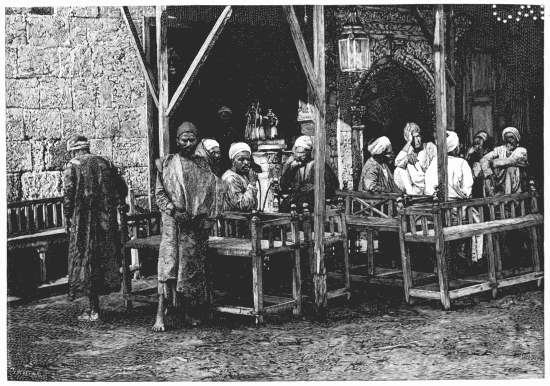
At the cafés, during another stage of the rest, games are played, the favorites being dominos, backgammon, and chess. Sometimes a story-teller entertains the circle. He narrates the deeds of Antar and legends of adventure; he also tells stories from the Bible, such as the tale of the flood, or of Daniel in the den of lions. Sometimes he recites, in Arabic, the poems of Omar Khayyam.
"I sent my soul through the invisible,
Some letter of that after-life to spell;
And by-and-by my soul returned to me,
And answered, 'I myself am heaven and hell!'"
This verse of the Persian poet might be taken as the motto of kief; for if the heaven or hell of each person is simply the condition of his own mind, then if he is able every day to reduce his mind, even for a half-hour only, to a happy tranquillity which has forgotten all its troubles, has he not gained that amount of paradise?
II
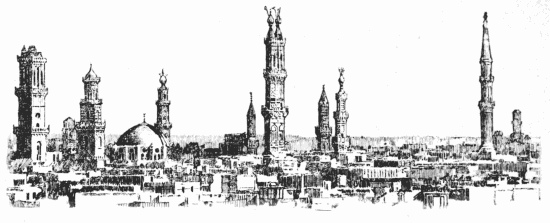
"I love the Arabian language for three reasons: because I am an Arab myself; because the Koran is in Arabic; because Arabic is the language of Paradise." This hadith, or saying, of Mohammed might be put upon the banner of the old university of Cairo, El Azhar; that is, the Splendid. El Azhar was founded in the tenth century, when Cairo itself was hardly more than a name. In its unmoved attachment to the beliefs of its founders, to their old enthusiasms, their methods and hates, El Azhar has opposed an inflexible front to the advance of European ideas, sending out year after year its hundreds of pupils to all parts of Egypt and to Nubia, to the Soudan and to Morocco, to Turkey, Arabia, and Syria, to India and Ceylon, and to the borders of Persia, believing that so long as it could keep the education of the young in its grasp the reign of the Prophet was secure. It is to-day the most important Mohammedan college in the world; for though it has no longer the twenty thousand students who crowded its courts in the thirteenth and fourteenth centuries, there is still an annual attendance of from seven to ten thousand; by some authorities the number is given as twelve thousand. The twelve thousand have no academic groves; they have not even one tree. There is nothing sequestered about El Azhar; it is near the bazaars in the old part of the town, where the houses are crowded together like wasps' nests. One sees nothing of it as one approaches save the minarets above, and in the narrow, crowded lane an outer portal. Here the visitor must show his permit and put on the mosque-shoes, for El Azhar was once a mosque, and is now mosque and university combined. After the shoes are on he steps over the low bar, and finds himself within the porch, which is a marvel as it stands, with its fretwork, carved stones, faded reds, and those old plaques of inscription which excite one's curiosity so desperately, and which no dragoman can ever translate, no matter in how many languages he can complacently ask, "You satisfi?" One soon learns something of the older tongue; hieroglyphics are not difficult; any one with eyes can discover after a while that the A of the ancient Egyptians is, often, a bird who bears a strong resemblance to a pigeon; that their L is a lion; and that the name of the builder of the Great Pyramid, for instance, is represented by a design which looks like two freshly hatched chickens, a football, and a horned lizard (speaking, of course, respectfully of them all). But one can never find out the meaning of the tantalizing characters, so many thousand years nearer our own day, which confront us, surrounded by arabesques, over old Cairo gateways, across the fronts of the street fountains, or inscribed in faded gilt on the crumbling walls of mosques. It is probable that they are Kufic, and one would hardly demand, I suppose, that an English guide should read black-letter? But who can be reasonable in the land of Aladdin's Lamp?

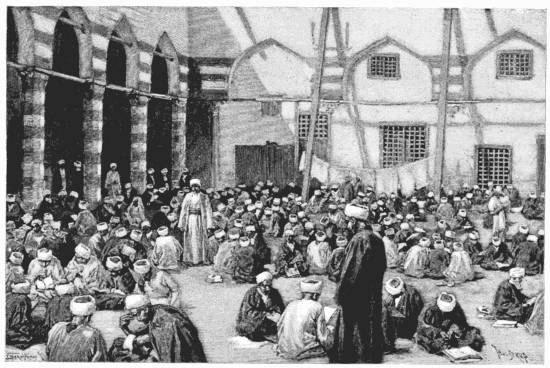
The porch leads to the large central court, which is open to the sky, the breeze, and the birds; and this last is not merely a possibility, for birds of all kinds are numerous in Egypt, and unmolested. On the pavement of this court, squatting in groups, are hundreds of the turbaned students, some studying aloud, some reading aloud (it is always aloud), some listening to a professor (who also squats), some eating their frugal meals, some mending their clothes, and some merely chatting. These groups are so many and so close together that often the visitor can only make the circuit of the place on its outskirts; he cannot cross. There is generally a carrier of drinking-water making his rounds amid the serried ranks. "For whoever is thirsty, here is water from God," he chants. One is almost afraid to put down the melodious phrase, for the street cries of Cairo have become as trite as the Ranz des Vaches of Switzerland. Still, some of them are so imaginative and quaint that they should be rescued from triteness and made classic. Here is one which is chanted by the seller of vegetables—the best beans, it should be explained, come from Embebeh, beyond Boulak—"Help, O Embebeh, help! The beans of Embebeh are better than almonds. Oh-h, how sweet are the little sons of the river!" (This last phrase makes poetical allusion to the soaking in Nile water, which is required before the beans can be cooked.) Certain famous baked beans nearer home also require preliminary soaking. Let us imagine a huckster calling out in Boston streets, as he pursues his way: "Help, O Beverly, help! The beans of Beverly are better than peaches. Oh-h, how sweet are the little sons of Cochituate!"
PORCH OF EL AZHAR From a photograph by Sebah, Cairo
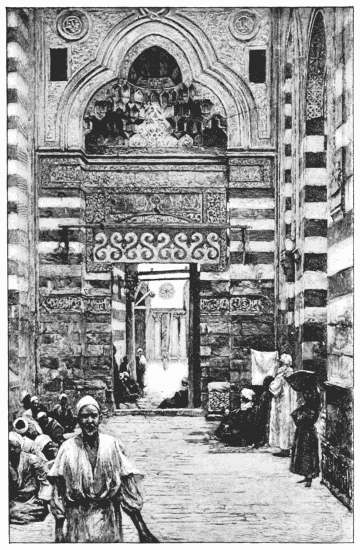
The central court of the Splendid is surrounded by colonnades, whose walls are now undergoing repairs; but the propping beams do not appear to disturb either the pupils or teachers. On the east side is the sanctuary, which is also a school-room, but a covered one; it is a large, low-ceilinged hall, covering an area of thirty-six hundred square yards; by day its light is dusky; by night it is illuminated by twelve hundred twinkling little lamps suspended from the ceiling by bronze chains. The roof is supported by three hundred and eighty antique columns of marble and granite placed in irregular ranges; there are so many of these pillars that to be among them is like standing in a grove. The pavement is smoothly covered with straw matting; and here also are assembled throngs of pupils—some studying, some reciting, some asleep. I paid many visits to El Azhar, moving about quietly with my venerable little dragoman, whom I had selected for an unusual accomplishment—silence. One day I came upon an arithmetic class; the professor, a thin, ardent-eyed man of forty, was squatted upon a beautiful Turkish rug at the base of a granite column; his class of boys, numbering thirty, were squatted in a half-circle facing him, their slates on the matting before them. The professor had a small black-board which he had propped up so that all could see it, and there on its surface I saw inscribed that enemy of my own youth, a sum in fractions—three-eighths of seven-ninths of twelve-twentieths of ten-thirty-fifths, and so on; evidently the terrible thing is as savage as ever! The professor grew excited; he harangued his pupils; he did the sum over and over, rubbing out and rewriting his ferocious conundrum with a bit of chalk. Slender Arabian hands tried the sum furtively on the little slates; but no one had accomplished the task when, afraid of being remarked, I at last turned away.
The outfit of a well-provided student at El Azhar consists of a rug, a low desk like a small portfolio-easel, a Koran, a slate, an inkstand, and an earthen dish. Instruction is free, and boys are admitted at the early age of eight years. The majority of the pupils do not remain after their twelfth or fourteenth year; a large number, however, pursue their studies much longer, and old students return from time to time to obtain further instruction, so that it is not uncommon to see a gray-bearded pupil studying by the side of a child who might be his grandson. To me it seemed that two-thirds of the students were men between thirty and forty years of age; but this may have been because one noticed them more, as collegians so mature are an unusual sight for American eyes.
All the pupils bow as they study, with a motion like that of the bowing porcelain mandarins. The custom is attributed to the necessity for bending the head whenever the name of Allah is encountered; as the first text-book is always the Koran, children have found it easier to bow at regular intervals with an even motion than to watch for the numerous repetitions of the name. The habit thus formed in childhood remains, and one often sees old merchants in the bazaars reading for their own entertainment, and bowing to and fro as they read. I have even beheld young men, smartly dressed in full European attire, who, lost in the interest of a newspaper, had forgotten themselves for the moment, and were bending to and fro unconsciously at the door of a French café. A nation that enjoys the rocking-chair ought to understand this. Some of the students of El Azhar have rooms outside, but many of them possess no other shelter than these two courts, where they sleep upon their rugs spread over the matting or pavement. Food can be brought in at pleasure, but those two Oriental time-consumers, pipes and coffee, are not allowed within the precincts. In one of the porches barbers are established; there is generally a row of students undergoing the process of head-shaving. The fierce, fanatical blind pupils, so often described in the past by travellers, are no longer there; the porter can show only their empty school-room. Blindness is prevalent in Egypt; no doubt the sunshine of the long summer has something to do with it, but another cause is the neglected condition of young children. There is no belief so firmly established in the minds of Egyptian mothers as the superstition that the child who is clean and well-dressed will inevitably attract the dreaded evil-eye, and suffer ever afterwards from the effects of the malign glance. I have seen women who evidently belonged to the upper ranks of the middle class—women dressed in silk, with gold ornaments, and a following servant—who were accompanied by a poor baby of two or three years of age, so dirty, so squalid and neglected, that any one unacquainted with the country would have supposed it to be the child of a beggar.
In addition to the bowing motion, instruction at El Azhar is aided by a mnemonic system, the rules of grammar, and other lessons also, being given in rhyme. I suppose our public schools are above devices of this sort; but there are some of us among the elders who still fly mentally, when the subject of English history comes up, to that useful poem beginning "First, William the Norman;" and I have heard of the rules for the use of "shall" and "will" being properly remembered only when set to the tune of "Scotland's burning!" Surely any tune—even "Man the Life-boat"—would become valuable if it could clear up the bogs of the subjunctive.
It must be mentioned that El Azhar did not invent its mnemonics; it has inherited them from the past. All the mediæval universities made use of the system.
The central court is surrounded on three sides by chambers, one of which belongs to each country and to each Egyptian province represented at the college. These sombre apartments are filled with oddly-shaped wardrobes, which are assigned to the students for their clothes. There is a legend connected with these rooms: At dusk a man whose heart is pure is sometimes permitted to see the elves who come at that hour to play games in the inner court under the columns; here they run races, they chase each other over the matting, they climb the pillars, and indulge in a thousand antics. The little creatures are said to live in the wardrobes, and each student occasionally places a few flowers within, to avert from himself the danger that comes from their too great love of tricks. There are other inhabitants of these rooms who also indulge in tricks. These are little animals which I took to be ferrets; twice I had a glimpse of a disappearing tail, like a dark flash, as I passed over a threshold. Probably they are kept as mouse-hunters, for pets are not allowed; if they were, it would be entertaining to note those which would be brought hither by homesick pupils from the Somali coast, or Yemen.
In beginning his education the first task for a boy is to commit the Koran to memory. As he learns a portion he is taught to read and to write those paragraphs; in this way he goes through the entire volume. Grammar comes next; at El Azhar the word includes logic, rhetoric, composition, versification, elocution, and other branches. Then follows law, secular and religious. But the law, like the logic, like all the instruction, is founded exclusively upon the Koran. As there is no inquiry into anything new, the precepts have naturally taken a fixed shape; the rules were long ago established, and they have never been altered; the student of 1890 receives the information given to the student of 1490, and no more. But it is this very fact which makes El Azhar interesting to the looker-on; it is a living relic, a survival in the nineteenth century of the university of the fourteenth and fifteenth. It is true that when we think of those great colleges of the past, the picture which rises in the mind is not one of turbaned, seated figures in flowing robes; it is rather of aggressively agile youths, with small braggadocio caps perched on their long locks, their slender waists outlined in the shortest of jackets, and their long legs incased in the tightest of party-colored hose. But this is because the great painters of the past have given immortality to these astonishing scholars of their own lands by putting them upon their canvases. They confined themselves to their own lands too, unfortunately for us; they did not set sail, with their colors and brushes, upon Homer's "misty deep." It would be interesting to see what Pinturicchio would have made of El Azhar; or how Gentile da Fabriano would have copied the crowded outer court.
STUDENTS IN THE OUTER COURT, EL AZHAR From a photograph by Abdullah Frères, Cairo
The president of El Azhar occupies, in native estimation, a position of the highest authority. Napoleon, recognizing this power, requested the aid of his influence in inducing Cairo to surrender in 1798. The sheykh complied; and a month later the wonderful Frenchman, in full Oriental costume, visited the university in state, and listened to a recitation from the Koran.
Now that modern schools have been established by the government in addition to the excellent and energetic mission seminaries maintained by the English, the Americans, the Germans, and the French, one wonders whether this venerable Arabian college will modify its tenets or shrink to a shadow and disappear. There are hopeful souls who prophesy the former; but I do not agree with them. Let us aid the American schools by all the means in our power. But as for El Azhar, may it fade (as fade it must) with its ancient legends draped untouched about it.
All who visit Cairo see the Assiout ware—pottery made of red and black earth, and turned on a wheel; it comes from Assiout, two hundred and thirty miles up the Nile, and the simple forms of the vases and jugs, the rose-water stoups and narrow-necked perfume-throwers, are often very graceful. Assiout ware is offered for sale in the streets; but the itinerant venders are sent out by a dealer in the bazaars, and the fatality which makes it happen that the vender has two black stoups and one red jug when you wish for one black stoup and two red jugs sent us to headquarters. But the crowded booth did not contain our heart's desire, and as we still lingered, making ourselves, I dare say, too pressing for the Oriental ease of the proprietor, it was at last suggested that Mustapha might perhaps go to the store-room for more—? (the interrogation-point meaning backsheesh). Seizing the opportunity, we asked permission to accompany the messenger. No one objecting—as the natives consider all strangers more or less mad—we were soon following our guide through a dusky passageway behind the shop, the darkness lit by the gleam of his white teeth as he turned, every now and then, to give us an encouraging smile and a wink of his one eye, over his shoulder. At length—still in the dark—we arrived at a stairway, and, ascending, found ourselves in a second-story court, which was roofed over with matting. This court was surrounded by chambers fitted with rough, sliding fronts: almost all of the fronts were at the moment thrown up, as a window is thrown up and held by its pulleys. In one of these rooms we found Assiout ware in all its varieties; but we made a slow choice. We were evidently in a lodging-house of native Cairo; all the chambers save this one store-room appeared to be occupied as bachelors' apartments. The two rooms nearest us belonged to El Azhar students, so Mustapha said: he could speak no English, but he imparted the information in Arabic to our dragoman. Seeing that we were more interested in the general scene than in his red jugs, Mustapha left the Assiout ware to its fate, and, lighting a cigarette, seated himself on the railing with a disengaged air, as much as to say: "Two more mad women! But it's nothing to me." One of the students was evidently an ascetic; his room contained piles of books and pamphlets, and almost nothing else; his one rug was spread out close to the front in order to get the light, and placed upon it we saw his open inkstand, his pens, and a page of freshly copied manuscript. When we asked where he was, Mustapha replied that he had gone down to the fountain to wash himself, so that he could say his prayers. The second chamber belonged to a student of another disposition; this extravagant young man had three rugs; clothes hung from pegs upon his walls, and he possessed an extra pair of lemon-colored slippers; in addition we saw cups and saucers upon a shelf. Only two books were visible, and these were put away in a corner; instead of books he had flowers; the whole place was adorned with them; pots containing plants in full bloom were standing on the floor round the walls of his largely exposed abode, and were also drawn up in two rows in the passageway outside, where he himself, sitting on a mat, was sewing. His blossoms were so gay that involuntarily we smiled. Whereupon he smiled too, and gave us a salam. Opposite the rooms of the students there was a large chamber, almost entirely filled with white bales, like small cotton bales; in a niche between these high piles, an old man, kneeling at the threshold, was washing something in a large earthen-ware tub of a pink tint. His body was bare from the waist upward, and, as he bent over his task, his short chest, with all the ribs clearly visible, his long brown back with the vertebræ of the spine standing out, and his lean, seesawing arms, looked skeleton-like, while his head, supported on a small wizened throat, was adorned with such an enormous bobbing turban, dark green in hue, that it resembled vegetation of some sort—a colossal cabbage. Directly behind him, also on the threshold, squatted a large gray baboon, whose countenance expressed a fixed misanthropy. Every now and then this creature, who was secured by a long, loose cord, ascended slowly to the top of the bales and came down on the other side, facing his master. He then looked deeply into the tub for several minutes, touched the water carefully with his small black hand, withdrew it, and inspected the palm, and then returned gravely, and by the same roundabout way over the bales, to resume his position at the doorsill, looking as if he could not understand the folly of such unnecessary and silly toil.
In another chamber a large, very black negro, dressed in pure white, was seated upon the floor, with his feet stretched out in front of him, his hands placed stiffly on his knees, his eyes staring straight before him. He was motionless; he seemed hardly to breathe.
"What is he doing?" I said to the dragoman.
"He? Oh, he berry good man; he pray."
In a chamber next to the negro two grave old Arabs were playing chess. They were perched upon one of those Cairo settees which look like square chicken-coops. One often sees these seats in the streets, placed for messengers and porters, and for some time I took them for actual chicken-coops, and wondered why they were always empty. Chickens might well have inhabited the one used by the chess-players, for the central court upon which all these chambers opened was covered with a layer of rubbish and dirt several inches thick, which contained many of their feathers. It was upon this same day that we made our search for the Khan of Kait Bey. No dragoman knows where it is. The best way, indeed, to see the old quarters is to select from a map the name of a street as remote as possible from the usual thoroughfares beloved by these tasselled guides, and then demand to be conducted thither.
BEFORE THE SACRED NICHE From a photograph by Sebah, Cairo
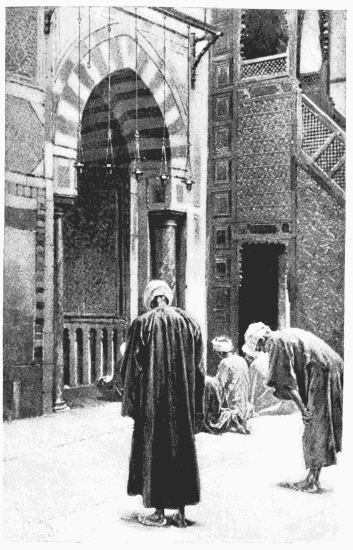
We did this in connection with the Khan of Kait Bey. But when we had achieved the distinction of finding it, we discovered that it was impossible to see it. The winding street is so narrow, and so constantly crowded with two opposed streams of traffic, that your donkey cannot pause to give you a chance to inspect the portion which is close to your eyes, and there is no spot where you can get a view in perspective of the whole. So you pass up the lane, turn, and come down again; and, if conscientious, you repeat the process, obtaining for all your pains only a confused impression of horizontal plaques and panels, with ruined walls tottering above them, and squalid shops below. There is a fine arched gateway adorned with pendentives; that, on account of its size, you can see; it leads into the khan proper, where were once the chambers for the travelling merchants and the stalls for their beasts; but all this is now a ruin. One of the best authorities on Saracenic art has announced that this khan is adorned with more varieties of exquisite arabesques than any single building in Cairo. This may be true. But to appreciate the truth of the statement one needs wings or a ladder. The word ladder opens the subject of the two ways of looking at architecture—in detail or as a whole. The natural power of the eye has more to do with this than is acknowledged. If one can distinctly see, without effort and aid, a whole façade at a glance, with the general effect of its proportions, the style of its ornament, the lights and shadows, the outline of the top against the sky, one is more interested in this than in the small traceries, for instance, over one especial window. There are those of us who remember the English cathedrals by their great towers rising in the gray air, with the birds flying about them. There are others who, never having clearly seen this vision—for no opera-glass can give the whole—recall, for their share of the pleasure, the details of the carvings over the porches, or of the old tombs within. It is simply the far-sighted and the near-sighted view. Another authority, a master who has had many disciples, has (of late years, at least) devoted himself principally to the near-sighted view. In his maroon-colored Tracts on Venice he has given us a minute account of the features of the small faces of the capitals of the columns of the Doge's palace (all these ofs express the minuteness of it); but when we stand on the pavement below the palace—and naturally we cannot stand in mid-air—we find that it is impossible to follow him: I speak of the old capitals, some of which are still untouched. The solution lies in the ladder. And Ruskin, as regards his later writings, may be called the ladder critic. The poet Longfellow, arriving in Verona during one of his Italian journeys, learned that Ruskin was also there, and not finding him at the hotel, went out in search of his friend. After a while he came upon him at the Tombs of the Scaligers. Here high in the air, at the top of a long ladder, with a servant keeping watch below, was a small figure. It was Ruskin, who, nose to nose with them, was making a careful drawing of some of the delicate terminal ornaments of those splendid Gothic structures. One does not object to the careful drawings any more than to the descriptions of the little faces at Venice. They are good in their way. But one wishes to put upon record the suggestion that architectural beauty as viewed from a ladder, inch by inch, is not the only aspect of that beauty; nor is it, for a large number of us, the most important aspect. A man who is somewhat deaf, if talking about a symphony, will naturally dwell upon the strains which he has heard—that is, the louder portions; but he ought not therefore to assume that the softer notes are insignificant.
THE DERVISHES
On the 31st of January, 1890, we took part in a horse-race. It was a long race of great violence, and the horses engaged in it were disgracefully thin and weak. "Very Mohammedan—that," some one comments. The race was Mohammedan from one point of view, for it was connected with the dervishes, Mohammedans of fanatical creed. The dervishes, however, remained in their monasteries—with their fanaticism; the race was made by Christians, who, crowded into rattling carriages, flew in a body from the square of Sultan Hassan through the long, winding lanes that lead towards Old Cairo at a speed which endangered everybody's life, with wheels grating against each other, coachmen standing up and yelling like demons, whiplashes curling round the ribs of the wretched, ill-fed, galloping horses, and natives darting into their houses on each side to save themselves from death, as the furious procession, in clouds of dust, rushed by. The cause of this sudden madness is found in the fact that the two best-known orders of these Mohammedan monks (one calls them monks for want of a better name; they have some resemblance to monks, and some to Freemasons) go through their rites once a week only, and upon the same afternoon; by making this desperate haste it is possible to see both services; and as travellers, for the most part, make but a short stay in Cairo, they find themselves taking part, nolens volens, in this frantic progress, led by their ambitious dragomans, who appear to enjoy it. The service of the Dancing Dervishes takes place in their mosque, which is near the square of Sultan Hassan. Here they have a small circular hall; round this arena, and elevated slightly above it, is an aisle where spectators are allowed to stand; over the aisle is the gallery. This January day brought a crowd of visitors who filled the aisle completely. Presently a dervish made the circuit of the empty arena, warning, by a solemn gesture, those who had seated or half-seated themselves upon the balustrade that the attitude was not allowed. As soon as he had passed, some of the warned took their places again. Naturally, these were spectators of the gentler sex. I am even afraid that they were pilgrims from the land where the gentler sex is accustomed from its earliest years to a profound deference. Two of these pretty pilgrims transgressed in this way four times, and at last the dervish came and stood before them. They remained seated, returning his gaze with amiable tranquillity. What he thought I do not know—this lean Egyptian in his old brown cloak and conical hat. I fancied, however, that it had something to do with the great advantages of the Mohammedan system regarding the seclusion of women. He did not conquer.
At length began the music. The band of the dervishes is placed in one of the galleries; we could see the performers squatting on their rugs, the instruments being flutes or long pipes, and small drums like tambourines without the rattles. Egyptian music has a marked time, but no melody; no matter how good an ear one has, it is impossible to catch and resing its notes, even though one hears them daily. Pierre Loti writes: "The strains of the little flutes of Africa charm me more than the most perfect orchestral harmonies of other lands." If by this he means that the flutes recall to his memory the magic scenes of Oriental life, that is one thing; but if he means that he really loves the sounds for themselves, I am afraid we must conclude that this prince of verbal expression has not an ear for music (which is only fair; a man cannot have everything). The band of the dervishes sends forth a high wail, accompanied by a rumble. Neither, however, is distressingly loud.
OUTER ENTRANCE OF THE CITADEL, CAIRO From a photograph by Sebah, Cairo
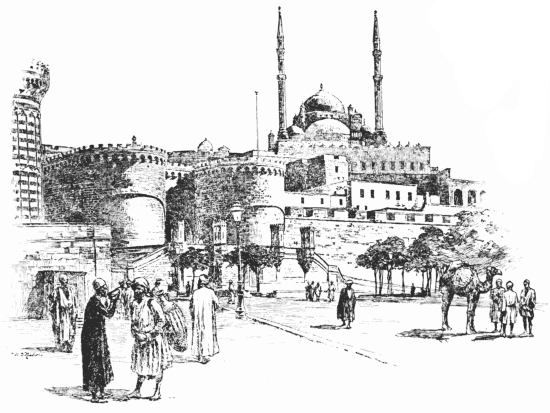
Meanwhile the dervishes have entered, and, muffled in their cloaks, are standing, a silent band, round the edge of the arena; their sheykh—a very old man, much bent, but with a noble countenance—takes his place upon the sacred rug, and receives with dignity their obeisances. All remain motionless for a while. Then the sheykh rises, heads the procession, and, with a very slow step, they all move round the arena, bowing towards the sacred carpet as they pass it. This opening ceremony concluded, the sheykh again takes his seat, and the dervishes, divesting themselves of their cloaks, step one by one into the open space, where, after a prayer, each begins whirling slowly, with closed eyes. They are all attired in long, full white skirts, whose edges have weights attached to them; as the speed of the music increases, their whirl becomes more rapid, but it remains always even; though their eyes are closed, they never touch each other. From the description alone, it is difficult to imagine that this rite (for such it is) is solemn. But looked at with the actual eyes, it seemed to me an impressive ceremony; the absorbed appearance of the participants, their unconsciousness of all outward things, the earnestness of the aspiration visible on their faces—all these were striking. The zikr, as this species of religious effort is named, is an attempt to reach a state of ecstasy (hallucination, we should call it), during which the human being, having forgotten the existence of its body, becomes for the moment spirit only, and can then mingle with the spirit world. The Dancing Dervishes endeavor to bring on this trance by the physical dizziness which is produced by whirling; the Howling Dervishes try to effect the same by swinging their heads rapidly up and down, and from side to side, with a constant shout of "Allah!" "Allah!". The latter soon reach a state of temporary frenzy. For this reason the dancers are more interesting; their ecstasy, being silent, seems more earnest. The religion of the Hindoos has a similar idea in another form—namely, that the highest happiness is a mingling with God, and an utter unconsciousness of one's humanity. Christian hermits, in retiring from the world, have sought, as far as possible, the same mental condition; but for a lifetime, not, like the dervishes, for an hour. These enthusiasts marry, if they please; many of them are artisans, tradesmen, and farm laborers, and only go at certain times to the monasteries to take part in the zikrs. There are many different orders, and several other kinds of zikr besides the two most commonly seen by travellers.
Travellers see also the Mohammedan prayers. These prayers, with alms-giving, fasting during the month Ramadan, and the pilgrimage to Mecca, are the important religious duties of all Muslims. The excellent new hotel, the Continental, where we had our quarters, a hotel whose quiet and comfort are a blessing to Cairo, overlooked a house which was undergoing alteration; every afternoon at a certain hour a plasterer came from his work within, and, standing in a corner under our windows, divested himself of his soiled outer gown; then, going to a wall-faucet, he turned on the water, and rapidly but carefully washed his face, his hands and arms, his feet, and his legs as far as his knees, according to Mohammed's rule; this done, he took down from a tree a clean board which he kept there for the purpose, and, placing it upon the ground, he kneeled down upon it, with his face towards Mecca, and went through his worship, many times touching the ground with his forehead in token of self-humiliation. His devotions occupied five or six minutes. As soon as they were over, the board was quickly replaced in the tree, the soiled gown put on again, and the man hurried back to his work with an alertness which showed that he was no idler.
A MECCA DOOR
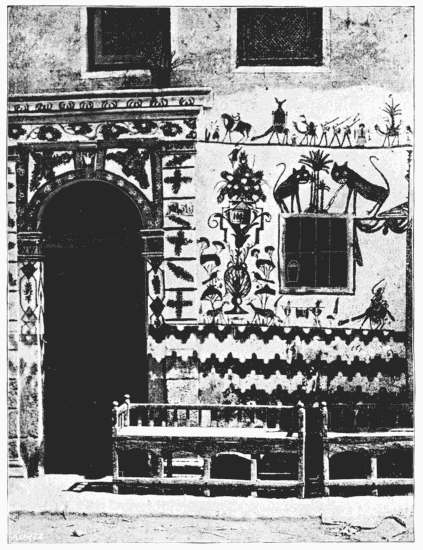
On the Nile, at the appointed hour, our pilot gave the wheel to a subordinate, spread out his prayer-carpet on the deck, and said his prayers with as much indifference to the eyes watching him as though they did not exist. In the bazaars the merchants pray in their shops; the public cook prays in the street beside his little furnace; on the shores of the river at sunset the kneeling figures outlined against the sky are one of the pictures which all travellers remember. The official pilgrimage to Mecca takes place each year, the departure and return of the pilgrim train being celebrated with great pomp; the most ardent desire of every Mohammedan is to make this journey before he dies. When a returning Cairo pilgrim reaches home, it is a common custom to decorate his doorway with figures, painted in brilliant hues, representing his supposed adventures. The designs, which are very primitive in outline, usually show the train of camels, the escort of soldiers, wonderful wild beasts in fighting attitudes, nondescript birds and trees, and garlands of flowers. One comes upon these Mecca doorways very frequently in the old quarters. Sometimes the gay tints show that the journey was a recent one; often the faded outlines speak of the zeal of an ancestor.
THE REIGNING DYNASTY
THE ROAD TO CHOUBRA. From a photograph by Sebah, Cairo
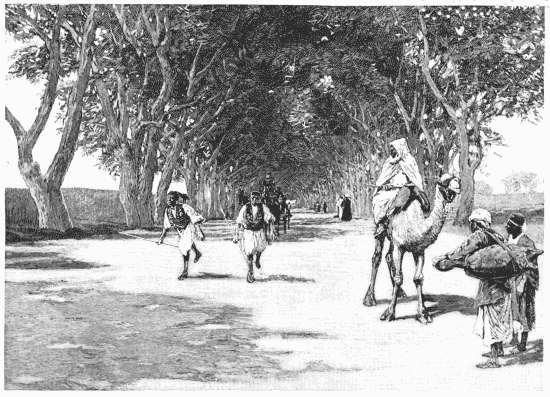
While in the city of the Khedive, if one has a wish for the benediction of a far-stretching view, he must go to the Citadel. The prospect from this hill has been described many times. One sees all Cairo, with her minarets; the vivid green of the plain, with the Nile winding through it; the desert meeting the verdure and stretching back to the red hills; lastly, the pyramids, beginning with those of Gizeh, near at hand, and ending, far in the distance, with the hazy outlines of those of Abouseer and Sakkarah. The Citadel was built by Saladin in the twelfth century. Saladin's palace, which formed part of it, was demolished in 1824 to make room for the modern mosque, whose large dome and attenuated minarets are now the last objects which fade away when the traveller leaves Cairo behind him. This rich Mohammedan temple was the work of Mehemet Ali, the founder of the present dynasty. It is not beautiful, in spite of its alabaster, but Mehemet himself would probably admire it, could he return to earth (the mosque was not completed until after his death), as he had to the full that bad taste in architecture and art which, for unexplained reasons, so often accompanies a new birth of progress in an old country. Mehemet was born in Roumelia; he entered the Turkish army, and after attaining the rank of colonel he was sent to Egypt. Here he soon usurped all power, and had it not been for the intervention of Russia and France, and later of England and Austria, it is probable that he would have succeeded in freeing himself and the country whose leadership he had grasped from the domination of Turkey. Every one has heard something of the terrible massacre of the Memlooks by his order, in this Citadel, in 1811. The Memlooks were opposed to all progress, and Mehemet was bent upon progress. Freed from their power, this ferocious liberator built canals; he did his best to improve agriculture; he established a printing-office and founded schools; he sent three hundred boys to Europe to be educated as civil engineers, as machinists, as printers, as naval officers, and as physicians; his idea was that, upon their return, they could instruct others. When the first class came back, he filled his public schools by the simple method of force. The translators of the French text-books which had been selected for the use of the schools were taken from the ranks of the returned students. A text-book was given to each, and all were kept closely imprisoned in the Citadel a period of four months, until they had completed their task. Mehemet had a dream of an Arabian kingdom in Egypt which should in time rival the European nations without joining them. It is this dream which makes him interesting. He was the first modern. A Turk by birth, and remaining a Turk as regards his private life, he had great ideas. Undoubtedly he possessed genius of a high order.