THE SINCLAIR EXPERIMENTS FOR TELEPATHY
Reading edition
About eighteen months ago I first opened a new book by the novelist Upton Sinclair, entitled Mental Radio, then newly issued. In 239 pages it outlined the story of the discovery and development of what purported to be a supernormal faculty possessed by his wife, and rehearsed a large number of experiments in which she seemed to have achieved a large and convincing percentage of successes as a telepathic “percipient,” the “agent” generally being Mr. Sinclair, but sometimes her brother-in-law or another person. I confess to misgivings as I began to read, first for the very reason that the writer is a novelist (unmindful of Wells and certain other writers of fiction who, nevertheless, have shown themselves capable of serious and even scientific thinking),[1] and secondly because I had suspected, rightly or wrongly, that once or twice in the past he had failed to discover the devices of certain clever professionals. To be sure, his wife was not a professional, and all the conditions could be under his own hand, but sometimes through sheer confidence people are deceived by their own relatives.
152This, to be frank, was my initial attitude—one of cautious interrogation and alertness to find signs of credulity, failure to appreciate the possibilities of chance, or lack of data by which the calculus of chance coincidence could be determined. But as I read on and studied the reproductions of drawings it became more and more evident that something besides chance had operated, that the conditions of many of the experiments had been excellently devised, and that where the conditions were relaxed Mr. Sinclair had been quite aware of the fact and was candid enough to admit it. He stated that such relaxation did not increase the percentage of success, and it certainly so appeared from the examples given. He reported the total number of experiments, and estimated the percentages of successes, partial successes, and failures. In 290 experiments, he made these percentages: successes, approximately 23 per cent; partial successes, 53 per cent; failures, 24 per cent. He admitted that judges probably would not agree upon exactly the same ratios. In fact I personally think that certain examples which he did not publish are better than a few which he did, but have not yet found reason to quarrel with his general estimates.
After considerable study of the book, becoming interested beyond any expectation, I wrote to Mr. Sinclair, stating that I had become favorably impressed, and making the somewhat audacious proposal that he should send me all the original materials for a fresh study by the individual standards and through the particular methods of a professional investigator. One can think of several reasons which might make the most honest and confident man hesitant to assent to such a proposal, coming from one whom he had never seen, and who might for all he knew have a set of prejudices which after all would cause him to make a lawyer’s argument against the case. I was really surprised that the bundle of materials was sent as quickly as it could be gotten together.[2]
Among the objects in mind were: (1) To study the materials in their strict chronological order, day by day. The mode of presentation in Mental Radio was to give some of the most striking 153results first, then many more that were more or less classified according to subjects and aspects. This is effective for popular reading but not satisfactory to the serious student. (2) To see if there were signs, in any part of the results, of profiting from normal knowledge, whether consciously or subconsciously acquired, of what the “agent” had drawn. Mr. Sinclair took this theory into account and quite decidedly killed it, but it was my duty to try it out anew by my own processes, with the same rigor shown in relation to my own wife and my daughter in The Psychic in the House. Later, in summary fashion, these tests will be set forth. (3) To try out other theories to account for the ratios and degrees of correspondence between “original drawings” and “reproductions” in the Sinclair experiments, such as involuntary whispering and chance coincidence. (4) To make a large number of guessing tests on the basis of the Sinclair originals, both as a means of deciding whether the “mere coincidence” theory is tenable (as aforesaid) and, if it should prove otherwise, in order to make a rough measurement of the disparity between telepathic results and those of guessing. (5) In the event that there appeared to be no reasonable escape from conclusion that telepathy is displayed by the material, to ascertain (a) whether the telepathic faculty with Mrs. Sinclair was constant, vacillating, progressively constant, or what; (b) whether the telepathic impressions came to her in the form of ideas, images, names or in more than one fashion; (c) whether any further hints as to the mental processes involved could be discerned or any particular pieces of information isolated which might be helpful in this field of study. (6) Finally, to urge readers to institute experiments of their own, and to give amateurs some directions as to procedure. If many could be persuaded to start “games” of this character with their friends, doubtless favorable subjects could be discovered or developed. Attention being called to these persons, series of tests could be made with them under conditions against which none of the old objections could be offered.[3]
The Sinclair experiments are treated first in this Bulletin, 154since they are its chief subject. The drier Historical Notes, presenting a sketch of the first steps in methodical research relating to alleged Thought-Transference, with summaries of some of the classic series of tests, particularly such as are based upon drawings, are relegated to Part Two. The more earnest and methodical students of such matters will prefer to read that first.
Mr. Upton Sinclair, about fifty-two years old when his book Mental Radio was issued, is, as everyone is supposed to know, one of the leading novelists of the United States. His stories are all, or nearly all, characterized by an intense purpose. To those who claim that art should be exercised only for art’s sake this may be obnoxious. But from the point of view of this examination of his book purporting to prove telepathy, the fact that his novels also attempt to prove something, on the basis of studies made by him, is quite in his favor.[4] Whether he has in fact proved the thesis of his respective tales is not within our province to determine; we do propose rigidly to analyze and review his claims to have proved telepathy.
Mr. Sinclair is a Socialist, and a very active and prominent one; he has been Socialist candidate for Congress in New Jersey and later in California, besides having been Socialist candidate for the United States Senate and for Governor in the latter-named State. Political prejudices or predilections should be strictly excluded from the minds of readers of the book or this review of it.[5] It is another gratifying indication that Mr. Sinclair was not deterred from publishing Mental Radio by the solicitations or irony of influential friends in his political group, for the scientific spirit is in part compounded of courage, honesty and candor.
Mrs. Sinclair, née Mary Craig Kimbrough, somewhere about forty-five years old when the experiments afterwards published took place, is the daughter of a retired judge, bank president, and planter of Mississippi.
The reader may judge of the quality of her mentality by reading Appendix 1. That is, in part, the reason that it is printed. It is a piece of writing by Mrs. Sinclair shortened according to 155permission given. Almost immediately after my suggestion that the experimental materials should be sent for examination, they were bundled up and sent, together with some stray scraps, among which was this unfinished piece of manuscript which, as it proved, the Sinclairs did not know had been included. In spots the composition may be a bit diffuse and repetitious, but the woman really thinks and reasons, which is more than many do.
There is in it a sincerity, earnestness and intensity of desire to know, which can hardly be counterfeited. Its writer fairly rivals Descartes in her determination to find some salient and secure spot from which to start in her quest. But in a manner she goes back farther than Descartes, at least she splits his ultimate in two. She is satisfied with “I am,” not because “I think,” but because “I am conscious of thinking”; but she does not so readily grant the “I think.” She wants to know, “Am I doing all the thinking I am conscious of?”
In fact, the document is so intense in its eagerness to penetrate the secret of personality in relation to its cosmic environment that it is almost febrile. At least in its first pages there is something pathological. To paint life with such dark colors and to dwell so upon its “discouragements” is not an indication of perfect health.
And yet it is certain that the writer is not self-absorbed. The painful reactions of the kind which she has experienced, the torture produced in her by the existence of so much in life that seems unmeaning and disappointing, she supposes to be quite general with her fellow-men and so feels a great pity for them. Whereas, in my belief, while more are complaining than are happy or contented, it is common to fret because of income taxes, and inability to wear such fine clothes as those of Mrs. Jones, and cold weather and squalling cats, and such sordid matters, but uncommon to be agonized by the desire to fathom the mysteries of the human spirit.
The main points of what Mr. Sinclair tells us of the characteristics of his wife are to be discerned in this revealing manuscript. He says “She has nothing of the qualities of naïveté and credulity. She was raised in a family of lawyers and was given the training and sceptical point of view of a woman of the world. ‘Trust people, but watch them,’ was old Judge Kimbrough’s maxim, and following 156it too closely has almost made a pessimist of his daughter. In the course of the last five or six years Craig has acquired a fair-sized library of books on the mind, both orthodox, scientific, and ‘crank.’ She has sat up half the night studying, marking passages and making notes, seeking to reconcile various doctrines, to know what the mind is, and how it works, and what can be done with it.” This began with a breakdown of health when she was about forty years old. “A story of suffering needless to go into; suffice it that she had many ills to experiment upon, and mental control became suddenly a matter of life and death.” This breakdown, it is said, resulted directly from “her custom of carrying the troubles of all who were near her.” She is intensely sympathetic, we are told. “The griefs of other people overwhelm Craig like a suffocation.”[6]
158The book relates several spontaneous experiences of Mrs. Sinclair when she was young and which, taken together, strongly indicate telepathy. Her husband rightly remarks that it is the number of such incidents which is impressive; one or two might well be coincidence. Still the coincidence of being suddenly impressed that Mr. B, whose home was three hundred miles away, was at her home where he had never been, and turning back from a drive and finding him there, even taken by itself, is a very striking one. Mr. Sinclair himself is witness to the fact that she suddenly, for no known reason became very much worried about Jack London, insisting that he was in mental distress, whereas it proved that London committed suicide at about that time.
Such incidents indicate that her experimental successes were not solely the result of the method which she explains at length, but that she had an inborn gift from early childhood. Her interest in that gift seems to have been much stimulated by her acquaintance with “Jan,” the “young hypnotist” of Appendix I, whose advent is probably not in that narrative placed in chronological order. She became convinced that he showed evidence of telepathy, and tried in turn to ascertain what he was thinking or what he was doing when absent, and became convinced that many times she had been successful. Also, “Craig has been able to establish exactly the same rapport with her husband,” who relates instances. These were “written down at the time.” So few even intelligent people do make immediate record of such things that we would have suspected, even if he had not informed us on another page, 159that he has made a considerable study of the literature of psychic research.
One of these incidents we shall particularly notice here, and that because Mr. Sinclair himself has either not noticed all of its evidential value, or has not fully called attention to it. * * * [Refer to Figs. 14a and 14b and experiment.]
Probably Mr. Sinclair thought it would be sufficiently obvious to the reader that the first drawing is as similar in shape to a clover blossom as a person having no gift for drawing would be likely to make it, in addition to the correspondence of color. But it should also be remarked that the second drawing is like the flower-head of the American aloe, as one may see by comparing it with the cut shown in the article entitled “Agave,” in the Encyclopedia Britannica. The article provokingly fails to tell us what are the colors of the flower, but the cut shows that it is at least much lighter above than below.
Another incident is remarkable for its apparent revelation of subconscious mechanisms. Seemingly here Mrs. Sinclair not only got an impression of what her husband had drawn, but it was modified by something he was then reading, and that by the aid of memories from childhood. His drawing represented a football, “neatly laced up” (Fig. 15). Hers (Fig. 15a) shows a band of exactly the same shape on a figure not so very far from that of a football, but with an extension suggesting the head of an animal, and a line suggesting a leg. And she wrote “Belly-band on calf.” * * *!
“Wishing to solve the mystery!” But why should the lady have felt that there was any mystery in her drawing and script, any more than in the generality of her results? But she evidently did, or she would not have asked the question. It is one of the most interesting features of this experiment that she seemed to feel that something else than the original drawing or her husband’s thoughts about it was influencing her impression, and suspected that this something was his contemporaneous reading.
Sometimes the apparent telepathy was exercised in a dream, especially during its latter stage, while the lady was gradually emerging into full consciousness.[7]
160
The Sinclair-Irwin Long-distance Group of Experiments
On July 8, 1928, the first formal set of experiments with drawings began, by arrangement between Mrs. Sinclair and the husband of her younger sister; Robert L. Irwin, “a young American business man, priding himself on having no ‘crank’ ideas.” The arrangement was that at a stated hour Mr. Irwin should seat himself in his home in Pasadena, make a drawing, and then fix his mind upon the drawing from fifteen to twenty minutes. At the same hour in her home at Long Beach, twenty-five or thirty miles distant as the crow flies, Mrs. Sinclair proposed to lie on a couch, in semi-darkness and with closed eyes, compose her mind according to the rules she had by this time evolved, and after coming to a decision, make a drawing corresponding with her mental impression. It appears that there was one such experiment on July 8, two on the 9th, two on the 10th and one each on the 11th and 13th.
We have here, then, a set of seven experiments under ideal conditions. Since something like thirty miles separated the parties, there could be no contact, no “involuntary whispering” that would carry that far and no conceivable other source of information or material for surmise.
1. On July 8, Irwin drew a chair with horizontal bars at the back (Fig. 16). Mrs. Sinclair drew first a chair with horizontal bars (Fig. 16a), then a chair with vertical ones. And she distinctly set down on the same paper her sense of greater satisfaction with her first drawing, her feeling that the second was not as “Bob” had drawn it, and her feeling that the second may really express the foot of his bed. She also set down that his drawing was on “green paper.” Here is a remarkable combination of impressions: (a) his drawing on green paper, (b) seen as a chair “on his paper,” (c) his chair with horizontal bars, (d) her chair with vertical bars perhaps derived from “his bed-foot.” Even had there been, as there was not, a pre-understanding that some object familiar in daily life was to be drawn, to hit exactly the same one would be very unlikely. To do this and also to get the unusual color of the paper he drew on is 161remarkable. To get all the enumerated particulars exactly correct is incalculably beyond chance expectation. For he drew a chair, on green paper, with horizontal bars, then gazed at the chair through the vertical bars of his bed! * * * [Refer to Figs. 16 and 16a and experiment.]
She added that she sees a star and straight lines, and draws the star and the lines, horizontal like those of the chair.
There are several partial correspondences besides those we have enumerated. Bob did sit at the northeast corner of the dining-room table. He faced a sideboard (but apparently did not take anything out of it) where were silver (not glass) candlesticks; there is a star on the back of the chair; whether any white object was in front of him as he sat at the table, before lying down on the bed, is not reported. But it is to be presumed that Mrs. Sinclair was familiar with his room and furniture, and these particulars add comparatively little. Once she got the chair, subconscious memory might supply the star; but it would not give any clue to the green paper or to his looking through vertical bars.
2. On July 9, at the stated hour, Bob drew a watch (Fig. 17).[8] First Mrs. Sinclair drew a chair, but cancelled it with the words then written down, “but do not feel it is correct.” Then she drew Figure 17a. * * *
This is not a success, but the flower which is not a flower, the petals, which are not petals and should be more uniform, the “metal,” the “wire” (adumbration of the hands?), the “glass circle,” the bridging across the extremities of the “petals” as if from an urge toward making a circle, the black center corresponding with the center post of a watch, taken together are very suggestive. Other impressions resulted in the addition of an ellipse, a drinking-glass and a glass pitcher, and Bob did have in front of him a glass bowl of goldfish, which may have furnished a telepathic hint, but this is doubtfully evidential.
3. Another experiment was scheduled for the same day. Bob made an elaborate drawing of a telephone receiver, transmitter, dial, cord and all. The top part, the transmitter, as drawn, is 162strikingly like a round, black, glass ink-bottle, seen with mouth facing the spectator. Mrs. Sinclair made four drawings. The first looks like such an ink-bottle seen from the side, and she writes, “Ink bottle?” The second drawing shows a twisted line attached to a triangle, reminding one of the twisted telephone cord attached to a sharp angle of the base, and the third repeats the twisting line. The fourth inverted is considerably like the base of the telephone. The correspondences are very suggestive.
4. On the 10th, Bob drew, on the back of the paper having the telephone drawing (he should not have done this), which he of course saw anew, what is probably intended to represent a square frame containing a picture, both very black. The percipient first drew two lines forming an angle and placed in relation to it about as the dial of the telephone is placed in relation to the angle of the telephone base, a black disc. Her next and last drawing was a circle containing about a dozen round spots, as the circular dial of the telephone contains eight spots.
5. On the 10th, also, Bob drew a pair of scissors (Fig. 18), and the percipient made two attempts which, taken together, certainly do sense its parts (Figs. 18a and 18b).
6. On the 11th, Bob, whose health had been in bad shape for several years, made a circle with a compass, of course producing a hole in the center of it. And this is what Mrs. Sinclair got (Fig. 19a). There is a circle—in fact, a number of them concentrically arranged—and there is a central dot corresponding to the mark made by the compass leg. But other impressions came to Mrs. Sinclair, accompanied by poignant emotions, and she seemed to see and tried to draw a spreading stain of blood. She wrote her feeling and her conviction: “All this dark like a stain,—feel it is blood; that Bob is ill, more than usual.” She did not draw, but directly told her husband, “I wanted to draw a little hill.” And why all this? It transpired that while Bob was making the circle he was in a state of distress, for, he afterwards testified, “I discovered that I had a hemorrhoid, and couldn’t put my mind on anything but the thought, ‘My God, my lungs—my kidneys—and now this!’” It is hardly necessary, perhaps, to point out that a hemorrhoid is like 163a little hill and that one is very likely to bring on hemorrhage,[9] so that this possibility was probably in Bob’s mind.
Had Mrs. Sinclair been in a laboratory with one professor of psychology or of physics, and her brother-in-law in another laboratory with another, not all the apparatus of both laboratories nor all the ingenuity of both professors could have made the conditions more rigid, or tested the essence of the matter farther. There would simply have been the testimony of four persons, two at each end, and that is exactly what there is. Bob’s affliction was of sudden occurrence, and the particular terms of Mrs. Sinclair’s impressions could not have been produced by any hint of knowledge. His willingness in the interest of psychic research, in order that this remarkable demonstration of telepathy should not be lost, to put aside squeamishness, is a rebuke to the human violets who shrink, for no intelligible reason from allowing evidence to be used which relates to them.
7. On the 13th, Bob drew a table fork (Fig. 1), and Mrs. Sinclair, at the same hour, many miles away, drew nothing but wrote, “See a table fork. Nothing else.” (Fig. 1a.)
These seven experiments[10] are all that were undertaken between Mrs. Sinclair and her brother-in-law. This is unfortunate, for it certainly appears from this short but remarkable series as though they were remarkably suited to each other, for reasons we cannot yet fathom, for long-distance experiments. But “he found them a strain,” and since his health was so poor and strains were most undesirable, we cannot blame him for discontinuing them.
One pauses to consider the words “he found them a strain.” May it be that when experiments reveal thought-transference the agent generally does feel a strain beyond that involved in merely gazing at an object and wishing (or willing, or what you please) that the percipient may get the idea of it. If so, it would seem to imply, not necessarily some energy proceeding outwardly, but at any rate some process going on within which causes the special exhaustion. But no statistics bearing on this question have been 164gathered from successful agents. It is one of the many sorts of data which must be accumulated in the future.
Mr. Irwin and his wife made corroborating affidavits, as follows:
To whom it may concern:
Robert L. Irwin, having been duly sworn, declares that he has read the portion of manuscript by Upton Sinclair dealing with his experiments in telepathy with Mary Craig Sinclair, and that the statements made therein having to do with himself are true according to his clear recollection. The drawings attributed to him were produced by him in the manner described, and are recognized by him in their photographic reproductions. The experiments were conducted in good faith, and the results may be accepted as valid.
[Signed] Robert L. Irwin.
To whom it may concern:
Dollie Kimbrough Irwin, having been duly sworn, declares that she has read the portion of manuscript by Upton Sinclair dealing with experiments in telepathy by her sister, Mary Craig Sinclair, and having to do with her husband, Robert L. Irwin; that she was present when the drawings were made and the tests conducted, and also when the completed drawings were produced and compared. The statements made in the manuscript are true according to her clear recollection, and the experiments were made in good faith and with manifest seriousness.
[Signed] Dollie Kimbrough Irwin.
These statements were severally.
“Subscribed and sworn to before me this 26th day of July, 1929, [Signed] Laura Unangst, Notary Public in and for the County of Denver, Colorado.”
The Sinclair-Sinclair Group of July 14–29, 1928
We are in two passages told precisely the conditions of this group of experiments. Since her brother-in-law felt obliged to withdraw from participation, Mrs. Sinclair asked her husband to make some drawings. * * *
1. July 14. Mr. Sinclair made the above drawing (Fig. 2), a very imperfectly constructed six-pointed star. Mrs. Sinclair, reclining 16530 feet away, with a closed door between, produced five drawings (Fig. 2a).[11] Immediately after the agent’s and percipient’s drawings had been compared, the lady stated that just before starting to concentrate she had been looking at her drawing of many concentric circles made on the previous day in the concluding test of the Sinclair-Irwin group. This was bad method, but we can hardly regret it, as the sequel is illuminating. At first she got a tangle of circles: “This turned sideways [thus assuming the shape of one of the star-points], then took the shape of an arrowhead [confused notion of the stair-point, one would conjecture], and then of a letter A [another attempt to interpret the dawning impression], and finally evolved into a complete star.” The star so nearly reproduces the oddities of the original star, its peculiar shape and the direction which its greatest length takes, that had it been produced in one of the unguarded series, one would have been tempted to think that the percipient “peeked.” But the original was actually made, as well as gazed at, behind a closed door, so that there is no possible basis for imagining any such accident or any inadvertence on the part of either experimenter.
2. July 14. In his room Mr. Sinclair drew the grinning face of Figure 21, and then Mrs. Sinclair drew in hers Figure 21a. Two eyes in his, one “eye” in hers. Look at the agent’s drawing upside down (how can we or he be sure that he did not momentarily chance to look at it reversed and retain the impression?), and note the parallels. At the top of his two eyes—at the top of hers one “eye”; midway in his two small angles indicating the nose—somewhat above midway in hers, three similarly small angles unclosed at the apexes; at the bottom of his a crescent-shaped figure to indicate a mouth, with lines to denote teeth—at the bottom of hers a like crescent, minus any interior lines. Had the percipient drawn what would be instantly recognizable as a face, though a face of very different lines, it would be pronounced a success. But such 166a fact would be very much more likely as a guess than a misinterpreted, almost identical crescent (she thought it probably a “moon”), so similar little marks, angularly related (she “supposed it must be a star”), and an “eye,” all placed as in the original.
3. July 17. Mr. Sinclair, lying on a couch in one room, drew and then gazed at a drawing which can easily be described; it is a broad ellipse with its major axis horizontal, like an egg lying on its side, and a smaller and similar one in contact over it. Mrs. Sinclair, lying on a couch in another room, first drew a broad ellipse (not quite closed at one end), with major axis horizontal, and beside it and not quite touching, a somewhat smaller circle not quite closed at one end. Then she got an impression represented in a second drawing, four ellipses of equal size, two of them in contact with each other.
4. July 20. Under the same conditions Mr. Sinclair drew two heavy lines like a capital T. Mrs. Sinclair drew what is like an interrogation point with misplaced dot, then a reversed S with two dots enclosed, then an upright cross composed of lines of equal length, and finally such a cross circumscribed by a tangential square. Though, as Mr. Sinclair remarks, the cross is the T of the original with its vertical line prolonged, I should call this experiment barely suggestive.
5. July 20. Under the same conditions Mr. Sinclair drew a long-handled fork with three short tines. Mrs. Sinclair, to use the language of her own record, “kept seeing horns,” and she attempted to draw them. She also “thought once it was an animal’s head with horns, and the head was on a long stick—a trophy mounted like this....” But her drawing was like a long-handled fork with two short tines combining to make a curve very close to that of the two outer tines of the original.
6. July 20. Under the same conditions Mr. Sinclair drew a cup with a handle. Mrs. Sinclair twice drew a figure resembling the handle of the original, then the same with an enclosed dot, then lines parallel and at an angle. She felt confused and dissatisfied. It is possible that her first impression was derived from the cup, but we can hardly urge this evidentially.
7. July 21. Under the same conditions Mr. Sinclair drew a man’s face in profile (Fig. 20). Mrs. Sinclair wrote: “Saw Upton’s 167face—saw two half-circles. Then they came together, making full circle. But I felt uncertain as to whether they belonged together or not. Then suddenly saw Upton’s profile float across vision.” Well, Mr. Sinclair is a man, hence his face is a man’s face, and it was seen in profile like the original drawing.
Thus far there is no gap in the record of this group. There were experiments on July 27 and 29, but apparently two or more papers are missing. It is certain that on the 29th, under the same conditions, Mr. Sinclair drew a smoking cigarette and wrote beneath it, “My thought, ‘cigarette with curls for smoke,’” and that Mrs. Sinclair drew a variety of curving lines and wrote, “I can’t draw it, but curls of some sort.” So it appears that on this date there was a suggestive result, but as there is doubt whether one or two other experiments may not have been tried, the papers of which were not all preserved, we had better regard the group as closed with No. 7.
So far as concerns the question solely whether Mrs. Sinclair has shown telepathic powers, I would be willing to rest the case right here, after but fourteen experiments under the conditions which have been stated.[12] Every intelligent reader who really applies his mind to them must see the extreme unlikelihood that the results of those fourteen experiments, taking them as they stand, successes, partial successes, suggestive and failures, are the products of chance. And any one who has had hundreds of experiments in guessing, as I have done, will know that there is no likelihood of getting out of many thousands of guesses anything like the number and grades of excellence in correspondence found in these fourteen consecutive tests for telepathy.
We cannot take space to comment on all the tests made, the papers of which were sent us, and we here pass over three on as many dates, one a success though not a perfect one, two failures.
The Series of January 28, 1929
Mr. Sinclair asked his secretary “to make simple geometrical designs, letters and figures, thinking that these would be easier 168to recognize and reproduce.” It seems a little strange that when things were going on so well, he should have wanted a change, though any experiment is interesting. It is by no means certain, and I very much doubt from these and earlier printed experiments, that the assumption is a correct one. It may well be that geometrical diagrams, letters of the alphabet and such like fail to interest the agent and afford him a lively mental representation, as do pictures of miscellaneous objects. And if I understand rightly, another change of method was also initiated, and that was for Mrs. Sinclair to try to get the drawings not while the maker of them was gazing intently at them, but after they had left his hands. This certainly was often the case later on.
I wrote and asked Mr. Sinclair if Mrs. Sinclair was told the fact that this and several other series of original drawings consisted of geometrical drawings, letters and figures, and he said that she was not so told, that he would have regarded this as a vitiation of the experiments. It would certainly increase the chance of getting drawings right by guess, but it would hardly have ruined the experiments. In fact, some people think that the most scientific experiments are those in which the range of chance guess is limited to an extent known to the percipient, as when the problem is to determine which of the 52 cards of a pack is being looked at, or which of only ten known diagrams. This opinion is probably based on the fact that then the ratio of success to chance expectation can be exactly calculated, though why it should be more satisfactory to know that the chance of a correct guess is exactly 1 in 10 than it is not to be able to tell exactly what the chance is but to be sure at least that it cannot be 1 in 100, I do not know.
Unless I had carefully recorded at the time that there was no chance of the percipient having a hint that the drawings were now for a time to consist of geometrical designs, letters and figures, I would not dare to be certain of it after several years have passed. If Mrs. Sinclair had no inkling, the change in the general character of her drawings is a fact of great interest. But we will take cognizance only of whatever resemblance may or may not be found between the several reproductions and their originals.
The first series of drawings by the secretary were seven in number, and, says Mr. Sinclair, “They brought only partial successes; 169Craig would get elements of the drawing, but would not know how to put them together.... There is some element right in every one.” Let us see.
1. Agent’s drawing, a script B; Percipient’s drawing, a figure very like a script 3, practically the B without its vertical line.
2. Agt., a script S; Per., a script J. As made, each has two balloon-like parts joined at the small ends, certain details of course different.
3. Agt., a hexagon; Per., two lines forming an acute angle, like two sides of the hexagon, also a capital E with a line drawn down at an acute angle to the left from the upper extremity of the vertical line.
4. Agt., script M made with a peculiar twist in its first line; Per., almost precisely that first line with its twist.
5. Agt., a thin, long, quadrilateral, like a shingle; Per., (1st drawing) what would be almost exactly the same quadrilateral, narrow and long, but its shorter sides are wanting, and (2nd drawing) a closely similar quadrilateral, with another and longer one attached to its side at a sharp angle.
6. Agt., an interrogation point; Per., a figure hard to describe, a round dot with curves springing from it like concentric 3’s, and two parallel lines shooting to the left. The points which attract notice are the dot, like that of the original, and the curves similar to that of the interrogation point.
7. Agt., script E; Per., same minus the “curls.”
Several of the above are not impressive taken alone; taken together, the greater or less approaches to the several originals defeat chance, though how much no man can measure. Counter-tests by guessing will come the nearest to measuring.
The Series of January 28–29, 1929
This series also has to do with drawings made by Mr. Sinclair’s secretary.
1. Agent’s drawing, a diamond or rhombus (Fig. 32); Percipient’s drawing, the two halves of a rhombus, “wandering about,” as Mr. Sinclair says (Fig. 32a); if connected they would make a rhombus closely similar to the original.
1702. Agt., a script capital Y; Per., a print capital Y. (Figs. 33 and 33a.)
3. The Agent’s drawing, a bottle of milk with “certified” written on it, was suggested by his knowledge that Mrs. Sinclair to a considerable extent lives on milk and is particular about its quality; Per., an ellipse much like the top of the bottle, a straight line depending therefrom, and the script “Round white foamy stuff on top like soapsuds or froth.” And foam is characteristic of her milk, as she drinks it sour and whipped (Figs. 34 and 34a). Here the percipient failed to get much as to shape, but got considerable in the way of associated ideas.
4. Agt., an oil derrick (Fig. 35); Per., got what will be seen in Figure 35a. There are long lines diverging like the long lines of the oil derrick, but at a slant, and with a 5 or perhaps a 9 at the top which has no counterpart in the original. This is not a very satisfactory reproduction, but the general shape and long downward lines are suggestive.
5. Agt., something like a poplar leaf; Per., three scrawls like letters or parts of letters. A failure.
6. Agt., three small ellipses attached to a stem; Per., script “See what looks like spider’s web,” but drawing shows a bunch of elliptic figures.
7. Agt., apparently an apple with stem; Per., (1) what looks like a tall script V, (2) the same less tall, (3) one so low and broad that it is nearly equivalent to the top of the apple minus the stem.
8. Agt., a house from whose chimney proceeds smoke represented by a spiral line (Fig. 36). Per., (1) a double spiral cut by a straight line, same slant as in the original, (2) single spiral of nearly the same slant, (3) what looks like a battlement, the crenels or openings of which are like the windows of the house minus the upper sides (Fig. 36a). The rectangular openings are three in number, the rectangular openings in the house (two windows and a door) are also there.
9. Agt., an open fan (Fig. 102); Per., a drawing represented by Figure 102a, accompanied by the script, “Inside seems irregular, as if cloth draped or crumpled.” Two words, “cloth,” and “draped,” suggest what takes place as one begins to shut a fan, though the drawing is an incorrect representation.
17110. Agt., the figures 13 (Fig. 103); Per., (1) what would be a 3 but for a supernumerary curve, (2) a 3 (Fig. 103a).
11. Agt., a conventional heart (Fig. 105); Per., practically the upper part of such a heart, with three spots which may or may not represent blood-drops, according to Mr. Sinclair’s conjecture (Fig. 105a). We can hardly contend, as an evidential point, that this is the meaning of the round spots. Some obscure subconscious recollection of expressions like “My heart bleeds,” expressing suffering, may have come out in the drawing, though in that case one wonders why the whole heart was not drawn. But it may be that the three marks proceeding in the direction of the right side of the original came from a feeling that something should line in that direction.
12. Agt., a broom (Fig. 104); Per., several attempts all more or less resembling the original (Figs. 104a, 104b), and a valuable script: “All I’m sure of is a straight line with something curved at the end of it [and this description, all that she was sure of, is so far correct]; once it came [here see the drawing at the left]—then it doubled, or reappeared, I don’t know which [referring to the upper right drawing] (am not sure of the curly edges) [and she was justified in her doubt. Probably the curly edges resulted from the intermingling of her surmise that the curved something at the end of a line might be a flower]. Then it was upside down.”
Series of February 8, 1929
Tests with drawings in carefully sealed envelopes.
1. Agt., a coiled snake (Fig. 45); Per., no drawing, but this script: “See something like kitten with tail and saucer of milk. Now it leaps into action and runs away to outdoors. Turns to fleeing animal outdoors. Great activity among outdoor creatures. Know it’s some outdoor thing, not indoor object—see trees, and a frightened bird on the wing (turned sidewise). It’s outdoor thing, but none of above seems to be it.”
This is much more interesting than if there had been the perfect success of writing the word “snake,” because we seem to get inklings of the internal process. “Saucer of milk”—observe that the serpent’s coil plus the unattached ellipse in the center (due to Mr. Sinclair’s confessed bad drawing) really does look like a saucer. 172“Something like a kitten with a tail”—why mention tail? Most kittens have tails. But a tail sticks up back of the saucer. Later neither kitten, trees nor frightened bird is it, yet something is causing great commotion among outdoor creatures. It is an outdoor thing, therefore not a kitten, but evidently something alive. The scene is very appropriate to the appearance of a snake. Mr. Sinclair tells us that his wife’s childhood was in part spent where there were many poisonous snakes, and that fear of them was bred in her. As he conjectures, it is very likely that dawning in the subconsciousness, not fully emerging in the conscious, the subject of the drawing stirred up imagery from childhood. I surmise that, if the truth, which she may not consciously remember, could be known, she saw while a child a kitten fleeing from a snake.
2. Agt., a daisy (Fig. 59); Per. got what is very like the petals around the disk of the daisy, also two stems, also various curving lines more or less like the daisy leaves or vegetation at least (Fig. 59a).
3. Agt., an axe, seemingly a battle-axe, with AX printed (Fig. 145); Per., as in Figure 145a. Note the parallels: (a) “letter A [right as far as it goes], (b) with something long (c) above it”; (d) “there seems to be no end to the handle”; (e) the drawing much resembles the original, in fact one type of ancient battle-axe was very much of the same shape. Although she finally guessed that it was a key, yet a suspicion of military use enters in the conjecture “a sword,” which is perhaps all the more striking since the drawing bears little resemblance to a sword.
4. Agt., a crab (Fig. 48); Per. drew as in Figures 48a, 48b, and wrote “Wings, or fingers—wing effect, but no feathers, things like fingers, instead of feathers. Then many little dots which all disappear, and leave two of them, O O, as eyes of something.” And again, “streamers flying from something.” The reader will judge for himself whether the drawings do not suggest the crab’s nippers, and one of them the joint adjoining. “Wing effect but no feathers, things like fingers”—especially the lower pair in Mr. Sinclair’s remarkable crab do look like fingers. “Many dots”; well the original has four. Then she sees but two of them and they are “O O, eyes of something.” True enough, two of the “dots” in the crab are O O, and they are eyes.
1735. Agt., a man in a sledge driving a dog-team (Fig. 60). Per. by accident opened this drawing, so of course could not experiment with it. But after she had made her drawings for No. 2 she wrote “Maybe snow scene on hill with a sled.” On the back of No. 3, which was so brilliant a success, she wrote “I get a feeling again of a snow scene to come in this series—a sled in the snow.” It is unfortunate that an accident prevented her trying No. 5 when she had actually reached it, but she certainly got it by anticipation.
6. Agt., a tobacco pipe with smoke issuing therefrom (Fig. 37); Per. first drew an ellipse and wrote “Now it begins to spin, round and round, and is attached to a stick”; (2) next she made the conventional “curl” which usually means smoke; (3) then she made another curl of smoke and pushed the open end of an ellipse into it,[13] joined a line to the ellipse just about where the stem of a pipe meets the bowl and at the end of the line made a small circle, which certainly is not found in the original but may express the feeling that there is a circular opening (Fig. 37a).
7. Agt., a house with smoking chimney; Per., two figures, each very like the frame of a window lacking the upper side, or like the crenels or openings in the battlement of Figure 36a, but longer. In connection with that drawing (Experiment of January 28–29) we made the remark (which may have seemed fanciful) that the number of these openings or uncompleted rectangles was the same as that of the windows and door in the original drawing. Here the uncompleted 2 rectangles equal in number the one window plus the one door of the house. She also wrote “There is something above this—can’t see what it is part of.” True, the roof and chimney are above the window and door.
Series of February 10, 1929
1. Agt., a bat (Fig. 109); Per., as in Fig 109a. The drawing at the top is accompanied by the remark “Looks like ear shape something.” And certainly each of the bat’s wings does resemble an ear in shape. The middle left drawing gets the idea that there are two symmetrical and diverging curves, but fails to complete them; space is left between them which in the agent’s drawing is occupied 174by the body. The middle right figure again has symmetrical diverging curves, with a further approach toward shaping the wings. This time they are incorrectly joined at the bottom, but the perpendicular line between betrays an inkling that something belongs there. Imperfect as all these attempts are, they contain hints which it is difficult to attribute to chance. The agent, looking at his drawing, would of necessity have his attention focus first on one part of it and then upon another, and the percipient’s drawings seem as though they caught his several moments of wandering attention.
2. Agt., a hand with pointing finger, and thumb held vertically (Fig. 108); Per., (1) a drawing not reproduced here of a negro’s head with a finger-like projection drawn vertically from his skull, (2) then script “Turned into a pig’s head, (3) then a rabbit’s,” as in Figure 108a. In one sense the percipient’s drawings are all failures; that is, none of them would be recognized as a hand. But in all three a feeling seems to express itself that there is something sticking up. This is the more remarkable in Drawing 1, since such an excrescence does not belong on a head. Drawing 2 gets rid of the face, and the thumb of the original becomes a peculiarly thumb-like ear.
3. For this experiment see the “line-and-circle men” and their evidentially suggestive sequel (Figs. 144, 144a).
4. Agt., a rudely drawn caterpillar (Fig. 118); Per., script: “Fork—then garden tool—lawn rake. Leaf,” and drawing representing a leaf which has a certain fantastic resemblance to the caterpillar (Fig. 118a). Mr. Sinclair makes the illuminating remark that he owned “a lawn-rake made of bristly bamboo, which looks very much like my drawing.”
5. Agt., a smoking volcano (Fig. 25); Per., what she called a “Big black beetle with horns” (Fig. 25a). But the body of the beetle closely matches the smoke of the volcano, while the antennae or “horns” nearly correspond to the outline of the mountain.
A Series of February 15, 1929[14]
Let us now inspect a complete and long series of February 15, 1929. It contains no such brilliant success as in Experiment 4 of February 20, but out of 13 experiments there is but one absolute 175failure, the first. In this the agent drew a rat, the percipient two crossed objects like keys.
2. In Figure 147, the agent’s drawing represents a door with lattice on the upper half; it is made up of perpendicular and horizontal lines only. The percipient’s drawing (Fig. 147a) consists of four perpendicular lines finishing at the top in curves like fish-hooks, and these lines are crossed by three horizontal lines. There is in the crossed lines a suggestion of the agent’s drawing, a resemblance greater than to any other of the thirteen.
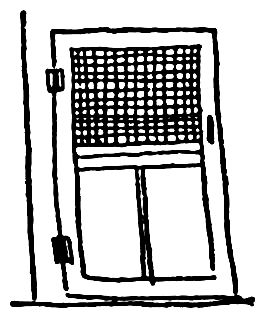
Fig. 147
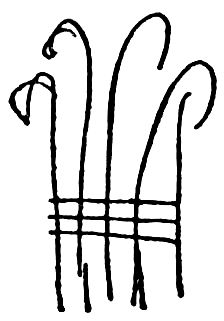
Fig. 147a
3. The agent’s next drawing (Fig. 93) represents a sun over hills. Mrs. Sinclair first seems to have got the notion of a sun, which was right (Fig. 93a). Then she made another circle and put features in it, as will be seen suggested in the agent’s drawing (actually, in the original drawing, the features are plainly to be seen). Then she got the idea of something stretching out below it with curving lines, interpreted it to be a body, so probably, from mere inference, clapped her sun with features on to it.
4. Agent’s Figure 97 is a butterfly but the percipient did not get the idea of a butterfly (Fig. 97a). However, the divergent lines and the spots, five instead of four, and similarly placed, do seem to bear a relation to it.
5. In Figure 96a, Mrs. Sinclair’s drawing resembles a part of her husband’s (Fig. 96), although she misinterpreted her mental picture. What she thought to be the leg of an animal, and which she drew twice, was judged by the way it bends to be a front one, but the knee of the leg roughly corresponds with the elbow of the pipe. Note that she seems to have got the bulge at the end of the pipe, translating it into a “foot,” naturally at the end of the leg.
1766. In Figures 98 and 98a, compare the three “sparks” with the three crosses on the box.
7. The shape of Figure 94a is like that of Figure 94 reversed, and there is a suggestion of the strings, while the feet represent the pedals of the harp.
8. The percipient in the case of Figure 95a did not get the picture of the whole balloon bag of the agent (Fig. 95), but she did of half of it, with a strong suggestion of the cords.
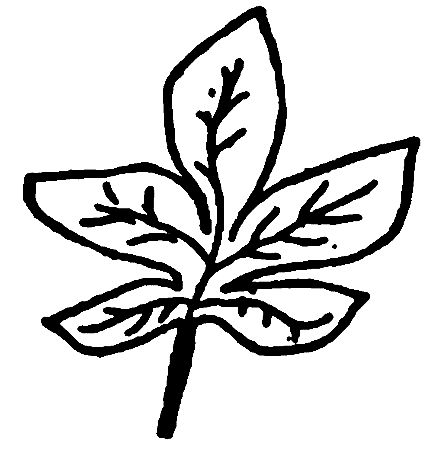
Fig. 148
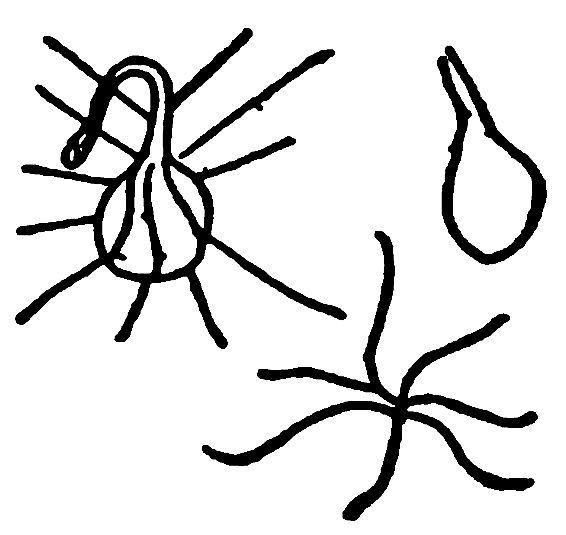
Fig. 148a
9. In Figure 148a, bad as the percipient’s drawings are, regarded as reproductions of Figure 148, yet they do contain suggestions of it. In her left upper drawing we may suppose that an impression of the leaf-stem (but badly twisted) was expressed with a leaf-lobe directly below the stem, together with an idea of the veining, that in the right upper one the stem is corrected, and that in the lower drawing a notion of the veining alone is conveyed. Exactly so would the attention of the agent, when drawing the leaf or afterward looking at or thinking of it, pass from and to, or at least stress, one part of the leaf after another.
10. The agent drew a necktie (Fig. 90). The percipient first drew what much resembled the necktie, even to the shaded knot (not given here), and almost exactly like Figure 90a aside from the “smoke.” Next she wrote “Then it began to smoke,” and drew as in Figure 90a. One would suppose that the knobby extremity and the diverging lines suggested a burning match.
11. But no, the alteration appears to have been an anticipation of the agent’s next drawing, already prepared (Fig. 91)! In this case Mrs. Sinclair achieved a complete success (Fig. 91a), though she 177distrusted it, writing beside the drawing, “Must be memory of the last one.”
12. In Figure 92a the percipient got the first two links of the agent’s chain (Fig. 92) fairly well. The succeeding ones are suggested by a series of partially superposed ovals, owing to misinterpretation of her impressions. She wrote: “An egg-shaped thing smoking? Anyway, curls of something coming out of end of egg.” Note that her combined “egg” and “curls” describe a curve similar to that of the chain, and one not far from the same length.
13. The last experiment of this date resulted in two percipient drawings (Fig. 149a), similar but with differences as noted below. Presumably the “arm” of the upper drawing is a reflection of the neck of the violin (Fig. 149), the “hand” of its bridge, the “strings” of the violin strings, while the “something” very imperfectly stands for the body of the instrument. The bracelet (?) on the arm may result from an obscure impression of something curving in that region, really the volute termination above the keys. The lower drawing stops with the strings, but makes them more nearly parallel, like those of the violin.
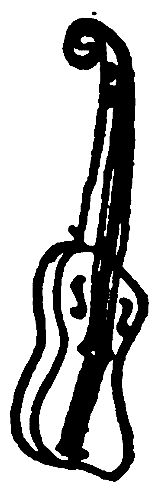
Fig. 149
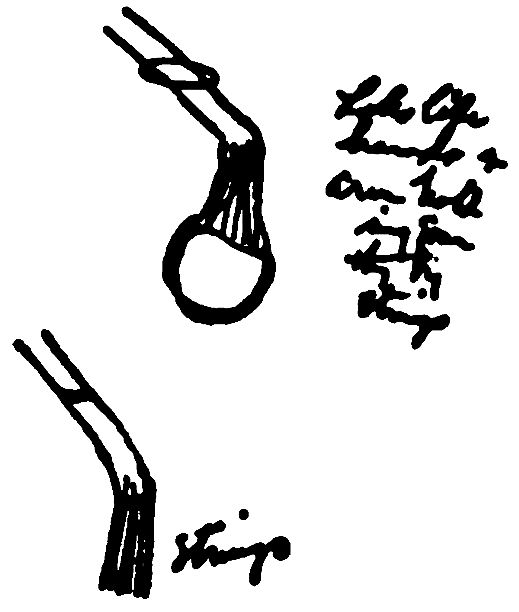
Fig. 149a
No exact mathematics can be applied to such experiments as these. But, considering the multitude of objects and shapes which must have been familiar to both experimenters, do you believe that there was 1 chance in 16 of the successes in Experiments 10, 11 and 12? Or more than 1 chance in 4 for Experiments 5, 6 and 7? Or more than an average of 1 in 2 for such small degree of success as is discoverable in the rest, excluding the failure of the first? Multiply 178accordingly, and divide the product, let us say, by 2 for this failure. The result, on what I think a moderate basis, is 1 chance in 16,777,216. Figure any other way you like, but be reasonable.
Or substitute the first above percipient drawing for that in any and every one of the above 12 pairs. Then take the next drawing and match it with the other originals. And thus with the others, if your patience holds out to the end of 132 exchanges. Have you found a single one which will suit as well as in its actual position?
COUNTER-TESTS WHICH PROVE THE VAST DISPARITY BETWEEN THE RESULTS OBTAINED IN THE SERIES OF FEBRUARY 15TH AND THOSE OBTAINED BY GUESSING
It is proposed at this point to interrupt the review of Mr. Sinclair’s report of his experiments for telepathy by a test applied to the series which has just been exhibited. In the light of the test, as it proves, the evidential weight of both the earlier series and those which will come later ought to be better appreciated. The only way to explain (?) such results is to hazard the conjecture that they were due to the possibilities of chance guessing. Well then, let us have a lot of guessing done on the basis of the same originals and see what we get and how it compares.[15]
It seems almost incredible that any intelligent person would hold, or suggest it possible, that the several degrees of resemblance between 12 of the 13 originals in this series and the reproductions could have come about by chance guessing. Surely, no one possessing 179an average quality of logical and mathematical faculty, if he takes time to consider, will be guilty of so monstrous a faux pas of the intellect. But experience teaches that some, even of excellent academic or professional standing, to whom the notion of the possibility of telepathy has long been obnoxious, are indeed capable of dismissing an exhibit such as this after a passing glance, with the exclamation, “Merely chance coincidence.” It is well, then, to make a large number of experiments in order to test the chances of chance-coincidence to produce such a result. Perhaps, after that is done, even those most convinced that chance cannot account for such correspondences as we have seen will be astonished to find the extent to which results where telepathy has played a part and results of mere guessing differ.
Ten ladies offered themselves for experimentation. Of course the likelihood was very small that any one of them would show a trace of telepathic faculty. As it proved, there developed no reason to suspect its possession by a single one of them. And it is certain that no one who disbelieves that any one gets impressions by telepathy will complain of our conclusion that the ten ladies did nothing more than guess.
If they did nothing more than to guess, it made no difference what method we employed, so long as the ladies were given no inkling of the original drawings. Nevertheless, the exact replicas of Mr. Sinclair’s 13 drawings of February 15th were separately sealed in numbered envelopes, and the lady was asked to hold the envelopes, one by one, in her hand, and to draw what came into her mind visually or by concept, choosing from such impressions according to vividness, recurrence or by whatever criterion seemed to her most congenial. She was told to take all the time she wished and was then left alone. Thus the conditions of the Sinclair experiments were imitated as closely as possible. The time occupied by the ladies for the series varied from half an hour to nearly an hour and a half. Every woman would have been pleased, naturally, if her results had been such as to give grounds for suspecting telepathy, but the results of the ladies differed in quality only by narrow degrees, and, as said, there was not the slightest reason to suppose that with any of them there was anything but chance in play.
180It is, of course, not practicable to reproduce their 130 drawings in this Bulletin. But they are to be mounted, the ten for each original drawing on a separate sheet together with a copy of the Sinclair original and reproduction, and the 13 sheets will be preserved by the Boston Society for Psychic Research as a permanent exhibit which any visitor may inspect and judge for himself.
As has been seen, we classified the Sinclair reproductions of this series as Successes, Partial Successes, Suggestive and Failures. This is a rough method, and others might increase or decrease the number assigned to any of these classes, except the last. There can be no question that there is but one entire failure. But however faulty our standard of rating, it is the same standard which is applied to the drawings of the ten ladies.
Not only did I use the utmost care in rating the drawings of the ten ladies, but I asked my secretary, Miss Hoffmann, a lady of education and keen intelligence, to do the same. Her rating of the guessing sets was as absolutely independent of mine as mine was independent of hers.
Our mutually independent estimates were surprisingly alike. According to both, there were among the 130 trials (by 10 women) not a single Success, only 1 (Miss H) or 2 (W. F. P.) deserving to be entitled to Partial Success, 7 Suggestive, 5 Slightly Suggestive and 116 (W. F. P.) or 117 (Miss H) Failure. Compare with the Sinclair set, 3 Success, 5 Partial Success, 4 Suggestive, 1 Failure, out of a total of but 13.
Before the foregoing judging was done, I had Miss Hoffman guess the whole set, twice a day, until another 10 sets were produced, based upon the same Sinclair series. Our wholly independent estimates of the total results of these additional 130 experiments in guessing proved again to be surprisingly alike. Neither found a single Success, 1 (W. F. P.) or no (Miss H) reproduction deserved to be called a Partial Success, 5 (W. F. P.) or 7 (Miss H) were rated Suggestive, 8 (W. F. P.) or 7 (Miss H) as Slightly Suggestive and 116 as Failures.
We will now tabulate the two groups (the sets of the 10 ladies and Miss H’s 10 sets), taken together (260 experiments in guessing).
181
W. F. P.’s Estimate Miss H’s Estimate
S. 0 S. 0
P. S. 3 P. S. 1
Sug. 12 Sug. 14
S. Sug. 13 S. Sug. 12
F. 232 F. 233
If we calculate the averages for the 20 sets of experiments, we can more directly compare with the Sinclair results.
Sinclair Set Average of the 20 Guessing Sets
W. F. P.’s Estimate Miss H’s Estimate
S. 3 S. 0 S. 0
P. S. 5 P. S. 3⁄20 P. S. 1⁄20
Sug. 4 Sug. 3⁄5 Sug. 7⁄10
S. Sug. 0 S. Sug. 13⁄20 S. Sug. 3⁄5
F. 1 F. 11 3⁄5 F. 11 13⁄20
But there is perhaps a surer way of making comparisons. It is sometimes difficult to draw the line between a Success and a Partial Success, a Partial Success and a Suggestive, a Suggestive and a Slightly Suggestive. But when the drawings represent not simple diagrams, but objects animate and inanimate, and a reproduction by Mrs. Sinclair is placed beside a like-numbered one in any of the 20 guessing sets, it is very seldom that one cannot be certain whether one is better as compared with the common original, and within fair limits how much better. And the proof of this statement is found in the fact that when two persons passed upon the 20 sets of guessing reproductions, comparing them with the 1 set of Sinclair reproductions, to determine, case for case, in 260, which were more nearly like the originals, and to what degree, their rating was almost identical, although they worked in entire and absolute mutual independence of each other.
In the following table, Si. = Sinclair drawing, G. = a Guessing drawing, v.m.b. = very much better, m.b. = much better, b. = better.
W. F. P. found the guessing reproduction of experiment 1 to be bad to a degree equal with the Mrs. Sinclair failure, in 16 instances. Miss Hoffmann found it equally bad also in 16 instances, 182and deemed another reproduction equally to possess some tiniest resemblance to the original in 1 instance. Aside from these we have
In the 20 Sets (10 Ladies and Miss H’s 10)
W. F. P.’s Estimate Miss H’s Estimate
Si.v.m.b. 222 Si.v.m.b. 222
Si.m.b. 11 Si.m.b. 13
Si.b. 7 Si.b. 4
G.v.m.b. 2 G.v.m.b. 2
G.b. 2 G.b. 2
240 4 239 4
It is almost incredible that two human beings could come to so close an agreement, unless one had some clue to the opinions of the other, but it is even so, no smallest hint passed in either direction. The fact is that in very few instances can there be the slightest hesitancy in deciding which is nearer the common original, the Sinclair or the guessing reproduction.
If there is any reproduction of the Sinclair series whose resemblance to the original might seem illusory it is that coupling with the leaf of a tree or plant (Figs. 148, 148a). But of the 20 guesses of that original not one is so near; in 18 instances (W. F. P.) or at least 15 (Miss H) Mrs. Sinclair’s is very much the better, in 1 (W. F. P.) to 3 (Miss H) it is much better, and in 1 (W. F. P.) or 2 (Miss H) it is better.
Perhaps some persons would think that such resemblance as there is between the butterfly and Mrs. Sinclair’s reproduction (Figs. 97, 97a) is too faint to count, or at least is accidental. But, by the independent judgment of two persons, not a single one of the corresponding guessing reproductions is as near the original or anything like so near.
Or one might sneer at calling Mrs. Sinclair’s reproduction of Figure 147 “Suggestive.” Only 5 vertical lines, wrongly curving at the top, crossed by three lines, to stand for a “door with hinges, lower sash,” and wire screen covering the upper half! But not a single one of the 20 guesses approaches so much resemblance. Miss H says that of 19 of these, and W. F. P. of 16, “Si.v.m.b.” Miss H says of 1, W. F. P. of 2, “Si.m.b.,” while W. F. P. at least is sure of his remaining 2, “Si.b.”
183In the light of such tests as those just now made, even such degrees of resemblance as we have found in the very weakest numbers of the 13 in this Sinclair series take on deep significance. And the whole mass of our counter-experiments clearly indicates that the reproductions by Mrs. Sinclair in that series are prodigiously beyond the reach of chance guessing.
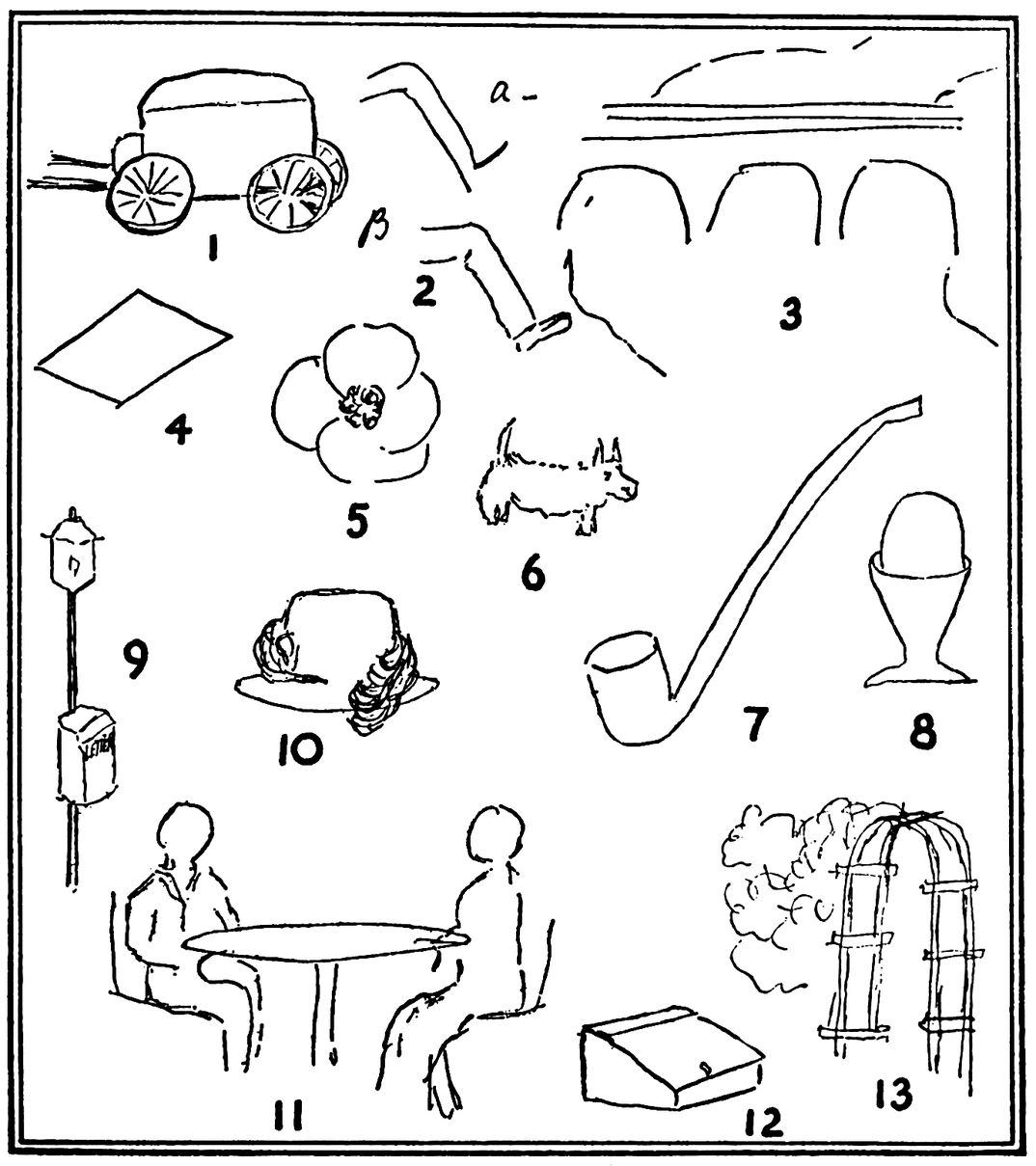
The Best of the Twenty Guessing-Sets
As already remarked, it is hardly practicable to reproduce here the 260 drawings resulting from 20 sets of attempts to guess what 184the 13 originals (the same as those in the Sinclair series of February 15th) were. But following is shown Mrs. P—n’s set of guesses, the one which made the nearest, though so distant, approach to success. Let the reader compare her drawings, one by one, with the reproductions of Mrs. Sinclair, and judge for himself both which were nearer the originals they had in common, and by how much.
A Series of February 17, 1929[16]
The conditions under which this series of experiments was conducted were excellent, and will be given partly in Mr. Sinclair’s words and partly, for greater conciseness, abridged from his statement, aided by an examination of the materials.
(a) The original drawings were made by Mr. Sinclair when he was alone in his study. (b) They were made on green paper. (c) Each drawing was enclosed “in a separate sheet of green paper.” (d) Each drawing with its enclosing sheet was folded once, making four thicknesses. (e) And each pair of sheets, that with the drawing and the blank outside one, was put in an envelope [Experiment shows that not even when held up to a strong light can a drawing made and enclosed in such paper and placed in an envelope be seen at all]. (f) The envelope was sealed. (g) The nine sealed envelopes were laid on the table by Mrs. Sinclair’s couch. (h) Her procedure was to put an envelope, and each in turn as the tests proceeded, over her solar plexus, and when she had made her decision, to sit up and draw upon a paper pad. (i) Meanwhile, at her own insistence, Mr. Sinclair watched her throughout. (j) “Never did she see my drawing,” he declares, “until hers was completed and her descriptive words written.” (k) “I spoke no word and made no comment until after this was done.” He adds: “The drawings represented here are in every case exactly what I drew, and the corresponding drawing is exactly what my wife drew, with no change or addition whatsoever.”
1. Agt., a geographical globe; Per., an obscure drawing most probably representing the head and neck of some animal. Failure.[17]
1852. Agt., a wall-hook (Fig. 123); Per., the drawing of Figure 123a, which resembles the original to a certain limited degree, having a narrow extension to the left though not curving, and broadening to the right with a suggestion of curving at the bottom.
3. Agt., a monkey hanging from a bough and grasping at another (Fig. 24); Per. drew as in Figures 24a, 24b (except that in the former the cut fails to give all of the pencil drawing. Instead of four curving lines hanging from the flower or whatever it is, the ends of each pair should be united by a curve) and it seems as though elements of the original were caught but misplaced. Each figure is of the shape of the under branch in the original drawing, but with the slant of the monkey; there are two as-it-were arms reaching down instead of one; and while the drawings do not suggest any animal, the script begins “Buffalo or lion. Tiger,” and concludes with the conviction that there is at least some “wild animal.”
4. Agt., man and woman standing together; Per., two drawings, one almost exactly the shape of the woman’s skirt, with two black spots below and touching its bottom line, exactly as the feet of the woman appear below her skirt; the other drawing similar but less like the original.
5. Agt., an animal shape, probably intended for a goat (certain species, as the Angora, have long horns which resemble those of the drawing, and goats generally have a short tail) (Fig. 138); Per., no drawing, but the single word “Goat.”
6. Agt., a mandolin, its neck drawn with several parallel lines, the body of the instrument composed of four curving lines with three straight ones for the strings; Per., what may perhaps be intended for a flower, but its long stem indicated by several parallel lines and its blossom drawn with curving and straight lines constitute a strong resemblance, and entitle it to be regarded a partial success.
1867. Agt., a nearly round bag with a dollar mark on it, pursed and drawn up on top, as by a string; Per., (1) a circle with a vertical line protruding from its upper edge, (2) a cup-like figure with a line from its bottom to above its upper edge.
8. Agt., a Lima bean (?); Per., a head wearing a turban, which in shape is conspicuously like the bean.
9. Agt., a nest containing seven eggs and surrounded by leaves (Fig. 4); Per., a drawing which she interpreted as “Inside of rock well with vines climbing on outside,” but which presents features startlingly like the original (Fig. 4a).
There is the outer rim, like that of the nest, and which would probably have completed the circle if the top of the paper had not been reached. There are the “stones,” for some unknown reason obscured in the cut but some of them in the center showing more plainly and more regularly ovoid in the pencil drawing, resembling the eggs of the original. And there are not only surrounding leaves as in the original, but they are leaves of similar shape.
Series of February 20, 1929
There were four experimental tests made this day, the same when the remarkable case of spontaneous telepathy occurred, in which Mrs. Sinclair sensed that her husband was reading about flowers and described them by drawings and script (p. 30).
In the 1st, Mr. Sinclair drew a fire hydrant (Fig. 74); Mrs. Sinclair drew as in Figure 74a. This was certainly a partial success, as the drawings compare. And for aught we know it may in fact have been a still better success, since Mr. Sinclair in looking at his drawing may well have imagined water bursting forth from the spout of the hydrant. Oddly, Mrs. Sinclair first wrote “Peafowl,” and then drew what had nothing to do with a peafowl. This is one of the many cases where it seems as though Mrs. Sinclair had glimpses ahead in a series.
For the agent’s second drawing was a peacock (Fig. 75). And the percipient not only said “peafowl again,” which constitutes a complete success, but she also drew what it seems likely are impressions of the peacock’s long neck and of the “eyes” or spots of his wings (Fig. 75a).
The agent’s third drawing was of an hourglass, with sand running 187from its upper to its lower part (Fig. 133). The resemblance in shape of the percipient’s tree (Fig. 133a) to the upper half of the hourglass is evident, its trunk may represent the slender line of flowing sand, and “white” sand is placed relatively like the sand in the lower part of the hourglass. The percipient’s results seem to be partly from the lines of the original drawing, but also from Mr. Sinclair’s thoughts about the sand.
Mr. Sinclair’s fourth drawing represents an animal (dog?) running after a ball attached to a string (Fig. 9). Mrs. Sinclair’s drawing shows (a) an animal, (b) also running, (c) in the same direction, (d) having a short tail as in the original, (e) the tail represented by two diverging lines, (f) a line extending from its nose, but touching the nose, while there is a space between in the original, (g) the line running left and at about the same angle from the horizontal. Besides the script which appears in the cut (Fig. 9a) Mrs. Sinclair wrote “Long thing like rope flung out in front of him.”
I should say that the addition of that “rope” drawn in front of the animal at that angle made chance guessing of the combination at least ten times as unlikely, and, on the basis of my hundreds of experiments in guessing, I should not expect in ten thousand such experiments on the basis of the same original drawing one reproduction as good in the summation of its correspondences.
Series of March 11, 1929
1. Agt., a fountain which, were it taken alone, might be taken for a tree, standing in what superficially appears like a long shallow tub-like structure (Fig. 53); Per., a long, shallow tub, with two tree-like objects above it and on its rim, (2) a drawing, the upper portion of which parts in the center and leans to either side, as does the fountain. The tree or plant-like objects are both said to “shine,” which does not so well comport with a tree or plant as with a fountain sparkling in the sunshine (Fig. 53a).
2. Agt., a melon on an inclined plane, having a stem and leaf on the stem; Per., three drawings: (1) what suggests the leaf and stem of the original twice over, (2) an unnameable figure, but slanting like the original, (3) what looks like some kind of fruit with stem, also slanting like the original.
3. Agt., the figure 6 followed by the mark indicating per cent, 188not single-line drawn but having breadth as if cut out of cardboard; Per., the letter F, a failure except for the curious parallel that this also is formed as if made with strips of cardboard.
4. Agt., a fishhook (Fig. 78); Per., (1) a figure very much like the fishhook except that the barb is transformed into a tiny flower (Fig. 78a).
5. Agt., an obelisk (Fig. 79); Per., two drawings, the first of which shows the three long lines of the obelisk but with a slight curvature (Fig. 79a).[18]
6. Agt., as in Figure 80; Per., as in Figure 80a. Only point of resemblance the two angles formed by the legs of the reclining seat.
7. Agt., what was probably intended to represent a German Pickelhaube (Fig. 5); Per., what the accompanying script called a “Knight’s helmet”; very similar (Fig. 5a).
1898. Agt., a row of five pillars (shown with a rather extraordinary perspective slant), each mainly indicated by three or four vertical parallel lines, an entablature above (Fig. 132); Per., four pillar-like objects constructed of vertical parallel lines, three to five, the presumed pillars having no entablature but in themselves and additional lines showing the same slant as in the original. The presumed pillars are likewise nearly equally spaced, but are of unequal heights, indicating that the percipient’s impression was a visual one and that she had no clear idea what she was drawing (Fig. 132a).
9. Agt., presumably a palm tree (Fig. 8); Per., two objects hard to name, but each in a general way curiously like the original, even to the bend in what is presumably the trunk, though it is not the same bend (Fig. 8a).
Series of March 16, 1929
There were seven tests on this date.
1. Agt., a burning lamp (Fig. 40); Per., as in Figure 40a, whether the drawing represents a tube from which flame proceeds, or the wick and that part of the lamp which is within the chimney, at any rate the same lines which conventionally signify light appear as in the original. Accompanying script says “flame and sparks.”
2. Agt., a butterfly net (Fig. 110); Per., the handle of the net is duplicated, and the general shape of the net is pretty well shown (Fig. 110a).
3. Agt., a carnation with four near-angles along its upper edge (Fig. 113); Per., four triangles in a row with a hint of lines below (Fig. 113a).
4. Agt., a trench mortar (Fig. 42); Per., a figure considerably like but shorter than the trench mortar, and likewise pointing upward, a stem-like extension like the axle in the original but on the other side, whiffs of smoke emerging (Fig. 42a). Here the impressions received seem partly visual, partly ideational.
5. Agt., a telegraph pole and four wires proceeding horizontally from it in two directions (Fig. 129); Per., something like a pole, and five lines proceeding from it in one direction (Fig. 129a).
6. Agt., two hearts side by side, transfixed horizontally by an arrow (Fig. 126); Per., two balloon-like shapes side by side, transfixed horizontally by a line (Fig. 126a).
1907. Agt., a frieze (Fig. 124); Per., what looks like a detail of a different design yet one which also consists of parallel lines enclosing narrow tracts which run in different directions (Fig. 124a). Even so much of distant resemblance would not occur anything like once in ten times by chance.
Miscellaneous Examples
February 23, 1929. The agent drew a steamboat with incorrectly designed stem paddle wheel (Fig. 77). The percipient’s results are very interesting (Figs. 77a, 77b, 77c). There is smoke, so labeled, by itself, then the smoke stack with smoke issuing from it, then the paddle wheel in the water, its paddles more correctly placed externally to the rim, then what may mean smoke containing cinders. The cut of the paddle wheel has left out the axle-end, very distinctly indicated in the original pencil drawing.
February 17, 1929. The agent drew an Alpine hat with a feather (Fig. 142). Of the shapes drawn by the percipient (Fig. 142a) the one on the right may very possibly be related to the rim and the band of the hat, the top left one is very suggestive of the feather, and the bottom one, though called in the script a “chafing dish,” is very like the hat. All this suggests that the attention of the agent was directed first to one part, then to another and another of his drawing.
February 29, 1929. The agent drew a very intricate and unusual cross, one with eight arms, notched at the ends (see Figs. 7, 7a). The percipient also drew a circle of notched arms, but seven in number. One would suppose that when she began she had no idea where the drawing would end, or it would be more regular.
Through all the experiments of the period covered by the book Mental Radio, and enough more to make 300, there is no other agent drawing resembling this. And nowhere is there another percipient drawing like it. Granting that the percipient should make such a drawing once, which was by no means certain (nothing like it appears among the 564 Guess-drawings reported in this Bulletin), then the chance of its coinciding in place with the eight-armed cross of the agent would be 1 in 300.
February 17, 1929. The agent drew an open umbrella, with curved handle (Fig. 122). The percipient wrote, “I feel that it is a 191snake crawling out of something—vivid feeling of snake, but it looks like a cat’s tail.” And in her drawing (Fig. 122a) we have the curved umbrella handle, but it has sprouted a tongue and an eye; the ellipse of the umbrella rim is retained but it is a smaller one; otherwise the “something” is shaped wrongly.
We have cited instances where Mrs. Sinclair proved that she got an inkling of some drawing in a series before reaching it, by writing down at the moment her conviction. In Mental Radio our attention is called to a number of instances of seeming anticipations even where Mrs. Sinclair was not so conscious of them, or at least did not write down her expectation that some particular thing was coming. Here is an instance not mentioned in the book. The next agent’s drawing after the umbrella was a snake. Had it not been for the dawning consciousness of that snake, the umbrella handle might not have undergone metamorphosis.[19]
February ?, 1929. The agent made an American flag, with pole surmounted by a ball (Fig. 127). The percipient failed to get the stars but she got the stripes and the pole, and the ball, which last has wandered from its place, although the neighborhood in which it should be is sensed (Fig. 127a).
March ?, 1929. Mrs. Sinclair wrote “Muley cow with tongue hanging out.” And this is the drawing her husband had made (Fig. 137). In 260 experiments in guessing, the originals being replicas of Mr. Sinclair’s drawings on February 15, there was not one success. We would have said that Mrs. Sinclair had a success in this case had she merely said “Cow.” But she did better than this, for she got the particular “tongue hanging out,” which certainly increases the value tenfold. I venture to say that not one time in twenty will a picture of a cow show her with her tongue hanging out.
Pursuing the tests past the period until more than 300 have been had, we find that Mr. Sinclair drew a cow’s head three times. Once the percipient’s response was technically a failure; it resembled 192horns, or rather antlers. The second time she got a chicken’s face, again strictly a failure, but at least something with animal life. The third time was the “cow with tongue hanging out.”
And there were three other times that Mrs. Sinclair either drew a cow’s head or wrote “cow” or “calf.” For the first see Figures 15, 15a. In the second instance the agent had drawn a face, not that of a cow but of a man. The third was a brilliant success, not in name but in form. The agent had drawn what was doubtless intended for a donkey with a harness band across its neck. In the reproduction the donkey’s long ears were metamorphosed to resemble horns, and across the cow’s neck is a band, which the lady interpreted in the following script: “Cow’s head in stock.”
March 2, 1929. The agent drew six concentric circles (Fig. 144). As in the case of the balloon (see Figs. 95, 95a), the percipient seemed to “see” only part of the original. She also draws concentric circles, but omits about a quarter of each (Fig. 144a).
We can allow space but for one more exhibit, and this because of its seeming suggestiveness (Figs. 56, 56a). Of course, when we move away from correspondences in visual form or direct correspondences in idea we enter a region where the possibilities of chance relation are considerable. Nevertheless, literature abounds in associations between fleeing foxes on the one hand and guns and sounding horns on the other. It seems likely enough, therefore (though I would not bring forward this case as proof), that the sensing of the original drawing found a path for emergence through association ideas.
There are many more tests described and illustrated in Mr. Sinclair’s book. What we have given has been, save for a few exceptions, according to selected and entire groups or series on particular dates.
PERCIPIENT SEQUELAE TO CERTAIN CATEGORIES OF AGENT DRAWINGS
Mr. Sinclair remarks that “when in these drawing tests there has been anything [that is, in his drawings] indicating fire or smoke she has ‘got’ it, with only one or two failures out of more than a dozen cases.” This would mean a much larger ratio of success for 193the drawings so characterized than that for the total number of drawings. Mr. Sinclair accounts for this by the fact that his wife, owing to terrifying incidents in her childhood, is exceedingly sensitive to the thought of fire and given to taking unusual precautions. Readers will probably agree that this is a plausible and sensible theory. I propose to tabulate all such tests, including the original drawings significant of light.
Original Drawings Indicating Fire or Smoke
1928
1. July 29. O:[20] Smoking cigarette—R: Various curved lines, and “I can’t draw it, but curls of some sort.”
1929
2. Jan. 28. O: House with smoking chimney—R: Curls as of smoke. (See Figs. 36, 36a.)
3. Feb. ?. O: Lighted lamp—R: Pipe, and “Pipe with fire in it.”
4. Feb. 8. O: Pipe with smoke—R: Drawing similar to a pipe, with smoke. (See Figs. 37, 37a.)
5. Feb. 8. O: House with smoking chimney—R: Failure.
6. Feb. ?. O: Pipe with smoke—R: Written, “Smoke stack.”
7. Feb. 10. O: Smoking mountain—R: (No thought of smoke but) Drawing very like O. (See Figs. 25, 25a.)
8. Feb. 15. O: Smoking match—R: Smoking match. (See Figs. 91, 91a.)
9. Feb. 23. O: Steamboat with smoking stack—R: Draws smoke, “Smoke again,” and draws figure like stack with smoke. (See Figs. 77, 77a, 77b, 77c.)
10. Mar. 16. O: Lighted lamp—R: Drawing somewhat like the part of a lamp within the chimney, and “Flame and sparks.” (See Figs. 40, 40a.)
Original Drawings Not Indicating But Significant of Fire or Smoke
1929
11. Feb. ?. O: Pipe—R: Failure (But a smoking pipe in same series of 8).
19412. Feb. 2. O: Candelabrum—R: Base of candelabrum correctly drawn.
13. Feb. 10. O: Fire-rocket (felt unable to draw it bursting)—R: Six drawings labelled “light,” several like swirling rocket, and words “whirling light lines.”
14. Feb. 11. O: Muzzle of end of cannon, mouth indicated by double circle—R: Drawing of “half circle double lines—light inside—light is fire busy whirling or flaming.”
15. Feb. 16. O: Gable and chimney—R: Chimney with smoke.
16. Mar. 7. O: Cannon—R: “Black Napoleon hat and red military coats.”[21]
17. Mar. 16. O: Trench mortar, with wheels and axle—R: Drawing similar to mortar and axle, plus smoke. (See Figs. 42, 42a.)
Original Drawings Significant of Light
1929
18. Feb. ?. O: Electric light bulb—R: Drawing and script very suggestive; but nothing about light.
19. Feb. 10. O: Electric light bulb—R: Two drawings somewhat like O in shape; nothing about light.
20. Feb. 11. O: Sun—R: “Setting sun and bird in sky.”
21. Feb. 15. O: Sun over hills—R: Sun over a “body.” (See Figs. 93, 93a.)
This is a very noteworthy exhibit. In idea, shape or both, all the 21 reproductions show marked correspondences, with 3 exceptions only, one of which is doubtfully an anticipation of an original in the same group, and another very possibly connected by an interior association of ideas.
195
Originals Representing Forms of Animal Life
In some cases, after the agent had drawn an animal, a bird, or some other creature possessing animal life, the percipient’s drawing was successful, partly successful or at least suggestive in shape; in many instances it was a flat failure. But as examination proceeded it began to appear that a number of the failures represented some other form of the animal kingdom, however diverse. A careful canvass was made, including the material in hand produced subsequent to that in the Sinclair book, embracing in all 388 experiments; drawings of human beings, animals, birds, fishes, insects, and parts of bodies, as a hand or a leg, were included.
The Agent drew 103 such out of 388.
The Percipient drew 98 such out of 388.
There were found to be 39 correspondences;[22] that is, in 39 cases, where the agent drew some animal form or part thereof, the percipient also drew some animal form or part thereof. If out of a total of 388, the agent makes 103 drawings of this character, chance would give about 26 correspondences, so defined, among the 98 reproductions. In fact, there are 39, another proof, by a peculiar test, that something more than chance is in operation.
Now let us make another test, this time including the material only up to the close of the period covered by the book, and not insisting, as we have done above, on strict recognition of reproductions, but stating precisely how they compare with the originals in form.
Where the Original Drawings Represent Vegetable Forms
1929
Feb. 2. O: Plant with 18 spots for flowers (?)—R: 9 similar spots and writing “Many dots.”
Feb. 6. O: Daisy—R: 8 small assembled figures shaped like petals of daisy, and other figures indicating vegetation.
196Feb. 11. O: Cat-tail—R: Three angular protrusions somewhat like cat-tail leaves, and “Dog’s head?”
Feb. 12. O: Flower with stalk—R: Flower resembling O; no stalk.
Feb. 15. O: Stalk of celery—R: Flower and stalk somewhat resembling O.
Feb. 15. O: Leaf—R: Indeterminate drawings, but with features like O.
Feb. 16. O: Acorn—R: Drawing looks like an acorn, whatever is meant by it.
Feb. 16. O: Flower and leaves—R: Absolute failure.
Feb. 17. O: Lima bean—R: Man’s head, but his large turban is curiously shaped like O.
Feb. 17. O: Leaves around nest of eggs—R: Same shape of leaves around what much resembles the nest of eggs.
Feb. ?. O: Fleur-de-lis—R: Failure.
Feb. 20. O: “Red” flower[23]—R: “Red” flower. (See Fig. 14a.)
Feb. 22. O: Odd tree—R: Similar odd tree.
Feb. 24. O: Branch of tree with thorns—R: Apparently branch of tree, not thorned.
Mar. 11. O: Melon, with stalk and leaf—R: Indeterminate vegetable or flower, with stalk, and what looks like two leaves similar to the leaf in O.
Mar. 11. O: Palm tree—R: 2 indeterminate figures, curiously like O.
Mar. ?. O: Dead tree with pointed limbs—R: 3 “horns,” somewhat suggestive.
Mar. ?. O: Bouquet of “pink” roses, and leaves—R: An odd half flower-like figure, marked “green” exteriorly and “pink” inside.
Mar. 16. O: Carnation—R: Similar exterior four sharp angles; no other resemblance.
197
All the Original Drawings Representing Crosses
1929
1. Feb. ?. O: Swastika cross (Fig. 101)—R: 3 drawings which together give 3 of the 4 rectangular quarters of the swastika cross, and the directions in which they open; 2 drawings, each of which practically represents a half of the cross, but one of these reversed (Fig. 101a).
2. Feb. 6. O: Swastika cross—R: Failure.
3. Feb. ?. O: Pattée cross (Fig. 81)—R: A figure, four of which rightly placed make the cross; but by adding a bail (because of inference?) it is made a basket (Fig. 81a).
4. Feb. 10. O: Eight-armed crosses (Fig. 64)—R: Script, “See spider, or some sort of legged pest.” (Note that the Arachnida are eight-legged.)
5. Feb. 15. O: Three four-armed crosses on a box—R: Three six-armed crosses. (See Figs. 98, 98a.)
6. Mar. ?. O: Eight-armed cross with notched ends (Fig. 7)—R: Seven-armed cross with notched ends (Fig. 7a).
Originals Representing the Sun
In the course of 300 experiments, extending a little beyond the period reported by the book, there were but two of these.
The first was on February 11, 1929. The agent made a sun as children draw it, a circle with rays surrounding it. The percipient made no drawing but wrote “Setting sun and bird in the sky. Big bird on the wing—sea gull or wild goose.” Mr. Sinclair calls this a partial success, and surely it is.
The second was on February 15, more than fifty experiments having intervened. The agent drew a sun over hills, the percipient a circle with rays around it actually labelled “a sun,” over a “body.” (See Figs. 93, 93a.) This also was a partial success.
Thus both times out of 300 experiments when Mr. Sinclair made a sun, his wife “got it” and drew one also.
But twice, also, Mrs. Sinclair drew what was meant for the upper half of a sun at the horizon when there was no sun in the original. In one of these instances the original did have something, not a sun, considerably like the reproduction, and there was a certain 198degree of resemblance in the other. But let these count as failures. We will allow the reader to figure out the chances of two of Mrs. Sinclair’s four suns, in the course of 300 experiments, being drawn at the same time when Mr. Sinclair drew his two suns.
“Line-and-Circle-Men” Originals
On February 6, 1929, Mr. Sinclair made a line-and-circle man; that is, one drawn in schoolboy fashion (Fig. 106). The percipient got the head circle, adding dots for features, and her crossing lines, properly placed below the circle, roughly represent the spread of arms and legs (Fig. 106a).
On February 10th, thirty experiments having intervened, the agent made two such men, facing each other in boxing attitudes (Fig. 107). It will be seen that just two vertical lines, longer than any of the others, enter into their composition. The longest lines in what the percipient drew are also two and vertical. And she got a confused notion of the legs and arms, each with its angle for knee or elbow. She failed to get any circles (Fig. 107a).
All through the period covered by the book, and past it until the 300th experiment, there is no other line-and-circle man original. The percipient in the same number of experiments made one drawing in which head and body are represented by a circle and an ellipse, and the rest of the man by single lines. And she made one fairly well drawn head with hair, the rest of the figure represented by single lines.
A STUDY IN “ANTICIPATIONS”
Series of February 11, 1929
We have been pursuing the rigorous rule of estimating a percipient drawing by its correspondence or lack of correspondence with the agent drawing then in hand. Only when Mrs. Sinclair announced in advance that a described drawing would come in a series, and it actually came, have we given weight to an anticipation. Such an instance was that of the snow and sled drawing of February 8th. This is not by any means to say that other “anticipations” have not had weight, as a matter of fact. In some of the 199instances exhibited in Mental Radio the original drawings represented objects of such character that it was extremely unlikely that there should be a near correspondence among the half dozen or dozen reproductions constituting the whole series, or in fifty guesses.
Again, there could be a series with so many of these correspondences out of order that one is mathematically[24] and logically compelled to acknowledge that there was anticipation. Such a series is that of February 11, 1929.
1. Agt., a molar tooth; Per., an ellipse containing 19 tiny circles. This is emphatically a failure compared with the contemporaneous original drawing. However, see No. 12. Before the drawing was made, the percipient wrote “First see rooster. Then elephant.”