CONTENTS (continued 2)
Reading edition
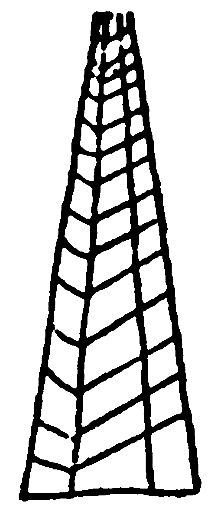
Fig. 35
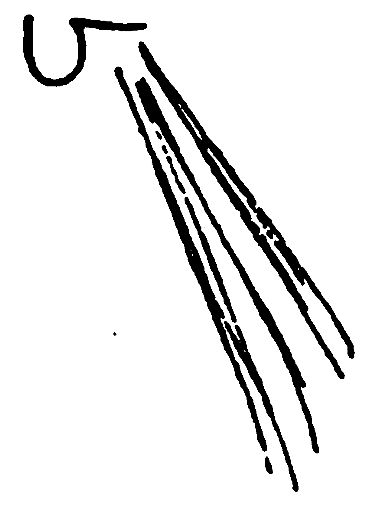
Fig. 35a
After she had opened the envelope and seen the original drawing, the problem became, not why a figure five should have an appendage, but why an oil derrick should have a figure five. Craig puzzled over this, and then lay down and told her subconscious mind to bring her the answer. What came was this: the German version of my book, called “Petroleum,” has three oil derricks on the front, and a huge dollar sign on the back of the 59cover, and this was what Craig had really “seen.” She had looked at this book when it arrived, a year or more back, and it had been filed away in her memory. Of course, this may not be the correct explanation, but it is the one which her mind brought to her.
60
12
These drawing tests afford a basis for psycho-analysis, and it is interesting to note some of the facts thus brought up from the childhood of my wife. For example, fires! She was raised in the “black belt,” where there are nine Negroes to one white, and the former are still close to Africa. When Craig was a girl, a nurse in the family, having been discharged, set fire to the home while the adults were away, and the children asleep. Another servant, jealous of an unfaithful husband, put her two babies into a barrel full of feathers and burned them alive. Other fires occurred; so now, in her home, Craig keeps an uneasy eye out for greasy rags, or overheated stoves, or whatever else her fears suggest. When in these drawing tests there has been anything indicating fire or smoke, she has “got” it, with only one or two failures out of more than a dozen cases. Sometimes she “got” the fire or smoke without the object; sometimes she supplied fire or smoke to an object which might properly have it—a pipe, for example. The results are so curious that I assemble them together—a series of fire-alarms, as it were.
You recall the fact that in one of the early drawing tests—those in which, instead of giving the drawings to my wife, I sat in my study and concentrated upon them—I drew a lighted cigarette, and thought of the curls of smoke. Craig filled up her drawing with curves, and wrote: “I can’t draw it, but curls of some sort.” At this time the convention that “curls stood for smoke” had not been established. But now, in the series drawn by my secretary, appeared a little house with smoking chimney, and you will see that my wife got the smoke better than the house (Figs. 36, 36a):
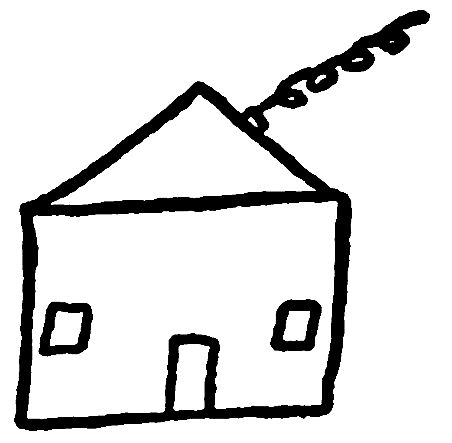
Fig. 36
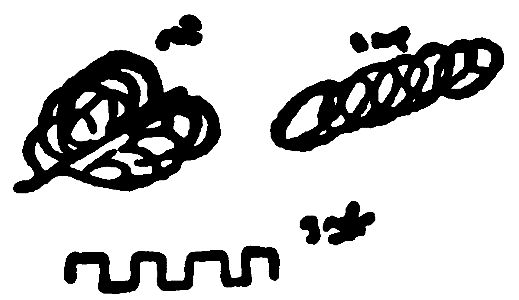
Fig. 36a
61This apparently established in her mind the association of curls with smoke. So when, in series six, I drew a pipe with smoke-curls, my wife first drew an ellipse, and then wrote: “Now it begins to spin, round and round, and is attached to a stick.” She then drew (Figs. 37, 37a):
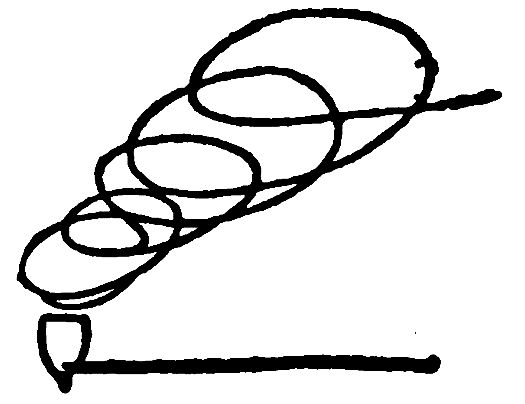
Fig. 37
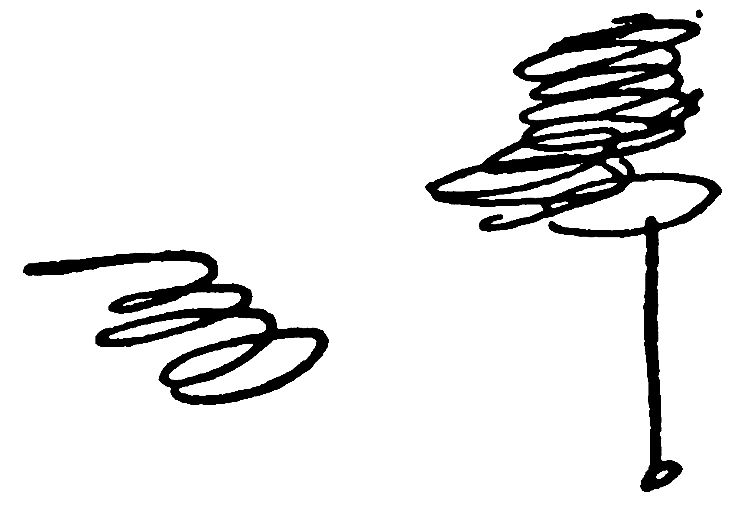
Fig. 37a
In series eight I drew a sky-rocket going up. My first impulse had been to draw a bursting rocket, with a shower of stars, but I realized that would be difficult, so I drew this instead (Fig. 38):
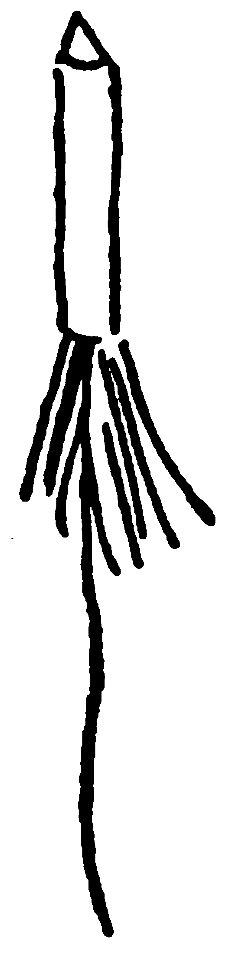
Fig. 38
My wife apparently took my first thought, rather than my drawing. Anyhow, she made half a dozen sketches of whirligigs and light (Figs. 38a, 38b, 38c):
62
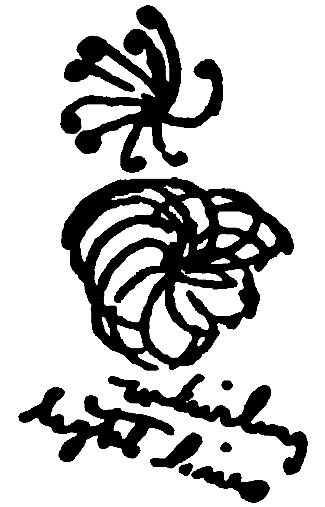
Fig. 38a
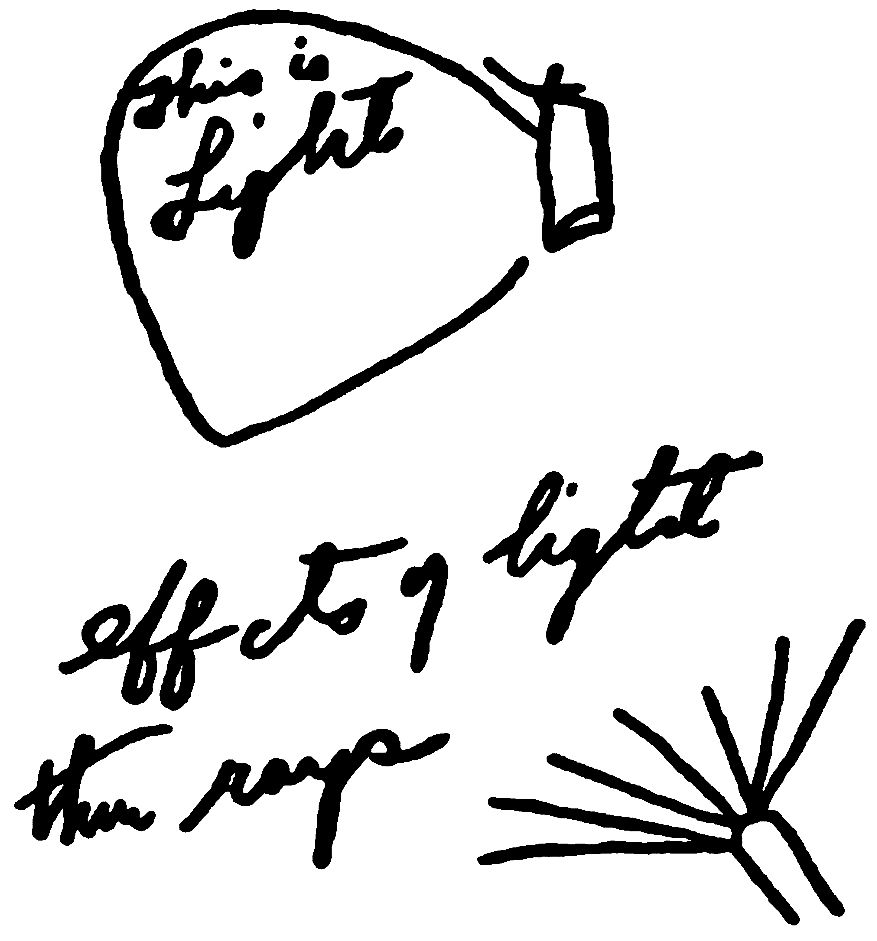
Fig. 38b
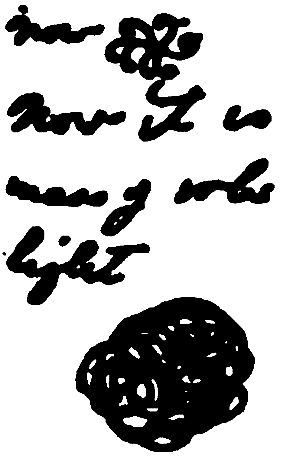
Fig. 38c
And here in series twenty-two is a burning lamp (Figs. 39, 39a):
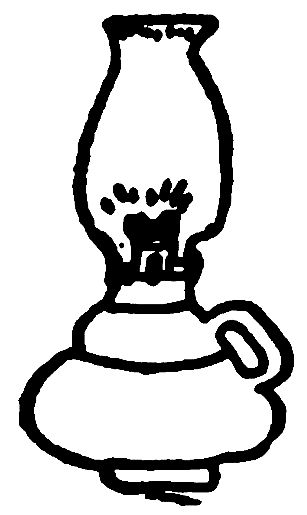
Fig. 39
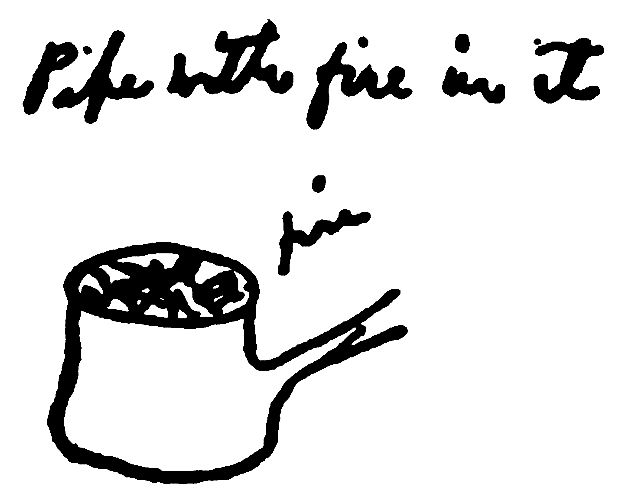
Fig. 39a
And here in series thirty-four another, with comment: “flame and sparks” (Figs. 40, 40a):
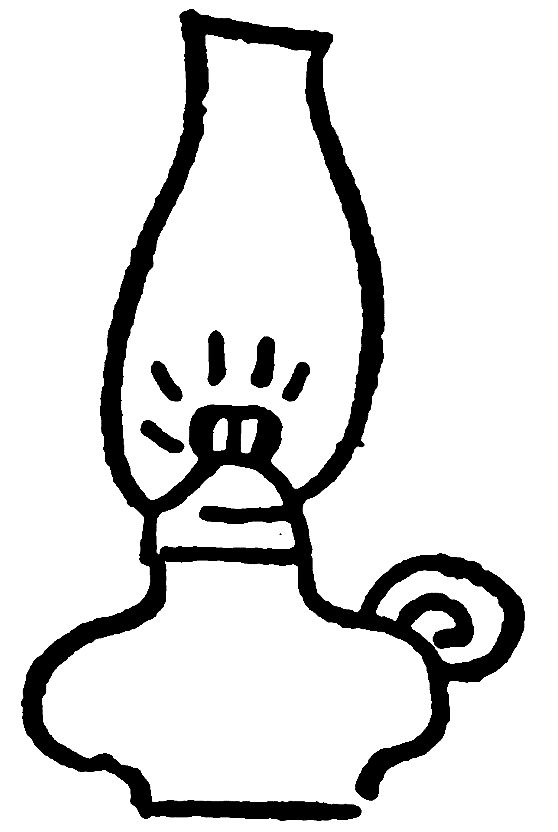
Fig. 40
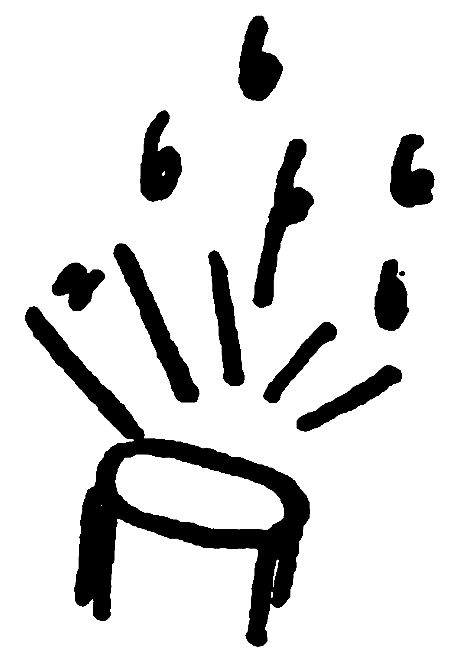
Fig. 40a
63I drew another pipe in series twenty-two, with the usual curls of smoke; and Craig wrote: “Smoke stack.” I drew another in series thirty-three with the result that, five drawings in advance of the correct one, Craig drew a pipe with smoke. Of course, this may have been a coincidence; but wait till you see how often such coincidences happen! (Figs. 41, 41a):
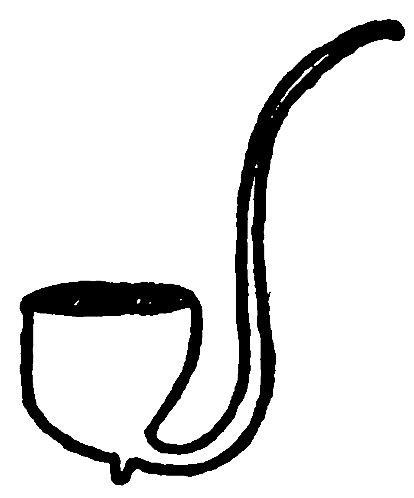
Fig. 41
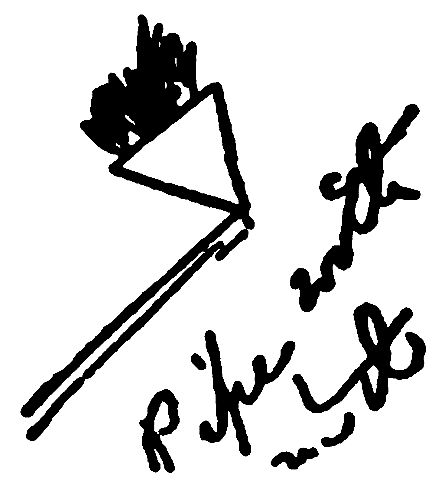
Fig. 41a
In series twenty-one I drew a chimney, and Craig drew a chimney, and added smoke. In thirty-four I drew an old-fashioned trench-mortar; and here again she supplied the smoke (Figs. 42, 42a):
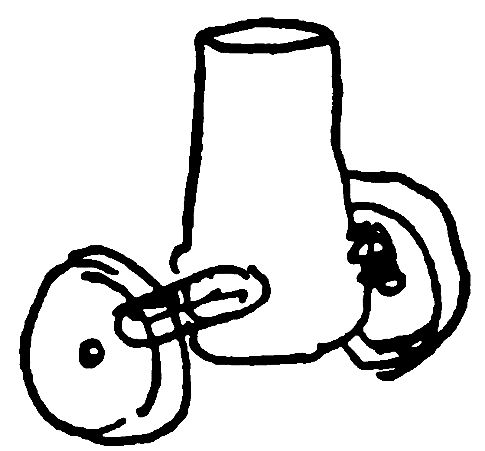
Fig. 42
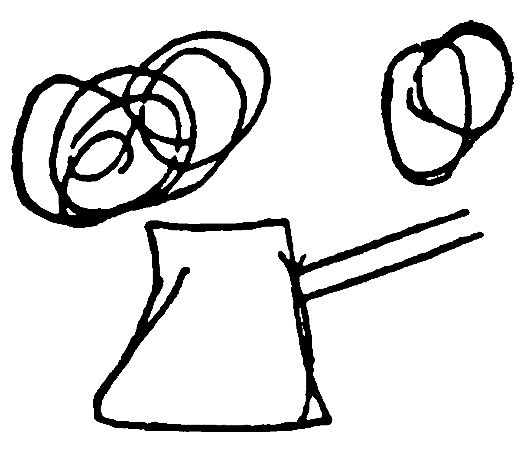
Fig. 42a
Cannons are especially horrible things to her, as you may note again and again in her published war-sonnets:
The sharpened steel whips round, the black guns blaze,
Waste are the harvests, mute the songs of birds.
So when, in series eleven, I drew the muzzle half of an old-style cannon, Craig’s imagination got to work one drawing ahead of time. She wrote: “Fire and smoke—smoke—flame,” and then drew as follows (Fig. 43a):
64
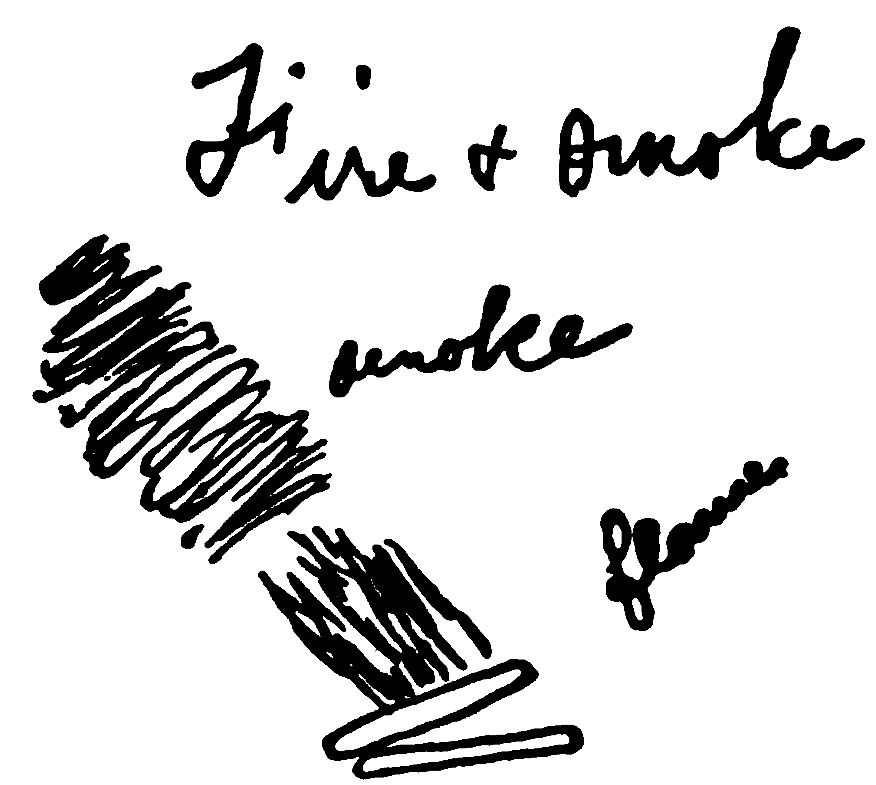
Fig. 43a
The next drawing was the cannon, and I give it, along with the drawing Craig made to go with it. The comment she wrote was: “Half circle—double lines—light inside—light is fire busy whirling or flaming” (Figs. 44, 44a):
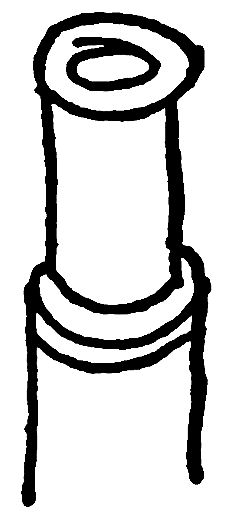
Fig. 44
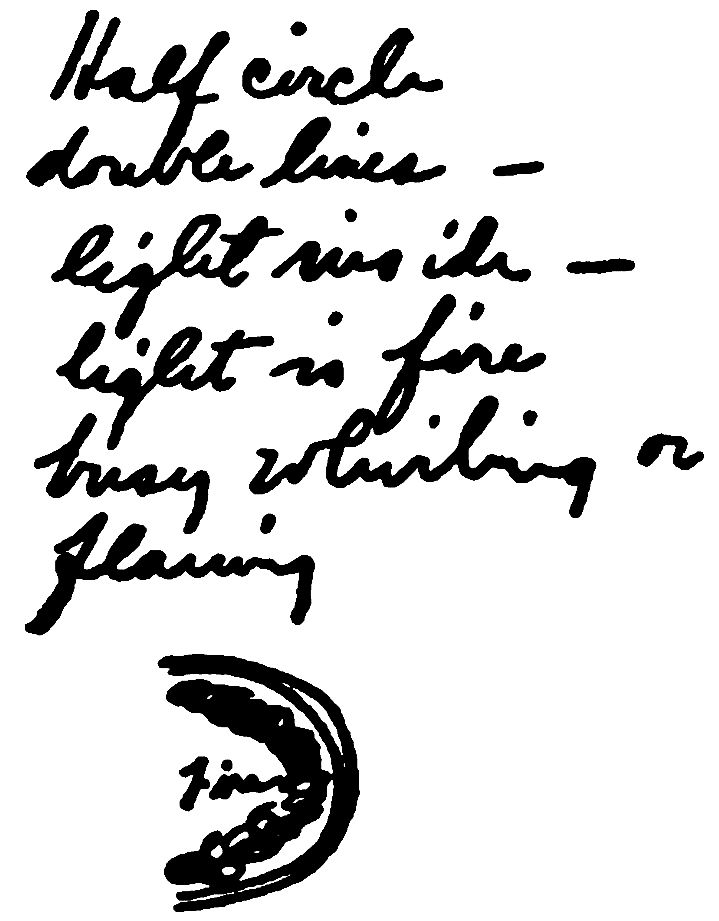
Fig. 44a
So much for fires, and things associated with fire. Now consider another detail about life in the Yazoo delta, brought out in the course of our psycho-analysis. In the days of Craig’s childhood, poisonous snakes were an ever-present menace, and fear of them had to be taught to children, and could hardly be taught too early. There is a family story of a little tot crawling under the house and coming back to report, “I see nuffin wiv a tail to it!” In the swamps back of Craig’s summer home on the Mississippi Sound I have counted a dozen copperheads and moccasins in the course of 65a half hour’s walk. Also, her father has some childhood complex buried in his mind, which causes him to have a spell of nausea at the sight of a snake. All this, of course, strongly affected the child’s early days, and now it is in her mental depths. So when I drew a hissing snake, just see the uproar I caused! She made no drawing, but wrote a little essay. I give my drawing, and her essay following (Fig. 45):
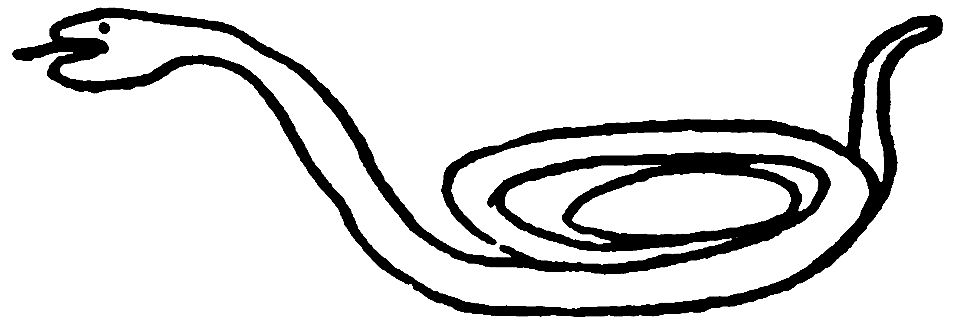
Fig. 45
“See something like kitten with tail and saucer of milk. Now it leaps into action and runs away to outdoors. Turns to fleeing animal outdoors. Great activity among outdoor creatures. Know it’s some outdoor thing, not indoor object—see trees, and a frightened bird on the wing (turned sidewise). It’s outdoor thing, but none of above seems to be it.”
In other words, little Mary Craig Kimbrough is back on the plantation, seeing terror among birds and poultry, and not knowing what causes it! Study the drawing, and you see that I got the action of the snake, but didn’t get the coils very well, so they might be a “saucer of milk”—and a sure-enough kitten’s tail sticking out from it. Another childhood horror here! Craig was a fat little thing, and she slipped and plumped down on her favorite pet kitten, and exploded it.
66
13
The person whom we are subjecting to this process of psycho-analysis has a strong color sense, and wanted to be a painter. So we note that she “gets” colors and names them correctly. Here is my drawing of what I meant to be a bouquet of pink roses (Figs. 46, 46a):
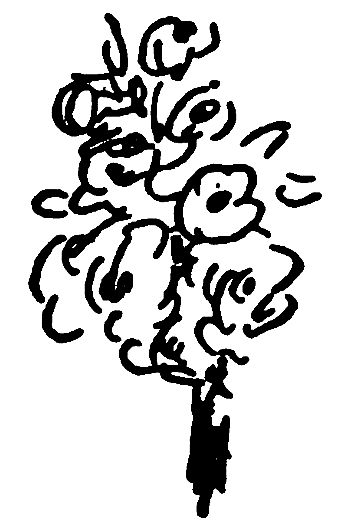
Fig. 46
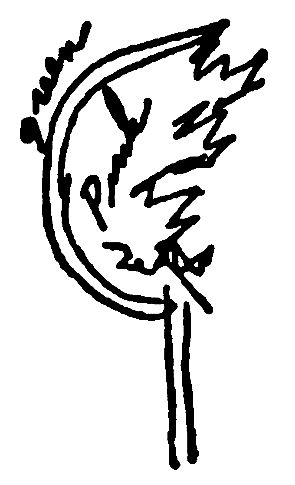
Fig. 46a
Or take this case of a lobster. Craig’s comment was: “Gorgeous colors, red and greenish tinges.” Apparently I had failed to decide whether I was drawing a live lobster or a boiled one! My wife wrote further: “Now it turns into a lizard, camelian, reds and greens.” When she sees this about to be made public, she is embarrassed by her bad spelling; but she says: “Please do not overlook the fact that a chameleon is a reptile—and so is a lobster.” I dutifully quote her, even though her zoology is even worse than her spelling! (Figs. 47, 47a):
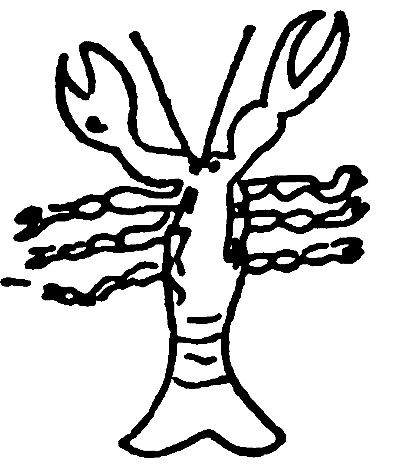
Fig. 47
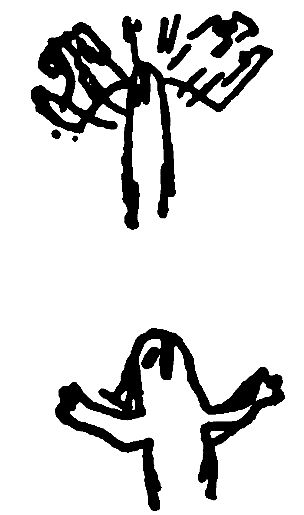
Fig. 47a
67While we are on the “reptiles,” I include this menacing crab, which may have got hold of little Mary Craig’s toe on the beach of the Mississippi Sound (Fig. 48):
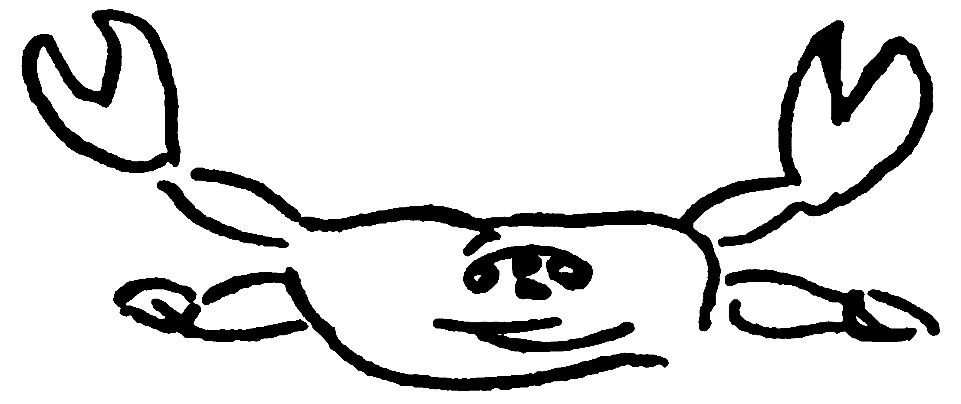
Fig. 48
For the crab, Craig made two drawings, on opposite sides of the paper (Figs. 48a, 48b):
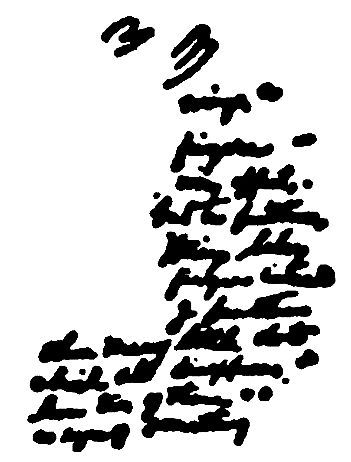
Fig. 48a
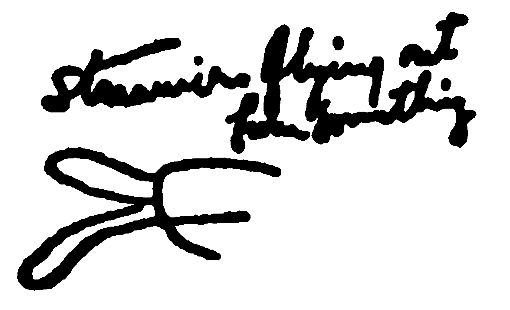
Fig. 48b
The comments on the above read: “Wings, or fingers—wing effect, but no feathers, things like fingers instead of feathers. Then many little dots which all disappear, and leave two of them, O O, as eyes of something.” And then, “Streamers flying from something.”
Another color instance: I drew the head of a horse, and Craig drew a lot of apparently promiscuous lines, and at various places wrote “yellow,” “white,” “blue,” “(dark),” and then a general description, “Oriental.” Afterwards she said to me: “That looks like a complete failure; yet it was so vivid, I can’t be mistaken. Where did you get that horse?” Said I: “I copied it from a Sunday supplement.” We got the paper from the trash-basket, and the page opposite the horse contained what Craig described. We shall note several other cases of this sort of intrusion of things I did not draw, but which I had before me while drawing.
68Also anything with metal or shine seems to stand a good chance of being “got.” For example, these nose-glasses (Figs. 49, 49a):
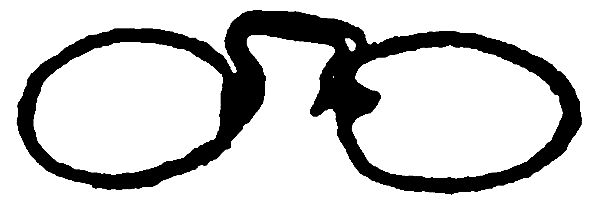
Fig. 49
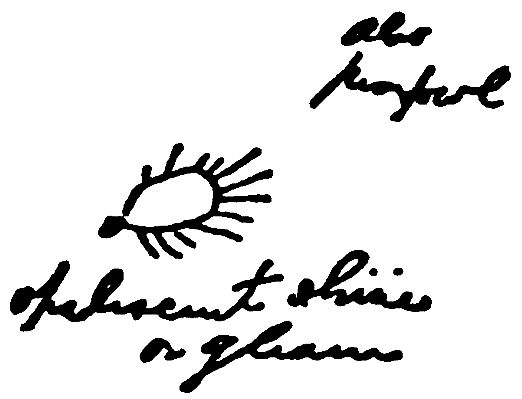
Fig. 49a
The comment reads: “Opalescent shine or gleam. Also peafowl.”
Or again, a belt-buckle; my wife writes the word “shines” (Figs. 50, 50a):
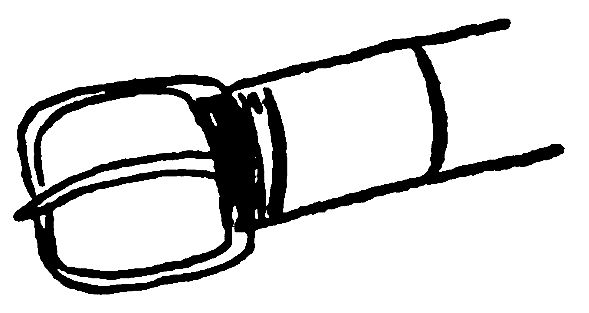
Fig. 50

Fig. 50a
Or this very busy alarm clock—she writes the same word “shines” (Figs 51, 51a):
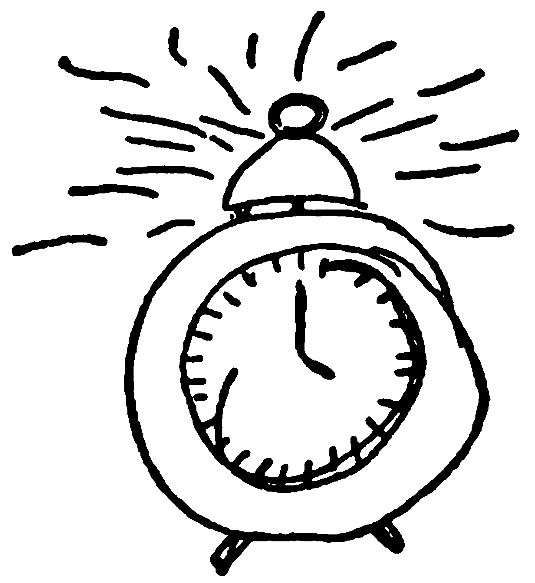
Fig. 51
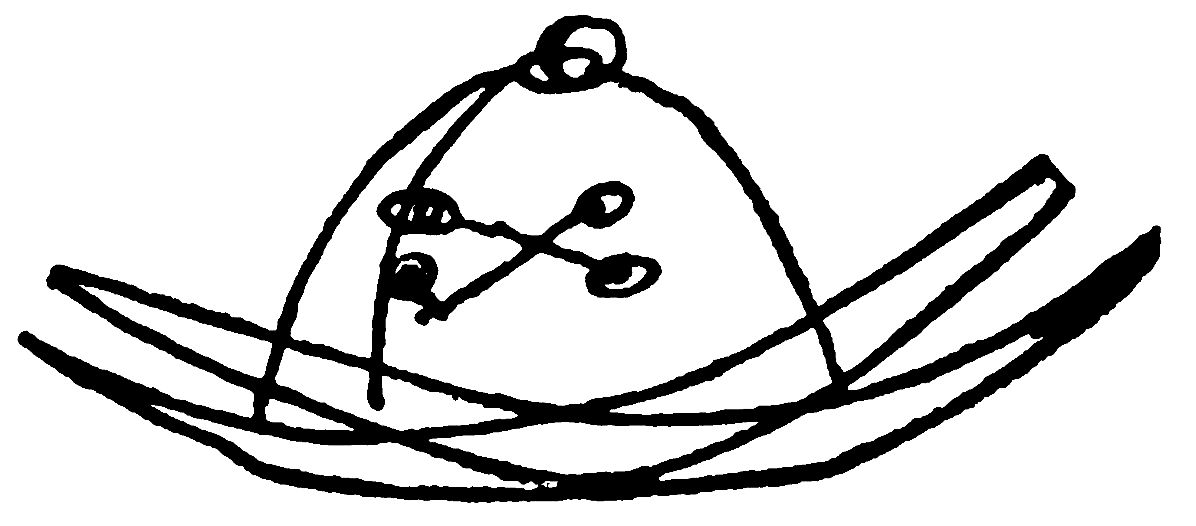
Fig. 51a
She has got at least part of a watch whenever one has been presented. You remember the one Bob drew (Fig. 17). There was another in series thirty-three; Craig made a crude drawing and added: “Shines, glass or metal” (Figs. 52, 52a):
69
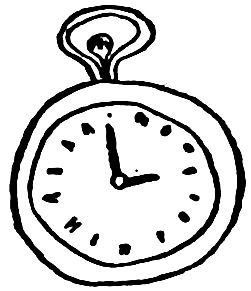
Fig. 52
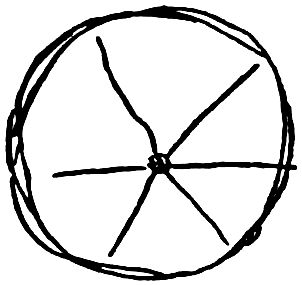
Fig. 52a
Also, on the automobile ride to Pasadena, series three, there was a watch-face among the drawings, and Craig drew the angle of the hands, and added the words, “a complication of small configurations.” Having arrived in Pasadena, she took the twelve drawings and tried them over again. This time, of course, she had a one in twelve chance of guessing the watch. She wrote: “A white translucent glimmering, or shimmering which I knew was not light but rather glass. It was like heat waves radiating in little round pools from a center.... Then in the center I saw a vivid black mark.... So it was bound to be the watch, and it was.”
And here is a fountain. You see that it appears to be in a tub, and is so drawn by Craig. But you note that the “shine” has been got. “These shine!” (Figs. 53, 53a):
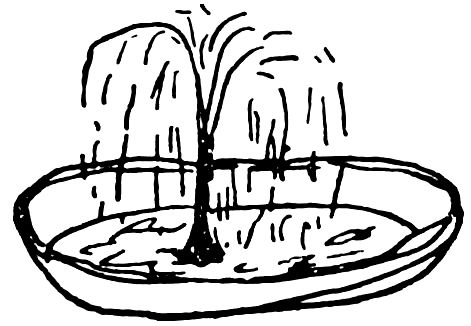
Fig. 53
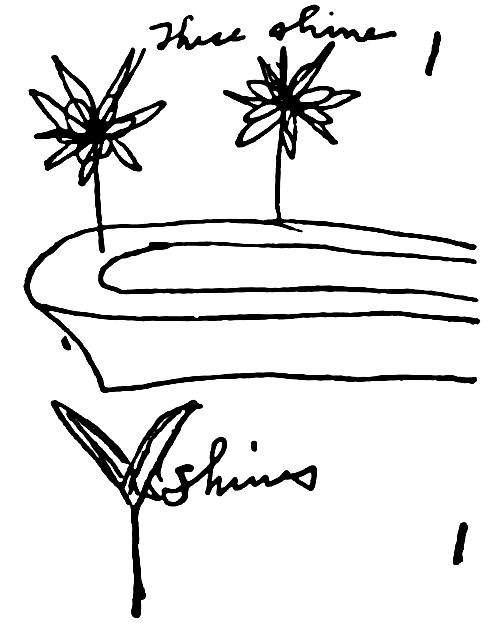
Fig. 53a
Another instance, even more vivid. I made a poor attempt to draw a bass tuba, as one sees them on the stage—a lot of jazz musicians 70dressed up in white duck, and a row of big brass and nickel horns, polished to blind your eyes. See what Craig drew, and also what she wrote (Figs. 54, 54a):
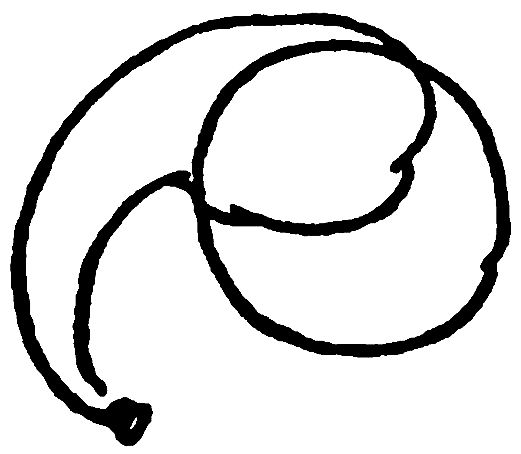
Fig. 54
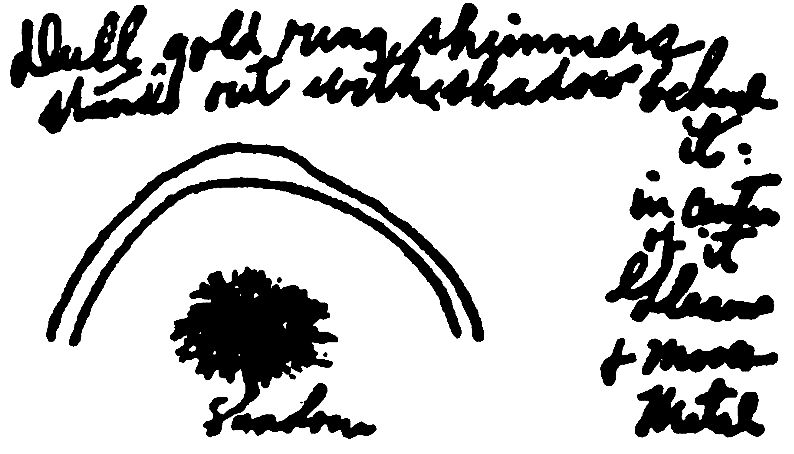
Fig. 54a
The comments, continued on the other side of the sheet, are: “Dull gold ring shimmers and stands out with shadow behind it and in center of it. Gleams and moves. Metal. There is a glow of gold light, and the ring or circle is out in the air, suspended, and moves in blur of gold.”
You see, she gets the feeling, the emotional content. I draw a child’s express-wagon, and she writes: “Children again playing but can’t get exactly how they look. Just feel there are children.” Or take this one, which she describes as “Egyptian.” I don’t know if my pillar is real Egyptian, but it seems so to me, and evidently to my wife, for you note all the artistry it inspired (Figs. 55, 55a):
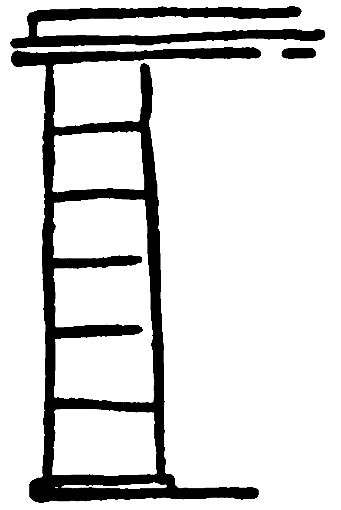
Fig. 55
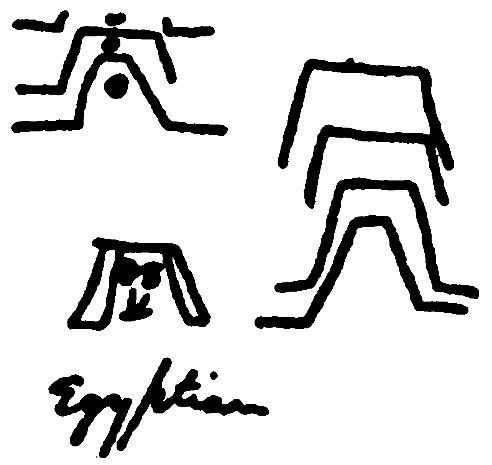
Fig. 55a
Sometimes Craig will embody the feeling in some new form of her own invention; as for example, when I draw an old-fashioned cannon on wheels, and she writes: “Black Napoleon hat and red military coat.” I draw a running fox—well drawn, because I copy it from a picture; she rises to the occasion with two crossed guns, 71and a hunting horn with a lot of musical notes coming out of it (Figs. 56, 56a):
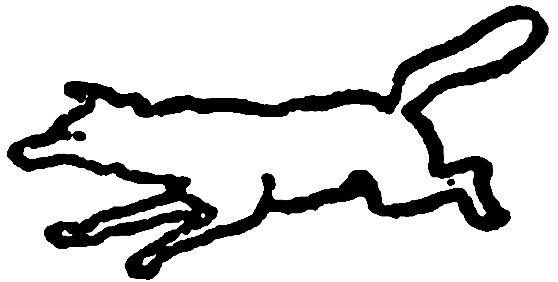
Fig. 56
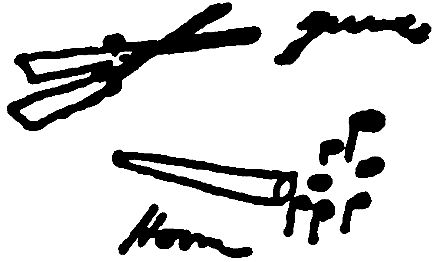
Fig. 56a
I draw an auto, and she replies with the hub and spokes of a wheel. Not satisfied with this, she sets it aside, and tries again a little later—without looking at the original drawing—and this time she produces a horn, with indication of a noise. I give both her drawings, which are on two sides of the same slip of paper (Figs. 57a, 57b):
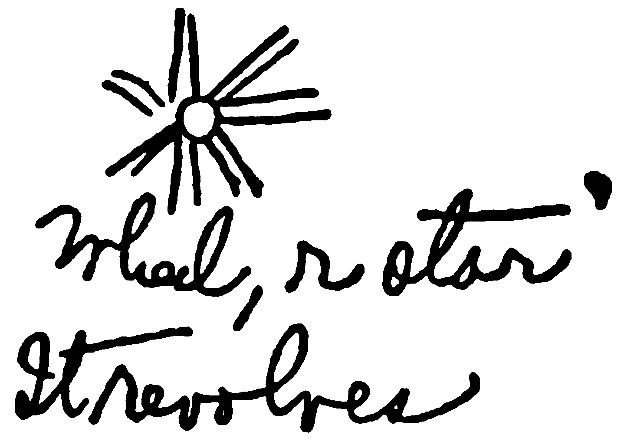
Fig. 57a
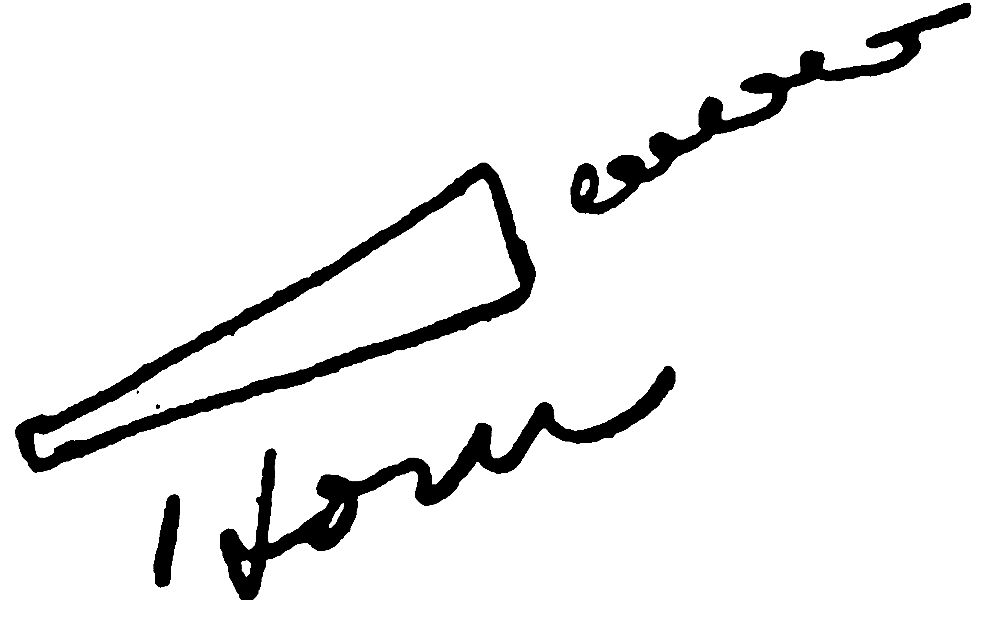
Fig. 57b
72
14
An extraordinary incident occurred in connection with the fourth series of drawings. While my secretary, E. M. Hart, was making the drawings, there came into the office his brother-in-law, R. H. Craig, Jr., a teller of the Security First National Bank of Long Beach, a person entirely unknown to my wife. He heard what was going on, and said, “I’ll give her some that’ll stump her.” He took a pen and drew two pictures, which were duly wrapped in sheets of green paper and sealed in envelopes, and put with the rest of the series. I was not at the office, and nothing was said to me about Mr. Craig having taken part in the matter.
My wife did this series under my eyes; and when she came to the first of Mr. Craig’s two drawings, she wrote, “Some sort of grinning monster,” and added an elaborate description. Then she opened the envelope, and found a roller skate with a foot and leg attached. This, naturally, was called a failure; but seven drawings later in the same series came Mr. Craig’s other drawing, which was as follows (Fig. 58):
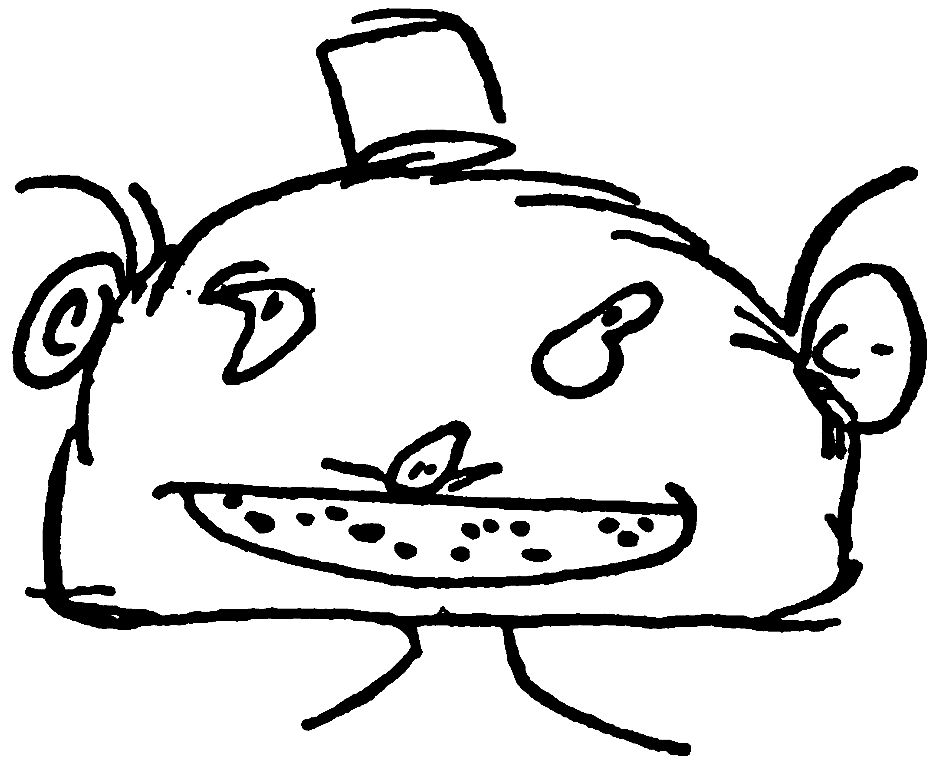
Fig. 58
Now read the amazing description which my wife had written, seven drawings back, when the first of Mr. Craig’s drawings had come under her hand:
“Some sort of grinning monster—see only the face and a vague 73idea of deformed neck and shoulders. It is a man, but it looks like a cat’s face, cat eyes and whiskers. Don’t know just how I know it is a man—it is a deformity. Not a cat. See color of skin which is deep, flat pink, as of a colored picture. The face of the creature is broad and weird. The flesh of neck, or somewhere, gives effect of rolls or creases.”
I asked my secretary what this drawing was meant to be, and he said “a Happy Hooligan.” My cultural backwardness is such that I wasn’t sure just what a “Happy Hooligan” might be, but my secretary told me it is a comic supplement figure, and I then looked it up in the paper, and found that the face of the figure as printed is a very pale pink, and the little cap on top is a bright red. I called Mr. Craig on the phone and asked him this question: “If you were to think of a color in connection with a ‘Happy Hooligan,’ what color would it be?” He answered, “Red.”
Now I ask you, what chance do you think there is of a person’s writing a description such as the above by guess work? To be sure, my wife had eight guesses; but do you think that eight million guesses would suffice? And if we call it telepathy, do we say that my wife’s mind has the power to dip into the mind of a young man whom she has never seen, nor even heard of? Or shall we say that his mind affected his brother-in-law’s, the brother-in-law’s affected mine, and mine affected my wife’s? Or, if we decide to call it clairvoyance, or psychometry, then are we going to say there is some kind of vibration or emanation from Mr. Craig’s drawing, so powerful that when one of his drawings is handed to my wife, she gets what is in another drawing which has been done at the same time?
Whatever may be the explanation, here is the fact: Again and again we find Craig getting, not the drawing she is holding under her hand, but the next one, which she has not yet touched. When she picks up the first drawing, she will say, or write: “There is a little man in this series”; or: “There is a snow scene with sled”; or: “An elephant, also a rooster.” I am going to show you these particular cases; but first a word as to how I have counted such “anticipations.”
Manifestly, if I grant the right to more than one guess, I am increasing the chances of guesswork, and correspondingly reducing 74the significance of the totals. What I have done is this: where such cases have occurred, I have called them total failures, except in a few cases, where the description was so detailed and exact as to be overwhelming—as in the case of this “Happy Hooligan.” Even so, I have not called it a complete success, only a partial success. In order to be classified as a complete success, my wife’s drawing must have been made for the particular drawing of mine which she had in her hand at that time; and throughout this account, the reader is to understand that every drawing presented was made in connection with the particular drawing printed alongside it—except in cases where I expressly state otherwise.
Now for a few of the “anticipations.” In the course of series six, drawn by me on Feb. 8, 1929, drawing number two was a daisy, and Craig got the elements of it, as you see (Figs. 59, 59a):
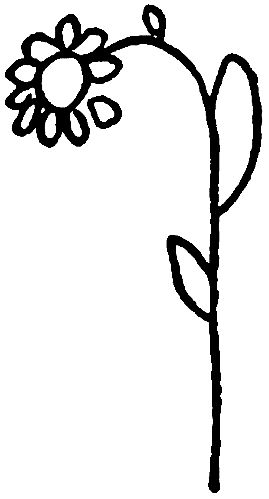
Fig. 59
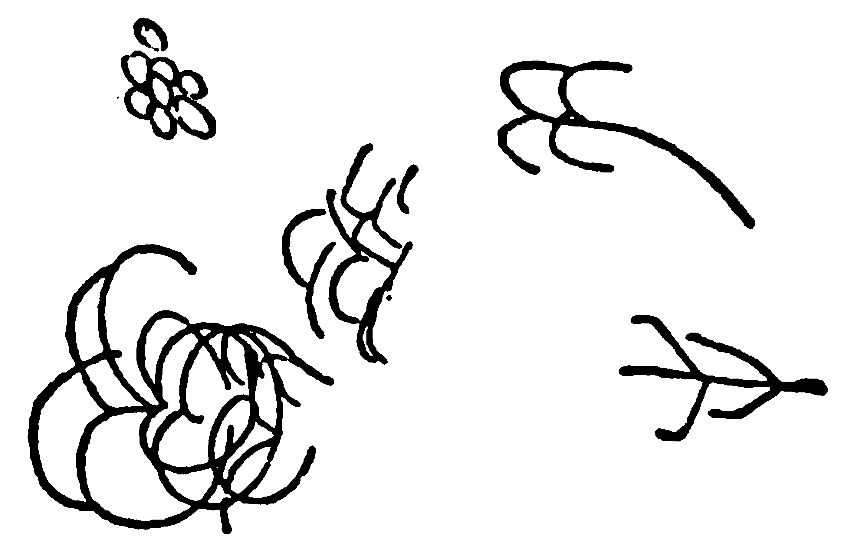
Fig. 59a
Her mind then went ahead, and she wrote, “May be snow scene on hill and sled.” The next drawing was an axe, which I give later (Fig. 145); she got the elements of this very well, and then added on the back: “I get a feeling again of a snow scene to come in this series—a sled in the snow.” That was number three; and when number five came Craig made this annotation: “Opened it by mistake, without concentrating. It’s my expected sled and snow scene.” Here is the drawing (Fig. 60):
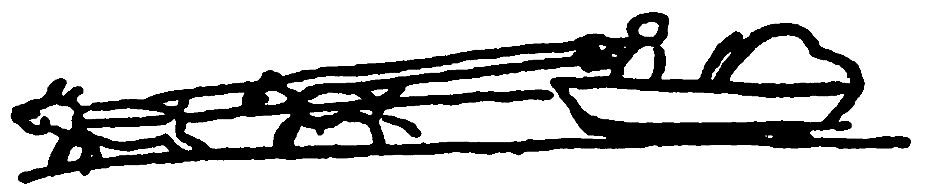
Fig. 60
Series number eight, on Feb. 10, brought even stranger results. This is the series in which the laced-up football was turned into a 75calf wearing a belly-band (Figs. 15, 15a). But even while I was engaged in making the drawings, sitting in my study apart, and with the door closed, Craig’s busy magic, whatever it is, was bringing her messages. She called out: “I see a rooster!” I had actually drawn a rooster; but of course I made no reply to her words. She at once drew a rooster and several other things, and after I had brought my drawings into the room, but before she had started to work with them, she wrote as follows:
“While Upton was making these drawings I sat before the fire thinking how to dry felt slippers which I had washed. I had my mind on them. Hung them on grating to see if they would hang there without burning. Suddenly saw rooster crowing. Then thought, ‘Can U be drawing rooster?’ Decided to make note of this. Did so. Then saw”—and she draws a circle with eight radiating lines, like spokes of a wheel.
In due course came drawing number eight, and before looking at it, Craig wrote: “Rooster.” Then she added, “But no—it looks like a picture of coffee-pot—see spout and handle.” This is hard on me as an artist, but I give the drawing and let you judge for yourself (Fig. 61):
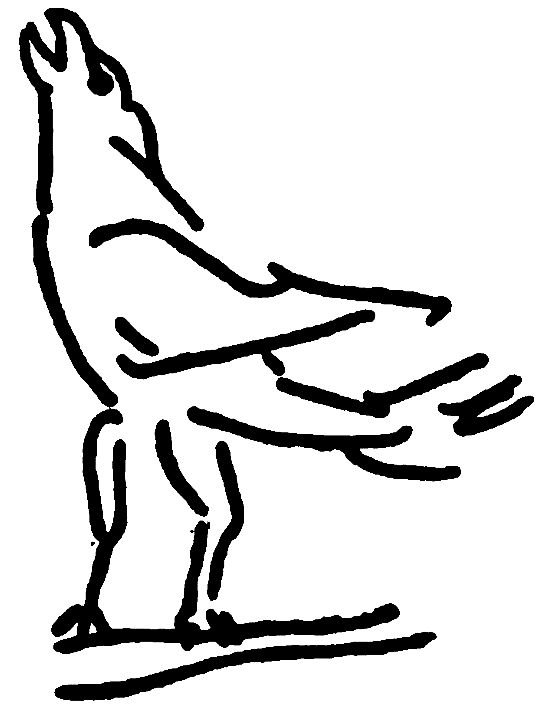
Fig. 61
What about the circle and the radiating spokes? That was, apparently, a fore-glimpse of drawing number five. I give you that, together with what Craig drew for that particular test when it came. Her effort suggests the kind of humor with which the newspaper artists used to delight my childhood; a series of drawings in which one thing turns into some other and quite unexpected thing by 76gradual changes. You will see here how the hub of a wagon-wheel may turn into the muzzle of a deer! (Figs. 62, 62a):
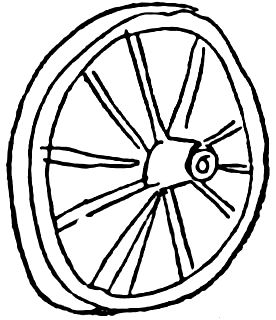
Fig. 62
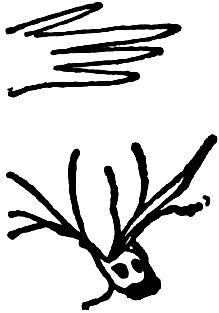
Fig. 62a
77
15
What are the principles upon which I have classified the drawings, as between success, partial successes, and failures? I will use this series, number eight, to illustrate. There are eight drawings, and I have set them down as one success, six partial successes, one failure. The success is the rooster (Fig. 61), called “a rooster,” even though it “looks like a coffee pot.” The partial successes are, first, an electric light bulb, very crudely imitated as to shape in three drawings. Perhaps this was hardly good enough to be counted; it was a border-line case, and probably the poorest that I admitted to the classification of “partial successes” (Fig. 63a).
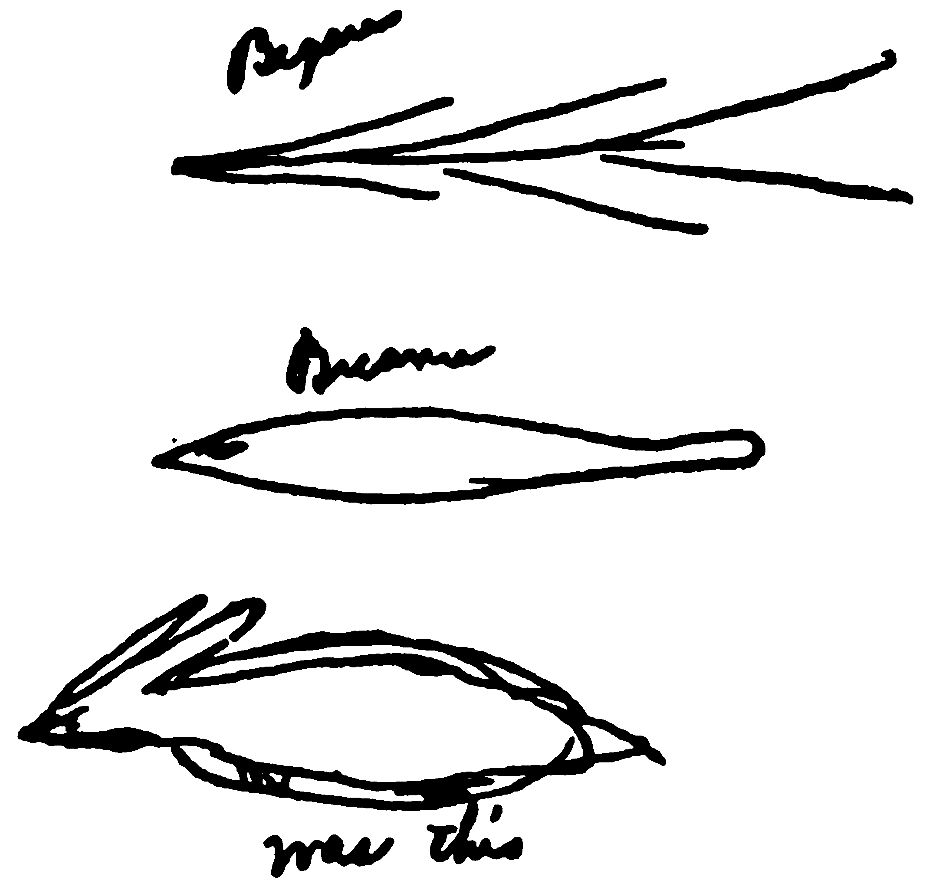
Fig. 63a
Second, the ascending sky-rocket, already printed as fig. 38, giving rise to six different drawings of whirligigs and light. Third, the following drawing, for which Craig wrote: “See spider, or some sort of legged pest. If this is not a spider, there is a spider in the lot somewhere! This I know!” (Fig. 64):
78

Fig. 64
The fourth partial success was a drawn bow, with arrow fitted, ready to be launched. Craig wrote as follows: “Picked this up and saw inside as it dropped on floor—so did not try it. Suddenly recall I have already ‘seen’ it earlier.” Before starting the tests, along with her written mention of “a rooster,” she had drawn a bow and crude arrow, and the resemblance is so exact that it seems to me entitled to be called a partial success (Figs. 65, 65a):
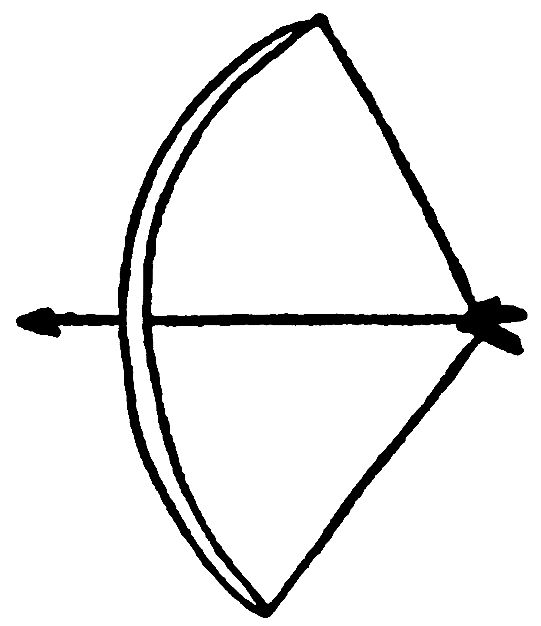
Fig. 65
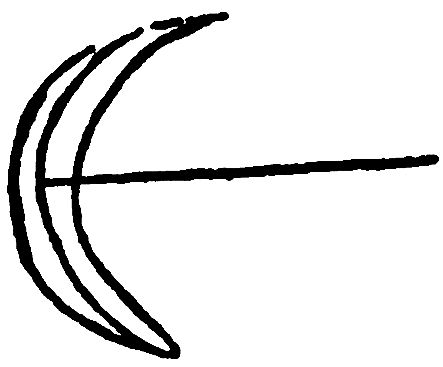
Fig. 65a
Fifth, the wagon hub (Fig. 60), which became the deer’s muzzle. And finally the laced-up football (Fig. 15) which became a belly-band on a calf (Fig. 15a).
As for the failure in this series, it is a cake of soap, which was called “whirls.” There are a couple of other drawings in the series, marked: “Too tired to see it,” and “Tired now and excited and keep seeing old things”—meaning, of course, the preceding drawings.
I tried to avoid drawing the same object more than once, but 79now and then I slipped up. In series eleven I drew another rooster, and there followed, not one “anticipation,” but several. Drawing number one was a tooth; Craig wrote: “First see rooster. Then elephant.” Drawing number two was an elephant; and Craig wrote: “Elephant came again. I try to suppress it, and see lines, and a spike sticking some way into something.” She drew it, and it seems clear that the “spike” is the elephant’s tusk, and the head of the “spike” is the elephant’s eye (Figs. 66, 66a):
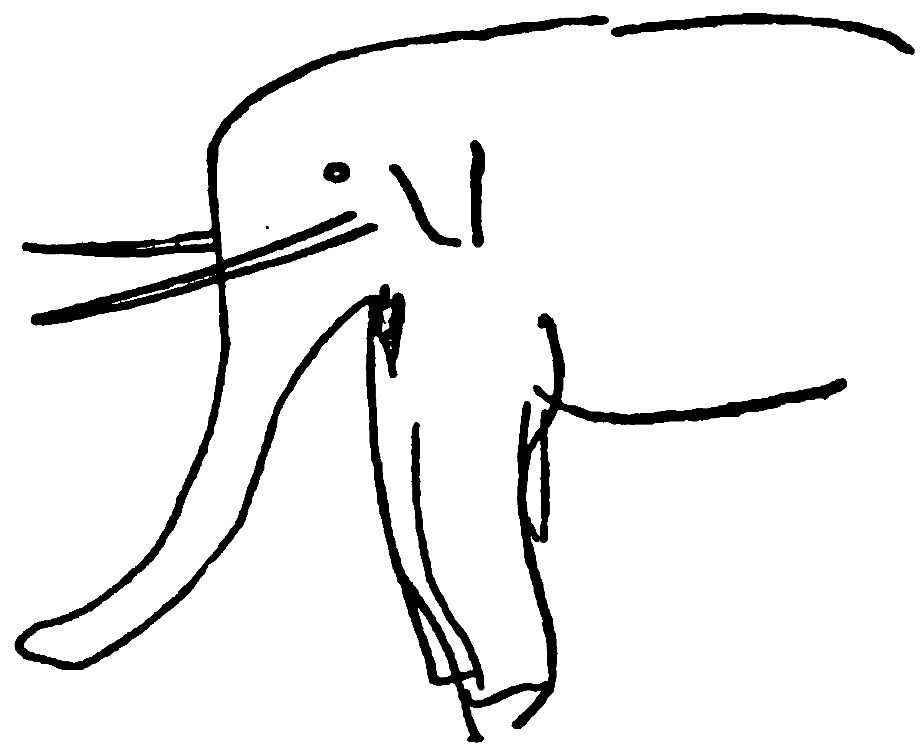
Fig. 66
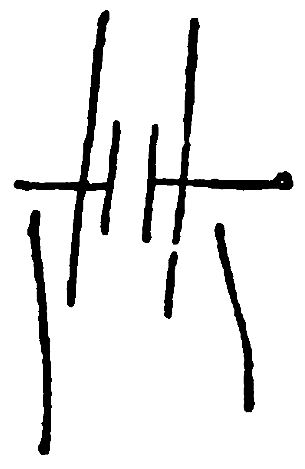
Fig. 66a
Next, number three, was the rooster. But Craig had set “rooster” down in her mind as a blunder, so now she wrote: “I don’t know what, see a bunch, or tuft clearly. Also a crooked arm on a body. But don’t feel that I’m right.” Here are the drawings, and you can see that she was somewhat right (Figs. 67, 67a):
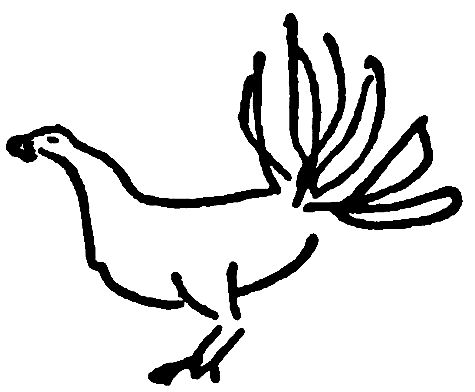
Fig. 67
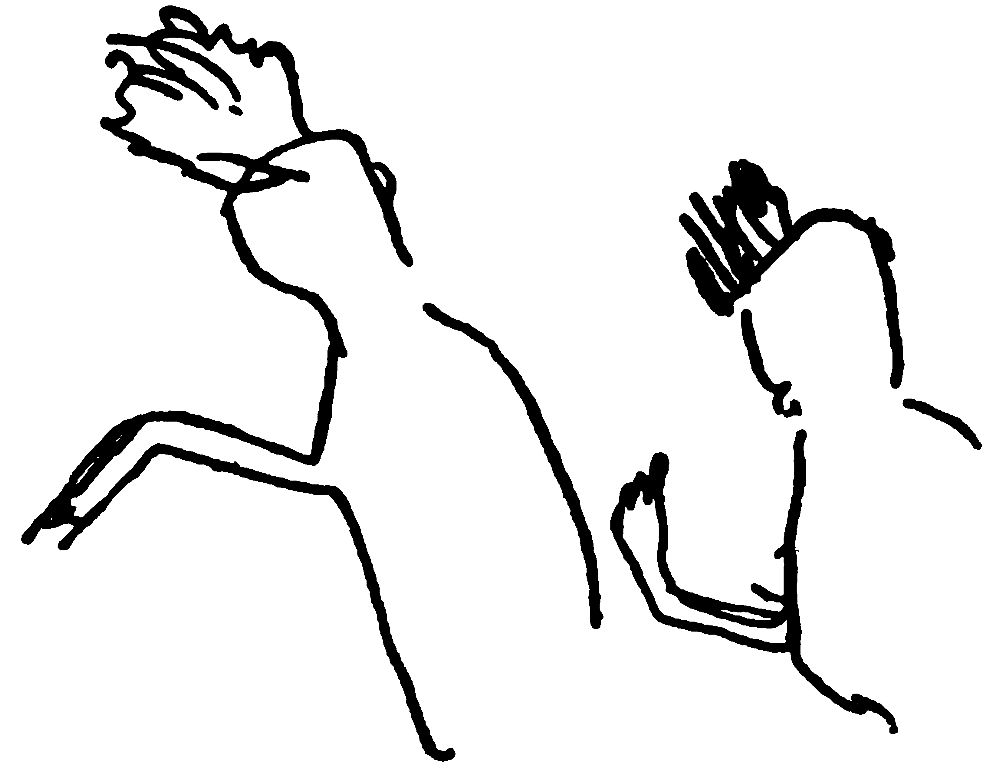
Fig. 67a
This series eleven, containing fourteen drawings, is marked: “Did this lot rapidly, without holding (mind) blank. The chicken 80and elephant came at once, on a very earnest request to my mind to ‘come across.’” I have classified in this series two successes, five partial, and five failures: throwing out numbers twelve and fourteen, because Craig wrote: “Nothing except all the preceding ones come—too many at once—all past ones crowding in memory”; and again, “Nothing but everything in the preceding. Too many of them in my mind.”
The anticipations run all through this series in a quite fascinating way. Thus, for number four Craig wrote: “Flower. This is a vivid one. Green spine—leaves like century plant.” She drew Figure 68a:
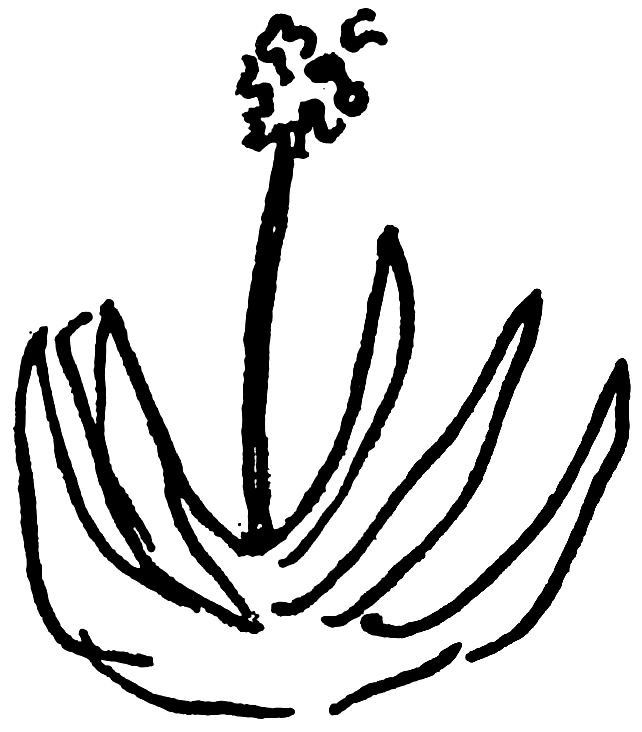
Fig. 68a
And then again, for drawing number seven, she did more flowers, with this comment: “This is a real flower, I’ve seen it before. It’s vivid and returns. Century plant? Now it turns into candle stick. See a candle” (Fig. 69a).
All this was wrong—so far. Number four was a table, and number seven was the rear half of a cow. But now we come to number eleven, the plant known as a “cat-tail,” which seems to resemble rather surprisingly the lower of the two drawings in Figure 69a. My drawing is given as Figure 70, and the one Craig made for it is given as 70a.
81
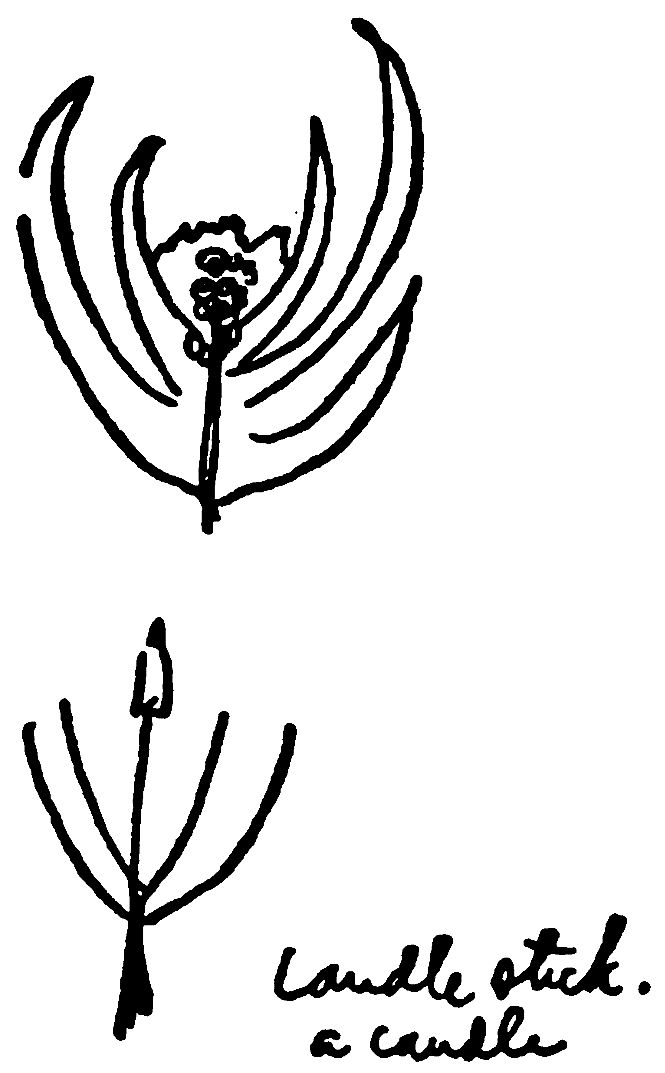
Fig. 69a
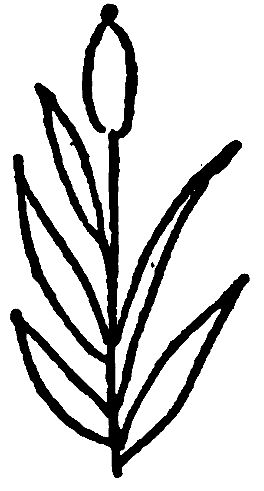
Fig. 70
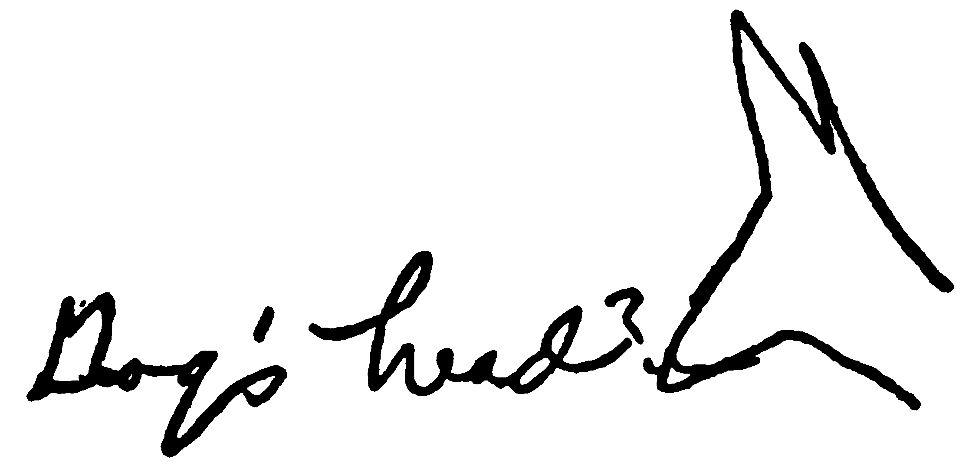
Fig. 70a
Comment on the above read: “Very pointed. Am not able to see what. Dog’s head?”
Drawing five was a large fish-hook; and this inspired the experimenter to a discourse, as follows: “Dog wagging—see tail in air busy wagging—jolly doggie—tail curled in air.” And then: “Now I see a cow. I fear the elephant and chicken got me too sure of animals. But I see these.”
Now, a big fish-hook looks not unlike a “tail curled in air.” But when we come to number seven, we discover what Craig was apparently anticipating. It is the drawing of what I have referred to as “the rear half of a cow.” It is badly done, with a cow’s hoof, but I forgot what a cow’s tail is like, and this tail that I drew would fit much better on a “jolly doggy,” you must admit (Fig. 71):
82
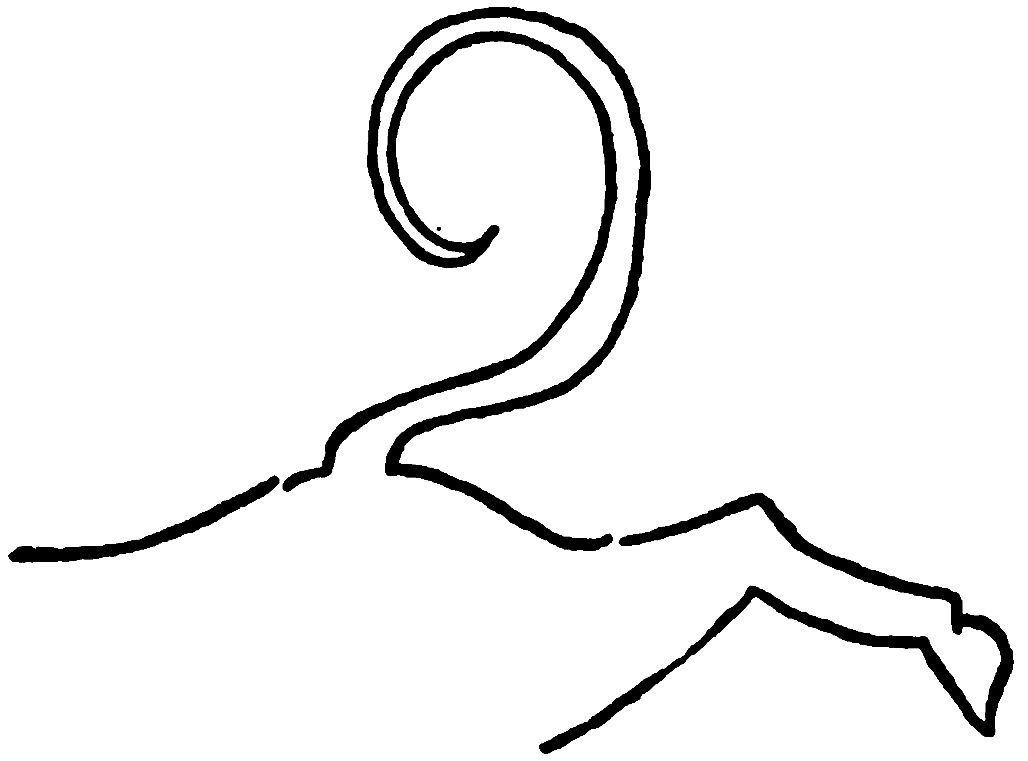
Fig. 71
Drawing number six was a sun, as children draw it, a circle with rays going out all round. Craig wrote: “Setting sun and bird in sky. Big bird on wing—seagull or wild goose.” This I called a partial success. Number nine was the muzzle end of an old-style cannon, already reported in Figures 46, 46a.
I conclude the study of this particular series with drawing thirteen, to which was added the comment: “Think of a saucer, then of a cup. It’s something in the kitchen. Too tired to see” (Figs. 72, 72a):
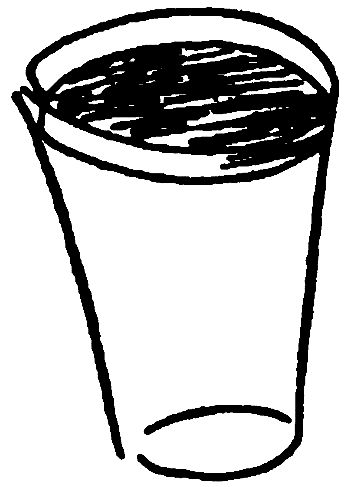
Fig. 72
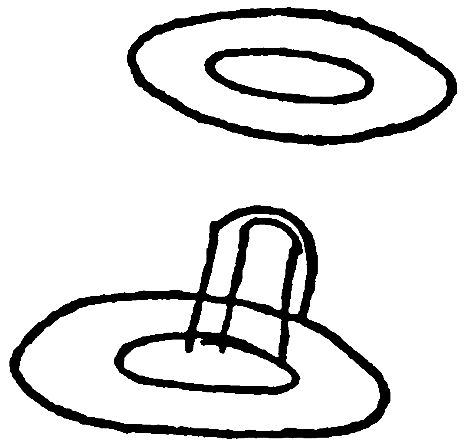
Fig. 72a
In series fourteen, drawing three, Craig wrote: “Man running, can’t draw it.” She drew as follows (Fig. 73a):
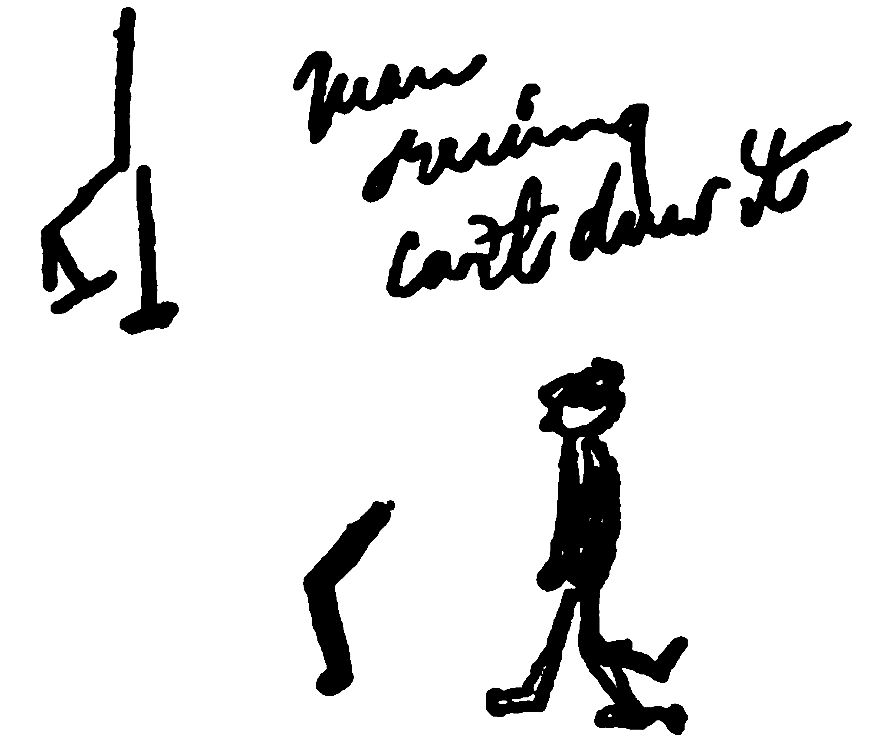
Fig. 73a
83Next came my drawing four, as follows (Fig. 73):
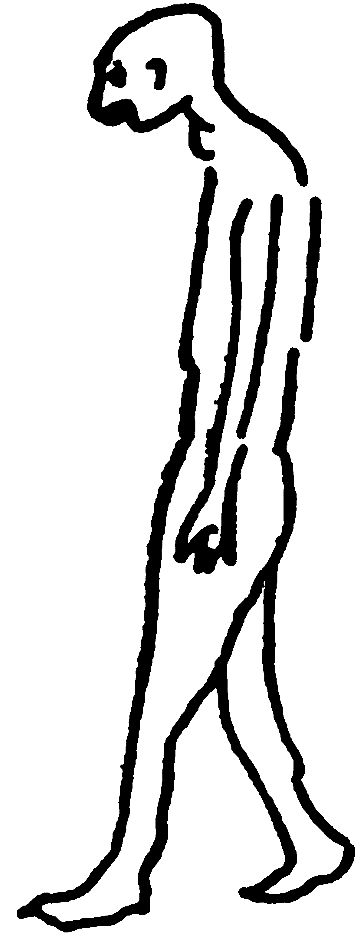
Fig. 73
In series thirty-five I first drew a fire hydrant, and Craig wrote, “Peafowl,” and added the following drawing, which certainly constitutes a partial success (Figs. 74, 74a):
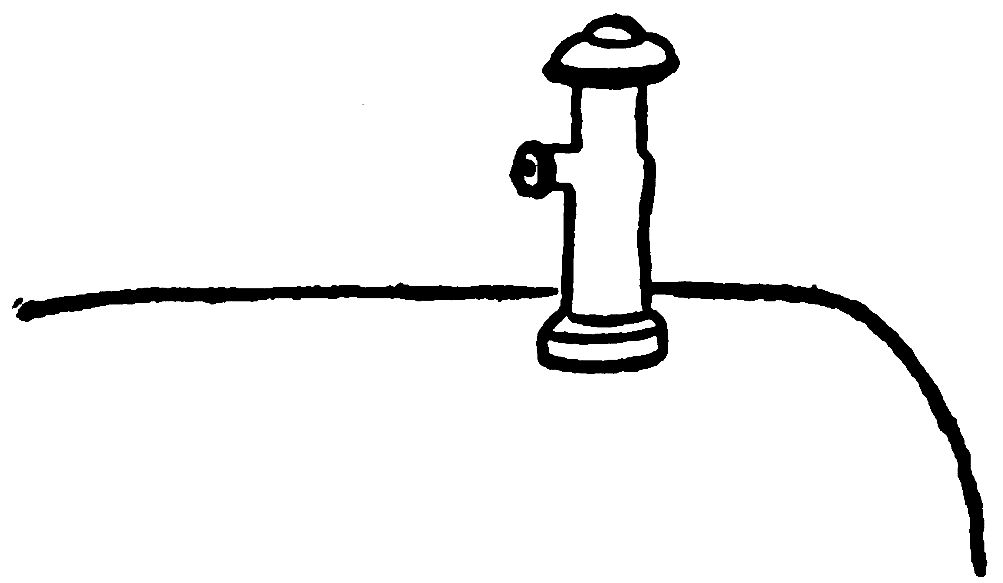
Fig. 74
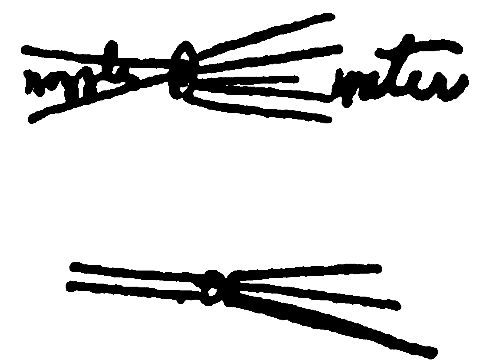
Fig. 74a
My next drawing was the peafowl, as you see. For this Craig wrote: “Peafowl again,” and apparently tried to draw the peafowl’s neck, and a lot of those spots which I had forgotten are an appurtenance of peafowls (Figs. 75, 75a):
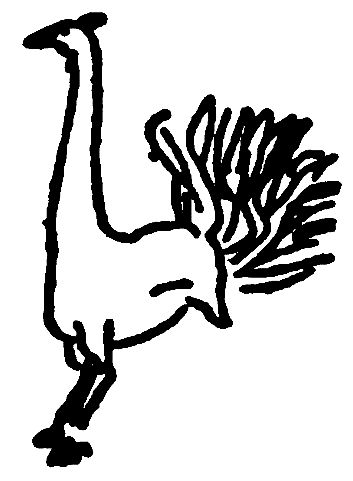
Fig. 75
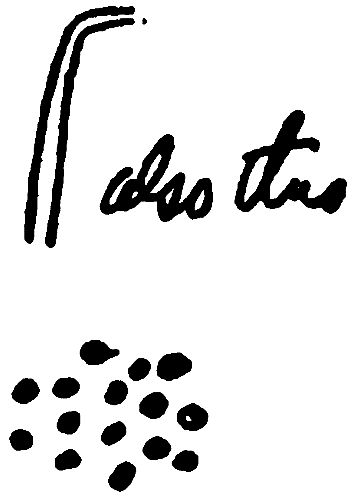
Fig. 75a
84In series twenty-nine I drew an elevated railway. If you turn it upside down, as I have done here, it looks like water and smokestacks. Anyhow, Craig drew a steamboat (Figs. 76, 76a):
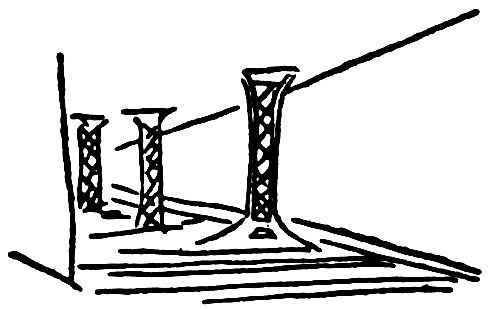
Fig. 76
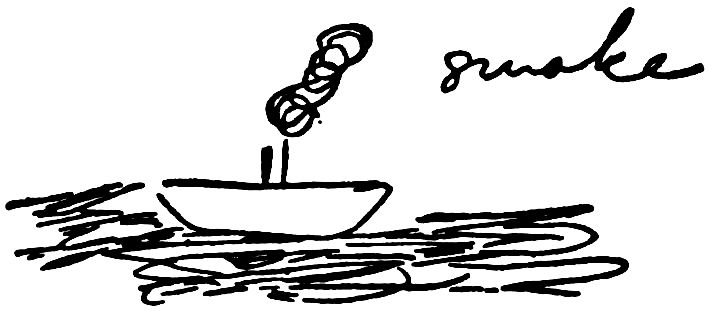
Fig. 76a
And then came my next drawing—a steamboat! Craig wrote: “Smoke again,” and drew the smoke and the stack (Figs. 77, 77a):
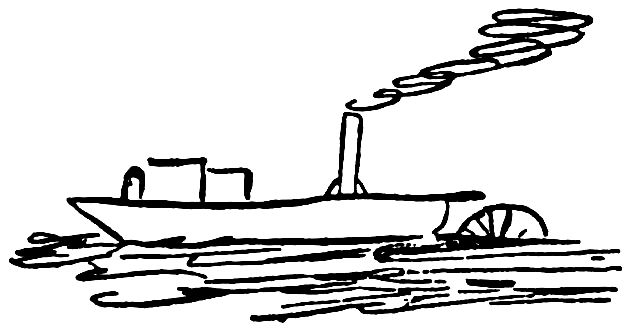
Fig. 77
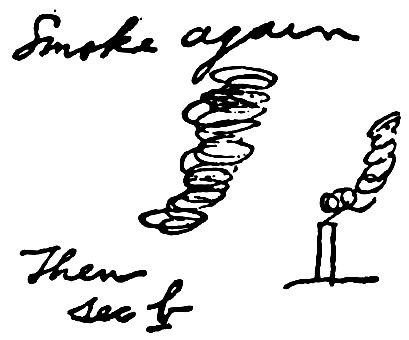
Fig. 77a
She added two more drawings, which appear to be the wheel of the boat in the water, and the smoke (Figs. 77b, 77c):
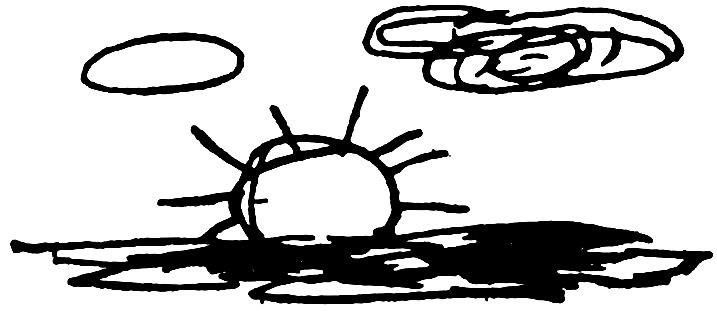
Fig. 77b
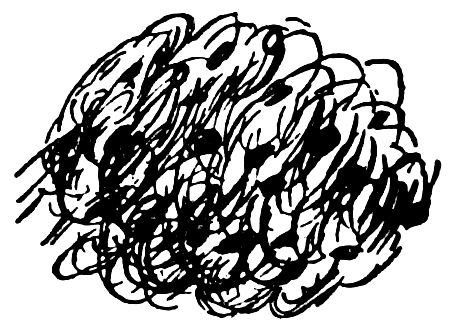
Fig. 77c
85In series thirty I drew a fish-hook with line, and you see it turned into a flower (Figs. 78, 78a):
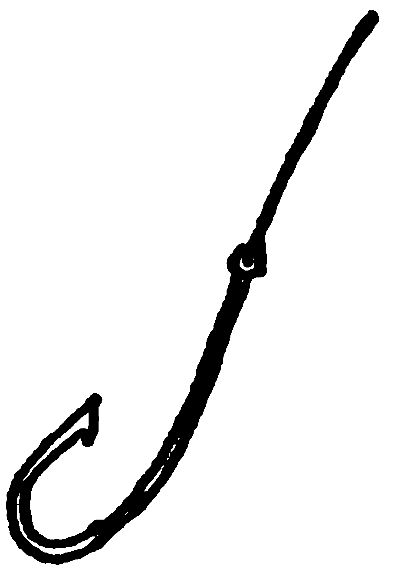
Fig. 78
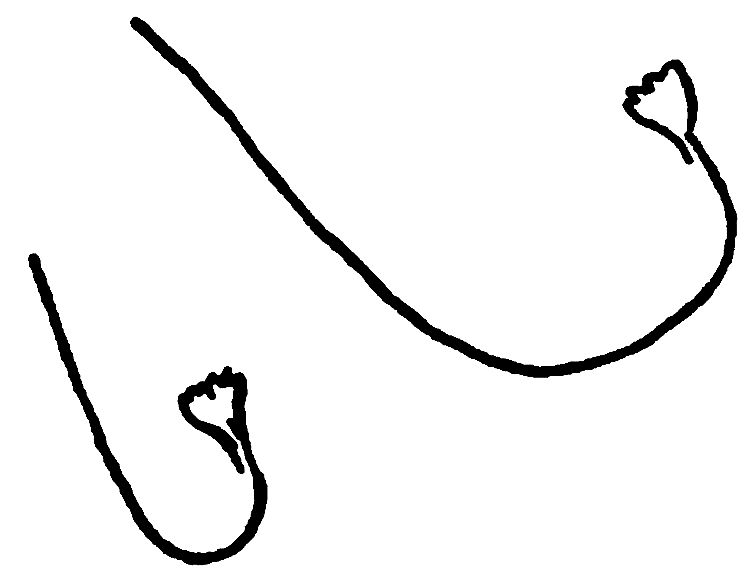
Fig. 78a
Then came an obelisk, and Craig got it, but with novel effects, thus (Figs. 79, 79a):
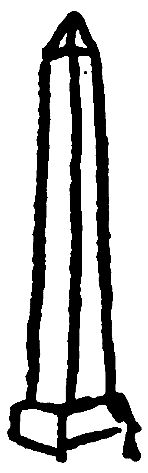
Fig. 79
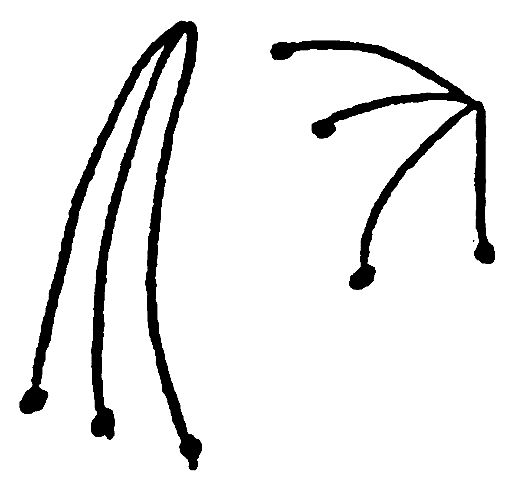
Fig. 79a
Now why should an obelisk go on a jag, and have little circles at its base? The answer appears to be: it inherited the curves from the previous fish-hook, and the little circles from the next drawing. You will see that, having used up her supply of little circles, Craig did not get the next drawing so well (Figs. 80, 80a):
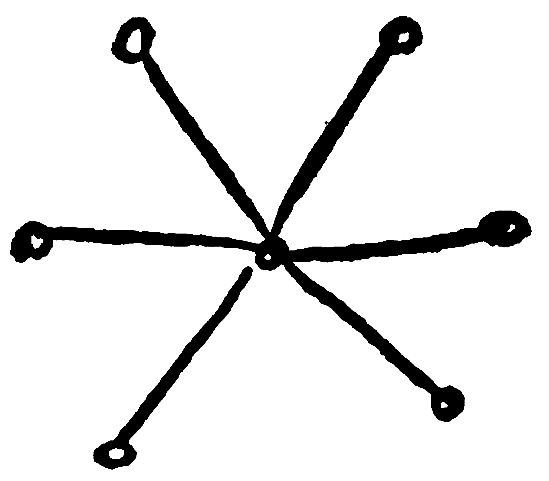
Fig. 80
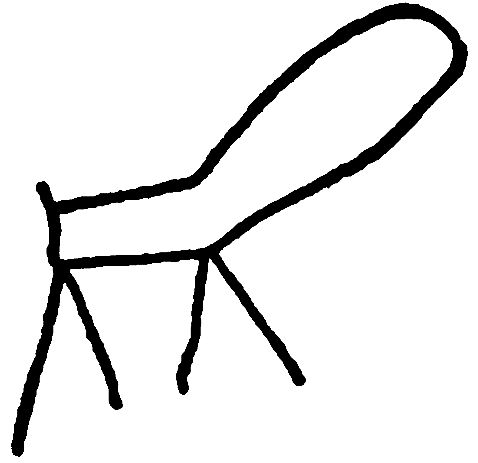
Fig. 80a
86In series twenty-two I first drew a bed, and Craig made two attempts to draw a potted plant. My second drawing was a maltese cross, and Craig turned it into a basket (Figs. 81, 81a):
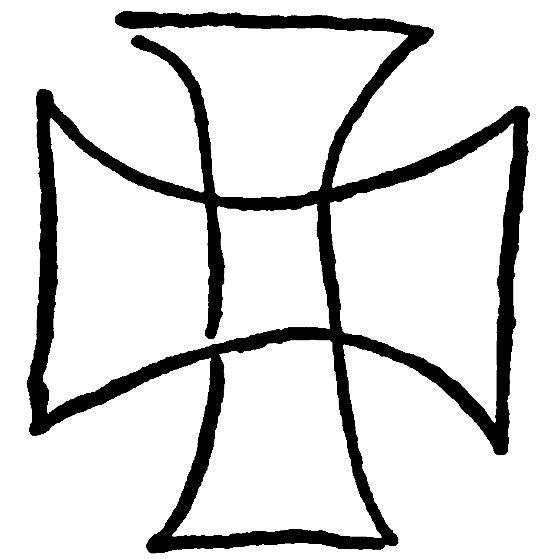
Fig. 81
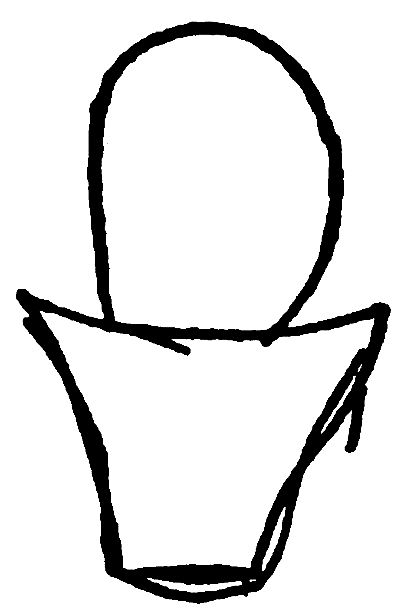
Fig. 81a
But she could not give up her plant. She added: “There is a flower basket in this lot, or potted plant.” The next drawing was a fleur-de-lis, which looks not unlike a potted plant or hanging basket (Fig. 82):

Fig. 82
In drawing four she got the elements of a door-knob pretty well, and added: “See head of bird, too—eagle beak.” Drawing seven was a crane, with beak open.
87
16
I could go through all thirty-five of the series, listing such “anticipations” as this: but I have given enough to show how the thing goes. Such occurrences make it hard for Craig because, when she has once drawn a certain object, she naturally resists the impulse to draw it again, thinking it is nothing but a memory. Thus, in series thirteen, my first drawing was a savage woman carrying a bundle on her head, and Craig drew the profile of a head with a long nose. My next drawing was the profile of a head, with a very conspicuous nose, and Craig wrote: “Face again, but [I] inhibit this. Then come two hands, and below”—and she draws what might be a cross section of a skull, side view.
Yet sometimes she overcomes this handicap triumphantly. Series twelve is marked: “Hastily done,” and she adds the general comment: “Several times saw bristles on things of different shapes, some flowers, some bristled brushes. Saw flower, also more than once”—and then she appends a drawing of a four-leaf clover. As it happened, this series contained a three-leaf clover, and it contained another flower, and also a cactus-plant—more of one kind of thing than it was fair to put into one set of drawings. Nevertheless, Craig scored one of her successes with the cactus, setting it down as “fuzzy flower” (Figs. 83, 83a):
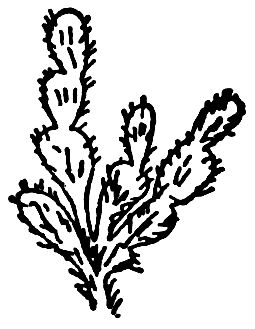
Fig. 83
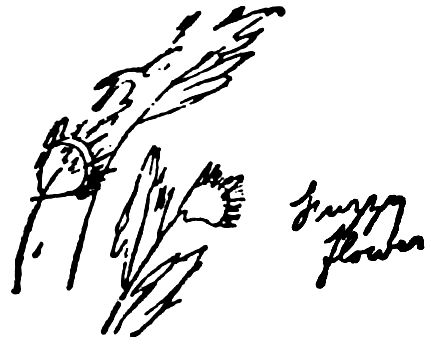
Fig. 83a
Nor was she afraid to repeat herself when she came to another “fuzzy flower” in this series (Figs. 84, 84a):
88
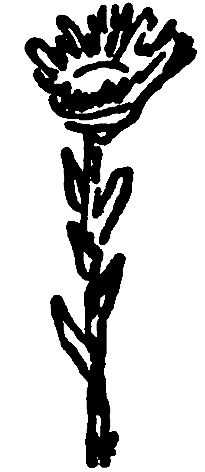
Fig. 84
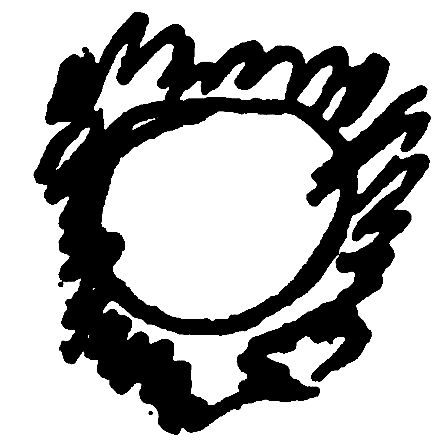
Fig. 84a
Frequently she will make a good drawing of an object, but name it badly. In that same series twelve I drew a hoe, and she got the shape of it, but wrote: “May be scissors, may be spectacles with long stem ears” (Figs. 85, 85a):
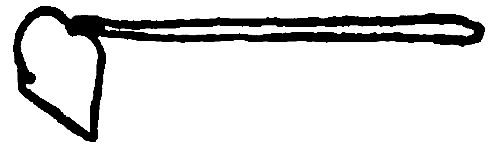
Fig. 85
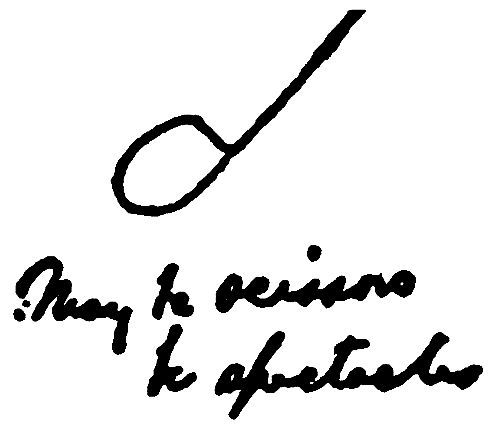
Fig. 85a
Also in the same series these reindeer horns, which she calls “holly leaves.” It is psychologically interesting to note that reindeer and holly trees were both associated with Christmas in Craig’s childhood (Figs. 86, 86a):
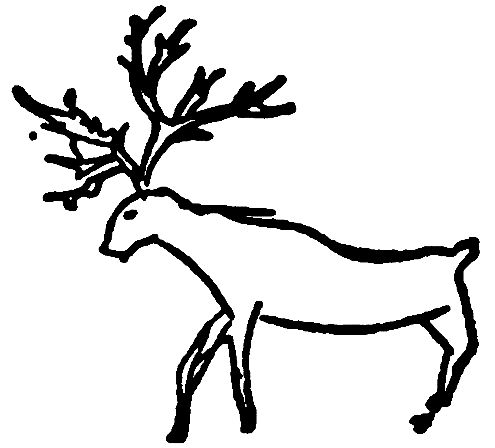
Fig. 86
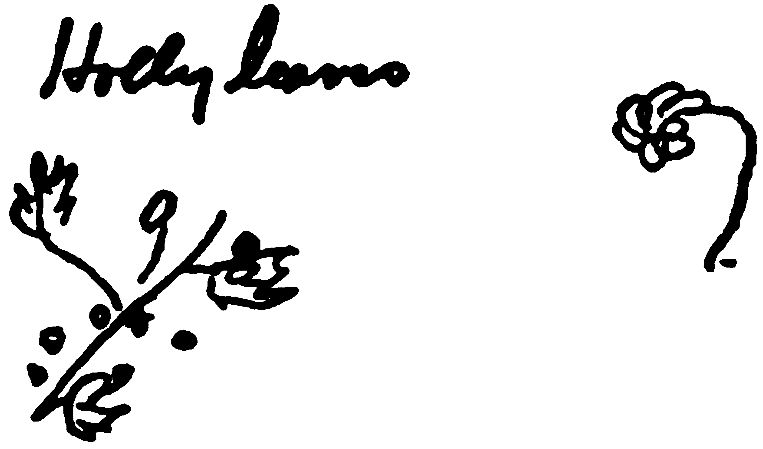
Fig. 86a
And in series eighteen, this fat baby bird of mine is hardly recognizable when called “flounder” (Figs. 87, 87a):
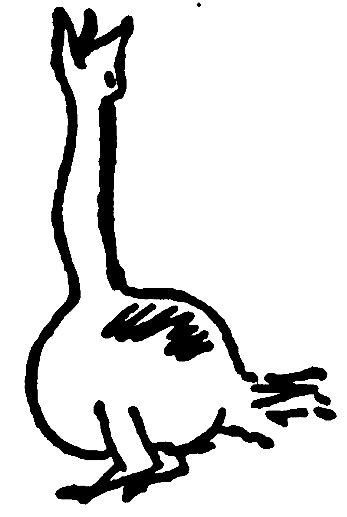
Fig. 87
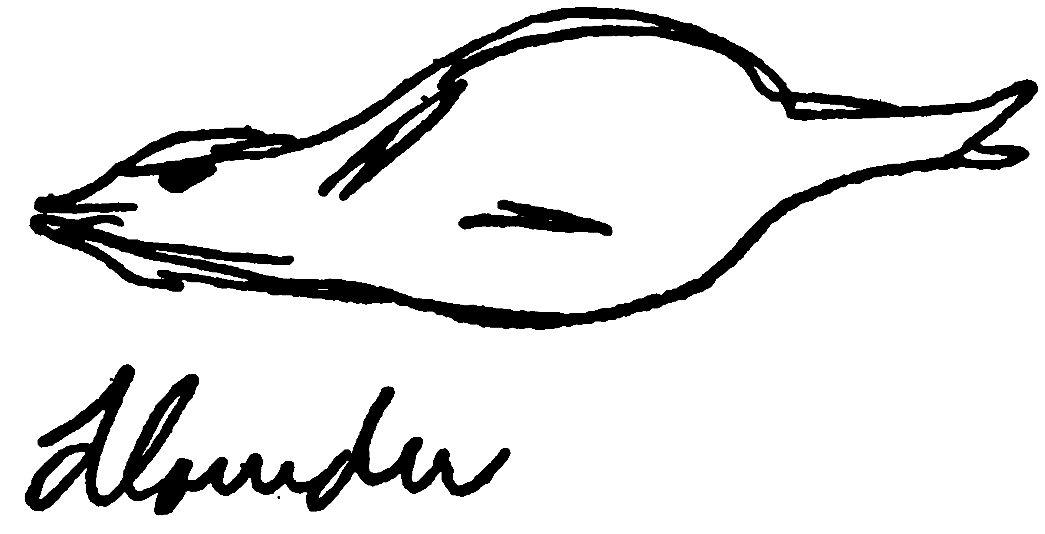
Fig. 87a
89This very dim stalk of celery, drawn by me, I must admit looks more like a fish-fork (Figs. 88, 88a):
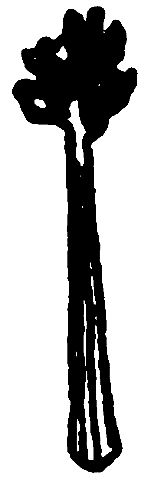
Fig. 88
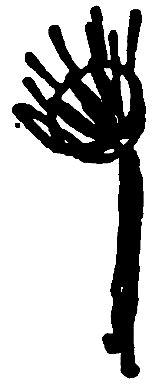
Fig. 88a
Craig’s verbal description of the above reads: “Stone set in platinum; may be diamond, as points seem to be white light—at least it shines, not red shine of fire but white shine.” How does a stalk of celery, which looks like a fish-fork, come to have a diamond set in it? You may understand the reason when you hear that three drawings later in the same series is a diamond set in a stick. Just why it occurred to me to set a diamond thus I cannot now recall, but the drawing is plain, and it led to a bit of fun. I had been to lunch with Charlie Chaplin that day, and had come home and told my wife about it; so here my sparkling diamond undergoes a transfiguration! “Chaplin,” writes my wife, and adds: “I don’t see why he has on a halo” (Figs. 89, 89a):
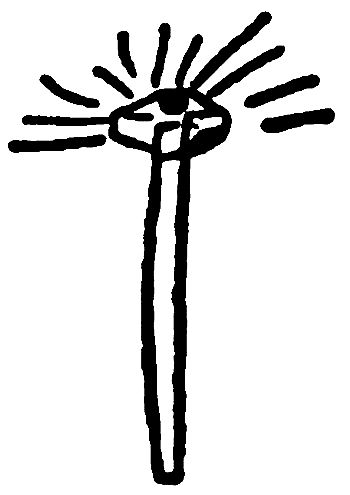
Fig. 89
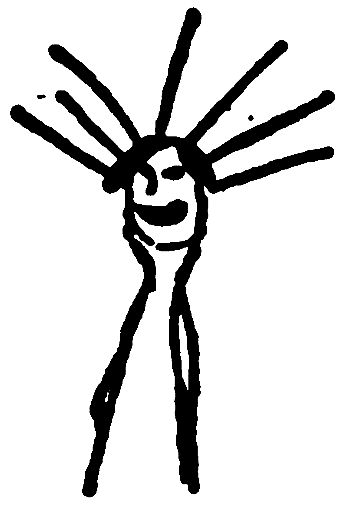
Fig. 89a
From the point of view of bad guessing, the most conspicuous series is number twenty. In this I have recorded four successes, seven partial, and one failure; yet there is hardly an object that is correctly named. Here are the three which I call successes; there may be dispute about any one of them, but it seems to me the essential elements have been got. You may be surprised at a necktie 90which “began to smoke”—but not when you see that the next drawing is a burning match! (Figs. 90, 90a; 90, 91a; 90, 92a):
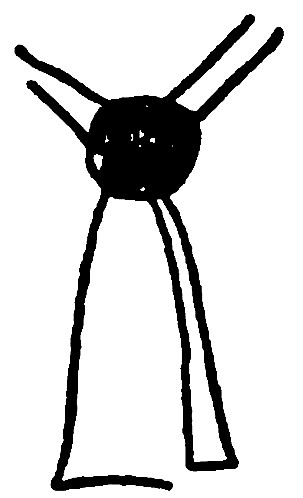
Fig. 90
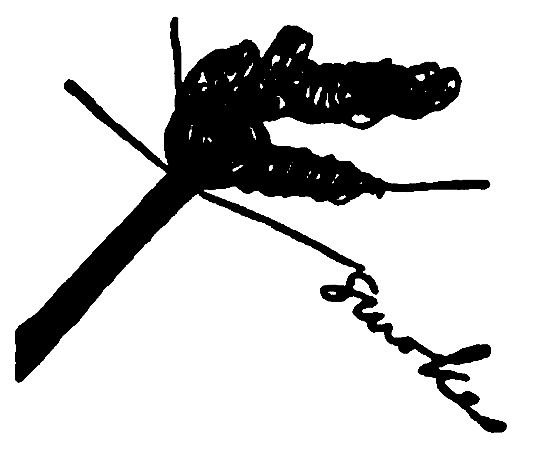
Fig. 90a
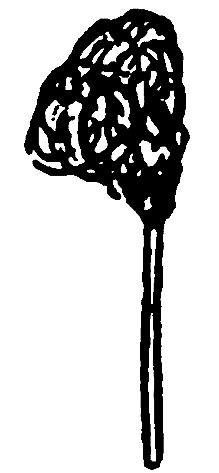
Fig. 91
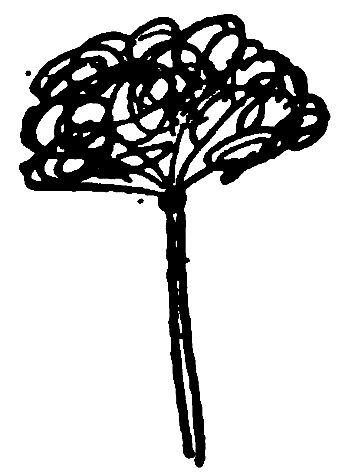
Fig. 91a
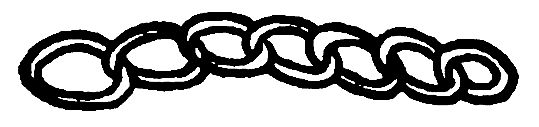
Fig. 92
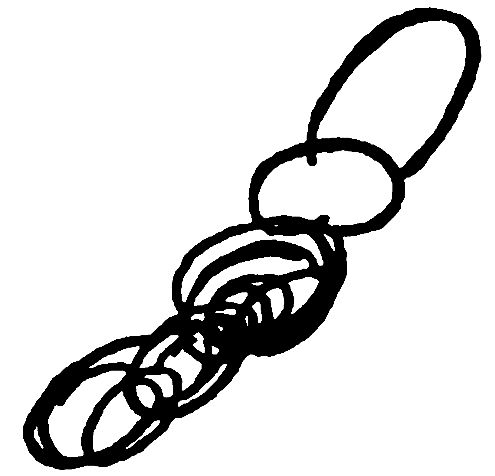
Fig. 92a
As for the partial successes, I give six of them by way of samples. For the first, Craig’s comment was: “The body is vague, but see there is a body.” You will agree that my mountain landscape looks oddly like a body (Figs. 93, 93a):
91
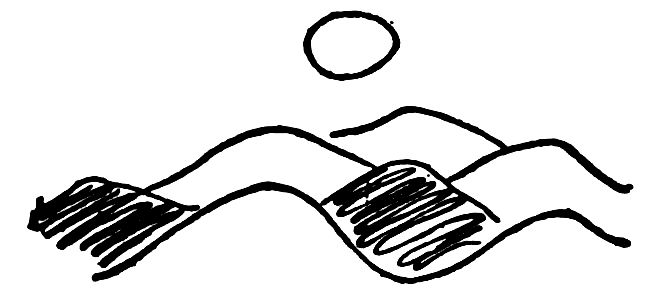
Fig. 93
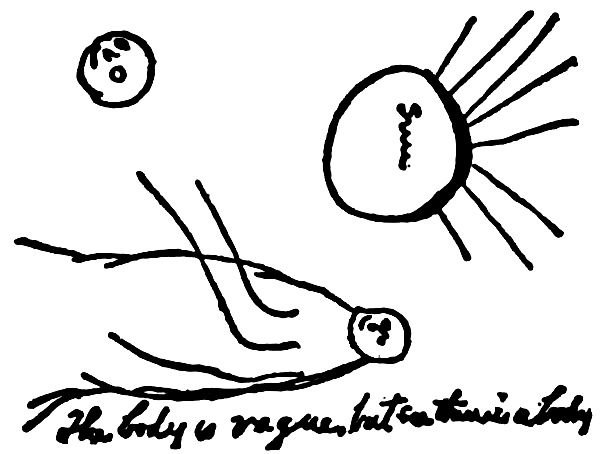
Fig. 93a
And the pedals of this harp make a charming pair of lady’s feet (Figs. 94, 94a):
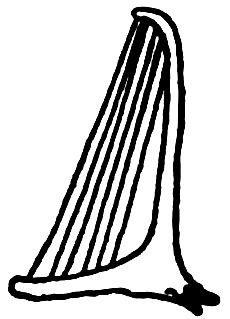
Fig. 94
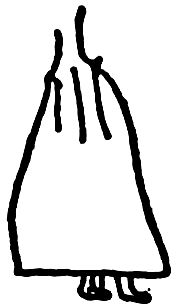
Fig. 94a
This balloon is described in my wife’s comment as: “Shines in sunlight, must be metal, a scythe hanging among vines or strings.”
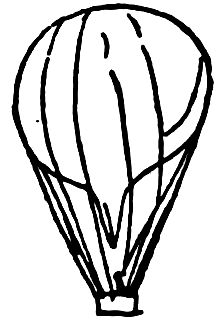
Fig. 95
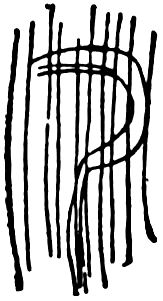
Fig. 95a
92This, which is called “front foot and leg of dog, though I don’t see the dog,” is really drawn more like the spigot of my drawing (Figs. 96, 96a):
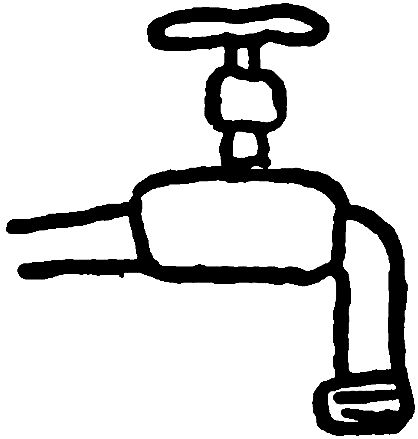
Fig. 96
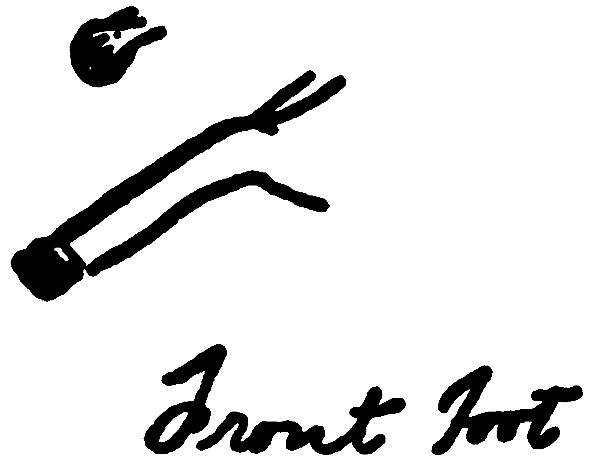
Fig. 96a
A butterfly’s wings are “got” remarkably well (Figs. 97, 97a). And the trade-marks on my little box are called “tiny stars, or sparks” (Figs. 98, 98a):
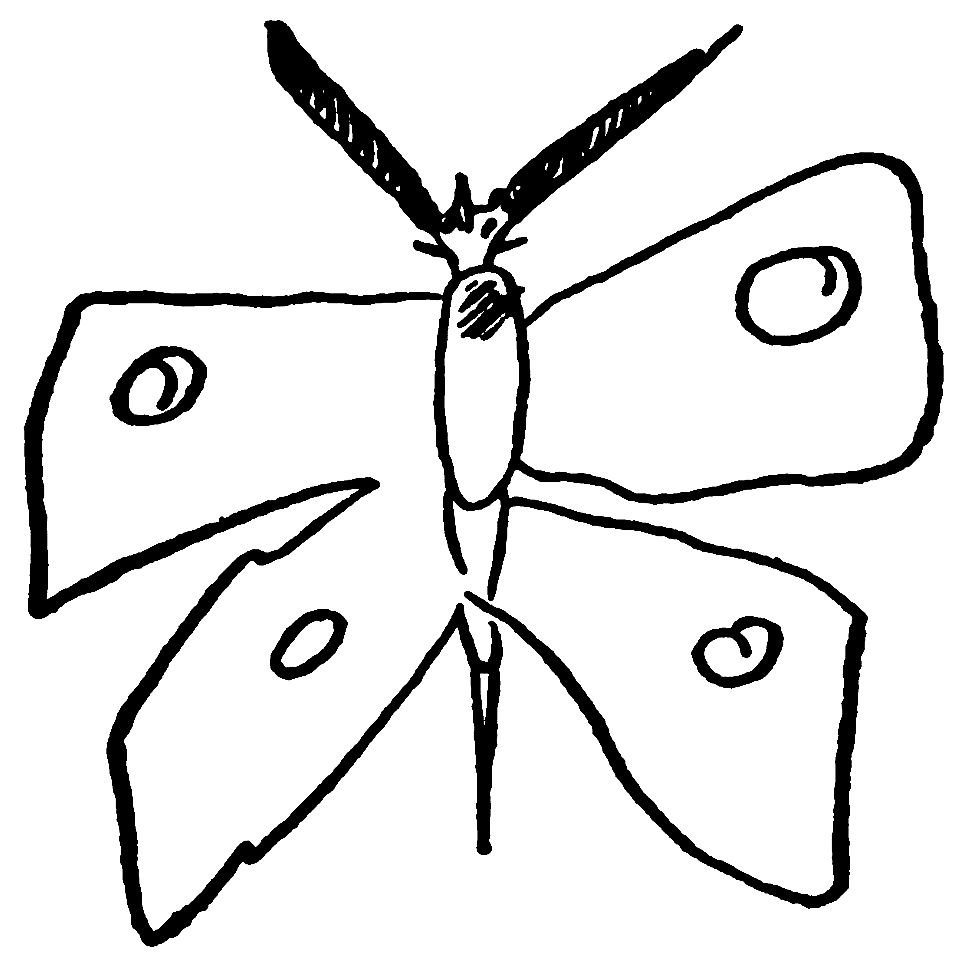
Fig. 97
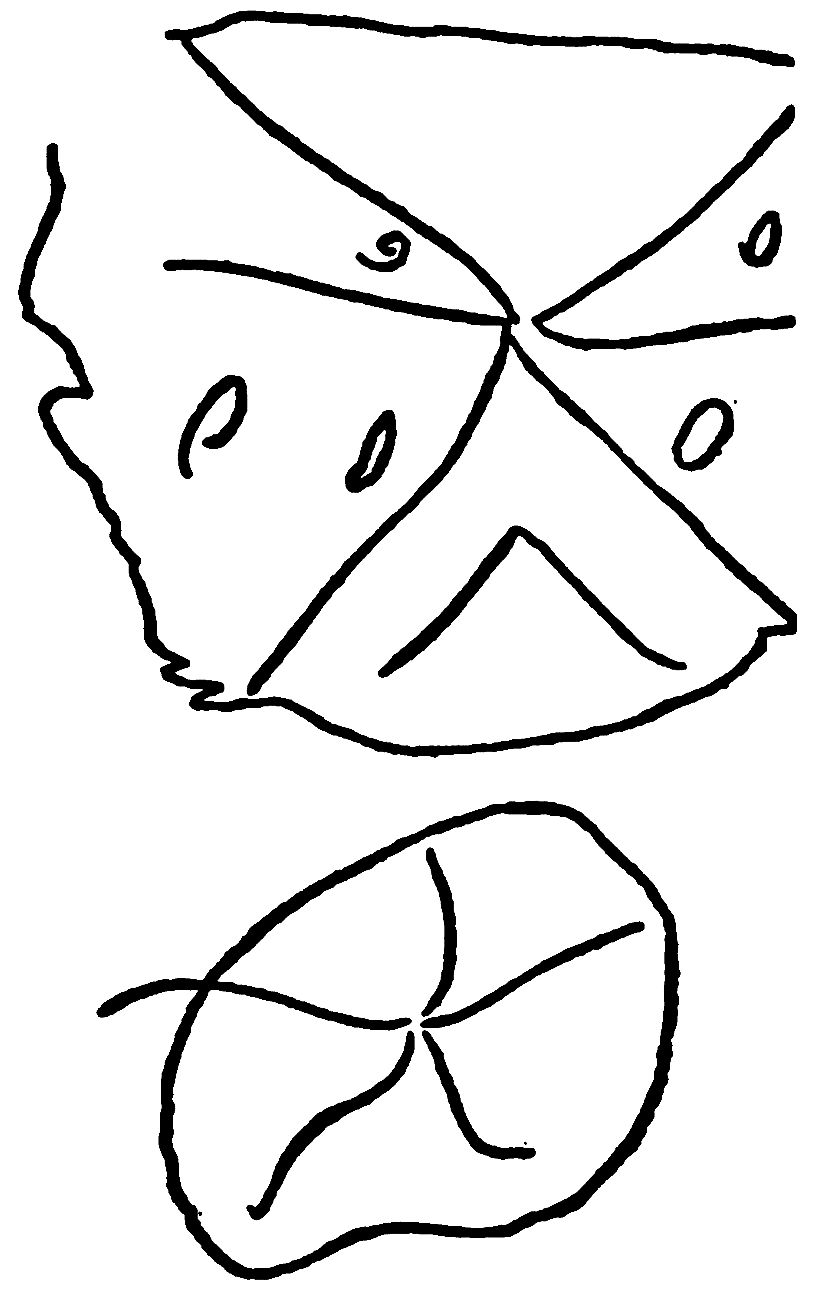
Fig. 97a
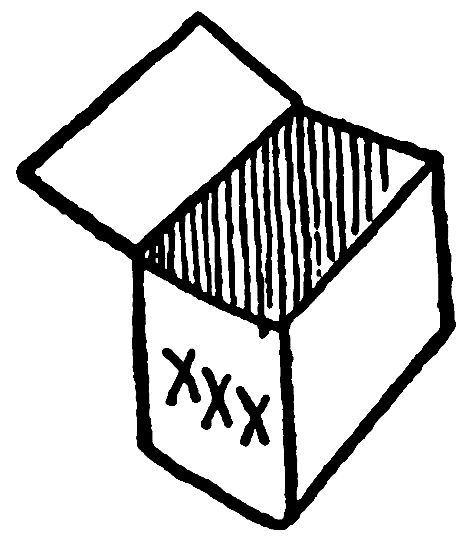
Fig. 98
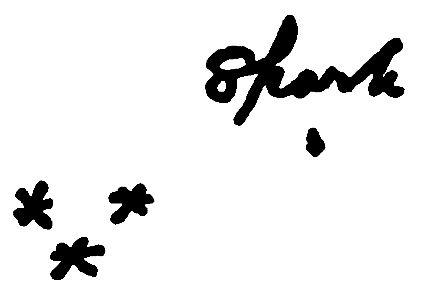
Fig. 98a
93
17
I have referred to the fact that my wife’s drawings sometimes contain things which are not in mine, but which were in my mind while I was making them, or while she was “concentrating.” One of the most curious of such cases came in series twenty-eight, which was after we had given up, as too great a nuisance, all precautions in the way of sealing the drawings in envelopes. I made eight drawings, and laid them face down on my wife’s table, and then went out and took a walk while she did them. So, of course, it was easy for her to do what she pleased—and maybe she “peeked,” the skeptic will say. But as it happens, she didn’t get a single one right! Instead of reproducing my drawings, what she did was to reproduce my thoughts while I was walking up and down on the ocean front. It seems to me that in so doing, she provided a perfect answer to those who may attribute these results to any form of deception, whether conscious or unconscious.
There was a moon behind a bank of dark clouds, and it produced an unusual effect—a well-defined white cross in the sky. I watched it for nearly half an hour, and my continued thought was: “If this were an age of superstition, that would be a portent, and we should hear about it in history.” It was so strange that I finally went home and called my wife out onto the street. I did not tell her why. I wanted to see her surprise, so I purposely gave no hint. I said: “Come out! Please come!” Finally she came, and her comment was: “I just drew that!” We went back into the house, and she handed me a drawing. I give it alongside my drawing of an Indian club, which Craig had held while doing hers. You may see exactly how much of her impulse came from that source (Figs. 99, 99a):

Fig. 99
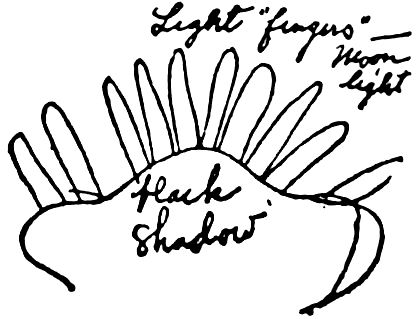
Fig. 99a
94The “comment” reads: “Light ‘fingers’—moonlight.” Also: “black shadow.”
Let me add also that in the eight drawings I handed to Craig there was neither moon, cloud, cross, nor light. Two of these eight my wife failed to mark, and so I cannot identify them as belonging to this series; but we examined all eight at the time, and made sure of this point. Those which I now have are a flag, a bearded man, a chiffonier, a cannon, a dirt-scraper, and the Indian club, given above.
You will ask, perhaps, did Craig look out of the window. As it happened, this sky effect was invisible from any window, and I have her word that she had not moved from her couch. I should add that she is nervous, and keeps the curtains tightly drawn at night, and never goes out at night unless it is to be driven somewhere. It was early in March, with a cold wind off the sea, and I had to labor to persuade her to put a wrap over her dressing gown and step out into the middle of the street to look up at the sky.
95
18
The casual reader may be bored by too many of these drawings, but they are easy to skip, or to take in at a glance, and there may be students who will want to examine them carefully. So I will add a selection of the significant drawings, with only brief remarks. I begin with what I have called partial successes, and then add a few more of those I have called “complete.”
Let us return to the early drawings, made by my secretary. On the automobile ride to Pasadena, there was an ash-can (Fig. 100):
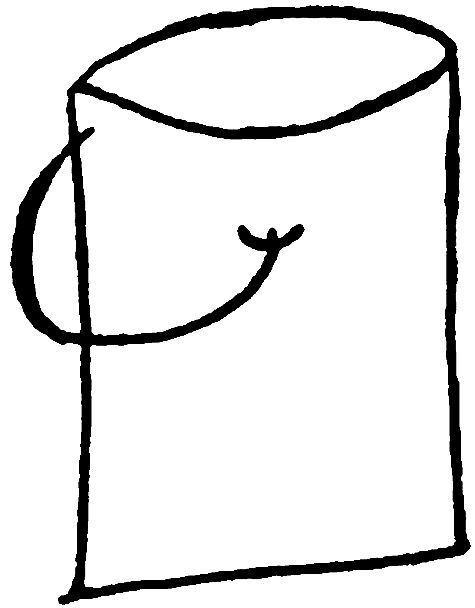
Fig. 100
For the above my wife wrote: “I see a chain dangling from something—resembling little chimney pot on top of house.”
And here is design for which the comment was: “These somehow belong together but won’t get together” (Figs. 101, 101a):

Fig. 101
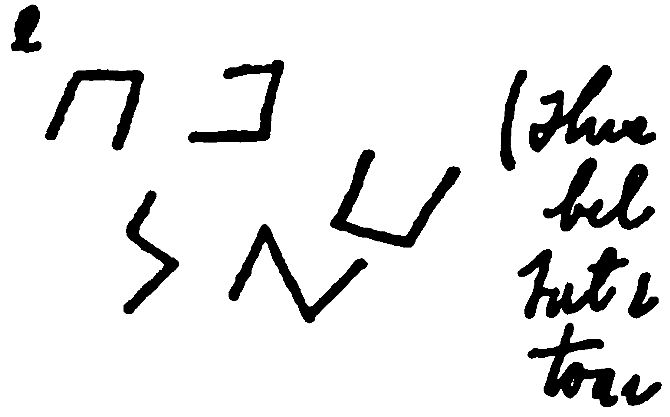
Fig. 101a
Here is a fan, with comment: “Inside seems irregular, as if cloth draped or crumpled” (Figs. 102, 102a):
96
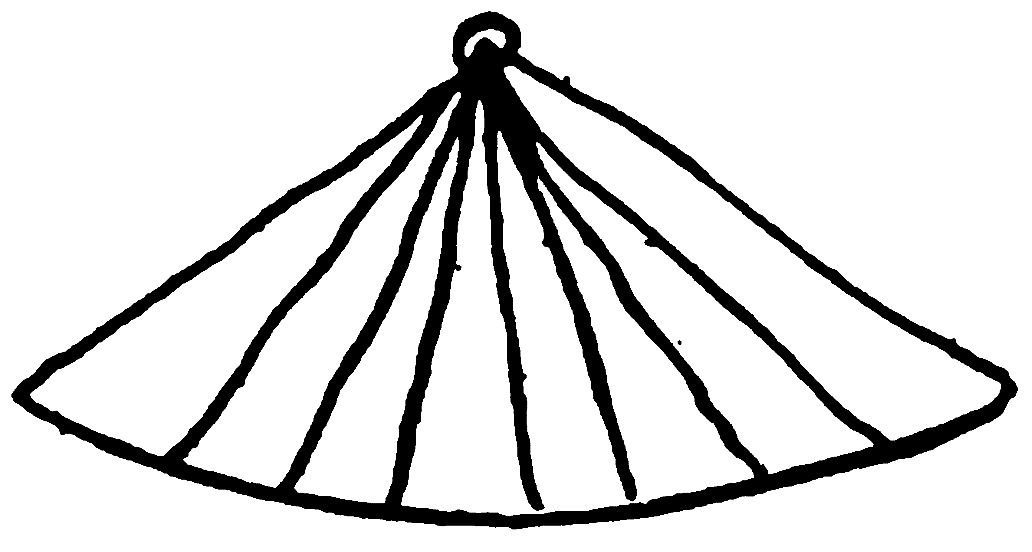
Fig. 102
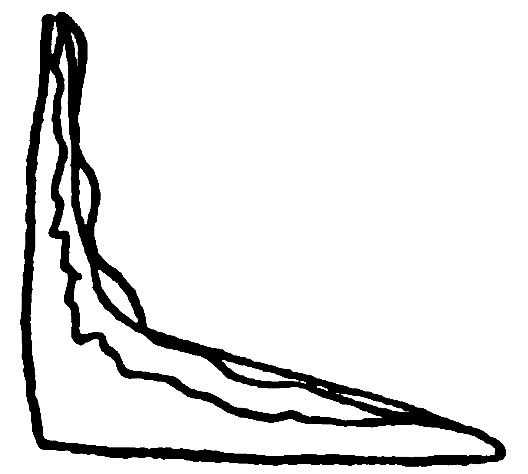
Fig. 102a
Here is a one-half success (Figs. 103, 103a):
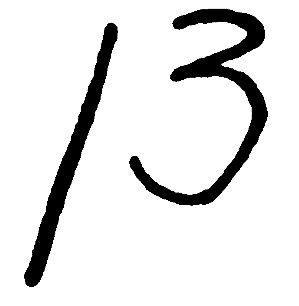
Fig. 103
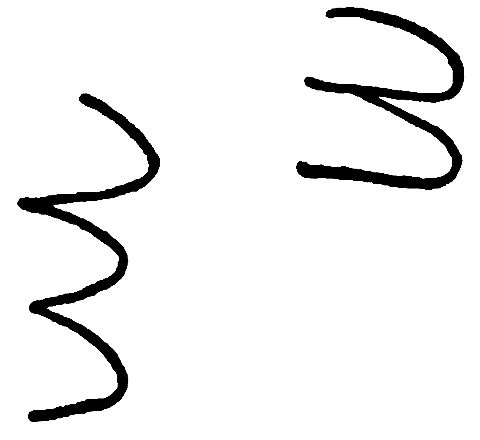
Fig. 103a
Here is a broom, drawn by my secretary (Fig. 104), and several efforts to reproduce it (Figs. 104a, 104b):
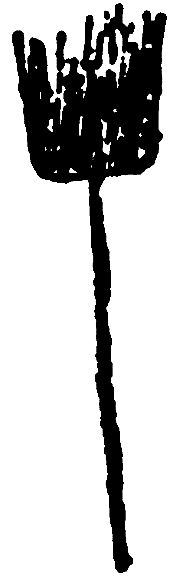
Fig. 104
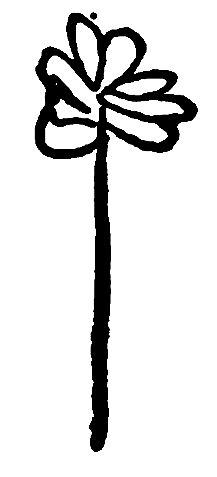
Fig. 104a
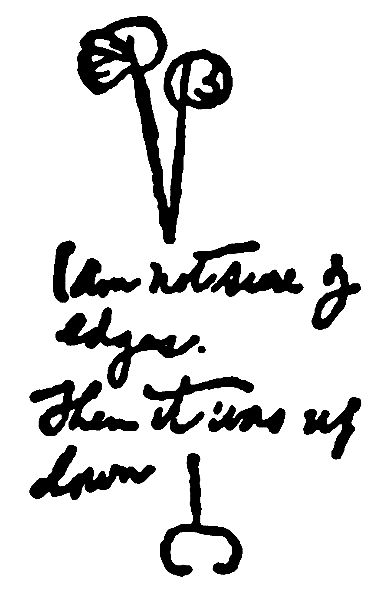
Fig. 104b
The comments accompanying these drawings read: “All I’m sure of is a straight line with something curved at end of it; once it came” (here is drawing of the flower). “Then it doubled, or reappeared, I don’t know which. (Am not sure of curly edges.) Then it was upside down.”
The next drawing was a heart, and my wife got the upper half with what are apparently blood-drops added (Figs. 105, 105a):
97

Fig. 105

Fig. 105a
The above is interesting, as suggesting that whatever agency furnished the information knew more than it was telling. For if Craig’s drawing, a pair of curves, constituted a crude letter N, or had no significance, why add the blood-drops, which were not in the original? On the other hand, if her subconscious mind knew it was a heart, why not give her the whole heart, and let her draw it?
So much for the drawings of my secretary; and now for my own early drawings. When I was a school boy, we used to represent human figures in this way; and, as you see, Craig got the essentials (Figs. 106, 106a):
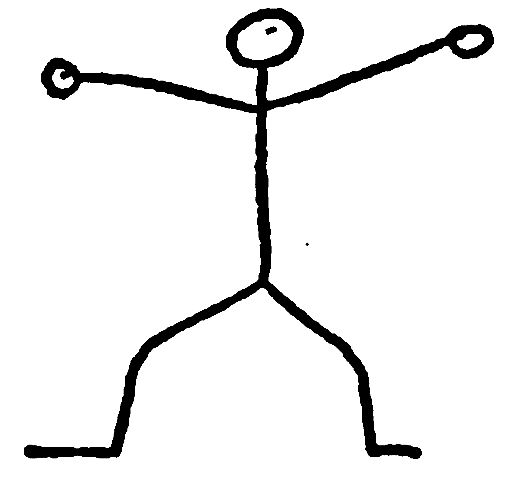
Fig. 106

Fig. 106a
Several weeks later, I drew a pair of such figures in action and the comment was: “It’s a whirligig of some sort” (Figs. 107, 107a).
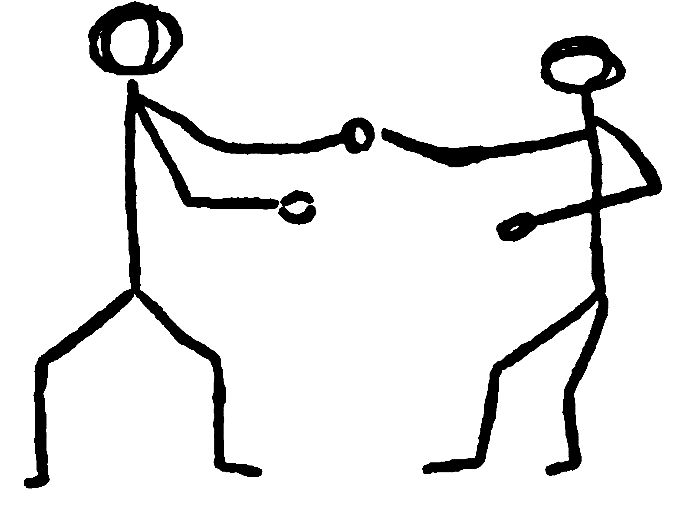
Fig. 107
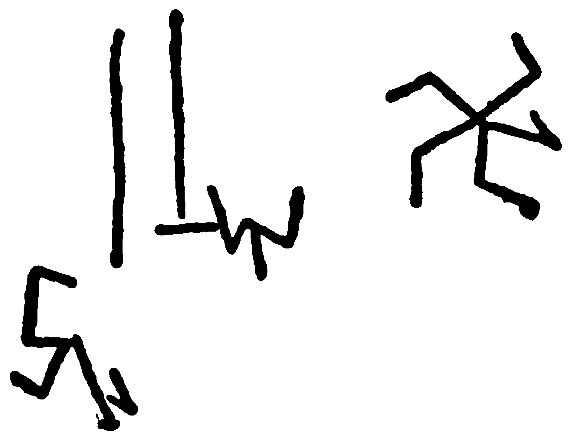
Fig. 107a
98After the following drawing, Craig asked me not to do any more hands, for the reason that she “got” this, but thought it was my own hand doing the drawing. She guessed something else, and wrote: “Turned into pig’s head, then rabbit’s” (Figs. 108, 108a):
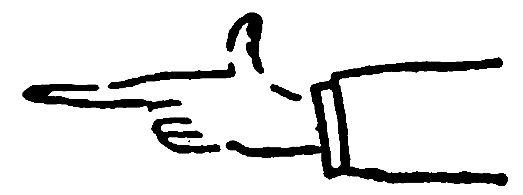
Fig. 108
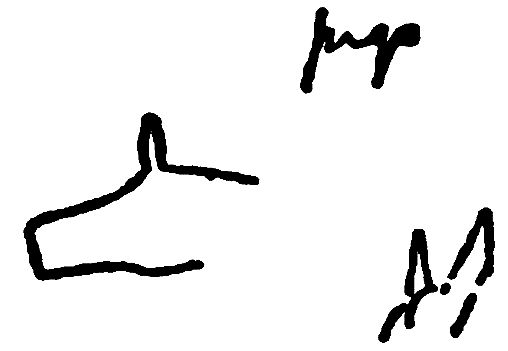
Fig. 108a
Next, this bat, with very striking comment.
“Looks like ear-shaped something,” and again:
“Looks like calla lily” (Figs. 109, 109a):
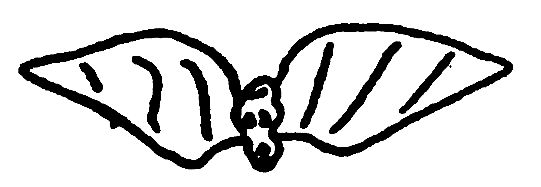
Fig. 109
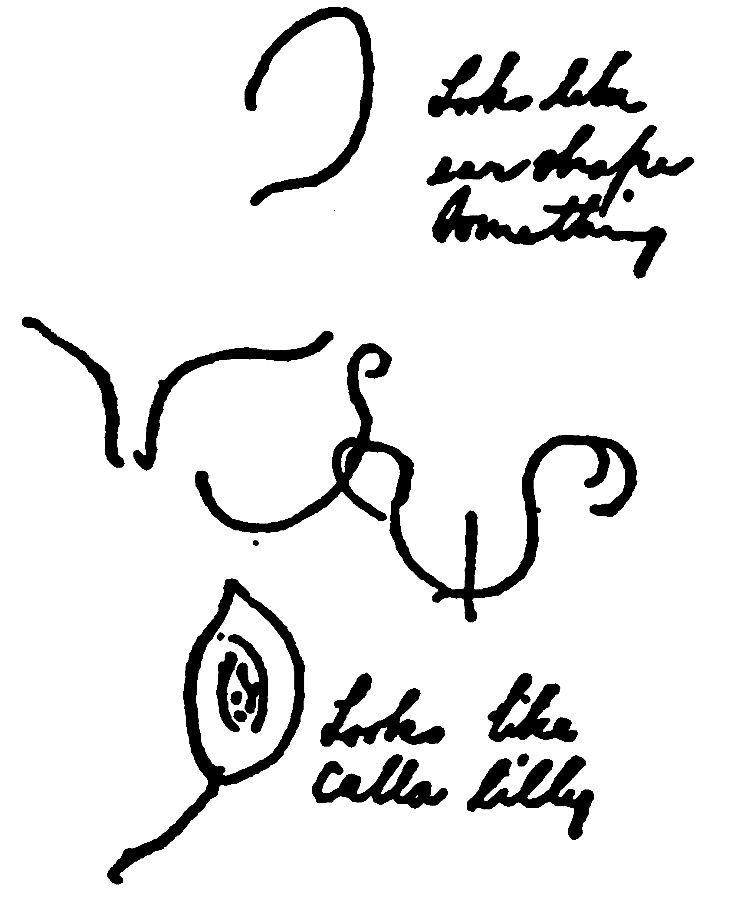
Fig. 109a
A butterfly net (Figs. 110, 110a).
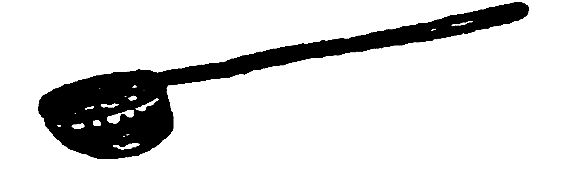
Fig. 110
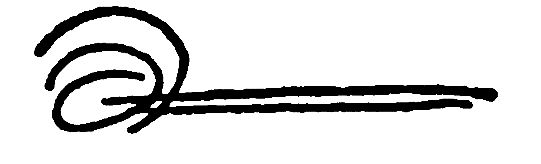
Fig. 110a
A key (Figs. 111, 111a):
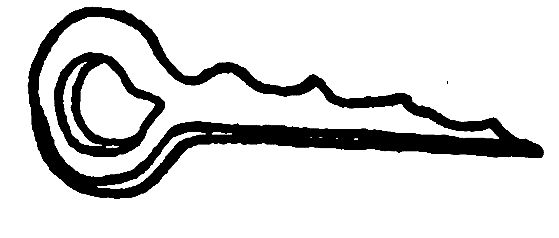
Fig. 111
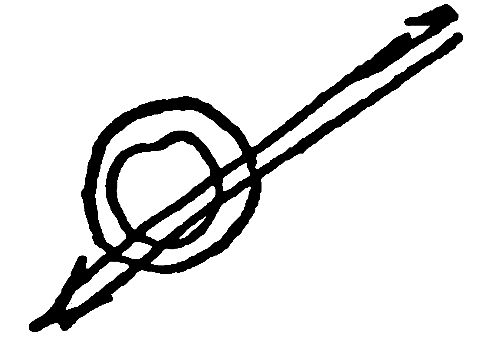
Fig. 111a
99This highly humorous sunrise (Figs. 112, 112a):
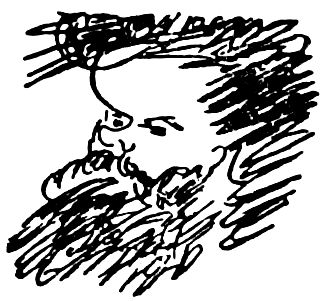
Fig. 112
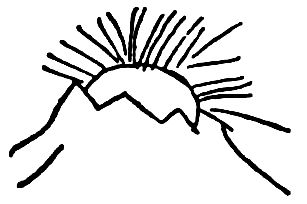
Fig. 112a
A carnation which came after the preceding drawing, and apparently had been anticipated in the “sunrise” (Figs. 113, 113a).
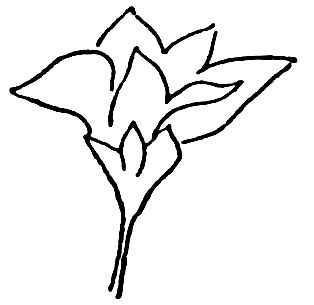
Fig. 113
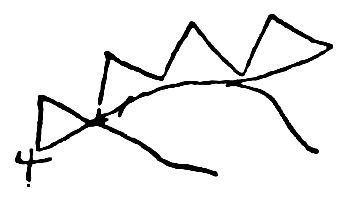
Fig. 113a
Note that this camp-stool, as I drew it, really does appear to be standing on water (Figs. 114, 114a):
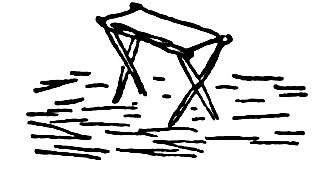
Fig. 114
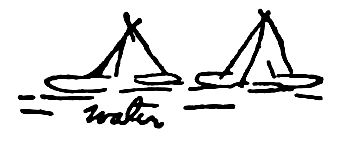
Fig. 114a
For this little waiter, who follows, no drawing was made by my wife. Her written comment was: “I see at once the profile of human face. Am interrupted by radio tune. Something makes me think of a cow. Now see two things sticking out like horns” (Fig. 115).
100
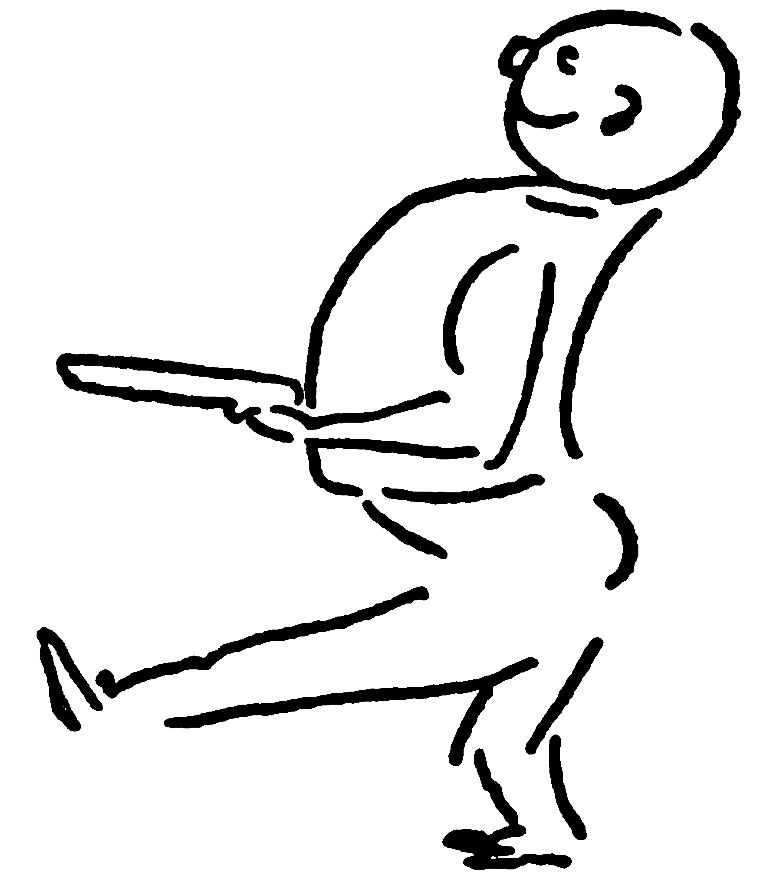
Fig. 115
The following had no comment (Figs. 116, 116a):
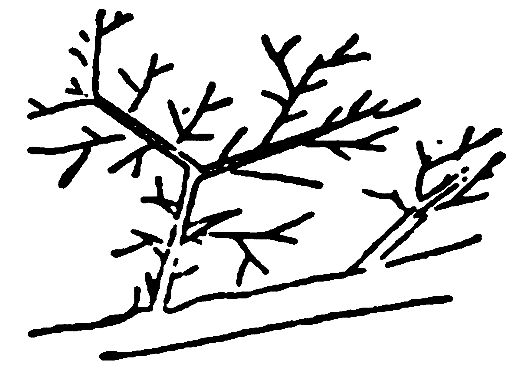
Fig. 116
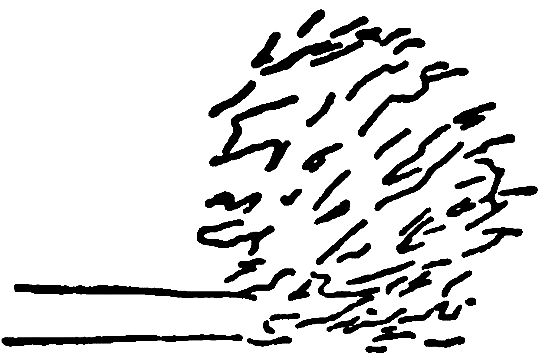
Fig. 116a
Nor the next ones (Figs. 117, 117a):
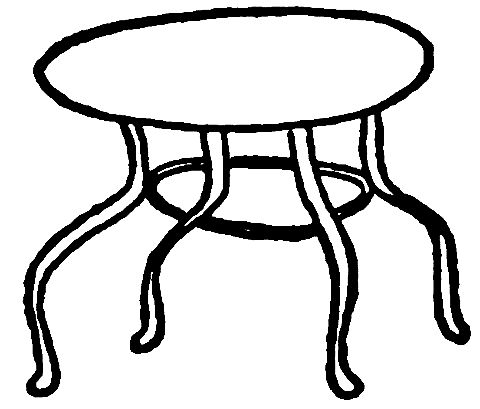
Fig. 117
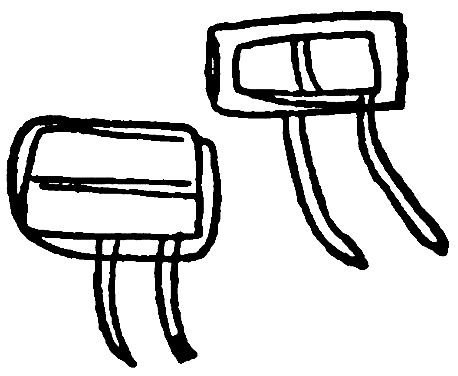
Fig. 117a
The comment on this caterpillar was: “Fork—then garden tool—lawn rake. Leaf.” I might add that we have a lawn-rake made of bristly bamboo, which looks very much like my drawing (Figs. 118, 118a):
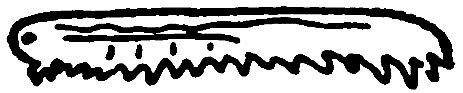
Fig. 118
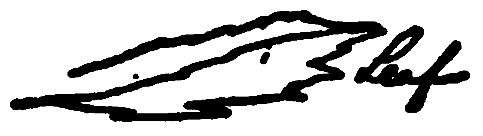
Fig. 118a
101In the following case I drew sixteen stars, and you may count and see that Craig got twelve of them, and made up the difference with a moon! (Figs. 119, 119a):
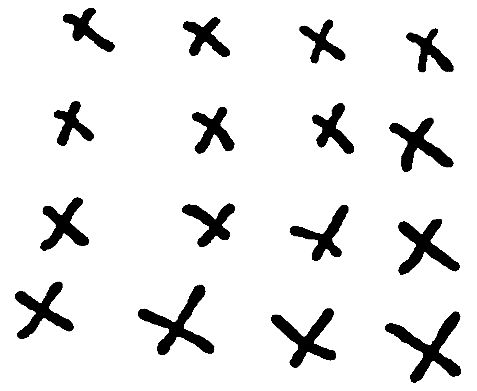
Fig. 119
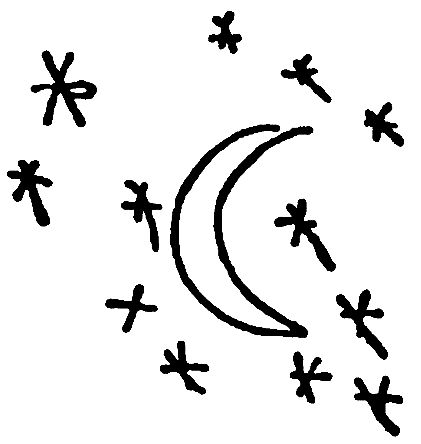
Fig. 119a
Comment on the following: “Looks like a monkey wrench, but it may be a yardstick” (Figs. 120, 120a):
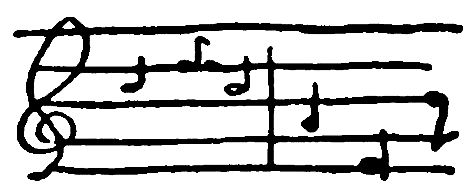
Fig. 120
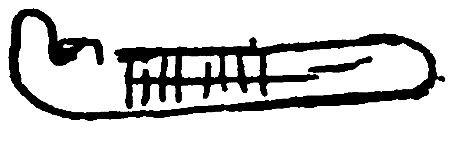
Fig. 120a
In the next one, the curve of the worm is amusingly reproduced by the bird’s neck. The comment added: “But it may be a snake.” Craig says this is an example of how one part of the drawing comes to her, and then, in haste, her memory-trains and associations supply what they think should be the rest (Figs. 121, 121a).
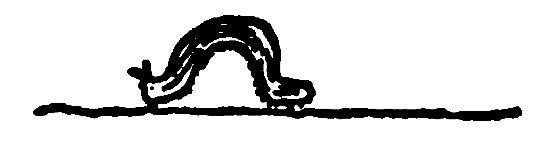
Fig. 121
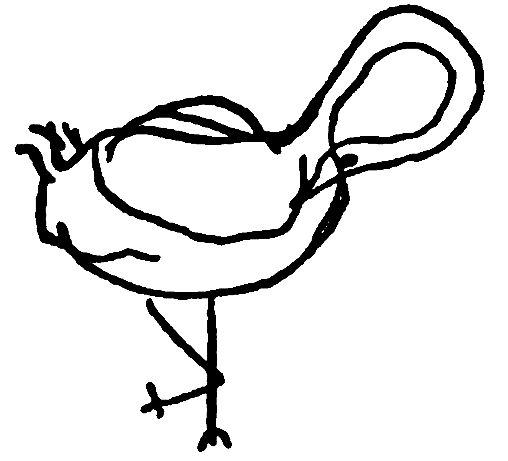
Fig. 121a
The umbrella brings up Craig’s reptile “complex” again. I assure you that in her garden, she turns sticks into snakes when they are far less snake-like than my drawing. Her comment was: “I feel that it is a snake crawling out of something—vivid feeling of snake, but it looks like a cat’s tail” (Figs. 122, 122a):
102
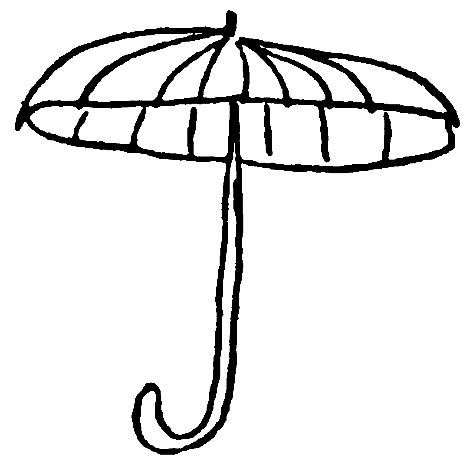
Fig. 122
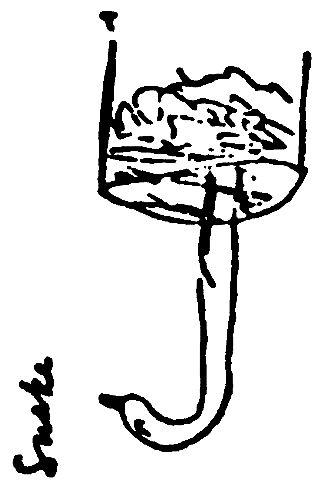
Fig. 122a
I drew a wall-hook to hang your coat on (Figs. 123, 123a):
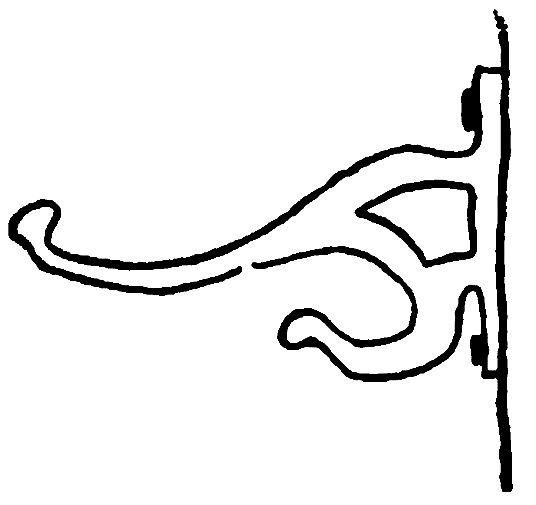
Fig. 123
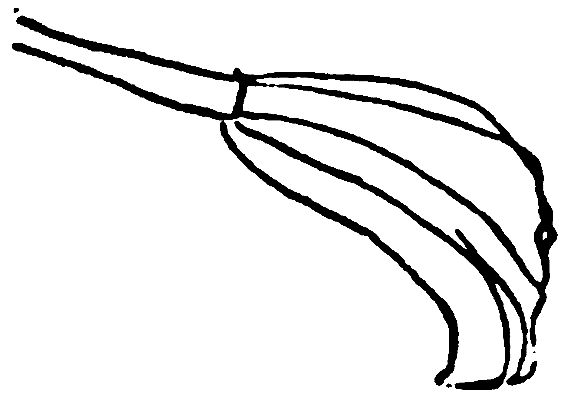
Fig. 123a
A design, evidently felt as a design, though not well got (Figs. 124, 124a):

Fig. 124
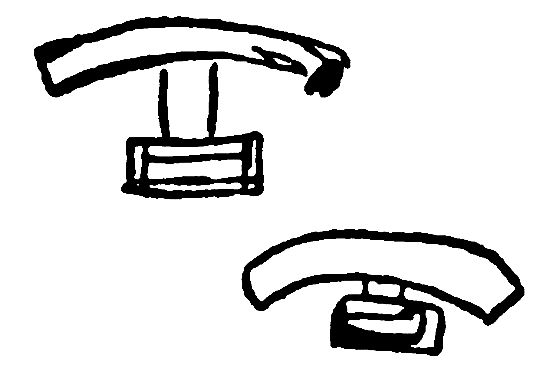
Fig. 124a
A screw, with comment: “light-house or tower. Too fat at base.” If Craig’s drawing were made narrower at base, it would reproduce the screw very well. Note that in the right-hand “tower” the screw-like effect of the “set backs” is kept (Figs. 125, 125a):
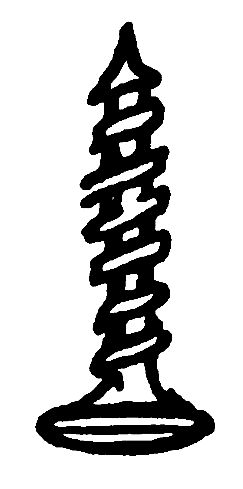
Fig. 125
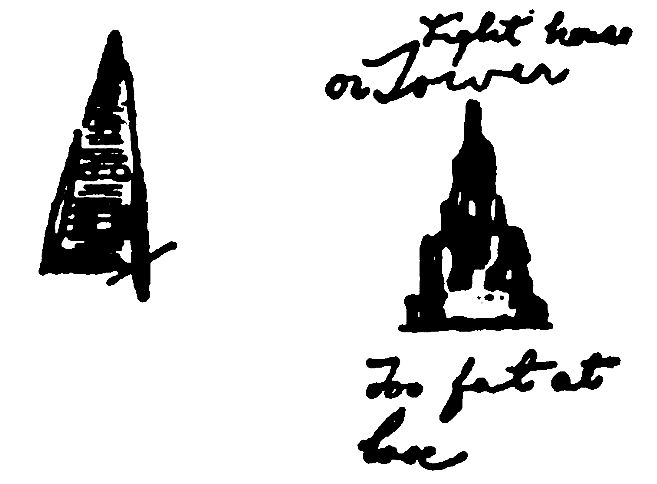
Fig. 125a
103Here is a love story which seems to go wrong, the hearts being turned to opposition (Figs. 126, 126a):
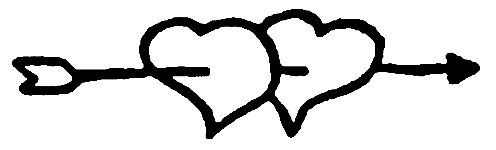
Fig. 126

Fig. 126a
Here is the flag, made simpler—“e pluribus unum!” (Figs. 127, 127a):
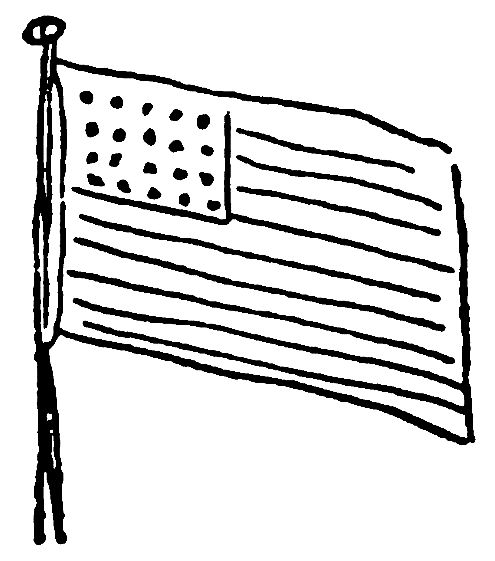
Fig. 127
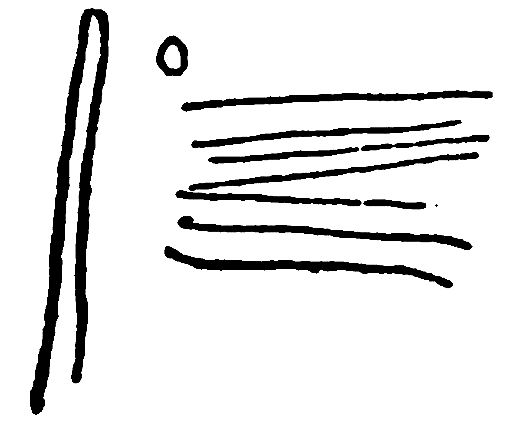
Fig. 127a
Here is a cow, as seen by the cubists. Comment: “Something sending out long lines from it” (Figs. 128, 128a):
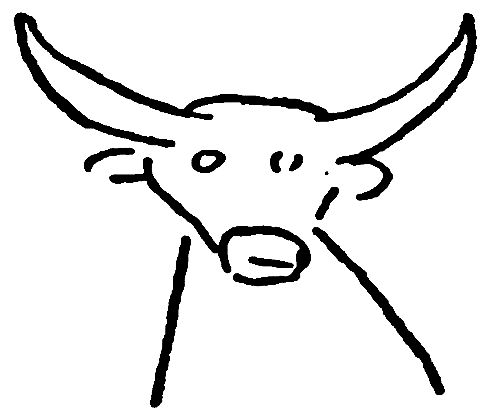
Fig. 128
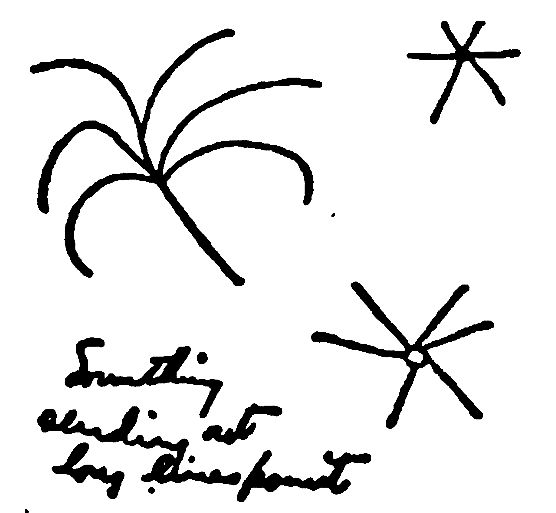
Fig. 128a
Telegraph wires, apparently seen as waves in the ether (Figs. 129, 129a):
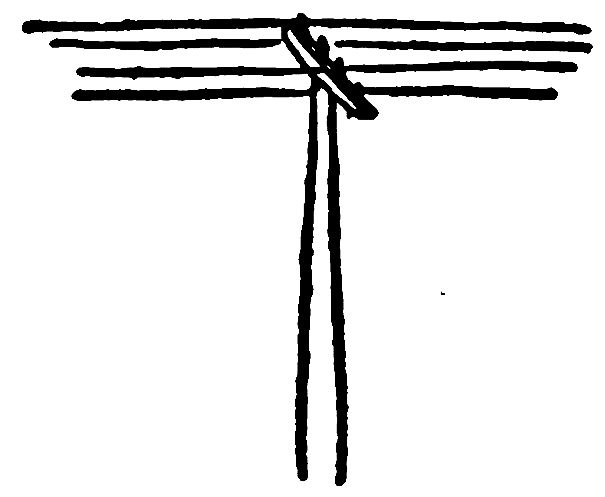
Fig. 129
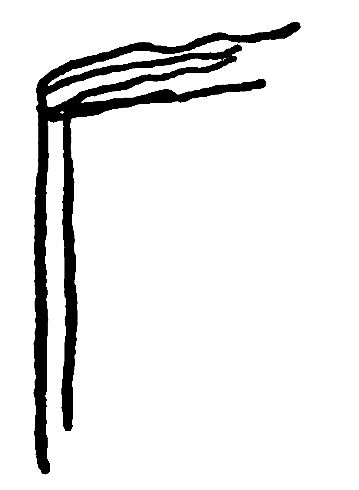
Fig. 129a
104Comment on the following: “Horns. Can’t see what they are attached to” (Figs. 130, 130a):
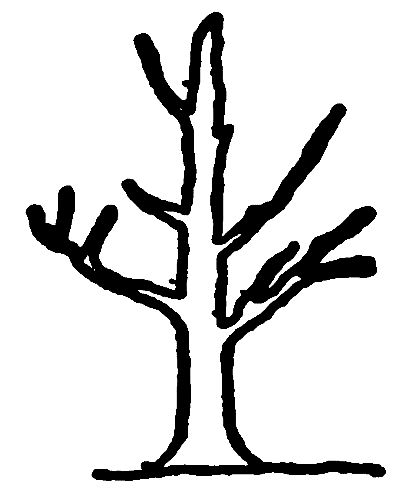
Fig. 130
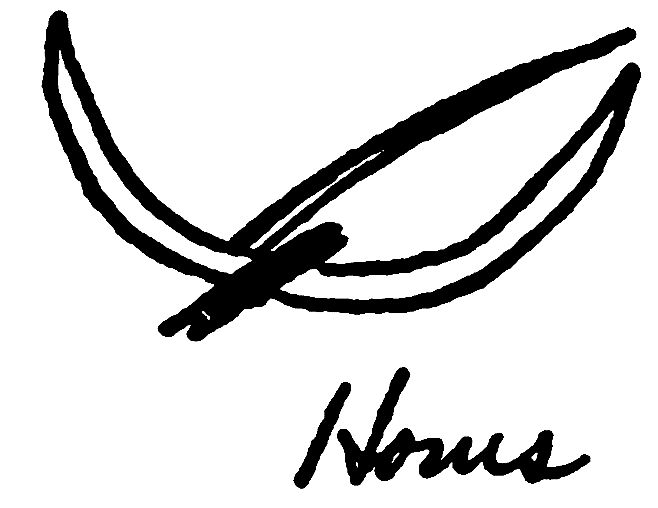
Fig. 130a
And here is a parrot turned into a leaf, with comment. “See veins and stem with sharp vivid bend in it”—which seems to indicate a sense of the parrot’s beak (Figs. 131, 131a):
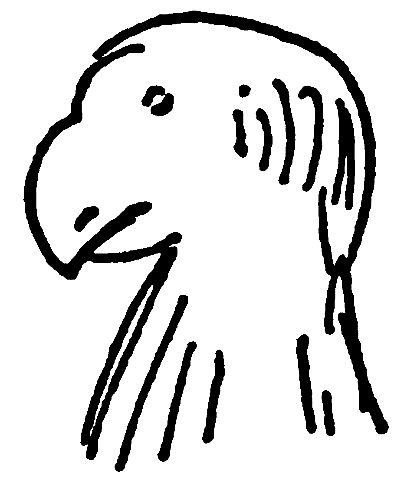
Fig. 131
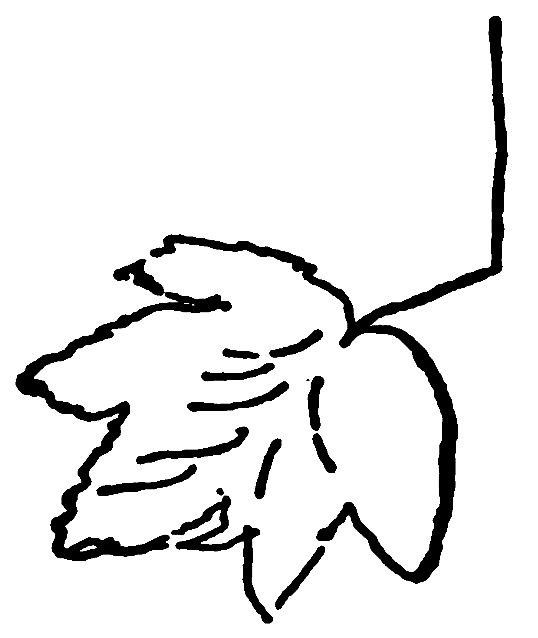
Fig. 131a
105
19
The border-line between successes and failures is not easy to determine. Bear in mind that we are not conducting a drawing class, nor making tests of my wife’s eyesight: we are trying to ascertain whether there does pass from my mind to hers, or from my drawing to her mind, a recognizable impulse of some sort. So, if she gets the essential feature of the drawing, we are entitled to call it evidence of telepathy. I think the fan with “crumpled cloth” (Fig. 102), and the umbrella handle that may be a “snake crawling out of something,” but that “looks like a cat’s tail” (Fig. 122), and the screw that was called a “tower” (Fig. 126)—all these are really successes. I will append a number of examples, about which there seems to me no room for dispute, and which I have called successes. The first is a sample of architecture (Figs. 132, 132a):
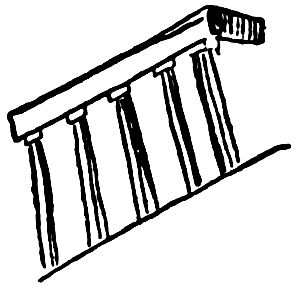
Fig. 132
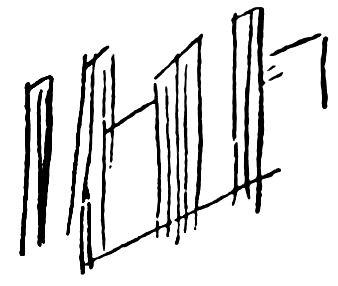
Fig. 132a
And here is an hourglass, with sand running through it. Not merely did Craig write “white sand,” but she made the tree the same shape as the glass. I have turned the hourglass upside down so that you can get the effect better. It should be obvious that “upside-downness” has nothing to do with these tests, as Craig is as apt to be holding a drawing one way as another (Figs. 133, 133a):
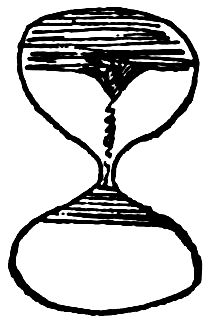
Fig. 133

Fig. 133a
106And these three circles, with comment: “Feel sure it is,” written above the drawing (Figs. 134, 134a):
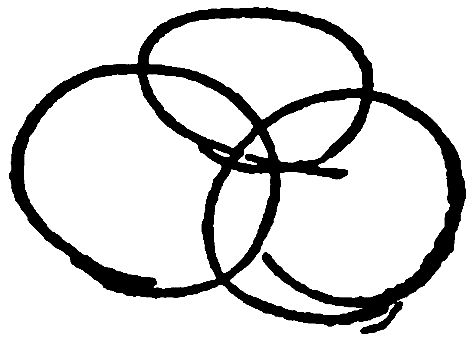
Fig. 134
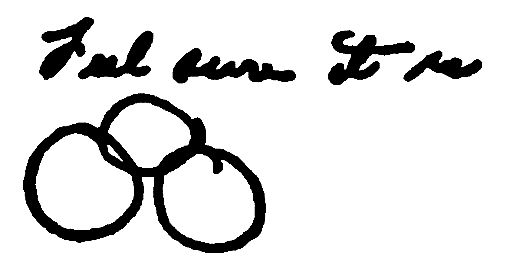
Fig. 134a
As to the next comment, “Trumpet flower,” let me explain that we have them in our garden, whereas we do not have any musical trumpets or horns (Figs. 135, 135a):
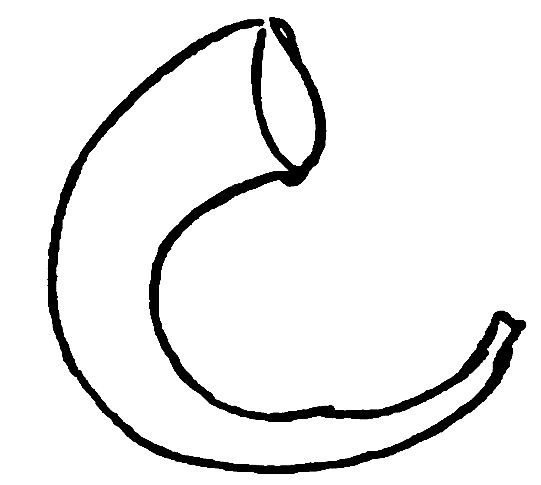
Fig. 135
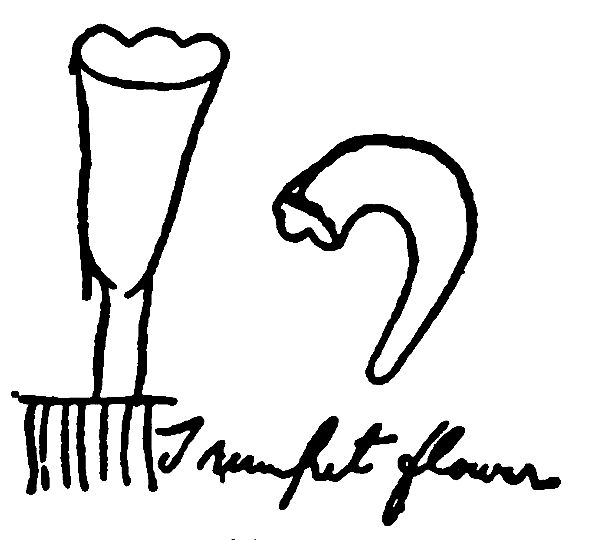
Fig. 135a
This strange object from my pencil tried to be a conch-shell, but got a bad start, and was left unclassified. Craig made it “life buoy in water,” which is good, except for the spelling. She insists upon my pointing out that shells also belong in water (Figs. 136, 136a):
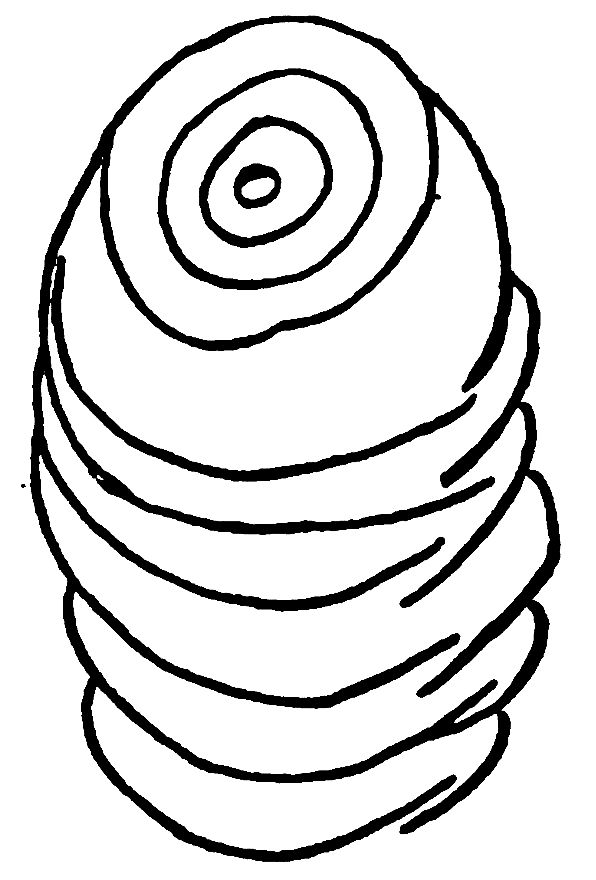
Fig. 136
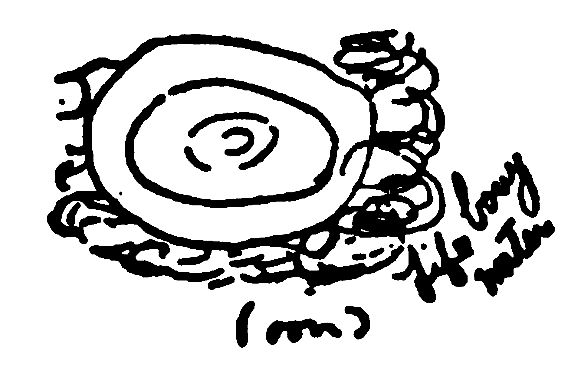
Fig. 136a
107This one, described in good country fashion, “Muley cow with tongue hanging out” (Fig. 137):
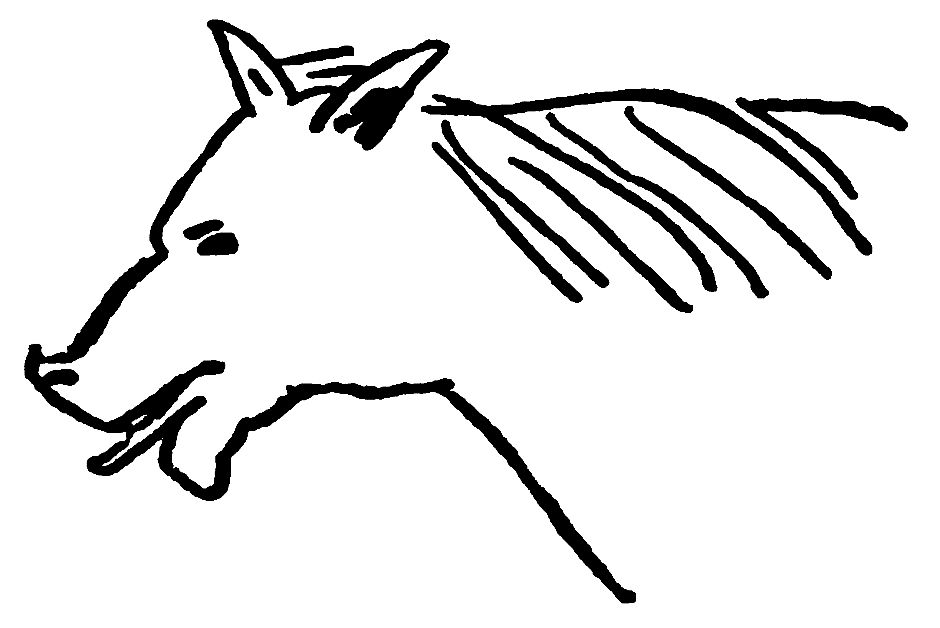
Fig. 137
This next one was described by the written word: “Goat” (Fig. 138):
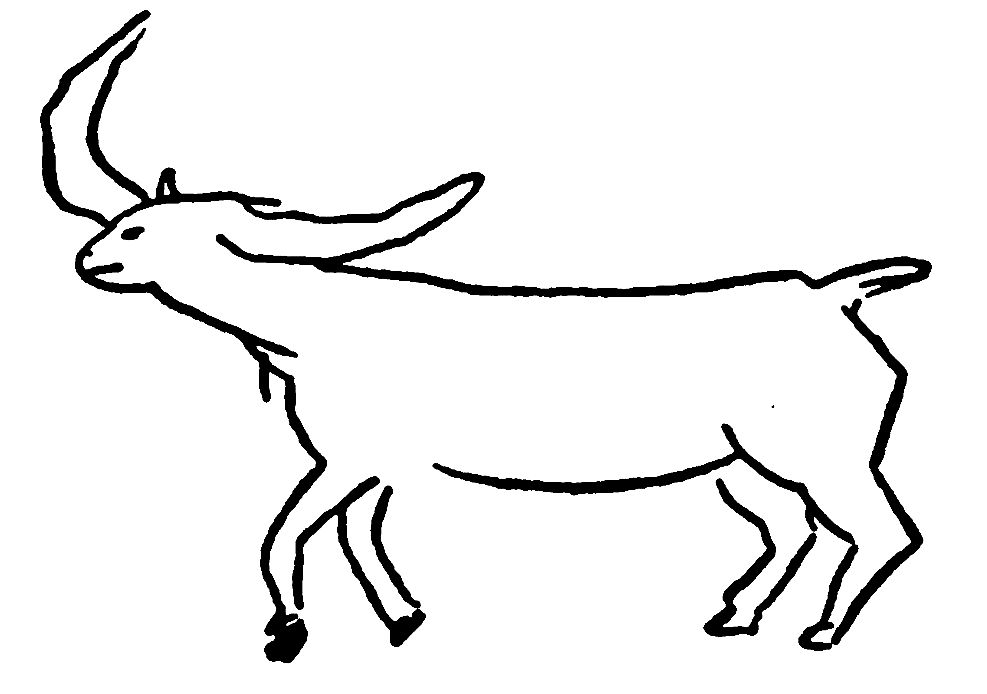
Fig. 138
And this one is so striking that I give the words in facsimile (Figs. 139, 139a):
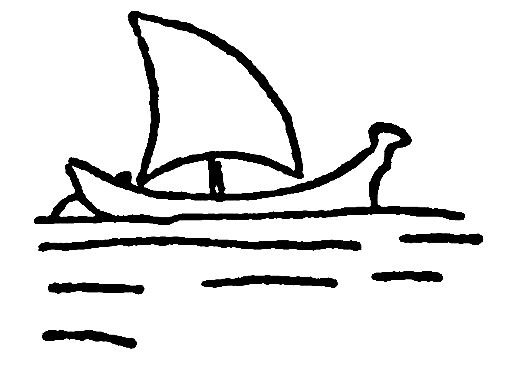
Fig. 139
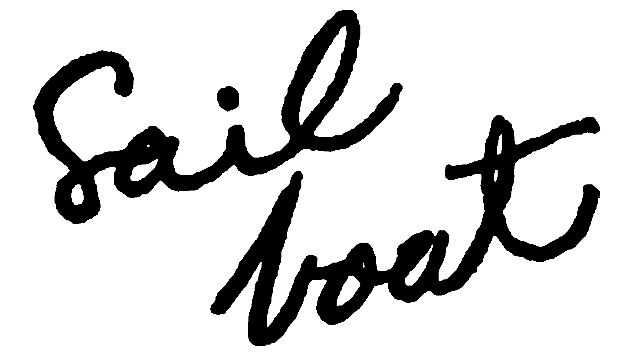
Fig. 139a
For the following, my wife described a wrong thing, and then added: “Now a sudden new thing, cone-shaped or goblet-like. This feels like it” (Figs. 140, 140a):
108
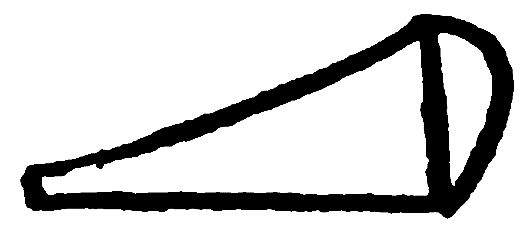
Fig. 140
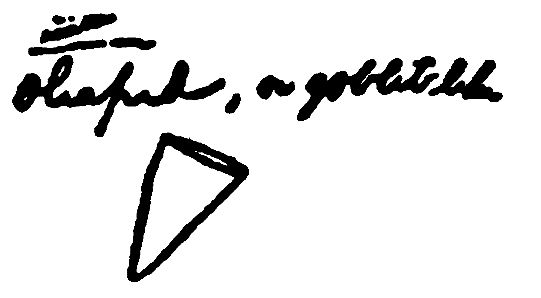
Fig. 140a
This was correctly named: “2 legs of something running” (Figs. 141, 141a):
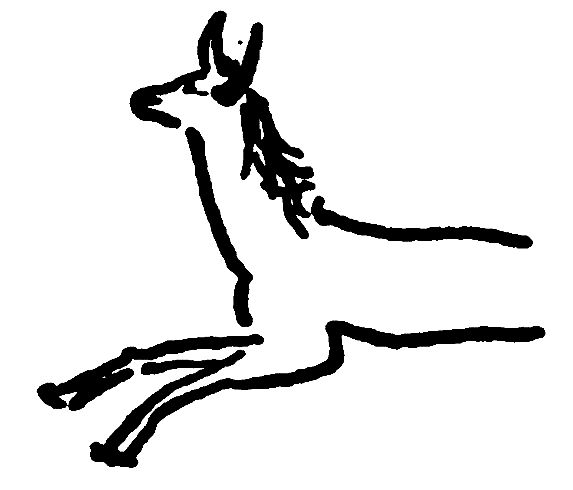
Fig. 141
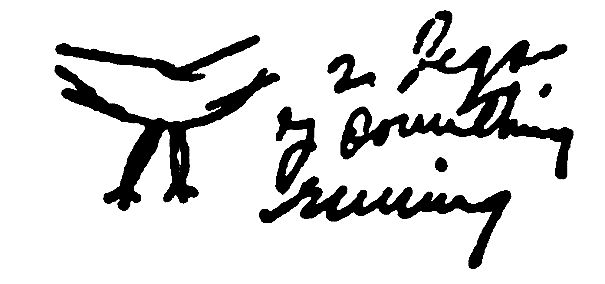
Fig. 141a
This Alpine hat with feather seems to me no less a success because it is called “Chafing dish” (Figs. 142, 142a):
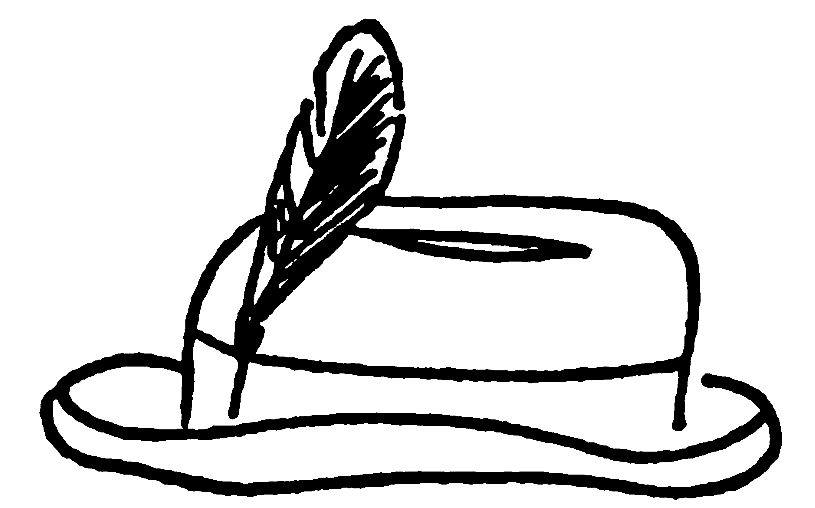
Fig. 142
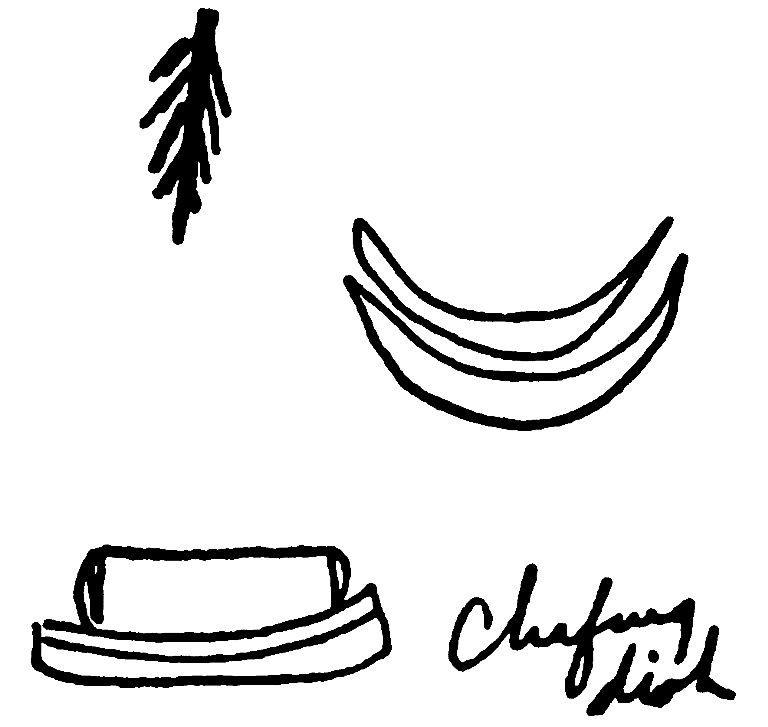
Fig. 142a
Nor this wind-mill because the sails are left off (Figs. 143, 143a):
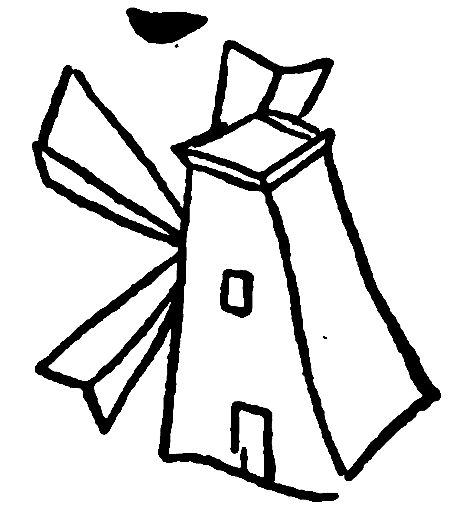
Fig. 143
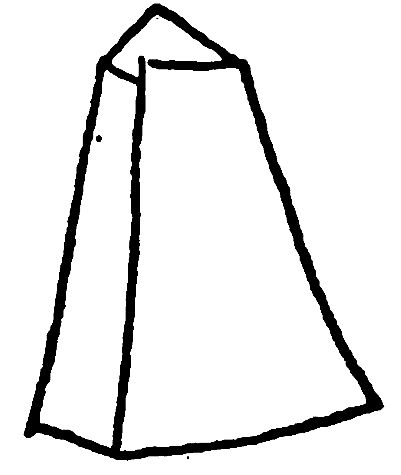
Fig. 143a
109These concentric circles are called “Horn (very curled), or shell” (Figs. 144, 144a):
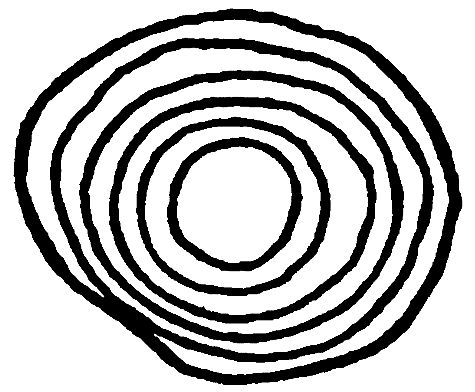
Fig. 144
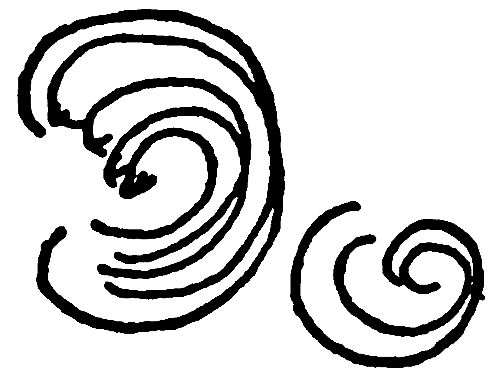
Fig. 144a
And here is a curious one, which came early in the tests. I call attention to the comment about the handle, which ran off the sheet of paper without any ending, just as she says. “Letter A with something long above it. Key or a sword, there seems to be no end to the handle. Think it’s a key” (Figs. 145, 145a):
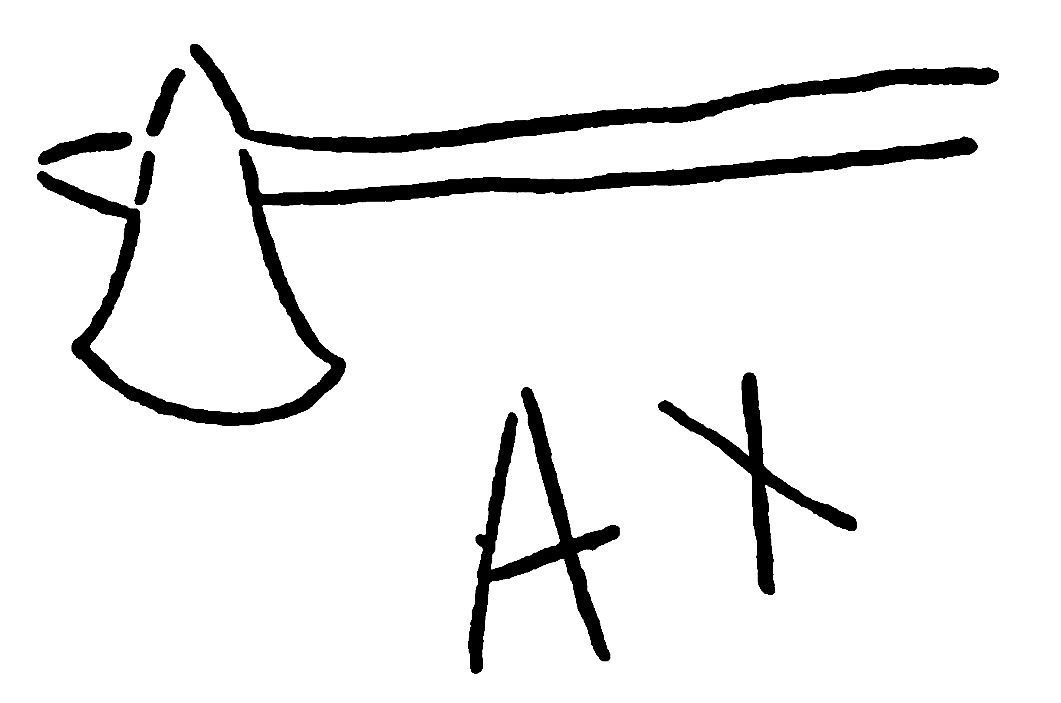
Fig. 145
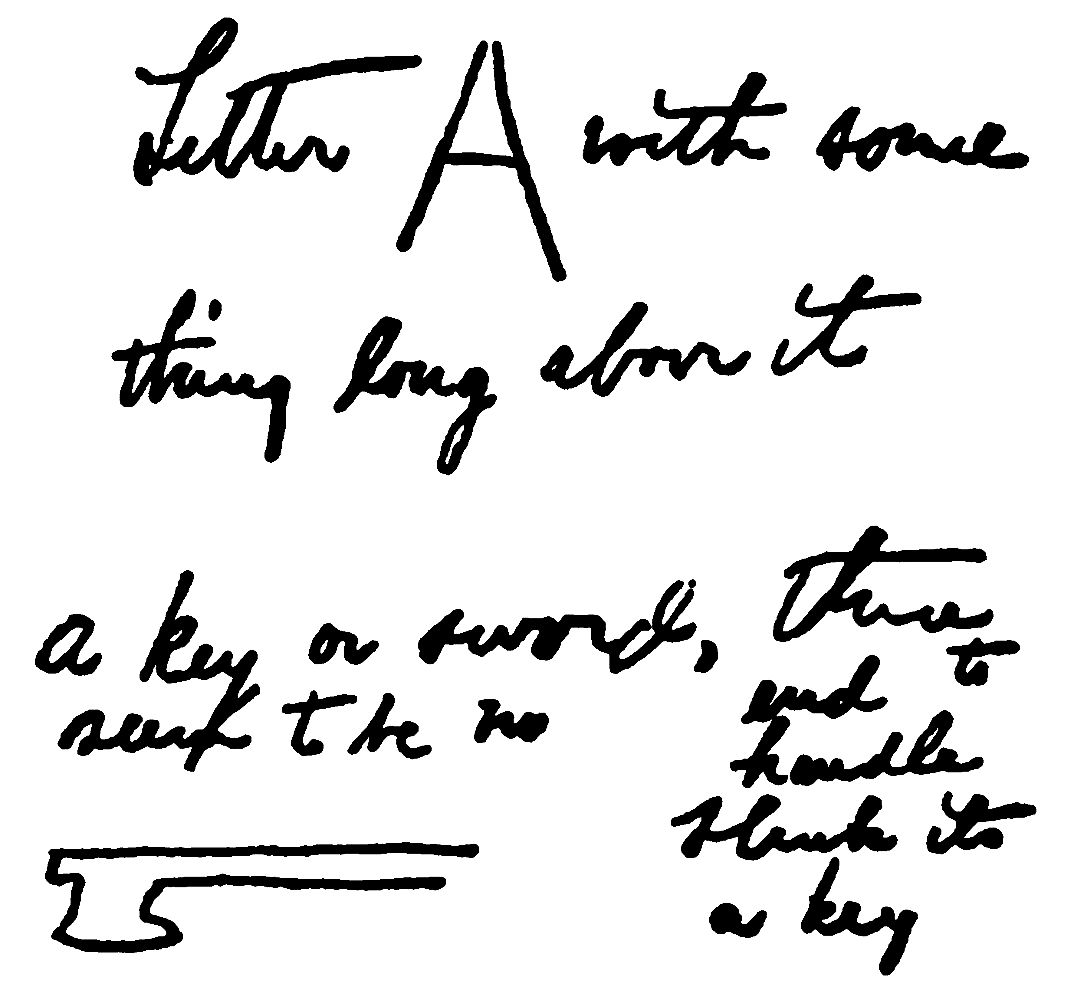
Fig. 145a
110And finally, this still more astonishing one, to serve as a climax. Let me explain that I am not so good an artist as this; I copied my drawing from some magazine (Figs. 146, 146a):
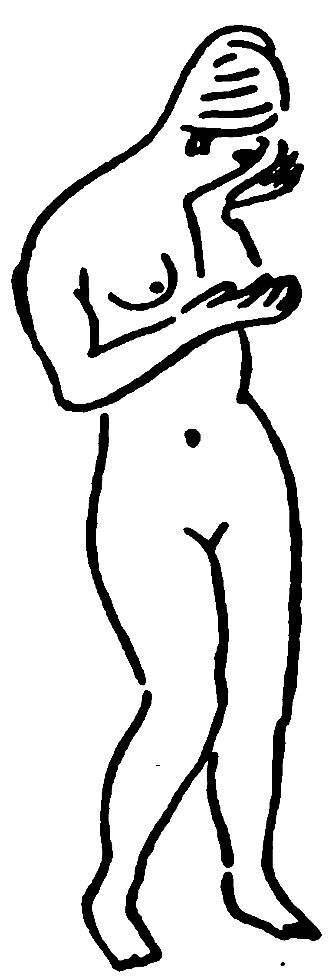
Fig. 146
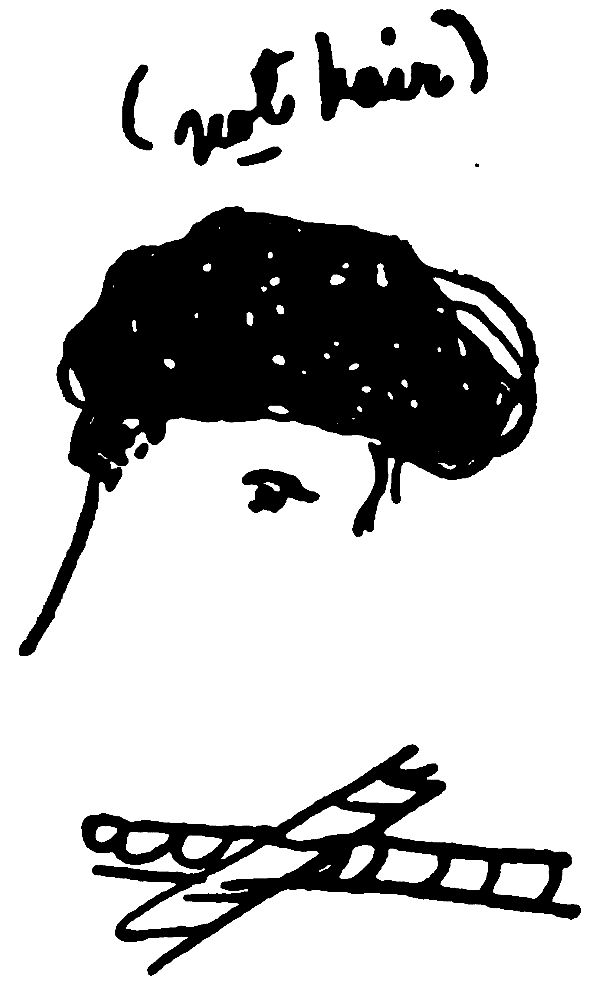
Fig. 146a
You note that my wife “got,” not merely the whole top of the drawing, but some impression of the arms, which are crossed in a peculiar way. I ask her about this case—the drawing having been made less than a month ago—and I find that she remembers it well. She saw what she thought was a turban wound about the head, and got the impression of color. She wrote the words “not hair” to make this clear. The rest of the comment written at the time was: “See back of head, ear, and swirling scarf tied around head.”
111
20
I have now given nearly all the 65 drawings which I call “successes,” and about half the 155 which I call “partial successes.” This, I think, is enough for any purpose. No one can seriously claim that such a set of coincidences could happen by chance, and so it becomes necessary to investigate other possible explanations.
First, a hoax. As covering that point, I prepared a set of affidavits as to the good faith of myself, my wife, her sister, and her sister’s husband. These affidavits were all duly signed and witnessed; but friends, reading the manuscript, think they use up space to no purpose, and that the reader will ask no more than the statement that this book is a serious one, and that the manuscript was carefully read by all four of the persons mentioned above, and approved by them as representing the exact truth.
That a group of persons should enter into a conspiracy to perpetrate a hoax is conceivable. Whether or not it is conceivable of the group here quoted is something of which the reader is the judge. But this much is clear: any reader who, having read the above, still suspects us, will not be convinced by further protestations.
How about the possibility of fraud by one person? No one who knows Mary Craig Sinclair would suspect her; but you who do not know her have, naturally, the right to consider such an hypothesis. Can she be one of those women who enjoy being talked about? The broaching of this idea causes her to take the pencil away from her husband, and you now hear her own authentic voice, as follows:
“I happen to be a daughter of that once very living thing, ‘the Old South,’ and there are certain ideals which are in my blood. The avoidance of publicity is one of them. But even if I had ever had a desire for publicity, it would have been killed by my actual experiences as the wife of a social crusader. My home is besieged by an endless train of persons of every description, who travel over 112the place, knocking on doors and windows, and insisting upon having a hearing for their various programs for changing the nature of the universe. I have been driven to putting up barriers and fences around my garden, and threatening to flee to the Himalayas, and become a Yogic mistress, or whatever a Yogic ‘master’ of my sex is called.
“Jack London tried to solve this problem by putting a sign on the front door which read, ‘Go to the back door,’ and on the back door one which read, ‘Go to the front door.’ But when I tried this, one seeker of inspiration took his seat halfway between the two doors, and declared that he would remain there the rest of his life, or until his wishes were acceded to. Another hid himself in the swimming-pool, and rose up from its depths to confront me in the dusk, when, as it happened, I was alone on the place, and went out into the garden for a breath of air. A third announced that he had a million dollars to present to my husband in person, and would not be persuaded to depart until my brother invited him to go downtown to supper, and so got him into a car. Having faithfully fed the hungry millionaire, my brother drove him to the police-station, where, after a serious talking-to by the chief, he consented to carry his million dollars away. A fourth introduced himself by mail as having just been released from the psychopathic ward in Los Angeles, and intending to call upon us, for reasons not stated. A fifth announced himself by telephone, as intending to come at once and shoot my husband on sight. Yet another, seven feet tall and broad in proportion, announced that he had a revelation direct from God, and had come to have the manuscript revised. When politely asked as to its nature, he rose up, towering over my none too husky spouse and declaring that no human eye had ever beheld it, and no human eye would ever be permitted to behold it. Such experiences, as a continuing part of a woman’s life, do not lead her to seek publicity; they tend rather to develop a persecution complex.
“Speaking seriously, I consider that I have every evidence of the effect of people’s thoughts on each other. And my distrust of human nature, in its present stage of evolution, is so great, that the idea of having many persons concentrate their attention on me is an idea from which I shrink. I agree with Richet that the 113fact of telepathy is one of the most terrifying in existence; and nothing but a deep love of truth has induced me to let this very personal story be told in print.”
Next, what about the possibility of unconscious fraud? This also is a question to be frankly met. All students of psychology know that the subconscious mind has dubious morals. One has only to watch his own dreams to discover this. A person in a trance is similar to one talking or walking in sleep, or a drunken man, or one under the influence of a drug. But in this case it must be noted that my wife has never been in a trance. In these mind-reading tests, no matter how intense the “concentration,” there is always a part of her mind which knows what she is doing. If you speak to her, she is immediately “all there.” When she has her mental pictures, she sits up and makes her drawing, and compares it with mine, and this is a completely conscious act.
Moreover, I point out that a great deal of the most impressive evidence does not depend upon Craig alone. The five drawings with her brother-in-law, Figures 1, 16, 17, 18, 19, constitute by themselves evidence of telepathy sufficient to convince any mind which is open to conviction. While it would have been possible for Craig and Bob to hoax Dollie and me, it could certainly not have been done without Bob’s connivance. If you suggest that my wife and my brother-in-law may have been fooling me, I reply that there is a still greater mass of evidence which could not have been a hoax without my connivance. When I go into my study alone—a little sun-parlor at the front of a beach-house, with nothing but a couch, a chair and a table—I certainly know that I am alone; and when I make a drawing and hold it before my eyes for five or ten minutes, I certainly know whether any other person is seeing it. This covers the drawings presented as Figures 2, 20, and 21, with four others told about in the same series. It seems to me these seven cases by themselves are evidence of telepathy sufficient to convince any open mind.
Furthermore, there are the several score drawings which I made in my study and sealed up in envelopes, taking them to my wife and watching her lay them one by one upon her body and write down more or less accurately what was in them. I certainly know whether I was alone when I made the drawings, and whether 114I made the contents of the envelopes invisible, and whether my wife had any opportunity to open the envelopes before she made her drawings. Of course, I understand the familiar conjuring trick whereby you open one envelope, and hide it in your palm, and pretend to be describing the next one while really describing the one you have seen. But I would stake my life upon the certainty that my wife knows no sleight-of-hand, and anyhow, I made certain that she did not open the first one; I sat and watched her, and after each test she handed me the envelopes and drawings, one by one—the envelopes having previously been numbered by me. She would turn out the reading-light which was immediately over her head, but there was plenty of light from other parts of the room, enough so that I could look at drawings as they were shown to me. Often these tests were done in the daytime, and then all we did was to pull down the window-shades back of the couch.
It should be obvious that I stand to lose much more than I stand to gain by publishing a book of this sort. Many have urged me not to take the risk. It is the part of prudence not to believe too many new and strange ideas. Some of my Socialist and materialist friends are going to say—without troubling to read what I have written: “Sinclair has gone in for occultism; he is turning into a mystic in his old age.” It is true that I am fifty-one, but I think my mind is not entirely gone; and if what I publish here is mysticism, then I do not know how there can be such a thing as science about the human mind.
We have made repeated tests to see what happens; we have written down our observations as we go along; we have presented the evidence carefully and conscientiously, without theories; and what any scientist can do, or ask to have done, more than this, I cannot imagine. Those who throw out these results will not be scientists, but merely another set of dogmatists—of whom new crops are continually springing up, wearing new disguises and new labels. The plain truth is that in science, as in politics and religion, it is a lot easier to believe what you have been taught, than to set out for yourself and ascertain what happens.
Of course the thing would be more convincing if it were done in the presence of strangers. That brings up a question which is bound to be asked, so I will save time by answering it here. The 115first essential to success in these tests is a state of mind; and at present my wife is a sensitive woman, at the stage of life described as “glandular imbalance.” She has never tried these experiments in the presence of a stranger, and has no idea whether she could get the necessary concentration. She learned from her experiments with her sick brother-in-law that the agent can send you pain and fear, as well as chairs and table-forks, and she would certainly not enter lightly into a condition of rapport with those whom she did not know and trust.
She insists that the way for you to be really certain is to follow her example. If you sat and watched her do it, you might go away with doubts, as she did after her experiments with Jan. But when you have done it yourself, then you know. One reason the thing has not been proven to the public is that people depend on professional mediums, many of whom are deliberate and conscious cheats. Others are vain and temperamental, difficult to manage; and research is hindered by their instability. That is why Craig set to work and learned to do it, and she believes that others can do the same, if they have the desire and the patience.
116
21
The next thing is to carry out our promise and tell you the technique. My wife has, among her notes, a mass of writing on this subject in the form of instructions to Bob, and others who were interested. I tried to condense it, but found I could not satisfy her, and in the end I realized that her point of view is correct. No one objects to repetition of phrases in a legal document, where the one essential is precision; and the same thing applies to descriptions of these complicated mental processes. This was the most difficult writing task she ever undertook, and the reason lies in its newness, and the complexity of the mind itself.
If you want to learn the art of conscious mind-reading, this will tell you how; and if you don’t want to learn it, you can easily skip this section of the book. Here is Craig’s statement:
“The first thing you have to do is to learn the trick of undivided attention, or concentration. By these terms I mean something quite different from what is ordinarily meant. One ‘concentrates’ on writing a chapter in a book, or on solving a problem in mathematics; but this is a complicated process of dividing one’s attention, giving it to one detail after another, judging, balancing, making decisions. The kind of concentration I mean is putting the attention on one object, or one uncomplicated thought, such as joy, or peace, and holding it there steadily. It isn’t thinking; it is inhibiting thought, except for one thought, or one object in thought.
“You have to inhibit the impulse to think things about the object, to examine it, or appraise it, or to allow memory-trains to attach themselves to it. The average person has never heard of such a form of concentration, and so has to learn how to do it. Simultaneously, he must learn to relax, for strangely enough, a part of concentration is complete relaxation.
“There seems to be a contradiction here, in the idea of simultaneous concentration and relaxation. I do not know whether this is due to a contradiction in the nature of the mind itself, or to our 117misunderstanding of its nature. Perhaps we each have several mental entities, or minds, and one of these can sleep (be blankly unconscious), while another supervises the situation, maintaining the first one’s state of unconsciousness for a desired period, and then presenting to it some thought or picture agreed on in advance, thus restoring it to consciousness.
“Anyway, it is possible to be unconscious and conscious at the same time! Almost everyone has had the experience of knowing, while asleep, that he is having a bad dream and must awaken himself from it. Certainly some conscious entity is watching the dream, and knowing it is a dream; and yet the sleeper is ‘unconscious.’ Or perhaps there is no such thing as complete relaxation—until death.
“All I can say is this: when I practice this art which I have learned, with my mind concentrated on one simple thing, it is a relaxation as restful, as seemingly ‘complete’ as when I am in that state called normal sleep. The attention is not allowed to be on the sensations of the body, or on anything but the one thing it is deliberately ‘concentrated’ on.
“Undivided concentration, then, means, for purposes of this experiment, a state of complete relaxation, under specified control. To concentrate in this undivided way you first give yourself a ‘suggestion’ to the effect that you will relax your mind and your body, making the body insensitive and the mind a blank, and yet reserving the power to ‘break’ the concentration in a short time. By making the body insensitive I mean simply to relax completely your mental hold of, or awareness of, all bodily sensation. After giving yourself this suggestion a few times, you proceed to relax both body and mind. Relax all mental interest in everything in the environment; inhibit all thoughts which try to wander into consciousness from the subconsciousness, or from wherever else thoughts come. This is clearly a more thorough affair than ‘just relaxing.’
“Also, there is something else to it—the power of supervising the condition. You succeed presently in establishing a blank state of consciousness, yet you have the power to become instantly conscious, also; to realize when you are about to go into a state of sleep, in which you have not the power of instantly returning to consciousness. Also, you control, to a certain degree, what is to be 118presented to consciousness when you are ready to become conscious. For example, you want a message from the person who is sending you a message; you do not want a train of subconscious ‘day dreams.’
“All this is work; and so far, it is a bore. But when you have learned to do it, it is an art worth knowing. You can use it, not only for such experiments as telepathy and clairvoyance, but for improving your bodily health. To relax thoroughly several times each day while holding on to a suggestion previously ‘planted’ in the subconsciousness is more beneficial to health than any other one measure I know.
“The way to relax is to ‘let go.’ ‘Let go’ of every tense muscle, every tense spot, in the body. Pain is tension. Pain can be inhibited by suggestion followed by complete relaxation. Drop your body, a dead-weight, from your conscious mind. Make your conscious mind a blank. It is the mind, conscious or subconscious, which holds the body tense. Give to the subconsciousness the suggestion of concentrating on one idea, and then completely relax consciousness. To make the conscious mind a blank it is necessary to ‘let go’ of the body; just as to ‘let go’ of the body requires ‘letting go’ of consciousness of the body. If, after you have practiced ‘letting go’ of the body, you find that your mind is not a blank, then you have not succeeded in getting your body rid of all tension. Work at it until you can let both mind and body relax completely.
“It may help you to start as follows: Relax the body as completely as possible. Then visualize a rose, or a violet—some pleasant, familiar thing which does not arouse emotional memory-trains. Gaze steadily, peacefully, at the chosen object—think only of it—try not to let any memories it may arouse enter your mind. Keep attention steady, just seeing the color, or the shape of the flower and nothing else. Do not think things about the flower. Just look at it. Select one thing about it to concentrate on, such as its shape, or its color, or the two combined in a visual image: ‘pink and round.’
“If you find that you are made nervous by this effort, it is apt to be due to the fact that you are thinking things. Maybe the object you have chosen has some buried memories associated with it—something which arouses unconscious memories of past unhappy events. Roses may suggest a lost sweetheart, or a vanished garden 119where you once were happy and to which you long to return. If so, select some other flower to concentrate on. Flowers are usually the most restful, the things which are not so apt to be involved with distressing experiences. A bottle of ink might suggest the strain of mental work, a spoon might suggest medicine. So, find a peace-inspiring object to look at. When you have found it, just look at it, with undivided attention.
“If you succeed in doing this, you will find it hard not to drop asleep. But you must distinguish between this and the state you are to maintain. If you drop asleep, the sleep will be what is called auto-hypnotic sleep, and after you have learned to induce it, you will be able to concentrate on an idea, instead of the rose, and to carry this idea into the sleep with you as the idea to dominate the subconsciousness while you sleep. This idea, taken with you into sleep in this way, will often act in the subconsciousness with the same power as the idea suggested by a hypnotist. If you have ever seen hypnotism, you will know what this means. You can learn to carry an idea of the restoration of health into this auto-hypnotic sleep, to act powerfully during sleep. Of course this curative effect is not always achieved. Any idea introduced into the subconsciousness may meet a counter-suggestion which, if you are ill, already exists in the subconsciousness, and a conflict may ensue. Thus, time and perseverance may be necessary to success.
“But this is another matter, and not the state for telepathy—in which you must avoid dropping into a sleep. After you have practiced the exercise of concentrating on a flower—and avoiding sleep—you will be able to concentrate on holding the peculiar blank state of mind which must be achieved if you are to make successful experiments in telepathy. There may be strain to start with, but it is getting rid of strain, both physical and mental, which constitutes relaxation, or blankness, of the conscious mind. Practice will teach you what this state is, and after a while you can achieve it without strain.
“The next step: ask someone to draw a half-dozen simple designs for you on cards, or on slips of paper, and to fold them so that you cannot see the contents. They should be folded separately, so that you can handle one at a time. Place them on a table, or chair, beside your couch, or bed, in easy reach of your hand, so that 120you can pick them up, one at a time, while you are stretched out on the bed, or couch, beside them. It is best at first to experiment in the dark, or at least in a dimly lit room, as light stimulates the eyes and interferes with relaxation. If you experiment at night, have a table lamp within easy reach, so that you can turn the light off and on for each experiment without too much exertion, as you must keep your body and mind as passive as possible for these experiments. If you have no reading light near, use a candle. You must have also a writing pad and pencil beside you.
“After you have placed the drawings on the table, turn off the light and stretch your body full length on the couch. Close your eyes and relax your body. Relax completely. Make the mind a complete blank and hold it blank. Do not think of anything. Thoughts will come. Inhibit them. Refuse to think. Do this for several moments. It is essential to induce a passive state of mind and body. If the mind is not passive, it feels body sensations. If the body is not relaxed, its sensations interfere with the necessary mental passivity. Each reacts on the other.
“The next step, after having turned off the light and closed your eyes and relaxed mind and body full length on the couch, is to reach for the top drawing of the pile on the table. Hold it in your hand over your solar plexus. Hold it easily, without clutching it. Now, completely relaxed, hold your mind a blank again. Hold it so for a few moments, then give the mental order to the unconscious mind to tell you what is on the paper you hold in your hand. Keep the eyes closed and the body relaxed, and give the order silently, and with as little mental exertion as possible.
“However, it is necessary to give it clearly and positively, that is, with concentration on it. Say to the unconscious mind, ‘I want the picture which is on this card, or paper, presented to my consciousness.’ Say this with your mind concentrated on what you are saying. Repeat, as if talking directly to another self: ‘I want to see what is on this card.’ Then relax into blankness again and hold blankness a few moments, then try gently, without straining, to see whatever forms may appear on the void into which you look with closed eyes. Do not try to conjure up something to see; just wait expectantly and let something come.
“My experience is that fragments of forms appear first. For 121example, a curved line, or a straight one, or two lines of a triangle. But sometimes the complete object appears; swiftly, lightly, dimly-drawn, as on a moving picture film. These mental visions appear and disappear with lightning rapidity, never standing still unless quickly fixed by a deliberate effort of consciousness. They are never in heavy lines, but as if sketched delicately, in a slightly deeper shade of gray than that of the mental canvas. A person not used to such experiments may at first fail to observe them on the gray background of the mind, on which they appear and disappear so swiftly. Sometimes they are so vague that one gets only a notion of how they look before they vanish. Then one must ‘recall’ this first vision. Recall it by conscious effort, which is not the same thing as the method of passive waiting by which the vision was first induced. Instead, it is as if one had seen with open eyes a fragment of a real picture, and now closes his eyes and looks at the memory of it and tries to ‘see’ it clearly.
“It is necessary to recall this vision and make note of it, so as not to forget it. One is sure to forget it—indeed it is his duty to do so—in the process of the next step, which is one of blankness again. This blankness is, of course, a deliberate putting out of the conscious mind of all pictures, including the one just visioned. One must now order the subconscious not to present it to the conscious mind’s picture-film again unless it is the right picture, i.e., the one drawn on the card which is held in hand. Make the conscious mind blank again for a brief space. Then look again on the gray canvas of mind for a vision. This is to test whether the first vision came from subconscious guessing, or whether it came from the deeper mind—from some other source than that of the subconscious, which is so apt to offer a ‘guess,’ or false picture.
“Do this whole performance two or three times, and if the first vision persists in coming back, accept it. As soon as you have accepted it—that is, decided that this is the correct vision—turn on the light, and without looking at the card, or paper, which contains the real picture, pick up the writing pad and pencil and make a sketch of every detail of the vision-picture. This is a nuisance, as it interrupts concentration and the desired passivity. But it is absolutely necessary to record the vision in every detail, before one looks at the real picture, the one on the card he has been holding in hand. 122If one does not make a record of his vision in advance of looking at the card picture, he is certain to forget at least some part of it—maybe something which is essential. Worse yet, he is apt to fool himself; the mind is given to self-deception. As soon as it sees the real drawing, it not only forgets the vision, but it is apt to imagine that it visioned the picture it now sees on the card, which may or may not be true. Imagination is a far more active function than the average person realizes. This conscious-subconscious mind is ‘a liar,’ a weaver of fiction. It is the dream-mind, and also it is the mind of memory trains.
“Do not omit fragments which seem to be out of place in a picture. These fragments may be the real things. If in doubt as to what the object of your vision is, do not try to guess. But if you have a ‘hunch’ that something you have seen is connected somehow with a watch, for example, or with an automobile, make a note of this ‘hunch.’ I use this popular word to indicate a real presentation from some true source, something deeper and more dependable than our own subconscious minds. I call this the ‘deep mind’ in order to have a name for it. I do not know what it is, of course—I am only judging from the behavior of the phenomena.
“Do not fail to record what seems to be a very stray fragment, for it may be a perfect vision of some portion of the real picture. Record everything, and then later you can compare it carefully with the real drawing. Of course, do not be fantastic in your conclusions. Do not think you have gotten a correct vision of an automobile because you saw a circle which resembled a wheel. However, I once saw a circle and felt that it was an automobile wheel—felt it so vividly that I became overwhelmed with curiosity to see if my ‘feeling’ was correct, and forthwith turned on the light and examined the real picture in my hand. I found that it was indeed the wheel of an automobile. But I do not do this kind of thing unless I have a very decided ‘hunch,’ as it tends to lead back to the natural impulse of the mind to ‘guess’—and guessing is one of the things one has to strive to avoid. To a certain extent, one comes to know a difference between a guess and a ‘hunch.’
“The details of this technique are not to be taken as trifles. The whole issue of success or failure depends on them. At least, this is so in my case. Perhaps a spontaneous sensitive, or one who 123has a better method, has no such difficulties. I am just an average conscious-minded person, who set out deliberately to find a way to test this tremendously important question of telepathy and clairvoyance, without having to depend on a ‘medium,’ who might be fooling himself, or me. It was by this method of careful attention to a technique of details that I have found it possible to get telepathic messages and to see pictures on hidden cards, and symbolic pictures of the contents of books.
“This technique takes time, and patience, and training in the art of concentration. But this patience is in itself an excellent thing to learn, especially for nervous and sick people. The uses of mental concentration are too various and tremendously beneficial to enumerate here. The average person has almost no power of concentration, as he will quickly discover by trying to hold his undivided attention on one simple object, such as a rose, or a bottle of ink, for just a few minutes. He will find that a thousand thoughts, usually association trains connected with the rose, or the ink, will appear on his mental canvas, interrupting his concentration. He will find that his mind behaves exactly like a moving-picture film, or a fireworks display. It is the division of attention that uses up energy, if I am not mistaken.
“Of course this technique is not ‘original.’ I got it by selecting from hints here and there in my reading, and from my general study and observation of the behavior of the mind.
“Among the difficulties to be overcome—and this is one which is easily detected—is the appearing of visions of objects one has observed in the environment just before closing the eyes. When I close my eyes to make the next test, I invariably find that the last picture, and my own drawing of it, and also the electric light bulb which I have lighted in order to see the last picture—all these immediately appear on the horizon of my mind. It often takes quite a while to banish these memory-ghosts. And sometimes it is a mistake to banish them, as the picture you hold in your hand may be quite similar to the preceding one. If, therefore, a picture resembling the preceding continues obstinately to represent itself, I usually accept it, and often find that the preceding and present cards contain similar pictures.
“Another difficulty is the way things sometimes appear in 124fragments, or sections, of the whole picture. A straight line may appear, and it may be either only a portion of the whole, or it may be all there is on the card. Then I have to resist the efforts of my imagination to speculate as to what object this fragment may be part of. For instance, I see a series of points, and have the impulse to ‘guess’ a star. I must say no to this guesswork, unless the indescribable ‘hunch’ feeling assures me it is a star. I must tell myself it may be indeed a part of a star, but, on the other hand, it may be a complete picture of the drawing in hand, perhaps the letter W, or M, or it may be a part of a pennant, or what not. Then I must start over, and hold blank a while. Then repeat the request to the deep mind for the true picture. Now I may get a more complete picture, or maybe this fragment reappears alone, or maybe it repeats itself upside-down, or doubled up in most any way.
“I start all over once more and now I may get a series of fragments which follow each other and jump together as do the comic cartoons which are drawn on the screen with pen and ink. For instance, two points appear, then another appears separately and jumps to the first two, and joins up with them, then two more. The result is a star, and this may be the true picture. It usually is. But sometimes this is the subconscious mind, or perhaps the conscious, trying to finish the object as it has ‘guessed’ it should be. This error of allowing the conscious or the subconscious mind to finish the object is one to be most careful about. As one experiments, he realizes more and more that these two minds, the conscious and the subconscious, are really one, subconsciousness being only a disorderly store-house of memories. The third, or ‘deep mind’ is apparently the one which gives us our psychic phenomena. Again I say, I do not know what this ‘deep mind’ is; I use the words merely to have a name for that ‘other thing’ which brings the message.
“The conscious mind, combined with the subconscious, not only wants to finish the picture, but decides sometimes to eliminate a detail which does not belong to what it has guessed should be there. For example, I will discuss the drawings which have been given as Figures 35, 35a, in this book. I ‘visioned’ what looked like a figure 5, except that at the top where there should be a small vertical line projecting toward the right, there was a flare of very long lines converging at one end. I consciously decided that the 125long lines were an exaggeration and multiplication of what should properly be at the top of a five, and that I should not accept them. Here was conscious mind making a false decision. But by obeying the rules I had laid down in advance, I was saved from this error of consciousness. I closed my eyes, gave a call for the true picture, and the lines appeared again, so I included them in my drawing. When I opened the envelope and looked at the picture inside, it was an oil derrick. So the flare of long lines was the real thing, while the figure 5 was the interloper—at least, so I now consciously decided. I thought that the figure 5 and the flare of lines were entirely separate mental images, one following the other so rapidly that they appeared to belong together.
“But again my conscious decision was in error. Several hours later, after I had put the whole matter out of my mind and had been attending to household duties, I suddenly remembered the paper jacket of a German edition of my husband’s novel, ‘Oil,’ which was on a shelf in the next room to the one in which I had made my experiments. Why did I suddenly remember this book? I had not noticed it for a long time—its jacket drawings were out of sight, as the book was wedged between many others on the book shelves in an inconspicuous place in the room. On one side of the jacket of this book was a picture of three oil derricks; on the other side was a large dollar mark, almost covering one entire side of the book. I had seen this jacket, had indeed taken special notice of it, at the time of its arrival from Germany. So here seems to have been a clear case of the subconscious mind at work during my experiment, adding to my true vision of an oil derrick, the subconsciously remembered dollar mark which looked like a figure 5, partly hidden by the oil derrick in my vision. Here was a grand mix-up of the false guesses of consciousness and subconsciousness, and the true presentations from the ‘deep mind.’
“But this was not the end. This confusion in regard to the dollar mark went forward, in memory-trains to two other experiments. Several days later, I was trying a new set of drawings, and one of them caused in my mind a vision of the capital letter S. Instantly, two parallel straight lines crossed it, turning it into a dollar mark: $. Then it became an S again without the lines. Then the lines came back. This strange behavior of my vision continued. I 126was in a quandary as to which to accept, the S or the $. Then there appeared an old-fashioned money-bag, such as I used to see in my father’s bank as a child, full of small coins. It took its place in the vision beside the dollar mark. I decided with the usual erroneous consciousness that this money-bag was a hint from my real mind, so I accepted the dollar mark as correct. But it turned out not to be. When I looked at the drawing in hand it was a letter S. My subconsciousness had supplied the money-bag, and the two parallel lines.
“Several days later, in a vision with a third set of drawings, I saw a letter S, and then at once the bag of small change appeared, but there were no parallel lines on the S. This time the real drawing was a dollar mark! So, my subconsciousness, as soon as the dollar mark had appeared in subconsciousness, had meddled again; it had remembered the last experiment and the scolding I had given it for its guess work, so it now subtracted the parallel lines from the new vision to make it correct, according to the last experiment. It had remembered the last experiment only, forgetting the first one, of the oil derrick, just as I had ordered it to do on the occasion of the second experiment. So, it subtracted the two parallel lines, but it added the remembered bag of money, which I had included in my scolding. From this kind of interference by the subconsciousness, I realized that it is indeed no simple matter to get things into consciousness from the ‘deep mind’ without guesses and additions and subtractions made by the subconsciousness. Why the subconscious should meddle, I do not know. But it does. Its behavior is exactly like that of the conscious mind, which is also prone to guessing. All this sounds fantastic—to anyone who has not studied his mind. But I tell you how it seems to me.
“Maybe everything comes from the subconscious. Maybe there is no ‘deep mind.’ Maybe the subconscious gets its knowledge of what is on the drawing directly from the drawing, and is merely blundering around, adding details by guesswork to what it has seen incompletely. But I think that these experiments prove that this is not the case. I think a study of them shows that a true vision comes into the subconsciousness, not directly from the drawing, but from another mind which has some means of knowing, and sending to consciousness via the subconsciousness whatever I ask it for. Of 127course I cannot attempt to prove this here. It was one of the questions to which I was seeking an answer, and the result seems to point to the existence of a deeper mind, showing how its behavior is quite different from that of the subconscious.
“I wanted to find out if the true vision could in any way be distinguished from ‘imagination,’ or these busy guesses of the subconsciousness. To help myself in this matter, I first made an examination of exactly how these guesses come. I said to myself: every thought that ever comes to consciousness, excepting those due to direct outside stimulation, may proceed from some deeper source, and by subconscious memory-trains attaching to them, appear to be the work of subconsciousness. So I shut my eyes and made my mind blank, without calling on my mind to present any definite thing. I had no drawing in my hand. After a brief space of blankness, I relaxed the enforced blankness and waited, dreamily, for what might come. A picture soon came, with a whole memory-train. First a girl in a large garden hat, then a garden path and flowers bordering it, then a spade, a wheelbarrow, and so on—things associated in my memory with a girl in a garden hat. As to where the girl in the hat came from, I know not. As to why she should come instead of any other of billions of things seen by me during my life, I know not. I had not asked my mind for her. The question of why she came is interesting.
“But it was easy to account for the other things—the association-train. I learned from this experiment, and several repetitions of it, that something always came—a girl, or a steamship, or the fact that I had not attended to some household duty, or what not—and a train of associated ideas followed. I learned, in a more or less vague way, how these things behaved, and how I felt about them. This enabled me to notice, when later I got a true vision, that there was a difference between the way this true vision came and the way the ‘idle’ visions came. When the true visions came, there usually came with them a ‘something’ which I call a ‘hunch.’ There was, of course, always in my consciousness the question: is this the right thing, or not? When the true vision came, this question seemed to receive an answer, ‘yes,’ as if some intelligent entity was directly informing me.
128“This was not always the case. At times no answer came, or at least, if it came, it was obscured by guesses. But usually it did, after I had watched for it, and a sort of thrill of triumph came with it, quite different from the quiet way in which the money-bag had appeared in answer to my uncertainty. The subconscious answers questions, and its answers are always false; its answers come quietly, like a thief in the night. But the ‘other’ mind, the ‘deep mind’ answers questions, too, and these answers come, not quietly, but as if by ‘inspiration,’ whatever that is—with a rustling of wings, with gladness and conviction. These two minds seem different from each other. One lies and rambles; the other sings, and is truthful.
“But do not misunderstand me. I am not a religious convert. I am searching for knowledge, and recording what I find. Others on this search may have found these same things, but the conclusions they have drawn may not turn out to be the ones I shall draw.
“One or two other things of interest should perhaps be mentioned. First, I found that, in doing a series of several drawings, the percentage of successes was higher in the first three attempts. Then there began to be failures, alternating with successes. This may have been due to the fact that the memory-pictures of these first three experiments now constituted a difficulty. So much attention had to be given to inhibiting these memory-pictures, and in deciding whether or not they were to be inhibited. Or it may be due to some other cause, such as fatigue or boredom.
“The second detail is that during the earliest experiments, I developed a headache. I think this was due to the fact that I strained my closed eyes trying to see with them. I mean, of course, trying to see a vision, not the card in my hand. Using the eyes to see with is a habit, and habits are not easily overcome. I soon learned not to use my eyes, at least not in a strained way, and this was the end of the headaches. However, this use of the eyes in telepathy may perhaps mean more than a mere habit. The mental canvas on which these ‘visions’ are projected seems to be spread in the eyes, and it is the eyes which seem to see them—despite the fact that the room may be dark, the eyes closed, and the drawing on the paper be wrapped in thick covering and not within normal range of the eyes. But this may be due to the habit of associating all pictures with your eyes.”
129
22
So much for the art of voluntary mind-reading. In conclusion I, the husband, attempt to say a few words about what these phenomena mean, and how they come about.
This attempt involves me in a verbal duel with my wife, which lasts into the small hours of morning. It involves the everlasting debate between the vitalists and the mechanists, which had best be left to Dr. Watson and Professor McDougall, and the others who are no more able than I am to look at the neurons of the brain in action, to see what happens. But I insist that until Craig and Dr. Watson, Professor Eddington and Mrs. Eddy have found out positively whether the universe is all mind or all matter, I must go on speaking in the old-fashioned way, as if there were two worlds, the physical and the mental, two sets of phenomena which interact one upon the other continuously, even though the manner of this happening is beyond comprehension.
With this much apology, I obtain permission to put forth my humble guess as to the part played by mental concentration in the causing of telepathy, clairvoyance, and trance phenomena. It seems to me that the process of intense concentration may cause the nervous energy, or brain energy, whatever it is, to be withdrawn from some of the brain centers and transferred to others; and it may be this displacement and disturbance of balance which accounts for such phenomena as catalepsy, automatism, and somnambulism. Portions of the mind which are ordinarily below the level of consciousness are raised to more intense forms of activity. New levels of mind are tapped, new “personalities” or faculties are brought into action, and persons under hypnotism develop mental powers they do not consciously possess.
That it is intense concentration upon one suggestion—the narrowing of the attention to one focus—which produces the cataleptic trance is something which my wife set out to prove, and by going close to the border-line she feels that she did prove it. The rigidity 130began at the extremities and crept rapidly over the body. In spite of my protests, Craig insisted that she was going the whole way, and asked me to stand by and make some tests. I was to wait three minutes, and then lift her up by the feet. I did so, and found an extraordinary thing—the body was perfectly rigid, like a log of wood, except at the neck! When I lifted her by her feet, the neck bent, so that the head remained on the pillow, while the feet were raised at least a yard in the air. Later, when Craig had relaxed, she told me that she had known what was happening; there had been one point of consciousness left, and she had the belief that she could let that go in another moment, but was afraid to do so, because she might not come out again. For an instant, she had felt that strange terror one feels at the moment he ceases to struggle against the fumes of gas or ether, and plunges into oblivion. The difference is that, in the case of gas or ether, one cannot hold on to consciousness; but in the case of the cataleptic state, he can recall his receding consciousness. Craig, of course, had not concentrated with complete attention to one idea; one portion of her mind was concentrated upon achieving rigidity, while another was watching and protesting against oblivion.