DORCHESTER[49]
Reading edition
DORCHESTER[49]
By the Lord Bishop of Durham, D.D.

F Bede is right, the Roman armies did not leave our shores till A.D. 452. Whether it was then, so near the end of the old Western Empire, or a little earlier, it must have been a dark hour for Dorset, which no doubt saw something of the embarkation; some considerable force, in that strict order which to the last the legions maintained, would no doubt march from Durnovaria to Clavinio (Weymouth) to take ship. The light of history falls faint over Dorset and Dorchester for many a year from that Roman exodus. But it is interesting to find that the “Saxons,” to use the familiar term, took a century and a half to master Dorset; our fathers must have made a stubborn fight against endless raids. It is at least possible that the victory of Badon Hill—in which, says the Arthurian legend, the Saxon hordes were ruinously beaten by the “Britons,” led perhaps by a Rome-trained chief—was won in Dorset; Badbury, near Wimborne, in the belief of Edwin Guest of Cambridge, was Badon. But Wessex in due time absorbed Dorset and Dorchester; and now our fields and woodlands were well sprinkled with royal manors, while our town, beyond a doubt, still kept much of its old dignity and culture; for the Saxons left the walled cities largely alone, after disarming their inhabitants. Durnovaria, with its name changed to Dorceastre, still stood fenced with its massive wall and still contained many a stately house, tessellated and frescoed. Kings of Wessex doubtless visited Dorset often, for the chase, and for sustenance on their manors, and to keep state at Dorceastre. Alfred, in all likelihood, was known by sight in the town. His grandson, Athelstan, allowed it the right of coinage—a sure testimony to its importance.
It suffered sorely from the Danes a century later. Sweyn, in 1002, taking awful revenge for the massacre wrought by Ethelred the “Unredy”—that is to say, the “Counsel-less”—marched from Devon to Wilts by Dorset, and left Dorchester a desolation. It is said that he tore down the walls, but this, almost for certain, was not so; they were too massive to be wrecked without long labour, which the rovers would not care to spend; and there is large evidence for their existence far into the seventeenth century. However, Danish fire and sword must have left the town black and blood-stained within its ramparts. Half a century later, under the Confessor, Dorchester counted 172 houses; the number is recorded in Domesday Book (1085-6) as large, in contrast to the eighty-eight at the date of the survey. Very likely the building of the Norman Castle (where now stands the Prison) had to do with the shrinkage; the castle was sure to be a centre of spoliation.
The restless John was in the town in 1201, and often later—hunting, no doubt, and taking his “one night’s firm,” the statutable sustenance due to the King and his men. Under Edward I., in 1295, we sent burgesses to the first English Parliament. Our last burgess sat from 1874 till 1885. Dorchester is now only the centre of an electoral division.
In that same reign appears the first mention of our town churches: Holy Trinity, St. Peter’s, and All Saints’. Not that the parishes are no older than that date; indeed, the porch of St. Peter’s contains a twelfth century fragment.
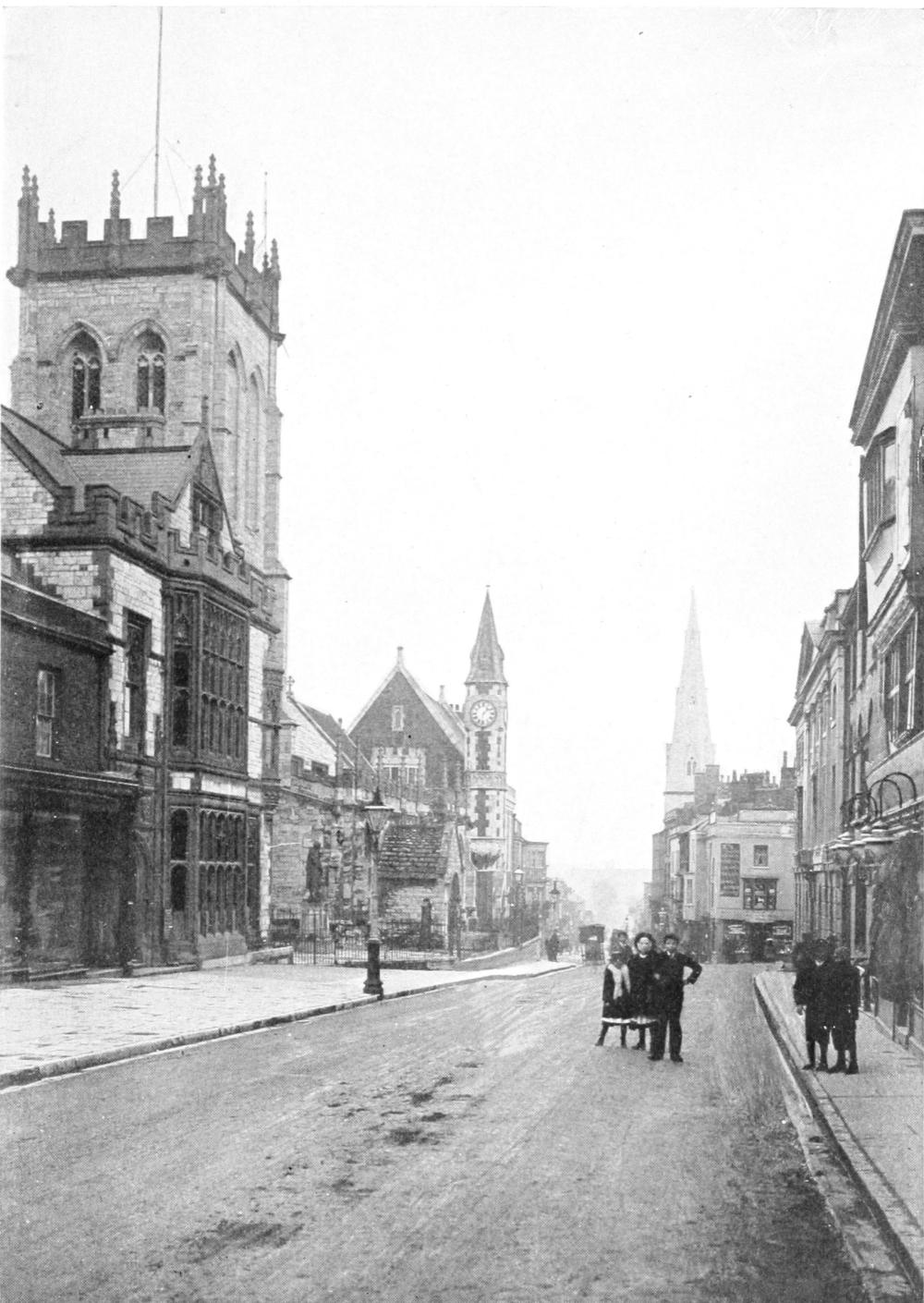
High Street, Dorchester.
The reign of Edward III. experienced the terror of the Great Plague, carried from China over Asia to Europe, where literally millions of people perished. It burst into England, alas! from a ship which put in at the Dorset shore, and no doubt our town owed to that awful scourge the low state of industry recorded a little later. Things had mended by the time of Henry VI., and from then, upon the whole, the place has been prosperous. In the seventeenth century it was busy with cloth-making and, as now, with the brewing of beer. In the old times of farming it was a great centre of grain commerce. Stories are told of Dorchester fair-days, when wheat-laden wagons stood ranged in long file from Cornhill, along South Street, and far out upon the Weymouth road.
The town had its troubles in “the great century.” In August, 1613, a fierce fire swept it almost clean away. The old churches of Trinity and All Saints vanished, with nearly every other building within the walls (and some outside their circuit, in Fordington), save only St. Peter’s and the houses near it—among which would be that now almost solitary relic of picturesque Old Dorchester, “Jeffreys’ lodgings.”
But the rebuilding must have been energetic, for in the Civil Wars we find Dorchester populous and active enough to be a troublesome focus of “malignity.” “A place more entirely disaffected to the King, England had not,” says Clarendon. One probable cause of this attitude lay in the commanding influence of John White, Rector of Holy Trinity from 1606 to 1648. White was an Oxonian, a man of culture and piety, and evidently of strong personal influence. Preachers to-day may envy, if they please, the pulpit privileges given him by the town. The borough records show, for example, that in 1630 one Nycholls was brought to justice for having “offered speeche concerning Mr. John White’s preaching.” White helped to plan the colony of Massachusetts, but he did not join the emigration. His power was felt at home, in the Westminster Assembly, and in the politics of Dorchester.
In 1642 the walls were solidly repaired, and outside works thrown up at, among other points, Maumbury Ring. Watch was kept day and night at the gates and on St. Peter’s Tower. But the spirit of the town strangely failed when, on the approach of the enemy, one Master Strode predicted that the walls would hold off the King’s men for just half-an-hour. The Governor, Sir Walter Erle, hearing that Lord Carnarvon was coming with two thousand men, and Prince Maurice’s artillery besides, promptly left the place, and the citizens opened the gates on a promise that they should be spared violence. Carnarvon would have kept the promise with chivalrous fidelity, but Maurice let his men loose, and Dorchester was so badly handled that Carnarvon threw up his command and went to serve the King in person. A little later the town behaved much more bravely, and baffled a small Irish force under Lord Inchiquin till help from Weymouth completed the rout of the Royalists. Later again Essex occupied the town in force; and then Sir Lewis Dives, for the King, surprised it with brilliant success, but was badly beaten on a second attempt. Yet later there was a skirmish at Dorchester, when the royalist Mercurius says that no less a captain than Cromwell himself was put to flight by Lord Goring; but the account lacks full confirmation. A story of that skirmish clings to a corner of lower Fordington, a curve in the road near Grey’s Bridge, known as Tupp’s, or Tubb’s, Corner; it is said that a Cromwellian hero of that name fled thereby at a speed memorable for all time.
A still darker experience than that of war awaited Dorchester not long after. When Monmouth fought at Sedgemoor (1685) our Dorset peasants were among the bravest of his rude but heroic army. And when the abortive rising was over, the Bloody Assizes began, and Jeffreys sat at Dorchester. His lodgings are still shown, the most striking house-front in the town, with its black timbers and long, low windows; and still, in the Town Hall, is kept the chair from which the terrible Chief Justice, in a court hung with red, dealt out death with grim smiles and ghastly jests. Nearly three hundred men, told that it was their only hope, pleaded guilty, but for most of them the only result was a few days’ respite. Seventy-four were executed at Dorchester, with all the horrible circumstances of death for treason. For years afterwards grim human relics of that evil time still clung to the railings round St. Peter’s, greeting the entering worshippers.
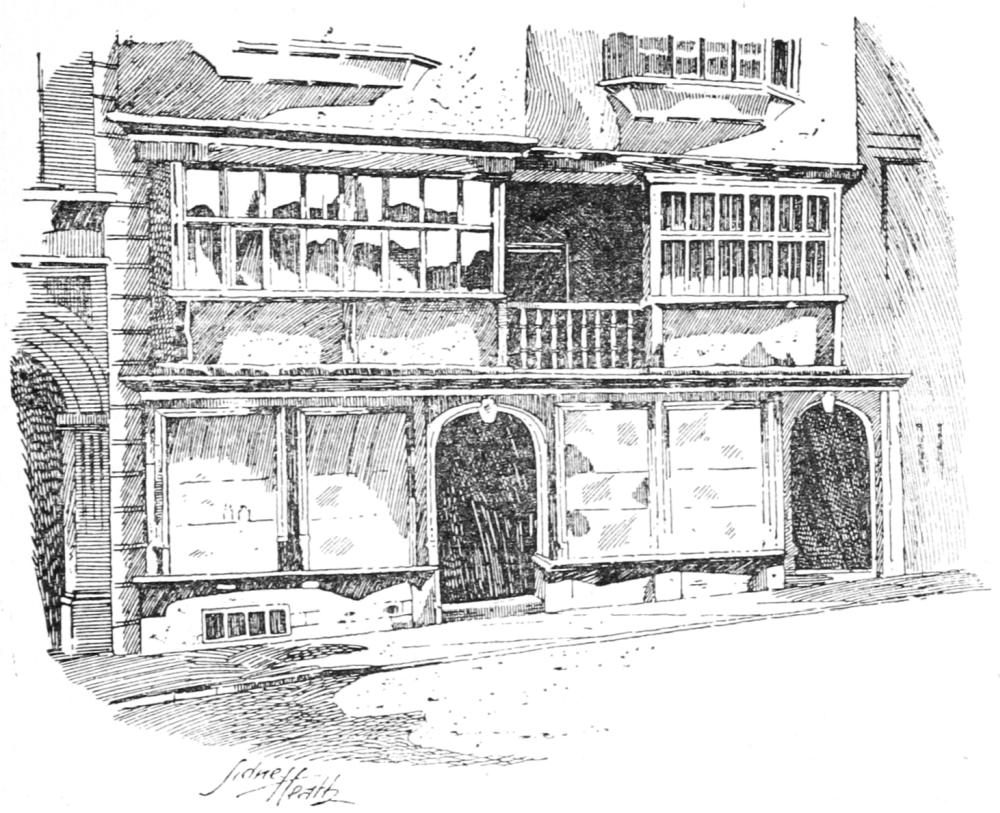
Sidney Heath 1901
Judge Jeffreys’ Lodgings
This was not quite the last scene of horror at Dorchester, though it was alone in its dreadful kind. As late as within the eighteenth century an unhappy woman, convicted of the murder of her husband, was hanged and then burned within Maumbury, amidst a vast gazing multitude.
It is a relief to think that about the same time the town put on a beauty of a sort unique, I think, in England. The walls had somehow largely disappeared within the last half of the seventeenth century; and now it was proposed to plant double rows of trees all along the line of their foundations. By 1712 the planting was complete, and for nearly two complete centuries Dorchester has been surrounded by the noble range of avenues which we call The Walks, renewed from time to time, and kept with increasing care. From close to Glide Path Hill (“Glippath”) the visitor can walk under long successive aisles of sycamores or chestnuts on a well-laid gravel road, now facing east, now south, now west, now north, till he finds himself close to the foot of High Street, within ten minutes of his point of departure. I have seen the noble avenues at King’s Lynn, and those of the Backs at Cambridge are only less dear to me than our Walks. But I do not think that anything even there can quite equal these bowery ramparts of our ancient town—certainly not when we put together the natural charm and the historical interest.
The Walks were still young about the year 1730, when a poet, in the course of a tour from London to Exeter with a group of friends, rode through Dorchester. It was Pope’s intimate, John Gay. The travellers first saw the town, of course, from Stinsford Hill, over a foreground which then, no doubt, was less full of trees. The reaches of the Frome and the broad water-meadows pleased Gay, as well they might, and in his delightful verse-journal we read his impression:
Now the steep hill fair Dorchester o’erlooks, Border’d by meads and wash’d by silver brooks.
In 1762 we find recorded as noteworthy the paving and fencing of a side-walk in the lower High Street; and in 1774 came the first public lighting of the streets. A decade later Miss Burney (Mme. D’Arblay) gives a lively picture of Dorchester as she saw it when travelling in the suite of George III. to Weymouth: “The city had so antique an air, I longed to investigate its old buildings. The houses have the most ancient appearance of any that are inhabited that I have happened to see; and inhabited they were indeed! There was an amazing quantity of indigenous residers—old women and young children,” who, as she shrewdly remarks, could not have come in from a distance, and so formed an index of population. Yet the town could not have counted then more than 3,000 inhabitants. It contains now just 10,500.
We reach at last the nineteenth century. The town, like the county, and like all rural England, was in grave alarm in 1830 at the time of the “rick-burnings.” Mrs. Mary Frampton’s Journal speaks much of the scenes of riot and of wild alarms. I possess letters written by my mother, then the young mistress of Fordington Vicarage,[50] in which she speaks of the nightly watch and ward kept all around, and of her husband’s active share in it, and the relief, under the terrible strain, which was given by the friendly attitude of Fordington towards him. Just later the Frampton Journal describes the battle royal of an election scene on Poundbury (Pummery, as I must be allowed still to call it), when the greatest of all Dorset’s sons, the seventh Earl of Shaftesbury, then Lord Ashley, stood for the county.
That date brings me to times only a little previous to my own memory, and well within the memory of my brothers and friends, and familiar of course to my father, who from 1829 to 1880, as Vicar of Fordington, laboured alike for the spiritual and social good of his parishioners. I may be allowed to close my narrative with a small sheaf of reminiscences from his and other memories. Then, after a brief glance of the mind’s eye over my native town, my task of love is done.
My father knew very old people who “remembered when rooms were first carpeted at Dorchester.” One aged parishioner could recall the change of style in the calendar in 1752; the children were taken to a stile in the Great Field as a memento. He and my mother saw, from Maumbury, about 1832, the Princess Victoria with her mother, passing in their carriage on the way to Weymouth. My brother, since 1880 Bishop in Mid-China, recalls the bringing into the town, in carts, about 1834, of loads of saplings sent to be planted along the London Road; and a noble avenue they made, which now, alas! is no more than a relic of itself.
I just remember the days of the stage coaches in Dorchester. I see the old Emerald still, and hear the bugle of the guard. In 1852 I travelled by coach to Dorchester from Bath. And how vividly I can see the excitement of the crowd on the arrival of the first South-Western train, in 1847! An old woman still runs across my field of view, crying out: “There, I did never zee a coach avore goo wi’out ’osses!” I remember, two years later, Prince Albert’s arrival at the station, where he took carriage for Weymouth, there to lay the first stone of the Breakwater. Very vividly I recall the thousands of lamps festooned along the Walks to illuminate an entertainment for old people after the Crimean peace. Two years earlier, a few weeks before the Alma, I remember the awful outburst of the cholera in Fordington; it was brought from London in tainted clothing which was sent to the wash in a Fordington cottage. My father “stood between the dead and the living” at that dark time, and, with admirable assistance, was able, under God, to bar the pestilence from entering the town.
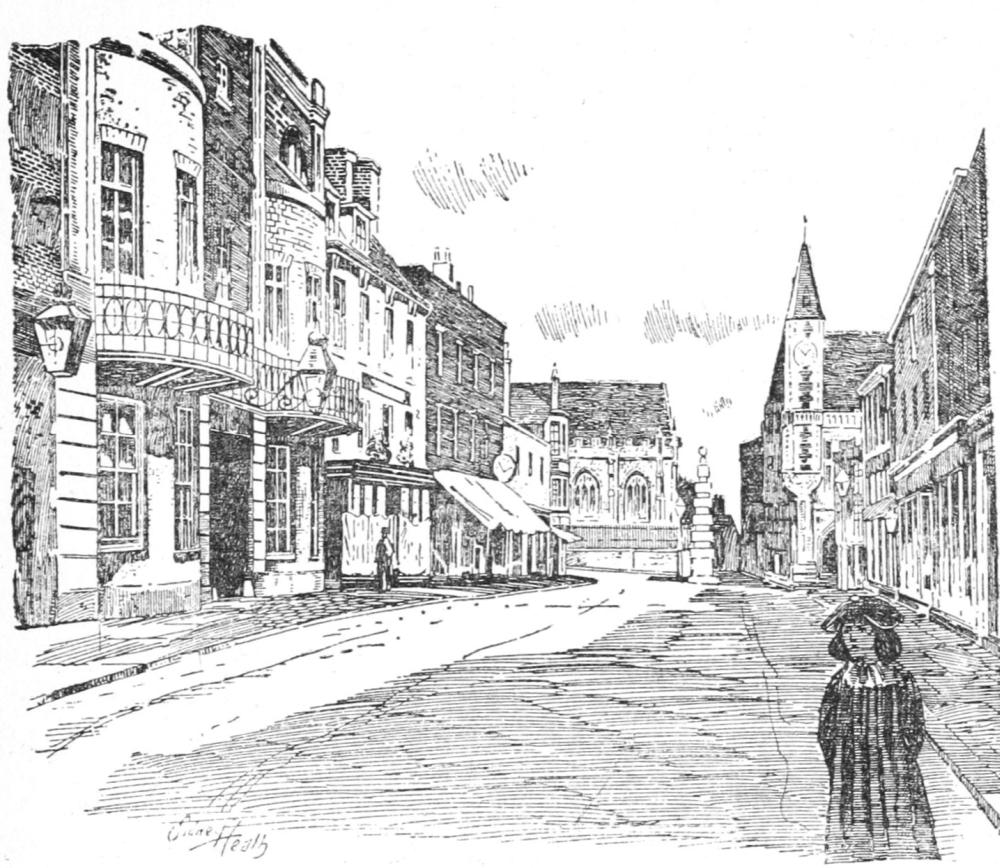
Sidney Heath
Cornhill
But I must not ramble further into narrative. Dorchester, with its integral neighbour, Fordington (incorporated into the borough in 1835), is very dear to my heart, and it is not easy to put narrow limits upon reminiscence. Yet scarcely a word has been said here about our chief architectural features of the place. I have but named Trinity Church, the third structure in succession to that which perished in 1613, as All Saints’ Church is the second in like sequence—All Saints’, whose fine spire, raised in 1852, gave a wholly new feature to the town. St. Peter’s is the ecclesiastical crown of Dorchester—a noble Perpendicular church, with a dignified tower, vocal with eight fine bells; in its churchyard stands a bronze statue of our Dorset poet, William Barnes. At the head of High Street, where the tree-vaulted Bridport road runs out westward, stands the modern St. Mary’s, the church of West Fordington; the pretty original church, Christ Church, now the chapel of the Artillery Barracks, was built by my father’s efforts in 1847, when the parish was divided from old Fordington. The County Hall and Town Hall are leading features of the High Street. The present Town Hall, in 1849, took the place of a building visible still to my memory, under which opened an archway leading into North Square, and which itself succeeded, in 1791, “The Cupola,” near the Town Pump. The Museum, where my brother, Henry Moule, long superintended and developed the excellent geological and antiquarian collections, is a handsome modern feature of the middle High Street; it stands at a point where, almost within the oldest living memory, projecting houses so narrowed the roadway that the stage-coach could pass up and down only with great caution. The County Hospital, founded in 1841, has grown into abundant usefulness, and makes, with its beautiful little chapel, a dignified feature of the place. In South Street the quaint front of the “Napper’s Mite” almshouses, and the Grammar School, are conspicuous.
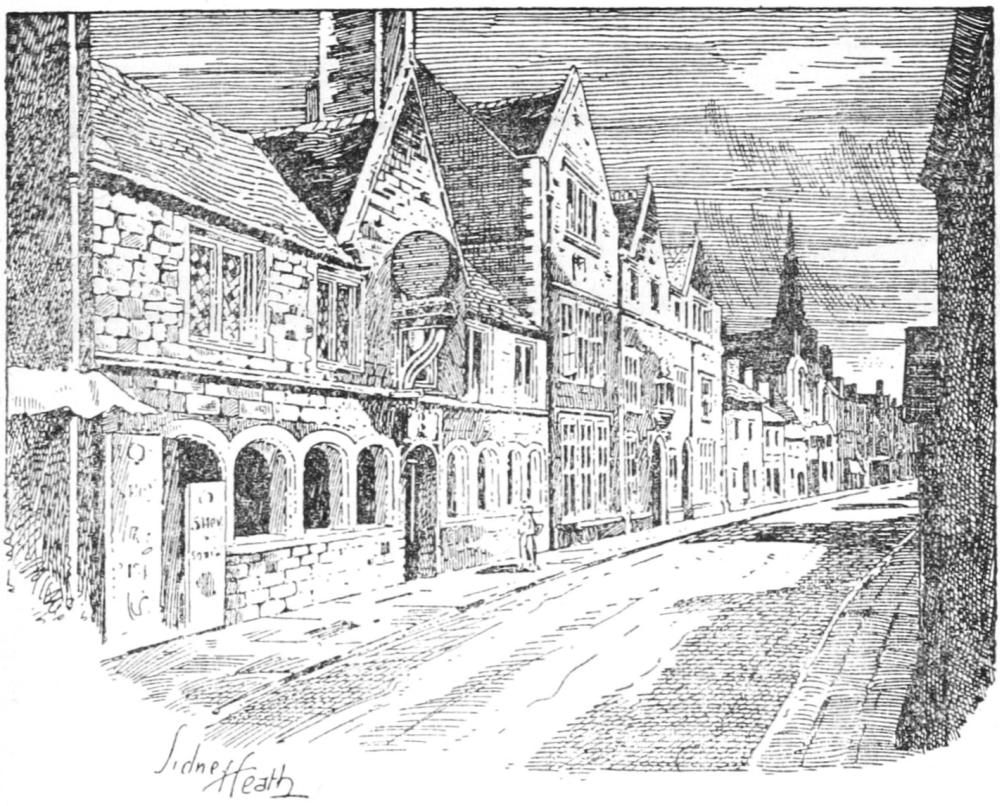
Sidney Heath
“Napper’s Mite”
With Fordington Church, St. George’s, let me close. As I write[51] it is about to be largely rebuilt, for Fordington has grown fast; and the north aisle of 1833 is, indeed, very far from beautiful. But, whilst I rejoice that space and form should be added to the church, my mind must still and always see it as it was, with its simple chancel of 1750; its rude, partly Norman, north aisle; its pulpit of 1592, now approached by a rood-stair re-opened in 1863; its remarkable eleventh century tympanum at the south door, which shows (probably) St. George routing the Saracens at Antioch, in armour of the Bayeux type; and its very noble fifteenth century tower, a model of proportion. Let us climb that tower, by the stairs familiar to me all my days, and from it bid farewell to Dorchester. Beautiful is the prospect, near and far. Below us lies the spacious churchyard, a burial-place, in parts, ever since the Roman period. Westward you see Dorchester, tower, spire, and bowery Walks, with Poundbury beyond them. South-westward lies expanded the vast field of Fordington, which till 1870 was unbroken by fence, and was tilled by the farmers on a system of annual exchange, older, probably, than the Christian era. Beyond it stretches the green, massive rampart of Maiden Castle, and, more distant still, the aerial dome of Blackdown, crowned by the monumental tower which commemorates Nelson’s Hardy. North-westward we can almost see beautiful Wolfeton House, cradle of the greatness of the Bedfords. Northward, we look down on the roofs and lanes of dear old Fordington; and eastward lie the long, fair levels of the Swingbridge meadows, where Frome is sluiced into hundreds of channels, bright with living water. The bowery slopes of Stinsford and Kingston flank the meadows; and then, eastward, the broad valley leads the eye away to the vanishing yet abiding line of the Purbecks, a cloud of tenderest blue. South-eastward, over the village and its bartons, the woods of Came appear, and the sea-ridge runs above them with its long line of Danish burial-mounds. Almost in sight are Max Gate, the home of Mr. Hardy, our renowned novelist, and the thatched roof of Came Rectory, once the home of our poet, William Barnes—deep student, true pastor, clear and tender seer of nature and of man.
O fields and streams, another race Already comes to take our place, To claim their right in you, Our homes to hold, our walks to rove— But who shall love you with our love, Shall know you as we knew?