Chapter XLII
Reading edition
publication of the heart of mid-lothian. — its reception in edinburgh and in england. — abbotsford in october. — melrose abbey, dryburgh, etc. — lion-hunters from america. — tragedy of the cherokee lovers. — scott's dinner to the selkirkshire yeomen.
1818.
"Now for it, dear Mr. Scott. I can speak to the purpose, as I have not only read it myself, but am in a house where everybody is tearing it out of each other's hands, and talking of nothing else. So much for its success—the more flattering, because it overcomes a prejudice. People were beginning to say the author would wear himself out; it was going on too long in the same key, and no striking notes could possibly be produced. On the contrary, I think the interest is stronger here than in any of the former ones—(always excepting my first-love Waverley)—and one may congratulate you upon having effected what many have tried to do, and nobody yet succeeded in, making the perfectly good character the most interesting. Of late days, especially since it has been the fashion to write moral and even religious novels, one might almost say of some of the wise good heroines, what a lively girl once said to [me] of her well-meaning aunt—'Upon my word she is enough to make anybody wicked.' And though beauty and talents are heaped on the right side, the writer, in spite of himself, is sure to put agreeableness on the wrong; the person from whose errors he means you should take warning, runs away with your secret partiality in the mean time. Had this very story been conducted by a common hand, Effie would have attracted all our concern and sympathy—Jeanie only cold approbation. Whereas Jeanie, without youth, beauty, genius, warm passions, or any other novel-perfection, is here our object from beginning to end. This is 'inlisting the affections in the cause of virtue' ten times more than ever Richardson did; for whose male and female pedants, all-excelling as they are, I never could care half so much as I found myself inclined to do for Jeanie before I finished the first volume....
"You know I tell you my opinion just as I should do to a third person, and I trust the freedom is not unwelcome. I was a little tired of your Edinburgh lawyers in the introduction; English people in general will be more so, as well as impatient of the passages alluding to Scotch law throughout. Mr. Saddletree will not entertain them. The latter part of the fourth volume unavoidably flags to a certain degree; after Jeanie is happily settled at Roseneath, we have no more to wish for. But the chief fault I have to find relates to the reappearance and shocking fate of the boy. I hear on all sides, 'Oh, I do not like that!' I cannot say what I would have had instead; but I do not like it either; it is a lame, huddled conclusion. I know you so well in it, by the bye!—you grow tired yourself, want to get rid of the story, and hardly care how. Sir George Staunton finishes his career very fitly; he ought not to die in his bed, and for Jeanie's sake one would not have him hanged. It is unnatural, though, that he should ever have gone within twenty miles of the Tolbooth, or shown his face in the streets of Edinburgh, or dined at a public meeting, if the Lord Commissioner had been his brother. Here ends my per contra account. The opposite page would make my letter too long if I entered equally into particulars. Carlisle and Corby Castles in Waverley did not affect me more deeply than the prison and trial scenes. The end of poor Madge Wildfire is also most pathetic. The meeting at Muschat's Cairn tremendous. Dumbiedikes and Rory Bean are delightful. And I shall own that my prejudices were secretly gratified by the light in which you place [Uncle] John of Argyle, whom Mr. Coxe so ran down to please Lord Orford. You have drawn him to the very life. I heard so much of him in my youth, so many anecdotes, so often 'as the Duke of Argyle used to say'—that I really believe I am almost as good a judge as if I had seen and lived with him.... [My beloved mother] has told me, that when she married, [in 1737, the very time], he was still remarkably handsome; with manners more graceful and engaging than she ever saw in any one else; the most agreeable person in conversation, the best teller of a story. When fifty-seven thus captivates eighteen, the natural powers of pleasing must be extraordinary. You have likewise colored Queen Caroline exactly right—but I was bred up in another creed about Lady Suffolk, of whom, as a very old deaf woman, I have some faint recollection. [My mother] knew her intimately, and never would allow she had been the King's mistress, though she owned it was currently believed. She said he had just enough liking for her to make the Queen very civil to her, and very jealous and spiteful; the rest remained always uncertain at most, like a similar scandal in our days, where I, for one, imagine love of seeming influence on one side, and love of lounging, of an easy house and a good dinner on the other, to be all the criminal passions concerned. However, I confess, [my mother] had that in herself which made her not ready to think the worst of her fellow-women.
"[Amongst the persons most pleased here is Lady Charlotte Lindsay. She has the true North humor, and love of humor, and she does enjoy it heartily. They] have, to help [them], an exemplification on two legs in [their] country apothecary, whom you have painted over and over without the honor of knowing him; an old, dry, arguing, prosing, obstinate Scotchman, very shrewd, rather sarcastic, a sturdy Whig and Presbyterian, tirant un peu sur le démocrate. Your books are birdlime to him, however; he hovers about the house to obtain a volume when others have done with it. I long to ask him whether Douce Davie was any way sib to him. He acknowledges he would not now go to Muschat's Cairn at night for any money—he had such a horror of it 'sixty years ago' when a laddie. But I am come to the end of my fourth page, and will not tire you with any more scribbling....
"P. S.—If I had known nothing, and the whole world had told me the contrary, I should have found you out in that one parenthesis,—'for the man was mortal, and had been a schoolmaster.'"
In the introduction and notes to The Heart of Mid-Lothian, drawn up in 1830, we are presented with details concerning the suggestion of the main plot, and the chief historical incidents made use of, to which I can add nothing of any moment.
The 12th of July restored the author as usual to the supervision of his trees and carpenters; but he had already told the Ballantynes that the story which he had found it impossible to include in the recent series of Jedediah should be forthwith taken up as the opening one of a third; and instructed John to embrace the first favorable opportunity of offering Constable the publication of this, on the footing of 10,000 copies again forming the first edition; but now at length without any more stipulations connected with the unfortunate "old stock" of the Hanover Street Company.
Before he settled himself to his work, however, he made a little tour of the favorite description with his wife and children—halting for a few days at Drumlanrig, thence crossing the Border to Carlisle and Rokeby, and returning by way of Alnwick. On the 17th August he writes thus to John Ballantyne from Drumlanrig: "This is heavenly weather, and I am making the most of it, as I shall have a laborious autumn before me. I may say of my head and fingers as the farmer of his mare, when he indulged her with an extra feed,—
'Ye ken that Maggie winna sleep For that or Simmer.'
We have taken our own horses with us, and I have my pony, and ride when I find it convenient."
The following seems to have been among the first letters he wrote after his return:—
TO J. B. S. MORRITT, ESQ., M. P., ROKEBY.
Abbotsford, 10th September, 1818.
My dear Morritt,—We have been cruising to and fro since we left your land of woods and streams. Lord Melville wished me to come and stay two days with him at Melville Castle, which has broken in upon my time a little, and interrupted my purpose of telling you as how we arrived safe at Abbotsford, without a drop of rain, thus completing a tour of three weeks in the same fine weather in which we commenced it—a thing which never fell to my lot before. Captain Ferguson is inducted into the office of Keeper of the Regalia, to the great joy, I think, of all Edinburgh. He has entered upon a farm (of eleven acres) in consequence of this advancement, for you know it is a general rule, that whenever a Scotsman gets his head above water, he immediately turns it to land. As he has already taken all the advice of all the notables in and about the good village of Darnick, we expect to see his farm look like a tailor's book of patterns, a snip of every several opinion which he has received occupying its appropriate corner. He is truly what the French call un drôle de corps.
I wish you would allow your coachman to look out for me among your neighbors a couple of young colts (rising three would be the best age) that would match for a carriage some two years hence. I have plenty of grass for them in the mean while, and should never know the expense of their keep at Abbotsford. He seemed to think he could pick them up at from £25 to £30, which would make an immense saving hereafter. Peter Matheson and he had arranged some sort of plan of this kind. For a pair of very ordinary carriage-horses in Edinburgh they ask £140 or more; so it is worth while to be a little provident. Even then you only get one good horse, the other being usually a brute. Pray you excuse all this palaver,—
"These little things are great to little men."
Our harvest is almost all in, but as farmers always grumble about something, they are now growling about the lightness of the crop. All the young part of our household are wrapt up in uncertainty concerning the Queen's illness—for—if her Majesty parts cable, there will be no Forest Ball, and that is a terrible prospect. On Wednesday (when no post arrives from London) Lord Melville chanced to receive a letter with a black seal by express, and as it was of course argued to contain the expected intelligence of poor Charlotte, it sold a good many ells of black cloth and stuffs before it was ascertained to contain no such information. Surely this came within the line of high treason, being an imagining of the Queen's death.
Ever yours truly, Walter Scott.
P. S.—Once more anent the colts. I am indifferent about color; but, cæteris paribus, would prefer black or brown, to bright bay or gray. I mention two off—as the age at which they can be best judged of by the buyer.
Of the same date I find written in pencil, on what must have been the envelope of some sheriff's-process, this note, addressed to Mr. Charles Erskine, the Sheriff-Substitute of Selkirkshire:—
September 10, 1818.
Dear Charles,—I have read these papers with all attention this morning—but think you will agree with me that there must be an Eke to the Condescendence. Order the Eke against next day.—Tom leaves with this packet a blackcock, and (more's the pity) a gray hen. Yours,
W. S.
And again he thus writes by post to James Ballantyne:
Abbotsford, September 10, 1818.
Dear James,—I am quite satisfied with what has been done as to the London bills. I am glad the presses move. I have been interrupted sadly since my return by tourist gazers. This day a confounded pair of Cambridge boys have robbed me of two good hours, and you of a sheet of copy—though whether a good sheet or no, deponent saith not. The story is a dismal one, and I doubt sometimes whether it will bear working out to much length after all. Query, if I shall make it so effective in two volumes as my mother does in her quarter of an hour's crack by the fireside? But nil desperandum. You shall have a bunch to-morrow or next day—and when the proofs come in, my pen must and shall step out. By the bye, I want a supply of pens—and ditto of ink. Adieu for the present, for I must go over to Toftfield, to give orders anent the dam and the footpath, and see item as to what should be done anent steps at the Rhymer's Waterfall, which I think may be made to turn out a decent bit of a linn, as would set True Thomas his worth and dignity. Ever yours,
W. S.
It must, I think, be allowed that these careless scraps, when combined, give a curious picture of the man who was brooding over the first chapters of The Bride of Lammermoor. One of his visitors of that month was Mr. R. Cadell, who was of course in all the secrets of the house of Constable; and observing how his host was harassed with lion-hunters, and what a number of hours he spent daily in the company of his work-people, he expressed, during one of their walks, his wonder that Scott should ever be able to write books at all while in the country. "I know," he said, "that you contrive to get a few hours in your own room, and that may do for the mere pen-work; but when is it that you think?" "Oh," said Scott, "I lie simmering over things for an hour or so before I get up—and there's the time I am dressing to overhaul my half-sleeping, half-waking projet de chapitre—and when I get the paper before me, it commonly runs off pretty easily.—Besides, I often take a doze in the plantations, and while Tom marks out a dyke or a drain as I have directed, one's fancy may be running its ain riggs in some other world."
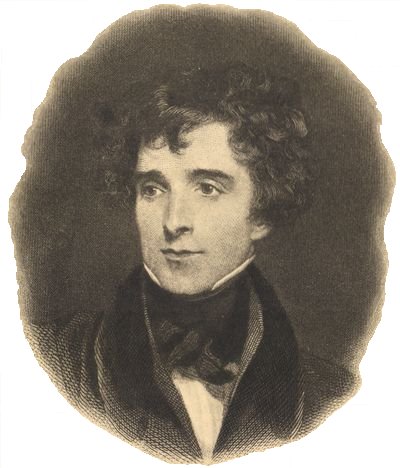
JOHN GIBSON LOCKHART After the painting by Pickersgill.
At length we drew near Peterhouse, and found sober Peter himself, and his brother-in-law, the facetious factotum Tom Purdie, superintending, pipe in mouth, three or four sturdy laborers busy in laying down the turf for a bowling-green. "I have planted hollies all round it, you see," said Scott, "and laid out an arbor on the right-hand side for the laird; and here I mean to have a game at bowls after dinner every day in fine weather—for I take that to have been among the indispensables of our old vie de château." But I must not forget the reason he gave me some time afterwards for having fixed on that spot for his bowling-green. "In truth," he then said, "I wished to have a smooth walk, and a canny seat for myself within ear-shot of Peter's evening psalm." The coachman was a devout Presbyterian, and many a time have I in after-years accompanied Scott on his evening stroll, when the principal object was to enjoy, from the bowling-green, the unfailing melody of this good man's family worship—and heard him repeat, as Peter's manly voice led the humble choir within, that beautiful stanza of Burns's Saturday Night:—
"They chaunt their artless notes in simple guise; They tune their hearts, by far the noblest aim," etc.
I had never before seen Scott in such buoyant spirits as he showed this evening—and I never saw him in higher afterwards; and no wonder, for this was the first time that he, Lord Melville, and Adam Ferguson, daily companions at the High School of Edinburgh, and partners in many joyous scenes of the early volunteer period, had met since the commencement of what I may call the serious part of any of their lives. The great poet and novelist was receiving them under his own roof, when his fame was at its acme, and his fortune seemed culminating to about a corresponding height—and the generous exuberance of his hilarity might have overflowed without moving the spleen of a Cynic. Old stories of the Yards and the Cross-causeway were relieved by sketches of real warfare, such as none but Ferguson (or Charles Mathews, had he been a soldier) could ever have given; and they toasted the memory of Green-breeks and the health of the Beau with equal devotion.
When we rose from table, Scott proposed that we should all ascend his western turret, to enjoy a moonlight view of the valley. The younger part of his company were too happy to do so: some of the seniors, who had tried the thing before, found pretexts for hanging back. The stairs were dark, narrow, and steep; but the Sheriff piloted the way, and at length there were as many on the top as it could well afford footing for. Nothing could be more lovely than the panorama; all the harsher and more naked features being lost in the delicious moonlight; the Tweed and the Gala winding and sparkling beneath our feet; and the distant ruins of Melrose appearing, as if carved of alabaster, under the black mass of the Eildons. The poet, leaning on his battlement, seemed to hang over the beautiful vision as if he had never seen it before. "If I live," he exclaimed, "I will build me a higher tower, with a more spacious platform, and a staircase better fitted for an old fellow's scrambling." The piper was heard re-tuning his instrument below, and he called to him for Lochaber no More. John of Skye obeyed, and as the music rose, softened by the distance, Scott repeated in a low key the melancholy words of the song of exile.
On descending from the tower, the whole company were assembled in the new dining-room, which was still under the hands of the carpenters, but had been brilliantly illuminated for the occasion. Mr. Bruce took his station, and old and young danced reels to his melodious accompaniment until they were weary, while Scott and the Dominie looked on with gladsome faces, and beat time now and then, the one with his staff, the other with his wooden leg. A tray with mulled wine and whiskey punch was then introduced, and Lord Melville proposed a bumper, with all the honors, to the Roof-tree. Captain Ferguson having sung Johnnie Cope, called on the young ladies for Kenmure's On and Awa'; and our host then insisted that the whole party should join, standing in a circle hand-in-hand more majorum, in the hearty chorus of
"Weel may we a' be, Ill may we never see, God bless the king and the gude companie!"
—which being duly performed, all dispersed. Such was the handsel (for Scott protested against its being considered as the house-heating) of the new Abbotsford.
While this criticism proceeded, Scott was cutting away at his brown loaf and a plate of kippered salmon, in a style which strongly reminded me of Dandie Dinmont's luncheon at Mump's Hall; nor was his German topic at all the predominant one. On the contrary, the sentences which have dwelt on my memory dropt from him now and then, in the pauses, as it were, of his main talk;—for though he could not help recurring, ever and anon, to the subject, it would have been quite out of his way to make any literary matter the chief theme of his conversation, when there was a single person present who was not likely to feel much interested in its discussion.—How often have I heard him quote on such occasions Mr. Vellum's advice to the butler in Addison's excellent play of The Drummer: "Your conjuror, John, is indeed a twofold personage—but he eats and drinks like other people!"
I may, however, take this opportunity of observing, that nothing could have been more absurdly unfounded than the statement which I have seen repeated in various sketches of his Life and Manners, that he habitually abstained from conversation on literary topics. In point of fact, there were no topics on which he talked more openly or more earnestly; but he, when in society, lived and talked for the persons with whom he found himself surrounded, and if he did not always choose to enlarge upon the subjects which his companions for the time suggested, it was simply because he thought or fancied that these had selected, out of deference or flattery, subjects about which they really cared little more than they knew. I have already repeated, over and again, my conviction that Scott considered literature, per se, as a thing of far inferior importance to the high concerns of political or practical life; but it would be too ridiculous to question that literature nevertheless engrossed, at all times and seasons, the greater part of his own interest and reflection: nor can it be doubted that his general preference of the society of men engaged in the active business of the world, rather than that of, so-called, literary people, was grounded substantially on his feeling that literature, worthy of the name, was more likely to be fed and nourished by the converse of the former than by that of the latter class.
Before breakfast was over, the post-bag arrived, and its contents were so numerous, that Lord Melville asked Scott what election was on hand—not doubting that there must be some very particular reason for such a shoal of letters. He answered that it was much the same most days, and added, "though no one has kinder friends in the franking line, and though Freeling and Croker especially are always ready to stretch the point of privilege in my favor, I am nevertheless a fair contributor to the revenue, for I think my bill for letters seldom comes under £150 a year; and as to coach-parcels, they are a perfect ruination." He then told with high merriment a disaster that had lately befallen him. "One morning last spring," he said, "I opened a huge lump of a despatch, without looking how it was addressed, never doubting that it had travelled under some omnipotent frank like the First Lord of the Admiralty's, when, lo and behold, the contents proved to be a MS. play, by a young lady of New York, who kindly requested me to read and correct it, equip it with prologue and epilogue, procure for it a favorable reception from the manager of Drury Lane, and make Murray or Constable bleed handsomely for the copyright; and on inspecting the cover, I found that I had been charged five pounds odd for the postage. This was bad enough—but there was no help, so I groaned and submitted. A fortnight or so after, another packet, of not less formidable bulk, arrived, and I was absent enough to break its seal, too, without examination. Conceive my horror when out jumped the same identical tragedy of The Cherokee Lovers, with a second epistle from the authoress, stating that, as the winds had been boisterous, she feared the vessel entrusted with her former communication might have foundered, and therefore judged it prudent to forward a duplicate."
Scott said he must retire to answer his letters, but that the sociable and the ponies would be at the door by one o'clock, when he proposed to show Melrose and Dryburgh to Lady Melville and any of the rest of the party that chose to accompany them; adding that his son Walter would lead anybody who preferred a gun to the likeliest place for a blackcock, and that Charlie Purdie (Tom's brother) would attend upon Mr. Wilson, and whoever else chose to try a cast of the salmon-rod. He withdrew when all this was arranged, and appeared at the time appointed, with perhaps a dozen letters sealed for the post, and a coach-parcel addressed to James Ballantyne, which he dropt at the turnpike-gate as we drove to Melrose. Seeing it picked up by a dirty urchin, and carried into a hedge pot-house, where half-a-dozen nondescript wayfarers were smoking and tippling, I could not but wonder that it had not been the fate of some one of those innumerable packets to fall into unscrupulous hands, and betray the grand secret. That very morning we had seen two post-chaises drawn up at his gate, and the enthusiastic travellers, seemingly decent tradesmen and their families, who must have been packed in a manner worthy of Mrs. Gilpin, lounging about to catch a glimpse of him at his going forth. But it was impossible in those days to pass between Melrose and Abbotsford without encountering some odd figure, armed with a sketch-book, evidently bent on a peep at the Great Unknown; and it must be allowed that many of these pedestrians looked as if they might have thought it very excusable to make prize, by hook or by crook, of a MS. chapter of the Tales of my Landlord.
Scott showed us the ruins of Melrose in detail; and as we proceeded to Dryburgh, descanted learnedly and sagaciously on the good effects which must have attended the erection of so many great monastic establishments in a district so peculiarly exposed to the inroads of the English in the days of the Border wars. "They were now and then violated," he said, "as their aspect to this hour bears witness; but for once that they suffered, any lay property similarly situated must have been harried a dozen times. The bold Dacres, Liddells, and Howards, that could get easy absolution at York or Durham for any ordinary breach of a truce with the Scots, would have had to dree a heavy dole had they confessed plundering from the fat brothers, of the same order perhaps, whose lines had fallen to them on the wrong side of the Cheviot." He enlarged, too, on the heavy penalty which the Crown of Scotland had paid for its rash acquiescence in the wholesale robbery of the Church at the Reformation. "The proportion of the soil in the hands of the clergy had," he said, "been very great—too great to be continued. If we may judge by their share in the public burdens, they must have had nearly a third of the land in their possession. But this vast wealth was now distributed among a turbulent nobility, too powerful before; and the Stuarts soon found, that in the bishops and lord abbots they had lost the only means of balancing their factions, so as to turn the scale in favor of law and order; and by and by the haughty barons themselves, who had scrambled for the worldly spoil of the church, found that the spiritual influence had been concentrated in hands as haughty as their own, and connected with no feelings likely to buttress their order any more than the Crown—a new and sterner monkery, under a different name, and essentially plebeian. Presently the Scotch were on the verge of republicanism, in state as well as kirk, and I have sometimes thought it was only the accession of King Jamie to the throne of England that could have given monarchy a chance of prolonging its existence here." One of his friends asked what he supposed might have been the annual revenue of the abbey of Melrose in its best day. He answered that he suspected, if all the sources of their income were now in clever hands, the produce could hardly be under £100,000 a year; and added: "Making every allowance for modern improvements, there can be no question that the sixty brothers of Melrose divided a princely rental. The superiors were often men of very high birth, and the great majority of the rest were younger brothers of gentlemen's families. I fancy they may have been, on the whole, pretty near akin to your Fellows of All Souls—who, according to their statute, must be bene nati, bene vestiti, et mediocriter docti. They had a good house in Edinburgh, where, no doubt, my lord abbot and his chaplains maintained a hospitable table during the sittings of Parliament." Some one regretted that we had no lively picture of the enormous revolution in manners that must have followed the downfall of the ancient Church in Scotland. He observed that there were, he fancied, materials enough for constructing such a one, but that they were mostly scattered in records—"of which," said he, "who knows anything to the purpose except Tom Thomson and John Riddell? It is common to laugh at such researches, but they pay the good brains that meddle with them;—and had Thomson been as diligent in setting down his discoveries as he has been in making them, he might, long before this time of day, have placed himself on a level with Ducange or Camden. The change in the country-side," he continued, "must indeed have been terrific; but it does not seem to have been felt very severely by a certain Boniface of St. Andrews, for when somebody asked him, on the subsidence of the storm, what he thought of all that had occurred,—'Why,' answered mine host, 'it comes to this, that the moderautor sits in my meikle chair, where the dean sat before, and in place of calling for the third stoup of Bordeaux, bids Jenny bring ben anither bowl of toddy.'"
At Dryburgh, Scott pointed out to us the sepulchral aisle of his Haliburton ancestors, and said he hoped, in God's appointed time, to lay his bones among their dust. The spot was, even then, a sufficiently interesting and impressive one; but I shall not say more of it at present.
On returning to Abbotsford, we found Mrs. Scott and her daughters doing penance under the merciless curiosity of a couple of tourists who had arrived from Selkirk soon after we set out for Melrose. They were rich specimens—tall, lanky young men, both of them rigged out in new jackets and trousers of the Macgregor tartan; the one, as they had revealed, being a lawyer, the other a Unitarian preacher, from New England. These gentlemen, when told on their arrival that Mr. Scott was not at home, had shown such signs of impatience, that the servant took it for granted they must have serious business, and asked if they would wish to speak a word with his lady. They grasped at this, and so conducted themselves in the interview, that Mrs. Scott never doubted they had brought letters of introduction to her husband, and invited them accordingly to partake of her luncheon. They had been walking about the house and grounds with her and her daughters ever since that time, and appeared at the porch, when the Sheriff and his party returned to dinner, as if they had been already fairly enrolled on his visiting list. For the moment, he too was taken in—he fancied that his wife must have received and opened their credentials—and shook hands with them with courteous cordiality. But Mrs. Scott, with all her overflowing good-nature, was a sharp observer; and she, before a minute had elapsed, interrupted the ecstatic compliments of the strangers, by reminding them that her husband would be glad to have the letters of the friends who had been so good as to write by them. It then turned out that there were no letters to be produced—and Scott, signifying that his hour for dinner approached, added, that as he supposed they meant to walk to Melrose, he could not trespass further on their time. The two lion-hunters seemed quite unprepared for this abrupt escape. But there was about Scott, in perfection, when he chose to exert it, the power of civil repulsion; he bowed the overwhelmed originals to his door, and on reëntering the parlor, found Mrs. Scott complaining very indignantly that they had gone so far as to pull out their note-book, and beg an exact account, not only of his age—but of her own. Scott, already half relenting, laughed heartily at this misery. He observed, however, that, "if he were to take in all the world, he had better put up a sign-post at once,—
and that no traveller of respectability could ever be at a loss for such an introduction as would insure his best hospitality." Still he was not quite pleased with what had happened—and as we were about to pass, half an hour afterwards, from the drawing-room to the dining-room, he said to his wife, "Hang the Yahoos, Charlotte—but we should have bid them stay dinner." "Devil a bit," quoth Captain John Ferguson, who had again come over from Huntly Burn, and had been latterly assisting the lady to amuse her Americans, "Devil a bit, my dear,—they were quite in a mistake, I could see. The one asked Madame whether she deigned to call her new house Tully-Veolan or Tillietudlem; and the other, when Maida happened to lay his nose against the window, exclaimed pro-di-gi-ous! In short, they evidently meant all their humbug not for you, but for the culprit of Waverley, and the rest of that there rubbish." "Well, well, Skipper," was the reply, "for a' that, the loons would hae been nane the waur o' their kail."
From this banter it may be inferred that the younger Ferguson had not as yet been told the Waverley secret—which to any of that house could never have been any mystery. Probably this, or some similar occasion soon afterwards, led to his formal initiation; for during the many subsequent years that the veil was kept on, I used to admire the tact with which, when in their topmost high-jinks humor, both "Captain John" and "The Auld Captain" eschewed any the most distant allusion to the affair.
I remember nothing particular about our second day's dinner, except that it was then I first met my dear and honored friend William Laidlaw. The evening passed rather more quietly than the preceding one. Instead of the dance in the new dining-room, we had a succession of old ballads sung to the harp and guitar by the young ladies of the house; and Scott, when they seemed to have done enough, found some reason for taking down a volume of Crabbe, and read us one of his favorite tales,—
"Grave Jonas Kindred, Sibyl Kindred's sire, Was six feet high, and looked six inches higher," etc.
But jollity revived in full vigor when the supper-tray was introduced; and to cap all merriment, Captain Ferguson dismissed us with The Laird of Cockpen. Lord and Lady Melville were to return to Melville Castle next morning, and Mr. Wilson and I happened to mention that we were engaged to dine and sleep at the seat of my friend and relation, Mr. Pringle of Torwoodlee, on our way to Edinburgh. Scott immediately said that he would send word in the morning to the Laird, that he and Adam Ferguson meant to accompany us—such being the unceremonious style in which country neighbors in Scotland visit each other. Next day, accordingly, we all rode over together to Mr. Pringle's beautiful seat—the "distant Torwoodlee" of The Lay of the Last Minstrel, but distant not above five or six miles from Abbotsford—coursing hares as we proceeded, but inspecting the antiquities of the Catrail to the interruption of our sport. We had another joyous evening at Torwoodlee. Scott and Ferguson returned home at night, and the morning after, as Wilson and I mounted for Edinburgh, our kind old host, his sides still sore with laughter, remarked that "the Sheriff and the Captain together were too much for any company."
There was much talk between the Sheriff and Mr. Pringle about the Selkirkshire Yeomanry Cavalry, of which the latter had been the original commandant. Young Walter Scott had been for a year or more Cornet in the corps, and his father was consulting Torwoodlee about an entertainment which he meant to give them on his son's approaching birthday. It was then that the new dining-room was to be first heated in good earnest; and Scott very kindly pressed Wilson and myself, at parting, to return for the occasion—which, however, we found it impossible to do. The reader must therefore be satisfied with what is said about it in one of the following letters:—
TO J. B. S. MORRITT, ESQ., M. P., ROKEBY.
Abbotsford, 5th November, 1818.
My Dear Morritt,—Many thanks for your kind letter of 29th October. The matter of the colts being as you state, I shall let it lie over until next year, and then avail myself of your being in the neighborhood to get a good pair of four-year-olds, since it would be unnecessary to buy them a year younger, and incur all the risks of disease and accident, unless they could have been had at a proportional under-value.
* * * * * * leaves us this morning after a visit of about a week. He improves on acquaintance, and especially seems so pleased with everything, that it would be very hard to quarrel with him. Certainly, as the Frenchman said, il a un grand talent pour le silence. I take the opportunity of his servant going direct to Rokeby to charge him with this letter, and a plaid which my daughters entreat you to accept of as a token of their warm good wishes. Seriously you will find it a good bosom friend in an easterly wind, a black frost, or when your country avocations lead you to face a dry wap of snow. I find it by far the lightest and most comfortable integument which I can use upon such occasions.
We had a grand jollification here last week;—the whole troop of Forest Yeomanry dining with us. I assure you the scene was gay and even grand, with glittering sabres, waving standards, and screaming bagpipes; and that it might not lack spectators of taste, who should arrive in the midst of the hurricane, but Lord and Lady Compton, whose presence gave a great zest to the whole affair. Everything went off very well, and as cavalry have the great advantage over infantry, that their legs never get drunk, they retired in decent disorder about ten o'clock. I was glad to see Lord and Lady Compton so very comfortable, and surrounded with so fine a family, the natural bond of mutual regard and affection. She has got very jolly, but otherwise has improved on her travels. I had a long chat with her, and was happy to find her quite contented and pleased with the lot she has drawn in life. It is a brilliant one in many respects, to be sure; but still I have seen the story of the poor woman, who, after all rational subjects of distress had been successively remedied, tormented herself about the screaming of a neighbor's peacock—I say, I have seen this so often realized in actual life, that I am more afraid of my friends making themselves uncomfortable, who have only imaginary evils to indulge, than I am for the peace of those who, battling magnanimously with real inconvenience and danger, find a remedy in the very force of the exertions to which their lot compels them.
I sympathize with you for the dole which you are dreeing under the inflictions of your honest proser. Of all the boring machines ever devised, your regular and determined story-teller is the most peremptory and powerful in his operations. This is a rainy day, and my present infliction is an idle cousin, a great amateur of the pipes, who is performing incessantly in the next room for the benefit of a probationary minstrel, whose pipes scream à la distance, as the young hoarse cock-chicken imitates the gallant and triumphant screech of a veteran Sir Chanticleer. Yours affectionately,
W. Scott.[Back to Contents]
APPENDIX
THE DURHAM GARLAND IN THREE PARTS
[The following is the Garland referred to at pages 4 and 26, in connection with the novel of Guy Mannering. The ballad was taken down from the recitation of Mrs. Young of Castle-Douglas, who, as her family informed Mr. Train, had long been in the habit of repeating it over to them once in the year, in order that it might not escape from her memory.]
PART I
1
A worthy Lord of birth and state, Who did in Durham live of late— But I will not declare his name, By reason of his birth and fame.
2
This Lord he did a-hunting go; If you the truth of all would know, He had indeed a noble train, Of Lords and Knights and Gentlemen.
3
This noble Lord he left the train Of Lords and Knights and Gentlemen; And hearing not the horn to blow, He could not tell which way to go.
4
But he did wander to and fro, Being weary, likewise full of woe: At last Dame Fortune was so kind That he the Keeper's house did find.
5
He went and knocked at the door, He thought it was so late an hour. The Forester did let him in, And kindly entertained him.
6
About the middle of the night, When as the stars did shine most bright, This Lord was in a sad surprise, Being wakened by a fearful noise.
7
Then he did rise and call with speed, To know the reason then indeed, Of all that shrieking and those cries Which did disturb his weary eyes.
8
"I'm sorry, Sir," the Keeper said, "That you should be so much afraid; But I do hope all will be well, For my wife she is in travail."
9
The noble Lord was learned and wise, To know the Planets in the skies. He saw one evil Planet reign, He called the Forester again.
10
He gave him then to understand, He'd have the Midwife hold her hand; But he was answered by the maid, "My Mistress is delivered."
11
At one o'clock that very morn, A lovely infant there was born; It was indeed a charming boy, Which brought the man and wife much joy.
12
The Lord was generous, kind, and free, And proffered Godfather to be; The Goodman thanked him heartily For his goodwill and courtesy.
13
A parson was sent for with speed, For to baptize the child indeed; And after that, as I heard say, In mirth and joy they spent the day.
14
This Lord did noble presents give, Which all the servants did receive. They prayed God to enrich his store, For they never had so much before.
15
And likewise to the child he gave A present noble, rich, and brave; It was a charming cabinet, That was with pearls and jewels set.
16
And within it was a chain of gold, Would dazzle eyes for to behold; A richer gift, as I may say, Was not beheld this many a day.
17
He charged his father faithfully, That he himself would keep the key, Until the child could write and read— And then to give him it indeed;—
18
"Pray do not open it at all Whatever should on you befall; For it may do my godson good, If it be rightly understood."
19
This Lord did not declare his name, Nor yet the place from whence he came, But secretly he did depart, And left them grieved to the heart.
PART II
1
The second part I now unfold, As true a story as e'er was told, Concerning of a lovely child, Who was obedient, sweet, and mild.
2
This child did take his learning so, If you the truth of all would know, At eleven years of age indeed, Both Greek and Latin he could read.
3
Then thinking of his cabinet, That was with pearls and jewels set, He asked his father for the key, Which he gave him right speedily;
4
And when he did the same unlock, He was with great amazement struck When he the riches did behold, And likewise saw the chain of gold.
5
But searching farther he did find A paper which disturbed his mind, That was within the cabinet, In Greek and Latin it was writ.
6
My child, serve God that is on high, And pray to him incessantly; Obey your parents, love your king, That nothing may your conscience sting.
7
At seven years hence your fate will be, You must be hanged upon a tree; Then pray to God both night and day, To let that hour pass away.
8
When he these woeful lines did read, He with a sigh did say indeed, "If hanging be my destiny, My parents shall not see me die;
9
"For I will wander to and fro, I'll go where I no one do know; But first I'll ask my parents' leave, In hopes their blessing to receive."
10
Then locking up his cabinet, He went from his own chamber straight Unto his only parents dear, Beseeching them with many a tear
11
That they would grant what he would have— "But first your blessing I do crave, And beg you'll let me go away, 'T will do me good another day."
12
***** ***** "And if I live I will return, When seven years are past and gone."
13
Both man and wife did then reply, "I fear, my son, that we shall die; If we should yield to let you go, Our aged hearts would break with woe."
14
But he entreated eagerly, While they were forced to comply, And give consent to let him go, But where, alas! they did not know.
15
In the third part you soon shall find, That fortune was to him most kind, And after many dangers past, He came to Durham at the last.
PART III
1
He went by chance, as I heard say, To that same house that very day In which his Godfather did dwell; But mind what luck to him befell—
2
This child did crave a service there, On which came out his Godfather, And seeing him a pretty youth, He took him for his Page in truth.
3
Then in this place he pleased so well, That 'bove the rest he bore the bell; This child so well the Lord did please, He raised him higher by degrees.
4
He made him Butler sure indeed, And then his Steward with all speed, Which made the other servants spite, And envy him both day and night.
5
He was never false unto his trust, But proved ever true and just; And to the Lord did hourly pray To guide him still both night and day.
6
In this place, plainly it appears, He lived the space of seven years; His parents then he thought upon, And of his promise to return.
7
Then humbly of his Lord did crave, That he his free consent might have To go and see his parents dear, He had not seen this many a year.
8
Then having leave, away he went, Not dreaming of the false intent That was contrived against him then By wicked, false, deceitful men.
9
They had in his portmanteau put This noble Lord's fine golden cup; That when the Lord at dinner was, The cup was missed as come to pass.
10
"Where can it be?" this Lord did say, "We had it here but yesterday." The Butler then replied with speed, "If you will hear the truth indeed.
11
"Your darling Steward which is gone, With feathered nest away is flown; I'll warrant you he has that, and more That doth belong unto your store."
12
"No," says this Lord, "that cannot be, For I have tried his honesty;" "Then," said the Cook, "my Lord, I die Upon a tree full ten feet high."
13
Then hearing what these men did say, He sent a messenger that day, To take him with a hue and cry, And bring him back immediately.
14
They searched his portmanteau with speed, In which they found the cup indeed; Then was he struck with sad surprise, He could not well believe his eyes.
15
The assizes then were drawing nigh, And he was tried and doomed to die; And his injured innocence Could nothing say in his defense.
16
But going to the Gallows tree, On which he thought to hanged be He clapped his hands upon his breast, And thus in tears these words exprest:—
17
"Blind Fortune will be Fortune still, I see, let man do what he will; For though this day I needs must die, I am not guilty—no, not I."
18
This noble Lord was in amaze, He stood and did with wonder gaze; Then he spoke out with words so mild,— "What mean you by that saying, Child?"
19
"Will that your Lordship," then said he, "Grant one day's full reprieve for me, A dismal story I'll relate, Concerning of my wretched fate."
20
"Speak up, my Child," this Lord did say, "I say you shall not die this day— And if I find you innocent, I'll crown your days with sweet content."
21
He told him all his dangers past, He had gone through from first to last, He fetched the chain and cabinet, Likewise the paper that was writ.
22
When that this noble Lord did see, He ran to him most eagerly, And in his arms did him embrace, Repeating of those words in haste.—
23
"My Child, my Child, how blessed am I Thou art innocent, and shalt not die; For I'm indeed thy Godfather, And thou wast born in fair Yorkshire.
24
"I have indeed one daughter dear, Which is indeed my only heir; And I will give her unto thee, And crown you with felicity."
25
So then the Butler and the Cook ('Twas them that stole the golden cup) Confessed their faults immediately, And for it died deservedly.
26
This goodly youth, as I do hear, Thus raised, sent for his parents dear, Who did rejoice their Child to see— And so I end my Tragedy.[Back to Contents]
NARRATIVE OF THE LIFE OF JAMES ANNESLEY.
(See Note, p. 26.)
"Lord and Lady Altham, of Dunmain, in the county of Wexford, had been for many years married and childless, when, in the year 1715, their warmest hopes and wishes were realized by the birth of an heir to their estates and title. On that joyful evening the hospitality of the house of Dunmain was claimed by a young gentleman travelling from Dublin, named 'Master Richard Fitzgerald,' who joined Lord Altham and his household in drinking the healths of the 'lady in the straw,' and the long expected heir, in the customary groaning drink. It does not appear that Master Fitzgerald was learned in astrology, or practised any branch of the 'Black art,' or that he used any spell with reference to the infant more potent than these hearty libations and sincere good wishes for his future prosperity. Next day, before leaving the hospitable mansion, the little hero of this tale was presented to the stranger, who 'kissed him, and gave the nurse half-a-guinea.'
"Of Fitzgerald we have only to add, that he entered the army and became a distinguished officer in the service of the queen of Hungary, and that twenty-eight years afterwards he returned to Ireland to assist in recovering for his former infantile friend the estates and titles of his ancestors, which had been for many years iniquitously withheld from him.
"Lord and Lady Altham lived unhappily together, and a separation took place soon after the birth of their son. Her Ladyship, shamefully neglected by her husband, resided in England during the remainder of her life, and from disease and poverty was reduced to a state of extreme imbecility both of body and mind.
"James Annesley, the infant son of this unhappy mother, was entrusted, by Lord Altham, to the charge of a woman of indifferent character, named Joan or Juggy Landy. Juggy was a dependent of the family, and lived in a cabin on the estate, about a quarter of a mile from the house of Dunmain. This hut is described as a 'despicable place, without any furniture except a pot, two or three trenchers, a couple of straw beds on the floor,' and 'with only a bush to draw in and out for a door.' Thus humbly and inauspiciously was the boy reared under the care of a nurse, who, however unfortunate or guilty, appears to have lavished upon her young charge the most affectionate attention. From some unexplained cause, however, Juggy Landy incurred the displeasure of Lord Altham, who took the boy from her, and ordered his groom to 'horsewhip her,' and 'to set the dogs upon her,' when she persisted in hovering about the premises to obtain a sight of her former charge.
"Lord Altham now removed with his son to Dublin where he appears to have entered upon a career of the most dissipated and profligate conduct. We find him reduced to extreme pecuniary embarrassment, and his property became a prey to low and abandoned associates; one of whom, a Miss Kennedy, he ultimately endeavored to introduce to society as his wife. This worthless woman must have obtained great ascendancy over his Lordship, as she was enabled to drive James Annesley from his father's protection, and the poor boy became a houseless vagabond, wandering about the streets of Dublin, and procuring a scanty and precarious subsistence 'by running of errands and holding gentlemen's horses.'
"Meantime Lord Altham's pecuniary difficulties had so increased as to induce him to endeavor to borrow money on his reversionary interest in the estates of the Earl of Anglesey, to whom he was heir-at-law. In this scheme he was joined by his brother Captain Annesley, and they jointly succeeded in procuring several small sums of money. But as James Annesley would have proved an important legal impediment to these transactions, he was represented to some parties to be dead; and where his existence could not be denied, he was asserted to be the natural son of his Lordship and of Juggy Landy.
"Lord Altham died in the year 1727, 'so miserably poor that he was actually buried at the public expense.' His brother Captain Annesley attended the funeral as chief mourner, and assumed the title of Baron Altham, but when he claimed to have this title registered he was refused by the king-at-arms, 'on account of his nephew being reported still alive, and for want of the honorary fees.' Ultimately, however, by means which are stated to have been 'well known and obvious,' he succeeded in procuring his registration.
"The usurper now commenced a series of attempts to obtain possession of his nephew's person, for the purpose of transporting him beyond seas, or otherwise ridding himself of so formidable a rival. For some time, however, these endeavors were frustrated, principally through the gallantry of a brave and kind-hearted butcher, named Purcel, who, having compassion upon the boy's destitute state, took him into his house and hospitably maintained him for a considerable time; and on one occasion, when he was assailed by a numerous party of his uncle's emissaries, Purcel placed the boy between his legs, and stoutly defending him with his cudgel, resisted their utmost efforts, and succeeded in rescuing his young charge.
"After having escaped from many attempts of the same kind, Annesley was at length kidnapped in the streets of Dublin, dragged by his uncle and a party of hired ruffians to a boat, and carried on board a vessel in the river, which immediately sailed with our hero for America, where, on his arrival, he was apprenticed as a plantation slave, and in this condition he remained for the succeeding thirteen years.
"During his absence his uncle, on the demise of the Earl of Anglesey, quietly succeeded to that title and immense wealth.
"While forcibly detained in the plantations, Annesley suffered many severe hardships and privations, particularly in his frequent unsuccessful attempts to escape. Among other incidents which befell him, he incurred the deadly hatred of one master, in consequence of a suspected intrigue with his wife—a charge from which he was afterwards honorably acquitted. The daughter of a second master became affectionately attached to him; but it does not appear that this regard was reciprocal. And finally, in effecting his escape, he fell into the hands of some hostile negroes, who stabbed him severely in various places; from the effects of which cruelty he did not recover for several months.
"At the end of thirteen years, Annesley, who had now attained the age of twenty-five, succeeded in reaching Jamaica in a merchant vessel, and he immediately volunteered himself as a private sailor on board a man-of-war. Here he was at once identified by several officers; and Admiral Vernon, who was then in command of the British West India fleet, wrote home an account of the case to the Duke of Newcastle (the Premier), and, 'in the mean time, supplied him with clothes and money, and treated him with the respect and attention which his rank demanded.'
"The Earl of Anglesey no sooner heard of these transactions on board the fleet, than he used every effort to keep possession of his usurped title and property, and 'the most eminent lawyers within the English and Irish bars were retained to defend a cause, the prosecution of which was not as yet even threatened.'
"On Annesley's arrival in Dublin, 'several servants who had lived with his father came from the country to see him. They knew him at first sight, and some of them fell on their knees to thank heaven for his preservation,—embraced his legs, and shed tears of joy for his return.'
"Lord Anglesey became so much alarmed at the probable result of the now threatened trial, that he expressed his intention to make a compromise with the claimant, renounce the title, and retire into France; and with this view he commenced learning the French language. But this resolution was given up, in consequence of an occurrence which encouraged the flattering hope that his opponent would be speedily and most effectually disposed of.
"After his arrival in England, Annesley unfortunately occasioned the death of a man by the accidental discharge of a fowling-piece which he was in the act of carrying. Though there could not exist a doubt of his innocence from all intention of such a deed, the circumstance offered too good a chance to be lost sight of by his uncle, who employed an attorney named Gifford, and with his assistance used every effort at the coroner's inquest, and the subsequent trial, to bring about a verdict of murder. In this, however, he did not succeed, although 'he practised all the unfair means that could be invented to procure the removal of the prisoner to Newgate from the healthy gaol to which he had been at first committed;' and 'the Earl even appeared in person on the bench, endeavoring to intimidate and browbeat the witnesses, and to inveigle the prisoner into destructive confessions.' Annesley was honorably acquitted, after his uncle had expended nearly one thousand pounds on the prosecution.
"The trial between James Annesley, Esq., and Richard, Earl of Anglesey, before the Right Honorable the Lord Chief Justice and other Barons of the Exchequer, commenced on the 11th November, 1743, and was continued for thirteen days. The defendant's counsel examined an immense number of witnesses in an attempt to prove that Annesley was the illegitimate son of the late Baron Altham. The Jury found for the plaintiff; but it did not prove sufficient to recover his title and estates: for his uncle 'had recourse to every device the law allowed, and his powerful interest procured a writ of error which set aside the verdict.' Before another trial could be brought about, Annesley died without male issue, and Lord Anglesey consequently remained in undisturbed possession.
"It is presumed that the points of resemblance between the leading incidents in the life of this unfortunate young nobleman and the adventures of Henry Bertram in Guy Mannering, are so evident as to require neither comment nor enumeration to make them apparent to the most cursory reader of the Novel. The addition of a very few other circumstances will, it is believed, amount to a proof of the identity of the two stories.[Back to Contents]
END OF VOLUME FIVE
On the fly-leaf is the following note, in Scott's handwriting: "This book I read in early youth. I am ignorant whether it is altogether fictitious and written upon De Foe's plan, which it greatly resembles, or whether it is only an exaggerated account of the adventures of a real person. It is very scarce, for, endeavoring to add it to the other favorites of my infancy, I think I looked for it ten years to no purpose, and at last owed it to the active kindness of Mr. Terry. Yet Richard Falconer's adventures seem to have passed through several editions."[Back to Main Text]
"Mr. Scott's poem of The Lord of the Isles will appear early in January. The Author of Waverley is about to amuse the public with a new novel, in three volumes, entitled Guy Mannering."[Back to Main Text]
"Scott is certainly the most wonderful writer of the day. His novels are a new literature in themselves, and his poetry as good as any—if not better (only on an erroneous system), and only ceased to be popular, because the vulgar learned were tired of hearing 'Aristides called the Just,' and Scott the Best, and ostracized him."—Byron (1821), vol. v. p. 72.[Back to Main Text]
"April 9, 1815. Dear Murray,—I have a great objection to your proposition about inscribing the vase—which is, that it would appear ostentatious on my part; and of course I must send it as it is, without any alteration. Yours ever, Byron."[Back to Main Text]
[In the November of this year, Scott writes to Lady Abercorn: "The only thing I have been doing of late is to write two or three songs for a poor man called Campbell.... He has made an immense collection of Highland airs, and I have given him words for some of them. One of them is the only good song I ever wrote—it is a fine Highland Gathering tune called Pibroch an Donuil Dhu, that is, the Pibroch of Donald the Black."—Familiar Letters, vol. i. p. 374.][Back to Main Text]
TO WILLIAM BLACKWOOD, ESQ.
Edinburgh, 4th October, 1816.
My dear Sir,—Our application to the author of Tales of my Landlord has been anything but successful; and in order to explain to you the reason why I must decline to address him in this way in future, I shall copy his answer verbatim:—
"My respects to our friends the Booksellers. I belong to the Death-head Hussars of Literature, who neither take nor give criticism. I am extremely sorry they showed my work to Gifford, nor would I cancel a leaf to please all the critics of Edinburgh and London; and so let that be as it is: They are mistaken if they think I don't know when I am writing ill, as well as Gifford can tell me. I beg there may be no more communications with critics."
Observe—that I shall at all times be ready to convey anything from you to the author in a written form, but I do not feel warranted to interfere farther.
Yours very truly, J. Ballantyne.
TO JAMES BALLANTYNE, ESQ.
Edinburgh, 5th October, 1816.
My dear Sir,—I am not a little vexed at having ventured to suggest anything to the author of the Tales of my Landlord, since I find he considers it in the light of sutor ultra crepidam. I never had for one moment the vanity to think, that from any poor remark of mine, or indeed of any human being, he would be induced to blot one line or alter a single incident, unless the same idea occurred to his own powerful mind. On stating to you what struck me, and finding that your opinion coincided with mine, I was induced to request of you to state it to the author, in order that he might be aware that the expense of cancelling the sheets was no object to me. I was the more anxious to do this, in case the author should have given you the MS. of this portion of the work sooner than he intended, in order to satisfy the clamoring for it which I teased you with. I trust the author will do me the justice to believe that it is quite impossible for any one to have a higher admiration of his most extraordinary talents; and speaking merely as a bookseller, it would be quite unnecessary to be at the expense of altering even one line, although the author himself (who alone can be the proper judge) should wish it, as the success of the work must be rapid, great, and certain.
With regard to the first volume having been shown to Mr. Gifford, I must state in justification of Mr. Murray, that Mr. G. is the only friend whom he consults on all occasions, and to whom his most secret transactions are laid open. He gave him the work, not for the purpose of criticism, but that as a friend he might partake of the enjoyment he had in such an extraordinary performance. No language could be stronger than Mr. Gifford's, as I mentioned to you; and as the same thing had occurred to Mr. G. as to you and me, you thought there would be no harm in stating this to the author.
I have only again to express my regret at what has taken place, and to beg you will communicate this to the author in any way you may think proper.
Yours, etc., W. Blackwood.
[A much fuller and more accurate knowledge of this whole transaction, than that possessed by Lockhart, can be gathered from the annals of the two great publishing houses concerned in it;—Smiles's Memoir of John Murray (vol. i. chap. xviii.), and Mrs. Oliphant's William Blackwood and his Sons (vol. i. pp. 56-92), especially from the latter work, in which the whole incident is set in its proper light. Notwithstanding the heavy preliminary tax for unsalable books from the Ballantynes' "wretched stock," neither publisher seems to have had a moment's doubt as to the acceptance of the offer of the ostensibly anonymous Work of Fiction, though they were much fretted by the delays, uncertainties, and mysteries attending the matter. "One in business must submit to many things, and swallow many a bitter pill, when such a man as Walter Scott is the object in view," writes Blackwood to Murray,—the bitterness being largely the dealing with James Ballantyne. "John I always considered as no better than a swindler, but James I put some trust and confidence in. You judged him more accurately." ... And on another occasion,—"Except my wife, there is not a friend whom I dare advise with. I have not ventured to mention the business to my brother on account of the cursed mysteries and injunctions of secrecy connected with it. I know he would blame me for engaging in it, for he has a very small opinion of the Ballantynes." Apart from the vexations attending their office as intermediaries, for which the Ballantynes were only partially responsible, this shrewd, if irritated, observer appears to have formed opinions of the brothers as business men, in some respects not differing greatly from those held by Lockhart in later days.
The delight of the two publishers in at last receiving the MS. of The Black Dwarf and the manner in which it passed into the hands of Constable, even before the stipulated 6000 copies were disposed of,—it must be owned he treated his rivals somewhat unhandsomely, finally severing them from Scott's literary career,—are fully set forth by the historian of the House of Blackwood. With her "one cannot but feel that this was one of those tragically insignificant circumstances which so often shape life apart from any consciousness of ours. Probably ruin would never have overtaken Sir Walter had he been in the steady and careful hands of Murray and Blackwood, for it is unlikely that even the glamour of the great Magician would have turned heads so reasonable and sober."][Back to Main Text]
"I can assure you, but in the greatest confidence, that I have discovered the author of all these Novels to be Thomas Scott, Walter Scott's brother. He is now in Canada. I have no doubt but that Mr. Walter Scott did a great deal to the first Waverley Novel, because of his anxiety to save his brother, and his doubt about the success of the work. This accounts for the many stories about it. Many persons had previously heard from Mr. Scott, but you may rely upon the certainty of what I have told you." By this time Blackwood is firm in the faith of Scott's authorship; but Bernard Barton writes to Murray that he has heard that James Hogg is the author of Tales of my Landlord, and that he has had intimation from himself to that effect; while Lady Mackintosh is informed on excellent authority that the writer is Mrs. Thomas Scott. Writing to Blackwood in February, 1817, Murray avers,—"I will believe, till within an inch of my life, that the author of Tales of my Landlord is Thomas Scott."—See Smiles's Memoir of John Murray, vol. i. pp. 461, 473, 474.][Back to Main Text]
"All I ever longed for on the Continent was their light wines, which you do not care about, and their fine climate, which we should both value equally; and to say truth, I never saw scene or palace which shook my allegiance to Tweedside and Abbotsford, though so inferior in every respect, and though the hills, or rather braes, are just high enough 'to lift us to the storm' when the storms are not so condescending as to sweep both crest and base, which, to do them justice, is seldom the case. What have I got to send you?... Alas, nothing but the history of petty employments and a calendar of increasing bad weather. The latter was much mitigated by enjoying for a good portion of the summer the society of John Morritt, of Rokeby, who has so much of that which is delightful, both in his grave and gay moods, that he can make us forget the hillside while sitting by the fireside. His late loss has cast a general shade of melancholy over him, which renders him yet dearer to his friends, by the gentle and unaffected manner in which his natural gayety of temper gleams through it and renders it still more interesting....
"A far different object of interest, yet still of interest, checkered with pity and disapprobation, is Lord Byron, whose present situation seems to rival all that ever has been said and sung of the misfortunes of a too irritable imagination. The last part of Childe Harold intimates a terrible state of mind, and with all the power and genius which characterized his former productions, the present seems to indicate a more serious and desperate degree of misanthropy. I own I was not much moved by the scorn of the world which his first poems implied, because I know it is a humor of mind which those whom fortune has spoilt by indulgence, or irritated by reverses, are apt to assume, because it looks melancholy and gentlemanlike, and becomes a bard as well as being desperately in love, or very fond of the sunrise, though he lies in bed till noon, or anxious in recommending to others to catch cold by visiting old abbeys by moonlight, which he never happened to see under the chaste moonbeam himself; but this strange poem goes much deeper, and either the Demon of Misanthropy is in full possession of him, or he has already invited ten guests, equally desperate, to the swept and garnished mansion of Harold's understanding."—Familiar Letters, vol. i. p. 369.][Back to Main Text]
Of the review, Byron writes to Murray (March 3, 1817):—
... "It seems to me (as far as the subject of it may be permitted to judge) to be very well written as a composition, and ... even those who may condemn its partiality, must praise its generosity. The temptations to take another and less favorable view of the question have been so great and numerous, that, what with public opinion, politics, etc., he must be a gallant as well as a good man, who has ventured in that place and at this time to write such an article even anonymously. Such things, however, are their own reward; and I even flatter myself that the writer, whoever he may be (and I have no guess), will not regret that the perusal of this has given me as much gratification as any composition of that nature could give, and more than any other has ever given,—and I have had a good many in my time of one kind or the other. It is not the mere praise, but there is a tact and a delicacy throughout, not only with regard to me, but to others, which, as it has not been observed elsewhere, I had till now doubted, whether it could be observed anywhere." He writes a few weeks later, on learning that Scott wrote the article: ... "It cannot add to my good opinion of him, but it adds to that of myself."—Letters and Journals of Lord Byron (1900), vol. iv. pp. 63, 85.][Back to Main Text]
"[Old Mortality] is super-excellent in all its points; it breaks up fresh ground, and has all the raciness of originality. I cannot help thinking it will bear down the world before it triumphantly. As usual it makes its personages our intimate acquaintance, and its scenes so present to the eye, that, last night, after sitting up unreasonably late over it, I got no sleep, from a kind of fever of mind it had occasioned. It seemed as if I had been an eye and ear witness of all the passages, and I could not lull the agitation into calmness. Mause and Cuddie hurried my spirits in another way; they forced me to laugh out aloud, which one seldom does alone. On a second slower reading I expect to be still better pleased, and then also I suppose I shall find out the faults. At present it has, in the Scotch phrase, 'taken me off my feet,' and I do not criticise, though I think you will believe me when I say I do not and will not flatter. One thing I regret, that like the author of The Antiquary, Jedediah did not add a glossary; because even I, a mongrel, occasionally paying long visits to Scotland, and hearing Girsy at Bothwell gate and Peggy Macgowan hold forth in the village,—even I, thus qualified, have found a great many words absolute Hebrew to me, and I fear the altogether English will find many more beyond their comprehension or conjecture. But this may be remedied in another edition. I have as yet only one great attack to make, and that upon a single word; but such a word! such an anachronism! Claverhouse says he has no time to hear sentimental speeches. My dear sir! tell Jedediah that Claverhouse never heard the sound of those four syllables in his life. We are used to them; but sentiment and sentimental were, I believe, first introduced into the language by Sterne, and are hardly as old as I am. Let alone the Covenanters' days, I am persuaded you would look in vain for them in the works of Richardson and Fielding. Nay, the French, from whom they were borrowed, did not talk of le sentiment in that sense till long after Louis XIV.'s reign. No such thing is to be found in Madame de Sévigné, la Bruyère, etc., etc., etc. At home or abroad I defy Lord Dundee ever to have met with the expression. Mr. Peter Pattieson had been reading the Man of Feeling, and it was a slip of his tongue, which I am less inclined to excuse than Mause's abstruse Scotch, which I duly reverence, as she did Kettledrummle's sermons, because I do not understand it. Once more I shall be much disappointed if this work does not quickly acquire a very great reputation. I fancy Mr. Morritt is in the secret; yet, as I am not certain, I will keep on the secure side and not mention it when I write to him, however one may long to intercommune on such subjects with those likely to hold the same faith."
At the close of his reply, Scott says: "I must not forget to thank your Ladyship for your acute and indisputable criticism on the application of the word sentimental. How it escaped my pen I know not, unless that the word owed me a grudge for the ill will I have uniformly borne it, and was resolved to slip itself in for the express purpose of disgracing me. I will certainly turn it out the first opportunity." This was done in the second edition.—Familiar Letters, vol. i. pp. 394, 400.][Back to Main Text]
Scott says in his reply (December, 1828): "As to Covenanters and Malignants, they were both a set of cruel and bloody bigots, and had, notwithstanding, those virtues with which bigotry is sometimes allied. Their characters were of a kind much more picturesque than beautiful; neither had the least idea either of toleration or humanity, so that it happens that, so far as they can be distinguished from each other, one is tempted to hate most the party which chances to be uppermost for the time."—See Journal, note, vol. ii. p. 404.][Back to Main Text]
W. S."[Back to Main Text]
"I flatter myself it will not require many protestations to assure you with what pleasure I would undertake any book that can give you pleasure; but in the present case I am hampered by two circumstances: one, that I promised Gifford a review of this very Kirkton for the Quarterly; the other that I shall certainly be unable to keep my word with him. I am obliged to take exercise three or four hours in the forenoon and two after dinner, to keep off the infernal spasms which since last winter have attacked me with such violence, as if all the imps that used to plague poor Caliban were washing, wringing, and ironing the unshapely but useful bag which Sir John Sinclair treats with such distinction—my stomach, in short. Now, as I have much to do of my own, I fear I can hardly be of use to you in the present case, which I am very sorry for, as I like the subject, and would be pleased to give my own opinion respecting the Jacobitism of the editor, which, like my own, has a good spice of affectation in it, mingled with some not unnatural feelings of respect for a cause which, though indefensible in common sense and ordinary policy, has a great deal of high-spirited Quixotry about it.
"Can you not borrow from your briefs and criticism a couple of days to look about you here? I dare not ask Mrs. Jeffrey till next year, when my hand will be out of the mortar-tub; and at present my only spare bed was till of late but accessible by the feudal accommodation of a drawbridge made of two deals, and still requires the clue of Ariadne.... I am like one of Miss Edgeworth's heroines, master of all things in miniature—a little hill, and a little glen, and a little horse-pond of a loch, and a little river, I was going to call it,—the Tweed; but I remember the minister was mobbed by his parishioners for terming it, in his statistical report, an inconsiderable stream. So pray do come and see me, and if I can stead you, or pleasure you, in the course of the winter, you shall command me."—Cockburn's Life of Jeffrey, vol. i p. 417.][Back to Main Text]
"In the chancel Miss Scott, a very charming, lively girl of seventeen, pointed out to us 'The Wizard's Grave,' and then the black stone in the form of a coffin, to which the allusion is made in the poem, 'A Scottish monarch sleeps below,'—said to be the tomb of Alexander II. 'But I will tell you a secret,' she half whispered; 'only don't you tell Johnnie Bower. There is no Scottish monarch there at all, nor anybody else, for papa had the stone taken up, not long ago, and no coffin nor anything was to be found. And then Johnnie came and begged me not to tell people so. "For what wull I do, Miss Scott, when I show the ruins, if I canna point to this bit, and say, 'A Scottish monarch sleeps below'?"' As, however, he had the pleasure of saying this to us the evening before, Miss Scott thought we might fairly have her secret....
"We now set out for Dryburgh, about five miles. Mr. Scott placed his daughter in our carriage, that she might point out the different places as we passed them. We could not have had a better director, nor a more lively, entertaining companion. Every spot was known to her, and in this fairyland her quick imagination seemed to delight in all the legendary lore she had heard, and could so promptly apply.... At the view of some distant mountains, Miss Scott suddenly exclaimed, 'Look, there are the Cheviots; are you not glad to see England again?' We assured her we were, though we should quit Scotland with so much regret. 'Well,' she said, 'I should not have liked you if you were not glad to return home.' Her father had taken her to London the year before, and she was delighted to get back again, and to hail the Cheviots on her return. It was plain to see she was her father's darling, and she talked of him with enthusiasm. She has a very natural, unaffected character, with a strong tincture of romantic feeling, which seemed judiciously kept in check by him, as she said he did not allow her to read much poetry, nor had she even read all his own poems, which were never to be found in the way, at their house. She spoke of her sister and her brothers, with a warmth of affection very pleasing. On asking what was become of Camp, she shook her head, and said he was dead. 'You must never come to Abbotsford when any of the dogs die, for there is a sad weeping amongst us all.'"—Lang's Life of Lockhart, vol. i. pp. 232-234.][Back to Main Text]
"The joke passed harmless and unnoticed by Mrs. Scott, but hit the poor Dominie just as he had raised a cup of tea to his lips ... sending half its contents about the table."—Irving's Abbotsford.][Back to Main Text]
"Good-morrow to thy sable beak, And glossy plumage dark and sleek, Thy crimson moon, and azure eye, Cock of the heath, so wildly shy!" etc.[Back to Main Text]
"I have read Rob Roy twice.... The scale with me would be Waverley, Old Mortality, Guy Mannering—so far I am sure. I am not sure which of the others I could positively prefer; there are striking beauties in each. In Rob Roy the painting of character is as vivid as in anything the author ever wrote. Rob himself, Die Vernon, Nicol Jarvie, Andrew Fairservice, not to speak of the Tory baronet and his cubs, or the Jesuit Rashleigh. The beginning and end, I am afraid, I quarrel with; ... but beginnings signify little; ends signify more. Now, I fear the end of this is huddled, as if the author were tired and wanted to get rid of his personages as fast as he could, knocking them on the head without mercy. Die Vernon has what a Lord Bellamont (famous in my day and before it for profligacy and affectation) used to call such 'a catastrophical countenance' that one cannot reconcile oneself to her being married and settled like her sober neighbors. It is almost as bad as if Flora MacIvor had married the Colonel's nephew.... You see I give my opinion (let it be worth something or nothing) as if I were writing to a person not supposed to be in any way sib to the mysterious Unknown; but it is because I believe you have too distinguishing a taste to relish all sugar and treacle. Goldsmith's metaphor was bad when he said, 'Who peppers the highest is surest to please,' for flattery resembles neither pepper nor salt. Apropos of the mystery, those who see far into a millstone are now sure that the Tales of my Landlord were written by a different person, and parts of them by different hands. When they give their reasons with a complacent delight in their own sagacity, I think to myself, how often must I have talked as much wise nonsense upon subjects which I knew nothing about."—Familiar Letters, vol. ii. p. 11.][Back to Main Text]
"26. But when the Spirits were gone, he (The Crafty) said unto himself, I will arise and go unto a magician, which is of my friends: of a surety he will devise some remedy, and free me out of all my distresses.
"27. So he arose and came unto that great magician which hath his dwelling in the old fastness, hard by the River Jordan, which is by the Border.
"28. And the magician opened his mouth and said, Lo! my heart wisheth thy good, and let the thing prosper which is in thy hands to do it.
"29. But thou seest that my hands are full of working, and my labor is great. For, lo, I have to feed all the people of my land, and none knoweth whence his food cometh; but each man openeth his mouth, and my hand filleth it with pleasant things.
"30. Moreover, thine adversary also is of my familiars.
"31. The land is before thee: draw thou up thine hosts for the battle on the mount of Proclamation, and defy boldly thine enemy, which hath his camp in the place of Princes; quit ye as men, and let favor be shown unto him which is most valiant.
"32. Yet be thou silent; peradventure will I help thee some little.
"33. But the man which is Crafty saw that the magician loved him not. For he knew him of old, and they had had many dealings; and he perceived that he would not assist him in the day of his adversity.
"34. So he turned about, and went out of his fastness. And he shook the dust from his feet, and said, Behold I have given this magician much money, yet see now, he hath utterly deserted me. Verily, my fine gold hath perished."—Chap. iii.[Back to Main Text]
"What beauties does Flora disclose, How sweet are her smiles upon Tweed," etc.—Crawford.[Back to Main Text]
"Among the other important and privileged members of the household who figured in attendance at dinner, was a large gray cat, who, I observed, was regaled from time to time with titbits from the table. This sage grimalkin was a favorite of both master and mistress, and slept at night in their room, and Scott laughingly observed, that one of the least wise parts of their establishment was that the window was left open at night for puss to go in and out. The cat assumed a kind of ascendency among the quadrupeds—sitting in state in Scott's armchair, and occasionally stationing himself on a chair beside the door, as if to review his subjects as they passed, giving each dog a cuff beside the ears as he went by. This clapper-clawing was always taken in good part; it appeared to be, in fact, a mere act of sovereignty on the part of grimalkin to remind the others of their vassalage; which they acknowledged by the most perfect acquiescence. A general harmony prevailed between sovereign and subjects, and they would all sleep together in the sunshine."][Back to Main Text]
'To call up him who left half told The story of Cambuscan bold'?"[Back to Main Text]