Chapter XXXIX
Reading edition
excursion to the lennox, glasgow, and drumlanrig. — purchase of toftfield. — establishment of the ferguson family at huntly burn. — lines written in illness. — visits of washington irving, lady byron, and sir david wilkie. — progress of the building at abbotsford. — letters to morritt, terry, etc. — conclusion of rob roy.
1817.
During the summer term of 1817, Scott seems to have labored chiefly on his History of 1815 for the Register, which was published in August; but he also found time to draw up the Introduction for a richly embellished quarto, entitled Border Antiquities, which came out a month later. This valuable essay, containing large additions to the information previously embodied in the Minstrelsy, has been included in the late collection of his Miscellaneous Prose, and has thus obtained a circulation not to be expected for it in the original costly form.
Upon the rising of the Court in July, he made an excursion to the Lennox, chiefly that he might visit a cave at the head of Loch Lomond, said to have been a favorite retreat of his hero, Rob Roy. He was accompanied to the seat of his friend, Mr. Macdonald Buchanan, by Captain Adam Ferguson—the long Linton of the days of his apprenticeship; and thence to Glasgow, where, under the auspices of a kind and intelligent acquaintance, Mr. John Smith, bookseller, he refreshed his recollection of the noble cathedral, and other localities of the birthplace of Bailie Jarvie. Mr. Smith took care also to show the tourists the most remarkable novelties in the great manufacturing establishments of his flourishing city; and he remembers particularly the delight which Scott expressed on seeing the process of singeing muslin—that is, of divesting the finished web of all superficial knots and irregularities, by passing it, with the rapidity of lightning, over a bar of red-hot iron. "The man that imagined this," said Scott, "was the Shakespeare of the Wabsters,—
The following note indicates the next stages of his progress:—
TO HIS GRACE THE DUKE OF BUCCLEUCH, DRUMLANRIG CASTLE.
From Ross, where the clouds on Benlomond are sleeping— From Greenock, where Clyde to the Ocean is sweeping— From Largs, where the Scotch gave the Northmen a drilling— From Ardrossan, whose harbor cost many a shilling— From Old Cumnock, where beds are as hard as a plank, sir— From a chop and green pease, and a chicken in Sanquhar, This eve, please the Fates, at Drumlanrig we anchor.
W. S.
It was while struggling with such languor, on one lovely evening of this autumn, that he composed the following beautiful verses. They mark the very spot of their birth,—namely, the then naked height overhanging the northern side of the Cauldshiels Loch, from which Melrose Abbey to the eastward, and the hills of Ettrick and Yarrow to the west, are now visible over a wide range of rich woodland,—all the work of the poet's hand:—
"The sun upon the Weirdlaw Hill, In Ettrick's vale, is sinking sweet; The westland wind is hush and still— The lake lies sleeping at my feet. Yet not the landscape to mine eye Bears those bright hues that once it bore; Though evening, with her richest dye, Flames o'er the hills of Ettrick's shore.
"With listless look along the plain I see Tweed's silver current glide, And coldly mark the holy fane Of Melrose rise in ruin'd pride. The quiet lake, the balmy air, The hill, the stream, the tower, the tree,— Are they still such as once they were, Or is the dreary change in me?
"Alas! the warp'd and broken board, How can it bear the painter's dye! The harp of strain'd and tuneless chord, How to the minstrel's skill reply! To aching eyes each landscape lowers, To feverish pulse each gale blows chill; And Araby's or Eden's bowers Were barren as this moorland hill."
He again alludes to his illness in a letter to Mr. Morritt:—
TO J. B. S. MORRITT, ESQ., M. P., ROKEBY.
Abbotsford, August 11, 1817.
My dear Morritt,—I am arrived from a little tour in the west of Scotland, and had hoped, in compliance with your kind wish, to have indulged myself with a skip over the Border as far as Rokeby, about the end of this month. But my fate denies me this pleasure; for, in consequence of one or two blunders, during my absence, in executing my new premises, I perceive the necessity of remaining at the helm while they are going on. Our masons, though excellent workmen, are too little accustomed to the gimcracks of their art, to be trusted with the execution of a bravura plan, without constant inspection. Besides, the said laborers lay me under the necessity of laboring a little myself; and I find I can no longer with impunity undertake to make one week's hard work supply the omissions of a fortnight's idleness. Like you, I have abridged my creature-comforts,—as Old Mortality would call them,—renouncing beer and ale on all ordinary occasions; also pastry, fruit, etc., and all that tends to acidity. These are awkward warnings; but sat est vixisse. To have lived respected and regarded by some of the best men in our age is enough for an individual like me; the rest must be as God wills, and when He wills.
The poor-laws, into which you have ventured for the love of the country, form a sad quagmire. They are like John Bunyan's Slough of Despond, into which, as he observes, millions of cart-loads of good resolutions have been thrown, without perceptibly mending the way. From what you say, and from what I have heard from others, there is a very natural desire to trust to one or two empirical remedies, such as general systems of education, and so forth. But a man with a broken constitution might as well put faith in Spilsbury or Godbold. It is not the knowledge, but the use which is made of it, that is productive of real benefit. To say that the Scottish peasant is less likely than the Englishman to become an incumbrance on his parish, is saying, in other words, that this country is less populous,—that there are fewer villages and towns,—that the agricultural classes, from the landed proprietor down to the cottager, are individually more knit and cemented together;—above all, that the Scotch peasant has harder habits of life, and can endure from his infancy a worse fare and lodging than your parish almshouses offer.—There is a terrible evil in England to which we are strangers,—the number, to wit, of tippling-houses, where the laborer, as a matter of course, spends the overplus of his earnings. In Scotland there are few; and the Justices are commendably inexorable in rejecting all application for licenses where there appears no public necessity for granting them. A man, therefore, cannot easily spend much money in liquor, since he must walk three or four miles to the place of suction and back again, which infers a sort of malice prepense of which few are capable; and the habitual opportunity of indulgence not being at hand, the habits of intemperance, and of waste connected with it, are not acquired. If financiers would admit a general limitation of the ale-houses over England to one fourth of the number, I am convinced you would find the money spent in that manner would remain with the peasant, as a source of self-support and independence.
All this applies chiefly to the country;—in towns, and in the manufacturing districts, the evil could hardly be diminished by such regulations. There would, perhaps, be no means so effectual as that (which will never be listened to) of taxing the manufacturers according to the number of hands which they employ on an average, and applying the produce in maintaining the manufacturing poor. If it should be alleged that this would injure the manufacturers, I would boldly reply,—"And why not injure, or rather limit, speculations, the excessive stretch of which has been productive of so much damage to the principles of the country, and to the population, whom it has, in so many respects, degraded and demoralized?" For a great many years, manufactures, taken in a general point of view, have not partaken of the character of a regular profession, in which all who engaged with honest industry and a sufficient capital might reasonably expect returns proportional to their advances and labor—but have, on the contrary, rather resembled a lottery, in which the great majority of the adventurers are sure to be losers, although some may draw considerable advantage. Men continued for a great many years to exert themselves, and to pay extravagant wages, not in hopes that there could be a reasonable prospect of an orderly and regular demand for the goods they wrought up, but in order that they might be the first to take advantage of some casual opening which might consume their cargo, let others shift as they could. Hence extravagant wages on some occasions; for these adventurers who thus played at hit or miss, stood on no scruples while the chance of success remained open. Hence, also, the stoppage of work, and the discharge of the workmen, when the speculators failed of their object. All this while the country was the sufferer;—for whoever gained, the result, being upon the whole a loss, fell on the nation, together with the task of maintaining a poor, rendered effeminate and vicious by over-wages and over-living, and necessarily cast loose upon society. I cannot but think that the necessity of making some fund beforehand, for the provision of those whom they debauch, and render only fit for the almshouse, in prosecution of their own adventures, though it operated as a check on the increase of manufactures, would be a measure just in itself, and beneficial to the community. But it would never be listened to;—the weaver's beam, and the sons of Zeruiah, would be too many for the proposers.
This is the eleventh of August: Walter, happier than he will ever be again, perhaps, is preparing for the moors. He has a better dog than Trout, and rather less active. Mrs. Scott and all our family send kind love.
Yours ever, W. S.
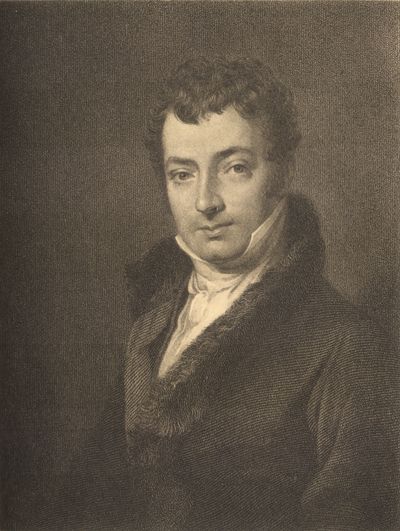
WASHINGTON IRVING After the painting by Leslie.
Scott had received The History of New York by Knickerbocker, shortly after its appearance in 1812, from an accomplished American traveller, Mr. Brevoort; and the admirable humor of this early work had led him to anticipate the brilliant career which its author has since run. Mr. Thomas Campbell, being no stranger to Scott's high estimation of Irving's genius, gave him a letter of introduction, which, halting his chaise on the high-road above Abbotsford, he modestly sent down to the house, "with a card, on which he had written, that he was on his way to the ruins of Melrose, and wished to know whether it would be agreeable to Mr. Scott to receive a visit from him in the course of the morning." Scott's family well remember the delight with which he received this announcement:—he was at breakfast, and sallied forth instantly, dogs and children after him as usual, to greet the guest, and conduct him in person from the highway to the door.
"The noise of my chaise," says Irving, "had disturbed the quiet of the establishment. Out sallied the warder of the castle, a black greyhound, and leaping on one of the blocks of stone, began a furious barking. This alarm brought out the whole garrison of dogs, all open-mouthed and vociferous. In a little while, the lord of the castle himself made his appearance. I knew him at once, by the likenesses that had been published of him. He came limping up the gravel walk, aiding himself by a stout walking staff, but moving rapidly and with vigor. By his side jogged along a large iron-gray staghound, of most grave demeanor, who took no part in the clamor of the canine rabble, but seemed to consider himself bound, for the dignity of the house, to give me a courteous reception.
"Before Scott reached the gate, he called out in a hearty tone, welcoming me to Abbotsford, and asking news of Campbell. Arrived at the door of the chaise, he grasped me warmly by the hand: 'Come, drive down, drive down to the house,' said he; 'ye're just in time for breakfast, and afterwards ye shall see all the wonders of the Abbey.'
"I would have excused myself on the plea of having already made my breakfast. 'Hut, man,' cried he, 'a ride in the morning in the keen air of the Scotch hills is warrant enough for a second breakfast.'
"I was accordingly whirled to the portal of the cottage, and in a few moments found myself seated at the breakfast-table. There was no one present but the family, which consisted of Mrs. Scott; her eldest daughter, Sophia, then a fine girl about seventeen; Miss Anne Scott, two or three years younger; Walter, a well-grown stripling; and Charles, a lively boy, eleven or twelve years of age.
"I soon felt myself quite at home, and my heart in a glow, with the cordial welcome I experienced. I had thought to make a mere morning visit, but found I was not to be let off so lightly. 'You must not think our neighborhood is to be read in a morning like a newspaper,' said Scott; 'it takes several days of study for an observant traveller, that has a relish for auld-world trumpery. After breakfast you shall make your visit to Melrose Abbey; I shall not be able to accompany you, as I have some household affairs to attend to; but I will put you in charge of my son Charles, who is very learned in all things touching the old ruin and the neighborhood it stands in; and he and my friend Johnnie Bower will tell you the whole truth about it, with a great deal more that you are not called upon to believe, unless you be a true and nothing-doubting antiquary. When you come back, I'll take you out on a ramble about the neighborhood. To-morrow we will take a look at the Yarrow, and the next day we will drive over to Dryburgh Abbey, which is a fine old ruin, well worth your seeing.'—In a word, before Scott had got through with his plan, I found myself committed for a visit of several days, and it seemed as if a little realm of romance was suddenly open before me."
On his return from the Abbey, Irving found Scott ready for a ramble. I cannot refuse myself the pleasure of extracting some parts of his description of it.
"As we sallied forth, every dog in the establishment turned out to attend us. There was the old staghound, Maida, that I have already mentioned, a noble animal, and Hamlet, the black greyhound, a wild thoughtless youngster, not yet arrived at the years of discretion; and Finette, a beautiful setter, with soft, silken hair, long pendent ears, and a mild eye, the parlor favorite. When in front of the house, we were joined by a superannuated greyhound, who came from the kitchen wagging his tail; and was cheered by Scott as an old friend and comrade. In our walks, he would frequently pause in conversation, to notice his dogs, and speak to them as if rational companions; and, indeed, there appears to be a vast deal of rationality in these faithful attendants on man, derived from their close intimacy with him. Maida deported himself with a gravity becoming his age and size, and seemed to consider himself called upon to preserve a great degree of dignity and decorum in our society. As he jogged along a little distance ahead of us, the young dogs would gambol about him, leap on his neck, worry at his ears, and endeavor to tease him into a gambol. The old dog would keep on for a long time with imperturbable solemnity, now and then seeming to rebuke the wantonness of his young companions. At length he would make a sudden turn, seize one of them, and tumble him in the dust, then giving a glance at us, as much as to say, 'You see, gentlemen, I can't help giving way to this nonsense,' would resume his gravity, and jog on as before. Scott amused himself with these peculiarities. 'I make no doubt,' said he, 'when Maida is alone with these young dogs, he throws gravity aside, and plays the boy as much as any of them; but he is ashamed to do so in our company, and seems to say—Ha' done with your nonsense, youngsters: what will the laird and that other gentleman think of me if I give way to such foolery?'
"Scott amused himself with the peculiarities of another of his dogs, a little shamefaced terrier, with large glassy eyes, one of the most sensitive little bodies to insult and indignity in the world. 'If ever he whipped him,' he said, 'the little fellow would sneak off and hide himself from the light of day in a lumber garret, from whence there was no drawing him forth but by the sound of the chopping-knife, as if chopping up his victuals, when he would steal forth with humiliated and downcast look, but would skulk away again if any one regarded him.'
"While we were discussing the humors and peculiarities of our canine companions, some object provoked their spleen, and produced a sharp and petulant barking from the smaller fry; but it was some time before Maida was sufficiently roused to ramp forward two or three bounds, and join the chorus with a deep-mouthed bow wow. It was but a transient outbreak, and he returned instantly, wagging his tail, and looking up dubiously in his master's face, uncertain whether he would receive censure or applause. 'Ay, ay, old boy!' cried Scott, 'you have done wonders; you have shaken the Eildon hills with your roaring: you may now lay by your artillery for the rest of the day. Maida,' continued he, 'is like the great gun at Constantinople; it takes so long to get it ready, that the smaller guns can fire off a dozen times first: but when it does go off, it plays the very devil.'
"These simple anecdotes may serve to show the delightful play of Scott's humors and feelings in private life. His domestic animals were his friends. Everything about him seemed to rejoice in the light of his countenance.
"Our ramble took us on the hills commanding an extensive prospect. 'Now,' said Scott, 'I have brought you, like the pilgrim in the Pilgrim's Progress, to the top of the Delectable Mountains, that I may show you all the goodly regions hereabouts. Yonder is Lammermuir, and Smailholm; and there you have Galashiels, and Torwoodlee, and Gala Water; and in that direction you see Teviotdale and the Braes of Yarrow, and Ettrick stream winding along like a silver thread, to throw itself into the Tweed.' He went on thus to call over names celebrated in Scottish song, and most of which had recently received a romantic interest from his own pen. In fact, I saw a great part of the Border country spread out before me, and could trace the scenes of those poems and romances which had in a manner bewitched the world.
"I gazed about me for a time with mute surprise, I may almost say with disappointment. I beheld a mere succession of gray waving hills, line beyond line, as far as my eye could reach, monotonous in their aspect, and so destitute of trees, that one could almost see a stout fly walking along their profile; and the far-famed Tweed appeared a naked stream, flowing between bare hills, without a tree or thicket on its banks; and yet such had been the magic web of poetry and romance thrown over the whole, that it had a greater charm for me than the richest scenery I had beheld in England. I could not help giving utterance to my thoughts. Scott hummed for a moment to himself, and looked grave; he had no idea of having his Muse complimented at the expense of his native hills. 'It may be pertinacity,' said he at length; 'but to my eye, these gray hills, and all this wild Border country, have beauties peculiar to themselves. I like the very nakedness of the land; it has something bold, and stern, and solitary about it. When I have been for some time in the rich scenery about Edinburgh, which is like ornamented garden land, I begin to wish myself back again among my own honest gray hills; and if I did not see the heather, at least once a year, I think I should die!' The last words were said with an honest warmth, accompanied by a thump on the ground with his staff, by way of emphasis, that showed his heart was in his speech. He vindicated the Tweed, too, as a beautiful stream in itself; and observed that he did not dislike it for being bare of trees, probably from having been much of an angler in his time; and an angler does not like to have a stream overhung by trees, which embarrass him in the exercise of his rod and line.
"I took occasion to plead, in like manner, the associations of early life for my disappointment in respect to the surrounding scenery. I had been so accustomed to see hills crowned with forests, and streams breaking their way through a wilderness of trees, that all my ideas of romantic landscape were apt to be well wooded. 'Ay, and that's the great charm of your country,' cried Scott. 'You love the forest as I do the heather; but I would not have you think I do not feel the glory of a great woodland prospect. There is nothing I should like more than to be in the midst of one of your grand wild original forests, with the idea of hundreds of miles of untrodden forest around me. I once saw at Leith an immense stick of timber, just landed from America. It must have been an enormous tree when it stood in its native soil, at its full height, and with all its branches. I gazed at it with admiration; it seemed like one of the gigantic obelisks which are now and then brought from Egypt to shame the pigmy monuments of Europe; and, in fact, these vast aboriginal trees, that have sheltered the Indians before the intrusion of the white men, are the monuments and antiquities of your country.'
"The conversation here turned upon Campbell's poem of Gertrude of Wyoming, as illustrative of the poetic materials furnished by American scenery. Scott cited several passages of it with great delight. 'What a pity it is,' said he, 'that Campbell does not write more, and oftener, and give full sweep to his genius! He has wings that would bear him to the skies; and he does, now and then, spread them grandly, but folds them up again, and resumes his perch, as if he was afraid to launch away. What a grand idea is that,' said he, 'about prophetic boding, or, in common parlance, second sight—
"Coming events cast their shadows before!"—
The fact is,' added he, 'Campbell is, in a manner, a bugbear to himself. The brightness of his early success is a detriment to all his further efforts. He is afraid of the shadow that his own fame casts before him.'
"We had not walked much farther, before we saw the two Miss Scotts advancing along the hillside to meet us. The morning's studies being over, they had set off to take a ramble on the hills, and gather heather blossoms with which to decorate their hair for dinner. As they came bounding lightly like young fawns, and their dresses fluttering in the pure summer breeze, I was reminded of Scott's own description of his children, in his introduction to one of the cantos of Marmion:—
'My imps, though hardy, bold, and wild, As best befits the mountain child,' etc.
Having often, many years afterwards, heard Irving speak warmly of William Laidlaw, I must not omit the following passage:—
"One of my pleasantest rambles with Scott about the neighborhood of Abbotsford was taken in company with Mr. William Laidlaw, the steward of his estate. This was a gentleman for whom Scott entertained a particular value. He had been born to a competency, had been well educated, his mind was richly stored with varied information, and he was a man of sterling moral worth. Having been reduced by misfortune, Scott had got him to take charge of his estate. He lived at a small farm, on the hillside above Abbotsford, and was treated by Scott as a cherished and confidential friend, rather than a dependant.
"That day at dinner we had Mr. Laidlaw and his wife, and a female friend who accompanied them. The latter was a very intelligent respectable person, about the middle age, and was treated with particular attention and courtesy by Scott. Our dinner was a most agreeable one, for the guests were evidently cherished visitors to the house, and felt that they were appreciated. When they were gone, Scott spoke of them in the most cordial manner. 'I wished to show you,' said he, 'some of our really excellent, plain Scotch people: not fine gentlemen and ladies, for such you can meet everywhere, and they are everywhere the same. The character of a nation is not to be learnt from its fine folks.' He then went on with a particular eulogium on the lady who had accompanied the Laidlaws. She was the daughter, he said, of a poor country clergyman, who had died in debt, and left her an orphan and destitute. Having had a good plain education, she immediately set up a child's school, and had soon a numerous flock under her care, by which she earned a decent maintenance. That, however, was not her main object. Her first care was to pay off her father's debts, that no ill word or ill will might rest upon his memory. This, by dint of Scotch economy, backed by filial reverence and pride, she accomplished, though in the effort she subjected herself to every privation. Not content with this, she in certain instances refused to take pay for the tuition of the children of some of her neighbors, who had befriended her father in his need, and had since fallen into poverty. 'In a word,' added Scott, 'she's a fine old Scotch girl, and I delight in her more than in many a fine lady I have known, and I have known many of the finest.'
"The evening passed away delightfully in a quaint-looking apartment, half study, half drawing-room. Scott read several passages from the old Romance of Arthur, with a fine deep sonorous voice, and a gravity of tone that seemed to suit the antiquated black-letter volume. It was a rich treat to hear such a work read by such a person, and in such a place; and his appearance, as he sat reading, in a large armchair, with his favorite hound Maida at his feet, and surrounded by books and reliques and Border trophies, would have formed an admirable and most characteristic picture. When I retired for the night, I found it almost impossible to sleep: the idea of being under the roof of Scott; of being on the Borders on the Tweed; in the very centre of that region which had, for some time past, been the favorite scene of romantic fiction; and, above all, the recollections of the ramble I had taken, the company in which I had taken it, and the conversation which had passed, all fermented in my mind, and nearly drove sleep from my pillow.
Among other visitors who succeeded the distinguished American that autumn, were Lady Byron, the wife of the poet, and the great artist, Mr., now Sir David Wilkie, who then executed for Captain Ferguson that pleasing little picture, in which Scott and his family are represented as a group of peasants, while the gallant soldier himself figures by them in the character of a gamekeeper, or perhaps poacher. Mr. Irving has given, in the little work from which I have quoted so liberally, an amusing account of the delicate scruples of Wilkie about soliciting Scott to devote a morning to the requisite sitting, until, after lingering for several days, he at length became satisfied that, by whatever magic his host might contrive to keep Ballantyne's presses in full play, he had always abundance of leisure for matters less important than Ferguson's destined heirloom. I shall now, however, return to his correspondence; and begin with a letter to Joanna Baillie on Lady Byron's visit.
TO MISS JOANNA BAILLIE, HAMPSTEAD.
Abbotsford, September 26, 1817.
Yours truly, W. S.
The next letter refers to the Duke of Buccleuch's preparations for a cattle-show at Bowhill, which was followed by an entertainment on a large scale to his Grace's Selkirkshire neighbors and tenantry, and next day by a fox-hunt, after Dandie Dinmont's fashion, among the rocks of the Yarrow. The Sheriff attended with his tail on; and Wilkie, too, went with him. It was there that Sir David first saw Hogg, and the Shepherd's greeting was graceful. He eyed the great painter for a moment in silence, and then stretching out his hand, said: "Thank God for it. I did not know that you were so young a man!"
TO THE DUKE OF BUCCLEUCH, ETC., ETC., ETC., DRUMLANRIG CASTLE.
Trade of every kind is recovering, and not a loom idle in Glasgow. The most faithful respects of this family attend the Ladies and all at Drumlanrig. I ever am your Grace's truly obliged and grateful
Walter Scott.
Given from my Castle of Grawacky, this second day of the month called October, One Thousand Eight Hundred and Seventeen Years.
There is a date nearly as long as the letter.
I hope we shall attack the foxes at Bowhill. I will hazard Maida.
We have some allusions to this Bowhill party in another letter; the first of several which I shall now insert according to their dates, leaving them, with a few marginal notes, to tell out the story of 1817:—
TO DANIEL TERRY, ESQ., LONDON.
Abbotsford, October 24, 1817.
P. S.—I agree with you that the tower will look rather rich for the rest of the building; yet you may be assured, that with diagonal chimneys and notched gables, it will have a very fine effect, and is in Scotch architecture by no means incompatible. My house has been like a cried fair, and extreme the inconvenience of having no corner sacred to my own use, and free from intrusion.
Ever truly yours, W. S.
TO THE SAME.
Abbotsford, 29th October, 1817.
W. S.
TO MR. WILLIAM LAIDLAW, KAESIDE.
Edinburgh, November 15, 1817.
Dear Willie,—I have no intention to let the Whitehaugh without your express approbation, and I wish you to act as my adviser and representative in these matters. I would hardly have ventured to purchase so much land without the certainty of your counsel and coöperation.... On the other side you will find a small order on the banker at Galashiels, to be renewed half yearly; not by way of recompensing your friendship "with a load of barren money," but merely to ease my conscience in some degree for the time which I must necessarily withdraw from the labor which is to maintain your family. Believe me, dear Willie, yours truly,
W. Scott.
TO THE SAME.
Edinburgh, 19th November, 1817.
Yours truly, W. S.
TO THOMAS SCOTT, ESQ., PAYMASTER, 70TH REGIMENT, KINGSTON, CANADA.
Edinburgh, 13th December, 1817.
My dear Tom,—I should be happy to attend to your commission about a dominie for your boy, but I think there will be much risk in yoking yourself with one for three or four years. You know what sort of black cattle these are, and how difficult it is to discern their real character, though one may give a guess at their attainments. When they get good provender in their guts, they are apt to turn out very different animals from what they were in their original low condition, and get frisky and troublesome. I have made several inquiries, however, and request to know what salary you would think reasonable, and also what acquisitions he ought to possess. There is no combating the feelings which you express for the society of your son, otherwise I really think that a Scottish education would be highly desirable; and should you at any time revert to this plan, you may rely on my bestowing the same attention upon him as upon my own boys.
Walter Scott.
The following note is without date. It accompanied, no doubt, the last proof sheet of Rob Roy, and was therefore in all probability written about ten days before the 31st of December, 1817—on which day the novel was published.
TO MR. JAMES BALLANTYNE, ST. JOHN STREET.
Dear James,—
With great joy I send you Roy. 'T was a tough job, But we're done with Rob.
Yours ever, W. S.
The novel had indeed been "a tough job"—for lightly and airily as it reads, the author had struggled almost throughout with the pains of cramp or the lassitude of opium. Calling on him one day to dun him for copy, James Ballantyne found him with a clean pen and a blank sheet before him, and uttered some rather solemn exclamation of surprise. "Ay, ay, Jemmy," said he, "'tis easy for you to bid me get on, but how the deuce can I make Rob Roy's wife speak, with such a curmurring in my guts?"[Back to Contents]