Chapter XXVII
Reading edition
INSANITY OF HENRY WEBER. — LETTERS ON THE ABDICATION OF NAPOLEON, ETC. — PUBLICATION OF SCOTT'S LIFE AND EDITION OF SWIFT. — ESSAYS FOR THE SUPPLEMENT TO THE ENCYCLOPÆDIA BRITANNICA. — COMPLETION AND PUBLICATION OF WAVERLEY
1814
I have to open the year 1814 with a melancholy story. Mention has been made, more than once, of Henry Weber, a poor German scholar, who escaping to this country in 1804, from misfortunes in his own, excited Scott's compassion, and was thenceforth furnished, through his means, with literary employment of various sorts. Weber was a man of considerable learning; but Scott, as was his custom, appears to have formed an exaggerated notion of his capacity, and certainly countenanced him, to his own severe cost, in several most unfortunate undertakings. When not engaged on things of a more ambitious character, he had acted for ten years as his protector's amanuensis, and when the family were in Edinburgh, he very often dined with them. There was something very interesting in his appearance and manners: he had a fair, open countenance, in which the honesty and the enthusiasm of his nation were alike visible; his demeanor was gentle and modest; and he had not only a stock of curious antiquarian knowledge, but the reminiscences, which he detailed with amusing simplicity, of an early life chequered with many strange-enough adventures. He was, in short, much a favorite with Scott and all the household; and was invited to dine with them so frequently, chiefly because his friend was aware that he had an unhappy propensity to drinking, and was anxious to keep him away from places where he might have been more likely to indulge it. This vice, however, had been growing on him; and of late Scott had found it necessary to make some rather severe remonstrances about habits which were at once injuring his health, and interrupting his literary industry.
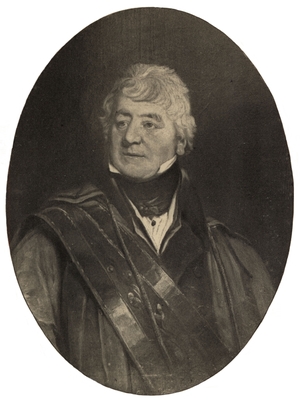
J. B. S. MORRITT From the painting by Sir M. A. Shee
They had, however, parted kindly when Scott left Edinburgh at Christmas, 1813,—and the day after his return, Weber attended him as usual in his library, being employed in transcribing extracts during several hours, while his friend, seated over against him, continued working at the Life of Swift. The light beginning to fail, Scott threw himself back in his chair, and was about to ring for candles, when he observed the German's eyes fixed upon him with an unusual solemnity of expression. "Weber," said he, "what's the matter with you?" "Mr. Scott," said Weber, rising, "you have long insulted me, and I can bear it no longer. I have brought a pair of pistols with me, and must insist on your taking one of them instantly;" and with that he produced the weapons, which had been deposited under his chair, and laid one of them on Scott's manuscript. "You are mistaken, I think," said Scott, "in your way of setting about this affair—but no matter. It can, however, be no part of your object to annoy Mrs. Scott and the children; therefore, if you please, we will put the pistols into the drawer till after dinner, and then arrange to go out together like gentlemen." Weber answered with equal coolness, "I believe that will be better," and laid the second pistol also on the table. Scott locked them both in his desk, and said, "I am glad you have felt the propriety of what I suggested—let me only request further, that nothing may occur while we are at dinner to give my wife any suspicion of what has been passing." Weber again assented, and Scott withdrew to his dressing-room, from which he immediately despatched a message to one of Weber's intimate companions,—and then dinner was served, and Weber joined the family circle as usual. He conducted himself with perfect composure, and everything seemed to go on in the ordinary way, until whiskey and hot water being produced, Scott, instead of inviting his guest to help himself, mixed two moderate tumblers of toddy, and handed one of them to Weber, who, upon that, started up with a furious countenance, but instantly sat down again, and when Mrs. Scott expressed her fear that he was ill, answered placidly that he was liable to spasms, but that the pain was gone. He then took the glass, eagerly gulped down its contents, and pushed it back to Scott. At this moment the friend who had been sent for made his appearance, and Weber, on seeing him enter the room, rushed past him and out of the house, without stopping to put on his hat. The friend, who pursued instantly, came up with him at the end of the street, and did all he could to soothe his agitation, but in vain. The same evening he was obliged to be put into a strait-waistcoat; and though in a few days he exhibited such symptoms of recovery that he was allowed to go by himself to pay a visit in the north of England, he there soon relapsed, and continued ever afterwards a hopeless lunatic, being supported to the end of his life, in June, 1818, at Scott's expense, in an asylum at York.
The reader will now appreciate the gentle delicacy of the following letter:—
TO J. B. S. MORRITT, ESQ., ROKEBY, GRETA BRIDGE.
Edinburgh, 7th January, 1814.
Many happy New Years to you and Mrs. Morritt.
My dear Morritt,—I have postponed writing a long while, in hopes to send you the Life of Swift. But I have been delayed by an odd accident. Poor Weber, whom you may have heard me mention as a sort of grinder of mine, who assisted me in various ways, has fallen into a melancholy state. His habits, like those of most German students, were always too convivial—this, of course, I guarded against while he was in my house, which was always once a week at least; but unfortunately he undertook a long walk through the Highlands of upwards of 2000 miles, and, I suppose, took potations pottle deep to support him through the fatigue. His mind became accordingly quite unsettled, and after some strange behavior here, he was fortunately prevailed upon to go to **** who resides in Yorkshire. It is not unlikely, from something that dropped from him, that he may take it into his head to call at Rokeby, in which case you must parry any visit, upon the score of Mrs. Morritt's health. If he were what he used to be, you would be much pleased with him; for besides a very extensive general acquaintance with literature, he was particularly deep in our old dramatic lore, a good modern linguist, a tolerable draughtsman and antiquary, and a most excellent hydrographer. I have not the least doubt that if he submits to the proper regimen of abstinence and moderate exercise, he will be quite well in a few weeks or days—if not, it is miserable to think what may happen. The being suddenly deprived of his services in this melancholy way, has flung me back at least a month with Swift, and left me no time to write to my friends, for all my memoranda, etc., were in his hands, and had to be new-modelled, etc., etc.
Your little friends, Sophia and Walter, were at a magnificent party on Twelfth Night at Dalkeith, where the Duke and Duchess entertained all Edinburgh. I think they have dreamed of nothing since but Aladdin's lamp and the palace of Haroun Al-Raschid. I am uncertain what to do this spring. I would fain go on the Continent for three or four weeks, if it be then safe for non-combatants. If not, we will have a merry meeting in London, and, like Master Silence,
I have much to say about Triermain. The fourth edition is at press. The Empress Dowager of Russia has expressed such an interest in it, that it will be inscribed to her, in some doggerel sonnet or other, by the unknown author. This is funny enough.—Love a thousand times to dear Mrs. Morritt, who, I trust, keeps pretty well. Pray write soon—a modest request from
Walter Scott.
The last of Weber's literary productions were the analyses of the Old German Poems of the Helden Buch, and the Nibelungen Lied, which appeared in a massive quarto, entitled Illustrations of Northern Antiquities, published in the summer of 1814, by his and Scott's friend, Mr. Robert Jameson. Scott avowedly contributed to this collection an account of the Eyrbiggia Saga, which has since been included in his Prose Miscellanies (Vol. V., edition 1834); but any one who examines the share of the work which goes under Weber's name will see that Scott had a considerable hand in that also. The rhymed versions from the Nibelungen Lied came, I can have no doubt, from his pen; but he never reclaimed these, or any other similar benefactions, of which I have traced not a few; nor, highly curious and even beautiful as many of them are, could they be intelligible, if separated from the prose narrative on which Weber embroidered them, in imitation of the style of Ellis's Specimens of Metrical Romance.
The following letters, on the first abdication of Napoleon, are too characteristic to be omitted here. I need not remind the reader how greatly Scott had calmed his opinions, and softened his feelings, respecting the career and fate of the most extraordinary man of our age, before he undertook to write his history.
TO J. B. S. MORRITT, ESQ., PORTLAND PLACE, LONDON.
Abbotsford, 30th April, 1814
Ever yours,
Walter Scott.
TO ROBERT SOUTHEY, ESQ., KESWICK.
Edinburgh, 17th June, 1814.
My dear Southey,—I suspended writing to thank you for the Carmen Triumphale—(a happy omen of what you can do to immortalize our public story)—until the feverish mood of expectation and anxiety should be over. And then, as you truly say, there followed a stunning sort of listless astonishment and complication of feeling, which, if it did not lessen enjoyment, confused and confounded one's sense of it. I remember the first time I happened to see a launch, I was neither so much struck with the descent of the vessel, nor with its majestic sweep to its moorings, as with the blank which was suddenly made from the withdrawing so large an object, and the prospect which was at once opened to the opposite side of the dock crowded with spectators. Buonaparte's fall strikes me something in the same way: the huge bulk of his power, against which a thousand arms were hammering, was obviously to sink when its main props were struck away—and yet now—when it has disappeared—the vacancy which it leaves in our minds and attention marks its huge and preponderating importance more strongly than even its presence. Yet I so devoutly expected the termination, that in discussing the matter with Major Philips, who seemed to partake of the doubts which prevailed during the feverish period preceding the capture of Paris, when he was expressing his apprehensions that the capital of France would be defended to the last, I hazarded a prophecy that a battle would be fought on the heights of Montmartre—(no great sagacity, since it was the point where Marlborough proposed to attack, and for which Saxe projected a scheme of defence)—and that if the allies were successful, which I little doubted, the city would surrender, and the Senate proclaim the dethronement of Buonaparte. But I never thought nor imagined that he would have given in as he has done. I always considered him as possessing the genius and talents of an Eastern conqueror; and although I never supposed that he possessed, allowing for some difference of education, the liberality of conduct and political views which were sometimes exhibited by old Hyder Ally, yet I did think he might have shown the same resolved and dogged spirit of resolution which induced Tippoo Saib to die manfully upon the breach of his capital city with his sabre clenched in his hand. But this is a poor devil, and cannot play the tyrant so rarely as Bottom the Weaver proposed to do. I think it is Strap in Roderick Random, who, seeing a highwayman that had lately robbed him, disarmed and bound, fairly offers to box him for a shilling. One has really the same feeling with respect to Buonaparte, though if he go out of life after all in the usual manner, it will be the strongest proof of his own insignificance, and the liberality of the age we live in. Were I a son of Palm or Hoffer, I should be tempted to take a long shot at him in his retreat to Elba. As for coaxing the French by restoring all our conquests, it would be driving generosity into extravagance: most of them have been colonized with British subjects, and improved by British capital; and surely we owe no more to the French nation than any well-meaning individual might owe to a madman, whom—at the expense of a hard struggle, black eyes, and bruises—he has at length overpowered, knocked down, and by the wholesome discipline of a bull's pizzle and strait-jacket, brought to the handsome enjoyment of his senses. I think with you, what we return to them should be well paid for; and they should have no Pondicherry to be a nest of smugglers, nor Mauritius to nurse a hornet-swarm of privateers. In short, draw teeth, and pare claws, and leave them to fatten themselves in peace and quiet, when they are deprived of the means of indulging their restless spirit of enterprise.
Walter Scott.
On the 1st of July, 1814, Scott's Life and Edition of Swift, in nineteen volumes 8vo, at length issued from the press. This adventure, undertaken by Constable in 1808, had been proceeded in during all the variety of their personal relations, and now came forth when author and publisher felt more warmly towards each other than perhaps they had ever before done. The impression was of 1250 copies; and a reprint of similar extent was called for in 1824. The Life of Swift has subsequently been included in the author's Miscellanies, and has obtained a very wide circulation.
The Edinburgh Reviewer thus characterizes Scott's Memoir of the Dean of St. Patrick's:—
"It is not everywhere extremely well written, in a literary point of view, but it is drawn up in substance with great intelligence, liberality, and good feeling. It is quite fair and moderate in politics; and perhaps rather too indulgent and tender towards individuals of all descriptions—more full, at least, of kindness and veneration for genius and social virtue, than of indignation at baseness and profligacy. Altogether, it is not much like the production of a mere man of letters, or a fastidious speculator in sentiment and morality; but exhibits throughout, and in a very pleasing form, the good sense and large toleration of a man of the world, with much of that generous allowance for the
'Fears of the brave and follies of the wise,'
which genius too often requires, and should therefore always be most forward to show. It is impossible, however, to avoid noticing that Mr. Scott is by far too favorable to the personal character of his author, whom we think it would really be injurious to the cause of morality to allow to pass either as a very dignified or a very amiable person. The truth is, we think, that he was extremely ambitious, arrogant, and selfish; of a morose, vindictive, and haughty temper; and though capable of a sort of patronizing generosity towards his dependents, and of some attachment towards those who had long known and flattered him, his general demeanor, both in public and private life, appears to have been far from exemplary; destitute of temper and magnanimity, and we will add, of principle, in the former; and in the latter, of tenderness, fidelity, or compassion."—Edinburgh Review, vol. xvii. p. 9.
I have no desire to break a lance in this place in defence of the personal character of Swift. It does not appear to me that he stands at all distinguished among politicians (least of all, among the politicians of his time) for laxity of principle; nor can I consent to charge his private demeanor with the absence either of tenderness, or fidelity, or compassion. But who ever dreamed—most assuredly not Scott—of holding up the Dean of St. Patrick's as on the whole an "exemplary character"? The biographer felt, whatever his critic may have thought on the subject, that a vein of morbid humor ran through Swift's whole existence, both mental and physical, from the beginning. "He early adopted," says Scott, "the custom of observing his birthday, as a term not of joy but of sorrow, and of reading, when it annually recurred, the striking passage of Scripture in which Job laments and execrates the day upon which it was said in his father's house that a man-child was born;" and I should have expected that any man who had considered the black close of the career thus early clouded, and read the entry of Swift's diary on the funeral of Stella, his epitaph on himself, and the testament by which he disposed of his fortune, would have been willing, like Scott, to dwell on the splendor of his immortal genius, and the many traits of manly generosity "which he unquestionably exhibited," rather than on the faults and foibles of nameless and inscrutable disease, which tormented and embittered the far greater part of his earthly being. What the critic says of the practical and businesslike style of Scott's biography, appears very just—and I think the circumstance eminently characteristic; nor, on the whole, could his edition, as an edition, have been better dealt with than in the Essay which I have quoted. It was, by the way, written by Mr. Jeffrey, at Constable's particular request. "It was, I think, the first time I ever asked such a thing of him," the bookseller said to me; "and I assure you the result was no encouragement to repeat such petitions." Mr. Jeffrey attacked Swift's whole character at great length, and with consummate dexterity; and, in Constable's opinion, his article threw such a cloud on the Dean, as materially checked, for a time, the popularity of his writings. Admirable as the paper is, in point of ability, I think Mr. Constable may have considerably exaggerated its effects; but in those days it must have been difficult for him to form an impartial opinion upon such a question; for, as Johnson said of Cave, that "he could not spit over his window without thinking of The Gentleman's Magazine," I believe Constable allowed nothing to interrupt his paternal pride in the concerns of his Review, until the Waverley Novels supplied him with another periodical publication still more important to his fortunes.
The two next letters will give us, in more exact detail than the author's own recollection could supply in 1830, the history of the completion of Waverley. It was published on the 7th of July; and two days afterwards he thus writes:—
TO J. B. S. MORRITT, ESQ., M. P., LONDON.
Edinburgh, 9th July, 1814.
W. Scott.
P. S.—As your conscience has very few things to answer for, you must still burthen it with the secret of the Bridal. It is spreading very rapidly, and I have one or two little fairy romances, which will make a second volume, and which I would wish published, but not with my name. The truth is, that this sort of muddling work amuses me, and I am something in the condition of Joseph Surface, who was embarrassed by getting himself too good a reputation; for many things may please people well enough anonymously, which, if they have me in the title-page, would just give me that sort of ill name which precedes hanging—and that would be in many respects inconvenient if I thought of again trying a grande opus.
This statement of the foregoing letter (repeated still more precisely in the following one), as to the time occupied in the composition of the second and third volumes of Waverley, recalls to my memory a trifling anecdote, which, as connected with a dear friend of my youth, whom I have not seen for many years, and may very probably never see again in this world, I shall here set down, in the hope of affording him a momentary, though not an unmixed pleasure, when he may chance to read this compilation on a distant shore—and also in the hope that my humble record may impart to some active mind in the rising generation a shadow of the influence which the reality certainly exerted upon his. Happening to pass through Edinburgh in June, 1814, I dined one day with the gentleman in question (now the Honorable William Menzies, one of the Supreme Judges at the Cape of Good Hope), whose residence was then in George Street, situated very near to, and at right angles with, North Castle Street. It was a party of very young persons, most of them, like Menzies and myself, destined for the Bar of Scotland, all gay and thoughtless, enjoying the first flush of manhood, with little remembrance of the yesterday, or care of the morrow. When my companion's worthy father and uncle, after seeing two or three bottles go round, left the juveniles to themselves, the weather being hot, we adjourned to a library which had one large window looking northwards. After carousing here for an hour or more, I observed that a shade had come over the aspect of my friend, who happened to be placed immediately opposite to myself, and said something that intimated a fear of his being unwell. "No," said he, "I shall be well enough presently, if you will only let me sit where you are, and take my chair; for there is a confounded hand in sight of me here, which has often bothered me before, and now it won't let me fill my glass with a good will." I rose to change places with him accordingly, and he pointed out to me this hand which, like the writing on Belshazzar's wall, disturbed his hour of hilarity. "Since we sat down," he said, "I have been watching it—it fascinates my eye—it never stops—page after page is finished and thrown on that heap of MS., and still it goes on unwearied—and so it will be till candles are brought in, and God knows how long after that. It is the same every night—I can't stand a sight of it when I am not at my books."—"Some stupid, dogged, engrossing clerk, probably," exclaimed myself, or some other giddy youth in our society. "No, boys," said our host, "I well know what hand it is—'tis Walter Scott's." This was the hand that, in the evenings of three summer weeks, wrote the last two volumes of Waverley. Would that all who that night watched it had profited by its example of diligence as largely as William Menzies!
In the next of these letters Scott enclosed to Mr. Morritt the Prospectus of a new edition of the old poems of the Bruce and the Wallace, undertaken by the learned lexicographer, Dr. John Jamieson; and he announces his departure on a sailing excursion round the north of Scotland. It will be observed that when Scott began his letter, he had only had Mr. Morritt's opinion of the first volume of Waverley, and that before he closed it he had received his friend's honest criticism on the work as a whole, with the expression of an earnest hope that he would drop his incognito on the title-page of a second edition.
TO J. B. S. MORRITT, ESQ., M. P., PORTLAND PLACE, LONDON.
Abbotsford, July 24, 1814.
My Dear Morritt,—I am going to say my vales to you for some weeks, having accepted an invitation from a committee of the Commissioners for the Northern Lights (I don't mean the Edinburgh Reviewers, but the bona-fide Commissioners for the Beacons), to accompany them upon a nautical tour round Scotland, visiting all that is curious on continent and isle. The party are three gentlemen with whom I am very well acquainted, William Erskine being one. We have a stout cutter, well fitted up and manned for the service by Government; and to make assurance double sure, the admiral has sent a sloop of war to cruise in the dangerous points of our tour, and sweep the sea of the Yankee privateers, which sometimes annoy our northern latitudes. I shall visit the Clephanes in their solitude—and let you know all that I see that is rare and entertaining, which, as we are masters of our time and vessel, should add much to my stock of knowledge.
As to Waverley, I will play Sir Fretful for once, and assure you that I left the story to flag in the first volume on purpose; the second and third have rather more bustle and interest. I wished (with what success Heaven knows) to avoid the ordinary error of novel writers, whose first volume is usually their best. But since it has served to amuse Mrs. Morritt and you usque ab initio, I have no doubt you will tolerate it even unto the end. It may really boast to be a tolerably faithful portrait of Scottish manners, and has been recognized as such in Edinburgh. The first edition of a thousand instantly disappeared, and the bookseller informs me that the second, of double the quantity, will not supply the market long.—As I shall be very anxious to know how Mrs. Morritt is, I hope to have a few lines from you on my return, which will be about the end of August or beginning of September. I should have mentioned that we have the celebrated engineer, Stevenson, along with us. I delight in these professional men of talent; they always give you some new lights by the peculiarity of their habits and studies, so different from the people who are rounded, and smoothed, and ground down for conversation, and who can say all that every other person says, and—nothing more.
What a miserable thing it is that our royal family cannot be quiet and decent at least, if not correct and moral in their deportment. Old farmer George's manly simplicity, modesty of expense, and domestic virtue, saved this country at its most perilous crisis; for it is inconceivable the number of persons whom these qualities united in his behalf, who would have felt but feebly the abstract duty of supporting a crown less worthily worn.
I am glad you are not to pay for this scrawl. Ever yours,
Walter Scott.
P. S.—I do not see how my silence can be considered as imposing on the public. If I give my name to a book without writing it, unquestionably that would be a trick. But, unless in the case of his averring facts which he may be called upon to defend or justify, I think an author may use his own discretion in giving or withholding his name. Harry Mackenzie never put his name in a title-page till the last edition of his works; and Swift only owned one out of his thousand-and-one publications. In point of emolument, everybody knows that I sacrifice much money by withholding my name; and what should I gain by it, that any human being has a right to consider as an unfair advantage? In fact, only the freedom of writing trifles with less personal responsibility, and perhaps more frequently than I otherwise might do.
W. S.
I am not able to give the exact date of the following reply to one of John Ballantyne's expostulations on the subject of the secret:—
"No, John, I will not own the book— I won't, you Picaroon. When next I try St. Grubby's brook, The A. of Wa—shall bait the hook— And flat-fish bite as soon, As if before them they had got The worn-out wriggler
Walter Scott."