Chapter XXVI
Reading edition
AFFAIRS OF JOHN BALLANTYNE AND CO. — CAUSES OF THEIR DERANGEMENT. — LETTERS OF SCOTT TO HIS PARTNERS. — NEGOTIATION FOR RELIEF WITH MESSRS. CONSTABLE. — NEW PURCHASE OF LAND AT ABBOTSFORD. — EMBARRASSMENTS CONTINUED. — JOHN BALLANTYNE'S EXPRESSES. — DRUMLANRIG, PENRITH, ETC. — SCOTT'S MEETING WITH THE MARQUIS OF ABERCORN AT LONGTOWN. — HIS APPLICATION TO THE DUKE OF BUCCLEUCH. — OFFER OF THE POET-LAUREATESHIP, — CONSIDERED, — AND DECLINED. — ADDRESS OF THE CITY OF EDINBURGH TO THE PRINCE REGENT. — ITS RECEPTION. — CIVIC HONORS CONFERRED ON SCOTT. — QUESTION OF TAXATION ON LITERARY INCOME. — LETTERS TO MR. MORRITT, MR. SOUTHEY, MR. RICHARDSON, MR. CRABBE, MISS BAILLIE, AND LORD BYRON
1813
About a month after the publication of The Bridal of Triermain, the affairs of the Messrs. Ballantyne, which had never apparently been in good order since the establishment of the bookselling firm, became so embarrassed as to call for Scott's most anxious efforts to disentangle them. Indeed, it is clear that there had existed some very serious perplexity in the course of the preceding autumn; for Scott writes to John Ballantyne, while Rokeby was in progress (August 11, 1812),—"I have a letter from James, very anxious about your health and state of spirits. If you suffer the present inconveniences to depress you too much, you are wrong; and if you conceal any part of them, are very unjust to us all. I am always ready to make any sacrifices to do justice to engagements, and would rather sell anything, or everything, than be less than true men to the world."
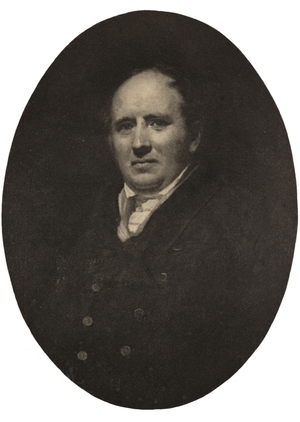
ARCHIBALD CONSTABLE From the painting by Raeburn
How reluctantly Scott had made up his mind to open such a negotiation with Constable, as involved a complete exposure of the mismanagement of John Ballantyne's business as a publisher, will appear from a letter dated about the Christmas of 1812, in which he says to James, who had proposed asking Constable to take a share both in Rokeby and in the Annual Register, "You must be aware, that in stating the objections which occur to me to taking in Constable, I think they ought to give way either to absolute necessity or to very strong grounds of advantage. But I am persuaded nothing ultimately good can be expected from any connection with that house, unless for those who have a mind to be hewers of wood and drawers of water. We will talk the matter coolly over, and, in the mean while, perhaps you could see W. Erskine, and learn what impression this odd union is like to make among your friends. Erskine is sound-headed, and quite to be trusted with your whole story. I must own I can hardly think the purchase of the Register is equal to the loss of credit and character which your surrender will be conceived to infer." At the time when he wrote this, Scott no doubt anticipated that Rokeby would have success not less decisive than The Lady of the Lake; but in this expectation—though 10,000 copies in three months would have seemed to any other author a triumphant sale—he had been disappointed. And meanwhile the difficulties of the firm, accumulating from week to week, had reached, by the middle of May, a point which rendered it absolutely necessary for him to conquer all his scruples.
Mr. Cadell, then Constable's partner, says in his Memoranda,—"Prior to this time the reputation of John Ballantyne and Co. had been decidedly on the decline. It was notorious in the trade that their general speculations had been unsuccessful; they were known to be grievously in want of money. These rumors were realized to the full by an application which Messrs. B. made to Mr. Constable in May, 1813, for pecuniary aid, accompanied by an offer of some of the books they had published since 1809, as a purchase, along with various shares in Mr. Scott's own poems. Their difficulties were admitted, and the negotiation was pressed urgently; so much so, that a pledge was given, that if the terms asked were acceded to, John Ballantyne and Co. would endeavor to wind up their concerns, and cease as soon as possible to be publishers." Mr. Cadell adds: "I need hardly remind you that this was a period of very great general difficulty in the money market. It was the crisis of the war. The public expenditure had reached an enormous height; and even the most prosperous mercantile houses were often pinched to sustain their credit. It may easily, therefore, be supposed that the Messrs. Ballantyne had during many months besieged every banker's door in Edinburgh, and that their agents had done the like in London."
The most important of the requests which the laboring house made to Constable was that he should forthwith take entirely to himself the stock, copyright, and future management of the Edinburgh Annual Register. Upon examining the state of this book, however, Constable found that the loss on it had never been less than £1000 per annum, and he therefore declined that matter for the present. He promised, however, to consider seriously the means he might have of ultimately relieving them from the pressure of the Register, and, in the mean time, offered to take 300 sets of the stock on hand. The other purchases he finally made on the 18th of May were considerable portions of Weber's unhappy Beaumont and Fletcher—of an edition of De Foe's novels in twelve volumes—of a collection entitled Tales of the East in three large volumes, 8vo, double-columned—and of another in one volume, called Popular Tales—about 800 copies of The Vision of Don Roderick—and a fourth of the remaining copyright of Rokeby, price £700. The immediate accommodation thus received amounted to £2000; and Scott, who had personally conducted the latter part of the negotiation, writes thus to his junior partner, who had gone a week or two earlier to London in quest of some similar assistance there:—
TO MR. JOHN BALLANTYNE, CARE OF MESSRS. LONGMAN & CO., LONDON.
Printing-Office, May 18, 1813.
Adieu, my dear John. I have the most sincere regard for you, and you may depend on my considering your interest with quite as much attention as my own. If I have ever expressed myself with irritation in speaking of this business, you must impute it to the sudden, extensive, and unexpected embarrassments in which I found myself involved all at once. If to your real goodness of heart and integrity, and to the quickness and acuteness of your talents, you added habits of more universal circumspection, and, above all, the courage to tell disagreeable truths to those whom you hold in regard, I pronounce that the world never held such a man of business. These it must be your study to add to your other good qualities. Meantime, as some one says to Swift, I love you with all your failings. Pray make an effort and love me with all mine. Yours truly,
W. S.
Three days afterwards Scott resumes the subject as follows:—
TO MR. JOHN BALLANTYNE, LONDON.
Edinburgh, 21st May, 1813.
Dear John,—Let it never escape your recollection, that shutting your own eyes, or blinding those of your friends, upon the actual state of business, is the high road to ruin. Meanwhile, we have recovered our legs for a week or two. Constable will, I think, come in to the Register. He is most anxious to maintain the printing-office; he sees most truly that the more we print the less we publish; and for the same reason he will, I think, help us off with our heavy quire-stock.
I was aware of the distinction between the state and the calendar as to the latter including the printing-office bills, and I summed and docked them (they are marked with red ink), but there is still a difference of £2000 and upwards on the calendar against the business. I sometimes fear that, between the long dates of your bills, and the tardy settlements of the Edinburgh trade, some difficulties will occur even in June; and July I always regard with deep anxiety. As for loss, if I get out without public exposure, I shall not greatly regard the rest. Radcliffe the physician said, when he lost £2000 on the South Sea scheme, it was only going up 2000 pair of stairs; I say, it is only writing 2000 couplets, and the account is balanced. More of this hereafter. Yours truly,
W. Scott.
P. S.—James has behaved very well during this whole transaction, and has been most steadily attentive to business. I am convinced that the more he works the better his health will be. One or other of you will need to be constantly in the printing-office henceforward,—it is the sheet-anchor.
The allusion in this postscript to James Ballantyne's health reminds me that Scott's letters to himself are full of hints on that subject, even from a very early period of their connection; and these hints are all to the same effect. James was a man of lazy habits, and not a little addicted to the more solid, and perhaps more dangerous, part of the indulgences of the table. One letter (dated Ashestiel, 1810) will be a sufficient specimen:—
TO MR. JAMES BALLANTYNE.
My dear James,—I am very sorry for the state of your health, and should be still more so, were I not certain that I can prescribe for you as well as any physician in Edinburgh. You have naturally an athletic constitution and a hearty stomach, and these agree very ill with a sedentary life and the habits of indolence which it brings on. Your stomach thus gets weak; and from those complaints of all others arise most certainly flatulence, hypochondria, and all the train of unpleasant feelings connected with indigestion. We all know the horrible sensation of the nightmare arises from the same cause which gives those waking nightmares commonly called the blue devils. You must positively put yourself on a regimen as to eating, not for a month or two, but for a year at least, and take regular exercise—and my life for yours. I know this by myself, for if I were to eat and drink in town as I do here, it would soon finish me, and yet I am sensible I live too genially in Edinburgh as it is. Yours very truly,
W. Scott.
Among Scott's early pets at Abbotsford there was a huge raven, whose powers of speech were remarkable, far beyond any parrot's that he had ever met with; and who died in consequence of an excess of the kind to which James Ballantyne was addicted. Thenceforth, Scott often repeated to his old friend, and occasionally scribbled by way of postscript to his notes on business—
"When you are craving, Remember the Raven."
Sometimes the formula is varied to—
"When you've dined half, Think on poor Ralph!"
'A fouth of auld nick-nackets, Rusty airn caps and jingling jackets, Wad haud the Lothians three in tackets A towmont gude, And parritch-pats and auld saut-backets, Before the flude.'"
Notwithstanding all this, it must have been with a most uneasy mind that he left Edinburgh to establish himself at Abbotsford that July. The assistance of Constable had not been granted, indeed it had not been asked, to an extent at all adequate for the difficulties of the case; and I have now to transcribe, with pain and reluctance, some extracts from Scott's letters, during the ensuing autumn, which speak the language of anxious, and, indeed, humiliating distress; and give a most lively notion of the incurable recklessness of his younger partner.
TO MR. JOHN BALLANTYNE.
Abbotsford, Saturday, 24th July.
Dear John,—I sent you the order, and have only to hope it arrived safe and in good time. I waked the boy at three o'clock myself, having slept little, less on account of the money than of the time. Surely you should have written, three or four days before, the probable amount of the deficit, and, as on former occasions, I would have furnished you with means of meeting it. These expresses, besides every other inconvenience, excite surprise in my family and in the neighborhood. I know no justifiable occasion for them but the unexpected return of a bill. I do not consider you as answerable for the success of plans, but I do and must hold you responsible for giving me, in distinct and plain terms, your opinion as to any difficulties which may occur, and that in such time that I may make arrangements to obviate them if possible.
Of course, if anything has gone wrong you will come out here to-morrow. But if, as I hope and trust, the cash arrived safe, you will write to me, under cover to the Duke of Buccleuch, Drumlanrig Castle, Dumfries-shire. I shall set out for that place on Monday morning early.
W. S.
TO MR. JAMES BALLANTYNE.
Abbotsford, 25th July, 1813.
Dear James,—I address the following jobation for John to you, that you may see whether I do not well to be angry, and enforce upon him the necessity of constantly writing his fears as well as his hopes. You should rub him often on this point, for his recollection becomes rusty the instant I leave town and am not in the way to rack him with constant questions. I hope the presses are doing well, and that you are quite stout again. Yours truly,
W. S.
(Enclosure.)
TO MR. JOHN BALLANTYNE.
My Good Friend John,—The post brings me no letter from you, which I am much surprised at, as you must suppose me anxious to learn that your express arrived. I think he must have reached you before post-hours, and James or you might have found a minute to say so in a single line. I once more request that you will be a businesslike correspondent, and state your provisions for every week prospectively. I do not expect you to warrant them, which you rather perversely seem to insist is my wish, but I do want to be aware of their nature and extent, that I may provide against the possibility of miscarriage. The calendar, to which you refer me, tells me what sums are due, but cannot tell your shifts to pay them, which are naturally altering with circumstances, and of which alterations I request to have due notice. You say you could not suppose Sir W. Forbes would have refused the long dated bills; but that you had such an apprehension is clear, both because in the calendar these bills were rated two months lower, and because, three days before, you wrote me an enigmatical expression of your apprehensions, instead of saying plainly there was a chance of your wanting £350, when I would have sent you an order to be used conditionally.
All I desire is unlimited confidence and frequent correspondence, and that you will give me weekly at least the fullest anticipation of your resources, and the probability of their being effectual. I may be disappointed in my own, of which you shall have equally timeous notice. Omit no exertions to procure the use of money, even for a month or six weeks, for time is most precious. The large balance due in January from the trade, and individuals, which I cannot reckon at less than £4000, will put us finally to rights; and it will be a shame to founder within sight of harbor. The greatest risk we run is from such ill-considered despatches as those of Friday. Suppose that I had gone to Drumlanrig—suppose the pony had set up—suppose a thousand things—and we were ruined for want of your telling your apprehensions in due time. Do not plague yourself to vindicate this sort of management; but if you have escaped the consequences (as to which you have left me uncertain), thank God, and act more cautiously another time. It was quite the same to me on what day I sent that draft; indeed it must have been so if I had the money in my cash account, and if I had not, the more time given me to provide it the better.
Now, do not affect to suppose that my displeasure arises from your not having done your utmost to realize funds, and that utmost having failed. It is one mode, to be sure, of exculpation, to suppose one's self accused of something they are not charged with, and then to make a querulous or indignant defence, and complain of the injustice of the accuser. The head and front of your offending is precisely your not writing explicitly, and I request this may not happen again. It is your fault, and I believe arises either from an ill-judged idea of smoothing matters to me—as if I were not behind the curtain—or a general reluctance to allow that any danger is near, until it is almost unparriable. I shall be very sorry if anything I have said gives you pain; but the matter is too serious for all of us, to be passed over without giving you my explicit sentiments. To-morrow I set out for Drumlanrig, and shall not hear from you till Tuesday or Wednesday. Make yourself master of the post-town—Thornhill, probably, or Sanquhar. As Sir W. F. & Co. have cash to meet my order, nothing, I think, can have gone wrong, unless the boy perished by the way. Therefore, in faith and hope, and—that I may lack none of the Christian virtues—in charity with your dilatory worship, I remain very truly yours,
W. S.
Scott proceeded, accordingly, to join a gay and festive circle, whom the Duke of Buccleuch had assembled about him on first taking possession of the magnificent Castle of Drumlanrig, in Nithsdale, the principal messuage of the dukedom of Queensberry, which had recently lapsed into his family. But, post equitem sedet atra cura—another of John Ballantyne's unwelcome missives, rendered necessary by a neglect of precisely the same kind as before, reached him in the midst of this scene of rejoicing. On the 31st, he again writes:—
TO MR. JOHN BALLANTYNE, BOOKSELLER, EDINBURGH.
Drumlanrig, Friday.
Dear John,—I enclose the order. Unfortunately, the Drumlanrig post only goes thrice a week; but the Marquis of Queensberry, who carries this to Dumfries, has promised that the guard of the mail-coach shall deliver it by five to-morrow. I was less anxious, as your note said you could clear this month. It is a cruel thing that no State you furnish excludes the arising of such unexpected claims as this for the taxes on the printing-office. What unhappy management, to suffer them to run ahead in such a manner!—but it is in vain to complain. Were it not for your strange concealments, I should anticipate no difficulty in winding up these matters. But who can reckon upon a State where claims are kept out of view until they are in the hands of a writer? If you have no time to say that this comes safe to hand, I suppose James may favor me so far. Yours truly,
W. S.
Let the guard be rewarded.
Another similar application reached Scott the day after the guard delivered his packet. He writes thus, in reply:
TO MR. JOHN BALLANTYNE.
Drumlanrig, Sunday.
Dear John,—I trust you got my letter yesterday by five, with the draft enclosed. I return your draft accepted. On Wednesday I think of leaving this place, where, but for these damned affairs, I should have been very happy.
W. S.
Scott had been for some time under an engagement to meet the Marquis of Abercorn at Carlisle, in the first week of August, for the transaction of some business connected with his brother Thomas's late administration of that nobleman's Scottish affairs; and he had designed to pass from Drumlanrig to Carlisle for this purpose, without going back to Abbotsford. In consequence of these repeated harassments, however, he so far altered his plans as to cut short his stay at Drumlanrig, and turn homewards for two or three days, where James Ballantyne met him with such a statement as in some measure relieved his mind.
He then proceeded to fulfil his engagement with Lord Abercorn, whom he encountered travelling in a rather peculiar style between Carlisle and Longtown. The ladies of the family and the household occupied four or five carriages, all drawn by the Marquis's own horses, while the noble Lord himself brought up the rear, mounted on horseback, and decorated with the ribbon of the order of the Garter. On meeting the cavalcade, Scott turned with them, and he was not a little amused when they reached the village of Longtown, which he had ridden through an hour or two before, with the preparations which he found there made for the dinner of the party. The Marquis's major-domo and cook had arrived there at an early hour in the morning, and everything was now arranged for his reception in the paltry little public house, as nearly as possible in the style usual in his own lordly mansions. The ducks and geese that had been dabbling three or four hours ago in the village pond were now ready to make their appearance under numberless disguises as entrées; a regular bill-of-fare flanked the noble Marquis's allotted cover; every huckaback towel in the place had been pressed to do service as a napkin; and, that nothing might be wanting to the mimicry of splendor, the landlady's poor remnants of crockery and pewter had been furbished up, and mustered in solemn order on a crazy old beauffet, which was to represent a sideboard worthy of Lucullus. I think it worth while to preserve this anecdote, which Scott delighted in telling, as perhaps the last relic of a style of manners now passed away, and never likely to be revived among us.
Having despatched this dinner and his business, Scott again turned southwards, intending to spend a few days with Mr. Morritt at Rokeby; but on reaching Penrith, the landlord there, who was his old acquaintance (Mr. Buchanan), placed a letter in his hands: ecce iterum—it was once more a cry of distress from John Ballantyne. He thus answered it:—
TO MR. JOHN BALLANTYNE.
Penrith, August 10, 1813.
Dear John,—I enclose you an order for £350. I shall remain at Rokeby until Saturday or Sunday, and be at Abbotsford on Wednesday at latest.
I hope the printing-office is going on well. I fear, from the state of accompts between the companies, restrictions on the management and expense will be unavoidable, which may trench upon James's comforts. I cannot observe hitherto that the printing-office is paying off, but rather adding to its embarrassments; and it cannot be thought that I have either means or inclination to support a losing concern at the rate of £200 a month. If James could find a monied partner, an active man who understood the commercial part of the business, and would superintend the conduct of the cash, it might be the best for all parties; for I really am not adequate to the fatigue of mind which these affairs occasion me, though I must do the best to struggle through them.
Believe me yours, etc.
W. S.
At Brough he encountered a messenger who brought him such a painful account of Mrs. Morritt's health, that he abandoned his intention of proceeding to Rokeby; and, indeed, it was much better that he should be at Abbotsford again as soon as possible, for his correspondence shows a continued succession, during the three or four ensuing weeks, of the same annoyances that had pursued him to Drumlanrig and to Penrith. By his desire, the Ballantynes had, it would seem, before the middle of August, laid a statement of their affairs before Constable. Though the statement was not so clear and full as Scott had wished it to be, Constable, on considering it, at once assured them, that to go on raising money in driblets would never effectually relieve them; that, in short, one or both of the companies must stop, unless Mr. Scott could find means to lay his hand, without farther delay, on at least £4000; and I gather that, by way of inducing Constable himself to come forward with part at least of this supply, John Ballantyne again announced his intention of forthwith abandoning the bookselling business altogether, and making an effort to establish himself—on a plan which Constable had shortly before suggested—as an auctioneer in Edinburgh. The following letters need no comment:—
TO MR. JOHN BALLANTYNE.
Abbotsford, August 16, 1813.
Dear John,—I am quite satisfied it is impossible for J. B. and Co. to continue business longer than is absolutely necessary for the sale of stock and extrication of their affairs. The fatal injury which their credit has sustained, as well as your adopting a profession in which I sincerely hope you will be more fortunate, renders the closing of the bookselling business inevitable. With regard to the printing, it is my intention to retire from that also, so soon as I can possibly do so with safety to myself, and with the regard I shall always entertain for James's interest. Whatever loss I may sustain will be preferable to the life I have lately led, when I seem surrounded by a sort of magic circle, which neither permits me to remain at home in peace, nor to stir abroad with pleasure. Your first exertion as an auctioneer may probably be on "that distinguished, select, and inimitable collection of books, made by an amateur of this city retiring from business." I do not feel either health or confidence in my own powers sufficient to authorize me to take a long price for a new poem, until these affairs shall have been in some measure digested. This idea has been long running in my head, but the late fatalities which have attended this business have quite decided my resolution. I will write to James to-morrow, being at present annoyed with a severe headache.
Yours truly,
W. Scott.
Were I to transcribe all the letters to which these troubles gave rise, I should fill a volume before I had reached the end of another twelvemonth. The two next I shall quote are dated on the same day (the 24th August), which may, in consequence of the answer the second of them received, be set down as determining the crisis of 1813.
TO MR. JAMES BALLANTYNE.
Abbotsford, 24th August, 1813.
Clerkship, £1300
Sheriffdom, 300
Mrs. Scott, 200
Interest, 100
Somers, (say) 200
———
£2100
I am sure I would strip myself to my shirt rather than it should be the case; and my only reason for wishing to stop the concern was to do open justice to all persons. It must have been a bitter pill to me. I can more confidently expect some aid from Mr. Constable, or from Longman's house, because they can look into the concern and satisfy themselves how little chance there is of their being losers, which others cannot do. Perhaps between them they might manage to assist us with the credit necessary, and go on in winding up the concern by occasional acceptances.
An odd thing has happened. I have a letter, by order of the Prince Regent, offering me the laureateship in the most flattering terms. Were I my own man, as you call it, I would refuse this offer (with all gratitude); but, as I am situated, £300 or £400 a year is not to be sneezed at upon a point of poetical honor—and it makes me a better man to that extent. I have not yet written, however. I will say little about Constable's handsome behavior, but shall not forget it. It is needless to say I shall wish him to be consulted in every step that is taken. If I should lose all I advanced to this business, I should be less vexed than I am at this moment. I am very busy with Swift at present, but shall certainly come to town if it is thought necessary; but I should first wish Mr. Constable to look into the affairs to the bottom. Since I have personally superintended them, they have been winding up very fast, and we are now almost within sight of harbor. I will also own it was partly ill-humor at John's blunder last week that made me think of throwing things up.
Yours truly,
W. S.
After writing and despatching this letter, an idea occurred to Scott that there was a quarter, not hitherto alluded to in any of these anxious epistles, from which he might consider himself as entitled to ask assistance, not only with little, if any, chance of a refusal, but (owing to particular circumstances) without incurring any very painful sense of obligation. On the 25th he says to John Ballantyne:—
After some meditation, last night, it occurred to me I had some title to ask the Duke of Buccleuch's guarantee to a cash account for £4000, as Constable proposes. I have written to him accordingly, and have very little doubt that he will be my surety. If this cash account be in view, Mr. Constable will certainly assist us until the necessary writings are made out—I beg your pardon—I dare say I am very stupid; but very often you don't consider that I can't follow details which would be quite obvious to a man of business;—for instance, you tell me daily, "that if the sums I count upon are forthcoming, the results must be as I suppose." But—in a week—the scene is changed, and all I can do, and more, is inadequate to bring about these results. I protest I don't know if at this moment £4000 will clear us out. After all, you are vexed, and so am I; and it is needless to wrangle who has a right to be angry. Commend me to James.
Yours truly,
W. S.
Having explained to the Duke of Buccleuch the position in which he stood—obliged either to procure some guarantee which would enable him to raise £4000, or to sell abruptly all his remaining interest in the copyright of his works; and repeated the statement of his personal property and income, as given in the preceding letter to James Ballantyne—Scott says to his noble friend:—
I am not asking nor desiring any loan from your Grace, but merely the honor of your sanction to my credit as a good man for £4000; and the motive of your Grace's interference would be sufficiently obvious to the London Shylocks, as your constant kindness and protection is no secret to the world. Will your Grace consider whether you can do what I propose, in conscience and safety, and favor me with your answer?—I have a very flattering offer from the Prince Regent, of his own free motion, to make me poet laureate; I am very much embarrassed by it. I am, on the one hand, afraid of giving offence where no one would willingly offend, and perhaps losing an opportunity of smoothing the way to my youngsters through life; on the other hand, the office is a ridiculous one, somehow or other—they and I should be well quizzed,—yet that I should not mind. My real feeling of reluctance lies deeper—it is, that favored as I have been by the public, I should be considered, with some justice, I fear, as engrossing a petty emolument which might do real service to some poorer brother of the Muses. I shall be most anxious to have your Grace's advice on this subject. There seems something churlish, and perhaps conceited, in repelling a favor so handsomely offered on the part of the Sovereign's representative; and on the other hand, I feel much disposed to shake myself free from it. I should make but a bad courtier, and an ode-maker is described by Pope as a poet out of his way or out of his senses. I will find some excuse for protracting my reply till I can have the advantage of your Grace's opinion; and remain, in the mean time, very truly your obliged and grateful
Walter Scott.
P. S.—I trust your Grace will not suppose me capable of making such a request as the enclosed, upon any idle or unnecessary speculation; but, as I stand situated, it is a matter of deep interest to me to prevent these copyrights from being disposed of either hastily or at under prices. I could have half the booksellers in London for my sureties, on a hint of a new poem; but bankers do not like people in trade, and my brains are not ready to spin another web. So your Grace must take me under your princely care, as in the days of lang syne; and I think I can say, upon the sincerity of an honest man, there is not the most distant chance of your having any trouble or expense through my means.
The Duke's answer was in all respects such as might have been looked for from the generous kindness and manly sense of his character.
TO WALTER SCOTT, ESQ., ABBOTSFORD.
Drumlanrig Castle, August 28, 1813.
My dear Sir,—I received yesterday your letter of the 24th. I shall with pleasure comply with your request of guaranteeing the £4000. You must, however, furnish me with the form of a letter to this effect, as I am completely ignorant of transactions of this nature.
I am never willing to offer advice, but when my opinion is asked by a friend I am ready to give it. As to the offer of his Royal Highness to appoint you laureate, I shall frankly say that I should be mortified to see you hold a situation which, by the general concurrence of the world, is stamped ridiculous. There is no good reason why this should be so; but so it is. Walter Scott, Poet Laureate, ceases to be the Walter Scott of the Lay, Marmion, etc. Any future poem of yours would not come forward with the same probability of a successful reception. The poet laureate would stick to you and your productions like a piece of court plaster. Your muse has hitherto been independent—don't put her into harness. We know how lightly she trots along when left to her natural paces, but do not try driving. I would write frankly and openly to his Royal Highness, but with respectful gratitude, for he has paid you a compliment. I would not fear to state that you had hitherto written when in poetic mood, but feared to trammel yourself with a fixed periodical exertion; and I cannot but conceive that his Royal Highness, who has much taste, will at once see the many objections which you must have to his proposal, but which you cannot write. Only think of being chaunted and recitatived by a parcel of hoarse and squeaking choristers on a birthday, for the edification of the bishops, pages, maids of honor, and gentlemen-pensioners! Oh horrible! thrice horrible! Yours sincerely,
Buccleuch, etc.
The letter which first announced the Prince Regent's proposal was from his Royal Highness's librarian, Dr. James Stanier Clarke; but before Scott answered it he had received a more formal notification from the late Marquis of Hertford, then Lord Chamberlain. I shall transcribe both these documents.
TO WALTER SCOTT, ESQ., EDINBURGH.
Pavilion, Brighton, August 18, 1813.
I hope, therefore, I may be allowed to congratulate you on this event. You are the man to whom it ought first to have been offered, and it gave me sincere pleasure to find that those sentiments of high approbation which my Royal Master had so often expressed towards you in private, were now so openly and honorably displayed in public. Have the goodness, dear sir, to receive this intrusive letter with your accustomed courtesy, and believe me, yours very sincerely,
J. S. Clarke.
Librarian to H. R. H., the Prince Regent.
TO WALTER SCOTT, ESQ., EDINBURGH.
Ragley, 31st August, 1813.
Sir,—I thought it my duty to his Royal Highness, the Prince Regent, to express to him my humble opinion that I could not make so creditable a choice as in your person for the office, now vacant, of poet laureate. I am now authorized to offer it to you, which I would have taken an earlier opportunity of doing, but that, till this morning, I have had no occasion of seeing his Royal Highness since Mr. Pye's death. I have the honor to be, sir, your most obedient, humble servant,
Ingram Hertford.
The following letters conclude this matter:—
TO THE MOST NOBLE THE MARQUIS OF HERTFORD, ETC., ETC., RAGLEY, WARWICKSHIRE.
Abbotsford, 4th September.
My Lord,—I am this day honored with your Lordship's letter of the 31st August, tendering for my acceptance the situation of poet laureate in the Royal Household. I shall always think it the highest honor of my life to have been the object of the good opinion implied in your Lordship's recommendation, and in the gracious acquiescence of his Royal Highness, the Prince Regent. I humbly trust I shall not forfeit sentiments so highly valued, although I find myself under the necessity of declining, with every acknowledgment of respect and gratitude, a situation above my deserts, and offered to me in a manner so very flattering. The duties attached to the office of poet laureate are not indeed very formidable, if judged of by the manner in which they have sometimes been discharged. But an individual selected from the literary characters of Britain, upon the honorable principle expressed in your Lordship's letter, ought not, in justice to your Lordship, to his own reputation, but above all to his Royal Highness, to accept of the office, unless he were conscious of the power of filling it respectably, and attaining to excellence in the execution of the tasks which it imposes. This confidence I am so far from possessing, that, on the contrary, with all the advantages which do now, and I trust ever will, present themselves to the poet whose task it may be to commemorate the events of his Royal Highness's administration, I am certain I should feel myself inadequate to the fitting discharge of the regularly recurring duty of periodical composition, and should thus at once disappoint the expectation of the public, and, what would give me still more pain, discredit the nomination of his Royal Highness.
Will your Lordship permit me to add, that though far from being wealthy, I already hold two official situations in the line of my profession, which afford a respectable income. It becomes me, therefore, to avoid the appearance of engrossing one of the few appointments which seem specially adapted for the provision of those whose lives have been dedicated exclusively to literature, and who too often derive from their labors more credit than emolument.
Nothing could give me greater pain than being thought ungrateful to his Royal Highness's goodness, or insensible to the honorable distinction his undeserved condescension has been pleased to bestow upon me. I have to trust to your Lordship's kindness for laying at the feet of his Royal Highness, in the way most proper and respectful, my humble, grateful, and dutiful thanks, with these reasons for declining a situation which, though every way superior to my deserts, I should chiefly have valued as a mark of his Royal Highness's approbation.
For your Lordship's unmerited goodness, as well as for the trouble you have had upon this occasion, I can only offer you my respectful thanks, and entreat that you will be pleased to believe me, my Lord Marquis, your Lordship's much obliged and much honored humble servant,
Walter Scott.
TO HIS GRACE THE DUKE OF BUCCLEUCH, ETC., DRUMLANRIG CASTLE.
Abbotsford, September 5, 1813.
I will send your Grace a copy of the letter of guarantee when I receive it from London. By an arrangement with Longman and Co., the great booksellers in Paternoster Row, I am about to be enabled to place their security, as well as my own, between your Grace and the possibility of hazard. But your kind readiness to forward a transaction which is of such great importance both to my fortune and comfort can never be forgotten—although it can scarce make me more than I have always been, my dear Lord, your Grace's much obliged and truly faithful,
Walter Scott.
(Copy—Enclosure.)
TO THE REV. J. S. CLARKE, ETC., ETC., ETC., PAVILION, BRIGHTON.
Abbotsford, 4th September, 1813.
Sir,—On my return to this cottage, after a short excursion, I was at once surprised and deeply interested by the receipt of your letter. I shall always consider it as the proudest incident of my life that his Royal Highness, the Prince Regent, whose taste in literature is so highly distinguished, should have thought of naming me to the situation of poet laureate. I feel, therefore, no small embarrassment lest I should incur the suspicion of churlish ingratitude in declining an appointment in every point of view so far above my deserts, but which I should chiefly have valued as conferred by the unsolicited generosity of his Royal Highness, and as entitling me to the distinction of terming myself an immediate servant of his Majesty. But I have to trust to your goodness in representing to his Royal Highness, with my most grateful, humble, and dutiful acknowledgments, the circumstances which compel me to decline the honor which his undeserved favor has proposed for me. The poetical pieces I have hitherto composed have uniformly been the hasty production of impulses, which I must term fortunate, since they have attracted his Royal Highness's notice and approbation. But I strongly fear, or rather am absolutely certain, that I should feel myself unable to justify, in the eye of the public, the choice of his Royal Highness, by a fitting discharge of the duties of an office which requires stated and periodical exertion. And although I am conscious how much this difficulty is lessened under the government of his Royal Highness, marked by paternal wisdom at home and successes abroad which seem to promise the liberation of Europe, I still feel that the necessity of a regular commemoration would trammel my powers of composition at the very time when it would be equally my pride and duty to tax them to the uttermost. There is another circumstance which weighs deeply in my mind while forming my present resolution. I have already the honor to hold two appointments under Government, not usually conjoined, and which afford an income, far indeed from wealth, but amounting to decent independence. I fear, therefore, that in accepting one of the few situations which our establishment holds forth as the peculiar provision of literary men, I might be justly censured as availing myself of his Royal Highness's partiality to engross more than my share of the public revenue, to the prejudice of competitors equally meritorious at least, and otherwise unprovided for; and as this calculation will be made by thousands who know that I have reaped great advantages by the favor of the public, without being aware of the losses which it has been my misfortune to sustain, I may fairly reckon that it will terminate even more to my prejudice than if they had the means of judging accurately of my real circumstances. I have thus far, sir, frankly exposed to you, for his Royal Highness's favorable consideration, the feelings which induce me to decline an appointment offered in a manner so highly calculated to gratify, I will not say my vanity only, but my sincere feelings of devoted attachment to the crown and constitution of my country, and to the person of his Royal Highness, by whom its government has been so worthily administered. No consideration on earth would give me so much pain as the idea of my real feelings being misconstrued on this occasion, or that I should be supposed stupid enough not to estimate the value of his Royal Highness's favor, or so ungrateful as not to feel it as I ought. And you will relieve me from great anxiety if you will have the goodness to let me know if his Royal Highness is pleased to receive favorably my humble and grateful apology.
I cannot conclude without expressing my sense of your kindness and of the trouble you have had upon this account, and I request you will believe me, sir, your obliged humble servant,
Walter Scott.
TO ROBERT SOUTHEY, ESQ., KESWICK.
Abbotsford, 4th September, 1813.
My dear Southey,—On my return here I found, to my no small surprise, a letter tendering me the laurel vacant by the death of the poetical Pye. I have declined the appointment, as being incompetent to the task of annual commemoration; but chiefly as being provided for in my professional department, and unwilling to incur the censure of engrossing the emolument attached to one of the few appointments which seems proper to be filled by a man of literature who has no other views in life. Will you forgive me, my dear friend, if I own I had you in my recollection? I have given Croker the hint, and otherwise endeavored to throw the office into your option. I am uncertain if you will like it, for the laurel has certainly been tarnished by some of its wearers, and, as at present managed, its duties are inconvenient and somewhat liable to ridicule. But the latter matter might be amended, as I think the Regent's good sense would lead him to lay aside these regular commemorations; and as to the former point, it has been worn by Dryden of old, and by Warton in modern days. If you quote my own refusal against me, I reply—first, I have been luckier than you in holding two offices not usually conjoined; secondly, I did not refuse it from any foolish prejudice against the situation, otherwise how durst I mention it to you, my elder brother in the muse?—but from a sort of internal hope that they would give it to you, upon whom it would be so much more worthily conferred. For I am not such an ass as not to know that you are my better in poetry, though I have had, probably but for a time, the tide of popularity in my favor. I have not time to add ten thousand other reasons, but I only wished to tell you how the matter was, and to beg you to think before you reject the offer which I flatter myself will be made to you. If I had not been, like Dogberry, a fellow with two gowns already, I should have jumped at it like a cock at a gooseberry. Ever yours most truly,
Walter Scott.
TO R. SOUTHEY, ESQ., KESWICK.
Edinburgh, November 13, 1813.
Adieu, my dear Southey; my best wishes attend all that you do, and my best congratulations every good that attends you—yea even this, the very least of Providence's mercies, as a poor clergyman said when pronouncing grace over a herring. I should like to know how the Prince received you; his address is said to be excellent, and his knowledge of literature far from despicable. What a change of fortune even since the short time when we met! The great work of retribution is now rolling onward to consummation, yet am I not fully satisfied—pereat iste!—there will be no permanent peace in Europe till Buonaparte sleeps with the tyrants of old. My best compliments attend Mrs. Southey and your family.
Ever yours,
Walter Scott.
To avoid returning to the affair of the laureateship, I have placed together such letters concerning it as appeared important. I regret to say that, had I adhered to the chronological order of Scott's correspondence, ten out of every twelve letters between the date of his application to the Duke of Buccleuch, and his removal to Edinburgh on the 12th of November, would have continued to tell the same story of pecuniary difficulty, urgent and almost daily applications for new advances to the Ballantynes, and endeavors, more or less successful, but in no case effectually so, to relieve the pressure on the bookselling firm by sales of its heavy stock to the great publishing houses of Edinburgh and London. Whatever success these endeavors met with, appears to have been due either directly or indirectly to Mr. Constable; who did a great deal more than prudence would have warranted, in taking on himself the results of its unhappy adventures,—and, by his sagacious advice, enabled the distressed partners to procure similar assistance at the hands of others, who did not partake his own feelings of personal kindness and sympathy. "I regret to learn," Scott writes to him on the 16th October, "that there is great danger of your exertions in our favor, which once promised so fairly, proving finally abortive, or at least being too tardy in their operation to work out our relief. If anything more can be honorably and properly done to avoid a most unpleasant shock, I shall be most willing to do it; if not—God's will be done! There will be enough of property, including my private fortune, to pay every claim; and I have not used prosperity so ill, as greatly to fear adversity. But these things we will talk over at meeting; meanwhile believe me, with a sincere sense of your kindness and friendly views, very truly yours, W. S."—I have no wish to quote more largely from the letters which passed during this crisis between Scott and his partners. The pith and substance of his, to John Ballantyne at least, seems to be summed up in one brief postscript: "For God's sake treat me as a man, and not as a milch-cow!"
The difficulties of the Ballantynes were by this time well known throughout the commercial circles not only of Edinburgh, but of London; and a report of their actual bankruptcy, with the addition that Scott was engaged as their surety to the extent of £20,000, found its way to Mr. Morritt about the beginning of November. This dear friend wrote to him, in the utmost anxiety, and made liberal offers of assistance in case the catastrophe might still be averted; but the term of Martinmas, always a critical one in Scotland, had passed before this letter reached Edinburgh, and Scott's answer will show symptoms of a clearing horizon. I think also there is one expression in it which could hardly have failed to convey to Mr. Morritt that his friend was involved, more deeply than he had ever acknowledged, in the concerns of the Messrs. Ballantyne.
TO J. B. S. MORRITT, ESQ., ROKEBY PARK.
Edinburgh, 20th November, 1813.
I did not answer your very kind letter, my dear Morritt, until I could put your friendly heart to rest upon the report you have heard, which I could not do entirely until this term of Martinmas was passed. I have the pleasure to say that there is no truth whatever in the Ballantynes' reported bankruptcy. They have had severe difficulties for the last four months to make their resources balance the demands upon them, and I, having the price of Rokeby, and other monies in their hands, have had considerable reason for apprehension, and no slight degree of plague and trouble. They have, however, been so well supported, that I have got out of hot water upon their account. They are winding up their bookselling concern with great regularity, and are to abide hereafter by the printing-office, which, with its stock, etc., will revert to them fairly.
I have been able to redeem the offspring of my brain, and they are like to pay me like grateful children. This matter has set me a-thinking about money more seriously than ever I did in my life, and I have begun by insuring my life for £4000, to secure some ready cash to my family should I slip girths suddenly. I think my other property, library, etc., may be worth about £12,000, and I have not much debt.
Upon the whole, I see no prospect of any loss whatever. Although in the course of human events I may be disappointed, there certainly can be none to vex your kind and affectionate heart on my account. I am young, with a large official income, and if I lose anything now, I have gained a great deal in my day. I cannot tell you, and will not attempt to tell you, how much I was affected by your letter—so much, indeed, that for several days I could not make my mind up to express myself on the subject. Thank God! all real danger was yesterday put over—and I will write, in two or three days, a funny letter, without any of these vile cash matters, of which it may be said there is no living with them nor without them.
Ever yours, most truly,
Walter Scott.
All these annoyances produced no change whatever in Scott's habits of literary industry. During these anxious months of September, October, and November, he kept feeding James Ballantyne's press, from day to day, both with the annotated text of the closing volumes of Swift's works, and with the MS. of his Life of the Dean. He had also proceeded to mature in his own mind the plan of The Lord of the Isles, and executed such a portion of the First Canto as gave him confidence to renew his negotiation with Constable for the sale of the whole, or part of its copyright. It was, moreover, at this period, that, looking into an old cabinet in search of some fishing-tackle, his eye chanced to light once more on the Ashestiel fragment of Waverley.—He read over those introductory chapters—thought they had been undervalued—and determined to finish the story.
All this while, too, he had been subjected to those interruptions from idle strangers, which from the first to the last imposed so heavy a tax on his celebrity; and he no doubt received such guests with all his usual urbanity of attention. Yet I was not surprised to discover, among his hasty notes to the Ballantynes, several of tenor akin to the following specimens:—
"September 2, 1813.
"My temper is really worn to a hair's breadth. The intruder of yesterday hung on me till twelve to-day. When I had just taken my pen, he was relieved, like a sentry leaving guard, by two other lounging visitors; and their post has now been supplied by some people on real business."
Again:—
"Monday evening.
"Oh James! oh James! Two Irish dames Oppress me very sore; I groaning send one sheet I've penned— For, hang them! there's no more."
A scrap of nearly the same date to his brother Thomas may be introduced, as belonging to the same state of feeling:—
Dear Tom,—I observe what you say as to Mr. ****; and as you may often be exposed to similar requests, which it would be difficult to parry, you can sign such letters of introduction as relate to persons whom you do not delight to honor short, T. Scott; by which abridgment of your name I shall understand to limit my civilities.
It is proper to mention that, in the very agony of these perplexities, the unfortunate Maturin received from him a timely succor of £50, rendered doubly acceptable by the kind and judicious letter of advice in which it was enclosed; and I have before me ample evidence that his benevolence had been extended to other struggling brothers of the trade, even when he must often have had actual difficulty to meet the immediate expenditure of his own family. All this, however, will not surprise the reader.
Nor did his general correspondence suffer much interruption; and, as some relief after so many painful details, I shall close the narrative of this anxious year by a few specimens of his miscellaneous communications:—
TO MISS JOANNA BAILLIE, HAMPSTEAD.
Abbotsford, September 12, 1813.
My dear Miss Baillie,—I have been a vile lazy correspondent, having been strolling about the country, and indeed a little way into England, for the greater part of July and August; in short, "aye skipping here and there," like the Tanner of Tamworth's horse. Since I returned, I have had a gracious offer of the laurel on the part of the Prince Regent. You will not wonder that I have declined it, though with every expression of gratitude which such an unexpected compliment demanded. Indeed, it would be high imprudence in one having literary reputation to maintain, to accept of an offer which obliged him to produce a poetical exercise on a given theme twice a year; and besides, as my loyalty to the royal family is very sincere, I would not wish to have it thought mercenary. The public has done its part by me very well, and so has Government: and I thought this little literary provision ought to be bestowed on one who has made literature his sole profession. If the Regent means to make it respectable, he will abolish the foolish custom of the annual odes, which is a drudgery no person of talent could ever willingly encounter—or come clear off from, if he was so rash. And so, peace be with the laurel,
"Profaned by Cibber and contemned by Gray."
I was for a fortnight at Drumlanrig, a grand old chateau, which has descended, by the death of the late Duke of Queensberry, to the Duke of Buccleuch. It is really a most magnificent pile, and when embosomed amid the wide forest scenery, of which I have an infantine recollection, must have been very romantic. But old Q. made wild devastation among the noble trees, although some fine ones are still left, and a quantity of young shoots are, in despite of the want of every kind of attention, rushing up to supply the places of the fathers of the forest from whose stems they are springing. It will now I trust be in better hands, for the reparation of the castle goes hand in hand with the rebuilding of all the cottages, in which an aged race of pensioners of Duke Charles, and his pious wife,—"Kitty, blooming, young and gay,"—have, during the last reign, been pining into rheumatisms and agues, in neglected poverty.
All this is beautiful to witness: the indoor work does not please me so well, though I am aware that, to those who are to inhabit an old castle, it becomes often a matter of necessity to make alterations by which its tone and character are changed for the worse. Thus a noble gallery, which ran the whole length of the front, is converted into bedrooms—very comfortable, indeed, but not quite so magnificent; and as grim a dungeon as ever knave or honest man was confined in, is in some danger of being humbled into a wine-cellar. It is almost impossible to draw your breath, when you recollect that this, so many feet under-ground, and totally bereft of air and light, was built for the imprisonment of human beings, whether guilty, suspected, or merely unfortunate. Certainly, if our frames are not so hardy, our hearts are softer than those of our forefathers, although probably a few years of domestic war, or feudal oppression, would bring us back to the same case-hardening both in body and sentiment.
I meant to have gone to Rokeby, but was prevented by Mrs. Morritt being unwell, which I very much regret, as I know few people that deserve better health. I am very glad you have known them, and I pray you to keep up the acquaintance in winter. I am glad to see by this day's paper that our friend Terry has made a favorable impression on his first appearance at Covent Garden—he has got a very good engagement there for three years, at twelve guineas a week, which is a handsome income.—This little place comes on as fast as can be reasonably hoped; and the pinasters are all above the ground, but cannot be planted out for twelve months. My kindest compliments—in which Mrs. Scott always joins—attend Miss Agnes, the Doctor, and his family. Ever, my dear friend, yours most faithfully,
Walter Scott.
TO DANIEL TERRY, ESQ., LONDON.
Abbotsford, 20th October, 1813.
Dear Terry,—You will easily believe that I was greatly pleased to hear from you. I had already learned from The Courier (what I had anticipated too strongly to doubt for one instant) your favorable impression on the London public. I think nothing can be more judicious in the managers than to exercise the various powers you possess, in their various extents. A man of genius is apt to be limited to one single style, and to become perforce a mannerist, merely because the public is not so just to its own amusement as to give him an opportunity of throwing himself into different lines; and doubtless the exercise of our talents in one unvaried course, by degrees renders them incapable of any other, as the over-use of any one limb of our body gradually impoverishes the rest. I shall be anxious to hear that you have played Malvolio, which is, I think, one of your coups-de-maître, and in which envy itself cannot affect to trace an imitation. That same charge of imitation, by the way, is one of the surest scents upon which dunces are certain to open. Undoubtedly, if the same character is well performed by two individuals, their acting must bear a general resemblance—it could not be well performed by both were it otherwise. But this general resemblance, which arises from both following nature and their author, can as little be termed imitation as the river in Wales can be identified with that of Macedon. Never mind these dunderheads, but go on your own way, and scorn to laugh on the right side of your mouth, to make a difference from some ancient comedian who, in the same part, always laughed on the left. Stick to the public—be uniform in your exertions to study even those characters which have little in them, and to give a grace which you cannot find in the author. Audiences are always grateful for this—or rather—for gratitude is as much out of the question in the theatre, as Bernadotte says to Boney it is amongst sovereigns—or rather, the audience is gratified by receiving pleasure from a part which they had no expectation would afford them any. It is in this view that, had I been of your profession, and possessed talents, I think I should have liked often those parts with which my brethren quarrelled, and studied to give them an effect which their intrinsic merit did not entitle them to. I have some thoughts of being in town in spring (not resolutions by any means); and it will be an additional motive to witness your success, and to find you as comfortably established as your friends in Castle Street earnestly hope and trust you will be.
The summer—an uncommon summer in beauty and serenity—has glided away from us at Abbotsford, amidst our usual petty cares and petty pleasures. The children's garden is in apple-pie order, our own completely cropped and stocked, and all the trees flourishing like the green bay of the Psalmist. I have been so busy about our domestic arrangements, that I have not killed six hares this season. Besides, I have got a cargo of old armor, sufficient to excite a suspicion that I intend to mount a squadron of cuirassiers. I only want a place for my armory; and, thank God, I can wait for that, these being no times for building. And this brings me to the loss of poor Stark, with whom more genius has died than is left behind among the collected universality of Scottish architects. O Lord!—but what does it signify?—Earth was born to bear, and man to pay (that is, lords, nabobs, Glasgow traders, and those who have wherewithal)—so wherefore grumble at great castles and cottages, with which the taste of the latter contrives to load the back of Mother Terra?—I have no hobbyhorsical commissions at present, unless if you meet the Voyages of Captain Richard, or Robert Falconer, in one volume—"cow-heel, quoth Sancho"—I mark them for my own. Mrs. Scott, Sophia, Anne, and the boys, unite in kind remembrances. Ever yours truly,
W. Scott.
TO THE RIGHT HON. LORD BYRON, 4 BENNET STREET, ST. JAMES'S, LONDON.
Abbotsford, 6th November, 1813.
The author of The Queen's Wake will be delighted with your approbation. He is a wonderful creature for his opportunities, which were far inferior to those of the generality of Scottish peasants. Burns, for instance—(not that their extent of talents is to be compared for an instant)—had an education not much worse than the sons of many gentlemen in Scotland. But poor Hogg literally could neither read nor write till a very late period of his life; and when he first distinguished himself by his poetical talent, could neither spell nor write grammar. When I first knew him, he used to send me his poetry, and was both indignant and horrified when I pointed out to him parallel passages in authors whom he had never read, but whom all the world would have sworn he had copied. An evil fate has hitherto attended him, and baffled every attempt that has been made to place him in a road to independence. But I trust he may be more fortunate in future.
I have not yet seen Southey in the Gazette as Laureate. He is a real poet, such as we read of in former times, with every atom of his soul and every moment of his time dedicated to literary pursuits, in which he differs from almost all those who have divided public attention with him. Your Lordship's habits of society, for example, and my own professional and official avocations, must necessarily connect us much more with our respective classes in the usual routine of pleasure or business, than if we had not any other employment than vacare musis. But Southey's ideas are all poetical, and his whole soul dedicated to the pursuit of literature. In this respect, as well as in many others, he is a most striking and interesting character.
I am very much interested in all that concerns your Giaour, which is universally approved of among our mountains. I have heard no objection except by one or two geniuses, who run over poetry as a cat does over a harpsichord, and they affect to complain of obscurity. On the contrary, I hold every real lover of the art is obliged to you for condensing the narrative, by giving us only those striking scenes which you have shown to be so susceptible of poetic ornament, and leaving to imagination the says I's and says he's, and all the minutiæ of detail which might be proper in giving evidence before a court of justice. The truth is, I think poetry is most striking when the mirror can be held up to the reader, and the same kept constantly before his eyes; it requires most uncommon powers to support a direct and downright narration; nor can I remember many instances of its being successfully maintained even by our greatest bards.
As to those who have done me the honor to take my rhapsodies for their model, I can only say they have exemplified the ancient adage, "One fool makes many;" nor do I think I have yet had much reason to suppose I have given rise to anything of distinguished merit. The worst is, it draws on me letters and commendatory verses, to which my sad and sober thanks in humble prose are deemed a most unmeet and ungracious reply. Of this sort of plague your Lordship must ere now have had more than your share, but I think you can hardly have met with so original a request as concluded the letter of a bard I this morning received, who limited his demands to being placed in his due station on Parnassus—and invested with a post in the Edinburgh Custom House.
What an awakening of dry bones seems to be taking place on the Continent! I could as soon have believed in the resurrection of the Romans as in that of the Prussians—yet it seems a real and active renovation of national spirit. It will certainly be strange enough if that tremendous pitcher, which has travelled to so many fountains, should be at length broken on the banks of the Saale; but from the highest to the lowest we are the fools of fortune. Your Lordship will probably recollect where the Oriental tale occurs, of a Sultan who consulted Solomon on the proper inscription for a signet-ring, requiring that the maxim which it conveyed should be at once proper for moderating the presumption of prosperity and tempering the pressure of adversity. The apophthegm supplied by the Jewish sage was, I think, admirably adapted for both purposes, being comprehended in the words, "And this also shall pass away."
When your Lordship sees Rogers, will you remember me kindly to him? I hope to be in London next spring, and renew my acquaintance with my friends there. It will be an additional motive if I could flatter myself that your Lordship's stay in the country will permit me the pleasure of waiting upon you. I am, with much respect and regard, your Lordship's truly honored and obliged humble servant,
Walter Scott.
I go to Edinburgh next week, multum gemens.
TO MISS JOANNA BAILLIE, HAMPSTEAD.
Edinburgh, 10th December, 1813.
Many thanks, my dear friend, for your kind token of remembrance, which I yesterday received. I ought to blush, if I had grace enough left, at my long and ungenerous silence: but what shall I say? The habit of procrastination, which had always more or less a dominion over me, does not relax its sway as I grow older and less willing to take up the pen. I have not written to dear Ellis this age,—yet there is not a day that I do not think of you and him, and one or two other friends in your southern land. I am very glad the whiskey came safe: do not stint so laudable an admiration for the liquor of Caledonia, for I have plenty of right good and sound Highland Ferintosh, and I can always find an opportunity of sending you up a bottle.
We are here almost mad with the redemption of Holland, which has an instant and gratifying effect on the trade of Leith, and indeed all along the east coast of Scotland. About £100,000 worth of various commodities, which had been dormant in cellars and warehouses, was sold the first day the news arrived, and Orange ribbons and Orange Boven was the order of the day among all ranks. It is a most miraculous revivification which it has been our fate to witness. Though of a tolerably sanguine temper, I had fairly adjourned all hopes and expectations of the kind till another generation: the same power, however, that opened the windows of heaven and the fountains of the great deep has been pleased to close them, and to cause his wind to blow upon the face of the waters, so that we may look out from the ark of our preservation, and behold the reappearance of the mountain crests, and old, beloved, and well-known land-marks, which we had deemed swallowed up forever in the abyss: the dove with the olive branch would complete the simile, but of that I see little hope. Buonaparte is that desperate gambler, who will not rise while he has a stake left; and, indeed, to be King of France would be a poor pettifogging enterprise, after having been almost Emperor of the World. I think he will drive things on, till the fickle and impatient people over whom he rules get tired of him and shake him out of the saddle. Some circumstances seem to intimate his having become jealous of the Senate; and indeed anything like a representative body, however imperfectly constructed, becomes dangerous to a tottering tyranny. The sword displayed on both frontiers may, like that brandished across the road of Balaam, terrify even dumb and irrational subjection into utterance;—but enough of politics, though now a more cheerful subject than they have been for many years past.
Your pinasters are coming up gallantly in the nursery-bed at Abbotsford. I trust to pay the whole establishment a Christmas visit, which will be, as Robinson Crusoe says of his glass of rum, "to mine exceeding refreshment." All Edinburgh have been on tiptoe to see Madame de Staël, but she is now not likely to honor us with a visit, at which I cannot prevail on myself to be very sorry; for as I tired of some of her works, I am afraid I should disgrace my taste by tiring of the authoress too. All my little people are very well, learning, with great pain and diligence, much which they will have forgotten altogether, or nearly so, in the course of twelve years hence: but the habit of learning is something in itself, even when the lessons are forgotten.
I must not omit to tell you that a friend of mine, with whom that metal is more plenty than with me, has given me some gold mohurs to be converted into a ring for enchasing King Charles's hair; but this is not to be done until I get to London, and get a very handsome pattern. Ever, most truly and sincerely, yours,
W. Scott.
The poet's allusion to "taxing men" may require another word of explanation. To add to his troubles during this autumn of 1813, a demand was made on him by the commissioners of the income-tax, to return in one of their schedules an account of the profits of his literary exertions during the last three years. He demurred to this, and took the opinion of high authorities in Scotland, who confirmed him in his impression that the claim was beyond the statute. The grounds of his resistance are thus briefly stated in one of his letters to his legal friend in London:—
TO JOHN RICHARDSON, ESQ., FLUDYER STREET, WESTMINSTER.
My dear Richardson,—I have owed you a letter this long time, but perhaps my debt might not yet be discharged, had I not a little matter of business to trouble you with. I wish you to lay before either the King's counsel, or Sir Samuel Romilly and any other you may approve, the point whether a copyright being sold for the term during which Queen Anne's act warranted the property to the author, the price is liable in payment of the property-tax. I contend it is not so liable, for the following reasons: 1st, It is a patent right, expected to produce an annual, or at least an incidental profit, during the currency of many years; and surely it was never contended that if a man sold a theatrical patent, or a patent for machinery, property-tax should be levied in the first place on the full price as paid to the seller, and then on the profits as purchased by the buyer. I am not very expert at figures, but I think it clear that a double taxation takes place. 2d, It should be considered that a book may be the work not of one year, but of a man's whole life; and as it has been found, in a late case of the Duke of Gordon, that a fall of timber was not subject to property-tax because it comprehended the produce of thirty years, it seems at least equally fair that mental exertions should not be subjected to a harder principle of measurement. 3d, The demand is, so far as I can learn, totally new and unheard of. 4th, Supposing that I died and left my manuscripts to be sold publicly along with the rest of my library, is there any ground for taxing what might be received for the written book, any more than any rare printed book, which a speculative bookseller might purchase with a view to republication? You will know whether any of these things ought to be suggested in the brief. David Hume, and every lawyer here whom I have spoken to, consider the demand as illegal. Believe me truly yours,
Walter Scott.
Mr. Richardson having prepared a case, obtained upon it the opinions of Mr. Alexander (afterwards Sir William Alexander and Chief Baron of the Exchequer) and of the late Sir Samuel Romilly. These eminent lawyers agreed in the view of their Scotch brethren; and after a tedious correspondence, the Lords of the Treasury at last decided that the Income-Tax Commissioners should abandon their claim upon the produce of literary labor. I have thought it worth while to preserve some record of this decision, and of the authorities on which it rested, in case such a demand should ever be renewed hereafter.
At this time Scott further expressed his patriotic exultation in the rescue of Europe, by two songs for the anniversary of the death of Pitt; one of which has ever since, I believe, been chanted at that celebration:—