MEMOIRS OF THE LIFE, EXILE, AND CONVERSATIONS, OF THE EMPEROR NAPOLEON.
Reading edition
BY
THE COUNT DE LAS CASES.
A NEW EDITION.
WITH PORTRAITS
AND NUMEROUS OTHER EMBELLISHMENTS.
VOL. III.
LONDON:
PUBLISHED FOR HENRY COLBURN,
BY RICHARD BENTLEY; BELL AND BRADFUTE, EDINBURGH; J. CUMMING, DUBLIN;
AND ALL BOOKSELLERS.
DCCCXXXVI.
ANDOVER: STEREOTYPED AND PRINTED BY B. BENSLEY.
3MEMOIRS
OF
THE EMPEROR NAPOLEON.
THE BILL RESPECTING OUR EXILE.—BEAUMARCHAIS.—THE WORKS OF CHERBOURG.
July 15, 1816. About ten o’clock, the Emperor entered my apartment: he came unawares, as he wished to take a walk. I followed him, and he walked for some time towards the wood, where we were taken up by the calash. A considerable interval had elapsed since he made use of it. I was the only person with him, and the Bill, which related to him, and with the nature of which we were unacquainted, was, during the whole time, the subject of our conversation.
Upon our return, the Emperor, after some hesitation whether he should breakfast under the trees, determined to go in, and remained at home the whole of the day. He dined alone.
He sent for me after dinner; I found him engaged in reading some Mercures or old newspapers. He found in them various anecdotes and circumstances respecting Beaumarchais, whom the Emperor, during his Consulate, had, notwithstanding all his wit, uniformly discountenanced, on account of his bad character and his gross immorality. The difference of manners imparted a poignancy to the anecdotes, although the difference of times was so trifling. He found an account of Louis the Sixteenth’s visit to Cherbourg, on which he dwelt for some time. He next adverted to the works of Cherbourg, 4and took a rapid review of them, with the clearness, precision, and lively manner that characterized every thing he said.
Cherbourg is situated at the bottom of a semicircular bay, the two extremities of which are the Pelée Island on the right, and Point Querqueville on the left. The line, by which these two points are connected, forms the chord or the diameter, and runs East and West.
Opposite to the North, and at a very small distance, about 20 leagues, is the famous Portsmouth, the grand arsenal of the English. The remainder of their coast runs nearly parallel opposite to ours. Nature has done every thing for our rivals; nothing for us. Their shores are safe and clear themselves daily from obstructions. They abound in deep soundings, in the means of shelter, in harbours and excellent ports; ours are, on the contrary, full of rocks, the water is shallow, and they are every day choking up. We have not in these parts a single real port of large dimensions, and it might be said that the English are, at the same moment, both at home and on our coast, since it is not requisite for their squadrons, at anchor in Portsmouth, to put to sea to molest us. A few light vessels are sufficient to convey intelligence of our movements, and, in an instant, without trouble or danger, they are ready to pounce upon their prey.
If, on the contrary, our squadrons are daring enough to appear in the British Channel, which ought, in reality, to be called the French Sea, they are exposed to perpetual danger; their total destruction may be effected by the hurricane or the superiority of the enemy, because in both these cases there is no shelter for them. This is what happened at the famous battle of La Hogue, where Tourville might have united the glory of a skilful retreat with that of a hard fought and unequal contest, had there been a port for him to take shelter in.
In this state of things, men of great sagacity and anxious for the welfare of their country, prevailed upon government, by dint of projects and memorials, to seek, by the assistance of art, those resources of which we had been deprived by nature; and, after a great deal of hesitation, the bay of Cherbourg was selected, and it was 5determined to protect it by an immense dike, projecting into the sea. In that way we were to acquire, even close to the enemy, an artificial road, whence our ships might be able, in all times and in all weathers, to attack his, or to escape his pursuit.
“It was,” said the Emperor, “a magnificent and glorious undertaking, very difficult with respect to the execution and to the finances of that period. The dike was to be formed by immense cones constructed empty in the port and towed afterwards to the spot, where they were sunk by the weight of the stones with which they were filled.[1] There certainly was great ingenuity in the invention. Louis XVI. honoured these operations with his presence. His departure from Versailles was a great event. In those times, a king never left his residence, his excursions did not extend beyond the limits of a hunting party; they did not hurry about as at present, and I really believe that I contributed not a little to the rapidity of their movements.
“However, as it was absolutely necessary that things should be impressed with the character of the age, the eternal rivalry between the land and sea, that question which can never be decided, continued to be carried on. It might have been said in that respect, that there were two kings in France, or that he who reigned had two interests, and ought to have two wills, which proved rather that he had none at all. Here the sea was the only subject for consideration, yet the question was decided in favour of the land, not by superiority of argument, but by priority of right. Where the fate of the empire was at stake, a point of precedence was substituted, and thus the grand object, the magnificent enterprise, failed of success. The land-party established itself at Pelée Island and at fort Querqueville; it was employed there merely to lend an auxiliary hand to the construction of the dike, which was itself the chief object; but instead of that, it began by establishing its own predominance, and afterwards compelled the dike to become 6the instrument of its convenience, and subservient to its plans and discretion. What was the result? The harbour, which was forming and which was intended to contain the mass of our navy, whether designed to strike at the heart of the enemy’s power, or to take occasional shelter, could only accommodate fifteen sail at most, while we wanted anchorage for more than a hundred, which might have been effected without more labour and with little more expense, had the works been carried more forward into the sea, merely beyond the limits which the land-party had appropriated to itself.
“Another blunder highly characteristic, and scarcely conceivable, took place. All the principal measures for completing the harbour were fixed upon; the dike commenced; one of the channels, that to the eastward, finished, and the other to the westward was on the point of being formed, without an exact and precise knowledge of all the soundings. This oversight was so great that the channel already formed, that to the eastward, five hundred fathoms broad, having been carried too close to the fort, did not, without inconvenience, admit vessels at low water, and that the other, which was about to be constructed to the westward, would have been impracticable, or at least very dangerous, but for the individual zeal of one officer (M. de Chavagnac), who made that important discovery in time, and caused the works on the left extremity of the dike to be stopped at the distance of twelve hundred fathoms from fort Querqueville, by which it was to be defended. This seems to me, and is, in fact, too great a distance.[2]
“The system adopted in the works of the dike, which is more than a league from the shore, and more than 1900 fathoms long by 90 feet broad, was also subjected to numerous changes, suggested, however, by experience. 7The cones, which, according to the established principle, ought to have touched each other at their bases, were, in that respect, either separated by accident or with a view to economy. They were damaged by storms, eaten by worms, or rotted with age. They were at length altogether neglected, with the exception of stones thrown at random into the sea; and when it was observed that these were scattered by the rolling of the waves, recourse was had to enormous blocks, which finally answered every expectation.
“The works were continued, without interruption, under Louis XVI. An encreased degree of activity was imparted to them by our legislative assemblies; but in consequence of the commotions which soon followed, they were completely abandoned, and at the time of the Consulate, not a trace of that famous dike was to be seen. Every thing had been destroyed for several feet under low water level, by the original imperfection of the plan, by the length of time, and the violence of the waves.
“The moment, however, I took the helm of affairs, one of the first things I did was to turn my attention to so important a point. I ordered commissions of inquiry; I had the subject discussed in my presence; I made myself acquainted with the local circumstances; and I decided that the dike should be run up with all possible expedition, and that two solid fortifications should, in the course of time, be constructed at the two extremities; but that measures should be immediately taken for the establishment of a considerable provisional battery. I had then to encounter, on all sides, the inconveniencies, the objections, the particular views, the fondness which attaches itself to individual opinions, &c. Several maintained that the thing certainly could not be done; I continued steady, I insisted, I commanded, and the thing was done. In less than two years, a real island was seen rising as it were, by magic, from the sea, on which was erected a battery of large calibre. Until that moment, our labours had almost constantly been the sport of the English; they had, they said, been convinced, from their origin, that they would prove fruitless; 8they had foretold that the cones would destroy themselves, that the small stones would be swept away by the waves, and above all, they relied upon our lassitude and our inconstancy. But here things were completely altered, and they made a shew of molesting our operations; they were, however, too late; I was already prepared for them. The western channel naturally continued very wide, and the two extreme fortifications, which defended, each its peculiar passage, being incapable of maintaining a cross-fire, it was probable that an enterprising enemy might be enabled to force the western channel, come to an anchor within the dike, and there renew the disaster of Aboukir. But I had already guarded against this with my central provisional battery. However, as I am for permanent establishments, I ordered within the dike, in the centre, by way of support, and which in its turn might serve as an envelope, an enormous elliptical paté to be constructed, commanding the central battery, and mounted itself in two casemated stories, bomb-proof, with 50 pieces of large calibre and 20 mortars of an extensive range, as well as barracks, powder-magazine, cistern, &c.
“I have the satisfaction of having left this noble work in a finished state.
“Having provided for the defensive, my only business was to prepare offensive measures, which consisted in the means of collecting the mass of our fleets at Cherbourg. The harbour, however, could contain but fifteen sail. For the purpose of increasing the number, I caused a new port to be dug; the Romans never undertook a more important, a more difficult task, or one which promised a more lasting duration! It was sunk into the granite to the depth of 50 feet, and I caused the opening of it to be celebrated by the presence of Maria Louisa, while I myself was on the fields of battle in Saxony. By this means I procured anchorage for 25 sail more. Still that number was not sufficient, and I therefore relied upon very different means of augmenting my naval strength. I was resolved to renew the wonders of Egypt at Cherbourg. I had already erected my pyramid in the sea; I would also have my lake Mœris. 9My great object was to be enabled to concentrate all our maritime force, and in time, it would have been immense and adequate to strike a fatal blow against the enemy. I was preparing my scene of action in such a way, that the two nations, in their totality, might have been enabled to grapple with each other, man to man, and the issue could not be doubtful, for we should have been more than 40 millions of French against 15 millions of English. I should have wound up the war, with a battle of Actium, and afterwards what did I want of England? Her destruction? Certainly not. I merely wanted the end of an intolerable usurpation, the enjoyment of imprescriptible and sacred rights, the deliverance, the liberty, of the seas, the independence, the honour, of flags. I was speaking in the name of all and for all, and I should have succeeded by concession or by force. I had, on my side, power, indisputable right, the wishes of nations,” &c.
I have reasons for believing that the Emperor, disgusted with the losses occasioned by partial attempts at sea, and enlightened by fatal experience, had adopted a new system of maritime warfare.
The war between England and France had insensibly assumed the aspect of a real struggle for life or death. The irritation of all the English against Napoleon was raised to the highest degree. His Berlin and Milan decrees, his continental system, and his offensive expressions, had shocked all minds on the other side of the Channel; while the English ministers, by their libels, fabrications, and all imaginable means, had succeeded, by exciting every passion, in rendering the quarrel altogether national. On this ground, it was declared in full Parliament, that the war was perpetual, or at least for life. The Emperor thought it his duty to shape his plans in conformity to that state of things, and from that instant, as much from calculation as from necessity, he gave up all kind of cruizing, distant enterprizes, and hazardous attempts. He determined upon a strict defensive system, until his continental affairs should be finally settled, and the accumulation of his maritime force should allow him to strike, with certainty, at a later 10period. He, therefore, retained the whole of his shipping in port, and confined himself to the gradual augmentation of our naval resources, without exposing them to any further risk. Every thing was calculated on the basis of a remote result.
Our navy had lost a great number of vessels, the greatest part of our good seamen were prisoners in England, and all our ports were blockaded by the English, who obstructed their communications. The Emperor ordered canals in Britanny, by means of which, and in spite of the enemy, points of communication for providing Brest with all kinds of supplies were established between Bordeaux, Rochefort, Nantes, Holland, Antwerp, Cherbourg, and that port. He was desirous of having wet docks at Flushing or in its neighbourhood, for the purpose of containing the Antwerp squadron, completely equipped and ready to put to sea in four-and-twenty hours, which was necessarily confined in the Scheldt four or five months of the year. Finally, he projected near Boulogne, or on some spot along that coast, the construction of a dike similar to that of Cherbourg, and between Cherbourg and Brest, a suitable harbour at the Ile-à-Bois. All this was planned, for the purpose of securing, at all times and without danger, a full and free communication to our large ships between Antwerp and Brest. To obviate the want of seamen, and the great difficulty of forming them, it was ordered that the young conscripts should be, every day, trained in all our ports. They were, at first, to be put on board small light vessels, and a flotilla of that kind was even to navigate the Zuiderzee; they were afterwards to be turned over to large ships and immediately replaced by others of the same class. The vessels were ordered to get under sail every day, to go through every possible manœuvre and evolution, and even to exchange shots with the enemy, without exposing themselves to the chance of an engagement.
The last point was the force and number of our vessels; they were considerable, notwithstanding all our losses, and the Emperor calculated on being enabled to build 20 or 25 yearly. The crews would be ready as 11fast as they were wanted, and thus, at the expiration of four or six years, he could have relied upon having 200 sail of the line, and perhaps 300, had that number been necessary, in less than 10 years. And what was that period in comparison with the perpetual war, or the war for life, which was declared against us? The affairs of the continent would, in the mean time, be brought to a termination; the whole of it would have embraced our system; the Emperor would have marched back the greatest part of his troops to our coast, and it was in that situation that he looked with confidence to a decisive issue of the contest. All the respective resources of the two nations would have been called into action, and we should then, in his opinion, subdue our enemies by moral energy, or strangle them by our material strength.
The Emperor entertained several projects for the improvement of the navy, and adapted to that end part of his military tactics. He intended to establish his offensive and defensive line from Cape Finisterre to the mouth of the Elbe. He was to have had three squadrons with admirals commanding in chief, as he had corps d’armée with their generals in chief. The Admiral of the centre was to establish his head quarters at Cherbourg; of the left, at Brest; and of the right, at Antwerp. Smaller divisions were to be stationed at the extremities, at Rochefort, and at Ferrol, in the Texel, and at the mouth of the Elbe, for the purpose of turning and outflanking the enemy. All these points were to be connected by numerous intermediate stations, and their respective commanders in chief were to be considered as constantly present, by the assistance of telegraphs, which, lining the coast, were to preserve an uninterrupted communication between the parts of the grand system.
Let us consider, however, what would have been the conduct of the English during our preparations and the progressive increase of our naval power. Would they have continued the blockade of our ports? We should have had the satisfaction of witnessing the wear and tear of their cruising squadrons; we should have compelled them to maintain 100 or 150 vessels constantly exposed 12on our coasts to the violence of tempests, to the danger of rocks, to all the hazards of disaster, while we, on the contrary, had every chance of success, should any unforeseen catastrophe occur from natural events, or the faults of their admirals, which could not fail to happen in the course of time. What advantages should we not have derived from the event? We, fresh and in excellent condition; we, waiting only for the opportunity, always ready to set sail and engage! Should the English be tired out? Our vessels would immediately put to sea for the purpose of exercising and training their crews.
On the completion of our armaments and at the approach of the decisive moment, were the English alarmed for the safety of their island, to collect their strength in front of their principal arsenals, Plymouth, Portsmouth, and the Thames, our three divisions of Brest, Cherbourg, and Antwerp, would attack them, and our wings would turn then upon Ireland and Scotland. Were they, relying upon their skill and bravery, resolved to oppose us in one great body, then the struggle would be reduced to a decisive issue, of which we should have been at liberty to choose the time, the place, and the opportunity;—and this is what the Emperor called the battle of Actium, in which, if we were defeated, we should experience but simple losses, while, if we proved victorious, the enemy would cease to exist. But our triumph, he maintained, was certain, for the two nations would have to contend man to man, and we were upwards of forty millions against fifteen. This was the favourite position on which he uniformly dwelt. Such was one of his grand ideas, his gigantic conceptions.
Napoleon has been the founder of so many establishments, that his works and monuments are injurious to each other by their number, variety, and importance. It was my earnest wish to have given a full relation of his works, which were executed at Cherbourg, as well as of those which he had projected. A person precisely of the profession best qualified to appreciate the subject, and one of its brightest ornaments, has promised me a description of them. Should he keep his word, it shall be given hereafter.
13
LONG AUDIENCE GIVEN TO THE GOVERNOR.—REMARKABLE CONVERSATION.
16th.—About nine o’clock, the Emperor took an airing in the calash. There was a vessel in sight, at which he looked through the glass. He invited the Doctor, whom he found employed in the same way, to accompany him. On our return, we breakfasted under the trees. He conversed at great length with the Doctor respecting the Governor’s conduct to us, his endless vexations, &c.
About two o’clock, a person came to enquire if the Emperor would receive the Governor. He gave him an audience that lasted nearly two hours, and ran over, without falling into a passion, he said, all the objects under discussion. He recapitulated all our grievances; enumerated all his wrongs; addressed himself, he observed, by turns to his understanding, his imagination, his feelings, and his heart. He put it in his power to repair all the mischief he had done, to recommence upon a plan altogether new, but in vain, for that man, he declared, was without fibres; nothing was to be expected from him.
This Governor, said the Emperor, assured him that, when the detention of M. de Montholon’s servant took place, he did not know he was in our service, and he added that he had not read Madame Bertrand’s sealed letter. The Emperor observed to him that his letter to Count Bertrand was altogether repugnant to our manners and in direct opposition to our prejudices; that if he, the Emperor, were but a mere general and a private individual, and had received such a letter from him, the Governor, he would have called him out; that a man so well known and respected in Europe, as the Grand Marshal, was not to be insulted, under the penalty of social reprobation; that he did not take a correct view of his situation with regard to us; that all his actions here came within the province of history, and that even the conversation which was passing at that moment belonged to history; that he injured every day, by his conduct, his own government and his own nation, and 14that in time he might feel the consequences of it; that his government would disclaim his conduct in the end, and that a stain would attach itself to his name, which would disgrace his children. “Will you allow me,” said the Emperor, “to tell you what we think of you? We think you capable of every thing; yes, of every thing; and while you retain your hatred, we shall retain our opinion. I shall still wait for some time, because I like to act upon certainties; and I shall then have to complain, not that the worst proceeding of ministers was to send me to St. Helena, but that they gave you the command of it. You are a greater calamity to us than all the wretchedness of this horrible rock.”
The Governor’s answer to all this was that he was about to make a report to his government; that he learned at least something from the Emperor, but that he received only provoking treatment from us, and that we made matters worse.
With respect to the Commissioners of the powers, whom the Governor wished to present, the Emperor rejected them in their political capacity, but assured the Governor that he would readily receive them as private individuals; that he had no dislike to any one of them, not even to the French Commissioner, M. de Montchenu, who might be a very worthy man, who had been his subject ten years, and, having been an emigrant, was probably indebted to him, the Emperor, for the happiness of returning to France; that, besides, after all, he was a Frenchman; that title was indelible in his eyes, and no opinion could destroy it in his estimation, &c.
With regard to the new buildings at Longwood which were the great object of the Governor’s visit, the Emperor replied to his communication on that topic that he did not wish for them; that he preferred his present inconvenient residence to a better, situated at a great distance, and to be obtained at the expense of a great deal of bustle and the trouble of moving; that the buildings which he had just mentioned to him required years to be completed, and that before that time, either we should not be worth the cost incurred for us, or Providence would have delivered him from us, &c.
15
ON THE BEAUTIFUL WOMEN OF ITALY.—MADAME GRASSINI—MADAME V—— AND BERTHIER.
17th.—The Emperor sent for me about two o’clock; he dressed himself and went out in the calash. Madame de Montholon was of the party. It was her first appearance since her accouchement. The conversation turned particularly on the Italian ladies, their character and beauty.
The young General, who effected the conquest of Italy, excited in that country, from the first moment, every feeling of enthusiasm and ambition. This the Emperor was delighted to hear and to repeat. Above all, there was not a beauty who did not aspire to please and touch his heart, but in vain. “My mind,” he said, “was too strong to be caught in the snare; I fancied that there was a precipice under the flowers. My situation was singularly delicate; I had the command of veteran generals; the task I had to execute was immense; all my motions were watched by jealous eyes; my circumspection was extreme. My good fortune consisted in my prudence; I might have forgotten myself for an hour, and how many of my victories,” said he, “depended on no greater length of time!”
Several years afterwards, at the time of his coronation at Milan, his attention was attracted by Grassini, the celebrated singer. Circumstances were then more auspicious. He desired to see her, and immediately after her introduction, she reminded him that she had made her début precisely during the early achievements of the General of the army of Italy. “I was then,” said she, “in the full lustre of my beauty and my talent. My performance in the Virgins of the Sun was the topic of universal conversation. I fascinated every eye and inflamed every heart. The young General alone was insensible to my charms, and yet he was the only object of my wishes! What caprice, what singularity! When I possessed some value, when all Italy was at my feet, and I heroically disdained its admiration for a single glance from you, I was unable to obtain it; and now, how strange an alteration! you condescend to notice me—now, 16when I am not worth the trouble and am no longer worthy of you!”
The celebrated Madame V.... was also among the crowd of Armidas; but, tried with losing her time, she lowered her pretensions to Berthier, who, from the first instant, lived but for her. The Commander-in-Chief made him a present one day of a magnificent diamond worth more than 100,000 francs. “Here,” said he, “take that; we often play high, lay it up against a rainy day.”—Scarcely had four-and-twenty hours elapsed, before Madame Bonaparte came to tell her husband of a diamond which was the subject of her admiration. It was the present that was to have been laid up against a rainy day, which had already found its way from Berthier’s hand to Madame ——’s head. He has since, in all the circumstances of his life, been uniformly governed by her.
The Emperor, having gradually heaped riches and honours upon Berthier, pressed him often to marry, but he as constantly refused, declaring, that Madame V—— could alone make him happy. The son, however, of Madame V—— having got acquainted with a duchess of Bavaria, who had come to Paris, with the hope of obtaining a husband, through the Emperor’s favour, Madame V—— , thought she was doing wonders and advancing her son’s fortune by the marriage of her lover; and, with this impression, she prevailed upon Berthier to espouse the Bavarian princess. But, said the Emperor, there is no project, however excellent, which does not become the sport of fortune; for scarcely was the marriage concluded, when Madame V——’s husband died and left his wife at liberty. That event proved to her and to Berthier the source of real despair; they were inconsolable. Berthier came with tears in his eyes to communicate his wretched fate to the Emperor, who laughed at his misfortune. To what a miserable condition, he exclaimed, was he reduced; with a little more constancy, Madame V—— might have been his wife!
17
FAUBOURG SAINT GERMAIN.—ARISTOCRACY; DEMOCRACY.—THE EMPEROR’S INTENTION TO MARRY A FRENCH WOMAN.
18th.—About four o’clock, I was sent for by the Emperor, who was in a very weak state. He had, by an absence of mind, remained three hours in a very hot bath and scalded his right thigh with the boiling water. He had read two volumes in the bath. He shaved, but would not dress himself.
At half-past seven, the Emperor ordered two covers to be laid in his cabinet, and was very much out of temper, because his papers were thrown into confusion by being removed for the purpose of using the table on which they lay. They were replaced by his direction, and the covers laid upon another small table.
We conversed for a long time; he brought me back to topics which often suggested themselves to him when we were together, and upon which I must endeavour not to be guilty of repetitions, the more so, as they possess attractions, which to me are peculiarly interesting. We talked a great deal about our youthful years and the time we passed at the military school. This subject led him again to notice the new schools which he had established at St. Cyr and at St. Germain, and he finally recurred to the emigrants and those he called nos encroûtés. He became gay and lively in consequence of some anecdotes of the Faubourg St. Germain, respecting his person, which I related, and as the slightest things grew into importance the moment he touched upon them, he said—“I see plainly that my plan with respect to your Faubourg St. Germain was ill-managed. I did too much or too little. I did enough to dissatisfy the opposite party, and not enough to attach it to me altogether. Although some of them were fond of money, the multitude would have been content with the rattles and sound, with which I could have crammed them, without any injury, in the main, to our new principles. My dear Las Cases, I did too much and not enough, and yet I was earnestly occupied with the business. Unfortunately, I was the only one seriously engaged in the undertaking. 18All who were about me thwarted, instead of promoting it, and yet there were but two grand measures to be taken with regard to you;—that of annihilating, or that of melting you down into the great mass of society. The former could not enter my head, and the latter was not an easy task, but I did not consider it beyond my strength. And, in fact, although I had no support, and was even counteracted in my views, I nearly realized them at length. Had I remained, the thing would have been accomplished. This will appear astonishing to him who knows how to appreciate the heart of man and the state of society. I do not think that history can furnish any case of a similar kind, or that so important a result, obtained in so short a space of time, can be found. I should have carried that fusion into effect, and cemented that union by every sacrifice; it would have rendered us invincible. The opposite conduct has ruined us, and may for a long time protract the misfortunes, perhaps the last gasps of unhappy France. I once more repeat, that I did too much or too little. I ought to have attached the emigrants to me upon their return; I might have easily become an object of adoration with the aristocracy. An establishment of that nature was necessary for me. It is the real, the only, support of monarchy—its guide—its lever—its point of resistance. Without it, the state is but a vessel without a rudder, a real balloon in the air. But, the essence of aristocracy, its talismanic charm, consists in antiquity, in age; and these were the only things I could not create. The intermediate means were wanting. M. de Breteuil, who had insinuated himself into my favour, encouraged me. On the contrary, M. de T——, who certainly was not a favourite with the emigrants, discouraged me by every possible means. Reasonable democracy contents itself with husbanding equality for all, as a fair ground of pretension and possession. The real line of conduct would have been to employ the remains of aristocracy, with the forms and intention of democracy. Above all, it was necessary to collect the ancient names, those celebrated in our history. This is the only mode of giving an instantaneous air of antiquity to the most modern institutions.
19“I entertained, upon that subject, ideas which were altogether peculiar to myself. Had any difficulties been started by Austria and Russia, I would have married a French woman. I would have selected one of the most illustrious names of the monarchy. That was even my original thought, my real inclination. If my ministers prevented me, it was only by their earnest appeals to political views. Had I been surrounded by the Montmorencies, the Nesles, and the Clissons, I should, by adopting their daughters, have united them with foreign sovereigns. My pride and my delight would have been to extend these noble French stocks, had they taken part with us, or given themselves up to us altogether. They and those belonging to me thought that I was influenced by prejudice alone, when I was acting in conformity with the most profound combinations. Be that as it will, your friends have lost more in me than they are aware of!... They are destitute of soul, of the feeling of true glory. By what unhappy propensity have they preferred wallowing in the mire of the allies to following me to the top of mount Simplon, and commanding, from its summit, the respect and admiration of the rest of Europe. Senseless men!—I had, however,” he continued, “a project in my portfolio; time alone was wanting to mature it, which would have rallied round me a great number of that class of persons, and which, after all, would have been but just. It was that every descendent of ancient marshals, ministers, &c., should be considered at all times capable of getting himself declared a duke, by presenting the requisite endowment. All the sons of generals and governors of provinces were upon the same principle, to be qualified to assume the title of count, and so on in gradation. This would have advanced some, raised the hopes of others, excited the emulation of all, and hurt the pride of none; grand, but altogether harmless rattles, and belonging, besides, to my system and my combinations.
“Old and corrupt are not governed like ancient and virtuous nations. For one individual, at present, who would sacrifice himself for the public good, there are thousands and millions who are insensible to every thing 20but their own interests, enjoyments and vanity. To pretend, therefore, to regenerate a people in an instant or as if one were travelling post, would be an act of madness. The genius of the workman ought to consist in knowing how to employ the materials he has at hand, and that is one of the causes of the resumption of all the monarchical forms, of the re-establishment of titles, of classes, and of the insignia of orders. The secret of the legislator should consist in knowing how to derive advantage even from the caprice and irregularities of those whom he pretends to rule; and, after all, these gewgaws were attended with few inconveniences, and not destitute of benefit. At the point of civilization to which we have now attained, they are calculated to attract the respect of the multitude, provided always that the person decorated with them preserves respect for himself. They may satisfy the vanity of the weak, without scaring, in the slightest degree, strong and powerful minds.” It was very late, and the Emperor said, at parting, “There is another pleasant evening spent.”
OUR HOUSE ON FIRE.—-ETIQUETTE AT LONGWOOD.
19th.—The chimney of the saloon took fire in the night, but the flames did not break out until day-light. Two hours sooner, and the building would have been a heap of ashes.
The Emperor took a walk; he was attended by several of us, and we went round the park on foot.
One of his shoe-buckles fell out, and we all eagerly strove to put it in again; he, who succeeded, considered himself the most fortunate. The Emperor, who would not have permitted this at the Tuileries, seemed here to feel a kind of satisfaction at our conduct; he let us do as we liked, and we were thankful to him for indulging us in an act, that did honour to us, in our own opinion.
This leads me to observe that I have not yet spoken of our customary manners when about his person, and I am more peculiarly induced to notice them because we have received several London newspapers, which circulate a thousand idle stories on this subject, and assert 21that the imperial etiquette was as strictly maintained at Longwood as at the Tuileries.
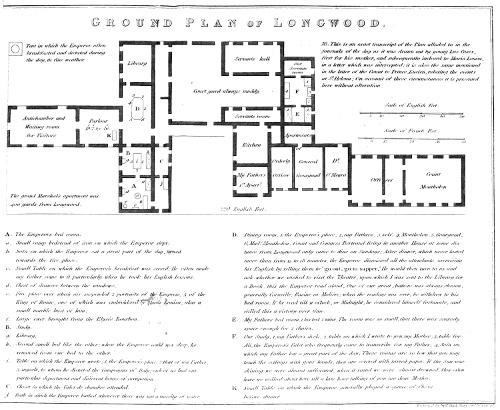
Ground Plan of Longwood.
The Emperor behaved to us in the kindest manner, and with a paternal familiarity. We were, on our part, the most attentive and respectful of courtiers. We uniformly endeavoured to anticipate his wishes; we carefully watched all his wants, and he had scarcely time to make a sign with his hand, before we were in motion.
None of us entered his apartment without being sent for, and, if any thing of importance was to be communicated to him, it was necessary to apply to be admitted. If he walked separately with any of us, no other presumed to intrude. In the beginning, we constantly remained uncovered near his person, which appeared strange to the English, who had been ordered to put on their hats, after the first salute. This contrast appeared so ridiculous to the Emperor that he commanded us, once for all, to behave like them. Nobody, except the two ladies, took a seat in his presence, unless desired to do so. He was never spoken to till he had spoken first, and always, and in all cases, the conversation was under his control and guidance. Such was the etiquette at Longwood, which was entirely, as it must be evident, that of our recollections and feelings.
On our return, the Emperor received and questioned, for a long time, the master of the Newcastle.
In consequence of the fire in the saloon, and a billiard-table being placed in the dining-room, we dined in the topographical cabinet. After dinner, there being no other apartment to retire to, we were obliged to remain a long time at table. That circumstance seemed, however, to give an additional interest to the conversation; we became more acquainted, more united with each other; we gave a greater scope to our language, and the evening passed off more rapidly.
ESTABLISHMENTS FOR MENDICITY IN FRANCE.—NAPOLEON’S PROJECTS RELATIVE TO ILLYRIA.—HOSPITALS.—THE FOUNDLING.—PRISONERS OF STATE.—IDEAS OF THE EMPEROR.
20th.—The Emperor sent for me in the morning; I found him reading an English work on the poor’s rate, 22the immense sums raised, and the vast number of individuals maintained at the expense of their parishes; the account embraced millions of men and hundreds of millions of money.
The Emperor was apprehensive that he had not read the work correctly, or that he had mistaken the meaning. The thing, he said, seemed altogether impossible. He could not conceive by what vices and defects so many poor could be found in a country so opulent, so industrious, and so abundant in resources for labour as England. He was still less capable of comprehending, by what prodigy the proprietors, overloaded with an oppressive ordinary and extraordinary taxation, were also enabled to provide for the wants of such a multitude. “But we have nothing,” he observed, “in France to be compared to it in the proportion of a hundredth or a thousandth part. Have you not told me that I sent you into the departments on a particular mission with regard to mendicity? Let us see, what is the number of our beggars? What did they cost? How many poor-houses did I establish? What was the number they held? What effect had they in removing mendicity?”
To this crowd of questions I was compelled to answer that a considerable period of time had since elapsed, that my mind had been occupied with several other objects, and that it was impossible for me to enter into correct statements from mere recollection; but that I had the official report itself among the few papers I had preserved, and that, the first time he might be pleased to send for me, I should be enabled to satisfy him. “But,” said he, “go instantly and look for it, things are not profitable unless seasonably applied, and I shall soon run it over with my thumb, as Abbé de Pradt ingeniously said; although, to tell the truth, I don’t much like to think of such subjects; they remind me of mustard after dinner.”
In two minutes the report was in his hand. “Well!” said the Emperor to me, also, in a very few minutes, for it might be really said that he had not turned over the leaves; “well, this, in fact, is not at all like England. Our organization, however, had failed; I suspected as much, and it was on that account I entrusted you with 23the mission. Your report would have been in perfect conformity with my views. You took up the consideration frankly and like an honest man, without fear of exciting the displeasure of the minister, by depriving him of a great many appointments.
“I am pleased with a great number of your details. Why did you not come and converse with me about them yourself? You would have satisfied me, and I should have known how to value your services.”—“Sire, as things were then situated, it would have been impossible for me to do so; we were then involved in the confusion and embarrassment caused by our misfortunes.”—“Your observation is perfectly correct; you establish an unquestionable position. The fact is that, in the flourishing state to which I had raised the empire, no hands could any where be found destitute of employment. It was idleness and vice alone that could produce mendicants.
“You think that their complete annihilation was possible; and, for my part, I am of the same opinion.
“Your levy en masse, to build a vast and single prison in each department, was equally adapted to the tranquility of society and to the well-being of those confined in it;—your idea of making them monuments for ages would have attracted my attention. That gigantic undertaking, its utility, its importance, the permanence of its results, were all in my way.
“With respect to your university for the people, I am very apprehensive that it would have been but a beautiful chimera of philanthropy, worthy of the unsophisticated Abbé de Saint Pierre. There is, however, some merit in the aggregate of those conceptions; but energy of character, and an unbending perseverance, for which we are not generally distinguished, would be requisite to produce any good result.
“For the rest, I every day collect ideas from you in this place, of which I did not imagine you capable; but it was not at all my fault. You were near me; why did you not open your mind to me? I did not possess the gift of divination. Had you been minister, those ideas, however fantastical they might at first have appeared to 24me, would not have been the less attended to, because there is, in my opinion, no conception altogether unsusceptible of some positive good, and a wrong notion, when properly controlled and regulated, often leads to a right conclusion. I should have handed you over to commissioners, who would have analyzed your plans; you would have defended them by your arguments, and, after taking cognizance of the subject, I alone should have finally decided according to my own judgment. Such was my way of acting, and my intention; I gave an impulse to industry; I put it into a state of complete activity throughout Europe; I was desirous of doing as much for all the faculties of the mind, but time was not allowed me. I could not bring my plans to maturity at full gallop; and, unfortunately, I but too often wasted them upon a sandy foundation, and consigned them to unproductive hands.
“What were the other missions with which I entrusted you?”—“One in Holland, another in Illyria.”—“Have you the reports?”—“Yes, Sire.”—“Go for them.” But I had not got to the door, when he said, “Never mind, come back, spare me the trouble of reading such matters!—They are henceforth, in reality, altogether useless.”—What did not these words unfold to me!
The Emperor resumed the subject of Illyria. “In obtainingobtaining possession of Illyria, it was never my intention to retain it; I never entertained the idea of destroying Austria. Her existence was, on the contrary, indispensably requisite for the execution of my plans. But Illyria was, in our hands, a vanguard to the heart of Austria, calculated to keep a check upon her; a sentinel at the gates of Vienna, to keep her steady to our interests. Besides, I was desirous of introducing and establishing in that country our doctrines, our system of government, and our codes. It was an additional step to the regeneration of Europe. I had merely taken it as a pledge, and intended, at a later period, to exchange it for Gallicia, at the restoration of Poland, which I hurried on against my own opinion. I had, however, more than one project with regard to Illyria; for I frequently fluctuated in my designs, and had few ideas that were fixed on solid 25grounds. This arose rather from adapting myself to circumstances than from giving an impulse and direction to them, and I was every instant compelled to shift about. The consequence was that, for the greater part of the time, I came to no absolute decision, and was occupied merely with projects. My predominant idea, however, particularly after my marriage, was to give it up to Austria as an indemnity for Gallicia, on the re-establishment of Poland, at any rate, as a separate and independent kingdom. Not that I cared upon whose head, whether on that of a friend, an enemy, or an ally, the crown was placed, provided the thing was effected. The results were indifferent to me. I have, my dear Las Cases, formed vast and numerous projects, all unquestionably for the advancement of reason and the welfare of the human race. I was dreaded as a thunderbolt; I was accused of having a hand of iron; but the moment that hand had struck the last blow, every thing would have been softened down for the happiness of all. How many millions would have poured their benedictions on me, both then and in future times! But how numerous, it must be confessed, the fatal misfortunes which were accumulated and combined to effect my overthrow, at the end of my career! My unhappy marriage; the perfidies which resulted from it; that villainous affair of Spain; from which I could not disengage myself; that fatal war with Russia, which occurred through a misunderstanding; that horrible rigour of the elements, which devoured a whole army; ... and then, the whole universe against me!... Is it not wonderful that I was still able to make so long a resistance, and that I was more than once on the point of surmounting every danger and emerging from that chaos more powerful than ever!... O destiny of man!—What is human wisdom, human foresight!”—And then abruptly adverting to my report, he said, “I observed, that you travelled over a great number of departments. Did your mission last long? Was your journey agreeable? Was it of real benefit to you? Did you collect much information? Were you enabled to form a correct judgment on the state of the country, on that of public opinion?
26“I now recollect that I selected you precisely because you had just returned from your mission to Illyria, and I found in your report several things which made a strong impression upon me; for it is surprising how many things at present are every day brought back to my memory, which, at the time, struck me in you, and which, by a singular fatality, were immediately afterwards completely forgotten. When any appointments were about to take place to those special and confidential missions, the decree, with blanks for the names, was laid before me, and I filled them up with persons of my own selection—I must have written your name with my own hand.”
“Sire,” I replied, “there never was, perhaps, a mission more agreeable and satisfactory in every point of view. I commenced it early in the spring, and proceeded from Paris to Toulon, and from Toulon to Antibes, following the line of coast and occasionally diverging into the interior. I travelled nearly thirteen hundred leagues, but unfortunately the time was short. The minister, in his instructions, had strictly limited the period to three, or at most, to four months. It would be difficult for me to give an adequate description of all the delight, enjoyments, and advantages which I derived from the journey. I was a member of your Council, an officer of your household. I was every where considered as one of your missi dominici, and was received with suitable respect. The more I behaved with discretion, moderation, and simplicity, visiting myself the high functionaries, whose attendance I was authorized to require, the more I was treated with deference and complaisance. For one, who shewed any distrust, or betrayed any symptom of ill-humour or envy; (for I afterwards learnt from themselves, that my character, as a nobleman, emigrant, and chamberlain, formed three certain grounds for reprobation;) for one, I repeat, who looked upon me with a jealous eye, I found many whose communications were altogether unreserved, even upon subjects, respecting which I should not have presumed to make inquiry. They assured me that they took pleasure in unbosoming themselves to me with perfect openness; that they viewed my situation, near the person of the sovereign, 27as a favourable medium; and considered me as the confessor upon whom they relied for transmitting their most secret thoughts to the Most High. The more I endeavoured to convince them that they were mistaken with regard to my situation and the nature of my mission, the more they were confirmed in the contrary opinion. In so short a period, what a lesson for me on mankind! There were none of these high functionaries who did not differ from each other with regard to the views, means, and designs of all the objects under consideration; and yet they were all men selected with care, of tried ability, and generally of great merit. Persons in private life also looked up to me as to a ray of Providence, and applied to me either publicly or in secret. How many things did I not learn! How numerous the denunciations and accusations communicated to me! What a multitude of local abuses, of petty intrigues, were disclosed to me!
“Altogether unacquainted with affairs, and until then absolutely ignorant of official proceedings, I made use of that peculiar opportunity to obtain information. I did not fail to make myself acquainted with all the objects and particular circumstances of every party. I was not apprehensive of shewing my ignorance to the first who presented themselves, for I was thus enabled to qualify myself for discussing business with the others.
“It is true, Sire, that my special mission was restricted to the mendicity establishments and the houses of correction: but feeling, as I did, all the want of a stock of knowledge, fit to render myself useful to the Council of State, and taking advantage of my appointment, I connected with it, of my own accord, the minute inspection of prisons, hospitals, and beneficent institutions, and I also took a survey of all our ports and squadrons.
“How magnificent the combination which thus presented itself to my view! I every where beheld the most perfect tranquillity and complete confidence in the government; every hand, every faculty, every branch of industry, was employed; the soil was embellished by the flourishing state of agriculture, it was the finest time of the year; the roads were excellent; public works were 28in progress in almost in every quarter;—the canal of Arles, the noble bridge of Bordeaux, the works of Rochefort, the canals from Nantes to Brest, to Rennes, to Saint Malo; the foundation of Napoleonville, intended to be the key of the whole peninsula of Britanny; the magnificent works of Cherbourg, those of Antwerp, sluices, moles, or other improvements in most of the towns of the Channel—such is the sketch of what I saw.
“On the other hand, the ports of Toulon, Rochefort, L’Orient, Brest, Saint Malo, Havre, and Antwerp, displayed an extraordinary degree of activity; our roads were filled with vessels, and the numbers increased daily: our crews were training in spite of every obstacle, and our young conscripts were becoming good seamen, fit for future service. I, who belonged to the old naval establishment, was astonished at every thing I saw on board, so very great were the improvements made in the art, and so far did they exceed, in every point of view, all that I had witnessed.
“The squadrons belonging to the different ports got under sail every day, and executed their regular manœuvres, like the parades of garrisons, and all this took place within sight of the English, who thought it a ridiculous farce, without foreseeing the danger with which they were threatened; for, never at any period was our navy more formidable, or our ships more numerous. We already had upwards of 100 afloat or on the stocks, and we were making daily additions to the number. The officers were excellent, and animated with zeal and ardour. I had no idea whatever of the forward state of our preparations, before I witnessed it in person, and should not have believed it, had I been told of it.
“With respect to the mendicity establishments, the special object of my mission, your intentions, Sire, had been ill understood, and the plan was altogether unsuccessful. In most of the departments, mendicity not only remained with all its defects, but no steps whatever had been taken for its annihilation. The fact was that several prefects, so far from making the establishments a terror to the mendicants, had merely considered them as a refuge for the poor. Instead of holding out confinement 29as a punishment, they caused it to be sought after as an asylum; and thus the lot of the prisoners might be envied by the hard-working peasantry of the neighbourhood. France might, in that way, have been covered with similar establishments, which might have been filled without diminishing the number of mendicants, who commonly make a trade of begging, and follow it in preference. I was, however, enabled to judge that the extirpation of the evil was possible, and the example of some departments, in which the prefects had taken a better view of the subject was sufficient to produce that conviction. There were a few in which it had entirely disappeared.
“It is an observation which makes an immediate and striking impression, that, all other things fairly averaged, mendicity is much more rare in those parts which are poor and barren, and much more common in those which are fruitful and abundant. It is also infinitely more difficult to effect its destruction in the places where the clergy have enjoyed superior wealth and power. In Belgium, for instance, mendicants were seen to derive honour from their trade, and boast of having followed it for several generations. These claims belonged peculiarly to them, and that country was accordingly the rendezvous of mendicity.” “But I am not surprised at it,” resumed the Emperor, “the difficulty of this important consideration consists entirely in discriminating accurately between the poor man who commands our respect, and the mendicant who ought to excite our indignation; besides, our religious absurdities confound these two classes so completely that they seem to make a merit, a kind of virtue, of mendicity, and to encourage it by the promise of heavenly rewards. The mendicants are, in reality, neither more nor less than monks au petit pied; so that in the list of them we even find the mendicant monks. How was it possible for such ideas not to produce confusion in the mind, and disorder in society? A great number of saints have been canonized, whose only apparent merit was mendicity. They seem to have been transplanted to Heaven for that, which, considered as a matter of sound policy, ought to have subjected them to 30castigation and confinement in this world. This would not, however, have prevented them from being worthy of Heaven. But go on.”—
“It was not, Sire, without emotion that I observed the details of the charitable establishments. In contemplating the anxiety, the cares, the ardent charity, of so many sympathetic hearts, I was enabled to ascertain that we were far from yielding the palm, whatever might be the consideration, to any other people, and that we merely had less ostentation and made less use of artificial means to enhance our merits. The South, above all, and Languedoc, in particular, displayed a zeal and animation of which it would be difficult to form an adequate conception. The hospitals and alms-houses were every where numerous and well attended to. The foundlings had increased tenfold since the revolution, and I instantly ascribed it to the corruption of the times; but I was desired to remark, and constant reflection convinced me of the truth, that the result was, on the contrary, to be attributed to very satisfactory causes. I was assured that formerly the foundlings were so wretchedly taken care of, and so badly fed, that the whole of them were diminutive, sickly, and short-lived, and that from seven to nine perished out of ten; while at present their food, cleanliness, and the care taken of them, in every respect are such that nearly all of them are preserved, and constitute a fine race of children. They are thus indebted for their numbers solely to their preservation. Vaccination has also contributed, in an immense proportion, to their increase. These children are now treated with such attention as to give rise to a singular abuse. Mothers, even in easy circumstances, are tempted to expose their infants; they afterwards apply at the hospital, and, under a charitable pretence, offer to bring up one themselves; it is their own which is restored to them with the benefit of a small allowance. All this is carried on through the favour of the agents themselves, and often for the purpose of obtaining a trifling pension for one of their relations. Another abuse of this kind, and not less extraordinary, was that which I observed in Belgium, of persons getting their names entered a long time before, 31for the purpose of entitling them to send their children to the hospital. Any young couple, on their marriage, strove to get their names entered for vacancies, which fell to them some years afterwards, as a matter of right; it was a part of the marriage settlement.”—“O Jesus! Jesus!” exclaimed the Emperor, shrugging up his shoulders and laughing, “and after this make laws and regulations!”—
$1“$2”$3But with regard to the prisons, Sire, they were almost uniformly the scenes of horror and real misery, the shame and disgrace of our provinces, absolute sinks of corruption and infection, which I was obliged to pass through with the utmost haste, or from which I was driven back in spite of all my efforts. I had formerly visited certain prisons in England, and indulged in a smile at the kind of luxury which I observed in them; but it was quite a different thing with respect to ours, and my indignation was excited by the contrary extreme. There are no offences, I might even say crimes, that are not sufficiently punished by such habitations, and those who leave them should not, in strict justice, have any further expiation to make. Yet after all those confined in them were merely under a simple accusation, while those who had been found guilty, the real criminals, and hardened villains, had their special prisons, their houses of correction, where they were, perhaps, too well taken care of; and even, in the latter case, the honest day-labourer might have reason to envy their lot, and make comparisons injurious to Providence and society. Another striking inconsistency was observable in these houses of correction; it was the amalgamation, the habitual mixture of all the classes upon whom sentence had been passed. Some being imprisoned for small offences only for a year, and others for fifteen, twenty years, or for life, on account of the dreadful crimes they had perpetrated, it necessarily followed that they would be all reduced to one moral level, not by the amelioration of the latter, but rather by the corruption of the former.
“What struck me also very forcibly in La Vendée and the adjacent country was that maniacs had increased 32there, perhaps, tenfold more than in any other part of the empire, and that persons were detained in the mendicity establishments and other places of confinement, who were treated as vagabonds, or likely to become so, and who having been taken up in their childhood, had no knowledge of their parents or origin. Some of them had marks of wounds on their persons, but were ignorant how they had been inflicted. They had, no doubt, been made in their infancy. The opportunity of employing these persons, who had not acquired a single social idea, has been suffered to pass by; they are now unfit for any purpose.”—“Ah!” exclaimed the Emperor, “this is civil war and its hideous train; its inevitable consequences and its certain fruits! If some leaders make fortunes, and extricate themselves from danger, the dregs of the population are always trodden under foot, and become the victims of every calamity!”
“With respect to other matters, I found in the aggregate of these establishments a considerable number of persons who, I was told, whether right or wrong, were prisoners of state, and were kept in custody by order of the high, the intermediate, or the low, police.
“I listened to all those prisoners, I heard their complaints, and received their petitions, certainly, without any engagement on my part; for I had no right to contract any; and besides, I was perfectly aware that, having heard their testimony only, I could not attach guilt to any person. With the exception, however, of some notorious villains, they did not really, in general, deserve more at farthest than the common punishments of the correctional police.
“I found among them, in the prisons of Rennes, a boy between twelve and fourteen, who had, when only a few months old, been taken with a band of Chauffeurs. They had been all executed, and the boy had remained there ever since, without any decision on his case. His moral capabilities may be easily appreciated. He never saw, knew, or heard any but villains; they were the only kind of people of whose existence he was able to form an idea.
“At Mont Saint-Michel, a woman, whose name I 33have forgotten, particularly attracted my attention. She had rather a pretty face, pleasing manners, and a modest deportment. She had been imprisoned fourteen years, having taken a very active part in the troubles of La Vendée, and constantly accompanied her husband, who was the chief of a battalion of insurgents, and whom she succeeded, after his death, in the command. The wretchedness she suffered, and the tears she shed, had sensibly impaired her charms. I assumed a severe air during the recital of her misfortunes, but it was put on for the purpose of concealing the emotions which she excited. She had, by the kindness of her manners and her other qualifications, acquired a kind of empire over the vulgar and depraved women that were about her. She had devoted herself to the care of the sick; the prison infirmary was entrusted to her, and she was beloved by every one.
“With the exception of that woman, a few priests, and two or three old Chouan spies, the rest exhibited but a filthy compound of disgusting or extravagant depravity.
“I met with a married man, possessing an annual income of 15,000 livres, evidently confined in consequence of his wife’s intrigues, after the manner of the ancient lettres de cachet; and with prostitutes, who assured me they were detained, not as a punishment for the indiscriminate profusion of their favours, but out of spite at their want of complaisance for a single person. They told me lies, or they did not; but in either case ought they to be honoured with the title of prisoners of state, to be maintained at the expense of two francs a day, and contribute to render the government odious and ridiculous? Finally, I met with an unhappy man in a town of Belgium, who had married one of those girls for whom the municipalities provide marriage portions on great occasions. He was imprisoned on a charge of having stolen the portion, because he had neglected to earn it. He was positively required to discharge that important debt, and he as positively refused. He was, perhaps, required to do what was absolutely impossible for him.
34“Immediately upon my return to Paris, I called on M. Réal, prefect of police of the district I had just visited. I considered it my duty, I said, to communicate to him, in a friendly manner, the result of my observations. I must do him justice; for whether he was far from having a bad heart, whether he was impressed with my plain dealing, or affected perhaps, Sire, by the magic influence of your uniform, he thanked me, observed that I was doing him a real service, and assured me that he would take immediate steps for relieving and redressing, such were his words, the cases I had laid before him. Meeting him, however, a few days afterwards at an assembly, he said, with apparent grief, ‘That is an unfortunate business, and very unfavourable to your Amazon (he alluded to General Mallet’s rash enterprise), which I thought myself capable of doing a few days ago of my own accord. I cannot now pretend to undertake it without an order from a superior quarter.’—I do not know how the thing ended.”
The Emperor dwelt some time on the abuses I had pointed out, and then concluded: “In the first place, in order to proceed regularly, it was incumbent upon you to ascertain whether your information was well founded, and to hear the evidence against the persons accused; and then it must be frankly admitted that abuses are inherent in every human establishment. You see that almost every thing, of which you complain, is done by the very persons who were expressly entrusted with the means of prevention. Can a remedy be provided, when it is impossible to see what passes every where? There is, as it were, a net spread over the low places, which envelops the lower classes. A mesh must be broken and discovered by a fortunate observer like you, before any thing of the matter is known in the upper regions. Accordingly, one of my dreams would have been, when the grand events of war were completely terminated, and I returned to the interior in tranquillity and at ease, to look out for half a dozen, or a dozen, of real philanthropists, of those worthy men who live but to do good. I should have distributed them through the empire, which they should have secretly inspected for the purpose 35of making their report to me. They would have been spies of virtue! They should have addressed themselves directly to me, and should have been my confessors, my spiritual guides, and my decisions with them should have been my good works done in secret. My grand occupation, when at full leisure, and at the height of my power, would have been the amelioration of every class of society. I should have descended to the details of individual comfort; and, had I found no motive for that conduct in my natural disposition, I should have been actuated by the spirit of calculation; for, after the acquisition of so much glory, what other means would have been left me to make any addition to it? It was because I was well aware that that swarm of abuses necessarily existed, because I wished for the preservation of my subjects, and was desirous of throwing every impediment in the way of subordinate and intermediate tyranny, that I conceived my system of state prisons, adapted to any crisis that might occur.”—“Yes, Sire, but it was far from being well received in our saloons, and contributed not a little to make you unpopular. An outcry was every where raised against the new bastiles, against the renewal of lettres de cachet.”—“I know it very well.” said the Emperor, “the outcry was echoed by all Europe, and rendered me odious. And yet, observe how powerful was the influence of words, envenomed by perfidy! The whole of the discontent was principally occasioned by the preposterous title of my decree, which escaped me from distraction, or some other cause; for, in the main, I contend that the law itself was an eminent service, and rendered individual liberty more complete and certain in France than in any other country of Europe.
“Considering the crisis from which we had emerged, the factions by which we had been divided, and the plots which had been laid, and were still contriving, imprisonment became indispensable. It was, in fact, a benefit; for it superseded the scaffold. But I was desirous of sanctioning it by legal enactments, and of placing it beyond the reach of caprice, of arbitrary power, of hatred, and of vengeance. Nobody, according to my 36law, could be imprisoned and detained as a prisoner of state, without the decision of my privy council, which consisted of sixteen persons; the first, the most independent and most distinguished characters of the state. What unworthy feeling would have dared to expose itself to the detection of such a tribunal? Had I not voluntarily deprived myself of the power of consigning individuals to prison? No man could be detained beyond a year, without a fresh decision of the Privy-Council, and four votes out of sixteen were sufficient to effect his release. Two councillors of state were bound to attend to the statements of the prisoners, and became from that moment their zealous advocates with the Privy Council. These prisoners were also under the protection of the Committee of individual liberty, appointed by the Senate, which was the object of public derision, merely because it made no parade of its labours and their results. Its services, however, were great; for it would argue a defective knowledge of mankind to suppose that Senators, who had nothing to expect from ministers, and who were their equals in rank, would not make use of their prerogative to oppose and attack them, whenever the importance of the case called for their interference. It must also be considered that I had assigned the superintendence of the prisoners, and of the police of the prisons, to the tribunals, which, from that instant, paralyzed the exercise of every kind of arbitrary authority by the other branches of administration and their numerous subordinate agents. After such precautions, I do not hesitate to maintain that civil liberty was as effectually secured by that law in France as it could possibly be. The public misconceived, or pretended to misconceive, that truth, for we Frenchmen must murmur at every thing and on every occasion.
“The fact is, that at the time of my downfal the state prisons scarcely contained 250 persons, and I found 9000 in them, when I became Consul. It will appear, from the list of those who were imprisoned, and upon an examination into the causes and motives of their confinement, that almost every one of them deserved death, and would have been sentenced to it by regular 37process of law; and it consequently follows that their imprisonment was, on my part, a benefit conferred upon them. Why is there nothing published against me on this subject at present? Where are the serious grievances to be found with which I am reproached? There are none in reality. If some of the prisoners afterwards made a merit of their sufferings with the King, on account of their exertions in his favour, did they not by that proceeding pronounce their own sentence and attest my justice? For what may seem a virtuous action in the King’s eye was incontestably a crime under me; and it was only because I was repugnant to the shedding of blood on account of political crimes, and because such trials would have but tended to the continuance of commotion and perplexity in the heart of the country, that I commuted the punishment to mere imprisonment.
“I repeat it, the French were, at my era, the freest people of all Europe, without even excepting the English; for, in England, if any extreme danger causes the suspension of the Habeas Corpus act, every individual may be sent to prison at the mere will of ministers, who are not called upon to justify their motives, or to account for their conduct. My law had very different limits.” He concluded with saying;—“And then, at last, if, in spite of my good intention, and notwithstanding my utmost care, all that you have just said, and no doubt, many other things, were well founded, it must not still be considered so easy a task as it is thought to create a beneficial establishment for a nation. It is a remarkable circumstance that the countries which have been separated from us have regretted the laws with which I governed them. This is an homage paid to their superiority. The real, the only, mode of passing a decisive sentence upon me, with regard to their defects, would be to shew the existence of a better code in any other country. New times are drawing near, it will be seen,” &c.
About five o’clock, I was told by the Grand Marshal, who had just left the Emperor, that he wished to see me. He had staid at home the whole of the day. I found him 38engaged in examining the new billiard-table. He was apprehensive that the weather was too damp for walking, and he played at chess until dinner. In the evening, he read us Crebillon’s Atrée et Thyeste. That piece seemed horrible to us; we found it disgusting, and by no means of a tragic cast. The Emperor could not finish it.
EGYPT.—ST. JEAN D’ACRE.—THE DESERT.—ANECDOTES.
21st. About three o’clock, the Emperor called for his calash. He sent for me, and we walked together to the bottom of the wood where he had ordered the carriage to take him up. I had some particulars of no great moment to communicate, which personally concerned him. We observed, in the course of our ride, two vessels under sail for the island.
At dinner, the Emperor was very talkative. He had been just employed on his campaign in Egypt, which he had, for some time, neglected, and which, he said, would be as interesting as an episode of romance. In speaking of his position at St. Jean d’Acre, he observed:—It was certainly a daring thing to post myself thus in the heart of Syria, with only 12,000 men. I was 500 leagues from Desaix, who formed the other extremity of my army. It has been related, by Sydney Smith, that I lost 18,000 men before Acre, although my army consisted but of 12,000. An obscure person, M...., who had just left college, as it seemed, who knows nothing of what he describes, and whose only talent is that of tacking some sentences together, with a view, no doubt, of converting them to his emolument, the brother, however, of one whom I have loaded with favours, and who was one of my Council of State, has recently published something on that subject, on which I have cast a glance, and which vexes me on account of its silliness and the unfavourable colouring which he endeavours to throw over the glory and exploits of that army.
“Had I been master of the sea, I should have been master of the East, and the thing was so practicable that it failed only through the stupidity or bad conduct of some seamen.
“Volney, who travelled in Egypt before the revolution, 39had stated his opinion that that country could not be occupied without three great wars, against England, the Grand Signor, and the inhabitants. The latter, in particular, seemed difficult and terrible to him. He was altogether mistaken in that respect, for it gave us no trouble. We had even succeeded in making friends of the inhabitants, in the course of a short time, and of uniting their cause with ours. A handful of Frenchmen had thus been sufficient to conquer that fine country, which they ought never to have lost. We had actually accomplished prodigies in war and in politics. Our undertaking was altogether different from the crusades; the crusaders were innumerable and hurried on by fanaticism. My army, on the contrary, was very small, and the soldiers were so far from being prepossessed in favour of the enterprise that, at first, they were frequently tempted to carry off the colours and return. I had, however, succeeded in familiarizing them with the country, which supplied every thing in abundance, and at so cheap a rate that I was one time on the point of placing them on half-pay for the purpose of laying by the other half for them. I had acquired such an ascendancy over them, that I should have been able, by a mere order of the day, to make them Mahometan. They would have treated it as a joke, the population would have been gratified, and the very Christians of the East would have considered themselves gainers, and approved it, knowing that we could do nothing better for them and for ourselves.
“The English were struck with consternation at seeing us in possession of Egypt. We exposed to Europe the certain means of wresting India from them. They have not yet dismissed their apprehensions, and they are in the right. If 40 or 50,000 European families ever succeed in establishing their industry, laws, and government in Egypt, India will be more effectually lost to the English by the commanding influence of circumstances than by the force of arms.”
In the course of the evening, the Grand Marshal put the Emperor in mind of one of his conversations with Monge, the mathematician, at Cutakié, in the midst of the desert. “What do you think of all this, citizen 40Monge?” said Napoleon.—“Why, citizen general,” answered Monge, “I think, if there are ever seen in this place as many equipages as at the Opera house, there must first be some wonderful revolutions on the globe.” The Emperor laughed very heartily at the recollection. He had, however, he observed, a carriage with six horses on the spot. It was unquestionably the first of the kind that travelled over the desert, and accordingly it very much surprised the Arabs.
The Emperor remarked that the desert always had a peculiar influence on his feelings. He had never crossed it without being subject to a certain emotion. To him, he said, it was an image of immensity: it seemed to have no bounds, neither beginning nor end; it was an ocean on terra firma. His imagination was delighted with the sight, and he took pleasure in drawing our attention to the observation that Napoleon meant Lion of the Desert!...
The Emperor also told us that, when he was in Syria, it was a settled opinion at Cairo that he never would be seen there again, and he noticed the thievery and impudence of a little Chinese, who was one of his servants. “It was,” said he, “a little deformed dwarf, whom Josephine once took a fancy to at Paris. He was the only Chinese in France; thenceforth she would always have him behind her carriage. She took him to Italy, but as he was in the constant habit of pilfering, she wished to get rid of him. With that view, I took him with me on my Egyptian expedition. Egypt was a lift to him half-way on his journey. This little monster was entrusted with the care of my cellar, and I had no sooner crossed the desert than he sold, at a very low price, 2000 bottles of capital claret. His only object was to make money, convinced that I should never come back. He was not at all disconcerted at my return, but came eagerly to meet me, and acquainted me, as he said, like a faithful servant, with the loss of my wine. The robbery was so glaring that he was himself compelled to confess it. I was much urged to have him hanged, but I refused, because, in strict justice, I ought to have done as much to those in embroidered clothes, who had knowingly 41bought and drunk the wine. I contented myself with discharging and sending him to Suez, where he was at liberty to do what he pleased.”
On this subject I must observe that we were induced, in this place, to give momentary credit to a very singular coincidence. We were informed a few months ago, that on board one of the Chinese traders, which were then off the island, on their return to Europe, there was a Chinese, who said he had been in the Emperor’s service in Egypt. The Emperor instantly exclaimed, that it must be his little thief, whose story I have just told; but it was, in fact, a cook of Kleber’s.
The Emperor put a sudden stop to the conversation, and, with more gaiety than usual, turning to Madame Bertrand, said with a smile, “When shall you be at your apartments in the Tuileries? When will you give your splendid dinners to the ambassadors? But you will be obliged, at least, I am told so, to have new furniture, for it is reported that the fashions have entirely changed.” The conversation then naturally turned on the magnificence and luxury which we had witnessed under the Emperor.
PATERNAL ADVICE—REMARKABLE CONVERSATION—CAGLIOSTRO; MESMER, GALL, LAVATER, &C.
22nd.—The Emperor came to my apartment about 10 o’clock, and took me out to walk. We all breakfasted under the trees. The weather was delightful, and the heat, though great, was not unwholesome. The Emperor ordered his calash; two of us were with him, and the third accompanied us on horseback. The Grand Marshal could not attend. The Emperor recurred to some misunderstanding which had taken place among us a few days before. He took a view of our situation and our natural wants;—“You are bound,” said he, “when you are one day restored to the world, to consider yourselves as brothers, on my account. My memory will dictate this conduct to you. Be so, then, from this moment!” He next described how we might be of mutual advantage to each other, the sufferings we had it in our power to alleviate, &c. It was, at once, a family and moral lesson, a lesson of feeling and conduct. 42It ought to have been written in letters of gold. It lasted nearly an hour and a quarter, and will, I think, never be forgotten by any of us. For myself, not only the principles and the words, but the tone, the expression, the action, and above all, the heart with which he delivered them, will never be forgotten by me.
About five o’clock, the Emperor entered my apartment where I was employed with my son, on the chapter of the battle of Arcole. He had something to say to me, and I followed him to the garden, where he resumed, at great length, the conversation that had taken place in the calash....
We now dined in the old topographical cabinet, adjoining to that of the Emperor, and the apartment formerly occupied by Montholon’s family, which, with the help of the books and shelves lately received from England, was converted into a tolerable library.
As the damage done by the fire in the saloon was long in repairing, we were obliged to continue at table in our new dining-room until the Emperor withdrew. This circumstance, however, gave additional interest to the conversation.
The Emperor was very communicative to-day. The conversation turned on dreams, presentiments, and foresights, which the English call second sight. We exhausted every common-place topic, ordinarily connected with these objects, and came at last to speak of sorcerers and ghosts. The Emperor concluded with observing, “All these quackeries, and many others, such as those of Cagliostro, Mesmer, Gall, Lavater, &c. are destroyed by this sole and simple argument: All that may exist, but it does not exist.
“Man is fond of the marvellous; it has for him irresistible fascinations; he is ever ready to abandon what is near at hand, to run after what is fabricated for him. He voluntarily gives way to delusion. The truth is, that every thing about us is a wonder. There is nothing which can be properly called a phenomenon. Every thing in nature is a phenomenon. My existence is a phenomenon. The wood that is put on the fire and warms me, is a phenomenon; that candle yonder, 43which gives me light, is a phenomenon. All the first causes, my understanding, my faculties, are phenomena; for they all exist and we cannot define them. I take leave of you here,” said he, “and lo! I am at Paris, entering my box at the Opera. I bow to the audience; I hear their acclamations; I see the performers; I listen to the music. But if I can bound over the distance from Saint Helena, why should I not bound over the distance of centuries? Why should I not see the future as well as the past? Why should the one be more extraordinary, more wonderful, than the other? The only reason is, that it does not exist. This is the argument which will always annihilate, without the possibility of reply, all visionary wonders. All these quacks deal in very ingenious speculations; their reasoning may be just and seductive, but their conclusions are false, because they are unsupported by facts.
“Mesmer and Mesmerism have never recovered from the blow dealt at them by the report of Bailly on behalf of the Academy of Sciences. Mesmer produced effects upon a person by magnetizing him to his face, yet the same person, magnetized behind, without his knowing it, experienced no effect whatever. It was therefore, on his part, an error of the imagination, a debility of the senses; it was the act of the somnabulesomnabule, who, at night runs along the roof without danger, because he is not afraid; but who would break his neck in the day, because his senses would confound him.
“I once attacked the quack Puységur, on his somnabulismsomnabulism, at one of my public audiences. He would have assumed a very lofty tone: I brought him down to his proper level with only these words: If your doctrine is so instructive, let it tell us something new! Mankind will, no doubt, make very great progress in the next two hundred years; let it specify any single improvement which is to take place within that period! Let it tell me what I shall do within the following week! Let it declare the numbers of the lottery, which will be drawn to-morrow!
“I behaved in the same manner to Gall, and contributed very much to the discredit of his theory. Corvisart 44was his principal follower. He and his colleagues have a great propensity to materialism, which is calculated to strengthen their theory and influence. But nature is not so poor. Were she so clumsy as to make herself known by external forms, we should do our business more promptly and know a great deal more. Her secrets are more subtle, more delicate, more evanescent, and have hitherto escaped the most minute researches. We find a great genius in a little hunchback; and a man, with a fine commanding person, turns out to be a stupid fellow. A big head, with a large brain, is sometimes destitute of a single idea; while a small brain is found to possess a vast understanding. And observe the imbecility of Gall. He attributes to certain protuberances propensities and crimes, which are not in nature, but arise solely from society and the conventional usages of mankind. What would become of the protuberance of theft, if there were no property; of drunkenness, if there were no fermented liquors; and of ambition, if there were no society?
“The same remarks apply to that egregious charlatan, Lavater, with his physical and moral relations. Our credulity lies in the defect of our nature. It is inherent in us to wish for the acquisition of positive ideas, when we ought, on the contrary, to be carefully on our guard against them. We scarcely look at a man’s features, before we pretend to know his character. We should be wise enough to repel the idea and to neutralize those deceitful appearances. I was robbed by a person who had grey eyes, and from that moment am I never to look at grey eyes without the idea, the fear, of being robbed? A weapon wounded me, and I am afraid of it wherever I see it; but was it the grey eyes that robbed me? Reason and experience, and I have been enabled to derive great benefit from both, prove that all those external signs are so many lies; that we cannot be too strictly on our guard against them, and that the only true way of appreciating and gaining a thorough knowledge of mankind is by trying and associating with them. After all, we meet with countenances so hideous, it must be allowed,” (and as an instance he described one; it was 45that of the governor,) “that the most powerful understanding is confounded, and condemns them in spite of itself.”
SINGULAR SERIES OF VEXATIONS, &C.
23d.—The Emperor called upon me about three o’clock. He wished to take a walk. He had a gloomy look, and had suffered much since yesterday. He was seriously affected by the intense heat during his ride in the calash. He had observed a new outer door which was making, and which would have altered the whole interior of the topographical cabinet and of Madame Montholon’s former apartment. He had not been consulted on the occasion, and was sensibly affected at it. He sent instantly for the person who had given the directions, and the wretched reasons he assigned served only to vex him still more. We had come out to walk; but it seemed decided that every thing was to irritate and put him in ill humour that evening. He saw some English officers on his way, and turned aside from them almost in anger, observing that shortly it would be impossible for him to put his foot out of doors. A few paces off he was joined by the Doctor, who came to tell him, unseasonably enough, of some arrangements that were making for him, (the Emperor) and to ask his opinion on the subject. It was one of the topics which, perhaps, hurt his feelings most. He made no answer, his ordinary resource against disappointment; but this time he kept silence with a fretfulness which he could not conceal. He came up with the carriage, and got in; but on our way we met some more English officers, and then he suddenly ordered the coachman to drive off, at a gallop, in another direction.
The new door-way, however, which had been made in the house without his knowledge, and which he found so inconvenient, still lay heavy on his heart. He was about to lighten the load by a lively playfulness with the wife of the person who had ordered it, and who happened to be in the calash. “Ah,” said he, “are you there? You are in my power; you shall pay the penalty. The husband is the guilty person; it is the 46wife that shall answer for him.” But instead of accommodating herself to the sense in which the words were uttered, which she might have done without the least inconvenience, and with the certainty of a satisfactory result, she persisted in making lame excuses for her husband, and repeating reasons, which served but to revive his dissatisfaction. Finally, to fill up the chapter of cross-purposes, one of us, on discovering the tents of the camp, informed him that the evolutions and manœuvres of the preceding day were in celebration of one of the great victories gained by the English in Spain, and that the regiment which executed them had been very nearly destroyed in that battle. “A regiment. Sir, is never destroyed by the enemy; it is immortalized,” was his only answer. It is true, that it was delivered very dryly.
For myself, I meditated in silence on this accumulation of contrarieties, which struck such repeated blows in so short a time. It was a precious moment for an observer. I estimated the mortification which they were calculated to produce, and I remarked with admiration, how little he betrayed. I said to myself: This is the intractable man, this the tyrant! One would have supposed that he knew what was passing in my mind, for, when we left the calash, and were a few paces before the others, he said to me in a low tone, “If you like to study mankind, learn how far patience can go, and all that one can put up with,” &c.