MEMOIRS OF THE LIFE, EXILE, AND CONVERSATIONS, OF THE EMPEROR NAPOLEON. (continued 3)
Reading edition
Here the Grand Marshal observed “that he actually belonged to one of the battalions which manifested the most determined devotion. He was several times on the point of being massacred as he returned alone to his 91residence.” We remarked, on our part, that in general the national guard of Paris had constantly displayed the virtues of its class; the love of order, attachment to authority, the dread of plunder, and the detestation of anarchy; and that also was the Emperor’s opinion.
“The palace being forced, and the King having repaired to the Assembly,” continued he, “I ventured to penetrate into the garden. Never since has any of my fields of battle given me the idea of so many dead bodies, as I was impressed with by the heaps of the Swiss; whether the smallness of the place seemed to increase the number, or because it was the result of the first impression I ever received of that kind. I saw well dressed women commit the grossest indecencies on the dead bodies of the Swiss. I went through all the coffee-houses in the neighbourhood of the Assembly; the irritation was every where extreme; fury was in every heart and shewed itself in every countenance, although the persons thus enflamed were far from belonging to the class of the populace; and all these places must necessarily have been frequented daily by the same visitors: for, although I had nothing particular in my dress, or perhaps it was because my countenance was more calm, it was easy for me to perceive that I excited many hostile and distrustful looks, as some one who was unknown or suspected.”
MASKED BALLS.—MADAME DE MÉGRIGNY.—PIEDMONT AND THE PIEDMONTESE.—CANALS OF FRANCE.—PLANS RESPECTING PARIS.—VERSAILLES.—FONTAINEBLEAU, &C.
4th.—The weather was much improved. The Emperor ordered his calash, and walked a good way until it took him up.
The conversation turned upon masked balls, which the Emperor was peculiarly fond of and frequently ordered. He was then always sure of a certain meeting which never failed to take place. He was, he said, regularly accosted every year by the same mask, who reminded him of old intimacies, and ardently entreated to be received and admitted at Court. The mask was a 92most amiable, kind, and beautiful woman, to whom many persons were certainly much indebted. The Emperor, who continued to love her, always answered;—“I do not deny that you are charming, but reflect a little upon your situation; be your own judge and decide. You have two or three husbands, and children by several of your lovers. It would have been thought a happiness to have shared in the first fault; the second would have caused pain, but still it might be pardoned; but the sequel—and then, and then!... Fancy yourself the Emperor and judge; what would you do in my place, I who am bound to revive and maintain a certain decorum.” The beautiful suitor either did not reply, or said:—“At least do not deprive me of hope;” and deferred her claims of happiness to the following year. And each of us,” said the Emperor, “was punctual at the new meeting.”
The Emperor took great pleasure in getting himself insulted at these balls. He laughed heartily at the house of Cambacérès one day, on being told by a Madame de St. D——, “that there were people at the ball who ought to be turned out, and that they certainly could not have got admittance without stolen tickets.”
Another time, he forced the tender and timid Madame de Mégrigny to rise and retire in anger, and with tears in her eyes, complaining that the freedom, allowed at a masked ball, had, in her case, been sadly abused. The Emperor had just put her in mind of a very remarkable favour, which he had formerly granted to her, and added that every one supposed she had paid for it by granting him the lord’s right. “But there was,” said the Emperor, “nobody but myself who could say so, without insulting her; because, although such was the report, I was certain of its falsehood.” The following is an account of the circumstance.
When the Emperor was on his way to be crowned at Milan, he slept at Troyes. The authorities were presented to him; and with them was a young lady, on the point of being married, with a petition, intreating his protection and assistance. As the Emperor was, besides, desirous of doing something which might produce a 93good effect, and prove agreeable to the country, the circumstance appeared favourable, and he took advantage of it with all imaginable grace. The young lady (Madame de Mégrigny) belonged to the first families of this province, but had been completely ruined by the emigration. She had scarcely returned to the miserable abode of her parents, when a page arrived with the Emperor’s decree, which put them in possession of an income of 30,000 francs or more. The effect of such a proceeding may be well imagined. However, as the young lady was very charming and perfectly handsome, it was decided that her fascinations had some share in his gallantry, although he left the town a few hours afterwards, and never thought more of the thing; but the general opinion was not a jot altered on that account. It is well known how stories are formed; and as she married one of his equerries, and had consequently come to Court, all this had been so well mingled together that, when she was afterwards appointed sub-governess to the King of Rome, the choice shocked, for a moment, the austere Madame de Montesquiou, who suspected, said the Emperor, that it was but a mere arrangement.
The Emperor said that he renewed at Turin, in the person of Madame de Lascaris, the gracious gallantry exercised at Troyes; and that, in both instances, he had reason to be gratified with the results of his liberality. The two families gave proofs of attachment and gratitude.
We enquired what might have been the sentiments of Piedmont with regard to himself. He had, he said, a particular affection for that province. M. de Saint-Marsan, on whose fidelity he relied to the end, had assured him, at the period of our reverses, that the country would shew itself one of his best provinces.
“In fact,” continued the Emperor, “the Piedmontese do not like to be a small state; their King was a real feudal lord, whom it was necessary to court, or to dread: He had more power and authority than I, who, as Emperor of the French, was but a supreme magistrate, bound to see the laws executed, and unable to dispense with them. Had I it in my power to prevent the arrest 94of a courtier for debt? Could I have put a stop to the regular action of the laws, no matter upon whom they operated?”
During the conversation at dinner, the Emperor inquired whether the quantity of river water flowing into the Mediterranean and the Black Sea had been calculated. This led him to express a wish that a calculation of the fluvial water of Europe should be made, and that the proportion contributed by each valley and each stream, should be ascertained. He regretted much that he had not proposed this series of scientific questions. This was, he observed, his grand system. Did any useful, curious or interesting idea suggest itself to him: “I proposed, at my levees, or in my familiar communications, analogous questions to my Members of the Institute, with orders to resolve them. The solution became the subject of public inquiry; it was analyzed, contested, adopted or rejected; and there is nothing which cannot be accomplished in this way. It is the grand lever of improvement for a great nation, possessing a great deal of intelligence, and a great deal of knowledge.”
The Emperor also observed on this subject, that geography had never been so successfully cultivated as at present, and that his expeditions had contributed somewhat to its improvement. He afterwards noticed the canals, which he had caused to be made in France, and particularly mentioned that from Strasburg to Lyons, in which, he hoped sufficient progress had been made to induce others to complete it. He thought that, out of thirty millions, twenty-four must have been already expended.
“Communications are now established in the interior from Bordeaux to Lyons and Paris. I had constructed a great number of canals, and projected a great many more.” One of us having observed that a proposal for the construction of a very useful canal had been submitted to the Emperor, but that measures had been taken to deceive him, for the purpose of preventing his acceptance of the offer: “Without doubt,” said the Emperor, “the plan must have appeared advantageous only on paper; but I suppose it would have been necessary to 95advance money, which was drawn from me with difficulty.”—No, Sire, the refusal was but the effect of an intrigue. Your Majesty was deceived.”—“It was impossible, with respect to such a subject. You speak without sufficient information.”—“But I am confident of it. I was acquainted with the plan, the offers and the subscribers; my relations had put down their names for considerable sums. The object was the union of the Meuse with the Marne. The length of the canal would have been less than seven leagues.”—“But you do not tell us all; it was, perhaps, required that I should grant immense national forests in the environs, which I should not have agreed to.”—“No, Sire, the whole was an intrigue of your Board of Bridges and Roads.”—“But even then, it was necessary for them to allege some reasons, some appearance of public interest. What reasons did they assign?”—“Sire, that the profits would have been too considerable.”—“But in that case the plan ought to have been submitted to me in person, and I would have carried it into execution. I repeat, that you are not justified by the facts; you are speaking now to a man upon the very subject which constantly engaged his attention. The Board of Bridges and Roads were, on their part, never better pleased than when they were employed. There never was an individual who proposed the construction of a bridge that was not taken at his word. If he asked for a toll for twenty-five years, I was disposed to grant him one for thirty. If it cost me nothing, it was a matter of indifference whether it would prove useful. It was still a capital with which I enriched the soil. Instead of rejecting proposals for canals, I eagerly courted them. But, my dear Sir, there are no two things that resemble each other so little as the conversation of a saloon, and the consideration of an Administrative Council. The projector is always right in a saloon; his projects would be magnificent and infallible, if he were listened to, and if he can, by some little contrivance, but connect the refusal under which hehe suffers with some bottles of wine, with some intrigue carried on by a wife or a mistress, the romance is complete, and that is what you probably heard. But an 96Administrative Council is not to be managed so, because it comes to no decision but on facts and accurate measurement. What is the canal you mentioned? I cannot be unacquainted with it.”—“Sire, from the Meuse to the Marne, a distance of seven leagues only.”—“Very well! my dear Sir, it is from the Meuse to the Aisne you mean, and it would have been less than seven leagues. I shall soon recollect all about it; there is, however, but one little difficulty to overcome, and that is that at this very instant it is doubtful whether the project be practicable. There, as in other places, Hippocrates says yes, and Galen says no. Tarbé maintained that it was impossible, and denied that there was a sufficiency of water at the point where it was to commence. I repeat, that you are speaking to him, who, of all others was the most attentive to these objects, more especially in the environs of Paris. It was the constant subject of my thoughts to render Paris the real capital of Europe. I sometimes wished it, for instance, to become a city with a population of two, three, or four millions, in short, something fabulous, colossal, unexampled until our days, and with public establishments suitable to its population.”
Some one having then observed that, if Heaven had allowed the Emperor to reign sixty years, as it had Louis XIV., he would have left many grand monuments: “Had Heaven but granted me twenty years, and a little more leisure,” resumed the Emperor with vivacity, “ancient Paris would have been sought for in vain; not a trace of it would have been left, and I should have changed the face of France. Archimedes promised to do any thing, provided he had a resting place for his lever; I should have done as much, wherever I could have found a point of support for my energy, my perseverance, and my budgets; a world might be created with budgets. I should have displayed the difference between a constitutional Emperor and a King of France. The Kings of France have never possessed any administrative or municipal institution. They have merely shown themselves great Lords who were ruined by their men of business.
“The nation itself has nothing in its character and its tastes but what is transitory and perishable. Every 97thing is done for the gratification of the moment and of caprice, nothing for duration.... That is our motto, and it is exemplified by our manners in France. Every one passes his life in doing and undoing; nothing is ever left behind. Is it not unbecoming that Paris should not possess even a French theatre, or an Opera house, in any respect worthy of its high claims?
“I have often set myself against the feasts which the city of Paris wished to give me. They consisted of dinners, balls, artificial fire-works, at an expense of four, six, or eight hundred thousand francs; the preparations for which obstructed the public for several days, and which afterwards cost as much for their removal as they had for their construction. I proved that, with these idle expenses, they might have erected lasting and magnificent monuments.
“One must have gone through as much as I have, in order to be acquainted with all the difficulty of doing good. If the business related to chimneys, partitions, and furniture for some individuals in the imperial palaces, the work was quickly accomplished; but if it was necessary to lengthen the garden of the Tuileries, to render some quarters wholesome, to cleanse some sewers, and to perform a task beneficial to the public, in which particular persons had no direct interest, I found it requisite to exert all the energy of my character, to write six, ten letters a day, and to get into a downright passion. It was in this way that I laid out as much as thirty millions in sewers, for which no body will ever thank me. I pulled down a property worth seventeen millions in houses in front of the Tuileries, for the purpose of forming the Carousel, and throwing open the Louvre. What I did is immense; what I had resolved to do and what I had projected was much more so.”
A person then remarked that the Emperor’s labours had not been limited either to Paris or to France, but that almost every city in Italy exhibited traces of his creative powers. Wherever one travelled, at the foot as well as on the top of the Alps, in the sands of Holland, on the banks of the Rhine, Napoleon, always Napoleon, was to be seen.
98In consequence of this remark, he observed that he had determined on draining the Pontine marshes. “Cæsar,” he said, “was about to undertake it, when he perished.” Then reverting to France; “The kings, he said, had too many country-houses and useless objects. Any impartial historian will be justified in blaming Louis XIV. for his excessive and idle expenditure at Versailles, involved as he was in wars, taxes, and calamities. He exhausted himself for the purpose of forming after all but a bastard town.” The Emperor then analyzed the advantages of an administrative city, that is to say, calculated for the union of the different branches of administration, and they seemed to him truly problematical.
The Emperor did not conceal his opinion that the capital was not, at times, a fit residence for the sovereign; but, in another point of view, Versailles was not suitable to the great, the ministers, and the courtiers. Louis XIV. therefore committed a blunder, if he undertook to build Versailles solely for the residence of the kings, when Saint Germain was, in every respect, ready for the purpose; Nature seemed to have made it expressly for the real residence of the kings of France. Napoleon himself had committed faults in that respect: for it was not right he said to praise himself for all that had been done in this way. He ought, for instance, to have given up Compiegne, and he regretted having celebrated his marriage there instead of selecting Fontainebleau. “That,” said he, referring to Fontainebleau, “is the real abode of kings, the house of ages; it is not, perhaps, strictly speaking, an architectural palace; but it is, unquestionably, well calculated and perfectly suitable. It was certainly the most commodious and the most happily situated in Europe for a sovereign.”
He then took a review of the capitals he had visited, of the palaces he had seen, and claimed a decided superiority in our favour. Fontainebleau, he further added, was also, at the same time, the most suitable political and military situation. The Emperor reproached himself with the sums he had expended on Versailles, but yet it was, he said, necessary to prevent it from falling into 99ruin. The demolition of a considerable part of that palace was a subject of consideration, during the Revolution; it was proposed to take away the centre, and thus to separate the two wings. “It would have been of essential service to me,” he observed; “for nothing is so expensive or so truly useless as this multitude of palaces: and if, nevertheless, I undertook that of the King of Rome, it was because I had views peculiar to myself; and besides, in reality, I never thought of doing more than preparing the ground. There I should have stopped.[5]
“My errors, in disbursements of this kind, could not, after all, be very great. They were, thanks to my budgets, observed and necessarily corrected every year, and could never exceed a small part of the expense occasioned by the original fault.”
The Emperor assured us that he experienced every possible difficulty in making his system of budgets intelligible, and in carrying it into execution. Whenever a plan to the amount of thirty millions, which suited me, was proposed; Granted, was my answer, but to be completed in twenty years, that is to say, at a million and a half francs a-year. So far, all went on very smoothly; but what am I to get, I added, for my first year? For if my expenditure is to be divided into parts, it is, however, my determination to have the result, the work, as far as it goes, entire and complete. In this manner, I wished at first for a recess, an apartment, no matter what, but something perfect, for my million and a half of francs. 100The architects seemed resolved not to comprehend my meaning; it narrowed their expansive views and their grand effects. They would, at once, have willingly erected a whole façade, which must have remained for a long time useless, and thus involved me in immense disbursements, which, if interrupted, would have swallowed up every thing.
“It was in this manner, which was peculiar to myself, and in spite of so many political and military obstacles, that I executed so many undertakings. I had collected furniture belonging to the Crown, to the amount of forty millions, and plate worth at least, four millions. How many palaces have I not repaired? Perhaps, too many; I return to that subject. Thanks to my mode of acting, I was enabled to inhabit Fontainebleau within one year after the repairs were begun, and it cost me no more than 5 or 600,000 francs. If I have since expended six millions on it, that was done in six years. It would have cost me much more in the course of time. My principal object was to make the expense light and imperceptible, and to give durability to the work.
“During my visits to Fontainebleau,” said the Emperor, “from 12 to 1500 persons were invited and lodged, with every convenience; upwards of 3000 might be entertained at dinner, and this cost the Sovereign very little, in consequence of the admirable order and regularity established by Duroc. More than twenty or five-and-twenty Princes, Dignitaries, or Ministers, were obliged to keep their households there.
“I disapproved the building of Versailles; but in my ideas respecting Paris, and they were occasionally gigantic, I thought of making it useful and of converting it, in the course of time, into a kind of fauxbourg, an adjacent site, a point of view from the grand capital; and, for the purpose of more effectually appropriating it to that end, I had conceived a plan, of which I had a description sketched out.
“It was my intention to expel from its beautiful groves those nymphs, the productions of a wretched taste, and those ornaments à la Turcaret, and to replace them by panoramas, in masonry, of all the capitals, into which we 101had entered victorious, and of all the celebrated battles, which had shed lustre on our arms. It would have been a collection of so many eternal monuments of our triumphs and our national glory, placed at the gate of the capital of Europe, which necessarily could not fail of being visited by the rest of the world.” Here he suddenly left off, and began reading Le Distrait, but he almost instantly laid it aside, whether from the agitation of his own thoughts, or from a nervous cough, with which he had, for a short time, been often affected after dinner. He certainly gets considerably worse, and his health is altogether declining.
PLAN OF A HISTORY OF EUROPE.—SELIM III.—FORCES OF A TURKISH SULTAN.—THE MAMELUKES.—ON THE REGENCY.
5th.—The Emperor did not go out until after five o’clock. He was in pain, and had taken a bath, where he remained too long, in consequence of the arrival of Sir H. Lowe, as he would not leave it until the Governor was gone.
The Emperor had been reading, while in the bath, the Ottoman History, in two volumes. He had conceived the idea, and regretted that he had been unable to execute it, of having all the histories of Europe, from the time of Louis XIV., composed from the documents belonging to our office for Foreign Affairs, where the regular official reports of all the ambassadors are deposited.
“My reign,” he observed, “would have been a perfect epoch for that object. The superiority of France, its independence, and regeneration, enabled the then government to publish such matters without inconvenience. It would have been like publishing ancient history. Nothing could have been more valuable.”
He next adverted to Sultan Selim III., to whom, he said, he once wrote: “Sultan, come forth from thy seraglio; place thyself at the head of thy troops, and renew the glorious days of thy monarchy.”
“Selim, the Louis XVI. of the Turks,” said the Emperor, “who was very much attached and very favourable 102to us, contented himself with answering, that the advice would have been excellent for the first Princes of his dynasty; but that the manners of those times were very different; and that such a conduct would, at present, be unseasonable, and altogether useless.”useless.”
The Emperor added, however, that nobody knew how to calculate, with certainty, the energy of the sudden burst, which might be produced by a Sultan of Constantinople, who was capable of placing himself at the head of his people, of infusing new spirit into them, and of exciting that fanatical multitude to action. At a later period, he observed, that, for his own part, if he had been able to unite the Mamelukes with his French, he should have considered himself the master of the world. “With that chosen handful, and the rabble,” he added, with a smile, “recruited on the spot, to be expended in the hour of need, I know nothing that could have resisted me. Algiers trembled at it.
“‘But should your Sultan,’ said, one day, the Dey of Algiers to the French Consul, ‘ever take it into his head to pay us a visit, what safety could we hope for? For he has defeated the Mamelukes.’ The Mamelukes,” observed the Emperor, “were, in fact, objects of veneration and terror throughout the East; they were looked upon as invincible until our time.”
The Emperor, while waiting for dinner in the midst of us, opened a book, which lay at his side on the couch; it was the Regency. He stigmatized it as one of the most abominable eras of our annals: and was vexed that it had been described with the levity of the age, and not with the severity of history. It had been strewed with the flowers of fashionable life, and set off with the colouring of the Graces, instead of having been treated with rigorous justice. The Regency, he observed, had been, in reality, the reign of the depravity of the heart, of the libertinism of the mind, and of the most radical immorality of every species. It was such, he said, that he believed all the horrors and abominations with which the manners of the Regent were reproached in the bosom of his own family; while he did not give credit to the stories told of Louis XV., who, although plunged in the 103foulest and most frightful debauchery, afforded, however, no grounds to justify his belief in such shocking and monstrous indulgencies; and he vindicated him very satisfactorily from certain imputations, which would have seriously affected the person of one of his (Napoleon’s) former aides-de-camp. He considered the epoch of the Regent to have been the overthrow of every kind of property, the destruction of public morals. Nothing had been held sacred either in manners or in principles. The Regent was personally overwhelmed with infamy. In the affair of the legitimate Princes, he had exhibited the most abject baseness, and committed a great abuse of authority. The King alone could authorize such a decision, and he, the Regent, had felt pleasure in gratuitously dishonouring himself in the person of his wife, the natural daughter of Louis XIV., whom he had found it his interest, however, to marry, while that King was on the throne.
6th.—As we wished to try the tent, which was just finished, the table was laid there, and we invited the English officers, who had superintended the work, to breakfast with us.
The Emperor sent for me to his apartment; he dressed himself, and, when he went out, I accompanied him to the bottom of the wood, where we walked for some time. He entered into the discussion of some important subjects.
The Emperor returned to the calash for the purpose of ordering it to be in readiness, and we resumed our walk, until it took us up. On our return, the Emperor visited the tent, and said a few words, expressive of his satisfaction to the officer and seamen who were employed in putting the last hand to it.
CAMPAIGNS OF ITALY, &C.—EPOCH OF 1815, &C.—GUSTAVUS III.—GUSTAVUS IV.—BERNADOTTE.—PAUL I.
7th.—After breakfasting in the tent, the Emperor took a fancy to review some chapters of the Campaigns in Italy: he sent for my son, whose foot was at length mending, and whose eyes were much better. He finished the chapters of Pavia and Leghorn. He afterwards 104walked towards the bottom of the wood, having ordered the carriage to follow. On the way, the Emperor said that he considered the Campaigns of Italy and Egypt as completely finished, and in a fit state to be given to the public, and it would, no doubt, he remarked, be a very agreeable present to the French and Italians; it was the record of their glory and their rights. He did not think, however, that he ought to put his name to it; and he repeated that the different epochs of his memoirs would perpetuate those of his faithful companions.
On the arrival of the calash, the conversation, continuing on the same subject, he was earnestly pressed to finish 1815; and its importance, interest, and results, were warmly canvassed. “Very well!” said he, with a smile, “I must give myself up to it entirely; it is a pleasure to be encouraged; but it is also requisite to go to work with a proper temper. We are surfeited here with disgust and trickery; we seem to be envied the air we breathe.”
He returned to his apartment, and I followed him, when a conversation peculiarly interesting and remarkable took place. It related to Gustavus III., to Sweden, to Russia, to Gustavus IV., to Bernadotte, to Paul I., &c.
I have said that, at Aix-la-Chapelle, Gustavus III. lived among us as a private individual under the name of Count de Haga. He constituted the charm of society, by the vivacity of his wit and the interest he imparted to his conversation. I had heard from his own mouth his famous Revolution of 1772, and I was in the happiest situation to obtain a thorough knowledge of that epoch of the history of Sweden. I was, at the same time, very well acquainted with a Baron de Sprengporten, who, after having displayed great zeal for Gustavus, had the misfortune to remove to Russia, and to return at the head of foreigners to fight against his country. The consequence was that sentence of death had been passed upon him in Sweden. He was also at Aix-la-Chapelle at the moment, and had banished himself from it, out of courtesy, he said, on the arrival of Gustavus. He had not, however, removed farther off than half a league, so that all I heard the King say in the evening was 105controverted, modified, or confirmed for me the next morning at breakfast by the Baron. He had enjoyed a very considerable share of that Prince’s confidence, and he communicated the most numerous and minute particulars, as positive facts, respecting the romance of the birth of Gustavus IV., who had been represented as altogether unconnected by blood with Gustavus III., according to his full knowledge and his own desire.
The Emperor observed that this same Sprengporten had been actually sent to him as envoy by Paul, at the time of his Consulate. With respect to Gustavus IV., he said that that Prince had, on his appearance in the world, announced himself as a hero, and had terminated his career merely as a madman, and that he had distinguished himself in his early days by some very remarkable traits. While yet a boy, he had insulted Catharine by the refusal of her grand-daughter, at the moment even when that great EmpressEmpress seated on her throne, and surrounded by her Court, waited only for him to celebrate the marriage ceremony.
At a later period, he had insulted Alexander, in no less marked a manner, by refusing, after Paul’s catastrophe, to suffer one of the new Emperor’s officers to enter his dominions, and by answering, to the official complaints addressed to him on this subject, that Alexander ought not to be displeased that he, Gustavus, who still mourned the assassination of his father, should shut the entrance of his States against one of those, accused by the public voice of having immolated his (Alexander’s).
“On my accession to the sovereignty,” said the Emperor, “he declared himself my great antagonist; it might have been supposed that nothing short of renewing the exploits of the great Gustavus Adolphus would have satisfied him. He ran over the whole of Germany, for the purpose of stirring up enemies against me. At the time of the catastrophe of the Duke d’Enghien, he swore to avenge it in person; and at a later period, he insolently sent back the black eagle to the King of Prussia, because the latter had accepted my legion of honour.
“His fatal moment at length arrived; a conspiracy, 106of no common kind, tore him from the throne and banished him from his country. The unanimity evinced against him is, no doubt, a proof of the blunders which he had committed. I am ready to admit that he was inexcusable and even mad, but it is, notwithstanding, extraordinary and unexampled that, in that crisis, not a single sword was drawn in his defence, whether from affection, from gratitude, from virtuous feeling, or even from stupidity, if you please; and truly, it is a circumstance which does little honour to the atmosphere of Kings.”
This Prince, tossed about and deceived by the English, who wished to make him their instrument, and repulsed by his relatives, seemed determined to renounce the world, and, as if he had felt his existence disgraced by his contempt of mankind and his disgust at things, he voluntarily lost himself altogether in the crowd.
The Emperor said that, after the battle of Leipsic, he had been informed on the part of Gustavus, that he had no doubt been his enemy a long time; but that, for a long time, he (Napoleon) was of all others the sovereign of whom he had the least to complain, and that, for a long time also, his only sentiments with regard to him were those of admiration and sympathy; that his actual misfortunes permitted him to express his feelings without restraint; that he offered to be his Aide-de-camp, and requested an asylum in France.[6] “I was affected,” observed the Emperor; “but I soon reflected that if I received him, my dignity would be pledged to make exertions in his favour. Besides, I no longer ruled the world, and then common minds would not fail to discover 107in the interest I took for him, an impotent hatred against Bernadotte; finally, Gustavus had been dethroned by the voice of the people, and it was the voice of the people by which I had been elevated. In taking up his cause, I should have been guilty of inconsistency in my own conduct, and have acted upon discordant principles. In short, I dreaded lest I should render affairs more complicated than they were, and silenced my feelings of generosity. I caused him to be answered that I appreciated what he offered me, and that I was sensible of it, but that the political interest of France did not allow me to indulge in my private feelings, and that it even imposed upon me the painful task of refusing, for the moment, the asylum which he asked; that he would, however, greatly deceive himself, if he supposed me to entertain any other sentiments than those of extreme good will and sincere wishes for his happiness, &c.
“Some time after the expulsion of Gustavus, while the succession to the Crown was vacant, the Swedes, desirous of recommending themselves to me and securing the protection of France, asked me to give them a King. My attention was, for an instant, turned to the Viceroy; but it would have been necessary for him to change his religion, which I deemed beneath my dignity and that of all those who belonged to me. Besides, I did not think the political result sufficiently important to excuse an action so contrary to our manners. I attached, however, too much value to the idea of seeing the throne of Sweden in possession of a Frenchman. It was, in my situation, a puerile sentiment. The real King, according to my political system and the true interests of France, would have been the King of Denmark, because I should then have governed Sweden by the influence of my simple contact with the Danish provinces. Bernadotte was elected, and he was indebted for his elevation to his wife, the sister-in-law of my brother Joseph, who then reigned at Madrid.
“Bernadotte, affecting great dependence on me, came to ask my approbation, protesting, with too visible an anxiety, that he would not accept the Crown, unless it was agreeable to me.me.
“I, the elected Monarch of the people, had to answer 108that I could not set myself against the elections of other nations. It was what I told Bernadotte, whose whole attitude betrayed the anxiety excited by the expectation of my answer. I added that he had only to take advantage of the good-will of which he had been the object; that I wished to be considered as having had no weight in his election, but that it had my approbation and my best wishes. I felt, however, shall I say it, a secret instinct, which made the thing disagreeable and painful. Bernadotte was, in fact, the serpent which I nourished in my bosom; he had scarcely left us before he attached himself to the system of our enemies, and we were obliged to watch and dread him. At a later period, he was one of the great active causes of our calamities; it was he who gave to our enemies the key of our political system and communicated the tactics of our armies; it was he who pointed out to them the way to the sacred soil! In vain would he excuse himself by saying that, in accepting the Crown of Sweden, he was thenceforth bound to be a Swede only; pitiful excuse, valid only with those of the populace and the vulgar that are ambitious! In taking a wife, a man does not renounce his mother, still less is he bound to transfix her bosom and tear out her entrails. It is said that he afterwards repented, that is to say, when it was no longer time, and when the mischief was done. The fact is that, in finding himself once more among us, he perceived that opinion exacted justice of him; he felt himself struck with death. Then the film fell from his eyes; for it is not known to what dreams his presumption and his vanity might have incited him in his blindness.”blindness.”
AtAt the end of this and many other things besides, I presumed to observe to him, as a very fantastical and extraordinary matter of chance, that Bernadotte, the soldier, elevated to a Crown, for which Protestantism was a necessary qualification, was actually born a Protestant, and that his son, destined, on that account, to reign over the Scandinavians, presented himself in the midst of them precisely with the national name of Oscar. “My dear Las Cases,” replied the Emperor, “it is because that chance, so often cited, of which the ancients made a 109deity, which astonishes us every day and strikes us every instant, does not, after all, appear so singular, so capricious, so extraordinary, but in consequence of our ignorance of the secret and altogether natural causes, by which it is produced; and yet this single combination is sufficient to create the marvellous and give birth to mysteries. Here, for instance, with respect to the first point, that of having been born a Protestant, let not the honour of that circumstance be assigned to chance; blot that out. With regard to the second, the name of Oscar; I was his godfather, and, when I gave him the name, I doted upon Ossian; it presented itself, of course, very naturally. You now see how simple that is which so greatly astonished you.”
At the end of this conversation, the Emperor returned to Paul; he talked of the passionate fits brought upon him by the perfidy of the English ministry. He had been promised Malta, the moment it was taken possession of, and accordingly, he was in great haste to get himself nominated Grand Master. Malta reduced, the English ministers denied that they had promised it to him. It is confidently stated that, on the reading of this shameful falsehood, Paul felt so indignant that, seizing the dispatch in full Council, he ran his sword through it, and ordered it to be sent back in that condition, by way of answer. “If it be a folly,” said the Emperor, “it must be allowed that it is the folly of a noble soul; it is the indignation of virtue, which was incapable, until then, of suspecting such baseness.”
At the same time, the English ministers, treating with us for the exchange of prisoners, refused to include, on the same scale, the Russian prisoners taken in Holland, who were in the actual service and fought for the sole cause of the English. “I had,” said the Emperor, “hit upon the bent of Paul’s character. I seized time by the forelock; I collected these Russians; I clothed them and sent them back to him without any expense. From that instant, his generous heart was altogether devoted to me; and, as I had no interest in opposition to Russia, and should never have spoken or acted but with justice, there was no doubt that I should be able, for the future, 110to have had the Cabinet of St. Petersburgh at my disposal. Our enemies were sensible of the danger, and it has been thought that this good-will of Paul proved fatal to him. That might have been the case; for there are Cabinets with whom nothing is sacred.”
It has been already mentioned that the Emperor complained that the Prince of Ponte-Corvo (Bernadotte) was scarcely in Sweden before he had occasion to distrust and counteract his schemes. The following letter is a decisive proof of this assertion, and also contains an important exposition of the continental system.
“Tuileries, August 8, 1811.
“Monsieur, the Prince Royal of Sweden, your private correspondence has reached me; I have appreciated, as a proof of the sentiments of friendship you entertain for me, and as a testimony of the loyalty of your character, the communications which you make to me. There is no political reason which prevents me from answering you.
“You appreciate, without doubt, the motives of my decree of the 21st of November, 1806. It prescribes no laws to Europe. It merely traces the steps that are to be followed, to reach the same end; the treaties, which I have signed, constitute the remainder. The right of blockade, which England has arrogated to herself, is as injurious to the commerce of Sweden and as hostile to the honour of her flag, as it is prejudicial to the commerce of the French Empire and to the dignity of its power. I will even assert that the domineering pretensions of England are still more offensive with regard to Sweden; for your commerce is more maritime than continental; the real strength of the kingdom of Sweden consists as much in the existence of its navy as in the existence of its army.
“The development of the forces of France is altogether continental. I have been enabled to create, within my states, an internal trade, which diffuses subsistence and money, from the extremities to the centre of the empire, by the impulse given to agricultural and manufacturing industry, and by the rigorous prohibition of 111foreign productions. This state of things is such that it is impossible for me to decide whether French commerce would gain much by peace with England.
“The maintenance, observance, or adoption of the decree of Berlin is, therefore, I venture to say, more for the interest of Sweden and of Europe, than for the particular interest of France.
“Such are the reasons which my ostensible policy may set up against the ostensible policy of England. The secret reasons that influence England are the following: She does not desire peace; she has rejected all the overtures which I have caused to be made to her; her commerce and her territory are enlarged by war; she is apprehensive of restitutions; she will not consolidate the new system by a treaty; she does not wish that France should be powerful. I wish for peace, I wish for it in its perfect state, because peace alone can give solidity to new interests, and States created by conquest. I think, that on this point, your Royal Highness ought not to differ in opinion from me.
“I have a great number of ships; I have no seamen: I cannot carry on the contest with England for the purpose of compelling her to make peace; nothing but the continental system can prove successful. In this respect, I experience no obstacle on the part of Russia and Prussia; their commerce can only be a gainer by the prohibitive system.
“Your cabinet is composed of enlightened men. There is dignity and patriotism in the Swedish nation. The influence of your Royal Highness in the Government is generally approved: you will experience few impediments in withdrawing your people from a mercantile submission to a foreign nation. Do not suffer yourself to be caught by the too tempting baits which England may hold out to you. The future will prove to you that, whatever may be the revolutions which time must produce, the Sovereigns of Europe will establish prohibitive laws, which will leave them masters in their own dominions.
“The third article of the treaty of the 21st of February, 1802, corrects the incomplete stipulations of the 112treaty of Fredericsham. It must be rigorously observed in every point which relates to colonial commodities. You tell me that you cannot do without these commodities, and that, from the want of their introduction, the produce of your customs is diminished. I will give you twenty millions worth of colonial produce, which I have at Hamburgh; you will give me twenty millions worth of iron. You will have no specie to export from Sweden. Give up these productions to merchants; they will pay the import duties; you will get rid of your iron; this will answer my purpose. I am in want of iron at Antwerp, and I know not what to do with the English commodities.
“Be faithful to the treaty of the 24th of February: drive the English smugglers from the roads of Gottenburg; drive them from the coasts, where they carry on an open trade: I give you my word that I will, on my part, scrupulously observe the conditions of that treaty. I shall oppose the attempts of your neighbours to appropriate to themselves your continental possessions. If you fail in your engagements, I shall consider myself released from mine.
“It is my wish to be always on an amicable understanding with your Royal Highness; I shall hear with pleasure your communication of this answer to his Swedish Majesty, whose good intentions I have constantly appreciated.
“My Minister for Foreign Affairs will return an official answer to the last note, which the Comte d’Essen has submitted for my perusal.
“This letter having no other end, &c.
Napoleon.”
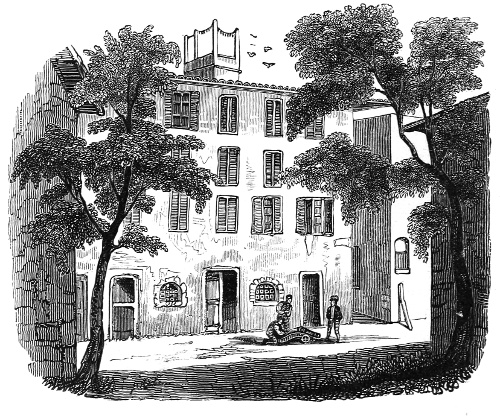
HOUSE IN WHICH NAPOLEON WAS BORN, AT AJACCIO, IN CORSICA. London: Published for Henry Colburn, Feb. 1836.
NAPOLEON’S PATRIMONIAL VINEYARD, &C.—HIS NURSE—HIS PATERNAL HOME.—TEARS OF JOSEPHINE DURING WURMSER’S SKIRMISHES IN THE ENVIRONS OF MANTUA.
8th.—I went to the Emperor’s apartment about eleven o’clock. He was dressing himself, and looking over, with his valet, some samples of perfumery and scents, received from England. He enquired about them all,
113did not know one of them, and laughed heartily at his gross ignorance, as he called it. He wished to breakfast in the tent, and we all assembled there.
He complained of the bad quality of the wine; and appealed to his maître-d’hôtel, Cipriani, who is a Corsican, whether he had not much better in their country. He said that he had received, as part of his patrimony, the best vineyard in the island, extensive and productive, called l’Esposata, and he felt it his duty, he said, not to mention it but with gratitude. It was to that vineyard that he was indebted, in his youth, for his visits to Paris; it was that which supplied the expenses of his vacations. We asked him what had become of it. He told us, that he had long ago given it to his nurse, to whom, he was sure he must have given at least one hundred and twenty thousand francs in lands and houses in the island. He had even resolved, he said, to give her his patrimonial house; but finding it too much above her situation, he had made a present of it to the Romalino family, his nearest relatives by his mother’s side, on condition that they should transfer their habitation to his nurse.[7]
In short, he had, he said, made a great lady of her. She had come to Paris at the time of the coronation, and had an audience of the Pope for upwards of an hour and a half. “Poor Pope,” exclaimed the Emperor, “he must have had a good deal of spare time! She was, 114however, extremely devout. Her husband was a coasting trader of the island. She gave great pleasure at the Tuileries, and enchanted the family by the vivacity of her language and her gestures. The empress Josephine made her a present of some diamonds.”
After breakfast, the Emperor, adhering to his resolution of yesterday, proceeded with his work. He finished the chapter of Castiglione, and then went to the wood, with the intention of waiting for the calash. In continuance of the conversation, which had been brought on by the chapter, he related that Josephine had left Brescia with him, and had thus commenced the campaign against Wurmser. Arrived at Verona, she had witnessed the first shots that were fired. When she returned to Castel-Nuovo, and saw the wounded as they passed, she was desirous of reaching Brescia; but she found herself stopped by the enemy, who was already at Ponte-Marco. In the anxiety and agitation of the moment, she was seized with fear, and wept a great deal, on quitting her husband, who exclaimed, when embracing her, and with a kind of inspiration: “Wurmser shall pay dearly for those tears which he causes thee!” She was obliged to pass in her carriage very close to the fortifications of Mantua. She was fired upon from the place, and one of her suite was even wounded. She traversed the Po, Bologna, Ferrara, and stopped at Lucca, attended by dread and the unfavourable reports, which were usually spread around our patriotic armies; but she was internally supported by her extreme confidence in her husband’s good fortune.
Such was, however, already the opinion of Italy, observed the Emperor, and the sentiments impressed by the French General, that, in spite of the crisis of the moment, and of all the false reports which accompanied him, his wife was received at Lucca by the Senate, and treated with the same respect as the greatest princess. It came to compliment her, and presented her with the oils of honour. It had reason to applaud itself for that conduct. A short time afterwards the couriers brought intelligence of the prodigious achievements of her husband, and the annihilation of Wurmser.
115The Emperor returned to the saloon for the first time since the fire. It is gradually furnished with articles sent expressly from London, which make it a little more tolerable. After dinner, the Emperor began with reading Turcaret, with which, he said, notwithstanding all its wit, he felt himself disgusted, in consequence of its vulgarity; but it bore, he remarked, the impression of Le Sage. He then took up l’Avocat Patelin, and was much amused with its genuine humour.
9th.—The Emperor breakfasted in the tent, and revised the chapter of the Brenta. At three o’clock, he took an airing in the calash. The Governor called during our ride. It was understood that he wished to speak to the Emperor on the celebration of the Prince Regent’s birthday, which is to take place next Monday, the 12th inst., and to give him notice of the salutes and volleys that are to be fired on the occasion at the camp, situated so closely to us. It is said, on the other hand, that he has given directions for supplying the Emperor’s table only, and that each of us is to be put upon a particular allowance, as he finds the expense very much beyond his credit. At any rate, we shall see.
CATHERINE II.—IMPERIAL GUARDS.—PAUL I. &C.—PROJECTS ON INDIA, &C.
10th.—The Emperor was indisposed and took a bath. At three he walked out and called for the carriage. He had just read the history of Catherine. “She was,” he said, “a commanding woman; she was worthy of having a beard upon her chin. The catastrophe of Peter and that of Paul were seraglio revolutions, the work of janissaries. These palace-soldiers are terrible, and dangerous in proportion as the Sovereign is absolute. My imperial guard might also have become fatal under any other but myself.”
The Emperor said that he and Paul had been on the best terms together. At the time of his murder, in which the public spared neither his relations nor his allies, he had concerted a plan with him, at that very moment, for an expedition to India, and he would have certainly prevailed upon him to carry it into execution. 116Paul wrote to him very often, and at great length. His first communication was curious and original. “Citizen First Consul,” (he had written to him with his own hand,) “I do not discuss the merits of the rights of man; but, when a nation places at its head a man of distinguished merit and worthy of esteem, it has a government, and France has, henceforth, one in my eyes.”
On our return, we found the Admiral and his lady; the Emperor took them in the calash and made another tour. He afterwards walked for some time with Lady Malcolm, to whom he behaved in a most gracious manner.
After dinner, the Emperor turned over the leaves of two volumes of the Théâtre Français, without being able to find any thing capable of fixing his attention.
THE EMPEROR BISHOP, &C.
11th.—After our breakfast in the tent and a few turns in the garden, the Emperor read, for the last time, the chapter of Arcole.
During our ride in the calash, somebody observed that it was Sunday. “We should have mass,” said the Emperor, “if we were in a Christian country, if we had a priest; and that would have been a pastime for us during the day. I have been always fond of the sound of the bells in the country. We should,” he added in a gay tone, “resolve upon choosing a priest among us;—the curate of St. Helena.”—But how ordain him, it was said, without a bishop?—“And am I not one,” replied the Emperor, “have I not been anointed with the same oil, consecrated in the same manner? Were not Clovis and his successors anointed, at the time, with the formula of Rex Christique sacerdos? Were they not, in fact, real bishops? Was not the subsequent suppression of that formula caused by the jealousy and policy of the bishops and popes?”
I did not eat at dinner, the Emperor wished to know the cause. I had a violent pain in my stomach, a complaint to which I said I was very subject. “I am more fortunate than you,” he observed. “In all my life, I never had either the head-ache or a pain in my stomach”stomach” 117The Emperor often repeated what he had said, and he has pronounced these same words perhaps ten, twenty, or thirty times, in the midst of us at different moments.[8]
CAMPAIGN OF 1809, &C.
12th.—The Emperor passed the morning in his bath, reading the Journals des Debats of March and April, received yesterday by way of the Cape. The Emperor was very much occupied with them; they produced a great degree of agitation in his system.
In general, since the Emperor had received books, and particularly the Moniteur, he continued much more at home; he scarcely ever went abroad; he no longer used a horse, nor even the calash; he hardly took the air for a few moments in the garden; he was not the better for it, his features and his health underwent a visible alteration.
I found him to-day reading Les Croisades by Michaud, which he left to run over Les Memoires de Bezenval. He stopped at the duel between the Comte d’Artois and the Duc de Bourbon. He found the details curious, but they seemed to be very remote from us. “It is difficult,” he observed, “to reconcile times so close to us with manners so different.”
In the course of this day’s conversations, the Emperor happened to repeat, what I have mentioned elsewhere, that his finest manœuvre had been at Eckmuhl, without, however, specifying it any further.
118
ON THE WAR WITH RUSSIA.—FATALITIES, &C.—M. DE TALLEYRAND, &C.—MADAME DE STAEL’S CORINNE.—M. NECKER, &C.
13th. At an early hour in the morning, I accompanied the Emperor very far into the wood; he conversed for upwards of an hour, on the situation of France, and then reverted to the persons who had betrayed him, and the numerous fatalities which had hurried him along; to the perfidious security caused by his marriage with Austria; to the infatuation of the Turks, who made peace precisely when they ought to have made war; to that of Bernadotte, who was actuated by his self-love and his resentment, rather than by his real grandeur and stability; to a season severe beyond measure, and even to the superiority of talent, evinced by M. de Narbonne, who, discovering the designs of Austria, compelled her to take active measures. Finally, he reverted to the successes of Lutzen and Bautzen, which, by bringing back the king of Saxony to Dresden, put him, Napoleon, in possession of the hostile signatures of Austria, and deprived her of all further subterfuge. “What an unhappy concurrence!” he exclaimed in a most expressive tone, “and yet,” he continued, “the day after the battle of Dresden, Francis had already sent a person to treat. It was necessary, that Vandamme’s disaster should happen at a given moment, to second, as it were, the decree of fate.”
M. de Talleyrand, to whose conduct the Emperor frequently alluded, for the purpose of discovering, he said, when he had really begun to betray him, had strongly urged him to make peace, on his return from Leipsic. “I must,” he observed, “do him that justice. He found fault with my speech to the Senate, but warmly approved of that which I made to the Legislative Body. He uniformly maintained, that I deceived myself with respect to the energy of the nation; that it would not second mine, and that it was requisite for me to arrange my affairs by every possible sacrifice. It appears that he was then sincere. I never, from my own experience, found Talleyrand eloquent or persuasive. He dwelt a great deal, and a long time, on the same idea. Perhaps 119also, as our acquaintance was of old date, he behaved in a peculiar manner to me. He was, however, so skilful in his evasions and ramblings that, after conversations which lasted several hours, he has gone away, frequently avoiding the explanations and objects I expected to obtain from him on his coming.”
With regard to the affairs of the moment and to the contents of the last journals which described France in a constantly increasing agitation, the result was that the chances of the future seemed indefinite, multiplied, and inexhaustible for all Europe, and that there existed, at that instant, an incontrovertible fact, communicated to us from all quarters, that nobody in Europe considered himself in a permanent situation. Every one seemed to apprehend or to foresee new events.
The Emperor kept me to breakfast with him in the tent. He afterwards sent for Madame de Staël’s Corinne, and read some chapters of it. He said that he could not get through it. Madame de Staël had drawn so complete a likeness of herself in her heroine, that she had succeeded in convincing him that it was herself. “I see her,” said he, “I hear her, I feel her, I wish to avoid her, and I throw away the book. I had a better impression of this work on my memory, than what I feel at present. Perhaps it is because, at the time, I read it with my thumb, as M. l’Abbé de Pradt ingeniously says, and not without some truth. I shall, however, persevere; I am determined to see the end of it; I still think that it was not destitute of some interest. Yet I cannot forgive Madame de Staël for having undervalued the French in her romance. The family of Madame de Staël is unquestionably a very singular one—her father, her mother and herself, all three on their knees, in constant adoration of each other, regaling one another with reciprocal incense, for the better edification and mystification of the public. Madame de Staël may, nevertheless, exult in surpassing her noble parents, when she presumed to write, that her sentiments for her father were such that she detected herself in being jealous of her mother.
“Madame de Staël,” he continued, “was ardent in her passions, vehement and extravagant in her expressions. 120This is what was discovered by the police, while she was under its superintendence. ‘I am far from you;’ (she was probably writing to her husband,) ‘come instantly;—I command;—I insist upon it; I am on my knees; I beseech you, come.—My hand grasps a dagger. If you hesitate, I shall kill myself; and you alone will be guilty of my destruction’destruction’” This was Corinne.
She had, said the Emperor, combined all her efforts and all her means to make an impression on the General of the army of Italy; without any knowledge of him, she wrote to him, when far off; she tormented him when present. If she was to be believed, the union of genius with a little insignificant Creole, incapable of appreciating or comprehending him, was a monstrosity. Unfortunately the General’s only answer was an indifference which women never forgive, and which, indeed, he remarked with a smile, is hardly to be forgiven.
On his arrival at Paris, he was followed with the same eagerness, but he maintained, on his part, the same reserve, the same silence. Madame de Staël resolved, however, to extract some words from him and to struggle with the conqueror of Italy, attacked him face to face, at the grand entertainment given by M. de Talleyrand, Minister for Foreign Affairs, to the victorious General. She challenged him in the middle of a numerous circle, to tell her who was the greatest woman in the world, whether dead or living. “She, who has had most children,” answered Napoleon, with great simplicity. Madame de Staël was, at first, a little disconcerted, and endeavoured to recover herself by observing that it was reported that he was not very fond of women. “Pardon me, Madam,” again replied Napoleon, “I am very fond of my wife.”
The General of the army of Italy, said the Emperor, might, no doubt, have excited the enthusiasm of the Genevese Corinna to its highest pitch; but he dreaded her politic perfidy and her thirst of celebrity; he was, perhaps, in the wrong. The heroine had, however, been too eager in her pursuit and too often discouraged, not to become a violent enemy. “She instigated the person, who was then a under her influence, and he,” observed the Emperor, “did not enter upon the business in a very 121honourable manner. On the appointment of the Tribunate, he employed the most pressing solicitations with the First Consul to be nominated a member. At eleven o’clock at night, he was supplicating with all his might; but at twelve, when the favour was granted, he was already erect and almost in an insulting attitude. The first meeting of the Tribunes was a splendid occasion for his invectives against me. At night, Madame de Staël’s hotel was illuminated. She crowned her Benjamin amidst a brilliant assembly, and proclaimed him a second Mirabeau. This farce, which was ridiculous enough, was followed by more dangerous plans. At the time of the Concordat, against which Madame de Staël was quite furious, she united at once against me the aristocrats and the republicans. ‘You have,’ she exclaimed, ‘but‘but a single moment left; to-morrow the tyrant will have forty thousand priests at his disposal.’”
“Madame de Staël,” said Napoleon, “having at length tired out my patience, was sent into exile. Her father had seriously offended me before, at the time of the campaign of Marengo. I wished to see him on my way, and he struck me merely as a dull bloated college tutor. Shortly afterwards, and with the hope, no doubt, of again appearing, by my help, in public life, he published a pamphletpamphlet, in which he proved that France could neither be a republic nor a monarchy. What it might be,” remarked the Emperor, “was not sufficiently evident. In that work, he called the First Consul, the necessary man, &c. Lebrun replied to him, in a letter of four pages, in his admirable style, and with all his powers of sarcasm; he asked him whether he had not done sufficient mischief to France, and whether his pretensions to govern her again were not exhausted by his experiment of the Constituent Assembly.
“Madame de Staël, in her disgrace, carried on hostilities with the one hand, and supplicated with the other. She was informed, on the part of the First Consul, that he left her the universe for the theatre of her achievements; that he resigned the rest of the world to her, and only reserved Paris for himself, which he forbade her to approach. But Paris was precisely the object of 122Madame de Staël’s wishes. No matter; the Consul was inflexible. Madame de Staël, however, occasionally renewed her attempts. Under the empire, she wished to be a lady of the palace. Yes or no might certainly be pronounced; but by what means could Madame de Staël be kept quiet in a palace?” &c.
After dinner, the Emperor read the Horatii, and was frequently interrupted by our bursts of admiration. Never did Corneille appear to us grander, more noble, more nervous, than on our rock.
SHOOTING PARTY AT ST. HELENA, &c.—EVE OF THE 15TH OF AUGUST, &C.
14th. The Emperor went out early. He sent for me before nine o’clock. His intention was to mount his horse, and endeavour to get a shot at some partridges, which we saw every time we were in the carriage; but which never let any one with a fowling-piece come near them. The Emperor walked on for the purpose of placing himself in a convenient situation, but the partridges were no longer to be found. He was soon fatigued, and got on horseback, observing that our shooting party was not exactly after the fashion of those of Rambouillet and Fontainebleau. We breakfasted, on our return, in the tent. The Emperor placed little Tristan, whom he saw crossing the meadow, at table, and was much amused with him during the whole of the repast.
After breakfast, the Emperor had the chapter of Rivoli read over again to him, and finished it. We had gone through three-fourths of it, when the Governor being announced, we made a precipitate retreat from the tent, and each of us took refuge in his den. The Emperor was less inclined than any other person to let himself be seen: his conversations with the Governor are by far too disagreeable and painful to him. “I am determined,” he said, “to have no more to do with him. Harsh remarks escape me, which affect my character and my dignity; nothing should fall from my lips but what is kind and complimentary.” He found himself fatigued with his exercise in the morning, and took a bath.
About five o’clock, he took a turn in the calash, the weather was delicious.
123The Governor had expressed an earnest desire to see the Emperor; he wished, he said, to speak with him on business. It is suspected that it was to tell him that he had no more money, that he had exhausted all, and that he no longer knew how to act; a matter of perfect indifference to the Emperor, who would not have failed, once more, to entreat to be let alone.
The Emperor played at chess, before dinner, in the saloon; he had taken some punch. It was late when I arrived; he told me, on entering, to take my share of the punch; but it was observed that there were no more glasses. “O yes,” said he, handing me his, “and he will drink out of it, I am sure.” He then added, “This is the English fashion; is it not? In our country one seldom drinks after any one but one’s mistress.“
It was remarked, during dinner, that it was the eve of the 15th of August; the Emperor then observed; “Many healths will be drunk to-morrow, in Europe, to St. Helena. There are certainly some sentiments, some wishes, that will traverse the ocean.” He had entertained the same thought in the morning when on horseback, and had said the same things to me.
After dinner, Cinna;—Corneille appears to us divine.
THE EMPEROR’S BIRTH-DAY.
15th.—This day, the 15th of August, was the Emperor’s birthday. We had determined to wait upon him, in a body, about eleven o’clock. He disappointed us by appearing gaily at our doors at nine. The weather was mild; he went to the garden, and we all assembled there in succession. The Grand Marshal, with his wife and children, joined us. The Emperor, surrounded by his faithful servants, breakfasted in the large and beautiful tent, which is a really fortunate acquisition. The temperature was fine, and he himself cheerful and talkative. He seemed, for some instants, to participate in our sentiments and wishes. He desired, he said, to pass the whole day in the midst of us. Accordingly, we continued together, and spent the time in conversation, in different pursuits, in walking, and in riding in the carriage.
124
POLYTECHNIC SCHOOL SUPPRESSED, &c.—INDECENCY OF THE ENGLISH JOURNALS.—ICE MACHINE.
16th.—My son and I went, at a very early hour, to the tent, where the Emperor continued employed on different chapters of the Campaign of Italy until two o’clock, when the Governor being announced, he retired, muttering, “The wretch, I believe, envies me the air I breathe.”
During breakfast, he had called for the Journal des Débats, which contained the organization of the academies; he wished to see the names of the members, who had been expelled from the Institute. This led him to revert to the suppression of the Polytechnic School, which was said to be useless and dangerous. The English Journal, which we had received, was not of that opinion. It maintained that the suppression alone was more valuable to the enemies of France than a signal victory, and that nothing could more decidedly prove the real pacific sentiments and the extreme moderation of the dynasty, which then governed France, &c. It also stated several other things.
Somebody remarked, upon this subject, that the English papers shewed a malevolence against the French Government, which extended to coarseness and indecency.
Lord or Lady Holland had, with a peculiar degree of attention, sent to Longwood, for the Emperor’s use, a newly invented machine, adapted to the formation of ice. It was delivered to us to-day, through the intervention of Admiral Malcolm. The Emperor went out about five o’clock, and was desirous of witnessing the experiment; the Admiral was present, but the experiment proved very imperfect.
The Emperor, after some time, took a walk, accompanied by the Admiral, and the conversation turned upon a variety of subjects; it was maintained in the most affable and friendly manner on the part of the Emperor.
125
RELIGIOUS IDEAS OF NAPOLEON.—BISHOP OF NANTES (DE VOISINS).—THE POPE.—LIBERTIES OF THE GALLICAN CHURCH.—ANECDOTES.—CONCORDAT OF FONTAINEBLEAU.
17th.—While the Emperor was at breakfast in the tent, two persons described the excesses which they had witnessed in the army, and which had not come to his knowledge. They noticed the numerous violations of his orders, the violent abuses of authority, and other outrages. The Emperor listened; but some were so shocking that he could not, he said, give credit to them, and observed: “Come, gentlemen, these are libels.”
The wind was very violent; it blew a storm, with occasional showers. The wet obliged the Emperor to go in again.
After dinner Zaire and the beautiful scenes of Œdipe were read, among which he particularly pointed out that of the discovery, which he pronounced the finest and the most finished of the drama.
In speaking of priests and religion, the conversation led the Emperor to say: “Man, entering into life, asks himself: Whence do I come? What am I? Whither am I to go? These are so many mysterious questions, which urge us on to religion. We eagerly embrace it; we are attracted by our natural propensity; but as we advance in knowledge our course is stopped. Instruction and history are the great enemies of religion, deformed by human imperfection. Why, we ask ourselves, is the religion of Paris neither that of London nor of Berlin? Why is that of Petersburgh different from that of Constantinople? Why is the latter different from that of Persia, of the Ganges, and of China? Why is the religion of ancient times different from that of our days? Then reason is sadly staggered; it exclaims, O religions, religions! the children of man!... We very properly believe in God, because every thing around us proclaims him, and the most enlightened minds have believed in him; not only Bossuet, whose profession it was, but also Newton and Leibnitz, who had nothing to do with it. But we know not what to think of the 126doctrine that is taught us, and we find ourselves like the watch which goes, without knowing the watchmaker that made it. And observe a little the stupidity of those who educate us; they should keep away from us the idea of paganism and idolatry; because their absurdity excites the first exercise of our reason, and prepares us for a resistance to passive belief; and they bring us up, nevertheless, in the midst of the Greeks and Romans, with their myriads of divinities. Such, for my own part, has literally been the progress of my understanding. I felt the necessity of belief; I did believe, but my belief was shocked and undecided, the moment I acquired knowledge and began to reason; and that happened to me at so early an age as thirteen. Perhaps, I shall again believe implicitly; God grant I may! I shall certainly make no resistance, and I do not ask a greater blessing; it must, in my mind, be a great and real happiness.
“In violent agitations, however, and in the casual suggestions of immorality itself, the absence of that religious faith has never, I assert, influenced me in any respect, and I never doubted the existence of God; for, if my reason was inadequate to comprehend it, my mind was not the less disposed to adopt it. My nerves were in sympathy with that sentiment.
“When I seized on the helm of affairs, I had already fixed ideas of all the primary elements by which society is bound together; I had weighed all the importance of religion; I was convinced, and I determined to re-establish it. But the resistance I had to overcome in restoring Catholicism would scarcely be credited. I should have been more willingly followed had I hoisted the standard of Protestantism. This reluctance was carried so far that in the Council of State, where I found great difficulty in getting the Concordat adopted, several yielded only by forming a plan to extricate themselves from it. ‘Well!’ they said to one another, ‘let us turn Protestants, and that will not affect us.’ It is unquestionable that, in the disorder which I succeeded, upon which I found myself I was at liberty to choose between Catholicism and Protestantism; and it may also be said, with truth, that the general disposition, at the 127moment, was quite in favour of the latter: but, besides my real adherence to the religion in which I was born, I had the most important motives to influence my decision. What should I have gained by proclaiming Protestantism? I should have created two great parties, very nearly equal, in France, when I wished for the existence of none at all; I should have revived the fury of religious disputes, when their total annihilation was called for by the light of the age and my own feelings. These two parties would, by their mutual distractions, have destroyed France, and rendered her the slave of Europe, when I had the ambition to make her the mistress of it. By the help of Catholicism I attained much more effectually all the grand results that I had in view. In the interior, at home, the smaller number was swallowed up by the greater, and I relied upon my treating the former with such an equality that there would be shortly no motive for marking the difference. Abroad, the Pope was bound to me by Catholicism; and, with my influence, and our forces in Italy, I did not despair, sooner or later, by some means or other, of obtaining for myself the direction of that Pope, and from that time, what an influence! What a lever of opinion on the rest of the world!” &c. He concluded with saying; “Francis I. was really in a state to adopt Protestantism, at its birth, and to declare himself the head of it in Europe. Charles V., his rival, was the zealous champion of Rome, because he considered that measure as an additional means to assist him in his project of enslaving Europe. Was not that circumstance alone sufficient to point out to Francis the necessity of taking care of his independence; but he abandoned the greater to run after the lesser advantage. He persevered in pursuing his imprudent designs on Italy, and, with the intention of paying court to the Pope, he burnt Protestants at Paris.
“Had Francis I. embraced Lutheranism, which is favourable to royal supremacy, he would have preserved France from the dreadful religious convulsions brought on, at later periods, by the Calvinists, whose efforts, altogether republican, were on the point of subverting the throne and dissolving our noble monarchy. Unfortunately, 128Francis I. was ignorant of all that; for he could not allege his scruples for an excuse, he, who entered into an alliance with the Turks, and brought them into the midst of us. It was precisely because he was incapable of extending his views so far. The folly of the time! The extent of feudal intellect! Francis I. was, after all, but a hero for tilts and tournaments, and a gallant for the drawing-room, one of those pigmy great men.
“The Bishop of Nantes (De Voisins), said the Emperor, made me a real Catholic by the efficacy of his arguments, by the excellence of his morals, and by his enlightened toleration. Marie Louise, whose confessor he was, consulted him once on the obligation of abstaining from meat on Fridays.—‘At what table do you dine?’ asked the Bishop.—‘At the Emperor’s.’ ‘Do you give all the orders there?’—‘No.’ ‘You cannot, then make any alteration in it; would he do it himself?’—‘I am inclined to think not.’ ‘Be obedient then, and do not provoke a subject for scandal. Your first duty is to obey, and make him respected; you will not be in want of other means to amend your life, and to suffer privations in the eyes of God.’
“He also behaved in the same way with respect to a public communion, which some persons put into Marie Louise’s head to celebrate on Easter-day. She would not, however, consent, without the advice of her prudent confessor, who dissuaded her from it by similar arguments. What a difference, said the Emperor, had she been worked upon by a fanatic! What quarrels, what disagreements might he not have caused between us! What mischief might he not have done, in the circumstances in which I was placed!”
The Emperor remarked to us, “that the bishop of Nantes had lived with Diderot, in the midst of unbelievers, and had uniformly conducted himself with consistency; he was ready with an answer to every one; and, above all, he had the good sense to abandon every thing that was not maintainable, and to strip religion of every thing which he was not capable of defending.—He was asked, ‘has not an animal, which moves, combines, 129and thinks, a soul?’ ‘Why not,’ was his answer. ‘But whither does it go? For it is not equal to ours.’ ‘What is that to you? It dwells, perhaps, in limbo.’ He used to retreat within the last intrenchments, even within the fortress itself, and there he reserved excellent means for defending himself. He argued better than the Pope, whom he often confounded. He was the firmest pillar, among our bishops, of the Gallican liberties. He was my oracle, my luminary; in religious matters, he possessed my unbounded confidence. For, in my quarrels with the Pope, it was my first care, whatever intriguers and marplots in cassocs may say, not to touch upon any dogmatic point: I was so steady in this conduct, that the instant this good and venerable bishop of Nantes said to me, ‘Take care, there you are grappling with a dogma,’ I immediately turned off from the course I was pursuing, to return to it by other ways, without amusing myself by entering into dissertations with him, or by seeking even to comprehend his meaning; and, as I had not let him into my secret, how amazed must he not have been at the circuits I made! How whimsical, obstinate, capricious, and incoherent, must I not have appeared to him! It was because I had an object in view, and he was unacquainted with it.
“The Popes could not forgive us our liberties of the Gallican church. The four famous propositions of Bossuet, in particular, provoked their resentment. It was, in their opinion, a real hostile manifesto, and they accordingly considered us at least as much out of the pale of the church as the Protestants. They thought us as guilty as they, perhaps more so, and if they did not overwhelm us with their ostensible thunderbolts, it was because they dreaded the consequences—our separation. The example of England was before them. They did not wish to cut off their right arm with their own hand, but they were constantly on the watch for a favourable opportunity; they trusted to time for it. They are, no doubt, ready to believe, that it has now arrived. They will, however, be again disappointed by the light of the age and the manners of the times.
130“Some time before my coronation,” said the Emperor, “the Pope wished to see me, and made it a point to visit me himself. He had made many concessions. He had come to Paris for the purpose of crowning me; he consented not to place the crown on my head himself; he dispensed with the ceremony of the public communion; he had, therefore, in his opinion, many compensations to expect in return. He had accordingly at first dreamt of Romagna and the Legations, and he began to suspect that he should be obliged to give up all that. He then lowered his pretensions to a very trifling favour, as he called it, my signature to an ancient document, a worn-out rag, which he held from Louis XIV. ‘Do me that favour, said he, in fact, it signifies nothing.’ ‘Cheerfully, most holy father, and the thing is done, if it be feasible.’”feasible.’” It was, however, a declaration, in which Louis XIV. at the close of his life, seduced by Madame de Maintenon, or prevailed upon by his confessors, expressed his disapprobation of the celebrated articles of 1682, the foundations of the liberties of the Gallican church. The Emperor shrewdly replied, that he had not, for his own part, any personal objection, but that it was requisite for him, as a matter of form, to speak to the bishops about it; on which the Pope repeatedly observed, that such a communication was by no means necessary, and that the thing did not deserve to make so much noise. “‘I“‘I shall never,’ he remarked, ‘shew the signature, it shall be kept as secret as that of Louis XIV.’ ‘But, if it signifies nothing,’ said Napoleon, ‘what use is there for my signature? And if any signification can be drawn from it, I am bound by a sense of propriety to consult my doctors.’”
With the view, however, of avoiding the imputation of a constant refusal of every request, the Emperor wished to seem rather inclined to grant the favour. “The Bishop of Nantes and the other bishops, who were really French, came to me in great haste. They were furious, and watched me,” said the Emperor, “as they would have watched Louis XIV. on his death-bed, to prevent him from turning Protestant. The Sulpicians were called in; they were Jesuits au petit pied, they 131strove to find out my intention, and were ready to do whatever I wished.”wished.” The Emperor concluded with observing;—“The Pope had dispensed with the public communion in my favour, and it is from his determination in that respect that I form my opinion of the sincerity of his religious belief. He had held a congregation of cardinals for the purpose of settling the ceremonial. The greater number warmly insisted upon my taking the communion in public, asserting the great influence of the example on the people, and the necessity of my holding it out. The Pope, on the contrary, fearful lest I should fulfil that duty as if I were going through one of the articles of M. de Ségur’s programme, looked upon it as a sacrilege, and was inflexible in opposing it. ‘Napoleon,’ he observed, ‘is not perhaps a believer; the time will, no doubt, come, in which his faith will be established, and in the mean time, let us not burthen his conscience or our own.’
“In his Christian charity, for he really is a worthy, mild, and excellent man, he never once despaired of seeing me a penitent, at his tribunal; he has often let his hopes and thoughts on that subject escape him. We sometimes conversed about it in a pleasant and friendly manner. ‘It will happen to you, sooner or later,’ said he, with an innocent tenderness of expression; ‘you will be converted by me or by others, and you will then feel how great the content, the satisfaction of your own heart,’ &c. In the mean time, my influence over him was such, that I drew from him, by the mere power of my conversation, that famous Concordat of Fontainebleau, in which he renounced the temporal sovereignty, an act on account of which he has since shown that he dreaded the judgment of posterity, or rather the reprobation of his successors. No sooner had he signed than he felt the stings of repentance. He was to have dined the following day with me in public; but at night, he was, or pretended to be ill. The truth is that, immediately after I left him, he again fell into the hands of his habitual advisers, who drew a terrible picture of the error which he had committed. Had we been left by ourselves, I might have done what I pleased with him; 132I should have governed the religious with the same facility that I did the political world. He was, in truth, a lamb, a good man in every respect, a man of real worth, whom I esteem and love greatly, and who, on his part, is, I am convinced, not altogether destitute of interest with regard to me. You will not see him make any severe complaints against me, nor prefer, in particular, any direct and personal accusation against me, any more than the other sovereigns. There may, perhaps, be some vague and vulgar declamations against ambition and bad faith, but nothing positive and direct; because statesmen are well aware, that when the hour of libels is past, no one would be allowed to prefer a public accusation without corroborative proofs, and they have none of these to produce: such will be the province of history. On the other hand, there will be at most but some wretched chroniclers, shallow enough to take the ravings of clubs, or intrigues, for authentic facts, or some writers of memoirs, who, deceived by the errors of the moment, will be dead before they are enabled to correct their mistakes.
“When the real particulars of my disputes with the Pope shall be made public, the world will be surprised at the extent of my patience, for it is known that I could not put up with a great deal. When he left me, after my coronation, he felt a secret spite at not having obtained the compensations which he thought he had deserved. But, however grateful I might have been in other respects, I could not, after all, make a traffic of the interests of the empire by way of paying my own obligations, and, I was, besides, too proud to seem to have purchased his kindnesses. He had hardly set his foot on the soil of Italy, when the intriguers and mischief-makers, the enemies of France, took advantage of the disposition he was in, to govern his conduct, and from that instant every thing was hostile on his part. He no longer was the gentle, the peaceable Chiaramonti, that worthy bishop of Imola, who had at so early a period shown himself worthy of the enlightened state of the age. His signature was thenceforth affixed to acts only which characterised the Gregories and Bonifaces more 133than him. Rome became the focus of all the plots hatched against us. I strove in vain to bring him back by the force of reason, but I found it impossible to ascertain his sentiments. The wrongs became so serious, and the insults offered to us so flagrant, that I was imperatively called upon to act, in my turn. I, therefore, seized his fortresses; I took possession of some provinces; and I finished by occupying Rome itself, at the same time declaring and strictly observing that I held him sacred in his spiritual capacity, which was far from being satisfactory to him. A crisis, however, presented itself; it was believed, that fortune had abandoned me at Essling, and measures were in immediate readiness for exciting the population of that great capital to insurrection. The officer, who commanded there, thought that he could escape the danger only by getting rid of the Pope, whom he sent off to France. That measure was carried into effect without my orders, and was even in direct opposition to my views. I despatched instant orders for stopping the Pope, wherever he might be met with, and he was kept at Savona, where he was treated with every possible care and attention; for I wished to make myself feared, but not to ill-treat him; to bend him to my views, not to degrade him;—I entertained very different projects! This removal served only to inflame the spirit of resentment and intrigue. Until then, the quarrel had been but temporal; the Pope’s advisers, in the hope of re-establishing their affairs, involved it in all the jumble of spirituality. I then found it necessary to carry on the contest with him on that head; I had my council of conscience, my ecclesiastical councils, and I invested my imperial courts with the power of deciding in cases of appeal from abuses; for my soldiers could be of no further use in all this: I felt it necessary to fight the Pope with his own weapons. To his men of erudition, to his sophists, his civilians, and his scribes, it was incumbent upon me to oppose mine.
“An English plot was laid to carry him off from Savona; it was of service to me, I caused him to be removed to Fontainebleau; but that was to be the period of his sufferings, and the regeneration of his splendour. 134All my grand views were accomplished in disguise and mystery. I had brought things to such a point, as to render the development infallible, without any exertion, and in a way altogether natural. It was accordingly consecrated by the Pope in the famous Concordat of Fontainebleau, in spite even of my disasters at Moscow. What then would have been the result, had I returned victorious and triumphant? I had consequently obtained the separation, which was so desirable, of the spiritual from the temporal, which is so injurious to his Holiness, and the commixture of which produces disorder in society, in the name and by the hands of him who ought himself to be the centre of harmony: and from that time I intended to exalt the Pope beyond measure, to surround him with grandeur and honours. I should have succeeded in suppressing all his anxiety for the loss of his temporal power; I should have made an idol of him; he would have remained near my person. Paris would have become the capital of the Christian world, and I should have governed the religious as well as the political world. It was an additional means of binding tighter all the federative parts of the empire, and of preserving the tranquillity of every thing placed without it. I should have had my religious as well as my legislative sessions; my councils would have constituted the representation of Christendom, and the Popes would have been only the presidents. I should have called together and dissolved those assemblies, approved and published their discussions, as Constantine and Charlemagne had done; and if that supremacy had escaped the Emperors, it was because they had committed the blunder of letting the spiritual heads reside at a distance from them; and the latter took advantage of the weakness of the princes, or of critical events, to shake off their dependence and to enslave them in their turn.
“But,” resumed the Emperor, “to accomplish that object, I had found it requisite to manœuvre with a great deal of dexterity; above all, to conceal my real way of thinking, to give a direction, altogether different to general opinion, and to feed the public with vulgar trifles for the purpose of more effectually concealing the importance 135and depth of my secret design. I accordingly experienced a kind of satisfaction on finding myself accused of barbarity towards the Pope, and of tyranny in religious matters. Foreigners, in particular, promoted my wishes in this respect, by filling their wretched libels with invectives against my pitiful ambition, which, according to them, had driven me to devour the miserable patrimony of Saint Peter. But I was perfectly aware, that public opinion would again declare itself in my favour at home, and that no means could exist abroad for disconcerting my plan. What measures would not have been employed for its prevention, had it been anticipated at a seasonable period; for how vast its future ascendency over all the Catholic countries, and how great its influence even upon those that are not so, by the co-operation of the members of that religion who are spread throughout these countries!”