INTRODUCTION. (continued 2)
Reading edition
Scarcely had Napoleon descended from his throne, when those who witnessed the misfortunes of the nation, which followed, regarded his sacrifice as a capital error. When they heard of his being a prisoner at Plymouth, they censured his magnanimity; there was not a single incident, even to his suffering himself to be sent to St. Helena, which they did not make a subject of reproach. But such is the tendency of vulgar minds: never judging except on what they see at the moment! It is, however, impossible to judge of one resolution without considering, not only the evils which unavoidably attend it, but those which a contrary determination might have produced.
By abdicating, Napoleon rallied all the friends of their country round one point—that of its safety! He left France demanding, before all nations, nothing but the sacred rights of national independence; he took from the Allies every pretext to ravage and dismember our territory; he destroyed all idea of his personal ambition; terminating his career as the martyr of a cause of which he had been the hero. If all the advantages which might have been derived from his genius and talents as a citizen were not obtained, it is to be imputed to the weakness and treachery of the transitory Government by which he was succeeded. When he arrived at Rochefort, and the commander of the frigates refused to sail, ought he to have abandoned the fruits of his abdication? Should he have returned to the interior, and placed himself at the head of mere bands, when he had renounced armies? or, ought he to have desperately encouraged a civil war which would lead to no beneficial result, but only serve to ruin the remaining pillars, the future hopes, of the country? In this state of affairs, he formed a most magnanimous resolution, worthy of his life, and a complete refutation of the calumnies that for twenty years had been so ridiculously accumulated on his head. But what will history say of those Ministers 56of a liberal nation, the guardians and depositaries of popular rights—ever ardent in encouraging a Coriolanus, having only chains for a Camillus?
As to the reproach of suffering himself to be transported to St. Helena, it would be a disgrace to answer such a charge. To contend with an adversary in the cabin of a ship—kill some one with his own hand—or attempt to set fire to the powder-magazine, would have been, at best, the act of a Buccaneer. Dignity in misfortune, submission to necessity, have also their glory: it is that which becomes great men overwhelmed by adversity.
When the English Ministers found themselves in possession of Napoleon’s person, passion had much more influence over them than justice or policy. They neglected the triumph of their laws, denied the rights of hospitality, disregarded their own honour, and compromised that of their country. They determined to exile their guest in the midst of the ocean, to keep him prisoner on a rock, two thousand leagues from Europe, and far from all communion with mankind. It seemed that they wished to trust to the anguish of exile, the fatigues of a long voyage, privations of every kind, and the corroding influence of a burning climate, for effecting that which they feared to perform themselves. In order, however, to gain over the public voice, to make it appear that their conduct was indispensably necessary, the newspapers were instigated to irritate the passions of the multitude, by reviving former calumnies and falsehoods; while the Ministers, on their side, represented their own determination as an engagement entered into with their allies. We presented ourselves at the moment of popular effervescence, just as every thing which could render us odious had been brought forward. The public journals were full of the most virulent declamations; maliciously raking up every act and expression of the previous struggle of twenty years that could wound the national pride, or rekindle its hatred. Yet, when all England hurried to the south to see us, during our stay at Plymouth, the conduct and sentiments of the multitudes who came were enough to convince us that this 57factitious irritation would disappear of itself. Hence we were led to hope, on our departure, that the British people would daily grow more impartial in a cause to which they were no longer parties; that the current of public opinion would eventually turn against Ministers; and that we had thus ensured them formidable attacks and a terrible responsibility for a future day.
THE EMPEROR’S MODE OF LIVING ON BOARD THE NORTHUMBERLAND.
11th—14th. Our course was shaped across the Bay of Biscay, and double Cape Finisterre. The wind was fair, though light; and the heat excessive: nothing could be more monotonous than the time we now passed. The Emperor breakfasted in his own cabin at irregular hours; we took our breakfast at ten o’clock, in the French style, while the English continued to breakfast in their own way at eight.
The Emperor sent for one of us every morning to know what was going on, the distance run, the state of the wind, and other particulars connected with our progress. He read much, dressed towards four o’clock, and then came into the general cabin; here he played at chess with one of the party: at five o’clock the Admiral, having come out of his cabin a few minutes before, announced that dinner was on the table.
It is well known that Napoleon was scarcely ever more than fifteen minutes at his dinner; here the two courses alone occupied from an hour to an hour and a half: this was to him a most serious annoyance, though he never mentioned it; his features, gestures, and manner, always evinced perfect indifference. Neither the new system of cookery, the difference nor quality of the dishes, ever met with his censure or approbation; he never expressed any wish or objection on the subject. He was attended by his two valets, who stood behind his chair. At first the Admiral was in the habit of offering to help the Emperor; but the acknowledgment of Napoleon was expressed so coldly that this practice was discontinued. The Admiral continued very attentive, but thenceforth only pointed out to the servants what 58was preferable; they alone attended to these matters, to which the Emperor seemed totally indifferent, neither seeing, noticing, nor seeking, any thing. He was generally silent, remaining in the midst of conversation as if totally unacquaintedunacquainted with the language, though it was French. If he spoke, it was to ask some technical or scientific question, and to address a few words to those whom the Admiral occasionally asked to dinner. I was the person to whom the Emperor generally addressed his questions, in order to translate them.
I need scarcely observe that the English are accustomed to remain a long time at table after the dessert, drinking and conversing: the Emperor, already tired by the tedious dinner, could never have endured this custom, and he rose, therefore from the first day, immediately after coffee had been handed round, and went out on deck followed by the Grand Marshal and myself. This disconcerted the Admiral, who took occasion to express his surprise to his officers; but Madame Bertrand, whose maternal language is English, warmly replied—“Do not forget, Admiral, that your guest is a man who has governed a large portion of the world, and that kings once contended for the honour of being admitted to his table.” “Very true,” rejoined the Admiral; and this officer, who possesses good sense, a becoming pliability of manners, and sometimes much elegance, did his utmost from that moment to accommodate the Emperor in his habits. He shortened the time of sitting at table, ordering coffee for Napoleon and those who accompanied him, even before the rest of the company had finished their dinner. The moment Napoleon had taken his coffee, he left the cabin; upon which every body rose till he had quitted the room, and then continued to take their wine for another hour.
The Emperor remained walking on deck till dark, attended by the Grand Marshal and myself. This became a regular practice, and was seldom omitted. On returning to the after-cabin, he sat down to play vingt-et-un with us, and generally retired in about half an hour.
59
SINGULAR GOOD FORTUNE OF THE EMPEROR.
15th.—We asked permission to be admitted into the Emperor’s presence this morning, and all entered his cabin at the same time. He was not aware of the cause of this visit:—it was his birthday, which seemed to have altogether escaped his recollection. We had been in the habit of seeing him on that anniversary, on a much larger stage, and in the midst of his power, but never were our wishes more sincere, or our hearts more full of attachment, than on the present occasion.
The days now exactly resembled each other: at night we constantly played at vingt-et-un; the Admiral and some of his officers being occasionally of the party. The Emperor used to retire after losing, according to custom his ten or twelve Napoleons; this happened to him daily, because he would persist in leaving his stake on the table, until it had produced a considerable number. To-day he had gained from eighty to a hundred. The Admiral dealt the cards: the Emperor still wished to leave his winnings, in order to see how far he could reach; but thought he could perceive it would be quite as agreeable to the Admiral if he stopped where he was. The Emperor had won sixteen times, and might have won more than sixty thousand Napoleons. While all present were expatiating on his being thus singularly favoured by fortune, an English officer observed that it was the anniversary of his birth-day.
CONTINUATION OF THE VOYAGE.—OCCUPATIONS.—THE EMPEROR’S ORIGIN AND FAMILY.—ANECDOTES.
16th—21st. We doubled Cape Finisterre on the 16th, passed Cape St. Vincent on the 18th, and were off the Straits of Gibraltar next day. Continuing our course along the coast of Africa towards Madeira, nothing worthy of remark occurred, there being a perfect uniformity in our habits and mode of passing the time; if there was any difference, it could only arise from the subject of our conversation.
The Emperor usually remained in his cabin during the whole morning: so excessive was the heat that he only 60wore a very slight dress. He could not sleep, and frequently rose in the night. Reading was his chief occupation. I was sent for almost every morning, and translated from the “Encyclopædia Britannica,” and such other books as were on board, whatever they contained relative to St. Helena, or the countries near which we were sailing. This led to my Historical Atlas being brought under review. Napoleon had merely glanced at it on board the Bellerophon, and before that time he had but a very indistinct notion of the work. I now had the satisfaction of seeing it in the Emperor’s hands for several days, and of hearing him express the warmest approbation of my labours. The quantity and arrangementarrangement of the matter seemed more particularly to please him: he had, in fact, hitherto been but little acquainted with the book. Passing over all the others, his chief attention was attracted by the geographical charts; more especially the map of the world, which seemed principally to excite his notice and applause. I did not attempt to convince him that the geography was the weakest part of the work, displaying far less labour and research than other parts; the general tables could not easily be surpassed, either as to their method, symmetry, or facility for use; while each of the genealogical tables presented a miniature history of the country they concerned and of which they were, in all respects, both a complete analysis and a collection of elementary materials.
The Emperor asked me whether the work had been used in all our systems of education; adding, that had it been better known to him, all the schools and lyceums should have been furnished with it. He further asked, why I had published it under the borrowed name of Le Sage? I replied that a very imperfect sketch had been published in England, just after my emigration, at a time when we could not acknowledge our names as emigrants abroad, without danger to our relations in France; “and, perhaps,” said I, laughing, “I was not then cured of the prejudices of my youth; like the nobles of Bretagne, who deposited their swords with the registrar of the Civil Court, while engaged in trade, that they might not derogate from their family dignity.”
61As already observed, the Emperor always rose from table long before the rest of the company: the GrandGrand Marshal and I always followed him to the quarter-deck, where I was frequently left alone with him; as General Bertrand had often to attend his wife, who suffered excessively from sea-sickness.
After the preliminary remarks on the weather, the ship’s progress, and the winds, Napoleon used to start a subject of conversation, or revive that of the preceding or some other former, day; and when he had taken eight or nine turns the whole length of the deck, he would seat himself on the second gun from the gangway on the larboard side. The midshipmen soon observed this habitual predilection, so that the cannon was thenceforth called the Emperor’s gun.
It was there that Napoleon often conversed for hours together, and that I learned for the first time a part of what I am about to relate: in doing which, I wish to observe that I shall at the same time add whatever I collected in a variety of subsequent conversations; thus presenting at one view, all that I have heard worth noting on the subject.
The name of Bonaparte may be spelt either Bonaparte or Buonaparte; as all Italians know. Napoleon’s father always introduced the u; and his uncle, the Archdeacon Lucien (who survived Napoleon’s father and was a parent to Napoleon and his brothers), at the same time, and under the same roof, wrote it Bonaparte. During his youth, Napoleon followed the example of his father. On attaining the command of the Army of Italy he took good care not to alter the orthography, which agreed with the spirit of the language; but at a later period, and when amongst the French, he wished to adopt their orthography, and thenceforth wrote his name Bonaparte.
This family for many years made a distinguished figure in the Bolognese territory: it was very powerful at Treviso; and is to be found inscribed in the Golden book of Bologna, as also amongst the patricians of Florence. When Napoleon, as General in chief of the army of Italy, entered Treviso, at the head of his victorious army, the principal inhabitants came to meet 62him, bringing title deeds and records, which proved that his family had once been one of the most eminent in their city.
At the interview of Dresden, before the Russian campaign, the Emperor Francis one day told Napoleon, then his son-in-law, that his family had governed as sovereigns at Treviso: a fact of which there could be no doubt, as Francis had caused all the documents proving it to be drawn up and presented to him. Napoleon replied, with a smile, that he did not wish to know anything about it, and that he preferred being the Rodolph of Hapsburgh of his own family. Francis attached much more importance to the matter: he said that it was of very little consequence to have fallen from wealth to poverty; but that it was above all price to have been of sovereign rank, and that the fact must be communicated to Maria Louisa, to whom it would afford infinite pleasure.
When, during the campaign of Italy, Napoleon entered Bologna, Marescalchi, Caprara, and Aldini, since so well known in France, and at that time deputies in the senate of their native city, came of their own accord to present the golden book, in which the name and arms of his ancestors were inscribed.
There are several houses at Florence which attest the former existence of the Buonaparte family there; many houses are even still seen bearing the escutcheons of the family.
Cesari, a Corsican or Bolognese, residing in London, who was shocked at the manner in which the British Government had received Napoleon’sNapoleon’s pacific letter on assuming the Consulate, published a genealogical notice, wherein he established the Emperor’s alliance with the ancient house of Este, Welf, or Guelf, supposed to be the parent stem of the present royal family of England.[10]
63The Duke de Feltre, French ambassador in Tuscany, brought to Paris, from the Gallery de Medici, the portrait of a Buonaparte who had married a princess of the Grand Duke’s family. The mother of Pope Nicholas V. or Paul V., of Sarzana, was also a Buonaparte.
It was a Buonaparte who negotiated the treaty by which Leghorn was exchanged for Sarzana. It is to a Buonaparte that we are indebted for one of the oldest comedies written at the period of the revival of letters intitled The Widow. It may still be seen in the Royal Library at Paris.[11]
When Napoleon marched against Rome at the head of the French army, and received the propositions of the Pope at Tolentino, one of the negotiators of the enemy observed that he was the only Frenchman who had marched against Rome since the Constable de Bourbon; but what rendered this circumstance still more singular was that the history of the first expedition was written by an ancestor of him who executed the second, that is to say, Signor Niccolo Buonaparte, who has in reality left us a work, called The Sacking of Rome by the Constable de Bourbon.[12]
64Hence, perhaps, or from the Pope mentioned above, the name of Niccolo, which the writers of certain pamphlets pretended to be that of the Emperor, instead of Napoleon. This work is to be found in most libraries; it is preceded by a history of the house of Buonaparte, printed about forty or fifty years ago, and edited by Dr. Vaccha, a professor of Pisa.
M. de Cetto, ambassador of Bavaria, has often told me that the archives of Munich contained a great number of documents, in Italian, which proved the antiquity and importance of the Buonaparte family.
During the continuance of his power, Napoleon always refused to take any pains, or even to enter into conversation, on the subject. The first attempt to turn his attention to this matter occurred in the time of his Consulate, and was so much discouraged that no one ever sought to renew the discussion. Some person published a genealogy, in which he contrived to connect the family of Napoleon with certain northern kings. Napoleon caused this specimen of flattery to be ridiculed in the public papers in which the writers concluded by observing that the nobility of the First Consul only dated from Montenotte, or from the 18th of Brumaire.
This family suffered, like many others, from the numerous revolutions which desolated the cities of Italy. The troubles of Florence placed the Buonapartes amongst the fuorusciti, or emigrants. One of the family retired to Sarzana in the first instance, and thence went to Corsica, from which island his descendants always continued to send their children to Tuscany, where they were educated under the care of the branch that remained at San Miniato. The second sons of this branch had borne the name of Napoleon for several generations, which was derived from an ancestor thus named, celebrated in the annals of Italy.
When on his way to Florence, after the expedition to 65Leghorn, Napoleon slept at the house of an old Abbé Buonaparte, at San Miniato, who treated the whole of his staff with great magnificence. Having exhausted all the family recollections, the Abbé told the young General that he was going to bring forth the most precious document of all. Napoleon thought he was about to shew him a fine genealogical tree, well calculated to gratify his vanity (said he, laughing); but it was a memorial regularly drawn up in favour of father Buonaventura Buonaparte, a Capuchin friar of Bologna, long since beatified, but who had not yet been canonized owing to the enormous expense which it required. “The Pope will not refuse you,” said the good Abbé, “if you ask him; and should it be necessary to pay the sum now, it will be a mere trifle for you.” Napoleon laughed heartily at this simplicity, so little in harmony with the manners of the day: the old man never dreamt that the saints were no longer in fashion.
On reaching Florence, Napoleon conceived it would be very satisfactory to his namesake to send him the ribbon of the order of St. Stephen, of which he was merely a knight; but the pious Abbé was much less anxious about the favours of this world than the religious justice which he so pertinaciously claimed: and, as it afterwards appeared, not without reason. The Pope, when he came to Paris to crown the Emperor, also recurred to the claims of Father Buonaventura. “It was doubtless he,” said the Pope, “who, from his seat amongst the blessed, had led his relative, as it were, by the hand through the glorious earthly career he had traversed; and who had preserved Napoleon in the midst of so many dangers and battles.” The Emperor, however, always turned a deaf ear to these remarks; leaving it to the holy father’s own discretion to provide for the glory of Buonaventura. As to the old Abbé of San Miniato, he left his fortune to Napoleon, who presented it to one of the public establishments in Tuscany.
It would, however, be very difficult to connect any genealogical data in this place, from the conversations of the Emperor, who used often to say he had never looked at one of his parchments: these having always 66remained in the hands of his brother Joseph, whom he styled the “genealogist of the family.” And, lest I may forget it, I will here mention the fact of Napoleon’s having, when on the point of embarking, delivered a packet to his brother, containing all the original letters addressed to him by the sovereigns of Europe in their own hand-writing. I frequently expressed my regret to the Emperor at his parting with such a precious historical manuscript.[13]
Charles Buonaparte, the father of Napoleon, was extremely tall, handsome, and well-made; his education had been well conducted at Rome and Pisa, where he studied the law: he is said to have possessed great spirit and energy. It was he who, on its being proposed to submit to France, in the public assembly of Corsica, delivered a speech which electrified the whole country: he was not more than twenty years of age at this period. “If it only depended on the will to become free,” said he, “all nations would be so; yet history teaches us that very few have attained the blessings of liberty, because few have had energy, courage, and virtue enough to deserve them.”
When the island was conquered, he wished to accompany Paoli in his emigration; but an old uncle, the Archdeacon Lucien, who exercised the authority of a parent over him, prevented his departure.
In 1779, Charles Buonaparte was elected deputy to represent the nobles of Corsica at Paris, whither he brought young Napoleon with him, then only ten years old. He passed through Florence on his way, and obtained a letter of introduction from the Grand Duke Leopold to his sister the Queen of France. It was to his known rank and the respectability of his name and 67family in Tuscany, that he was indebted for this mark of attention.
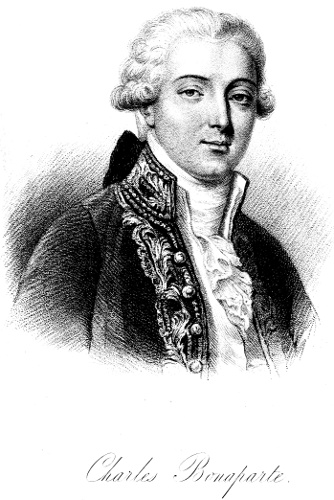
Charles Bonaparte. London. Published for Henry Colburn. January, 1836.
There were two French generals in Corsica, at the above period, so inimical to each other that their quarrels formed two parties; one was M. de Marbeuf, a mild and popular character, and the other, M. de Narbonne Pellet, distinguished for haughtiness and violence. The latter, from his birth and superior interest, must have been a dangerous man for his rival: fortunately for M. de Marbeuf, he was much more beloved in the island. When the deputation headed by Charles Buonaparte arrived at Versailles, he was consulted on the dispute, and the warmth of his testimony obtained a triumph for Marbeuf. The Archbishop of Lyons, nephew to Marbeuf, thought it his duty to wait on the deputy, and thank him for the service he had rendered. On young Napoleon’s being placed in the military school of Brienne, the Archbishop gave him a special recommendation to the family of Brienne, which lived there during the greater part of the year: hence the friendly demeanour of the Marbeufs and Briennes towards the children of the Buonaparte family. Calumny has assigned another cause, but the simple examination of dates is fully sufficient to prove its absurdity.
Old M. de Marbeuf, who commanded in Corsica, lived at Ajaccio, where the family of Charles Buonaparte was one of the principal. Madame Buonaparte being the most fascinating and beautiful woman in the town, it was very natural for the General to frequent her house in preference to many other places of resort.
Charles Buonaparte died at the age of thirty-eight, of an induration in the glands of the stomach. He had experienced a temporary cure during one of his visits to Paris, but became the victim of a second attack at Montpellier, where he was interred in one of the convents of the city.
During the Consulate, the notables of Montpellier, through the medium of their countryman Chaptal, minister of the interior, solicited the permission of the First Consul to erect a monument to the memory of his father. Napoleon thanked them for their good intentions, but 68declined acceding to their solicitation. “Let us not disturb the repose of the dead,” said he; “let their ashes remain in peace. I have also lost my grandfather and great-grandfather; why not erect monuments to them? This might lead too far. Had my father died yesterday, it would be proper and natural that my grief should be accompanied by some signal mark of respect. But his death took place twenty years ago: it is an event of no public interest, and it is useless to revive the recollection of it.” At a subsequent period Louis Buonaparte, without the knowledge of Napoleon, had his father’s remains disinterred, and removed to St. Leu, where he erected a monument to his memory.
Charles Buonaparte had been the very reverse of devout; he had even written some anti-religious poems; and yet, at the period of his death, said the Emperor, there were not priests enough for him in Montpellier. In this respect he was very different from his brother Archdeacon Lucien, a very pious and orthodox ecclesiastic, who died long after him, at a very advanced age. On his death-bed, he took great umbrage at Fesch, who, being by this time a priest, ran to him in his stole and surplice to assist him in his last moments. Lucien begged that he would suffer him to die in peace, and he breathed his last surrounded by the members of his family, giving them philosophic counsel and patriarchal benedictions.
The Emperor frequently spoke of his old uncle, who had been a second father to him, and who was for a length of time the head of the family. He was Archdeacon of Ajaccio, one of the principal dignitaries of the island. His prudence and economy re-established the affairs of the family, which had been much deranged by the extravagance of Charles. The old uncle was much revered, and enjoyed considerable authority in the district: the peasantry voluntarily submitted their disputes to his decision, and he freely gave them his advice and his blessing.
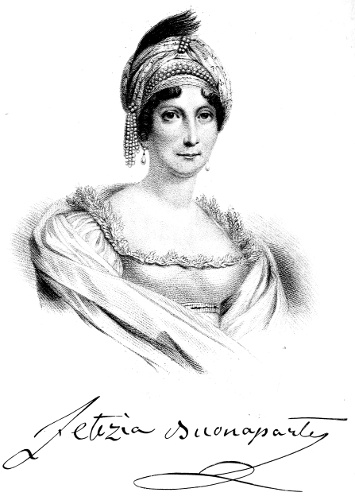
Letizia Buonaparte Published for Henry Colburn, Dec. 1835.
Charles Buonaparte married Mademoiselle Letitia Ramolini, whose mother, after the death of her first husband, married Captain Fesch, an officer in one of the 69Swiss regiments, which the Genoese usually maintained in the island. Cardinal Fesch was the issue of this second marriage, and was consequently step-brother to Madame and uncle to the Emperor.
Madame was one of the most beautiful women of her day, and she was celebrated throughout Corsica. Paoli, in the time of his power, having received an embassy from Algiers or Tunis, wished to give the Barbary envoys some notion of the attractions of the island, and for this purpose he assembled together all the most beautiful women in Corsica, among whom Madame took the lead. Subsequently, when she travelled to Brienne to see her son, her personal charms were remarked even in Paris.
During the war for Corsican liberty, Madame Buonaparte shared the dangers of her husband, who was an enthusiast in the cause. In his different expeditions she frequently followed him on horseback, while she was pregnant with Napoleon. She was a woman of extraordinary vigour of mind, joined to considerable pride and loftiness of spirit. She was the mother of thirteen children, and she might have had many more, for she was a widow at the age of thirty. Of these thirteen children, only five boys and three girls lived, all of whom performed distinguished parts in the reign of Napoleon.
Joseph, the eldest of the family, was originally intended for the church, on account of the influence possessed by Marbeuf, archbishop of Lyons, who had the patronage of numerous livings. He went through the regular course of study; but when the moment arrived for taking orders, he refused to enter the ecclesiastical profession. He was successively King of Naples and Spain.
Louis was King of Holland, and Jerome King of Westphalia. Eliza was Grand Duchess of Tuscany; Caroline, Queen of Naples; and Pauline, Princess Borghese. Lucien, who through his marriage and a mistaken direction of character, doubtless forfeited a crown, atoned for all his past errors by throwing himself into the arms of the Emperor on his return from Elba, at a moment when Napoleon was far from relying on the certainty of his prospects. Lucien, the Emperor 70used to say, passed a turbulent career in his youth: at the age of fifteen he was taken to France by M. Semonville, who soon made him a zealous revolutionist and an ardent clubist. On this subject the Emperor said that in the numerous libels published against him were some addresses or letters, bearing, among other signatures, that of Brutus Buonaparte, which were attributed to him, Napoleon; he would not affirm, he added, that these addresses were not written by some individual of the family, but he could declare that they were not his production.
I had the opportunity of rendering myself acquainted with the sentiments of Prince Lucien, on the Emperor’s return from Elba, and am enabled to say that it would have been difficult for any man to have been more upright and steady in his political views, or to have evinced greater attachment and good-will towards his brother.
MADEIRA, &c.—VIOLENT GALE.—CHESS.
22nd–26th. On the 22nd we came within sight of Madeira, and at night arrived off the port. Only two of the vessels cast anchor, to take on board supplies for the squadron. The wind blew very hard, and the sea was exceedingly rough. The Emperor found himself indisposed, and I was also ill. A sudden gale arose; the air was excessively hot, and seemed to be impregnated with small particles of sand—we were now assailed by the emanations of the terrible winds from the deserts of Africa. This weather lasted throughout the whole of the following day. Our communication with the shore became extremely difficult. The English Consul came on board, and informed us that for many years there had not been such a hurricane at Madeira; the vintage was entirely destroyed, all the windows in the town were broken, and it had been found scarcely possible to breathe in the streets. All this time we continued tacking about before the town; which we continued to do throughout the whole of the following night, and the 24th, when we took on board several oxen, and stores of other provisions, such as unripe oranges, bad peaches, and tasteless pears; the figs and grapes were however 71excellent. In the evening we made way with great rapidity; the wind still blowing hard. On the 25th and 26th we lay-to during a portion of each day, to distribute provisions among the vessels composing the squadron; during the rest of the time, we sailed on smoothly and rapidly.
Meanwhile nothing occurred to interrupt the uniformity of the scene. Each day crept slowly on, and added to the past interval, which, as a whole, seemed brief because it was void of interest, and not characterized by any remarkable incident.
The Emperor had added to the number of his amusements by a game at piquet, which he regularly played about three o’ clock. This was succeeded by a few games at chess with the Grand Marshal, M. de Montholon, or some other individual, until dinner-time. There was no very good chess-player on board the vessel. The Emperor was but an indifferent player; he gained with some and lost with others, a circumstance which one evening led him to say, “How happens it that I frequently lose with those who are never able to beat him whom I almost always beat? Does not this seem contradictory? How is this problem to be solved?” said he, winking his eye, to shew that he was not the dupe of the constant politeness of him who was really the best player.
We no longer played at vingt-et-un in the evening: we gave up this game on account of our having played too high, at which the Emperor appeared displeased, for he was a great enemy to gaming. On returning from his afternoon walk on the deck. Napoleon played two or three games at chess, and retired to rest early.
THE CANARIES.—PASSING THE TROPIC.—DETAILS OF THE EMPEROR’S CHILDHOOD.—NAPOLEON AT BRIENNE.—PICHEGRU.—NAPOLEON AT THE MILITARY SCHOOL IN PARIS.—IN THE ARTILLERY.—HIS COMPANIONS.—NAPOLEON AT THE COMMENCEMENT OF THE REVOLUTION.
27th—31st. At daybreak on Sunday, 27th, we found ourselves among the Canaries, which we passed 72in the course of the day, sailing at the rate of ten or twelve knots an hour, without having perceived the famous Peak of Teneriffe—a circumstance the more extraordinary, since in clear weather it is visible at the distance of sixty leagues.
On the 29th we crossed the tropic, and observed many flying fish round the ship. On the 31st, at eleven at night, one of the sailors threw himself overboard; he was a negro who had got drunk, and was fearful of the flogging that awaited him. He had several times, in the course of the evening, attempted to jump overboard, and at last succeeded. He however soon repented, and uttered loud cries. He swam very well; but though a boat was immediately sent off, and every endeavour used to rescue him, he was lost. The cries of this man in the sea excited a powerful sensation on board the vessel. In a moment the crew were hurrying about in every direction: the noise was very great, and the agitation universal.
As I was descending from deck to the cabin, a midshipman, a youth between ten and twelve years of age, of an interesting countenance, thinking I was going to inform the Emperor of what had occurred, laid hold of my coat, and in a tone expressive of the tenderest interest exclaimed, “Ah, Sir, do not alarm him! Tell him the noise is nothing at all; that it is only a man fallen overboard.” Amiable and innocent youth! he expressed his sentiments rather than his thoughts!
In general the midshipmen, of whom there were several on board the ship, behaved with marked respect and attention to the Emperor. They every evening repeated a scene that made a deep impression on our feelings. Early in the morning the sailors carried up their hammocks, and put them in the large nettings at the sides of the ship; and about six in the evening they carried them away at the signal of a whistle. Those who were tardy in the performance of this duty received a certain punishment. On the signal being given, a great bustle ensued; and it was gratifying to see the midshipmen at this moment form a circle round the Emperor, whether he might be standing in the middle of the deck, or resting on his favourite gun. They 73watched his motions with an anxious eye, and either by signs or words directed the sailors to avoid incommoding him. The Emperor frequently observed this conduct, and remarked that youthful hearts were always inclined to enthusiasm.
I will now proceed with the details, which I collected at various times, respecting the early years of the Emperor’s life.
Napoleon was born about noon on the 15th of August (Assumption-day) in the year 1769. His mother, who was possessedpossessed of great bodily as well as mental vigour, and who had braved the dangers of war during her pregnancy, wished to attend mass on account of the solemnity of the day: she was, however, taken ill at church, and on her return home was delivered before she could be conveyed to her chamber. The child, as soon as it was born, was laid on the carpet, which was an old-fashioned one, representing at full length the heroes of fable, or, perhaps, of the Iliad. This child was Napoleon.
In his boyhood Napoleon was turbulent, adroit, lively and agile in the extreme. He had gained, he used to say, the most complete ascendancy over his elder brother Joseph. The latter was beaten and ill-treated; complaints were carried to the mother, and she would begin to scold before poor Joseph had even time to open his mouth.
At the age of ten, Napoleon was sent to the military school at Brienne. His name, which in his Corsican accent he pronounced as if written Napoilloné, from the similarity of the sound, procured for him, among his youthful companions, the nick-name of la paille au nez (straw in his nose). At this period a great change took place in Napoleon’s character. In contradiction to all the apocryphal histories, which contain anecdotes of his life, he was when at Brienne mild, quiet, and susceptible. One day the quarter master, who was a man of harsh disposition, and who never took the trouble of considering the physical and moral shades of character in each individual scholar, condemned Napoleon, by way of punishment, to wear the serge coat, and to take his dinner on his knees at the door of the refectory. Napoleon, 74who had a vast share of pride and self-conceit, was so mortified by this disgrace, that he was seized with a violent retching, and suffered a severe nervous attack. The head master of the school happening accidentally to pass by, relieved him from the punishment, reproving the quarter-master for his want of discernment; and Father Patrault, the professor of mathematics, was very indignant on finding that his first mathematician had been treated with so little respect.
[14]“On attaining the age of puberty, Napoleon’s temper became morose and reserved; his passion for reading was carried to excess; and he eagerly devoured the contents of every book that fell in his way. Pichegru was at this time his quarter-master and his tutor in the four rules of arithmetic.
“Pichegru was a native of Franche-Comté, where his family were farmers. The Minim monks of Champagne were appointed to superintend the military school of Brienne. Owing to their poverty, however, so few individuals were induced to enter their order that they found themselves inadequate to the task imposed on them; and they solicited the assistance of the Minim monks of Franche-Comté, of whom Father Patrault was one. An aunt of Pichegru’s, a nun of La Charité, followed Patrault, for the purpose of superintending the infirmary, and she was accompanied by her nephew, a youth who was admitted to the school to receive his education gratuitously. Pichegru, who was extremely clever, was, on his attaining a suitable age, made quarter-master and tutor under Father Patrault, who had taught him mathematics. He intended to become a monk, which was the sole object of his ambition and of his aunt’s wishes. But Father Patrault dissuaded him from this intention, assuring him that the profession was not suited to the age; and that he ought to look forward to something better: he prevailed on him to enlist in the artillery, where the Revolution found him a sub-officer. 75His military career is known:—he was the conqueror of Holland. Thus Father Patrault had the honour of counting among his pupils the two greatest generals of modern France.
“Father Patrault was subsequently secularized by M. de Brienne, Archbishop of Sens and Cardinal de Lomenie, who made him one of his grand vicars, and intrusted him with the management of his numerous benefices.
“At the time of the Revolution, Father Patrault, though his opinions were widely opposite to those of his patron, nevertheless exerted every endeavour to save him, and with this view applied to Danton, who was a native of the same part of France to which the Cardinal and himself belonged. But all was unavailing; and it is supposed that Patrault, after the manner of the ancients, rendered to the Cardinal the service of procuring for him a poisoned draught to save him from the scaffold.
“Madame de Lomenie, the Cardinal’s niece, before her life was sacrificed by the revolutionary tribunal, intrusted Father Patrault with the care of her two daughters, who were yet in their childhood. The moment of terror having passed away, their aunt Madame de Brienne, who had escaped the storm and preserved a considerable portion of her fortune, applied to Father Patrault for the children; but he refused to give them up, on the ground that their mother had directed him to withdraw them from the world and to devote them to the occupation of peasants. He had conceived the design of literally executing these figurative commands, and was on the point of uniting them to two of his own nephews. ‘I was then,’ said Napoleon, ‘General of the Army of the Interior, and I became the mediator for the restoration of the two children, an object which was not accomplished without difficulty. Patrault employed every possible means of resistance. These daughters of Madame de Lomenie were the two ladies whom you have since known by the names of Madame de Marnesia, and the beautiful Madame de Canisy, Duchess de Vicenza.’Vicenza.’
“Father Patrault, having renewed his acquaintance 76with his old pupil, followed him and joined the Army of Italy, where he proved himself better able to calculate projectiles than to meet their effects. At Montenotte, Millesimo, and Dego, he evinced the most puerile cowardice. During the action he was occupied, not like Moses, in praying, but in weeping. The General-in-chief appointed him administrator of domains at Milan, from which he derived considerable profits. On Napoleon’s return from Egypt, he presented himself to him: he was no longer the little Minim monk of Champagne, but a corpulent financier, possessed of upwards of a million. Two years afterwards he again sought an interview with the First Consul at Malmaison: he now looked mean, dejected, and shabbily dressed. ‘How is this?’ inquired the Consul. ‘You see before you a ruined man,’ replied Patrault; ‘one who is reduced to beggary; the victim of severe misfortune.’ The First Consul determined to investigate the truth of this statement; he discovered that Father Patrault had commenced the trade of an usurer. The great calculator had lost his fortune through bankruptcies, in lending at great risk for a high interest. ‘I have already paid my debt,’ said the First Consul, at his next interview with him; ‘I can do no more for you; I cannot make a man’s fortune twice.’ He contented himself with granting Patrault a pension sufficient for his subsistence.
“Napoleon retained but a faint idea of Pichegru; he remembered that he was a tall man, rather red in the face. Pichegru, on the contrary, seems to have preserved a striking recollection of young Napoleon. When Pichegru joined the royalist party, he was asked whether it would not be possible to gain over the General-in-chief of the Army of Italy. ‘To attempt that would only be wasting time,’ said he: ‘from my knowledge of him when a boy, I am sure he must be a most inflexible character: he has formed his resolutions, and he will not change them.’”
The Emperor has often been much amused at the tales and anecdotes that are related of his boyhood, in the numerous little publications to which he had given rise: he acknowledges the accuracy of scarcely any of them. 77There is one, relative to his confirmation at the military school of Paris, which, however, he admitted to be true. It is as follows:—the archbishop who confirmed him, manifesting his astonishment at the name of Napoleon, said he did not know of any such saint, and that there was no such name in the calendar; the boy quickly replied, that that could be no rule, since there were an immense number of saints, and only 365 days.
Napoleon never observed his festival-day until after the Concordat: his patron saint was a stranger to the French Calendar, and even where his name is recorded the date of his festival is a matter of uncertainty. The Pope, however, fixed it for the 15th of August, which was at once the Emperor’s birth-day, and the day of the signing of the Concordat.
[15]“In 1783, Napoleon was one of the scholars who, at the usual competition at Brienne, were fixed upon to be sent to the military school at Paris, to finish their education. The choice was made annually by an inspector, who visited the twelve military schools. This office was filled by the Chevalier de Keralio, a general officer, and the author of a work on military tactics. He was also the tutor of the present [the late] King of Bavaria, who in his youth bore the title of Duke of Deux-Ponts. Keralio was an amiable old man and well qualified to discharge the duty of Inspector of the military schools. He was fond of the boys, played with them when they had finished their examinations, and permitted those who had acquitted themselves most to his satisfaction to dine with him at the table of the monks. He was particularly attached to young Napoleon, and took a pleasure in stimulating him to exertion. He singled him out to be sent to Paris, though it would appear he had not at that time attained the requisite age. The lad was not very far advanced in any branch of education except mathematics, and the monks suggested that it would be better to wait till the following year, to afford time for further improvement. But this the Chevalier de Keralio would by no means agree to; ‘I 78know what I am about,’ said he, ‘and if I am transgressing the rules, it is not on account of family influence:—I know nothing of the friends of this youth. I am actuated only by my own opinion of his merit. I perceive in him a spark of genius which cannot be too early fostered.’ The worthy chevalier died suddenly, before he had time to carry his determination into effect; but his successor, M. de Regnaud, who would not perhaps have evinced half his penetration, nevertheless fulfilled his intention, and young Napoleon was sent to Paris.”
At this period he began to develop qualities of a superior order: decision of character, profound reflection, and vigorous conceptions. It would appear, that from his earliest childhood his parents rested all their hopes on him. His father, when on his death-bed at Montpellier, though Joseph was beside him, spoke only of Napoleon, who was then at the military school. In the delirium with which he was seized in his last moments, he incessantly called Napoleon to come to his aid with his great sword. The grand uncle, Lucien, who on his death-bed was surrounded by all his relatives, said, addressing himself to Joseph, “You are the eldest of the family; but there is the head of it (pointing to Napoleon). Never lose sight of him.” The Emperor used to laugh and say, “This was a true disinheritance: it was the scene of Jacob and Esau.”
Having myself been educated at the military school of Paris, though at an earlier period than that at which Napoleon attended it, I was enabled, on returning from my emigration, to converse about the Emperor with the masters who had been common to us both.
M. de l’Eguille, our teacher of history, used to boast that the records of the military school contained proofs of his having foretold the great career which his pupil was destined to fill; and that he had frequently, in his notes, eulogised the depth of his reflection, and the shrewdness of his judgment. He informed me that the First Consul used often to invite him to breakfast at Malmaison, and that he always took pleasure in conversing about his old lessons.—“That which made the 79deepest impression on me,” said he, one day to M. de l’Eguille, “was the revolt of the Constable de Bourbon, though you did not present it to us precisely in its proper light. You made it appear that his great crime was his having fought against his king; which certainly was but a trifling fault, in those days of divided nobility and sovereignty; particularly considering the scandalous injustice of which he was the victim. His great, his real, his only crime, and that on which you did not sufficiently dwell, was his having joined with foreigners to attack his native country.”
M. Domairon, our professor of belles-lettres, informed me that he had always been struck with the singularity of Napoleon’s amplifications, which he said were like granite heated in a volcano.
Only one individual formed a mistaken idea of him; that was M. Bauer, the dull heavy German master. Young Napoleon never made much progress in the German language, which offended M. Bauer, who ranked German above all things, and he in consequence formed a most contemptible opinion of his pupil’s abilities. One day, Napoleon not being in his place, M. Bauer inquired where he was, and was told that he was attending his examination in the class of artillery. “What! does he know any thing?” said M. Bauer ironically. “Why, Sir, he is the best mathematician in the school,” was the reply. “Ah! I have always heard it remarked, and I have always believed, that none but a fool could learn mathematics.” “It would be curious,” said the Emperor, “to know whether M. Bauer lived long enough to see me rise in the world, and to enjoy the confirmation of his own judgment.”
Napoleon was scarcely eighteen years of age when the Abbé Raynal, struck with the extent of his acquirements, appreciated his merit so highly as to make him one of the ornaments of his scientific déjeûners. Finally, the celebrated Paoli, who, after having long inspired Napoleon with a sort of veneration, found the latter at the head of a party against him, the moment he shewed himself favourable to the English, was accustomed to say—“This young man is formed on the ancient model. He is one of Plutarch’s men.”
80In 1785, Napoleon, who was appointed at once a cadet and an officer of artillery, quitted the military school to enter the regiment of la Fère with the rank of second lieutenant; from which he was promoted to the rank of first lieutenant in the regiment of Grenoble.
Napoleon, on quitting the military school, went to join his regiment at Valence. The first winter he spent there, his comrades at the mess-table were Lariboissière, whom, during the empire, he appointed inspector-general of the artillery; Sorbier, who succeeded Lariboissière in that post; d’Hedouville, junior, afterwards minister plenipotentiary at Frankfort; Mallet, brother of him who headed the tumult in Paris in 1813; an officer named Mabille, whom, on his return from emigration, the Emperor appointed to a situation in the post-office; Rolland de Villarceaux, afterwards prefect of Nismes; Desmazzis, junior, his companion at the military school, and the friend of his early years, who after Napoleon ascended the throne, became keeper of the Imperial wardrobe.
There were in the corps officers more or less easy in their circumstances; Napoleon ranked among the former. He received from his family 1200 francs a year, which was then the amount of an officer’s full pay. There were two individuals in the regiment who could afford to keep cabriolets, or carriages of some kind, and they were looked upon as very great men. Sorbier was one of these two: his companions got him to drive them about, and they repaid the obligation by jokes and puns. Sorbier was the son of a physician at Moulins.
At Valence, Napoleon obtained an early introduction to Madame dudu Columbier, a lady about fifty years of age, who was endowed with many rare and estimable qualities, and who was the most distinguished person in the town. She entertained a great regard for the young artillery-officer, and through her acquaintance he mingled in all the best company in Valence and its neighbourhood. She introduced him to the Abbé de Saint Rufe, an elderly man of property, who was frequently visited by the most distinguished persons in the country. Napoleon was indebted for the favour he enjoyed to his 81extensive information, joined to the facility and force with which he turned it to account. Madame du Colombier often foretold that he would be a distinguished man. The death of this lady happened about the time of the breaking out of the Revolution: it was an event in which she took great interest, and in her last moments was heard to say that, if no misfortune befel young Napoleon, he would infallibly play a distinguished part in the events of the time. The Emperor never spoke of Madame du Colombier but with expressions of the tenderest gratitude; and he did not hesitate to acknowledge that the valuable introductions and superior company in society which she procured for him had great influence over his destiny.
The gaiety which Napoleon enjoyed at this period of his life, excited great jealousy on the part of his fellow-officers. They were displeased at seeing him absent himself so frequently from among them, though his doing so could be no reasonable ground of offence to them. Fortunately the commandant, M. d’Urtubie, had formed a just estimate of his character: he shewed him great kindness, and afforded him the means of fulfilling his military duties, and at the same time of mingling in the pleasures of society.
Napoleon conceived an attachment for Mademoiselle du Colombier, who, on her part, was not insensible to his merits. It was the first love of both; and it was that kind of love which might be expected to arise at their age and with their education. “We were the most innocent creatures imaginable,” the Emperor used to say; “we contrived little meetings together: I well remember one which took place on a Midsummer morning, just as daylight began to dawn. It will scarcely be believed that all our happiness consisted in eating cherries together.”
It has been said that the mother wished to bring about this marriage, and that the father opposed it on the ground that they would ruin each other by their union; while each was separately destined to a fortunate career. But this story is untrue, as is likewise another anecdote relative to a marriage with Mademoiselle 82Clary, afterwards Madame Bernadotte, now Queen of Sweden.
In 1805, the Emperor, when about to be crowned King of Italy, on passing through Lyons, again saw Mademoiselle du Colombier, who had now changed her name to Madame de Bressieux. She gained access to him with some difficulty, surrounded as he was by the etiquette of royalty. Napoleon was happy to see her again; but he found her much altered for the worse. He did for her husband what she solicited, and placed her in the situation of lady of honour to one of his sisters.
Mademoiselles de Laurencin and Saint-Germain were at that time the reigning toasts in Valence, where they divided the general admiration. The latter married Monsieur de Montalivet, who was also known to the Emperor at that time, and who was afterwards made Minister of the Interior. “He was an honest fellow,” said Napoleon, “and one who, I believe, remained firmly attached to me.”
When about eighteen or twenty years of age, the Emperor was distinguished as a young man of extensive information, possessing a reflective turn of mind and strong reasoning powers. His reading had been very extensive, and he had profoundly meditated on the fund of knowledge thus acquired, much of which, he used to say, he had probably since lost. His sparkling and ready wit and energetic language distinguished him wherever he went: he was a favourite with every one, particularly with the fair sex, to whom he recommended himself by the elegance and novelty of his ideas, and the boldness of his arguments. As for the men, they were often afraid to engage with him in those discussions into which he was led by a natural confidence in his own powers.
Many individuals, who knew him at an early period of life, predicted his extraordinary career; and they viewed the events of his life without astonishment. At an early age he gained anonymously a prize at the Academy of Lyons, on the following question, proposed by Raynal:—“What are the principles and institutions calculated to advance mankind to the highest possible degree of 83happiness?” The anonymous memorial excited great attention: it was perfectly in unison with the ideas of the age. It began by enquiring in what happiness consisted; and the answer was, in the perfect enjoyment of life in the manner most conformable with our moral and physical organization. After he became Emperor, Napoleon was one day conversing on this subject with M. de Talleyrand: the latter, like a skilful courtier, shortly after presented to him the famous memorial, which he had procured from the archives of the Academy of Lyons. The Emperor took it, and, after reading a few pages, threw into the fire this first production of his youth. “We can never think of every thing,” said Napoleon: and M. de Talleyrand had not taken the precaution of having it copied.
The Prince de Condé one day visited the Artillery school at Auxonne; and the cadets considered it a high honour to be examined by that military prince. The commandant, in spite of the hierarchy, placed young Napoleon at the head of the polygon, in preference to others of superior rank. It happened that, on the day preceding the examination, all the cannons of the polygon were spiked: but Napoleon was too much on the alert to be caught by this trick of his comrades, or snare, perhaps, of the illustrious traveller.
It is generally believed that Napoleon, in his boyhood, was taciturn, sullen, and morose: on the contrary, he was of a very lively turn. He never appeared more delighted than when relating to us the various tricks he was accustomed to play when at the School of Artillery. In describing the joyous moments of his early youth, he seems to forget the misfortunes which hold him in captivity.
There was an old commandant, upwards of eighty years of age, for whom the cadets entertained a very high respect, notwithstanding the many jokes they played upon him. One day, while he was examining them in their cannon exercise, and watching every discharge with his eye-glass, he asserted they were far from hitting the mark, and asked those near him if they had seen the ball strike. Nobody had observed the 84youths’ slipping aside the ball every time they loaded. The old general was rather sharp; after five or six discharges, he took it into his head to count the balls. The trick was discovered. The general thought it a very good one; but nevertheless ordered all who had participated in it to be put under arrest.
The cadets would occasionally take a pique at some of their captains, or determine to revenge themselves on others to whom they owed a grudge. They then resolved to banish them from society, and to reduce them to the necessity of putting themselves under a sort of arrest. Four or five of the cadets undertook to execute the design. They fastened on their victim; pursued him into every company, and he was not suffered to open his mouth without being methodically and logically contradicted, though always with a strict regard to politeness: at length the poor fellow found that retirement was his only alternative.
“On another occasion,” Napoleon used to relate, “one of my comrades who lodged above me unluckily took a fancy to learn to play the horn, and made such a hideous noise as completely disturbed the studies of those who were within hearing. We met each other one day on the stairs; ‘Are you not tired of practising the horn?’ said I. ‘Not at all,’ he replied. ‘At any rate, you tire other people.’ ‘I am sorry for it.’ ‘It would be better if you went to practise elsewhere.’ ‘I am master of my own apartment.’ ‘Perhaps you may be taught to entertain a doubt on that point.’ ‘I scarcely think any one will be bold enough to attempt to teach me that.’” A challenge ensued; but before the antagonists met, the affair was submitted to the consideration of a council of the cadets, and it was determined that the one should practise the horn at a greater distance, and that the other should be more accommodating.
In the campaign of 1814, the Emperor again met his horn-player in the neighbourhood of Soissons or Laon: he was residing on his estate, and gave some important information respecting the enemy’s position. The Emperor made him one of his aides-de-camp; this officer was Colonel Bussy.
85When attached to his artillery-regiment, Napoleon seized every opportunity of mingling in company, where he invariably made an agreeable impression. Women at that time attached a high value to wit in the other sex; it was a quality which never failed to win their good graces. Napoleon, at this period, performed what he termed his Sentimental Journey from Valence to Mont-Cenis in Burgundy, and he intended to write an account of it after the manner of Sterne. The faithful Desmazzis was of the party: he was constantly with him, and his narrative of Napoleon’s private life, if combined with the details of his public career, would form a perfect history of the Emperor. It would then be seen that, however extraordinary his life might be with respect to its incidents, yet nothing could be more simple or natural than its course.
Circumstances and reflection have considerably modified his character. Even his style of expression, now so concise and laconic, was in his youth diffuse and emphatic. At the time of the Legislative Assembly, Napoleon assumed a serious and severe demeanour, and became less communicative than before. The army of Italy also marked another epoch in his character. His extreme youth, when he went to take the command of the army, rendered it necessary that he should evince great reserve, and the utmost strictness of morals. “This was indispensably necessary,” said he, “to enable me to command men so much above me in point of age. I pursued a line of conduct truly irreproachable and exemplary. I proved myself a sort of Cato. I must have appeared such in the eyes of all. I was a philosopher and a sage.” In this character he appeared on the theatre of the world.
Napoleon was in garrison at Valence when the Revolution broke out. At that time it was made a point of particular importance to induce the artillery-officers to emigrate; and the officers, on their part, were very much divided in opinion. Napoleon, who was thoroughly imbued with the notions of the age, possessing a natural instinct for great actions and a passion for national glory, espoused the cause of the Revolution; and his example influenced the majority of the regiment. He was an ardent 86patriot under the Constituent Assembly; but the Legislative Assembly marked a new period in his ideas and opinions.
He was at Paris on the 21st of June, 1792, and witnessed the insurrection of the people of the Faubourgs, who traversed the garden of the Tuileries, and forced the palace. There were but 6000 men; a mere disorderly mob, whose language and dress proved them to belong to the very lowest class of society.
Napoleon was also a witness of the events of the 10th of August, in which the assailants were neither higher in rank nor more formidable in number.
In 1793, Napoleon was in Corsica, where he had a command in the National Guards. He opposed Paoli, as soon as he was led to suspect that the veteran, to whom he had hitherto been so much attached, entertained the design of betraying the island to the English. Therefore it is not true, as it has been generally reported, that Napoleon, or one of his family, was at one time in England, proposing to raise a Corsican regiment for the English service.
The English and Paoli subdued the Corsican patriots, and burnt Ajaccio. The house of the Buonapartes was destroyed in the general conflagration, and the family was obliged to fly to the Continent. They fixed their abode at Marseilles, whence Napoleon proceeded to Paris. He arrived just at the moment when the federalists of Marseilles had surrendered Toulon to the English.
CAPE VERD ISLANDS.—NAPOLEON AT THE SIEGE OF TOULON.—RISE OF DUROC AND JUNOT.—NAPOLEON QUARRELS WITH THE REPRESENTATIVES OF THE PEOPLE.—QUARRELS WITH AUBRY.—ANECDOTES RELATIVE TO VENDEMIAIRE.—NAPOLEON GENERAL OF THE ARMY OF ITALY.—INTEGRITY OF HIS MILITARY ADMINISTRATION.—HIS DISINTERESTEDNESS.—NICK-NAMED PETIT-CAPORAL.—DIFFERENCE BETWEEN THE SYSTEM OF THE DIRECTORY AND THAT OF THE GENERAL OF THE ARMY OF ITALY.
September 1st—6th. On the 1st of September we found from our latitude that we should see the Cape Verd 87Islands in the course of the day. The sky was, however, overcast, and at night we could see nothing. The Admiral, convinced that there was a mistake in the reckoning of our longitude, was preparing to bear westward to the right, in order to fall in with the islands, when a brig, which was ahead of us, intimated by a signal that she had discovered them on the left. During the night the wind blew violently from the south-east, and if our mistake had been the reverse of what it was, and the Admiral had really borne to the right, it is not improbable that we should have been thrown out of our course; a proof that, notwithstanding the improvements in science, mistakes are very apt to take place, and that the chances of navigation are very great. As the wind continued to blow strong, and the sea was boisterous, the Admiral preferred continuing his course, rather than waiting to take in water, of which he believed he had already a sufficient store. Every thing now promised a prosperous passage; we were already very far advanced on our course. Every circumstance continued favourable; the weather was mild, and we might even have thought our voyage agreeable, had it been undertaken in the pursuit of our own plans and in conformity with our own inclinations: but how could we forget our past misfortunes, or close our eyes on the future?——
Occupation alone could enable us to support the languor and tedium of our days. I had undertaken to teach my son English; and the Emperor, to whom I mentioned the progress he was making, expressed a wish to learn also. I endeavoured to form a very simple plan for his instruction, in order to save him trouble. This did very well for two or three days; but the ennui occasioned by the study was at least equal to that which it was intended to counteract, and the English was laid aside. The Emperor occasionally reproached me with having discontinued my lessons: I replied that I had the medicine ready, if he had the courage to take it. In other respects, particularly before the English, his manners and habits were always the same: never did a murmur or a wish escape his lips; he invariably appeared contented, patient, and good-humoured.
88The admiral, who, on account of our reputation, I suppose, had assumed great stiffness, on our departure from England, gradually laid aside his reserve, and every day took greater interest in his captive. He represented the danger incurred by coming on deck after dinner, owing to the damp of the evening; the Emperor would then sometimes take his arm and prolong the conversation, which never failed to gratify him exceedingly. I have been assured that the Admiral carefully noted down every particular that he could collect. If this be true, the remarks which the Emperor one day made, during dinner, on naval affairs—on the French resources in the south; those which he had already created, and those which he contemplated; and on the ports and harbours of the Mediterranean: to all of which the Admiral listened with deep attention, and as if fearful of interruption—will compose a chapter truly valuable to a seaman.
I will now return to the details collected during our ordinary conversation. The following relate to the siege of Toulon.
In September 1793, Napoleon Buonaparte, then in his twenty-fourth year, was yet unknown to the world which was destined to resound with his name. He was a lieutenant-colonel of artillery, and had been only a few weeks in Paris; having left Corsica, where political events had forced him to yield to the faction of Paoli. The English had taken possession of Toulon; an experienced artillery-officer was wanting to direct the operations of the siege, and Napoleon was fixed on. There will history take him up, never more to leave him;—there commences his immortality.
I refer to the Memoirs of the Campaign of Italy for the plan of attack which he adopted, and the manner in which that plan was carried into effect. It will there be seen that it was he, and he alone, who took the fortress. This was a great triumph, no doubt: but to appreciate it justly, it would be necessary to compare the plan of the attack with the account of the evacuation; the one is the literal prediction, and the other is the fulfilment word for word. From this moment the young commander 89of artillery enjoyed the highest reputation. The Emperor never looks back to this period without pleasure, and always mentions it as the happiest portion of his life. The taking of Toulon was his first successful achievement, and it naturally excites the fondest recollections. The history of the campaign of Italy will present a faithful picture of the three generals-in-chief who succeeded each other during the siege: the inconceivable ignorance of Cartaux, the gloomy brutality of Doppet, and the honest courage of Dugommier. Of them I shall here say nothing.
At the first breaking out of the Revolution, there was nothing but disorder in the matériel and ignorance in the personnel of the French army, which was owing both to the confusion of the times and the rapidity and irregularity with which the promotions had been made. The following story will afford an idea of the state of affairs and of the manners of the time:—
On his arrival at head-quarters, Napoleon waited on General Cartaux, a fine figure, covered with gold lace from head to foot, who asked him what duty he had been sent upon. The young officer modestly presented the letter which directed him to superintend, under the general’s command, the operations of the artillery. “This was quite unnecessary,” said the fine-looking man, twirling his whiskers; “we want no assistance to retake Toulon: however, you are welcome, and you may share the glory of burning the town to-morrow, without having experienced any of the fatigue.” And he made him stay to sup with him.
A party of thirty sat down to table; the general alone was served like a prince, while every one else was dying of hunger; a circumstance which, in those days of equality, strangely shocked the new guest. The next morning, at break of day, the general took him out in his cabriolet, to admire, as he said, the preparations for attack. As soon as he had crossed the height, and come within sight of the roads, they got out of the carriage, and entered some vineyards by the road side. The commandant of artillery then perceived some pieces of ordnance, and some digging, for which it was literally impossible 90for him in the slightest degree to account. “Dupas,” said the general haughtily, turning to his aide-de-camp, his confidential man, “are those our batteries?”—“Yes, general.”—“And our park?” “There, close at hand.”—“And our red-hot balls?”—“In yonder houses, where two companies have been employed all the morning in heating them.”—“But how shall we be able to carry these red-hot balls?” This consideration seemed to puzzle them both completely, and they turned to the officer of artillery, and begged to know whether, through his scientific knowledge, he could not explain how the thing was to be managed. Napoleon, who would have been very much tempted to take the whole for a hoax, had his interrogators evinced less simplicity, for they were more than a league and a half from the object of attack, summoned to his aid all the gravity he was master of, and endeavoured to persuade them, before they troubled themselves about red-hot balls, to try the range of the shot with cold ones. After a great deal of trouble, he at length prevailed on them to follow his advice, but not till he had very luckily made use of the technical term coup d’épreuve, (proof-shot,) which took their fancy, and brought them over to his opinion. They then made the experiment, but the shot did not reach to a third of the distance required: and the general and Dupas began to abuse the Marseillais and the Aristocrats who had, they said, maliciously spoiled the powder. In the mean time the representative of the people came up on horseback: this was Gasparin, an intelligent man, who had served in the army.—Napoleon, perceiving how things were going on, and boldly deciding on the course he meant to pursue, immediately assumed great confidence of manner, and urged the representative to intrust him with the whole direction of the affair. He exposed, without hesitation, the unparalleled ignorance of all who were about him, and from that moment took upon himself the entire direction of the siege.
Cartaux was a man of such limited intellect that it was impossible to make him understand that, to facilitate the taking of Toulon, it would be necessary to make the attack at the outlet of the road. When the commandant 91of artillery sometimes pointed to this outlet on the map, and told him there was Toulon, Cartaux suspected he knew very little of geography; and when, in spite of his opposition, the authority of the representative decided on the adoption of this distant point of attack, the general was haunted by the idea of treasonable designs, and he would often remark, with great uneasiness, that Toulon did not lie in that direction.
Cartaux wanted one day to oblige the commandant to erect a battery, with the rear of the guns so close against the front of a house as to leave no room for the recoil. On another occasion, on his return from the morning parade, he sent for the commandant to tell him that he had just discovered a position, from which a battery of from six to twelve pieces would infallibly carry Toulon in a few days: it was a little hillock which would command three or four forts and several points of the town. He was enraged at the refusal of the commandant of artillery, who observed to him that, although the battery commanded every point, it was itself commanded by every point; that the twelve guns would have one hundred and fifty to oppose them; and that simple subtraction would suffice to show him his disadvantage. The commandant of the engineer department was called on for his opinion, and, as he concurred without hesitation in that of the commandant of artillery, Cartaux said that it was impossible to do any thing with those learned corps, as they all went hand-in-hand. At length, to put a stop to difficulties which were continually recurring, the representative decided that Cartaux should communicate to the commandant of artillery his general plan of attack, and that the latter should execute the details, according to the rules of his department. The following was Cartaux’s memorable plan:—“The general of artillery shall batter Toulon during three days, at the expiration of which time I will attack it with three columns, and carry it.”
At Paris, however, the engineer committee found this summary measure much more humorous than wise, and it was one of the causes which led to Cartaux’s recal. There was indeed no want of plans; for, the retaking of 92Toulon having been proposed as a subject for competition in the popular societies, plans poured in from all quarters. Napoleon says he must have received at least six hundred during the siege. It was to the representative Gasparin that Napoleon was indebted for the triumph of his plan (that which took Toulon) over the objections of the Committees of the Convention. He preserved a grateful recollection of this circumstance: it was Gasparin, he used to say, who had first opened his career.[16]
In all the disputes between Cartaux and the commandant of artillery, which usually took place in the presence of the general’s wife, the latter uniformly took the part of the officer of artillery, saying, with great naïveté to her husband, “Let the young man alone, he knows more about it than you do, for he never asks your advice; besides, it is you who are to give the account: the glory will be yours.”
This woman was not without some share of good sense. On her return to Paris, after the recal of her husband, the jacobins of Marseilles gave a splendid fête in honour of the disgraced family. In the course of the evening the conversation happened to fall on the commandant of artillery, who was enthusiastically praised. “Do not reckon on him,” said she; “that young man has too much understanding to remain long a sans-culotte.” On which the general exclaimed, with the voice of a Stentor, “Wife Cartaux, would you make us all out to be fools then?” “No, I do not say that, my dear; but ... I must tell you, he is not one of your sort.”
One day, at head quarters, a superb carriage arrived from the Paris road; it was followed by a second, and a third; and at length no fewer than fifteen appeared. It 93may be imagined how great was the astonishment and curiosity occasioned by such a circumstance in those times of republican simplicity. The grand monarque himself could not have travelled with greater pomp. The whole cavalcade had been procured by a requisition in the capital; several of the carriages had belonged to the Court. About sixty soldiers, of fine appearance, alighted from them, and inquired for the General-in-chief; they marched up to him with the important air of ambassadors:—“Citizen General,” said the orator of the party, “we come from Paris; the patriots are indignant at your inactivity and delay. The soil of the Republic has long been violated; she is enraged to think that the insult still remains unavenged: she asks, why is Toulon not yet retaken? Why is the English fleet not yet destroyed? In her indignation, she has appealed to her brave sons; we have obeyed her summons, and burn with impatience to fulfil her expectation. We are volunteer gunners from Paris: furnish us with arms, to-morrow we will march upon the enemy.” The General, disconcerted at this address, turned to the commandant of artillery, who promised, in a whisper, to rid him of these heroes next morning. They were well received, and at day-break the commandant of artillery led them to the sea-shore, and put some guns at their disposal. Astonished to find themselves exposed from head to foot, they asked whether there was no shelter or epaulement. They were told that all those things were out of fashion; that patriotism had abolished them. Meanwhile, an English frigate fired a broadside, and put all the braggadocios to flight. There was but one cry throughout the camp; some openly fled, and the rest quietly mingled with the besiegers.
Disorder and anarchy now prevailed. Dupas, the factotum of the General-in-chief, a man of no ability, made himself busy, and was continually meddling with the artillery-men in the arrangement of their field-train and batteries. A plan was formed to get rid of him. They turned him into ridicule, and urged each other on till they became very vehement in their jokes. On a sudden Dupas appeared among them with all his usual confidence, 94giving orders and making inquiries about every thing he saw. He received uncivil answers, and high words arose. The tumult spread on every side; cries of l’aristocrate and la lanterne were echoed from every mouth; and Dupas clapped both spurs to his horse, and never returned to annoy them.
The commandant of artillery was to be seen every where. His activity and knowledge gave him a decided influence over the rest of the army. Whenever the enemy attempted to make a sortie, or compelled the besiegers to have recourse to rapid and unexpected movements, the heads of columns and detachments were always sure to exclaim, “Run to the commandant of artillery, and ask him what we are to do; he understands the localities better than any one.” This advice was uniformly adopted without a murmur. He did not spare himself; he had several horses killed under him, and received from an Englishman a bayonet-wound in his left thigh, which for a short time, threatened to require amputation.
Being one day in a battery where one of the gunners was killed, he seized the rammer, and, with his own hands, loaded ten or twelve times. A few days afterwards he was attacked with a violent cutaneous disease. No one could conceive where he had caught it, until Muiron, his adjutant, discovered that the dead gunner had been infected with it. In the ardour of youth and the activity of service, the commandant of artillery was satisfied with slight remedies, and the disorder disappeared; but the poison had only entered the deeper into his system, it long affected his health, and well nigh cost him his life. From this disorder proceeded the meagreness, the feebleness of body, and sickly complexion, which characterized the General-in-chief of the army of Italy and of the army of Egypt.
It was not till a much later period, at the Tuileries, that Corvisart succeeded, by the application of numerous blisters on his chest, in restoring him to perfect health; and it was then that he acquired the corpulence for which he has since been remarked.
From being the commandant of artillery in the army 95of Toulon, Napoleon might have become general-in-chief before the close of the siege. The very day of the attack on Little Gibraltar, General Dugommier, who had delayed it for some days, wished to delay it still longer; about three or four o’clock in the afternoon, the Representatives sent for Napoleon: they were dissatisfied with Dugommier, particularly on account of his delay; they wished to deprive him of the command, and to transfer it to the chief of the artillery, who declined accepting it. Napoleon went to the General, whom he esteemed and loved, informed him of what had occurred, and persuaded him to decide on the attack. About eight or nine in the evening, when all the preparations were completed, and just as the attack was about to commence, a change took place in the state of affairs, and the Representatives countermanded the attack. Dugommier, however, still influenced by the commandant of artillery, persisted: had he failed, he must have forfeited his head. Such was the course of affairs and the justice of the times.
The notes which the committees of Paris found in the office of the artillery department, respecting Napoleon, first called their attention to his conduct at the siege of Toulon. They saw that, in spite of his youth and the inferiority of his rank, as soon as he appeared there, he was master.—This was the natural effect of the ascendancy of knowledge, activity, and energy, over the ignorance and confusion of the moment. He was, in fact, the conqueror of Toulon, and yet he is scarcely named in the official despatches. He was in possession of the town before the army had scarcely dreamt of it. After taking Little Gibraltar, which he always looked upon as the key of the whole enterprise, he said to old Dugommier, who was worn out with fatigue,—“Go and rest yourself—we have taken Toulon—you may sleep there the day after to-morrow.” When Dugommier found the thing actually accomplished—when he reflected that the young commandant of artillery had always foretold exactly what would happen, he became all enthusiasm and admiration; he was never tired of praising him. It is perfectly true, as some of the publications 96of the period relate, that Dugommier informed the Committees of Paris that he had with him a young man who merited particular notice; for that, whichever side he might adopt, he was certainly destined to throw great weight into the balance. When Dugommier joined the Army of the Eastern Pyrenees, he wished to take with him the young commandant of artillery; but this he was unable to do. He, however, spoke of him incessantly: and, at a subsequent period, when this same army was, on the conclusion of peace with Spain, sent to re-inforce the army of Italy, of which Napoleon soon after became general-in-chief, he found on his arrival, that in consequence of all Dugommier had said of him, the officers had, to use his own expression, scarcely eyes enough to look at him.
With regard to Napoleon, his success at Toulon did not much astonish him; he enjoyed it, he says, with a lively satisfaction, unmingled with surprise. He was equally happy the following year at Saorgio, where his operations were admirable: he accomplished in a few days what had been attempted in vain for two years. “Vendemiaire, and even Montenotte,” said the Emperor, “never induced me to look upon myself as a man of a superior class; it was not till after Lodi that I was struck with the possibility of my becoming a decisive actor on the scene of political events. It was then that the first spark of my ambition was kindled.” He, however, mentioned that, subsequently to Vendemiaire, during his command of the Army of the Interior, he drew up the plan of a campaign which was to terminate by a treaty of peace on the summit of the Simmering, which plan he shortly afterwards carried into execution at Leoben. It is, perhaps, still to be found in the official archives. The well-known fury of the times was still farther increased under the walls of Toulon, by the assembling of two hundred deputies from the neighbouring popular associations, who had proceeded thither for the purpose of instigating the most atrocious measures. To them must be attributed the excesses which were then committed, and of which the whole army complained. When Napoleon afterwards rose to distinction, 97attempts were made to throw the odium of these atrocities on him. “It would be a degradation,” said the Emperor, “to think of replying to such calumnies.”
As soon as Napoleon took the command of the artillery at Toulon, he availed himself of the necessity of circumstances to procure the return of many of his old companions, who had, at first, left the service on account of their birth or political principles. He obtained the appointment of Col. Gassendi to the command of the arsenal of Marseilles. The obstinacy and severity of this man are well known: they frequently placed him in danger: it more than once required all Napoleon’s vigilance and care to save him from the effects of the irritation which his conduct excited.
The ascendancy which Napoleon had acquired, through his services, in the port and arsenal of Toulon, afforded him the means of saving several unfortunate members of the emigrant family of Chabriant, or Chabrillan, who had been overtaken by storms at sea, and driven on the French shore. They were about to be put to death, for the law was decisive against emigrants who might return to France. They urged, in their defence, that their return had been purely the effect of accident, and was contrary to their own wishes; the only favour they solicited was to be permitted to depart; but all was vain: they would have perished, had not the Commandant of the Artillery hazarded his own safety, and procured for them a covered boat, which he sent off from the French coast under the pretence of business relative to his department. During the reign of Napoleon, these individuals took an opportunity of expressing their gratitude to him, and informing him that they had carefully preserved the order which saved their lives.
Napoleon was himself, at various times, exposed to the fury of revolutionary assassins.—Whenever he established a new battery, the numerous patriotic deputations, who were at the camp, solicited the honour of having it named after them. Napoleon named one ‘the battery of the Patriots of the South:’ this was a sufficient ground for his being denounced and accused of 98federalism; and had he been a less useful person, he would have been put under arrest, or, in other words, he would have been sacrificed. In short, language is inadequate to describe the frenzy and horror of the times. For instance, the Emperor told us that, while engaged in fortifying the coasts at Marseilles, he was a witness to the horrible condemnation of the merchant Hugues, a man of eighty-four years of age, deaf and nearly blind. In spite of his age and infirmities, his atrocious executioners pronounced him guilty of conspiracy: his real crime was his being worth eighteen millions. This he was himself aware of, and he offered to surrender his wealth to the tribunal, provided he might be allowed to retain five hundred thousand francs, which, he said, he should not live long to enjoy. But this proposition was rejected, and his head was cut off. “At this sight,” said Napoleon, “I thought the world was at an end!” an expression he was accustomed to employ on any extraordinary occasion. Barras and Fréron were the authors of these atrocities. The Emperor did Robespierre the justice to say that he had seen long letters written by him to his brother, Robespierre the younger, who was then a representative with the army of the South, in which he warmly opposed and disclaimed these excesses, declaring that they would disgrace and ruin the Revolution.
Napoleon, when at Toulon, formed friendships with many individuals, who subsequently became very celebrated. He distinguished in the train a young officer, whose talents he had at first much difficulty in cultivating, but from whom he afterwards derived the greatest services: this was Duroc, who, with a very unprepossessing person, was endowed with talent of the most solid and useful kind: he loved the Emperor for himself, was devoted to his interests, and at the same time knew how to tell him the truth at proper seasons. He was afterwards created Duke de Frioul and Grand Marshal of the Palace. He placed the Imperial household on an excellent footing, and preserved the most perfect order. At his death, the Emperor thought he had sustained an irreparable loss, and many other persons were 99of the same opinion. The Emperor told me that Duroc was the only man who had possessed his intimacy and entire confidence.
During the erection of one of the first batteries which Napoleon, on his arrival at Toulon, directed against the English, he asked whether there was a serjeant, or corporal, present who could write. A man advanced from the ranks, and wrote by his dictation on the epaulement. The note was scarcely ended, when a cannon ball which had been fired in the direction of the battery, fell near the spot, and the paper was immediately covered by the loose earth thrown up by the ball. “Well,” said the writer, “I shall have no need of sand.” This remark, together with the coolness with which it was made, fixed the attention of Napoleon, and made the fortune of the serjeant. This man was Junot, afterwards Duke of Abrantes, colonel-general of the Hussars, commandant in Portugal, and governor-general in Illyria, where he evinced signs of mental alienation, which increased on his return to France, where he wounded himself in a horrible way. He died the victim of the intemperance which destroyed both his health and his reason.
Napoleon, on being created General of Artillery, and Commandant of that department in the Army of Italy, carried thither all the superiority and influence which he had acquired before Toulon; still, however, he experienced reverses, and even dangers. He was put under arrest for a short time at Nice, by the representative Laporte, because he refused to crouch to his authority. Another representative pronounced sentence of outlawry upon him, because he would not suffer him to employ all his artillery-horses for the posting service. Finally, a decree, which was never executed, summoned him to the bar of the Convention, for having proposed certain military measures relative to the fortifications at Marseilles.
When attached to the Army of Nice or of Italy, he became a great favourite with the representative Robespierre the younger, whom he described as possessing qualities very different from his brother: the latter Napoleon 100never saw. Robespierre the younger, on being recalled to Paris by his brother, some time before the 9th of Thermidor, exerted every endeavour to prevail on Napoleon to accompany him. “If I had not firmly resisted,” observed the Emperor, “who knows whither this first step might have led me, and for what a different destiny I might have been reserved?”
At the Army of Nice, there was another Representative, an insignificant man. His wife, who was an extremely pretty and fascinating woman, shared and even usurped his authority; she was a native of Versailles. Both husband and wife paid great attention to the General of artillery; they became extremely fond of him, and treated him in the handsomest manner. This was a great advantage to the young General, for, at that time, during the absence or the inefficiency of the laws, a representative of the people was a man of immense power.
The individual here alluded to was one of those who, in the Convention, most contributed to bring Napoleon into notice, at the crisis of Vendemiaire: this was the natural consequence of the deep impressions produced by the character and capacity of the young General.
The Emperor relates that, after he had ascended the throne, he again saw his old acquaintance the fair representative of Nice. She was so much altered as to be scarcely recognisable; her husband was dead, and she was reduced to extreme indigence. The Emperor readily granted every thing she solicited: “He realized,” he said, “all her dreams, and even went beyond them.” Although she lived at Versailles, many years had elapsed before she succeeded in gaining access to him. Letters, petitions, solicitations of every description had proved unavailing: “So difficult it is,” said the Emperor, “to reach the sovereign, even when he does not wish to deny himself.” At length, one day when he was on a hunting excursion at Versailles, Napoleon happened to mention this lady to Berthier, who was also a native of that place, and had known her in her youth; and he, who had never yet deigned to mention her, and still less to regard her petitions, on the following day presented 101her to the sovereign. “But why did you not get introduced to me through our mutual acquaintances in the Army of Nice?” inquired the Emperor: “many of them are now great men, and are on a constant footing of intimacy with me.” “Alas! sire,” replied she, “our acquaintance ceased when they became great, and I was overtaken by misfortune.”