ESTABLISHMENT AT LONGWOOD.
Reading edition
REMOVAL TO LONGWOOD.—DESCRIPTION OF THE ROAD.—TAKING POSSESSION.—THE EMPEROR’S FIRST BATH, &C.
10th.—The Emperor ordered me to be called about nine o’clock, to accompany him into the garden. He was obliged to leave his chamber very early, as all the furniture was to be removed that morning to Longwood. On entering the garden, the Emperor sent for Mr. Balcombe, our host. He then ordered his breakfast, and invited Mr. Balcombe to breakfast with him. He was in charming spirits, and his conversation was very lively.
About two o’clock the Admiral was announced: he advanced with an air of embarrassment. The manner in which the Emperor had been treated at Briars, and the restraints which had been imposed upon the members of his suite residing in the town, had occasioned a coolness between them. The Emperor had discontinued receiving the visits of the Admiral; yet, on the present occasion, he behaved to him as though they had met but yesterday.
At length we left Briars, and set out for Longwood. The Emperor rode the horse which had been brought for him from the Cape. He had not seen him before: he was a small, sprightly, and tolerably handsome animal. The Emperor wore his uniform of the chasseurs of the guard: his graceful figure and handsome countenance were particularly remarkable. His appearance attracted general notice, and I was gratified to hear the observations which it called forth. The Admiral was very attentive to him. Many persons had collected on the road to see him pass. Several English officers, together with ourselves, formed his escort.
The road from Briars to Longwood runs for some distance in the direction of the town. It then turns off suddenly to the right, and, after three or four windings, clears the chain of hills forming one side of the valley. 261The road next opens upon a level height of gentle acclivity, and a new horizon and new scenes present themselves. We now left behind us the chain of barren mountains and rocks which distinguish the landing-side of the island, and saw before us a transverse group of hills, of which Diana’s Peak is the highest, and appears like the key-stone, or the nucleus, of the surrounding scene. On the left, or eastern, side, where Longwood is situated, the horizon is bounded by the broken chain of rocks forming the outline and barrier of the island. There the soil exhibits an uncultivated desert; but on the right the eye rests on an extensive tract of country, which, though rugged, at least presents traces of vegetation: it is covered with numerous residences, and upon the whole is tolerably well cultivated. On this side, it must be confessed, the picture is romantic and pleasing.
Here a deep valley opens on the left of the road, which is in very good condition; and two miles farther on, where the road makes an angle, stands Hut’s Gate, a wretched little house, which was selected as the residence of the Grand Marshal and his family. At a short distance from this point, the valley on the left, having gradually increased in depth, forms a circular gulf, which, from its vast depth and extent, has received the name of the Devil’s Punch-bowl. The road is here contracted by an eminence on the right, and it runs along the side of this precipice, until it turns off in the direction of Longwood, which is close at hand.
At the entrance of Longwood, we found a guard under arms, who rendered the prescribed honours to the august captive. The Emperor’s horse, which was spirited and untractable, being unused to this kind of parade, was startled at the sound of the drum; he refused to pass the gate, and it was only by the help of the spur that his rider succeeded in forcing him to advance. At this moment, I observed very expressive looks exchanged among the persons composing the Emperor’s escort. We entered our new residence about four o’clock.
The admiral took great pains to point out to us even the minutest details at Longwood. He had superintended all the arrangements, and some things were even 262the work of his own hands. The Emperor was satisfied with every thing, and the Admiral seemed highly pleased. He had evidently anticipated petulance and disdain; but the Emperor manifested perfect good-humour.
He retired at six o’clock, and beckoned me to follow him to his chamber. Here he examined various articles of furniture, and enquired whether I was similarly provided. On my replying in the negative, he insisted on my accepting them; saying in the most engaging manner, “Take them; I shall want for nothing: I shall be taken better care of than you.” He felt much fatigued, and he asked whether he did not look so. This was the consequence of having passed five months in absolute inactivity. He had walked a good deal in the morning, besides riding some miles on horseback.
Our new residence was provided with a bathing machine, which the Admiral had ordered the carpenters to fit up in the best way they could. The Emperor, who since he quitted Malmaison, had been obliged to dispense with the use of the bath, which to him had become one of the necessaries of life, expressed a wish to bathe immediately, and directed me to remain with him. The most trivial details of our new establishment came once more under consideration; and, as the apartment which had been assigned to me was very bad, the Emperor expressed a wish that, during the day, I should occupy what he called his topographic cabinet, which adjoined his own private closet, in order, as he said, that I might be nearer to him. I was much affected by the kind manner in which all this was spoken. He even went so far as to repeat to me several times that I must come next morning and take a bath in his machine; and when I excused myself on the ground of the respect and the distance which ought to be kept up between us, “My dear Las Cases,” said he, “fellow prisoners should accommodate each other. I do not want the bath all day, and it is not less necessary to you than to me.” One would have supposed that he wished to indemnify me for the loss that I was about to sustain, in being no longer the only individual about his person. This kindness delighted me, it is true; but it also produced a 263feeling of regret. The kindness of the Emperor was doubtless the reward of my assiduous attentions at Briars; but it also gave me cause to anticipate the close of that constant intercourse with him, for which I had been indebted to our profound solitude. The Emperor, not wishing to dress again, dined in his own room, and desired me to remain with him. We were alone, and our conversation turned on a subject of a peculiar nature, the result of which may be exceedingly important. He asked my opinion, and told me to communicate it to him next morning.
DESCRIPTION OF LONGWOOD.
11th—14th. We now found unfolded to us a new portion of our existence on the wretched rock of St. Helena. We were settled in our new abode, and the limits of our prison were marked out.
Longwood, which was originally merely a farm-house belonging to the East India Company, and which was afterwards given as a country residence to the Deputy Governor, is situated on one of the highest parts of the Island. The difference of the temperature between this place and the valley where we landed is marked by a variation of at least ten degrees of the English thermometer. Longwood stands on a level height, which is tolerably extensive on the eastern side, and pretty near the coast. Continual and frequently violent gales, always blowing in the same quarter, sweep the surface of the ground. The sun, though it rarely appears, nevertheless exercises its influence on the atmosphere, which is apt to produce disorders of the liver, if due precaution be not observed. Heavy and sudden falls of rain complete the impossibility of distinguishing any regular season. But there is no regular course of seasons at Longwood. The whole year presents a continuance of wind, clouds, and rain; and the temperature is of that mild and monotonous kind which, perhaps, after all, is rather conducive to ennui than disease. Notwithstanding the abundant rains, the grass rapidly disappears, being either nipped by the wind or withered by the heat. The water, which is conveyed hither by a conduit, is so unwholesome that 264the Deputy Governor, when he lived at Longwood, never suffered it to be used in his family until it had been boiled; and we are obliged to do the same. The trees, which, at a distance, impart a smiling aspect to the scene, are merely gum trees—a wretched kind of shrub, affording no shade. On one side the horizon is bounded by the vast ocean; but the rest of the scene presents only a mass of huge barren rocks, deep gulfs, and desolate valleys; and, in the distance, appears the green and misty chain of mountains, above which towers Diana’s Peak. In short, Longwood can be pleasing only after the fatigues of a long voyage, when the sight of any land is a cheering prospect. Arriving at St. Helena on a fine day, the traveller may, perhaps, be struck with the singularity of the objects which suddenly present themselves, and exclaim “How beautiful!” but his visit is momentary; and what pain does not his hasty admiration cause to the unhappy captives who are doomed to pass their lives at St. Helena!
Workmen had been constantly employed for two months in preparing Longwood for our reception; the result of their labours, however, amounted to little. The entrance to the house was by a room which had just been built, and which was intended to answer the double purpose of an ante-chamber and a dining room. This apartment led to another, which was made the drawing room; beyond this was a third room running in a cross direction and very dark. This was intended to be the depository of the Emperor’s maps and books; but it was afterwards converted into the dining room. The Emperor’s chamber opened into this apartment on the right-hand side. This chamber was divided into two equal parts, forming the Emperor’s cabinet and sleeping room: a little external gallery served for a bathing-room. Opposite to the Emperor’s chamber, at the other extremity of the building, were the apartments of Madame de Montholon, her husband, and her son, which have since been used as the Emperor’s library. Detached from this part of the house was a little square room on the ground floor contiguous to the kitchen, which was assigned to me. My son was obliged to enter his room through a 265trap-door and by the help of a ladder; it was nothing but a loft, and scarcely afforded room for his bed. Our windows and beds were without curtains. The few articles of furniture which were in our apartments had evidently been obtained from the inhabitants of the island, who doubtless readily seized the opportunity of disposing of them to advantage for the sake of supplying themselves with better.
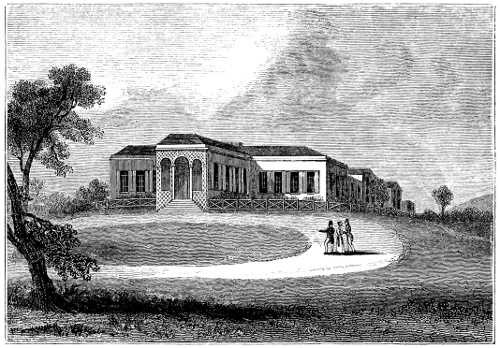
RESIDENCE OF NAPOLEON AT LONGWOOD. London: Published for Henry Colburn, Feb. 1836.
The Grand Marshal, with his wife and children, had been left at the distance of two miles behind us, in a place denominated Hut’s-Gate. General Gourgaud slept under a tent, as did also the Doctor,[27] and the officer commanding our guard, till such time as their apartments should be ready, which the crew of the Northumberland were rapidly preparing.
We were surrounded by a kind of garden; but, owing to the little attention which we had it in our power to bestow on its cultivation, joined to the want of water and the nature of the climate, it was a garden only in name. In front, and separated from us by a tolerably deep ravine, was encamped the fifty-third regiment, different parties of which were posted on the neighbouring heights.—Such was our new abode.
On the 12th, Colonel Wilks (formerly Governor for the East India Company), who had been succeeded by the Admiral, came to visit the Emperor. I acted as interpreter on the occasion. On the 13th or 14th the Minden sailed for Europe, and I availed myself of the opportunity thus afforded to send letters to London and Paris.
ARRANGEMENT OF THE EMPEROR’S ESTABLISHMENT.—FEELINGS OF THE CAPTIVES WITH RESPECT TO EACH OTHER.—TRAITS OF THE EMPEROR’S CHARACTER.—PORTRAIT OF NAPOLEON BY M. DE PRADT, TRANSLATED FROM AN ENGLISH NEWSPAPER.—ITS REFUTATION.
15th—16th. The domestic establishment of the Emperor, on his departure from Plymouth, consisted of twelve persons. I feel pleasure in recording their names 266here: it is a testimony due to their attachment.[28] However numerous this establishment may appear, it may be truly said that after our departure from England, during the voyage, and from the time of our landing at St. Helena, it had ceased to be serviceable to the Emperor. Our dispersion, the uncertainty of our establishment, our wants, and the irregular way in which they were supplied, necessarily created disorder.
As soon as we were all assembled at Longwood, the Emperor determined to arrange his establishment, and to assign to each of us an employment suited to our respective capacities. Reserving to the Grand Marshal the general control and superintendence of the whole household; he consigned to M. de Montholon all the domestic details. To M. Gourgaud he intrusted the direction of the stables: and I was appointed to take care of the property and furniture, and to superintend the management of our supplies. The latter part of my duty appeared to interfere too much with the regulation of domestic details. I conceived that it would be conducive to the general advantage, if these two departments were under the control of one individual, and I soon succeeded in accomplishing this object.
Every thing now proceeded tolerably well, and we were certainly more comfortable than before. But, however reasonable might be the regulations made by the 267Emperor, they, nevertheless, sowed the seeds of discontent, which took root, and occasionally developed themselves. One thought himself a loser by the change; another sought to attach too high an importance to his office; and a third conceived that he had been wronged in the general division of duties. We were no longer the members of one family, each exerting his best endeavours to secure the advantage of the whole. We were far from putting into practice that which necessity seemed to dictate to us; and a wreck of luxury, or a remnant of ambition, frequently became an object of dispute.
Though attachment to the person of the Emperor had united us around him, yet chance, and not sympathy, had brought us together. Our connexion was purely fortuitous, and not the result of any natural affinity. Thus, at Longwood, we were encircled round a centre, but without any cohesion with each other. How could it be otherwise? We were almost all strangers to one another, and, unfortunately, our different conditions, ages, and characters, were calculated to make us continue so.
These circumstances, though in themselves trifling, had the vexatious effect of depriving us of our most agreeable resources. They banished that confidence, that interchange of sentiment, and that intimate union, which are calculated to soothe even the most cruel misfortunes. But, on the other hand, these very circumstances served to develope many excellent traits in the Emperor’s character. They were apparent in his endeavours to produce among us unity and conformity of sentiment; his constant care to remove every just cause of jealousy; the voluntary abstraction by which he averted his attention from that which he wished not to observe; and finally, the paternal expressions of displeasure, of which we were occasionally the objects, and which (to the honour of all be it said) were avoided as cautiously, and received as respectfully, as though they had emanated from the throne of the Tuileries.
Who in the world can now pretend to know the Emperor 268in his character of a private man better than myself?—Who else was with him during two months of solitude in the desert of Briars?—Who else accompanied him in his long walks by moonlight, and enjoyed so many hours in his society? Who, like me, had the opportunity of choosing the moment, the place, and the subject of his conversation? Who, besides myself, heard him call to mind the charms of his boyhood, or describe the pleasures of his youth, and the bitterness of his recent sorrow? I am convinced that I know his character thoroughly, and that I can now explain many circumstances which, at the time of their occurrence, seemed to many difficult to be understood. I can now very well comprehend that which struck us so forcibly, and which particularly characterized him in the days of his power; namely, that no individual ever permanently incurred the displeasure of Napoleon: however marked might be his disgrace, however deep the gulf into which he was plunged, he might still confidently hope to be restored to favour. Those who had once enjoyed intimacy, whatever cause of offence they might give him, never totally forfeited his regard. The Emperor is eminently gifted with two excellent qualities;—a vast fund of justice, and a disposition naturally prone to attachment. Amidst all his vexations and fits of anger, a sentiment of justice still predominates. He is sure to turn an attentive ear to sound arguments, and, if left to himself, candidly brings them forward whenever they occur to his mind. He never forgets services performed for him, nor habits he has contracted. Sooner or later he invariably casts a thought on those who may have incurred his displeasure; he reflects on what they have suffered, considers their punishment as sufficient, recals them, when they are perhaps forgotten by the world; and they again enjoy his good graces, to the astonishment of themselves as well as of others. Of this there have been many instances. The Emperor is sincere in his attachments, without making a show of what he feels. When once he becomes used to a person, he cannot easily bear separation. He observes and condemns his faults, blames his own choice, expressing his displeasure in the most 269unreserved way; but still there is nothing to fear: these are but so many new ties of regard.
It will probably be a matter of surprise that I should sketch the Emperor’s character in so simple a style. All that is usually written about him is so far fetched: it has been thought necessary to employ antitheses and brilliant colouring; to seek for effect, and to rack the imagination for high-flown phrases. For my own part, I merely describe what I see, and express what I feel. This reflection, by the by, comes à propos.
The Emperor was to-day reading with me, in the English papers, a portrait of himself, drawn by the Archbishop of Malines, and worked up with innumerable witticisms, affected antitheses and contrasts. He desired the Grand Marshal to transcribe it word for word. TheThe following are the principal points: “The mind of Napoleon,” says the Abbé de Pradt, in his Embassy to Warsaw, in 1812, “was vast; but after the manner of the Orientals: and through a contradictory disposition, it descended as it were, by the effect of its own weight, to details which might justly be called low. His first idea was always grand, and his second mean and petty. His mind was like his purse; munificence and meanness held each a string. His genius, which was at once adapted to the stage of the world, and the mountebank’s show, resembled a royal robe joined to a harlequin’s jacket. He was the man of extremes; one, who having commanded the Alps to bow down, the Simplon to smooth its ruggedness, and the sea to advance or recede from its shores, ended by surrendering himself to an English cruiser. Endowed with wonderful and infinite shrewdness; glittering with wit; seizing or creating, in every question, new and unperceived relations; abounding in lively and picturesque images, animated and pointed expressions, the more forcible from the very incorrectness of his language, which always bore a sort of foreign impress; sophistical, subtle, and changeable, to excess, he adopted different rules of optics from those by which other men are guided. Add to this the delirium of success, the habit of drinking from the enchanted cup, and intoxicating himself with the incense of the world: and 270you may form an idea of the man who, uniting in his caprices all that is lofty and mean in the human character, majestic in the splendour of sovereignty, and peremptory in command, with all that is ignoble and base, even in his grandest achievements, joining the treacherous ambush to the subversion of thrones—presents altogether such a Jupiter-Scapin, as never before figured on the scene of life.”
Certainly here is abundance of wit, and of the most studied kind. I pass over the indecorous and disgraceful fact that a reverend prelate, an Archbishop loaded with the bounty of his sovereign, to whom, during his prosperity, he paid the most assiduous court, and offered the most abject flattery, should, in the adversity of that sovereign, indulge in language so trivial, grotesque, and insulting, as that above quoted. Without noticing the harlequin’s coat, and Jupiter-Scapin, I shall merely dwell on the merit of the Abbé de Pradt’s judgment, when he says that “the Emperor’s first idea is always grand, and his second petty; that he is the man of extremes: one who having commanded the Alps to bow down, the Simplon to smooth its ruggedness, and the sea to advance and recede from its shores, ended by surrendering himself to an English cruiser.” The Abbé de Pradt must have formed but a faint idea of the sublimity, grandeur, and magnanimity of that noble act. To withdraw himself from a people who were misled by faithless intriguers, in order to remove every obstacle to their welfare: to sacrifice his own personal interests, for the sake of averting the evils of a civil war without national results: to disdain honourable and secure, but dependent, asylums: to prefer taking refuge among a people to whom he had, for the space of twenty years, been an inveterate foe: to suppose their magnanimity equal to his own: to honour their laws so far as to believe that they would protect him from the ostracism of Europe:—certainly such ideas and sentiments are not the reverse of sublime, noble, and great.
At this part of my journal were inserted several pages, full of details very discreditable to the Archbishop of Malines, which were received from the Emperor’s own 271mouth, or collected from the different individuals about him. I however strike them out, in consideration of the satisfaction which I was informed the Emperor subsequently experienced in perusing M. de Pradt’s Concordats. For my own part, I am perfectly satisfied with numerous other testimonies of the same nature, and derived from the same source. An honourable and voluntary acknowledgment is a thousand times better than all the retorts that can be heaped upon an offender. There are persons to whom atonement is not without its due weight; I am one of these.
Just as I had written the above, I happened to read some lines from the pen of the Abbé de Pradt, which are certainly very fine with respect to diction; but which are still finer on account of their justice and truth. I cannot refrain from transcribing them here; as they make ample amends for those already quoted. A declaration of the Allied Sovereigns at Laybach, in which Napoleon was, in terms of reprobation, pronounced to be the representative of the Revolution, called forth the following observations from the Archbishop of Malines:—
“It is too late to insult Napoleon, now that he is defenceless, after having for so many years crouched at his feet, while he had the power to punish.... Those who are armed should respect a disarmed enemy, and the glory of the conqueror depends in a great measure on the consideration shewn towards the captive, particularly when he yields to superior force, not to superior genius. It is too late to call Napoleon a revolutionist, after having for such a length of time pronounced him to be the restorer of order in France, and, through France, in Europe. It is too late for those to aim the shaft of insult at him who once stretched forth their hands to him as a friend, pledged their faith to him as an ally, and sought to prop a tottering throne by mingling their blood with his.” Farther on he says: “He the representative of the revolution! The revolution broke the bonds of union between France and Rome: he renewed them. The revolution overthrew the temples of the Almighty: he restored them. The revolution 272created two classes of clergy hostile to each other: he reconciled them. The revolution profaned St. Denis: he purified it, and offered expiation to the ashes of Kings. The revolution subverted the throne: he raised it up, and gave it a new lustre. The revolution banished from their country the nobility of France: he opened to them the gates of France and of his palace, though he knew them to be his irreconcileable enemies, and for the most part the enemies of the public institutions; he reincorporated them with the society from which they had been separated. This representative of a revolution, which is distinguished by the epithet anti-social, brought from Rome the head of the Catholic Church, to anoint his brow with the oil that consecrates diadems! This representative of a revolution, which has been declared hostile to sovereignty, filled Germany with kings, advanced the rank of princes, restored superior royalty, and re-constructed a defaced model. This representative of a revolution which is condemned as a principle of anarchy, like another Justinian, drew up, amidst the din of war and the snares of foreign policy, those codes which are the least defective portion of human legislature, and constructed the most vigorous machine of government in the whole world. This representative of a revolution, which is vulgarly accused of having subverted all institutions, restored universities and public schools, filled his empire with the masterpieces of art, and accomplished those amazing and stupendous works which reflect honour on human genius: and yet, in the face of the Alps, which bowed down at his command; of the ocean, subdued at Cherbourg, at Flushing, at the Helder, and at Antwerp; of rivers, smoothly flowing beneath the bridges of Jena, Serres, Bourdeaux, and Turin; of canals, uniting seas together in a course beyond the control of Neptune; finally, in the face of Paris, metamorphosed as it is by Napoleon,—he is pronounced to be the agent of general destruction! He who restored all, is said to be the representative of that which destroyed all! To what undiscerning men is this language supposed to be addressed? &c.”
273
MY SITUATION MATERIALLY IMPROVED.—MY BED-CHAMBER CHANGED, &C.
17th.—The Emperor summoned me at two o’clock, when he began to dress. On entering, he observed that I looked pale: I replied that it might be owing to the atmosphere of my chamber, which, from its proximity to the kitchen, was an absolute oven, being frequently filled with smoke. He then expressed a wish that I should constantly occupy the topographic cabinet, in which I might write during the day, and sleep at night, in a bed which the Admiral had fitted up for the Emperor himself, but which he did not make use of as he preferred his own camp-bed. When he had finished dressing, and was choosing between two or three snuff-boxes, which lay before him, he abruptly gave one to his valet-de-chambre (Marchand): “Put that by,” said he, “it is always meeting my eye, and it pains me.” I know not what was on this snuff-box; but I imagine it was a portrait of the King of Rome.
The Emperor left his apartment, and I followed him; he went over the house, and entered my chamber. Seeing a dressing-glass, he inquired whether it was the one that he had given me. Then putting his hand to the wall, which was heated by the kitchen, he again observed that I could not possibly remain in that room, and absolutely insisted on my occupying his bed in the topographic cabinet: adding, in a tone of captivating kindness, that it was “the bed of a friend.” We walked out, and proceeded towards a wretched farm which was within sight. On our way we saw the barracks of the Chinese. These Chinese are labouring men, who enlist on board English ships at Macao, and who continue at St. Helena in the service of the East India Company for a certain number of years, when they return to their homes, after collecting a little store of money, as the people of Auvergne do in France. The Emperor wished to ask them some questions: but we could not make ourselves understood by them. We next visited what is called Longwood Farm, The Emperor was seduced by the name; he expected to find one of the delightful 274farms of Flanders or England; but this was merely on a level with our lowest metairies. We afterwards went down to the Company’s garden, which is formed in the hollow where the two opposite ravines meet. The Emperor called the gardener, and the man who attends to the Company’s cattle and superintends the Chinese, of whom he asked many questions. He returned home very much fatigued, though we had scarcely walked a mile: this was his first excursion.
Before dinner the Emperor summoned me and my son to our accustomed task. He said that I had been idle, and called my attention to my son, who was laughing behind my back. He asked why he laughed; and I replied that it was probably because his Majesty was taking revenge for him. “Ah!” said he, smiling, “I see I am acting the part of the grandfather here.”
HABITS AND HOURS OF THE EMPEROR.—HIS STYLE TO THE TWO EMPRESSES.—DETAILS.—THE EMPEROR’S MAXIMS ON THE SUBJECT OF THE POLICE.—SECRET POLICE FOR THE EXAMINATION OF LETTERS.—CURIOUS PARTICULARS.—THE EMPEROR FAVOURABLE TO A FIXED AND MODERATE SYSTEM OF GOVERNMENT.
18th—19th. By degrees our hours and habits began to be fixed and regular. About ten o’clock the Emperor breakfasted in his own chamber, and one of us occasionally attended him. At the table of the household we breakfasted at nearly the same hour. The Emperor granted us permission to do the honours of this table as we pleased, and to invite to it whomsoever we might think fit.
No hours were yet fixed for the Emperor’s walks. The heat was very great during the day, and the damp came on speedily and profusely towards evening. We were informed, some time before, that coach and saddle horses were coming from the Cape; but they never arrived. During the day the Emperor was engaged in dictating to the different persons of his suite; and he usually reserved me for the interval preceding dinner, which was not served until eight or nine o’clock. He required my attendance about five or six o'clock, together with my 275son. I could neither write nor read, owing to the state of my eyes; but my son was enabled to supply my place. He wrote to the Emperor’s dictation, and I was present only to help him afterwards to correct his hasty scrawl; for, by dint of habit, I could repeat, almost literally and entirely, all that had fallen from the Emperor.
The Campaign of Italy being now finished, we began to revise it, and the Emperor corrected, and dictated anew. We dined, as I have before observed, between eight and nine o’clock. The table was laid out in the room nearest to the entrance of the house. Madame de Montholon sat on the right of the Emperor; I on his left; and Messrs. de Montholon, Gourgaud, and my son, sat in the opposite places. The room still smelled of paint, particularly when the weather was damp; and though not very offensive, it was sufficiently annoying to the Emperor: we, therefore, sat no longer than ten minutes at table. The dessert was prepared in the adjoining apartment, which was the drawing-room, and we again seated ourselves round the table. Coffee was then served up, and conversation commenced. We read a few scenes from Moliere, Racine, and Voltaire, and always regretted not having a copy of Corneille. We then played at reversis, which had been the Emperor’s favourite game in his youth. The recollection was pleasing to him, and he at first thought that he could amuse himself for a length of time at it; but he was soon undeceived. We played at the game and all its varieties; which made it so complex that I have seen from fifteen to eighteen thousand counters in use at once. The Emperor’s aim was always to make the reversis; that is to say, to make every trick, which is no easy matter. However, he frequently succeeded:—character developes itself every where and in every thing. We retired about ten or eleven o’clock.
To-day, the 19th, when I paid my respects to the Emperor, he shewed me a libel upon himself which had fallen into his hands, and asked me to translate it. Amidst a mass of other nonsense, some private letters were mentioned, which were said to have been addressed 276by Napoleon to the Empress Josephine, under the solemn form of Madame et chère Epouse. Allusion was next made to a combination of spies and agents, by whose aid the Emperor knew the private affairs of every family in France, and penetrated the secrets of all the cabinets in Europe. The Emperor wished to proceed no farther, and made me lay aside the book, saying,—“It is too absurd.” The fact is that, in his private correspondence, Napoleon always addressed the Empress Josephine very unfashionably by the pronoun “thou” (tu); and “my good little Louisa” (ma bonne petite Louise) was the form by which he addressed Maria Louisa.
The first time I ever saw the Emperor’s running-hand was at Saint-Cloud, after the battle of Friedland, when the Empress Josephine amused herself by making us try to decipher a note which she held in her hand, and which seemed to be written in hieroglyphics. It was to the following effect:—“My sons have once more shed a lustre over my career: the victory of Friedland will be inscribed in history, beside those of Marengo, Austerlitz, and Jena. You will cause the cannon to be fired; Cambaceres will publish the bulletin.”
I was again favoured with the sight of a note in the Emperor’s hand-writing, at the time of the treaty of Tilsit. It contained the following:—“The Queen of Prussia is really a charming woman. She is fond of coquetting with me; but do not be jealous: I am like a cerecloth, along which every thing of this sort slides, without penetrating. It would cost me too dear to play the gallant.”
On this subject, an anecdote was related in the saloon of Josephine. It was said that the Queen of Prussia one day had a beautiful rose in her hand, which the Emperor asked her to give to him. The Queen hesitated for a few moments, and then presented it to him, saying: “Why should I so readily grant what you request, while you remain deaf to all my entreaties?” She alluded to the fortress of Magdeburg, which she had earnestly solicited him to give up. Such was the nature of the intimacy, and such the conversations, that were so unblushingly 277misrepresented in English works of a certain degree of merit, where the Emperor was described as an insolent and brutal tyrant, seeking, with the aid of his ferocious Mamelukes, to violate the honour of the lovely Queen, before the very face of her unfortunate husband.
As to the grand machinery of spies and police, which has been so much talked of, what state on the Continent could boast of having less of such evils than France; and yet what country stood more in need of them? What circumstances more imperatively called for them? Every pamphlet published in Europe was directed against France, with a view of rendering odious in another country that which it was thought advisable to conceal at home. Still, however, these measures, so necessary in principle, though doubtless hateful in their details, were looked at merely in a general way by the Emperor, and always with a strict observance of his constant maxim, that nothing should be done that is not absolutely indispensable. In the Council of State, I have frequently heard him make enquiries into these subjects; investigate them with peculiar solicitude; correct abuses and seek to obviate evils, and appoint committees of his Council to visit the prisons, and make reports to him. Having been myself employed in a mission of this nature, I had an opportunity of observing the misconduct and abuses of subaltern agents; and, at the same time, of knowing the ardent wishes of the sovereign to repress them.
The Emperor found that this branch of the administration in a certain degree clashed with established prejudices and opinions; and he therefore wished to elevate it in the eyes of the people, by placing it under the control of a man whose character was beyond the reach of censure. In the year 1810, he summoned the Councillor of State, Baron ——, to Fontainebleau. The Baron had been an emigrant, or what nearly amounted to the same thing. His family, his early education, his former opinions,—all were calculated to render him an object of suspicion to one more distrustful than Napoleon. In the course of conversation, the Emperor said:—“If the Count de Lille were now to discover himself in Paris, 278and you were intrusted with the superintendence of the police, would you arrest him?”—“Yes, certainly,” answered the Councillor of State, “because he would thereby have broken his ban, and because his appearance would be in opposition to every existing law.”—“If you were one of a committee appointed to try him, would you condemn him?”—“Yes, doubtless; for the laws which I have sworn to obey would require that I should condemn him.”—“Very well!” said the Emperor, “return to Paris: I make you my prefect of police.”
With regard to the inspection of letters under the government of Napoleon, whatever may have been publicly said on that subject, the Emperor declared that certainly very few letters were read at the post-offices. Those which were delivered either open or re-sealed, to private persons, had, for the most part, not been read: to read all would have been an endless task. The system of examining letters was adopted with the view of preventing, rather than discovering, dangerous correspondence. The letters that were really read exhibited no trace of having been opened, so effectual were the precautions employed. “Ever since the reign of Louis XIV.,” said the Emperor, “there had existed an office of political police for discovering foreign correspondence: and from that period the same families had managed the business of the office, though the individuals and their functions were alike unknown. It was in all respects an official post. The persons superintending this department were educated at great expense in the different capitals of Europe. They had their own peculiar notions of propriety, and always manifested reluctance to examine the home correspondence: it was, however, also under their control. As soon as the name of any individual was entered upon the lists of this important department, his arms and seals were immediately engraved at the office; and thus his letters, after having been read, were closed up and delivered without any mark of suspicion. These circumstances, joined to the serious evils which they might create, and the important results which they were capable of producing, constituted the vast responsibility of the office of postmaster-general, and required that it should 279be filled by a man of prudence, judgment, and intelligence.” The Emperor bestowed great praise on M. de Lavalette, for the way in which he had discharged his duties.
The Emperor was by no means favourable to the system of inspecting correspondence. With regard to the diplomatic information thereby obtained, he did not consider it of sufficient value to counterbalance the expenses incurred; for the establishment cost 600,000 francs. As to the examination of the letters of citizens, he regarded that as a measure calculated to do more harm than good. “It is rarely,” said he, “that conspiracy is carried on through such channels; and with respect to the individual opinions obtained from epistolary correspondence, they may be more dangerous than useful to a sovereign, particularly among such a people as the French. Of whom will not our national volatility and fickleness lead us to complain? The man whom I may have offended at my levee will write to-day that I am a tyrant, though but yesterday he overwhelmed me with praises, and perhaps to-morrow will be ready to lay down his life to serve me. The violation of the privacy of correspondence may, therefore, cause a prince to lose his best friends, by wrongfully inspiring him with distrust and prejudice towards all; particularly as enemies capable of mischief are always sufficiently artful to avoid exposing themselves to that kind of danger. Some of my ministers were so cautious, in this respect, that I could never succeed in detecting one of their letters.”
I think I have already mentioned that, on the Emperor’s return from Elba, there were found in M. De Blacas’ apartments in the Tuileries, numerous petitions and letters, in which Napoleon was spoken of most indecorously. He caused them to be burnt. “They would have formed a most odious collection,” said the Emperor. “For a moment I entertained the idea of inserting some of them in the Moniteur. They would have disgraced certain individuals; but they would have afforded no new lesson on the human heart: men are always the same!”
The Emperor was far from knowing all the measures taken by the police in his name, with respect to writings 280and individuals; he had neither time nor opportunity to enquire into them. He now daily learns from us, or from pamphlets that happen to fall in his way, the arrests of individuals, or the suppression of works, of which he had never before heard.
In alluding to the works that had been suppressed by the police during his reign, the Emperor observed that, having plenty of leisure-time during his residence at Elba, he amused himself with glancing over some of these works, and that he was frequently unable to conceive the motives which had induced the police to suppress them.
He then proceeded to converse on the subject of the liberty and restriction of the press. This, he said, was an interminable question, and admitted of no medium. The grand difficulty, he observed, did not lie in the principle itself, but in the treatment of the accused party, or the circumstances under which it might be necessary to apply the principle taken in an abstract sense. The Emperor would have been favourable to unlimited liberty. In all our conversations at St. Helena, he constantly treated every great question in the same point of view and with the same arguments. Thus Napoleon truly was, and must remain in the eyes of posterity, the type, the standard, and the prince of liberal opinions; they belonged to his heart, to his principles, and to his mind. If his actions sometimes seemed to be at variance with these ideas, it was when he was imperatively swayed by circumstances. This is proved by the following fact, to which I now attach more importance than I did when it first came to my knowledge.
In one of the evening-parties at the Tuileries, Napoleon, conversing aside with three or four individuals of the Court, who were grouped around him, closed a discussion on a great political question with the following remarkable words:—“For my part, I am fundamentally and naturally favourable to a fixed and moderate government.” And, observing that the countenance of one of the interlocutors expressed surprise, “You don’t believe me!” continued he; “why not? Is it because my deeds do not seem to accord with my words? My dear sir, 281how little you know of men and things! Is the necessity of the moment nothing in your eyes? Were I to slacken the reins only for a moment, we should have fine disorder; neither you nor I would probably sleep another night at the Tuileries.”
THE EMPEROR’S FIRST RIDE ON HORSEBACK.—SEVERITY OF THE MINISTERIAL INSTRUCTIONS.—OUR VEXATIONS AND COMPLAINTS.—THE EMPEROR’S REMARKS.—RUDE REPLIES.
20th-23rd. The Emperor mounted his horse after breakfast. We directed our course towards the farm: we found the farmer in the Company’s garden, and he attended us over the whole of the grounds.grounds. The Emperor asked him a number of questions respecting his farm, as he used to do during his hunting-excursions in the neighbourhood of Versailles, where he discussed with the farmers the opinions of the Council of State, in order to bring forward to the Council in their turn the objections of the farmers. We advanced through the grounds of Longwood, in a line parallel with the valley, until, finding no farther road for the horses, we were compelled to turn back. We then crossed the little valley, gained the height where the troops were encamped, advanced to the Alarm Hill, and passing over its summit, we arrived beyond the camp, near the Alarm House, on the road leading from Longwood to Madame Bertrand’s residence. The Emperor at first proposed calling on her; but, when about half-way thither, he changed his mind, and we returned to Longwood.
The instructions of the English Ministers, with regard to the Emperor at St. Helena, were dictated in that disgraceful spirit of harshness which in Europe had urged the solemn violation of the law of nations. An English officer was to be constantly at the Emperor’s table; this cruel measure was of course calculated to deprive us of the comforts of familiar intercourse. The order was not carried into effect, only because the Emperor, had it been enforced, would have taken his meals in his own chamber. I have very good reason to believe that he regretted not having done so on board the Northumberland. 282An English officer was to accompany the Emperor in his rides on horseback: this was a severe annoyance, which rendered it impossible that his mind could for a moment be diverted from his unfortunate situation. This order was not, however, enforced within certain limits, which were prescribed to us, because the Emperor had declared that he would not ride on horseback at all on such conditions.
In our melancholy situation, every day brought with it some new cause of uneasiness; we were constantly suffering some new sting, which seemed the more cruel as we were destined to endure it for a long time to come. Lacerated as our feelings undoubtedly were, each fresh wound was sensibly felt; and the motives that were assigned for our vexations frequently assumed the appearance of irony. Thus sentinels were posted beneath the Emperor’s windows, and before our doors; and this we were informed was for our safety. We were impeded in our communications with the inhabitants of the island; we were put under a kind of close confinement; and were told that this was done to free the Emperor from all annoyance. The pass-words and orders were incessantly changed; we lived in the continual perplexity and apprehension of being exposed to some unforeseen insult. The Emperor, whose feelings were keenly alive to all these things, resolved to write to the Admiral, through the medium of M. de Montholon. He spoke with warmth, and made some observations worthy of remark. “Let not the Admiral suppose,” said he, “that I shall treat with him on any of these subjects. Were he to present himself to me to-morrow, in spite of my just resentment, he would find my countenance as serene, and my temper as composed, as usual. This would not be the effect of dissimulation on my part, but merely the fruit of experience. I recollect that Lord Whitworth once filled Europe with the report of a long conversation that he had had with me, scarcely a word of which was true. But that was my fault; and it taught me to be more cautious in future. The Emperor has governed too long not to know that he must not commit himself to the discretion of any one who may 283have it in his power to say falsely: The Emperor told me so and so; while the Emperor may not have the means of either affirming or contradicting the statement.
“One witness is as good as another. It is, therefore, necessary to employ some one who may be enabled to tell the narrator that, in attributing such and such words to the Emperor, he lies, and that he is ready to give him satisfaction for this expression, which the Emperor himself cannot do.”
M. de Montholon’s letter was couched in sharp terms; the reply was insulting and coarse: “No such thing as an Emperor was known at St. Helena; the justice and moderation of the English government towards us would be the admiration of future ages, &c.” Dr. O’Meara was instructed to accompany this written reply with verbal additions of the most offensive nature: to enquire, for example, whether the Emperor wished that the Admiral should send him sundry atrocious libels and anonymous letters which had been received, addressed to him, &c.
I was engaged with the Emperor at the time this answer was communicated to him. I could not conceal my astonishment and indignation at certain expressions that were employed. But we could only let philosophy take place of resentment: it was sufficient to reflect that all satisfaction was beyond our reach. To address a direct complaint to the Prince Regent would perhaps have been to furnish a gratification to that prince; as well as a recommendation to him who had offended us. Besides, the Emperor could not address complaints to any individual on earth: he could appeal only to the tribunals of Heaven, nations, and posterity.
On the 23rd the Doris frigate arrived from the Cape, bringing seven horses that had been purchased there for the Emperor.
THE EMPEROR’S DISDAIN OF POPULARITY; HIS REASONS, ARGUMENTS, &C.—CONVERSATION RESPECTING MY WIFE.—ON GENERAL GOURGAUD’S MOTHER AND SISTER.
24th.—The Emperor had been reading some publication in which he was made to speak in too amiable a 284strain; and he could not help exclaiming against the mistake of the writer. “How could they put these words into my mouth?” said he. “This is too tender, too sentimental, for me: every one knows that I do not express myself in that way.” “Sire,” I replied, “it was done with a good intention; the thing is innocent in itself, and may have produced a good effect. That reputation for amiableness, which you seem to despise, might have exercised great influence over public opinion; it might at least have counteracted the effect of the colouring in which a certain European system has falsely exhibited your Majesty to the world. Your heart, with which I am now acquainted, is certainly as good as that of Henri IV., which I did not know. Now, his amiableness of character is still proverbial: he is still held up as an idol; yet I suspect Henri IV. was a bit of a quack. And why should your Majesty have disdained to be so? You have too great an aversion to that system. After all, quackery rules the world; and it is fortunate when it happens to be only innocent.”
The Emperor laughed at what he termed my prosing. “What,” said he, ”is the advantage of popularity and amiableness of character? Who possessed those qualities in a more eminent degree than the unfortunate Louis XVI.? Yet what was his fate? His life was sacrificed!—No! a sovereign must serve his people with dignity, and not make it his chief study to please them. The best mode of winning their love is to secure their welfare. Nothing is more dangerous than for a sovereign to flatter his subjects: if they do not afterwards obtain every thing they want they become irritated, and fancy that promises have been broken; and if they are then resisted, their hatred increases in proportion as they consider themselves deceived. A sovereign’s first duty is doubtless to conform with the wishes of the people; but what the people say is scarcely ever what they wish: their desires and their wants cannot be learned from their own mouths so well as they are to be read in the heart of their prince.
“Each“Each system may, no doubt, be maintained: that of mildness as well as that of severity. Each has 285its advantages and its disadvantages; for every thing is mutually balanced in this world. If you ask me what was the use of my severe forms and expressions, I shall answer, to spare me the pain of inflicting the punishment I threatened. What harm have I done after all? What blood have I shed? Who can boast that, had he been placed in my situation, he could have done better? What period of history, exhibiting any thing like the difficulties with which I was surrounded, presents such harmless results? What am I reproached with? My government archives and my private papers were seized; yet what has there been found to publish to the world? All sovereigns, situated as I was, amidst factions, disorders, and conspiracies, are surrounded by murders and executions! Yet, during my reign, what sudden tranquillity pervaded France!—You are, no doubt, astonished at this chain of reflection,” continued he, smiling, “you, who frequently display the mildness and simplicity of a child.”
I could not but admit the force of his arguments, and now, in my turn, maintained that both systems might have their peculiar advantages. “Every individual,” said I, “should form a character for himself by means of education; but he should be careful, at the same time, to lay its foundation on the character he has received from Nature; otherwise he runs a risk of losing the advantages of the latter, without obtaining those of the character which he wishes to acquire; and his education may prove an instrument to mislead him. After all, the course of a man’s life is the true result of his character, and the proper test by which it should be judged. Of what, then, can I have to complain? From the lowest degree of misery, I raised myself, by my own efforts, to tolerable independence; and from the streets of London, I penetrated to the steps of your throne, and to the benches of your Council-chamber; all this, too, without having cause to blush in the presence of any individual for any thing that I have ever spoken, written, or done. Have I not then also performed my little wonders in my own little way? What could I have done better had another turn been given to my character?”
286The conversation was here interrupted by some one entering, to announce that the Admiral and some ladies, who had arrived by the Doris, solicited the favour of being presented to the Emperor; but he answered drily, that he would see no one, and that he did not wish to be disturbed.
Under our present circumstances, the personal politeness of the Admiral was felt only as an additional insult: and with regard to those who accompanied him, as no one could approach us but with the Admiral’s permission, the Emperor did not choose that the honours of his person should be thus performed. If it were intended that he should remain in close confinement, he ought to be told so; but, if not, he should be allowed to see whom he pleased without the interference of any person. Above all, it was not fair that they should pretend in Europe to surround him with every sort of attention and respect, while, on the contrary, they were annoying him with every kind of indecorum and caprice.
The Emperor walked out in the garden at five o’clock. The Colonel of the 53rd regiment waited on him there, and begged permission to present to him, next day, the officers of his regiment. The Emperor granted his request, and appointed three o’clock as the hour to receive them. The Colonel took his leave, and we prolonged our walk. The Emperor stopped awhile to look at a flower in one of the beds, and asked me whether it was not a lily. It was indeed a magnificent one.
After dinner, while we were playing our usual game of reversis, of which, by the by, the Emperor began to grow weary, he suddenly turned to me and said, “Where do you suppose Madame Las Cases is at this moment?”—“Alas, Sire,” I replied, “Heaven knows!”—“She is in Paris,” continued he; “to-day is Tuesday; it is nine o’clock; she is now at the Opera.”—“No, Sire, she is too good a wife to go to the theatre while I am here.”—“Spoken like a true husband,” said the Emperor, laughing, “ever confident and credulous!” Then turning to General Gourgaud, he rallied him in the same style with respect to his mother and sister. Gourgaud seemed very much downcast, and his eyes were 287suffused with tears, which the Emperor perceiving, cast a side-glance towards him, and said, in the most interesting manner, “How wicked, barbarous and tyrannical I must be thus to trifle with feelings so tender!”[29]
The Emperor then asked me how many children I had, and when and how I had become acquainted with Madame Las Cases. I replied that my wife had been the first acquaintance of my life; that our marriage was a tie which we had ourselves formed in early youth, yet that it had required the occurrence of the greater part of the events of the Revolution to bring about its accomplishment.
THE EMPEROR FREQUENTLY WOUNDED IN HIS CAMPAIGNS.—COSSACKS.—JERUSALEM DELIVERED.
25th.—The Emperor, who had not been well the preceding evening, was still indisposed this morning, and sent word that it would be impossible for him to receive the officers of the 53rd, as he had appointed. He sent for me about the middle of the day, and we again perused some chapters of the Campaign of Italy. I compared that which treats of the battle of Arcole to a book of the Iliad.
Some time before the dinner-hour, he assembled us all around him in his chamber. A servant entered to announce that dinner was ready; he sent us away, but, as I was going out last, he called me back. “Stay here,” said he, “we will dine together. Let the young people go; we old folks will keep one another company.” He then determined to dress, intending, as he said, to go into the drawing-room after dinner.
While he was dressing, he put his hand on his left 288thigh, where there was a deep scar. He called my attention to it by laying his finger in it; and, finding that I did not understand what it was, he told me that it was the mark of a bayonet wound by which he had nearly lost his limb, at the siege of Toulon. Marchand, who was dressing him, here took the liberty of remarking that the circumstance was well known on board the Northumberland; that one of the crew had told him, on going on board, that it was an Englishman who first wounded our Emperor.
The Emperor, on this, observed that people had in general wondered and talked a great deal of the singular good fortune which had preserved him, as it were, invulnerable in so many battles. “They were mistaken,” added he; “the only reason was that I always made a secret of all my dangers.” He then related that he had had three horses killed under him at the siege of Toulon; several others killed and wounded in his campaigns of Italy; and three or four at the siege of St. Jean-d’Acre. He added that he had been wounded several times; that, at the battle of Ratisbon, a ball had struck his heel; and at the battle of Esling, or Wagram, I cannot say which, another had torn his boot and stocking, and grazed the skin of his left leg. In 1814, he lost a horse and his hat at Arcis-sur-Aube, or in its neighbourhood. After the battle of Brienne, as he was returning to head-quarters in the evening, in a melancholy and pensive mood, he was suddenly attacked by some Cossacks, who had passed over into the rear of the army. He thrust one of them off with his hand, and was obliged to draw his sword in his own defence; several of the Cossacks were killed at his side. “But what renders this circumstance very extraordinary,” said he, “is, that it took place near a tree which at that moment caught my eye, and which I recognized as the very one under which, when I was but twelve years old, I used to sit during play-hours and read Jerusalem Delivered.” ... Doubtless on that spot Napoleon had been first fired by the love of glory!
The Emperor repeated that he had been very frequently exposed to danger in his different battles, but it was carefully kept secret. He had enjoined once 289for all, the most absolute silence on all circumstances of that nature. He said that it would be impossible to calculate the confusion and disorder which might have resulted from the slightest report or the smallest doubt relative to his existence. On his life depended the fate of a great Empire, and the whole policy and destinies of Europe. He added that this habit of keeping circumstances of that kind secret had prevented him from relating them in his campaigns; and indeed he had now almost forgotten them. It was only, he said, by mere accident, and in the course of conversation, that they could recur to him.
MY CONVERSATION WITH AN ENGLISHMAN.
26th.—The Emperor continued indisposed.
One of the English gentlemen, whose wife had yesterday been refused admittance, in company with the Admiral, paid me a visit this morning, with the view of making another and a final attempt to get presented to Napoleon. This gentleman spoke French very well, having resided in France during the whole of the war. He was one of those individuals who were known at the time by the title of detenus: who, having visited France as travellers, were arrested there by the First Consul, on the rupture of the treaty of Amiens, by way of reprisal for the seizure of our merchant-ships by the English Government, according to its custom, before the declaration of war. This event gave rise to a long and animated discussion between the two Governments; and even prevented, during the whole of the war, a cartel for the exchange of prisoners. The English ministers persisted in refusing to consider their detained countrymen as prisoners, lest they should, in so doing, make an implicit renunciation of what may perhaps be called their right of piracy. However, their obstinacy cost their countrymen a long captivity. They were detained in France more than ten years; their absence was as long and as irksome, though not so glorious, as that of the besiegers of Troy.
This English gentleman was a brother-in-law of Admiral Burton, the Commander on the Indian station, who lately died. This circumstance might very possibly 290procure for him an immediate communication with Ministers on his arrival in England. He might perhaps have been appointed by the Admiral to be the bearer of intelligence respecting us. Instead, therefore, of declining conversation, I prolonged it. It lasted more than two hours, and was all calculated on my part with a view to what he might repeat to the Admiral, or communicate to the Government or private circles in England. I will not tire my readers by a recital of it. They would only find the same eternal recapitulation of our reproaches and grievances: a repetition of our complaints and vexations: a continued exposure of the violation of those laws that are esteemed most sacred; of the outrage on our good faith; of the arrogance, impudence, and petty insolence of power. I dwelt particularly on the ill-treatment to which we were here exposed; and on the caprices of the individual who was appointed our keeper. “His glory,” said I, “should consist, not in oppressing, but in relieving us. He should endeavour to make us forget, by his attentions, all the rigour and injustice of his country’s policy. Can he court the reprobation of mankind, when his good fortune enables him to connect his name gloriously with that of the man of the age, the hero of history? Can he object that he is bound by his instructions? But even then, in the spirit of our European manners, honour enables him to interpret them in a suitable manner.”
The Englishman listened to me with great attention. He seemed occasionally to take particular interest in what I said; and expressed his approbation of several of my remarks. But was he sincere, and will he not express very different sentiments in London?
Whenever a ship arrives in England from St. Helena, the public papers immediately give insertion to various stories relative to the captives at Longwood, of so false and absurd a nature, as must necessarily render them ridiculous to the great mass of the public. When we expressed our indignation at these idle reports in the presence of honourable and distinguished Englishmen here, they replied: “Do not deceive yourselves, these false accounts proceed not from our countrymen who 291visit you; but from our Ministers in London; for, to the excess and violence of power, the administration by which we are now ruled adds all the meanness of the lowest and vilest intrigues.”
ON THE FRENCH EMIGRANTS.—KINDNESS SHEWN BY THE ENGLISH.—RESOURCES OF THE EMIGRANTS.
27th.—The Emperor felt himself better, and rode out on horseback about one o’clock. On his return he received the officers of the 53rd, and behaved to them in the most amiable and condescending manner.
After this visit, the Emperor, who had desired me to remain with him, walked in the garden. I there gave him an account of the conversation I had had the day before with the Englishman. He then asked me some questions relative to the French emigrants, London, and the English. I told him that though the emigrants in a body did not like the English, yet there were few who did not become attached to some Englishman or other: that though the English were not fond of the emigrants, yet there were few English families who did not shew themselves friendly to some of the French. This is the real key to those sentiments and reports, so often contradictory, that are met with on the subject. With regard to the kindness we received from the English, particularly the middle class, from whom the character of a nation is always to be learned, it is beyond all expression, and has entailed a heavy debt of gratitude upon us. It would be difficult to enumerate the private benefactions, the benevolent institutions, and the charitable measures, by which our distresses were relieved. The example of individuals induced the Government to assist us by regular allowances; and even when these were granted, private benevolence did not cease.
The Emperor here asked me whether I had been a sharer in the grants supplied by the English Government: I told him that I had felt more pleasure in being indebted for support solely to my own exertions; and that the state of society and encouragement of industry in England were such that with this feeling a man was sure to succeed. On two occasions I had had an opportunity of 292making my fortune: Colbert, Bishop of Rhodez, a native of Scotland, who was very fond of me, proposed that I should accompany his brother to Jamaica, where he was appointed to the head of the executive power, and where he was one of the most considerable planters. He would have intrusted to me the direction of his property, and would have obtained for me other employment of the same kind. The Bishop assured me that I should make a fortune in three years. I could not, however, prevail on myself to go; I preferred continuing a life of poverty, to removing to a greater distance from the French shore.
“On another occasion,” continued I, “some friends wished to persuade me to go to India, where I should have obtained employment and patronage, and was assured that in a short time I should realize a considerable fortune. But this I declined. I thought myself too old to travel so far. This was twenty years ago; and yet I am now at St. Helena.
“However, there were few who suffered greater hardships than I did at the commencement of my emigration, and who enjoyed greater comforts towards its close. I have more than once found myself on the point of being entirely destitute of every thing. Still I was never discouraged or dejected. I consoled myself with the treasure of philosophy, and compared my own condition with that of numbers around me, who were more wretched than myself: to old men and women, for example, to those who were destitute of education, or who, wanting the faculties requisite for acquiring a foreign language, were thus cut off from all resources. I was young, full of hope, and capable of exertion. I taught what I did not well know myself, whatever was asked of me, and I learned over-night what I might have to teach on the succeeding day. My Historical Atlas was a fortunate idea, which opened to me a mine of gold. At that period, however, I had executed only an outline of my plan; but in London every thing is encouraged, every thing sells; and, moreover, Heaven blessed my exertions. I landed at the mouth of the Thames, and reached London on foot, with only seven louis in my pocket, without a friend, without an introduction, 293in a foreign land; but I left it in a post-chaise, possessed of 2500 guineas, having gained many dear friends, to serve whom I would gladly have sacrificed my life.”
“But, supposing I had been an emigrant,” said the Emperor, “what would have been my lot?” He took a view of various professions, but decided in favour of a soldier’s life. “I should have fulfilled my career after all,” said he.—“That is not quite certain,” I observed. “Sire, you would have been smothered in the crowd. On arriving at Coblentz in any French corps, you would have been placed according to your rank on the list, without any possibility of getting beyond it; for we were rigid observers of forms,” &c.
The Emperor then enquired when and how I had returned to France. “After the peace of Amiens,” said I, “availing myself of the benefit of your amnesty; yet I joined an English family, and slipped in in a sort of contraband way, in order to reach Paris earlier than I otherwise could have done. Immediately on my arrival there, fearing lest I should compromise that family, I went in person to make my declaration to the police, and received a paper which I was to present for inspection once a week or once a month. I paid no attention to it; but nothing happened to me through my neglect. I had determined on conducting myself with prudence, and therefore felt satisfied that I had nothing to fear. At one time, however, I saw that my intention might have cost me dear: it was during the most violent crisis of the affair of Georges and Pichegru. I usually passed my evenings in the society of intimate friends in my own house; I scarcely ever went out. On this occasion, however, impelled by fate, or, perhaps, by the strong interest which I took in passing events, I strolled about in the Faubourg Saint-Germain till rather a late hour in the evening. I missed the way to the Pont de Louis XVI. which I knew so well, and came out upon the Boulevard des Invalides, without knowing where I was. The posts were everywhere increased in number, and each consisted of a doubled guard. I enquired my way of one of the sentinels, and I distinctly heard his comrade, who was a few yards off, ask him why he had not 294stopped me; he answered that I was doing no harm. I hastened home as fast as I could, terrified at the danger I had so narrowly escaped. I was in formal contravention to the police: the circumstances of my emigration, my name, my habits, and my opinions, all tended to identify me with the malcontents. Every enquiry that could have been instituted respecting me would have been to my prejudice. I could not have referred to any one; and what alarmed me still more was that they would have found five guineas in my pocket. I had, it is true, been in France two years; but these guineas were the last fruits of my industry: I always carried them about me, and I have them with me still. I used to take a pleasure in seeing them: they reminded me of a period of misfortune which had gone by. It is easy to conceive the conclusions which might have been drawn from so many concurring circumstances. In vain would have been my denials and assertions; no credit would have been given to me. I should, no doubt, have suffered considerably; and yet I was not in the least to blame: such is the justice of men! However, I never took the trouble to arrange my business with the police; and yet I never got into any difficulty.
“When I was presented at your Majesty’s court, the emigrants, who were in the same situation as myself, and had been placed under the superintendence of the police for ten years, applied for their emancipation, which they procured; for my part, I determined to let my surveillance die a natural death. Being invited, in your Majesty’s name, to a fête at Fontainebleau, I thought it would be a good jest to apply to the police for a passport. They agreed that it was, strictly speaking, necessary, but declined giving it, on the ground that it would tend to make government ridiculous. At a subsequent period, having become your Majesty’s Chamberlain, I had occasion to go on a private journey; and they then exempted me from all future formality.
“On your Majesty’s return in 1815, being desirous of serving some emigrants who had returned with the King, I went in their name to the police. Being a Councillor of State, all the registers were open to me. After 295having inspected the article relating to my friends, I felt a curiosity to refer to my own. I found myself designated as a distinguished courtier of the Comte d’Artois, in London. I could not help reflecting on the differences of times, and the changes produced by revolution. However, my register was altogether incorrect. I certainly visited the Comte d’Artois; but not oftener than once a month. As to my being a courtier, if I had been ever so much inclined to be one, the thing was out of my power. I had to provide for my daily subsistence, and I had pride enough to wish to live by my own industry; my time was therefore valuable.” The Emperor was very much amused by my story, and I felt much pleasure in relating it to him.
The Doris frigate sailed this day for Europe.
28th.—Mr. Balcombe’s family called, in the hope of seeing the Emperor, but he was again indisposed. His health declines; this place is evidently unfavourable to him. He sent for me at three o’clock; he was slightly feverish, but felt himself better. He spoke a good deal of the domestic arrangements of the house, which sometimes annoyed him. He then dressed, with the intention of going out. I persuaded him to resume his flannel under-waistcoat, which he had laid aside very imprudently in this damp and variable climate. We took a walk in the garden, and the conversation continued to turn on the same subject as before. The Emperor strolled about at random, and we came to the gum-trees which run along the park, conversing on our local situation, and our relations with the authorities, and speculating on the political events of Europe. We were overtaken by a shower of rain, and were forced to take shelter under a tree. The Grand Marshal and M. de Montholon soon joined us. The Emperor made me return with him; and when we got home, he played a game at piquet in the drawing-room with Madame de Montholon. As it was very damp, the Emperor ordered a fire; but as soon as it was lighted, we were driven away by the smoke, and were compelled to take refuge in the Emperor’s chamber. Here the game was resumed; but it was very soon suspended by the Emperor’s conversation, which became 296most interesting. He entertained us with anecdotes and minute details of his domestic life; and confirmed, corrected, or contradicted those which Madame de Montholon and myself related to him, as having been publicly circulated. Nothing could be more gratifying: the conversation was quite confidential, and we sincerely regretted its interruption by the announcement of dinner.
DIFFICULT EXCURSION.—RIDE TO THE VALLEY.—THE MARSH.—CHARACTERISTIC TRAITS.—ENGLISHMEN UNDECEIVED.—POISON OF MITHRIDATES.
29th.—There is a spot in the grounds about Longwood, which commands a distant view of that part of the sea where the ships are first seen on their arrival: here, too, is a tree at the foot of which the spectator may survey it at his ease. I had been in the habit, for some days, of spending a few idle moments here, amusing myself, in idea, with looking out for the ship that was to conclude our exile. The celebrated Münich lingered out twenty years in the heart of Siberia, drinking every day to his return to St. Petersburg, and was at length blessed with the accomplishment of his wish. I shall possess his courage; but I trust I shall not have occasion for his patience.
Ships had successively appeared for several days. Three came in sight very early this morning, two of which I judged to be ships of war.—On my return home, I was informed that the Emperor had already risen: I went to the garden to meet him, and to acquaint him with my discovery. He ordered breakfast to be brought to him under a tree, and desired me to keep him company. After breakfast, he directed me to ride out with him on horse-back. We rode along by the side of the gum-trees, beyond the confines of Longwood, and then attempted to descend into a very steep and deeply-furrowed valley, whose sides were covered with sand and loose stones, interspersed with brambles. We were obliged to dismount. The Emperor desired General Gourgaud to turn off to one side with the horses and the two grooms who accompanied us, and insisted on continuing his journey on foot, amidst the difficulties which surrounded us. I 297gave him my arm, and, with a great deal of trouble, we succeeded in clambering over the ridges. The Emperor lamented the loss of his youthful agility, and accused me of being more active than himself. He thought that there was a greater difference in this respect than the trifling disproportion of our ages would justify. I told him that the pleasure of serving him made me forget my age. As we were going along, he observed that any one who could have seen us at that time would recognize without difficulty the restlessness and impatience of the French character. “In fact,” said he, “none but Frenchmen would ever think of doing what we are now about.” At length we arrived, breathless, at the bottom of the valley. What we had at a distance mistaken for a beaten road, proved to be nothing but a little streamlet, a foot and a half wide. We proposed to step across it and wait for our horses; but the banks of this little streamlet were very treacherous. They appeared to consist of dry ground which at first supported us, but we soon found ourselves suddenly sinking, as though we had been breaking through ice. I had already sunk nearly above my knees, when, by a sudden effort, I disengaged myself, and turned to assist the Emperor, who had both legs in the mud, and had got his hands on the ground, endeavouring to extricate himself. With a great deal of trouble, and a great deal of dirt, we regained the terra firma; and I could not help thinking of the marshes of Arcole, which we had been engaged in describing a few days before, and in which Napoleon was very near being lost. The Emperor looked at his clothes and said, “Las Cases, this is a dirty adventure. If we had been lost in the mud,” added he, “what would have been said in Europe? The canting hypocrites would have proved, beyond a doubt, that we had been swallowed up for our crimes.”
The horses being at length brought to us, we continued our journey, breaking through hedges, and leaping over ridges; and with great difficulty rode up the whole length of the valley, which separates Longwood from Diana’s Peak. We returned by the way of Madame Bertrand’s residence; it was three o’clock when we reached home. We then learned that the vessels which 298had been seen in the morning were a brig and a transport from England, and an American ship.
The Emperor sent for me about seven o’clock; he was with the Grand Marshal, who was reading to him the newspapers from the 9th to the 16th of October. He had not done reading at nine o’clock. The Emperor, astonished to find it so late, hastily rose and went to the table, complaining of being kept waiting for his dinner. They were stupid enough to give a very ridiculous reason for the delay. This domestic irregularity irritated him very much; and then he was angry with himself for having given vent to his anger; so the dinner passed off in dulness and silence.
However, on returning to the drawing-room, to the dessert, the Emperor began to converse on the news which the papers had brought us: the conditions of peace, the fortresses ceded to foreign powers, and the fermentation of the great cities of Europe. He treated these subjects in a masterly style. He retired early; and had evidently not forgotten the moment preceding dinner.
He soon sent for me, being desirous to continue the perusal of the papers. As I was preparing to read, he recollected the state of my eyes, and would not allow me. I begged to be permitted to continue, telling him that I read quickly, and should soon have finished them; but he took them away from me, saying, “We cannot command nature. I forbid it; I will wait till to-morrow.” He then began to walk about a little, and soon gave utterance to the feelings which had oppressed his spirits. How amiable he appeared in his reproaches and complaints! How humane and kind he seemed! How just and true was every observation that escaped him! These were a few of the precious moments when Nature, taken by surprise, exposes the inmost recesses of the human heart and character. I left him, saying within myself, as I have so often had occasion to say: “Good God, how little has the character of the Emperor been known to the world!”
They are, however, beginning here to form a more just opinion of him. Those Englishmen whose violent 299prejudices against him were in a great degree excusable from the false accounts they had received, begin now to entertain a more correct idea of his character. They allow that they are strangely undeceived every day, and that the Emperor is a very different being from that Napoleon whose image had been traced to them through the medium of falsehood and political interests. All those who have had opportunities of seeing him and hearing him converse, have but one opinion on the subject. The Admiral has more than once, in the midst of our disputes with him, hastily exclaimed that the Emperor was decidedly the most good-natured, just, and reasonable of the whole set. And he was in the right.
On another occasion, an Englishman, whom we frequently saw, confessed to Napoleon, with the utmost humility of heart, and as it were by way of expiation, that he had to reproach his conscience with having once firmly believed all the abominable falsehoods related of him. He had given credit to all the accounts of stranglings, massacres, and brutal ferocity; in short, he even believed in the deformities of his person, and the hideous features of his countenance. “And how,” said he candidly, “could I help crediting all this? Our English publications were filled with these statements; they were in every mouth; not a single voice was raised to contradict them.”—“Yes,” said Napoleon, smiling, “it is to your Ministers that I am indebted for these favours: they inundated Europe with pamphlets and libels against me. Perhaps they might say, in excuse, that they did but reply to those which they received from France; and it must in justice be confessed that those Frenchmen who have since been seen to exult over the ruins of their country felt no hesitation in furnishing them with such articles in abundant supplies.
“Be this as it may, I was repeatedly urged during the period of my power, to adopt measures for counteracting this underhand work; but I always declined it. What advantage should I have gained by such a defence? It would have been said that I had paid for it, and that would only have discredited me still more. Another victory, another monument,—these, I said, are the best, 300the only answers I can make. Falsehood passes away, and truth remains! The sensible portion of the present age, and posterity in particular, will form their judgment only from facts. And what has been the consequence? Already the cloud is breaking; the light is piercing through, and my character grows clearer every day. It will soon become the fashion in Europe to do me justice. Those who have succeeded me possess the archives of my administration and police, and the records of my tribunals: they hold in their pay, and at their disposal, those who must have been the perpetrators and the accomplices of my atrocities and crimes; yet what proofs have they brought forward? What have they made known?
“The first moments of fury being passed away, all honest and sensible men will render justice to my character; none but rogues or fools will be my enemies. I may rest at ease; the succession of events, the disputes of opposing parties, their hostile productions, will daily clear the way for the correct and glorious materials of my history. And what advantage has been reaped from the immense sums that have been paid for libels against me? Every trace of them will soon be obliterated; while my institutions and monuments will recommend me to the remotest posterity.
“It is now, moreover, too late to heap abuse upon me. The venom of calumny,” said he, repeating an idea which he had before expressed, “has been exhausted on me; it can no longer injure me; it operates only like poison on Mithridates.”
THE EMPEROR PLOUGHING.—THE WIDOW’S MITE.—INTERVIEW WITH THE ADMIRAL.—NEW ARRANGEMENTS.—THE POLISH CAPTAIN PIONTKOWSKY.
30th.—The Emperor desired me to be called before eight o’clock. While he dressed, I finished reading to him the newspapers which I had begun to examine the day before. When dressed, he himself went to the stables, asked for his horse, and rode out with me alone; his attendants not being yet quite ready. We rode on at random, and soon arrived in a field where some labourers were engaged in ploughing. The Emperor alighted 301from his horse, seized the plough, and, to the great astonishment of the man who was holding it, he himself traced a furrow of considerable length. He again mounted and continued his ride through various parts of the neighbourhood, and was joined successively by General Gourgaud and the grooms.
On his return, the Emperor expressed a wish to breakfast under a tree in the garden; and desired us to remain with him. During the ride, he had mentioned a little present that he intended for us. “It is a trifle, to be sure,” observed he; “but every thing must be proportioned to circumstances, and to me this is truly the widow’s mite.” He alluded to a monthly stipend which he had determined to settle on each of us. It was to be deducted from an inconsiderable sum, which we had contrived to secrete in spite of the vigilance of the English; and this sum was henceforth Napoleon’s sole resource. It may well be imagined how precious this trifle had become. I seized the first moment, on finding myself alone with him, to express my opinion on this subject, and to declare my own personal determination to decline his intended bounty. He laughed at this, and as I persisted in my resolution, he said, pinching my ear, “Well, if you don’t want it now, keep it for me: I shall know where to find it when I stand in need of it.”
After breakfast, the Emperor went in-doors, and desired me to finish reading the newspapers. I had been some time engaged in reading, when M. de Montholon requested to be introduced. He had just had a long conversation with the Admiral, who was very anxious to see the Emperor. I was directed to suspend my translations from the newspapers, and the Emperor walked about for some time, as though hesitating how to proceed; at length, taking up his hat, he went into the drawing-room to receive the Admiral. This circumstance afforded me the highest satisfaction; for I knew that it was calculated to put a period to our state of hostility. I was well assured that two minutes’ conversation with the Emperor would smooth more difficulties than two days correspondence with any one else. Accordingly I was soon informed that his convincing arguments 302and amiable manners had produced the wished-for effect. I was assured that on his departure the Admiral appeared enchanted: as for the Emperor, he was very well pleased at what had taken place; he is far from disliking the Admiral: he is even somewhat prepossessed in his favour. “You may be a very good seaman,” said the Emperor to him, “but you know nothing at all about our situation. We ask nothing of you. We can bear in silence and retirement our pains and privations; we can find resources within ourselves; but still our esteem is worth obtaining.” The Admiral referred to his instructions. “But,” replied the Emperor, “you do not consider the vast distance that intervenes between the dictation and the execution of those instructions! The very individual who issues them in a remote part of the world would oppose them if he saw them carried into execution. Besides,” continued he, “it is certain that on the least difference, the least opposition, the slightest expression of public opinion, the Ministers would disavow their instructions, or severely blame those who had not given them a more favourable interpretation.”
The Admiral conducted himself wonderfully well; the Emperor had every reason to be satisfied with him: all asperities were softened down, and good understanding prevailed on every point. It was agreed that the Emperor should henceforth freely ride about the Island; that the officer who had been instructed to attend him, should merely watch him from a distance, so that the Emperor might not be offended with the sight of a guard; that visitors should be admitted to the Emperor, not with the permission of the Admiral, as the inspector of Longwood, but with that of the Grand Marshal, who did the honours of the establishment.
To-day our little colony was increased by the arrival of Captain Piontkowsky, a native of Poland. He was one of those individuals whom we had left behind us at Plymouth. His attachment to the Emperor, and his grief at being separated from him, had subdued the severity of the English Ministers, and he had received permission to proceed to St. Helena.
303
LIEUTENANT-GOVERNOR SKELTON.
31st.—Lieutenant-Governor Skelton and his lady, who had always shewn us great attentions, came to present their respects to the Emperor, who, after an hour’s conversation, desired me to translate to the Colonel an invitation to ride out with him on horseback. The invitation was joyfully accepted, and we set out. We passed through the valley which separates us from Diana’s Peak, to the great astonishment of the Colonel, to whom this ride was perfectly new. He found it fatiguing, and in many parts dangerous. The Emperor detained Colonel and Mrs. Skelton to dinner, and entertained them in the most agreeable way.
NEW-YEAR’S DAY.—FOWLING-PIECES, &C.—COLONEL WILKS’S FAMILY.
January 1st—3rd, 1816. On new-year’s-day we all assembled about ten o’clock in the morning, to present the compliments of the season to the Emperor. He received us in a few moments. We had to offer him wishes rather than congratulations. The Emperor wished that we should breakfast and spend the whole day together. He observed that we were but a handful in one corner of the world, and that all our consolation must be our regard for each other. We all accompanied the Emperor into the garden, where he walked about until breakfast was ready. At this moment, his fowling-pieces, which had hitherto been detained by the Admiral, were sent back to him. This measure, on the part of the Admiral, was only another proof of the new disposition which he had assumed towards us. The guns could be of no use to the Emperor; for the nature of the ground and the total want of game rendered it impossible that he could enjoy even a shadow of diversion in shooting. There were no birds except a few pigeons among the gum-trees, and these were soon killed, or forced to migrate, by the few shots that Gen Gourgaud and my son amused themselves in firing.
It seemed like a fatality that measures, dictated by the best and kindest intentions on the part of the Admiral, should still bear an appearance of restriction and 304colouring of caprice, which destroyed their effect. Along with the Emperor’s fowling-pieces were two or three guns belonging to individuals of his suite. These were delivered to their owners; but on condition that they should be sent every evening to the tent of the officer on duty. It may well be supposed that this proposition induced us, without hesitation, to decline the favour altogether; and the guns were not surrendered to us unconditionally, until after a little parleying. And after all what were the important subjects under discussion? A few fowling-pieces; and the owners of them were unfortunate men, banished from the rest of the world, surrounded by sentinels, and guarded by a whole camp. I mention this circumstance, because, though trifling in itself, it proves better than many others our real situation and the mode in which we were treated.