Chapter XLII · CONCLUSION
Reading edition
Lord Anophel one morning paid Anthelia his usual visit. ‘You must be aware, Miss Melincourt,’ said he, ‘that if your friends could have found you out, they would have done it before this; but they have searched the whole country far and near, and have now gone home in despair.’
Anthelia. That, my Lord, I cannot believe; for there is one, at least, who I am confident will never be weary of seeking me, and who, I am equally confident, will not always seek in vain.
Lord Anophel Achthar. If you mean the young lunatic of Redrose Abbey, or his friend the dumb Baronet, they are both gone to London to attend the opening of the Honourable House; and if you doubt my word, I will show you their names in the Morning Post, among the Fashionable Arrivals at Wildman’s Hotel.
Anthelia. Your Lordship’s word is quite as good as the authority you have quoted.
Lord Anophel Achthar. Well, then, Miss Melincourt, I presume you perceive that you are completely in my power, and that I have gone too far to recede. If, indeed, I had supposed myself an object of such very great repugnance to you, which I must say (looking at himself in a glass) is quite unaccountable, I might not, perhaps, have laid this little scheme, which I thought would be only settling the affair in a compendious way; for that any woman in England would consider it a very great hardship to be Lady Achthar, and hereafter Marchioness of Agaric, and would feel any very mortal resentment for means that tended to make her so, was an idea, egad, that never entered my head. However, as 319I have already observed, you are completely in my power: both our characters are compromised, and there is only one way to mend the matter, which is to call in Grovelgrub, and make him strike up ‘Dearly beloved.’
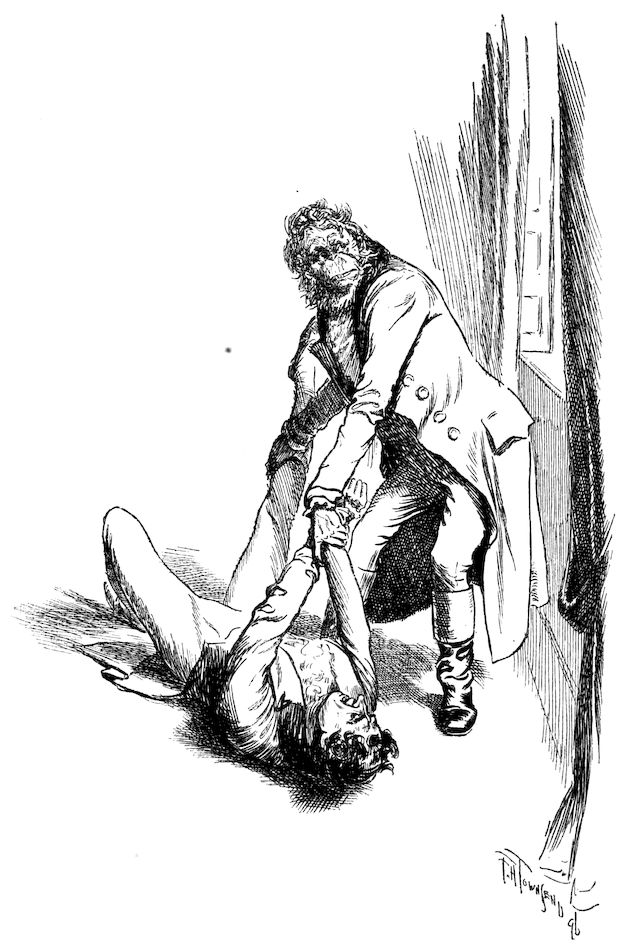
Preparing to administer natural justice by throwing him out at the window.
Anthelia. As to your character, Lord Anophel, that must be your concern. Mine is in my own keeping; for, having practised all my life a system of uniform sincerity, which gives me a right to be believed by all who know me, and more especially by all who love me, I am perfectly indifferent to private malice or public misrepresentation.
Lord Anophel Achthar. There is such a thing, Miss Melincourt, as tiring out a man’s patience; and, ‘pon honour, if gentle means don’t succeed with you, I must have recourse to rough ones, ‘pon honour.
Anthelia. My Lord!
Lord Anophel Achthar. I am serious, curse me. You will be glad enough to hush all up, then, and we’ll go to court together in due form.
Anthelia. What you mean by hushing up, Lord Anophel, I know not: but of this be assured, that under no circumstances will I ever be your wife; and that whatever happens to me in any time or place, shall be known to all who are interested in my welfare. I know too well the difference between the true quality of a pure and simple mind and the false affected modesty which goes by that name in the world, to be intimidated by threats which can only be dictated by a supposition that your wickedness would be my disgrace, and that false shame would induce me to conceal what both truth and justice would command me to make known.
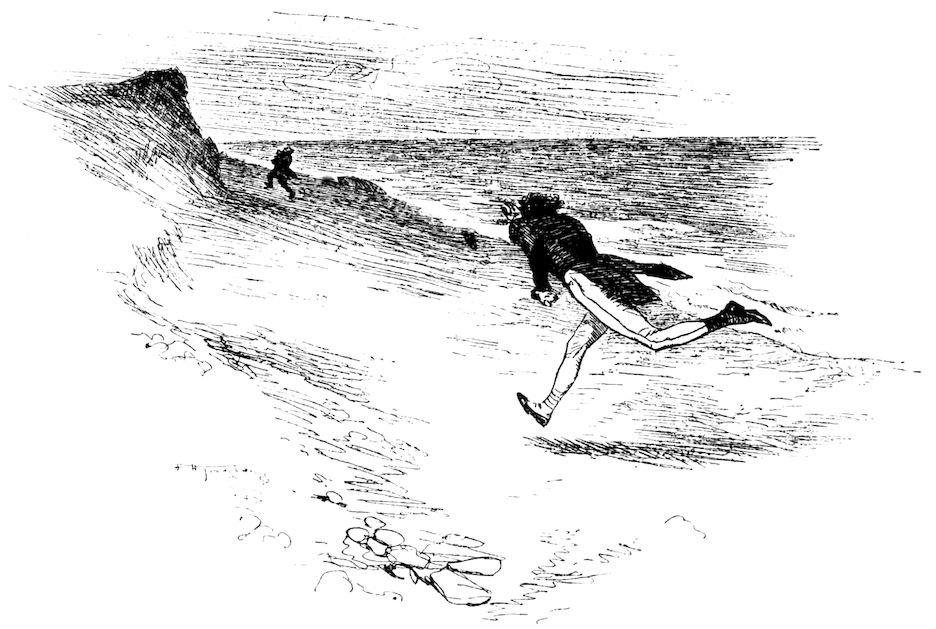
We shall leave them to run ad libitum.
Lord Anophel stood aghast for a few minutes, at the declaration of such unfashionable sentiments. At length saying, ‘Ay, preaching is one thing, and practice another, as Grovelgrub can testify,’ he seized her hand with violence, and threw his arm round her waist. Anthelia screamed, and at that very moment a violent noise of ascending steps was heard on the stairs; the door was burst open, and Sir Oran Haut-ton appeared in the aperture, with the Reverend Mr. Grovelgrub in custody, whom he dragged into the apartment, followed by Mr. Forester and Mr. Fax. Mr. Forester flew to Anthelia, who threw herself into his arms, hid her face in his bosom, and burst into tears: which when Sir Oran saw, his wrath grew 320boundless, and quitting his hold of the Rev. Mr. Grovelgrub (who immediately ran downstairs, and out of the castle, as fast as a pair of short thick legs could carry him), seized on Lord Anophel Achthar, and was preparing to administer natural justice by throwing him out at the window; but Mr. Fax interposed, and calling Mr. Forester’s attention, which was totally engaged with Anthelia, they succeeded in rescuing the terrified sprig of nobility; who immediately, leaving the enemy in free possession, flew downstairs after his reverend tutor; whom, on issuing from the castle, he discovered at an immense distance on the sands, still running with all his might. Lord Anophel gave him chase, and after a long time came within hail of him, and shouted to him to stop. But this only served to quicken the reverend gentleman’s speed; who, hearing the voice of pursuit, and too much terrified to look back, concluded that the dumb Baronet had found his voice, and was then in the very act of gaining on his flight. Therefore, the more Lord Anophel shouted ‘Stop!’ the more nimbly the reverend gentleman sped along the sands, running and roaring all the way, like Falstaff on Gadshill; his Lordship still exerting all his powers of speed in the rear, and gaining on his flying 323Mentor by very imperceptible gradations: where we shall leave them to run ad libitum, while we account for the sudden appearance of Mr. Forester and his friends.
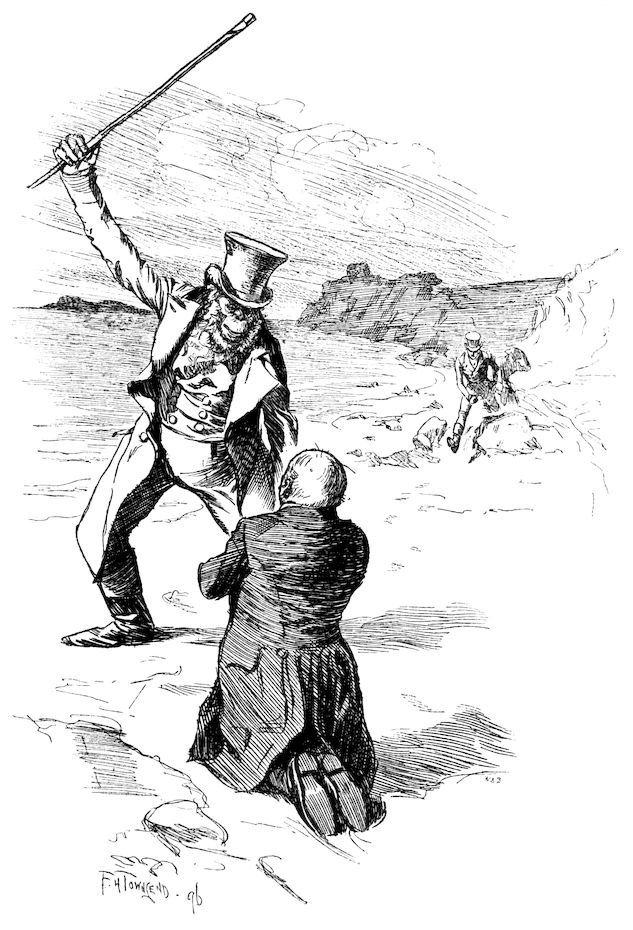
‘He would confess all.’
We left them walking along the shore of the sea, which they followed till they arrived in the vicinity of Alga Castle, from which the Reverend Mr. Grovelgrub emerged in evil hour, to take a meditative walk on the sands. The keen sight of the natural man descried him from far. Sir Oran darted on his prey; and though it is supposed that he could not have overtaken the swift-footed Achilles,[133] he had very little difficulty in overtaking the Reverend Mr. Grovelgrub, who had begun to run for his life as soon as he was aware of the foe. Sir Oran shook his stick over his head, and the reverend gentleman dropping on his knees, put his hands together, and entreated for mercy, saying ‘he would confess all.’ Mr. Forester and Mr. Fax came up in time to hear the proposal: the former restrained the rage of Sir Oran, who, however, still held his prisoner fast by the arm; and the reluctant divine, with many a heavy groan, conducted his unwelcome company to the door of Anthelia’s apartments.
‘O Forester!’ said Anthelia, ‘you have realised all my wishes. I have found you the friend of the poor, the enthusiast of truth, the disinterested cultivator of the rural virtues, the active promoter of the cause of human liberty. It only remained that you should emancipate a captive damsel, who, however, will but change the mode of her durance, and become your captive for life.’
It was not long after this event, before the Reverend Mr. Portpipe and the old chapel of Melincourt Castle were put in requisition, to make a mystical unit of Anthelia and Mr. Forester. The day was celebrated with great festivity throughout their respective estates, and the Reverend Mr. Portpipe 324was voti compos, that is to say, he had taken a resolution on the day of Anthelia’s christening, that he would on the day of her marriage drink one bottle more than he had ever taken at one sitting on any other occasion; which resolution he had now the satisfaction of carrying into effect.
Sir Oran Haut-ton continued to reside with Mr. Forester and Anthelia. They discovered in the progress of time that he had formed for the latter the same kind of reverential attachment as the Satyr in Fletcher forms for the Holy Shepherdess:[134] and Anthelia might have said to him in the words of Corin:
They wrong thee that do call thee rude:
Though thou be’st outward rough and tawny-hued,
Thy manners are as gentle and as fair
As his who boasts himself born only heir
To all humanity.
His greatest happiness was in listening to the music of her harp and voice: in the absence of which he solaced himself, as usual, with his flute and French horn. He became likewise a proficient in drawing; but what progress he made in the art of speech we have not been able to ascertain.
325Mr. Fax was a frequent visitor at Melincourt, and there was always a cover at the table for the Reverend Mr. Portpipe.
Mr. Hippy felt half inclined to make proposals to Miss Evergreen; but understanding from Mr. Forester that, from the death of her lover in early youth, that lady had irrevocably determined on a single life,[135] he comforted himself with passing half his time at Melincourt Castle, and dancing the little Foresters on his knee, whom he taught to call him ‘grandpapa Hippy,’ and seemed extremely proud of the imaginary relationship.
Mr. Forester disposed of Redrose Abbey to Sir Telegraph Paxarett, who, after wearing the willow twelve months, married, left off driving, and became a very respectable specimen of an English country gentleman.
We must not conclude without informing those among our 326tender-hearted readers who would be much grieved if Miss Danaretta Contantina Pinmoney should have been disappointed in her principal object of making a good match, that she had at length the satisfaction, through the skilful management of her mother, of making the happiest of men of Lord Anophel Achthar.
THE END
Printed by R. & R. Clark, Limited, Edinburgh.
MACMILLAN & CO.’S NEW NOVELS
Crown 8vo. 6s. each.
Second Edition now ready.
THE COURTSHIP OF MORRICE BUCKLER. By A. E. W. Mason.
PUNCH.—“Readers will, unless gratitude be extinct, thank me for my strong recommendation as to the excellent entertainment provided for them in The Courtship of Morrice Buckler.”
GRAPHIC.—“A fine stirring narrative it is. Mr. Mason is a new recruit to the growing school of historical romancers in which Mr. Stanley Weyman and Mr. Conan Doyle are conspicuous figures, and he promises to make himself well worthy of his company. The ‘Record of the Growth of an English Gentleman during the years 1685–1687 under strange and difficult circumstances’ is a gallant and chivalrous story, cast in a period and among scenes of which I, at least, am never tired of reading.”
HIS HONOR AND A LADY. By Mrs. Everard Cotes (Sara Jeannette Duncan). Illustrated by A. D. McCormick.
DAILY CHRONICLE.—“We are inclined to place it as the best book that Mrs. Everard Cotes has yet written. The story is exceedingly well told, is everywhere witty. It has that charm of atmosphere which India yields so readily for the canvas of a consummate artist.”
PALL MALL GAZETTE.—“This is a fascinating story of Anglo-Indian life, accurate in detail and true to nature. The authoress has not only maintained the high standard of her Simple Adventures of a Mem-Sahib, but surpassed it. This is praise, but true.”
ADAM JOHNSTONE’S SON. By F. Marion Crawford.
DAILY NEWS.—“Mr. Crawford has written stories richer in incident and more powerful in intention, but we do not think that he has handled more deftly or shown a more delicate insight into tendencies that go towards making some of the more spiritual tragedies of life.”
SPEAKER.—“A book to be enjoyed by everybody.”
THE RELEASE, OR CAROLINE’S FRENCH KINDRED. By Charlotte M. Yonge.
DENIS. A Study in Black and White. By Mrs. E. M. Field.
TOM GROGAN. By F. Hopkinson Smith. With Illustrations by Charles S. Reinhart.
GLASGOW HERALD.—“A clever bit of character study.”
MACMILLAN AND CO., Ltd., LONDON.
MESSRS. MACMILLAN AND CO.’S PUBLICATIONS.
BY RUDYARD KIPLING.
THE SECOND JUNGLE BOOK. With Illustrations by J. Lockwood Kipling. Twenty-first Thousand.
DAILY TELEGRAPH.—“The appearance of The Second Jungle Book is a literary event of which no one will mistake the importance. Unlike most sequels, the various stories comprised in the new volume are at least equal to their predecessors.”
THE JUNGLE BOOK. With Illustrations by J. L. Kipling, W. H. Drake, and P. Frenzeny. Twenty-eighth Thousand. Crown 8vo. 6s.
ATHENÆUM.—“We tender our sincere thanks to Mr. Kipling for the hour of pure and unadulterated enjoyment which he has given us, and many another reader, by this inimitable Jungle Book.”
PUNCH.—“‘Æsop’s Fables and dear old Brer Fox and Co.,’ observes the Baron sagely, ‘may have suggested to the fanciful genius of Rudyard Kipling the delightful idea, carried out in the most fascinating style, of The Jungle Book.’”
WEE WILLIE WINKIE and other Stories. Crown 8vo. 6s.
SOLDIERS THREE and other Stories. Crown 8vo. 6s.
ST. JAMES’S GAZETTE.—“In these, as the faithful are aware, are contained some of Mr. Kipling’s very finest work.”
GLOBE.—“Containing some of the best of his highly vivid work.”
PLAIN TALES FROM THE HILLS. Thirty-first Thousand. Crown 8vo. 6s.
Saturday Review.—“Mr. Kipling knows and appreciates the English in India, and is a born story-teller and a man of humour into the bargain.... It would be hard to find better reading.”
GLASGOW HERALD.—“Character, situation, incident, humour, pathos, tragic force, are all in abundance; words alone are at a minimum. Of course these are ‘plain’ tales—lightning-flash tales. A gleam, and there the whole tragedy or comedy is before you—elaborate it for yourself afterwards.”
THE LIGHT THAT FAILED. Re-written and considerably enlarged. Nineteenth Thousand. Crown 8vo. 6s.
ACADEMY.—“Whatever else be true of Mr. Kipling, it is the first truth about him that he has power, real intrinsic power.... Mr. Kipling’s work has innumerable good qualities.”
MANCHESTER COURIER.—“The story is a brilliant one and full of vivid interest.”
LIFE’S HANDICAP. Being Stories of Mine Own People. Twenty-third Thousand. Crown 8vo. 6s.
BLACK AND WHITE.—“Life’s Handicap contains much of the best work hitherto accomplished by the author, and, taken as a whole, is a complete advance upon its predecessors.”
OBSERVER.—“The stories are as good as ever, and are quite as well told.... Life’s Handicap is a volume that can be read with pleasure and interest under almost any circumstances.”
MANY INVENTIONS. Twentieth Thousand. Crown 8vo. 6s.
PALL MALL GAZETTE.—“The completest book that Mr. Kipling has yet given us in workmanship, the weightiest and most humane in breadth of view.... It can only be regarded as a fresh landmark in the progression of his genius.”
NATIONAL OBSERVER.—“The book is one for all Mr. Kipling’s admirers to rejoice in—some for this, and some for that, and not a few for well-nigh everything it contains.”
BY J. LOCKWOOD KIPLING.
BEAST AND MAN IN INDIA. A Popular Sketch of Indian Animals in their Relations with the People. By John Lockwood Kipling, C.I.E. With Illustrations by the Author. Extra crown 8vo. 7s. 6d.
MACMILLAN’S THREE-AND-SIXPENNY LIBRARY
OF
WORKS BY POPULAR AUTHORS.
In Crown 8vo. Cloth extra. Price 3s. 6d. each.
By ROLF BOLDREWOOD.
SATURDAY REVIEW.—“Mr. Boldrewood can tell what he knows with great point and vigour, and there is no better reading than the adventurous parts of his books.”
PALL MALL GAZETTE.—“The volumes are brimful of adventure, in which gold, gold-diggers, prospectors, claim-holders, take an active part.”
Robbery under Arms.
The Squatter’s Dream.
A Colonial Reformer.
The Miner’s Right.
A Sydney-Side Saxon.
Nevermore.
A Modern Buccaneer.
By HUGH CONWAY.
MORNING POST.—“Life-like, and full of individuality.”
DAILY NEWS.—“Throughout written with spirit, good feeling, and ability, and a certain dash of humour.”
Living or Dead?
A Family Affair.
By MRS. CRAIK.
(The Author of ‘John Halifax, Gentleman.’)
Olive. With Illustrations by G. Bowers.
The Ogilvies. With Illustrations.
Agatha’s Husband. With Illustrations.
Head of the Family. With Illustrations.
Two Marriages.
The Laurel Bush.
About Money, and other Things.
My Mother and I. With Illustrations.
Miss Tommy: A Mediæval Romance. Illustrated.
King Arthur: Not a Love Story.
Sermons out of Church.
Concerning Men, and other Papers.
By F. MARION CRAWFORD.
SPECTATOR.—“With the solitary exception of Mrs. Oliphant we have no living novelist more distinguished for variety of theme and range of imaginative outlook than Mr. Marion Crawford.”
Mr. Isaacs: A Tale of Modern India. Portrait of Author.
Dr. Claudius: a True Story.
A Roman Singer.
Zoroaster.
Marzio’s Crucifix.
A Tale of a Lonely Parish.
Paul Patoff.
With the Immortals.
Greifenstein.
Sant’ Ilario.
A Cigarette-Maker’s Romance.
Khaled.
The Three Fates.
The Witch of Prague.
Children of the King.
Marion Darche.
Pietro Ghisleri.
Katharine Lauderdale.
Don Orsino.
By Sir HENRY CUNNINGHAM, K.C.I.E.
ST. JAMES’S GAZETTE.—“Interesting as specimens of romance, the style of writing is so excellent—scholarly and at the same time easy and natural—that the volumes are worth reading on that account alone. But there is also masterly description of persons, places, and things; skilful analysis of character; a constant play of wit and humour; and a happy gift of instantaneous portraiture.”
The Cœruleans.
The Heriots.
Wheat and Tares.
Crown 8vo. 3s. 6d. each volume.
By CHARLES DICKENS.
The Pickwick Papers.
Oliver Twist.
Nicholas Nickleby.
Martin Chuzzlewit.
The Old Curiosity Shop.
Barnaby Rudge.
Dombey and Son.
Christmas Books.
Sketches by Boz.
David Copperfield.
American Notes and Pictures from Italy.
The Letters of Charles Dickens.
By MARY ANGELA DICKENS.
A Mere Cypher.
A Valiant Ignorance.
By BRET HARTE.
SPEAKER.—“The best work of Mr. Bret Harte stands entirely alone ... marked on every page by distinction and quality.... Strength and delicacy, spirit and tenderness, go together in his best work.”
Cressy.
The Heritage of Dedlow Marsh.
A First Family of Tasajara.
By THOMAS HUGHES.
Tom Brown’s Schooldays. With Illustrations by A. Hughes and S. P. Hall.
Tom Brown at Oxford. With Illustrations by S. P. Hall.
The Scouring of the White Horse, and The Ashen Faggot. With Illustrations by Richard Doyle.
By HENRY JAMES.
SATURDAY REVIEW.—“He has the power of seeing with the artistic perception of the few, and of writing about what he has seen, so that the many can understand and feel with him.”
WORLD.—“His touch is so light, and his humour, while shrewd and keen, so free from bitterness.”
A London Life.
The Aspern Papers.
The Tragic Muse.
By ANNIE KEARY.
SPECTATOR.—“In our opinion there have not been many novels published better worth reading. The literary workmanship is excellent, and all the windings of the stories are worked with patient fulness and a skill not often found.”
Castle Daly.
A York and a Lancaster Rose.
Oldbury.
A Doubting Heart.
Janet’s Home.
Nations around Israel.
By W. CLARK RUSSELL.
TIMES.—“Mr. Clark Russell is one of those writers who have set themselves to revive the British sea story in all its glorious excitement. Mr. Russell has made a considerable reputation in this line. His plots are well conceived, and that of ‘Marooned’ is no exception to this rule.”
Marooned.
A Strange Elopement.
By ARCHDEACON FARRAR.
Seekers after God.
Eternal Hope.
The Fall of Man.
The Witness of History to Christ.
The Silence and Voices of God.
In the Days of thy Youth.
Saintly Workers.
Ephphatha.
Mercy and Judgment.
Sermons and Addresses in America.
MACMILLAN’S THREE-AND-SIXPENNY SERIES.
Crown 8v. 3s. 6d. each volume.
By CHARLES KINGSLEY.
Westward Ho!
Hypatia.
Yeast.
Alton Locke.
Two Years Ago.
Hereward the Wake.
Poems.
The Heroes.
The Water Babies.
Madam How and Lady Why.
At Last.
Prose Idylls.
Plays and Puritans, etc.
The Roman and the Teuton.
Sanitary and Social Lectures and Essays.
Historical Lectures and Essays.
Scientific Lectures and Essays.
Literary and General Lectures.
The Hermits.
Glaucus: or the Wonders of The Seashore. With Coloured Illustrations.
Village and Town and Country Sermons.
The Water of Life, and other Sermons.
Sermons on National Subjects, and the King of the Earth.
Sermons for the Times.
Good News of God.
The Gospel of the Pentateuch, and David.
Discipline, and other Sermons.
Westminster Sermons.
All Saints’ Day, and other Sermons.
By D. CHRISTIE MURRAY.
SPECTATOR.—“Mr. Christie Murray has more power and genius for the delineation of English rustic life than any half-dozen of our surviving novelists put together.”
SATURDAY REVIEW.—“Few modern novelists can tell a story of English country life better than Mr. D. Christie Murray.”
Aunt Rachel.
John Vale’s Guardian.
Schwartz.
The Weaker Vessel.
He Fell among Thieves. D. C. Murray and H. Herman.
By Mrs. OLIPHANT.
ACADEMY.—“At her best she is, with one or two exceptions, the best of living English novelists.”
SATURDAY REVIEW.—“Has the charm of style, the literary quality and flavour that never fails to please.”
A Beleaguered City.
Joyce.
Neighbours on the Green.
Kirsteen.
Hester.
Sir Tom.
A Country Gentleman and his Family.
The Curate in Charge.
The Second Son.
He that Will Not when He May.
The Railway Man and his Children.
The Marriage of Elinor.
The Heir Presumptive and the Heir-Apparent.
A Son of the Soil.
The Wizard’s Son.
Young Musgrave.
Lady William.
By J. H. SHORTHOUSE.
ANTI-JACOBIN.—“Powerful, striking, and fascinating romances.”
John Inglesant.
Sir Percival.
The Little Schoolmaster Mark.
The Countess Eve.
A Teacher of the Violin.
Blanche, Lady Falaise.
By FREDERICK DENISON MAURICE.
Sermons Preached in Lincoln’s Inn Chapel. In 6 vols.
Christmas Day, and Other Sermons.
Theological Essays.
Prophets and Kings.
Patriarchs and Lawgivers.
The Gospel of the Kingdom of Heaven.
Gospel of St. John.
Epistles of St. John.
Lectures on the Apocalypse.
Friendship of Books.
Social Morality.
Prayer Book and Lord’s Prayer.
The Doctrine of Sacrifice.
Acts of the Apostles.
Crown 8vo. 3s. 6d. each volume.
By CHARLOTTE M. YONGE.
The Heir of Redclyffe.
Heartsease.
Hopes and Fears.
Dynevor Terrace.
The Daisy Chain.
The Trial: More Links of the Daisy Chain.
Pillars of the House. Vol. I.
Pillars of the House. Vol. II.
The Young Stepmother.
The Clever Woman of the Family.
The Three Brides.
My Young Alcides.
The Caged Lion.
The Dove in the Eagle’s Nest.
The Chaplet of Pearls.
Lady Hester, and the Davers Papers.
Magnum Bonum.
Love and Life.
Unknown to History.
Stray Pearls.
The Armourer’s ‘Prentices.
The Two Sides of the Shield.
Nuttie’s Father.
Scenes and Characters.
Chantry House.
A Modern Telemachus.
Bye-Words.
Beechcroft at Rockstone.
More Bywords.
A Reputed Changeling.
The Little Duke.
The Lances of Lynwood.
The Prince and the Page.
P’s and Q’s, and Little Lucy’s Wonderful Globe.
Two Penniless Princesses.
That Stick.
An Old Woman’s Outlook.
Grisly Grisell.
By VARIOUS WRITERS.
Sir S. W. BAKER.—True Tales for My Grandsons.
R. BLENNERHASSETT AND L. SLEEMAN.—Adventures in Mashonaland.
FRANCES HODGSON BURNETT.—Louisiana and That Lass O’ Lowrie’s.
Sir MORTIMER DURAND, K.C.I.E.—Helen Treveryan.
‘English Men of Letters’ Series. In 13 Monthly Volumes, each Volume containing three books.
LANOE FALCONER.—Cecilia de Noël.
ARCHIBALD FORBES.—Barracks, Bivouacs, and Battles.—Souvenirs of Some Continents.
W. FORBES-MITCHELL.—Reminiscences of the Great Mutiny, 1857–59.
W. W. FOWLER.—Tales of the Birds. Illustrated by Bryan Hook. A Year with the Birds. Illustrated by Bryan Hook.
Rev. J. GILMORE.—Storm Warriors.
P. KENNEDY.—Legendary Fictions of the Irish Celts.
HENRY KINGSLEY.—Tales of Old Travel.
MARGARET LEE.—Faithful and Unfaithful.
AMY LEVY.—Reuben Sachs.
S. R. LYSAGHT.—The Marplot.
LORD LYTTON.—The Ring of Amasis.
M. M’LENNAN.—Muckle Jock, and other Stories of Peasant Life.
LUCAS MALET.—Mrs. Lorimer.
GUSTAVE MASSON.—A French Dictionary.
A. B. MITFORD.—Tales of Old Japan.
Major G. PARRY.—The Story of Dick.
E. C. PRICE.—In the Lion’s Mouth.
W. C. RHOADES.—John Trevennick.
THE WORKS OF SHAKESPEARE. Vol. I. Comedies. Vol. II. Histories. Vol. III. Tragedies. 3 vols.
FLORA A. STEEL.—Miss Stuart’s Legacy.—The Flower of Forgiveness.
MARCHESA THEODOLI.—Under Pressure.
“TIMES” Summaries.—Biographies of Eminent Persons. In 4 vols.—Annual Summaries. In 2 vols.
Mrs. HUMPHRY WARD.—Miss Bretherton.
MONTAGU WILLIAMS, Q.C.—Leaves of a Life.—Later Leaves.—Round London: Down East, and Up West.
Hogan, M.P.—Tim.—The New Antigone.
MACMILLAN AND CO., LONDON.
TRANSCRIBER’S NOTES
Typos fixed; non-standard spelling and dialect retained.
Used numbers for footnotes, placing them all at the end of the last chapter.