TEELIN, BUNGLASS, AND SLIEVE LEAGUE
Reading edition
It is a lovely summer’s day, warm and fragrant and sunny. We have just come from Mass at Carrick chapel, and are following the road that leads south by the harbour up to Teelin village. Numbers of people are on the road with us—mostly women and girls, for the men have remained behind to smoke and to talk over the week’s happenings in the different ends of the parish. The groups go in ages—the old women with the old women, the marriageable girls with the marriageable girls, the younger girls with the girls of their own age. There is a crowd of little boys, too—active as goats, dressed in corduroys or homespuns, and discussing in Irish what they will do with themselves in the afternoon. Some will go bathing in the harbour, others will go up to the warren by Loch O’Mulligan to hunt rabbits, others will remain in the village to watch the men and bigger boys play at skittles in a cleared space by the high road. I pick up with a quiet-eyed lad—the makings of a priest or a scholar, by his look—and in a short time I am friends with the crowd. If one could see me behind I must look like the Pied Piper of Hamelin, so many children have I following alongside me and at my heels. They come to know by my talk that I am interested in Irish—an enthusiast, in fact—and they all want to tell me at once about the Feis at Teelin, and about the great prizes that were offered, and how one out of their own school, a little fellow of eight years, won first prize for the best telling of a wonder-tale in the vernacular. The quiet-eyed lad asks me would I like to see Bunglass and the great view to be had of Slieve League from the cliff-head. I tell him that I am going there, and in an instant the crowd is running out in front of us, shouting and throwing their caps in the air—delighted, I suppose, at the prospect of a scramble for coppers on the grass when we get to the end of our journey. For boys are boys the world over, let the propagandists carp as they will! and when I was young myself I would wrestle a ghost under a bed for a halfpenny—so my grandmother used to tell me, and she was a very wise and observant woman. We have come to Teelin village—a clean, whitewashed little place on a hill, built “all to one side like Clogher”—and from there we strike up to the right by a sort of rocky, grass-covered loaning which leads to the cliffs. We pass numbers of houses on the way, each with a group of gaily-dressed peasants sunning themselves at the door. The ascent is gradual at first, but as we go on it gets steeper, and after a while’s climbing we begin to feel the sense of elevation and detachment. The air is delightfully warm, and the fragrance of sea and bracken and ling is in our hearts. In time we reach Carrigan Head, with its martello tower, seven hundred feet odd over the Atlantic. Southwards the blue waters of Donegal Bay spread themselves, with just the slightest ripple on their surface, glinting in the warm sunlight. In the distance the heights of Nephin Beag and Croagh Patrick in Mayo are faintly discernible, and westwards the illimitable ocean stretches to the void. From Carrigan Head we follow a rough mountain trail, and in a short time reach Loch O’Mulligan, a lonely freshwater tarn, lying under the shadow of Slieve League. Back of the loch a grassy hill rises. We climb this, the younger boys leading about fifty yards in front, jumping along the short grass and over the stones like goats. Arrived at a point called in Irish Amharc Mór, or “Great View,” a scene of extraordinary beauty bursts on us. We are standing on Scregeighter, the highest of the cliffs of Bunglass. A thousand and twenty-four feet below us, in a sheer drop, the blue waters of Bunglass advance and recede—blue as a sapphire, shading into emerald and white where they break on the spit of grass-covered rock rising like a sceilg-draoidheachta, or “horn of wizardy,” out of the narrow bay. Right opposite us is Slieve League, its carn a thousand feet higher than the point on which we stand. In the precipitous rock-face, half-way up, is a scarped streak called Nead an Iolair, or the Eagle’s Nest. The colouring is wonderfully rich and varied—black, grey, violet, brown, red, green—due, one would think, to the complex stratification and to the stains oozing from the soft ores, clays, and mosses impinging between the layers. We step back from the cliff-edge, and sit down on a flat slab of stone, the better to enjoy the view, and the boys spread themselves out in various attitudes over the short grass before and behind us. They are conversing among themselves in Irish, speaking very rapidly, and with an intonation that is as un-English as it can possibly be. The thickened l’s and thrilled r’s are especially noticeable. To hear these children speak Irish the way they do makes one feel that the language of Niall Naoi Giallach is not dead yet, and has, indeed, no signs of dying.
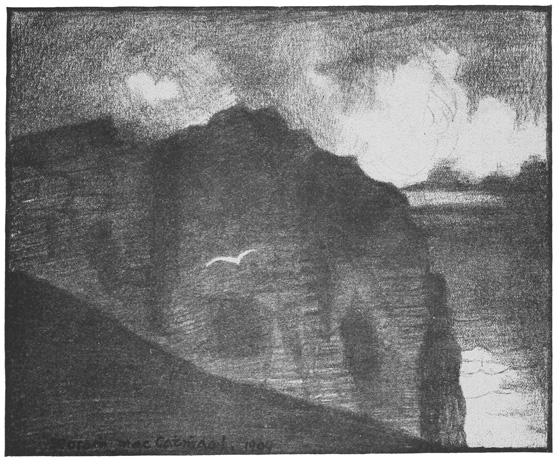
THE HORN.
One could spend a day in this place sunning oneself on the cliff-head, or loafing about on the grass, enjoying the panorama of mountain and sea and sky spread in such magnificence on all sides. But we have promised to be back in Carrick for lunch, and already the best part of the forenoon is gone. “Cad a-chlog é anois?” I ask one of the boys. He looks into the sky, calculates for a while, and answers: “Tá sé suas le h-aon anois. Féach an ghrían.” (It is upwards of one o’clock now. Look at the sun.) In a remote, open country like this the children are wonderfully astute, and well up in the science of natural things. Coming up the hill I had noticed a number of strange birds, and when I asked the crowd the names of them in Irish they told me without once having to stop to think. We are ready to go now, but before setting out we decide on having a scramble. My friend, R. M., takes a sixpence from his pocket, puts it edge down on the turf, and digs it in with his heel, covering it up so that no sign of it is visible. He then brings the boys back over the grass about a hundred yards, handicapping them according to age and size. One boy, the youngest, has boots on, and he is put in front. At a given signal—the dropping of a handkerchief—the race is started, and in the winking of an eye the crowd is mixed up on the grass, one boy’s head here, another’s heels there, over the spot where the sixpence is hidden. Five minutes and more does the scramble last, the boys pushing and shoving for all they are worth, and screaming at the top of their voices. Then the lad who reached the spot first crawls out from underneath the struggling mass, puffing and blowing, his hair dishevelled, the coat off him, and the sixpence in his hand!
We have got back to Carrick, an hour late for lunch, and with the appetites of giants. We met many people on the road as we returned, all remarkably well-dressed—young men in the blue serge favoured by sailors, and girls in white; a clerical student, home on holidays from Maynooth, discussing the clauses of Mr. Birrell’s latest Land Bill with a group of elderly folk; big hulking fellows with bronzed faces, in a uniform that I hadn’t seen before, but which a local man told me was that of the Congested Districts Board; and pinafored children. One young man we noticed sitting on a rock over the water with his boots off, washing his feet, and several boys sailing miniature boats made out of the leaves of flaggers.