SHAN MAC ANANTY
Reading edition
Up Glengesh. The hills of the Pass close in darkly on either side of me. The brown road rises between them in devious loops and twists to the sky beyond. There is the smell of bog-myrtle and ling in the air, and the sound of running water. The silence is awful. I am going along quiet and easy-like, with hardly a thought in my head, when near a sodded shelter, almost hidden from view in a cluster of fuchsia bushes, I come on a little lad of about three years of age. He can’t be older, I fancy, he is so small. He runs out in front of me, scared somewhat at my approach, as quaint a figure as ever I looked at. I shout at him and he stops, pulling the hat which he wears—and it is big enough to be his father’s—over his face, and laughing shyly at me out of one corner of it. His hands are wet, I notice, a blae-red colour, and sticking with grass—as if he had been “feeling” for minnows in the stream which runs alongside the road. He has a pair of homespun jumpers on, very thick, and dyed a crude indigo colour, a shirt and vest, and his legs are bare and wet up to the knees. I ask him in English “where he comes from,” “who is his father,” “who is his mother,” “where he lives?” He doesn’t answer, only pulls the hat deeper over his head, and laughs into it. I put the question to him then in Irish. . . . . The words were hardly out of my mouth when he gave a leap in the air. I felt as if something had struck me in the face—something soft and smothering, like a bag of feathers—and I was momentarily blinded. When I looked again who should I see but Shan Mac Ananty, my leaprachán friend from Scrabo in Down, running out in front of me, in a whirl of dust, it seemed—a white, blinding cloud—giving buck-jumps in the air, and dancing and capering about in the most outlandish fashion possible.
“So it’s you, Shan?” I said, when I had recovered my breath. I wasn’t a bit afraid, only winded.
“Ay,” says he. “I didn’t know you at first. The English is strange to me.” Then with a quaint grimace: “What are you doing up here?”
“And what are you doing up here yourself, Shan?” says I. “I thought Scrabo was your playground.”
“You’re right, son,” says he. “The old fort is my playground, but the smoke—the smoke from the mill chimneys—chases me away at times, and I come up here for an airing. And, anyway, you mustn’t forget that I’m king of the fairies of Leath-Chuinn,” says he.
“And so you are,” says I. “I clean forgot that. And do you be in Donegal often?” I asked.
“Once in a spell,” says he. “I travel the townlands in turn from Uisneach to Malin,” says he, “and it takes me a year and a day to do the round. I saw you at Scrabo in June last,” says he, “but you didn’t see me.”
“When was that, Shan?” says I, thinking.
“On the night of the twenty-third,” says he. “There wasn’t a fire lighting as far as I could see; and I could see from Divis to the Horns of Boirche, and from that over to Vannin.”
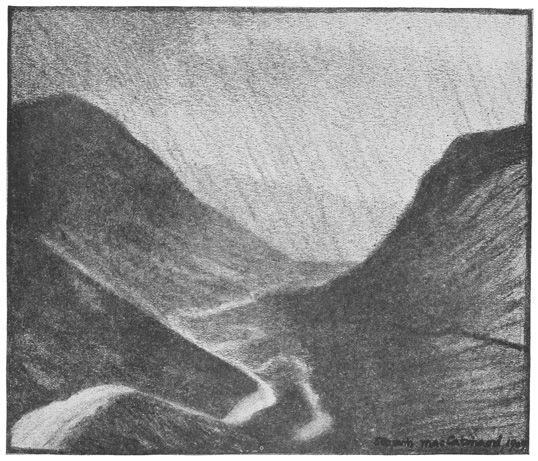
A GAP BETWEEN THE HILLS.
He stopped, and I turned to answer . . . . but Shan was gone! Nothing in sight for miles—nothing living—only a magpie walking the road, and a toit of blue smoke from a cabin away down in the glen.