BOB, DÉBUTANT
Reading edition
BY HENRY GARDNER HUNTING
ILLUSTRATIONS BY DENMAN FINK
Of course, Bob knew that, as an abstract ethical principle, it is wrong to fight. His mother had been endeavoring to impress that idea upon him, from the moment it was first decided that he should go to public school till his books and his lunch-box were packed and he was on his way thither; and she had succeeded fairly well, for she had exacted a promise from him faithfully to avoid personal encounters as wholly sinful and unbecoming.
As a matter of fact, Bob knew only so much about fighting as he had learned through round-eyed, somewhat frightened observation of a very few entirely bloodless encounters among older boys; and, inasmuch as he had found himself consistently excluded from nearly all other, more peaceful pursuits and interests of these older ones, it was not unnatural that he should feel merely a spectator's interest in their fistic battles also, and that he should look upon them as he would have looked upon any other natural phenomenon—with some excitement, perhaps, but with no personal concern.
Bob admired his mother. To him, she was the most beautiful and the most resourceful woman in the world. He had found her judgment upon many subjects so wise that he was quite prepared to believe her position in this matter (which did not appear to be vital) completely and unquestionably correct, and to promise accordingly.
But conditions which exist on the big, bare public-school playgrounds, away alike from parental restraint and parental protection, are quite different from those in the home door-yard, and the code which obtains in the ward-school world is not an open book to all mothers of chubby-fisted sons who are called upon to observe it. It seems difficult for mothers to comprehend that a normal boy's standing on the school-ground is, like that of a young cock in a barn-yard, simply a matter of mettle and muscle.
So it was as early as Bob's second day at school—on the first Papa Jack had gone with him—that a revelation came both to him and to his mother. To him it was a painful revelation, first because he had this new code to learn, and afterward because of his promise; and it was the latter thing that made the real difficulty. When you are a small boy you can easily adapt yourself and your habits of mind to new conditions and environment; but when you have some one else to think of, and when you are bound by a promise, that complicates matters.
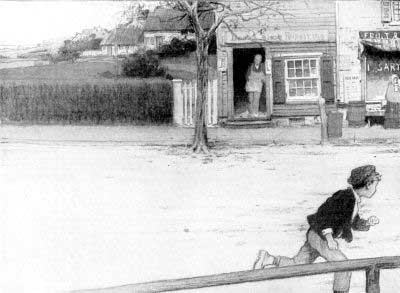
"SCHOOL-BAG AND LUNCH-BOX DROPPED FROM HIS HANDS"
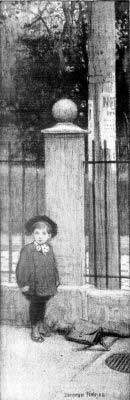
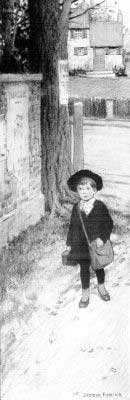
"HE SET HIS FACE ONCE MORE TOWARD SCHOOL AND WALKED VERY FAST"
Now, one "Curly" Davis—who was said to have been christened Charles, but whose astonishingly spiral locks surely constituted better authority for a name than any possible application of baptismal water—was, by right of reputed might, dictator of the Vine Street Primary. Curly was alleged to be of pugnacious disposition, and had not been bred to appreciation of the Golden Rule. He had the outward bearing of one who has reason for confidence in his personal prowess. He was popularly believed to have fought many fights and fierce,—just when and where his admirers seemed not to consider important,—and he had a reputation for ferocity rather disproportionate to his stature. He had a way of glaring at you, too, if you happened to be a new boy at school, which was sufficiently suggestive of a sanguinary temperament to overawe the average youngster and to render quite unnecessary any more active demonstration.
Like all despots who rule through fear, Curly had a following. It was made up of lesser lights of like tastes and ambitions, who toadied to and imitated the tyrant simply to avoid the unpleasant necessities which the alternative involved. These followers, numbering some six or eight, through their unity of aim and Curly's leadership, had gained a certain ascendency over the far greater, but unorganized, body of would-be independents who, chafe as they might under the yoke, dared not attempt to throw it off; and these loyal retainers were zealous in service of their lord's interests and pleasure.
On that beautiful fall morning when Bob first went alone to school, he had not been ten minutes on the playground, standing upon its outer edge, school-bag and lunch-box in hand, to gaze upon its novelties, before a satellite of Curly's, one Percy Emery, espied him. Instantly it was as though Percy had discovered some new quarry, unearthed a fresh specimen of some genus, edible and choice.
"Hi, Curly," he yelled, with the eager loyalty of his kind, "come 'ere. 'Ere's a new one. Look at the school-bag to 'im."
Curly, who was at the moment engaged in the pleasing pastime of hectoring a scared little five-year-old who ought still to have been in the kindergarten, pricked up his ears at the cry and, like a hungry bird of prey leaving a mouse for a lamb, promptly swooped down upon the new game. His movement was the signal for the gathering of a crowd, and, before Bob was fairly aware that he was the object of attention, he had become the center of a curious group whose interest, if not wholly hostile, was in the main certainly not friendly. The dictator himself confronted him with unmistakably bellicose intentions.
"New shoes!" said Curly contemptuously, selecting the first obviously vulnerable point open to a shaft of insult. "New shoes! Spit on 'em!" He suited the action to the word, and immediately word and act alike were imitated by two or three of his more ardent admirers.
"Stop!" said Bob. He did not know what it meant. He backed away from his persecutors.
"Aw, stop, eh?" mocked Curly. "Who are you? What's yer name?"
"Bob McAllister."
"Bob! Bob-tail! Bob-cat!" chanted Curly, in gratuitous insult of which only bantam shamelessness is capable. "Stop, will I? Who'll make me? You? You want to fight?"
He danced about Bob's quiet little figure, snapping his fingers in the new boy's eyes. Then, suddenly, he swung his wiry body and swept a stinging blow in Bob's face.
A yell of delight from the despot's own drowned a weaker chorus of protest. Curly backed and squared, ready for some show of retaliation or resistance, a scornful little grin on his face.
"Come on, now. Fight! Stop me!" he cried.
But Bob did not move. Curly's blow had landed fair on the tender little red lip, and it had cut against the teeth behind; a tiny scarlet stream flowed down Bob's smooth little chin. In his eyes the dizziness of the first jar gradually gave way to slow amazement. Then the tears welled up, hot tears which overflowed the lids and ran scalding down the cheeks, but they did not conceal or quench a glitter which grew to a bright flame behind them.
Bob's school-bag and lunch-box dropped from his hands. The pudgy fists which had never before been clinched with belligerent purpose, but which were, nevertheless, a boy's fists, doubled themselves into hard little knots; but still he stood quiet.
So far as his whirling little mind could think, he thought thus: So this was fighting; this was what he had promised mother not to do; what he had promised—had promised—promised. He was not so big, this boy who had struck him, not so big. Bob was not afraid. But that a promise is a thing to be kept inviolate he had learned, oh, years ago, from Papa Jack, along with all the other of-course-ities of life, like telling the truth, keeping your troubles to yourself, and not being a cry-baby or a telltale. And a promise to mother—well, nothing could be more sacred. Yet here was a new condition which he had never met before, a new situation which suddenly made him see in an altogether different aspect a question supposedly settled—this question of to fight or not to fight. It made his sweeping promise to mother suddenly seem to have been very ill-advised indeed. He wondered if his mother could have known that he would meet this kind of thing at school. In that first instant after Curly's blow was struck, instinct told him that fists were made to be used, and reason added that self-defense is right; and now something else was stirring in his heart—something which might not, perhaps, be wholly unexpected, under such circumstances, to stir in the heart of a boy whose grandfather had carried a musket at Gettysburg and whose father had worn khaki at San Juan. He wondered if his mother could have known.
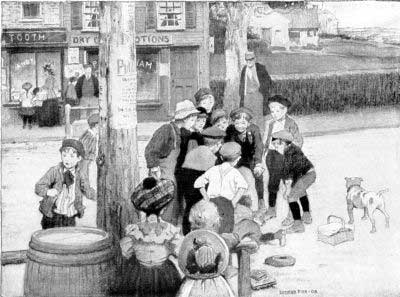
"A RING OF BOYS—EXCITED, EAGER, YELLING"
But Bob's fists only clinched; they did not strike. All the sturdy little muscles in his small body stiffened, and he stood with head up and eyes blazing, but he did not strike. And then the school-bell suddenly began to ring, and the group about him broke away; and Curly Davis started off, shouting back something about fixing him after school, and—he was alone.
Bob stood still. He realized that the last bell for school had rung. He knew that he should have gone in with the others. That was what he had been sent to school for, certainly. But he stood still.
The tears had dried upon his face, and so had the thin little line of red on his chin. His lip was swelling, and felt as if a hazelnut or a big bean had been pushed up under it and were sticking to and stinging the skin. He stooped and picked up his school-bag and lunch-box, stood still again for a moment, and then walked away. He was not going to school, and, naturally, as there was nowhere else to go, he was going home.
But a great, heavy weight seemed to have settled down upon his breast and pressed in upon it, and it was hard to breathe. His thoughts were still confused, but he was wondering—wondering. Why was it? Why had they treated him so? Why had they singled him out to attack him? Why had that boy with the curly hair struck him? Why had the others laughed? Didn't they like him? Didn't any one like him? Why, what had he done? His heart swelled with sudden misery and wretchedness. Why was such an unkind thing permitted in the world? And then again returned that something which stirred inside him, something hot and hard, which made his cheeks and eyes burn and his fingers clinch once more. And then again the question, "Could mother have known?"
Mrs. McAllister saw him coming a block away, and she ran down to the gate to meet him as he trudged in. Bob looked up into his mother's face. The quick concern in her eyes, as she saw the battered little lip and the stained chin, came nearer to making him sob than Curly's blow had done; but, though the tears would well up and his throat felt very tight, he only swallowed and carefully wet the puffed lip with his tongue.
"Why, Bobbie, Bobbie, what is the matter?" cried his mother, dropping down on her knees on the walk beside him. She put both her hands on his shoulders and turned his face toward her; and Bob looked straight into her troubled blue eyes, and suddenly began to feel better—began to feel, indeed, that he did not have to care so much, after all.
"Oh, Bobbie, have you been fighting?"
Bob shook his head.
"How did you get your lip hurt so? Did you fall down?"
Again he shook his head. He didn't know just how to tell her. It wasn't fighting. At least, he didn't fight; it had been that other boy. But, somehow, he did not want to say that; he did not want to tell; he wanted something, but he did not know just what it was. He found himself forgetting how he had felt a moment before, and then he discovered that he was not thinking about what he wanted at all. He was thinking what a very blue blue his mother's eyes were when she looked at him so, and, all at once, he felt more sorry for her than for himself, because she looked so troubled; and he kissed her quickly, and hurt his lip.
Mrs. McAllister led him into the house. "Won't you tell mother, Bob?" she asked.
But he couldn't. He was feeling better—much better—but he couldn't tell. There was another reason now, that he hadn't thought of before: it would make her feel more sorry. And after all, it didn't matter so much; that is, it didn't if— He looked up at her with a new thought.
"But, Bob, you must tell mother all about it," she was saying, as she carefully bathed his chin and lip, and so he had to shake his head again.
"Then you must tell papa this noon, Bob."
Bob considered. No, he couldn't tell Papa Jack, either. He felt pretty sure father himself wouldn't tell about such a thing if he were a boy. He was silent.
Mrs. McAllister began to move about her work, though she still looked at him frequently and anxiously. Bob went away to the window, and stood looking out. He remembered how he had started out that morning, with school-bag and lunch; he remembered how he had approached the school-grounds, and how big and strange and attractive a place it had seemed to him at first, and what a good time all those boys had been having; and then he remembered how, suddenly, he had found them all around him, summoned by the call of that boy with the hateful grin, and how Curly Davis had sneered and spat and struck. Suddenly he found himself tingling all over, and pressing a burning forehead against the cool glass, and digging his knuckles into the corner of the sash till they ached. Then he went into the library, and lay down on father's big leather couch, and thought and thought.
Papa Jack came home for lunch at noon, and mother told him. Bob heard them in the hall.
"He says he didn't fight," said his mother, "and he says he didn't fall down. He won't tell me, and I told him he must tell you. I don't know why he doesn't want to tell; he isn't ashamed or very much frightened, and he didn't cry after he came home."
Bob heard Papa Jack's footsteps cross the hall and come in upon the hard-wood library floor, and then on the big rug by the library couch. Papa Jack sat down beside him and put his big fingers around Bob's little ones.
"Well, what about it, Son?"
Bob looked up and smiled. Always such a pleasant, warm feeling came over him when Papa Jack came near him and talked to him.
"What about it, Son?"
But Bob could not reply. His eyes grew serious as they looked back into his father's.
"What did this, Bob?" asked Papa Jack, gently touching the hazelnut bruise with a finger.
"A boy," said Bob.
"What boy?" asked Papa Jack. "A big boy?"
Silence, and then a shake of the head.
"Did you strike him first?"
Again Bob shook his head.
"What did you do to him?"
Still another shake of the head.
"Do you mean he just came up and struck you without any provocation?"
"He laughed," said Bob.
"What else?"
"Spit on my new shoes," reddening.
Papa Jack drew his mustache down between his lip and teeth. "Hm! He did, eh? What else?"
"Said 'Bob-tail, bob-cat,'"
Papa Jack looked puzzled.
"Said I was—Bob, bob-tail, bob-cat," explained Bob.
"Oh!" Papa Jack seemed to see light. "And then he struck you?"
A nod once more.
Mr. McAllister looked out the window and his fingers closed tightly around Bob's. "When was this, Bob—before school?"
"Mm."
"And you came right home?"
A nod.
"Did you strike him back?"
Bob's eyes widened. "No."
Papa Jack's eyes widened also. "Why?"
"Because."
"Because what, Bob?"
"Because mama said not to fight."
"And you promised?"
Bob nodded again.
"I see." Papa Jack's eyes suddenly lighted with something Bob did not understand, and he sat looking down at Bob for a long minute. "I see," he said again, and then he turned and called to mother. "Helen!" And mother came in, with a piece of white sewing in her hands.
"Helen," said Papa Jack, "it's a case of bullying. The boy promised you not to fight, and he didn't. It's a mistake, mother. He's been set upon by some young bully, and couldn't defend himself because of his promise."
Mother looked at Bob; there was distress in her eyes, but something else came into them, too.
"It's only the beginning, dear—the beginning of battles," said Papa Jack, and he put his other hand on mother's.
"Bob," he said, "mother doesn't mean you're not to defend yourself. Understand? By fighting, mother only means beginning fights, picking fights, provoking other boys to fight. We have to defend ourselves. It isn't right to pick a fight; that's what mother means."
Bob saw tears come into his mother's eyes. Papa Jack saw them, too.
"There's only one way among boys, Helen dear. The bullies must be fought, you know. Our boy's got to be a boy's boy if he's to be a man's man by-and-by."
Suddenly mother bent over and kissed Bob, and held him, with her arms thrust under and about him—held him hard.
"The only thing, Bob, is to be a man always. Be square and white. Do the right thing. I can't tell you what it will be every time; neither can anybody else: but you your own self will know. It may be right even to fight sometimes, for yourself and for others who are bullied; but every boy knows for himself when it's right and when it's wrong. If he does as he knows, he'll do right."
It was a quiet lunch that day. Father and mother talked little and the meal was quickly over. Bob hardly knew what he himself ate or did or thought. There was a strange excitement in his heart and in his head, a feeling that he could not define. It was not that he was going back to school after dinner. It was not that he would probably meet those boys again, nor that he would sooner or later have to face again that Curly Davis. Neither was it that, when he did face Curly Davis, he meant to—yes, to fight him. No, it was none of these things, though his heart did beat the faster as he thought of them. It was something else; it was something about what his father had said, not so much his words, but the way he had said "a man's man" and "we must defend ourselves"—something that thrilled him, made him proud and humble, all at once. Someway, father seemed to have taken a new attitude toward him, and in that change even Bob seemed to see father's recognition that babyhood was over for his small son.
Mother stood in the door and watched him go. She had been crying again, a little; she had even wanted to keep him at home. But father had said, "No, let him go; as well now as to-morrow," and so she had kissed him and cried again, a little. And then she had begged him to "try to keep away from those bad little boys," and to "play only with good boys who did not want to fight"; and Bob had said yes—doubtfully. He waved his hand to her from the gate, and again from the corner of the block, and then he set his face once more toward school, and walked very fast.
It was five o'clock when Bob came home again. School closed at four, but the clock on the library mantel was tinkling five when he opened the door and closed it very softly. He didn't want mother to see him just then.
He was trembling and very white—his little mirror by the window showed him that. There was a brown-and-blue bruise just in the corner of his little brown eyebrow, of which he had felt carefully a dozen times on the way home, but which did not look so big in the glass as it had felt. There was a rubbed place on his chin, and the soft knuckles of his hands were grimy and stained. He laid his school-bag and box carefully on a chair, and went to look out the window for a moment. And then a strange feeling came over him.
—This was his little room; yes, it was his—the same little room; the same white curtains, the same little window, the same view of the little green door-yard and the apple-tree and the cedar-hedge; the same soft sunset light coming in upon him where it had come so many, many other evenings, ever since he could remember. But the boy—that little boy who had looked upon it all, who had lived there and loved the white curtains and the sun and the apple-tree—where was he? he wondered.
When he closed his eyes he could see just one thing—one whirling, seething vision: a ring of boys, excited, eager, yelling, laughing, cheering, with only here and there a frightened face; and there in the midst himself and another—some one who was striking and kicking and scratching at him, but whose blows he did not seem to feel, so hard and fierce and fast he himself was striking, and so hotly ran his blood. And in his ears were ringing the cries which had gone up at the end, when that other boy—he of the curly hair—had suddenly, at last, turned from him and run away through the crowd, beaten and sniveling and—alone. And he remembered that he had felt sorry then—oh, so sorry—sorry for that other boy!
He washed his face and hands carefully, and looked again in the little mirror. Perhaps mother wouldn't notice—much. He opened his door and crept softly down the stairs and into the library, and there was mother, looking anxiously from the window, and father, who had just come in, putting on his hat as if he were going out again. And they both turned and looked at him; and mother ran and caught him up in her arms, just as if he were that baby-boy again—that baby he had been yesterday. He wondered.
Father looked at the brown bruise and the scuffed knuckles critically, while mother held him with her face against his hair.
"Do you think he'll bother you any more, Bob?" father asked, just as if the whole story had been told.
Bob shook his head, and mother suddenly clasped him closer, while father turned away with a grim smile. And Bob himself just wondered—wondered about that baby-boy he had been yesterday.