THE PSYCHOLOGICAL LABORATORY AT HARVARD. By Herbert Nichols, Ph.D., Instructor in Psychology, Harvard University.
Reading edition
Editor’s Note.—The illustrations of this article are from photographs, specially taken for the Harvard University Exhibit at the World’s Fair.
What do they do there?
What do they expect to come out of it?
The notion of a mental laboratory is still a mystery to most persons. They ask themselves the above questions, and many feel as they do so an uncanny shiver. They cannot realize that the study of the mind is already an established natural science, here, at sober Harvard, in all the leading universities, and free of spooks and mediums.
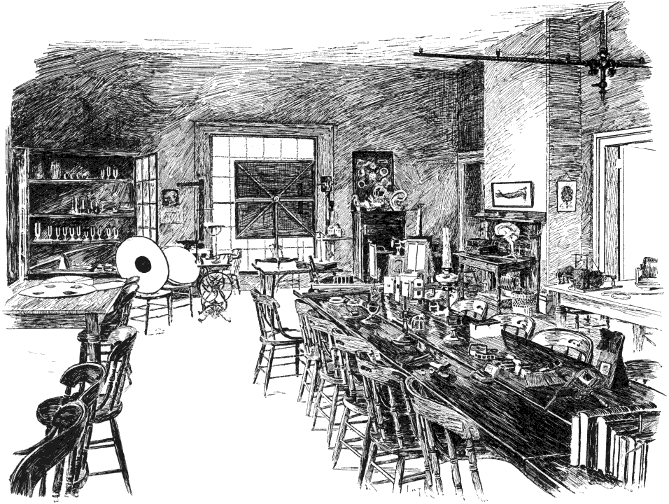
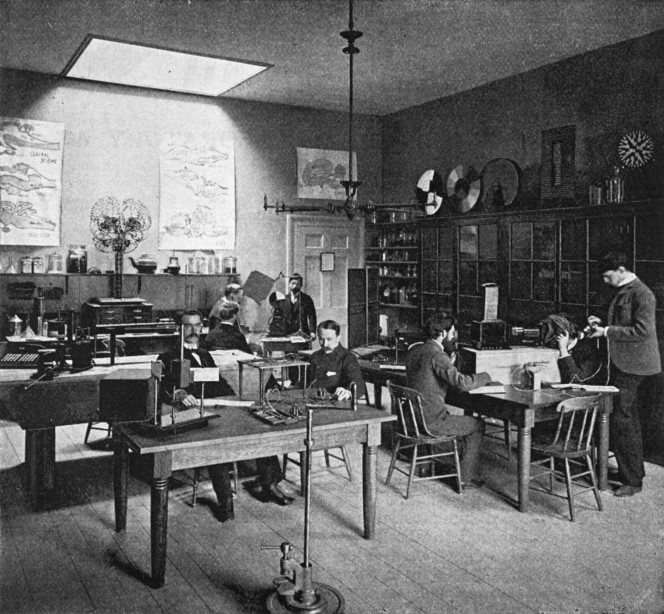
Yet a psychological laboratory looks much like any other modern laboratory. Around the rooms run glass-cases filled with fine instruments. Shelves line up, row after row, of specimen-jars and bottles. Charts cover the remainder of the walls. The tables and floors are crowded with working apparatus. Two large rooms and one small one are now occupied at Harvard. Four more rooms will be added to these this summer.
Also, the spirit that reigns in these rooms is the same that is found in other laboratories of exact science. This is the important thing. The minds of these workers are not wandering in dialectics and vagrant hypotheses. Reverence has opened her eyes. Hypotheses they have, and must have. Often they hold conflicting opinions. But the referee is always present—Nature herself. To experiment, to show the fact, is always the method of debate. This is the great advantage of the modern way of studying psychology over the old.
The American public is so practical that I feel I can alone satisfy its “whats and wherefores” by explicitly describing some of the investigations being carried on here.
EFFECT OF ELEMENTARY SENSATIONS ON ONE ANOTHER.
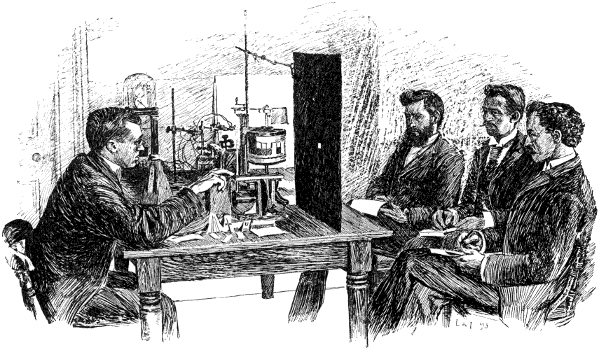
Here is a lantern throwing a steady light through a large tube. (See illustration below, the right hand group.) By transparent slides of colored glass or gelatine, the light may be made of any color. At the end of the tube is a box, like a camera. The operator covers his head with a cloth, and observes the color of the light as it shines from the tube through, or on, a tiny hole in the dark box. The size of the hole can be varied by moving slides, worked by micrometer screws so fine that they measure the dimensions of the hole to the four-hundredth of an inch.
STUDYING THE EFFECTS OF SOUND AND OF ATTENTION ON COLORS.
The first step is to discover the “threshold” of each separate color. That means the smallest-sized hole through which each color can be distinguished. This varies for different colors. But now comes the interesting point. The size of the hole, for any given color seen, varies according to the nature of any sound heard at the same time. For instance, in order to distinguish a given red, the hole must be larger or smaller, in proportion as the pitch of a musical tone is lower or higher, fainter or stronger.
STUDYING THE EFFECTS OF COLORS ON JUDGMENTS OF TIME.
The above experiment is one in a system of investigations, intended to discover the laws by which the simplest sensations modify each other under the simplest conditions. These are laws as fixed as the laws of gravity, and, once determined, we may move on to study the combination of these elements into the higher thought processes.
EFFECTS OF ATTENTION.
Another experiment will further illustrate this method of study. An apparatus is so contrived that a colored disk can be made darker or brighter by the operator, and a measure of the change be recorded. (See illustration on opposite page, rear group.) The persons operated on do not know what change is made, or whether any will be made or not. They first look at the disk for ten seconds, taking good note of its color. Next, the operator changes the shade (or not) as he sees fit. Then for another ten seconds the subject judges the shade of color, but this time performs meanwhile a sum in addition as the operator calls to him simple numbers.
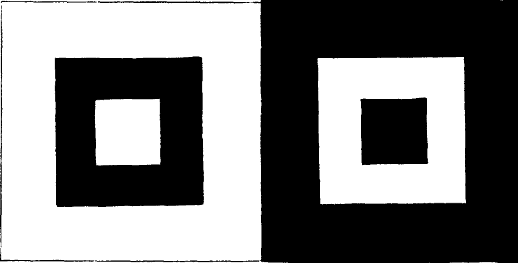
The experiment is to determine how the appearance of the color changes, by reason of dividing the attention between observing the disk and performing the addition. Do the colors of a rival’s bonnet really grow more glaring the harder they are looked at? To explain this is to touch on a social as well as an esthetic problem.
Diversion of attention changes the appearance of distances as well as of colors. A large frame covered with black cloth stands vertical. Two tiny white disks are held in place on the cloth by invisible threads manipulated behind the frame by the operator. When the disks are set a given distance apart they rest close upon the smooth black ground. The eye sees but two white spots in a free field, and may judge the distance between them without complication. This is done for ten seconds, as with the color disks. Then the spots are covered, and their distance apart slightly changed (or not) by the operator. Again they are shown, and now judged for ten seconds while adding figures. The mental process of addition changes the judgment of the distance.
You will say it is a familiar experience that the road seems longer or shorter as the mind is busy or not. But it is not a familiar thing to determine the law of such lengthening and shortening for definite distances, and under precise mental condition, as in the above experiment.
JUDGMENTS OF TIME.
Every woman knows that color has an effect on the apparent size of objects; that of her dress on her figure.[2] It is not as well known that color affects our judgments of time. Our next experiment examines this matter.
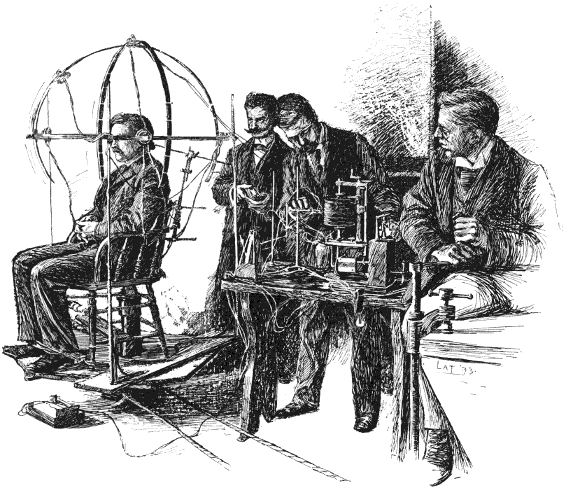
REVOLVING CHAIR FOR STUDYING LOCALIZATIONS OF SOUNDS.
Upon a cylinder, slowly revolving by fine clockwork, strips of different colored cardboard are fastened, and observed through a hole in a screen. (See illustration on the preceding page.) The time of each rotation is measured precisely. By observation it is found that the period of rotation seems to vary with the colors on the cylinder. By combining colors differently through a long and tedious series of investigations on many people, it is being determined what part this sort of influence plays in mental processes. “When things look gay, time seems short.” Psychology seeks the laws of such happenings.
LOCALIZATION OF SOUNDS.
They are the most familiar things which in our science become the strangest. Not to know where you are when seasick, still less where your mind is, is common enough. Our next experiment will trace our power to know where sounds are to the same origin as seasickness.
Seasickness starts in the ear. In its cavity are three small tubes, each bent in a circle, and filled with fluid. The three sit at right angles to each other, like the three sides at the corner of a room or a box. Consequently, in whatever direction the head is moved, the fluid in some one of the tubes is given a circular motion. Hanging out into the tubes, from their sides, are hairs or cilia, which connect with nerve cells and fibres that branch off from the auditory nerve. When the head moves the fluid moves, the hairs move, the cells are “fired off,” a nervous current is sent up to the brain, and a feeling of the head’s peculiar motion is consequent.
As for seasickness: this nerve current, on its way to the brain, at one point runs beside the spot or “centre” where the nerve governing the stomach has its origin. When the rocking of the head is abnormally violent and prolonged, the stimulus is so great that the current leaks over into this adjoining “centre,” and so excites the nerve running to the stomach as to cause wretchedness and retching. Deaf mutes, whose ear “canals” are affected, are never seasick.
But normally the amount of ear-feeling which we get by reason of moving our head in a particular direction comes in a curious way to be a measure of the direction of sound. The feelings we get from our skin and muscles in turning the head play a similar rôle. We turn our ear to catch a sound. We do this so frequently for every point, that in time we learn to judge the direction of the sound by the way we would have to turn the head in order to hear the sound best. Thereafter we do not have to turn the head to get the direction, for we now remember the proper feeling and know it. This memory of the old feeling is our idea of the present direction. If we never moved our heads we never could have any such notion of the location of sounds as at present—perhaps none whatever.
MENTAL ORIGIN OF NUMBERS.
Number! surely there can be nothing mysterious here; no “law” to be discovered about one, two, three? Well, the next time you shake hands, ask the man what he feels. A hand. Then ask further and he will feel five fingers. Now ask rightly and he will feel any number of distinct spots of pressure. But the real pressures were practically the same all through. Why, then, did he feel first one, then five, then eight, ten, or a dozen? So with the objects we become acquainted with through any of our senses! Why does the same bit of nature now stand before us “one tree,” and now a myriad of leaves and branches? Why do the same outer groupings fall into such different inner groupings? Why does not the result of each little nerve of the millions continually played on in eye, ear, and skin stand out by itself, and we have so many million feelings?
To explain this: the first time a child opens his eyes he sees, as Professor James says, but “one big, blooming, buzzing confusion.” Not till some “whole” (knife) be broken up into parts (blade, handle) and each part be mentally perceived in immediate succession the one after the other can the idea of “twoness” ever be possible to that child. The “twoness” is a feeling of distinct nature apart from the two terms (blade, handle). It rises from the “shock of succession.” It is one of the “modified states” wrought by one element on another, which we studied in our first experiment. Once lodged in the mind, the feeling may be remembered and reawakened, like any other. Thereafter the two parts or terms may come before the mind, awaken this feeling of twoness, and now stand side by side, simultaneously and numerically separate.
These are the primary laws of number perception. Our experiments illustrate and prove them. Though the nerves lying under a needle point are really several in number, the pressure on them is commonly felt as “one prick.” The area is so small that usually, through life, all the nerves have been pressed together. They have not been split up and pressed enough times in succession among themselves for a memory of “twoness” to have been developed among them. But, by proper manipulation, not unlike some of the processes of hypnotism, yet perfectly normal, the “twoness” of some other group of nerves can be yoked to the feeling resulting from the pressure of a particular needle point. Thereupon the one needle will feel like two, as distinctly and clearly as any real two.
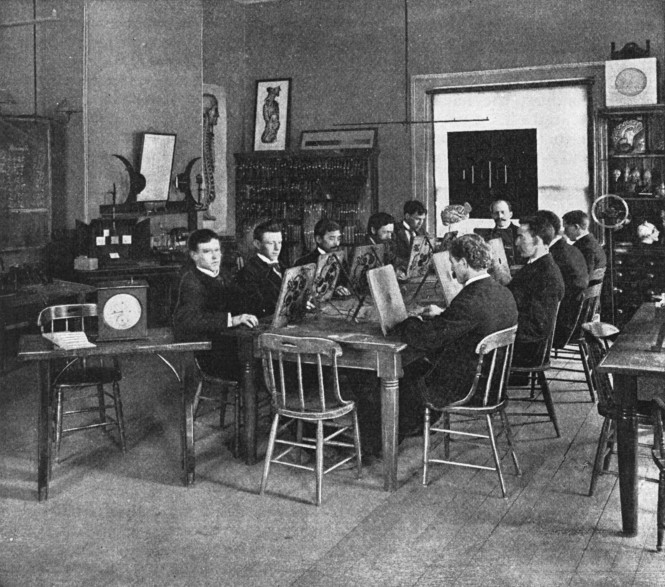
MEASURING THE TIME REQUIRED FOR VARIOUS MENTAL ACTS.
MENTAL ORIGIN OF DISTANCES AND SPACE.
By similar manipulations the simple needle may be made to feel like three or like four; now standing in a line, now in a triangle, and again in the corners of a square. But, since there is but one needle, what about the apparent distance between these several points that are clearly felt? This is the most curious thing of all, and from the light it throws on the formation of our “ideas” both of number and of space, is the most important.
To explain this: our notion of distance results out of “series” of sensations, in the same way as our notions of number. To have any idea of “distance” aroused between any two points of skin, the line of nerves lying between those points must, some time during life, have been previously stimulated in a line of succession, such as would result from a pencil drawn along between them. A card edge would give no idea of “distance” until such a series had some time been previously experienced. The memory of the “series” is the idea of the distance.
Within small areas of the skin, so few “series” have been experienced that no “distance memories” have been developed. Consequently pin-point areas commonly awaken no notion of distance. For some regions of the body these “limit areas” are larger than for others; at some places are quite large. On the back, spaces three inches apart may fail to give any idea of number or of distance. Every region has such a limit distance.
Now it is this limit distance, the smallest distance for which a “series” memory has been developed for a given region, that always shoves itself in, as the apparent distance between the several fictitious points felt from the single needle in our experiment. On the back the one needle feels like two set three inches apart; on the forehead like two half an inch apart; on the tongue one-sixteenth of an inch; and so on.
The upshot, then, of this matter is to show that our whole mind—our notions of space, number, time, and all else—is but a bundle of lawful habits, formed in relation with the things and occurrences around us. Ordinarily we have right ideas, because on the whole our mind has formed right habits. We have the right idea of an inch of skin, because the proper idea of an “inch long” has become habitually joined to each inch of skin, or in so far as this has been done. When a wrong idea gets joined, then we have an illusion; that is, the stretch of skin, or, as well, the pin-point of skin, seems a fraction of an inch in length; or, again, like three inches.
“TIME REACTIONS:” METHODS OF MEASURING THE TIME REQUIRED FOR PERFORMING VARIOUS MENTAL ACTS.
A sketch like this would be incomplete without a word about time reactions—a subject that historically was almost the first in the field, and has occupied more workers than any other. A generation ago “as quick as thought” was our extreme limit of expression. It outran “quicker than lightning.” The great physiologist, Johannes Müller, wrote, in 1844:
“We shall probably never secure the means of ascertaining the speed of nerve activities, because we lack the comparative distances from which the speed of a movement, in this respect analogous to light, could be calculated.”
We now know that sensory processes travel along the nerves on an average only about one hundred and ten feet per second, and often less than twenty-six feet. While you are performing the commonest judgment, electricity or light would have shot from continent to continent. The time-measurement of different mental processes is now one of the chief means which the psychologist uses for getting at mental laws. When certain measures are once determined, he uses these as the chemist does his familiar reagents, to dissolve the unfamiliar and more complicated combinations.
The following table shows in decimals of a second about the average length of time which our commonest judgments occupy:
SECONDS
To recognize the direction of a ray of light.011
To recognize a color when one of two, as red and blue, and expected to be seen.012
To recognize the direction of ordinary sounds.015
To localize mentally, when blindfolded, any place on our body, touched by another person.021
Mentally to judge a distance when seen.022
To recognize the direction of loud sounds.062
To recognize capital letters.180
To recognize short English words.214
To recognize pictures of objects.163
To add single figures.170
Given a month, to name its season.164 to .354
To answer such questions as “Who wrote Hamlet?”.900 and over.
Such then, are a few out of the many problems which have been experimented upon in the Harvard Laboratory during the last year—problems in perception, association, attention, “reaction times,” psycho-physic law, kinesthetics, esthetics, memory, will, and so on, covering nearly the whole range of mental phenomena. I have selected these few for presentation here, not for their importance over others, but because they could be simply described in these pages. The general aim of all the work is, however, very simple. As in the other sciences, it seeks to establish fact after fact, in orderly manner, along the whole line of mental nature; and by unifying these to work ever to a larger knowledge of the whole.
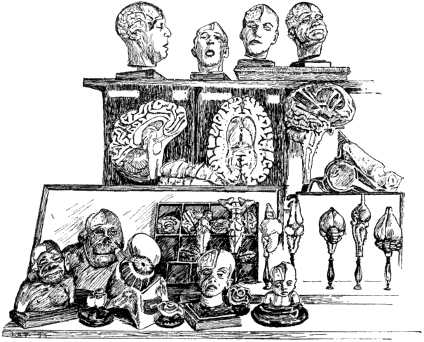
WAX SPECIMENS IN THE MUSEUM.
FACILITIES FOR TEACHING.
But the university laboratory is for teaching as well as for discovering. It is equipped for the undergraduate, as well as for the advanced investigator. The elementary or demonstrational courses are designed to impress upon the student the facts, the methods, and the spirit of his science. There is now furnished for these, at Harvard, nearly every kind of apparatus commonly used in physical and physiological laboratories, for the study of neurology, optics, acoustics, kinesthetics, esthetics, anthropology, and so on. The electrical department is a miniature laboratory in itself. And the various models in wax, wire, and plaster—of eyes, ears, brains, fishes, reptiles, monkeys, children, adults, idiots, insane people, and people of genius—is a veritable museum.[3]
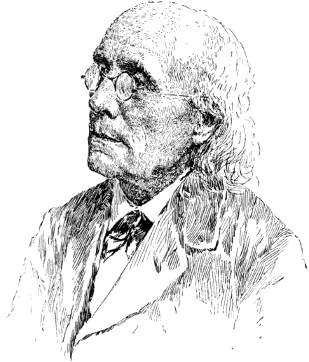
GUSTAVE THEODORE FECHNER.
The laboratory workshop is provided with the common implements and facilities required for working in wood, glass, and metal. Both for original research and for demonstration, this laboratory is the most unique, the richest, and the most complete in any country; and in witness of the fame and genius of its present director, and of the rapidly spreading interest in experimental psychology, particularly in America, there are already gathered here, under Professor Münsterberg’s administration, a larger number of students specially devoted to mental science than ever previously studied together in any one place.
THE FUTURE AND INFLUENCE OF THE NEW SCIENCE.
So much for the place and what is done there. Now, what is expected to come from this new psychology? “Do you fellows expect to invent patent ways of thinking?” was once asked me. Who can tell? Who, before Galileo, would have prophesied that man should weigh the stars or know their chemistry? Yet there is much ground for comparison between the position of physical science then and that of mental science now. The popular opinion of to-day is perhaps even less awake to the fact that the world of mental phenomena is a world of laws, susceptible to scientific experimentation, than was the day of Galileo to the similar conception regarding physical phenomena. Have the physical sciences changed aught for man since the sixteenth century? Then we must not forget how slow was the growth, and how long it took to arrive at the laws of gravity and of conservation, not to mention those of evolution. Experimental psychology, as a systematic science, is almost younger than its youngest students. The mental laws are as fixed and as determinable as the laws of physics. Who then shall say what man shall come to know of mental composition, of the great mental universe, and of ourselves, its wandering planets, since minds may be known as well as stars!
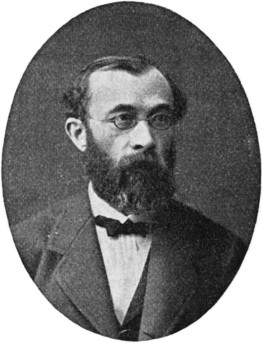
PROFESSOR WILHELM WUNDT, OF LEIPSIC, FOUNDER OF FIRST PSYCHOLOGICAL LABORATORY (1878).
But psychology will not have to wait till its greater laws shall be wholly established before she becomes of practical influence in common affairs. He who reads most thoughtfully to-day will most appreciate this truth. He who reads at all, reads of “individualism” as opposed to “socialism.” The Pope of Rome has declared that the “preoccupying” problem for active Christianity must now be the industrial problem. Every important treatise on the subject, appearing at present, admits that the crucial question of the industrial problem is an ethical problem, and every ethical treatise, that every ethical problem is a psychological problem. Two years ago the Roman Catholic Church established a psychological laboratory in its leading American college.
The Presbyterians the coming year will follow with a laboratory at Princeton. Psychology is no longer feared by religion, but is accepted, though in places yet too timidly, as a source of its further and unending revelation.
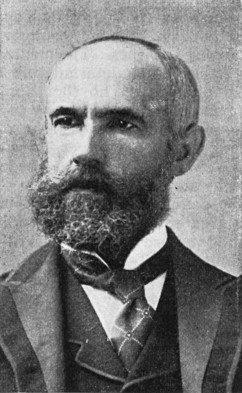
PRESIDENT G. STANLEY HALL, FOUNDER OF FIRST PSYCHOLOGICAL LABORATORY IN AMERICA.
But psychology is coming close to affairs of church and state in more than one way. One of the greatest crimes of modern society is its conception of criminal jurisprudence. Between the fœtal period and adult life man passes through, in abridged series, all the degrees of evolution that have led up through the lower animal stages to his own. In early infancy, and even in childhood, he is not yet wholly man; not yet safely over the brute period of his lineal development. If the domestic calf and chicken spend their first days wild in the woods, this pre-domestic environment will seize upon and develop their pre-domestic traits; and these once set, no amount of domestic training will, thereafter, make calf or chicken anything else than a wild, untamable creature. The early instinctive periods of man’s progeny are more prolonged, more delicate, and more susceptible than those of lower animals, yet are of the same nature. If left to evil environment in early years the latent brute within him will surely lay hold of its own, and ripen the yet innocent child to a creature bearing the same relation to the moral and civilized man that the wild wolf does to the house-dog.
On the other hand, the wolf whose first lair is the hunter’s hearth, grows to share it lovingly with the hunter’s children. The government that ignores the hordes of children which crowd to-day the criminal quarters of its great cities, and abandons them to ripen their pre-civilized propensities under such evil influences, becomes itself the foster-father of its own crimes; nurses its own children to fill its poorhouses, and raises its own youths to fill its prisons. Psychology, if on mere ground of financial economy alone, will yet force criminal jurisprudence to begin its work before, rather than after, this early period of “unalterable penalty.”
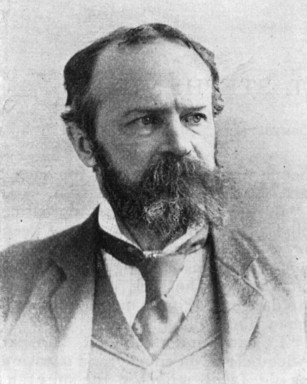
PROFESSOR WILLIAM JAMES, HARVARD UNIVERSITY.
The benefits of a psychological training to the medical man are now so obvious as to make a knowledge of psychology imperative for every first-class physician. The nervous activities are the regulating activities of every part of the body; and the brain embodies an ever-meddling three-fourths of the body’s whole neural energy. The mind is a play-house wherein the skilful physician now looks to observe the condition of the general system, and with growing precision even to read the working of such specific organs as the heart, the stomach, the bladder, and the liver.
The relation of our science to modern education has long passed from novelty to a recognized principle. A chair of psychology and a chair of pedagogy, side by side and hand in hand, is now the requisite of every institution of advanced learning. “To get up more ‘fads’? More patent methods?” It is only the ignorant now who ask these questions. Galton has shown that some men do their thinking in visual pictures—in memories of what they see; others, in memories of what they hear; others, in the memories of their own speaking. There is reason to suspect that the lightning-calculator’s speed is largely due to peculiar “image processes” used in his thinking, and that these could be taught if science could but catch his unconscious secrets. This in time will be done, and is but an instance of innumerable things that are sure to be accomplished. In the face of all present pedagogical fads and blunders we may yet say with confidence, of the mind, the instincts, the emotions, the conduct of man, individual and social, all is lawful; and the laws may be discovered. They are difficult—more difficult than all the physical laws achieved from Ptolemy to Darwin. But they can be scientifically determined and mastered, and modern methods, swift with gathering impetus, shall make of this no lingering matter.
HISTORY OF MENTAL LABORATORIES.
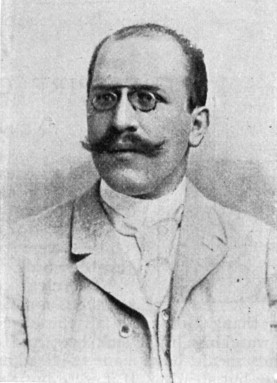
PROFESSOR HUGO MÜNSTERBERG, HARVARD UNIVERSITY.
The psychological laboratory sprang first from no single mind; not wholly from science nor yet from philosophy, but from an age. In 1860 Gustave Theodore Fechner, the godfather of experimental psychology, published his famous Law. Fechner was as much a mystic as a scientist. His Law was, perhaps, the first great impetus to active psycho-physical experimentation. The prospects now are, however, that this Law will stand, a halfway truth, beside Newton’s erroneous theory of light, rather than, as was at first claimed for it, beside the Law of Gravity, a great primary law of nature.
The spirit of Fechner, of evolution, and of our times joined to fall upon Wilhelm Wundt, who founded at Leipsic, in 1878, the first laboratory in the world for regular scientific mental experimentation. Professor Wundt is the greatest psychologist now living in Europe, and a majority of the noted psychological experts, both of Germany and of America, have been his pupils.
One of these pupils, G. Stanley Hall, now President of Clark University, opened the first American laboratory at Johns Hopkins in 1883, and the larger laboratory at Worcester in 1889. To him must be credited the founding of experimental psychology in this country, and an eminent share of its present successful growth.
A foremost figure in modern psychology is Professor William James, of Harvard, whose great text-book, the product of twelve years of labor, appeared in 1890. In 1891 he opened the present Harvard Laboratory, or, at least, expanded a previously slow growth to important dimensions.
In 1892 Harvard established a new chair of Experimental Psychology, and elected to the same, and to direct its new laboratory, Professor Hugo Münsterberg, previously Professor of Philosophy at Freyburg, Germany. Professor Münsterberg was at one time a pupil of Wundt, but is much more a man of original inspiration; and in his genius the hopes and destiny of experimental psychology at Harvard are now centred.
Some twenty laboratories are now actively at work in America, and about half that number in Europe. The twentieth century will be to mental what the sixteenth century was to physical science, and the central field of its development is likely to be America.
Harvard University, July, 1893.