MOUNTAINEERING ADVENTURE. THE DANGERS OF AVALANCHE, GLACIER, CREVASSE, AND PRECIPICE. By Francis Gribble.
Reading edition
This is the season when the mountaineer once more takes down his Norfolk jacket, his nailed boots, and his ice-axe, and prepares to face the perils that may lurk for him above the snowline.
Strictly speaking—from the point of view of the expert who knows and does everything that an expert ought to know and do—mountaineering has two dangers only. There is the danger of bad weather, and there is the danger of the falling stone. But every climber is not an expert, and even of experts it may be said that nemo horis omnibus sapit. So that there are all sorts of dangers to be reckoned with, and foremost among them is the avalanche.
Everybody knows—vaguely, if not precisely—what an avalanche is. Masses of snow accumulate in winter on the mountain slopes. In spring the warmth loosens their coherence, and they fall into the valleys, sweeping away or burying everything in their track. It is bad for the mountaineer, if he happens to be in the way of one.
Says the editor of the volume devoted to mountaineering, in the Badminton Library: “The simple rule with regard to all forms of avalanche is to avoid their track, and all that is necessary in the majority of instances is to recognize the marks on the snow surfaces that denote their cause, and to steer clear of them.”
THE NARROW ESCAPE OF MR. TUCKETT.
Undoubtedly an admirable rule, if only it could be always carried out. But mistakes, unhappily, may be made even by experts, as witness this story of a thrilling adventure which befell F. F. Tuckett, twenty-two years ago.
The season had been exceptionally cold and wet. Snow lay thickly everywhere, even on the Faulhorn, the Scheinige Platte, and the Wengern Alp. But in the early days of July an improvement began to show itself, and Mr. Tuckett, who for a whole month had been able to make no big expedition, resolved to make an attempt upon the Eiger.
The members of the party were Mr. Tuckett, Mr. Whitwell, J. H. Fox, and the guides, Christian and Ulrich Lauener. They got off between 3 and 4 A.M., and presently started to ascend the Eiger glacier. The surface of it was entirely concealed with snow, but, for some reason, they neglected to put on the rope. High up in front of them were the disordered pillars and buttresses of the ice-fall, and above the ice-fall rested an enormous weight of freshly fallen snow.
Instead of ascending the centre of the glacier, the party, fortunately for themselves, were keeping to the left, towards the rocks of the Rothstock. Of a sudden, a sort of crack was heard high up above their heads, and every eye was turned upon the hanging ice-cliff from which it came. A large mass of “sérac” was seen to break away, mingled with a still larger contingent of snow from the slopes above; and the whole mass slid down like a cataract, filling the “couloir” to its brim, and dashing in clouds of frozen spray over the rocky ridges in its path, towards the travellers.
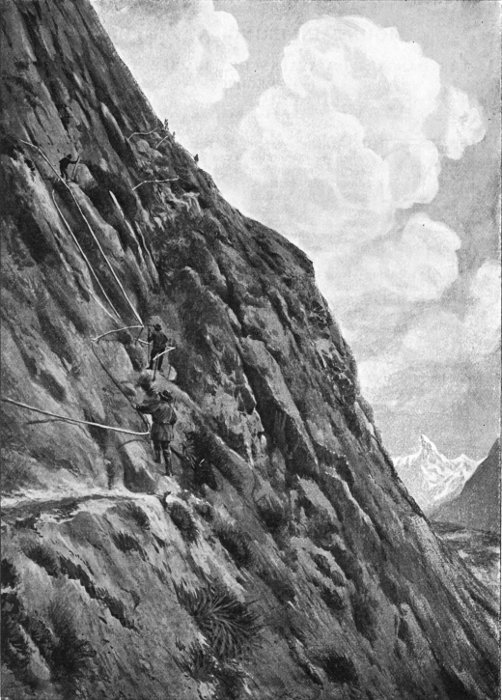
THE MAUVAIS PAS, MONT BLANC.
For a moment they did not realize that they were in its track. But then the knowledge flashed upon them all, and they shouted to each other, “Run for your lives,” and struggled desperately through the deep, soft snow to reach the rocks of the Rothstock, yet with their faces turned to watch the swift oncoming of the foe.
Let Mr. Tuckett himself describe that thrilling race for life.
“I remember,” he writes, “being struck with the idea that it seemed as though, sure of its prey, it wished to play with us for a while, at one moment letting us imagine that we had gained upon it, and were getting beyond the line of its fire, and the next, with mere wantonness of vindictive power, suddenly rolling out on its right a vast volume of grinding blocks and whirling snow, as though to show that it could outflank us at any moment if it chose.
“Nearer and nearer it came, its front like a mighty wave about to break. Now it has traversed the whole width of the glacier above us, taking a somewhat diagonal direction; and now—run, oh! run, if ever you did, for here it comes straight at us, swift, deadly, and implacable! The next instant we saw no more; a wild confusion of whirling snow and fragments of ice—a frozen cloud—swept over us, entirely concealing us from one another, and still we were untouched—at least I knew that I was—and still we ran. Another half-second and the mist had passed, and there lay the body of the monster, whose head was still careering away at lightning speed far below us, motionless, rigid, and harmless.”
The danger was over, and the party examined the avalanche at their leisure. It had a length of three thousand three hundred feet, an average breadth of a thousand feet, and an average depth of five feet. This is to say, its bulk was six hundred and eleven thousand cubic yards, and its weight, on a moderate computation, about four hundred and fifty thousand tons.
Accidents of this sort, happily, are very rare, and the climber who is carried away by the avalanche has, as a rule, deliberately faced the risk out of bravado, and the desire to go home and boast that he had done hard things. But there is another sort of avalanche which is a much more frequent source of danger. It consists of a stratum of snow loosely adherent to a slope of névé or ice. The snow breaks away under the weight of the party, and carries them down with it, sometimes to a place of safety, sometimes to a crevasse.
AN ADVENTURE OF PROFESSOR TYNDALL.
Experience, of course, has laid down many rules for determining whether snow of this sort is safe, but the best men—guides as well as amateurs—may sometimes be misled. Professor Tyndall, for instance, was always a cautious as well as a brilliant mountaineer; yet there was a day when the professor’s snow craft failed him, and he came very near to paying for his blunder with his life.
The place was the Piz Morteratsch, in the Engadine, and the time the month of July, 1864. Professor Tyndall’s companions were Mr. Hutchinson and Lee Warner, and the guides Jenni and Walter. Jenni was at that time the dictator of Pontresina, and he seems to have set out with the deliberate intention of showing his Herren how great and brave a man he was.
The ascent was accomplished without any incident of note. On the way down the party reached a broad couloir, or gully, filled with snow, which had been melted and refrozen, so as to expose a steeply sloping wall of ice. The question arose whether it would be better to descend this wall of ice, or to keep to the steep rocks by the side of it. Professor Tyndall preferred the rocks; Jenni inclined towards the slope, and started to lead the way upon it.
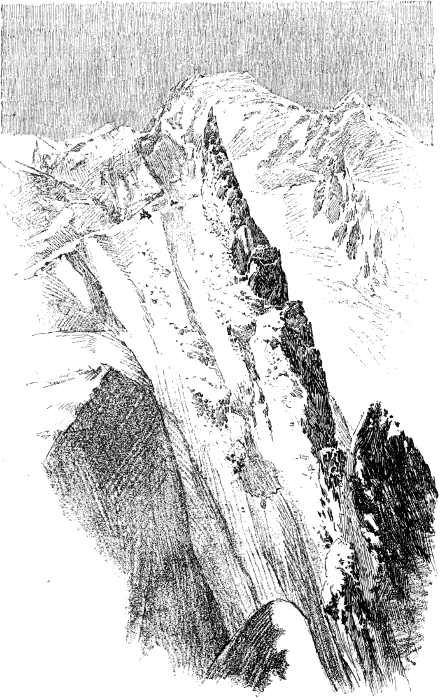
THE NEEDLE OF THE GIANTS AND MONT BLANC.
There was a remonstrance from the professor:
“Jenni,” he said, “do you know where you are going? The slope is pure ice.”
“I know it,” the guide replied, “but the ice is quite bare for a few rods only. Across this exposed portion I will cut steps, and then the snow which covers the ice will give us a footing.”
So they started, roped together, Jenni in front, Mr. Tyndall next, followed by Mr. Hutchinson, Mr. Lee Warner, the one inexperienced member of the party, and, last of all, the guide Walter, ready to check on the instant any false step that Mr. Lee Warner might make.
After a few steps Jenni began to see that the slope was less safe than he had supposed. He stopped and turned round to speak a word of warning to the three men above him.
“Keep carefully in the steps, gentlemen,” he said; “a false step here might start an avalanche.”
And, even as he spoke, the false step was made. There was a sound of a fall and a rush, and Professor Tyndall saw his friends and their guide, all apparently entangled, whirled past him. He planted himself to resist the shock, but it was irresistible; he, too, was torn from his foothold, and Jenni followed him, and all five found themselves riding downwards, with uncontrollable speed, on the back of an avalanche, which a single slip had started.
“Turn on your face, and grind the point of your axe or baton through the moving snow into the ice”—that is the golden rule for cases of the kind, the only way in which the faller can do anything to arrest his speed. But it seldom avails much, and in this instance it availed nothing.
“No time,” writes Professor Tyndall, “was allowed for the break’s action; for I had held it firmly thus for a few seconds only, when I came into collision with some obstacle and was rudely tossed through the air, Jenni at the same time being shot down upon me. Both of us here lost our batons. We had been carried over a crevasse, had hit its lower edge, and, instead of dropping into it, were pitched by our great velocity beyond it. I was quite bewildered for a moment, but immediately righted myself, and could see the men in front of me, half-buried in the snow, and jolted from side to side by the ruts among which we were passing.”
Presently a second crevasse was reached. Jenni knew that it was there, and did a brave thing. He deliberately threw himself into the chasm, thinking that the strain thus put upon the rope would stop the motion. But, though he was over a hundred and eighty pounds in weight, he was violently jerked out of the fissure, and almost squeezed to death by the pressure of the rope.
And so they continued to slide on. Below them was a long slope, leading directly downwards to a brow where the glacier fell precipitously; and at the base of the declivity the ice was cut by a series of profound chasms, where they must fall, and where the tail of the avalanche would cover them up forever.
The three foremost men rode upon the forehead of the avalanche, and were at times almost wholly hidden by the snow; but behind, the sliding layer was not so thick, and Jenni strove with desperate energy to arrest his progress.
“Halt! Herr Jesus! halt!” he shouted, as again and again he drove his heels into the firmer surface underneath.
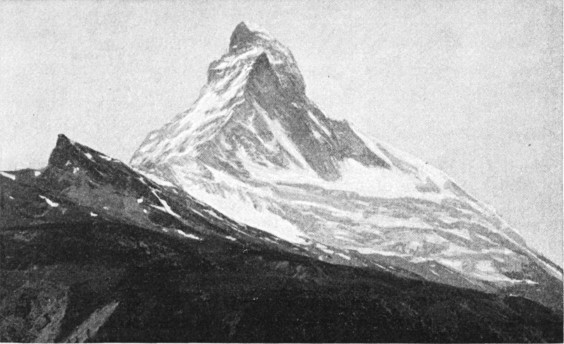
THE MATTERHORN.
And now let Professor Tyndall tell the rest:
“Looking in advance, I noticed that the slope, for a short distance, became less steep, and then fell as before. Now or never we must be brought to rest. The speed visibly slackened, and I thought we were saved. But the momentum had been too great; the avalanche crossed the brow and in part regained its motion. Here Hutchinson threw his arm round his friend, all hope being extinguished, while I grasped my belt and struggled to free myself. Finding this difficult, from the tossing, I sullenly resumed the strain upon the rope. Destiny had so related the downward impetus to Jenni’s pull as to give the latter a slight advantage, and the whole question was whether the opposing force would have sufficient time to act. This was also arranged in our favor, for we came to rest so near the brow that two or three seconds of our average motion of descent must have carried us over. Had this occurred, we should have fallen into the chasms and been covered up by the tail of the avalanche. Hutchinson emerged from the snow with his forehead bleeding, but the wound was superficial; Jenni had a bit of flesh removed from his hand by collision against a stone; the pressure of the rope had left black welts on my arms, and we all experienced a tingling sensation over the hands, like that produced by incipient frost-bite, which continued for several days. This was all. I found a portion of my watch-chain hanging round my neck, another portion in my pocket; the watch was gone.”
Very similar in many respects was the famous accident of the Haut de Cry, in which J. J. Bennen perished in February, 1864. So sure of foot was Bennen that it used to be said of him, as it was said of Johann Lauener, who died upon the Jungfrau, that nothing could bring him to grief but an avalanche. And the hour came when the snowfield which he was crossing with his Herren split suddenly and the ground on which they stood began to move, and Bennen solemnly called out the words, “Wir sind alle verloren,” and never spoke again.
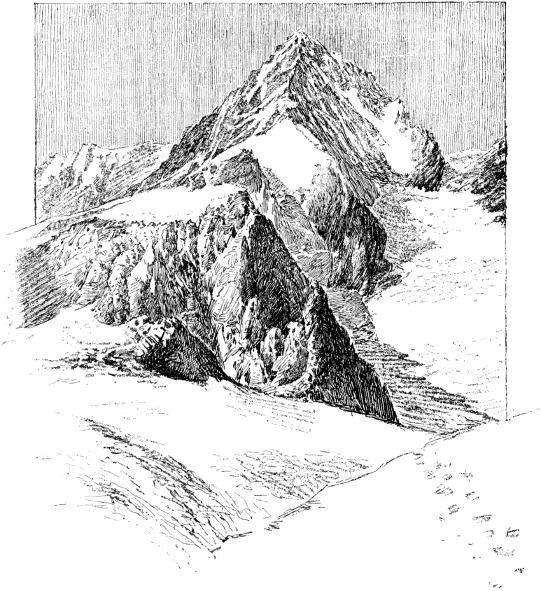
THE DENT BLANCHE.
The avalanche was deeper than the one which swept Professor Tyndall down the glacier of the Piz Morteratsch. “Before long,” writes Mr. Gossett, one of the survivors of the accident, “I was covered up with snow and in utter darkness. I was suffocating, when, with a jerk, I suddenly came to the surface again. To prevent myself sinking again I made use of my arms much in the same way as when swimming in a standing position. At last I noticed that I was moving slower; then I saw the pieces of snow in front of me stop at some yards distance; then the snow straight before me stopped, and I heard on a large scale the same creaking sound that is produced when a heavy cart passes over hard, frozen snow in winter.”
But the snow behind pressed on and buried Mr. Gossett. So intense was the pressure that he could not move, and he began to fear that it would be impossible to extricate himself. Then, while trying vainly to move his arms, he suddenly became aware that his hands, as far as the wrist, had the faculty of motion. The cheering conclusion was that they must be above the snow. So Mr. Gossett struggled on. At last he saw a faint glimmer of light. The crust above his head was getting thinner, and let a little air pass; but he could no longer reach it with his hands. The idea struck him that he might pierce it with his breath. He tried, and after several efforts he succeeded. Then he shouted for help, and one of his guides, who had escaped uninjured, came and extricated him. The snow had to be cut with the axe down to his feet before he could be pulled out. Then he found that his travelling companion, M. Boissonnet, was dead, and that no trace of Bennen could be seen. His body, however, was afterwards recovered. The story is told in a letter from Mr. Gossett to Professor Tyndall.
“Bennen’s body,” he writes, “was found with great difficulty the day after Boissonnet was found. The cord end had been covered up with snow. The Curé d’Ardon informed me that poor Bennen was found eight feet under the snow, in a horizontal position, the head facing the valley of the Luzerne. His watch had been wrenched from the chain, probably when the cord broke; the chain, however, remained attached to his waist-coat. This reminds me of your fall on the Morteratsch glacier.”
It may be said that the principal danger of climbing rock-mountains is the danger of falling off them. For the art consists largely in traversing the faces of precipices by means of narrow and imperfect ledges, which afford more facilities for falling off than will readily be believed by any one who has not tried to stand on them. The climbers, of course, are always securely roped together in such places, and the theory is that two of them shall always be so firmly anchored that they can instantly check any slip that the third may make. But that is not always feasible. It is not feasible, for instance, at the difficult corner on the Dent Blanche, where Mr. Gabbett and the two Lochmatters came to grief.
As all three climbers were killed on that occasion, no details of the accident are known. But the elder Lochmatter was known to be an exceptionally heavy man, and the presumption is that it was he who fell, and dragged the rest of the party after him. How he came to fall may be understood from the following description of the “Mauvais Pas,” given by a traveller who traversed it a little afterwards:
“Here,” he writes, “we must get round past a perpendicular ledge by creeping out on an overhanging rock, and then turning sharp round, with head and arms on one side of the rock, while the legs are still on the other; then we must at once cling to a hardly visible fissure, and draw round the rest of the body, gently, cautiously, little by little, and hang there by the points of our fingers until our toes find their way to a second fissure lower down. I made this passage,” he adds, “like a bale of goods at the end of a rope, without being conscious of the danger, and I really do not know how I escaped in safety.”
The description gives some idea of what stiff rock-climbing is really like; and it should be remembered that in the Dolomites more awkward places even than the Lochmatters’ corner have often to be passed, and that when, as often happens, the rocks are glazed with ice, the danger of climbing them is more than doubled.
It is always assumed that the Dent Blanche is inaccessible in such a case. Yet the story is told of an inexperienced climber who managed to get to the summit in spite of the ice.
He was on his first visit to Switzerland; and as soon as he got to Zermatt he engaged the best available guide.
“What are considered the hardest mountains here?” he asked.
The guide told him: “The Dent Blanche, the Weisshorn, and the Ober Gabelhorn.”
“Very well,” said the novice; “we’ll begin with the Dent Blanche.”
The guide protested. Did not his Herr think it would be better to begin with something easier—with the Rothhorn, for instance, or the Strahlhorn, or the Unter Gabelhorn?
“No,” was the reply; “you’ve got to take me up the Dent Blanche. I’ve climbed in Wales, and I’ll undertake to climb any rock you show me.”
So the guide yielded, and the two started, with a porter, and for a certain distance got on very well. But at last they came to a point where all the hand-holds within reach were frozen up; the nearest practicable hand-hold could only just be found by stretching out the ice-axe. The guide explained the situation, and insisted that they must turn back. But his employer had been roused to such a pitch of excitement that he would not hear of it.
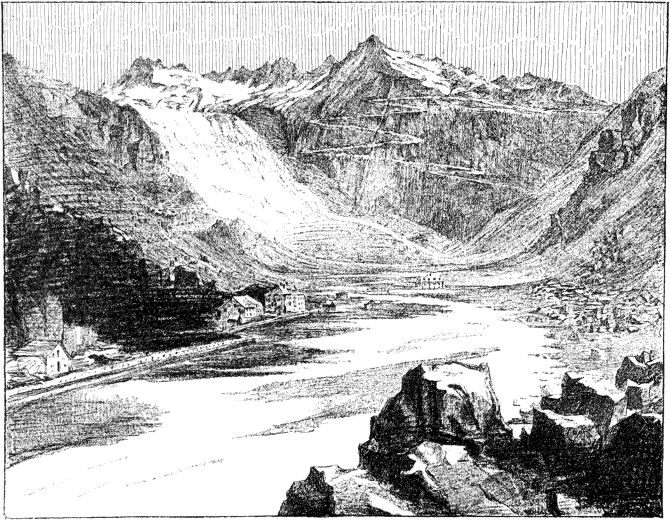
THE RHONE GLACIER.
“Look here,” he said, “you’re a bachelor; I’m a married man with a family. If I can afford to risk my life you can afford to risk yours. You’ve got to go on up this mountain. Otherwise I’ll throw myself over the precipice, and as you’re roped to me you’ll have to come, too.”
The man was absolutely mad. There was no question that, in his excitement, he would do what he threatened if he were not obeyed. So the guide sullenly struck his ice-axe into the fissure, and climbed up it hand over hand, and took his lunatic up and down the Dent Blanche at a time when its ascent ought by all the laws of ice-craft to have been impossible.
CROSSING GLACIERS.
To turn from rock to snow climbing. Accidents are constantly happening on glaciers; yet the observance of the most elementary precautions ought to make such accidents absolutely impossible.
An open glacier, of course, is safe enough under any circumstances. The one thing needful is to look where you are going and not try to make flying leaps across crevasses. But even when the crevasses are masked by snow all danger may still quite easily be obviated. The simple rule is that the party crossing the glacier should never consist of less than three, and that the three should be roped together in such a way that, if one falls into a crevasse, the other two can pull him out. And this, of course, involves the further rule that the rope must always be kept taut, so that a fall may be checked before it has gained an impetus which would make it difficult to resist.
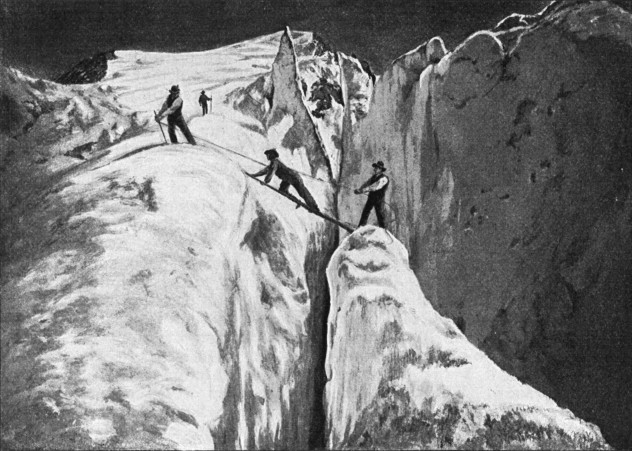
PASSAGE OF A CREVASSE, MONT BLANC.
By experience it is possible to recognize a crevasse, with tolerable accuracy, in spite of its snow covering; and by sounding with the ice-axe before treading on it, one ought to be able to tell whether the snow bridge will bear one’s weight. But, now and again, it will happen that the most experienced man’s judgment is at fault. Relying upon their instinctive perception of such things, the Swiss peasantry constantly traverse glaciers alone in mid-winter. But accidents are very frequent, and when guides, tourists, or porters have attempted the same thing, accidents have constantly befallen them as well. As an illustration may be quoted the case of a reporter, who foolishly ventured to return alone over the Loetschen pass. A snow bridge broke and he fell into a crevasse, where only his knapsack saved him from breaking his neck. He lay on his back, wedged into the ice in such a way that he could not move, and it was by the merest accident that he was discovered in time, and rescued by a party journeying in the same direction.
So much, as Herodotus would say, for crevasses. Another serious Alpine danger is the danger of bad weather; and bad weather, as Leslie Stephen has pointed out, may make the Righi at one time as dangerous as the Matterhorn at another.
To a certain extent, of course, bad weather can be foreseen; but meteorology is not yet an exact science, and even the acquired instinct of the guides is sometimes at fault, so that grave mistakes, often followed by fatal consequences, are made almost every year.
DANGERS OF BAD WEATHER.
Mont Blanc is probably the mountain in which bad weather makes the greatest difference. On a fine day, the ascent of it is scarcely more dangerous than the ascent of Primrose Hill; but in a storm you will lose your way, and wander round and round, until you sink down exhausted, and freeze to death.
In September, 1870, a party of eleven persons, eight of whom were guides or porters, were lost in this way. When their bodies were recovered, a memorandum was found in the pocket of one of them, J. Beane, of the United States of America, finished apparently just before his death, and giving a brief summary of the circumstances of the calamity. This is how it read:
“Tuesday, September 6.—I have made the ascent of Mont Blanc, with ten persons; eight guides, Mr. Corkendal and Mr. Randall. We arrived at the summit at 2.30 o’clock. Immediately after leaving it, I was enveloped in clouds of snow. We passed the night in a grotto excavated out of snow, affording very uncomfortable shelter, and I was ill all night.
“September 7 (morning).—Intense cold; much snow falls uninterruptedly: guides restless.
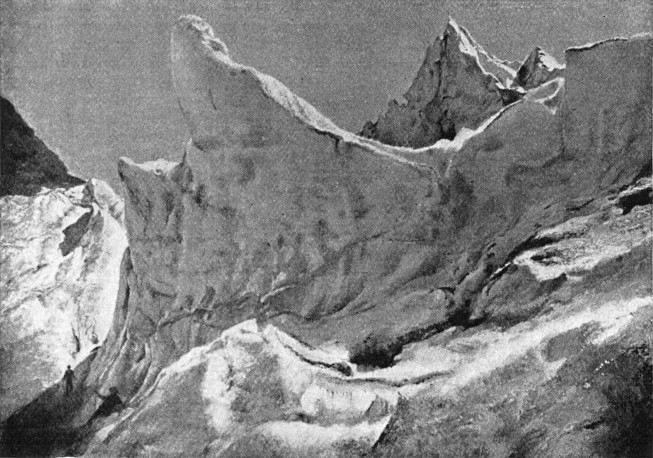
PYRAMIDS OF THE MORTERATSCH.
“September 7 (evening).—We have been on Mont Blanc for two days in a terrible snow-storm: we have lost our way and are in a hole scooped out of the snow, at a height of fifteen thousand feet. I have no hope of descending. Perhaps this book may be found and forwarded. (Here follow some instructions on his private affairs.) We have no food; my feet are already frozen and I am exhausted; I have only strength to write a few words. I die in the faith of Jesus Christ, with affectionate thoughts of my family. My remembrance to all. I trust we may meet in heaven.”
Says Leslie Stephen, commenting on the incident in the “Alpine Journal:”
“The main facts are so simple that little explanation is needed. The one special danger of Mont Blanc is bad weather. The inexperienced travellers were probably ignorant of the fearful danger they were encountering, and had not the slightest conception of the risk to life and limb which accompanies even a successful ascent of the mountain under such circumstances. I once ascended Mont Blanc on a day so unusually fine that we could lie on the summit for an hour, light matches in the open air, and enjoy the temperature. Yet, in two or three hours before sunrise, the guide of another party which ascended the same day was so severely frost-bitten as to lose his toes. Such things may happen in the finest weather, when proper precautions are neglected; but in bad weather it is simple madness to proceed. Why, one cannot help asking, did not the guides oppose the wishes of their employers?”
FALLING ICE.
Among other dangers that the mountaineer has to reckon with are ice avalanches and cornices.
A cornice is a mass of snow projecting over the edge of a precipice, and resting upon empty space. Occasionally it will bear the weight of one, or even several, men; but more often it gives way when trodden on, carrying a whole party to destruction. This was the case in the famous accident on the Lyskamm—a mountain where the cornices are particularly treacherous—when Messrs. William Arnold Lewis and Noel H. Paterson, with the guides Niklaus, Johann, and Peter Joseph Knubel, met their deaths in the year 1877. “The cornice,” writes Mr. Hartley, who visited the scene of the accident immediately afterwards, “had broken away in two places, leaving some ten feet in the middle still adhering to the mountain. The length of the parts which broke away was, perhaps, forty feet on each side of the remaining portion. The distance of the fall we estimated at from twelve hundred to fifteen hundred feet. The bodies, from the nature of the injuries they had received, had evidently fallen upon their heads on the rocks, and then, in one great bound, had reached almost the spot where they were found.”
A typical instance of the ice-avalanche accident happened to, and has been recorded by, Mr. Whymper. Accompanied by A. W. Moore and the guides Croz and Almer, he was trying to discover a shorter route than those usually taken between Zinal and Zermatt. After spending the night in a châlet on the Arpitetta Alp, they started, and struck directly up the centre of the Moming glacier. The route proved impracticable, and it became necessary to cut steps across an ice-slope immediately below the great pillars and buttresses of the ice-fall, which were liable to break away and descend upon them at any moment.
“I am not ashamed to confess,” wrote Mr. Moore in his journal, “that during the whole time we were crossing the slope my heart was in my mouth, and I never felt so relieved from such a load of care as when, after, I suppose, a passage of about twenty minutes, we got on to the rocks and were in safety. I have never heard a positive oath come from Almer’s mouth, but the language in which he kept up a running commentary, more to himself than to me, as we went along, was stronger than I should have given him credit for using. His prominent feeling seemed to be one of indignation that we should be in such a position, and self-reproach at being a party to the proceeding; while the emphatic way in which, at intervals, he exclaimed, ‘Quick; be quick,’ sufficiently betokened his alarm.”
And now, let the rest of the story be told in Mr. Whymper’s graphic words. Croz, it should be remembered, was leading, and had advised the perilous route.
“It was not necessary,” Mr. Whymper says, “to admonish Croz to be quick. He was fully as alive to the risk as any of the others. He told me afterwards that the place was not only the most dangerous he had ever crossed, but that no consideration whatever would tempt him to cross it again. Manfully did he exert himself to escape from the impending destruction. His head, bent down to his work, never turned to the right or to the left. One, two, three, went his axe, and then he stepped on to the spot where he had been cutting. How painfully insecure should we have considered those steps at any other time! But now we thought of nothing but the rocks in front, and of the hideous ‘séracs’ lurching over above us, apparently in the very act of falling.”
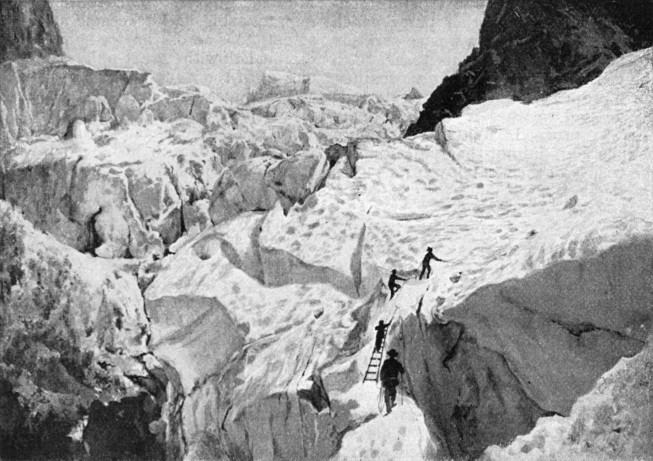
PASSAGE OF A CREVASSE, MONT BLANC.
At last they reached the rocks in safety, and, says Mr. Whymper, “If they had been doubly as difficult as they were, we should still have been well content. We sat down and refreshed the inner man; keeping our eyes on the towering pinnacles of ice which we had passed, but which now were almost beneath us. Without a preliminary warning sound, one of the largest—as high as the Monument, at London Bridge—fell upon the slope below. The stately mass heeled over as if upon a hinge (holding together until it bent thirty degrees forward), then it crushed out its base, and, rent into a thousand fragments, plunged vertically down upon the slope that we had crossed. Every atom of our track that was in its course was obliterated; all the new snow was swept away, and a broad sheet of smooth, glassy ice showed the resistless force with which it had fallen.”