PASTEUR AT HOME. WITH AN ACCOUNT OF THE WORK DONE AT THE PASTEUR INSTITUTE IN PARIS. By Ida M. Tarbell.
Reading edition
“Institut Pasteur.” The coachman nodded. The cab door slammed. The vehicle rattled across the Seine, left the grand boulevards, passed the garden of the Luxembourg, and fell into a long, narrow street running off into the southwestern corner of Paris. The high, dignified house-fronts and the stately portals were soon passed; busy little shops took their place. We were in an industrial quarter whose commonplace was only varied here and there by a fine old hôtel, the country house of some rich proprietor, probably, in the days, not so very long ago, when all this portion of the city was without the walls, and when an industrial invasion was undreamed of.
The cab left the Rue Vaugirard, crossed a superb boulevard, entered the Rue Dutot, and stopped. Behind a long, high, black grille, and separated from it by a hedge of shrubbery, a grass plot, and a broad gravelled drive-way, rose a red-brick, stone-trimmed façade. Across the front, above the handsome doorway, one read Institut Pasteur; and, still higher, Subscription Publique, MDCCCLXXXVIII.
On the grass plot in front of the stately marble steps stood a small bronze statue mounted on a high granite pedestal. It represented a boy of twelve or fourteen years in a life-and-death struggle with a mad dog. He has succeeded in fastening about the neck of the furious animal the thong of a long whip. He is strangling him. Beside the boy, or the ground, is a wooden shoe. With it he will beat the beast to death. The statue tells the story of one of the earliest subjects treated by M. Pasteur for hydrophobia, Jean-Baptiste Jupille, a shepherd lad, who, seeing a group of children attacked by a mad dog, throttled the animal and beat it dead with his sabot. He carried away a dozen or more bites from the conflict, was sent to Paris, inoculated, and cured. A fitting subject to place before the doorway of the Pasteur Institute!
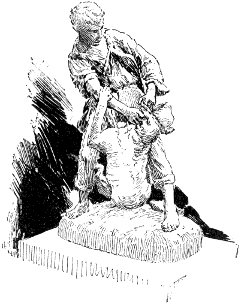
THE STATUE OF JUPILLE.
Statue, façade and lawn are new. The bricks have not yet lost their glare. One can almost see the dust still on the stone. The bronze has not lost its fresh lustre. Even the lawn has the unevenness of new sod, the horse-chestnut trees are small, the ivy has not had time to climb far up the walls.
Everything is still and sealed in front, but to the right, from the concierge’s lodge back to a solid, practical, dark stone building in the rear of the main hall, is a throng of idle people, chatting in clusters, sunning themselves on the benches, walking up and down. It is a strikingly cosmopolitan company. There are Arabs in red, brown, blue, or white; Italian women in aprons and lace head-dresses; Spanish peasants in dark cloaks and broad-brimmed hats; Yankees, Zouaves, Russians. The low babel of a multitude of tongues fills the air.
One only brushes the edge of this crowd as he makes his way to the doorway in the end of the main building, the entrance to the private apartment of M. Pasteur.
Narrow winding stairs lead up to a suite of lofty rooms, furnished with solid, dignified woods, carpeted with soft, dark rugs, windows and doors hung with heavy stuffs. The immediate impression is one of comfort, warmth and quiet. The impression deepens as one enters the library, where, before a desk, sits the great French savant, Madame Pasteur near by. There is something home-like here. This might be the sitting-room of some well-to-do New England squire or judge. Involuntarily one searches in the face of the eminent savant, eying him so keenly and so kindly, for traces of relationship with the Puritan type. There is the same square determination, the same obstinacy of purpose, the same direct sincerity; but it is mellowed by Latin tenderness, kindled by French brilliancy.
This is a great man, one feels instinctively—a man so great that he despises notoriety—and a journalist. It is reassuring.
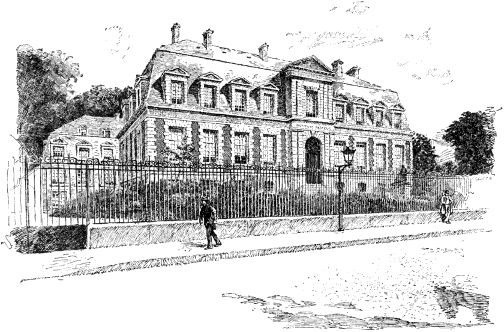
THE PASTEUR INSTITUTE.
The great master does not look to be seventy years of age as he sits behind his desk, his elbow on the table, his hand supporting his head. His hair and beard are still iron-gray; the hair is concealed largely by the silk skullcap he always wears, but the beard is abundant. The eyes are as penetrating, as full of ardor, as ever. It is only when he speaks or moves that one sees the ravages of the paralysis which overtook him twenty-five years ago, after his terrible three years of labor in the little house at Alais, investigating the disease of the silk-worm. The whole left side has been since then nearly useless. His speech is hesitating, his motion difficult, but in spite of his feebleness he spares no pains to interest his guest. One talks with M. Pasteur with the ease and naturalness of the fireside.
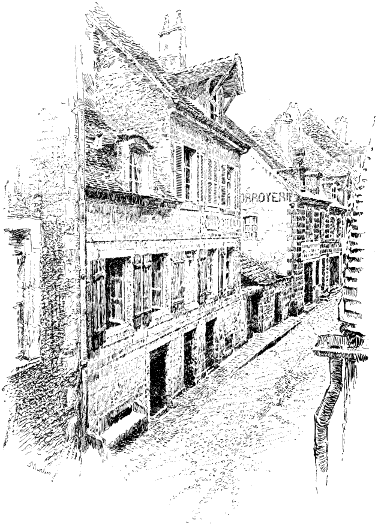
“Look at my birthplace,” he says, rising, and taking from the mantel a photograph of the humble home at Dôle, Jura, where he was born. “My village gave it to me at my fête.”
I happen to know the story of the picture, and examine it with pleasure. There was, indeed, no more touching feature in the great Pasteur jubilee of last December than the presentation of this photograph by the Mayor of Dôle.
The little village has always had a loyal pride in the fact that M. Pasteur was born there. Ten years ago it celebrated the French Fourth of July (July 14) by placing a plaque on the façade of the house, bearing the inscription:
Ici est né Louis Pasteur, Le 22 Dec., 1822.
M. Pasteur was present and made a speech. In the course of it he referred to his parents, their ambition for him, their self-sacrifice, their faith in him. He recalled his father’s words: “Louis, if I see you one day a professor in the college of Arbois I shall be the happiest man on earth.” Overpowered by his recollections, he broke down, sobbing.
The villagers of Dôle have never forgotten the scene. When the great Pasteur jubilee was celebrated they sent up their mayor, commissioned to present the picture of the early home, together with a facsimile of the register of M. Pasteur’s birth. That they were not mistaken in thinking that he would be pleased, it is easy to see as he stands before me, eying the humble house with tender pride.
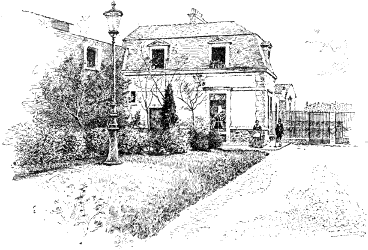
THE LODGE.
“Have you no picture of yourself taken in your boyhood at Dôle?”
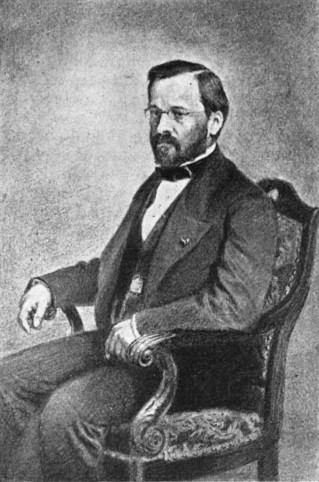
“No,” he answered. “The earliest picture I have is much later. Let me see, I must have been decorated then. Where is the old album?”
The album is brought, a small square book, looking as if it had just come off the table in the best room of a New England farm-house. There is the same high-relief decoration, the same gilt lines edging the photograph apertures. And these people? Verily, they might have lived in New England forty years ago!
M. Pasteur turns the leaves. Madame Pasteur leans over his shoulder. They stop now and then and exchange a smile as they come upon an old friend. At last the sought-for photograph is found. M. Pasteur at thirty—a great man already, for already he has made discoveries in crystallography which have won him a name among scientists.
The plans for investigation which filled the head of the young man who sits up so straight in the old photograph were never completed. The enthusiastic student of crystallography was forced to change the subject of his studies. Even now the great savant laments the change.
“If I have a regret,” he says, “it is that I did not follow that route, less rude, it seems to me, and which would have led, I am convinced, to wonderful discoveries. A sudden turn threw me into the study of fermentations, fermentations set me at diseases, but I am still inconsolable to think that I have never had time to go back to my old subject.”
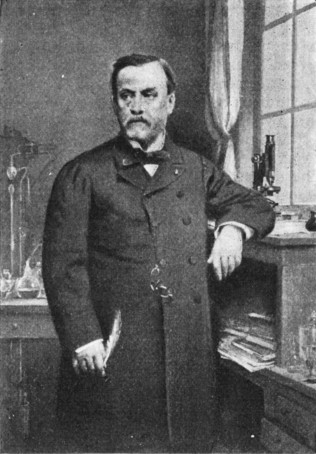
Beside the hero of the studies in crystallography M. Pasteur places his latest picture. It lacks in youthfulness, but it has gained in ripeness. This photograph has much of the vigor and the alertness one sees in the splendid bust by Paul Dubois displayed in the Salon of 1880, and now in a gallery at Copenhagen. This bust is the most satisfactory portrait of M. Pasteur ever made, unless it be the painting by Edelfelt displayed in the Salon of 1886. In the same Salon appeared Bonnat’s portrait of M. Pasteur and his granddaughter.
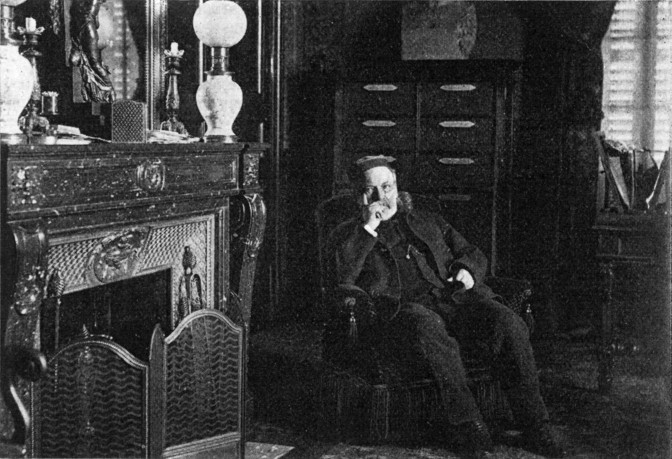
M. PASTEUR IN HIS SALON.
As I look at M. Pasteur in his library, however, I see only the old model of Bonnat. I have difficulty in believing, indeed, as I watch him bending smilingly over the old album, now and then laughing aloud at the discovery of some forgotten picture, that this man, over fifty years ago, for the sake of an education, made himself a jack-of-all-trades in the college of Besançon, and was aroused every morning at four o’clock with the night-watchman’s cry: “Come, Pasteur, chase the demon of laziness.” It is difficult to picture him in the intoxication of scientific enthusiasm and discovery, sacrificing health, leisure, pleasure, to the passion of learning which had taken possession of him.
He is so gentle, it seems incredible that he has had to meet coldness, contempt, opposition of every species, in his life; that, when he asked the most modest of appropriations from the government, he met the contemptuous reply that “there was no rubric in the budget for allowing three hundred dollars a year for experiments;” that for every step in his discoveries he has had literally to fight, contending with Pouchet and Joly on the subject of spontaneous generation, with Liebig on fermentations, with the Germans and Italians on the attenuation of virus, with the popular opinion of his own compatriots when he dared vaccinate for hydrophobia, and when his supporters dared erect the present Institute to facilitate his work.
One cannot picture him tête-à-tête with mad dogs. It is hard to believe him capable of that astonishing self-mastery which made him withhold for months, and sometimes even years, the results of incomplete investigations, and of the equal hardihood which, when he was convinced of a truth, led him to accept the most severe and most public tests of its exactness.
I make an attempt to find the scientist and venture a question.
“Oh,” says M. Pasteur, “if you want to know that, you must go and see M. Roux. You will find him in the laboratory.”
We rise and go into the long hall. At the opposite end from the library two large doors open into the spacious vestibule which occupies the centre of the main building.
“You can go out by the main hall and directly into the laboratory, or down the private stairs.” I hesitated. No, I would not spoil my impression of M. Pasteur at home. I would keep laboratory and home separate. I descended to the private entrance, and, as I went down, two kindly faces looked over at me, and the gentle, hesitating voice of the great savant said:
“Take care, it is dark. Don’t slip. Take care.” On the last step I stopped and looked up. The two friendly faces were still looking down.
THE HOUSE AT DÔLE, WHERE M. PASTEUR WAS BORN.
I had come to see the destroyer of the theory of spontaneous generation, the demonstrator of the microbe origin of disease, the conqueror of hydrophobia. I had found something greater, perhaps, than them all—a perfectly gentle soul.
IN M. PASTEUR’S WORKSHOP.
I crossed the lawn and entered a large waiting-room occupying the middle of the building devoted to laboratory work. The room is flooded with light, seated with benches, and decorated with no other ornaments than a series of photographs of the Pasteur Institute at Rio Janeiro, two great maps on which are marked the cities where institutions similar to this at Paris are to be found, and cards containing certain rules applicable to patients coming for treatment against hydrophobia. Among these latter the important ones are that the treatment is gratuitous, that each patient must bathe before coming for inoculation, that board and lodging are not furnished, and that the grateful may, if they wish, leave a gift at the end of their term of treatment.
There were sixty or seventy persons in the room. They had come to be vaccinated against hydrophobia. They were of the greatest contrast in age, in condition, in culture. Beside a shrivelled, leather-brown Arab woman from the desert was a pink and white little miss from London. A young man with the refined face, correct dress and distinguished manners of a gentleman sat beside a huge and none-too-clean German laborer. As a rule, it was a friendly, cheerful company. It was only here and there that one saw a person who seemed conscious that in his veins a hideous poison was at work. Most of them took it for granted that their cure was certain. Some of them scoffed at the nonsense of going to the trouble of being vaccinated.
A dignified liveried servant entered, calling “Attention.” The company bestirred itself and disappeared. I made my way to the inoculating room.
The operation of inoculating for hydrophobia is founded on the theory that if an “attenuated” microbe, that is a microbe so treated that its power of doing harm has been reduced to a low degree, is introduced into a body, it will produce an indisposition which is not itself serious, but which is sufficient to render the body proof against attacks of the original microbe.
Now M. Pasteur has discovered that it is possible to so treat a microbe that its power of evil is of any degree; that is, to “exalt” as well as to “attenuate” it. Having these microbes of varying strengths he invented a method of graduated vaccination; that is, by beginning with a virus of low degree, and increasing each day the strength of the virus, an operator arrives at a point where he can vaccinate a body with a virus stronger than there is any danger of its ever being exposed to in nature. He thus secures lasting immunity.
Thus, in vaccinating against rabies, the patient is treated first with a weak virus; this is followed by one more powerful, and so on, until at the end a highly “exalted” one is injected safely.
M. PASTEUR AT THIRTY.
It is this treatment which is practised daily at the Pasteur Institute, in the inoculation room where I found myself.
Gathered in a kind of pen formed by a little fence were three members of the institution: a secretary, whose business it is to keep track of the number of persons to be treated with each particular virus; an assistant, who has prepared the virus for the day’s use; twelve small wine glasses of cloudy liquid protected by small paper funnels; and, by a table, the inoculator. The roll was called and a half dozen men entered the room. They were to be inoculated with a virus of the lowest strength, most of them for the first time. They showed a bewildered and comic embarrassment as the attendant directed them to bare the hypogastrium. The embarrassment changed to a momentary look of distress as they felt their arms pinned behind their backs, and the sharp needle injected a syringeful of virus into the delicate flesh. The first class of men and boys passed out, and the women and little children entered. They were succeeded by a second class, and so on until all had been treated.
The simplicity of the operation seemed out of proportion to the horror of the disease. I remembered the shrugs I had seen and the doubts I had heard expressed over the treatment. “It is not sure yet.” “It does not always work; such-a-one died, you know.” “They have not found the microbe either.” My faith was shaking. Evidently I must see Doctor Roux.
On the second floor of the building I found the office and private laboratory of the under-director of the Pasteur Institute, a man whose researches in connection with Pasteur, whose devotion in the cholera mission in Egypt in 1883, and whose independent investigations on diphtheria, have made him famous in the medical world. The office was small, and it had something of the attraction of a curio shop. There was none of the precision of the man of small affairs here. It was the confusion of the man of big affairs, who cannot endure to have his things meddled with. Over a table where culture tubes, blow-pipes, virus glasses and bottles filled with suspicious-looking fluids were scattered promiscuously around a valuable microscope, hung a gem of a painting—a dashing charge of cavalry. Beside a case of books, and partly concealing a fine portrait of Pasteur, hung the gray-white laboratory blouses of M. Roux. Under an exquisite etching askew in a corner stood a cage of brown-and-white guinea-pigs, martyrs to science, probably.
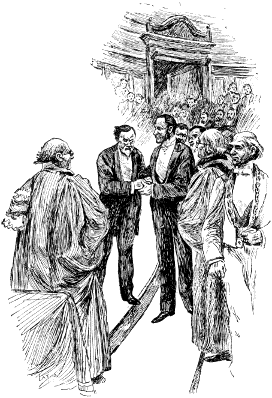
AT THE JUBILEE OF M. PASTEUR. THE PRESIDENT OF THE REPUBLIC WELCOMING M. PASTEUR IN THE AMPHITHEATRE OF THE OLD SORBONNE.
Curiosity was cut short, for a quick step was heard in the outer room, and Doctor Roux entered. A slight figure, bent a little from a life spent over books, tubes and microscopes, but tingling to the finger-tips with nervous energy; a face a little pale, but fresh in color; brown hair and beard, glowing brown eyes, perhaps forty years—such is this eminent associate of Pasteur. As he runs over the pile of letters cut and awaiting him, he talks.
“So you have just seen the inoculation? Do I believe it a sure cure?” The doctor lays down his letters as he repeats the latter question in an astonished tone. “Of course I do. There is nothing surer in medical science. Look at these figures.” He rises and draws out from the midst of a pile of papers a big black serviette, fumbles for a moment among the documents it contains, and pulls out the latest report made by the Institute on the results of vaccination for hydrophobia, that for 1891.
“Now listen to these figures. In 1886 the Pasteur made its first report: 2,671 persons were vaccinated that year against hydrophobia; 25 of them died—.94 of one per cent. In 1887, 1,770 persons were treated; 13 died—.73 of one per cent. In 1888, 1,622 were treated; 9 died—.55 of one per cent. In 1889, 1,830 were treated; 7 died—.38 of one per cent. In 1890, 1,540 were treated; 5 died—.32 of one per cent. In 1891, 1,559 were treated; 3 died—.19 of one per cent. You notice each year the per cent. of deaths has been lower. In the six years the treatment has been reported, we average just about one-half of one per cent of loss. Tell me where you find a treatment surer?”
“But you have not found the microbe?”
“Humph! that does not prevent the method working. It is aggravating not to have found him. It prevents, possibly, the simplification of the inoculation process. Nevertheless it works. So does vaccination for small-pox. We do not know the microbe of small-pox. There is much we do not know yet. Remember, too, that it was only in 1880 that M. Pasteur made up his mind to begin an exhaustive study of hydrophobia, and that all he foresaw at first was the possibility of vaccinating dogs against rabies, and that it was only in 1885 that the first person, little Joseph Meister, was inoculated, after a council of physicians had decided that his death was certain, and that his life was saved.”
PORTRAITS OF M. PASTEUR.
BY LAFON.
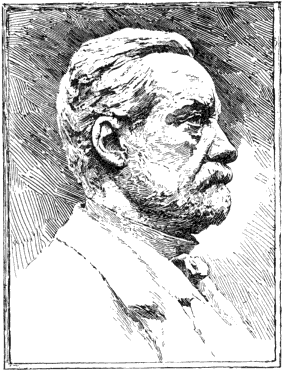
BUST BY P. DUBOIS.
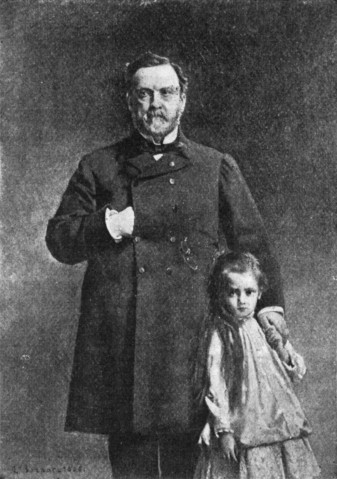
BY BONNAT.
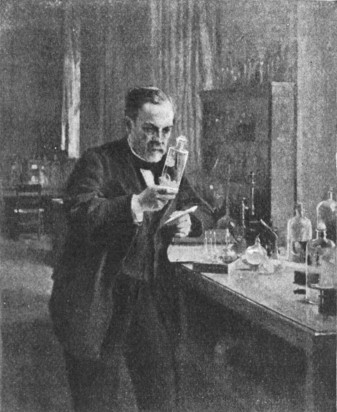
BY A. EDELFALT.
The newness of the Pasteur doctrines and treatment is, indeed, one of the most striking things about the Institute. One rubs his eyes to remember that, thirteen years ago, very few people admitted the rôle of bacteria in the world, and that those who did admit their existence were very much at sea about what to do with them.
The doctrine of microbe, the theory that ferments and virus are living beings, that a vaccine is an attenuated virus, that medicine is based on the artificial attenuation of virus—all this is now so widely received, is so thoroughly a part of popular belief, that one is bewildered in remembering that twelve years ago the general theory of disease was that it is “in us, from us, by us.” Especially is all this astonishing, standing in the Pasteur Institute, the crystallization of the microbe doctrine.
“Yes,” continued Doctor Roux, “we have conquered hydrophobia; nothing is more certain.”
“And you hope to conquer other diseases in the same way?”
The doctor made a fine nervous gesture. “In science one does not hope; one proves. In every thirty thousand experiments one succeeds. We study diseases here. Each physician has his special line of investigation. We hope for nothing. We simply report what we find.”
“But you yourself, Doctor Roux, have certainly hopes that diphtheria is almost conquered?”
The doctor pursed up his mouth.
“The investigations in diphtheria are in just this condition. We have proved at the Pasteur Institute” (Doctor Roux is modest and says ‘we,’ which means himself and his assistant, M. Versin) “that diphtheria is a toxic disease; that is, that it results from a poison. The microbe of diphtheria does not penetrate throughout the system as in the case of most other microbic diseases. It exists only in the mucus found on the pharynx. This microbe does not cause death, but it secretes a poison which penetrates throughout the body and kills. This being proved, of course the next step is to find what will destroy the poison.
“Doctor Behring, working at Berlin, has found that the blood of animals vaccinated for diphtheria gives a therapeutic serum which destroys the diphtheric poison. We are now testing the practical value of the serum at the Institute. This is absolutely our ‘last word’ on diphtheria.”
“And as for cholera! What is the last word?”
“The bacillus virgula of Doctor Koch is believed, by the great majority of savants, to be the true cholera germ. We are trying here, as experimenters are trying elsewhere, to give immunity to animals against the microbe. It is absolutely all that one can say authoritatively on the cholera.”
“And the method of vaccination which Doctor Haffkine believes he has discovered?”
“It has not been proved yet that it will give immunity. Until we have that proof we neither hope nor fear. We simply work and wait. Doctor Haffkine has, you know, severed his connection with the Pasteur Institute and gone to India to continue his researches.”
“But he has had faith enough in his method to try its effects on himself, has he not?”
“Very true, and so have perhaps a hundred others tried its effects. But that proves nothing.”
There is a self-repression about these severe statements which has something of the heroic in it. Who would be so glad to announce absolute safeguards against diphtheria and cholera as this man who has risked his life to find them? Yet, until he is sure, he will not even say “hope.”
I remember the words of Pasteur himself: “To believe that one has found an important scientific fact, to be in a fever to announce it, to compel one’s self for days, weeks, sometimes years, to be silent, to force one’s self to destroy his own experiments and to announce nothing until he has exhausted all contrary hypotheses—that is hard.”
It is hard, but it is one of the strongest elements in the Pasteur spirit of scientific research. Evidently Doctor Roux has learned to practise it vigorously.
“In the same way that we are investigating diphtheria and cholera,” continues the doctor, “we are studying other diseases. But one cannot get a fair idea of what the Pasteur Institute does by any other means than looking at its organizations. There is a great deal done here besides original investigation. In the first place, we are an absolutely independent and free institution. The money was given by popular subscription and without conditions.
“The entire lower floor is devoted to practical work. There are performed the inoculations for hydrophobia on an average of some seventy a day. The practical department is not, however, confined to the treatment of hydrophobia. There are prepared the vaccines for all those diseases of animals which M. Pasteur has proved can be cured by inoculation, such as chicken cholera, splenic fever, and rouget of swine.
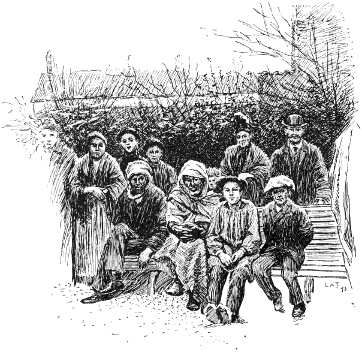
A GROUP OF PATIENTS.
“Quantities of virus are sold constantly to farmers for vaccinating their stock. It is these sales which help support the institution. It is an example of science living by science.
“Here on this floor we do our instructing. In the lecture hall across the way M. Ducloux gives his lessons on microbic chemistry, studies the process of fermentation, microbic poisons, all phases, in short, of biological chemistry.
“My work is lectures on, and experiments illustrating, the technique of the microbic method. Those who follow the courses are divided into two classes, students who simply follow the courses and repeat the experiments in the general laboratory, and the savants who conduct original researches here. The latter are furnished each with a private laboratory in the third story. Here for a merely nominal rent they can have the exclusive use of a laboratory furnished with all necessary apparatus, and can pursue whatever class of investigation pleases them.”
“And you have many students?”
“We have always fifteen or twenty, and from all parts of the world. Look at my roll.”
The doctor rose and drew out from the mass of pamphlets and papers on his table a big roll-book.
“I have the names of those who have taken my lectures. Here is an Egyptian, many Russians, a Turk, numbers from South America, from Canada, from the East, from everywhere. Let us look for your compatriots.”
Doctor Roux ran his finger down the pages. “Here is one, Doctor Orchinard of New Orleans. Here another, Doctor Tabadie of New York; and then there is Kenyoun of the United States Marine Service. But there have been more students in the institution from South America than from North.
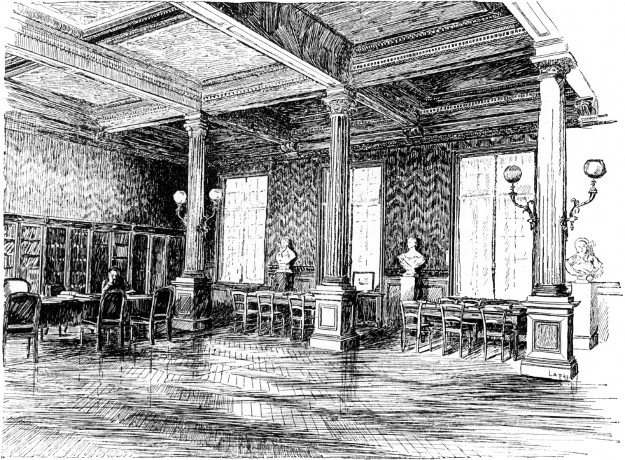
THE LIBRARY.
“The department of original work is in the third story, and is under Doctor Metchnikoff, who is, you know, a Russian who has established himself here in order to devote himself to scientific investigation. Doctor Metchnikoff is aided by his wife, who acts as preparateur. She is an assistant of great skill and delicacy. He receives no salary for his labor. There are, in fact, three of the leading members of our faculty who receive no salary—M. Pasteur himself, M. Ducloux, and M. Metchnikoff. They have resigned the award they deserve because of our insufficient income.”
“But the common opinion is that you are rich here.”
“I know, but it is a mistake. The Pasteur Institute is very poorly endowed. Its yearly income is only about twenty-four thousand dollars. This revenue comes from three sources: the small appropriations made by the government, the income from the remnant of the private subscription with which it was built, and the product of the sales of vaccine. The fact that we can partly support ourselves,” added the doctor, laughingly, “is the best proof one can have of the practicability of bacteriology.
“The most surprising feature about it is, that in the case of almost every institution copied after us, and there are some eighteen or twenty of them in various parts of the world, the income is much larger than ours. At Berlin and St. Petersburg the incomes are four or five times as large as ours, and, excepting Berlin, we are the only Pasteur Institute doing practical work. It is the old story,” said the doctor resignedly, “one sows and another reaps.”
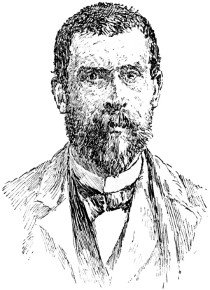
M. ROUX.
There is certainly injustice and short-sightedness in such a state of things. The investigations of Pasteur have taken too heavy a bundle from the load of horrors which humanity carries, to be allowed to be limited for lack of money:
Immunity from infectious diseases, and nothing else is the logical outcome of the Pasteur doctrines, means too much to make economy on the part of purse-holders excusable, when it is a question of funds for the investigations. When men like Doctor Roux and his associates, men trained in the severe Pasteur spirit and passionate for truth, are ready to sacrifice their lives to this work, overcoming the earth’s plagues, money is the last thing they should be wanting. Especially is this true now, when the work on two of the most terrible scourges of humanity—diphtheria and cholera—stands at critical stages.
There is something harshly ironical, too, in the idea that the institution of Louis Pasteur, whose discoveries have, declares Professor Huxley, made good the war indemnity of five thousand million francs paid by France to Germany, should be crippled for funds.
The doctor’s confidences were cut short by an imperative summons from without. I rose to go.
“Take a stroll through the building,” advised he as he said good-by. I followed his advice.
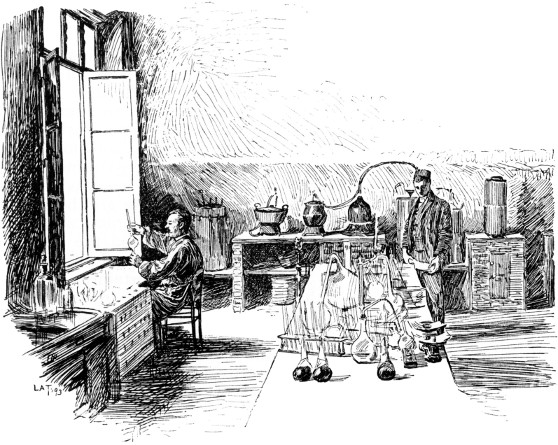
DOSING THE VIRUS.
From the library one naturally passes to the laboratories. They open from the long halls in numbers. One wonders how so much room can be utilized, but none seems to be going to waste. In each some step of the microbic process is going on. Here is a doctor inoculating a rabbit with the poison of a mad dog sent to the Institute only the day before. The little animal lies on the table insensible, chloroformed, while with the sharp-toothed little trephine the operator makes a tiny hole in its skull, lays bare the brain, and inserts the virus. By the time the aperture is closed Brer Rabbit is sitting up, looking about, none the worse for his experience, save a bald spot on his forehead, a tiny tin tag covered with hieroglyphics hanging from his ear. Two minutes later he was nibbling a carrot; fifteen days later he died “mad as a March hare.”
It is not only rabbits which undergo this operation. Guinea-pigs, chickens, mice and rats are used in quantities. In the laboratory of autopsy there are to be seen aquariums filled with the dainty axolotl of Mexico, glasses of odd fish, even cages of birds.
In another room an experimenter is dissecting a rabbit which has died of rabies, and from whose spinal cord he expects to get material for vaccinal virus.
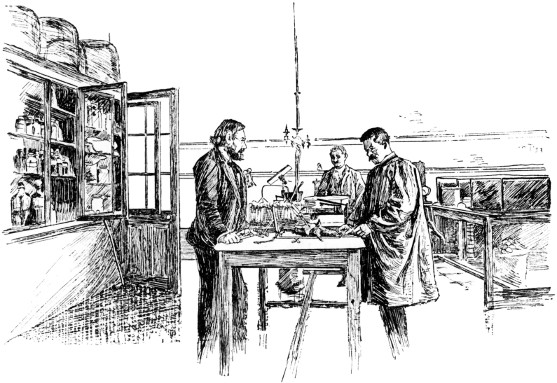
DR. METCHNIKOFF IN HIS LABORATORY.
In a small dark room, whose temperature is never allowed to vary, which is never swept nor dusted for fear of arousing tranquil microbes, and whose door is never opened except when absolutely necessary, are arranged rows of drying bottles, in which hang bits of the marrow. These bottles are marked with the degree of violence of the rabies from which the animal died, and with the date when the marrow was put up to dry.
Here, attendants are preparing the veal broth and the gelatines in which the infected marrows will be cultivated.
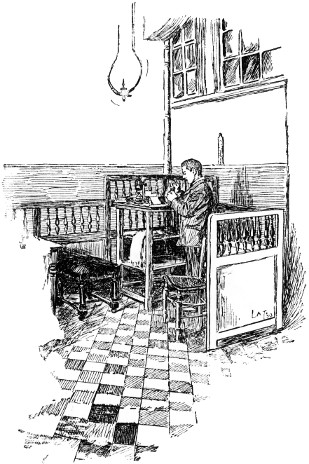
FILLING THE SYRINGES.
Thus as one goes from room to room he can follow the whole method of successive cultures, that method which is “the key-stone of the arch, and without which there could be no vigorous demonstration of the Pasteur method.”
On every hand one sees the interesting “ways of doing things” which characterize the Institute. Here, the cleaning of jars, syringes and tubes is going on; not a simple washing and drying. In the Pasteur household articles are sterilized as well as cleaned—that is, burned in the flames of a spirit lamp, or in an oven. There, a man is blowing bulbs, droll balloon pipettes, all the multitude of glass contrivances the laboratories demand. Here, under a microscope, an investigator has the diphtheria pest, an inoffensive speck; there, another has in his field a whole colony of lively little straight and bent sticks; it is a company of Doctor Koch’s cholera microbes.
Wherever one goes in the building there is a busy intentness, an absorption, an absolute blindness to everything but the work in hand, be it the contents of a culture tube, or the film on a microscope slide. One can easily believe of these workers the story told of M. Pasteur himself, that he had to be hunted up on his wedding morning and pulled away from his microscope, in order to be got into his dress-coat and gloves in time for the ceremony.
Evidently, too, they have not forgotten the words their master spoke on the day of the inauguration of the Institute:
“All the enthusiasm you have had since the beginning, my dear co-laborers, I beg of you to keep; but give it, as an inseparable companion, a severe control. Announce nothing that you cannot prove in a simple, decisive fashion.
“Cultivate the critical spirit. Left to itself it neither awakens ideas nor stimulates to great deeds, but without it all is lost.”
As one goes from room to room, and talks with one and another of the busy, courteous savants, he realizes finally that it is here that Pasteur the scientist is to be found. The labors that made the great savant famous are all summed up here. Here his methods are at work, here is his spirit alive in the men who have best comprehended him, and whom he has been able most deeply to inspire. It is a great thing to achieve. It is a greater thing to inspire others to achieve. Louis Pasteur has done both.
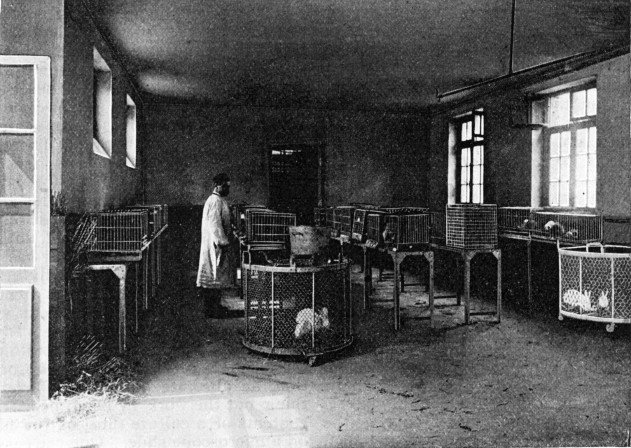
THE RABBITS’ QUARTERS.