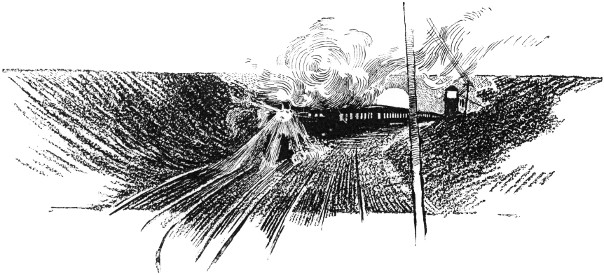
AT THE THROTTLE. THE LIFE AND EXPERIENCES OF AN ENGINEER OF A LIMITED EXPRESS. By Cleveland Moffett.
Reading edition
“See the huge creature with muscles of steel, his heart a furnace of glowing coal, and the strength of a thousand horses nerving his sinews. See him strut forth from his stable, and, saluting the train of cars with a dozen sonorous puffs from his iron nostrils, stand panting to be gone. He would drag the pyramids across the Desert of Sahara if they could be hitched on.”
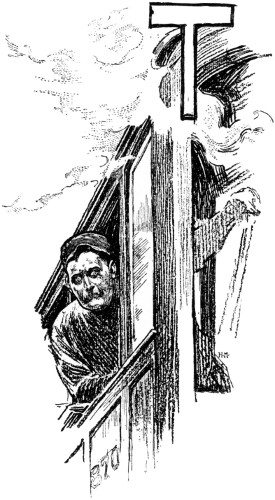
The average New Yorker who rides to Chicago in twenty hours on the World’s Fair flyer does an easy day’s work, in fact, does no work at all. He rests comfortably at night, enjoys well-served meals, and reaches his destination almost before he knows it. Having paid the price, such is the arrogance of money, he takes all that is done for him quite as a matter of course, and knows no more of the workings of this wonderful train than a school-boy, while he cares rather less. An engine pulls the cars, steam works the engine, and as for the engineer, the New Yorker never thinks of him except to growl at him when the train is late, and to advocate hanging him if there is an accident.
Meantime, what is the engineer of this fastest train in the world doing for the passenger? In the first place, the Chicago flyer is not driven by one but by many engineers. In order to cover the nine hundred and sixty-four miles between the two cities in twenty hours, including nine stops, there are required seven huge engines in relays, driven by seven grimy heroes. A run of less than one hundred and fifty miles is the limit per day for each engine, while three hours of the plunging rush wears out the strongest engineer. Sixty, seventy, eighty miles an hour—what does that mean to the man at the throttle? It means that the six and a half feet drivers turn five times every second and advance one hundred feet. Tic-tic-tic, and the train has run the length of New York’s highest steeple. The engineer turns his head for five seconds to look at the gauges, and in that time the terrible iron creature, putting forth the strength of a thousand horses, may have shot past a red signal with its danger warning five hundred feet away. Ten seconds, and one thousand feet are left behind—one-fifth of a mile. Who knows what horrors may lie within that thousand feet! There may be death lurking round a curve, death spreading its arms in a tunnel, and the engineer must see and be responsible for everything. Not only must he note instantly all that is before him, the signals, switches, bridges, the passing trains, and the condition of the rails, but he must act at the same moment, working throttle, air-brakes, or reversing-lever, not as quick as thought, but quicker, for there is no time to think. His muscles must do the right thing automatically under circumstances where a second is an age. In the three hours of his vigil there are ten thousand eight hundred seconds, during each one of which he must watch with the mental alertness of an athlete springing for a flying trapeze from the roof of an amphitheatre, with the courageous self-possession of a matador awaiting the deadly rush of a maddened bull; and far more depends upon the engineer’s watching well, because, if he fails by a hair’s breadth in coolness or precision of judgment, there may come destruction, not only to himself, but to hundreds of passengers, who, while he stands guard, are perhaps grumbling at the waiters in the dining-car or telling funny stories in the smoker.
In addition to this constant mental tension the engineer on this hurling train has to endure material discomfort, often bodily suffering. The air sweeps back in his face with the breath of a hurricane, blowing smoke and cinders into his eyes. Most people know the intense pain a cinder causes in a man’s eye, particularly a hot cinder. The suffering is almost unbearable, and yet, suffering or no suffering, the engineer who gets a cinder in his eye can have no relief until the end of his relay. They shut their lips, these unflinching men, keep looking ahead, and bear it. Long after they leave the cab, the burning sensation in their eyes and eyelids continues, and even persists after hours of sleep. “It seems as if nothing would rest my eyes, sir,” said one of the new men after his first week on the flyer. No wonder the eyesight of engineers fails rapidly, no wonder many of them are removed from their positions every year because the examining doctors find them unable to distinguish the signals. The engineer suffers also from the plunging and tossing of the monster locomotive, which bruises his whole body with its violent rocking, and causes sharp pains in the back, particularly where there is any tendency to kidney trouble. One has only to watch these strong men as they stumble down from their engines at the end of a relay, has only to observe their white faces and unsteady gait, and see the condition of physical collapse which follows, to understand what it costs in vitality and grit to give the ease-loving public this incomparable train service.
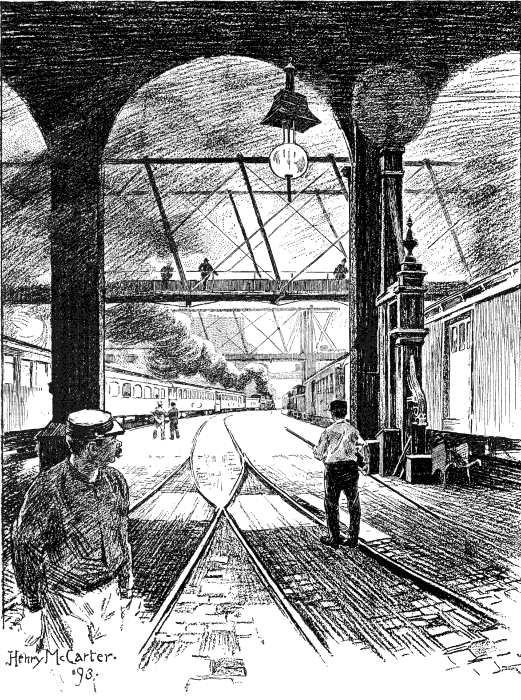
“THE FLYER” LEAVING THE GRAND CENTRAL STATION, NEW YORK CITY.
Thus it is that while the New Yorker gets to Chicago with scarcely more discomfort than if he had remained at home, the same journey wears out seven engineers, all picked men; for many of them who have seen years of service on trains running forty miles an hour, break down entirely when put upon the flyer. So exhausted are these seven engineers by their comparatively short relays that they are obliged to lay off entirely during the following day to recover from the shock. They do not even take the opposite-bound flyer back over their stretch, but return with their engines to their respective starting-points, drawing slower trains. Thus, seven strong men do two days’ work every time the flyer runs from New York to Chicago, and seven other men do two days’ work every time it runs back. Each engineer works three hours on the flyer, returns home on an easy train, and then rests forty hours before his muscles and nerves and brain are in condition to repeat the operation.
So it results that twenty-eight engineers, one at a time, are required to run this wonderful train from New York to Chicago and back again. Fourteen veterans drive the great engines one way, and fourteen brother veterans drive them the other. Twenty-eight men for a single complete trip of a single train, and they the flower of American engineers, splendid fellows every one of them, with cool heads, stanch hearts, and the experience of years at the throttle. The fact is, these men of iron, who, after all, are made of flesh and blood, have been called upon of late years to bear a mental and physical strain which has increased steadily as the speed rates have advanced. Forty, fifty, sixty, seventy, and now eighty miles an hour, each greater velocity has meant greater pressure, not only on the boilers and cylinders, but on men’s brains; has meant greater expenditure, not only of coal and dollars, but of nerve force, until now experts recognize with concern that the limit of human endurance has been almost reached. Science may remove the mechanical difficulties in the way of running a hundred miles an hour, or more, for such a rate has already been predicted; money may buy better axles, wheels, lubricators, and machinery, but where are the men who will run these trains of the future when they are built? Can science breed us a race of giants? Can money purchase an immunity against suffering or eyes that are indestructible? If twenty-eight engineers are required to-day on the Chicago flyer, how many, pray, will be necessary on a train running fifty or one hundred per cent. faster?
I gained a vivid impression of what it means to drive one of these monster engines, by actually travelling from New York to Albany, a few days ago, in the cab of Engine 870, which takes the Empire State express over the first stretch of its journey—one hundred and forty-two miles—at a rate rather faster than that of the Chicago flyer. At the throttle was Archie Buchanan, a silent man with gray eyes and earnest face, who comes of a family of engineers, and is one of the most trusted of the New York Central employees. Buchanan’s brother John, a skilled engineer in his time, was cut in two some years ago in an accident near East Albany. His brother James is a master mechanic at the shops at West Albany, and his brother William, after serving for years as a New York Central engineer, was made Superintendent of Rolling Stock, a position he still holds.
Buchanan smiled quietly as I climbed upon the fireman’s seat at the left. It was a perfect July morning, and at 8.39 the shrill whistle sounded, worked by the conductor’s bell-rope, and we were off, nine minutes behind time on account of some trouble with the air-brakes.
“We must make up the delay, Al,” said the engineer to his fireman, as the wheels began to turn. Those were the only words he spoke until we reached Albany, and, had he spoken, neither Al nor I could have heard him for the roar.
Now the slow, heavy pant of the engine quickens, and we shoot under bridges and streets, passing out of New York. For a few minutes Buchanan, working the reversing-lever, lets the pistons go the full length of the cylinders, but he gradually cuts down their stroke to eight inches, making the steam expansion do the rest. This lessens the noise from the exhaust, but the noise from the pounding of the mountain of iron on the rails increases in geometrical ratio. A shower of cinders blows in with black smoke, and a hot one settles in my neck. The smoke tastes of oil, the cinder burns—this is but a foretaste of things to come. I turn my head to avoid suffocation and get a scorching blast from the fire-box, whose door is swung wide open. The fireman’s orders are to make up the lost time, and he proposes to do it. In goes coal at the rate of two shovelfuls a minute for the first half-hour. Before we reach Albany he has shovelled in more than three tons, and had the day been windy it would have taken more. In the intervals he rakes and prods the white-hot crater and rings the bell as we shoot past towns and cities. Buchanan tends to the whistle and air-brakes. The noise is dreadful, as if a thousand devils were dancing in one’s head. The motion is so violent from side to side that we all have to hold on tightly. A little more and one would be seasick.
As the hundred-ton engine pounds along with horrible din, a strange sense of exhilaration succeeds that of physical discomfort. One becomes indifferent to everything, and, courting now the smoke-laden hurricane, thrusts one’s head from the window into the sweeping air-billows, which dash against the face like breakers and with the same strangling force. I was seized with a wild desire to go faster; seventy miles an hour was not enough, and I would fain have opened everything to its full capacity, stop-cocks, levers, throttle, and all, and taken part in a furious, splendid runaway. Strange thoughts chased through my mind; the houses of flying towns seemed to be rushing at each other in battle from either side, a long line of loose ties between the tracks suggested an endless procession of turtles, the trees seemed to be dancing down the hills, and the people who stared up at us while stepping away from the dangerous suction seemed to be creatures of another race. I have learned since that engineers often have that feeling of belonging to some other world, and it comes upon them particularly at night. A man of highly strung organization could easily go mad riding on an engine running seventy miles an hour.
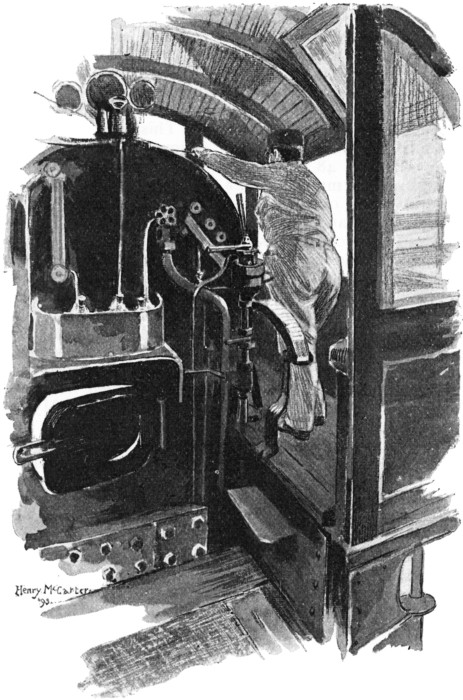
These curious illusions of the senses were presently succeeded by a period of intense and perfectly normal curiosity. I counted the number of strokes made by the piston in a minute, and found there were about three hundred. I counted the number of puffs from the smoke-stack, and decided correctly that there were four times as many of these as there were piston-strokes, that is, about twenty to the second. Then I counted the oil-cans, the gauges, and made mental photographs of the inside of the cab.
From start to finish we made no stop and only slackened our speed twice to “pick up water,” this important operation being accomplished with a great splashing by a scoop under the tender, which drops into a trough running lengthwise of the track for about twelve hundred feet, and always kept full to the brim. The scoop is controlled by a lever in the tender, which the fireman directs. In the winter, steam-pipes through the troughs keep the water from freezing. During the whole distance Buchanan scarcely changed his position, and never turned his head. For two hours and thirty-six minutes he stood at the right of the boiler, an immovable figure in gray overalls and black skullcap, his left hand on the throttle, while his right clutched the window to steady him. I never once saw his eyes, which were fixed on the track ahead as if held there by a magnet. No matter how the smoke and cinders poured in through the open windows in front, no matter the bridges and tunnels nor the mad rush of air, his eyes stayed forward always, sweeping the line before us anxiously, constantly on the alert for signals, for switches, for obstructions, for the long tunnel, for the train side-tracked near Poughkeepsie, for the water troughs, for a score of things, the missing any one of which might mean disaster. And, as he watched, silent and motionless, there was one thought in his mind and only one, whether we would make up the lost nine minutes and get into Albany on time. Al’s thoughts were the same, and, like one of Dante’s demons, he worked at the coal and the fire and the water, now oiling the drivers, now looking at the gauges, ever busy and ever growing blacker and oilier in hands and face.
Very proud we were as we ran into Albany at 11.15 A.M. on time to the minute, having made the run of one hundred and forty-two miles in one hundred and fifty-six minutes, an average of 53.8 miles an hour. This exceeds the average of the Chicago flyer, which is 48.2 miles an hour, although for a much greater distance. Several times our speed had reached seventy miles an hour, and with better coal and other conditions equally favorable, Buchanan has driven 870 up to the eighty-mile point. With the sound devils still dancing in my head, I watched the engineer as he rubbed down his iron horse after the hard run. He was tired himself, and his face was white, but he went over the rods and cylinders as tenderly and carefully as if he was refreshing the muscles and sinews of a living creature.
“She’s a beauty, isn’t she?” he said, in a tone which bore witness to the love felt by the man for the machine. “You see, she has always been true to me, 870 has, and I’ve run her ever since she was built. She’s never cranky or sick, and she makes her three hundred miles a day three hundred and sixty-five times a year, and does her duty every time. That’s more than you can say of many men, or women either, isn’t it?”
It seems that there are about fifty engines in constant use on the New York Central with the power and dimensions of 870, and only the peerless 999, with her heavier build and smoke-consuming device, can boast any points of superiority. The life of an engine like 870 is about twenty years, during which time she makes several visits to the hospital for new cylinders, new flues, and a new fire-box. Aside from that, the engine needs about an hour’s care morning and night, and a washout and blowout of her boilers at the end of alternate weeks. Only at these periods is the engine’s fire allowed to go out.
I asked Buchanan what were the principal qualifications for a first-class engineer, and what was the training necessary to become one. “To begin with,” he said, “a man must be a first-class fireman, which is no easy matter. He must know just how much coal to put on the fire and when to put it on, so as to keep the steam at full pressure without burning too much fuel. The great secret of good firing is to put coal on often and a little at a time. You noticed Al did that on our run up. When a fireman has shown himself worthy of it, he is given a chance to drive an engine for switching work or on a freight train. The first years of his life as an engineer are very hard, for he has to run at all sorts of hours, day and night, winter and summer, and on the meanest kinds of trains. If this does not kill him he finally becomes engineer on an express and has a better time of it, but a good many of the boys prefer to remain firemen all their lives rather than stand such hardships. My man Al has tried driving an engine twice, and come back to me both times. You can be pretty sure that a man who gets to be an engineer on one of the fine trains to-day has earned his position. He must know his engine like a book, backwards and forwards, must know how to manage her when she is sick and well, and what to do if an eccentric breaks or a piston gets leaking or a valve-spindle is bent. He must know how to work the injector so as to keep water enough in the boiler without wasting any by the steam blowing off. He must be able to save power by working the steam expansively and yet keeping up his speed; he must know every inch of the road, the grades, bridges, switches, curves, and tunnels, and all the trains he has to pass or which may pass him. He must be able to control his train and engine at full speed, must understand the effect of the weather on the rails, must know how to use the air-brakes and the reversing-lever, and when not to use them.”
I listened and marvelled.
“What would you do in a collision?” I asked.
The engineer pushed back the little black skullcap from his iron-gray hair and said, in the low tone which is usual with him:
“It is pretty hard to say what a man should do when he hears the whistle of danger ahead or sees that a crash is coming. Even the best of us are liable to get confused at such a moment. What would you do if you woke up in the night and found a burglar holding a pistol at your head? There are no rules for such cases. What I would not do, though, is to reverse my engine, although many engineers are liable to lose their heads at a critical moment and make that mistake. It is a curious thing that reversing your engine suddenly when going at high speed makes the train go faster instead of slower. The reason is that the drivers slip and the locomotive shoots ahead as if she were on skates. The only thing to do is to put on the air-brakes and pray hard.”
The man’s words, all the more impressive for their rugged simplicity, brought to my mind again the thought of danger, for in spite of the wonderful system by which these flying trains are run, in spite of the elaborate precautions taken and the many eyes forever watching to see that they are carried out, it is impossible to go through such an experience as mine without realizing that there is danger in these desperate dashes. Suppose something goes wrong on the track ahead while the train is making sixty or seventy miles an hour. Suppose, as the whirling caravan rounds a curve or plunges through a tunnel, another whirling caravan is seen blocking the path. Then what? Would there be time to stop? Could the engineer, with all his skill and bravery, prevent disaster? With the old trains running forty miles an hour, seven hundred and sixty feet of track was necessary to bring the locomotive and six cars to a dead stop from full speed. No one has ever made the experiment with the Chicago flyer or the Empire State express, but unquestionably it would take at least a thousand feet of track to stop either of them, and many things can happen in a thousand feet. There are never more than a thousand feet, and very often only a few hundred, between the three sets of signals, with their red, green, and yellow bars, which are shown at each station of the block system all along the route. As there are a hundred of these stations between New York and Albany, that gives three hundred sets of signals to be instantly recognized and obeyed on this relay alone, and a man had better die than make a mistake. Now there are two difficulties with these signals; in the first place, some of them are so close together that no human power could stop the train in the space between them; and in the second place, going at such a speed, it is almost impossible to distinguish the green signals against the background of foliage. Already it has been found necessary to substitute yellow signals for green ones in a number of cases.
While we were talking, a trainman drew a dead chicken from between two bars of the cowcatcher, where its head was wedged. It had been struck so suddenly that the feathers were scarcely rumpled, and the lucky finder evidently proposed to have broiled poulet for dinner. I had noticed the poor fowl on the way up, scurrying along in front of the engine, and pitied its stupidity in refusing to leave the track, as it might perfectly well have done. Buchanan told me that they often catch chickens in this way, and find them excellent eating. Then he went on to describe the sensations of running over animals and men.
“It always seems to me, sir, that the engine hates to kill a man as much as we do. Of course, it’s only a fancy, but once, up at Germantown, when the sheet-iron flange around the tender cut off a man’s head clean as a razor, the fireman and I both felt the engine tremble in a queer way. Another time there was a man on the track who had just come out of a hospital, and, instead of killing him, old 870 just caught him gently on her cowcatcher and threw him off the track without doing him any injury except a broken arm. It’s curious about animals. The ones we dread most are hogs. A fat hog will throw a train off the track quicker than a horse or a cow. When we see a cow or horse ahead we put on full speed and try to hurl them clear of the track. If we strike them going slow we are apt to get the worst of it.”
There is a sympathy which draws together two men who have ridden side by side on an engine running seventy miles an hour, and I was glad to accept Engineer Buchanan’s invitation to pay him a visit at his place up the Hudson. No contrast could be greater or more charming than that between the engineer at his post of danger and endurance, and the father and husband, in his pretty vine-covered home by the river. Mr. Buchanan in private life is a prosperous resident of Morris Heights, where he owns valuable property, and enjoys alternate days among the flowers, fruits, and vegetables of his garden. This garden is the pride of his life, and, next to bringing a train in on time, I believe he takes more pride in his roses, grapes, peas, and onions than in anything in the world. We sat for a long time on the engineer’s favorite bench, under a cool grape arbor, with the river running lazily at our feet. Buchanan, looking like a different man in citizen’s dress, talked unpretentiously of his life. There was no posing as a hero, no complaining about hardships, just a simple, straight-forward story of twenty-six years passed almost entirely on an engine—twenty-six years of constant danger. Surely that ought to have some curious influence on the human mind and character. In Buchanan’s case this influence certainly has been for good, for he told me how, as a young man, he had come out of the war with shiftless, lazy habits, fond of wasting his time and money in Eighth Avenue saloons, and then how he had become steady and saving, when he began to run regularly on an engine.
“When I used to be away on long stretches,” he said, “with nothing to do but think, I saw how foolish it was giving my money to a saloon keeper for him to put in the bank instead of putting it there myself. It used to come to me at night, as the engine ran along through the shadows, that the friends I had down in the city were not good for much, and that, if I lost my job or was hurt in an accident, they would be the first to turn their backs on me. At last I decided to get away from all my bad associations and from New York too; so I scraped together what money I could and bought this land, where I have lived ever since with my wife and children. That was the best day’s work I ever did. It was a hard-looking place when I bought it, nothing but rocks and weeds, but I was proud of it, and put in all my spare time fixing it up until I have made it what it is to-day.”
As he spoke the engineer’s eyes wandered complacently over the gardens, the trim gravel walks, and the pretty house—everything as neat and spic-span as the kitchen of a Dutch house-wife.
When not busy with his garden Buchanan’s favorite occupation is reading histories of the war and reminiscences of its great generals. He will sit in his rocking-chair on the shady piazza for hours, reading of Lincoln and McClellan and the stirring scenes in which he himself took part—the battles of Second Bull Run, Seven Days, Big Bethel, and Bristol Station. He has fought these battles over again hundreds of times in his fancy, and many a lonely hour on the track has been brightened by the memories of what he saw and did in the great struggle. His admiration for General McClellan knows no bound, and he entered into quite an argument to show that “McClellan did all the work, sir, and the other fellows got all the glory.” The only vacation Buchanan has taken in a quarter of a century was a few years ago, when he went South for a month to see the old battlefields once more; but they were all changed, and he came back saddened. “I shall never lay off again,” he said, “until I lay off for good.”
Archie Buchanan is but a fair type of the loyal fellows who drive the flying engines of to-day. Many of them are as thrifty as he is; he told me of one veteran in the company’s employ, Thomas Dormatty, who has property in Schenectady valued at one hundred thousand dollars, and who, in spite of his seventy years, does his regular run between Albany and Syracuse. It is easy to see what that means of saving and prudent investment, when one remembers that the best engineers receive only from one hundred and forty to one hundred and sixty dollars per month. And when they have finished their terms of usefulness, and are unable to run any longer, that same day their pay stops, as it stops when they are ill; for railway companies are not philanthropists and have no pension system.
I was glad to learn that there is no truth in the popular notion that engineers are full of superstition. Buchanan told me he had never experienced any such feeling, and had never known a superstitious engineer, with the exception of Nat Sawyer, the veteran who is now at Chicago with Engine 999. It is Nat who runs “the bosses’ engine”—that is, the luxurious observation car which takes the directors and officials of the road on their tours of inspection. In spite of his well-proven courage, Engineer Sawyer always hesitates to go out on his engine if he meets a cross-eyed person in the morning on his way to the roundhouse. That, however, is only the exception which proves the rule.
As he was showing me about his house, which is furnished with taste and comfort, Buchanan stopped before two large portraits of his father and mother. Both of them are alive. His father is eighty-seven, his mother four years younger. Speaking of his parents, the engineer said reverently: “My father was a blacksmith and gave me a strong body, but my mother did more for me than that, because she has prayed for me every day of her life, and I have never had an accident on a train and never got so much as a scratch in the war.”
When I spoke of religion Buchanan showed some reticence. “How can I get time to go to church,” he said, “when I run my engine every other day in the year, Sundays, holidays, and all? I guess my religion is hard work, and I don’t know but it’s as good as any other.”
The religion of hard work! Is it possible for the man who drives one of our great modern trains to have any other religion than that? Fifteen days in the month, twelve months in the year, he runs his engine three hundred miles; and besides that, does extra work when a sick comrade must be replaced, or the occasion demands. The remaining days of the year he is resting for the strain and responsibility of the morrow. He worships in the same place that he does his duty, under the broad arch of heaven; his creed is to keep the train on time, his prayer that danger may be averted. And when his eyes fail or his health breaks down, he says good-by to the old engine which has been his comrade on many a thrilling ride, and spends the years that remain in some quiet, vine-covered home like the one I saw up the Hudson.