BOILER REPAIRS.
Reading edition
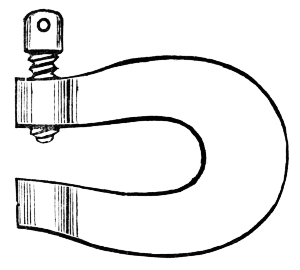
Fig. 66.
This cut represents a form of clamp used in holding the plates against each other when being riveted.
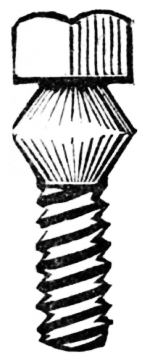
Fig. 67.
Fig. 67 represents a peculiar form of bolt for screwing a patch to a boiler. It is threaded into the boiler plate, the chamfer rests against the patch and the square is for the application of the wrench. After the bolt is well in place, the head can be cut off with a cold chisel.
REPAIRING CRACKS.
Cracks in the crown-sheet or side of a fire-box boiler, or top head of the upright boiler can be temporarily repaired by a row of holes drilled and tapped touching one another, with 3⁄8 or 1⁄2 inch copper plugs or bolts, screwed into the plates and afterwards all hammered together.
For a permanent job, cut out the defect and rivet on a patch. This had better be put on the inside, so as to avoid a “pocket” for holding the dirt. In putting on all patches, the defective part must be entirely removed to the solid iron, especially when exposed to the fire.
Note.—When fire comes to two surfaces of any considerable extent, the plate next to the fire becomes red-hot and weakens, hence the inside plate, in repairs, must be removed.
The application of steel patches to iron boilers is injudicious. Steel and iron differ structurally and in every other particular, and their expansion and contraction under the influence of changing temperatures, is such that trouble is sure to result from their combination.
DEFECTS AND NECESSARY REPAIRS.
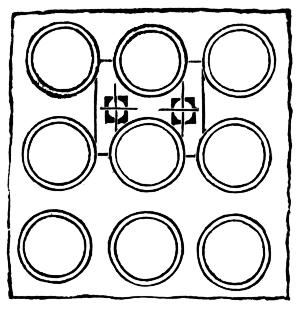
Fig. 68.
Fig. 68 represents a patch called a “spectacle piece.” This is used to repair a crack situated between the tube ends. These are usually caused (if the metal is not of bad quality) by allowing incrustation to collect on the plate inside the boiler, or by opening the furnace and smoke doors, thus allowing a current of cold air to contract the metal of the plates round the heated and expanded tubes.
The “spectacle piece” is bored out to encircle the tubes adjacent to the crack, or in other words, to be a duplicate of a portion of the tube plate cracked. These plates are then pinned on to the tube covering the crack.
Steam generators, as they are exposed to more or less of trying service in steam production, develop almost an unending number and variety of defects.
When a boiler is new and first set up it is supposed to be clean, inside and out, but even one day’s service changes its condition; sediment has collected within and soot and ashes without.
Unlike animals and plants they have no recuperative powers of their own—whenever they become weakened at any point the natural course of the defect is to become continually worse.
In nothing can an engineer better show his true fitness than in the treatment of the beginnings of defects as they show themselves by well-known signs of distress, such as leaks of water about the tube ends, and in the boiler below the water line, or escaping steam above it. In more serious cases, the professional services of a skillful and honest boiler maker is the best for the occasion.
In a recent report given in by the Inspectors the following list of defects in boilers coming under their observation was reported. The items indicate the nature of the natural decay to which steam boilers in active use are exposed. The added column under the heading of “dangerous” carries its own lesson, urging the importance of vigilance and skill on the part of the engineer in charge.
Nature of Defects. Whole Number. Dangerous.
Cases of deposit of sediment 419 36
Cases of incrustation and scale 596 44
Cases of internal grooving 25 16
Cases of internal corrosion 139 21
Cases of external corrosion 347 114
Broken and loose braces and stays 83 50
Settings defective 129 14
Furnaces out of shape 171 14
Fractured plates 181 84
Burned plates 93 31
Blistered plates 232 22
Cases of defective riveting 306 34
Defective heads 36 20
Serious leakage around tube ends 549 57
Serious leakage at seams 214 53
Defective water gauges 128 14
Defective blow-offs 45 9
Cases of deficiency of water 9 4
Safety-valves overloaded 22 7
Safety-valves defective in construction 41 16
Pressure-gauges defective 211 29
Boiler without pressure-gauges 3 0
This list covers nearly, if not all, the points of danger against which the vigilance of both engineer and fireman should be continually on guard; and is worth constant study until thoroughly memorized.
Note.
Probably one-quarter, if not one-third, of all boiler-work is done in the way of repairs, hence the advice of men who have had long experience in the trade is the one safe thing to follow for the avoidance of danger and greater losses, and for the best results the united opinion of 1, the engineer, experienced in his own boiler and 2, the boiler-maker with his wider observation and 3, the owner of the steam plant, all of whom are most interested.
Corrosion is a trouble from which few if any boilers escape. The principal causes of external corrosion arise from undue exposure to the weather, improper setting, or possibly damp brick work, leakage consequent upon faulty construction, or negligence on the part of those having them in charge.
Internal corrosion maybe divided into ordinary corroding, or rusting and pitting. Ordinary corrosion is sometimes uniform through a large portion of the boiler, but is often found in isolated patches which have been difficult to account for. Pitting is still more capricious in the location of its attack; it may be described as a series of holes often running into each other in lines and patches, eaten into the surface of the iron to a depth sometimes of one-quarter of an inch. Pitting is the more dangerous form of corrosion, and the dangers are increased when its existence is hidden beneath a coating of scale. There is another form of decay in boilers known as grooving; it may be described as surface cracking of iron, caused by its expansion and contraction, under the influence of differing temperatures. It is attributable generally to the too great rigidity of the parts of the boiler affected, and it may be looked upon as resulting from faulty construction.
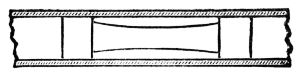
Fig. 69.
In plugging a leaky tube with a pine plug, make a small hole, of 3⁄16 of an inch diameter, or less, running through it from end to end. These plugs should never have a taper of more than 1⁄8 of an inch to the foot. It is well to have a few plugs always on hand. Fig. 69 exhibits the best shape for the wooden plug.
QUESTIONS BY THE PROPRIETOR TO THE ENGINEER IN CHARGE, RELATING TO CONDITION OF THE BOILER,
How long since you were inside your boiler?
Were any of the braces slack?
Were any of the pins out of the braces?
Did all the braces ring alike?
Did not some of them sound like a fiddle-string?
Did you notice any scale on flues or crown sheet?
If you did, when do you intend to remove it?
Have you noticed any evidence of bulging in the fire-box plates?
Do you know of any leaky socket bolts?
Are any of the flange joints leaking?
Will your safety-valve blow off itself, or does it stick a little sometimes?
Are there any globe valves between the safety-valve and the boiler? They should be taken out at once, if there are.
Are there any defective plates anywhere about your boiler?
Is the boiler so set that you can inspect every part of it when necessary?
If not, how can you tell in what condition the plates are?
Are not some of the lower courses of tubes or flues in your boiler choked with soot or ashes?
Do you absolutely know, of your own knowledge, that your boiler is in safe and economical working order, or do you merely suppose it is?
QUESTIONS ASKED OF A CANDIDATE FOR A MARINE LICENSE RELATING TO DEFECTS IN BOILER WITH ANSWERS.
If you find a thin plate, what would you do? Put a patch on.
Would you put it on inside or outside? Inside.
Why so? Because the action that has weakened the plate will then act on the patch, and when this is worn it can be replaced; but the plate remains as we found it.
If the patch were put on the outside, the action would still be on the plate, which would in time be worn through, then the pressure of the steam would force the water between the plate and the patch, and so corrode it; and during a jerk or extra pressure, the patch might be blown off.
It is on the same principle that mud-hole doors are on the inside.
If you found several thin places, what would you do? Patch each, and reduce the pressure.
If you found a blistered plate? Put a patch on the fire side.
If you found a plate at the bottom buckled? Put a stay through the centre of the buckle.
If you found several? Stay each, and reduce the pressure.
The crown of the furnace down? Put a stay through the middle, and a dog across the top.
If a length of the crown were down, put a series of stays and dogs.
A cracked plate? Drill a hole at each end of the crack; caulk the crack, or put a patch over it.
If the water in the boiler is suffered to get too low, what may be the consequence? Burn the top of the combustion chamber and the tubes; perhaps cause an explosion.
If suffered to get too high? Cause priming; perhaps cause the breaking of the cylinder covers.