"Don't care" (continued 3)
Reading edition
“What is it? Who is there, father?” cried Edgar, expectant of any turn of events.
“It is—your brother!” said Mr Cunningham, laying his hand on the wall, with pale lips, and his eyes fixed on the first figure approaching him.
Alwyn stood still at the top of the steps and took off his hat.
“I see you know me, sir,” he said; “I did not mean to come here against your wish. But your keepers have made a mistake, which perhaps you will explain to them.”
“That will do, blockheads; don’t you know a gentleman when you see one?” said Mr Cunningham, as the two men, greatly crestfallen, and muttering a “Beg pardon, I’m sure, sir,” retreated in haste.
“It is right, sir, that I should explain myself,” said Alwyn, speaking with evident effort. “I had no intention of forcing myself on you. If you will have the goodness to read the letter I gave to my brother, I will go back to London and wait—”
“No, no, no!” interposed Edgar, struggling up on to his elbow. “I’d stand by your side if I could stand anywhere. At least I’ll claim the right to own you.”
Alwyn had not meant to make any advance to Edgar which might be construed as a defiance, but he now crossed over to the couch and took the offered hand gently in both his own.
“My father will understand,” he said, “that I should not have made any approach to you if I had known of the fatal mischief for which I am responsible. Dear Edgar, lie still; no one could have done more for me than you have.”
There was a pause. Mr Cunningham moved and sat down in a chair opposite his sons. Edgar lay back, but with eyes still fronting his father, while he still held Alwyn’s hand. Alwyn himself hardly knew what next to do. There was, however, something about him so unlike the wild youth from whom the father had parted, so unlike what Mr Cunningham had imagined as his probable condition, that all previous ideas were upset.
“Your reappearance,” said Mr Cunningham at length, “is very sudden after so complete a silence. What is your reason for coming here?”
Alwyn hesitated, his mouth quivered, and he pointed to the letter which still lay on Edgar’s knee. Then he dropped his brother’s hand and made a step or two forward.
“Father,” he said, “I—I beg your pardon. That first, nothing else. I have made a position for myself, as you will see. I came partly because I hope to set Whittaker’s character right with his friends here and to leave no mystery about my own. But I have nothing to say for myself—as to the past. I was inexcusable all through.”
“Give me your letter,” said Mr Cunningham. “I will read it; I make no promises. I—I am glad; it is a satisfaction to me to hear that you have done well. But personal intercourse is another question, to which you once attached conditions to which I am not likely to see my way.”
“The conditions, sir,” said Alwyn, “are, I know now, entirely for you to make. Without your desire I shall not come here again. Indeed, of course, I cannot.”
“I never felt till now,” burst out Edgar passionately, “what it is to be helpless. I’ll not ask you to stay without a welcome. But what my father told me is not with my goodwill. I would blot out the past I must say—wait—oh! I cannot even speak for you,” as his breath came in panting gasps and his voice failed him.
“Hush, hush! I understand,” said Alwyn, much distressed; “there is no need to tell me. Hush!”
“Don’t linger here for me,” gasped Edgar, resolute still. “It is—all—nothing.”
But the last word died away in deadly faintness. Mr Cunningham gave a hasty call. Robertson came out of the house, and Alwyn could do nothing but help to carry his brother into his room. He could not go till Edgar revived, which was not for some time, and then it was hardly to full consciousness, certainly not to his ordinary self-control, for he clung to Alwyn’s hand, entreating him not to leave him.
“Don’t go, Alwyn, don’t! You know I can’t come to you—you know I can’t come to the wood to-day.”
“Can you say nothing to quiet him, sir?” whispered Robertson. “He has no strength for such excitement. His heart is very weak.”
“I shall stay,” said Alwyn; “don’t fret, my dear boy; indeed, I won’t leave you now.”
“You know that I’ll never take your place; even if I live I will not!” said Edgar vehemently.
“No, no,” said Alwyn, without much perception of the sense of what Edgar was saying. “Never mind it now. There, that’s better. Hush! we will talk by-and-by.”
Edgar grew quieter at last, and Alwyn, as he sat beside him, began a little to realise the situation. His father had retired as soon as the first alarm was over, and no word came from him.
Presently some soup was brought for Edgar, and Robertson deferentially offered Alwyn a tray with sandwiches and some claret.
“You will need it, sir, if you remain with Mr Edgar,” he said.
Alwyn hesitated, but he had had nothing since morning, and for Edgar’s sake he must accept the situation in full. It was a long strange night. Edgar was restless and feverish, only soothed by Alwyn’s voice and touch; but towards morning he fell asleep quietly, and Alwyn, as the sweet summer morning dawned, looked round about him, and recognised that the room in which he sat had been the old “study”—full of how many memories! All the furniture was changed to suit Edgar’s requirements, but the lines of the window, the panels on the wall, had a strange familiarity. When Edgar, half waking, looked at him, and murmured something about a dream, Alwyn felt that either this night, or all the past eight years, were as a dream to him. He heard the sounds of the rousing household, familiar as no other sounds in the world could be, and presently Robertson, who had gone to lie down in the outer room, where he usually slept, came back and said:
“Mr Cunningham has sent word, sir, to say that breakfast will be served at nine in the dining-room. Will you let this man show you a room? I think my young master will be quite easy now.”
“I don’t like to leave him while he is asleep, he might wake and miss me.—What, Edgar, awake? I am going to get some breakfast; I shall be back soon.”
He spoke in as matter-of-course a voice as possible, and Edgar only smiled a little and assented.
Alwyn went out into the new old house. The servants, who came to him also with a curious new old deference, unknown across the water, were strange to him; but he almost laughed to see how, evidently, they accepted him, and noticed that the man who had been attending on him did not offer, when he came out, to show him the way to the dining-room; he watched him as he turned naturally towards it. The room was empty.
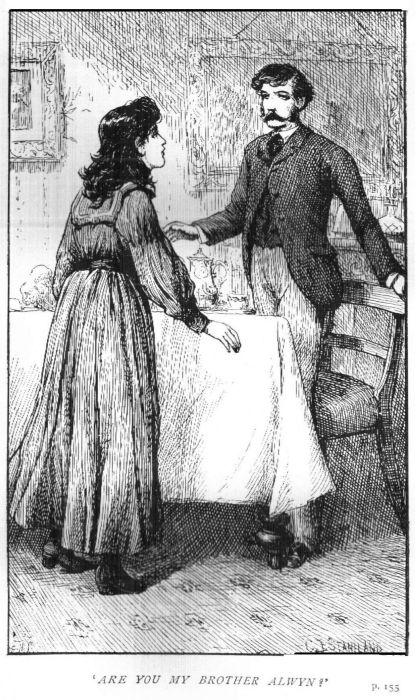
“Mr Cunningham begged you to take some breakfast, sir, and to come to him afterwards in his library.”
Alwyn sat down and silently accepted the breakfast. He recognised the gold-edged, deep-coloured china, the plate, even the special variety of hot cakes which was offered to him. He was too much absorbed to be embarrassed, and was just deciding that it would be better to get the interview with his father over before he saw Edgar again, when a quick step sounded in the hall, and Geraldine stood before him, her tall figure upright as a dart, and her dark eyes recalling Edgar’s youth so vividly, that she seemed more familiar to Alwyn than poor Edgar’s own altered countenance.
He rose, colouring, and hardly knowing what to do; but Geraldine walked straight up to him.
“Are you my brother Alwyn?” she said in her clear outspoken voice.
“Yes—you are Geraldine?” said Alwyn.
“Why didn’t you tell me so in the wood? I am very glad you are come home. I’ll be friends with you anyhow.”
Her bold, defiant voice sounded to Alwyn like an echo of his own old self, and it struck him how ready both his father’s children were to side against him.
Geraldine came close to him and offered to kiss him, and he kissed her tenderly but very quietly, and looked at her as if learning her face.
“I am very glad I have seen my sister,” he said. “But now I must go to my father. I must not talk to you now.”
“I told Miss Hardman that I would come and speak to you,” said Geraldine. “I shall write to you if you go away again. I won’t be prevented.” Alwyn said nothing, and she looked at length a little awed by his silence and gravity. He moved away towards the door, then came back and kissed her again, this time in a warm hasty fashion that brought the tears to her eyes, then went across the hall and knocked at the door of his father’s library.
Chapter Sixteen.
Harry Again.
Harry Whittaker, when suddenly claimed by Florrie as her long-lost brother, felt an immediate sense of recognition of the fair, fat, bouncing-ball of a seven years child, whom he remembered in the equally bouncing and fully proportioned damsel of fifteen.
“If you’re my little sister Florrie,” he said, taking hold of her hands, “how do you come to be out here by yourself at this time in the evening?”
“’Twas I went and chattered to the keepers and set ’em upon you. And when little Miss Lily found this here letter, I knew as how it was you and Miss Geraldine’s brother, and I run away to tell Wyn to stop ’em.”
“Run away from the Warrens?”
“No—from Ravenshurst; I was to help the nurse there.”
“Run away from your situation!”
“Well,” said Florrie with more spirit, “it was a deal better to run away than have you put in prison. I ain’t so set on situations, either.”
“Well, Florence, you’re a plucky girl I see, and I’m greatly obliged to you; but now I must just take you back to the keeper’s lodge, that they may be able to say to the lady that your own brother brought you home again.”
He gave a little squeeze to the hand he held, which brought a curious thrill to Florence’s heart. “But—but won’t they take you up?” she said.
“No; I shan’t play hide-and-seek any longer. Anyway, if you came out to take care of me I’m bound to take care of you. So come along.”
“I ain’t afraid to go back to Ravenshurst and face it out,” said Florrie.
“No; you shall go back with a good account to give of yourself to-morrow, and now you do as I tell you.”
Harry was so uneasy as to what had become of Mr Alwyn that he was not sorry for any chance of finding out.
Florence walked along by his side more subdued than she had ever been in her life. She answered all the various questions which Harry asked her about home and their father quite meekly and as they neared the keeper’s lodge, to which he knew the way much better than she did, he heard a little sniffle.
“Don’t be afraid, I’ll stand by you,” said Harry good-naturedly, and Florence for once did not reply that she never was afraid in her life.
There was a light still burning in the lodge, and Harry went boldly up and knocked at the door. It was opened by Charles Warren himself, who looked the tall burly figure up and down.
“If you’re Henry Whittaker,” he said, “walk in, and we’ll hear what you’ve got to say.”
“I thank you kindly,” said Harry; “I shouldn’t have intruded, but I’ve brought back my sister, who—”
“Mercy on us, Florrie!” exclaimed Mrs Warren, coming forward, while Wyn, looking very pale and red-eyed, with a large patch of brown paper on his nose, almost fell upon Florence.
“Oh, Florrie I have they sent you home in disgrace, for—for thinking Mr Alwyn was a poacher? It’s all over now, and we’ve been the ruin of everything, and Mr Edgar’s heart will be broke, and all through me.”
“It ain’t ruined at all,” said Florence, “and I’ve found the letter for you, and here it is.”
“That’s nothing near so bad as the other letter what master’s got!” said poor Wyn.
“Now shut up, Wyn,” said his father. “Mr Alwyn’s at the house, and the matter’s out of your hands, which never ought to have been mixed up in it. Get you to bed at once. And what has brought Florence back again?”
“I went and carried on with Jim Blake and young Benson, and I set ’em on thinking the men in the wood were poachers, and when I found the letter in Miss Lily’s pocket, and saw it was Mr Alwyn and my brother, I thought I’d better run away than have their deaths on my shoulders. But I was settling down, Aunt Charlotte, I was indeed, and folding up the clothes quite regular.”
“Could a note be sent to tell the lady what is become of her?” said Harry. “I’ll go myself if that’s all; but it’s late, perhaps, to disturb them with a long story.”
“I’ll take the note,” said Ned Warren, who had been standing in the background, “if Bessie ’ll write it.”
Bessie accordingly indited a note in her mother’s name, in which she begged to inform her ladyship that Florence Whittaker had come home, but that circumstances had occurred in part to excuse her and that she (Mrs Warren) would wait on her ladyship the next morning with a full explanation.
This note despatched, Bessie good-naturedly went upstairs to bathe Wyn’s face and to hear Florence’s story, and to leave the elders free to come to an explanation with the returned stranger. “Would you be good enough,” said Harry, “to tell me what has occurred as to Mr Cunningham?”
“It’s just this,” said Charles Warren. “Strangers are scarce in these parts, and my boy and the girl took it into their heads as they must be after mischief, and chattered about what was none of their business to the two young fellows that Ned and I have got in to help us. So when they saw a stranger, as they expressed it, ferreting in a tree, they clapped him on the shoulder and asked him his business. He looked them in the face, as they put it, as cool as you please, and asked them if they thought he was looking for pheasants’ eggs in a hollow tree in August? Which they took for cheek, which it sounded like, and told him they’d walk him up here to me. So he says, says they, ‘I’m glad you mind your business so thoroughly. Just walk up to the house with me, and I’ll explain matters to Mr Cunningham myself.’ So they walked him up, and Jim Blake, who has the most gumption of the two, says he did begin to feel uncommon uncomfortable, and when they came to the garden side, there was the master on the terrace. So says their man, ‘There’s your master, alone, I think. We’ll go and speak to him at once.’ And he unlatched the gate, quite natural-like, and walks up to the terrace. And there they saw Mr Edgar lying, and he gave a start and held out his hands, and the master sent them off with a flea in the ear. And they come straight to me, full of misgivings; they’re new in these parts, but, of course, I knew who it must be at once.”
“It did sound like Mr Alwyn all over,” said Mrs Warren.
“Then back comes Wyn, and hears the story, and begins to cry, and bursts out about the letter that Mr Alwyn had given him and the master took.”
“And is Mr Alwyn at the house now?” asked Harry.
“Yes,” said Warren, “he is. But now, perhaps, you’ll tell us where you come from, and what’s brought you here, and why in the wood?”
“That last,” said Harry, “came about unfortunate. Mr Alwyn and I came down here straight from London, knowing nothing of any one. And, thinking I was least likely to be recognised, he sent me with the letter to his brother, asking him to meet him in the wood, or come to London to see him, and to tell him how the land lay before he made himself known to his father. I gave the letter to Wyn, who dropped it: here it is. Mr Alwyn met Mr Edgar by chance, and was so knocked down by the state in which he found him, that he couldn’t tell what to do next. He was afraid, you see, of his brother having to bear the brunt of a discovery, and he not there. That made him delay.”
“But, why hollow trees, which seem to have occurred in everybody’s story?” said Warren.
“Oh!” said Harry, “to pass the time,” repeating much of what he had told Mrs Stroud, omitting, however, Alwyn’s experiences, but showing the copies of the certificates and attestations of Lennox’s confession, giving proofs by letters and documents of his respectable position in the States, and expressing with the frankness which, while it was like his old daring, had yet a different note in it, how, being a father himself, he had repented of his hardness and neglect towards his home. “But,” he concluded, “if people don’t believe us, there’s no more to be said about it at present.”
Warren was a shrewd man; he had never thought it at all likely that Harry had stolen the jewels, and he saw plainly that there was no reason to induce him to return to his native country unless the story was true.
“I take it,” he said, “that the gentlemen before whom these affidavits were made believed in the story.”
“Why, certainly,” said Harry, “which they are prepared to say in writing. Mr Warren,” he added, standing up, “there’s a deal in the past I have to ask your pardon for. I was a young scamp that cared neither for man nor God, and I was downright ungrateful for all your kindness. But I’m clear from that theft, and if you and my father can say you think so, you’ll clear away a trouble from me which not all my good fortune has made me forget.”
“Well, Harry,” said Warren, “I see nothing against your story, and I’m prepared to help you to make it out.”
After this Bessie came down, and the conversation took an easier turn, the exhibition of the family photograph, with the well-dressed wife and comfortable baby, having its due effect on Mrs Warren. A shakedown was offered to Harry in the kitchen, and at a late hour they all went to bed, if not to sleep, after the day’s excitement.
The next morning, as Wyn, though he was still rather sick and headachy, and anything but presentable, was preparing to go about his work and to inquire for Mr Edgar, and as Mrs Warren was making Florence tidy, in Bessie’s hat, to accompany her on a penitential errand to Ravenshurst, there was a tap at the open door, and there stood Alwyn Cunningham himself, as Mrs Warren said afterwards, for all the world as if he had come to give his orders for a day’s shooting.
“I heard you were here, Harry,” he said, grasping his comrade’s hand. “Warren, I hope you’ll give me a welcome also.”
“Indeed I will, sir, and glad to see you. Hope you’ll overlook the young fellow’s mistake yesterday.”
Alwyn laughed a little.
“They were quite in the right of it,” he said. “Hullo, Wyn, you have punished yourself as well as the horse.”
“Please, sir, if I hadn’t been stupid-like with my nose bleeding, I’d never have give up the letter. I’d have eaten it first!” burst out Wyn miserably.
“It was all for the best,” said Alwyn, “and you’re a faithful little fellow.”
He paused a moment, then went on, aside to Harry:
“My father wishes me to remain here for the present, and he will give facilities for the search in the wood which we wished to make. What are your plans, Harry?”
“Well, sir, since things are settled here, I think I ought to go to Rapley.”
“Can you go to London as well, and give orders for my things to be sent here? I could telegraph, but they are all in confusion. I don’t wish to leave my brother to-day. And you know I must not delay in going to Ravenshurst.”
“Is Mr Edgar better, sir?” asked Wyn timidly. “Not much, I’m afraid, as yet. He must be very quiet for the present.”
“Is all right, Mr Alwyn?” said Harry, as he followed him out of doors.
“As right as may be. My father acknowledges me, and asks me to stay with him. Friendliness and forgiveness are another matter. He read and heard all I had to say, and I believe he thinks your character cleared. Perhaps the sudden meeting was as well for him as any other, but poor Edgar fainted; all plans and scruples had to give way. It has been a terrible shock for him, and he is quite worn out, only wanting to keep me in sight I’ll go back to him. I can’t think of anything else just now.”
He turned off with a hasty “Good morning.”
“He’s as grave as his father,” said Mrs Warren, “only the master never spoke so gentle. Well, I’d like to have seen Mr Alwyn’s merry face again.”
“When folks have to right themselves after they’ve gone as wrong as Mr Alwyn and I did,” said Harry, “there ain’t so much merry-making left in them. Not but what a light heart, thank God, is very persevering. And Mr Alwyn’s got a twinkle in him yet. But coming home’s bitter hard to him, and everybody ain’t as forgiving as you, Cousin Charlotte, nor as comfortable to ask pardon of.”
Chapter Seventeen.
To Set Wrongs Right.
The abrupt disappearance of the new nursemaid had naturally caused considerable excitement at Ravenshurst, and Lily’s story, when she was asked to repeat what the new girl had said to her, did not throw much light on the subject. It seemed, however, to be clear that the child had really picked up a letter in the forest, and that, on its being shown to Florence, the girl had at once decamped. When Mrs Warren’s note came, promising an explanation, Sir Philip Carleton hummed and hawed, but told his wife that, as Cunningham’s keeper’s wife seemed so respectable a person, she had better hear the explanation. As to taking the girl back, that was another thing altogether.
Lady Carleton had no idea what the explanation was to be, and when Mrs Warren appeared at the door of her morning-room with Florence behind, hanging her head, her reception was not encouraging.
“I hope, Mrs Warren, that you have some reason to give for your niece’s extraordinary conduct. She has behaved in a most unheard-of manner.”
“She has, my lady, and I am going to trouble your ladyship with the excuse for it. Some strangers were seen in the wood, and Florence here and my little boy took it into their heads, which was none of their business, to warn the keepers about them. Then, my lady, when Florence was putting Miss Lily to bed, the little lady showed her a letter which she said she had found in the wood.”
“Yes,” said Lady Carleton; “Miss Lily told me something about that letter, but I had no time to attend to her. Well?”
“My lady, she saw in that letter the name of her own brother, Harry Whittaker, and perceived it was written by Mr Alwyn Cunningham, whose story, my lady, she had heard, it seems, from my Wyn. And Florence put two and two together, and saw that ’twas her own brother and Mr Alwyn that she had set the keepers upon, and off she ran, without another thought to send Wyn to warn them. And indeed, my lady, I hardly know whether it was her place or not; certain sure she ought to have mentioned that she was going; but her brother met her and brought her home; and if your ladyship can overlook her behaviour, she’ll be a good girl for the future, I do think.”
“But, Mrs Warren,” exclaimed Lady Carleton, to whom Florence’s conduct was the least part of the matter, “do you mean to say that Mr Alwyn Cunningham has returned?”
“Yes, my lady, he has, and Henry Whittaker too; and I may say, your ladyship, that Henry appears to be a reformed character, and well-to-do also. And very remarkable things he had to tell us. But those it is not my business to trouble your ladyship with.”
Mrs Warren said no word about the confession and the jewels; that, she thought, was not her business. And now that Mr Alwyn was once more in his proper place, she had no call to discuss his character.
“Of course, my lady,” she said, “if your ladyship feels that you cannot overlook such a breach of propriety, I will take Florence back at once.”
Lady Carleton looked at the girl for a moment.
“I should like Florence to stay,” she said. “Will you please leave her with me now, Mrs Warren? I see that the case was exceptional.” Mrs Warren thanked her ladyship, and with a discreet hope that Florence would be grateful and obedient, withdrew at once.
“Come here, Florence,” said Lady Carleton in the softest voice Florence had ever heard. “It was a very serious thing to do, you know, to run away without leave. It is because I think that you are a good steady girl in general that I overlook it, as you had a reason.”
“I ain’t a good girl, Lady Carleton,” said Florence. “I ain’t steady, but I wasn’t after nothing wrong last night.”
“What do you mean by saying you are not steady?” said Lady Carleton, somewhat taken aback by Florence’s town-bred use of her name and by her queer manner.
“I was always the one to lead the rest,” said Florence, “and I’ve always liked a bit of fun. But I had to go and try to step them from taking Harry up for a poacher, and—and he says it ain’t no manner of use to say ‘Don’t care,’ and I’m very sorry.”
“If you were able to stop the harm you had begun to do, that is a thing to be very thankful for—to thank God for!” said Lady Carleton with some emotion in her tone.
Florence looked up with a certain solemnity in her round eyes never seen there before.
“I did say my prayers in the wood,” she said, “when I lost my way, and then Harry came.”
“Tell me about it,” said Lady Carleton kindly. Thus encouraged, Florence volubly, according to her nature, but with a friendliness of manner which was really the nearest approach to respect that she had ever exhibited, told her tale.
“And my heart was in my mouth, ma’am, the trees were that black and that awful. I’d have run back, for I wouldn’t have cared if nurse had given me ever so much of the rough side of her tongue. But there, I couldn’t have it on my mind that I’d set the keepers on my brother and dear Miss Geraldine’s too. But I didn’t know one path from another no more than if there hadn’t been none. And then I thought of little Miss Lily’s prayer about setting wrongs right and travellers, and I said it, Lady Carleton; and there was Harry.”
“Did you, Florence? Oh, thank God for it!” said Lady Carleton tearfully.
“And he took me right back, and he said this morning that the best thing I could do was to come back here and be trained a bit. And so I’ve come, please, ma’am—my lady. Please, aunt said I was to say ‘my lady,’ and I will, but I forgot; and I’ll be a good girl, and not gossip on the sly, nor answer nurse back, nor make the other girls saucy. And I’ll trim up my hat quiet, if you like, my lady. I—I want to be good.”
Florence cried as she finished speaking, and wiped her eyes and blew her nose noisily. Perhaps, but for the circumstances that appealed so strongly to her sympathy, Lady Carleton would never have recognised how real this confused desire “to be good” was in this extraordinary girl, so unlike any well-trained maiden whom she had ever encountered.
“Well,” she said, “you shall try. You had better talk as little about the matter as possible, and I trust you never will ‘gossip on the sly,’ or do anything of the kind, for I couldn’t have a girl who was not nice and modest near my little ones. I will speak to nurse.”
“Thank you—my lady.”
But as Lady Carleton rose to take her back to the nursery, Florence’s round face suddenly beamed all over, and she said sympathetically: “They’ve found out who stole the jewels, my lady, and it was not Harry nor Mr Alwyn. They were as innocent as lambs.”
“I think we had better not talk about that just now,” said Lady Carleton; and then, with a sudden inspiration and effort, she added: “Florence, perhaps you don’t know that it was partly my fault that those jewels were lost, that I helped to put some one in the way of temptation. It was because I was so silly, that I only thought of what you call ‘a bit of fun.’ That is why I was so glad you were able to prevent the mischief you started, and why I taught Miss Lily to say those prayers. The good God has heard them. You see, I shall be very glad if you are good.”
Lady Carleton had a very simple manner, but Florence looked up at her with the first sense of real respect—she had begun to have real likings—that she had ever known.
“I will try,” she said softly, with her bold eyes cast down; and Lady Carleton took her by the hand and led her up to the nursery.
An hour or two later, when Florence, whose reception by the nurse had not been particularly cordial, was sitting demurely in the nursery window, putting her best needlework, such as it was, into Miss Lily’s new pinafore, a note was brought to Lady Carleton. “The gentleman was waiting.” Lady Carleton had thought of nothing but the half-heard story of the returned travellers, of the hint about the jewels, and of the hope that the consequences of her girlish folly might be undone at last.
The note ran thus:—
“Ashcroft: August 5th.
“Dear Lady, Carleton,—My eldest son has returned from abroad. He asks your permission for a short interview, either with yourself or with Sir Philip Carleton, concerning the circumstances under which he left England.
“I remain sincerely yours,—
“George Cunningham.”
Lady Carleton handed the note to her husband, to whom she had already related Florence’s story.
“You will see him?” said Sir Philip. “Ask the gentleman to walk in.”
It was a very uncomfortable moment both for Lady Carleton and for Alwyn Cunningham, who had been boy and girl together, and now hardly knew how to meet; but Sir Philip carried it off by ordinary greetings as to the son of a neighbour, whose acquaintance he was ready to make, and Alwyn hardly waited a moment before he entered on the matter in hand.
He took out the jewel that he had shown to Edgar in the wood and laid it on the table.
“I can at least return to you this piece of your family property, Lady Carleton,” he said.
“My mother’s jewel, the ruby bird!” faltered Lady Carleton, hardly knowing what this implied.
“And,” said Alwyn, “I will ask Sir Philip Carleton to be good enough to read these papers.”
These contained the confession of Lennox, already alluded to by Harry Whittaker to his aunt, and the attestations of it, of which he had shown copies to the Warrens.
“That Lennox stole the jewels, and returned one of them on his death-bed to me, Whittaker has told some of his relations,” said Alwyn, “but the main fact of the matter has only been confided to my father, as you will see that it would not do to make it public. This Is the substance of what he told me as nearly as possible in his own words:
”‘I put the jewels for safety in a hollow tree near the entrance to Ravenshurst. I thought they were safer there than in my keeping. I kept one back to take it up to London, and see if I could dispose of it, but before I could do so the alarm was given. I was afraid to come back without a reason, and I went off with my new master, leaving the jewels in the tree, and thinking they’d either be found (I have never been in England since), or I should get a chance of coming back for them. But I put it off and I put it off. I took service with Mr Alwyn Cunningham because I thought I could find out how things had gone; and I hope he will go home and find the jewels.’”
“This is a most extraordinary story,” said Sir Philip.
“It is,” said Alwyn. “Of course it rests finally on the unsupported words of myself and Whittaker, who alone heard it. These other papers and letters may show what worth is attached to our words in our own neighbourhood, but that is all.”
“Then do you mean to say,” ejaculated Sir Philip, “that these missing jewels are—are in an old tree trunk in Ashcroft Wood?”
“Well,” said Alwyn, “all I can say is that Lennox said that he put them in one.”
“Good heavens!” exclaimed Sir Philip.
“But, of course,” Alwyn continued, “some one may have lighted on them during these eight years and carried them off, to say nothing of the difficulty of finding them. For he had done it, he said, in the dark, and though he could have found the tree himself, he could not tell me anything about it, except that it was near Ravenshurst. You see he was dying fast, and spoke with great difficulty.”
“Do you remember the man, Lily?” asked Sir Philip.
“I think I remember something about a servant who went to America. Oh, Philip, you will have every place searched—you will help Mr Cunningham? If the jewels could be found! But I don’t mind so much after all about that if no one is accused falsely.”
“As to that,” said Sir Philip, “I know Mr Dallas, of Boston, and the Bishop of. I knew them when I was once in the States, the year before I married. What they say here is quite sufficient to establish the worth of Mr Alwyn Cunningham’s testimony and the character of his foreman, who is more concerned in the matter. You will allow me to call on you, Mr Cunningham, and to express my pleasure at your return.”
“Thank you,” said Alwyn, a little stiffly, for the situation sorely tried his pride. “I am much obliged to you,” he added, after a moment.
“And, Alwyn,” said Lady Carleton, with tears in her eyes, “can you ever forgive me for my silly trick, and for being too frightened to tell of it at once? Oh, I have never—never forgiven myself.”
“I don’t think it is easy for any of us to forgive ourselves, Lady Carleton,” said Alwyn, “for that night’s work. But your share was a very small one.”
“The fact is,” said Sir Philip, “the thing was never properly investigated. Mr Fletcher was afraid that the silly trick would come to my ears—too soon. I needn’t say—since you know my wife—that I at once heard of it from her. The chance was lost. But what is to be done now? You yourself believe this story?”
“Oh yes,” said Alwyn, “I do. There was no object in deceiving me. No; I am sure Lennox had not sold the jewels, and made up the story of the old tree.”
“We cannot let it get about that the wood is full of diamonds,” said Sir Philip.
“No,” returned Alwyn with a laugh; “neither Whittaker nor myself could resist a little bird’s-nesting, but it was, of course, unwise. That was partly why I wished to make myself known first to my brother. I did not know then that part of our misfortunes.”
“Ah! poor fellow,” said Sir Philip, “he is sadly helpless. But your return will be a capital thing for him. His life must be rather solitary.”
“Yes, I fear so,” said Alwyn. “I will go back to him now, with many thanks for a most kind reception.”
“Lily,” said Sir Philip, when their guest was gone, “I believe young Cunningham told the truth and the whole truth, to-day. But I didn’t.”
“What in the world do you mean, Philip?”
“Why, only yesterday I got a letter from old Dallas, giving a wonderful account of him and his high character out there, but wanting naturally to know how Mr Cunningham’s eldest son came to be there at all. I was wondering what I could say, for it was very evident that he had a reason for asking—there’s a lady in question, I imagine—when to-day he turns up.”
“Oh, Philip, we must find the jewels!”
“We must; but it passes me to know how to set about it.”
Chapter Eighteen.
Sunday at Home.
On the next Sunday morning the bells of Ashcroft Church were ringing for an early celebration of the Holy Communion. Many eyes were turned on Alwyn Cunningham as he walked down the village in the fresh sweetness of the summer morning. Such early church-going was not according to Mr Cunningham’s habits, and probably Alwyn was the last person that any one expected to see practise it, for the formal confirmation of a careless public schoolboy had never been followed up, and in old days he had never been a communicant. The change from former habits was so marked that the conservative villagers of Ashcroft looked at him very distrustfully, as if they wondered why he came.
Perhaps Alwyn had forgotten what it was to be the observed of all observers; perhaps he had learnt that only thus would he obtain the help he needed in a most painful position. His father had accepted his statements as to Lennox’s confession, and had allowed such a search for the jewels as could be made without publicity to be commenced at once. He also acknowledged in a more indirect way that his son had become a respectable member of society, fit to visit at his house; but he did not open his heart to him, nor forgive him, except in a formal manner. Alwyn felt that his father did not trust him, he knew that his engagement to an American lady would not tell in his favour, and he guessed that the marked and complete change of attitude as to religious matters, the account of which, indeed, had been intended for Edgar only, would be viewed with suspicion. Mr Cunningham, after reading the letter, had touched on no point but the lost jewels, and Alwyn had accepted his silence and the situation, and talked diligently when they met, and at meal times, of general topics.
But when old Mr Murray saw him this morning he wondered if the inaccessible Cunninghams, who had always been so polite, and on such stiff term with him since his coming to Ashcroft, would approached by the unlikely channel of the returned exile.
Certainty anything less like the irreverent, light-minded youth whom he had heard described than Alwyn’s serious face could hardly be imagined, and Bessie Warren could not help wondering what he was thinking of, as she saw him look round before he turned away, as if noting the once familiar scene.
Edgar had been so weak and so much shaken by all that had passed that he had been content to take his brother’s presence for granted, and when Alwyn realised how very solitary such hours of languor and suffering must usually have been, he cared little what his presence there cost himself, if the sight of him made Edgar’s eye brighten and gave him any pleasure, however small.
To-day, however, Edgar was better, and his interest and curiosity began to revive. He had been lifted on to his couch by the open window, and had sent a message to Wyn to bring his black eyes to be looked at, and after a little space of the eager watching of the outdoor world that was always so much to him, he said to Alwyn:
“Where is that letter that you wrote for me? I could read it now, and I’m as much in the dark as the first day I saw you.”
“Here it is,” said Alwyn; “shall I read it to you or tell you about it? Is your head well enough to read it?”
“Oh yes; I can stop if I’m tired. I had rather have it.”
Alwyn gave him the letter, and went on with the one that he was himself writing, while Edgar studied the long document for some time in silence.
Presently Edgar talked a little about the jewels and the chances of their discovery, observing that whoever poked about in the dark or on the quiet, hunting for them, would certainly get shot by the zealous keepers who had laid hands on Alwyn.
“There’s nothing for it but setting the forest on fire,” he said.
“No, no,” said Alwyn, “the jewels are not worth a tree of it.”
Edgar gave him one of his keen glances, under which the colour mounted to Alwyn’s brow.
“My father has given Warren orders to be thorough over it,” he said.
Edgar said nothing, and returned to the letter.
“Are—are you writing to Miss Dallas?” he said presently, with a rather shy intonation.
“No; I have not that privilege. To her brother.”
“Tell me about her. What’s her name?” said Edgar.
Alwyn was nothing loath.
“Corinne is her name,” he said; “they use it in America.” And then he went on and told Edgar a great deal, for which there is no space in this story, and as he talked his face grew happy and eager, and Edgar listened a little wistfully.
“Now it will be all right for you?” he said.
“I think so—I hope so. Mr Dallas only wished to be certain that no complications could occur in the future. He does trust me, and is satisfied with my position there. My father has said all that is needful.”
“And when shall you go back, Val?” said Edgar.
The bright eyes were still resolute and clear and the voice steady, though with a little strain in it.
Alwyn looked at the white fragile face, and could not find voice for a moment to answer.
“You mustn’t stay too long and spoil me,” said Edgar, “unless you come back again very quickly.”
Alwyn came nearer and sat down by his side.
“My boy,” he said, “you know I did not come home only to clear my way for my great hopes. I did come to seek for pardon and to try to undo a little of the past. There’s a long time to make up for; there is no hurry. You need not think about parting yet; that is, if my father—”
Alwyn broke off, and Edgar lay still, twisting his long weak fingers round the hand he was holding.
“I think you might promise to stay—as long as I want you,” he said. “I shall let you go—soon.”
“I promise,” said Alwyn gently, and again Edgar was silent, till he said in a different tone:
“Well, that’s all as it may be. One must take what comes.”
“What is sent,” said Alwyn.
“Val,” said Edgar after another silence, “it was very curious. Just before you came back I dreamed about you. I saw you. I knew you directly. But I saw that you were changed; your face was like it is now—not as it used to be. You are different.”
“Yes,” said Alwyn, “I am different.”
“Tell me,” said Edgar.
Perhaps Alwyn had never found anything so hard as to enter on an account of what some people would call his “experiences” to his brother, but he said quietly:
“When I grew to love Corinne I found out what I had made of myself by my life. Beforehand, I thought since I had pulled myself together and all my offences had been before I was twenty that all was right. But I can’t tell how, through loving her, my sin against my father, and the bad example I set you, came back upon me. I felt how hard and selfish and callous I had been all along. Whether she cared for me or not, I wasn’t worthy to know she existed.”
“Go on,” said Edgar, as Alwyn paused, conscious that Edgar was not exactly a comprehending listener.
“Well,” said Alwyn, “as for religion, you know I never had thought about it. I don’t believe as a family, we’re given to thinking, and, apart Corinne, young Dallas was a new idea to me. Of course his ways and words put much into my head. But it was the earthly love that was granted to me that showed me what that Higher love might be. And when I had once said to my Heavenly Father, ‘I have sinned,’ there was nothing for it but to come and say the same to my earthly one, even—even if he is less merciful.”
Edgar listened with great surprise, but with no doubt whatever of the absolute sincerity of the speaker.
“Well,” he said, “as for me, I’ve had something to make up my mind to. I was determined no one should say I was beaten. I had to give up the army and to know I could never walk, but I’ve got along and put a good face on it. ‘Never say die’ is not a bad motto. Well now, you see, I’ve known for some time that I should have ‘to say die,’ sooner rather than later—very soon, I fancy. When I was last laid up, I made old Hartford tell me the truth, and I’ve faced that out too. What must be, must.”
“It would have taken less pluck, my boy, to face the enemy, if you had gone into the army, than to face your life here,” said Alwyn tenderly. “I thank God, who made you of that sort of stuff.”
Edgar looked somewhat struck by this remark.
“One got through things by saying, ‘I don’t care how they go,’” he said. “And so, Alwyn, it’s been great good luck to have seen you, and you mustn’t stay here if things are not smooth. I shall pull along—so remember you haven’t made any rash promises. Corinne mustn’t think you’re not in a mortal hurry to get back to her.”
“Corinne will understand,” said Alwyn with a smile. “Come, I mustn’t let you over-talk yourself. There’s Wyn on the terrace.”
“I say,” exclaimed Edgar, “he has made a spectacle of his little red phiz. Here, Wyn! Are you ready to take me out again?”
“Yes, sir; oh yes, sir. Are you ready to come?”
“Very soon, I hope. And how are all the creatures? Has the fox been behaving himself?”
“Yes, sir, but one of the little hedgehogs has got away, and the moor-fowl, sir, I’m sorry to say they constantly diminish. Father thinks there’s rats about—or a cat, sir.”
“Whew! That’s a bad look-out. Alwyn, you haven’t seen the Zoological Gardens?”
“Please, sir, should I bring anything up for you and Mr Alwyn to look at?”
“Let’s have the little Scotch terriers. I’m thinking, Wyn, of taking up those beetles that live in decayed wood—in old trees. You’ll have to hunt ’em up for me.”
“Very well, sir, but I don’t know as even Granny would like them about,” said Wyn, as he went after the dogs.
“Granny? You have seen old Bunny, Val?”
“Oh yes. That was a real welcome. But, Edgar, surely it could be managed for her to come and see you; she wishes it so much.”
“I should like to see her again,” said Edgar. “I missed her when she was crippled, too, poor old dear!”
As he spoke, Geraldine, having come back from church and let out Apollo, joined them, and presently Mr Cunningham, walking home by himself, paused a moment in front of the terrace, as a sound, unheard for many a year, fell on his ears—the clear ringing laugh of his first-born son. So had Alwyn laughed in days before they quarrelled, so had he laughed when his mother had been alive to hear him, and when Mr Cunningham, if a rather cold father, had been at least a proud one.
The three puppies, Apollo, a young fox terrier, and a little rough Skye, were sitting up on their hind legs in a row, under the tuition of Wyn, who squatted on the ground opposite them. Geraldine was looking on, holding her breath with delight, while Alwyn, leaning against the window by Edgar’s side, was laughing heartily and teasing Geraldine about her pet.
“Three to one on the little ruffian! Apollo’s nowhere. His back’s too long, and the fox terrier’s too frisky. Bravo, Wyn! You ought to keep a circus; they’re steady yet.”
“I should like to, sir, uncommon, and train the performing dogs, sir,” said Wyn.
“You look as if you had been practising for the clown,” said Edgar, as his father came forward on to the terrace.
Down tumbled the puppies and up jumped Wyn, retreating hastily. Alwyn grew stiff and grave in a moment, offering his father a chair, and Geraldine looked, as she felt, disappointed at the interruption.
Mr Cunningham sat down. It was the first time that the family had been thus all together, the first time he had seen his three children side by side for more than eight years. He noticed them. He observed that Geraldine was growing a tall, stately girl, with the promise of distinction if not of beauty. He noticed the hopeless delicacy of Edgar’s look, the son whom he had made his heir; and he looked at the handsome, grave, strong face of the son he had disinherited, and for the first time he confessed to himself that he looked fit, at any rate, to be the master of Ashcroft.
And why were they all so grave in his presence? That Alwyn should be reserved was right enough, but the others? He had heard them laughing and at case together. He saw Edgar turn naturally to Alwyn to do him some trifling service, and for the first time it struck Mr Cunningham that something more might be made out of his relations to Edgar and Geraldine than was the case at present. Surely they were unusually stiff, and not shy, but distant with him.
He did not wish for any approach from Alwyn; but it was none the less true that these feelings had come to him on Alwyn’s return, because Alwyn was the only one of his three children that he had ever greatly loved.
Chapter Nineteen.
After Eight Years.
Life was certainly a much more peaceable thing in the Whittaker household while Florence was undergoing the process of being “stroked down” by Mrs Warren at Ashcroft, Ethel and Sybil were much less perverse and saucy without her, and went their several ways like rational girls, Ethel looking forward to a clerkship in the post-office, and Sybil to an apprenticeship to a good dressmaker in Rapley. They contrived to walk about without staring or being stared at, and as they behaved with ordinary common sense, the respectability of their superior home showed, and they were thought well of by their various teachers, and began to take the lead at their Sunday school in better things than mischief. Miss Mordaunt found her Bible class comparatively harmless, and could not honestly feel that she regretted Florence Whittaker; while, at home, Mattie enjoyed unwonted peace and quiet.
She knew that she had not managed Florrie very well, but the relief of feeling no longer responsible for her was great. After a longish interval, Florence had replied to the letter in which she had urged her to keep in mind the lesson of Harry’s misconduct.
The girl could write rather a good letter, and her descriptions of her life at Ashcroft were amusing. “I should like it very well if there was anything but trees and live stock about,” she said, “but I get on right enough. Aunt Charlotte ain’t made up her mind that I’m going to ‘harry her up,’ as Aunt Stroud calls it. As for Harry, I remember him well enough, and there’s others that haven’t forgotten him neither, and maybe I’m taking example more than you think.”
Mattie could make nothing of this sentence, but it recalled Harry to her mind; and one evening, when George had come back from his work, she began to talk about him.
“It seems a bit heartless of us, George,” she said, “to think so little about him. He might be in trouble and poverty, and we so comfortable.”
“I expect we should have heard of him if he had been,” said George. “Of course, if he turned up, I should do the right thing by him—after proper inquiries. But I don’t suppose we should be much the better for him.”
“I wonder if father ever frets after him,” said Mattie.
“I don’t think he does,” said George dryly; “he put him out of the way too much. But Aunt Stroud made a pet of him.”
“I wish Aunt Lizzie wouldn’t talk so mysterious!” said Mattie impatiently. “She came down here to-day and talked about bursting clouds and Providence, till one would have thought she knew something particular.”
“She’s a talker, worse than Florrie,” said George. “I declare I’ll be off, Mattie—if there isn’t Aunt Stroud again!”
George was a worthy and useful young man, and if trouble or poverty had come upon his sisters he would have done his part by them well. But he liked his life very well as it was, and he naturally thought that the scapegrace Harry, though he knew nothing of the jewel story, would come into it as a disturbing element. Even Mattie, who was much more tender-hearted, felt afraid of the idea of him, and would have welcomed him from duty rather than from love. The father, too, was a good, conscientious, but rather selfish man, whose life consisted in the routine of his duties. He had been much more comfortable without Harry than with him. People cannot vanish for years, leaving trouble behind them, and always find a spontaneous welcome on their return. Neither Alwyn Cunningham nor Harry Whittaker had left to them in the world the one friend who would never have forgotten them. Their mothers were dead. Their places were filled up. Had poor Edgar been the gay young officer that Alwyn had pictured him, the place his brother held in his memory would probably have been much smaller, and when Harry Whittaker walked down the broad road in the middle of the cemetery, no dream had given notice of his return, nobody had any special desire to see him.
And for himself, he had come home more for the sake of his child than for that of his family. He recalled them all with an effort, even as he walked along counting the new tomb-stones that had appeared since he went away. His Aunt Stroud had arranged to come to the Lodge a few minutes before him, so as to prepare his family for his arrival. Suddenly, however, he perceived his father walking towards him by a side path, with his order-book under his arm, on his way from a meeting of the Board. A little greyer-haired, elderly middle-aged instead of young middle-aged, but far less altered than Harry himself, at whom he looked without any recognition. Harry had to choose between letting him pass and making himself known; but, before he could resolve what to say, some agitation in his manner, a look that was not that of the ordinary passer-by in his face, arrested Mr Whittaker’s attention, and he paused and looked at him.
“I think I’m speaking to Mr Whittaker?” said Harry, in his strong outspoken voice, which nevertheless shook a little. Then he suddenly put out his hand.
“Father, do you know me? I’ve come back to ask your forgiveness and friendship, and to clear my character as to the past.”
“My son Henry!” exclaimed Mr Whittaker. He faced him with a look of great surprise and of uncertain welcome, and yet, perhaps, he had often enough wondered whether Henry would come back, not to feel the utter strangeness of an event never looked forward to.
“It’s your place to explain a little, Henry,” he said, neither giving nor withholding a welcome.
“If you are willing to hear me,” said Harry.
“Come with me,” said Mr Whittaker.
He turned and led the way into the little office where business was transacted, and where the relatives and friends sometimes waited for funerals. In this not very cheerful spot Harry’s papers and letters (including one from Mrs Warren) were once more produced, and, under promise of secrecy for the present, he told his father of the search for the jewels, and how he would willingly have held back till they were found, but for his encounter with Florence.
“And,” said Harry, “after what passed I was justified, I think, in holding aloof, while I was a vagabond and times were so hard. And after I settled down comfortable and got on, thanks to Mr Alwyn’s kindness, I’d made up my mind to forget the old country; but you see, father, I thought, what if little Georgie, when he grows up, were to keep away from me for eight years, and live happy? Why, let us have quarrelled as we would, it’d break my heart to think he could forget me so. And so—and so, father—I hope you’ll let me take him his grandfather’s blessing. Mother would have set great store by him if she’d lived to see him, and he shall be taught to set store by you.”
The father and son sat looking at each other for a moment or two in silence. For the big, half-grown, trouble-town of a boy the father could not say that his heart had broken; but the thought of the little grandchild brought back early days, when Harry’s rosy face and sandy curls had been the mother’s pride, and when his father’s heart would have nearly broken if he had died in that scarlet fever from which he had barely recovered. Perhaps he had been too ready to think ill of the lad, and to cast him upon his own resources.
“If you were wronged about the jewels, Henry,” he said, “it’s you that have the advantage of us.”
“I’d acted so as to be easy wronged,” said Harry, “but I’d be glad to go back with all fair behind me.”
Mr Whittaker put out his hand with something like tears in his shrewd grey eyes. After all, he had not quite forgotten Harry. Harry gave the hand a great squeeze and walked over to the window, from which he presently turned round, saying:
“There’s my aunt, father; she was coming to tell you.”
Mr Whittaker went out to the door and beckoned Harry after him. There stood Mrs Stroud, beaming; Mattie, flushed and eager; George by no means so well pleased; and all the four younger ones eager and excited.
Harry’s coolness returned as soon as he had settled matters with his father, and he greeted them all as composedly as if he had returned from a short excursion abroad, and presently they all went in to sit down to supper and take each other’s measure as well as they could.
Mrs Stroud at once called for the photograph and Ethel and Sybil giggled with delight at finding themselves possessed of a nephew, while Mattie began to think that some of the romance she was so fond of had found its way into real life.
“And how long do you mean to stay this side of the water, Harry?” asked his aunt.
“Only till the matter of which I spoke to my father is concluded or given up. Mr Alwyn and myself could not both be away for long together, and I think he will not leave his brother again so quickly. Alberta would be very glad to make your acquaintances. Will you come back with me and pay us a visit, Mattie?”
“No, Henery,” said Mrs Stroud; “if Mattie knows which side her bread’s buttered she’ll stay on this side of the ocean. But if you want to do a brother’s part by your own family, you’ll take Florrie off their hands. For there’s no room for that girl—not in the High Street of Rapley. Perhaps there might be in Ameriky.”
“Aunt Eliza!” said Mattie indignantly, “Harry only meant so as to make acquaintance.”
“Well, well,” said Harry, “we’ll talk it all over. But Florence did her best to get me out of a scrape—”
“Which I make no doubt she got you into,” said Mrs Stroud.
Harry’s eyes twinkled a little, but he did not betray Florence, and the suggestion dropped into his mind. He would be glad to do something for one member of his family, and he rather inclined to the unpopular Florence, though, of course, he remembered Mattie much better, and felt pleased when at last she shyly came up to him and said that she was glad he had come home. But it was all uncomfortable and full of effort, and Harry felt glad when the time came to say “Good night,” and he went off to catch the last train for London. But, as he walked along at full speed to the station, the feeling of his father’s hand-shake lingered on his palm, and he felt that he could think of his child with peace and satisfaction.
Chapter Twenty.
Glad and Thankful.
There now set in at Ashcroft a period trying to the feelings of all concerned. No trace of the lost jewels was discovered. The number of hollow trees in the forest was limited, and so were their hollows, which were searched as thoroughly as was possible, and in vain. One or two old trees had been previously cut down and sawn up; the lost treasure could not be in them. Alwyn began to wish that the jewels had all been disposed of in America, and that this search, the folly of which seemed to throw a sort of doubt on the whole story, had never been undertaken. Lady Carleton was most anxious and eager over the matter, and as the search could hardly be kept quite secret, its cause came to the ears of Florence, who, when she was out with little Lily, spent her time in poking her fingers into the smallest knot or rent in perfectly sound trees, and started a theory that the jewels were probably in some of the jackdaws’ nests about the chimneys of Ravenshurst, having been carried there after the manner of the various thimbles, rings, etc, which had been so disposed of in the story books with which she was acquainted. Florence was behaving wonderfully well, and little Lily was very fond of her; and she perhaps owed some popularity with the other servants to the fact that she was the sister of the Henry Whittaker whose name was in every one’s mouth. Harry was very anxious to get home again. He took a room at Ashcroft, and visited his family sometimes; but he was often at a loss what to do with himself. The Warrens were very kind to him, and all the heads of departments at the great house took up the cue and showed him civility; Alwyn always treated him with the same friendly consideration, and was often glad of a chat with him on matters familiar to them both.
Alwyn had, however, much else to take up his time and thoughts. The neighbourhood accepted him and paid him attentions; which, as it soon became apparent, his father was anxious that he should accept. The Carletons especially came forward in a marked manner, and all this gradually changed and undermined Mr Cunningham’s feelings about him. He saw that it was impossible to treat such a son as in disgrace, and perhaps his continued stiffness was more shyness than displeasure. James Cunningham behaved admirably, and invited Alwyn to visit him in London, and he went, though very unwillingly, for all this while poor Edgar was growing more and more dependent on him, and though he eagerly urged the acceptance of his cousin’s invitation, he could not conceal his delight when Alwyn came back again. Alwyn was touched beyond measure at the affection that Edgar showed him, and repaid it with the tenderest devotion.
Poor little Wyn was always hoping that his master would be well enough to come into the wood; but the drives in the pony chaise had been very short of late, and often Edgar was only fit to lie quite still on the terrace, looking at the sky and the trees, still enjoying the sense of “out of doors,” which was like life to him.
One splendid afternoon, early in September, when the sky was one glorious sheet of blue, and the red creepers and purple clematis were covering the side of the old house with colour, Wyn came up the garden with a carefully constructed basket of lichens and wild flowers in his hand. He had brought it up to show it to Mr Edgar; and, by good luck, there lay Mr Edgar, alone on his couch, for once without Mr Alwyn by his side, to take up his attention.
“Ha, Wyn!” he said; “what have you there? What splendid affair is that?”
“Please, sir, Lady Carleton has offered a prize for the best wild-flower collection at the flower show to-morrow, and this is mine. There are grasses and lichens too, sir.”
“Yes. Capital! How well you have arranged it! All the three sorts of heath too!”
“Yes, sir. Please, sir, last year we went right through the wood to see the heather in bloom.”
“Ah, yes; but, you see, just lately the pony chair seems to shake me, so I have to lie still.”
“When you’re better, sir, there’s a new bit of clearing that’s very pretty. There’ll be plenty of anemones there in the spring.”
“Yes, in the spring! We’ve had some very good times out with Dobbles, Wyn, haven’t we? You must bring him up for me to look at some day, if I can’t go out. Now tell me about all the creatures.”
Wyn began a long list of the various birds and beasts under his charge, as had often been his custom; but there was something in the intent way in which his young master looked at him that made it difficult for Wyn to go on. Edgar lay so still, and made so little comment.
“Thank you,” he said, when Wyn paused, which was not at all his usual way of receiving the reports, as he used to call them. “Alwyn, is that you at last?” he said, as a step sounded.
“Yes; did you wonder where I was?” said Alwyn, standing over him. His colour was high and his look quite radiant. He held some letters in his hand. Edgar’s attention was caught at once.
“Your basket is first-rate, Wyn,” he said; “I wish I could have helped you to get the flowers. Are you going to take it in now?”
“Yes, sir, and to take some flowers to little Miss Lily, who wants to send up a bunch, ‘not for competition,’ she says, sir, because she can’t get them all herself.”
“Well, you must come and tell me about the show.—What is it, Alwyn?” he added eagerly, as Wyn went his way.
“It is the best of good new’s. Mr Dallas writes the kindest letter! My letter from here and one from Sir Philip Carleton have fully satisfied him that all is clear as to the past. For the future, he says, he can trust me there; and here he cares nothing. When I go back I shall find a welcome home, and I may write to her.”
“That’s right,” said Edgar.
He looked up bravely, but Alwyn felt the congratulating hand tighten close upon his own. Edgar’s nerves were too weak now for him to be allowed to dwell on any agitating topic, and Alwyn just added a word or two of detail, and then said: “Now I shall read to you; you’ll hear enough about it all in time, no doubt.”
“No,” said Edgar, “go and write your letter. I see father coming; he will tell me the news. Just lift me up a little bit and give me some drink. Yes, so—I am quite comfortable.”
Alwyn was naturally very eager to write his letter, and went into the house, grateful to Edgar for understanding his hurry.
But he did not know that Edgar had wound up all the remains of his resolute spirit to an effort he was determined to make. Poor fellow! ‘Don’t care’ was no easy saying to him now. His heart beat fast, and he could scarcely conquer the dread of making matters worse by speaking. “Father,” he began, after Mr Cunningham had said a few ordinary words about the weather, “I can’t say very much now; you’ll forgive me for being short and sudden. You know, father—I shall never be your heir—never. You will not let any one think that you wait for the chance of finding those jewels before you set Alwyn in his right place. What can a man do but repent? I know it must come right finally; but, father, will you give me the happiness of seeing it?”
“The jewels are neither here nor there,” said Mr Cunningham.
“But, if they are found, it will look as if Alwyn needed that to reinstate him. Don’t you see how scrupulous he is—that he will hardly pick a flower or ask a question? He puts off all his own happiness for me; he stays because I need him so much. But that won’t be for so very long. Oh, father, make it right for him to stay here; make it right for yourself. I know that you know how it must be, as things have turned out. But say so, father, say so. Things get clear when one is forced to think. I know now that you really missed him; he feels how much cause for anger you had. Father, I care so very much that you should really take him back and forgive him!”
“You distress yourself needlessly,” said Mr Cunningham, stiffly still, but not unkindly. “I was justified, I think, in taking time to consider. I greatly regret Alwyn’s American connections. But you are quite right in feeling that I should not now be justified in diverting the property from the direct line. That will I spoke of has been destroyed for some weeks.”
“I did not mean to distrust you, father,” said Edgar. “I knew that you would see it so, but you will let people know that it is so.”
“Did your brother know that you meant to speak to me?”
“No, oh no! We have never touched on the subject.”
“Don’t distress yourself,” said Mr Cunningham; “I will take opportunities. Here is Alwyn coming.”
Perhaps Alwyn thought the echo of the voices through the window a little too eager, for he came out with an anxious look at Edgar, making an excuse of pushing the couch more into the shade.
“Alwyn,” said Mr Cunningham, “my agent has been making a proposal to pull down the cottages and farm-buildings on Ashurst Farm, and throw it into one concern with Croppings. What do you think?”
“I—really, sir—I cannot judge,” said Alwyn, turning round and considerably startled at this appeal.
“I shouldn’t wish to do it if you disliked the notion. Perhaps, if Edgar does not want you, you would walk down with me and look at the place.”
“Go—go,” whispered Edgar. “Go with him at once.”
Alwyn and his father were a long while away. Edgar had been taken indoors while they were out, and, weak as he was, had grown weary of waiting before Alwyn came in, much too late to send his half-written letter by that day’s post.
“Edgar,” he said in a low voice, “it is all right. My father shall not, if I can help, repent it.”
“Tell me,” said Edgar eagerly.
“We didn’t get on much with settling about the farms,” said Alwyn, half laughing. “As we walked down he said that he begged me to spare him conversation on the subject. I was to understand that my place was ready for me. And then, when brooks came up about the farms, he referred him to me in a sort of matter-of-course way that I could have laughed at. A fine notion Brooks must have formed of my knowledge of the subject! We met Sir Philip Carleton, and when he said that the search in the wood seemed hopeless, my father answered that, for Lady Carleton’s sake, he was sorry. It did not, of course, particularly concern himself. Then he walked round by the stables and made me say which of his young horses should be sold. I could only say I would come to-morrow and look more particularly. I couldn’t have told a racer from a cab-horse then. But, Edgar, the best of it was that I—I knew that he liked it, that he felt it good to have me to ask and to care. And at last he said something about ‘my friends in America.’ I don’t think he liked the notion much, but he ended by saying that he would write to Mr Dallas, and that he should be glad to make the young lady’s acquaintance at no distant date.”
“Yes,” said Edgar. “Alwyn, you ought to go and fetch her—you will one day—and bring her to see Ashcroft. But—”
“Some day, perhaps,” said Alwyn. “Just now I’m going to take care of you, and do what I can to please my father. He was very good.”
“I couldn’t let you go,” said Edgar. “It used to come across me what it would be like to die alone. I was afraid of getting worse always, though I wouldn’t own it to myself. Afraid of having to lie here shut up from the air and the light, and just the things that made life bearable—with never any change. But now that I have you—”
“I have had much that I don’t deserve,” said Alwyn very low; “but of all these mercies, the one I am most glad, most thankful for, is that I can help you, my dear, dear boy! Thank God for that!”
“I am glad,” said Edgar; “oh, how glad! But I am afraid I don’t know much about being thankful, Val; you must teach me.”
Chapter Twenty One.
In a “Rift Imprisoned.”
Wyn gave up his basket of wild flowers to Mr Elton, who had charge of the arrangements for the flower show, and then went on to Ravenshurst with those he had collected for Lily. He had been sent over there once or twice with parcels or messages for Florence, and the nurse, thinking him a well-behaved little boy, allowed him to stop and give his opinion, whether the white flowers gathered in the hedges were all, as Florence said, “hemlock,” or would rank as different specimens. Wyn sorted out yarrow and wild parsley, cow parsley, and several others, and then said:
“Miss Lily hasn’t got any honeysuckle. That’s not rare, but it is very sweet, and suitable for a young lady’s basket. You should put the climbing things round the edge for her, Florrie; different sorts of brambles, and dog-rose berries, and traveller’s joy.”
“There’s some honeysuckle on the old oak tree,” said Florrie, “but we can’t get it, it’s too high up.”
“I’ll fetch it down for you,” said Wyn, scrambling up the lower branches of the tree. “Why,” he said, putting his hand into a hole a few feet up, “how clean someone’s scraped out this hole—taken all the old nests out of it!”
“There ain’t nothing in it, Wyn, is there?” said Florrie.
“No; I once tried to make that hole ever so nice and soft with moss and stuff, and put acorns and nuts in it to get the squirrels there. I even went and got a bit of putty and stopped up the hole in the bottom and put decayed wood over it; but, bless you, they never came.”
“What did you do, Wyn?” said Florence, coming close.
“Stopped a great hole. It’s stopped still; I can put my hand down, and you feel nothing but wood.”
“Could you get the hole open, Wyn? Was it a hole that things could be hidden in?”
“I suppose so. Whatever is the matter, Florrie? You look downright scared!”
The hole was wide and shallow. Wyn took the knife with which he had meant to cut the honeysuckle, scraped and cut, and, the soft decayed wood giving way, the piece of putty yielded to his pull and came out.
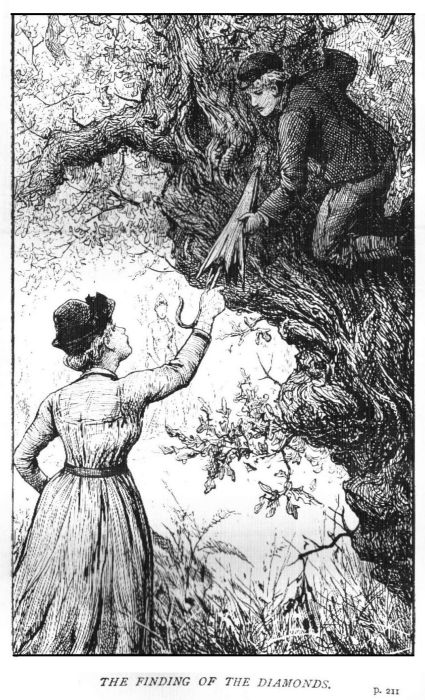
“There’s a hole, but I can’t feel the bottom of it,” he said.
“Put in my sunshade; feel with the hook.”
“My stars, Florrie, there’ll be nothing alive in there!” said Wyn; but, boy like, to fish in a hole with a hook was delightful to him. “There’s—there’s something down at the bottom. I can just reach. It’s hard—it’s loose. Hi! I’ve got it; it’s coming up. Oh, my eyes! Oh, my stars! It’s—it’s diamonds!”
“It’s them!” cried Florence, clasping her hands as a long band of flashing stones came up into the sunlight on the hook of her parasol, and Wyn tumbled right out of the tree in his amazement, dropping his treasure-trove most appropriately at the feet of Lady Carleton, who, unseen by Wyn and Florence, had come up, and was watching them under the tree.
“Found!” she exclaimed; “found at last!”
“Is it the lost jewels?” said Wyn, bewildered. “Why, who ever would have thought of looking in a tree for them?”
“As if they hadn’t been looking in all the holes in the wood,” said Florence, “and you could have told them of another. Didn’t you know?”
“I hated coming here without Mr Edgar,” said Wyn.
“Now, not another thing must be done till Sir Philip knows, and Mr Cunningham, and Harry Whittaker too. Stay there, Wyn Warren; don’t touch the tree. Come, Florence, and tell Sir Philip we have got them,” said Lady Carleton.
Sir Philip declared that the rest of the jewels must be taken out in the presence of those most nearly concerned, and hurried messengers were sent to summon them; while Sir Philip, the Ravenshurst keeper, and Wyn patrolled round the tree, as if they thought that the jays and the wood-pigeons would carry off the precious discovery.
The short September evening had closed in, and the wood was all dusky and dewy, when at last Mr Cunningham and Alwyn, Harry Whittaker, Sir Philip and Lady Carleton, Wyn and Florence by right of discovery, the two head-keepers, and the village constable, all gathered, by the light of the rising moon and of some half-dozen lanterns, round the tree.
“Now, Warren,” said Mr Cunningham, “cut away till you lay the bottom of the hole open.” Wyn held the light, the keeper gave two or three cuts with a small axe, and a great piece of the rotten bark gave way under the stroke.
“You can look in now, sir,” he said. “Give us the lantern, Wyn.”
Sir Philip and Mr Cunningham peered into the hole, which seemed to be full of decayed wood, soft and crumbling.
“Will Lady Carleton see if she can find anything?” said Alwyn.
Lady Carleton came forward and put her hand into the hole.
“It’s like a bran pie!” she said, with a nervous little laugh. “But yes—here is a prize!” Out came something, discoloured and tarnished, but a gold bracelet; then something else, which, as the dust was shaken off and the light fell on it, flashed and dazzled—a diamond star, rings, brooches, everything. The lost jewels were found at last!
“Begging your pardon, gentlemen,” said Harry Whittaker, “I can’t understand now how they came to be hidden so completely.”
“It is clear enough at last,” said Sir Philip.
“Lady Carleton, as she wishes every one fully to know, hid the box in which she had put the jewels among the ferns on the rockery. Lennox, who had left the place the week before, came back on the sly to see his sweetheart, and, according to his statement to you, stole the jewels, threw the box into the pond, and put the jewels for security into that great hole, just within a man’s reach. You explained why he never came back for them, and if he had I don’t see how he would have got them out, for of course they slipped through the smaller hole in the bottom of the visible hollow, of which he was not aware. Wyn Warren stopped that hole up to make a nesting-place for the squirrels, little thinking what he was burying away. He did his work so cleverly that the other day, when his father inspected this great shallow hole, he never thought of the cave beneath.
“And now this great discovery has been made by so strange a set of accidents that they must be called Providential: the losing of the letter, my little girl picking it up and this young woman finding it, which, I suppose, led to her knowing of the search for the jewels; Wyn’s good-nature in getting Lily the honeysuckle; your offer of the wild-flower prize—all these trifles have worked in to clear up a most unhappy perplexity. And, Mr Henry Whittaker, I beg to congratulate you.”
“And I,” said Mr Cunningham, holding out his hand to Harry, “to apologise for having misjudged you.”
Harry touched his hat first and then took the extended hand.
“Thank you, sir,” he said. “It’s very handsome of you to say so; but, under the circumstances, I should certainly have suspected myself.”
“You will all come in to Ravenshurst and get some supper, and look at the jewels in a better light?” said Sir Philip.
“Thank you,” said Alwyn, “but my brother will want me, and Whittaker and I would like to walk back together, if you don’t mind driving home alone, father.”
“As you will,” said Mr Cunningham; then, in a lower tone, “I am glad we had it out to-day, Alwyn. That was poor Edgar’s doing; he will be glad of this.”
So the group, so strangely gathered together, dispersed. Harry and Alwyn walked away through the wood together. Theirs had been a strange comradeship, first for evil and then for good, in bad fortune and good fortune. It was hardly likely that they could be as close companions in the future as they had been in the past, but there would always be a tie between them that nothing could loosen.
And when Lady Carleton, taking Florence by the hand, led her into her own room, and kneeling down with her gave thanks that the undoing of her childish folly had come through the sister of the man who had been most injured by it, and that all doubt and mystery were over, Florence never thought of being elated at her discovery; she felt grateful and quiet, and went to bed thinking chiefly of the hearty kiss with which Harry had parted from her, and his words: “I’m heartily grateful to you, Florence. You’ve been the means of doing me a real good turn.” Even while, as she thought how she would try and deserve my lady’s kind words, and be worth the friendly treatment she had had from her, the girlish thought pressed in between:
“Oh, my! what would Carrie and Ada think if they’d have known I’d had the finding of a real diamond necklace!”
The flower show next day in a tent in the park was an occasion never to be forgotten, for there, in the centre of the tent, above Mr Elton’s best orchids, and the geraniums from Sir Philip’s garden, under a glass case, and with Mr Warren on guard beside them, lay the lost jewels of Ravenshurst, still tarnished and dusty, with the bits of touchwood clinging to them still, and testifying to the prison from which their brightness had been released, that all the world might know that they were found at last.
And there all the country round came to look at them; Mr Cunningham, with his eldest son, looking more bright and genial than he had ever been seen before, telling the story to Mr and Mrs Murray. And there were Harry Whittaker and his father, to whom he had sent an urgent telegram, and Florence walking round with them, an object of astonishment to her Aunt Stroud and to Mattie, who had come also to see the wonderful jewels. And there were Geraldine and her governess—Geraldine calling Florence eagerly to look at the wild-flower baskets sent by “our class.” And at last in the afternoon, to the intense joy of Wyn Warren, came Mr Edgar himself. How carefully Wyn led the pony across the smooth turf and round the tent, where every one made way, and Edgar lay back quite still, not nodding and half raising himself and looking about, as had been his wont, but resting on his pillows, with only his bright eyes watching everything! He stopped in the middle of the tent, and Alwyn lifted down the jewels and showed them to him, one by one; and Harry, who had never yet seen him, came up to shake hands with him, and Edgar smiled at him and said in his old lively way:
“Found at last, you see!” and then, “My brother talks to me often about you.”
Harry could hardly speak, the white face and bright eyes quite overcame him.
“I want to see the wild flowers,” said Edgar, and the various collections were shown to him, with Wyn’s with the words “First Prize” on it.
“I’m so fond of wild flowers, you know,” he said. “I want all the children who collected them to have a shilling from me, besides their prizes. Wyn shall give them away.”
So the dozen or so of children who had competed were called up and named, and Alwyn gave Wyn the shillings to distribute as they bowed and curtsied and smiled at Mr Edgar.
Then Alwyn said that that was enough and he must come home, and Wyn led the pony back across the turf, while Alwyn walked beside it, looking sad and anxious, bright as the day should have been for him.
Before he was lifted out of the chair, Edgar called Wyn up to him and took his little red fist in his long white fingers.
“I’ve liked my drive very much,” he said. “Take care of old Dobbles.”
Wyn could not speak a word, and when Edgar had been carried away, and he had led the pony safely out of sight, he suddenly flung his arms round Dobbles’ neck and burst into a passion of tears; for he knew, as well as if any one had told him, that all their long pleasant days were over, and that he would never take Mr Edgar out again. He could not go back to the tent, to the tea that was to come, and the merry-making. He sat on the straw in Dobbles’ stable and cried as if his heart would break.
Here he was discovered by Alwyn, who had come to fulfil his father’s wish, by looking at the horses. Wyn jumped up in a hurry and feigned to be absorbed in the contents of Dobbles’ manger. Alwyn, although he saw pretty well what was amiss, did not want to face the boy’s grief just then, so he only patted Dobbles, and said that Mr Edgar was resting comfortably and did not seem overtired, and that Wyn had better go and play cricket and come up to-morrow to tell him how many runs he had made.
The half-realised fears of youth are easily soothed by cheerful words from an elder. Wyn, partly perhaps from Edgar’s influence and theoretical instructions, was an excellent cricketer for his age and station, and now went off quite cheerfully to share in the game; and as the boys, and indeed all the village, were much fuller of the discovery of the jewels than of Mr Edgar or of anything else, the flower show and fête concluded joyously.
Florence remained at the Lodge that night to see her relations, and as she walked back with Harry from the station after seeing them off by the last train for Rapley, he had a long talk with her, and told her, being an outspoken person, a good deal about his own history, and of his feelings when he had contemplated his returning.
“I’d never have got over it, Florrie,” he said, “if father hadn’t been there to make it up.”
He did not lecture Florrie nor allude to any of her misdemeanours, but somehow the tone he took influenced her and made her feel that the results of sauciness and defiance were not matters to be laughed at.
Chapter Twenty Two.
Wild Flowers.
Wyn saw Mr Edgar many times after the day of the flower show, though he never took him out again with Dobbles. The weather continued fine and bright, and Edgar, in every interval of pain and faintness, insisted on getting on to the terrace or near the window, saying that the feeling of the air and the sight of the sky and the trees kept the life in him.
Then Wyn would bring him a flower or two or tell him some anecdote about his pets, and it was very seldom that Edgar did not smile and brighten at these reminders of his old solaces.
It seemed as if with the jewels some spirit of kindliness and affection had also been released from long imprisonment. The Cunninghams drew nearer to each other, and it was not so much that Alwyn’s presence made the house more cheerful or might fill up the gap that Edgar would leave, as that the melting of the hardness of displeasure made them all more able to feel a common grief. Mr Cunningham was gentler to Edgar, and spoke of him tenderly; Geraldine softened down and began to have thoughts of making herself her father’s companion as time went on. They remembered, and seemed to feel for the first time, how faithful the love of old Granny Warren had been for them all and to know the value of such lifelong love. The master himself, and Geraldine, to say nothing of Alwyn, went to give her accounts of Edgar, and once she was taken down to see him, and to look at her two dear boys together again.
All the village had a feeling of sympathy with the trouble at the great house which was much warmer than the old respect. Mr Murray found that his squire could give him more than courtesy and the necessary subscriptions. He visited Edgar frequently, and when Geraldine Cunningham, Florence Whittaker, and Alwyn Warren were put under instruction for an approaching confirmation, it was for all of them something more than a piece of ordinary propriety, an occasion for dress and companionship, or a mere act of obedience, as it might have been once. But on poor Edgar himself the shadow of the valley of death fell heavily. He had indemnified himself for the long years of physical dependence, so peculiarly trying to one of his temper, by the unconquerable self-reliance of his spirit. He had doffed aside his suffering and given it the go-by with unfailing courage. And now, with his bodily strength, the strong nerves failed too; every trifle startled and fretted him. All his gay indifference was gone.
He could not meet the thought of death now as he might perhaps have done once, with unrealising boldness. He was brave still, and in moments of suffering would often whisper the old formula “I don’t care—it will soon be better;” but the time came when he answered Alwyn’s words of comfort with an altogether new look in his eyes, and with the faltering confession, “I am afraid.”
“Of what, my boy?” said Alwyn, pressing the clinging fingers tenderly.
“Of Death,” whispered Edgar; “when I must let you go.”
He listened dutifully to Mr Murray, and without any mental dissent, but his words did not seem to make much impression. In fact, it was difficult to know what to say to him; for the difficulty was hardly in a region where words could reach.
“If I am afraid I’ll face it,” he said once.
But at last the intense conviction that had been sent into Alwyn’s soul, and which had power to change his whole self—how, it was hard to say—by words or looks or tender hand-clasp, slid also into Edgar’s heart. Alwyn never thought himself that it was anything that he said or did that brought peace to Edgar at last.
But there came a morning bright and blue, when the ash trees were touched with gold, and the smooth turf was thick with dew, and the clear autumn air blew through the open window—when Edgar lay in his brother’s arms with the life ebbing fast away from him.
Then he opened his eyes once more and looked up into Alwyn’s face:
“I don’t care, Val,” he said, “for He careth for me.”
Those were his last conscious words, and with the daylight that he loved on his face, and, by great mercy, the day spring in his heart, Edgar Cunningham died.
Late on that same afternoon Alwyn was sitting alone on the terrace. He was very tired with the long strain of watching, and so sad at heart that he could scarcely turn with comfort to the thought of the love and the life that awaited him in future; he could only feel the want of the hand that had clung to his so constantly, could only think of the pitifulness of Edgar’s story.
He looked up, and there stood Wyn Warren with his eyes red with crying, and with a great wreath of wild flowers in his hand.
“Please, sir, he liked these best. And there’s a bit of everything here.”
Alwyn looked at the wreath, which was constructed with great skill and of an infinite variety of leaves, berries, and blossoms. Every summer flower lingering in shady corners of the wood had been brought together. There were bits of every different kind of tree—autumn berries, curious seed vessels, grasses and rushes, heather and ferns, moss and lichen—all the woodland world was represented. It could not be a gay wreath with its infinite mixture of tints and forms, but there was the very spirit of the wood in its sober colouring and fresh woody smell.