"Don't care" (continued 2)
Reading edition
She knew all the family troubles, and regarded them as her own; if she could have brought Alwyn back or cured Edgar, she would have sacrificed herself with entire and unconscious devotion. That Miss Geraldine “did not have the advantages nor the company of other young ladies” was a constant regret to her. She had a cat and a canary bird which lived in harmony together; and in her room Wyn frequently nursed white mice, or dormice, on the plea that they would amuse Mr Edgar; they certainly amused himself, and possibly Granny too. When Mrs Warren and Florrie arrived Wyn was already established, eating buttered toast, with his infant dormice asleep on his pocket-handkerchief. Granny never thought that animals or babies were dirty, noisy, or troublesome. She preferred her cat to her carpet, and her young masters and mistresses and grandchildren to her afternoon nap.
As she was filling up her brown teapot, which had already for some time been drawing on the hob, and was setting Wyn and Florence to fetch out various delicacies from her cupboard, a quick step sounded, and Geraldine came rushing in, and, flinging her arms round the old woman’s neck, kissed her heartily.
“How d’ye do, Bunny? Oh! good afternoon, Mrs Warren. I didn’t know you were having tea. Sit down, please.”
Florence had stood up because all the others did.
“Have a bit of cake, Miss Geraldine, my dear?” said Granny coaxingly.
“Miss Geraldine grows a tall young lady,” said Mrs Warren.
“They don’t give us half such nice cake in the schoolroom. Oh!—baby dormice! How lovely!”
“Would you be pleased to accept of a pair, Miss Geraldine?” said Wyn.
“You don’t think Apollo would eat them? He has eaten my German exercises and half a sheet of music.”
“There now, you’d better bring him up to me, Missy, and only have him out sometimes,” said Granny.
“He likes German—I don’t,” said Geraldine. “Wyn, if you like you can take Florence Whittaker to see the peacocks.”
“Thank you, ma’am, I will,” said Wyn, while Florence grinned and sniggered.
Geraldine went off in a whirlwind as she had come, and after tea Wyn and Florence went out together, leaving daughter and mother-in-law for a comfortable chat.
“That’s a fine girl of poor Jane Whittaker’s, but she don’t seem to have no manners at all,” said Granny.
“She hasn’t,” said Mrs Warren. “She don’t seem to know how to behave to anyone, except as if they were girls like herself. Liza Stroud wants to get her into good service, but she ain’t anyhow fit for it. No lady, nor no lady’s housekeeper, would put up with her for a week with them manners. But I’m in hopes to stroke her down gradually and unconscious-like, for she’s very like her poor brother, and ’tis no manner of use driving her. Miss Geraldine’s a fine young lady too, and favours poor Mr Alwyn remarkably.”
“Yes, there it is again,” said the old lady. “Miss Geraldine’s kept so strict in the schoolroom that she don’t know what to do when she gets out of it. She ought to be with ladies in the drawing-room, as would bring her on to receive company like her dear mamma, and sit down nice with her needlework. Oh, dear! that was a sore time, that there unlucky night at Ravenshurst.”
“Granny,” said Mrs Warren, “I’ve often wondered what you thought became of the jewels.”
“My dear, I’ve thought of they jewels day and night, nor never could give a guess about them. I knew the young gentlemen had some mischief on hand, laughing and plotting, and Mr Edgar told me some of the tricks as they played on each other up at Ravenshurst—which I told him weren’t such as young gentlemen and ladies should condescend to. But there, they all went off on their visit, and only the master and Mr Edgar came back.”
“I was sitting here,” pursued Granny, “in the dusk that next evening, when Mr Alwyn came rushing up the stairs—dear, dear! Miss Geraldine do fly up them just as he used—and told me to fetch Edgar to wish him good-bye, as he’d never see or speak to his father again. So I found Mr Edgar, and he came, but slow, and looking as white as that handkerchief. But they joked and laughed, and tried to be the one as fierce as the other. Then Mr Alwyn turned round to me, and swore Harry Whittaker never saw the jewels. ‘And you don’t think I’ve got ’em, Bunny?’ said Mr Alwyn, laughing. But they wouldn’t say not another word, and they was both awful hard when they spoke of master. But they made believe to laugh and make a mock of it when they was wishing each other good-bye, only I could see poor Mr Edgar was half-choking all the time, and when his brother was gone he near fainted. But never did I think when he laughed again, and said he’d had a slip and twisted his back, and the pain took him sudden, of all that was to come of it, and that he’d never come running up they stairs again.”
“Well, then,” said Mrs Charles Warren, “all we ever knew was that there was that bit put in the paper about a foolish and unjustifiable trick had been taken advantage of by dishonest people—valuable jewels, hidden in play, had disappeared. The person who hid them had owned that it had been done without the connivance of the young men whose names had been mentioned. But who were that person?”
“Well,” said Granny, “I don’t know, and I don’t know as even Mr Edgar knows. But there, the fact’s against them, and ’twas a terrible ending to a foolish trick.”
“Ravenshurst is full again this summer,” said Mrs Warren. “Sir Philip and Lady Carleton are coming down, and if Florrie were a sensible girl I might get her a temporary place under the housekeeper there; but it do go against me to have anything to do with that house.”
“Well, I’d not send her there,” said Granny; “she’s a deal too bouncing now for any lady’s house.” Mrs Warren saw no occasion for some time to change this verdict. Florence “bounced” more as she became more at her ease. She did not mean to misbehave herself, but her notions of behaviour were so very unlike Mrs Warren’s. The kindest thing that could be said of her was that she meant well, but unfortunately she did very badly. Moreover, she did not appear to have a single aspiration after better things. She had lived the life of a little animal, bent on nothing but on pleasing herself; but as she was not a mere animal, but a human soul, with human powers for good or evil, evil was getting terribly the upper hand. It was not so much what Florence did as what she was that was the pity. Girls are refined and softened, sometimes by intellectual tastes and a mental power of choosing the better part, and more often, in Florence’s rank of life, by the many self-denials, the care of little ones, the constant unselfishness born of the hard struggle of life in the working class. Florence had no intellectual tastes, and had never known any struggle. She had been ignorant and comfortable all her life, and her mind was full of silly common thoughts and fancies, and thoughts and fancies worse than merely silly. She was vain and selfish, saucy and curious. She did not love anyone very much; she had no wants or wishes except to please herself. She was so much bolder than other girls that she attracted more notice, but she was not at all exceptional, unhappily. As for religion, what religion can a creature have who never felt a superior and never knew a need? And religion had not come much before Florence except in the form of respectable observance. Mrs Warren, who in a still and quiet way was a religious woman, wondered how to teach her better, before, as she put it to herself, “the poor thing was taught by trouble.”
There was teaching of an unusual kind coming to Florence, and the absence of irritation caused by Mrs Warren’s quiet management was laying her open to new impressions. But the attraction she felt to Geraldine Cunningham was really the only new idea that at present touched her, and it took the form of an intense curiosity. She stared at her whenever she had the chance—at school, in church, wherever she met her; she tried to find out what the young lady did; she questioned Wyn, and at last was suddenly struck by a connecting link. Both their brothers were missing. Florence had never cared a straw about Harry, nor, indeed, had Geraldine for Alwyn; but the idea was quite pleasant. They each had a strict father and a lost brother. The odd touch of romance was Maud Florence Nellie’s first awakening and softening.
Chapter Nine.
In the Wood.
One night, about a fortnight after Florence Whittaker’s arrival at Ashcroft, Edgar Cunningham had a dream—a vivid dream—of his brother Alwyn’s face. Edgar could scarcely have called up the face before his mind’s eye; but this dream-face was as vivid and as real as Alwyn’s own had been when he planned out the fatal trick that had led to so much misery. Only, instead of the bold mocking eyes, half mirthful, half scornful, of the old Alwyn, these eyes were earnest and full of tenderness. Edgar woke, feeling as if his brother had really been near him. He had never dreamed of him in any marked way before. Although he had been fond of him in a boyish way, he had no reason to think well of him, and, though he could make many excuses for him, he would never have imagined him with such a look on his face as this. Edgar bore his own troubles with the same defiant gaiety that had marked his brother—he hardly ever pitied himself, and he had never blinked the fact that Alwyn was not likely to have improved during his absence. He resented his own ignorance of what he believed his father to know, but, except on the occasion of which he had spoken to his cousin, he had been willing to let matters alone. It was the Cunningham way; his father went about his business, and thought as little as he could of his disgraced son, saw as little as he could of his sick one; his brother had gone off with a laugh and a bitter joke from his home and his heirship. Geraldine sang when she was kept indoors, and made rhymes of the lesson she was told to learn for a punishment, and he himself prided himself on never complaining, never giving in, and taking his sufferings as a matter of course. The dream was accountable enough; Florence Whittaker’s name and face had recalled old days to him; his cousin had stirred up his thoughts on the subject, but nothing had ever so roused his feelings as the look on that dream-face. He got out the photograph, which in a rare moment of depression he had once shown to Wyn Warren. Yes—he had seen Alwyn; but Alwyn, as if with another soul. And then an awful thought came into Edgar’s mind, that in life Alwyn never could have looked at him so. Be that as it might, he took a sudden resolution, he would speak again to his father, and he felt that this time he should get a hearing. His father always visited him in the morning, either in his room or on the terrace, asking him how he was—commented on the news in the paper, or talked a little about local matters. The effort should be made on the first opportunity. James Cunningham had been perfectly right, and Edgar felt that only the passive languor of ill-health could have induced him to acquiesce so long in uncertainty.
It was very hard to begin when Mr Cunningham came in as usual, and talked in dry, short sentences about the harvest and about a foreign battle that had taken place, as if he had to think between his words of something else to say to his son. Want of resolution, however, was not a Cunningham failing.
“Father,” said Edgar presently, “will you be kind enough to shut the window for me? I want to speak to you—quite alone. I want to ask you to tell me exactly what you yourself know about Alwyn. It is a painful subject; but I think I ought to know.”
Mr Cunningham came back and sat down opposite his son’s couch.
“You’re right,” he said, “you should. I have been thinking so. A few words will do it. You recall, I dare say, that your brother and I were on very bad terms. His conduct had been unprincipled, and his behaviour to me was unfeeling. He was perfectly hard and reckless. You know how the scandalous practical joke at Ravenshurst was cut short by the terror of Mrs Fletcher’s little niece and the illness caused by it. When Mrs Fletcher came up to bed she missed such of her jewels as she had not worn at the ball; which she had carelessly left on her dressing-table. Some of the servants knew that Alwyn had had a confederate in Harry Whittaker, as another absurd figure was seen close to the ball-room windows. He was at once suspected, and the next morning Lilian Fletcher confessed that she had hidden the jewels in the garden for fun, and had intended to pretend that the ghost had stolen them, to heighten the excitement. When she took her mother to the place—of course no jewels. She vowed that no one knew what she had done. Alwyn had declared himself when the child was frightened, and between him and Ned Warren they made out so good an alibi for Whittaker that it was impossible to commit him. The thing was investigated privately; but Mrs Fletcher was ill at the time, and very much afraid of her daughter’s share in the business being made public. Nothing was discovered. But you know all this.”
“Most of it,” said Edgar. “But I do not know what you believe about the jewels.”
“It is my belief that somehow Whittaker had them, after all! I should have committed him for trial. Alwyn took his part, violently swore I insulted him by having such an idea in connection with his companion. He chose to misinterpret what I said, and swore he would never come home till the jewels were found or I had begged his pardon. He behaved as if I had accused him of the theft himself.”
“Father,” said Edgar, “you have at least allowed other people to imagine that you thought so.”
“No, Alwyn left his home. I did not cast him off, nor cut him off with a shilling. I told him that I could not allow him to associate with you—he said he wished to emigrate. I lodged a sum of money for him in a New York bank, and told him he could communicate with me through the bankers. He never did communicate with me; but he drew the money.”
“And you don’t know where he is now?”
“No. I never saw him after that night—Beresford did the business with him in London. Whittaker went away with him. Now for what I suppose you really want to know. You are my heir, and have been so, ever since that occurrence.”
“Father,” said Edgar again, “you must know that I am very unlikely to outlive you.”
“In that ease the estates will pass to your cousin James. I object to the idea of marrying Geraldine for the sake of a master for Ashcroft, and she is amply provided for.”
“Father,” said Edgar, “I don’t see that Alwyn has done anything to forfeit his heirship. As for his dissipations—I was quite ready to follow his example had I had the chance. A practical joke, however improper, is not cause sufficient. Will you take no steps to find him?”
“No,” said Mr Cunningham, “it is in his power to find me if he chooses.”
“It is right to tell you that, should I ever have the power, I should try to find him.”
“That would be as you please,” said Mr Cunningham, “but the estate is secured to your cousin. He doesn’t know it, though, and I don’t wish him to find it out.”
It was an odd, hard scene. Edgar’s manner was rather polite than respectful; his father showed no feeling whatever.
“I think,” said Edgar with one last effort, “that the matter has been made to appear more disgraceful than it is.”
“I never thought much of appearances,” said Mr Cunningham. “But there is no more I can tell you. If there is anything that you wish for yourself, you have only to name it. That night’s business cost you much as well as myself.”
“Nothing but the fall kept me out of the scrape myself,” said Edgar, “and Alwyn never knew that he startled me.”
“I never understood your share in the matter,” said Mr Cunningham.
“Alwyn tried to get some fun out of me, by refusing to tell me his plan. When I missed him from the dancing, I ran upstairs to find out; but the old monk’s figure made me jump, and I fell backwards down the stairs. I didn’t know I was hurt, and guessed directly who it was. I was going back to see the effect, when I turned so faint that I had to get away into my room instead.”
As Mr Cunningham looked down at his son’s prostrate figure it was perhaps inevitable that the bitterness of his recollection should increase rather than otherwise, especially as he knew that Edgar’s determined concealment of the extent of his injury for weeks afterwards had destroyed his chance of recovery.
“I’ll leave you to rest now,” he said. “The past is beyond recall, and nothing is gained by dwelling on it.”
Edgar lay still when his father left him, and reflected. He had hoped that more had been known about his brother. His father’s last words had been the key of his own life. Was nothing to be gained by a recall of the past? The Cunninghams had been brought up to a correct performance of such religious observances as were suitable to their position; but of vital religion they knew little or nothing. They “set a proper example” in the village, but all Edgar’s endurance and pluck had wanted the help that might have made it go so much deeper, and be so much more real. He could ignore his troubles, but he did not know what spiritual comfort or inward strength was. He held his tongue and disliked pity, even from himself. He was clear-headed and sensible, but neither a thinker nor a reader. It was strange to him that the thought of Alwyn’s death, which his dream had brought into his mind, impressed him so much. It would simplify the family complication, and he never, most likely, would see him again. Edgar had often faced his own probable early death as the loss of life here—he had never faced it as opening out a life hereafter. He was glad to be roused from thoughts that troubled him by Wyn’s appearance, looking eager and happy as usual.
“Please, sir, if you’re pretty well to-day, there’s a part of the wood I know I can take Dobbles to. And please, sir, there’s a pond and water-lilies, and I believe, that odd sort of flowering rush as you wanted. And, sir, wouldn’t you like to see it growing?”
“Well—I should, Wyn,” said Edgar. “Bring Dobbles round directly after lunch, and we’ll make a long afternoon of it.”
It was a lovely summer afternoon; the wood was green and cool, with long shafts of golden light penetrating the boughs overhead. Wyn led the sober Dobbles slowly along the green walks, explaining, as he went, that, some underwood having been cut down, the pond was now for the first time approachable by the pony.
“So you’ve never seen it, sir, and it’s uncommon pretty.”
“Oh yes, I have, Wyn; I remember it quite well. Last time I was there I waded in after the lilies, and started a heron. He’d come over from the Duke’s heronry. I can’t think how Dobbles is to get there.”
“Please, sir, he can; even Mr Robertson would say it was quite safe since they made the clearing.”
If Edgar loved anything on earth, it was the wood; the great trees, the birds and the squirrels, the ferns and the flowers, gave him real pleasure, and he never felt so nearly independent and, as he called it, locomotive, as when he was out in this way with no one but Wyn.
It was perhaps as well that Mr Robertson was not there to express an opinion on the nature of the ground over which Dobbles was taken; but at last they came almost to the edge of the little woodland pond, and Edgar exclaimed with delight at the white and yellow lilies on its surface, the tall reeds round the edge. He raised himself up as much as possible, and looked eagerly over it.
“Wyn,” he cried, “there are all sorts of treasures on the opposite bank—real yellow loose-strife and rosebay willow herb. That’s not common cream and codlins. There’s none of it about elsewhere in the wood. And all sorts of flowering grass. Go round and get a great bunch of whatever you can see—I’ll wait here; give me the rein—but Dobbles knows his duty.”
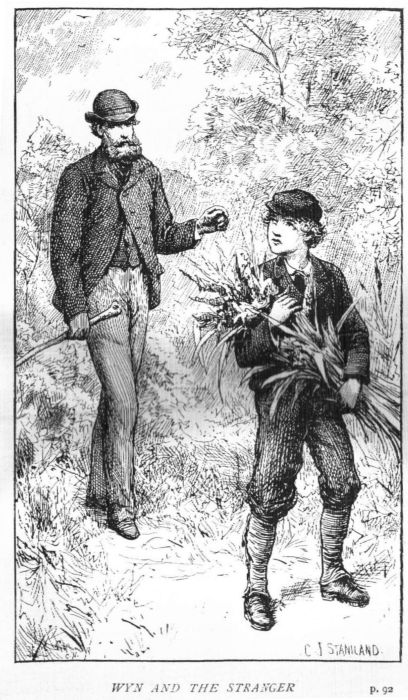
Wyn ran off and plunged into the brushwood. He had been trained to have keen eyes, and he had soon collected a large bunch of reeds and flowers. Dobbles and his master were quite out of sight, and Wyn had got to the other side of the pond, among a mass of ferns and brambles not likely to yield much out of the common, when he heard a rustling and saw a tall man standing on the little track beyond him, with his back turned. Wyn was a keeper’s son, and as soon as he perceived that the man was a stranger he at once jumped to the conclusion that he was after no good, and that he, Mr Edgar’s only protector, had left him alone at some distance. And, though Mr Edgar was only game in the sense that nothing would frighten him, he had a watch and a purse, and was of course perfectly defenceless. As he prepared to hurry back to him the man turned, showing a sunburnt face and a long yellowish beard. He looked at Wyn.
“I say, boy, do you belong to these parts?” he said.
“Yes,” said Wyn, “do you? For this wood ain’t open to the public.”
“Do you happen to know if Mr Edgar Cunningham’s at home just now?”
“What do you want of him?” said Wyn.
“Well, I want you to give him this note if you could see him by himself any time. Here’s a shilling.”
“No, thank ye,” said Wyn. “I can give my master a note; but this wood ain’t open to the public, and you’d best turn to the left, and go out by the stile.”
“All right,” said the stranger. “I’ve missed my way.”
He turned to the left and walked off, and Wyn hurried back to his master, relieved to see Dobbles exactly where he had left him, and Mr Edgar lying, looking up at the trees overhead, evidently perfectly safe and undisturbed.
“Oh, please, sir,” said Wyn, “here are the flowers. But please, sir, we’d best go home. There’s characters about, and—why—wherever can it be?”
“Why, what’s the matter? You look quite scared. What’s missing?”
“Please, sir, I met a chap as I don’t think had any business there, and he gave me a note for you, and, sir, I can’t find it nowhere. I had it in my hand, and I must have dropped it.”
“I suppose it was one of the men from Ashwood or Raby,” said Edgar, mentioning two places in the neighbourhood. “Very careless of you, Wyn, to lose the note, and very silly to get a scare about it. Well,” after some time spent in searching, “we must get back now, and to-morrow, if it’s fine, I’ll come here again, and you can have a hunt for it.”
Wyn was so upset, or, as he would have expressed it, “put about,” by the sight of the stranger, the loss of the note, and by Mr Edgar’s rare reproof, that he quite forgot at the moment either to realise to himself or to tell his master that the man could have been no one from the neighbourhood, since he had asked if Mr Edgar was at home, which everyone knew was invariably the case.
Chapter Ten.
Florence’s Duty.
On the same afternoon that Wyn and his master went to see the water-lily pond, Florrie Whittaker, seized with a fit of impatience, went off without leave for a ramble in the wood.
She didn’t think she could bear it much longer. There was no one to chatter to, there was no one to chatter about. Mrs Lee’s shop was far more lively than Mrs Warren’s parlour, and Carrie and Ada were much more congenial than Grace Elton. Florence, lazy and sociable, had made a strong effort to strike up a friendship with that pretty, pleasant girl, but Grace, as Florence put it, was “that particular,” and so often blushed and said, “Mother wouldn’t like it,” when Florence’s ill-trained tongue went its natural way, that Florence would have been quite disgusted with her but for the thought that “Miss Geraldine” wouldn’t like it either. Florence had once begun to astonish Grace with the history of how she had run after the boys down to the canal, and had then stopped with an odd new feeling that she wouldn’t like Miss Geraldine to know she had done that. Should she write home and say she would be a good girl, and go into any business Father and Aunt Stroud wished, knowing that some sort of fun could be got out of life at Rapley; or should she wait and let Aunt Charlotte “comb her down,” as she vigorously put it, till she thought her fit for a place at Ashcroft or at “The Duke’s?” That implied lilac cotton gowns in the week and a neat bonnet on Sundays; but then she had heard of servants’ dances and parties, and the great household wouldn’t be very dull, surely. Florence strolled on, thinking of one thing and another, swinging her hat in her hand, and now and then snatching at a foxglove or a bit of honeysuckle, till she suddenly became aware that she had lost her way. She stopped and looked round her. Which little green track would take her home? There was a good deal of undergrowth in the part of the wood to which she had wandered, and, so far as she knew, she might be miles from any outlet but the one by which she had come. The great trees arched over her head, the green solemn light was all around her. The tap of a woodpecker, the coo of a wood-pigeon or the whir of its wing, the soft indefinite murmur of the leaves, were all the sounds that broke the stillness of the August wood. If Florence had lost her way in a town she would have asked it of a policeman with perfect composure. No crowd of passengers, no bustle of life, would have impressed her in the least, but this stillness and silence and loneliness struck on her unaccustomed nerves, and an unaccountable fear took possession of her. What was there to be afraid of?
Snakes and water-rats were the only definite objects of terror that occurred to her; and, as she had never seen a specimen of either of these animals, they were not very present to her imagination. She did not know what she was afraid of, but for the first time in her life she knew what fear was. She stood quite still at the turn of the little foot track, suddenly afraid to go to the right or the left; her heart beat, her breath came in gasps, tears filled her eyes, and she burst out crying like a baby—she, who never cried except from bad temper or toothache, cried with fear.
Suddenly a rapid, light step ran down the track, and Geraldine Cunningham, in her blue cotton frock, and a basket in her hand, came into view.
“Why! Florence Whittaker! What’s the matter?”
“I’ve—I’ve lost my way, Miss; I can’t get out!” sobbed Florence, still too much scared to be ashamed of her fright.
“Lost your way! Dear me, you’re standing in the way back to Warren’s lodge. Come, don’t cry, I’ll show you.”
“Oh, thank you, Miss,” said Florence with unwonted meekness, and wiping her eyes. Then, recovering a little, “I’m a great silly, but the trees is so tall, and there ain’t nobody about.”
“Why, that’s the beauty of it,” said Geraldine. “One couldn’t run about in the wood if there was anybody about. But it’s just like the garden, nobody ever comes here.”
As Geraldine said this in her clear, outspoken voice, a tall man came into view along the opposite track: he was dark and slight, and dressed in a rough suit that might have belonged to anyone, gentle or simple, in a country place.
“We’ll go on,” whispered Geraldine, straightening herself up, and taking Florence by the hand.
The man came up to the two girls and looked at them rather keenly; then he touched his hat, and said: “Excuse me, young ladies, can you tell me the way out of the wood?”
“Yes,” said Geraldine, with her straightforward gaze; “if you go straight back and turn to the right, you’ll come into the Raby road.”
The stranger lingered a moment as if he would have liked to say more, but contented himself with saying rather oddly, “Thank you—Miss,” and walking away.
“How very odd!” said Geraldine, “that there should be a stranger in the wood. Who can he be?”
“He was very civil in his speech,” said Florrie. “Yes; but the wood’s private; he oughtn’t to be here. Come along, Florence, we’ll tell Mr Warren we saw him.”
The two girls talked a little as they walked on together, Florence feeling suddenly shy, and as if she had nothing to say for herself. Presently, as they came near the lodge, they met Wyn, looking hot and hurried. “Oh, if you please, Miss Geraldine,” he said, touching his cap, “you haven’t seen anything like a letter lying about in the forest?”
“A letter in the forest? Why, Wyn, how ever could a letter get there?”
“I’ve lost one, ma’am, as a man gave me for Mr Edgar, and I’m going to look for it again.”
“Oh,” said Geraldine, “that must be the man that spoke to us just now, and asked his way. If you run right on, Wyn, you could catch him.”
Wyn rushed off, but presently came back, overtaking the girls again as they came up to the lodge.
“It wasn’t the same man, Miss Geraldine,” he said. “The man I met was a stout party with a red beard, and this one was a deal thinner, and a black-haired chap, too.”
“Then there’s two strange men in the wood,” said Florence.
At this moment the keeper himself appeared, carrying his gun, and saluting his young lady; and all three children began to tell their stones. Warren took them very quietly. “I’ll keep a look-out, ma’am,” he said to Geraldine; “but strangers do pass through the wood. There’s artists about nowadays. They scare the birds dreadful. And, as for you, Wyn, you’d best go and look for that there note first thing in the morning: you’d no business to let it drop.”
“I think the man who spoke to me looked like an artist,” said Geraldine as she went off.
“Florrie,” said Wyn, as his father went into the house, “I don’t think that the man who gave me the letter for Mr Edgar was one of the Raby or Ashwood keepers or gardeners; he hadn’t the cut somehow, and he’d have known Mr Edgar was at the Hall. And he did stare that hard at me.”
“So did the other man at us,” said Florence.
“Was he a bird-catcher down from London, do you think?” said Wyn astutely.
“No,” said Florence, “he looked too much the gentleman.”
“I’m sure he hadn’t a red beard, aren’t you?” said Wyn.
“Red beard? No—d’ye think I haven’t eyes in my head? He’d a pointed sort of black beard—same shape as Mr Cunningham’s—only his is grey; and black eyes, looking right at you, like the squire’s do. But, dear me, I think a fellow creature or two’s a great improvement in that there lonesome wood. I’d sooner meet a man than a snake any day. And I believe I’d sooner meet a snake than nothing among all them trees!”
“The trees don’t set no traps nor springs,” said Wyn, “and snakes aren’t common in our wood, and wriggles off pretty quick if you do meet with one.”
“Do you think your man was a poacher?” said Florence.
“Well, Florrie,” said Wyn, “there’s all sorts of people come after game in these days. I shall keep my eyes open. Hallo! here’s mother calling us in to supper.”
In pursuance of this resolve, Wyn kept his eyes the next day open at their widest, but neither red beard, black eyes, nor letter came into his view, and the only thing he did see when he came disconsolately back again was a great owl’s nest that had apparently been pulled out of an old hollow tree on the Ravenshurst side of the wood and thrown on the ground. Wyn was sorry; he thought the owls would never nest there again, and he would have had a chance next spring of getting a young one for Mr Edgar.
“You’re to take the pony round again this afternoon, Wyn,” said his mother when he got back, “and don’t you be careless and drop any more letters about, anyhow.”
Florence was very much interested in the mysterious strangers in the wood, and in the lost letter. She went for a stroll with Wyn before it was time for him to fetch the pony, and they worked themselves up into a state of excitement, and a general idea that their keen observation of suspicious characters was highly to their credit. In the course of their walk they met two of the under-keepers, and Wyn stopped and asked them if they had seen anybody about. He described his man with the red beard much as if he had been a giant, and Florence chimed in with her suspicions of the dark man who had spoken to Miss Geraldine, till her description of him would have befitted the villain in a melodrama. The boy and girl succeeded in setting the young men on the look-out, and preparing discomfort for the strangers if they were seen. Florence found a chat with the young keepers a pleasant variety in her quiet life, especially when it was so justifiable, and she lingered, talking and joking, till Wyn pulled her skirts, and said Mr Edgar would be ready.
“You see what we’ll bring you, Miss,” said one of the lads as he went off.
“You ain’t men enough to get them there poachers,” said Florence.
“Ain’t we though?” cried the other youth.
“They’d best not come our way in a hurry.”
Florence laughed, and ran off after Wyn, who remarked virtuously:
“We’ve done our duty, I’m sure, in spreading about all we’ve noticed.”
“Your father knows too,” said Florrie.
“Yes,” said Wyn, with a slight suspicion that his father could have warned his own under-keepers for himself; “but father can’t be everywhere at once. They might rob Mr Edgar.”
“Or frighten Miss Geraldine,” said Florence, “so it’s quite our duty to give a warning.”
Chapter Eleven.
Meeting.
If Wyn Warren had chanced to be in the right part of the wood at the right time on the afternoon after he found the owl’s nest, he might have seen all the three objects of his search. For while he was leading Dobbles across the park towards the wood in order that Mr Edgar might try to sketch the lily pond, and hoping while his master was so engaged to get another chance of hunting for the letter, a respectable-looking nurse with a little boy and girl in pretty summer clothes came along the path from Ravenshurst to the stile in the Raby road. They passed the tall red-bearded man who had given Wyn the letter; but, being strangers to Ashcroft, his appearance there struck them as nothing remarkable; the nurse was holding the little boy by the hand, and the girl, running round her, was picking up moss and twigs, when her eyes fell on the spot which Wyn’s had failed to find, and on which the red-bearded stranger’s had never lighted. She had found one pretty, funny, white puff-ball, and she thought this other white object lying under the ferns was such another, till she took it in her hand and found that it was something much more familiar to her, namely, a letter in an envelope, moistened, and ready to break with the damp of the woods.
Lily Carleton poked her little fat fingers under the seal till the paper gave way and the open letter was in her hand, and she threw the envelope away and spread out the letter.
“It’s a letter from the fairies,” she thought, nodding her head, for she was a fanciful little person. “I’ll take it home and get mother to read it to me.”
She stuffed the letter into her little pocket, and, all unknowing, passed the writer of it, close to the stile in the Raby road, talking to the man with the red beard—a combination which would certainly have led Wyn to think that the two mysterious strangers were plotting mischief.
“Shall you go then, sir, as you have had no answer?” said he of the red beard.
“Yes, on the chance. It can do no harm; it’s all a chance, you see. You’re sure the lad said he was at home?”
“Yes, he undertook to deliver the note. But he was so sure I was going to set night-lines, or do some damage here, that I had to walk off as straight as I could.”
“Ay, we can’t lurk about here in secret. That’s why I take this step. Maybe I’m going on a fool’s errand, but we’ll meet at the station in any case. I don’t look altogether like a poacher, do I, Harry?”
“Well, Mr Alwyn, if you do,” said Harry, laughing, “poachers must have improved since our time. Perhaps they have, for I didn’t think I was quite the cut of one myself, and, for sure, that lad took me for some such customer. Keep up heart, sir, I’ll be on the look-out.”
So saying, he jumped over the stile, while his companion turned round and walked slowly through the wood. He threaded the tracks and glades with perfect case; but at the point where the next turn would bring him into view of the great ash-tree and the open space overlooking the water-lily pond he paused and grew visibly paler.
“I must remember that it cannot be much to him; if he has answered my appeal it cannot be much to him—it cannot be agreeable. I wish I’d asked a little more about him. However, now for it.” He turned round the dump of trees by which he stood, and stopped with a start.
“What! someone else! Oh, of all the ill luck,” he thought, as he saw under the tree a grey pony and a wheeled chair, in which was a young man sketching the pond and the trees beyond it.
Edgar was half sitting up against his cushions, and had pushed the soft cap which he wore back from his brows, so that his face was clearly visible; but he himself was looking the other way, and, intent on his sketch, did not observe that anyone was approaching.
The new-comer looked at him at first without any recognition. Who could the invalid be who had permission to sketch in the Ashcroft wood and seemed so much at home there? He had better walk quietly on, and pass by as if by accident. But, as he came nearer, Edgar threw back his head to look at his drawing, and something in the gesture struck on the stranger with a sudden thrill. He saw the dark hair, the long, delicate features. Could it be—was it possible? Was this the one he came to meet—evidently unwarned and unexpectant—and—like this?
As he paused, bewildered, doubtful how to proceed, Edgar turned his head and saw him. He saw the dark man with a pointed beard, whom Wyn had described on the authority of Florence as having been in the wood the day before, and, laying down his pencil, said, courteously, but with some decision, and in a voice at once recognisable:
“Excuse me, but perhaps you are not aware that this wood is private?”
The stranger made three or four steps forward, till he stood close beside the pony chair.
“Oh yes,” he said, “of course I know that. You—you did not receive my letter?”
“You are—you are Alwyn!” gasped Edgar, breathless and dizzy with the shock that came without a moment’s doubt or a moment’s warning.
“Edgar! Yes, yes, I wrote. I did not mean to take you by surprise. But it is I—prepared for what welcome you will give me.”
Edgar was so near fainting that welcome of any sort was beyond his power; but, as his senses came back, he saw Alwyn leaning over him, looking at him with frightened eyes, not daring to lift, hardly to touch him, and almost as much taken aback as himself by the unexpected state in which he found him.
Edgar lay looking at him for a moment or two.
“Then—you are alive?” he said slowly.
“Yes,” said Alwyn, “I wrote to you to ask you if you would see me. I gave the letter to a boy, here in the wood—”
“He lost it,” said Edgar, still as if half awake.
“What can I do for you?” said Alwyn anxiously. “Are you better? but no—rest a little don’t mind about it yet.”
Edgar still looked at him. Yes, it was Alwyn—perfectly unmistakable—only as much altered as the eight years made inevitable—with the face he remembered so clearly; yes, and with the softened look he had seen in his dream.
He put out his hand, and Alwyn took it timidly, and still with the same shocked, startled look.
“Of course,” he said gently, “I did not know you had been ill, or I would not have written to you, nor risked startling you.”
“I’m not ill,” said Edgar, still rather confusedly. “It’s only my back, you know—quite an old thing.”
“But when—how?”
“I fell downstairs,” said Edgar; “never mind, tell me—”
“Not then? Not that flight? You did fall, I remember. What? then I was the cause.”
Alwyn started up and turned his back on his brother, evidently shocked and overpowered almost beyond control. The meeting was utterly unlike what either of them had fancied to himself as probable.
“Alwyn,” said Edgar, “there’s nothing to mind—I’m quite used to it. It was a mere chance, and it’s not so very bad. I can walk—a little, and I can get out here and have very jolly times, you see.”
But the boyish language, and the still boyish voice, so well remembered, completely overcame Alwyn, who had not expected to be agitated, only perhaps embarrassed, at seeing his brother. He struggled hard with himself before he could turn round, and, coming back and leaning against the tree beside Edgar, said:
“What would you like me best to do?”
“Why!” said Edgar, with recovered energy, “tell me something. I am dazed with surprise. Tell me everything.”
“I went to New York, as I suppose you know,” said Alwyn; “Whittaker with me. I wasn’t altogether a fool, and I accepted the introductions the New York bankers gave me, and with the money my father had lodged there for me I bought some land in Massachusetts. Well, after a good deal of uncertainty it not only proved a success in the farming way, but we found coal on it, which proved well worth working, and, in short, we have done well. Whittaker is what I suppose you would call my agent and manager, and a good friend into the bargain. Well, two years ago he married—well. He had quite made up his mind to give up the old country. And I—I only wished to be independent. We made no effort, you understand, at concealment—used our own names always. Anyone could have found us out. Well, I must tell you very briefly.
“I made an acquaintance in Boston—an Episcopal clergyman. We took a walking tour together—had sundry adventures. I went home with him. He has a sister. After a little while I felt what it was to have such a past behind me. And a Boston gentleman such as Mr Dallas was not likely to accept a wandering Englishman for a son-in-law without inquiry, nor to think it natural that my father’s eldest son should be living over there. I knew what sort of thing a few inquiries would tell him, and I knew what I had flung away.” Alwyn paused for a moment and then went on hurriedly—“All my views changed—changed utterly.”
“You decided to come home,” said Edgar.
“Yes,” said Alwyn, “but then something else happened.”
He took a pocket-book out of his pocket, opened it, and, unrolling a little packet of tissue paper, laid something bright and glittering on Edgar’s hand.
“Did you ever see that before?” he said. “Yes,” as Edgar looked at him with startled eyes, “I see you remember it. But say what it is.”
“It is one of Mrs Fletcher’s lost jewels,” said Edgar, as if under a spell.
It was a curious enamelled bird with a great ruby in its breast, and set in a sort of frame of emeralds, a curiosity as well as an object of intrinsic value.
“Yes. I didn’t steal it, though,” said Alwyn; “nor did Harry Whittaker.”
The cool dry tone in which this was said was exactly that of the old Alwyn.
“I know who did, though,” he said, “and I have come back to try to prove it. Curious proof, don’t you think, of innocence, to produce the stolen object?”
“What proof can be needed?” said Edgar, warmly.
Alwyn smiled.
“I never thought there would be—for you,” he said. “But it’s a very long story. I think I must write it for you. There are some things I must ask. Shall we be interrupted? How can I see you again alone? My father—is he well—is he altered?”
“He is pretty well,” said Edgar, “and—not altered. Wyn Warren will be back directly, I think I must tell him. You see I can’t get anywhere alone. I couldn’t even post a letter for myself. And my father, you know, unlocks the post-bag. I hardly ever get letters.”
Edgar spoke merely as if considering the difficulties of the case—quite cheerfully; but to Alwyn the words sounded most pitiful.
“Then try not to trouble about me,” he said; “you have given me a welcome. I must manage for myself. Of course I am only keeping quiet till I can get one or two things in train. I am staying in London. You mustn’t have to bear the brunt of any discovery.”
“I don’t care a straw for that,” said Edgar. “I’ll answer for little Wyn. He shall bring me here again to-morrow, if possible; in any case he shall come himself. When I understand dearly I can tell my father that I’ve seen you, and everything else you think proper.”
“No, no,” said Alwyn, almost laughing at the coolness with which this fragile, helpless brother proposed to face the difficulty for him. “You were always a plucky fellow, but when the time comes I’ll make my own confession. I’ll go now.”
But he still lingered.
“Ought you to be alone?” he said. “Do you want anything? You will not be the worse for the fright I gave you?”
“No. I’m quite jolly. If you’ll just put this cushion lower for me, that’s all, so that I can lie down.”
“I am too rough to touch you. There—is that right, dear boy?” said Alwyn, anxiously.
“Oh yes, you are very clever!” said Edgar.
He spoke lightly; but suddenly tears filled the keen eyes at the touch that was more tender than all the skilled attention at his command.
“I’m glad you’re found, Val; it’s been rather lonely,” he said.
“If I had guessed!” said Alwyn hoarsely; but at this moment a tremendous rush was heard, and Wyn’s voice in loud tones of dismay broke in on them.
“What are you about—you? Here I am, Mr Edgar. Father ain’t far off.”
Alwyn, who had been bending over his brother, started up, and Edgar began to laugh.
“All right, Wyn,” he said, “stop that row. This gentleman isn’t smothering me, nor stealing my watch; look at him—you’ll see him again. You’d better ask his pardon for losing his letter.”
Wyn’s mouth and eyes opened wider and wider.
“Please, sir,” he stammered, “he ain’t the one that gave me the letter; and please, sir, I’ve lighted on the envelope, and someone has took the letter out.”
Alwyn and Edgar looked at each other in dismay.
“There is my address,” said Alwyn, after a moment; “if anything unexpected turns up, send a telegram to me. But I shall be here to-morrow, and then you shall know all. Here, boy, Mr Edgar will tell you what you’re to do. Be sure you are very careful of him. Can you lead the pony safely?” Edgar laughed again at Wyn’s indignant stare, first at the speaker, and then at the half-sovereign dropped into his palm.
“All right, Wyn,” he said, “he has every right to order you; yes, and give you a tip too. Put it in your pocket, and come along.”
Wyn unfastened Dobbles, and turned him round, a light slowly breaking in on him as his master put both hands into the stranger’s, and a few rapid whispers were exchanged between them. Then Edgar made a sign to him to go on, and Wyn, with one shrewd glance at the face and figure of the object of his suspicions, drew a long breath and said:
“Sir—sir—that’s Mr Alwyn!”
Chapter Twelve.
Aunt Stroud’s Surprise.
That same evening, while Alwyn Cunningham at his hotel in London was writing the story of his life to his brother, hardly able to fix his thoughts on anything but the interview of the afternoon, Harry Whittaker was walking through the streets of Rapley. Nobody noticed him there, or wondered to see a stout, good-looking man, with a long beard, and rather a rough coat, among the passers-by. Certainly no one identified him with the saucy errand-boy who had idled at street corners and engaged in a free fight, with parcels and bandboxes for missiles and weapons, eight years or so before. He walked on till he came to the small but respectable-looking ironmonger’s shop, over the door of which was painted the name of Stroud. He walked in, glanced round, and a well-dressed woman came forward.
“What can I show you, sir?”
Harry asked for a clasp knife, looked at her keenly for a moment, then said:
“That’s an American mowing machine, I think, ma’am?”
“Yes, sir, the newest patent, very light and handy. Anything in the way of garden tools, sir?”
Harry Whittaker was Harry Whittaker still; he appreciated the exquisite joke of being ceremoniously treated by his Aunt Stroud. But he could not afford to indulge it. He looked at her, smiled a little, and said:
“No, thank you, my farm’s across the water in State. It’d hardly pay to take over machinery from the old country.”
Mrs Stroud gave a start, and, as she afterwards expressed it, “nearly sunk down upon the rakes.”
“Could I have a word in private?” said Harry.
“Step this way—sir,” she said, still in a state of doubt, and leading him into the comfortable parlour behind the shop.
“Aunt Eliza,” said Harry, as the door closed behind them, “I felt sure that you would know me at once.”
Mrs Stroud did sink down into an arm-chair exclaiming:
“Bless us and save us, it’s Harry!”
“Yes, aunt,” said Harry, “it is; and I’ve come first to you, knowing your influence with father, and that you could be trusted with an important secret; to ask you to give me a welcome, and to overlook my past undutiful behaviour.”
“Oh, my! And I’d imagined you a convict, or drowned dead!”
“Not at all,” said Harry, “I never was drowned, and I haven’t yet been hanged. On the contrary, finding myself well-to-do in the world, and happily settled in life, I felt that it was time to endeavour to undo the past.”
Harry spoke quite earnestly, but with a boldness of manner, and confidence of look, that established his identity at once. He put out his hand; but Mrs Stroud, bursting into tears, launched herself on his neck.
“You were always my favourite, Harry, and if you’ve done well for yourself I’m most glad to see you.”
“Thank you, Aunt Eliza, you’re very good, I’m sure; it’s more than I deserve. My father, my sisters and brothers?”
“Your father’s very hearty, and your brothers and sisters doing well, except Florrie, who gives a deal of trouble, as you did yourself. But what’ll you take, Henry? Sit down and tell me where you’ve been living. What will you have?”
“A cup of tea, aunt, if it’s your tea-time; I’m a teetotaller,” said Harry, unable to help a twinkle of fun at his aunt’s astonished rapture at this evidence of virtue.
As she got the tea he began to tell his story much as Alwyn had already related it to Edgar; but at greater length, and with many interruptions from his aunt.
“Mr Alwyn,” he went on, after some preliminaries about the buying of the land, and the discovery of the coal upon it, “never played the fool any more after he was on his own hands as it were. He seemed to want to justify himself, and prove those mistaken that thought we should both go to the bad. He never let on that he felt parting from home and being cut off from his expectations, nor did I. But, when there’s no longer anyone to pull a young fellow up, it’s one of two things: either he goes down altogether, or he has to pull up himself. And I can tell you, aunt, if all the graceless young chaps knew what a much easier sort of thing it is to get a good blowing up at the time, and the consequences saved you afterwards, than to go scot-free and find out for yourself what you’ve brought about, they’d not be in such a hurry to kick over the traces. But Mr Alwyn said that he’d brought suspicion and trouble on me, and he wouldn’t be the ruin of me further. So we kept straight and got on, and thought a deal of ourselves for doing it.”
“It’s what no one never expected!” ejaculated Mrs Stroud.
“No,” said Harry. “Well, I got married, as I’ll tell more about by-and-by, and I thought I’d done with the old country altogether, and went on as comfortable as could be till my little boy came. Then, Aunt Eliza, somehow it came over me more and more what it would be to have that little chap hear that there were those over here that thought I was a thief, and have him know that I was an undutiful son that left my father in his old age. If that there baby was for eight years without so much as thinking of me, or caring what I thought of him, why, it’d go near to break my heart, and I’d sooner follow him to his grave now, and never see him again. God forgive me! I’d been a bad son, but ‘don’t care’ was a word I couldn’t say before the little chap, nor have him say after me.
“Well, when all this was waking in me, Mr Alwyn was away in Boston, and I’d reason to guess what kept him there, and how there was a young lady in the case. He came back sudden, and while I was thinking how to tell him what was in my mind he turned round upon me and said, says he ‘Harry, I’m going home to beg pardon.’
”‘If you do,’ says I, ‘I’ll go with you.’
“And then he told me how he couldn’t ask Miss Dallas to marry him till he had told about his quarrel with his father; but his pride had held him back from trying to make it up, and going to seek for what he’d thrown away. He’d had a very hard time, he told me, what with the oath he’d made, and all that lay behind him. And he did look pale and changed, I can tell you, and seemed as if he couldn’t speak what was in his mind. But he should go, he said, whether the jewels were found or not, and even if the opening up of all the old scandal put him further off the young lady. And then I told him the thoughts I’d had on the subject, and he said: ‘There’s more than that, Harry, for through all this I’ve come to see that I sinned against God.’”
“Well,” said Mrs Stroud, “I never did think to hear as Mr Alwyn was a converted man! It’s a miracle!”
“Well,” said Harry gravely, “as you may say it was; but ’twas that conviction that conquered his pride and made him resolve to go home again. Just as we’d settled on this conclusion, and were wondering what to do next, there was an accident with some paraffin, and a young fellow working for us was near burnt to death, and would have been killed on the spot but for Mr Alwyn. Now we knew that this young man Lennox had been footman at Ravenshurst, and had left the place about a week before we did, to go abroad with a gentleman. He told us he came to seek work because he had known us formerly.
“To make a long story short, Mr Alwyn, worse luck, sent the only other man about for the doctor, and he and I stayed with Lennox. Then, says he, he’d been a great sinner, and he’d like to own it before he died. And he told Mr Alwyn a number of dishonest actions, small and great, and at last he said he’d taken the Ravenshurst jewels. He’d come back on the sly to see his sweetheart after he left the place, and saw the young lady come down and slip the jewels under the ferns on the rockery, and he took them on the spur of the moment. Well, he was just off with his new master on a trip to India; but he contrived to hear how I was suspected before he started.”
“And took the jewels with him?”
“Well—it’s all in the confession Mr Alwyn wrote down. But one of the jewels he had still, and that he gave us, and Mr Alwyn has it row. But he said it had been on his conscience all the time he was knocking about the world, and that when he heard our names he came and got work with us on purpose, though he put off owning his guilt from day to day. He’d near put it off too late, for before he’d told us all we wanted to know the death struggle came on him and he could tell us no more. And ’twas then, Aunt Eliza, by the words Mr Alwyn said, and the prayers he made that I knew of the change that had come on him and first thought of my sin against God, as well as against the little one.
“Well, the doctor came as Lennox died, and Mr Alwyn made him stay with us and keep us in sight while, without a word to one another, we each wrote down what the dying man had said to us; and the doctor witnessed that we had written it without speech with one another since Lennox’s death. Then we took the papers before the nearest judge, and made our affidavits that they contained a true confession. But it’s all on our words after all; howsoever, on that confession we came back.”
“Well, Harry,” said Mrs Stroud, “I’d take my dying oath you was innocent. But whatever made you decamp just at that moment?”
“My father knew where I was,” said Harry. “He knew I joined Mr Alwyn. But he declared that after the jewels had been named in connection with us he’d never go home, if they were found twenty times over, without the squire made him an apology.”
Mrs Stroud sat and looked at her recovered nephew, at his good clothes, his watch chain, his air of undoubted respectability, and also at the unembarrassed and cheerful air with which he faced her.
“What are you going to do now?” she said.
“That must depend on Mr Alwyn. He thought Mr Edgar would perhaps have helped him search, or told him how the land lay, anyhow; so he wrote him a note appointing a meeting, which I gave to little Wyn Warren in the wood. It seems he lost it; and, though the meeting came about, Mr Alwyn was so distracted at the state in which he found his poor brother that he never laid any plans at all. When I joined him he couldn’t hardly speak of him. ’Twas the heaviest punishment of all, he said.”
“Ah, poor young gentleman,” said Mrs Stroud; “it’s a sad business, and I doubt he’s not long for this world. But do I take you to say, Harry, that you’re a family man?”
Harry nodded, and produced a photograph of his wife and baby, and another of the substantial house in which he lived; and over the tea a great many more questions and answers were interchanged. Harry heard all about his sisters, and where Florence was, and what his brother George was doing. He couldn’t help enjoying the joke of appearing to his aunt in so new a light—even while he asked with real affection after Mattie, and studied the photographs of his family in his aunt’s book. He could not make himself known to his father, he said, until Mr Alwyn had taken some action, and, of course, he could not but hope that the explanation of the lost jewels would be accepted at Ashcroft.
His coming to see his aunt had been, he said, a sudden thought, prompted by Mr Alwyn’s shock and distress at his brother’s illness.
“I didn’t know then what I might find at the old place,” he said. “But if you could keep my coming quiet for a few days, aunt, it would be all for the better.”
“Well, Henry,” said Mrs Stroud, “there’s nothing declares to me that you’re a reformed character so much as your coming and consulting me, as was your true friend in the past always. It’s a lucky thing that Stroud has gone down the line to-day to his cousin’s funeral. I’ll keep your secret, Harry, though the thought of you, sitting there so broad-shouldered, and so well-to-do looking, is so amazing that I feel as if it would ooze out of me at the seams of my gown!”
“Well, aunt,” said Harry, “you’re very good, and I hope in a couple of days the concealment will be over.”
“It’s well,” said Mrs Stroud, “that that unlucky Florrie knows nothing of it, or she’d have controverted your intentions to a dead certainty.”
Chapter Thirteen.
Most Haste, Worst Speed!
Unfortunately for his scheme of meeting with his brother again, poor Edgar awoke the next morning to one of the blinding and overpowering headaches to which over-fatigue and excitement always rendered him liable. There was no chance of getting that day to the trysting-place, no possibility of anything but lying still. He could not write a note to be given to Alwyn, he could hardly even think of a safe message for him.
“Tell Wyn—I cannot go out—tell him to—get what I told him—in the wood—he will understand,” he said, with a great effort at something that would be comprehensible.
“Yes, sir; don’t trouble yourself, sir,” said Robertson; “it shall be attended to.”
“And tell him to come for orders to-morrow; I shall be able to go to-morrow.”
“Very well, sir,” said Robertson, privately thinking that his master would be quite unequal to such fatigue to-morrow, or probably for two or three days to come.
Edgar chafed and fretted at his incapacity in a way that of course aggravated the headache. It was such a disappointment, besides the anxiety and suspense, not to see Alwyn again. He had not known how much he should care about it. Robertson thought that he had never known his master so restless and impatient.
The message to Wyn did not strike anyone as of paramount importance, and was sent down by the footman.
“Tell little Warren the pony won’t be wanted. Mr Edgar is ill. Warren is to get something, I believe, in the wood—flowers, I suppose—but they won’t be wanted to-day.”
This information was finally shouted out to Wyn by the stable-boy as he fed the peacocks before coming up for orders:
“Mr Edgar’s ill and can’t go out, but he says you’re to pick him some flowers instead.”
“Is that all?” said Wyn, horrified.
“That’s all, as I knows on.”
“But I say, what’s the matter with Mr Edgar?”
“Didn’t hear—that was my message.”
Wyn was a very sharp boy. He had been told by Edgar as little as possible, except as to the identity of the two strangers whom he had seen in the wood, as to which he was sworn to secrecy; but after puzzling a little over the message about the flowers he came to the conclusion that the best thing he could do was to keep Mr Edgar’s appointment for him. He was detained all the morning by Mrs Elton, under whose superintendence he attended to the fancy poultry, to give them an extra cleaning, as Mr Edgar did not want him; and when he went home to dinner he found his own family in a state of excitement and hurry.
Lady Carleton, at Ravenshurst, wanted a girl to help her nurse for a few weeks, and by favour of the wife of the Ravenshurst keeper had sent to see if Mrs Warren’s niece could come over.
Mrs Warren thought it a wonderful chance for Florence to try her hand at service in a good family, without being bound to a regular place, and Florence was just tired enough of the keeper’s lodge to think that she should like the change.
“I must take you over myself,” Mrs Warren said, “and explain to her ladyship that you haven’t things suitable at present for her household, but they shall be soon provided. She’ll excuse it, as they want you to come this afternoon. You can put on your grey dress, and turn your hair up and brush back your fringe.”
“My fringe! Why, even the generals at Rapley are allowed their fringes!” said Florence indignantly.
“Very likely. But it’s not the custom in good families,” said Mrs Warren dryly. “I look to you, Florence, to do me credit where you go.”
Florence pouted a little, but just then Warren, who had come in to his dinner, said rather meaningly to his wife:
“Mother, have you forgotten as Lady Carleton is Miss Lilian Fletcher that used to be? Maybe that will make an objection; it’d be best to name Florence, and make sure as she understands about her.”
Florence caught the words, and the confidence she had received about her brother from Wyn came, into her mind. So this was one of the owners of the jewels which Harry had been accused of stealing. Intense curiosity, and a sort of impulse for which she could not account, determined her on going to Ravenshurst at all costs. She went upstairs after dinner, screwed her hair up into a neat knot behind, brushed it back from her brows, and generally stroked herself down into a much tidier-looking young person than she had ever before appeared.
Wyn had also heard the hint, and sat listening, open-eared, to the strange coincidence.
“Wyn,” said his mother, “it’s a good thing Mr Edgar doesn’t want you to-day. You get out the trap and bring it round by four o’clock so as to drive Florrie and me over to Ravenshurst, and then you can take it on to the junction and pick up Bessie and her things; I’ll walk back through the wood.”
“But—but Mr Edgar sent word I was to get flowers.”
“Mr Edgar can’t want the flowers to-day. It can’t matter when you get them—if you have them ready for him to-morrow morning. Now don’t make difficulties, Wyn, you get idle with going after flowers and dawdling about.”
Wyn rushed out of doors in despair. There was nothing for it but to go at once to the ash-tree in the hope that Mr Alwyn might be there before his time, and if he did not appear to write a message on a bit of paper and leave it where he could find it. Alwyn, however, impatient for the meeting, was already sitting under the ash-tree on the look-out for his brother, and started up in dismay as Wyn appeared alone.
“Please, sir, Mr Edgar’s ill to-day. He can’t come. I think he meant me to come and tell you so.”
“Ill? What is the matter with him? What did he say?”
“Please, sir, I expect it’s only one of his headaches, and I only got a message, but I thought I’d better come and tell you.”
“Is he likely to be able to come to-morrow?”
“No, sir, I don’t expect so. He often doesn’t come out for a long time when he takes to having his headaches, except just to lie on the terrace.”
“But you can see him?”
“Yes, sir, when he’s a bit better. He likes to have me come and tell him about the ducks and the peacocks and all the creatures, and sometimes I take him the dogs to look at.”
“My poor boy! Is that all he has to amuse him?” murmured Alwyn, half to himself.
“No, sir, there’s the garden, and the wild flowers I get him. But, sir—please, sir, I’ve got to go. Is there anything for me to take him, sir? Most likely I shall see him to-morrow.”
Alwyn hesitated; but the fear of disappointing Edgar prevailed, and he gave Wyn the thick packet, to be kept with the greatest care, and to be delivered to his master in private. Mr Alwyn looked so miserable as he delivered it up that Wyn tried to say something consolatory.
“Please, sir, Mr Edgar ain’t no worse than usual. Often and often he has his headaches and a pain in his back. I don’t think he minds it much, sir. He’ll talk quite cheerful most times.” Alwyn did not look much consoled by this information.
“Tell him not to think of me,” he said; “not to make any exertion to see me. Come here again to-morrow, and bring me news of him.”
Wyn hurried off without more words to get the trap up for his mother, and it was not till he had deposited her safely with Florence at Ravenshurst, and was waiting for his sister’s train at the distant junction, that it suddenly flashed into his mind how much he and Florence had done to set the keepers on the track of the strangers whom they had met in the wood. What had he done? It was worse than losing the letter. Suppose they caught Mr Alwyn or Harry, whom he had himself taken for a suspicious character, and took them up to the squire or to his father, saying that they had been warned by Wyn Warren. What would Mr Alwyn and Mr Edgar think of him? He must go and put them off it somehow. Would the train never come? What possessed it to be so late? And when it did come groaning into the station what a time Bessie was before she appeared with her box behind her, well-dressed, smiling, and dignified, the sister Bessie that he was ordinarily so glad to see.
Now he could think of nothing but getting home quick, and started off at a rattling pace before Bessie had had time to remark on his growth or inquire for mother.
“You ought not to drive that young horse so fast downhill, Wyn,” said Bessie presently; “the road’s so bad, you’ll have him down. Isn’t it the one father says isn’t sure-footed?”
“All right, I understand him,” said Wyn; but as he spoke there was a stumble and a lurch, the horse fell, the trap tilted over, and Bessie Warren, frightened, shaken, but otherwise unhurt, rolled out on to the high bank beside the road.
She knew quite well enough what she was about to slip down the bank to the horse’s head and seize the rein as the beast righted himself with a great struggle; then floundered, and stood up with broken knees, dragging the trap, which had been turned right over, and scattering on the bank all its contents, Wyn included.
“Wyn, Wynny darling, are you hurt?” cried Bessie, seeing little at the first moment but her brother’s heels.
It was a lonely road, and great was her relief when a gentleman on horseback trotted up, and exclaiming, “Hullo! what’s the matter?” dismounted hastily, and displayed the features of Mr Cunningham himself.
“Oh, sir,” said Bessie as he took the reins from her hand, “there’s been an accident.”
“So I perceive,” said Mr Cunningham. “What, Wyn, my lad, let the young horse down, have you? Are you damaged too?” as Wyn struggled up on to his feet, looked at the horse’s knees, and burst into a roar of crying, while his nose began to bleed violently from the shake and the blow, and he would have fallen back again if Bessie had not caught him, and, sitting on the bank, laid him down with his head on her lap, and tried to stop the bleeding.
“Is he hurt?” said the squire.
“Not much, sir, I think; he’ll come round directly. Keep quiet, Wyn. Where’s your pocket-handkerchief? On the bank? Oh, sir, thank you,” as Mr Cunningham handed it to her, and saw the letter beside it with his son’s name on it.
“A letter for Mr Edgar,” he said, picking it up. He gave a second glance, and put it in his pocket. “I’ll give it to him,” he said.
Wyn was giddy and a little faint, and did not see what was passing; but presently he sat up, and Mr Cunningham said:
“Well, my boy, you’d better keep to Mr Edgar’s pony for the future.”
“Mr Stapleton won’t never forgive me,” said Wyn, feeling the horse’s knees of far more importance than his own nose, and referring to the stud-groom.
“Well, I hope there’s nothing worse than Rex’s knees on your conscience,” said the squire in the peculiar dry tone which made his displeasure so appalling. “You had better wait here, Elizabeth Warren. I’ll ride back and send someone to help you.”
“Thank you, sir;” then, as he rode on, “Surely nothing could be worse than breaking the horse’s knees! What will father say? What’s the matter, Wyn? here’s your handkerchief.”
“But—but—where’s—where’s—”
“Mr Edgar’s letter? Mr Cunningham took it, so that’s all right.”
Wyn jumped up with a positive howl.
“Oh! oh! oh! Whatever have I done! Oh, I am the unluckiest boy in the world! Oh, whatever will he say to me? But there—”
Wyn suddenly stifled his lamentations and sat perfectly still, only sobbing at intervals.
“Why,” said Bessie, “if anyone lets a horse down they must expect to catch it. But there, Wyn, it’s a mercy, to be very thankful for, that we’re neither of us killed. I feel all of a tremble still. There, isn’t that one of the stablemen coming? The master must have met him. Wipe your face, Wyn, dear, and don’t cry; we’ll go home to mother, and she’ll see to you.”
“Oh,” sobbed Wyn, burying his face in the bank as his sister went forward to meet the stableman, “I’d rather have let down all the hunters and broken all my bones than have let master have the letter. And I lost the other, and I’ve set on the keepers! I’m—I’m a regular traitor, and Mr Edgar’ll never trust me no more—never!”
Chapter Fourteen.
The Fairy Letter.
In the meantime Florence Whittaker and her aunt, having been set down by Wyn, waited in the housekeeper’s room at Ravenshurst till Lady Carleton was ready to see them. Mrs Warren was by no means confident of Florence’s success, and felt that she stretched a point in recommending her. But Maud Florence Nellie was not quite the same girl as she had been three weeks or a month before. Many new influences had been brought to bear on her some very ordinary, and others not quite so commonplace, and, like all young people, she was greatly influenced by her surroundings. If she had found herself on the Rapley road beside Carrie and Ada, she would probably have talked and acted exactly like her old self; but she had thoughts that did not belong to her old self at all. Her head had been filled with wider, other ideas than her own little follies, faults, and pleasures. The mystery of the lost jewels, the excitement of the strangers in the wood, the old grandmother, the Cunningham family—the trees, even the birds and beasts—were all apart from her own little selfish narrow interests, and were a great improvement on Carrie’s new hat, Ada’s new acquaintance, and her own newest scrape. Moreover, Mrs Warren’s quiet refinement had a subduing influence; Wyn was a thoroughly well-behaved little boy. Nobody nagged at the keeper’s lodge, and nobody quarrelled. To be saucy at Sunday school to gentle old Mrs Murray, who taught the girls with all the assured ease of long custom, was so out of keeping with the place that she never dreamed of it. Besides, she was usually occupied with the pleasure of sitting beside Miss Geraldine, who, when Mrs Murray was there, took her place in the class with the others. All these influences were doing Florence a great deal of good; and an odd sort of partisanship for the lost Harry was stirring up all sorts of new ideas in her mind.
It did not begin very worthily: chiefly consisting of the notion that he was probably much nicer than George, and wondering whether he would have been down upon herself for her tricks; but the thought of him, and of “Miss Geraldine’s brother,” filled Ravenshurst with interest. Besides, “dressing up to frighten people,” if they were so silly as to be frightened, was a proceeding with which Florrie had far too much sympathy.
“Florrie, my dear,” said Mrs Warren gently as they waited, “it’s a good deal that I’m undertaking for you. You’ve all to learn, remember, and the nurse must tell you if you make mistakes; don’t think to answer her back. Remember she’s your better, and set over you. And when you’re trusted with the little lady and gentleman you’ll be a careful girl, and never let them hear a word from you that isn’t fitting. Put it in your prayers, my dear, that you may do your duty by them. I’m not one to talk, Florrie, but there’s nothing but praying can help us through life.”
“I’ll try, Aunt Charlotte,” said Florrie, colouring Mrs Warren’s gentleness always subdued her, and when the summons came she followed her aunt, and made a sort of imitation of Mrs Warren’s country curtsey at the drawing-room door, as a proof that she meant to mind her manners.
Lady Carleton was very young and very pretty. Her manner was lively as she asked a few questions about previous experience, and said that her nurse preferred a girl who had not been out before.
“So you have only to attend to her directions. What is your name?”
“Her name is Florence Whittaker, my lady,” said Mrs Warren. “My husband wished me to name that at once. But she has been brought up very careful, and her brother George is a clerk on the railway and most respectable.”
Lady Carleton coloured up, and a curious look came into her face.
“I should like to do something for Florence Whittaker,” she said with a slight emphasis. “We will consider it settled, Mrs Warren, that your niece comes on trial.”
“Your ladyship is very good. Florence will do her best, I am sure,” said Mrs Warren.
Accordingly, in the course of an hour or so Florence found herself in Lady Carleton’s nursery, under the orders of a well-mannered superior nurse, making friends with Lily and Malcolm, and admiring the baby.
“Things are not so tidy as they should be, Florence,” said the nurse, “for our last girl began with the mumps, and was sent off in a hurry. Before you undress Miss Lily, please to straighten out her walking things and put her toys to rights. I couldn’t see properly to them yesterday or to-day.”
Lily Carleton was quite ready to make friends with the new nursemaid, and Florence, who was good-natured with children, had soon told her the names of her little sisters, and was hearing in return about the wood and the squirrels, and the pretty puff-balls, and all the delights of a London child in the country.
“What’s this, Miss Lily?” said Florence, putting her hand into the pocket of the little jacket which she was folding. “Have you been putting a puff-ball in your pocket?”
“No,” said Lily, “that’s a letter from the fairies. I found it in the wood; I told mother that I’d found a fairy letter, but she was too busy to look and see.”
Florence straightened out the crushed ball of damp paper, which, in company with bits of moss and lichen-covered stick, filled Lily’s little pocket.
“Why, Miss Lily,” she began, “this ain’t a fairy letter,” when she suddenly stopped, catching sight of her own name in the short, clearly written note: “Whittaker.” “Whittaker has come with me. Remember I am still your brother.—Alwyn Cunningham.”
Florence would not have taken a letter off the table and read it; but in the case of this mysterious paper no such scruple occurred to her. She saw that it began, “Dear Edgar”—that it stated that the writer had returned, had satisfactory explanations to give, and asked for a meeting at the old ash-tree on the following day. Two things flashed at once into Florence’s mind: one that this was the letter Wyn had lost; the other that the man who had spoken to herself and Miss Geraldine was Mr Alwyn.
“Miss Lily, where did you find the letter? When was it you got it?”
“I found it down under the ferns,” said Lily. “It wasn’t yesterday—mother took us out yesterday. It was Friday.”
Florence stared at the letter. Wyn’s poacher with the red beard—that must have been Harry himself! And, oh! she and Wyn had set the keepers to look out for him.
Florence turned quite pale. She had derived vague and awful notions of Mr Cunningham’s power from the way in which everything at Ashcroft was referred to his pleasure. She did not know what he would do to a “poacher”—also a vague character to the town-bred girl.
“You had better undress Miss Lily,” said the nurse, fearing that her new underling was a dawdle.
“Read me what the fairies say,” said Lily.
“Not to-night,” said Florence, stuffing the letter in her pocket. “You tell Florrie about the fairies to-morrow.”
She bustled about and did her work, till, Lily’s toilet being complete, she knelt up in her bed in her little nightgown, and said her prayers. She went through the usual baby prayers, which were pretty much all that Florence herself had to say, since she had never felt the need of any others; but when she had finished she still knelt with her two little hands clasped together, and said in a clear, parrot-like little voice:
“Please, God, make all wrongs right, and bring travellers safe home, for Jesus’ sake.”
“Miss Lily—who’s a traveller?” said Florence, startled.
“I don’t know; mother told me to say that prayer always,” she said as she curled herself up in her little white bed and shut her eyes.
Florence stood by the window looking out over the garden into the mass of trees that bounded it, under which the level evening light was pouring. If she could only get that letter back to Wyn! only tell him to stop the keepers from minding her foolish talk! With the letter in her pocket, she really did feel a sense of great responsibility; she really did try to think what it would be right to do. She had never felt so serious in her life. Come what come might, she must get at Wyn. She must run home across the forest. Lose her place for it! Perhaps she would; but, if she had lost one place to amuse herself, she could lose another to prevent such dreadful mischief.
“I don’t care,” said Florence, as she had said once before. There was good in her motive now, but it was the old daring, heedless Florence that never stopped to think. She slipped out of the bedroom by an outer door that did not lead through the nursery, downstairs along the passage, out at a side door, open to the summer evening, across the grass of the garden, and right into the wood. She ran on through the band of fir trees that divided Ravenshurst from Ashcroft, and, crossing the stile between the two properties, found herself, though she did not know it, close to the place where the letter had been picked up, and not far from the ash-tree named in it.
Then she began to grow puzzled about the way. The long yellow lines of light faded, the tall trees rustled overhead, the heavy whir and flap of a startled pheasant sounded close at hand. Deadly fear seized on Florence. If she had been frightened in the sunny morning, she was doubly frightened now in the twilight. Besides, it would really get dark soon, and then what would become of her? She had said “I don’t care!” but where was the use of saying “don’t care” to darkness and silence and confusion as to the right way? Should she go back? she knew the way back.
“No,” said Florence to herself, “I may have been a silly to come; but I’ll get that there letter to Wyn if I walk all night. And I’ll not be afraid of the wood. Miss Geraldine ain’t—but oh, dear, I wish I had to go down the broad path in the cemetery at home, all nice and straight, instead. If I go on I’ll have to get somewhere at last!”
Florence knew quite well that she had done a very serious thing, for which she would have to answer, and in the midst of her fear of the solitude came an involuntary fear of the scolding that would meet her arrival anywhere. She had rather enjoyed scolding when she knew she was wrong: why did she dread it when she thought she was right? The wood did grow darker, much darker than Florence had expected, judging by the light that she knew was outside it; and the poor girl’s knees trembled as she hurried along. It was a perfectly formless terror that seized on her; she had had too utterly matter-of-fact a training to fill the wood with any imaginary inhabitants, and she was too old and had too much sense to people it with wolves or bears. It did occur to her that the keepers she had herself stirred up might shoot her through the bushes, and her cheeks tingled at the thought of being seen and recognised by them; while, if she met her Uncle Warren—
“I’ll go through with it—rather than bring my own brother to the gallows,” she thought with a vividness worthy of her Aunt Stroud. But which was the way? what should she do? Florence was so accustomed to trust to her own wits that where her wits were perfectly useless she felt like another person. She did not know the way, she could not get at Wyn, she could not undo the mischief! There was no one to help her! Suddenly there struck into her mind a new thought:
“God.”
Now Florence had never thought about God in her life. She knew about Him: on the very last Sunday before she left Rapley she had answered Miss Mordaunt’s questions about His nature with a glib tongue, but without a trace of reverence in her manner or of awe in her heart. He was everywhere; He could see her in the dark and in the light; He knew her thoughts; He could hear her prayers. Such awful truths had been taught to her, and had been just as much a lesson as the multiplication table. But now, in the greatest need she had ever known, it did suddenly strike Florence that perhaps God would help her if she asked Him. She looked up—up through the dark trees to the pale clear sky above them, and associating praying with nothing but with “saying her prayers,” she began to repeat the childish formulary which she was in the habit of scurrying over every night, and with a sudden thought added the words which little Lily had been taught to say: “Set wrongs right, bring travellers home.”
“Oh, God,” whispered Florence, clasping her hands, “bring me—there! Save them somehow.” Something seemed let loose within her, and for the first time in her life she really prayed. And “Oh say not, dream not,” that those unrealised lessons, that formal habit of prayer, had been hitherto all in vain. How could she have heard without a teacher? There was the knowledge, there was the instinct, so soon as the naughty, graceless girl felt the need.
As she looked round, with a somewhat calmer inspection of the various footpaths, suddenly, in the stillness of the summer evening, she heard the tramp of a foot, and in a moment, round the great tree by which she stood, came the tall broad figure of a man with a long beard—surely the “character” who had given Wyn the letter.
“Hullo, my girl,” he said, stopping with a start at sight of a hatless maiden in a white apron, “what’s the matter? Have you lost your way?”
“Oh!” cried Florence, precipitating herself towards him, “I’ve got your letter—but—but, if you’re my brother Harry that’s come home—the keepers are going to seize you for a poacher!”
Chapter Fifteen.
Father and Son.
Edgar Cunningham got somewhat the better of his headache as the day went on, and late in the afternoon insisted on getting out into the fresh air on the terrace, in the hope that Wyn might make some excuse for coming up to speak to him. He was hardly fit even for this exertion; but the open air was always the one thing he cared for, and the suspense was more endurable so than when he was shut up in the house.
When his cushions were raised he could see across the flower garden, over the low wall that bounded it, to the road that led from the wood and the village, up to the stables, and to the back of the house; and as his bright eyes were keen and long-sighted, he often amused himself with watching the comers and goers, noticing all that went on, as only those people do who are confined to one place.
To-day, however, as he lay almost flat on his back, he could not see the road, and it was with a start of surprise that he looked up and saw his father standing by him.
“I hope, as you are out of doors, that you are better, Edgar?” he said.
“Oh yes, thanks, almost well,” said Edgar.
“Your boy, little Warren, has been getting into trouble. He has let down the young bay horse and broken his knees.”
“Wyn! Has he? What had he to do with the horse?” said Edgar, very much startled as he thought of what Wyn should have been doing.
“He had been driving his mother and her niece to Ravenshurst as I understand, and went to fetch his sister from the station. He let down the horse in Coombe Lane. That is what I am told,” said Mr Cunningham with emphasis, and using all the advantage his position gave him to look straight down into Edgar’s face.
“Was he hurt?” said Edgar, looking straight up in return.
Mr Cunningham was very angry with his son, and little disposed to be merciful to him, though he had not meant to enter on the subject of the letter if Edgar had been more manifestly unequal to a discussion.
“He broke his head; I believe nothing serious. He had a letter for you, which I undertook to deliver myself,” and Mr Cunningham laid Alwyn’s unopened packet in Edgar’s hand.
Edgar caught his breath, but his face never flinched as his father went on:
“I was not aware, when you spoke to me the other morning, that you were already in communication with your brother.”
“I dare say you think it possible that I might have so deceived you,” said Edgar bitterly. “But my brother made himself known to me for the first time yesterday. I should not be waiting here if I had the use of my limbs like other people. As things are, I’ll beg you to open that letter and read it at once yourself.”
Edgar’s manner and face were alike defiant, and he was so indignant at the imputation cast on him that he never saw that his father’s lips were twitching and that his face was pale, nor took advantage of the moment of softening.
Mr Cunningham took up the packet, and turned round as if to open and read it, when his attention was caught by three figures coming up the road towards the house. They evidently saw him on the terrace, and after a pause and a word or two came through the gate up the garden.