Front matter
Reading edition
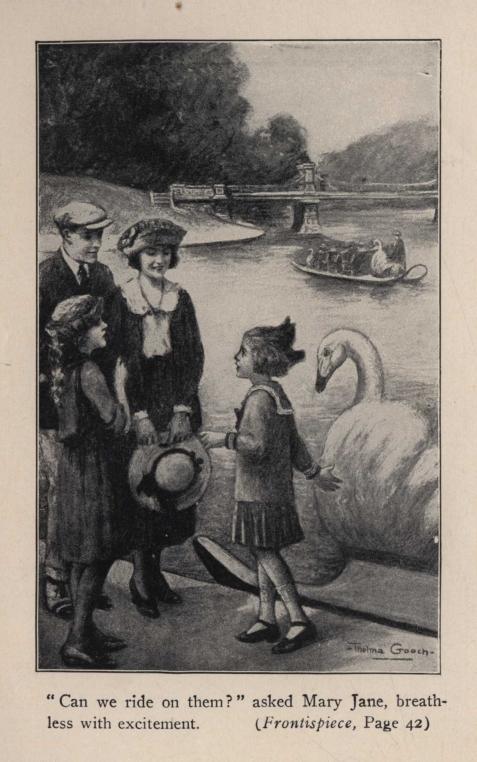
"Can we ride on them?" asked Mary Jane, breathless with excitement. (Frontispiece, Page 42)
MARY JANE IN NEW ENGLAND
BY
CLARA INGRAM JUDSON
AUTHOR OF "MARY JANE—HER BOOK," "MARY JANE—HER VISIT," "MARY JANE'S KINDERGARTEN," "MARY JANE DOWN SOUTH," "MARY JANE'S CITY HOME."
ILLUSTRATED BY THELMA GOOCH
GROSSET & DUNLAP PUBLISHERS NEW YORK
Copyright, 1921 by GROSSET & DUNLAP, INC.
Mary Jane In New England All Rights Reserved
Printed in the United States of America
To my brother, DWIGHT HAROLD INGRAM, with happy memories of his commencement week
CONTENTS
Plans for the Journey A Day of Wetness First Glimpses of Boston An Unexpected Visit at Wellesley Class Day Fun—and Troubles Winning the Game The Adventure by the Lagoon Commencement in the Stadium Fun on the Beach A Day in Plymouth Visiting Cousin Louise The Willow Tree Cottage Lost! One Mary Jane Tea on the Terrace The Last Day in Boston—and Home
LIST OF ILLUSTRATIONS
"Can we ride on them?" asked Mary Jane breathless with excitement . . . . . . Frontispiece
She sighed with relief as the offending shoe came off
"You almost touched it!" exclaimed Mary Jane
"My dear child! Where were you? We've hunted and hunted!"
MARY JANE IN NEW ENGLAND
PLANS FOR THE JOURNEY
"Then are we really going?" asked Mary Jane eagerly.
"To Boston and Harvard and Uncle Hal's Class Day and everything?" added Alice.
Mr. and Mrs. Merrill looked at each other and then at the long letter in Mrs. Merrill's hand.
"I do believe we are," said Mrs. Merrill thoughtfully.
"That's right!" approved Mr. Merrill heartily. "You'll never regret it. I am sure the girls are old enough to remember the interesting sights they will see and they may never have another chance to go to Harvard Class Day and all the 'doings' Hal writes about."
"And then," added Mrs. Merrill, "I always promised brother Hal I'd come when he graduated. One doesn't have a 'baby brother' graduate from Harvard every summer. Though I would like it better if you could go too."
"Sure you can't, Dad"? asked Alice, wistfully.
"Certain sure," replied her father. "With all the changes in the office just now I wouldn't think it wise to leave my work for men who are already loaded up. And then, too," he added when he noticed how disappointed the two girls looked, "remember we'll need somebody here to see about the new house—don't you forget that!"
"Of course we travel easily," said Mrs. Merrill, "and Hal promises to look after us so well."
"And makes good by sending that list," said Mr. Merrill. "I never saw the like of the way he has everything lined up for you—you couldn't get lost if you wanted to!"
Alice and Mary Jane Merrill, who with their father and mother had moved from the small town where they had always lived, to the big city of Chicago only a few months before, were having a most interesting time. Not only had they seen city sights, played in the parks and done good work in school; in addition they had made a number of fine friends and, partly through some of these friends, had discovered that they could have an even happier time if Mary Jane had some place to dig, and garden and play out of doors. Girls who live in flats can't very well have gardens—at least at Mary Jane's flat one couldn't. So the Merrills had started exploring and had quite suddenly bought a small piece of land on the edge of one of the outlying suburbs and there they planned to build a little "shack" where they could go every summer and play at being farmers. Such drawing of plans and studying of seed catalogues there never was—the girls found it wonderful fun.
Then, as though going to the country and making a garden was not enough to keep one little girl's head busy, there had come a letter from Mrs. Merrill's brother reminding her of a promise made long ago that she would come to his graduation from Harvard. At first it seemed as though such a trip wouldn't be possible. There was the house in the country to see to—and though it was to be only an unfinished cottage there were a thousand and one details about its building and furnishing that needed attention—the girls were in school and they had planned no summer dresses suitable to the gaieties of commencement week at Cambridge.
But a day or two of careful thinking and planning made Mrs. Merrill decide that they would go. Last year's "best" dresses had been let down and were very pretty; new ginghams for traveling surely would not be hard to make or buy and she loved making the dainty organdy dresses each girl would need for Class Day. The trip wouldn't take long and soon they would be back to attend to the new country home which would hardly have time to miss them.
Alice reached for the list Mr. Merrill had referred to and read what Uncle Hal had written out for them.
"Arrive in Boston Monday morning; Class Day, Tuesday; Baseball, Wednesday (tickets for you all) Commencement, Thursday and if the weather is fine you can all go, for it will be in the Stadium; Friday, sightseeing and anything you want to do." And below was a notation telling them he had had rooms engaged for weeks ahead at the Westminister Hotel, which was a very wise and thoughtful provision for their comfort, as Boston hotels are always more than crowded commencement week.
"It sounds like a lot of fun, Mother," she said happily.
"And are we going to sleep on the train and have hashed brown potatoes in the diner and live at a place by the ocean just like when we went to Florida?" asked Mary Jane.
"It won't be just like in Florida," explained Mr. Merrill, "because Boston is a big city like Chicago, and big cities have different sorts of hotels from any you have been in. But I'll venture to say you will have a good time. And if you stick to Uncle Hal's program you won't have much time for either napping or being homesick!"
"Dear me!" cried Mrs. Merrill suddenly glancing at the clock, "I don't know why we are sitting here all day dreaming! We ought to be making out lists and deciding what to take and do and everything. We're going to be busy people these next two weeks, let me tell you that."
Alice dashed to the desk for pencils and pads.
"Let's make out a list of what we have to do for the new house," said Mrs. Merrill, "and what we have to take and what I have to make or buy. And I can tell you this much," she added a few minutes later when the lists were well under way, "if I'm to do all those things before we go, you two people will have to do a lot of helping."
"Oh, we'd love that!" exclaimed Mary Jane eagerly, "I'd get breakfasts and Alice can wash all the dishes and—"
"What's all this?" demanded Alice as she looked up from the list she was finishing, "I'll get breakfasts, and you can wash dishes and—"
"Let's both do 'em both," corrected Mary Jane, "but I can make toast and cook eggs; I just know I can, mother dear, and I want to help a lot."
"I know you do, dear," said Mrs. Merrill, as she drew the little girl toward her, "and you're going to in just every way you can and will."
So it was decided that the two girls should do every bit of the housework they possibly could and let Mrs. Merrill have lots of time free for sewing and shopping and tending to the new house.
How those two weeks did fly! It really seemed no time at all since the four Merrills were sitting there deciding that they could go to Boston, till the last day had arrived and Mary Jane was having a dress up "try on" of her new organdy dress to be sure it was exactly right before it was packed. How they had all worked! Mary Jane had cooked—toast on the electric toaster and coffee in the kitchen and eggs boiled just as father liked them. And she had taken her turn with Alice at washing dishes and drying dishes and making beds and cleaning the bathroom (Mary Jane liked that the best of anything except cooking eggs with her own three-minute-glass to tell when they were done) and dusting and marketing and pulling out bastings—they had done all those things and more and Mrs. Merrill declared that never, never in the world, could she have finished so much work in two weeks' time if she hadn't had two fine assistants.
"Come here, dear," said Mrs. Merrill as Mary Jane danced off to look in the mirror, "I'll have to tack that bolero—there. Now let's tie the sash and try on the new shoes and be sure everything is just right."
But Mary Jane could hardly stand still. It was so thrilling to try on her first organdy dress—long pink ribbons, a white hat with pink streamers just like Alice's yellow ones and white stockings and brand new pumps, yes, truly, pumps like big folks. She could hardly wait to get everything on, she was so anxious to see herself.
Just as the last bow was adjusted, the bell rang three short taps, father's ring, and Mary Jane, looking all the world like a fairy dropped onto the stairs by some magic mistake, dashed down to greet him.
"Everything fits and it's all just right and don't I look nice and we're waiting for you to bring the trunk up from the basement and Alice has made apple dumplings—green apple dumplings for dinner so you'd better hurry," she finished, breathlessly.
"For that I will," laughed Mr. Merrill, "my! but you do look grown up, pussy!" he added as he looked her over carefully. "Shoes fit all right? Everything has to be just so for Class Day you know, young lady, for folks want to be comfortable as well as beautiful when they go to all day 'doings.'"
"She thinks everything is all right," explained Mrs. Merrill. "You look pleased about something. Is there anything new?"
"Maybe so," said Mr. Merrill so mysteriously that Mary Jane stopped in the hall to listen. "Think you could get off Saturday evening instead of Sunday morning as you had planned?"
Mrs. Merrill thought a second. "Yes, I guess we could," she decided, "it wouldn't make a lot of difference either way. But I thought you had our reservations?"
"Changed them," said Mr. Merrill. "How would you like me to go along as far as Niagara and spend Sunday with you there and then you folks go on east Sunday night?"
"Really, Daddah?" called Mary Jane happily, "then you could eat in the diner with us and sleep and everything!"
"Wouldn't Uncle Hal be flattered," teased Mr. Merrill, "if he knew that you talked more about the diner than you do about Class Day!"
"Oh, I like Class Day too," declared Mary Jane fingering her new sash, "but I'm glad we have to eat on the train to get there."
"For my part I'm glad to eat now," said Mr. Merrill as he sniffed the aroma of Alice's dumplings, "I know I could eat three, so you'd better hurry off with that finery, Mary Jane, if you want your share."
Just twenty-four hours later, the four Merrills boarded the train for Boston. Much to Mary Jane's interest, the conductor didn't call "all aboard!" and there wasn't a bit of excitement at the station. The great train dashed into the residence station where they had decided to board it, hesitated only long enough for the porter to assist the Merrills and their bags onto car 201 and off they went—through the factories and suburbs the girls had seen when they came to Chicago for the first time.
Mary Jane pressed close to the window and was eagerly watching the sight of busy city life she could see on the streets as they flashed by, when a white-coated man walked through the car calling "Second call for dinner! Second call for dinner!"
"Why we missed the first call!" exclaimed Mary Jane in distress.
"Cheer up, pussy," said her father, "that doesn't happen often."
"Well, we won't miss anything more," announced Mary Jane positively, "'cause I washed my hands the last thing and my gloves kept 'em clean."
It didn't take long to tuck gloves into coat pockets, put hats in a safe place and walk to the diner. And here Mary Jane had a dinner such as she loved, with hashed brown potatoes, and salad and ice cream—to say nothing of meat and bread and butter and a big glass of milk in a creamy white tumbler.
"Now tell us what Niagara Falls is going to look like," suggested Alice when they were back in their own car.
"Oh, I couldn't do that," said Mrs. Merrill, "you'll have to wait till morning. As soon as the porter makes up your berth, you can go to sleep and then, when you wake up, you can see it all for yourself—water—rivers of water! The most water you ever saw! That's what it is."
Mary Jane thought of that sentence the next morning when she wakened. She was alone in the lower berth—evidently mother was out and dressed—and she couldn't hear a thing but water. Water dashing against the window, water dripping in through the tiny screen at her feet, water sounding on the roof of the car till she couldn't hear another thing.
"Why, we've stopped right in the Falls," she cried to herself, as she whirled around to look out of the window, "and it's like she said, water, water—everything's water!"
A DAY OF WETNESS
"Alice! Alice! Wake up!"
Mary Jane reached her hand behind the curtain into Alice's berth just ahead and pounded briskly on the cushioned sides.
"Alice! Hurry and wake up 'cause we're stopped and we're right in the middle of Niagara Falls and it's a-falling down!"
Alice stirred drowsily and then, as she realized what her sister was saying, she sat up straight with a start of amazement.
"Why, Mary Jane Merrill, what are you saying?" she asked. "The train doesn't stop at the Falls—it doesn't even go close enough for us to see them from the train. I asked Daddah last evening before I went to sleep."
"Well," said Mary Jane, not in the least disturbed by her sister's doubt, "you just raise your window curtain and look out."
Alice did as she was told and for a minute she was inclined to believe Mary Jane must be right. Water, water, water was all she could see. Water in the air; water dashing against the window; water running off the roof of the car in great streams; grayness and wetness everywhere.
"Looking at the landscape, ladies?" asked Mr. Merrill as he poked his head through the curtains and saw Alice's amazement.
"Morning, Daddah!" whispered Mary Jane as she clambered over from her own berth, "it is the Falls, isn't it? I told Alice we were right in 'em."
"You've reason enough to think so," laughed Mr. Merrill, "but as a matter of fact, you're not quite right. The 'Falls' which you see is rain—common everyday rain."
"I'd never call that common everyday rain," said Alice as an extra hard beating of rain actually made her afraid the window pane wouldn't be enough to keep the water out of the car, "we never have rain like that at home."
"They don't have it like that often, anywhere," said Mrs. Merrill arriving from the dressing room, "and I hate to invite more gloom, but do you happen to recall that this party decided they wouldn't 'bother' with umbrellas?"
"What ever'll we do?" exclaimed Mary Jane with a gasp of horror.
"Swim, like as not," said Mr. Merrill comfortingly. "We might as well, because it's Sunday you know and no store open to buy umbrellas."
"Isn't it lovely!" sighed Mary Jane in a voice of perfect content.
"Lovely!" exclaimed Mrs. Merrill.
"How lovely?" asked Alice.
"And she thinks it's 'lovely'!" mimicked Mr. Merrill.
"Well, it is," insisted Mary Jane. "When things look perfectly awful and you're sure they're all wrong, then we always think of something to do different and we have a beautiful time—we always do."
As though to prove her right, at that very minute the porter came along the aisle to Mr. Merrill and said, "There's a taxi man outside at the steps, sir, and he says if you want a cab sir, he can back right up to the steps and the ladies won't even get damp."
"Well, if there is any man living who thinks people won't get 'damp' this morning," said Mr. Merrill laughingly, "I'll engage him on the spot. As a matter of fact though, porter," he added, "the ladies aren't ready yet. Could your man come back in half an hour?"
"He means us when he says 'the ladies,'" whispered Mary Jane joyfully, "'cause mother's all dressed and ready to go."
"Don't you feel sort of grand?" Alice whispered back.
The porter, who of course hadn't heard these asides, promised to have the driver there in thirty minutes, and Alice and Mary began to dress in a rush. You see, the car of folks who were going to get off at Niagara had been dropped from the eastern train and put on a siding so there was no hurry about getting off. That was nice too, for it was much easier to dress when the train was standing still than when it was dashing along through the country.
In less than twenty-five minutes, all the "ladies" of Mr. Merrill's party were dressed and combed and ready to go and, promptly on time, the porter announced the waiting taxi. By that time the rain had abated a trifle though it was still coming down very hard.
"He has backed his car close up to the steps," said the porter, "so the ladies needn't get a bit of wet. Can't I lift the little girl out, sir? And here's an umbrella, sir," he added as he unfurled a huge cotton umbrella at the vestibule door.
Seeing them coming, the driver opened the taxi door and Mrs. Merrill slipped in safe and dry. Then Mr. Merrill helped Alice the same way and the porter set Mary Jane beside them.
"Well, so far so well," said Mr. Merrill as he stepped in after them and the car started off. "That was a clever plan. Now if we only don't get drenched getting into the hotel, we can at least get breakfast, no matter what the weather."
At the hotel they found a wide porte cochère so they were safe and dry there.
"You're going to like this," said Mrs. Merrill, as she looked around the lobby. "There are lots of little shops over there and you girls can look at the souvenir things even if it rains too much for you to see the Falls!"
"But breakfast first, please," suggested Mr. Merrill, "and you can eat all you like for we don't have to hurry to go anywhere."
Breakfast was served in a charming "sun parlor"—which of course was gray and dark because of the rain and mist but was beautiful anyway with the dainty furnishings and gay cretons. The windows that in clear weather looked out on the rushing river a bit above the Falls, showed nothing interesting now. But perhaps that was just as well, for folks don't care much about sightseeing before eating—at least Mary Jane didn't.
A delicious breakfast of fruit and chops and French fried potatoes kept the party so busy that it was with surprise they noticed, three-quarters of an hour later, that the rain had cleared away and that rifts of sunshine were coming through the clouds.
"Why it isn't raining!" exclaimed Mary Jane, "come on, let's hurry up and see everything."
A walk of five minutes and they found themselves standing on a great rock at the edge of the Falls. It was a good thing that Mrs. Merrill was close by Mary Jane, for there was something so vast and powerful and terrifying about the mad rush of those roaring, tumbling waters that even the iron bars around the edge of the rock couldn't quite make a little girl feel safe—it needed the hold of a person's warm hand to make one feel comfortable enough to stand there and watch.
For five minutes or more the four Merrills stood there looking. There wasn't any use trying to talk—the roar of the falling water make words seem fairy whispers that could not be heard by human beings. Mary Jane thought of a number of things she wanted to ask about—the boat, riding so close up to the foot of the Falls; the great bridge over the river so near by, how had men built it there? And the hotel across the Falls, could they go there? But it was not till they had turned away from the rocky observation point and were walking through the park again that she tried to talk.
"That boat down there," replied Mr. Merrill, "is called 'The Maid of the Mist.' Folks who like to do queer things think it's great fun to ride up close to the foot of the Falls, but we had enough water this morning to last us a while, didn't we? We'll take the Falls from the top this trip!"
As though to play a joke on him, at that very minute there was a patter on the trees overhead and pell-mell—down dashed a thousand raindrops. Great, round drops that pounded right through the trees and seemed to shout, "there's more to come, more to come, more to come!"
There was no use staying under a tree and there's no telling what would have happened to hats bought for Boston if Alice hadn't happened to spy a bandstand close by. A hasty dash for its shelter and they were safe—at least for a while.
"If it ever stops again," suggested Mrs. Merrill, "let's go over there and take the trolley that runs across the bridge Mary Jane was asking about, and ride down the gorge."
And of course it did stop in a few minutes and they hurried over and boarded a car. That was the most interesting trolley ride Mary Jane had ever taken or even dreamed of taking. Across the wonderful suspension bridge, along the very tip edge of the high bluff on the Canadian side of the river the car made its way—so close sometimes that Mary Jane held her breath lest it tumble over. Then, several miles down the river, they crossed another bridge and came up the American side. This wasn't so exciting as the banks were not nearly as high, but it was even more interesting, for from her seat in the car Mary Jane could see the rapids where the water dashed over the great jutting rocks and the whirlpool that was so fascinating to watch.
"Oh, let's get out here and wait a while," she cried as the car stopped at a tiny station. "I want to watch that water a-whirling around."
"Good idea, dear," said Mrs. Merrill, and she signaled the conductor that they wished to get off. But as though to make sport of them, the rain clouds which had appeared to be blowing away, opened up again and a shower of rain fell on the car roof.
"No sightseeing for us to-day," laughed Mr. Merrill, "except under cover. I think we'll keep under a roof while we have one handy!"
So they stayed on the car and rode on into the city. But there was a lot to see even from a trolley car and Mary Jane thought she never could forget all the wonderful and curious sights of that trip.
They got off at their hotel and the girls spent a happy two hours looking at the curios in the shop windows and then they had luncheon.
Again the sun tried to come out and the party took a carriage to drive to Goat Island. But just as sure as they attempted to get out of the carriage to have a close view of some sight the driver pointed out to them—just that surely would the pattering drops descend and drive them scurrying to shelter.
At five o'clock they drove to the train that was to take them to Buffalo where father was to put them on the train for Boston.
"I know one thing I'll never forget about Niagara," said Mary Jane as the train pulled out of the station, "and that is that Niagara Falls is awfully wet!"
"And next time we start on a trip," added Mrs. Merrill, "we'll carry umbrellas instead of packing them."
Mr. Merrill waited and had dinner in the Buffalo station with them and then saw them off for Boston before his train for Chicago pulled in.
"Have a good time," he called as their train pulled away, "and remember, I shall want to hear everything about Harvard and Class Day and Boston."
Mary Jane promised to see and remember every single thing, then she turned back to their section which the porter was already making up for the night.
"You don't have to do a thing for me Mother," she said happily. "'Cause I know how to put my shoes in the hammock and take off my hair ribbon and roll it up and everything. And I'm going right straight to sleep so I can wake up early, early in the morning."
"That's a good idea," agreed Mrs. Merrill, "for early, early in the morning we shall be getting into Boston and Uncle Hal will be there to meet us."
FIRST GLIMPSES OF BOSTON
"Like to be brushed?"
Mary Jane turned from the window to see the porter standing by her, brush in hand ready to make her tidy for getting off the train. She looked questioningly at her mother and Mrs. Merrill replied, "Yes, dear, let him brush you off so you will be spick and span when we meet Hal."
So Mary Jane followed the porter down to the end of the aisle where he brushed and brushed till there wasn't a speck of dust on that pretty Peter Thompson suit. Alice and Mrs. Merrill had their turns next, then the porter took their hand baggage down toward the door.
"Do we get there now, Mother?" asked Mary Jane, "right away quick now?"
"We certainly do," answered Mrs. Merrill, "we're there this minute. Come girlies."
As the train came to a stop, Mary Jane looked out of the window in the narrow hallway by the dressing room—she wanted to be sure to get a glimpse of the wonderful Boston she had heard so much about. And at the very first glance, she spied Uncle Hal's smiling face close up outside of her very window. Alice saw him too and they waved and tried to speak and he grinned and motioned to the car door. In a twinkle they were off the train, Uncle Hal had picked up their bags, and they were walking up the stairs to the street.
Of course everybody talked at once, folks always do when they are met at the train, but through it all Mary Jane got the idea that they were walking to the hotel because it was so very, very near, and that Uncle Hal had time to visit with them a while before he went back to college for some last duties before Class Day.
Alice and Uncle Hal walked on ahead talking a blue streak about teams and baseball and all sorts of things that Mary Jane, for her part, didn't find particularly interesting. She was glad to be walking with her mother so she could look and ask all she liked. Five minutes walk and they were in a broad "square" framed on every side by fine looking buildings.
"That's the library I've told you so much about," said Mrs. Merrill nodding her head toward the left, "and this, I think," looking ahead to the right, "is our hotel."
She was right for just then Alice and Uncle Hal turned into the hotel and in a very few minutes they were all seated in the room Hal had engaged for them so many weeks before.
"There now, he's gone and I can look around," said Mary Jane as the door closed behind the boy who had carried up their bags. She slipped down from the big chair where she had primly settled herself and began exploring. One big bed, one little bed, lots of drawers in dressers and cupboards, a lovely white bathroom and, over in the corner of the room overlooking the Square, a desk and several easy chairs pulled together just right for visiting.
"How in the world did you know just exactly the kind of a room I'd like?" asked Mary Jane when she had finished her first tour of exploring.
"Well," said Uncle Hal, much pleased to think she liked it all, "I can't say that I really knew, but I did try pretty hard to guess."
"Now as soon as the trunk comes," continued Mary Jane, "let's unpack it and show him our new dresses. We've new shoes too," she added proudly, "for Class Day you know."
"Fine!" replied her uncle, "I know I'm going to be proud as a peacock of my family when I introduce them around to-morrow. But I'll tell you, Mary Jane," he added persuasively, "I know how slow those expressmen are commencement week and you don't. Suppose we keep the dress for a surprise to me to-morrow and go for a walk now while I have some time."
"I'd like that," agreed Mary Jane, "only what'll they do if the trunk comes while we are walking?"
"They put it in your room all ready for you," said Uncle Hal.
"Then I'm going walking with you," announced Mary Jane.
"And I'm going too," said Alice, "I just can't hardly wait till I see everything."
"And I'm going too," laughed Mrs. Merrill, as she put her hat back on, "because I don't want to miss anything either."
"Aren't we missing something anyway?" asked Alice as they walked from the room.
Mrs. Merrill and Hal looked back into the room.
"No-o," she answered, "I guess not. What did you think we were leaving?"
"I didn't think we were leaving anything," said Alice half laughing, half embarrassed, "but—"
"Oh, I know," announced Mary Jane laughingly, "I'm missing it too. It's breakfast."
"You don't mean to say—" exclaimed Uncle Hal. "That's certainly one on me! You see, I'm so little used to having my family come to see me, and so very glad to see them when they get here, that I actually forgot breakfast. We'll have to get an extra good one to make up for it."
And an extra good one it certainly was; for Mary Jane had strawberries and cream and toast and fish and hashed brown potatoes and a cup of delicious hot cocoa with whipped cream. While they ate, Mary Jane told Uncle Hal more about her Class Day frock.
"It's white, and pink ribbons—lovely long crispy ribbons," she told him, "and new shoes, pumps just like grown-up ladies." Of course Uncle Hal was much impressed as Mary Jane had hoped he would be, but neither he nor Mary Jane herself would ever in the world have guessed the trouble those pretty new pumps were going to make before another day was over!
Breakfast finished, they went for their walk, going through the Square and down as far as the Commons. The city looked fresh and clean, after a rain the night before and the flowers in the Commons nodded their fresh blooms and looked as though they had grown on purpose to make Mary Jane think Boston was beautiful.
"Now then," said Uncle Hal, looking at his watch, "I've just time for a surprise and then I'll have to leave you."
"Couldn't we go along to Harvard with you?" asked Alice.
"Yes, you could," replied Uncle Hal, "want to?"
"'Deed I do," answered Alice heartily, "I don't want to miss anything."
"Then with me you go, for even if I can't stay with you long, you can have the ride out and back. But now for the surprise."
He guided them across a bridge and down a sheltered path to a tiny lake and there riding on the water were several great white swans. No, they weren't swans either. They were much too big for real swans and there were seats on a platform right behind. Boats—that's what they were of course. Boats in the shape of swans!
"Can we ride on them?" asked Mary Jane breathless with excitement, "really ride on them—people can?"
"To be sure people can," laughed Uncle Hal, "and we're going to this very minute."
He bought four tickets while Mary Jane and Alice climbed into the nearest seats and then he and Mrs. Merrill sat just behind them.
"Where's the engineer?" asked Mary Jane.
"Coming," replied Uncle with a chuckle, "there he is, now."
Mary Jane watched an elderly man step aboard the boat and take his place on a queer-looking seat between the wings of the "swan" and much to her surprise he didn't start any engine: instead he began pedaling as if he was riding a bicycle. The swan boat moved away from the pier and, as the man pedaled, they rode with a slow and stately motion out into the little lake.
It was a queer way to ride, being bicycled around a lake in a boat built to look like a swan but Mary Jane loved it. They moved slowly—just like a swan in a fairy tale—and it didn't take Mary Jane a minute to forget all about Boston and the Commons and to fancy that she was a princess in a fairy tale and that the kind swan was drawing her in a magic boat through her country to visit her subjects. She didn't see the flower beds by the side of the tiny lagoon; she didn't see the children playing on the beach; she didn't hear the talk Mrs. Merrill and Uncle Hal were enjoying; she didn't even talk to Alice sitting right by her side. Mary Jane saw only the magic of the fairy tale that was in her mind and enjoyed the thrill of being a princess.
With a slight bump the swan boat touched the dock and Uncle Hal took her hand to help her off.
"Oh, do we have to get off?" she exclaimed in dismay, "we've only just begun to ride!"
"Like it so well?" asked Uncle Hal, "then you shall have a ride every day while you are here. I remember when I was a little kid and came to visit Boston, I liked them a lot. That's why I brought you here first thing this morning. But I guess we'll have to go now if you're going out to Cambridge with me."
Very reluctantly Mary Jane stepped off the boat and with a promise to herself that she would ride again every single time she possibly could, she trudged along behind the others.
A short walk brought them to the entrance of the subway. Of course Mary Jane hadn't an idea what a subway was, for there wasn't any such thing in any city she had ever lived in or visited, but she gathered from what Uncle Hal said that it must be something that took them out to Cambridge. But such a funny something as it was she never would have imagined!
They went down some stairs, through a turnstile and onto a platform. Before Mary Jane's eyes were used to the queer, half-darkness of the platform, and her nose to the funny, dank smell, there was a rumble and a roar and along came a car. They were crowded aboard and again there was a rumble and roar and away they dashed—past red lights and green lights, past platforms and more platforms till in no time at all (or so it seemed to Mary Jane) they were up on a street, dashing across a long bridge, down again in the ground and Uncle Hal saying, "Time to get off! We're at Cambridge!"
They hurried off and up the stairs to the fresh air.
"That's better than the old, slow, surface car," said Uncle Hal as they crossed the street.
"Then the surface car must have been pretty bad," said Mary Jane positively, "'cause this one smells awful and hurries so fast you can't see anything!"
"You're right about those two things," laughed Uncle Hal, "and I suggest that you take a surface car to go back because then you can see all the sights you want to on the way. But of course, Mary Jane, you wanted to ride in a subway once."
"Maybe I did," said Mary Jane, "but I think the swan boats are lots the nicest."
Mrs. Merrill decided that they wouldn't go into the Yard at this time; Hal would be busy and couldn't show them around, and she much preferred that Alice and Mary Jane should get their first impressions of the wonderful university when they could see it right. So Uncle Hal put them on a surface car for Boston and with a promise to dine with them in their hotel, bade them good-by.
"I just don't see why anybody would ever ride in a cellar when they might be riding on a bridge over a lovely river," said Mary Jane as she looked at the Charles gleaming in the warm June sunshine.
"They must be in an awful hurry to get somewhere or those things would never be built," added Alice.
"Well, you know," laughed Mrs. Merrill, "we're in a hurry sometimes ourselves! We're not always ladies of leisure as we are to-day. And you see, it's a long ride back to Boston. What shall we do when we get there, girls?" she added.
"Get lunch," answered Alice promptly.
"Lunch!" exclaimed Mrs. Merrill, teasingly, "after all that breakfast?"
"Breakfast!" said Mary Jane, teasing back, "did we have breakfast?"
"All right then, ladies," said Mrs. Merrill, "we'll have lunch. And then how would you like to take an automobile ride that Hal told me about? It doesn't last much over an hour and we can see the old part of Boston, the historic part and also the foreign district your father was telling you about the other day."
"That would be fine, Mother," said Alice eagerly, "don't let's stop long for lunch. Let's just eat something and go—I love to see old places. Remember St. Augustine, Mother?"
"Indeed I do, dear," answered Mrs. Merrill. "Here we are at Copley Square. I have a feeling we had better go to our room first—there might be a message or something. Then we'll get lunch and take the ride."
It was a good thing Mrs. Merrill thought to go to the hotel and inquire for a message, for there was one for them—one that changed all their plans for the afternoon.
AN UNEXPECTED VISIT AT WELLESLEY
Mrs. Merrill turned from the hotel desk and looked in a puzzled way at the slip of yellow paper she held in her hand.
"What do you suppose this means?" she said as she came up to where the two girls were sitting in big chairs waiting for her. "It says, 'Phone Cambridge 2811 at once.' Somebody telephoned five minutes ago, the clerk said, and was very anxious to reach me. Now whatever can have happened? Hal didn't know we were coming back here, so it couldn't be he and we don't know another soul. However," she added briskly, "I needn't be so silly as to stand here wondering when I might go to the 'phone and find out all about it. You stay right here, girlies, and I'll 'phone from the booth over there and we'll solve the mystery."
Mary Jane and Alice could hardly wait, they were so curious and impatient to find out what had happened. They could see Mrs. Merrill talking but she was too far away for them to make out whether she was pleased or distressed by the conversation. In two or three minutes though, she left the booth and came towards them and the girls could tell by the way she was smiling that something very nice and agreeable had happened.
"We're to be up at the station in thirty minutes," she announced, "the station where we came in this morning, and Uncle Hal will meet us and take us out to see Wellesley—what do you think of that?"
"But, Mother," exclaimed Alice, "I thought he had a lot of work to do?"
"He still has," said Mrs. Merrill, "but just after we left him he got a message from one of his friends at Wellesley telling him that the Tree Day dance was to be given this afternoon at the Garden Party, and that when it was first shown it was so very wonderful, we surely must see it."
"And so he told her we were here?" said Alice.
"He didn't have to, she already knew that," said Mrs. Merrill, "and her invitation included us. So just on a chance that we might come to the hotel, he called up and left the message for us. We won't have time to change or anything, but I guess we look all right in traveling clothes. Let's hurry now, so's not to miss the train."
"But where's lunch?" asked Mary Jane in dismay, "I am hungry, truly I am."
"Of course you are, dear," said Mrs. Merrill reassuringly, "and we'll get a bite. Hal said there was a nice little place right on the way to the station and if we go quickly, we'll have time for a sandwich and a glass of milk. Then if that isn't enough, perhaps we can get something later. In fact," and she smiled mysteriously, "I think I wouldn't worry a bit about starving if I were you."
After that Mary Jane didn't bother about being hungry—she was too busy wondering what was going to happen. They got a sandwich, a luscious big chicken sandwich with white meat sticking out all around the edges, and a glass of milk, a great big glass of milk, and that was all there was time for. Even so they barely got down the stairs in time for their train.
The ride out to Wellesley was great fun, for Uncle Hal told them stories all the way—stories of jolly times he had had going over this same route and of fun at Wellesley.
"When I grow up," announced Alice as they got off at the station, "I'm coming to Wellesley and I'm going to know some folks at Harvard and everything just like you've been telling us about."
"And I'm coming here too," said Mary Jane, "I wouldn't go to any place but Wellesley 'cause it's the very nicest."
"A lot you know about it," teased Uncle Hal, "now why is Wellesley the nicest—can you tell that?"
"'Cause it's near to Harvard," said Mary Jane, and of course if she had thought all day, she couldn't have thought up an answer that would better please her Harvard uncle.
"We'll hop onto this trolley and ride to the entrance to save time," said Uncle Hal as he hailed a passing car. They rode a very little way, really not a nickel's worth Mary Jane said, and found themselves at the college entrance.
Of the next hour and a half Mary Jane didn't have a very clear understanding. There was so much to see that a person just couldn't see and remember it all; and so many folks talking that one couldn't hear everything. But she remembered what she could and saved it up to ask her mother about afterward. There were the old-fashioned red brick buildings on the quadrangle and the stately Tower Court where Hal's friend, Miss Elliott, lived, and the beautiful campus with its lovely old trees that cast an inviting shade over the lawns.
"I'm going to study hard and come here to college," said Alice, after they had completed their trip around the grounds, "I think it would be just wonderful to live here for four years! And just think, Mother," she added, "in five years I'll be coming here!" She looked dreamily over the beautiful place and tried to imagine herself one of the girls in gay sport clothes walking under those very trees.
"I'm coming here too," said Mary Jane, "and I'll be here before so very long, won't I, Mother dear?"
"Before we know it, at the rate you girls are now growing," laughed Mrs. Merrill, "and just think of the fun I'm going to have coming here to 'settle my daughters' when they begin college."
Miss Elliott found them excellent seats where they could watch the dancing, and Mary Jane enjoyed sitting and looking at everything quite as much as being shown around. She thought the dancing wonderful and held her breath with the joy of it as the dancers came gayly down the shaded hill, across the open green and back up the hill again when the dance was over.
"I'll have to learn a lot if I'm going to come here and do all that," she whispered to her mother when the dancers were out of sight behind the greenery that made the background.
"No doubt about that, dear," said Mrs. Merrill, "but just think how much you are learning all the time! By the time you are grown-up as those girls are, you'll be sure to know a lot."
"Has Uncle Hal said anything about tea or anything?" whispered Alice as the groups of people broke up and she guessed that the program was over.
As though they suspected what the girls might be thinking of, Miss Elliott and Hal came up at that minute and Uncle Hal said, "I've just been telling Dorothy that we'll take our quarter of a cup of tea and half a wafer that we could get over there, some other time, and she's agreed to let me take you all to the Inn for real tea. Want to go or doesn't food appeal to you?"
"Um-m," said Alice, trying hard to be really grown-up like Miss Elliott, "I think I could eat a little if you insist."
"Here's the insisting then," laughed Uncle Hal, and tucking her arm into his, he started off, passed the administration building and down Freshman Row.
Miss Elliott walked with Mrs. Merrill and Mary Jane and pointed out the various houses as they passed them.
"This is where you want to stay your freshman year," she said as they passed a three-story frame building on their left, "lots of nice girls go there and you'll have great larks. But you'll have to put her application in early if you want her to get in there, Mrs. Merrill," she advised, "because it's one of the most popular houses."
"I think I'll put in application for both girls as soon as I can attend to it," said Mrs. Merrill, "for what I have seen of the college in even this one little glimpse, has made me feel that Alice and Mary Jane must go here. I can't imagine a more charming place to spend four years than right here."
Hal and Alice had turned in to a building on the other side of the street so Mary Jane hurried her mother and Miss Elliott that they might catch up.
"He engaged a table by 'phone before he came out," said Miss Elliott, "so we know they'll be looking for us."
"And then they'll have plenty to eat even though there are lots of folks, won't they?" said Mary Jane, much comforted.
Uncle Hal showed them to the table by the window where they could eat and at the same time see everything that might be going on either inside or out.
Mary Jane was a bit curious as to what Uncle Hal might offer her to eat—especially as he didn't ask her what she wanted. But evidently he knew what was good, for when the tray arrived a few minutes later it was piled up with good things.
"I thought you didn't have time to overeat this noon so you might like a hearty tea," he explained as Mrs. Merrill looked with a bit of dismay at the loaded tray. "If you don't want any, sister," he added, "I know some people who can eat more than their share—and I didn't have any lunch myself!"
There were sandwiches—olive sandwiches and lettuce and chicken, all so dainty and pretty that Mary Jane thought she could eat twenty by herself she was that hungry! And tea in dainty gold-rimmed cups, and fudge cake with icing as thick as the cake—almost—and cunning little cakes and candies in paper cases.
Mary Jane watched to see how Miss Elliot fixed her tea and then she took cloves too, just as Miss Elliott did—though it did make a funny taste. Still when one is visiting college one does as college folks do—cream and sugar is all right for home use, but isn't grown-up enough when one is "at college."
After tea, Miss Elliott walked down to the station with them and told them good-by. Mary Jane was sorry that they weren't to see her again but Miss Elliott explained that she would be far too busy with her own college affairs to come to the parties at Harvard.
"What are you thinking about so solemnly?" asked Uncle Hal as they were riding back to Boston, "you haven't said a word for five minutes!"
"I'm thinking 'bout my new shoes," said Mary Jane. "All the girls at Wellesley had white shoes and I've got white shoes—in the trunk. I'm going to wear them to-morrow and you're going to be surprised, you are, Uncle Hal."
"I believe it," laughed Uncle Hal, "I'll wager I'll be proud of my family."
"You won't be, if your family doesn't get back to its room and unpack its trunk pretty soon," said Mrs. Merrill.
"No," she added later, when they got off the train and he started toward their hotel, "you aren't to go a step of the way with us. It's right there in plain sight and we couldn't get lost if we tried. Now hurry back to Cambridge and do your work and don't you dare come to the hotel before seven."
"And we'll unpack and press our dresses and get everything ready for Class Day, won't we Mother?" said Mary Jane, "I think that'll be as much fun as seeing things."
CLASS DAY FUN—AND TROUBLES
"They must be all right," said Alice, as the girls were about through dressing for Class Day the next morning. "You know you tried them on three or four times, the day we bought them, and shoes don't change."
Mary Jane walked up and down the room twice, looking all the while at her left shoe. "Well," very doubtfully, "maybe they are all right now, only they don't feel all right—they don't a bit."
Mrs. Merrill sat down in the nearest chair and looked at Mary Jane in consternation.
"You don't mean to say that now when we are every bit ready to go to Class Day, and there isn't time to hunt up a store, that you think your shoes are wrong! Why, Mary Jane, you know you tried them on and tried them on and were sure they were a perfect fit."
"I know it," said Mary Jane, "and they were all right, only now there's something sticks into my heel every time I take a step."
"Give it to me dear," replied Mrs. Merrill, "and I'll press open the heels more. Maybe they are just a bit stiff. And then I'll put your black pumps in my bag so if these hurt you, you can change."
"But, Mother!" exclaimed Mary Jane, "folks don't wear black shoes to Class Day, not with new organdy dresses and a pink sash!"
"To be sure they don't," agreed Mrs. Merrill, "but black pumps would be vastly better than blistered heels, so we'll take them along to be sure. Are we ready now?" she added and as nobody objected she locked the door and they set out for Cambridge and Class Day.
The first thing on their arrival at Harvard was to see Uncle Hal's room. It was on the first floor in Matthews and was so attractive that Mary Jane thought she would like to stay here all day and just look at things. Off the main room, which was both a living room and study, were two tiny bedrooms, one Uncle Hal's and the other his roommate's. Mary Jane was fascinated by those tiny rooms.
"It's just as I'd like a house," she said to her uncle, "a great big room with banners and pictures and lots of things to look at and a tiny little room all my own to keep house in."
"Do you cook your breakfast there?" asked Alice as she spied a chafing dish in a corner.
"Heavens! No!" laughed Hal, "what do you think we come to Harvard for? To practice cooking? No, that's only for fudge or something—just on state occasions."
"Well, isn't this a state occasion?" asked Alice.
"Um-m, well, yes it is," admitted Hal, as he saw he had cornered himself, "but I'm afraid there isn't time for fudge-making. See, there is the band already and it's almost time to go over to the hall for the exercises."
Mary Jane was quite willing to give up fudge for a band and she stood at the window watching the yard. It was a picture to make any little girl—or big girl either—look long. The yard was gayly decorated with lanterns and streamers, and chairs set about invited folks to be comfortable while they visited or listened to the band. The walks and open spaces were thronged with well-dressed people all eager and happy and having a beautiful time. The frequent sight of a student in cap and gown, or, less often, in the red garb of marshal, made Mary Jane feel as though it was all a great play, and she was thrilled to think that she—Mary Jane—only six years old and living way off in Chicago—was there seeing it all. There were lots of men and lots of women but she hadn't yet seen a single girl as young as herself.
"I must remember every bit of it so's to tell it to Daddah," she said to herself, as a group of students and alumni went by singing, "I must remember it all."
But of course a person couldn't remember it all—for something was happening every minute! The exercises in Sander's Theatre for which, thanks to Uncle Hal's many friends, they all had seats; lunch at the "Dickey," one of Uncle Hal's clubs, and the procession to the Stadium. Much to Mary Jane's amazement, this procession was led by old men—men as old as her grandfather.
"Why, do they go to Harvard, Mother?" she asked as the old men marched by.
"Not now, dear," answered Mrs. Merrill, "they went there years ago—oh, long ago."
"Then what are they in Uncle Hal's Class Day for?" asked Mary Jane.
"They've come back for their re-union," explained Mrs. Merrill. "They come back in three years and ten years and twenty-five years I think it is—you must ask Uncle Hal to be sure, and their class has a regular get-together party. Then of course they come other times, whenever they can."
"They look as though they liked to come back," observed Mary Jane.
"They surely do," agreed Mrs. Merrill.
"I think that's fine," decided Mary Jane, "I should think it would be fun to march and shout and everything like that, after you'd been a grown-up man and had to behave so much."
At the tag-end of the procession, the onlookers fell in line and hurried over to the Stadium where the exercises were held. Mary Jane was thrilled by the sight of the great cement building, open to the blue sky and thronged with happy-looking people.
"I like it, Mother," she whispered as they found their seats, "I like it a lot, 'cause everything's so pretty and it makes you feel so good."
After the exercises were over the crowd scattered to the various club houses for tea. Uncle Hal took his party first to the D.U. house where they met some of his friends, and had lobster salad and sandwiches and cake and ice cream and tea.
"Better not eat too much," he advised as he saw Mary Jane reach for a third sandwich.
"Haven't they made enough?" asked Mary Jane.
"Look at the piles on the table," laughed Uncle Hal, "no, I guess they have enough, but you've just begun. You see, we have to make the rounds of several houses and you have to eat something at every place."
"Don't you worry about us," observed Alice, consolingly, "we can always eat at every place, and every time."
"All right then, go ahead, ladies," laughed Uncle Hal. "Bill, pass the food to my starving family!" And Alice and Mary Jane, both had second helpings all around.
But by the time they had eaten lobster salad and tea and sandwiches and ice cream and cakes at D.U., and tea and lobster salad and sandwiches and ice cream and cakes at the "Dickey," and lobster salad and sandwiches and tea and ice cream and cakes at the "Crimson" house, Mary Jane began to suspect that Uncle Hal's advice about going light at first wasn't so bad after all.
"Do they have the same things because that's all they know how to cook or because they think that's all we like to eat?" asked Mary Jane when she saw her plate filled with the fifth—or was it the sixth, she had lost count—helping of salad.
"You can't prove it by me," laughed Uncle Hal, "I guess it's all just the proper thing to have on Class Day. Don't you like it?"
"Oh, yes," replied Mary Jane, politely, "and I used to like it a lot."
"Maybe you're not really hungry any more," said Uncle Hal with a teasing twinkle in his eye, "if you can stand it not to eat for a while suppose we dance."
He brought up one of his friends, Lawrence Echart, to talk to Mary Jane and danced off with Alice.
"Have you a little sister about my size?" asked Mary of the college man she was left with.
"No, I haven't," he replied.
"I thought not," said Mary Jane.
"Now what made you think that?" asked Hal's friend with real curiosity.
"'Cause you talk to me like I was a real grown-up lady," explained Mary Jane. "When they've got a little sister like me they just bow when Uncle Hal brings 'em up and they say 'what grade are you in in school?' and then before I can answer they start talking to somebody else. But when they haven't any little sister, they talk to me like I was a real grown-up lady—well, anyway, as though I was as big as Alice."
"That's funny," laughed Mr. Echart, "what would you say if I asked you to dance with me—like a real lady?"
"I'd say thank you, yes I will," replied Mary Jane demurely, and much to her partner's surprise she danced off every bit as well as he could.
Now usually Mary Jane loved to dance; she and Alice often danced together and both enjoyed it and did it well. And to-day should have been perfect for the music was good and the floors excellent. But they hadn't taken a dozen steps before sharp twinges of pain shot through her left heel and she felt as though she couldn't stand it another minute.
"Tired?" asked Mr. Echart, as he noticed that something was wrong. "Anything you'd rather do than dance?"
"Yes," replied Mary Jane with a sudden burst of feeling, "I'd rather take off my shoe! Do they have any place where folks take off their shoes on Class Day?"
"Well," said her partner, "I can't say that they prepare for it as a regular part of the program, but it might be done."
"Then let's do it right away," said Mary Jane miserably.
She hobbled down the stairs after her partner and into a small office on the left. There was a great table in the center of the room, and pulled up to it was a huge, comfortable chair.
"How will that do?" asked Mr. Echart.
"Any chair would do," answered Mary Jane, "but that one is lovely!"
"Well, you sit down there, young lady," he added, "and I'll take off that shoe."
"Oh, that feels good," she sighed with relief as the offending shoe came off and she settled back in comfort in the great chair.
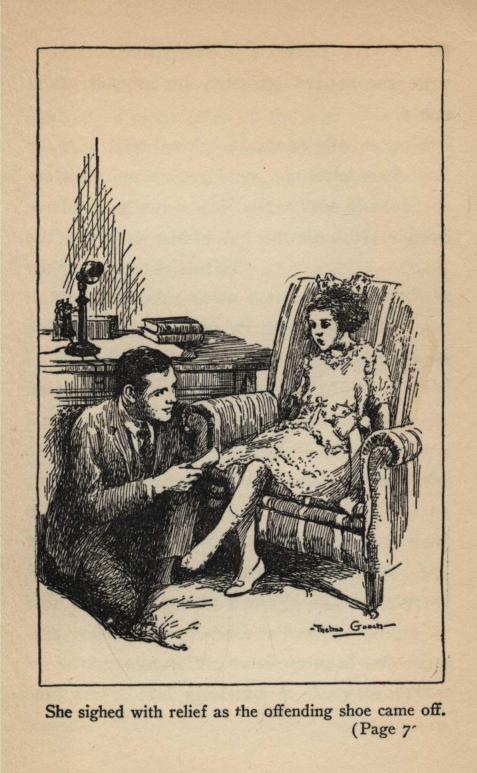
She sighed with relief as the offending shoe came off.
"Where did it hurt?" asked Mr. Echart.
"Right there," said Mary Jane, pointing to the back of the heel.
"That's easy," said Mr. Echart, "it's just too stiff and likely as not has made a blister. You just wait till I put in a pad of soft tissue paper and you'll see how much better it will feel."
At that minute the music stopped and Alice and Uncle Hal appeared at the door of the room.
"You don't mean to say," demanded Hal, "that you are letting my niece sit in the president's chair—the sacred chair of the president of the Crimson?"
"You didn't think you were going to keep it yourself, did you?" laughed Lawrence, "I must say Mary Jane looks every bit as well in it as you did!"
"But what are you doing?" asked Hal.
"Going into the boot and shoe business—repairing department," announced Lawrence. "And if I don't get the job I want on the Boston Transcript, I'm going to open a shop of my own. How's that feel, now?" he added as he slipped the shoe back on.
Mary Jane set her foot gingerly onto the floor. Then, as it didn't hurt, she pressed, harder and harder.
"It's all right," she said with great relief, "my, but you know a lot and I'm so much obliged!"
"You're entirely welcome," said Mr. Echart smilingly, "we do find a college education useful sometimes," he added teasingly, "even if it's only for stuffing copy paper into young ladies' shoes. Now where do we go from here?"
"Back to the yard for the music and lights," said Hal, and back to the yard they all went and found themselves chairs where they could hear the singing and watch the beautiful picture made by the throngs of people, the gay lights and the gleaming fountain.
WINNING THE GAME
How Class Day ended and how she got into her own room in the hotel, Mary Jane never in the world could have told you. She had a hazy recollection of singing, and lights, and crowds of people passing and re-passing; of more singing, and more lights, flashing through water and of people stopping to talk to her mother and Uncle Hal and their friends; of Mr. Echart inquiring about her shoe, and of Uncle Hal slipping on the black pumps that he must have gone to his room to get, and putting the white ones in his pocket. And then, later, of being picked up and carried to a taxi and of dozing comfortably against her mother during a long ride. But more than that she didn't know.
And now the sun was shining and her mother was standing at the side of the bed, dressed and ready to go and asking if Mary Jane was ever going to wake up.
"Is it all over?" asked Mary Jane sleepily, "Class Day and everything all over?"
"Class Day is over," replied Mrs. Merrill, "but everything isn't. Don't you remember that to-day is the game, the baseball game between Harvard and Yale?"
"Oh, yes," said Mary Jane sitting up in bed and wide awake at once, "it's the game Harvard wins and we see 'em do it."
"You certainly are loyal enough to suit even your Uncle Hal!" exclaimed Mrs. Merrill laughingly. "He never will forget how you told everyone within hearing that you were going to Harvard when you grew up."
"Did I really, Mother?" cried Mary Jane in dismay, "when?" She forgot all about being sleepy and sat straight up in bed.
"Yes, my dear, you did," replied Mrs. Merrill. "When Hal was trying to wake you up enough to get you into the taxi you said you didn't want to leave Harvard and that you were going to be president of the Crimson like Uncle Hal. And then, when he told you that you were too young, you announced that you were coming when you grew up."
"Well, anyway, Mother," interrupted Alice anxious to comfort her sister, "we are coming to Wellesley, you know, that's all settled and Wellesley is almost Harvard."
"Don't you worry!" laughed Mrs. Merrill, "Uncle Hal wasn't bothered. He was so proud to have you like it all and so pleased the way you met all his friends, that he liked to have you want to come—you just ask him to-day and you'll see.
"Now," she continued briskly, "I know you're sleepy, but you hurry up and jump into the tub. I have the water ready, and then when you're through, you'll find a lovely surprise."
"Do I know, Mother?" asked Alice.
"No," replied Mrs. Merrill, "and you never in the world could guess, so don't try. While Mary Jane tubs, I'll brush and braid your hair and by that time the surprise will be coming and you'll be ready for it. And don't hurry too fast, Mary Jane," she added, "you want to scrub as well as tub, you know."
It was a good thing she gave that warning, for even with a warning Mary Jane hurried so furiously fast that there was no time wasted over details. But she felt fresh and clean anyway and was wide awake and glowing from her rub.
"Now where's the surprise?" she asked.
"Slip into the bathroom again both of you—scoot!" and at that minute there was a loud knock on the door.
"Now whatever do you suppose—" wondered Alice as she heard her mother open the door of the room and talk to someone.
They had not long to wait—fortunately. A couple of minutes and Mrs. Merrill opened the bathroom door and—what do you suppose they saw?
Drawn up near the windows that overlooked Copley Square was a cunning little table and on the table was—you never would guess—breakfast for three! Strawberries and cream and cereal and milk and eggs and toast and hashed brown potatoes—the hot things all on silver dishes and covered with big silver covers to keep them nice and hot while the fruit and cereal were being eaten.
"Mother!" exclaimed Mary Jane, and then she stopped for she couldn't think of anything to say.
"How'd you ever think of it?" asked Alice.
"I didn't," answered Mrs. Merrill, and the girls saw that she was as pleased as they were with the idea. "Hal thought of it. When he brought us up last night he suggested that maybe we'd be tired this morning and that we shouldn't hurry. He said he'd order it as he went away and that I should ring when we were ready and they'd bring it up."
"And you did, and they did," added Mary Jane, not very intelligently to be sure, but they all knew what she meant.
"How did he know what to order?" asked Alice as she took the first luscious bit of strawberry.
"I guess he just ordered what he saw you liked yesterday, which was a very good way to do," said Mrs. Merrill. "Now while we eat, let's plan what to do to-day."
"When is the game?" asked Alice.
"Not till afternoon," replied Mrs. Merrill. "I thought maybe this morning would be a good time to take that ride through Boston that we didn't get on Monday—that won't tire us, and anyway, we'll just be sitting at the game, it won't be a lot of walking like yesterday."
"And I won't wear white shoes, will I?" asked Mary Jane with a pang of recollection.
"You poor child!" cried Mrs. Merrill, "as soon as we get through breakfast I must see about those shoes and your foot! I can't see why they should have given so much trouble when they seemed all right."
"I guess they're all right now," said Mary Jane, "but when are we going to ride on the swan boats? Uncle Hal said I could ride every day and we didn't even go there yesterday!"
"I thought we had enough to do yesterday as it was," laughed Mrs. Merrill. "Let's see, we might go there at the end of our ride. We are having such a late breakfast too that we won't want much lunch—would that be all right?"
Breakfast over, Alice finished dressing while Mary Jane had her hair brushed and the big ribbon tied on; then she finished dressing while her mother and Alice got out hats and tidied the room ready to go. Mary Jane would have loved to linger all morning at the window, for the comfy chairs felt so good and there was always something interesting to watch in the Square below. But when one goes to Boston, they don't seem to expect to sit in chairs at windows; they seem to hurry around and see something every minute—Mary Jane had discovered that.
They went nearly halfway around the Square, leaving Mary Jane's shoes at a little basement shop they were referred to on the way, and then they got into a great blue automobile that took folks around the city. Mary Jane tried to remember everything they saw, for she could tell that when she grew up big like Alice and was in eighth grade as Alice was, she too would want to know all about the historical sights they were seeing. Alice seemed to know all about the Old South Church, the Boston Navy Yard, the first court house and the funny, narrow winding streets. For her part, Mary Jane liked the Navy Yard best, for there they got out of the car and saw many sorts of government boats. Also they had the fun of going all over the old ship Constitution—a famous boat of long ago. Mary Jane thought the funny little cannon they used in those days looked very queer compared with the great big guns they could see on the boats in use now—they looked like toy cannon ready for a boy's Fourth of July!
Back in the big auto again they drove through the tenement district, and there Mary Jane held her breath many a time for the streets were so very narrow, the buildings so high and close, and the ragged, hungry looking children ran across the streets in a reckless way that frightened Mary Jane nearly to death. She was glad when they left that part of the city and drove to see Bunker Hill Monument.
It seemed a very small monument to make such a fuss about, but Mrs. Merrill explained that monuments are important not for their size but for what they celebrate.
"It does seem too bad, though," said Mary Jane thoughtfully as they turned away to go back to the car, "that the battle of Bunker Hill couldn't have been where those poor children want to play! Here's a lovely park and there, why, there isn't anything but a narrow street! When I grow up, I'm going to have a park for everybody—that's the way things ought to be."
Mrs. Merrill had the driver let them out at the entrance to the Commons instead of Copley Square, and they walked over to the lagoon to take the ride in the swan boats.
"I think this is the nicest thing to do!" exclaimed Mary Jane happily as the boat slowly paddled away from the tiny dock. "I feel so grand and story-book-y!"
"Do you suppose we could ever come here and just ride and ride and ride?" she added, "I'd just love to ride all day!"
"Let me see," said Mrs. Merrill thoughtfully, "I'm afraid we couldn't ride all day, dear, but we might come again after the game this afternoon and get two or three rides. You know a friend of Uncle Hal's is going to take us on a drive to-morrow and there's something planned for every single day."
"Well, then," said Mary Jane, "let's come whenever we can—and oh, I do just love it, I do!"
After a hurried bit of primping at their room the Merrills took the subway to Cambridge where they met Uncle Hal and went to the game. Crowds of gayly-dressed people were all hurrying the same way, bands were playing and colors flying, and Mary Jane got so thrilled that for a while she forgot all about the swan boats. Hal had not been able to get seats all together—one rarely could, he explained; so it was decided that Alice, who was looking (and feeling) very grown-up with her striped sport skirt, blue smock and white sport hat, should sit a few rows away with Lawrence Echart, while Hal and Mrs. Merrill and Mary Jane should sit together.
Alice's seat was halfway down in the middle of the stand and the others were up on the very top row. At first Mary Jane was very frightened; she couldn't stand up, she couldn't look around, for right there behind her was the end of the grandstand and the long, long way down to the ground—straight down. But gradually she got more used to it and she peeked around just a wee, tiny bit.
And there, right in the next row, was a boy about her own age shouting for—Yale!
"Why!" exclaimed Mary Jane in amazement, "he wants Yale to beat!"
"Some people do!" laughed Hal, much amused.
"But Yale!" exclaimed Mary Jane, "why—why—I thought everybody went to Harvard!"
The folks around her couldn't help but hear and they couldn't help being amused at her frankness. One kindly-looking gentleman just in front turned around and said, "Yes, my dear, folks do go to Yale—I did it myself." And everyone laughed.
Usually Mary Jane was very quiet, but the bands and flying colors and crowds of people must have excited her, for she suddenly forgot all about the long distance to the ground—just behind; she grabbed her mother's hand and climbed up on the bench; she waved her crimson banner high over her head and shouted at the top of her small voice, "I'm for Harvard! I want Harvard to win!"
And sure enough, Harvard did.
THE ADVENTURE BY THE LAGOON
"Do you think you two girls will be all right here while Hal and I sit over there and visit awhile?" asked Mrs. Merrill.
It was the late afternoon of the game and the Merrills, with Hal, had driven in to Boston with some friends of Hal's and now were sitting in the Commons trying to keep the promise to Mary Jane to let her ride all she wished in the swan boats.
It seemed a hopeless promise to keep though, for no sooner had they taken one ride than Mary Jane was ready for another, and another and another. Finally Mrs. Merrill suggested that as she and Hal had many things to talk about, they might sit at the side of the lagoon and let the two girls ride by themselves; Alice was old enough to make such a plan perfectly safe and anyway there was no danger, for Mary Jane was big enough to look after herself on the boat.
"Surely!" said Alice replying to her mother's question, "you sit right over there and we'll be safe as safe can be."
"And if we run out of money for rides," added practical Mary Jane, "we'll come and tell you."
"I'll save you the trouble," said Uncle Hal, "I'll buy a bunch of tickets that you never can use up!" And much to Mary Jane's delight, he went over to the window where the tickets were sold and bought fifty cents' worth—ten whole rides—five for each girl.
"Thank you ever so much, Uncle Hal," said Mary Jane gratefully, "and if you change your mind and want to ride, I'll let you have one of my tickets," she promised as he handed her five all for herself.
"Yes," added Alice, "and if mother wants to ride again, I'll let her have one of mine."
"Thanks awfully, ladies," said Hal laughing, "but I think sister and I will enjoy the talking every bit as much as you enjoy the riding, so everybody will be happy."
Mary Jane thought she never, never, never had had such a blissful time! The sun, halfway down in the west, was just warm enough; a soft June breeze blew the lagoon into tiny ripples and made the air cool and comfortable after the warm day; flowers blooming on the bank filled the air with dainty fragrance and, best of all, there were those magic boats—and five tickets all her own. She and Alice picked out the front seat in the boat they thought the prettiest and there they sat. They didn't even trouble to get off when one ride was over; they simply sat still while the two or three other passengers stepped off at the dock and two or three other passengers stepped on, and then off the boat went again on its slow, stately journey around the little lake.
But at the end of the third ride they noticed some talking at the side of the dock furtherest away from where Mrs. Merrill and Hal were sitting, and Alice stood up to see what was the matter.
"Look at that child!" exclaimed Alice. "Look, Mary Jane, at what she's doing! She's trying to make her doll sit on the edge of the dock, and anybody would know a doll couldn't do that!"
Evidently everyone around there except the little lady herself was of the same opinion as Alice, for the other children were trying to tell her that the doll couldn't sit there; that she would fall in surely, surely, if such a thing was attempted.
"And it's such a pretty doll too," worried Mary Jane. "Come on, Alice, let's get off and tell her not to do it. Maybe she'll mind us 'cause she doesn't know us."
But they were too late. Just as they stepped off the swan boat ready to hurry over to the end of the dock where the children were, the little lady succeeded in getting the doll set stiff and straight at the very edge of the dock. For a breathless instant the doll sat there. Then, so quickly nobody could reach out a hand or do a thing, the prettily-dressed doll tumbled over on its face—splash!—into the lagoon.
For an instant the children all stood motionless in amazement. Then the little mother began to cry, "My dolly's drowned! My dolly's drowned! I didn't want my dolly to drown!"
"Then what did you sit her on the edge of the dock for?" demanded an older boy who had tried with the others to tell her that the doll might fall in.
"'Cause I wanted her to sit there!" retorted the girl, "that's why!" Then with a sudden recollection of her loss, the impudence left her and she sat down on the dock and began to cry.
"Let's call for help," suggested Mary Jane, and she looked around to see just where her mother and uncle were sitting.
"Call nothing!" exclaimed the big boy, "do you want to get us all run in? Ain't you got no sense?"
Mary Jane looked at him in amazement. What was "run in" and why not call for help when a beautiful doll was drowned?
Alice, too, was surprised at the boy's attitude but being his own age she wasn't backward about asking for an explanation.
"Why not call for help?" she demanded. "How are you going to get the doll out?"
"Don't you worry about that," he said tartly, and then, more politely, he explained, "the park cop told us not to stay close by the water, and here she went and let her doll fall in and if we holler he'll hear sure as shooting and come and order us on. You just stop crying now," he said to the little mother who, frightened by his order to keep still was crying softly to herself, "we'll get her out for you—you just wait!"
"Is she your sister?" asked Alice.
"Sister—nothing!" replied the boy, "think my sister would have such a fine doll? That's my sister," he added, jerking his thumb toward a ragged little girl on the edge of the group, "my sister ain't got no doll—but she ain't a cry baby either!" he added.
Alice looked interestedly at the child thus pointed out. She was a bright, pretty looking little girl with oh, such a poor dress—and no doll? Why she was just Mary Jane's age—but this was no time to stand looking at other folks, and she turned to the water to see what could be done.
Mary Jane, in the meantime, had crept up to the edge of the dock and was peering down into the clear water.
"There it is," she said, pointing, "see? It's right down there! Now, don't you cry, we're going to get it out in a jiffy. I wish I had a long stick to poke with."
"You don't need a stick," said the big boy, peering over beside her. "See how shallow it is? And a stick would just stir up mud and get its clothes all dirty."
"I could pretty nearly reach it without a stick," suggested Mary Jane as she sat on the pier and reached down into the water.
"That's an idea," exclaimed the boy, "that's just what I'm going to do." He proceeded to lie down flat on the narrow dock and stretch his hands down into the water.
"You almost touched it!" exclaimed Mary Jane excitedly, "just reach a little more—"
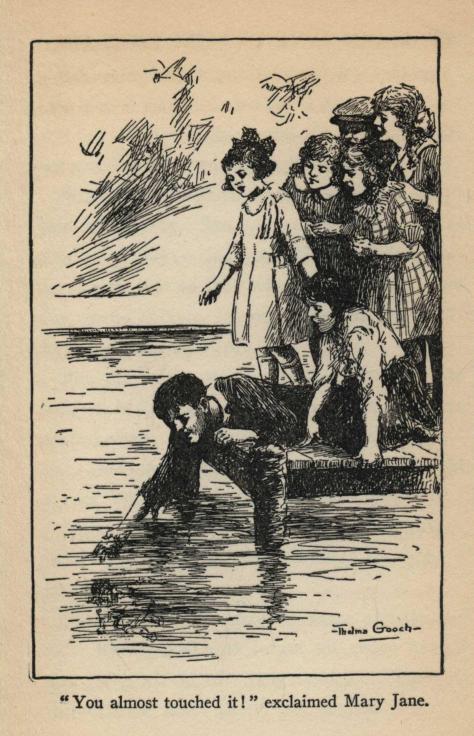
"You almost touched it!" exclaimed Mary Jane.
"But I can't reach any more!" said the boy, "see?" And he looked up for a suggestion. "Oh, I'll tell you what!" he added, "I'll reach over farther and you hold my feet so I won't fall in. Then I'll reach down with one hand and I'll bet I get it."
He wormed himself closer to the edge of the dock and while Alice held tightly to his shoes, he reached down, down, down into the water.
"He's got it," reported Mary Jane, who was watching, "he's touched it and he's got it—look!"
Sure enough. The boy wiggled back a bit from the very edge and lifted the dripping doll out of the water.
"Oh, my dolly! My dolly!" cried the little mother, "but she's all wet!"
"What did you expect after such a soaking?" chuckled the boy, "but water'll dry. My coat's wet but it'll dry in this warm air." He took off his coat and spread it out in the sun on the dock.
"And that's what you must do to your doll," said Mary Jane. She loved nothing so much as mothering folks—children, dolls—it didn't matter which just so they needed something done for them. "Here, let me help you and we'll have her fixed in a jiffy."
She sat down on the dock, with the little mother beside her, and began to undress the soaked dolly. "Now we'll take off her dress—so. And then her petticoat—so. And we'll spread 'em all out in the sun—so."
"Why don't you spread 'em on a bush?" asked the boy practically, "that's what I do when I go swimming."
"Here, I'll do it," said his sister, and the shy little brown-eyed girl forgot all about herself and being afraid of strangers in her eagerness to touch the doll's pretty wet clothes.
"Then you do it," agreed Mary Jane. Very carefully she took off stockings, shoes, underclothes, every stitch the doll had on and the little Italian girl spread the things on the bushes in the sunshine.
"You ought to spread the doll too," said Alice, "she's so wet the clothes get wet as soon as you put them back on."
"I'll tell you," suggested Mary Jane jumping up hurriedly, "let's get mother and Uncle Hal to hold it in the sun while we take a ride on the swan boat."
"Y'haf ta have money to ride those boats," replied the boy, "and we ain't got none."
"You don't have to have money if you have tickets," answered Mary Jane, "and I've got plenty of those—see?" And proudly she displayed the tickets she had put in her pocket when she began undressing the doll. "Come on, lets!"
Holding the undressed doll in her hands, she ran around the lagoon to where her mother was sitting. "Mother!" she exclaimed suddenly, "will you please hold this doll in the sun so it'll dry while I take these folks for a ride?"
"What in the world?" exclaimed Mrs. Merrill in amazement as she saw the strange children, the dripping doll and her own excited little girl.
"She drowned," explained Mary Jane, pointing to the doll, "and he rescued her," pointing to the boy, "and we're all going to take a ride."
Hal looked at the children and suspected that they were to be Mary Jane's guests—with the exception of the little girl who owned the doll they were ragged and poor looking, so he asked, "Have enough tickets, Mary Jane?"
"Just enough," replied Mary Jane, "with Alice's and mine together."
"Then we'll hold the doll and watch you ride," said Mrs. Merrill.
The children scampered over to the dock and got aboard a boat. The little Italian girl sat with Alice and Mary Jane and the others took the back seat.
"Oh!" exclaimed the child rapturously, as the boat slowly moved away from the shore, "ain't it just like a fairy story?"
"You like stories too!" cried Mary Jane delightedly, "so do I and I feel just like a princess. I do every time I ride on 'em."
"I never rode on one before," said the stranger, "but I feel like a princess now, I do."
"Never rode on a swan boat, never had a doll," the thought kept running through Mary Jane's head during the rest of the ride and while they were getting off and going back to her mother, "never had a doll—" How funny that would seem!
The rescued doll was not dry yet, of course, but Uncle Hal had procured a paper to wrap it in, so that it could be carried home safely.
"We'll get the clothes and wrap them up too," said Alice, and Mary Jane, and the mother of the doll ran and brought the clothes from the bush at the other side of the lagoon, and Alice wrapped them carefully so nothing could be lost out on the way home.
While she was doing that, Mary Jane whispered to her mother, "Won't you please find out the name of that little girl with the brown eyes, and the boy, Mother dear, and where they live, and I'll tell you why when we get home to the hotel?"
Mrs. Merrill pulled out her tiny notebook and tactfully asking the boy for his name and address, wrote them down in the book. Then they all said a good-by to their new friends, for it was now high time they were getting back to dress for dinner.
"Mother dear," said Mary Jane as she skipped along beside her mother five minutes later, "that little girl never had a doll and she never went on the boats before though she lives right here in Boston. And as soon as we get home I want to send her a doll, all dressed in pretty clothes and everything—may I please?"
"Indeed yes, dear," answered Mrs. Merrill, much pleased with the idea. "We'll do it just as soon as we get home, and you and Alice may make the clothes and have it a really gift of your own."
When, an hour or more after dinner that evening, Mary Jane snuggled down in her bed for a long night's sleep, she said to Alice, "Didn't we have fun to-day? Winning the game and going boat riding and rescuing the doll and everything? Now I wonder what'll happen to-morrow?"
COMMENCEMENT IN THE STADIUM
The first thing Mary Jane did when she wakened the next morning was to run and look out of the window. All their plans for the day depended upon the weather. Year after year the Harvard commencement had been held in Sanders Theatre, one of the rooms in Memorial Hall, and as the graduating class was always so large and the theatre so small in comparison, it was impossible for each student to have more than one ticket—and of course that meant that Mary Jane was not to go. But this year, partly through the influence of her own Uncle Hal, it had been decided to hold the exercises in the Stadium—if the weather permitted. And that meant that Mary Jane could go; in fact, she had the ticket all ready, the ticket marked so plainly "not good in case of rain."
A glance at the sky showed her she was not to be disappointed. It was clear and blue and the few dainty white clouds scattered about looked as unlike rain clouds as could be. It was a perfect June day.
"Goody!" she exclaimed, as she ran back to take a peep at the precious ticket. Not many little girls of six ever went to a Harvard commencement, and Mary Jane guessed that she was very fortunate.
Mrs. Merrill suggested that as both girls had had a good night's sleep, they dress and take a bit of a walk before breakfast, stopping on the way for Mary Jane's shoes which were to be ready. So Mary Jane slipped on a dark gingham dress after her bath, and they started out. There was only time for a short walk as they were tempted into the library and lingered to enjoy the pictures. Mary Jane knew the story of the Holy Grail, as every girl should, and she and Alice both enjoyed looking at the lovely paintings.
"Let's come again!" exclaimed Alice as her mother reminded them that they simply must not stay any longer now, as Uncle Hal would be waiting.
"Oh, I just love it here!" whispered Mary Jane as they walked down the broad marble staircase. "Doesn't it make you feel like a princess in your own castle? I can just see my subjects walking behind holding up my train and thinking how grand and lovely I look."
"Seems to me a good many things make you feel 'like a princess,'" said Mrs. Merrill smilingly, "the swan boats and now the marble stairs of the library."
"Well, I guess Boston must be a princess-y sort of a place," replied Mary Jane, "'cause I never felt that way in Chicago. I like Boston. I like Chicago too," she added loyally, "but Boston is more princess-y feeling."
They crossed the Square and hurried up to their room to dress. The girls were to wear the dainty little organdies they had worn on Class Day. Mrs. Merrill had had them pressed and when the girls stepped into the room there they were on the beds—as fresh and crisp as new. And now that the new shoes were fixed with a soft pad of leather at the heel to keep them from slipping up and down and making a blister, there was nothing likely to mar the day.
It didn't take long to dress as everything was laid out ready, and soon the three Merrills were in the subway, dashing out to meet Uncle Hal at Harvard Square. There wasn't much time for visiting; and anyway, Mary Jane didn't feel much like visiting just "common-like" with a queer-looking uncle who wore a long black dress and had a funny pointed cap on his head. Her mother explained that it was a "gown" not a dress, and that all the students who graduated that day and all the men of the university wore them. Mary Jane had, of course, seen a good many of them on Class Day but she couldn't get used to her own Uncle Hal having such a funny gown.
They all went over toward the Stadium together, and as they stepped upon the bridge across the Charles River, Uncle Hal picked her up and set her on his shoulder while Mrs. Merrill took a picture of them.
"There now," said Hal as he set her down again, "if anybody ever doubts that you came to my commencement they can just look at that! There's the Charles River in it and the Stadium in the background and you and I in front—if we didn't break the camera."
In the row in front of them, in the Stadium, sat Hal's friends, Mr. and Mrs. Humphrey. Alice and Mary Jane had never met them before, though Mrs. Merrill had known them some time.
"I'm so sorry you've been here all these days and we've been away," exclaimed Mrs. Humphrey, as the Merrills were seated. "We just got in this morning. I'm wondering if you and these nice girls wouldn't like to go for a drive this afternoon? Have you been down on the south shore? Toward Nantasket?"
"We haven't done a thing but Harvard!" laughed Mrs. Merrill, "because Hal wanted us to go to all the exercises and parties. We've had a marvelous time, but aside from one short ride, we haven't tried to see anything of Boston—I thought that would keep till the job of graduating my brother was over," she added.
"That's just the way I knew you would feel," answered Mrs. Humphrey, "because I know how Hal's been counting all winter on your seeing everything. But now that it's so soon over you'll have time for a ride with us. You're not going to the boat races are you?"
"No," said Mrs. Merrill, "I thought that would be almost too much of a crowd for the girls, so we've planned to go to Plymouth to-morrow while Hal and some friends go to the boat race, and then I want to stop over night with a dear cousin in Marshfield."
The talk was interrupted just then by the arrival of the first of the long procession of men entering the Stadium. Mary Jane could hardly sit still she was so thrilled by the sight of the long line of marching men—all in black gowns relieved here and there by the capes of scarlet or blue or purple some wore. And the bands playing and the crowds of people all interestedly watching—of course she couldn't understand it all, but she loved seeing it—it seemed like a scene from an old time pageant.