Front matter (continued 2)
Reading edition
But by the time the exercises were over Mary Jane was tired enough from sitting on the hard stone seat and from watching and trying to understand. So the idea of lunch at some place in Cambridge without waiting to go back to Boston, sounded very welcome.
"We'll go where Uncle Hal goes sometimes," suggested Mrs. Merrill. "I know the very place on the way back to the Square. You may have a sandwich and some ice cream and anything else they have, that you'd like."
"And is it all over?" asked Mary Jane as she ran along beside her mother, glad of the chance to hurry a bit and limber up the muscles stiffened by long sitting.
"All over, I think, honey," replied Mrs. Merrill. "All over for us anyway, as we're not going to the races. And won't we love that ride this afternoon? Hal will be busy packing up, and we'll get just that extra bit of fun thrown in."
Mary Jane found just what she wanted for lunch and was much refreshed, so, leaving a note in Hal's room in order that he would know their plans, they took the subway back to their hotel to change and make ready for the drive. White organdy dresses were not the most suitable frocks for an all-afternoon motor trip.
Promptly at two o'clock Mrs. Humphrey arrived in a beautiful limousine. Mary Jane, who wasn't used to a car of her own, had puzzled considerably as to what sort of a car Mrs. Humphrey might have, and had insisted that she wanted to wear a grown-up-lady veil so as not to muss her hair.
"You won't need a veil, dear," Mrs. Merrill had said, positively, "little girls don't need veils when their hair is short, no matter what kind of a car they ride in."
"But I saw a picture that had a little girl with a veil and a lady with a veil," said Mary Jane, "and I want to wear the big pink one, I do."
"Suppose you take it instead of wearing it," suggested Mrs. Merrill. "Then you'll have it if you need it, and you won't be bothered taking it off if you don't need it."
So Mary Jane went out to the car carrying a long floating veil of pink chiffon, and from her grand manner it was plain to see that again she felt "just like a princess."
Mrs. Merrill sat with Mrs. Humphrey in the big back seat and Alice and Mary Jane sat on the chairs just in front of them.
Mary Jane was much thrilled by the dignified looks of the middle-aged chauffeur and when Mrs. Humphrey said, "We're ready now, Higgins, drive down the south shore the way we like best, you know the route?" she couldn't keep her enthusiasm to herself.
"I think Higgins is an awfully nice name," she confided to Mrs. Humphrey. "I read a book, that is, mother read it to me, and it had a Higgins in it and I liked him a lot. I always thought I'd like to talk to a Higgins.
"Does yours talk again?" she added as she saw no sign of conversation in the straight shoulder before her.
Mrs. Humphrey's lip twitched. How explain to eager little Mary Jane that Higgins was so dignified everyone had to be careful of his feelings? Higgins was the most dignified of all the story-book Higginses ever invented! So she merely said, "I think he's rather busy driving just now, and we want to have a careful driver, don't we dear?" And then, in an effort to change the subject she added, "Isn't that a lovely garden?"
But Mary Jane wasn't that easily diverted and Higgins was very much on her mind—as Mrs. Humphrey was to discover later.
FUN ON THE BEACH
The drive down the south shore was very beautiful; the girls both enjoyed the glimpses they saw of Quincy, Hingham and Neponset—the quaint old-fashioned houses, so different from anything they had ever seen before, the lovely gardens and the view of the bay and various inlets that they caught from time to time. The road was good and the powerful car dashed along under the wide spreading trees that edged the roads. The girls were much refreshed by this sort of entertainment.
But Mary Jane was disappointed by one thing—it wasn't really windy enough to need a veil. And she did want to wear one. As they neared the ocean though, they felt a stronger breeze, a breeze that came gustily through the open windows of the limousine, and she felt justified in using the veil she had carried over her arm. It wasn't particularly easy to adjust a veil two yards long while they were driving so rapidly, and Alice had to help her sister, for Mary Jane insisted in putting it entirely over her hat and tying it under her chin.
Mrs. Merrill and Mrs. Humphrey were busy talking and didn't notice what Mary Jane was doing till the veil was almost fixed. Then Mrs. Humphrey noticed it, and was all regret for coming this route.
"My dear!" she exclaimed to Mrs. Merrill, "I didn't know your little girl was so delicate! We should never have come this way! We could just as well have driven west and then she wouldn't have felt this awful wind from the ocean! Why, it's just too bad! We'll have Higgins turn around at once! I should have asked you, only your little girl looked so strong and I thought she and her sister might like to go in bathing at the beach. Such a dear little thing to watch and put the veil on herself at the first breath! My nephew's children are so careless—they never will wrap up as—"
There seemed no hope of the good lady ever stopping, so Mrs. Merrill interrupted to say, "Don't be a bit concerned, Mrs. Humphrey, Mary Jane is not delicate—in fact she is very strong and vigorous. But she did want to wear a veil and pretend to be grown-up, and she has taken advantage of the first breeze to think she must put it on."
Mary Jane was panic-stricken. She wasn't sick; she'd love to go swimming in the ocean, and the very thought of leaving that pretty beach they were just approaching and turning west made her sorry. What had she done by putting on her veil?
"Don't you worry 'bout me," she said to Mrs. Humphrey, "I'm never sick. But I like to wear a veil—a big lady veil. Don't you like to, too? But I like to go swimming too, I do."
"Very well then," said Mrs. Humphrey, smilingly, "you shall go swimming. I guess I don't understand little girls very well. But I know they always like to come to the beach and they like to eat—oh, 'most anything."
"Then you know them pretty well after all," said Alice laughing.
"But they can't eat before they swim," said Mary Jane, "little girls can't."
"To be sure," agreed Mrs. Humphrey as the car came to a stop on the shining sand, "but if they go in the water at once—they won't have to wait long to eat, will they?"
As the girls climbed out of the car they decided that Mrs. Humphrey knew considerable about girls even if she didn't happen to understand Mary Jane's notions about wanting to dress up like grown folks.
At the right hand end of the long beach was a private clubhouse where Mr. Humphrey had a membership, and there Mrs. Humphrey took Alice and Mary Jane to fit them out with bathing suits.
"I wish someone we knew was here to go in with you," said she worriedly, as they walked toward the beach after the girls had dressed. "Of course Higgins is bringing lap rugs down close to the water and your mother and I will sit right there near. But you could have more fun with the big waves, if someone could take you out."
They threaded their way through the crowds of folks on the sand to the spot where Mrs. Humphrey thought the cleanest, nicest sand was found, and there—just as though he had been there all afternoon—was Uncle Hal and three of his friends!
"I thought you were going to pack!" exclaimed Mrs. Merrill in amazement.
"So I was," laughed Hal, "but why pack when I could go in swimming?"
"But how did you happen to come here?" asked Alice.
"I didn't 'happen,'" Hal assured her. "Art came over and said you were coming down here, and as it turned off so hot, wouldn't I like a swim, and I would—so here we are. Want some good company?"
"'Deed we do!" Mary Jane assured him, and much relieved, Mrs. Merrill and Mrs. Humphrey sat down on the rugs to continue their visit while the two girls, with the four college men for escorts, raced down into the water.
Mary Jane supposed she would have had fun on the beach, wading by the edge of the big waves even if Uncle Hal had not come. But it wouldn't have been fun such as she and Alice had with him there. The great waves rolled in and broke in a crest of foam near the shore and then spread in a frill of bubbles over the golden sand. Uncle Hal picked her up in his arms and walked with her way out into the water; then, holding her high, let her feel the "break" of the waves close to her face. She shouted with glee and splashed her hands in the crest of foam—never had she had such fun!
Then, taking her out deeper, where the waves did not break but rolled along in a great swell, he held her tightly by her bathing suit and under her chin and let her swim. It was fun to feel the water rolling, to let herself go as Uncle Hal told her to, and to breathe slowly and comfortably and work her hands and feet, feeling all the while the security of her uncle's strong arm.
"Let's do it some more!" she cried, as he took her in to shore.
"Pretty soon," he replied, "but you stay on the sand awhile now with Alice while I swim out to the raft to warm up. Then you shall have another swim—two, if you want them."
Back on the sand with Alice, Mary Jane found it nearly as much fun to dig and hunt shells as it was to swim. There seemed to be no pretty shells as there were on the beaches in Florida; perhaps because the crowds of people kept them picked over; perhaps because up further north there were not such pretty shells to be washed up. But there were plenty to build a wall with even if all were not beautiful and perfect. She and Alice collected several handfuls and then set about building a city with a wall around it. Other children playing near saw the plan and helped too, and in a few minutes a dozen little folks were working under Alice's direction, building streets, parks, houses, churches and the outer wall. It was great fun and as they worked the time sped by, one hour, two, and the girls would have guessed it wasn't more than ten minutes.
They were used to playing on the sandy beach of Lake Michigan and even Alice, who knew all about it, didn't think about the ocean's tides. And as all the children were in their bathing suits they didn't notice an occasional bit of wetness. So it was with amazement they saw a great wave roll up near and actually into their precious city!
"Why, what's the matter with the ocean?" exclaimed Mary Jane in dismay, "it's coming into our city, and it mustn't!"
"Matter with the ocean!" cried Alice, much disgusted with her thoughtlessness. "It's the tide. Don't you remember in Florida how it went up and down the beach each day, Mary Jane? We should have remembered and set our city further from the edge of the water."
As they talked, a second great wave broke in a frill of bubbles and down went the two nearest churches, three parks and a dozen houses.
"Regular earthquake-tidal wave effect," said one of Uncle Hal's friends who came up to the group just then. "Well, we were just going to take you into the water again anyway, so why worry?"
"Oh, goody!" cried Mary Jane happily, "we can build another city sometime, but we can't go in swimming with you and Uncle Hal—not very often we can't."
By the time the girls had had another good swim and had enjoyed the breakers till the boys were tired, Mrs. Merrill decided that it was time to come in. The sun was getting lower and lower, and already the breeze was blowing cooler.
"Dash up to the clubhouse quickly, girlies," said Mrs. Humphrey, "you know where I showed you to go. And then when you come back dressed we'll find something to eat."
But the girls took longer dressing than might have been expected—maybe they talked too much about the good time they were having—and when they reached the beach it was time the party was starting back for Boston, past time in fact, if Mrs. Humphrey was to keep an important dinner engagement. So there was no time for regular tea as Mrs. Humphrey had planned.
"But we can stop and get ice cream cones and crackerjack to eat on the way," she said. "Don't little girls like cones and crackerjack?"
"They certainly do," laughed Alice, "at least these little girls do."
"Then take this," said Mrs. Humphrey, handing her a five-dollar bill, "and get all you want, dear. This looks like a good place." They were back in the car of course, and Higgins had driven along the thoroughfare by the ocean—a street lined with shops.
Alice looked at the money with a feeling of dismay. How many should she get? One cone apiece and one box of crackerjack or maybe two? And how about the change? Five dollars seemed like a lot of money to carry into a crowd such as thronged the boardwalk by which the car had stopped.
Seeing her hesitation, Mrs. Humphrey said, "Would you rather I got it, dear?" and Alice replied so promptly, "oh, will you, Mrs. Humphrey?" that the lady had no doubt, but Alice would enjoy herself more if she didn't have to make the purchase.
So Mrs. Humphrey got out of the car and hurried to the shop. It is hardly likely that she had made such a purchase before—certainly not often, for when she got into the shop she scarcely knew what to buy, or how much the girls could eat. Of course they would be hungry—she bought four boxes of crackerjack and five cones; that amount simply because that seemed to be all she could carry, and went back to the car.
"Can you help me?" she asked as she found herself too loaded down to step comfortably into her car. Mary Jane was on that side and she reached out and took the boxes of crackerjack while Mrs. Merrill took the cones.
"Where's Higgins's crackerjack?" asked Mary Jane making a hasty count.
"What did you say, dear?" asked Mrs. Humphrey who thought her ears must have deceived her, "Higgins' what?"
"Higgins's crackerjack," repeated Mary Jane, "you've got a cone for everybody and only four boxes of crackerjack. Doesn't Higgins like crackerjack?"
"I really—why—" Mrs. Humphrey was so amazed that for the minute she couldn't think of anything to say. Higgins and crackerjack!
"Never mind," said Mary Jane, thinking to comfort her hostess, "there's plenty of ice cream and he can have half of my crackerjack—I'd be glad to divide it."
Before either Mrs. Merrill or Mrs. Humphrey could interfere, Mary Jane had slipped from her chair and was hospitably passing the cones to the dignified chauffeur. Never did a man look more insulted! He, Higgins, to eat an ice cream cone while on duty and in his best uniform! Perish the thought! But a glance at Mary Jane's kindly smile changed his answer and instead of frowning no without a word as he meant to, he smiled and said, "Thank you kindly, miss, but I must give all my attention to the wheel."
"Well, don't worry," said Mary Jane, "I'll eat it then." And she did.
A DAY IN PLYMOUTH
When Mary Jane stepped off the train in the little town of Plymouth the next morning, she expected to see the famous Plymouth Rock the very first thing. Instead, she saw a modern station with its line of autos, surreys and wagons drawn up along the side and a parkway stretching away toward the hill.
"Where do they keep the rock?" she asked her mother.
"Goodness only knows!" laughed Mrs. Merrill. "Don't expect me to know everything, honey. But I do know they have it around here somewhere."
"Oh, Mother," cried Alice, "look at that darling pony! Couldn't we get that man to drive us around some place? I'd adore to have that pony pull me!"
Mrs. Merrill and Mary Jane liked the idea too, so they engaged the driver of a quaint little pony cart to take them around the village.
But before five minutes had passed, they almost repented of their bargain. For, turning away from the station to the right, they began ascending a hill that taxed the strength of the pony to the utmost. Up they went and up and up, and the little pony pulled and pulled and pulled his best, but with such a load he couldn't go faster than a very, very slow walk.
At last they reached the top of the hill and there on an open plain they saw a handsome monument—the driver told them it was Forefathers' Monument.
"Whatever did they put it here for?" asked Mary Jane. "There's nothing here but a field."
"You should get out and look," said the driver proudly. "Just look—and you'll see."
They left the pony cart (they were glad to give the little fellow a chance to rest you may be sure) and walked close up to the monument before they turned around to look; and then they saw why the monument was set just there. Before them lay the bay, the blue waters sparkling in the bright sunshine; and to the left and to the right for miles and miles they could see the coast line gleaming gold with the shining sand, and back from the ocean to the north were the green marshes and fertile fields. It was a view long to be remembered.
"I expect the Pilgrims stood right here—didn't they, Mother?" asked Alice.
"Without a doubt they did," replied Mrs. Merrill, "and think how it must have looked to them! There were no fields then; only marshes and woods; no friendly city off in the distance; only strange Indians. I can imagine that many a time a lonely Pilgrim must have sat in this very spot and looked longingly out over the ocean toward the home they had left."
"They were brave folks, weren't they, Mother?" said Mary Jane, much impressed with the beautiful view and the thought of the long-ago Pilgrims. "But where's Plymouth Rock?"
"We'll have to find that rock for you in a hurry," laughed Mrs. Merrill. "Well, at least we know it isn't on a hill, so we can go on from here if you are ready."
The pony cart next pulled them down the hill and that was nearly as exciting as going up, for it surely seemed as though the cart with its four folks would fall over on top of the little pony.
"I really believe," suggested Mrs. Merrill, "that we could get around faster if we'd walk, girlies," as they turned back into the station parkway. "Suppose we walk for a way and explore as we go?" The girls were willing, so the pony cart was dismissed, and the Merrills set out to explore.
They went south along the main street of the village, passed the museum where relics of the Pilgrims were kept and which they meant to visit later in the day; passed several big hotels and many stores till they came to the end of the village where the fishermen had headquarters. And there, at the shore end of a small wharf, they saw a stone monument. Not a big handsome one such as they had seen on the hill a few minutes before; a small stone monument with an open space in the center and an iron grating sort of a door shutting up the open space.
Alice and Mary Jane ran ahead to see what it was, and there Alice read the words, "Plymouth Rock." There under the monument, set in the arch made by the stone corners and protected from injury by the heavy iron grating, was the famous stone. It wasn't big as Mary Jane had expected it to be—it was just a common-looking boulder, and nobody would have thought of it twice if it hadn't been in a monument so folks would know it was something to look at.
"Well," said Mary Jane practically, after she had looked at it carefully for a minute or two, "I don't see how in the world they stepped clear from the ocean there at the end of the pier to here—I don't see!"
"But you must remember, dear," replied Mrs. Merrill, "there wasn't any pier then—just the ocean and the shore. No doubt the ocean was close to the rock then, for sometimes sand and rocks are washed around and the shore line changed in so many years as have passed since that day. Or, possibly, folks have moved the rock up here so it wouldn't get weatherbeaten by the winter's storms. I think that is most likely the reason why it is here."
As she was speaking, two men came up to the monument to make some repairs on the lock of one of the iron gates. As the gate swung open after they unlocked it, Mary Jane looked longingly in at the rock—if she could only touch it! What fun it would be to tell Betty and Frances that she, Mary Jane Merrill, had really touched Plymouth Rock!
One of the workmen seemed to guess what she wanted for he said to her, "Hello there, little girl! Did you come a long way to look at that rock?"
"All the way from Chicago," answered Mary Jane.
"Then I think you'd like to touch it, wouldn't you?" he said. Mary Jane nodded happily.
"Here goes then," he replied, and he stepped aside so she and Alice could stand inside the gate and actually lay their hands on the rock.
"I know something better than that," said the other workmen, much pleased with the girls' interest and joy. "We'll open the gate on the other side where the sun is shining and your mother can take your picture standing on the rock, just as the Pilgrims did."
Mary Jane was so excited by that fine idea that she could hardly stand still, but with the help of mother and the men the gates were at last open, and she and Alice took their places on the rock—and the picture was taken.
"Thank you so very much," said Alice gratefully as the gates were again locked up, "that picture will be fine to take to school 'cause I'm studying American history."
"Then you want to notice that hill," said one workman, pointing to a hill close by. It wasn't such a very high hill but the sides were steep and grass covered and it was close to the shore. "That is the hill you will read about," continued the man. "After that hard winter when so many of the Pilgrims died, the bodies of the dead were buried there and the Pilgrims planted corn over the top, so the Indians would not guess it was a cemetery and find out how very many had died. You must walk up that hill," he advised Alice, "so you can tell your class about it when you get back."
"We certainly will," replied Alice gratefully, "and thank you for telling us about it."
They crossed the street and climbed the wooden stairway up the hill. On the top was an inn where a sign announced that luncheon was served, but the girls didn't care for anything so modern. Fortunately Mrs. Merrill had had the hotel put up a fine luncheon for them, so they wouldn't have to waste time eating indoors. As it was now nearly noon and the girls were very hungry, she suggested that they sit on some benches halfway up the hill and eat now, where they could enjoy seeing Plymouth, the ocean and the historic hill.
That seemed a splendid idea, and the girls agreed that never had fried chicken and sandwiches tasted as good as on Plymouth Hill.
"I do feel awfully selfish though," Mary Jane said as she polished off a drumstick, "to have such a good lunch at the very same place where folks died 'cause they didn't have enough to eat."
"I don't feel so selfish as I do thirsty," said Alice. "Now if I only had a drink—"
"No doubt we can find one," replied Mrs. Merrill. "If you've eaten all you wish, we can put the papers and scraps in that trash basket over there and walk on. Surely we'll find a drink soon."
They walked along the street, passing many an old curiosity shop where Alice would have loved to linger and price old candlesticks and bellows and chairs and all the curious wares she could see through the window; only she was so thirsty that a drink seemed more interesting than curiosities just then.
Turning to the left they went up a steep grade to another street and there, right in plain sight, was a beautiful drinking fountain. Without stopping to read the inscription she and Mary Jane had a good drink. Then Alice read aloud the tablet that said this water was piped up the hill from the very spring where the Pilgrim fathers first got their water.
"I think we're doing a lot of interesting things to-day," said Mary Jane happily. "We stood on Plymouth Rock and we ate lunch where the Pilgrims didn't have anything to eat, and now we're drinking out of their own spring! Now what do we do next?"
"I think we'd better walk up these steps to the old cemetery," said Mrs. Merrill.
Mary Jane thought it was awfully funny to walk up stairs on a street, but it was the only way to get up so steep a hill. Mrs. Merrill and Alice were much interested in the quaint, old inscriptions on the queer, flat tombstones, but Mary Jane was much more thrilled by the sight of the old funeral carriage which she saw in an old barn as they came down from the other entrance. It didn't seem possible that real folks had ever made such a funny, fancy carriage—it seemed more as though it was "made up" for a show!
The afternoon was flying along and they had to hurry if there was to be time to stop and see the wonders of the historic museum they had passed before. And, indeed, that was the hardest place of all to leave, for there the girls saw old spinning-wheels and looms, old-fashioned chairs, dishes and toys such as little folks used to play with—though goodness knows, children in those old days had very few toys of even home-made sorts!—and boats, models of real boats of those early days and oh, so many things, Mary Jane thought they would have to stay there a week to see all she wanted to see.
But they wouldn't stay a week, nor even an hour more, for at four they must take a train to Marshfield Hills where they were to visit Cousin Louise. If Mary Jane hadn't wanted to visit there very much she might have suggested to wait till another train; but she had so often heard her mother tell about this dear cousin and her little boy, that not even the curious boats and wonders of the museum could make her want to miss that train.
"Now you tell us all about 'em," she said to her mother, when, a little after four, they were seated in the train and speeding toward Marshfield Hills. "Is he big as me or is he a baby? And how do I talk to him?"
"Oh, you must play with him very nicely," said Mrs. Merrill, "for he's only a little bit of a boy—oh, lots younger than you are."
But when Mary Jane stepped off the train at Marshfield Hills she certainly was surprised, for the little fellow who sat in the front seat of the waiting auto didn't look as though he needed taking care of a bit!
VISITING COUSIN LOUISE
Cousin Louise was close to the train as it stopped, and she helped Mary Jane off and gave her a good welcoming hug as they hurried over to the auto.
"And this is John, my boy," she said proudly. "John, this is your cousin Mary Jane and this is Alice."
"You may sit up here with Dad and me," he said to Mary Jane, "and the others can sit in the back." Mary Jane saw in a minute that she was going to like John. He might be young but he wasn't a baby; it was plain that he expected to look after all the lady folks of the party just as he plainly was used to looking after his dainty little mother.
Mary Jane dutifully climbed into the front seat, with a little help from Cousin Louise, and then John played host by explaining to her all about their automobile. Mary Jane didn't know one thing about an automobile and she was much impressed by the fact that this little cousin whom she had expected to take care of and mother around, knew so very much more than she did. Bui she liked it; she liked his sturdy, frank way and she wished that they could stay longer and get acquainted, really acquainted, with so desirable a cousin.
Shortly, John's father who had been doing an errand, came back, and after greeting the travelers, started up the car and away they dashed, over the hills and bridges to the little white farmhouse by the mill where John lived.
Mary Jane loved the house from the minute she saw it. It had green blinds and a long front porch; a flower-covered front yard, an interesting looking barn at the side and a rambling kitchen at the back.
"Oh, Mother," she cried as the car turned in, "do let's stay a long time! Let's not go to-night."
"To-night!" exclaimed Cousin Louise, "surely you didn't think of going to-night?"
"That's what I had planned," said Mrs. Merrill. "You know there is a nine o'clock train to Boston, and I thought that would give us time for a nice visit-y dinner and we have so many plans for to-morrow."
"Then you'll just have to change your plans," said Cousin Louise briskly as she welcomed them into the comfortable old house. "We've lots of room and we'll loan you night things, and you can see what good times my sonny and your girls are going to have."
"Well, then—" said Mrs. Merrill.
"She's going to let you stay," said John. "Come on, let's go see my lamb."
He was a bit shy with his new grown-up cousin, Mrs. Merrill, but very comfortable and easy with the two girls.
"Coming along, Dad?" he called to his father as the three children slammed out of the kitchen door.
"Not for a while—got to see what's the matter with this," answered his father, who was tinkering with the automobile. "You take the girls through the barn and show them your pets. I'll join you in the pasture lot after a bit."
John needed no urging. He ran ahead to open the barn door and let his cousins in on the lower floor where his pet calf—a tiny little brown creature who looked wonderingly at her visitors—stood by her mother in a large roomy stall.
"This barn's most like grandpa's," exclaimed Mary Jane, as the sight and smell of barn things brought back to her mind the joys of the summer she spent visiting her grandparents in the country. "He had an underpart, too, where cows lived sometimes. And a stairs—have you a stairs that's most like a ladder?"
John had stairs just such as Mary Jane expected and, to tell the truth, he was a bit surprised to find that Mary Jane could run up the steep stairs as fast and as fearlessly as he could. He couldn't see how a girl who knew nothing about automobiles (when he was so used to them!) could know about anything at all.
On the main floor of the barn the children inspected all the nooks and corners, John explaining and playing host manfully.
"Now let's go to the pasture lot," he suggested. "I want to show you sumping there."
So out to the pasture lot they went, running gayly along the narrow roadway past the garden.
John led them up the hill, over stones and through briars and he wouldn't stop for anything till the very top by the fence was reached. Once there he looked around as though hunting for something.
"Why—where—?" he said in a puzzled way.
In the meantime Mary Jane stepped up close to the rocky wall bordering the pasture to pick some wild flowers she saw in bloom there. And as she reached into the bushes to pick the flowers, her hand brushed against something furred—and soft—and warm.
"Oh!" she cried drawing her hand back in a jiffy, "it's alive!"
John pushed into the bushes and there discovered what he was looking for—his best pet of all, his wee lamb. He caught firm hold of the soft wool at the back of the lamb's neck and pulling hard dragged the shy little creature out for inspection.
"Oh, I didn't know it was a lamb!" exclaimed Mary Jane happily. "I'm not afraid of a lamb, I'm not. I had a pet lamb too at grandpa's farm."
John and Mary Jane sat down on the nearest rock and fell to comparing notes about the lamb she had had and the lamb before them, and so busy were they that they failed to notice the approach of John's father with a wheelbarrow.
"Anybody want a ride?" he asked. "And Alice, if any big girl like you says she wants one, she's going to be fooled. But if any people the size of John and Mary Jane want one they'd better get in quick, because mother has just given the signal for dinner and that means come and wash your hands this minute."
John settled himself in the front of the barrow with his toes hanging over the wheel while his father lifted Mary Jane on just behind. And with Alice for an escort the party went back to the house.
"I love to wash hands at a back door," said Mary Jane enviously as she saw John's father splashing at a pan near the door. "It's so common to wash in a bathroom!"
"Well," laughed Cousin Louise, "I can't say that everybody agrees with you! I know I felt very grand when we had our nice bathroom installed upstairs. But if you'd really rather wash down here, I think John can find you a pan and a towel." Alice went upstairs with her mother and washed in a nice, lady-like fashion, but John and Mary Jane had a beautiful splash-y time at the back doorstep and to judge from their red noses—and the towel—they must have come to the table every bit as clean.
"I could eat just everything," said Mary Jane ravenously, as they sat down to an appetizing-looking dinner.
"Well, you won't get everythin'," giggled John, "but Mother won't let you be hungry, will you, Mother?" he added hospitably.
And with all the good things before her, Mary Jane was sure she wouldn't be hungry—lovely fresh peas, browned potatoes, salad in such a pretty bowl. For the next few minutes the children were too busy to talk, but by dessert time, John was again telling the girls some of the funny things his chickens and lamb could do.
"There now, John," said his mother interrupting, "I forgot the cream for the berries. Can you get it for me from the kitchen table? It's in the blue bowl."
John thought he could and he slipped down from his chair and hurried out to the kitchen. Coming back he didn't hurry for in his hands, held tightly, he carried a large blue bowl filled nearly full with rich looking cream.
"We always have our cream in a pitcher," remarked Mary Jane.
"You couldn't pour this cream out of a pitcher," explained Cousin Louise. "See?" She lifted a spoonful of the cream with a silver ladle and Mary Jane thought she had never seen anything so good looking. It was rich and creamy colored and almost as thick as soft gelatine. Alice was a bit worried lest it be sour, and she hated milk or cream that wasn't every bit sweet. But when the girls tasted it they found it sweet as could be and oh, so good.
"There are the queerest things around Boston," exclaimed Mary Jane as she smeared the thick cream over her berries ready to eat, "there are boats made like swans, and tides like in Florida, and a spring coming out of a pipe—that was in Plymouth—and cream that looks like pudding. Have you got plenty of it, Cousin Louise?" she added as she eyed the blue bowl.
Cousin Louise assured her that there was still plenty in the bowl and a great plenty more in the milk cellar outside so she could eat all she wanted. But to tell the truth, Mary Jane found that one big bowlful of strawberries and such cream was all she could eat, and she was soon ready for the drive that Cousin Louise proposed.
They drove through the marshes that much to the girls' interest proved to be the place where cranberries are grown.
"See?" said John's father as he slowed up the car so they could see the bushes and could, perhaps, imagine the red cranberries with which the low bushes would be loaded after frost. "Next time you eat your Thanksgiving dinner, you just look hard at the cranberry sauce and see if it didn't come from Marshfield."
Mary Jane giggled at his funmaking and promised to ask each cranberry she met during the coming fall.
Turning from the main road, they drove into the heart of a charming wood where Cousin Louise had them get out to see the wild flowers. There the girls saw, for the first time, the beautiful and very rare wild lady slipper which Alice thought was the loveliest wild flower she had ever seen. They didn't pick a single blossom as the flower is so rare that flower lovers will not take a single bloom from its home in the woods; but they looked at it so admiringly and so carefully that the girls were sure they never, never would forget its beauty.
Back into the car and around a couple of low hills they saw before them—the ocean—golden and blue and rosy as the varying lights of sunset were reflected in it.
"Oh," cried Mary Jane, "are we going swimming?"
"Not this late in the evening, I'm afraid, my dear," said Cousin Louise. "But perhaps mother will let you go in wading. We always carry towels in the back of the car for a good foot rub afterward." Mrs. Merrill approved, so the three children pulled off shoes and stockings and a minute later were dashing down toward the water leaving the grown-ups for a quiet visit near the car.
"Oh, look at the white stones!" exclaimed Mary Jane, as they wandered around on the beach after the first hilarious fun of wading. "I'm going to put some in my pocket. There's one. There's another. See, John, aren't they pretty?"
John agreed and was so diligent in helping to pick them up and so generous in handing over all he could find to Mary Jane, that by the time the children were called to come and dry their feet, Mary Jane's pockets were loaded down and Alice's were full of the overflow.
"I think they'll charge excess baggage for you, young lady," laughed John's father as he lifted Mary Jane into her place by John. "You're not going to take all those stones back to Chicago, are you?"
"Well," began Mary Jane, and then she saw how impossible it would be to carry so many so she decided, "I'm going to take two, the roundest, whitest two, and I'm going to leave the others for John. You'll like 'em, won't you, John?"
John hadn't an idea what he would do with stones but he was always glad to acquire valuable possessions, so he answered, "You bet!" most vigorously, and Mary Jane was happy.
Back at the house, John rushed upstairs ahead of the girls and they couldn't imagine the reason for his hurry—children don't usually like to go to bed in a rush like that, at least the Merrill girls didn't.
But when, a few minutes later, they leisurely went up, they found the reason for his hurry. He met them at the top of the stairs and offered to each girl a pair of his own pajamas! He remembered that his mother had promised night things and he wanted to be a good host. The girls looked with dismay at the cunning little blue pajamas offered them, but their mother came to their rescue.
"Thank you so much, John," she said to the little boy, "you certainly were nice to plan for the girls. Now, don't you want to show us your room? You know you promised you would." And John, carelessly handing over the pajamas, hurried off to display the room of which he was so proud.
A few minutes later the tired little fellow was sound asleep, and then Cousin Louise brought her guests a supply of night things that made them very comfortable.
"I wish I didn't have to go to bed," sighed Mary Jane as she trailed the length of her cousin's pretty gown over the floor. "I think it's horrid when you have a big lady's nighty and it's so long and pretty and like a court dress that then you just have to go to bed and sleep!"
"Well, if you don't go to bed pretty soon," laughed Cousin Louise, "you'll hear my alarm clock and John's roosters before you get to sleep."
But there was no real danger of that because Mary Jane was so tired that the minute her head touched the pillow she was sound asleep and dreaming of white stones that perched up on top of Plymouth Rock and of a dear woolly lamb that came over in the Mayflower.
THE WILLOW TREE COTTAGE
Mary Jane thought she never could wake up the next morning. She heard her mother and Cousin Louise talking in the next room, she heard John calling, "Mary Jane! Mary Jane! When you coming to breakfast?" But she simply couldn't make herself wake up and answer. She dozed off again and again, she was so very sleepy.
Finally she heard Cousin Louise say, "Your mother says you must get up, dear, so if you'll jump into the bath that is all ready for you, I'll have breakfast waiting when you come back." Mary Jane heard John and Alice laughing and playing under her window, so she hopped out of bed in a hurry and ran in to take her bath.
When she came back, she found that Cousin Louise had pulled a little table up to the window overlooking the garden and barnyard, and that on the table was spread out the nicest breakfast any girl could ask for.
"There now," said Cousin Louise as she laid a bathrobe around her little guest, "while you eat we're going to visit, because when there are so many other folks around, we don't get a chance to say a word." Mary Jane liked that breakfast ever so much. She told Cousin Louise all about Class Day and the game and the lobster salad and commencement and dancing with one of Uncle Hal's grown-up friends and the shoes that slipped up and down and made a blister—and everything. And as she talked she ate and ate—till all the fresh strawberries and all the egg and potatoes and coffee cake and milk and cereal that Cousin Louise had carried upstairs on the tray had vanished.
"Well," laughed Cousin Louise, "see how stupid I sit here without getting you one single bit of breakfast!" And she laughed at the tray of empty dishes.
"Never mind about any breakfast," replied Mary Jane continuing the joke, "I don't somehow seem hungry for anything this morning Anything more you might say!"
"Then you slip into your clothes as fast as ever you can," said Cousin Louise, "and run out to the barn. John's been watching his favorite hens since he first got up in hopes there would be eggs for you to gather before train time."
It didn't take Mary Jane long to dress and as Mrs. Merrill came in just at the right time to brush her hair and put on her hair bow, she was soon out in the barn lot with Alice and John.
With diligent hunting the three children discovered four eggs by the time that John's father called to them that it was time to go to the train.
"You take 'em with you in your pocket," said John hospitably giving his little cousin all four eggs. "You take 'em 'cause they're good and I'll let you have 'em."
Mary Jane took them gratefully. She had never been particularly fond of eggs but John's eggs, like grandpa's eggs, tasted awfully good and she was quite willing to carry four home. She promised faithfully to carry them all the way to Chicago so her father could taste one. "That'll make one for each of us, 'cause there's four of us," she told John as she put the fourth one in her second pocket.
But when the children got back to the house Mrs. Merrill inquired into the cause of the bulging pockets and out came the eggs—to stay in Marshfield.
"Why Mary Jane," said her mother, "you've stones, all those white stones you gathered on the beach last night, you know, and stones and eggs don't mix very well, you'd find. Then we're going 'way up to Rye Beach for Sunday, and you'll have lots to carry as it is. And there's no use taking the eggs away from John just to run the risk of breaking them, is there?"
Mary Jane agreed that there was no use of that. And with John's promise that next time she came she could have four eggs—not necessarily these same eggs however—for her very own, she was satisfied to put the eggs in the ice-box and wash her hands ready to go to the train.
The little cousins hated to leave each other; they were just getting well acquainted and were planning all sorts of fun they could do together. But Mrs. Merrill thought that Mary Jane, and Alice too, had had such a very busy week that they had better have a very quiet week-end. So as Uncle Hal had friends outside of Boston he wanted to see before leaving for his home in the middle west, it was decided that Mrs. Merrill and the girls go up to a quiet little hotel at Rye Beach and spend Sunday resting and loafing, and that they meet in Boston again on Monday to finish up the sightseeing and visiting.
"You come and see me again," shouted John, as the girls climbed aboard their train half an hour later. "Don't you forget to come to see me and get your eggs!"
"I won't forget," called back Mary Jane, and then, much to the surprise of the brakeman who was giving the signal to go ahead, she stepped half down the steps of her car and shouted back to John, "Next time I come I'm going to stay all day and get a lot of eggs—all the eggs you've got!" Then she hurried into the car to wave to John out of the window as the train moved away.
It was a very dusty morning, as there hadn't been rain for more than two weeks; so Mrs. Merrill shut the window by which they sat. Mary Jane liked that, for then she had a window sill where she could spread out her precious stones without danger of losing any out of the window.
"Now that's the father stone," she whispered to herself, as she hunted out the biggest stone and put it in the left hand corner of the sill, "and that's the mother stone," she added as she chose the next biggest, a round white stone that was her favorite, "and this is the big sister stone and this the big brother stone and here's all the little stones." She pulled them out of her pocket, every one and made a long row of stone children that filled the whole window sill.
"I guess I'll call them Mr. and Mrs. Stone," she laughed softly to herself, and then I'll name the Stone children. "You're Patricia," she announced to the biggest stone sister, "and you're William Stone and you're Edward and you're Margaret and you're Ellen and you're—you're—dear me! How in the world do people name their families? I should think it would be hard work! I should think it would be as hard as naming rivers."
The thought of rivers made Mary Jane remember that she was thirsty, so, with her mother's permission, she went up to the front end of the car where the case of paper drinking cups and the water fountain was. The drinking cup case didn't work very well, and Alice had to come and give her assistance before two cups were dropped out of the slot so that the little girls could get a cool drink. Then Boston was so near that Mary Jane had time only to pick up her Stone family and stow them safely in her pocket—and it was time to get off. There hadn't been a minute to wonder what she would do—the time just went that quickly.
They took a taxi up to their hotel, packed bags with things they would need for over Sunday, ate a bit of lunch and hurried back to the station to catch the train for Rye Beach.
"Did you ever see so many pretty flowers!" exclaimed Alice as their train went past station after station made beautiful with flowers—late irises, early roses, bridal wreath and snowballs, to say nothing of the gay geraniums in formal beds along by the tracks. "Wouldn't you love to have somebody say, 'just pick all you want to, Alice Merrill?'"
"We wouldn't have time to pick 'em, 'cause the train doesn't stop; it's taking us to Rye Beach where Mother went a long time ago. Tell us about it, Mother dear," Mary Jane added. So Mrs. Merrill snuggled the tired little girl close up and told her about the time she and her brothers went to Rye Beach so long ago and how they all went in bathing in the surf when the whistle blew the temperature of the water; and what good things they had to eat at the Willow Tree Cottage and how—but there wasn't any use talking any more, for Mary Jane was fast asleep.
Mrs. Merrill glanced over at Alice who was reading a favorite book Cousin Louise had given her, then she too picked up a magazine and read as the train sped northward toward New Hampshire.
It was a good thing Mary Jane had a long nap that afternoon, for when they got off at their station they found they were still a long way from Willow Tree Cottage and that there was a lot to see on the way. Several passengers got off, and the bus which met the train was filled to the last seat.
First they drove along by some pretty golf links where many folks were enjoying an afternoon game; then they turned into a handsome big hotel. Mary Jane saw children running up and down the broad verandas and caught a glimpse of the ocean through the trees.
"I'd like that place to live," she said to herself, "I wonder if that's where we're going?" But it wasn't.
Next they drove down a street where there were many private houses, in front of some of which the bus stopped to drop passengers. Mary Jane saw children playing in the grassy yards and everything looking so homelike and restful that she couldn't help but think, "I wonder if that's where we're going. I'd like to have that our place." But it wasn't.
Then they drove around a corner with a flourish that almost sent Mary Jane from her seat and out through the opposite window, and drove up in front of a grand-looking hotel right close to the ocean. Folks in pretty light dresses were walking on the broad porches. Children were playing in the great sand-pile out under the trees, and young folks were having a croquet match over near the beach.
"Now that must be where we're going," thought Mary Jane. But it wasn't.
At last, when everyone but Mary Jane and her mother and sister were out of the bus, the driver whipped up his horses and drove away down the beach and then turned down a short road and stopped in front of a rambling, old New England farmhouse. It was painted white, with green shutters; the porch had comfortable chairs enough for a big, big family and rambled around the front and sides of the house as though it was in search of the kitchen door. But out in front, close by where the bus stopped, was the most interesting sight of all—a great willow tree. It had half a dozen trunks all grown partly together and each big enough to make a tree of itself; it had wide spreading branches that arched over the roadway, over the house and over a wide, grassy yard. And under the tree, just past the porch steps was a swing, a big sand pile and a small merry-go-round and a slide place so that little folks who slid down it would tumble gently into the clean white sand.
Was Mary Jane glad that they hadn't stopped at the other places? You should have seen her happy face!
"Oh, Mother," she cried, "let's not just stay here over Sunday! Let's send for Daddah and stay and stay and stay 'cause I know I'm going to have a good time here."
But before Mrs. Merrill had time to answer, Mrs. Bryan, the hospitable lady who owned the cottage, came out to greet them and to say to Mary Jane, "Oh, my dear! I'm so glad you're here! Because I have the nicest surprise for you! Come right into the house and see. I know you'll like it because it's just what your mother and your Uncle Hal always liked to see."
And Mary Jane, followed by Alice, both wondering what in the world the surprise might be, hurried out of the bus and into the house.
LOST! ONE MARY JANE
"Can we see it right away?" asked Mary Jane as she hesitated by the newel post at the front stairs. (It was a lovely long, straight stairway with a white banister made of dainty white spindles and a mahogany railing wide and shining on top—just exactly the right sort of a banister for sliding down, and Mary Jane resolved to take a trial slide the first time she could get the hallway to herself!)
"If it's what I think it is," said Mrs. Merrill, looking laughingly at Mrs. Bryan, "you'd better run upstairs and wash off the stains of your journey before you go to see it, because once you get out in the kitchen with Mrs. Bryan you won't want to bother with washing and combing. Is it what I think?" she added.
"Pretty likely!" laughed Mrs. Bryan, "you're not forgetting so easily what you always liked to see. So do as your mother says, Mary Jane," she added kindly to the little girl, "and as soon as she says you may, come out through that door over there and you'll find me."
Alice dashed up the stairs, with Mary Jane close at her heels, and in a very short time they were down again with clean hands and faces and fresh frocks and hair ribbons. Out through the door they went, through the dining-room and into a great, roomy kitchen about as different from their own little apartment kitchen as one could imagine. It had a big pastry table in the middle; two huge stoves at one side and a long sink and several tables on another side. Big windows looked out on a grassy yard.
"Oh!" exclaimed Mary Jane rapturously, "I'd just love to live at your house, Mrs. Bryan. Would you let me beat eggs and fix the edges of pies and wipe dishes?"
"And the cupboards!" exclaimed Alice no less pleased, "would you look at these cupboards, Mary Jane! Wouldn't you just adore getting out sugar and spice and putting dishes away?"
"Well," replied Mrs. Bryan, half puzzled but very much pleased with their enthusiasm, "you're not much like most of the children who come here. Mostly they don't know or care what a kitchen looks like or where it is! I can't think what their mothers mean either, because a house without a kitchen is just nothing. And as for offering to help with dishes—" The good lady broke off in amazement at the unusual occurrence of two boarders offering assistance because they wanted to.
"Was this the surprise and may I look in that cupboard?" asked Alice as she spied a stack of pretty blue and white dishes—just the kind she had always wanted for her own—behind a half open cupboard door.
"Mercy no!" laughed Mrs. Bryan, "this isn't the surprise. But goodness knows you may look in any cupboard you like, dearie; I know you won't do any harm because you like things too well. The surprise is out here."
The girls followed her through a long pantry, the walls of which were covered with cupboards and shelves clear up to the high ceiling, through a summer kitchen where maids were working at preparations for supper, and out into a half dim shed, the floor of which felt soft under their feet because it was covered with thousands of tiny chips of wood, left from the chopping of wood for the big kitchen range.
"There," she said, pointing to two great tubs near the outside door, "that's what your mother and your uncles used to like to see when they used to come here. Have 'em every Saturday evening—just that many," she added as she pointed to the baskets, "and it's time they went into the pot this very minute."
"But what are they?" asked Alice while Mary Jane just stared at the queer sight.
Two heavily woven split baskets, bigger than bushel baskets, considerably, were filled with brownish, greenish things that seemed to move—but of course they couldn't—but they did, they surely did. Moved slowly but crawlingly like great spiders—
"Ugh!" shivered Mary Jane, "whatever are they?"
"You've a good catch this time, haven't you?" Mrs. Merrill's voice behind her reassured Mary Jane. Her mother had followed them out and surely if her mother didn't mind those queer things, they must be all right for she well knew her mother didn't like spiders any better than she did!
"But what are they?" insisted Alice wonderingly.
"Don't you know," laughed Mrs. Bryan, "they're lobsters. Sam caught 'em just to-day and a fine lot they are too. Do you like lobsters?"
"Um-m," replied Alice, "do I? You just try me! But all the lobsters I ever ate were red, bright red."
"Sure enough," laughed Mrs. Bryan as she bustled about a great iron pot in a corner, "and all you ever will eat will be, I hope, because they'll be cooked. The cooking makes 'em red. These are alive."
"But if they're alive you can't cook 'em!" exclaimed Mary Jane in great excitement.
"Oh, yes we can," replied Mrs. Bryan comfortably, "just that easily. We have the water boiling hot and dump 'em in—just that quick and they never know what happens to 'em. Now you can go out this door," she added, "because we've got to hurry now with supper. But don't you go far, for pretty soon you'll hear a gong and that means 'come to supper!' and you come first thing because I know you must be hungry."
Mary Jane and Alice needed no urging—they were hungry, for it had been a long time since breakfast at Cousin Louise's, and their hurried luncheon in Boston wasn't much to remember.
They ran out to the sand-pile, looked at the pretty shells, took a slide or two and a few swings in the big swing and made friends with the two children, a boy and a girl from Springfield, Massachusetts, who were playing there, and, in a very short while it seemed, the gong sounded and they went in to supper.
It was a different sort of a supper from any Mary Jane had ever eaten away at a hotel—though as a matter of fact the Willow Tree Cottage wasn't really a hotel at all; it was an old New England farmhouse enlarged a bit and opened to some twenty-five selected boarders through the summer season. And this meal truly was not a dinner such as Mary Jane was used to eating in the evening; it was a real supper, delicious and old fashioned as one could hope to find. There was coffee cake, fresh baked and luscious with great "wells" of sugar and butter running through in streaks of sweetness; baked beans in brown pots; cold ham, coldslaw with a sour cream sauce, and hot potatoes with cream gravy. And then, after each table full of guests were seated and the meal began, Mrs. Bryan herself (she would trust this task to no one else) appeared with a great platter of lobsters, red and shining and smelling oh, so good!
Mary Jane helped herself very daintily but Mrs. Bryan said, "Here, honey, that's no way to eat at my house! You take a big helping and then pass up! There's three more platterfuls like this out on the kitchen table!" The girls needed no second urging; they liked lobster, but as they polished off claw after claw, they agreed that never never had they eaten lobster before—not really truly lobster as this luscious food proved to be.
As the maid appeared to ask what dessert they wanted, Mrs. Merrill said, "Do you want any dessert, girls? You've had such a good supper already."
"Why mother!" exclaimed Mary Jane, "we were hungry!" And then as the maid said, "Huckleberry shortcake and apple pie" (meaning of course that Mary Jane should take her choice), Mary Jane, not understanding, replied blissfully, "I like 'em both, thank you!"
"Bless her heart!" laughed Mrs. Bryan, "she shall have 'em both, Ann. You bring the girls each a helping of pie and shortcake—it's not too rich, it won't hurt 'em for once," she added as she saw Mrs. Merrill starting to object, "remember how you used to eat two helpings of dessert and how you made your dear father so ashamed!" Mrs. Merrill and the good lady laughed in recollection—and the girls had their double dessert.
In the long twilight the Merrills took a leisurely walk through the pine tree grove off toward the south of the cottage and home along the rocks by the ocean. By the time they turned toward home the sun had set in rosy glory and through the gathering shadows could be seen the gleam of lights in lighthouses near and far. 'Way down the coast on some jutting rocks, still farther down on an out-reaching promontory, straight off to the northeast on the Isle of Shoals and away toward the north was the Portsmouth Light. Some lights burned steadily, red or white; some flashed on and off as though making a signal. Mrs. Merrill explained that each different location had its own light and method of burning it, so that a pilot, out in the ocean when he saw a light burning red, white, red white, could look on the chart and see just where that light belonged; and then, when he saw one burning white, white, red, he could look again and see where that one was.
The girls loved to watch the lights and to listen to the pound of the waves on the rocks near by. They would have liked to stay and watch a long time, but Mrs. Merrill led them back toward the cottage by dark and, to tell the truth, beds didn't feel so very bad after such a big day and, soon after the stars peeped out, two tired travelers were sound asleep.
Sunday morning the girls slept late and almost missed breakfast; then after a short walk to the beach they slipped on fresh frocks and went with Mrs. Merrill to a quaint little church about a mile away. The walk there was charming, past the biggest hotel they had seen the night before, along the beach, through a wood and to the edge of a meadow where the little church, all vine-covered and rose-laden, came to view.
After dinner at noon, the girls sat on the beach a long time, watching the tide and talking over the good times they had had and were going to have. They persuaded their mother that because the water was too cold for bathing that day, they ought to stay over till afternoon of Monday so that they might have a chance to bathe in the ocean.
"We'll do better than that," decided Mrs. Merrill, when she saw how the girls were enjoying the sea air and the quiet, "I'll wire Hal and we'll stay till afternoon Tuesday. That will give him time to finish his visit leisurely and we will still have all of Wednesday in Boston and you may go in bathing twice—if the water isn't too terribly cold."
"I'm a-going in to-morrow even if it's freezing!" said Mary Jane.
"So'm I," agreed Alice, "we're not afraid of cold and it's such fun to jump in those big waves!" But they little guessed what was really going to happen when they went in bathing in that heavy surf!
The next morning, promptly at eleven, the whistle on the bathhouse blew 5-8.
"Fifty-eight," said Mrs. Merrill thoughtfully, "that's pretty cold, girlies."
"Oh, we don't mind," Alice assured her. "The sun's good and hot and if the water seems cold we don't need to stay in long—we can come out and sit in the hot sand."
So they took their suits and walked down to the bathhouse.
The tide was high that morning and the beach was narrow because the great waves washed up, higher and higher. Heavy posts driven into the bed of the ocean supported great ropes stretched where folks would want to stand in the waves, and if one watched and went out between waves and then held tightly to the rope while a wave broke over, there wasn't a fraction as much real danger as there appeared to be from the noise and foam. Mrs. Merrill, grasping a hand of each girl, made a quick dash for the nearest rope and warned them to hold fast when the big wave came. Alice could manage herself very well, as she had a good strong grip and people were round about near to lend a hand if a wave should make her lose her footing for a second, but Mrs. Merrill held tightly to Mary Jane and together they jumped through the waves as the foamy crests of cold water broke just over them.
"Burr, it is cold, isn't it!" said Mary Jane gayly as she shook the salt water out of her eyes.
"Plenty cold and you're getting blue," replied Mrs. Merrill with a keen look at her little girl. "Let's go up and sit in the warm sand for a while. Alice, you come up the line, here, nearer to shore, and then as soon as I get Mary Jane settled in the sand snug and warm, I'll come back and take you out farther."
Left by herself a few minutes later, Mary Jane dug herself into the sand and buried her feet, her legs, and tossed the sand over her chest. Then, tiring of that amusement, she shook herself free of the sand, stood up and looked around and—but—after that nobody seemed to know just what Mary Jane did do.
Ten minutes after she left her so comfortably settled with her play, Mrs. Merrill and Alice, flushed and laughing with their fun in the waves, ran up the beach to where Mary Jane had been playing. But no Mary Jane was there to greet them!
Quickly Mrs. Merrill looked over the many bathers along the edge of the waves—there was no little girl with bobbed brown hair. Hurriedly she ran and questioned the life-guard; no, he hadn't seen any little girl in a blue and white suit.
The word passed along from one person to another but not a soul could tell where the little girl was. Several had seen her playing and watching her mother and sister but no one had seen her get up and go away.
There was lost, one Mary Jane; and a distracted mother and sister together with a beach full of interested people started on a hunt for the missing child.
TEA ON THE TERRACE
Questions and answers flew thick and fast as, one after another, the many bathers at Rye Beach learned that a little girl was lost.
"Are you sure she didn't follow you and go into the water?" asked one.
"Awful undertow," whispered another, "if she lost her footing even near the shore—" but Mrs. Merrill turned away so as not to hear any more.
"Maybe she went up the beach a way," suggested another.
"We looked up there first thing," was the reply.
"I don't know what to think," cried Mrs. Merrill in distraction as the police officer questioned her. "Mary Jane never ran away and I feel sure she wouldn't now. I don't think she would disobey me and go into the water—and yet, where is she?"
Alice, poor child, forgot about being wet, and ran up and down the beach, hunting and calling her sister.
At last, when there seemed nothing else to do, the officer said, "I am sorry to say, madam, that it looks very much as though—" but he never finished his sentence. For at that minute Mary Jane's voice close by her mother said, "Look, Mother, what I got for you! And there are a lot more too so Alice can pick some."
There stood Mary Jane, rosy and dry from the warm sun, her hand full of wild flowers she had picked—somewhere.
Mrs. Merrill gathered her up in her arms and hugged her so tight Mary Jane thought she never would get her breath again, then, when she could talk, she asked, "My dear child! Where were you? We've hunted and hunted!"
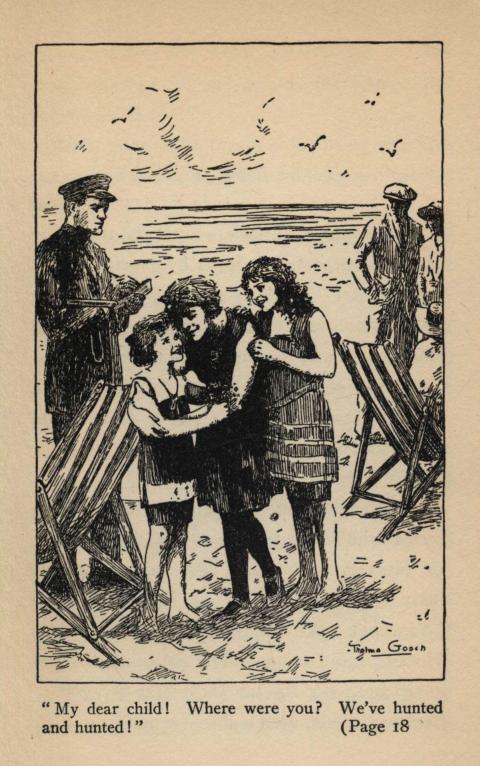
"My dear child! Where were you? We've hunted and hunted!"
"Why I was right there," answered Mary Jane, much surprised that they should have been anxious. "I stood up to shake off the sand and I saw some wild flowers back there—see 'em?" she added, pointing to the end of the bath-houses where some sand flowers bloomed on a low lying sand hill back of the beach. "And I thought, 'now I'll just get some of those and see if Alice wants 'em for her collection.' So I ran up there and there were so many—see how many kinds? And—that's all! I just picked 'em and then here I am!"
Mrs. Merrill thanked all the kind people who had helped hunt for Mary Jane and made a firm resolve (which she likely as not wouldn't keep) that next time Mary Jane was "lost" she would sit still and wait for the child to come back by herself.
For an hour Mary Jane played on the sand. They dug ditches, they "buried" each other and their mother, and finally they shook off the sand and ran to the beach for a final plunge before leaving. After they were dressed, Mary Jane led them up to the sand hill where she had found the flowers, and Alice picked a bloom or two of each kind to press and add to her collection.
Dinner never did taste so good as it did that day—surf bathing certainly makes girls hungry and they both enjoyed every bite of the good food Mrs. Bryan set before them.
"Now I think we'll all take a rest for an hour," suggested Mrs. Merrill, "and then, with some folks I met before you girlies woke up this morning, we'll drive to Portsmouth so you can see the harbor and the beautiful drive along the shore."
Promptly at three o'clock they set out, and Mary Jane thought it would take a whole book to tell all the beautiful and wonderful things they saw on that drive. The pine woods that smelled so sweet and good, the rolling golf links here and there, the glimpses of the Isle of Shoals that seemed no distance away, so clear was the air in the afternoon sunshine.
"I 'most could reach out and touch 'em!" exclaimed Mary Jane once, and it was hard to believe that the picturesque group of islands were miles away, out in the ocean.
The river at Portsmouth, dotted with boats, big and little, the view across into the state of Maine, and the beautiful grounds of a great hotel set high on the bluff overlooking the ocean, all seemed very wonderful. Everywhere were lovely gardens brilliant with bloom and grass so green and fresh, Mary Jane declared it made her want to get out and feel it, for it looked like soft velvet.
At Portsmouth they stopped at an old curiosity shop and bought an old-fashioned "knocker" for a souvenir of the drive.
"We'll put it on the door to your room," said Mrs. Merrill, "and then, when you shut the door, folks can knock before they come in. And every time you look at it, you will think of your trip to Rye Beach and to Portsmouth."
The next morning the Merrills took their ocean dip early, as they had decided to get to Boston in the afternoon instead of evening. The water was "freezing" cold, but the sun was good and warm and the dip was most refreshing as well as lots of fun.
It wasn't easy to leave Rye Beach. There was so much to do that would be fun, and so many nice people to meet and such good things to eat, that Mary Jane had to think hard about her father off home alone to make herself willing to leave so soon. But once away, she was quite happy, especially when she found that they could have their luncheon in a diner—Mary Jane would go anywhere—almost—to eat on a train!
Uncle Hal met them at the station in Boston and his smiling face assured them a surprise was in store.
"Too tired riding to do a little more?" he asked, as they walked out of the great station.
"Well," asked Mary Jane determined not to be tricked into anything, "is it a nice thing we would do, if we weren't too tired to do it?"
"Very nice, I'd say, my young lady," replied Uncle Hal.
"Then I'm not a bit tired," Mary Jane assured him.
It was a good thing that was her answer, for the surprise was ready and waiting at the station door.
"This is my sister and her two daughters, Miss Burn," said Hal as he stepped up to a waiting car, "and they say they will enjoy the ride you so kindly planned for them." Miss Burn was a charming young lady with whom Mary Jane and Alice promptly made friends, and her car was a beautiful big touring car in which the Merrills were whisked away before they quite realized what had happened to them.
Through the parks of Boston they went, out the boulevards along the north shore where the roadway borders the ocean for miles and miles. Beautiful homes flashed passed them, parks, suburbs, playgrounds, amusement places—all like a wonderful living moving picture show. Mary Jane was interested in the great shoe factories they passed in Lynn and she tried to peek into the windows and see which factory made shoes for little girls her age. Rows and rows of red brick buildings—all shoe factories Uncle Hal told her—seemed enough to make shoes for everybody in the whole country!
On they went till they could see the houses on Marblehead and the famous Marblehead lighthouse that can be seen from such a distance at night, then, back they went, mostly over a different route, toward Boston.
"Couldn't you stop at our house for a cup of tea?" invited Miss Burn, "mother would love to meet you but she didn't feel up to a ride to-day."
Mrs. Merrill said they had nothing to hurry them, so Miss Burn drove them to her pretty home on one of the tree-covered streets in Winchester.
"We'll go through the house," said Miss Burn as they left the car, "but I want you two girls to go to the garden. You'll like to see my pet goldfishes."
"Pet goldfishes!" exclaimed Mary Jane, "do you keep 'em in a bowl?"
"Wait a minute, and I'll show you where I keep them," replied Miss Burn, and she led them through the hallway of her beautiful home and out, through French doors, into the loveliest garden the girls had ever seen. It was in the middle of the house—almost—for the house went around three sides. French doors opened from the hallway, on the north, from the dining-room on the east, and from a long, low library living-room on the west, while on the south side a rose covered pergola connected the ends of the house making the garden appear to be surrounded with the house. The edge of the garden, near the house, was filled with bay trees, privet and vining roses, next, on a lower terrace, were flowers with brilliant bloom, hollyhocks, delphiniums and marigolds, while around the fountain in the center was a great bed of gorgeous roses making a mass of fragrant bloom.
"Oh!" cried Alice, "think of living here!"
"It's like a palace!" echoed Mary Jane.
"I thought you'd like it," said Miss Burn, much pleased with their frank enjoyment, "we love it. I do a lot of the work in the garden myself. I love the flowers so, and mother and I would rather be out here than anywhere else in the world."
She led them over dainty gravel paths to the center of the garden where, peering into the white fountain, the girls saw dozens of goldfish swimming about in the sunshine.
"See?" said Miss Burn, pointing into the water, "I have one silver fish—that's for luck they say," she added laughingly. "Don't you think it's better to have fish here than in a bowl on a table?"
"I think everything's better here—if you have a 'here' like this," agreed Alice. "I suppose Mary Jane feels like a princess again, now. She always feels that way when she sees something wonderful."
"'Deed I do," admitted Mary Jane who had been too busy looking around and pretending that all this was her own private palace, to talk with mere folks! "I love it here!"
"Let's go over and meet mother," suggested Miss Burn, "and see if tea is ready. Then you may walk around the garden all you like and pick as many flowers as you want to."
They found Mrs. Burn waiting for them under the rose-covered terrace, and tea was all ready but the hot water which came in a few minutes. Mary Jane was very glad that the grown folks were too busy talking to count the number of lobster salad sandwiches she ate—they were so good—even better than the nut sandwiches which were usually her favorites. After tea, the girls wandered up and down the little paths in the garden and picked a few flowers; not many, for the flowers looked so lovely there that it seemed a shame to take them away.
"Oh, dear!" exclaimed Mary Jane later as she saw her mother rise to go, "now it's going to be late and we'll have to go and—and I'd just love to stay in this garden forever and ever! I would!"
"I wish you could, dear," said Mrs. Burn, "because I like to have little girls around me—especially little girls who love flowers as you two do. But I'll tell you," she added comfortingly, "you've found the way out here now and the next time you come to Boston, which will be some time soon, let's hope, you come and see me the very first day and stay as long as ever you can."
Mary Jane promised and then she took a last glimpse at the fountain of goldfish before Miss Burn took them back to Boston and their hotel.
"When I have a house," she said as she dropped off to sleep that evening, "I'm going to have a garden just like Miss Burn's with goldfish and one silver fish and tea and lobster salad sandwiches and everything!"
THE LAST DAY IN BOSTON—AND HOME
The last morning in Boston! Mary Jane blinked at the bright sunshine that streamed in at the window and asked sleepily, "What are we going to do to-day, Mother?"
"Mother!" exclaimed Alice, suddenly wide awake, "we forgot to go to Concord! And my teacher told me surely, surely we must take that ride up through Sleepy Hollow and Concord."
"Don't you worry a minute, dear," said Mrs. Merrill, "I'm as anxious to take that ride as you are. In fact I had Hal get the seats in the automobile yesterday evening, so there would be no doubt about our being able to go this morning. I've never taken it either, you know, so we'll be seeing things together. Now everybody up and see who can beat getting dressed and ready for breakfast."
When they stepped up to the big sightseeing car, an hour and a half later, they found that Uncle Hal had bought their seats for the front row which pleased them very much. Mary Jane liked to see things without dodging the head of somebody in front, and Alice and Mrs. Merrill liked to be close to the man who tells about the historic scenes on the way, so they could ask questions and could hear everything that was said.
The car soon filled up with interested sightseers and the journey was begun.
Alice eagerly listened to all that was told and fitted it into what she knew of early American history. The old church where the lights were hung to give the signal to Paul Revere; the road he dashed across on his long journey—marked now, by a big bronze tablet which the girls got out of the car to read; the "green" where one of the early battles was fought—Alice had read all the stories and seemed to live over the scenes as she saw the famous sites.
Of course Mary Jane didn't know as much history as her sister did, but she knew something of the historical stories, as all American girls should even if they are only in first grade, and she learned more history in that two hours of riding than she would have learned in a month of reading. It didn't seem like history out of a book, it seemed like really truly—as it was.
The car turned down a long, shady road and came to a stop by a tiny wooden bridge.
"There," said the driver, "is the Concord bridge and you may get out and walk across if you like. There's no hurry."
"The Concord bridge?" exclaimed Alice, "why I thought it was a big bridge—I've heard so much about it."
"Size doesn't count for everything," laughed the driver; "it's what happens that counts."
They climbed out of the automobile and walked across the tiny bridge. It was a low, wooden foot bridge, so narrow that one had to walk carefully to pass anybody coming from the other direction. On one side was a hand rail, on the other nothing but the clear water of the little creek so close below.
The girls stood in the center of the bridge and Mrs. Merrill took their picture so Alice could show it to her teacher at school, then they sat down in the shade close by and Mrs. Merrill told Mary Jane the story that made that little bridge so famous; how the brave farmers stood there waiting—right there on the spot Mary Jane could see; how the Redcoats crept up through the darkness to the very tree (no doubt it was the very tree for its wide spreading branches and great trunk told of its old age), the very tree under which they were sitting, and then there was fired the shot "for freedom," the shot which the poet said was "heard 'round the world."
Reluctantly leaving the interesting spot that charmed them so, the Merrills climbed back into the big auto and drove away; through Concord, through Sleepy Hollow and to the house where Louisa M. Alcott had lived. There Mary Jane felt at home immediately. She saw the lilac bushes, the old trees and the quaint old house she had heard about. They went through the rooms, upstairs and down, and saw the very books and dishes and kettles and clothes that the girls in Miss Alcott's story had used and worn.
"Why they were just regular girls like we are, weren't they, Mother?" she exclaimed in surprise. "And they didn't know they were going to be in a story and everybody read about them, did they?"
"To be sure," said Mrs. Merrill, "and that's what makes them so interesting. They did all the things that real folks do, and we like to hear about such things in books."
"Wouldn't it be funny if we'd get into a story book," said Mary Jane, laughing at the ridiculous idea, "and somebody'd read about how we came to see Miss Alcott's house? I'd laugh if we did!"
"Well, you never can tell what'll happen," said Alice as they wandered out through the yard. "I expect Meg and Beth never thought of being in a book either. I wonder if they picked roses from this same old bush?" she added as she looked at a rose-bush that rambled high overhead, "it looks old enough to have been here then."
It was hard to leave the quaint old house with its interesting associations, but the honking of a horn out in front warned them that they had lingered long enough, so they hurried out to finish the drive.
"When I get back home," said Mary Jane as she snuggled down in her front seat again, "I'm going to read all about Concord and all about everything—if you'll read it to me, Mother, I am." Mrs. Merrill promised, so Mary Jane tried to look very hard at everything they saw so she could remember it a long, long time.
"Now then," said Mrs. Merrill briskly, as they got out of the auto at Copley Square, "we'll just have time to hurry up and pack our things and get our lunch before the train leaves. And we won't have a bit of time to spare, so it's a mighty good thing we haven't left anything else to do. That Wolverine leaves on time whether we are on it or not."
"Won't we have time but just only to pack and to get lunch?" asked Mary Jane disappointedly.
"Why Mary Jane!" exclaimed Mrs. Merrill, "haven't you seen enough of Boston?"
"Oh, yes," replied Mary Jane, "I've seen enough but I haven't done enough."
"What more is there to do, child?" asked Mrs. Merrill. "Seems to me you've done about everything a person could think of already."
"Yes, I guess I have," admitted Mary Jane, "but I wanted to do some of it over again. I wanted to take another ride in my swan boat, I did."
"My dear child!" exclaimed Mrs. Merrill sympathetically, "and you shall if I can get you down there. Hurry now and we'll get our packing done in a jiffy and then before we eat we'll go to the Commons and let you take a ride."
Up in their room Mary Jane helped all she could with the packing. She stuffed the tips of all the shoes, she folded hair ribbons that had been mussed and put clothes in neat piles on the bed. Alice took everything from the drawers, picked up personal belongings from the bathroom, and brought the clothes that had been hanging in the closet. With such good help Mrs. Merrill packed in a very short time, and sooner than she had supposed possible the trunk was ready to go, and they were dressed in traveling frocks ready for the journey home.
"Now a wire to Dad," she said as she took a careful look over the room to be certain that they were leaving nothing behind, "and I believe we are ready to go."
"Let's not stop for a big lunch," suggested Alice, "because we can have early dinner on the diner. Let's get sandwiches and milk some place and then let Mary Jane have two rides on the swan boats."
Mrs. Merrill telephoned Hal and he promised to call for their bags at the hotel and then to come for them at the entrance of the Commons nearest the lagoon.
A very happy little girl bought tickets for six rides and, with Alice and her mother, Mary Jane took two last blissful rides on her favorite boat.
"When I grow up to be a big lady and have a little girl of my own," she observed between rides, "I'm going to bring her to Boston and let her ride 'n ride 'n ride."
"Seems to me that's about what I am doing with my little girl," laughed Mrs. Merrill. "I believe you like the swan boats better than anything you have seen or done on the trip."
"I do," agreed Mary Jane, "unless," she added, thoughtfully, "unless eating in the garden or seeing the goldfishes or swimming or playing with John or—well, we've done a lot of nice things, Mother, but swan boats are my favorite, I guess."
Hal's taxi was chugging briskly when they reached the street and they dashed off to take their train for home.
"Now there's a whole day to ride without getting off or hurrying or anything," said Mary Jane luxuriously, as she settled herself in the comfortable sleeper and leaned back against the cushions with a deep sigh of satisfaction. "I just love riding on a train, I do, Mother."
It was fun to sit quietly and watch the towns dash by. For ten busy days Mary Jane had been the one to do the going, hurrying from one good time to another and now it seemed the best fun of all to sit still and think about all the fun she had had.
In an hour though, she began to want something to do. Alice, deep in a book, was close by, while her mother and Uncle Hal, who seemed to have an endless amount to say to each other, were just across the aisle. Should she bother them—or what should she do?
Suddenly she remembered! She had brought something for just such a time, and so busy had she been all the days in New England that she hadn't once thought of what she had carried around. She slipped her hand back of her till she touched her own little handbag that was on the seat between herself and Alice, opened it and spread out on her lap her precious paper dolls.
Mrs. Merrill, glancing across to see that her little girl was all right, saw what she was doing and said, "Press the button there between the windows, dear, and the porter will bring you a table to spread the dolls out on."
Five minutes later Mary Jane had a table all to herself and on it spread her whole paper doll family. All the time the great train sped through Massachusetts, she played with them, acting over again the Harvard Class Day parties, the tea party in Mrs. Burn's pretty garden and many other things that she herself had done on her trip.
At five-thirty they went to the diner for dinner, and Mary Jane had some good chicken and hashed-brown potatoes and apple dumplings with ice cream, before she went back to finish playing with her dolls.
"I think paper dolls are the nicest dolls for on a train, I do," she told her mother, as together they neatly tucked the dolls away for a night's rest in the handbag, "'cause they don't break and they don't take up a lot of room, and I can have them all along—every one of them."
Mr. Merrill met his family at the station the next day, and there was a happy reunion and a lot of talk about the fun they had had since they last saw him.
"But nobody asks me what I've been doing?" he exclaimed with mock grief at the first pause in the conversation.
"Oh, Daddah," cried Mary Jane, "I'm so sorry! But you see we had so much to do—graduating Uncle Hal and seeing everything, we did. Now you talk—it's your turn."
Then Mr. Merrill told his surprise. The builder who was to do their house in the woods had been able to get to work sooner than he had promised, and the house, while it wouldn't be finished for some little time yet, was well on the way.
"The roof's on," he told them, "and that's a lot, for it means we can go out there and picnic and not worry about rain. And if all goes well, we can pack our trunks and move into the shack in a very few days."
"Oh, goody!" cried Mary Jane clapping her hands gleefully, "and I'm going to make garden and keep house and hunt flowers and everything!"
* * * * * * * *