Part 1 — CHAPTER II. ANATOMY AND PHYSIOLOGY. (continued 2)
Reading edition
The worker-bees never attain a great age. Those reared in autumn may live for eight or nine months, and if in queenless stocks, where little labor is performed, even longer; while those reared in spring will wear out in three, and when most busy, will often die in from thirty to forty-five days. None of these bees survive the year through, so there is a limit to the number which may exist in a colony. As a good queen will lay, when in her best estate, three thousand eggs daily, and as the workers live from one to three months, it might seem that forty thousand was too small a figure for the number of workers. Without doubt a greater number is possible. That it is rare is not surprising, when we remember the numerous accidents and vicissitudes that must ever attend the individuals of these populous communities.
The function of the worker-bees is to do all the manual labor of the hives. They secrete the wax, which forms in small pellets (Fig, 27, a, a) under the over-lapping rings under the abdomen. I have found these wax-scales on both old and young. According to Fritz Müller, the admirable German observer, so long a traveler in South America, the bees of the genus melipona secrete the wax on the back.
The young bees build the comb, ventilate the hive, feed the larvæ and cap the cells. The older bees—for, as readily seen in Italianizing, the young bees do not go forth for the first one or two weeks—gather the honey, collect the pollen, or bee-bread, as it is generally called, bring in the propolis or bee glue, which is used to close openings, and as a cement, supply the hive with water(?), defend the hive from all improper intrusion, destroy drones when their day of grace is past, kill and arrange for replacing worthless queens, destroy inchoate queens, drones, or even workers, if circumstances demand it, and lead forth a portion of the bees when the conditions impel them to swarm.
When there are no young bees, the old bees will act as house-keepers and nurses, which they otherwise refuse to do. The young bees, on the other hand, will not go forth to glean, even though there be no old bees to do this necessary part of bee-duties. An indirect function of all the bees is to supply animal heat, as the very life of the bees require that the temperature inside the hive be maintained at a rate considerably above freezing. In the chemical processes attendant upon nutrition, much heat is generated, which, as first shown by Newport, may be considerably augmented at the pleasure of the bees, by forced respiration. The bees, too, by a rapid vibration of their wings, have the power to ventilate their hives, and thus reduce the temperature, when the weather is hot. Thus they moderate the heat of summer, and temper the cold of winter.
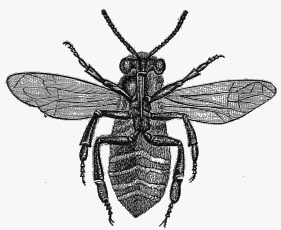
Under Surface of Bee, showing Wax between Segments.