Chapter V · THE HANDLING OF THE PLANTS (continued 2)
Reading edition
If the hotbed were high enough and broad enough to allow a man to work inside, we should have a forcing-house. Such a structure is shown in Fig. 207, upon one side of which the manure and soil are already in place. These manure-heated houses are often very efficient, and are a good make-shift until such time as the gardener can afford to put in flue or pipe heat.
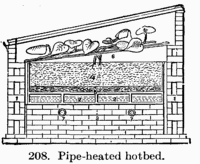
Hotbeds may be heated by means of steam or hot water. They can be piped from the heater in a dwelling-house or greenhouse. Fig. 208 shows a hotbed with two pipes, in the positions 7, 7 beneath the bed. The earth is shown at 4, and the plants (which, in this case, are vines) are growing upon a rack, at 6. There are doors in the end of the house, shown in 2, 2, which may be used for ventilation or for admitting air underneath the beds. The pipes should not be surrounded by earth, but should run through a free air space.
It would scarcely pay to put in a hot water or steam heater for the express purpose of heating hotbeds, for if such an expense were incurred, it would be better to make a forcing-house. Hotbeds may be heated, however, with hot-air flues with very good results. A home-made brick furnace may be constructed in a pit at one end of the run and underneath a shed, and the smoke and hot air, instead of being carried directly upwards, is carried through a slightly rising horizontal pipe that runs underneath the beds. For some distance from the furnace, this flue may be made of brick or unvitrified sewer pipe, but stove-pipe may be used for the greater part of the run. The chimney is ordinarily at the farther end of the run of beds. It should be high, in order to provide a good draft. If the run of beds is long, there should be a rise in the underlying pipe of at least one foot in twenty-five. The greater the rise in this pipe, the more perfect will be the draft. If the runs are not too long, the underlying pipe may return underneath the beds and enter a chimney directly over the back end of the furnace, and such a chimney, being warmed from the furnace, will ordinarily have an excellent draft. The underlying pipe should occupy a free space or pit beneath the beds, and whenever it lies near to the floor of the bed or is very hot, it should be covered with asbestos cloth. While such flue-heated hotbeds may be eminently successful with a grower or builder of experience, it may nevertheless be said, as a general statement, that whenever such trouble and expense are incurred, it is better to make a forcing-house. The subject of forcing-houses and greenhouses is not discussed in this book.
The most satisfactory material for use in hotbed and cold-frame sash is double-thick, second-quality glass; and panes twelve inches wide are ordinarily broad enough, and they suffer comparatively little in breakage. For coldframes, however, various oiled papers and waterproof cloths may be used, particularly for plants that are started little in advance of the opening of the season. When these materials are used, it is not necessary to have expensive sash, but rectangular frames are made from strips of pine seven-eighths inch thick and two and one-half inches wide, halved together at the corners and each corner reënforced by a square carriage-corner, such as is used by carriage-makers to secure the corners of buggy boxes. These corners can be bought by the pound at hardware stores.
Management of hotbeds.
Close attention is required in the management of hotbeds, to insure that they do not become too hot when the sun comes out suddenly, and to give plenty of fresh air.
Ventilation is usually effected by raising the sash at the upper end and letting it rest upon a block. Whenever the temperature is above freezing point, it is generally advisable to take the sash off part way, as shown in the central part of Fig. 199, or even to strip it off entirely, as shown in Fig. 197.
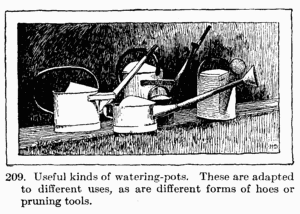
Care should be taken not to water the plants at nightfall, especially in dull and cold weather, but to give them water in the morning, when the sun will soon bring the temperature up to its normal state. Skill and judgment in watering are of the greatest importance in the management of hotbeds; but this skill comes only from thoughtful practice. The satisfaction and effectiveness of the work are greatly increased by good hose connections and good watering-pots (Fig. 209).
Some protection, other than the glass, must be given to hotbeds. They need covering on every cold night, and sometimes during the entire day in very severe weather. Very good material for covering the sash is matting, such as is used for covering floors. Old pieces of carpet may also be used. Various hotbed mattings are sold by dealers in gardeners’ supplies.
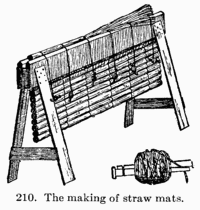
Gardeners often make mats of rye straw, although the price of good straw and the excellence of manufactured materials make this home-made matting less desirable than formerly. Such mats are thick and durable, and are rolled up in the morning, as shown in Fig. 199. There are various methods of making these straw mats, but Fig. 210 illustrates one of the best. A frame is made after the manner of a saw-horse, with a double top, and tarred or marline twine is used for securing the strands of straw. It is customary to use six runs of this warp. Twelve spools of string are provided, six hanging on either side. Some persons wind the cord upon two twenty-penny nails, as shown in the figure, these nails being held together at one end by wire which is secured in notches filed into them. The other ends of the spikes are free, and allow the string to be caught between them, thus preventing the balls from unwinding as they hang upon the frame. Two wisps of straight rye straw are secured and laid upon the frame, with the butt ends outward and the heads overlapping. Two opposite spools are then brought up, and a hard knot is tied at each point. The projecting butts of the straw are then cut off with a hatchet, and the mat is allowed to drop through to receive the next pair of wisps. In making these mats, it is essential that the rye contains no ripe grain; otherwise it attracts the mice. It is best to grow rye for this especial purpose, and to cut it before the grain is in the milk, so that the straw does not need to be threshed.
In addition to these coverings of straw or matting, it is sometimes necessary to provide board shutters to protect the beds, particularly if the plants are started very early in the season. These shutters are made of half-inch or five-eighths-inch pine lumber, and are the same size as the sash—three by six feet. They may be placed upon the sash underneath the matting, or they may be used above the matting. In some cases they are used without any matting.
In the growing of plants in hotbeds, every effort should be made to prevent the plants from growing spindling, or becoming “drawn.” To make stocky plants, it is necessary to give room to each plant, to be sure that the distance from the plants to the glass is not great, to provide not too much water in dull and cold weather, and particularly to give abundance of air.