Chapter X · THE GROWING OF THE VEGETABLE PLANTS (continued 2)
Reading edition
The ridges or hills should be prepared by plowing out a furrow 4 to 6 inches deep. Scatter manure in the furrow and plow back the soil so as to raise the center at least 6 inches above the level of the soil. On this ridge the plants are set, placing the plants well in to the leaves and about 12 to 18 inches apart in the rows, the rows being from 3 to 4 feet apart.
The after-cultivation consists in stirring the soil between the ridges; and as the vines begin to run they should be lifted frequently to prevent rooting at the joints. When the tips of the vines have been touched by frost the crop may be harvested, the tubers left to dry a few days, and stored in a dry, warm place.
To keep sweet potatoes, store in layers in barrels or boxes in dry sand, and keep them in a dry room See that all bruised or chilled potatoes are thrown out.
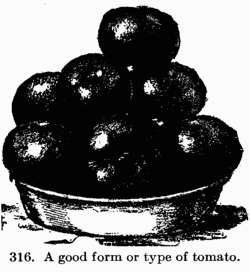
Tomato.—The tomato is an inhabitant of practically every home garden, and everybody understands its culture (Fig. 316).
The early fruits are very easily grown by starting the plants in a greenhouse, hotbed, or in shallow boxes placed in windows. A pinch of seed sown in March will give all the early plants a large family can use. When the plants have reached the height of 2 or 3 inches, they should be transplanted into 3-inch flower-pots, old berry boxes, or other receptacles, and allowed to grow slowly and stocky until time to set them out, which is from May 15 on (in New York). They should be set in rows 4 or 5 feet apart, the plants being the same distance in the rows.
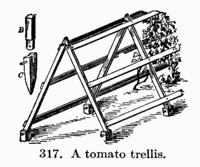
Some support should be given to keep the fruits off the ground and to hasten the ripening. A trellis of chicken-wire makes an excellent support, as does the light lath fencing that may be bought or made at home. Stout stakes, with wire strung the length of the rows, afford an excellent support. A very showy method is that of a frame made like an inverted V, which allows the fruits to hang free; with a little attention to trimming, the light reaches the fruits and ripens them perfectly (Fig. 317). This support is made by leaning together two lath frames.
The late fruits may be picked green and ripened on a shelf in the sun; or they will ripen if placed in a drawer.
One ounce of seed will be enough for from twelve to fifteen hundred plants. A little fertilizer in the hill will start the plants off quickly. The rot is less serious when the vines are kept off the ground and the rampant suckers are cut out. Varieties pass out and new ones come into notice, so that a list is of small permanent value.
Turnips and Rutabagas are little grown in home gardens; and yet a finer quality of vegetable than most persons know could be secured if these plants were raised on one’s own soil and brought fresh to the table. They are usually a fall crop, from seed sown in July and early August, although some kitchen-gardens have them from spring-sown The culture is easy.
Turnips should be grown in drills, like beets, for the early crop. The young plants will stand light frosts. Choose a rainy day for planting, if practicable. Cover the seed very lightly. Thin the young plants to 5 to 7 inches in the row. Sow every two weeks if a constant supply is desired, as turnips rapidly become hard and woody in warm summer weather. For the fall and winter crop in the North,
“On the fourteenth day of July, Sow your turnips, wet or dry.”
In many parts of the northern and middle states tradition fixes the 25th of July as the proper time for sowing flat turnips for winter use. In the middle states, turnips are sometimes sown as late as the end of August. Prepare a piece of very mellow ground, and sow the seed thinly and evenly broadcast. In spite of the old rhyme, a gentle shower will then be acceptable. These turnips are pulled after frost, the tops removed, and the roots stored in cellars or pits.
For the early crop, Purple-top Strap-leaf, Early White Flat Dutch, and Early Purple-top Milan are the favorite varieties. Yellow-fleshed sorts like Golden Ball are very fine for early table use, when well grown, but most eaters prefer white turnips in spring, although they occasionally patronize the yellow varieties in the fall. Yellow Globe is the favorite yellow fall turnip, though some persons grow yellow rutabagas and call them turnips. For late crop of white turnips, the same varieties chosen for spring sowing are also desirable.
Rutabagas are distinguished from turnips by their smooth, bluish foliage, long root, and yellow flesh. They are richer than turnips; they require the same treatment, except that the season of growth is longer. Fall-sown or summer-sown bagas should have a month the start of flat turnips.
Except the maggot (see cabbage maggot), there are no serious insects or diseases peculiar to turnips and bagas.
Watermelon.—The watermelon is shipped everywhere in such enormous quantities, and it covers so much space in the garden, that home-gardeners in the North seldom grow it. When one has room, it should be added to the kitchen-garden.
The culture is essentially that for muskmelons (which see), except that most varieties require a warmer place and longer period of growth. Give the hills a distance of 6 to 10 feet apart. Choose a warm, “quick” soil and sunny exposure. It is essential, in the North, that the plants grow rapidly and come into bloom early. One ounce of seed will plant thirty hills.
There are several white or yellow-fleshed varieties, but aside from their oddity of appearance they have little value. A good watermelon has a solid, bright red flesh, preferably with black seeds, and a strong protecting rind. Kolb Gem, Jones, Boss, Cuban Queen, and Dixie are among the best varieties. There are early varieties that will ripen in the Northern season, and make a much better melon than those secured on the market.
The so-called “citron,” with hard white flesh, used in making preserves, is a form of watermelon.