Chapter XVIII
Reading edition
VARIETIES OF GRAPES
Nature has expended her bounties in fullest measure for the vineyard. More than 2000 varieties of grapes are described in American viticultural literature, and twice as many more find mention in European treatises on the vine. Few other fruits offer the novelties given the grape in flavors, aromas, sizes, colors and uses. The vineyard, then, to fulfill commercial potentialities, should supply grapes throughout the whole season, and of the several colors and flavors and for all uses. A prime requisite for a vineyard being well-selected varieties, an assortment of all kinds and for all places in America is here described.
Actoni
(Vinifera)
Actoni is a table-grape of the Malaga type which ripens at Geneva, New York, late in October, too late for the average season in the East but worth trying in favorable locations. It is grown in California but is not a favorite sort. The following brief description is made from fruit grown at Geneva:
Clusters large, shouldered, tapering, loose; berries medium to very large, long-oval to oval, clear green yellow; flesh crisp, firm; flavor sweet; quality good.
Agawam
(Labrusca, Vinifera)
Randall, Rogers No. 15
The qualities commending Agawam are large size and attractive appearance of bunch and berry; rich, sweet aromatic flavor; vigor of vine; and capacity for self-fertilization. For a grape having its proportion of European parentage, the vine is vigorous, hardy and productive. The chief defects in fruit are a thick and rough skin, coarse, solid texture of pulp and foxy flavor. The vine is susceptible to the mildews and in many localities does not yield well. Although Agawam ripens soon after Concord, it can be kept much longer and even improves in flavor after picking. The vines prefer heavy soils, doing better on clay than on sand or gravel. This is one of the grapes grown by E. S. Rogers, Salem, Massachusetts. It was introduced as No. 15 but in 1861 was given the name it now bears.
Vine vigorous, hardy, productive. Canes thick, dark brown; nodes enlarged, flattened; internodes short; tendrils intermittent, bifid to trifid. Leaves thick; upper surface light green, dull, smooth; lower surface pale green, pubescent, flocculent; lobes lacking; terminus acute; petiolar sinus deep, narrow; lateral sinus very shallow; teeth shallow, wide. Flowers on plan of six, nearly self-fertile, open late; stamens upright.
Fruit mid-season, keeps until midwinter. Clusters medium to large, short, broad, tapering, loose; pedicel short; brush very short, pale green. Berries large, oval, dark purplish-red with thin bloom, very persistent; skin thick, tough, adherent, astringent; flesh pale green, translucent, tough, stringy, solid, foxy; good. Seeds adherent, two to five, large, long, brown.
Almeria
(Vinifera)
This is one of the varieties commonly found in eastern markets from Almeria and Malaga, Spain, although occasionally it may come from California where the variety, or similar varieties confused with it, is now grown. This sort is remarkable for its wonderful keeping qualities; it is adapted only to hot interior regions. The Almeria cultivated by the California Experiment Station is described as follows:
"Vine vigorous; leaves of medium size, round and slightly or not at all lobed, quite glabrous on both sides, teeth obtuse and alternately large and small; bunches large, loose or compact, irregular conical; berries from small to large, cylindrical, flattened on the ends, very hard and tasteless."
America
(Lincecumii, Rupestris)
The notable qualities of America are vigor of growth and health of foliage in vine, and persistence of berries, which have strongly colored red juice, high sugar-content and excellent flavor. The grapes wholly lack the foxy taste and aroma of Labrusca and the variety, therefore, offers possibilities for breeding sorts lacking the foxy flavor of Concord and Niagara. America has great resistance to heat and cold. Also, it is said to be a suitable stock upon which to graft Vinifera varieties to resist phylloxera. The vigor of the vine and the luxuriance of the foliage make it an excellent sort for arbors. America was grown by T. V. Munson, Denison, Texas, from seed of Jaeger No. 43 pollinated by a male Rupestris. It was introduced about 1892.
Vine vigorous, hardy, productive. Canes long, numerous, dark reddish-brown with heavy bloom; nodes enlarged, flattened; tendrils intermittent, long, bifid. Leaves small, thin; upper surface glossy, smooth; lower surface light green, hairy; lobes lacking or faint, terminal one acute; petiolar sinus deep and wide; teeth of average depth and width. Flowers self-sterile, usually on plan of six, open late; stamens reflexed.
Fruit mid-season or later, keeps well. Clusters large, long, broad, tapering, irregular, single-shouldered, compact; pedicel short, slender with small warts; brush short, thick with red tinge. Berries small, variable in size, round, purplish-black, glossy with purplish-red pigment, astringent; flesh dull white with faint red tinge, translucent, tender, melting, spicy, vinous, sweet; good. Seeds free, two to five, long, pointed, yellowish-brown.
Aminia
(Labrusca, Vinifera)
Aminia is one of the best early grapes, its season being with or a little after Moore Early. The grapes are of high quality and attractive appearance, but the bunches are small, variable in size, not well formed and the berries ripen unevenly. The vine is vigorous but is neither as hardy nor as productive as a commercial variety should be. In 1867 Isadora Bush, a Missourian, planted vines of Rogers No. 39 from several different sources. When these came into bearing, he distinguished three varieties. Bush selected the best of the three and, with the consent of Rogers, named it Aminia. In spite of Bush's care, there are two distinct grapes cultivated under this name.
Vine vigorous, precariously hardy, lacking in productiveness. Canes rough, long, thick, dark brown; nodes enlarged; internodes long; tendrils intermittent, long, trifid or bifid, persistent. Leaves large; upper surface dull, smooth; lower surface light green, pubescent; lobes three; terminal lobe acute; petiolar sinus deep, narrow, often closed and overlapping; basal sinus usually lacking; lateral sinus shallow, narrow; teeth shallow, wide. Flowers open in mid-season, self-sterile; stamens reflexed.
Fruit early, keeps well. Clusters small, broad, irregular, conical, sometimes with a long shoulder, loose; pedicel long with few warts; brush short, thick, brownish-red. Berries variable, round, dull black with thin bloom, persistent, firm; skin thick, tender, adherent with purplish-red pigment, astringent; flesh greenish, translucent, tender, solid, coarse, foxy; good. Seeds adherent, one to six, very large.
August Giant
(Labrusca, Vinifera)
August Giant is a hybrid between Labrusca and Vinifera in which the fruit characters are those of the latter species. In appearance and taste of berry, the variety resembles Black Hamburg. The vine is usually vigorous and, considering its parentage, is very hardy. The foliage is thick and luxuriant but subject to mildew. Vigor of vine, beauty of foliage and the quality of the fruit make the variety desirable for the amateur. It needs a long-maturing season. August Giant was grown by N. B. White, Norwood, Massachusetts, in 1861, from seed of an early, large-berried, red Labrusca pollinated by Black Hamburg.
Vine very vigorous, hardy, subject to mildew. Canes long, numerous, thick, dark brown; nodes enlarged, flattened; internodes short; tendrils continuous, long, bifid or trifid. Leaves large, thick; upper surface dark green, glossy, smooth; lower surface pale green or bronzed, pubescent; lobes three, terminal one acute; petiolar sinus deep, narrow, frequently closed and overlapping; lateral sinus shallow or a notch; teeth shallow, narrow. Flowers open in mid-season, self-sterile; stamens reflexed.
Fruit mid-season, keeps well. Clusters of average size, short, broad, irregularly tapering, single-shouldered, loose; pedicel long, thick with large warts; brush short, thick, green or with brown tinge. Berries large, oval, purplish-red or black, dull with thick bloom, firm; skin tough, adherent, astringent; flesh green, translucent, tough, stringy; good. Seeds adherent, one to four, large, blunt, light brown.
Bacchus
(Vulpina, Labrusca)
Bacchus is an offspring of Clinton which it resembles in vine and leaf characters, but surpasses in quality of fruit and in productiveness of vine. The special points of merit of the variety are: resistance to cold, resistance to phylloxera, freedom from fungi and insects, productiveness, ease of multiplication and capacity to bear grafts. Its limitations are: poor quality for table use, inability to withstand dry soils or droughts, and nonadaptability to soils containing much lime. The variety originated with J. H. Ricketts, Newburgh, New York, and was first exhibited by him in 1879.
Vine very vigorous, hardy, healthy, productive. Canes numerous, dark brown with bloom at the nodes which are enlarged and flattened; tendrils bifid. Leaves small; upper surface dark green, glossy, smooth; lower surface dull green, smooth; lobes three, terminal one acuminate; petiolar sinus shallow, narrow, sometimes overlapping; basal sinus lacking; lateral sinus shallow, wide. Flowers open early, self-sterile; stamens upright.
Fruit late, keeps well, hangs long. Clusters small, slender, uniform, cylindrical, single-shouldered, compact; pedicel short, slender with a few small warts; brush short, wine-colored. Berries small, round, black, glossy, covered with thin bloom, hang well to pedicels, firm; skin thin, adherent, contains much wine-colored pigment, slightly astringent; flesh dark green, translucent, fine-grained, tough, vinous, spicy; fair quality. Seeds clinging, one to four, many abortive, large, short and wide, plump, sharply pointed, brown.
Bakator
(Vinifera)
This is a Hungarian wine grape but its high quality and early season make it a desirable table-grape in the East. It seems to be grown but little on the Pacific slope. The following description is made from fruit grown at Geneva, New York:
Vine medium in vigor, productive. Young leaves tinged red at edges, upper surface glossy; mature leaves large, round, upper surface dull, lower surface downy; lobes five, terminal lobe acuminate; basal sinus deep, medium to narrow, closed to overlapping; lower lateral sinus deep, variable in width; upper lateral sinus deep, usually narrows; margins dentate, teeth shallow to medium deep. Flowers appear late; stamens reflexed.
Fruit ripens at Geneva the first or second week in October and keeps well in storage; clusters above medium in size, medium in length, broad, frequently double-shouldered, tapering, medium to loose; berries medium to small, oval, light red becoming dark when fully ripe, with thick bloom; skin thin, tender, adherent to the pulp; flesh greenish, juicy, tender, melting, vinous, sweet; quality very good.
Barry
(Labrusca, Vinifera)
Barry (Plate VII) is one of the best American black grapes, resembling in berry and in flavor and keeping quality of fruit its European parent, Black Hamburg. The appearance of berry and bunch is attractive. The vine is vigorous, hardy and productive but susceptible to mildew. The ripening season is just after that of Concord. For the table, for winter keeping and for the amateur, this variety may be highly recommended. Barry was dedicated in 1869, by E. S. Rogers, who originated it, to Patrick Barry, distinguished nurseryman and pomologist. The variety is grown in gardens throughout the grape regions of eastern America.
Vine vigorous, hardy, productive, susceptible to mildew. Canes long, numerous, thick, dark brown with heavy bloom; nodes flattened; shoots glabrous; tendrils intermittent, bifid or trifid. Leaves large; upper surface light green, glossy, smooth; lower surface pale green, pubescent; lobes one to three, terminus acute; petiolar sinus deep, narrow, sometimes closed and overlapping; basal sinus usually lacking; lateral sinus shallow, narrow; teeth shallow. Flowers open in mid-season, self-sterile; stamens reflexed.
Fruit mid-season, keeps well. Clusters short, very broad, tapering, often subdividing into several parts, compact; pedicel with small warts. Berries large, oval, dark purplish-black, glossy, covered with heavy bloom, adherent; skin thin, tough, adherent; flesh pale green, translucent, tender, stringy, vinous, pleasant-flavored; good. Seeds adherent, one to five, large, deeply notched, with enlarged neck, brown.
Beacon
(Lincecumii, Labrusca)
Another of T. V. Munson's hybrids is Beacon. It is not well adapted to northern regions but does very well in the South. The vine is vigorous and bears a handsome, compact mass of foliage which retains its color and freshness through drouths and heat. Munson grew Beacon in 1887 from seed of Big Berry (a variety of Lincecumii) pollinated by Concord, the vine bearing first in 1889.
Vine vigorous, precariously hardy, productive. Canes short, slender, light brown. Leaves healthy, thick, dark green, sometimes rugose; veins showing indistinctly through the slight pubescence of the lower surface. Flowers open in mid-season, on plan of five or six, self-fertile.
Fruit mid-season, keeps well. Clusters large, long, slender, cylindrical, usually high-shouldered, compact. Berries variable in size, round, purplish-black, dull with heavy bloom, firm; skin tough, adherent with a large amount of purplish-red pigment, astringent; flesh tender, aromatic, spicy, vinous, mildly subacid; good. Seeds free, large, broad, blunt, notched.
Berckmans
(Vulpina, Labrusca, Bourquiniana)
In Berckmans we have the fruit of Delaware on the vine of Clinton. The berry and bunch resemble Delaware in shape; the fruit is of the same color; bunch and berry are larger; the grapes keep longer; the flesh is firmer but the quality is not so good, the flesh lacking tenderness and richness in comparison with Delaware. The vine of Berckmans is not only more vigorous, but is less subject to mildew than that of Delaware. The vine characters are not, however, as good as those of Clinton. The variety is poorly adapted to some soils, and on these the grapes do not color well. In spite of many good qualities, Berckmans is but an amateur's grape. The name commemorates the viticultural labors of P. J. Berckmans, a contemporary and friend of A. P. Wylie, of Chester, South Carolina, who originated the variety. Berckmans came from Delaware seed fertilized by Clinton, the seed having been sown in 1868.
Vine vigorous, hardy, productive. Canes long, numerous, slender, dark brown; nodes prominent, flattened; internodes short; shoots glabrous; tendrils intermittent, long, bifid. Leaves small, thin; upper surface light green, smooth; lower surface pale green, glabrous; lobes one to three, terminal one acute; petiolar sinus shallow, wide; basal sinus usually lacking; lateral sinus shallow. Flowers open early, self-fertile; stamens upright.
Fruit ripens with Delaware. Clusters shouldered, compact, slender; pedicel long, slender with few warts; brush short, light green. Berries small, oval, Delaware-red, darker when well ripened, covered with thin bloom, persistent; skin thin, tough, adherent, astringent; flesh pale yellowish-green, translucent, fine-grained, tender, melting, vinous, sweet, sprightly; very good. Seeds free, one to four, small, broad, blunt, brown.
Black Eagle
(Labrusca, Vinifera)
The fruit of Black Eagle is of the best, but the vine lacks in vigor, hardiness and productiveness and is self-sterile. Bunch and berry are large and attractive. The season is about with Concord. Black Eagle has wholly failed as a commercial variety, and its several weaknesses prevent amateurs from growing it widely. The variety originated with Stephen W. Underhill, Croton-on-Hudson, New York, from seed of Concord pollinated by Black Prince. It fruited first in 1866.
Vine vigorous, precariously hardy, unproductive. Canes rough, thick, reddish-brown with light bloom; nodes enlarged, flattened internodes long; tendrils continuous, long, bifid or trifid. Leaves thick; upper surface dark green, glossy, smooth to rugose; lobes five; terminal lobe acute; petiolar sinus deep; lateral sinus wide, narrowing towards top, deep. Flowers open in mid-season, self-sterile; stamens reflexed.
Fruit mid-season, keeps well. Clusters large, long, tapering, single-or double-shouldered, compact; pedicel long, slender with few warts; brush short, pale green. Berries variable in size, oval, black, glossy with thick bloom; skin tender, thin, adherent with wine-colored pigment; flesh pale green, translucent, tender, vinous; good. Seeds free, one to four, large.
Black Hamburg
(Vinifera)
Black Hamburg (Plate VI) is an old European sort, long the mainstay in forcing-houses in Belgium, England and America and now popular out of doors in California. It is an excellent table-grape but, while it keeps well, its tender skin does not permit its being shipped far, especially when grown out of doors. The vine is subject to disease. The following description of the fruit is made from grapes grown in the greenhouse:
Bunches very large, often a foot in length and weighing several pounds; very broad at the shoulder and gradually tapering to a point; compact, oftentimes too compact; berries very large, round or slightly round-oval; skin rather thick; dark purple becoming black at full maturity; flesh firm, juicy, sweet and rich; quality very good or best. Season early in the forcing-house but rather late out of doors.
Black Malvoise
(Vinifera)
This variety is rather widely grown in California as an early table-grape and might be worth trying in eastern grape regions. While the fruit is not of the best quality, it is good. The following description is compiled:
Vine vigorous, healthy and productive; wood long-jointed, rather slender, light brown. Leaves of medium size, oval, evenly and deeply five-lobed; basal sinus open, with nearly parallel sides; upper surface smooth, almost glabrous; lower surface slightly tomentose on the veins and veinlets. Bunches large, loose, branching; berries large, oblong, reddish black with faint bloom; flesh firm, juicy, crisp; flavor lacking in richness and character; quality not high. Season early, keeping and shipping but poorly.
Black Morocco
(Vinifera)
Black Morocco very generally meets the approval of grape-growers on the Pacific slope without being a prime favorite for either home use or commerce. The grapes are not high enough in quality for a home vineyard, and, while they ship well, are hard to handle because of the large size and rigidity of the bunches. Another fault is that the vines are subject to root-knot. The chief asset of the variety is handsome appearance of fruit. This variety is remarkable for the number of second-crop bunches which it produces on the laterals. The following description is compiled:
Vine very vigorous, productive; canes spreading, few. Leaves medium to small, very deeply five-lobed; the younger leaves truncate at base, giving them a semi-circular outline, with long, sharp teeth alternating with very small ones; glabrous, or nearly so, on both sides. Bunches very large, short, shouldered, compact and rigid; berries very large, round, often misshapen from compression; dull purple, lacking color in the center of the bunch; flesh firm, crisp, neutral in flavor, lacking in richness; quality rather low. Season late, keeping and shipping well.
Brighton
(Labrusca, Vinifera)
Brighton (Plate VIII) is one of the few Labrusca-Vinifera hybrids which have attained prominence in commercial vineyards. It ranks as one of the leading amateur grapes in eastern America and is among the ten or twelve chief commercial sorts of this region. Its good points are: for the fruit, high quality; for the vine, vigorous growth, productiveness, adaptability to various soils and ability to withstand fungi. Brighton has two serious defects which keep it from taking higher rank as a commercial variety: it deteriorates in quality very quickly after maturity, so that it cannot be kept for more than a few days at its best, hence cannot well be shipped to distant markets; and it is self-sterile to a more marked degree than any other commonly-grown grape. Brighton is a seedling of Diana Hamburg pollinated by Concord, raised by Jacob Moore, Brighton, New York. The original vine fruited first in 1870.
Vine vigorous, hardy, productive, subject to mildew. Canes long, numerous, light brown; nodes enlarged, usually flattened; internodes long; tendrils continuous, long, bifid. Leaves large, thick; upper surface dark green, dull, smooth; lower surface pale green, pubescent; lobes three when present, terminal one acute; petiolar sinus intermediate in depth and width; lateral sinus shallow; teeth narrow. Flowers open late, self-sterile; stamens reflexed.
Fruit mid-season. Clusters large, long, broad, tapering, heavily shouldered, loose; pedicel thick; brush pale green with brown tinge, thick, short. Berries irregular, large, oval, light red, glossy with heavy bloom, persistent, soft; skin thick, tender, adherent, astringent; flesh green, transparent, tender, stringy, melting, aromatic, vinous, sweet; very good. Seeds free, one to five, broad, light brown.
Plate XXIV.—Moore Early (×3/5).
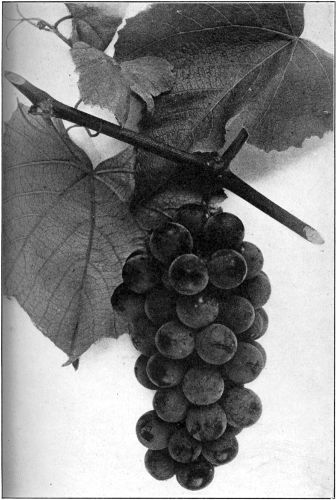
Brilliant
(Labrusca, Vinifera, Bourquiniana)
Brilliant is a cross between Lindley and Delaware. In cluster and size of berry it resembles Lindley; in color and quality of fruit it is about the same as Delaware, differing chiefly in having more astringency in the skin. Its season is about with Delaware. The grapes do not crack or shell, therefore ship well, and have very good keeping qualities, especially on the vine where they often hang for weeks. The vine is vigorous and hardy. The defects which have kept Brilliant from becoming one of the standard commercial sorts are: marked susceptibility to fungi, variability in size of cluster, unevenness in ripening and unproductiveness. In favorable situations this variety pleases the amateur, and the commercial grower often finds it profitable. The seed which produced Brilliant was planted by T. V. Munson, Denison, Texas, in 1883 and the variety was introduced in 1887.
Vine vigorous, hardy, rather unproductive. Canes long, numerous, thick, dark brown; nodes enlarged, flattened; internodes long; tendrils intermittent, long, bifid. Leaves large, thick; upper surface dark green, dull, rugose; lower surface gray-green, downy; obscurely three-lobed with terminal lobe acute; petiolar sinus deep, narrow; basal and lateral sinuses obscure and shallow when present; teeth intermediate in depth and width. Flowers open late, self-fertile; stamens upright.
Fruit early mid-season, keeps well. Clusters medium, blunt, cylindrical, usually shouldered, compact; pedicel short, thick with a few small warts; brush short, thick, pale green with reddish tinge. Berries round, dark red, glossy with thin bloom, strongly adherent, firm; skin thin, tough, adherent; flesh pale green, transparent, juicy, stringy, fine-grained, vinous, sweet; good. Seeds clinging, one to four, large, broad, elongated, plump, light brown.
Brown
(Labrusca)
In spite of many encomiums in the past quarter century, Brown has not received favorable recognition from fruit-growers. The quality is not high, the berries shatter badly, and the vine is lacking in vigor. Brown is a seedling of Isabella which came up in a yard at Newburgh, New York, about 1884.
Vine hardy, productive. Canes short, slender, dark brown; tendrils continuous. Leaves healthy, light green, glossy; veins well defined, distinctly showing through the thick bronze of the lower surface. Flowers open early, self-fertile stamens upright.
Fruit large, keeps well. Clusters small to medium, slender, cylindrical or tapering, usually single-shouldered. Berries intermediate in size, oval, black with thick bloom, drop soon after ripening; skin adherent; flesh juicy, tough, fine-grained, a little foxy, mild next the skin but tart at center; good. Seeds short, blunt, light brown.
Campbell Early
(Labrusca, Vinifera)
The meritorious qualities of Campbell Early (Plate IX) are: The grapes are high in quality when mature; free from foxiness and from acidity about the seeds; have small seeds which easily part from the flesh; are early, ripening nearly a fortnight before Concord; bunch and berry are large and handsome; and the vines are exceptionally hardy. Campbell Early falls short in not being adapted to many soils; the variety lacks productiveness; the grapes attain full color before they are ripe and are, therefore, often marketed in an unripe condition; the bunch is variable in size; and the color of the berry is not attractive. George W. Campbell, Delaware, Ohio, grew this variety from a seedling of Moore Early pollinated by a Labrusca-Vinifera hybrid. It bore first in 1892.
Vine vigorous, hardy, productive. Canes thick, dark reddish-brown, surface roughened with small warts; nodes flattened; internodes short; shoots pubescent; tendrils intermittent, short, bifid or trifid. Leaves large, thick; upper surface green, glossy; lower surface bronze, heavily pubescent; lobes three, usually entire, terminal one acute; petiolar sinus shallow, wide; basal sinus pubescent; lateral sinus wide or a notch; teeth shallow, narrow. Flowers self-fertile, open in mid-season; stamens upright.
Fruit early, keeps and ships well. Clusters usually large, long, broad, tapering, single-shouldered; pedicel short, slender with small warts; brush long, light wine color. Berries usually large, round, oval, dark purplish-black, dull with heavy bloom, persistent, firm; skin tough, thin, adherent with dark red pigment, astringent; flesh green, translucent, juicy, coarse, vinous, sweet from skin to center; good. Seeds free, one to four, light brown, often with yellow tips.
Canada
(Vulpina, Labrusca, Vinifera)
Canada is considered the most desirable hybrid between Vulpina and Vinifera. The variety shows Vinifera more than Vulpina parentage; thus, in susceptibility to fungal diseases, in shape, color and texture of foliage, in the flavor of the fruit and in the seeds, there are marked indications of Vinifera; while the vine, especially in the slenderness of its shoots and in the bunch and berry, shows Vulpina. Canada has little value as a dessert fruit but makes a very good red wine or grape-juice. Canada is a seedling of Clinton, a Labrusca-Vulpina hybrid, fertilized by Black St. Peters, a variety of Vinifera. Charles Arnold, Paris, Ontario, planted the seed which produced Canada in 1860.
Vine very vigorous, hardy, productive. Canes long, numerous, slender, ash-gray, reddish-brown at nodes with heavy bloom; nodes enlarged; internodes short; tendrils intermittent, short, trifid or bifid. Leaves thin; upper surface light green, smooth; lower surface pale green, hairy; terminal lobe acute; petiolar sinus deep, narrow; basal sinus variable in depth and width; lateral sinus deep and narrow; teeth deep and wide. Flowers self-sterile, early; stamens upright.
Fruit mid-season, keeps well. Clusters long, slender, uniform, cylindrical, compact; pedicel long, slender, smooth; brush short, light brown. Berries small, round, purplish-black, glossy with heavy bloom, persistent, firm; skin thin, tough, adherent; flesh dark green, very juicy, fine-grained, tender, spicy, pleasant vinous flavor, agreeably tart; good. Seeds free, one to three, blunt, light brown.
Canandaigua
(Labrusca, Vinifera)
Canandaigua is worth attention because of the exceptionally good keeping qualities of the grapes. The flavor is very good at picking time but seems, if anything, to improve in storage. The vine characters are those of Labrusca-Vinifera hybrids, and in these the variety is the equal of the average cultivated hybrid of these two species. The characters of the fruit, also, show plainly an admixture of Vinifera and Labrusca so combined as to make the grapes very similar to the best of such hybrids. Canandaigua is a chance seedling found by E. L. Van Wormer, Canandaigua, New York, growing among wild grapes. It was distributed about 1897.
Vine vigorous, doubtfully hardy, productive. Canes long, few, reddish-brown, faint bloom; nodes enlarged, flattened; tendrils semi-continuous, bifid, dehisce early. Leaves large, thin; upper surface light green; lower surface gray-green. Flowers sterile or sometimes partly self-fertile, open in mid-season; stamens reflexed.
Fruit late mid-season, keeps unusually well. Clusters variable in size, usually heavily single-shouldered, loose to medium. Berries large, oval, black, covered with thick bloom, persistent; skin adherent, thin, tough; flesh firm, sweet and rich; good, improves as season advances. Seeds long with enlarged neck.
Carman
(Lincecumii, Vinifera, Labrusca)
Carman is a grape having the characters of three species and hence is of interest to grape improvers. It has not become popular with growers, chiefly because the grapes ripen very late and are not of high quality. The most valuable character of the variety is that of long keeping, whether hanging on the vine or after harvesting. T. V. Munson, Denison, Texas, raised Carman from seed of a wild post-oak grape taken from the woods, pollinated with mixed pollen of Triumph and Herbemont. It was introduced in 1892.
Vine very vigorous, hardy, rather productive. Canes long, numerous, thick, reddish-brown; nodes enlarged, flattened; internodes long; tendrils intermittent, long, trifid. Leaves large, thick; upper surface light green, glossy, older leaves rugose; lower surface pale green, pubescent; terminal lobe acute; petiolar sinus deep; basal sinus absent or shallow; lateral sinus shallow when present. Flowers self-fertile or nearly so, open very late; stamens upright.
Fruit late, keeps well. Clusters variable in size, tapering, single-shouldered, compact; pedicel short, slender, smooth; brush short, slender, wine-colored. Berries small, round, slightly oblate, purplish-black, glossy, covered with heavy bloom, persistent, firm; skin thin, tough, free; flesh yellowish-green, tender, post-oak flavor, vinous, spicy; good to very good. Seeds free, one to four, small, blunt, brown.
Catawba
(Labrusca, Vinifera)
Arkansas, Catawba Tokay, Cherokee, Fancher, Keller's White, Lebanon, Lincoln, Mammoth Catawba, Mead's Seedling, Merceron, Michigan, Muncy, Omega, Rose of Tennessee, Saratoga, Singleton, Tekomah, Tokay, Virginia Amber.
Catawba has long been the standard red grape in the markets of eastern America, chiefly because the fruit keeps well and is of high quality. The vine is vigorous, hardy and productive, but the foliage and fruit are susceptible to fungi. These two faults account for the decline of Catawba in grape regions in the United States and for its growing unpopularity. In botanical characters and in adaptations and susceptibilities, the variety suggests Vinifera crossed with Labrusca. The characters of Catawba seem readily transmissible to its offspring and, besides having a number of pure-bred descendants which more or less resemble it, it is a parent of a still greater number of cross-breeds. As with Catawba, most of its progeny show Vinifera characters, as intermittent tendrils, Vinifera color of foliage, a vinous flavor wholly or nearly free from foxiness, and the susceptibilities of Labrusca-Vinifera hybrids to certain diseases and insects. Catawba was introduced by John Adlum, District of Columbia, about 1823. Adlum secured cuttings from a Mrs. Scholl, Clarksburgh, Montgomery County, Maryland, in the spring of 1819. Its further history is not known.
Vine vigorous, hardy, productive. Canes numerous, thick, dark brown; nodes enlarged; tendrils continuous, bifid or trifid. Leaves large; upper surface light green, dull, smooth; lower surface grayish-white, heavily pubescent; lobes sometimes three, terminal one acute; petiolar sinus deep, narrow; basal sinus often lacking; lateral sinus narrow; teeth shallow, narrow. Flowers self-fertile, open late, stamens upright.
Fruit late, keeps well. Clusters large, long, broad, tapering, single-or sometimes double-shouldered, loose; pedicel with a few inconspicuous warts; brush short, pale green. Berries of medium size, oval, dull purplish-red with thick bloom, firm; skin thick, adherent, astringent; flesh green, translucent, juicy, fine-grained, vinous, sprightly, sweet and rich; very good. Seeds free, frequently abortive, two, broad-necked, distinctly notched, blunt, brown.
Champion
(Labrusca)
Beaconsfield, Early Champion, Talman's Seedling
Champion is a favorite early grape with some growers, although the poor quality of the fruit should have driven it from cultivation long ago. The characters which have kept it in the market are earliness, good shipping qualities, attractive appearance of fruit, and a vigorous, productive, hardy vine. The hardiness of the vine and the short season of fruit development make it a good variety for northern climates. This grape is best in appearance of fruit, in quality and in the quantity produced, on light sandy soils. The origin of Champion is unknown. It was first grown about 1870 in New York.
Vine very vigorous, hardy and productive. Canes of average size, dark brown; nodes enlarged, flattened; internodes short; shoots pubescent; tendrils continuous, long, bifid. Leaves large; upper surface dark green, dull, rugose; lower surface dull gray, downy; lobes usually three, often obscurely five, terminal one acute; petiolar sinus deep; teeth shallow. Flowers self-fertile, early; stamens upright.
Fruit early, three weeks before Concord, season short. Clusters medium in size, blunt, cylindrical, usually not shouldered, compact; pedicel short with inconspicuous warts; brush white tinged with bronze. Berries medium in size, round, dull black covered with heavy bloom, soft; skin thick, tender, adherent, astringent; flesh light green, translucent, juicy, fine-grained, tender, foxy; poor in quality. Seeds adherent, one to five, broad, long, blunt, light brown.
Chasselas Golden
(Vinifera)
Chasselas Dore, Fontainebleau, Sweetwater
Several qualities have made Chasselas Golden a favorite grape wherever it can be grown. The variety is adapted to widely differing environments; the season of ripening is early; while not choicely high, the quality of the grapes is good and they are beautiful, clear green tinged with beautiful golden bronze where exposed to the sun. Chasselas Golden is a popular variety on the Pacific slope and should be one of the first Viniferas to be tried in the East. The following description was made from fruit grown at Geneva, New York:
Vine medium in vigor, very productive; buds open in mid-season. Young leaves tinged with red on both upper and lower surfaces, thinly pubescent to glabrous; mature leaves medium to above in size, slightly cordate; upper surface glabrous, lower surface slightly pubescent along the veins; lobes five in number, terminal lobe acuminate; basal sinus broad and rather deep; lower lateral sinus variable, usually broad and sometimes deep; upper lateral sinus broad and frequently deep; teeth large, obtuse to rounded. Flowers late; stamens upright.
Fruit ripens early and keeps well in storage; clusters large, long, broad, tapering, sometimes with a single shoulder, compactness medium; berries medium to above, slightly oval, pale green to clear yellow, with thin bloom; skin thin, tough, adherent, slightly astringent; flesh greenish, translucent, firm, juicy, tender, sweet; good.
Chasselas Rose
(Vinifera)
Chasselas Rose is very similar to Chasselas Golden, differing chiefly in smaller bunch and berry and slightly different flavor which is possibly better. It is a standard sort in California and should be planted in the East where the culture of Viniferas is attempted. The description is made from fruit grown at Geneva, New York:
Vine of medium vigor, productive. Opening leaves tinged with red on both surfaces, mature leaves small, round; upper surface medium green, somewhat dull, smooth; lower surface glabrous; lobes three; basal sinus medium in depth and of variable width; lateral sinus deep, narrow; teeth shallow, wide, dentate. Flowers appear late; stamens upright.
Fruit ripens the second week in October and is a good keeper though it loses its flavor in storage; clusters above and below medium, long, tapering to cylindrical, compact; berries medium in size, roundish-oval, light red changed to violet-red by the bloom; skin thin, astringent, juicy, tender, sweet, mild; quality good.
Chautauqua
(Labrusca)
In appearance of fruit, Chautauqua is very similar to Concord, its parent, but the grapes ripen a few days earlier and are of better quality, although they do not differ in these respects sufficiently to make the variety much more than an easily recognized strain of Concord. Chautauqua is a volunteer seedling of Concord, found near Brocton, New York, by H. T. Bashtite about 1890.
Vine vigorous, doubtfully hardy, unproductive. Canes long, thick, cylindrical; internodes long; tendrils continuous, trifid. Leaves large, irregularly round, dark green; upper surface dark green; lower surface tinged with bronze; leaf entire or faintly three-lobed. Flowers semi-fertile, open in mid-season or earlier; stamens upright.
Fruit early in mid-season. Clusters medium to large, broad, sometimes single-shouldered, compact. Berries large, round or slightly oval, purplish-black with abundant bloom, shatter badly; skin thin, very astringent; flesh tough, vinous, sweet at skin, acid at center; good to very good. Seeds few, free, broad, plump.
Clevener
(Vulpina, Labrusca)
This variety has long been grown in New Jersey and New York, and in both states is highly esteemed as a wine-grape. The fruit is remarkable in coloring very early and in ripening late. The vine is hardy, very vigorous, succeeds in various soils, and since it bears grafts well is an excellent sort upon which to graft varieties not thriving on their own roots. Clevener is self-sterile and must be planted with some other variety to set fruit well. In spite of its good qualities, Clevener is hardly holding its own in commercial vineyards, and it is not a desirable fruit for the amateur who wants a table-grape. Clevener has been raised in the vicinity of Egg Harbor, New Jersey, since about 1870, but its place and time of origin are unknown.
Vine a rampant grower, hardy, productive. Canes long, numerous, thick, dark reddish-brown with heavy bloom; nodes enlarged; tendrils continuous, bifid. Leaves unusually large, dark green with well-defined ribs showing through the thin pubescence of the under surface; lobes wanting or faint; teeth deep, wide. Flowers self-sterile, open very early; stamens reflexed.
Fruit late, keeps well. Clusters do not always fill well, small, short, slender, irregularly tapering, often with a single shoulder. Berries small, round or slightly flattened, black, glossy, covered with heavy bloom, persistent, firm; skin tough, thin, inclined to crack, adherent with much purplish-red pigment; flesh reddish-green, juicy, tender, soft, fine-grained, aromatic, spicy; good. Seeds free, notched, sharp-pointed, dark brown.
Clinton
(Vulpina, Labrusca)
Worthington
Clinton (Plate X) came into prominence because of vigor, hardiness, fruitfulness and immunity to phylloxera. A serious defect is that the vines bloom so early that the blossoms are often caught by late frosts in northern climates. Other defects are: the fruit is small and sour, and the seeds and skins prominent. The fruit colors early in the season but does not ripen until late, a slight touch of frost improving the flavor. Clinton bears grafts well, making a quick and firm union with Labrusca and Vinifera, and the vines are easily propagated from cuttings. This variety has been used widely in grape-breeding, and its blood can be traced in many valuable varieties. The offspring of Clinton are usually very hardy, and this, taken with its other desirable characters, makes it an exceptionally good starting-point for breeding grapes for northern latitudes. Clinton is an old sort, the Worthington, known as early as 1815, renamed; it began to attract attention about 1840.
Vine vigorous, hardy, healthy, productive. Canes long, numerous, slender, reddish-brown; nodes enlarged, flattened; shoots smooth; tendrils intermittent, sometimes continuous, bifid. Leaves hang until late in the season, small, thin; upper surface dark green, smooth; lower surface pale green, glabrous; petiolar sinus deep, narrow, urn-shaped; basal and lateral sinuses shallow; teeth wide. Flowers self-fertile, open early; stamens upright.
Fruit mid-season. Clusters small, slender, cylindrical, uniform, single-shouldered, compact; pedicel short, very slender, smooth; brush tinged with red. Berries small, round, oval, purplish-black, glossy, covered with thick bloom, adherent, firm; skin very thin, tough, free from pulp with much wine-colored pigment, astringent; flesh dark green, juicy, fine-grained, tough, solid, spicy, sour, vinous. Seeds adherent, two, short, blunt, brownish.
Plate XXV.—Muscat Hamburg (×2/3).
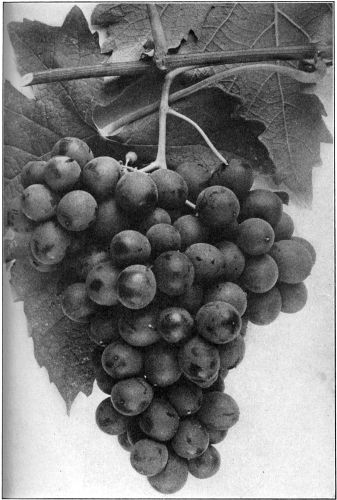
Colerain
(Labrusca)
This is one of the numerous white seedlings of Concord and one of the few with sufficient merit to be kept in cultivation. The vine has the characteristic foliage and habit of growth of its parent, but the fruit is earlier by a week, is of much higher quality and lacks the foxiness of most Labruscas. The grapes are sprightly and vinous, and neither seeds nor skin are as objectionable as in the parent. The fruit hangs to the vine and keeps well, but owing to tender pulp does not ship well. The variety is unproductive in some localities. Colerain is worthy a place in home vineyards. David Bundy, Colerain, Ohio, grew this variety from seed of Concord planted in 1880.
Vine vigorous, hardy, healthy, unproductive. Canes slender, dark reddish-brown; nodes flattened; internodes short, bifid. Leaves thick; upper surface light green, dull, smooth; lower surface bronze, downy; leaf not lobed, terminus acute; petiolar sinus wide; basal and lateral sinus very shallow when present; teeth shallow. Flowers self-fertile, opening in mid-season; stamens upright.
Fruit early. Clusters medium in size and length, slender, blunt, tapering, irregular, strongly shouldered, compact; pedicel slender, smooth; brush green. Berries round, light green, glossy with thin bloom, persistent; skin unusually thin, tender, adherent, unpigmented, astringent; flesh pale green, translucent, juicy, fine-grained, tender, soft, vinous, sweet; good. Seeds free, one to three, small, broad, notched, short, plump, brown.
Columbian Imperial
(Labrusca, Vulpina)
Columbian, Jumbo
Columbian Imperial is a Labrusca-Vulpina hybrid chiefly remarkable for the great size of its reddish-black berries, although the vine is so exceptionally healthy and vigorous as to give it prominence for these characters as well. The variety has remarkably thick leathery leaves which seem almost proof against either insects or fungi. The quality of the fruit, however, is inferior, and the small clusters vary in number of berries and these shell easily. The only value of the variety is for exhibition purposes and for breeding to secure the desirable characters named. The parentage of Columbian Imperial is unknown. It originated with J. S. McKinley, Orient, Ohio, in 1885.
Vine vigorous, hardy, healthy, unproductive. Canes long, numerous, thick, dark reddish-brown, heavily pubescent, spiny; nodes prominent; internodes short; tendrils continuous, long, bifid. Leaves green, very thick; lower surface pale green shading into bronze on older leaves with little pubescence; lobes three, indistinct; teeth sharp, shallow, wide. Flowers self-fertile; stamens upright.
Fruit late. Clusters medium in size, sometimes shouldered; peduncle slender; pedicel long; brush long, slender, green. Berries very large, round, slightly oval, dull reddish-black with faint bloom, firm; skin thick, tough, unpigmented; flesh juicy, tough, sweet at the skin but acid at center; fair in quality. Seeds adherent, large, plump, broad, blunt.
Concord
(Labrusca)
Concord (Plate XI) is the most widely known of the grapes of this continent, and with its offspring, pure-bred and cross-bred, furnishes 75 per cent of the grapes of eastern America. The preëminently meritorious character of Concord is that it adapts itself to varying conditions; thus, Concord is grown with profit in every grape-growing state in the Union and to an extent not possible with any other variety. A second character which commends Concord is fruitfulness—the vine bears large crops year in and year out. Added to these points of superiority, are: hardiness; ability to withstand the ravages of diseases and insects; comparative earliness; certainty of maturity in northern regions; and fair size and handsome appearance of bunch and berry. Concord also blossoms late in the spring and does not suffer often from spring frosts, nor is the fruit often injured by late frosts. The crop hangs well on the vine.
The variety is not, however, without faults: the quality is not high, the grapes lacking richness, delicacy of flavor and aroma, and having a foxy taste disagreeable to many; the seeds and skin are objectionable, the seeds being large and abundant and difficult to separate from the flesh, and the skin being tough and unpleasantly astringent; the grapes do not keep nor ship well and rapidly lose flavor after ripening; the skin cracks and the berries shell from the stems after picking; and the vine is but slightly resistant to phylloxera. While Concord is grown in the South, it is essentially a northern grape, becoming susceptible to fungi in southern climates and suffering from phylloxera in dry, warm soils.
The botanical characters of Concord indicate that it is a pure-bred Labrusca. Seeds of a wild grape were planted in the fall of 1843 by E. W. Bull, Concord, Massachusetts, plants from which fruited in 1849. One of these seedlings was named Concord.
Vine vigorous, hardy, healthy, productive. Canes long, thick, dark reddish-brown; nodes enlarged, flattened; internodes long; shoots pubescent; tendrils continuous, long, bifid, sometimes trifid. Leaves large, thick; upper surface dark green, glossy, smooth; lower surface light bronze, heavily pubescent; lobes three when present, terminal one acute; petiolar sinus variable; basal sinus usually lacking; lateral sinus obscure and frequently notched; teeth shallow, narrow. Flowers self-fertile, open in mid-season; stamens upright.
Fruit mid-season, keeps from one to two months. Clusters uniform, large, wide, broadly tapering, usually single-shouldered, sometimes double-shouldered, compact; pedicel thick, smooth; brush pale green. Berries large, round, glossy, black with heavy bloom, firm; skin tough, adherent with a small amount of wine-colored pigment, astringent; flesh pale green, translucent, juicy, fine-grained, tough, solid, foxy; good. Seeds adherent, one to four, large, broad, distinctly notched, plump, blunt, brownish.
Cottage
(Labrusca)
In vine and fruit, Cottage resembles its parent, Concord, having, however, remarkably large, thick, leathery leaves. It is noted also for its strong, branching root system and canes so rough as to be almost spiny. The fruit is better in quality than that of its parent, having less foxiness and a richer, more delicate flavor. The crop ripens from one to two weeks earlier than Concord. The good qualities of the variety are offset by comparative unproductiveness and unevenness in ripening. Cottage is recommended as an early grape of the Concord type for the garden. This variety was grown from seed of Concord by E. W. Bull, Concord, Massachusetts. It was introduced in 1869.
Vine vigorous, healthy, hardy. Canes rough, hairy, long, numerous, dark brown; nodes enlarged; shoots very pubescent; tendrils continuous, bifid. Leaves large, thick; upper surface dark green, glossy, smooth or rugose; lower surface tinged with bronze, pubescent; leaf entire with terminal acute; petiolar sinus deep and wide; teeth shallow, wide. Flowers self-fertile, open early; stamens upright.
Fruit does not keep well. Clusters of medium size, broad, cylindrical, sometimes single-shouldered, compact; pedicel short, thick with a few small warts; brush dark red. Berries of medium size, round, dull black with heavy bloom, drop badly from pedicel, firm; skin thick, tender, adherent with dark purplish-red pigment, astringent; flesh juicy, tough, solid, foxy; good. Seeds free, one to four, large, broad, blunt, light brown.
Creveling
(Labrusca, Vinifera)
Bloom, Bloomburg, Catawissa, Columbia Bloom
Creveling was long a favorite black grape for the garden, where, if planted in good soil, it produces fine clusters of large, handsome, very good grapes. Under any but the best of care, however, the vine is unproductive and sets loose, straggling bunches. The variety is markedly self-sterile. The origin of Creveling is uncertain. It was introduced about 1857 by F. F. Merceron, Catawissa, Pennsylvania.
Vine vigorous, not hardy, often unproductive. Canes long, numerous, thick, reddish-brown; nodes enlarged, flattened; internodes long; shoots glabrous; tendrils continuous, long, trifid or bifid. Leaves large, thick; upper surface dark green, dull, rugose; lower surface pale green, pubescent; lobes three, or obscurely five, terminal one acute; petiolar sinus deep, closed, overlapping; basal sinus very shallow; lateral sinus shallow, narrow; teeth shallow. Flowers on plan of six, self-sterile, open in mid-season; stamens reflexed.
Fruit early, does not keep well. Clusters long, broad, irregularly tapering, single-shouldered, the shoulder often connected to the cluster by a long stem, loose; brush thick, dark wine-color. Berries large, oval, dull black, covered with heavy bloom, persistent, firm; skin thick, tough, adherent with wine-colored pigment, astringent; flesh pale green, translucent, juicy, stringy, tender, coarse, foxy; good. Seeds free, one to five, broad, notched, blunt, light brown.
Croton
(Vinifera, Labrusca, Bourquiniana)
The fruit of Croton is a feast both to the eye and to the palate. Unfortunately the vine is difficult to grow, being adapted to but few soils and proving unfruitful, weak in growth, precariously tender and subject to mildew and rot in unfavorable situations. The grapes have a delicate, sweet Vinifera flavor with melting flesh which readily separates from the few seeds. The crop hangs on the vines until frost and keeps well into the winter. In spite of high quality of fruit, Croton has never become widely distributed, wholly failing as a commercial variety. It originated with S. W. Underhill, Croton Point, New York, from a seed of Delaware pollinated by a European grape. Fruits were first exhibited in 1868.
Vine vigorous, tender, productive. Canes long, numerous, thick, dark reddish-brown; nodes enlarged; internodes short; shoots glabrous; tendrils intermittent, long, bifid. Leaves of medium size, hang late; upper surface light green, dull, smooth; lower surface pale green, pubescent; lobes five, terminal one blunt; basal sinus narrow; lateral sinus deep and narrow; petiolar sinus narrow, often closed and overlapping; teeth shallow, wide. Flowers self-fertile, open late; stamens upright.
Fruit mid-season, keeps well. Clusters uniform, very large, long, slender, irregularly tapering with heavy shoulder, very loose; pedicel long, thick with inconspicuous warts; brush green. Berries irregular in size, round-elongated, yellowish-green with thin bloom, persistent, soft; skin thin, tough, adherent, unpigmented; flesh green, transparent, very juicy, melting, vinous, pleasant, agreeably sweet; very good. Seeds free, one to three, elongated, notched, sharply pointed.
Cunningham
(Bourquiniana)
Long, Prince Edward
Cunningham is cultivated very little in America, but in France, at one time, was one of the best-known grapes, both as a direct producer and as a stock for European varieties. It was much sought for by the French as a stock for large Vinifera cions, the size of the vine giving an opportunity for making a good graft. In the South, where the variety originated, Cunningham is not largely grown, as there are several other varieties of its type superior in fruit and vine. The vine is a capricious grower and is particular as to soil and climate. The grapes make a deep yellow wine of a very good quality but have little value as table-grapes. Cunningham originated with Jacob Cunningham, Prince Edward County, Virginia, about 1812.
Vine vigorous, spreading, productive. Canes large, long with stiff reddish hairs at base; shoots showing considerable bloom; tendrils intermittent, usually trifid. Leaves large, thick, round, entire or lobed; smooth and dark green above, yellowish green below, pubescent; petiolar sinus narrow, frequently overlapping.
Clusters of medium size, long, sometimes shouldered, very compact; pedicel long, slender with small warts; brush short, light brown. Berries small, purplish-black with thin bloom; skin thin, tough with much underlying pigment; flesh tender, juicy, sprightly; quality poor or but fair. Seeds two to five, oval.
Cynthiana
(Æstivalis, Labrusca)
Arkansas, Red River
There is controversy as to whether this variety differs from Norton. The two ripen at separate times, and the fruits differ a little so that they must be considered as distinct. Cynthiana is particular as to soil and location, preferring sandy loams and does not thrive on clays or limestones. While very resistant to phylloxera, this variety is not much used as a resistant stock because it is not easily propagated. The vines are resistant to mildew, black-rot, and anthracnose and are strong, vigorous growers. The cycle of vegetation for Cynthiana is long, the buds bursting forth early and the fruit maturing very late. The variety has no value as a table-grape but in the South is one of the best grapes for red wine. No doubt it will prove one of the best southern sorts for grape-juice. Cynthiana was received about 1850 by Prince, of Flushing, Long Island, from Arkansas, where it was found growing in the woods.
Vine vigorous, hardy, healthy, productive. Canes medium in length, numerous, reddish-brown with thick bloom; nodes enlarged; internodes short; shoots glabrous; tendrils intermittent or continuous, bifid. Leaves thick, firm; upper surface dark green, dull, rugose; lower surface tinged with blue, faintly pubescent, cobwebby; lobes variable in number, terminal one acute; petiolar sinus deep, narrow, closed, sometimes overlapping; basal sinus shallow; lateral sinus shallow, narrow; teeth shallow; stamens upright.
Fruit very late, keeps well. Clusters medium to small, long, tapering, often single-shouldered, compact; pedicel short, slender, with numerous warts; brush short, thick, wine-colored. Berries small, round, black, covered with heavy bloom, persistent, firm; skin thin, tough, adherent with purple pigment, astringent; flesh dark green, translucent, juicy, tough, firm, spicy, tart; poor in quality. Seeds adherent, one to six, small, short, blunt, dark brown.
Delaware
(Labrusca, Bourquiniana, Vinifera)
French Grape, Gray Delaware, Ladies' Choice, Powell, Ruff
Delaware (Plate VII) is used wherever American grapes are grown as the standard to gauge the quality of other grapes. Added to high quality in fruit, the variety withstands climatic conditions to which all but the most hardy varieties succumb, is adapted to many soils and conditions, and bears under most situations an abundant crop. These qualities make it, next to Concord, the most popular grape for garden and vineyard now grown in the United States. Besides the qualities named, the grapes mature sufficiently early to make the crop certain, are attractive in appearance, keep and ship well and are more immune than other commercial varieties to black-rot. Faults of the variety are: small vine, slow growth, susceptibility to mildew, capriciousness in certain soils and small berries. The first two faults make it necessary to plant the vines more closely than those of other commercial varieties. Delaware succeeds best in deep, rich, well-drained, warm soils, but even on these it must have good cultivation, close pruning and the crop must be thinned.
Delaware is grown North and South, westward to the Rocky Mountains. It is now proving profitable in many southern locations as an early grape to ship to northern markets. It is an especially desirable grape to cultivate in small gardens because of its delicious, handsome fruit, its compact habit of growth and its ample and lustrous green, delicately formed leaves which make it one of the most ornamental of the grapes. Delaware can be traced to the garden of Paul H. Provost, Frenchtown, New Jersey, where it was growing early in the nineteenth century, and from whence it was taken to Delaware, Ohio, in 1849 and from there distributed to fruit-growers.
Vine weak, hardy, productive. Canes short, numerous, slender, dark brown; nodes enlarged; internodes short; tendrils intermittent, short, bifid. Leaves small; upper surface dark green, dull, smooth; lower surface pale green, pubescent; lobes three to five in number, terminal one acute; petiolar sinus narrow; basal sinus narrow and shallow when present; lateral sinus deep, narrow; teeth shallow. Flowers self-fertile, open late; stamens upright.
Fruit early, keeps well. Clusters small, slender, blunt, cylindrical, regular, shouldered, compact; pedicel short, slender, smooth; brush light brown. Berries uniform in size and shape, small, round, light red, covered with thin bloom, persistent, firm; skin thin, tough, adherent, unpigmented, astringent; flesh light green, translucent, juicy, tender, aromatic, vinous, refreshing, sweet; best in quality. Seeds free, one to four, broad, notched, short, blunt, light brown.
Diamond
(Labrusca, Vinifera)
Few other grapes surpass Diamond in quality and beauty of fruit. When to its desirable fruit characters are added hardiness, productiveness and vigor of vine, the variety is surpassed by no other green grape. Diamond is a diluted hybrid between Labrusca and Vinifera and the touch of the exotic grape is just sufficient to give the fruit the richness in flavor of the Old World grape and not overcome the refreshing sprightliness of the native fox-grapes. The Vinifera characters are wholly recessive in vine and foliage, the plant resembling closely its American parent, Concord. Diamond is well established North and South and can be grown in as great a range of latitude as Concord. Jacob Moore, Brighton, New York, grew Diamond about 1870 from Concord seed fertilized by Iona.
Vine vigorous, hardy, productive. Canes short, brown with a slight red tinge; nodes enlarged; internodes short; tendrils intermittent, bifid. Leaves thick; upper surface light green, dull, smooth; lower surface light bronze, downy; lobes three in number, indistinct; petiolar sinus very shallow; teeth shallow. Flowers self-fertile, open early; stamens upright.
Fruit early, keeps well. Clusters medium to short, broad, blunt, cylindrical, often single-shouldered, compact; pedicel short, thick with a few inconspicuous warts; brush slender, pale green. Berries large, ovate, green with a tinge of yellow, glossy, covered with thin bloom, persistent, firm; skin thin, tough, adherent, astringent; flesh pale green, transparent, juicy, tender, melting, fine-grained, aromatic, sprightly; very good. Seeds free, one to four, broad and long, sharp-pointed, yellowish-brown.
Diana
(Labrusca, Vinifera)
Diana (Plate XII) is a seedling of Catawba to which its fruit bears strong resemblance, differing chiefly in having lighter color, in being less pulpy and more juicy. The flavor resembles that of Catawba but has less of the wild taste. The chief point of superiority of Diana over Catawba is in earliness, the crop ripening ten days sooner, making possible its culture far to the north. The defects of Diana are: the vine is tender in cold winters; the grapes ripen unevenly; the berries and foliage are susceptible to fungi; and the vine is a shy bearer. Diana demands poor, dry, gravelly soil without much humus or nitrogen. On clays, loams or rich soils, the vines make a rank growth, and the fruits are few, late and of poor quality. The vine needs to be long pruned and to have all surplus bunches removed, leaving a small crop to mature. Diana is a satisfactory grape for the amateur, and where it does especially well proves profitable for the local market. Mrs. Diana Crehore, Milton, Massachusetts, grew Diana from seed of Catawba, planted about 1834.
Vine vigorous, doubtfully hardy, often unproductive. Canes pubescent, long, reddish-brown, covered with thin bloom; nodes enlarged, flattened; internodes long; tendrils intermittent, long, bifid. Leaves large, thick; upper surface light green, heavily pubescent; lobes three to five, terminal one acute; petiolar sinus deep, wide, often closed and overlapping; basal sinus shallow; lateral sinus narrow; teeth shallow. Flowers self-fertile, open in mid-season; stamens upright.
Fruit late, keeps well. Clusters large, broad, tapering, occasionally shouldered, compact; pedicel covered with small warts; brush slender, pale green. Berries medium in size, slightly ovate, light red covered with thin bloom, persistent, firm; skin thick, tough, slightly adherent; flesh pale green, translucent, juicy, tough, fine-grained, vinous, good. Seeds adherent, one to three, light brown.
Plate XXVI.—Niagara (×2/3).
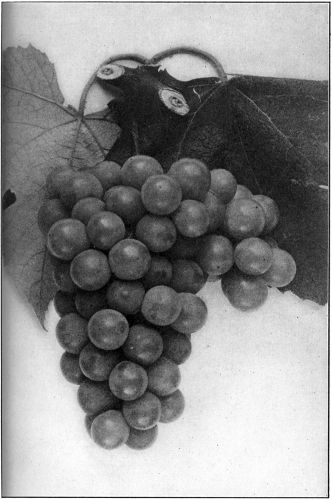
Downing
(Vinifera, Æstivalis, Labrusca)
Downing is well worthy a place in the garden because of the high quality, handsome appearance and good keeping qualities of the grapes. Added to these qualities of the fruits are fair vigor and health of vine. When grown as far north as New York, the vine should be laid down in the winter or receive other protection. In most seasons, unremitting warfare must be kept up to check mildew. In appearance of bunch and berry, Downing is distinct, the clusters being large and well-formed and the berries having the oval shape of a Malaga. The flesh, also, shows Vitis vinifera in texture and quality, while neither seeds nor skins are as objectionable as in pure-bred American varieties. J. H. Ricketts, Newburgh, New York, first grew Downing about 1865.
Vine tender to cold, unproductive. Canes short, few, slender, dark green with an ash-gray tinge, surface covered with thin bloom, often roughened with a few small warts; nodes much enlarged, strongly flattened; internodes short; tendrils intermittent, bifid or trifid. Leaves small, round, thick; upper surface dark green, glossy, rugose; lower surface dark green, glabrous; lobes one to five, terminal lobe acute; petiolar sinus narrow, closed and overlapping; basal sinus shallow and narrow when present; lateral sinus shallow, narrow; teeth wide, deep. Flowers open late; stamens upright.
Fruit late, keeps until spring. Clusters large, long, slender, cylindrical, sometimes loosely shouldered; pedicel slender, covered with numerous warts; brush long, slender, green. Berries large, markedly oval, dark purplish-black, glossy, covered with light bloom, strongly persistent, firm; skin thick, tender, adherent; flesh green with a yellow tinge, translucent, very juicy, tender, fine-grained, vinous, mild; very good in quality. Seeds free, one to three, notched, long, brown.
Dracut Amber
(Labrusca)
Dracut Amber is representative of the red type of Labrusca. The fruit has no particular merit, its thick skin, coarse pulp, seeds and foxy taste all being objectionable. However, the vine is very hardy, productive, and ripens its fruit early so that this variety becomes valuable in locations where a vigorous, hardy, early grape is wanted. Asa Clement, Dracut, Massachusetts grew Dracut Amber from seed planted about 1855.
Vine vigorous, hardy, productive. Canes long, numerous, dark brown; nodes enlarged, flattened; tendrils continuous, long, bifid or trifid. Leaves large, thick; upper surface dark green, dull, smooth; lower surface pale green, cobwebby; lobes three to five with terminal one obtuse; petiolar sinus deep, narrow; basal sinus shallow, wide; teeth shallow. Flowers on plan of six, semi-fertile, mid-season.
Fruit early, season short. Clusters short, broad, cylindrical, irregular, rarely shouldered, compact; pedicel short, covered with warts; brush long, light yellowish-green. Berries medium to large, oval, dull pale red or dark amber, covered with thin bloom, soft; skin very thick, tender, adherent, astringent; flesh green, translucent, juicy, tough, very foxy; inferior in quality. Seeds adherent, two to five, large, broad, light brown.
Dutchess
(Vinifera, Labrusca, Bourquiniana? Æstivalis?)
Dutchess (Plate XIII) is not grown largely in commercial vineyards because of several faults, as: the vine is tender to cold; the berries do not ripen evenly; berries and foliage are susceptible to fungi; and in soils to which it is not adapted, berries and bunches are small. In spite of these defects, Dutchess should not be discarded by the grape-lover, for there are few grapes of higher quality. The grapes are sweet and rich, yet do not cloy the appetite; although of but medium size, they are attractive, being a beautiful amber color with distinctive dots; the flesh is translucent, sparkling, fine-grained and tender; the seeds are small, few and part readily from the pulp; the skin is thin, yet tough enough for good keeping; and the bunches are large and compact when well grown. The variety is self-fertile and, therefore, desirable when only a few vines are wanted. The clusters are especially fine when bagged. A. J. Caywood, Marlboro, New York, grew Dutchess from seed of a white Concord seedling pollinated by mixed pollen of Delaware and Walter. The seed was planted in 1868.
Vine vigorous, an uncertain bearer. Canes dark brown with light bloom, surface roughened; nodes enlarged, flattened; internodes short; tendrils intermittent, short, bifid or trifid. Leaves irregular in outline; upper surface pale green, pubescent; leaf entire with terminus acute; petiolar sinus narrow; basal sinus shallow when present; lateral sinus medium in depth or a mere notch. Flowers self-fertile, open late; stamens upright.
Fruit mid-season, keeps and ships well. Clusters large, long, slender, tapering with a prominent single shoulder; pedicel slender, smooth; brush amber-colored. Berries of medium size, round, pale yellow-green verging on amber, some showing bronze tinge with thin bloom, persistent, firm; skin sprinkled with small dark dots, thin, tough, adherent; flesh pale green, translucent, juicy, fine-grained, tender, vinous, sweet, of pleasant flavor; quality high. Seeds free, one, two or occasionally three, small, short, sharp-pointed, brown.
Early Daisy
(Labrusca)
The qualities of Early Daisy render the variety more than commonplace. Its earliness commends it, the ripening period being eight or ten days earlier than Champion or Moore Early, making it one of the very earliest varieties. For a grape maturing at its season, it both keeps and ships well. Early Daisy would seem to be as desirable as Hartford or Champion. The variety originated with John Kready, Mount Joy, Pennsylvania, in 1874, as a seedling of Hartford.
Vine vigorous, hardy, produces fair crops. Canes of medium length, numerous, slender, reddish-brown; nodes enlarged, flattened; tendrils continuous, bifid. Leaves small, light green; upper surface rugose; lower surface slightly pubescent, cobwebby; lobes wanting or faintly three; petiolar sinus deep, narrow; teeth shallow, narrow. Flowers nearly self-sterile.
Fruit early. Clusters small to medium, often blunt at ends, cylindrical, sometimes single-shouldered, compact; pedicel short, slender, smooth; brush reddish, slender. Berries of medium size, round, dull black, covered with heavy bloom, persistent; skin tough, purplish-red pigment; flesh tough, solid, aromatic, tart at the skin, acid at center; inferior in flavor and quality. Seeds numerous, adherent, of average size, dark brown.
Early Ohio
(Labrusca)
Early Ohio is remarkable, chiefly, in being one of the earliest commercial grapes. The fruit resembles that of Concord, of which it is probably a seedling. Notwithstanding many defects, Early Ohio is grown somewhat commonly, although its culture is on the wane. The variety was found in 1882 by R. A. Hunt, Euclid, Ohio, between rows of Delaware and Concord.
Vine weak, tender, usually unproductive. Canes short, slender, brown with a red tinge; nodes enlarged, flattened; internodes short; tendrils continuous, short, bifid. Leaves intermediate in size; upper surface light green, dull, smooth; lower surface pale green tinged with bronze, pubescent; lobes wanting or one to three, terminal one acute; petiolar sinus shallow, wide; basal sinus usually absent; lateral sinus shallow, narrow; teeth shallow. Flowers self-fertile, open in mid-season; stamens upright.
Fruit very early, does not keep well. Clusters medium in size, tapering; pedicel slender with a few small warts; brush slender, tinged with red. Berries variable in size, round, purplish-black, glossy with heavy bloom, persistent, firm; skin adherent, astringent; flesh green, translucent, juicy, tough, aromatic; poor in quality. Seeds adherent, one to four, notched, brown with yellowish-brown tips.
Early Victor
(Labrusca, Bourquiniana?)
Early Victor is highest in quality of early black grapes. It is especially pleasing to those who object to the foxiness so marked in Hartford and Champion. Were the season but a few days earlier and bunch and berry a little larger, Early Victor would be the best grape to start the grape season. The vines are hardy, healthy, vigorous and productive, with growth and foliage resembling Hartford, which is probably one of its parents, Delaware being the other. The bunches are small, compact, variable in shape and the berries are about the size and shape of those of Delaware. Its season is that of Moore Early or a little later, although, like many black grapes, the fruit colors before it is ripe and is often picked too green. Unfortunately the fruit is susceptible to black-rot and shrivels after ripening. John Burr, Leavenworth, Kansas, first grew Early Victor about 1871.
Vine vigorous, hardy, healthy, productive. Canes long, numerous, slender, dark brown, surface pubescent; nodes enlarged; internodes long; tendrils continuous, bifid, sometimes trifid. Leaves thick; upper surface dark green, smooth; lower surface white, heavily pubescent; lobes three to five, terminal one acute; petiolar sinus intermediate in depth and width; basal sinus shallow and wide when present; lateral sinus narrow. Flowers semi-sterile, open in mid-season; stamens upright.
Fruit very early, does not keep well. Clusters small, variable in shape, cylindrical, frequently single-shouldered, compact; pedicel short, covered with numerous small warts; brush wine-colored or pinkish-red. Berries small, round, dark purplish-black, dull with heavy bloom, persistent; skin thin, tough, adherent, contains much red pigment, astringent; flesh greenish-white, opaque, fine-grained, aromatic, vinous; good. Seeds adherent, one to four, broad, notched, blunt, dark brown.
Eaton
(Labrusca)
Eaton (Plate XIV) is a pure-bred seedling of Concord which it surpasses in appearance but does not equal in quality of fruit. The flesh is tough and stringy, and though sweet at the skin, is acid at the seeds and has the same foxiness that characterizes Concord, but with more juice and less richness, so that it is well described as a "diluted" Concord. The grape-skin is very similar to that of Concord, and the fruit packs, ships and keeps about the same, perhaps not quite as well because of the greater amount of juice. The season is a few days earlier than Concord. The vine is similar in all characters to that of its parent. The grapes ripen unevenly, the flowers are self-sterile, and in some locations the vine is a shy bearer. The variety has not found favor with either grower or consumer. Eaton originated with Calvin Eaton, Concord, New Hampshire, about 1868.
Vine vigorous, hardy, healthy, productive. Canes thick, light brown with blue bloom; nodes enlarged, flattened; internodes short; tendrils continuous, long, bifid or trifid. Leaves large, round, thick; upper surface dark green; lower surface tinged with bronze, heavily pubescent; lobes three, terminal one acute; petiolar sinus shallow, wide; basal sinus usually lacking; lateral sinus shallow, narrow, often notched; teeth shallow. Flowers semi-sterile, early; stamens upright.
Fruit mid-season. Clusters large, short, broad, blunt, sometimes double-shouldered, compact; pedicel long, thick, smooth; brush slender, pale green. Berries large, round, black with heavy bloom, persistent, firm; skin tough, adherent, purplish-red pigment, astringent; flesh green, translucent, juicy, tough, stringy, foxy; fair in quality. Seeds adherent, one to four, broad, notched, plump, blunt.
Eclipse
(Labrusca)
Eclipse (Plate XV) is a seedling of Niagara and, therefore, a descendant of Concord which it resembles, differing chiefly in earlier fruit which is of better quality. Unfortunately, the bunches and berries are small. The vines are hardly surpassed by those of any other variety, being hardy, healthy and productive, qualities that should commend it for commercial vineyards. The ripe fruit hangs on the vines for some time without deterioration, and the grapes do not crack in wet weather. The crop ripens several days earlier than that of Concord. Eclipse originated with E. A. Riehl, Alton, Illinois, from seed planted about 1890.
Vine vigorous, hardy, productive. Canes medium in length, dark reddish-brown; nodes enlarged; tendrils continuous, long, bifid. Leaves large; upper surface dark green; lower surface white with a bronze tinge, heavily pubescent; lobes wanting or three with terminal one acute; petiolar sinus deep, narrow; basal sinus usually lacking; lateral sinus narrow, often notched; teeth shallow, narrow. Flowers self-sterile, open in mid-season; stamens reflexed.
Fruit early, keeps well. Clusters of medium size, broad, tapering, frequently single-shouldered, compact; pedicel short, thick, covered with small warts; brush long, pale green. Berries, large, oval, dull black with abundant bloom, persistent, firm; skin tender, slightly adherent, astringent; flesh pale green, translucent, juicy, tender, fine-grained, foxy, sweet; good. Seeds free, one to four, short, broad, distinctly notched, blunt, brown.
Eden
(Rotundifolia, Munsoniana?)
Eden is of value as a general-purpose grape for the South and is interesting as one of the few supposed hybrids with V. rotundifolia. It is probably a hybrid between the species named and V. Munsoniana, another southern wild grape. The vine is exceedingly vigorous and productive and thrives on clay soils, whereas most other Rotundifolias can be grown successfully only on sandy lands. Eden was found some years ago on the premises of Dr. Guild, near Atlanta, Georgia.
Vine very vigorous, productive, healthy and bearing a dense canopy of foliage. Canes darker in color than most other Rotundifolias. Leaves of medium size and thickness, longer than wide; petiolar sinus wide; marginal teeth rounded; leaf-tip blunt. Flowers perfect.
Fruit early, distinct first and second crops, ripens uniformly. Clusters large, loose, bearing from five to twenty-five berries which adhere fairly well to the pedicels. Berries round, one-half inch in diameter, dull black, faintly specked; skin thin, tender; flesh soft, juicy, pale green, sprightly; good in quality.
Eldorado
(Labrusca, Vinifera)
The fruit of Eldorado is delicately flavored, with a distinct aroma and taste and ripens about with that of Moore Early—a time when there are few other good white grapes. The vines inherit most of the good qualities of Concord, one of its parents, excepting ability to set large crops. Even with cross-pollination, Eldorado sometimes fails to bear and is not worth growing unless planted in a mixed vineyard. The clusters are so often small and straggling under the best conditions that the variety cannot be recommended highly to the amateur; yet its delightful flavor and its earliness commend it. J. H. Ricketts, Newburgh, New York, grew Eldorado about 1870 from seed of Concord fertilized by Allen's Hybrid.
Vine vigorous, hardy, an uncertain bearer. Canes long, few, thick, flattened, bright reddish-brown; nodes enlarged, flattened; tendrils intermittent, rarely continuous, bifid or trifid. Leaves large to medium, irregularly round, dark green; upper surface rugose on older leaves; lower surface tinged with brown, pubescent; lobes wanting or faintly three; petiolar sinus deep; teeth shallow. Flowers self-sterile, open late; stamens reflexed.
Fruit early, keeps well. Clusters do not always set perfectly and are variable in size, frequently single-shouldered; pedicel short, slender, smooth; brush short, yellow. Berries large, round, yellowish-green changing to golden yellow, covered with thin bloom; flesh tender, foxy, sweet, mild, high flavored; good to very good in quality. Seeds intermediate in size and length, blunt, yellowish-brown.
Elvira
(Vulpina, Labrusca)
Although it has never attained popularity in the North, Elvira (Plate XVI), after its introduction into Missouri about forty years ago, reached the pinnacle of popularity as a wine-grape in the South. The qualities which commended it were: great productiveness; earliness, ripening in the North with Concord; exceedingly good health, being almost free from fungal diseases; great vigor, as shown by a strong, stocky growth and ample foliage; and almost perfect hardiness even as far north as Canada. Its good qualities are offset by two defects: thin skin which bursts easily, thus wholly debarring it from distant markets; and flavor and appearance not sufficiently good to make it a table-grape. Elvira originated with Jacob Rommel, Morrison, Missouri, from seed of Taylor.
Vine vigorous, hardy, healthy, productive. Canes numerous, dark brown; nodes flattened; internodes short; tendrils continuous, trifid or bifid. Leaves large, thin; upper surface light green, pubescent, hairy; lobes wanting or one to three with terminus acute; petiolar sinus deep, narrow, sometimes closed and overlapping; basal sinus usually lacking; lateral sinus shallow, often notched; teeth deep, wide. Flowers self-fertile, open early; stamens upright.
Fruit mid-season, does not keep well. Clusters short, cylindrical, usually single-shouldered, compact; pedicel smooth; brush short, greenish-yellow with brown tinge. Berries medium in size, round, green with yellow tinge, dull with thin bloom, firm; skin very thin, tender, adherent, astringent; flesh green, juicy, fine-grained, tender, foxy, sweet; fair in quality. Seeds free, one to four, medium to large, blunt, plump, dark brown.
Emperor
(Vinifera)
Emperor is one of the standard shipping grapes of the Pacific slope, being one of the mainstays of the interior valleys. On the coast and in southern California, it is irregular in bearing, and on the coast the fruits often fail to ripen. It is chiefly grown in the San Joaquin Valley. It could hardly be expected to ripen even in the most favored grape regions in the East. The following brief description is compiled:
Vine strong, healthy and productive. Leaves very large, with five shallow lobes; teeth short and obtuse; light green in color; glabrous above, wooly beneath. Bunches very large, loose, sometimes inclined to be straggling, long-conical. Berries large, dull purple, oval; flesh firm and crisp; skin thick; flavor and quality good. Ripens late and keeps and ships well.
Empire State
(Vulpina, Labrusca, Vinifera)
Empire State (Plate XVII) competes with Niagara and Diamond for supremacy among green grapes. The variety is as vigorous in growth, as free from parasites, and on vines of the same age is as productive, but is less hardy, and the grapes are not as attractive in appearance as those of the other varieties named. In particular, the clusters are small in some localities, a defect which can be overcome only by severe pruning or by thinning. The quality is very good, approaching the flavor of the Old World grapes, its slight wild taste suggesting one of the Muscats. Empire State ripens early, hangs long on the vine and keeps well after picking without losing flavor. This grape originated with James H. Ricketts, Newburgh, New York, bearing fruit first in 1879.
Vine vigorous, somewhat tender. Canes short, few, slender, brownish; nodes enlarged; internodes short; tendrils intermittent, bifid. Leaves small; upper surface light green, glossy, smooth or somewhat rugose; lower surface tinged with bronze, heavily pubescent; lobes three to five when present, terminal one acuminate; petiolar sinus deep, narrow, often closed and overlapping; basal sinus variable in depth and width; lateral sinus deep, narrow, often enlarged at base; teeth deep, wide. Flowers self-fertile, open late; stamens upright.
Fruit mid-season, keeps well. Clusters large, long, slender, cylindrical, frequently single-shouldered, compact; pedicel slender with small warts; brush short, light green. Berries medium or small, round, pale yellowish-green, covered with thin bloom, persistent, firm; skin thick, adherent to the pulp, slightly astringent; flesh pale yellowish-green, translucent, juicy, fine-grained, tender, agreeably flavored; good to very good. Seeds adherent, one to four, small, broad, notched, short, blunt, plump, brown.
Plate XXVII.—Salem (×2/3).
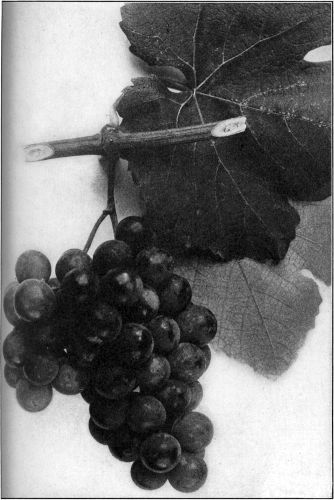
Etta
(Vulpina, Labrusca)
In appearance, taste and texture of fruit, Etta is very similar to Elvira, of which it is a seedling. The small, yellow clusters which characterize Elvira are reproduced in Etta, which differs chiefly in having a shoulder quite as large as the main bunch itself and in having a better flavor, lacking the slight foxiness of Elvira. The vine is very vigorous, hardy, and is productive to a fault. The fruit ripens with that of Catawba. The tendency of Elvira to crack and overbear influenced the originator of that variety, Jacob Rommel, Morrison, Missouri, to try for a grape without these faults, and the result was Etta from seed of Elvira. The fruit was first exhibited in 1879.
Vine very vigorous, hardy, productive. Canes long, numerous, light to dark brown; tendrils continuous, bifid. Leaves large, thick; upper surface dark green, glossy, smooth; lower surface pale green, somewhat cobwebby. Flowers self-fertile, early; stamens upright.
Fruit late, keeps well. Clusters small, short, broad, irregularly cylindrical, usually with a short, single shoulder but sometimes so heavily shouldered as to form a double bunch, very compact. Berries small, round, pale green, dull with thin bloom, shattering when over-ripe, firm; skin thin, tender; flesh juicy, fine-grained, tough, stringy, slightly foxy, mild; fair in quality. Seeds free, long, blunt, brown.
Eumelan
(Labrusca, Vinifera, Æstivalis)
Washington
The good qualities of Eumelan are: vines above the average in vigor, hardiness and productiveness; clusters and berries well formed, of good size and handsome color; flesh tender, dissolving into wine-like juice under slight pressure; and pure flavor, rich, sweet, vinous. The season is early, yet the fruit keeps much better than that of most other grapes maturing with it and becomes, therefore, a mid-season and late grape. The defects of the variety are susceptibility to mildew, self-sterile flowers and difficulty in propagation. The latter character has greatly hindered its culture, as the vines can be secured only at extra expense and nurserymen are loath to grow the variety at all. Eumelan may be recommended to amateur growers. It is a chance seedling which grew from seed, about 1847, in the yard of a Mr. Thorne, Fishkill Landing, New York.
Vine vigorous, hardy, productive. Canes numerous, covered with bloom; nodes enlarged; internodes short; tendrils intermittent, long, trifid or bifid. Leaves large; upper surface dark green, glossy, smooth; lower surface pale green, smooth; lobes usually three with terminal one acute; petiolar sinus deep, variable in width; basal sinus usually lacking; lateral sinus shallow, narrow; teeth shallow. Flowers self-sterile, open in mid-season; stamens reflexed.
Fruit early, keeps until late winter. Clusters long, slender, tapering, often with a long, loose, single shoulder; pedicel short, slender with a few small warts; brush short, stubby, pale green. Berries of medium size, round, black, glossy with thin bloom, persistent, firm; skin tough, adherent with wine-colored pigment, astringent; flesh dark green, juicy, fine-grained, tender, stringy, spicy and aromatic, sweet; good. Seeds adherent, one to four, large, wide, blunt, plump, brown.
Faith
(Vulpina, Labrusca)
Although spoken of as a desirable grape in some regions, Faith is of little value in most localities. The fruit is unattractive in appearance, and the quality is not high. If the variety has any preëminently good character, it is productiveness. The blossoms put forth so early that they often suffer from spring frosts. Faith is of the same breeding as Etta and from the same originator, Jacob Rommel, Morrison, Missouri, both having come from seed of Elvira.
Vine vigorous, hardy, healthy, productive. Canes long, numerous, thick, cylindrical; nodes prominent; internodes long; tendrils continuous, bifid. Leaves large, dark green; upper surface dark green, dull; lower surface grayish-green, thinly pubescent; lobes wanting or faint; teeth shallow, wide. Flowers self-sterile to partly self-fertile, open early; stamens upright.
Fruit early, does not keep well. Clusters medium in size, variable in length, usually slender, often heavily single-shouldered, loose; pedicel short, slender, warty; brush pale green, slender. Berries small, round, dull green, frequently with a yellow tinge changing to pale amber, with abundant bloom, persistent, soft; skin thin, adherent, astringent; flesh juicy, tender, agreeably flavored; fair to good in quality. Seeds numerous, broad, dark brown.
Feher Szagos
(Vinifera)
This variety succeeds rather well at Geneva, New York, bearing fruits of excellent quality. It has two defects, dull color of the berries and irregular bunches. It is worth trying in the East. Feher Szagos is said to make a very good raisin in California and usually appears in lists of table-grapes for that state.
Vines vigorous, somewhat uncertain bearers. Opening leaves pubescent, red along the edges and a tinge of red on the upper surface. Flowers have upright stamens. Fruit usually ripens the first week in October and does not keep well in storage; clusters large to medium, broad, loose, frequently irregular because of poor setting of fruit; berries large, oval to elliptical, rather dull green, with thin bloom; skin thick, tender, neutral; flesh greenish, translucent, juicy, meaty, tender, sweet; quality of the best; seeds free.
Fern Munson
(Lincecumii, Vinifera, Labrusca)
Admirable, Fern, Hilgarde, Munson's No. 76
Fern Munson is a southern grape not adapted to northern regions, 40° north latitude being its limit of adaptation. The fruits show some very good characters, as attractive appearance, agreeable quality and unobjectionable seeds and skin. The vines are vigorous and productive, but the foliage is not healthy although very abundant. This variety originated with T. V. Munson, Denison, Texas, from seed of Post-oak with mixed pollen. The seed was planted in 1885, and the variety was introduced by the originator in 1893.
Vine vigorous, doubtfully hardy. Canes long, numerous, thick, dark brown with a faint red tinge; tendrils intermittent, bifid. Leaves large, thick; upper surface rugose and heavily wrinkled; lower surface dull, pale green with a bronze tinge, faintly pubescent. Flowers semi-fertile, open very late; stamens upright.
Fruit late, keeps well. Clusters large, irregularly tapering, usually single-shouldered, often with many abortive fruits. Berries large, round, slightly flattened, dark purplish-black, glossy, covered with thin bloom, strongly persistent, firm; skin thin, tough, astringent; flesh juicy, tough, firm, fine-grained, vinous, briskly subacid; good. Seeds adherent, broad.
Flame Tokay
(Vinifera)
This is the leading shipping grape of the Pacific slope where it is everywhere grown under the name "Tokay," with several modifying terms, as "Flame," "Flame-colored" and "Flaming." The fruit is not especially high in quality nor attractive in appearance, but it ships and keeps well, qualities making it popular in commercial vineyards. The description is compiled.
Vine very vigorous, luxuriant in growth of canes, shoots and leaves; very productive; wood dark brown, straight with long joints. Leaves dark green with a brown tinge; lightly lobed. Bunches very large, sometimes weighing eight or nine pounds, moderately compact; shouldered. Berries large, oblong, red when mature, covered with lilac bloom; flesh firm, crisp, sweet; quality good. Season late, keeps and ships well.
Flowers
(Rotundifolia)
Flowers is a late, dark-colored Rotundifolia very popular in the Carolinas. The variety is noted for its vigorous and productive vines, its large fruit-clusters and grapes that cling in the cluster unusually well for a variety of this species. The crop ripens in North Carolina in October and November. The fruit is valuable only for wine and grape-juice, having little to recommend it for dessert purposes. Flowers was found in a swamp near Lamberton, North Carolina, more than a hundred years ago by William Flowers. Improved Flowers, probably a seedling of Flowers, was found near Whiteville, North Carolina, about 1869. It differs from its supposed parent in having a more vigorous and productive vine and larger clusters, the berries of which cling even more tenaciously.
Vine vigorous, healthy, upright, open, very productive. Canes long, slender, numerous. Leaves variable but average medium in size, longer than broad, pointed, cordate, thick, dark green, smooth, leathery; margins sharply serrate; flowers perfect.
Fruit very late, keeps well. Clusters, large, consisting of ten to twenty-five berries. Berries large, round-oblong, purple or purplish-black, clinging well to the cluster-stem; skin thick, tough, faintly marked with dots; pulp white, lacking in juice, hard, sweetish, austere in flavor; poor for a table-grape but excellent for grape-juice.
Gaertner
(Vinifera, Labrusca)
The berries and clusters of Gaertner are large and handsomely colored, making a very showy grape. The plant is vigorous, productive and as hardy as any of the hybrids between Labrusca and Vinifera. In view of these qualities, Gaertner has not received the attention it deserves, probably because it is more capricious as to soils than some others of its related hybrids. As a market grape, the variety has the faults of ripening unevenly and of shipping poorly. The fruit keeps well and this, with the desirable qualities noted, makes it an excellent grape for the home vineyard. Gaertner is often compared with Massasoit, the two varieties being very similar in fruit characters, but Gaertner is of distinctly better quality than Massasoit. The variety originated with E. S. Rogers, Salem, Massachusetts. It was first mentioned about 1865.
Vine vigorous, hardy except in severe winters, productive. Canes long, dark reddish-brown, surface covered with thin bloom; tendrils continuous, bifid or trifid. Leaves medium in size, round; upper surface dark green; lower surface pale green, pubescent. Flowers self-sterile, open late; stamens reflexed.
Fruit mid-season, matures unevenly, keeps only fairly well. Clusters medium in size, short, cylindrical, usually with a single shoulder but sometimes double-shouldered, loose with many abortive fruits. Berries large, round-oval, light to dark red, glossy, covered with bloom, persistent; skin thin, tender; flesh pale green, juicy, fine-grained, tough, stringy, agreeably vinous; good to very good. Seeds free, large, broad, distinctly notched, brown.
Geneva
(Vinifera, Labrusca)
Geneva is surpassed by so many other grapes of its season in quality that it has never become popular, although it has much to recommend it. The vine is vigorous and productive, although not quite hardy, and the berries and clusters are attractive; the fruit is nearly transparent and there is so little bloom that the grapes are a lustrous green or iridescent in sunlight; the berries cling well to the stem and the fruit keeps exceptionally well. Geneva originated with Jacob Moore, Brighton, New York, from seed planted in 1874 from a hybrid vine fertilized by Iona.
Vine vigorous, healthy, productive. Canes covered with thin bloom; tendrils intermittent or continuous, bifid or trifid. Leaves medium in size; upper surface light green, dull; lower surface grayish-white, pubescent; lobes three to five, acute; petiolar sinus, shallow, wide; teeth shallow, narrow. Flowers self-sterile or partly fertile, open late; stamens upright.
Fruit mid-season, ships well and keeps into the winter. Clusters large, blunt at the ends, usually not shouldered, with many abortive fruits; pedicel long, slender, smooth; brush long, green. Berries large, oval, dull green changing to a faint yellow with thin bloom; skin thick, tough, unpigmented; flesh pale green, tender, soft, vinous, sweet at skin but tart at center; fair to good. Seeds of medium size and length.
Goethe
(Vinifera, Labrusca)
Of all Rogers' hybrids, Goethe shows Vinifera characters most, resembling in appearance the White Malaga of Europe, and not falling far short of the best Old World grapes in quality. But the variety is difficult to grow, especially where the seasons are not long enough for full maturity. The vine is vigorous to a fault; it is fairly immune to mildew, rot and other diseases; and, where it succeeds, the vines bear so freely that thinning becomes a necessity. Added to high quality, which makes it an excellent table-grape, Goethe keeps well. Goethe was first mentioned in 1858 under the name of Rogers' No. 1.
Vine vigorous, hardy. Canes short, dark brown; nodes enlarged, flattened; internodes short; tendrils continuous or intermittent, long, bifid to trifid. Leaves irregularly round, thin; upper surface light green, glossy; lower surface pale green, pubescent; leaf usually not lobed, terminus broadly acute; petiolar sinus narrow, closed and overlapping; basal sinus usually lacking; lateral sinus shallow, often a notch; teeth shallow, narrow. Flowers partly self-fertile, open in mid-season; stamens upright.
Fruit late, keeps well. Clusters short, broad, tapering, frequently single-shouldered, usually two bunches to shoot; pedicel long, thick with numerous conspicuous warts; brush long, slender, yellowish-brown. Berries very large, oval, pale red covered with thin bloom, persistent; skin thin, tender, adherent, faintly astringent; flesh pale green, translucent, tender with Vinifera flavor; very good. Seeds adherent, one to three, large, long, notched, blunt, brown.
Gold Coin
(Æstivalis, Labrusca)
In the South, where alone it thrives, Gold Coin is a handsome market variety of very good quality. The vines are productive and are unusually free from attacks of fungal diseases. The variety originated with T. V. Munson, Denison, Texas, from seed of Cynthiana or Norton pollinated by Martha and was introduced by the originator in 1894.
Vine vigorous, hardy, productive. Canes slender, numerous; tendrils continuous, sometimes intermittent, trifid or bifid. Leaves medium in size; upper surface light green, slightly rugose; lower surface pale green, tinged with bronze, heavily pubescent. Flowers self-fertile; stamens upright.
Fruit late mid-season, keeps long. Clusters medium to small, usually single-shouldered. Berries large, round-oval, yellowish-green with a distinct trace of reddish-amber, with thin bloom, usually persistent; skin covered with small, scattering brown dots, thin, tough; flesh faintly aromatic, tart from skin to center; good. Seeds free, numerous, medium in size.
Green Early
(Labrusca, Vinifera)
Green Early is a white grape coming in season with Winchell, which surpasses it in most characters, quality in particular. Green Early was found in 1885, growing by the side of a ditch near a Concord vineyard, on land belonging to O. J. Green, Portland, New York.
Vine vigorous, hardy, productive. Canes variable in length and thickness, dark reddish-brown; nodes enlarged, flattened; internodes short; tendrils continuous, sometimes intermittent, bifid or trifid. Leaves variable in size, medium green; upper surface dark green, glossy; lower surface pale green, pubescent; lobes wanting or faintly five; teeth shallow, narrow; stamens upright.
Fruit early, does not keep well. Clusters variable in size, length and breadth, sometimes single-shouldered, variable in compactness. Berries large, oval, light green tinged with yellow, with thin bloom, persistent, soft; skin thin, tender, inclined to crack; flesh tough and aromatic, sweet at skin but acid at center; fair in quality. Seeds medium in size, length and breadth, sharp-pointed.
Grein Golden
(Vulpina, Labrusca)
Grein Golden is very similar to Riesling, but the vine is much stronger in growth. For a variety of the Taylor group, both cluster and berry are large and uniform, which, with the attractive color of the berries, make it a most handsome fruit. The flavor, however, is not at all pleasing, being an unusual commingling of sweetness and acidity very disagreeable to most palates. The quality of the fruit condemns it for table use, although it is said to make a very good white wine. Nicholas Grein, Hermann, Missouri, first grew Grein Golden about 1875.
Vine vigorous, hardy, productive. Canes long, numerous, slender, dark reddish-brown; nodes enlarged, flattened; internodes long; tendrils intermittent, trifid or bifid. Leaves large, thick; upper surface dark green, dull, smooth; lower surface pale green, lightly pubescent; lobes lacking or one to three with terminus acute; petiolar sinus deep, narrow; basal sinus usually lacking; lateral sinus shallow, wide, obscure; teeth deep. Flowers self-sterile, open in mid-season; stamens reflexed.
Fruit mid-season. Clusters large, long, broad, tapering, irregular, often heavily single-shouldered, loose; pedicel with a few inconspicuous warts; brush slender, pale green. Berries uniform in size, large, round, golden yellow, glossy with thin bloom, persistent; skin very thin, tender; flesh green, translucent, very juicy, tender, vinous; good. Seeds free, one to four, broad, plump, light brown.
Gros Colman
(Vinifera)
Dodrelabi
Gros Colman has the reputation of being the handsomest black table-grape grown. It is one of the favorite hot-house grapes in England and eastern America and is commonly grown out of doors in California. The variety is remarkable for having the largest berries of any round grape, borne in immense bunches, and for the long-keeping qualities, although the tender skins sometimes crack. The following description is compiled:
Vine vigorous, healthy and productive; wood dark brown. Leaves very large, round, thick, but slightly lobed; teeth short and blunt; glabrous above, wooly below. Bunches very large, short, well filled but rather loose; berries very large, round, dark blue; skin thick but tender; flesh firm, crisp, sweet and good; quality not of the highest. Season late and the fruits keep long.
Hartford
(Labrusca)
The vine of Hartford may be well characterized by its good qualities, but the fruit is best described by its faults, because of which the variety is passing out of cultivation. The plants are vigorous, prolific, healthy and the fruit is borne early in the season. The canes are remarkable for their stoutness and for the crooks at the joints. The bunches are not unattractive, but the quality of the fruit is low, the flesh being pulpy and the flavor insipid and foxy. The berries shell badly on the vine and when packed for shipping, so that the fruit does not ship, pack or keep well. The grapes color long before ripe, and the flowers are only partly self-fertile, so that in seasons when there is bad weather during blooming time the clusters are loose and straggling. The original vine of Hartford was a chance seedling in the garden of Paphro Steele, West Hartford, Connecticut. It fruited first in 1849.
Vine vigorous, very productive. Canes long, dark brown, covered with pubescence; nodes enlarged, flattened; internodes short; tendrils continuous, long, bifid. Leaves large, thick; upper surface dark green, dull, rugose; lower surface pale green, thinly pubescent; lobes variable; petiolar sinus deep, narrow; basal sinus usually lacking; lateral sinus shallow, narrow; teeth shallow. Flowers partly self-fertile, open in mid-season; stamens upright.
Fruit early. Clusters medium in size, long, slender, tapering, irregular, often with a long, large, single shoulder, loose; pedicel short with a few small warts; brush greenish. Berries medium in size, round-oval, black, covered with bloom, drop badly; skin thick, tough, adherent, contains much purplish-red pigment, astringent; flesh green, translucent, juicy, firm, stringy, foxy; poor in quality. Seeds free, one to four, broad, dark brown.
Plate XXVIII.—Triumph (×3/5).
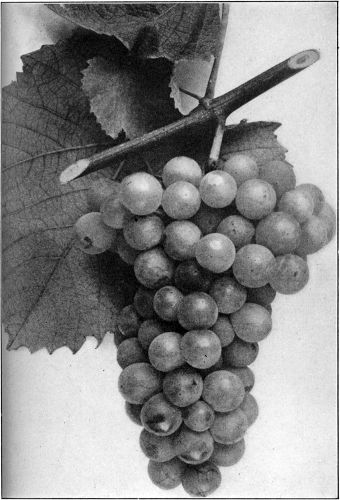
Hayes
(Labrusca, Vinifera)
In 1880, the Massachusetts Horticultural Society awarded a certificate of merit to Hayes for high quality in fruit. This brought it prominently before grape-growers and for a time it was popular, but when better known several defects became apparent. The vine is hardy and vigorous, but the growth is slow and the variety is a shy bearer. Both bunches and berries are small, and the crop ripens at a time, a week or ten days earlier than Concord, when there are many other good green grapes. Excellent though it is in quality, the variety is hardly worth a place in any vineyard. John B. Moore, Concord, Massachusetts, is the originator of Hayes. It is a seedling of Concord out of the same lot of seedlings as Moore Early. It was first fruited in 1872.
Vine variable in vigor and productiveness, hardy and healthy. Canes numerous, slender; nodes enlarged, flattened; internodes short; tendrils intermittent, bifid or trifid. Leaves uniform in size; upper surface dark green; lower surface pubescent; lobes one to three; teeth shallow, small. Flowers almost self-sterile, open medium late; stamens upright.
Fruit early, keeps well. Clusters variable in size and length, often single-shouldered; pedicel long, slender; brush small, pale green. Berries medium in size, round, greenish-yellow, covered with thin bloom, persistent; skin thin, tender with a few small reddish-brown dots; flesh fine-grained, tender, vinous, sweet at the skin, agreeably tart at center, mild; good. Seeds few, of average size, short, plump, brown.
Headlight
(Vinifera, Labrusca, Bourquiniana)
Headlight is more desirable for southern than for northern vineyards, yet it is worthy of trial in the North. Its meritorious characters are: productiveness, outyielding Delaware, with which it competes; disease-resistant foliage and vines; more than average vigor of vine; high quality of fruit, being almost the equal of Delaware in flavor and having tender, melting pulp which readily parts from the seeds; and earliness, ripening before Delaware and hanging on the vines or keeping after being picked for some time without deterioration. The originator of Headlight, T. V. Munson, states that the variety came from seed of Moyer fertilized by Brilliant. The seed was planted in 1895 and the grape was introduced in 1901.
Vine vigorous, hardy, very productive. Canes short, few in number, slender, reddish-brown; nodes enlarged; internodes short; tendrils continuous, short, bifid, very persistent. Leaves small, thick; upper surface light green, dull, smooth; lower surface pale green, pubescent; lobes one to three with terminus obtuse; petiolar sinus intermediate in depth and width; basal sinus usually lacking; lateral sinus shallow, narrow; teeth shallow. Flowers self-sterile, open in mid-season; stamens reflexed.
Fruit early, keeps well. Clusters small, short, tapering, frequently single-shouldered, compact; pedicel short, slender, covered with a few small warts; brush yellowish-brown. Berries small, round, dark red with thin bloom, persistent, firm; skin tough, adherent, astringent; flesh green, translucent, very juicy, tender, fine-grained, vinous, sweet; very good. Seeds free, one to three, small, light brown.
Herbemont
(Bourquiniana)
Bottsi, Brown French, Dunn, Herbemont's Madeira, Hunt, Kay's Seedling, McKee, Neal, Warren, Warrenton
In the South, Herbemont holds the same rank as Concord in the North. The vine is fastidious as to soil, requiring a well-drained warm soil, and one which is abundantly supplied with humus. Despite these limitations, this variety is grown in an immense territory, extending from Virginia and Tennessee to the Gulf and westward through Texas. The vine is remarkably vigorous, being hardly surpassed in this character by any other of our native grapes. The fruits are attractive because of the large bunch and the glossy black of the small berries, and are borne abundantly and with certainty in suitable localities. The flesh characters of the fruit are good for a small grape, neither flesh, skin nor seeds being objectionable in eating; the pulp is tender, juicy, rich, sweet and highly flavored. The ample, lustrous green foliage makes this variety one of the attractive ornamental plants of the South. Herbemont is known to have been in cultivation in Georgia before the Revolutionary War, when it was generally called Warren and Warrenton. In the early part of the last century, it came to the hands of Nicholas Herbemont, Columbia, South Carolina, whose name it eventually took.