Chapter XVIII · (continued 2)
Reading edition
Vine very vigorous. Canes long, strong, bright green, with more or less purple and heavy bloom; internodes short; tendrils intermittent, bifid or trifid. Leaves large, round, entire, or three to seven-lobed, nearly glabrous above and below; upper surface clear green; lower surface lighter green, glaucous. Flowers self-fertile.
Fruit very late. Clusters large, long, tapering, prominently shouldered, compact; pedicels short with a few large warts; brush pink. Berries round, small, uniform, reddish-black or brown with abundant bloom; skin thin, tough; flesh tender, juicy; juice colorless or slightly pink, sweet, sprightly. Seeds two to four, small, reddish-brown, glossy.
Herbert
(Labrusca, Vinifera)
In all that constitutes a fine table-grape, Herbert (Plate XVIII) is as near perfection as any American variety. For a Vinifera-Labrusca hybrid, the vine is vigorous, hardy and fruitful, ranking in these respects above many pure-bred Labruscas. While the fruit ripens with Concord, it keeps much later and packs and ships better. The variety is self-sterile and must be set near other varieties. Herbert is deserving attention from commercial growers who supply a discriminating market, and its many good qualities give it high place as a garden grape. The variety is one of Rogers' hybrids, named Herbert in 1869.
Vine very vigorous, productive. Canes long, numerous, thick, dark brown; nodes enlarged, flattened; internodes long; tendrils intermittent, long, bifid or trifid. Leaves large, round; upper surface dark green, dull, smooth; lower surface pale green with some pubescence; leaf entire, terminus obtuse; petiolar sinus deep, narrow, closed, overlapping; basal and lateral sinuses lacking; teeth shallow. Flowers self-sterile, open in mid-season; stamens reflexed.
Fruit mid-season, keeps well. Clusters large, broad, tapering, two to three clusters per shoot, heavily single-shouldered, loose; pedicel thick with small russet warts; brush yellowish-green. Berries large, round-oval, flattened, dull black, covered with thick bloom, persistent, firm; skin thick, tough, adherent, astringent; flesh light green, translucent, juicy, tender, fine-grained; very good. Seeds adherent, three to six, large, broad, notched, long with swollen neck, blunt, brown with yellow tips.
Hercules
(Labrusca, Vinifera)
Hercules is characterized by very large berries, fruit handsomely colored and cluster large and well-formed. The flavor, while not of the best, is good. Added to the desirable qualities of the fruit, the vines are hardy, vigorous and productive. These good characters, however, cannot make up for the several defects of the variety. The grapes drop and crack badly and the pulp is tough and adheres too firmly to the seed for a dessert grape, so that the variety is worthless except for breeding purposes. Hercules was introduced by G. A. Ensenberger, Bloomington, Illinois, about 1890; its parentage is unknown.
Vine very vigorous, hardy, very productive. Canes long, dark reddish-brown; nodes enlarged, flattened; internodes long; tendrils continuous, bifid. Leaves large; upper surface light green, glossy, smooth; lower surface grayish-green, pubescent; lobes one to three, terminus acute; petiolar sinus deep, narrow; basal sinus usually absent; lateral sinus shallow; teeth shallow. Flowers self-sterile, open in mid-season; stamens reflexed.
Fruit mid-season, keeps well. Clusters very large, broad, tapering, one to three clusters per shoot, compact; brush pale green. Berries very large, round, black, glossy with heavy bloom, firm; skin adherent, astringent; flesh green, translucent, juicy, very tough, coarse, stringy, foxy; fair in quality. Seeds adherent, one to five, large, broad, deeply notched, blunt, brown.
Hicks
(Labrusca)
Hicks is a remarkably good grape and were it not that the fruit is almost identical with that of Concord, ripening with it or a little earlier, it would have a place in the viticulture of the country. However, since it was introduced some years ago and has not found great favor with growers, it seems that it cannot make headway against Concord, with which it must compete. In many localities the vines are more prolific than those of Concord and of stronger growth. Hicks was introduced in 1898 by Henry Wallis, Wellston, Missouri, who states that it is a chance seedling sent from California about 1870 to Richard Berry, a nurseryman of St. Louis County, Missouri.
Vine very vigorous, hardy, very productive. Canes medium to long, numerous, reddish-brown, covered with thin bloom; tendrils continuous, bifid or trifid. Leaves large, thick; upper surface dark green, glossy; lower surface white, changing to a heavy bronze, strongly pubescent. Flowers self-fertile, open early; stamens upright.
Fruit mid-season, keeps well. Clusters large, long, broad, tapering, often single-shouldered. Berries large, round, purplish-black with heavy bloom, shatter when over-ripe, firm; skin tender with dark wine-colored pigment; flesh green, juicy, tough, fine-grained, faintly foxy; good. Seeds adherent, large, short, broad, blunt, brown.
Hidalgo
(Vinifera, Labrusca, Bourquiniana)
The grapes of Hidalgo are rich, sweet, delicately flavored, and with color, size and form of berry and bunch so well combined as to make the fruits singularly handsome. The skin is thin but firm and the variety keeps and ships well. The vines, however, are doubtfully hardy, variable in vigor and not always fruitful. While Hidalgo may not prove of value for the commercial vineyard, in favorable situations it may give a supply of choice fruit for the amateur. The parentage of Hidalgo, as given by its originator, T. V. Munson, is Delaware, Goethe and Lindley. The variety was introduced by the originator in 1902.
Vine variable in vigor, hardiness and productiveness. Canes thick, dark reddish-brown; nodes enlarged, flattened; tendrils intermittent or continuous, bifid or trifid. Leaves large, irregularly round, thick; upper surface light green, dull, rugose; lower surface pale green, bronzed, heavily pubescent; lobes three when present; petiolar sinus narrow, sometimes closed and overlapping; basal sinus wanting; lateral sinus shallow, narrow; teeth very shallow, narrow. Flowers semi-fertile, open after mid-season; stamens upright.
Fruit mid-season, keeps and ships well. Clusters large, long, slender, cylindrical, often blunt, not shouldered, one to two bunches per shoot, compact; pedicel long, slender with small warts; brush yellowish-green with brown tinge. Berries large, oval, greenish-yellow, glossy with thin bloom, persistent, firm; skin thin, tough, adherent, astringent; flesh green, transparent, juicy, tender, melting, aromatic, sweet; very good to best. Seeds free, two to four, large, plump, light brown.
Highland
(Vinifera, Labrusca)
Few varieties of black grapes equal Highland in appearance and quality of fruit. When given good care under favorable conditions, the bunches are unusually large and handsome in appearance, sometimes attaining a weight of two pounds, and bear beautiful bluish-black berries with the fine flavor and tender texture of Jura Muscat, one of its parents. The flesh is solid, firm and the fruit keeps and ships well. The vine is vigorous, productive to a fault but is doubtfully hardy. Where the climate is temperate and the season long enough for the vine and fruit of Highland to develop, this is one of the choicest grapes for the amateur. The variety originated about the close of the Civil War with J. H. Ricketts, Newburgh, New York, from seed of Concord fertilized by Jura Muscat.
Vine variable in vigor, productive, healthy. Canes long, numerous, dark brown with thin bloom; nodes enlarged; internodes long; tendrils intermittent, bifid or trifid. Leaves large; upper surface dark green, dull, rugose; lower surface grayish-green, pubescent; lobes one to five, terminal one acute; petiolar sinus deep, variable in width; basal sinus shallow, narrow; lateral sinus a notch; teeth deep, wide. Flowers self-fertile, open in mid-season; stamens upright.
Fruit late, keeps well. Clusters large, long, broad, tapering, usually single-shouldered, usually two bunches per shoot; pedicel long, thick, smooth; brush green with yellow tinge. Berries large, round-oval, purplish-black, dull with heavy bloom, persistent, firm; skin tough, free; flesh green, translucent, juicy, tender, vinous; good. Seeds free, one to six, large, long, notched, brown.
Hopkins
(Rotundifolia)
Hopkins is named by grape-growers in the South Atlantic states as the best early Rotundifolia grape. Its season in North Carolina begins early in August, nearly a month before any other. It is, also, one of the best in quality and for quality and earliness should be in every home vineyard in the region in which it grows. Hopkins was found near Wilmington, North Carolina, about 1845, by John Hopkins.
Vine very vigorous, hardy, productive. Canes long, slender, upright. Leaves of medium size, variable, cordate, longer than broad, thick, leathery, smooth, dark green; margins sharply serrate. Flowers self-fertile.
Fruit very early. Clusters large, containing from four to ten berries. Berries large, dark purple or almost black, round-oblong, shelling badly; skin thick, tough, faintly marked with dots; pulp white, tender, juicy with a sweet, pleasant flavor; one of the best of the Rotundifolias in quality.
Hosford
(Labrusca)
Hosford is an offspring of Concord, differing from the parent chiefly in the greater size of bunch and berry and in being less fruitful. The variety is surpassed by Worden and Eaton, of the same type, and is probably not worth cultivation. It is claimed by some that Hosford is identical with Eaton but there are noticeable differences in both vine and fruit characters. The vine looks very like that of Concord except that the indentations along the margins of the leaves are deeper. Hosford originated in the garden of George Hosford, Ionia, Michigan, about 1876, as a chance seedling growing between two Concord vines.
Vines lacking in vigor, hardy, unproductive. Canes short, few in number, slender; nodes enlarged; internodes very short; tendrils continuous, bifid or trifid. Leaves medium in size; upper surface light green, rugose; lower surface grayish-white to bronze, heavily pubescent; lobes faint; petiolar sinus wide; teeth small, sharp. Flowers shallow, semi-fertile, open in mid-season; stamens upright.
Fruit mid-season, does not keep well. Clusters large, tapering, slightly shouldered, compact; pedicel short with small warts; brush slender, green. Berries large, round-oval, dull black with abundant bloom, persistent; skin thick, tender; flesh pale green, juicy, fine-grained, tender, vinous, sweet; good. Seeds few, large, broad, blunt, plump, brown.
Hybrid Franc
(Vinifera, Rupestris)
Hybrid Franc is the best-known cross between Rupestris and Vinifera. It is one of the few varieties used in Europe as a resistant stock now recommended for a direct producer. The vines are hardy, vigorous and very productive. The fruit is fit only for wine or grape-juice, being too acid to eat out of hand. The coloring matter in the fruit is very intense and might be used in giving color to grape products. The variety is of French origin.
Vine vigorous, hardy, productive. Canes numerous, thick, light brown with blue bloom; nodes enlarged; internodes short; tendrils intermittent, long, bifid or trifid. Leaves small, thin; upper surface light green, glossy, smooth; lower surface green, hairy along ribs and large veins; lobes three to five with terminal one acute; petiolar sinus narrow, sometimes closed and overlapping; lateral sinus a notch. Flowers semi-fertile, open early; stamens upright.
Fruit mid-season, does not keep well. Clusters medium in size, short, cylindrical, single-shouldered, compact; pedicel long, slender with few small warts; brush short, wine-colored. Berries small, oblate, black, glossy with thick bloom, persistent, firm; skin thin, tender with very dark wine-colored pigment; flesh green with reddish tinge, translucent, juicy, fine-grained, tender, spicy, tart; fair in quality. Seeds free, one to five, small, short, light brown.
Ideal
(Labrusca, Vinifera, Bourquiniana)
Ideal is a handsome seedling of Delaware, from which it differs chiefly in being larger in bunch and berry, attaining in both of these characters nearly the size of Catawba. In Kansas and Missouri, this variety is highly recommended, not only for the high quality of the fruit, ranking with Delaware in quality, but because of vigorous, healthy, productive vines. But farther north the vines are precariously hardy and not sufficiently fruitful, healthy nor vigorous to warrant high recommendation. Ideal originated with John Burr, Leavenworth, Kansas, from seed of Delaware, about 1885.
Vine vigorous, doubtfully hardy, productive; tendrils intermittent, bifid or trifid. Canes long, numerous, slender, dark brown; nodes enlarged, flattened; internodes long. Leaves large, variable in color; lobes three to five; petiolar sinus deep, wide; teeth deep, narrow; upper surface light green, dull; lower surface pale green, pubescent.
Fruit early mid-season, keeps well. Clusters large, broad, heavily shouldered; pedicel thick; brush green. Berries large, round, dark red with thin bloom, usually persistent, firm; skin thick, tough, adherent; flesh green, tender, aromatic, sweet next the skin, acid at the center; good to very good. Seeds adherent, large, plump, brown.
Iona
(Labrusca, Vinifera)
In flavor, the fruit of Iona (Plate XIX) has a rare combination of sweetness and acidity, pure, delicate and vinous. The flesh is transparent, melting, tender, juicy and of uniform consistency quite to the center. The seeds are few and small and part readily from the flesh. The color is a peculiar dark-red wine with a tint of amethyst, variable and not always attractive. The bunch is large but loose, with berries varying in size and ripening unevenly. The fruit may be kept until late winter. The vine characters of Iona are not as good as those of the fruit. To do well, the vine must have a soil exactly suited to its wants, seemingly thriving best in deep, dry, sandy or gravelly clays. Iona responds especially well when trained against walls or buildings, attaining under such conditions rare perfection. The vines are doubtfully hardy and in many parts of the North must have winter protection; they are not vigorous and are inclined to overbear, to remedy which they must have close pruning. In localities in which mildew and rot thrive, the variety is badly attacked by these diseases. Iona originated with C. W. Grant, Iona Island, New York, from seed of Diana planted in 1885.
Vine weak, doubtfully hardy, unproductive. Canes short, light brown; nodes enlarged; internodes short; tendrils intermittent, bifid. Leaves thick; upper surface light green, dull, smooth; lower surface grayish-green, heavily pubescent; lobes three to five with terminal one acute; petiolar sinus of medium depth and width; basal sinus shallow; lateral sinus shallow, wide; teeth shallow. Flowers self-fertile, open late; stamens upright.
Fruit late, keeps well. Clusters medium in size, sometimes double-shouldered, slender, tapering, loose; brush pale green. Berries uniform, oval, round, dull, light and dark red with thin bloom, persistent, firm; skin tough, adherent, slightly astringent; flesh green, translucent, juicy, fine-grained, tender, melting, vinous; very good. Seeds free, one to four, small, broad, plump, brown.
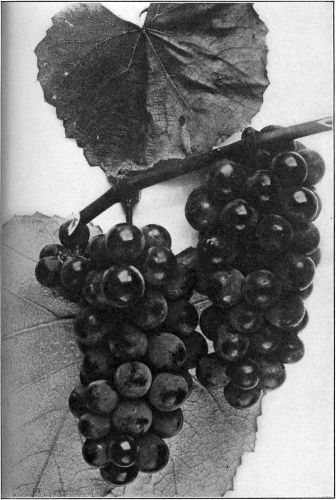
Plate XXIX.—Vergennes (×2/3).
Isabella
(Labrusca, Vinifera)
Alexander, Black Cape, Christie's Improved Isabella, Conckling's Wilding, Constantia, Dorchester, Gibb's Grape, Hensell's Long Island, Payne's Early, Helene, Woodward
Isabella (Plate XX) is now of little more than historical interest, it having been one of the mainstays of American viticulture. In appearance, the fruit of Isabella is fully as attractive as that of any black grape, the clusters being large and well formed and the berries glossy black with thick bloom. The flavor is good, but the thick skin and muskiness in taste are objectionable. The grapes keep and ship well. Isabella is surpassed in vine characters by many other kinds, notably Concord, which has taken its place. The lustrous green, ample foliage which remains late in the season, and the vigor of the vine, make this variety an attractive ornamental, well adapted for growing on arbors, porches and trellises. The origin of Isabella is not known. It was obtained by William Prince, Flushing, Long Island, about 1816 from Mrs. Isabella Gibbs, Brooklyn, New York.
Vine vigorous, hardy, productive. Canes short, numerous with heavy pubescence, thick, light brown; nodes enlarged, flattened; internodes short; tendrils continuous, long, bifid or trifid. Leaves thick; upper surface dark green, smooth, glossy; lower surface whitish-green, heavily pubescent; lobes three when present with terminal lobe obtuse; petiolar sinus shallow, narrow, often closed, overlapping; basal sinus usually wanting; lateral sinus shallow, narrow, frequently notched; teeth shallow, wide. Flowers self-fertile, open in mid-season; stamens upright.
Fruit late, keeps and ships well. Clusters large, cylindrical, frequently single-shouldered; pedicel slender, smooth; brush long, yellowish-green. Berries medium to large, oval, black with heavy bloom, persistent, soft; skin thick, tough, adherent, astringent; flesh pale green, translucent, juicy, fine-grained, tender, meaty, some foxiness, sweet; good. Seeds one to three, large, broad, distinctly notched, short, brown with yellow tips.
Isabella Seedling
(Labrusca, Vinifera)
Isabella Seedling is an early, vigorous, productive offspring of Isabella. In fruit characters it greatly resembles its parent, but ripens its crop earlier and has a more compact bunch. Like that of its parent, the fruit is of good quality and keeps remarkably well. This seedling is now grown more than Isabella and, while not of any considerable commercial importance, is far more deserving attention as a market grape than some of the poorly flavored kinds more generally grown. There are several varieties under this name. Two are mentioned by Warder; one of Ohio and one of New York origin. The Isabella Seedling here described originated with G. A. Ensenberger, Bloomington, Illinois, in 1889.
Vine vigorous, healthy, hardy, productive. Canes long, thick, dark brown, often with a red tinge, with thin bloom; nodes prominent, flattened; internodes long; tendrils intermittent or continuous, bifid. Leaves healthy, large, thick; upper surface green, dull; lower surface pale green or grayish-green, occasionally with a tinge of bronze, pubescent. Flowers self-fertile; stamens upright.
Fruit early, keeps well. Clusters large, long, slender, cylindrical, usually single-shouldered, loose, compact. Berries large, oval, often pear-shaped, dull black with thick bloom, persistent, soft; skin thick with some red pigment; flesh pale green, juicy, tender, coarse, vinous; good. Seeds numerous, free, large, broad, notched, dark brown.
Israella
(Labrusca, Vinifera)
Israella came from C. W. Grant contemporaneously with Iona and was heralded as the earliest good grape in cultivation. For several years after its introduction, it was widely tried but was almost everywhere discarded because of the poor quality and unattractive appearance of the fruit and lack of vigor, hardiness and productiveness in the vine. Grant grew Israella from seed of Isabella planted in 1885.
Vine lacking in vigor, unproductive. Canes slender, dark brown; nodes enlarged, flattened; internodes short; tendrils continuous, bifid. Leaves large; upper surface light green, dull, rugose; lower surface pale green, pubescent; lobes one to five, faint; petiolar sinus deep, narrow; teeth shallow, sharp; stamens upright.
Fruit late, keeps well. Clusters large, of medium length and breadth, tapering, often single-shouldered, compact, frequently with many abortive fruits. Berries of medium size, round-oval, black or purplish-black with thin bloom, inclined to drop, soft; skin thick, tough with a large amount of purplish-red pigment; flesh pale green, juicy, stringy, mild, sweet from skin to center; fair in quality. Seeds free, medium in size, notched, blunt, light brown, often covered with grayish warts.
Ives
(Labrusca, Æstivalis)
Ives' Madeira, Ives' Seedling, Kittredge
Ives has a high reputation as a grape for making red wine, being surpassed only by Norton for this purpose. The vine is hardy, healthy, vigorous and fruitful. The fruit is poor in quality, colors long before ripe, has a foxy odor, and the flesh is tough and pulpy. The bunches are compact, with well-formed, jet-black grapes, which make them attractive. The vine is easily propagated and is adapted to any good grape soil, but is so rampant in growth that it is difficult to manage. The variety is not widely cultivated. Ives was grown by Henry Ives from seed planted in 1840 in his garden in Cincinnati, Ohio.
Vine vigorous, hardy, healthy, productive. Canes long, thick, reddish-brown with thin bloom; nodes enlarged, flattened; internodes short; tendrils continuous, bifid or trifid. Leaves large; upper surface dark green, dull, rugose; lower surface pale green, pubescent; lobes three to five when present with terminal one acute; petiolar sinus deep, narrow, sometimes closed and overlapping; basal sinus shallow; lateral sinus narrow; teeth shallow.
Fruit late mid-season, keeps well. Clusters large, tapering, frequently single-shouldered, compact, often with numerous abortive berries; pedicel slender with numerous small warts; brush short, slender, pale with a reddish-brown tinge. Berries oval, jet-black with heavy bloom, very persistent, firm; skin tough, adherent, wine-colored pigment, astringent; flesh pale green, translucent, juicy, fine-grained, tough, foxy; good. Seeds adherent, one to four, small, often abortive, broad, short, blunt, plump, brown.
James
(Rotundifolia)
James is one of the largest of the Rotundifolia grapes and probably the best general-purpose variety of this species. The vine is noted for vigor and productiveness. It cannot be grown north of Maryland. It thrives in sandy loam soils with clay subsoil. The variety was found by B. W. M. James, Pitt County, North Carolina. It was introduced about 1890 and was placed on the grape list of the American Pomological Society fruit catalog in 1899.
Vine vigorous, healthy, productive. Canes slender, numerous, long, slightly trailing. Leaves of medium size, thick, smooth, leathery, cordate, as broad as long, with a serrate margin. Flowers open late; stamens reflexed.
Fruit ripens late, hangs on the vine for three weeks, keeps well. Clusters small, containing from four to twelve berries, irregular, loose. Berries large, three-fourths to one and one-fourth inches in diameter, round, blue-black, marked with specks; skin thick, tough. Pulp juicy, sweet; good in quality.
Janesville
(Labrusca, Vulpina)
Endowed with a constitution enabling it to withstand cold to which most other grapes succumb, Janesville has made a place for itself in far northern localities. Moreover, the grapes ripen early, being about the first to color although they are not ripe until some time after coloring. The vine also is healthy, vigorous and productive. The fruit, however, is worthless when better sorts can be grown. The clusters and berries are small, the grapes are pulpy, tough, seedy, have a thick skin and a disagreeable acid taste. Janesville was grown by F. W. Loudon, Janesville, Wisconsin, from chance seed planted in 1858.
Vine vigorous, hardy, healthy, productive. Canes spiny, numerous, dark brown; nodes flattened; internodes long; tendrils intermittent or continuous, long, bifid or trifid. Leaves small, thin; upper surface glossy, smooth; lower surface pale green, lightly pubescent; leaf usually not lobed with terminus acute; petiolar sinus narrow, often closed and overlapping; basal and lateral sinuses lacking; teeth shallow. Flowers self-fertile, open very early; stamens upright.
Fruit early, keeps well. Clusters small, short, cylindrical, usually single-shouldered, compact; pedicel short, slender, covered with small, scattering warts; brush dark wine color. Berries round, dull black with heavy bloom, persistent, firm; skin thick, tough, adherent with dark wine-colored pigment, astringent; flesh pale reddish-green, translucent, juicy, tough, coarse, vinous, acid; fair in quality. Seeds adherent, one to six, large, broad, angular, blunt, dark brown.
Jefferson
(Labrusca, Vinifera)
Jefferson (Plate XXI) is an offspring of Concord crossed with Iona, and resembles Concord in vigor, productiveness and healthiness of vine, and Iona in color and quality of fruit. The vine produces its fruit two weeks later than Concord and is not as hardy, faults that debar it from taking high rank as a commercial grape. Fortunately the vines yield readily to laying down for winter protection so that even in commercial plantations it is not difficult to prevent winter injury. The bunches of Jefferson are large, well-formed, compact with berries of uniform size and color. The flesh is firm yet tender, juicy with a rich, vinous flavor and a delicate aroma which persists even after the berries have dried into raisins. The fruit ships and keeps well, the berries adhering to the cluster and the fruit retaining its freshness into late winter. Jefferson is widely distributed and is well known by viticulturists in eastern America. It is not particular as to localities, if the season be long and the climate temperate, and thrives in all soils. The variety originated with J. H. Ricketts, Newburgh, New York; it fruited first in 1874.
Vine vigorous, healthy, doubtfully hardy, productive. Canes short, numerous, light to dark brown; nodes enlarged, round; internodes short; tendrils intermittent, short, bifid or trifid. Leaves healthy; upper surface light green, older leaves rugose; lower surface pale green, strongly pubescent; leaf usually not lobed with terminus acute; petiolar sinus narrow, sometimes closed and overlapping; basal sinus usually absent; lateral sinus shallow, often a mere notch; teeth regular, shallow. Flowers self-fertile, open late; stamens upright.
Fruit late, keeps and ships well. Clusters large, cylindrical, usually single-shouldered, sometimes double-shouldered, compact; pedicel short, slender with a few inconspicuous warts; brush long, slender, pale yellowish-green. Berries medium in size, oval, light and dark red, glossy with thin bloom, persistent, very firm; skin thick, tough, free, slightly astringent; flesh light green, translucent, juicy, coarse-grained, tender, vinous; good to best. Seeds free, one to four, broad, short, blunt, plump, brown.
Jessica
(Labrusca, Vinifera)
Jessica is an early, hardy, green grape. The fruit is sweet, rich, sprightly and almost free from foxiness, but is unattractive and does not keep well. The clusters and berries are small, and the clusters are too loose for a good grape. Jessica may be commended for earliness and hardiness and is, therefore, desirable, if at all, in northern regions. William H. Read, Port Dalhousie, Ontario, grew Jessica from seed planted some time between 1870 and 1880.
Vine medium in vigor, healthy, hardy, productive. Canes long, thick, dark brown with red tinge; nodes enlarged, flattened; internodes short; tendrils continuous or intermittent, bifid or trifid. Leaves small; upper surface dark green, glossy, often rugose; lower surface pale green, very pubescent; lobes three; petiolar sinus narrow; teeth shallow, narrow. Flowers self-fertile, open in mid-season; stamens upright.
Fruit very early. Clusters small, slender, tapering, usually single-shouldered. Berries small, round, light green, often tinged with yellow, covered with thin bloom, persistent, soft; skin thin, adherent, faintly astringent; flesh pale green, transparent, juicy, tender, soft, sprightly, sweet; good. Seeds adherent, medium to broad, notched, brown.
Jewel
(Labrusca, Bourquiniana, Vinifera)
The notable characters of Jewel are earliness and high quality in fruit; although, as compared with Delaware, its parent, the vine is vigorous, healthy and hardy. In form and size of bunch and berry, Jewel closely resembles Delaware, but the grapes are deep black in color. The flesh characters and flavor of the fruit are much like those of Delaware, the pulp being tender yet firm, and the flavor having the same rich, sprightly, vinous taste found in the parent. The seeds are few and small. The skin is thin but tough, and the grapes ship well, keep long, do not shell, and although early, hang until frost. Jewel is a most excellent grape, worthy the place among black grapes that Delaware has among red varieties. In particular, it is recommended for earliness and for localities in the North where standard varieties do not ripen. John Burr, Leavenworth, Kansas, grew Jewel from seed of Delaware planted about 1874.
Vine vigorous, healthy, hardy, productive. Canes slender, light reddish-brown; nodes enlarged, flattened; internodes short; tendrils continuous, bifid. Leaves scant, thick; upper surface light green, dull, rugose; lower surface tinged with bronze, heavily pubescent; lobes three when present with terminus acute; petiolar sinus narrow; basal sinus usually lacking; lateral sinus shallow, wide; teeth shallow. Flowers self-sterile, open in mid-season; stamens reflexed.
Fruit early. Clusters small, slender, cylindrical, single-shouldered, compact; pedicel short, slender; brush short, wine-colored. Berries medium in size, round, dark purplish-black, dull with heavy bloom, persistent, firm; skin thin, tough, adherent, wine-colored pigment; flesh pale green, translucent, juicy, fine-grained, tender, sprightly, vinous, sweet; very good. Seeds adherent, one to four, frequently one-sided, blunt, light brown.
Kensington
(Vinifera, Vulpina)
Kensington has several very meritorious fruit and vine characters. The vine resembles that of Clinton, its Vulpina parent, in vigor, hardiness, growth and productiveness, but the fruit has many of the characters of the European parent, Buckland Sweetwater. The grapes are yellowish-green, large, oval and borne in loose clusters of medium size. In quality the fruit of Kensington is not equal to that of Buckland Sweetwater but is much better than that of Clinton. The flesh is tender and juicy with a rich, sweet, vinous flavor. The hardiness of the vine and the high quality of the fruit should make Kensington a favorite green grape in northern gardens. This variety was grown by William Saunders, London, Ontario. It was sent out some time between 1870 and 1880.
Vine vigorous, hardy, productive. Canes long, slender, light brown; nodes enlarged, flattened; internodes short; tendrils persistent, intermittent or continuous, long, bifid or trifid. Leaves thin; upper surface light green, glossy, smooth; lower surface pale green, pubescent, hairy; lobes wanting or one to three with terminus obtuse; petiolar sinus narrow; basal sinus shallow when present; lateral sinus shallow, usually a notch; teeth deep and wide. Flowers self-fertile, open early, stamens upright.
Fruit mid-season. Clusters large, cylindrical, often heavily single-shouldered, loose, frequently with many undeveloped berries; pedicel long and slender with small, inconspicuous warts; brush short, pale green. Berries variable in size, oval, yellowish-green, glossy with thin bloom, persistent, firm; skin thin, tough, adherent, faintly astringent; flesh green, transparent, juicy, tender, vinous, sweet; good. Seeds free, two to four, wrinkled, large, long, broad, sharp-pointed, yellowish-brown.
King
(Labrusca)
King is similar to Concord, compared with which the vine is more vigorous and prolific, time of ripening and length of season the same, the clusters are one-fourth larger, the grapes are more persistent, the pulp is more tender, the flavor nearly the same but more sprightly, the seeds fewer in number, the wood harder and of shorter joints and the pedicels larger. King was found in the Concord vineyard of W. K. Munson, Grand Rapids, Michigan, in 1892. The vine was set for Concord and is supposed to be a bud-sport of that variety.
Vine very vigorous, hardy, productive. Canes large, dark reddish-brown; nodes enlarged, slightly flattened; internodes short; tendrils continuous or intermittent, trifid or bifid. Leaves unusually large, thick; upper surface green, dull; lower surface grayish-white changing to slight bronze, pubescent; lobes three when present, terminal one acute; teeth shallow, narrow. Flowers self-fertile, open in mid-season; stamens upright.
Fruit mid-season, keeps well. Clusters large, long, broad, irregularly tapering, usually single-shouldered, compact. Berries large, round, black with thin bloom, persistent, firm; skin thick, tough, adherent, astringent; flesh pale green, very juicy, tough, stringy and with some foxiness; good. Seeds adherent, few, large, short, broad, lightly notched if at all, blunt, plump, light brown.
Lady
(Labrusca, Vinifera)
The vine of Lady is much like that of Concord, its parent, although not quite so vigorous nor productive, but ripens its fruit fully two weeks earlier. The fruit is much superior to that of Concord in quality, being richer, sweeter and less foxy. The grapes hang on the vines well but deteriorate rapidly after picking. The term, "ironclad," used by grape-growers to express hardiness and freedom from disease, is probably as applicable to Lady as to any other of the Labrusca grapes. The foliage is dense and of a deep glossy green, neither scalding under a hot sun nor freezing until heavy frosts, making it an attractive ornament in the garden. Lady is deservedly popular as a grape for the amateur and should be planted for near-by markets. It succeeds wherever Concord is grown, and because of its early ripening is especially adapted to northern latitudes where Concord does not always mature. Although the fruit ripens early, the buds start late, often escaping late spring frosts. When Lady was first heard of, it was in the hands of a Mr. Imlay, Muskingum County, Ohio. George W. Campbell, Delaware, Ohio, introduced it in 1874.
Vine vigorous, hardy, medium in productiveness, healthy. Canes short, slender, dark reddish-brown; nodes flattened; internodes short; tendrils intermittent, bifid or trifid. Leaves medium in size; upper surface light green, glossy, rugose; lower surface pale green, pubescent; lobes one to five with terminal one acuminate; petiolar sinus shallow, wide; lateral sinus variable in depth and width; teeth shallow. Flowers self-fertile, open in mid-season; stamens upright.
Fruit early, does not keep well. Clusters small, short, slender, cylindrical, sometimes single-shouldered, compact; pedicel thick, smooth; brush slender, long, greenish-white. Berries large, round, light green, often with a tinge of yellow, glossy with thin bloom, persistent, firm; skin covered with small, scattering, dark dots, thin, tender, adherent, astringent; flesh greenish-white, translucent, juicy, tender, aromatic; very good. Seeds free, few, broad, light brown.
Lady Washington
(Labrusca, Vinifera)
Lady Washington is in many respects a most excellent grape but falls short in quality and does not excel in vine characters. The grapes make a good appearance, keep and ship well and are tender, juicy and sweet. The vines are luxuriant, hardy, for a grape with Vinifera blood, and healthy although slightly susceptible to mildew. As an exhibition grape, few green varieties show better when grown with care than Lady Washington. In the West and Southwest, the variety is said to succeed better than any other Concord seedling. Lady Washington is another of J. H. Ricketts' fine seedlings, this variety having come from seed of Concord fertilized by Allen's Hybrid. It was introduced in 1878.
Vine vigorous, productive. Canes long, few, thick, dark brown; nodes greatly enlarged, variable in shape; internodes long; tendrils continuous, long, bifid or trifid. Leaves large, thick; upper surface dark green, older leaves strongly rugose, glossy; lower surface pale green, pubescent; leaf entire with terminal acute; petiolar sinus deep, narrow, frequently closed and overlapping; basal sinus usually wanting; lateral sinus shallow; teeth shallow, narrow. Flowers self-fertile, open in mid-season; stamens upright.
Fruit late mid-season, keeps and ships well. Clusters large, broad, irregularly cylindrical, single-shouldered, frequently double-shouldered, loose; pedicel short with numerous conspicuous warts; brush very short, greenish. Berries variable in size, round-oblate, yellow-amber, glossy with thin bloom, persistent; skin thin, tender, adherent; flesh pale green, transparent, juicy and tender, stringy, aromatic, sweet; very good. Seeds free, one to four, broad, brown.
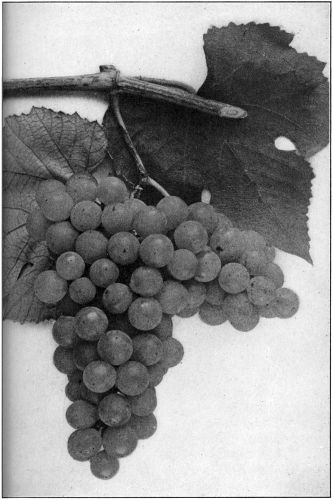
Plate XXX.—Winchell (×2/3).
Lenoir
(Bourquiniana)
Alabama, Black El Paso, Black July, Black Spanish, Blue French, Burgundy, Cigar Box Grape, Devereaux, Jack, Jacques, July Sherry, Longworth's Ohio, MacCandless, Ohio, Springstein, Warren
Lenoir is a tender southern grape which has been used largely in France and California as a resistant stock and a direct producer. The fruit is highly valued for its dark red wine and is very good for table use. The vine is very resistant to phylloxera and withstands drouth well. The origin of Lenoir is unknown. It was in cultivation in the South as long ago as the early part of the last century. Nicholas Herbemont states in 1829 that its name was given from a man named Lenoir who cultivated it near Stateburg, South Carolina.
Vine vigorous, thrifty, semi-hardy, productive. Canes numerous, with some bloom at the nodes; tendrils intermittent. Leaves from two to seven-lobed, usually five, with characteristic bluish-green color above and pale green below.
Clusters variable, medium to very large, tapering, usually shouldered. Berries small, round, dark bluish-purple, nearly black with lilac bloom; skin thick, tough; flesh juicy, tender, sweet, very rich in coloring matter.
Lignan Blanc
(Vinifera)
White July, Luglienga, Joannenc
At Geneva, New York, Lignan Blanc ripens first of all grapes, native or European. It is not of highest quality but is better than any other early grape and makes a valuable addition to the home vineyard. It is a favorite grape in Europe and is rather commonly grown in California. This variety offers excellent material for hybridization with native grapes.
Vine vigorous, medium productive; buds open early; opening leaves light green, glossy, tinged with red along the edges, thinly pubescent. Leaves medium in size, roundish, somewhat dull green, slightly rugose; lower surface glabrous; blade thick; lobes usually five though sometimes three; petiolar sinus medium in depth, wide; lower lateral sinus medium in depth, narrow; upper lateral sinus shallow, narrow; margin dentate; teeth long, narrow. Flowers appear early for a Vinifera; stamens upright.
Fruit ripens the first of September and is a good keeper; clusters above medium in size, tapering, medium compact; berries medium to large, oval, yellowish-green, with thin bloom; skin thin, tender, neutral; flesh greenish-white, firm, juicy, meaty, sweet; quality good.
Lindley
(Labrusca, Vinifera)
By common consent, Lindley (Plate XXII) is the best of the red grapes originated by Rogers in his crosses between Labrusca and Vinifera. The bunches are of only medium size and are loose, but the berries are well-formed, of uniform size and an attractive dark red color. The flesh is firm, fine-grained, juicy, tender with a peculiarly rich aromatic flavor. The skin is thick and tough but is not objectionable in fruit fully ripe. The fruit keeps and ships well, and the berries neither crack nor shatter. The vine is vigorous, hardy for a Vinifera hybrid, healthy but, as with most of its kind, susceptible to mildew. The chief defects of Lindley are self-sterility, precariousness in bearing and lack of adaptation to many soils. Lindley is a general favorite in the garden. In 1869 Rogers gave this grape its name in honor of John Lindley, the English botanist.
Vine vigorous, usually hardy, susceptible to mildew. Canes very long, dark reddish-brown with thin bloom; nodes enlarged, usually flattened; internodes long, thick; tendrils continuous, long, bifid or trifid. Leaves large, thick; upper surface light green, dull, slightly rugose; lower surface grayish-white, pubescent; obscurely three-lobed with terminus acute; petiolar sinus deep, narrow, often closed and overlapping; teeth shallow. Flowers self-sterile, open in mid-season; stamens reflexed.
Fruit mid-season, keeps and ships well. Clusters long, broad, cylindrical, frequently single-shouldered, the shoulder being connected to the bunch by a long stem, loose; pedicel short, slender, smooth; brush short, pale green. Berries large, round-oval, dark-red with faint bloom; skin tough, adherent, unpigmented, strongly astringent; flesh pale green, translucent, juicy, fine-grained, tender, vinous; good to best. Seeds adherent, two to five, notched, brown.
Lucile
(Labrusca)
In vigor, health, hardiness and productiveness, Lucile (Plate XXII) is not surpassed by any native grape. Unfortunately, the fruit characters are not so desirable. The size, form and color of bunches and berries are good, making a very attractive fruit, but the grapes have an obnoxious, foxy taste and odor and are pulpy and seedy. Lucile is earlier than Concord, the crop ripening with that of Worden or preceding it a few days. For an early variety, the fruit keeps well and in spite of thin skin ships well. The vine thrives in all grape soils. Lucile may be recommended where a hardy grape is desired and for localities in which the season is short. J. A. Putnam, Fredonia, New York, grew Lucile. The vine fruited first in 1890. It is a seedling of Wyoming, which it resembles in fruit and vine and surpasses in both.
Vine vigorous, hardy, very productive. Canes long, light brown; nodes enlarged, flattened; internodes short; tendrils continuous, bifid or trifid. Leaves large, firm; upper surface light green, glossy, smooth; lower surface pale green, pubescent; leaf with terminus acute; petiolar sinus shallow, narrow, sometimes closed and overlapping; basal sinus usually absent; lateral sinus a notch when present; teeth shallow. Flowers self-fertile, open early; stamens upright.
Fruit early, keeps well. Clusters large, long, slender, cylindrical, usually single-shouldered, very compact; pedicel short, thick with few, small, inconspicuous warts; brush light brown. Berries large, round, dark red with thin bloom, persistent, firm; skin thin, tender, astringent; flesh pale green, translucent, juicy, tough, stringy, foxy; fair in quality. Seeds adherent, one to four, small, broad, short, blunt, dark brown.
Lutie
(Labrusca)
Lutie (Plate XXIII) is chiefly valuable for its vine characters. The vines are vigorous, hardy, healthy and fruitful, although scarcely equaling Lucile in any of these characters. Pomologists differ widely as to the merits of the fruit, some claiming high quality for it and others declaring that it is no better than a wild Labrusca. The difference of opinion is due to a peculiarity of the fruit; if eaten fresh, the quality, while far from being of the best, is not bad, but after being picked for several days it develops so much foxiness of flavor and aroma that it is scarcely edible. Lutie is a seedling found by L. C. Chisholm, Spring Hill, Tennessee. It was introduced in 1885.
Vine vigorous, hardy, healthy, productive. Canes short, slender, dark reddish-brown; nodes enlarged; internodes short; tendrils continuous, short, bifid. Leaves medium in size; upper surface dark green, rugose; lower surface bronze or whitish-green, pubescent; leaf usually not lobed with terminus acute; petiolar sinus deep, wide; basal sinus lacking; lateral sinus shallow and narrow when present; teeth shallow, narrow. Flowers self-fertile, early; stamens upright.
Fruit early, does not keep well. Clusters medium in size, short, broad, blunt, cylindrical, usually not shouldered, compact; pedicel short with small, scattering warts; brush slender, pale green. Berries large, round, dark red, dull with thin bloom, drop badly from pedicel, firm; skin tender, adherent, astringent; flesh pale green, translucent, juicy, tough, foxy; fair in quality. Seeds adherent, one to four, large, broad, short and blunt, dark brown.
Malaga
(Vinifera)
Malaga is one of the favorite table-grapes in California and also a popular grape to ship to eastern markets. In some parts of southern California, where the Muscats do not thrive, it is much grown, and in the San Joaquin Valley it is rather largely used in making raisins. It requires a long season and probably could not be grown in eastern regions except in the most favored localities. The description is compiled.
Vine very vigorous, healthy and productive; wood reddish-brown, short-jointed. Leaves of medium size, smooth, leathery; light glossy green above, lighter below; deeply lobed. Bunches very large, long, loose, shouldered, sometimes scraggly; stem long and flexible; berries very large, oval, yellowish-green, covered with light bloom; skin thick; flesh firm, crisp, sweet and rich; quality good. Season late, keeps and ships well.
McPike
(Labrusca)
McPike is noteworthy because of the large size of the berries and bunches. It is very similar to its parent, Worden, differing in having fewer but larger berries, grapes not as high in flavor and fewer and smaller seeds. Because of the thin, tender skin, the berries crack badly. The grapes shell more or less, and the vines are less productive than those of Worden. The faults named debar it from becoming a commercial grape and it is not high enough in quality to make it of value for the amateur. This variety originated with H. G. McPike, Alton, Illinois, from seed of Worden planted in 1890.
Vine vigorous, hardy, very productive. Canes of medium length, dull reddish-brown; nodes enlarged, flattened; internodes very short; tendrils continuous, bifid or trifid. Leaves large, thick; upper surface light green, dull, rugose; lower surface grayish-white, heavily pubescent; leaf entire with terminus acute; petiolar sinus deep; basal and lateral sinuses lacking. Flowers nearly self-fertile.
Fruit mid-season, keeps well. Clusters variable in size, broad, irregularly tapering, usually not shouldered; pedicel long, thick, smooth; brush long, slender, green with brown tinge. Berries unusually large, round, purplish-black with heavy bloom, firm; skin cracks, adherent to pulp, astringent; flesh pale green, translucent, juicy, tender, stringy, vinous; fair to good. Seeds adherent, one to four, short, broad, blunt, plump, light brown.
Marion
(Vulpina, Labrusca)
Black German, Marion Port
Marion so closely resembles Clinton in botanical and horticultural characters as to be clearly of the same type. The vine is vigorous and hardy, but hardly sufficiently productive, and is susceptible to mildew and leaf-hoppers. The fruit is pleasantly sweet and spicy, although not high enough in quality for a table-grape, but makes a very good dark red wine. The fruit colors early but ripens late, hangs well on the vines and improves with a touch of frost. Marion was brought to notice by a Mr. Shepherd, Marion, Ohio, about 1850.
Vine vigorous, hardy, productive. Canes very long, dark reddish-brown, covered with bloom; nodes enlarged, flattened; internodes very long; tendrils continuous, sometimes intermittent, long, bifid. Leaves very large; upper surface dark green, glossy; lower surface pale green, smooth; leaf entire, terminus acuminate; petiolar sinus very deep, narrow, often closed and overlapping; basal and lateral sinuses usually lacking; teeth shallow, wide. Flowers self-sterile, open very early; stamens reflexed.
Fruit mid-season, keeps well. Clusters medium in size, short, slender, cylindrical, single-shouldered, compact; pedicel short, slender with a few inconspicuous warts; brush very short, wine-colored. Berries small, round, black, glossy with heavy bloom, persistent, firm; skin thin, tough, adherent with much wine-colored pigment, astringent; flesh dark green, translucent, juicy, fine-grained, tough, sprightly, spicy, tart; fair in quality. Seeds adherent, one to five, medium in size, broad, short, very plump, brown.
Martha
(Labrusca, Vinifera)
Martha was at one time a popular green grape, but the introduction of superior varieties has reduced its popularity until now it is but little grown. It is a seedling of Concord and resembles its parent, differing chiefly as follows: fruit green, a week earlier, bunch and berry smaller, flavor far better, being sweeter, more delicate and less foxy. The vine of Martha is a lighter shade of green, is less robust, and the blossoms open a few days earlier than those of Concord. One of the defects of Martha, and the chief cause of its going out of favor, is that it does not keep nor ship well. The variety is still being planted in the South but is generally abandoned in the North. Samuel Miller, Calmdale, Pennsylvania, grew Martha from seed of Concord; it was introduced about 1868.
Vine hardy, productive, susceptible to attacks of mildew. Canes long, dark reddish-brown, surface with thin bloom, roughened; nodes enlarged, slightly flattened; tendrils continuous, or intermittent, bifid. Leaves large, thick; upper surface light green; lower surface light bronze, heavily pubescent; lobes wanting or faint; petiolar sinus shallow, very wide; teeth irregular. Flowers self-fertile, open in mid-season; stamens upright.
Fruit early mid-season. Clusters medium in size, tapering, single-shouldered, loose; pedicel short, slender; brush very short, green. Berries medium in size, round, light green with thin bloom, persistent; skin thin, very tender, adherent; flesh pale green, juicy, tough, fine-grained, slightly foxy; very good. Seeds few in number, adherent, broad, blunt, dark brown.
Massasoit
(Labrusca, Vinifera)
Massasoit is distinguished as the earliest of Rogers' hybrids, ripening with Delaware. The grapes have the peculiarity of being best before full maturity, developing, after ripening, a degree of foxiness which impairs the quality. In shape and size of berry and bunch, there is a striking resemblance to Isabella, but the color is that of Catawba. The texture of the fruit is especially good, firm but tender and juicy, while the flavor is rich and sweet. The vine is vigorous, hardy and productive but subject to mildew and rot. Massasoit is worth a place in the home vineyard and as an early grape of fine quality for local markets.
Vine very vigorous, hardy, very productive, subject to rot and mildew. Canes long, thick, dark brown with reddish tinge; nodes enlarged, flattened; tendrils continuous, long, trifid or bifid. Leaves variable in size; upper surface light green, dull, smooth; lower surface pale green, pubescent; lobes three to five with terminus acute; petiolar sinus deep, narrow; basal sinus shallow, narrow, obscure; teeth shallow. Flowers self-sterile, open late; stamens reflexed.
Fruit early, keeps well. Clusters variable in size, broad, cylindrical, frequently single-shouldered; pedicel slender with a few indistinct warts; brush pale green. Berries large, round-oval, dark brownish-red, dull with thin bloom, very persistent, firm; skin thin, tender, adherent, astringent; flesh pale green, translucent, juicy, fine-grained, soft, stringy, foxy; good to very good. Seeds adherent, one to five, large, broad, distinctly notched, plump, blunt.
Maxatawney
(Labrusca, Vinifera)
While at one time very popular, grape-growers now seldom hear of Maxatawney. It is a southern grape, ripening its fruit in the North only occasionally. The variety is interesting historically as being the first good green grape and as showing unmistakable Vinifera characters, another example of the fortuitous hybridization which gave so many valuable varieties before artificial hybridization of Vinifera with native grapes had been tried. In 1843, a man living in Eagleville, Pennsylvania, received several bunches of grapes from Maxatawney. The seeds of these grapes were planted and one grew, the resulting plant being the original vine of Maxatawney.
Vine vigorous, doubtfully hardy, variable in productiveness. Canes medium in length, slender, reddish; nodes enlarged, flattened; internodes short; tendrils continuous, bifid. Leaves large, dark green, thick; lower surface grayish-white with tinge of bronze, heavily pubescent; lobes three to five; petiolar sinus narrow; teeth shallow. Flowers self-sterile, open in mid-season; stamens upright.
Fruit late, keeps well. Clusters small to medium, short, slender, cylindrical, occasionally with a small, single shoulder, compact; pedicel long, slender, warty; brush long, yellow. Berries variable in size, oval, pale red or dull green with amber tinge, with thin bloom, persistent; skin tough, astringent; flesh tender, foxy; good to very good. Seeds free, few, large, very broad, blunt.
Memory
(Rotundifolia)
Memory is one of the best of the Rotundifolia grapes for the garden and local markets, its fruits being especially good for dessert. As yet, however, the variety has not been widely distributed even in North Carolina where it originated. The vine is given credit for being the most vigorous grower and the most productive of the grapes of its species. Memory is probably a seedling of Thomas, which it much resembles, having been found in a vineyard of Thomas grapes near Whiteville, North Carolina, by T. S. Memory, about 1868.
Vine very vigorous, healthy, productive. Leaves large, longer than broad, thick, smooth with coarsely serrate margins. Flowers perfect.
Fruit ripens in September in North Carolina; clusters large, with from four to twelve berries which hang unusually well for a variety of V. Rotundifolia. Berries very large, round-oblong, deep brownish-black, almost jet black; skin thick; flesh tender, juicy, sweet; good to best.
Merrimac
(Labrusca, Vinifera)
Merrimac is often accredited as the best black grape among Rogers' hybrids, but an analysis of the characters of the several black varieties grown by Rogers shows that it is surpassed by Wilder, Herbert and possibly Barry. The vine is strong in growth, productive, hardy and exempt from fungal diseases; but the grapes are not high in quality, and flesh, skin and seed characters are such that the fruit is not as pleasant to eat as the other black varieties named. Merrimac is worthy a place in collections for the sake of variety. Rogers gave this variety the name Merrimac in 1869.
Vine vigorous, usually hardy, productive. Canes slender, dark brown, surface roughened; nodes enlarged, flattened; internodes short; tendrils intermittent, short, bifid. Leaves large, thin; upper surface very light green, glossy, smooth; lower surface pale green, pubescent and cobwebby; lobes three with terminal one obtuse; petiolar sinus deep, narrow, sometimes closed and overlapping; basal sinus usually lacking; lateral sinus shallow, narrow; teeth shallow. Flowers self-sterile, open in mid-season; stamens reflexed.
Fruit mid-season, keeps and ships well. Clusters variable in size, broad, tapering; pedicel slender, covered with numerous inconspicuous warts; brush wine-colored. Berries large, round, black, glossy with abundant bloom, persistent, firm; skin thick, tough, adherent, astringent; flesh light green, translucent, juicy, fine-grained, tender, stringy; good. Seeds adherent, one to five, broad, long, with enlarged neck, brown.
Mills
(Labrusca, Vinifera)
The bunches and berries of Mills are large and well-formed; the berries are firm and solid, with the skin adherent as in Viniferas; the flesh is juicy and parts readily from the seeds; the flavor is rich, sweet and vinous; and the grapes are hardly surpassed in keeping quality. But when the fruit characters of Mills have been praised, nothing further can be said in its favor. The vines are neither vigorous, hardy nor fruitful and are very subject to mildew; neither wood nor roots ripen well in the North in average seasons; and the variety is a most difficult one for nurserymen to grow. Mills is of doubtful commercial value, but for the garden it is possible that the grower may be able to graft it to advantage on some variety with better vine characters. William H. Mills, Hamilton, Ontario, grew Mills about 1870 from seed of Muscat Hamburg fertilized by Creveling.
Vine medium in vigor, hardiness and productiveness. Canes long, thick, light brown; nodes enlarged, flattened; tendrils intermittent, bifid or trifid. Leaves large, thick; upper surface dark green, dull, rugose; lower surface pale green, cobwebby; lobes three to five with terminus acute; petiolar sinus intermediate in depth and width; basal and lateral sinuses deep and wide; teeth deep. Flowers self-fertile, open in mid-season; stamens upright.
Fruit mid-season, keeps well. Clusters large, long, slender, cylindrical, often double-shouldered, compact; pedicel slender with numerous, small warts; brush long, wine-colored. Berries large, oval, jet-black with abundant bloom, persistent, firm; skin thick, tough, adherent; flesh light green, translucent, juicy, rich, tender, sprightly, vinous, sweet; very good to best. Seeds free, one to three, large, brown.
Mish
(Rotundifolia)
Mish is a favorite Rotundifolia in North Carolina, being planted extensively in some parts of that state. Its outstanding characters are vigor and productiveness in vine and high quality in the fruit. Mish is named by many as the best all-round Rotundifolia, being of value for dessert, wine and grape-juice. The variety was found by W. M. Mish, about 1846, near Washington, North Carolina.
Vine very vigorous, productive, healthy, open in growth; canes somewhat trailing. Leaves large, round, thick, smooth, leathery with coarsely dentate margin. Flowers perfect.
Fruit late, does not ripen uniformly, keeps and ships well. Clusters of medium size with from six to fifteen berries which cling well to the pedicel. Berries of medium size, round-oval, deep reddish-black with numerous conspicuous dots; skin thin, cracking in wet weather; flesh tender, juicy, sweet, exceptionally well flavored; very good to best.
Mission
(Vinifera)
Of all grapes, Mission has probably played the most important part in the vineyards of California. Grown from the earliest times at the old missions, its source or its name has never been determined. Its viticultural value for table and wine-press was early appreciated by California grape-growers, and its culture rapidly spread to every county in the state adapted to grape-growing. With vines vigorous, healthy and productive, bearing grapes of delicious quality, Mission is a mainstay on the Pacific slope, surpassed by few vineyard varieties for general usefulness. The description is compiled.
Vine vigorous, healthy, productive; wood short-jointed, grayish-brown, dull, dark. Leaf medium to large, slightly oblong, with large, deeply-cut compound teeth; basal sinus widely opened, primary sinuses narrow and shallow; smooth on both sides with scattered tomentum below, bright green above, lighter below. Bunch divided into many small, distinct lateral clusters, shouldered, loose, sometimes very loose; berries of medium size, purple or almost black with heavy bloom; skin thin; flesh firm, crisp, juicy, sweet, rich and delicious. Seeds rather large and prominent; season late.
Missouri Riesling
(Vulpina, Labrusca)
Missouri Riesling attains perfection only in the South. The vines are hardy, vigorous, productive and healthy in the North, as a rule, but the fruit is lacking in quality. In the South, Missouri Riesling is a beautiful fruit when well grown and has many good qualities of fruit and vine. It originated with Nicholas Grein, Hermann, Missouri, about 1870, probably from seed of Taylor.
Vine vigorous, hardy, productive. Canes very long, numerous, thick, dark brown; nodes enlarged; internodes long; tendrils continuous, long, trifid or bifid. Leaves large, thick; upper surface dark green, glossy, smooth; lower surface pale green, thinly pubescent; lobes five with terminal one acuminate; petiolar sinus deep, narrow; basal sinus shallow, wide; lateral sinus deep, wide; teeth deep, wide. Flowers self-fertile, open in mid-season; stamens upright.
Fruit late, does not keep nor ship well. Clusters short, cylindrical, single-shouldered; pedicel long with few small warts; brush green. Berries of medium size, round, yellowish-green changing to light red with thin bloom, persistent, firm; skin sprinkled with small brown dots, thin, tough, adherent, astringent; flesh pale green, translucent, juicy, tender, fine-grained, lacking in aroma, mild; fair in quality. Seeds adherent, one to four, surface rough, dark brown.
Montefiore
(Vulpina, Labrusca)
Montefiore is extensively grown in Missouri and the Southwest but is almost unknown in the North and East. It is reported as succeeding in the Lake District of Ohio and, with the exception that it is uncertain in bearing and not always productive, it grows well in sections of New York. While it is essentially a wine-grape, yet it is pleasing in taste and texture of fruit and is far better in quality than many of the coarser Labruscas commonly cultivated. It keeps and ships well and presents an attractive appearance. Jacob Rommel, Morrison, Missouri, grew this variety about 1875 from seed of Taylor fertilized by Ives.
Vine vigorous and hardy. Canes long, thick, dark brown with thin bloom; nodes enlarged, flattened; internodes long; tendrils continuous, long, bifid. Leaves thick; upper surface light green, dull, smooth; lower surface grayish-white, pubescent; lobes three when present with terminus acute; petiolar sinus wide; basal sinus lacking; lateral sinus shallow when present; teeth deep. Flowers semi-fertile, open in mid-season; stamens upright.
Fruit mid-season, keeps well. Clusters small, short, tapering, single-shouldered, the shoulder being connected to the bunch by a long stem, compact; pedicel short, slender, smooth; brush red. Berries small, oval, often compressed, black, glossy with abundant bloom, persistent, firm; skin thin, tough, adherent, astringent; flesh green, translucent, juicy, fine-grained, tender, melting, vinous, sweet; fair to good. Seeds free, one to five, small, broad, faintly notched, short, plump, brown.
Moore Early
(Labrusca)
Moore Early (Plate XXIV) is the standard grape of its season. Its fruit cannot be described better than as an early Concord. The vines are readily distinguishable from those of Concord, differing chiefly in being less productive. To grow the variety satisfactorily, the soil must be rich, well-drained and loose, must be frequently cultivated, and the vines should be pruned severely. The bunches of Moore Early are not as large as those of Concord and are less compact; the berries shell rather more easily, and the skin cracks more readily. The flesh characters and the flavor are essentially those of Concord, although the quality is not as high as in the older variety. The quality is, however, much higher than that of Champion and Hartford, its chief competitors, and varieties which it should replace. Moore Early is by no means an ideal grape for its season, but until something better is introduced it will probably remain the best early commercial sort. Captain John B. Moore, Concord, Massachusetts, originated this variety from seed of Concord, planted about 1868.
Vine vigorous, hardy, unproductive. Canes short, dark reddish-brown; nodes enlarged, flattened; internodes short; tendrils continuous, bifid or trifid. Leaves large, thick; upper surface dark green, dull; lower surface tinged with bronze, heavily pubescent; leaf usually not lobed, terminus acute; petiolar sinus wide; basal sinus lacking; lateral sinus a notch when present; teeth shallow, narrow. Flowers fertile, open in mid-season; stamens upright.
Fruit early, does not keep well. Clusters medium in size, length, and breadth, cylindrical, sometimes single-shouldered, loose; pedicel short, thick, smooth; brush short, pale green. Berries large, round, purplish-black, firm; skin tender, adherent; flesh green, translucent, juicy, fine-grained, tough with slight foxiness; fair to good. Seeds one to four, large, broad, plump, blunt, brown with yellow tinge at tips.
Moscatello
(Vinifera)
Moscatello Nero. Black Muscat
Beautiful in appearance and having a delicate Muscat taste and aroma, this variety is one of the good table-grapes of the Pacific slope. Unfortunately it ripens so late that it is hardly worth trying in the East. The variety has the reputation of being very productive. The description is compiled.
Vine vigorous, healthy, very productive. Leaves of medium size, with deep upper and shallow lower sinuses; glabrous above, slightly downy below, very hairy on the veins, with long, sharp teeth. Bunch large to very large, long, loose, conico-cylindrical, winged; berries very large, borne on long slender pedicels, dark purple, almost black; skin thin but tough; flesh rather soft, juicy; flavor sweet, rich, aromatic, musky; quality very good. Season late, does not keep well.
Moyer
(Labrusca, Bourquiniana)
Jordan, Moyer's Early Red
Moyer is almost a counterpart of its parent, Delaware. Were it not that the variety is from one to two weeks earlier than Delaware, and somewhat hardier, hence better adapted for cold regions, it could have no place in viticulture. Compared with Delaware, the vine is hardly as vigorous and is less productive, but is freer from rot and mildew. The bunches are much like those of Delaware but have the fault of setting fruit imperfectly even when cross-pollination is assured; the berries are a little larger, of much the same color and of like flavor, rich, sweet, with pure vinousness and without a trace of foxiness. The fruit keeps well, ships well and does not crack nor shell. Moyer is well established in Canada, proving perfectly hardy wherever Concord is grown, possibly standing even more cold. W. H. Read, Port Dalhousie, Ontario, raised the original vine of Moyer, about 1880, from seed of Delaware fertilized by Miller's Burgundy.
Vine vigorous, hardy, healthy, unproductive. Canes numerous, slender, dull, dark reddish-brown; nodes enlarged, flattened; internodes short; tendrils continuous, long, bifid or trifid. Leaves small; upper surface dark green, dull, smooth; lower surface pale green or with faint blue tinge, heavily pubescent; lobes two to five with terminus acute; petiolar sinus shallow; basal sinus shallow when present; lateral sinus shallow, narrow; teeth very shallow, narrow. Flowers self-sterile, open early; stamens reflexed.
Fruit early, keeps well but loses color if kept too long. Clusters small, short, slender, tapering, sometimes single-shouldered; pedicel short with small warts; brush yellowish-green. Berries small, oblate, dark red with faint bloom, persistent, firm; skin tough, free, astringent; flesh translucent, juicy, tender, fine-grained, vinous; good to very good. Seeds free, one to four, broad, short, very blunt, brown with yellow tinge at tips.
Muscatel
(Vinifera)
White Frontignan
This old and standard sort is rather commonly grown in some of the grape regions of California to follow Chasselas Golden. It might be tried with some show of success in favored grape regions in the East. The description is compiled.
Vine of medium size, vigorous, healthy; canes strong, spreading, reddish-brown with short internodes. Leaves of medium size, thin, five-lobed; glabrous except on the lower sides of the well-marked ribs where a few hairs show. Bunches long, cylindrical, regular, compact; berries round, golden-yellow becoming amber; flavor sweet, rich, aromatic, peculiar; quality very good. Season late mid-season, keeps and ships well.
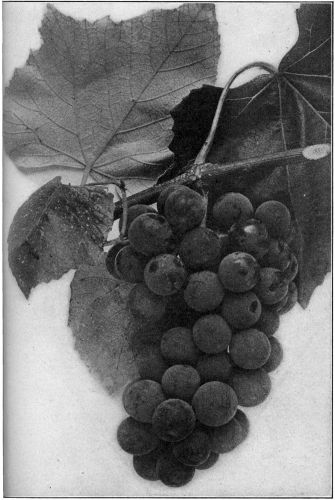
Plate XXXI.—Worden (×2/3).
Muscat Hamburg
(Vinifera)
Muscat Hamburg (Plate XXV) is an old European grape well known in some parts of America in greenhouse graperies, since it is one of the best for forcing. All who know the beautiful fruits of this variety grown in forcing-houses will want to test it out of doors, where at the Geneva, New York, Experiment Station, they have done well, many clusters attaining a weight of a pound and a half to two pounds. The accompanying plate, the fruit much less than half natural size, shows what a fine grape Muscat Hamburg is. One is struck with wondering admiration at a vine laden with these grapes growing alongside Concord, Niagara or Delaware. The quality is delectable, the quintessence of the flavors and aromas which make the grape a favorite fruit. The grapes keep long and retain their form, size, color and rich, delicate flavor almost to the end. This variety is a treasure to the amateur; and the professional who wants another grape for local markets should try grafting over a few vines of some native to this sort, following the directions given in Chapter X in caring for the vines.
Vines vigorous, tender, need protection during the winter; canes long, numerous, slender to medium, light brown, darker at the nodes which are enlarged and flattened. Leaves medium to large, intermediate in thickness; upper surface light green, dull; lower surface pale green, faintly pubescent, densely hairy.
Fruit ripens in October, ships and keeps well; clusters very large, long, broad, tapering, single or double-shouldered. Berries large, firm, oval, very dark purplish-red, covered with lilac bloom, very persistent; skin thick, adheres strongly to the pulp; flesh pale green, translucent, meaty, very juicy, tender, vinous, musky, sweet, rich; very good to best; seeds separating easily from the pulp, large.
Muscat of Alexandria
This is possibly the leading table- and raisin-grape of the Pacific slope. From the literature or from a visit to vineyards, one cannot make out whether one or several varieties are grown under the name. Probably there are several strains grown under the distinctive name "Muscat" which applies to these sweet, light yellow, musky grapes. This is one of the standard sorts to force indoors but requires too long a season for out of doors in the East. The following description is compiled:
Vine short, straggling, bushy, sometimes forming a bush rather than a vine, very productive; wood gray with dark spots, short-jointed. Leaf round, five-lobed; bright green above, lighter green below. Bunches long and loose, shouldered; berry oblong, light yellow and transparent when fully mature, covered with white bloom; flesh firm, crisp; flavor sweet and very musky; quality good. Season late, the laterals producing a second and sometimes even a third crop.
Niagara
(Labrusca, Vinifera)
Niagara (Plate XXVI) is the leading American green grape, holding the rank among grapes of this color that Concord maintains among black varieties. It is, however, a less valuable grape than Concord, and it is doubtful whether it should be ranked much higher than several other green grapes. In vigor and productiveness, when the two grapes are on equal footing as to adaptability, Niagara and Concord rank the same. In hardiness of root and vine, Niagara falls short of Concord; it cannot be relied on without winter protection where the thermometer falls below zero. Niagara has much of the foxiness of the wild Labrusca, distasteful to many palates. Both bunches and berries of Niagara are larger than those of Concord and are better formed, making a handsomer fruit if the colors are liked equally well. The fruit shells as badly as that of Concord and does not keep longer. Both vine and fruit of Niagara are more susceptible to fungal diseases than those of Concord, especially to black-rot, which proves a veritable scourge with this variety in unfavorable seasons. Niagara was produced by C. L. Hoag and B. W. Clark, Lockport, New York, from seed of Concord fertilized by Cassady planted in 1868.
Vine vigorous, lacking in hardiness, very productive. Canes long, thick, reddish-brown deepening in color at the nodes which are enlarged and slightly flattened; internodes long, thick; tendrils continuous, long, bifid or trifid. Leaves large, thick; upper surface glossy, dark green, smooth; lower surface pale green, pubescent; lobes three to five with terminus acute; petiolar sinus of medium depth and width; basal sinus shallow, wide, often toothed; lateral sinus wide, frequently toothed; teeth shallow, variable in width. Flowers self-fertile, open in mid-season; stamens upright.
Fruit mid-season, keeps well. Clusters large, long, broad, tapering, frequently single-shouldered, compact; pedicel thick with a few, small, inconspicuous warts; brush pale green, long. Berries large, oval, pale yellowish-green with thin bloom, persistent, firm; skin thin, tender, adherent, astringent; flesh light green, translucent, juicy, fine-grained, tender, foxy; good. Seeds free, one to six, deeply notched, brown.
Noah
(Vulpina, Labrusca)
Noah is little grown at present outside of Missouri, where it is still planted somewhat. Noah and Elvira are often confused but there are very marked differences. The clusters of Elvira are smaller, the berries are more foxy in taste, and the skins are more tender and crack more readily than do those of Noah. The large, dark, glossy green leaves make the vines of this variety very handsome. As with Elvira and other varieties of this group, Noah is of little value in the North. It originated with Otto Wasserzieher, Nauvoo, Illinois, from seed of Taylor planted in 1869.
Vine vigorous, doubtfully hardy, productive. Canes long, thick, dark brown, surface roughened; nodes enlarged, flattened; tendrils continuous, bifid or trifid. Leaves large; upper surface dark green, glossy, smooth; lower surface pale green, thinly pubescent; leaf usually not lobed with terminus acuminate; petiolar sinus deep, wide; basal sinus lacking; lateral sinus very shallow when present; teeth shallow, wide. Flowers semi-fertile, open early; stamens upright.
Fruit late mid-season, does not ship nor keep well. Clusters variable in size, cylindrical, single-shouldered, compact; pedicel short with a few small warts; brush short, brown. Berries small, round, light green tinged with yellow, dull with thin bloom, firm; skin adherent to pulp; flesh yellowish-green, translucent, juicy, tough, fine-grained, vinous, sprightly; good. Seeds adherent, one to four, dark brown.
Northern Muscadine
(Labrusca)
That this variety, together with Lucile, Lutie and other grapes with the foxy taste strongly marked, has not become popular, in spite of good vine characters, is evidence that the American public do not desire such grapes. In appearance of fruit, Northern Muscadine is much like Lutie, the two being distinguished from other grapes by an unmistakable odor. A serious defect of the fruit is that the berries shatter badly as soon as they reach maturity. Taken as a whole, the vine characters of this variety are very good and offer possibilities for the grape-breeder. The variety originated at New Lebanon, New York, and was brought to notice by D. J. Hawkins and Philemon Stewart of the Society of Shakers about 1852.
Vine vigorous, productive, healthy, hardy. Canes slender, dark brown, heavily pubescent; tendrils continuous, bifid, dehisce early. Leaves large, round, thick; upper surface dull, rugose; lower surface dark bronze, heavily pubescent. Flowers self-fertile, open in mid-season; stamens upright.
Fruit early mid-season, does not keep well. Clusters medium in size, short, occasionally single-shouldered, compact. Berries large, oval, dark amber with thin bloom, drop badly from the pedicel; skin tough, adherent, astringent; flesh pale green, juicy, fine-grained, tender, soft, very foxy, sweet; poor in quality. Seeds free, numerous, large, broad, faintly notched, long, brown.
Norton
(Æstivalis, Labrusca)
Norton is one of the leading wine-grapes in eastern America, the fruit having small value for any other purpose than wine or, possibly, grape-juice. The vine is hardy but requires a long, warm season to reach maturity so that it is seldom grown successfully north of the Potomac. Norton thrives in rich alluvial clays, gravels or sands, the only requisite seemingly being a fair amount of fertility and soil warmth. The vines are robust; very productive, especially on fertile soils; as free, or more so, from fungal diseases as any other of our native grapes; and are very resistant to phylloxera. The bunches are of but medium size and the berries are small. The grapes are pleasant eating when fully ripe, rich, spicy and pure-flavored but tart if not quite ripe. The variety is difficult to propagate from cuttings and to transplant, and the vines do not bear grafts well. The origin of Norton is uncertain, but it has been under cultivation since before 1830, when it was first described.
Vine very vigorous, healthy, half-hardy, productive. Canes long, thick, dark brown with abundant bloom; nodes much enlarged; internodes long; tendrils intermittent, occasionally continuous, long, bifid, sometimes trifid. Leaves large, irregularly round; upper surface pale green, dull, rugose; lower surface pale green, pubescent; leaf usually not lobed with terminus acute; petiolar sinus deep, narrow, sometimes closed and overlapping; basal sinus usually absent; lateral sinus shallow or a mere notch when present. Flowers self-fertile, late; stamens upright.
Fruit late, keeps well. Clusters medium in size, short, broad, tapering, single-shouldered, compact; pedicel slender with a few warts; brush dull, wine-colored. Berries small, round-oblate, black, glossy with heavy bloom, persistent, soft; skin thin, free with much dark red pigment; flesh green, translucent, juicy, tender, spicy, tart. Seeds free, two to six, small, brown.
Oporto
(Vulpina, Labrusca)
Oporto was at one time in demand as a wine grape because its wine resembled in color and flavor that from Oporto. The variety is now scarcely known, being inferior in most of its horticultural characters to others of its species, but might be valuable in breeding for some of its characters. The vine is very hardy, unusually free from fungal diseases, is very resistant to phylloxera and has been used in France as a phylloxera-resistant grafting-stock. The juice is very thick and dark, a deep purple, hence suitable for adding color to wine or grape-juice. The origin of Oporto is unknown. It was brought into cultivation about 1860 by E. W. Sylvester, Lyons, New York.
Vine very vigorous, hardy, healthy, variable in productiveness. Canes long, reddish-brown; nodes enlarged, flattened; internodes long, diaphragm thin; tendrils continuous, bifid. Stamens reflexed.
Fruit mid-season, ships and keeps well. Clusters small, cylindrical, often single-shouldered. Berries medium in size, round, black, glossy with abundant bloom, persistent, firm; skin very thin, tender, with much dark wine-colored pigment; flesh white, sometimes with purple tinge, juicy, fine-grained, solid, sweet, spicy; fair quality. Seeds free, numerous, small, broad, faintly notched, sharply pointed, plump, dark brown.
Othello
(Vinifera, Vulpina, Labrusca)
Arnold's Hybrid, Canadian Hamburg, Canadian Hybrid
In France, Othello does remarkably well as a direct producer and is used also for a resistant stock. While most of its characters are spoken of in the superlative by the French, in America the variety is not so highly esteemed because of susceptibility to fungi. Moreover, the fruit matures so late that it could never become a valuable variety for the North. It is in no sense a table-grape but makes a well-colored, pleasant wine. Charles Arnold, Paris, Ontario, grew Othello from seed of Clinton fertilized by Black Hamburg and planted in 1859.
Vine vigorous, hardy, productive. Canes long, brown; nodes enlarged, flattened; tendrils continuous, sometimes intermittent, bifid or trifid. Leaves of average size; upper surface light green, dull and smooth; lower surface pale green, pubescent; lobes three to five with terminal lobe acute; petiolar sinus deep, very narrow, frequently closed and overlapping; basal sinus shallow, narrow; lateral sinus deep; teeth deep, wide; stamens upright.
Fruit late, keeps fairly well. Clusters large, long, broad, tapering, frequently with a loose single shoulder, compact; pedicel long, slender with numerous small warts; brush short, wine-colored. Berries large, oval, black, glossy with abundant bloom, very persistent; skin thin, tough, adherent with red pigment; flesh dark green, very juicy, fine-grained, tough, sprightly; low in quality. Seeds free, one to three, neck sometimes swollen, brown.
Ozark
(Æstivalis, Labrusca)
Ozark belongs to the South and to Missouri in particular. Its merits and demerits have been threshed out by the Missouri grape-growers with the result that its culture is somewhat increasing. It is a grape of low quality, partly, perhaps, from over-bearing, which it habitually does unless the fruit is thinned. The vine is healthy and a very strong grower, but is self-sterile, which is against it as a market sort. In spite of self-sterility and low quality, Ozark is a promising variety for the country south of Pennsylvania. Ozark originated with J. Stayman, Leavenworth, Kansas, from seed of unknown source. The variety was introduced about 1890.
Vine very vigorous, hardy, productive. Canes long, thick with thin bloom, surface roughened; nodes enlarged, flattened; internodes long; tendrils intermittent, usually bifid. Leaves dense, large; upper surface light green; lower surface pale green, thinly pubescent, cobwebby; lobes three to five; petiolar sinus deep, narrow; serrations shallow, narrow. Flowers self-sterile or nearly so, open late; stamens reflexed.
Fruit late, keeps well. Clusters large, long, usually with a long, loose shoulder, very compact; pedicel short, thick, smooth; brush long, red. Berries variable in size, dull black with abundant bloom, persistent; skin tough with much wine-colored pigment; flesh tender, mild; fair in quality. Seeds free, small.
Palomino
(Vinifera)
Golden Chasselas, Listan
This variety seems to be grown in California under the three names given—while in France Palomino is described as a bluish-black grape. Palomino seems to be grown commonly in California as a table-grape and is worth trying in eastern America. The variety received under the name Palomino from California at the New York Experiment Station has the following characters, agreeing closely with those set down by Californian viticulturists:
Fruit ripens about the 20th of October, keeping qualities good; clusters medium to large, long, single-shouldered, tapering, loose; berries medium to small, roundish, pale greenish-yellow, thin bloom; skin and the adhering flesh medium tender and crisp, flesh surrounding seeds melting; flavor sweet, vinous; quality good.
Peabody
(Vulpina, Labrusca, Vinifera)
Peabody is as yet a comparatively unimportant offspring of Clinton. The grapes are of excellent quality. It appears to do better in the northern tier of states or in Canada, than farther south. This variety was grown by J. H. Ricketts about 1870.
Vine vigorous, hardy, productive. Canes long, numerous, thick, light brown with ash-gray tinge, darker at nodes, covered with thin bloom; nodes enlarged, flattened; internodes short; tendrils intermittent, bifid or trifid. Leaves medium in size; upper surface dark green, thin; lower surface pale green, nearly glabrous; lobes three, acuminate; petiolar sinus shallow, wide; serration deep, narrow. Flowers semi-fertile, mid-season; stamens upright.
Fruit early, keeps well. Clusters large, long, usually with a shoulder connected to the bunch by a long stem, compact; pedicel short, slender, warty; brush short, green. Berries oval, black, glossy, covered with thin bloom, persistent; skin thick, tough; flesh very juicy, tender, vinous, spicy, agreeably sweet at the skin, tart at the center; good. Seeds free, broad.
Perfection
(Labrusca, Bourquiniana, Vinifera)
Perfection is a seedling of Delaware, which it greatly resembles but does not equal in fruit; its fruits being hardly as high in quality, do not keep as well, shrivel more before ripening, and shell more readily. In its vine characters, it is much more like a Labrusca than Delaware, suggesting that it is a Delaware cross. In the Southwest, Perfection is considered a valuable early red grape. J. Stayman, Leavenworth, Kansas, grew Perfection from seed of Delaware; it was sent out for testing about 1890.
Vine vigorous, healthy, injured in severe winters, productive. Canes of medium length and number, slender; nodes enlarged, flattened; internodes short; tendrils intermittent, trifid or bifid. Leaves healthy, medium in size; upper surface light green; lower surface grayish-white with a tinge of bronze, heavily pubescent; lobes wanting or three to five; petiolar sinus shallow, wide; serration shallow. Flowers self-fertile or nearly so, open in mid-season; stamens upright.
Fruit early. Clusters usually single-shouldered, compact; pedicel short, slender, smooth; brush short, yellow. Berries small, round, red but less brilliant than Delaware with faint bloom, inclined to drop from pedicel, soft; skin thin, free from astringency; flesh medium in juiciness and tenderness, vinous, mild, sweet; good in quality. Seeds adherent, numerous, small, often with an enlarged neck.
Perkins
(Labrusca, Vinifera)
At one time Perkins was grown largely as an early grape but has been discarded very generally on account of the poor quality of the fruit. The pulp of the grape is hard and the flavor is that of Wyoming and Northern Muscadine, grapes characterized by disagreeable foxiness. As with nearly all Labruscas, Perkins is a poor keeper. Notwithstanding the faults of its fruit, the variety may have value in regions where grape-growing is precarious; for in fruiting it is one of the most reliable grapes cultivated, the vines being hardy, vigorous, productive and free from fungal diseases. Perkins is an accidental seedling found about 1830 in the garden of Jacob Perkins, Bridgewater, Massachusetts.
Vine vigorous, hardy, healthy, productive. Canes long, numerous, thick, dark brown, deepening in color at the nodes, surface heavily pubescent; nodes enlarged, flattened; internodes long; tendrils continuous, bifid or trifid. Leaves medium in size, thick; upper surface rugose; lower surface heavily pubescent; veins distinct; lobes three; petiolar sinus deep, narrow; serration shallow. Flowers self-fertile, early; stamens upright.
Fruit early, ships well. Clusters of medium size and length, broad, cylindrical, often with a single shoulder, compact; pedicel short, thick, warty; brush long, yellow. Berries large, oval, pale lilac or light red with thin bloom, inclined to drop from the pedicel, soft; skin thin, tough, without pigment; flesh white, juicy, stringy, fine-grained, firm, meaty, very foxy; poor in quality. Seeds adherent, numerous, medium in size, notched.
Pocklington
(Labrusca)
Before the advent of Niagara, Pocklington (Plate XXII) was the leading green grape. The variety has the fatal fault, however, of ripening its crop late, which with some minor defects has caused it to fall below Niagara for northern grape districts. Pocklington is a seedling of Concord and resembles its parent in vine characters; the vines are fully equal to or surpass those of Concord in hardiness, but are of slower growth and not quite as healthy, vigorous nor productive. In quality, the grapes are as good if not better than those of Concord or Niagara, being sweet, rich and pleasantly flavored, although as with the other grapes named, it has too much foxiness for critical consumers. Pocklington is not equal to several other grapes of its season in quality, as Iona, Jefferson, Diana, Dutchess and Catawba, but it is far above the average and for this reason should be retained. John Pocklington, Sandy Hill, New York, grew Pocklington from seed of Concord about 1870.
Vine medium in vigor, hardy. Canes of medium length, number and size, dark reddish-brown; nodes enlarged, flattened; tendrils continuous, bifid or trifid. Leaves variable in size, thick; upper surface light green, glossy; lower surface tinged with bronze, pubescent; lobes one to three with terminus acuminate; petiolar sinus deep, wide; teeth narrow. Flowers self-fertile, mid-season; stamens upright.
Fruit late mid-season, keeps and ships well. Clusters large, cylindrical, often single-shouldered, compact; pedicel short, thick with a few small warts; brush short, green. Berries large, oblate, yellowish-green with tinge of amber, with thin bloom, firm; skin with scattering russet dots, thin, tender, adherent, faintly astringent; flesh light green with yellow tinge, translucent, juicy, tough, fine-grained, slightly foxy; good. Seeds adherent, one to six, of medium length and breadth.
Poughkeepsie
(Bourquiniana, Labrusca, Vinifera)
Poughkeepsie has been known long on the Hudson River, yet it is now little grown there and has not been disseminated widely elsewhere. In quality of fruit, it is equal to the best American varieties, but the vine characters are all poor and the variety is thus effectually debarred from common cultivation. Both vine and fruit resemble those of Delaware, but in neither does it quite equal the latter. In particular, the vine is more easily winter-killed and is less productive than that of Delaware. The grapes ripen a little earlier than those of the last named sort and this, with their beauty and fine quality, is sufficient to recommend it for the garden at least. About 1865, A. J. Caywood, Marlboro, New York, grew Poughkeepsie from seed of Iona fertilized by mixed pollen of Delaware and Walter.
Vine of medium vigor. Canes short, thick, dark reddish-brown; tendrils intermittent, frequently three in line, bifid or trifid. Leaves small; upper surface green, glossy, older leaves rugose; lower surface grayish-green, pubescent. Flowers self-fertile, late; stamens upright.
Fruit early, keeps and ships well. Clusters small, tapering, usually single-shouldered, very compact. Berries small, round, pale red with thin bloom, persistent, firm; skin thin, tender, without pigment; flesh pale green, very juicy, tender, melting, fine-grained, vinous, sweet; very good to best. Seeds free, small, broad, with enlarged neck, brown.
Prentiss
(Labrusca, Vinifera)
Prentiss is a green grape of high quality, once well known and generally recommended, but now going out of cultivation because the vine is tender to cold, lacks in vigor, is unproductive, uncertain in bearing and is subject to rot and mildew. There are vineyards in which it does very well and in such it is a remarkably attractive green grape, especially in form of cluster and in color of berry, in these respects resembling the one-time favorite, Rebecca, although not so high in quality as that variety. Its season is given as both before and after Concord. Prentiss always must remain a variety for the amateur and for special localities. It originated with J. W. Prentiss, Pulteney, New York, about 1870 from seed of Isabella.
Vine weak. Canes thick, light to dark brown; tendrils continuous, bifid. Leaves small, thick; upper surface light green, rugose in the older leaves; lower surface pale green, pubescent. Flowers self-fertile, mid-season; stamens upright.
Fruit variable in season, about with Concord, keeps well. Cluster medium in size, tapering, sometimes with a single shoulder, compact. Berries medium in size, oval, light green with a yellow tinge, thin bloom, persistent, firm; skin tough, without pigment; flesh pale green, juicy, foxy; good. Seeds adherent, numerous, notched, short, sharp-pointed, dark brown.
Purple Cornichon
(Vinifera)
Black Cornichon
By virtue of attractive appearance and excellent shipping qualities of the fruit, this variety takes high place among the commercial grapes of California. Late ripening is another quality making it desirable, while its curious, long, curved berries add novelty to its attractions. The fruit does not take high rank in quality. The description has been compiled.
Vine very vigorous, healthy and productive; wood light brown striped with darker brown, short-jointed. Leaves large, longer than wide, deeply five-lobed; dark green above, lighter and very hairy below; coarsely toothed; with short, thick petiole. Bunches very large, loose or sometimes scraggly, borne on long peduncles; berries large, long, more or less curved, dark purple, spotted, thick-skinned, borne on long pedicels; flesh firm, crisp, sweet but not rich in flavor; quality good but not high. Season late, keeps and ships well.
Rebecca
(Labrusca, Vinifera)
In the middle of the last century, when grape-growing was in the hands of the connoisseurs, Rebecca was one of the sterling green varieties. It is wholly unsuited for commercial vineyards and for years has been disappearing gradually from cultivation. The fruit is exceptionally fine, consisting of well-formed bunches and berries, the latter handsome yellowish-white and semi-transparent. In quality, the grapes are of the best, with a rich, sweet flavor and pleasing aroma. But the vine characters condemn Rebecca for any but the amateur. The vines lack in hardiness and vigor, are susceptible to mildew and other fungi and are productive only under the best conditions. The original vine was an accidental seedling found in the garden of E. M. Peake, Hudson, New York, and bore its first fruit in 1852.
Vine weak, sometimes vigorous, doubtfully hardy. Canes long, numerous, slender, dull brown, deepening in color at the nodes; tendrils continuous or intermittent, bifid or trifid. Leaves variable in size; upper surface dark green, dull, rugose; lower surface grayish-green, pubescent. Flowers self-fertile; stamens upright.
Fruit late mid-season, ships and keeps well. Clusters small, short, cylindrical, rarely with a small, single shoulder, compact. Berries of medium size, oval, green with yellow tinge verging on amber, thin gray bloom, persistent, firm; skin thin, without pigment; flesh pale green, very juicy, tender, melting, vinous, a little foxy, sweet; good to very good. Seeds free, short, narrow, blunt, brown.
Red Eagle
(Labrusca, Vinifera)
Red Eagle is a pure-bred seedling of Black Eagle which it resembles in all characters except color of fruit. Vine and fruit exhibit the characters found in Rogers' hybrids. It takes high rank as a grape of quality and can be recommended for the garden. The variety originated with T. V. Munson, Denison, Texas, and was sent out in 1888.
Vine medium in vigor and hardiness, productive. Canes few, slender, dark brown with heavy bloom; nodes prominent, flattened; tendrils continuous or intermittent, long, bifid. Leaves thick; upper surface light green, dull, rugose; lower surface grayish-green, pubescent; lobes three to five with terminus obtuse; petiolar sinus deep, narrow, sometimes closed and overlapping; basal sinus wide; lateral sinus deep, wide; teeth deep, wide. Flowers semi-fertile, late; stamens upright.
Fruit early mid-season, keeps well. Clusters small, broad, tapering, single-shouldered, sometimes double-shouldered, loose with many abortive berries; pedicel very long, slender; brush green with brown tinge. Berries variable in size, round, light to very dark red with heavy bloom, persistent, soft; skin thick, tender, adherent with some red pigment; flesh green, transparent, juicy, very tender, melting, slightly foxy, tart; very good. Seeds free, one to five, large, long, blunt, light brown.
Regal
(Labrusca, Vinifera)
Regal is an offspring of Lindley, which it greatly resembles. The fruit is attractive in appearance and high in quality. A seemingly insignificant fault might make Regal undesirable in a commercial vineyard; the clusters are borne so close to the wood that it is difficult to harvest the fruit and avoid injury to the berries next to the wood. The variety is worthy of extensive culture in vineyards and gardens. Regal originated with W. A. Woodward, Rockford, Illinois, in 1879.
Vine vigorous, hardy, healthy, very productive. Canes intermediate in length and size, numerous, dark reddish-brown. Tendrils intermittent, bifid or trifid. Leaves large; upper surface green, glossy and rugose; lower surface pale green with a bronze tinge, strongly pubescent. Flowers self-fertile, mid-season; stamens upright.
Fruit mid-season, keeps well. Clusters small, broad, cylindrical, usually with a short single shoulder, sometimes double-shouldered, very compact. Berries large, round, purplish-red with faint bloom, persistent. Skin thin, tough, without pigment. Flesh pale green, very juicy, fine-grained, tender, musky; good. Seeds free, numerous, long, narrow, notched, blunt with a short neck, brown.
Requa
(Labrusca, Vinifera)
This is one of Rogers' hybrids which equals other grapes of its color and season. The grapes are attractive in cluster and berry and are of very good quality but are subject to rot and ripen too late for northern regions. The variety was named Requa in 1869, it having been previously known as No. 28.
Vine vigorous, hardy except in severe winters, medium in productiveness. Canes long, thick; tendrils continuous or intermittent, trifid or bifid. Leaves medium in size, dark green, often thick and rugose; lower surface grayish-green, pubescent. Flowers semi-fertile, late; stamens reflexed.
Fruit late, keeps long. Clusters large, cylindrical, often with a long, single shoulder, compact. Berries large, oval, dark, dull red covered with thin bloom, strongly adherent; skin thin, tough, adherent; flesh pale green, tender, stringy, vinous, foxy, sweet; good to very good. Seeds adherent, medium in size and length, broad, blunt.
Rochester
(Labrusca, Vinifera)
The fruit of Rochester is a large-clustered red grape, handsome and very good in quality. The vine is a strong grower, productive and free from diseases. The variety is difficult to propagate and, therefore, not in favor with nurserymen. The grapes are sweet, rich and vinous but should be used as soon as ripe, as they do not keep well and the berries quickly shatter from the bunch. As an attractive early red grape, Rochester is worth a place in the garden and in favored locations for a special market. Ellwanger and Barry, Rochester, New York, in 1867 grew Rochester from mixed seed of Delaware, Diana, Concord and Rebecca.
Vine vigorous, hardy, productive. Canes long, dark reddish-brown; nodes enlarged, flattened; internodes short; tendrils intermittent, long, bifid or trifid. Leaves large; upper surface light green, glossy, smooth; lower surface grayish-green, pubescent; lobes one to three with terminus acute; petiolar sinus deep; basal sinus absent; lateral sinus shallow; teeth shallow. Flowers fertile, mid-season; stamens upright.
Fruit does not keep well. Clusters large, broad, tapering, usually single-shouldered, compact; pedicel short, slender with few warts; brush slender, yellowish-brown. Berries medium, oval, purplish-red, dull with thin, lilac bloom, drop from the pedicel, soft; skin thick, tough, inclined to crack, free, without pigment, astringent; flesh pale green, transparent, juicy, tender, fine-grained, vinous, sweet; good to very good. Seeds free, one to three, large, short, broad, dark brown.
Plate XXXII.—Wyoming (×2/3).
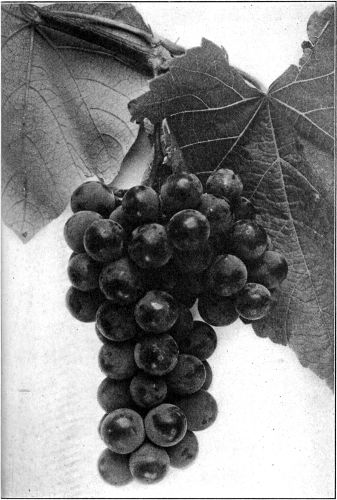
Rommel
(Labrusca, Vulpina, Vinifera)
Rommel is rarely cultivated in the North, because the vines lack in robustness, hardiness and productiveness and are susceptible to the leaf-hopper; and the grapes do not attain high quality and crack as they ripen. The bunch and berry are attractive in form, size and color. At its best, Rommel is a good table-grape and makes a fine white wine. It is worth growing in the South. T. V. Munson, Denison, Texas, originated Rommel in 1885, from seed of Elvira pollinated by Triumph, and introduced it in 1889.
Vine vigorous in the South. Canes long, numerous, thick, reddish-brown, surface roughened; nodes enlarged, often flattened; internodes short; tendrils intermittent, long, bifid or trifid. Leaves medium in size, round, thick; upper surface light green, dull, rugose; lower surface pale green, free from pubescence but slightly hairy; leaf not lobed, terminus acute to acuminate; petiolar sinus deep, narrow, often closed and overlapping; basal sinus lacking; lateral sinus shallow when present; teeth deep. Flowers semi-fertile, late; stamens upright.
Fruit mid-season, ships and keeps well. Clusters medium to short, broad, cylindrical, single-shouldered, compact; pedicel slender, smooth; brush short, pale green. Berries large, roundish, light green with a yellow tinge, glossy, persistent, firm; skin thin, cracks badly, tender, adherent, without pigment or astringency; flesh greenish, translucent, juicy, tender, melting, stringy, sweet; fair to good. Seeds free, one to four, broad, sharp-pointed, plump, brown.
Rosaki
(Vinifera)
Rosaki is a table-and raisin-grape of southeastern Europe and Asia Minor. According to some of the California nursery companies, it is grown in that state under the name Dattier de Beyrouth, although it would seem from French descriptions that there is a separate, very late variety of the latter name. Rosaki is similar to Malaga and there is a possibility that in some of the warmer parts of the East, it may be grown commercially as a substitute for the latter. The variety seems to be little grown on the Pacific slope.
Vines vigorous, usually very productive. Leaves large, roundish, rugose, usually five-lobed; terminal lobe acuminate; petiolar sinus moderately deep to deep, medium broad; lower lateral sinus shallow, broad, occasionally lacking; upper lateral sinus shallow to medium, broad; margins broadly and bluntly dentate. Fruit ripens the third week in October, keeping qualities excellent; clusters large, loose, tapering, shouldered; berries large to very large, oval to long-oval, pale yellow-green; flesh translucent, tender, meaty, vinous, sprightly; quality good to very good.
Rose of Peru
(Vinifera)
Rose of Peru is a favorite table-grape in California, confused with and possibly the same as Black Prince. Its chief commendable characters are handsome appearance and high quality of fruit and very productive vines. It is not adapted for shipping and does not enter plentifully into commerce. Its season is so late that the variety is hardly worth trying in the East, and yet it has matured in favorable seasons at Geneva, New York. The following description is compiled:
Vine vigorous, healthy, productive; wood short-jointed, dark brown. Leaves of medium size; deep green above, lighter green and tomentose below. Bunches very large, shouldered, very loose, often scraggly; berry large, round, black with firm, crackling flesh; skin rather thin and tender; flavor sweet and rich; quality very good to best. Season late, keeping rather well but not shipping well.
Salem
(Labrusca, Vinifera)
Rogers' No. 22, Rogers' No. 53
Salem (Plate XXVII) is the one of Rogers' hybrids of which the originator is said to have thought most, and to which he gave the name of his place of residence. The two chief faults, unproductiveness and susceptibility to mildew, are not found in all localities, and in these districts, near good markets, Salem ought to rank high as a commercial fruit. The vine is hardy, vigorous and productive and bears handsome fruit of high quality. This variety was christened Salem by Rogers in 1867, two years earlier than his other hybrids were named.
Vine vigorous, hardy, variable in productiveness. Canes long, dark brown; nodes enlarged; tendrils continuous or intermittent, long, bifid or trifid. Leaves variable in size; upper surface dark green, dull; lower surface pale green with slight bronze tinge, pubescent; lobes one to three with terminus acute; petiolar sinus deep, narrow, often overlapping; basal sinus lacking; lateral sinus shallow, narrow, notched. Flowers sterile, mid-season; stamens reflexed.
Fruit early, keeps and ships well. Clusters large, short, broad, tapering, heavily shouldered, compact; pedicel short, thick with small warts, enlarged at point of attachment to berry; brush short, pale green. Berries large, round, dark red, dull, persistent, soft; skin thick, adherent, without pigment, astringent; flesh translucent, juicy, tender, stringy, fine-grained, vinous, sprightly; good to very good. Seeds one to six, large, long and broad, blunt, brown.
Scuppernong
(Rotundifolia)
American Muscadine, Bull, Bullace, Bullet, Fox Grape, Green Scuppernong, Green Muscadine, Hickman, Muscadine, Roanoke
Scuppernong is preëminently the grape of the South, the chief representative of the great species, V. rotundifolia, which runs riot in natural luxuriance from Delaware and Maryland to the Gulf and westward from the Atlantic to Arkansas and Texas. Scuppernong vines are found on arbors, in gardens, or half wild, on trees and fences on nearly every farm in the South Atlantic states. As a rule, these vines receive little cultivation, are unpruned and are given no care of any kind; but even under neglect they produce large crops. The vines are almost immune to mildew, rot, phylloxera, or other fungal or insect pests; they give not only an abundance of fruit but on arbors and trellises are much prized for their shade and beauty. The fruit, to a palate accustomed to other grapes, is not very acceptable, having a musky flavor and a somewhat repugnant odor, which, however, with familiarity becomes quite agreeable. The pulp is sweet and juicy but is lacking in sprightliness. The grapes are not suitable for the market since the berries drop from the bunch in ripening and become more or less smeared with juice so that their appearance is not appetizing.