Part 2 — INTRODUCTION TO PART II (continued 2)
Reading edition
It must be obvious that there is going on a wicked 252waste of this wonderful power of reasoning, where reliance is placed on an automatic subconsciousness which permits the suspension of our common-sense and upsets our balance, thus narrowing our sphere of usefulness. Therefore if we are really to progress in the future, subconscious guidance must be superseded by a reasoned and conscious guidance which can safeguard us in unusual circumstances and at critical moments. For with real progress on a sound basis we must expect a great increase in “critical moments” and “unusual circumstances,” and our development must be on those lines which will enable us to meet them with calmness and common-sense, doing the one right thing the latter will suggest. This failing in reasoned action is as common amongst the educated as amongst the uneducated, and it is a most serious indictment of our present educational system that it should be so, and that as it is at present constituted it does not offer any real solution of the problem to be applied by the men and women of the future.
Take as an example a very prevalent form of human weakness, namely, our attitude of mind in regard to simple worries, whether real or imaginary. It is an interesting psychological fact that there are millions of highly educated people who have cultivated unwillingly what may be called the “worry habit.” This worry habit is directly the outcome of the lack of use of our reasoning faculties, as is 253conclusively proved to me in my long professional experience by the fact that people suffering in this way worry exactly in the same degree when the cause has been removed as when it was actually a reality. I can hear my readers say, “But the person is not convinced that the cause has been removed.” In the experience I refer to they were absolutely convinced, and in my next book there will be a fitting opportunity, I hope, to explain at considerable length this mental condition which seems so extraordinary and unreasonable.
This is one of the most difficult mental defects a teacher can be called upon to eradicate, because it shows that the person so afflicted is dominated by a subconsciousness built up of delusion and undue apprehension without any relation to common-sense or fact. Another instance of the disregard of reasoned judgment is demonstrated to me constantly in the mental attitude of my pupils when they first come to me for lessons. In the endeavour to perform some particular act, however simple, many pupils exhibit a degree of apprehension out of all proportion to the point at issue. This makes progress almost impossible and causes considerable distress. It is not my intention to deal with any of the complex examples which come to my notice in my daily experience with intelligent and educated pupils, but merely to set down some of the very simple examples of difficulties which seriously retard 254the progress of well-meaning people while undergoing any training.
Naturally a teacher is forced to point out at the beginning that this or that is wrong. All too frequently the pupil at once shows distinct signs of unnecessary apprehension. As this condition is the most retarding feature in any teaching work, I have for years in my own work devoted special attention to it and at once make an attempt to prevent it by endeavouring to put the pupil into “communication with his reason.” There are numerous and widely differing means to this end in the early stages of re-education to the description of which a whole book might easily be devoted, but it is sufficient here to mention it in a general way. I begin by pointing out that we expect these different things to be wrong, that their being so is not a case for worry or apprehension, seeing that they assuredly can be corrected. I draw attention to the obvious fact that a pupil comes to a teacher because there is something wrong. That must be the primary idea, otherwise the teacher’s help is superfluous. Then, why worry when the defects or failings are discovered and made known to one? Surely it is something that should evoke pleasure rather than worry. In other words, if we have imperfections and defects, we seek help because we are conscious of their existence, because we wish to know definitely what they are, so that we may have an opportunity to eradicate them. Common-sense dictates 255that we should find a teacher who can detect these defects and diagnose their cause, and when this is done the pupil has much to ease his mind, much to bring him real satisfaction when the teacher can assure him of their eradication, and a changed mental attitude should immediately follow. But many people are so out of communication with their reason that it needs days of re-education to establish a satisfactory working basis.
Now, to bring about the correct performance of any act by the principles of my system of teaching it is not necessary at the beginning to call upon the pupil for any specific physical efforts. This very fact should remove immediately any cause for worry or apprehension, but in many cases it does not. When this is the case the teacher must explain that the reason that the pupil is unable to perform the act correctly is that he believes that there is something for him to do physically, when as a matter of fact the very opposite is necessary. He is doing what is wrong. Obviously he should begin then by ceasing to do what is wrong, not by endeavouring blindly to do what is right. The process is this: Apprehensively he tries to do what he thinks his teacher desires him to do. The old wrong subconscious orders follow in their usual channels, and before he realises the fact he is performing the act in the old wrong manner. Therefore he must learn to inhibit these incorrect subconscious orders, which result in undue physical 256tension and the imperfect use of his muscles. But instead of employing inhibition he adds to his difficulties by renewing his efforts on the old basis to put right what he is told is wrong, and he actually employs increased force in accordance with his own estimate of the amount needed to perform the act. And why so? Chiefly because the ordinary human being has lost the habit of inhibition, and because he is guided here by his sense of feeling, in this connexion the most unreliable guide.
When it is explained to such a pupil that inhibition is the first step in his re-education, that his apprehensive fear that he may be doing wrong and his intense desire to do right are the secrets of his failure, he will invariably endeavour to prevent himself from doing anything, by exerting force usually in the opposite direction. And so he creates a second harmful force which, in conjunction with the first, serves only to increase the undue physical tension and to intensify the already exaggerated apprehensive condition. The fundamental principle in the re-education of such a subject is the prevention of this undue and unnecessary apprehension. He must not attempt to remedy any defect by “doing something” physically in accordance with his sensory appreciation, which is the outcome of his erroneous preconceived ideas and incorrect psycho-physical experience. His reasoning power is dominated by his sense of feeling where his psycho-physical self is concerned, so that he cannot even attempt 257to carry out any physical act excepting the one he feels to be right, despite the fact that by his reasoning faculties and practical proof, he knows that his sense of feeling is misleading and is the outcome of erroneous preconceived ideas. We must therefore make him understand that so very frequently in re-education the correct way to perform an act feels the impossible way. There is only one way out of the difficulty. He must recognise that guidance by his old sensory appreciation (feeling) is dangerously faulty and he must be taught to regain his lost power of inhibition and to develop conscious guidance. The teacher must with his hands move the pupil’s body for him in the particular act required, thereby giving him the correct kinæsthetic experience of the performance of the act.
To the uninitiated this may seem a simple matter, but if my reader will put it to the test, it will not be necessary for me to convince him that it is quite otherwise in the majority of cases. This is not surprising when it is realised that as soon as the teacher places his hands on the pupil and attempts to move him, he is at once in contact with his faulty and deceptive sense of feeling, the dominating sense in the subconsciously controlled person under such circumstances. My experience has proved that the pupil at first will act in precisely the same way if I attempt to perform the act for him as if I had asked him to do it without my assistance. He is 258just as apprehensive as a result of one request as of the other, and in this state of apprehensiveness he is, mentally and physically, impossible to deal with from the standpoint of re-education. He conjures up in his mind all kinds of fears that he will do this or that incorrectly. If you mention that he did a certain thing when you placed your hands on him, he will make an endeavour physically to prevent himself the next time. This, of course, is one of the worst errors a pupil can make. It is usually attended by far more tension and apprehension than when he performed the act which you pointed out was incorrect. The re-education work really begins here and it takes weeks, nay, sometimes months to bring the pupil to a stage in his co-ordination when he will be really once more in communication with his reason. With these facts before us I feel that my reader will advocate with me the necessity of adopting principles which will create new and correct habits, and eradicate needless apprehension and fear from the souls of human beings. To this end we must break the chains which have so long held them to that directive mental plane which belongs to the early stages of his evolution. The adoption of conscious guidance and control (man’s supreme inheritance) must follow, and the outcome will be a race of men and women who will outstrip their ancestors in every known sphere, and enter new spheres as yet undreamt of by the great 259majority of the civilised peoples of our time. The world will then make in one century greater progress in evolution towards a real civilisation than it has made in the past three.
260
VI Individual Errors and Delusions
Frequent reference has already been made to individual delusions, errors, and misconceptions of a more or less harmful nature associated with our mental and physical efforts in the different rounds of daily life. I wish now to draw special attention to those which may be said to have a more strictly personal bearing than those referred to heretofore, and which have not been fully recognised despite the fact that they are forerunners of unusually harmful and persistent bad habits. The individual misconceptions, errors, and delusions to which I refer are indicated in the cases which follow. They are the direct result of most laudable attempts to accomplish something considered necessary to the welfare of life, something which seemed essential to success in life, something which was felt to be a worthy achievement in life. Among these I would instance:
The attempt to bring about some change considered necessary in the shape or use of a part or parts of the physical organism, and to conceal or change some supposed or real psycho-physical peculiarity, weakness, or defect.
261The clinging to erroneous reasoning, in the face of undoubted evidence which revealed the errors in such reasoning, regarding the mode of procedure adopted in the attempt to prevent or “cure” attacks of illness and painful or disagreeable experiences.
The decision that a certain condition is present, and the definite conclusion as to its degree of harmfulness or the extent of its general effect upon the organism, or its influence upon the daily conduct of life.
The attempt to remedy what the subject considers a lack of concentration.
The attempt to gain benefit by relaxation in consequence of the recognition of undue tension of the muscular mechanisms, not only in physical acts, but also during the attempt to rest by sitting in a chair, lying on a bed or couch, etc.
The detection by the subject of symptoms which are always considered serious and call for immediate eradication and future prevention. The original conception in this connexion is influenced by warped and incorrect subconscious experiences, and consequently a narrow and perverted view is taken of the conditions present.
The “one-brain-track” method is in operation and the modus operandi adopted by the subject is therefore deduced from false premises. Symptoms are considered causes and furthermore the chief aim of the subject in practical procedure is the attainment of the “end” desired, not the due and 262proper considered analysis of the “means whereby” which will secure that “end.”
Perusal of the following history of cases will serve to draw attention to the little-recognised but all-important fact that mankind’s attempts at self-help on a subconscious basis in the spheres indicated cause him to live in a self-created danger zone. Moreover, the area of this zone is being gradually but surely extended by each and every new experience in those psycho-physical activities where attempts are being made in what may be termed preventive and curative spheres.
The foregoing applies to a very wide range of bad habits over the whole organism, such as:
(1) The cultivation of harmful habits in consequence of misdirected energy and mental delusions which cause disorders and defects of the eyes, ears, nose and throat, etc.
(2) The development of the dangerous habit of not hearing any instructions, opinions, advice or argument which if put into practical procedures would be contrary to the psycho-physical subconscious habit associated with some defect, peculiarity or other abnormal condition.
(3) The development of overcompensation in some direction. “Running an idea to death,” as we say.
(4) The harmful domination by a “fixed idea,” on account of which the subject struggles 263to gain an “end” without adequate and sound consideration of the correct “means whereby,” or of possible consequences to him in the cultivation of defects during this process.
CASE I
An attempt to hide a thin neck.
The subject’s wife intimated that the thinness of his neck made him look many years older than his real age. This occupied his mind for some time and he was increasingly worried by his wife’s statement. He felt that he must find a practical remedy, but in the plan which he conceived he only thought of the “end” he had in view which was to hide what he believed to be an unsightly and unsatisfactory part of his anatomy. He conceived the idea of wearing as high a collar as possible and, not being satisfied with the result, he took a second and very harmful step in the hiding plan. This was a deliberately cultivated habit of shortening his neck until the under part of the jaw rested on the top of the collar, while the head was pulled back until the lower part of the back of the head pressed on the back of the collar. From his point of view a satisfactory remedy had been found and the denounced neck was at last concealed from view.
In the standing, sitting, and walking positions these uses, or rather misuses, of the muscles of the 264neck soon grew into a very firmly established habit which became associated with a general tendency towards the shortening of the neck and spine, whilst the muscular co-ordinations of the whole organism were gradually and harmfully interfered with.
Some of my impressions at the first interview were:
(1) The exaggerated rolling movement of his body when walking.
(2) The pressure of the under part of the jaw and the lower part of the back of the head or upper part of the neck on the collar.
(3) The marked lumbar curve of the spine with the usual shortening of stature and protruding abdominal wall. Harmful flaccidity of the abdominal muscles and general stagnation of the abdominal viscera.
(4) The fallen arches of the feet—one foot caused very considerable pain at times when standing or walking.
(5) That colour of the skin and condition of the eyes which indicates serious internal disorder.
(6) The upper part of the front of the chest was held unusually high (pouter-pigeon style). The thorax was harmfully rigid.
(7) The apprehensive mental condition in his own personal affairs and also in his contact with the practical affairs of life.
265His medical advisers were unanimous in declaring that he was suffering from nerve and digestive disorders and he failed to make any improvement during many years of treatment. In his own words he “had year by year gone from bad to worse” until he was often too nervous to cross a street with ordinary traffic, and his fears in this connexion were increased by frequent attacks of giddiness when he almost lost his sense of equilibrium. He complained of painful distention after meals and suffered much from insomnia.
CASE II
An attempt to conceal his height when interviewing actor-managers of shorter stature.
It is well known in professional circles that there is a prevailing idea in the mind of the actor-manager that he should be taller than the actors who support him. The actor to whom I refer in this instance discovered that he had missed several lucrative engagements by being taller than the actor-manager with whom he had arranged personal interviews. Incidentally I may mention that he possessed a fine physique and enjoyed at this time good health. It is obvious that an actor must endeavour to prevent the loss of good engagements in his profession, and as his height was the only stumbling-block to his desires and necessities he considered his problem from this point of view only. Never for a moment did it occur to him that any mental or 266physical harm could result. With this “one idea” view he sought his remedy and soon decided that he must train himself to use his mechanisms in such a way that he could shorten his stature during interviews when seeking professional engagements. He succeeded in this direction, but unfortunately subconscious guidance and control takes no heed of the “means whereby” to be employed. His idea was merely to make an effort to gain the “end” he desired, and he was never really conscious of the actual means he ultimately employed. He merely conceived the idea of standing in a way which made him appear as short or even shorter than the person he was interviewing. Of the real mechanical happenings he was quite ignorant, and he had never thought it necessary to improve his knowledge in these all-important processes. This man came to me for help some four or five years after beginning to adopt this way of standing during the interviews. He had then been suffering for a considerable time from loss of voice, general exhaustion, and nerve and digestive disorders. On one occasion he experienced a mental and physical crisis which his medical advisers called “a nervous breakdown.”
Some of my impressions at the first and subsequent interviews were:
(1) The undue and harmful lumbar curve of the spine with the corresponding intra-abdominal pressure.
267(2) The harmful and undue depression of the larynx and its accessories.
(3) The exaggerated “gasping” in breathing in vocal and dramatic efforts.
(4) The undue rigidity of the thorax and a minimum intra-thoracic capacity.
(5) The lack of mental control in any attempts in psycho-physical re-education and co-ordination.
(6) A pessimistic mental outlook with recurring fits of depression.
(7) In the standing and walking positions the hips were held too far forward, the knee joints were pressed too far back and the angle of the torso from the hips was harmfully inclined backwards, with a general tendency, as we say, to narrow the back.
CASE III
A fixed idea regarding a definite mode of procedure adopted after experiencing a week’s illness in bed.
This lady developed certain symptoms for the first time. She then decided upon a practical common-sense method of dealing with them which would undoubtedly have been the correct one in the long run. The day following her first efforts in this direction her feeling-tones registered that she was much worse, in fact that she was very ill indeed and that the latest symptoms were worse than 268those she had hoped to remove and ultimately prevent. She decided that her attempted remedy had actually been the cause of additional trouble without in the least relieving the original symptoms. The remedy referred to was one of activity, mental and physical. She therefore came to the conclusion that this new phase of her illness had been actually brought about by the attempt she had made to fight her symptoms by simple but active methods. This conclusion became with her an idée fixe.
In discussing the matter the foregoing facts were vouchsafed to me. She said that she had given due consideration to them and had concluded in consequence of her experiences that the real remedy must be to go to bed and to allow the disorder to take its own course. This unfortunate experience caused her to continue to hold the idea that as soon as she felt any of the symptoms which preceded the first attack she should at once go to bed, to “prevent,” as she put it, “the possibility of increasing the severity of the attack.” She was absolutely convinced that she must not make any effort, mental or physical, in the way of removing or resisting the disorder as she had done on the first occasion of the attack. She decided upon the easy way of inactivity and non-resistance. Once the conscience seized upon an excuse for what the mental and physical “make-up” really craved she was doomed, and her conclusions were really influenced by this subconscious tendency. It is not surprising that after 269pursuing such a mistaken course for six months the attacks became more frequent and severe despite medical help, and the periods during which she was confined to her bed, and which she considered necessary to her recovery, became longer and longer. But the worst feature in her case was her increasing inability to make a real effort in the direction of health. She was actually developing her tendency to allow things to take their course, she was cultivating the serious habit of being guided and controlled by what she “felt” rather than by her reason. Her relatives at last came to the conclusion that her psycho-physical condition was serious and I was asked to express an opinion from this point of view.
At the outset one suspected some incorrect and harmful mental outlook and after a few lessons succeeded in securing the pupil’s admission of the fact. A review of this mental conception may prove interesting and perhaps of great value to my readers, as it shows that as long as it existed her chances of permanently eradicating these symptoms were nil. The whole procedure constituted a prostitution of those physical, mental, and spiritual forces which are inseparable from and absolutely essential to that condition of the human organism which we call good health. This lady was suffering from the inadequate functioning of the vital organs associated with and responsible for good digestion and adequate elimination. This was proved conclusively 270by the results which accrued from a method of psycho-physical treatment which restored the adequate functioning after the eradication of the mental conception referred to above.
The position then was as follows:
Certain symptoms were recognised which were the result of the stagnation of organs which needed increased activity in functioning. As a matter of fact they happened to be such as would have yielded more or less to a steady walk of a mile or so daily. The effect, therefore, of lying in bed for days was only a palliative measure. But in consequence of her first impressions through her debauched sense of feeling when she adopted active measures as a remedy, she made a definite decision against their adoption in the future; in fact, she absolutely objected to a second trial of the active method. In the intervals of freedom from these attacks the one idea was rigidly held in mind that on the recognition of the slightest symptom she must go to bed and remain there. She even considered any other mode of procedure harmful. These ideas became an obsession. She became less and less in communication with her reason and the fact that she admitted that the attacks became more frequent and the symptoms more serious did not cause her to relinquish her bed treatment in favour of some other. The fact is that her debauched emotions and feeling-tones 271had taken control instead of remaining secondary factors to reason.
It is possible to give hundreds of such cases, and attention is specially drawn to the fact that the one idea principle of meeting life’s difficulties is the real cause of these serious results. If Case I, for instance, had held in his mind the “means whereby” for the concealment of his neck and had watched carefully the effect of his attempts in this particular upon his whole organism, he would assuredly have come to the conclusion that the thin neck, natural in his case, was to be preferred to the positive evils he was unconsciously cultivating. Neither he nor his wife detected any of the numerous defects as they developed during the neck-concealing process. On the other hand, they were both aware that he was gradually failing in health and had reached a stage which his medical advisers considered serious. Of course, never for a moment was the influence of the process of shortening the neck connected with his increasing troubles and disorders. His mental training had been solely on the lines of working for an “end” (“one brain-track method”) instead of holding in his mind the “means whereby.”
He had never doubted for a moment the fallibility of the sensory appreciation of his organism. He firmly believed that immediately he decided to effect a change in his physical self he could command 272it by the employment of his subconscious guiding principles. He was unaware that these instinctive factors were delusive and unreliable as his directive agents.
If the reader’s interest can be aroused in this connexion, all-important benefits must accrue in even the simplest spheres of daily life. Furthermore, the more difficult problems of living will be sensibly considered without fear of the disastrous results which are now so common.
273
VII Notes and Instances
Since this book was published in England, I have received a steady flow of letters from interested readers, lay and professional, which have been of great value to me. Among this correspondence, three pertinent questions occur again and again, and I am forced to infer (1) that these points are of peculiar interest to my readers and (2) that no satisfactory explanation of them is suggested by the application of the broad principles I have laid down. I feel, therefore, that in this, the American edition of my work, it may be well to treat these questions and various other matters which arise out of them for the benefit of future readers.
The three main questions—two of which occur in about eighty per cent. of letters I have received—are these:
(1) What is the correct standing position, and the position of mechanical advantage?
(2) How is the reader to apply the principles of conscious control as here laid down, to specific bad habits such as overindulgence, whether in tobacco, alcohol, particular foods, etc., or to the cure 274of such diseases as asthma, tuberculosis, constipation, spinal curvature, appendicitis?
(3) What are the outward signs of improvement to be noted during treatment, and are there scientific reasons for these results? In this connection I have several times been asked to give particulars of some of my more striking and representative cases.
I will take these three questions seriatim, and devote as much space as possible to each of them.
I.
“What is the correct standing position, and the position of mechanical advantage?”
I think the average man is very apt to forget that he cannot assume a position of stable equilibrium and a position which ensures a perfect mobility, unless his feet are so placed as to furnish at once a stable pose and a ready pivot and fulcrum. The most perfect base is obtained by setting the feet at an angle of about forty-five degrees to one another. In all other erect positions (the defects becoming exaggerated as this angle is decreased), it will be found that there is a tendency to hollow and shorten the back and to protrude the stomach, and if any effort is made to avoid these serious faults in posture, such effort will only result—unless the feet are moved to the correct position—in a stiffened, uneasy, and unstable attitude. It is not possible, however, to set out in written language 275the correct pose of the feet and legs in the ideal standing position, and I therefore subjoin four photographs which have been specially taken for this purpose (first published on 22nd October, 1910), and which show quite clearly not only the correct position of the feet, the fundamental problem, but also how the whole body of the person is thereby thrown into gear.
But when this ideal position is realised, the task of obtaining it by each individual has still to be undertaken. With reference to this task, I cannot do better than quote my pamphlet of July, 1908, entitled Why “Deep Breathing” and Physical Culture Exercises Do More Harm than Good, from which it will be clearly seen that the ideal position varies slightly according to the idiosyncrasies of the person concerned. The passage in question is as follows:
“In the first place, to allow a pupil to assume, of himself, a certain standing position, means that his own perceptions and sensations are given the sole onus of bringing about the co-ordination upon which such standing position depends, an onus which they are quite unable to bear.
“The perceptions and sensations of all who need respiratory and physical re-education are absolutely unreliable. It is the teacher who should have the responsibility of certain detailed orders, the literal carrying out of which will ensure for the pupil what is then the correct standing position for him. 276I emphasise this last, because no one stereotyped position can be correct for each and every pupil. When the person so employs the different parts of his body that one can speak of his ‘harmful position in standing or walking,’ it is only by causing the physical machinery gradually to resume correct and harmonious working, thus changing the position from time to time, that serious harm can be averted and satisfactory results secured. I may point out, moreover, that in trying to assume the ‘proper standing position’ at the outset, the pupil unavoidably puts severe strain upon the throat, thereby paving the way for throat, ear, and eye disorders.”
Take the case, for example, of a boy who stoops very much, and combines a sinking above and below the clavicles with abnormal protrusion of the shoulder-blades. If he is told to “stand up straight” he will at once make undue physical effort to carry out the order thus crudely given, with the result that the shoulders will be thrown backward and upward, the shoulder-blades still further protruded, and the front and upper parts of the chest unduly elevated and expanded. There will also be a narrowing, a sinking, and a flabbiness of the lower dorsal and posterior thoracic region, with corresponding fixed protrusion and rigidity of the front chest wall, undue arching of the lumbar spine, shortening of the body and harmful stiffening of the arms and neck, instead of a fulness, broadness, and firmness of the back, with free mobility of the chest walls, 277resulting in normal curve of the lumbar region and comparative lengthening of the spine. With the arms hanging vertically, the relative position of that part of the thorax where the lungs are situated will be seen to be in front of the arms, instead of being, as it should be, behind them. In such a position, the boy feels helpless and tires rapidly, owing to the imperfect co-ordination, and any attempt to accustom him to this erect posture will ultimately result in deterioration rather than improvement.
Now the narrowing and arching of the back already referred to is exactly opposite to what is required by nature, and to that which is obtained in re-education, co-ordination, and re-adjustment, viz., widening of the back and a more normal and extended position of the spine. Moreover, if these conditions of the back be first secured, the neck and arms will no longer be stiffened, and the other faults will be eradicated.
In order to obviate the evils enunciated in the last two postulates the teacher must himself place the pupil in a position of mechanical advantage,[20] from which the pupil, by the mere mental rehearsal of orders which the teacher will dictate, can ensure the posture specifically correct for himself, although he is not, as yet, conscious of what that posture is.
I further elaborated the same point in Why We Breathe Incorrectly (November, 1909), and from this pamphlet I will now quote another passage 278which bears directly on some important points involved, viz.:
“There can be no such thing as a ‘correct standing position’ for each and every person. The question is not one of correct position, but of correct co-ordination (i.e., of the muscular mechanisms concerned). Moreover, any one who has acquired the power of co-ordinating correctly, can re-adjust the parts of his body to meet the requirements of almost any position, while always commanding adequate and correct movements of the respiratory apparatus and perfect vocal control—a fact which I demonstrate daily to my pupils. Continual re-adjustment of the parts of the body without undue physical tension is most beneficial, as is proved by the high standard of health and long life of acrobats. It is a significant fact that the very reverse is the case with athletes, showing that undue muscular tension does not conduce to health and longevity.”
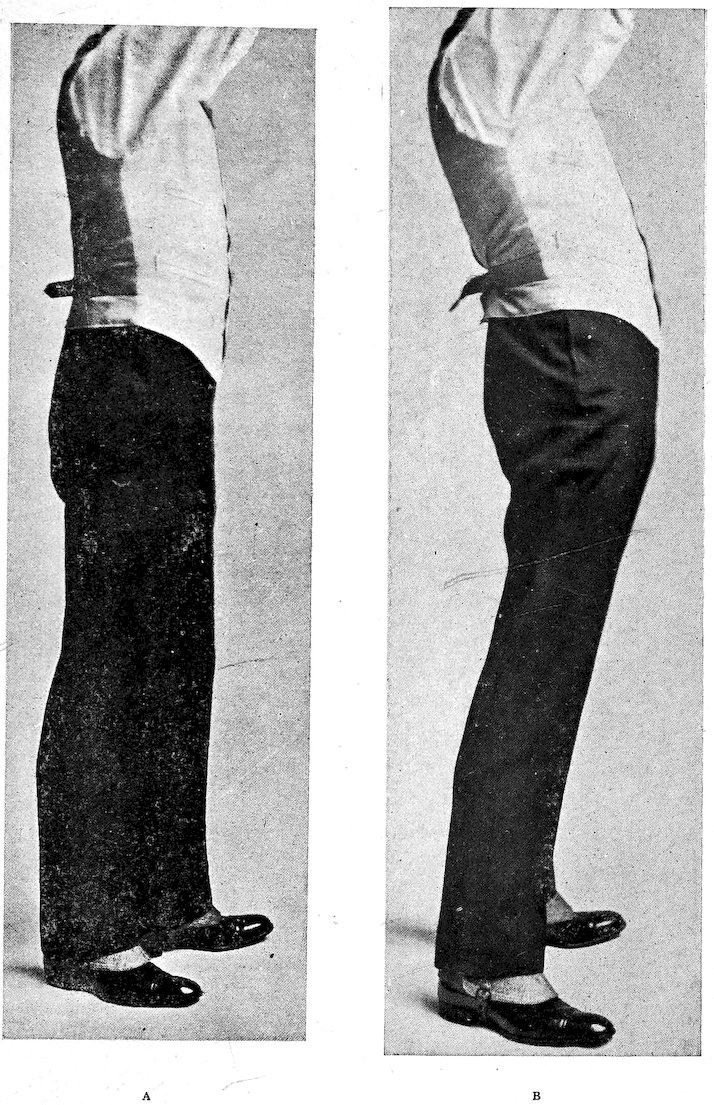
A.A. THE FEET ARE HERE PLACED IN THE IDEAL POSITION FOR OBTAINING PERFECT EQUILIBRIUM OF THE HUMAN MACHINE, AND FOR PERMITTING THE MAXIMUM ACTIVITY OF THE FUNCTIONING OF THE WHOLE ORGANISM. NOTE.—IT IS EVIDENT THAT EITHER THE RIGHT OR LEFT FOOT MAY BE IN ADVANCE WITHOUT AFFECTING THE CORRECTNESS OF THE POSE.
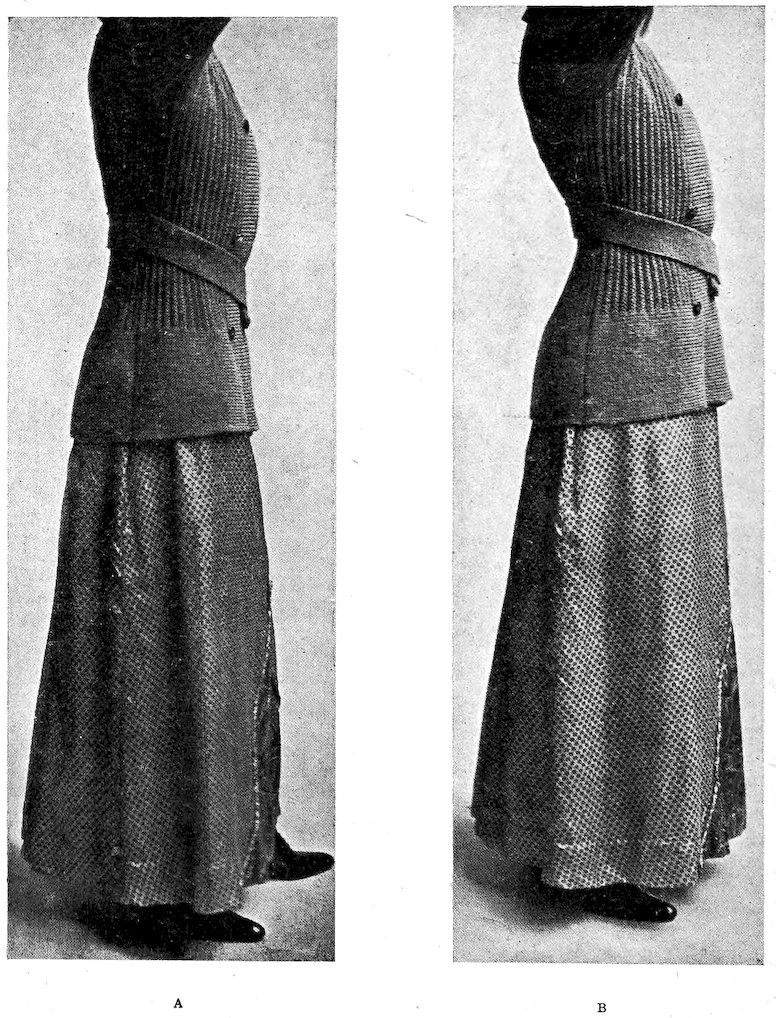
B.B. THE FEET ARE HERE PLACED IN A POSITION WHICH COMPELS AN IMPERFECT ADJUSTMENT OF THE WHOLE ORGANISM IN ORDER TO SECURE EVEN AN IMPERFECT EQUILIBRIUM. THIS POSITION RESULTS IN THE MINIMUM ACTIVITY OF THE VITAL FUNCTIONING.
From what I have now said, it will be quite evident that the primary principle involved in attaining a correct standing position is the placing of the feet in that position which will ensure their greatest effect as base, pivot, and fulcrum, and thereby throw the limbs and trunk into that pose in which they may be correctly influenced and aided by the force of gravity. The weight of the body, it should be noted (see diagram AA), rests chiefly upon the 279rear foot, and the hips should be allowed to go back as far as is possible without altering the balance effected by the position of the feet, and without deliberately throwing the body forward. This movement starts at the ankle, and affects particularly the joints of the ankles and the hips. When inclining the body forward, there must be no bending of the spine or neck; from the hips upwards the relative positions of all parts of the torso must remain unchanged. When the position is assumed, it is further necessary for each person to bring about the proper lengthening of the spine and the adequate widening of the back. The latter needs due psycho-physical training such as is referred to in the two extracts quoted above.
This standing position as now explained is physiologically correct as a primary factor in the act of walking. The weight is thrown largely upon the rear foot, and thus enables the other knee to be bent and the forward foot to be lifted; at the same time the ankle of the rear foot should be bent so that the whole body is inclined slightly forward, thus allowing the propelling force of gravitation to be brought into play.
The whole physiology of walking is, indeed, perfectly simple when once these fundamental principles are understood. It is really resolved into the primary movements of allowing the body to incline forward from the ankle on which the weight is supported and then preventing oneself from falling 280by allowing the weight to be taken in turn by the foot which has been advanced. This method, simple as it may appear, is not, however, the one usually adopted. The mechanical disadvantage displayed in what is known as a “rolling gait,” for instance, a gait which is common enough, is absolutely impossible when the instructions given are carefully followed. And the effect upon the whole mechanical mechanism of the person concerned is shown by the fact that when the co-ordinating principles brought about by this method are established, there is a constant tendency for the torso to lengthen, whereas the usual tendency—due to faulty standing position and the incorrect co-ordinations which follow—is for the torso to shorten.
Nearly every one I examine or observe in the act of walking, employs unnecessary physical tension in the process in such a way that there is a tendency to shorten the spine and legs, by pressing—if I may so put it familiarly—down through the floor instead of, as it were, lightening that pressure by lengthening the body and throwing the weight forward and moving lightly and freely. In consequence of the “shortening” and “pressing down” just referred to, the civilised peoples are becoming more and more flat-footed. The properly co-ordinated person employs a due amount of tension in such a way that the tendency of the spine and legs is to lengthen, and the equilibrium is such that the undue pressure through the floor is absent 281and there is a lightness and freedom in the movements of such a person that is most noticeable. The person who is flat-footed has only to establish these conditions to restore the natural arch of the flatfoot.
We can find, perhaps, no better instance of the necessity for the application of the principles of conscious control to these fundamental and essential propositions of standing, walking, and running, than in the photographs taken of Dorando as he appeared when he was making his last terrible efforts to reach the tape at the conclusion of the Marathon race in London in 1908. One sees that he was desperately wearied, and that whatever conscious control of his muscular mechanisms he may ever have obtained, he was at this moment completely under the domination of subconscious (or subjective) control, that he was out of “communication with his reason.” His body, as we see him in these photographs, is thrown back from the hips, his arms are outstretched behind him, and his legs are bent forward at the knee. As a consequence, he is compelled to use almost all his physical force in order to save himself from falling backwards. He is struggling against a tremendous gravitational pull which is dragging him away from his goal. If Dorando, magnificent athlete as he undoubtedly is, had been trained in the principles of conscious control, such an attitude would have been impossible for him, tired and exhausted even as he was. For 282if he had not been subconsciously controlled, he would have employed his common-sense at this moment and would have acted according to the guidance of its mandate. It is at such critical moments that we have urgent need for the control of reason, for it is then that we suffer most from the loss of the animal equivalent—instinct.
Dorando’s muscles may have been taxed to their utmost capacity, but if he had been consciously controlled he would have leaned forward, not back, and while he had the strength necessary (but a very small part of the strength he was actually expending) to prevent himself from falling on his face, that gravitational force would have dragged him on instead of dragging him back from the object of his achievement, as was actually the case. He would, in short, have been able to make the best instead of the worst use of his powers.
Faults such as we see exaggerated in this instance are to be found in the carriage of many people to-day, and the fact is one of great importance to medical men. Patients are constantly advised to take walking exercise, although in many cases that exercise undoubtedly does more harm than good. In my opinion it is very essential that all doctors should devote more attention to this subject than they are devoting at the present time, in order that they may be in a position to advise which of their patients will be benefited by taking walking exercise, and which of them by so doing will 283aggravate the troubles from which they are suffering. For it should be evident, I think, that the good effects of fresh air and gentle exercise will be practically nullified, if the patient can only obtain them by exaggerating and perpetuating the defects which have led him to the prescription.
These same rules are equally applicable in principle to the acts of sitting and of rising from a sitting position. Very few people have the right mental conception of the “means whereby” of these acts or of the correct use of the parts which should be employed in their performance, and this despite the fact that we are performing these acts continually, and with such apparent ease from our own point of view. If you ask any of your friends to sit down you will notice, if you observe their actions closely, that in nearly all cases there is undue increase of muscular tension in the body and lower limbs; in many cases the arms are actually employed. As a rule, however, the most striking action is the alteration in the position of the head which is thrown back, whilst the neck is stiffened and shortened. Now I will describe the correct method, but it must be borne in mind that it is useless to give what I here call “orders” to the muscular mechanism, until the original habit and the principle of mental conception connected with this action have been eradicated. If, for instance, before giving any of the “orders” which follow, the experimenter has already fixed in his 284mind that he is to go through the performance of sitting down, as that performance is known to him, this suggestion will at once call into play all the old vicious co-ordinations, and the new orders will never influence the mechanisms to which they are directed, because those mechanisms will already be imperfectly employed, and will be held in their old routine by the force of the familiar suggestion. Firstly, then, rid the mind of the idea of sitting down, and consider the exercise and each order independently of the final consequence they entail. In other words, study the “means,” not the “end.” Secondly, stand in the position already described as the correct standing position, with the back of the legs almost touching the seat of the chair. Thirdly, order the neck to relax, and at the same time order the head forward and up. (Note that to “order” the muscles of the neck to relax does not mean “allow the head to fall forward on the chest.” The order suggested is merely a mental preventive to the erroneous preconceived idea.) Fourthly, keep clearly in the mind the general idea of the lengthening of the body which is a direct consequence of the third series of orders. And fifthly, order simultaneously the hips to move backwards and the knees to bend, the knees and hip-joints acting as hinges. During this act a mental order must be given to widen the back. When this order is fulfilled, the experimenter will find himself sitting in the chair. But he is not yet upright, for the body will be inclined 285forward, unless he frustrates the whole performance at this point by giving his old orders to come to an upright position. Sixthly, then, and this is of great importance, pause for an instant in the position in which you will fall into the chair if the earlier instructions have been correctly followed, and then after ordering the neck to relax and the head forward and up, the spine to lengthen and the back to widen, come back into the chair and to an upright position by using the hips as a hinge, and without shortening the back, stiffening the neck, or throwing up the head.
The act of rising is merely a reversal of the foregoing. Draw the feet back so that one is slightly under the seat of the chair, allow the body to move forward from the hips, always keeping in mind the freedom of the neck, and the idea of lengthening the spine. Let the whole body come forward until the centre of gravity falls over the feet, that is to say, until the poise is such that if the chair were removed at this point, you would be left balanced in the position of a person performing the “frog dance,” then by the exercise of the muscles of the legs and back, straighten the legs at the hips, knees, and ankles, until the erect position is perfectly attained.
If you care to experiment on a friend in this act of rising, you will observe that in the movement as performed by an imperfectly co-ordinated person, the same bad movements occur, tending to stiffen 286the neck, to arch the spine unduly, to shorten the body, and to protrude the abdominal wall.
This completes the co-ordinating idea with regard to standing, walking, and sitting, and the exercises indicated in the explanations I have made will be found exceedingly helpful as a first step towards a proper and healthful use of the muscular mechanisms in these simple acts of everyday life.
II.
“How are the principles of Conscious Control to be applied to the cure of specific bad habits, or to the cure of specific diseases?”
The following letter is typical of many:
“Dear Sir,—I have read your book, Man’s Supreme Inheritance, with much interest, and I hope you will forgive me if I venture to point out a difficulty which presents itself to my mind, and probably to the mind of the ordinary reader.
“It is this: In what way is it proposed to apply the principle of ‘conscious control’ in a given case—say in the overcoming of a habit, such as smoking, to take a common example—or in the case of functional disorders, as constipation? It seems to me that the great attraction to most people of the popular books on so-called ‘New Thought’ is that they lay down clear and precise rules which can be put into practice, so that the reader knows what he must do to be saved. But I confess I am unable to 287gather how you would recommend setting about the attainment of your principles. It would be a great help to me, and no doubt to others, if this could be explained, and probably in the larger work which you contemplate this will be more fully done.
“In the meantime, however, if it is not asking too much, I should be extremely grateful to you if you could very kindly indicate the method you propose by which the principles could be applied in such cases as I have suggested....”
Now, I may be doing the writer of this letter an injustice, but I am inclined to class him among the many enquirers who seem confidently to anticipate a miracle. In my introduction I have said, “In this brochure will be found no mention of royal roads, panaceas, or grand specifics,” yet I feel sure that some of my readers have, nevertheless, imagined that by some marvellous means they may be cured by taking thought, despite all that I have written with regard to that procedure. We see in one paragraph of the letter quoted above a nice example of the desire to lean towards any mechanical method. “The great attraction ... of the popular books on so-called ‘New Thought,’” we read, “is that they lay down clear and precise rules which can be put into practice.” It is true that I have not laid down any “clear and precise rules” which may cover every conceivable form of physical and mental 288trouble, as do the exponents of “New Thought” and “faith-healing,” and I think that my reason should be plain enough, for in my experience I have never found two cases exactly alike, and the detailed instructions which I might lay down for A might be extremely detrimental to B or C.
Nevertheless, since I see that some further explanation is needed, I will adumbrate the general principles which embrace the rule of application, however diverse the method may be in practice.
In the first place, all specific bad habits such as overindulgence in food, drink, tobacco, etc., evidence a lack of “control” in a certain direction, and the greater number of specific disorders such as asthma, tuberculosis, cancer, nervous complaints, etc., indicate interference with the normal conditions of the body, lack of control, and imperfect working of the human mechanisms, with displacement of the different parts of that mechanism, loss of vitality and its inevitable concomitant, lower activity of functioning in all the vital organs. When the subject has arrived at this condition, harmful habits become established and the standard of resistance to disease is seriously lowered.
To regain normal health and power in such cases, what I have called “re-education” is absolutely imperative. This treatment begins, in practically all cases, by instructions in the primary factors connected with the eradication of erroneous preconceived ideas connected with bad habits, and the 289simplest correct mental and physical co-ordination. The displaced parts of the body must be restored to their proper positions by re-education in a correct and controlled use of the muscular mechanisms. In this process the blood is purified, the circulation is gradually improved, and all the injurious accumulations are removed by the internal massage which is part and parcel of the increased vital activity from such re-education.
Thus the first stage in the eradication of bad habits and disorders is reached when improved conditions of health are established. Nor must it be forgotten that in this process of re-education a great object lesson is given to the controlling mind. In the very breaking up of maleficent co-ordinations or vicious circles which have become established, a new impulse is given to certain intellectual functions which have been thrown out of play. The reflex action which is setting up morbid conditions can only be controlled and altered by a deliberate realisation of the guiding process which is to be substituted, and these new impulses to the conscious mind have, analogically, very much the same effect as is produced on the body by the internal massage referred to above. The old accumulations of subconscious thought are dispersed, and room is made for new conceptions and realisations.
When the first stage is passed, it is just as easy at almost any time of life to establish “good” habits (“good” that is, by the test of all our experience 290and knowledge) as “bad” ones. Bad habits mean, in ninety-nine per cent. of cases, that the person concerned has, often through ignorance, pandered to and wilfully indulged certain sensations, probably with little or no thought as to what evil results may accrue from his concessions to the dominance of small pleasures. This careless relaxation of reason, in the first instance, makes it doubly difficult to assert command when the indulgence has become a habit. Sensation has usurped the throne so feebly defended by reason, and sense, once it has obtained power, is the most pitiless of autocrats. If we are to maintain the succession that is our supreme inheritance, we must first break the power of the usurper, and then re-establish our sovereign, no longer dull and indifferent to the welfare of his kingdom, but active, vigilant, and open-eyed to the evils which result from his old policy of laissez-faire.
So many people, I find, seem to regard the principles of conscious control as a kind of magic which may be worked by some suitable incantation. They appear to think that we may obtain conscious control of, say, the secretive glands, that we may be able to give an order to secrete more or less bile or gastric juice by a command of the objective mind. If such a thing were possible, and if I could endow any person with such power to-morrow, I should know perfectly well that I should, by so doing, be signing that person’s death warrant; I might equally 291well give him a dose of poison. To refer to my metaphor of the sovereign ruler, you might as well expect a king to order and superintend the detail of his subjects’ private life as expect the conscious mind directly to order and superintend every function of the body. If the king will ordain good and just laws, his policy will prosper; the detail of organisation must be left to inferior officers. In the care of the body the organisation is there, aptly and perfectly adjusted to its functions, and when the ruling power of conscious control has ordained the sane laws which shall establish peace and prosperity within the assembly, the organisation already in force will work in harmony to its fit and proper ends. On the other hand, there is great danger in underrating the power of conscious control which, if it must not be prematurely forced and made to intrude on automatic functions, must in no way be undervalued or delimited.
For instance, though it may not be possible to control directly each separate part of the abdominal viscera, we can control directly the muscles of the abdominal wall which encloses the viscera, and in reducing a protruding abdomen we can control many other muscles, notably those of the back, which when they are properly employed and co-ordinated will, by widening and altering the shape of the back, make place for the protruded stomach, allow it to occupy the natural position from which it has been ousted, and so give free play once more 292to the natural functions of the viscera that have been distorted and pinched by the forced positions they have had to assume. Here we see that though conscious control does not affect by a process of direct command, as it were, the lower automatic functions, there is great danger in assuming that such functions are beyond the reach of my methods.
This danger was brought before me when I read, in the British Medical Journal for December, 1909, an article on one side of my teaching contributed by Dr. S——, an old pupil of mine.
In this article Dr. S—— says:
“Man’s education does not always demand conscious instruction; in the absence of unfavourable circumstances he can learn by unconscious imitation of good models.”
Now this is not demonstrably untrue, but at the same time it is, as I shall show, extraordinarily misleading, and is, in effect, just as valuable as the prescription of champagne and hothouse grapes for a pauper patient.
In the first place, we must remember, and Dr. S—— has himself admitted the fact, that the normal is the rarest of all states. Medical experts find that their most constant source of error in diagnosis arises from the overreadiness to assume normal conditions in patients whose internal economies and muscular co-ordination are, in fact, far from the ideal standard of proportion and interdependence. 293Yet if the expert trained in physiology fails to note the distortions which are upsetting the whole economy, what body is to be named the supreme authority that shall select the “good models” for unconscious imitation?
In the second place, we have to reckon with a psychological factor which at once determines the question of the validity of unconscious imitation. This factor is the demonstrable truth that unconscious imitation does in nine hundred and ninety-nine cases out of a thousand lay hold of the faults of the imitated and pass over the virtues. In a long experience of re-educating many professional men and women for the stage in this country, I have had abundant opportunity to observe the methods of the “understudy” set to “imitate” his or her principal, and my invariable experience has been that subconscious imitation has always been shown by a reproduction of the actor’s or actress’s most prominent failings. The intellectual reading of the part, the subtler inflexions of voice and the finer details of gesture are passed by, and the “understudy” reproduces the “mannerisms,” all those obvious tricks of speech, manner, and gesture which are the least essential factors in the true reading of the part. Again, my experience in cases of stammering has shown me very clearly that especially among boys and young men, the stutter has in a very large majority of cases come about by the imitation of some other boy. We do not find boys 294so apt to imitate one of their fellows who speaks particularly well.
Now this imitation of a fault in speech is subconscious and will not always right itself naturally, and the reason for this will become clear with a little consideration. Set a man to work on an elaborate and intricate piece of machinery. Tell him that if he moves a switch here and a lever there, certain effects will be produced and certain desired results obtained. The movements are simple ones, and the man left to himself will be able to control the working of the machine with ease and certainty. But let us suppose that some essential part of the machine is put out of gear, and that the machine instead of running smoothly and easily begins to jerk and hiccough. Our assumed operator is immediately at a loss. He sees that there is something wrong, and that there is obvious friction where there was ease before; noise has taken the place of silence; but he knows nothing of the working of the machine save the elementary movements of the switch and lever, in the uses of which he has had instruction. Now, he may perform these movements again and again; but the machine still stutters, and our operator, quite at a loss, can do nothing to obviate these faults. He must allow the machine to continue working badly if it works at all.
The boy we have adduced as an example of a stammerer, who has copied some fault of another 295boy and found that fault become permanent, is in exactly the same position as the unskilled operator of our illustration. This boy knows the ordinary uses of his vocal machine which have heretofore produced normal results, but he does not know enough of the machine to repair it when it is put out of gear; he cannot control the machinery so that it may at once be restored to its previous efficiency. But just as the unskilled operator may be instructed in the complete mechanism he is set to supervise, and may then stop the machine when any fault becomes evident, discover the source of the defect and set it right; so will any person who has been instructed in the principles of conscious control be able to detect and obliterate any fault in his vocal or any other bodily mechanism, even if that fault was originated below the level of consciousness.
These marked examples furnish a sound and unfailing analogy to the principles of unconscious imitation in their application to physiology. The perfectly co-ordinated man or woman does, as a matter of fact, offer less mark for imitation to the ordinary observer than the man or woman who displays an obvious defect, just as the perfectly dressed man or woman passes with less remark than those people who affect some exaggeration of costume in order to attract attention. Were we able at this time to set the Greek model before our children, we should be able to display it only on occasion, 296and the unconscious imitative powers of the child would seize hold far more readily of the marked defects with which it would be forced into contact during the greater part of its waking life. In a perfect world, unconscious imitation would not be able to exert a perverting influence, and to the conception of such a world we may well turn our attention, but we shall never attain it by any means other than these principles of conscious, reasoning, deliberate construction, or reconstruction, upon which I have based the whole of my theory and practice.
And, finally, there is still a serious danger to be reckoned with, even should we find sufficient methods in our present civilisation from which we might learn by unconscious imitation. We must remember that during the advance of civilisation mankind has lost the faculty we call instinct, the faculty which guided mankind in a state of nature as it still guides the lower animal world. During our advance from this primitive condition, the one great defect in our mental, physical, and educational training has been the failure to recognise that civilised life is the death-bed of instinct, and that in civilised life man’s education must always demand conscious instruction. For we see that it is at the critical moments that men fail to rise to the occasion. In such a case as that of Dorando, already cited, we see that a perfectly trained athlete, a man capable of the magnificent effort he made in 297the great Marathon race, was robbed of his victory by his dependence at the critical moment upon unconscious control as opposed to the conscious control which is the thesis of Man’s Supreme Inheritance. And every day we are told that at critical moments, at the crisis of a debate, when suddenly called upon to decide a question of moment, or when faced with terrifying physical danger, men “lose their heads”—and fail. It is more especially at these times, at the crises of life, that the men who had been educated in the principles of conscious control would be capable of acting with the same reason and common-sense that characterised their mental and physical acts on the ordinary occasions of life. If they had relied upon unconscious imitation they would still be dependent, to a certain degree, upon instinct.
Before leaving Question II, however, I will deal specifically with two of the prevailing maladies of our time, viz., spinal curvature and appendicitis, and show how the principles I have enunciated have a particular bearing on the prevention and cure of these two serious ailments.
1. Spinal Curvature. A perfect spine is an all-important factor in preserving those conditions and uses of the human machine which work together for perfect health, yet there are comparatively few people who do not in some form or degree suffer, perhaps quite unconsciously, from spinal curvature.
The present attitude towards this very serious 298mark of physical degeneration would be ludicrous were it not that the matter is one of almost tragic importance, and I may quote in this connexion a letter of mine which appeared in The Pall Mall Gazette for 14th March, 1908. After dealing with certain other matters which need not be reproduced here, I cited the following instances of the results of our present attitude:
“In our schools and in the army, human beings are actually being developed into deformities by breathing and physical exercises. I have before me a book on the breathing exercises which are used in the army, and any person reasonably versed in physiology and psychology, and knowing they are inseparable in practice, will at once understand why so much harm results from them. Take either the officers or the soldiers. In a greater or less degree the unduly protruded upper chests (development of emphysema), unduly hollowed backs (lordosis), stiff necks, rigid thorax, and other physical eccentricities have been cultivated. It is for these reasons that heart troubles, varicose veins, emphysema, and mouth breathing (in exercise) are so much in evidence in the army. As this is a matter of national importance, I am prepared to give the time necessary to prove to the authorities (medical or official) connected with the army, the schools, or the sanatoria that the ‘deep breathing’ and physical exercises in vogue are doing far more harm than good, 299and are laying the foundations of much graver trouble in the future. The truth is that all exercises involving ‘deep breathing’ cause an exaggeration of the defective muscular co-ordination already present, so that even if one bad habit is eradicated, many others, often more harmful, are cultivated.
“In this connexion it is only necessary to point to the serious effects of ‘deep breathing’ and physical culture exercises in the causation of throat and ear disorders, following upon the undue and harmful depression of the larynx—the crowding down of the structures of the throat—such depression occurring with every inspiration, and as a rule with every expiration. This disorganisation and consequent strain in the region of the throat is always found exaggerated, and tends gradually to increase in people who are subject to asthma, bronchitis, and hay fever, and the removal of the factors causing such strain and disorganisation means great relief and gradual progress towards the eradication of these disorders; but, of course, all organic troubles should be removed in such cases.”
Now I may say further that I have not, up to now, examined any method of physical culture or respiration which has not tended to bring about in time some form of directly harmful lumbar spinal curvature. And I have never examined a case of the (alleged) cure of spinal curvature in which the front of the chest has not been harmfully altered, 300and very often seriously deformed. The original idea in diagnosis of spinal curvature which has led to the methods producing these results is “that the activity of the muscles is necessary to the retention of the spine in an erect position, in consequence of which, therefore, the primary cause for the scoliosis must be sought in an abnormal function of the muscles influencing the spine.” This is the myopathic theory of Eulenburg, an authority whose dicta have had an important influence in medical practice.
The error of advocating physical exercises, as generally understood, of any kind in the treatment of spinal curvature is even greater than in the case of John Doe, whom I cited in the earlier part of this work and whose case should be again referred to in this connexion. The question here also is one of correct conscious recognition, and it is much more marked in the case of spinal curvature than in the case of my earlier illustration, a case in which there was no special deformity, and in which the muscle-tensing exercises I deprecated did not work to emphasise a marked structural malformation.
The important factors in relation to spinal curvature are these:
(a) The bent or curved and therefore shortened spine.
(b) The decreased internal capacity of the thoracic cavity.
Plainly, attention must first be given to straightening 301and lengthening the curved and shortened spine. This can be done by an expert manipulator who is able to diagnose the erroneous preconceived ideas of the person concerned, and cause the pupil to inhibit them while employing the position of mechanical advantage. And it can be done without asking the pupil to perform what he understands as a single physical act. Moreover, if the correct guiding orders are given to the pupil by the teacher, and the pupil makes no attempt to hold him or herself in the lengthened position, such use of the muscular mechanism will, nevertheless, be brought about as will ensure that the torso is held in a correct position. Formerly, the consciousness in regard to the correct action has been erroneous, a mere delusion, and the muscular mechanisms have worked to pull the body down. The truth of the matter is that in the old morbid conditions which have brought about the curvature the muscles intended by Nature for the correct working of the parts concerned had been put out of action, and the whole purpose of the re-educatory method I advocate is to bring back these muscles into play, not by physical exercises, but by the employment of a position of mechanical advantage and the repetition of the correct inhibiting and guiding mental orders by the pupil, and the correct manipulation and direction by the teacher, until the two psycho-physical factors become an established psycho-physical habit.
During this process of re-education, factor (b) 302has not been forgotten. A little consideration will show that any alteration in the spine must necessarily affect the position and working of the ribs. (The analogy of the keel of a boat and the ribs which spring from it may well be held in mind to make clear the following explanation.) It will be seen that as the ribs are held apart by muscular tissues (analogous to the boards of a boat), a bending of the spine will not buckle the ribs unless great force is applied, force sufficient to rupture the muscular tissue. But it is equally evident that there must be some play in the ribs in order that they may adjust themselves to the new position. This play is effected in the human body (and would be effected mechanically in the ribs of a boat, if they possessed sufficient elasticity) by the coming together of the ends of the “false” and “flying” ribs, that is, those lower ribs which are not attached to the bony sternum. This flattening of the curve of the ribs, and the approach of their free ends towards each other, reduces the thoracic cavity, just as in our illustration of the boat its capacity would be reduced if we forcibly narrowed the distance between the thwarts. On the other hand, we see that by increasing the thoracic capacity and so increasing the distance between the ends of these ribs, we are applying a mechanical principle which by a reverse action tends to straighten the spine.
These two actions, the re-education of the “Kinæsthetic Systems” and the increasing of the thoracic 303capacity which applies a mechanical power by means of the muscles and ribs to the straightening of the spine, are both aspects of the one central idea, and are not separate and divisible acts.
2. Appendicitis. The prevalence of appendicitis has always seemed to me one of the most striking proofs of the inefficiency of present-day methods in regard to health. At times I am filled with wonder that we permit such bad conditions to become established as may necessitate the removal of the appendix. It is, of course, well known that the operation is frequently performed when the conditions do not warrant such extreme measures, but cases have come under my notice, nevertheless, and those not among the uneducated classes, in which the symptoms had become so aggravated by years of harmful habits of life as to necessitate the major operation. Fortunately there is a section of the medical profession which objects, on scientific grounds, to the removal of the appendix in all but extreme cases, and this opposition and the evidence adducible as to the comparative ease with which the exaggerated condition may be avoided and the trouble completely cured by natural means, is doing much to limit the sphere of those champions of the knife who are never content unless they can be dissecting the living body.
There can be no question or shadow of doubt that when the whole frame is properly co-ordinated and the adjustment of the body is correct and controlled 304according to the principles I have enunciated, it is a practical impossibility to get appendicitis. The cause of the trouble is due to imperfect adjustment of the body which allows or forces the abdominal viscera to become displaced and to fall. The first consequence of this is a change of pressures and the loss of the natural internal massage, present in normal conditions. This leads to constipation among other symptoms, and permits the gradual accumulation of toxic poisons.
When the trouble has already shown itself and there is some positive inflammation of the appendix and tenderness in that region, it is by no means too late to apply my methods. The new co-ordinations which may in such cases be brought about very quickly, and established later, at once relieve false internal pressures and permit a natural re-adjustment of the viscera, and the furtherance of a rapid return to a healthy and normal condition is greatly accelerated by the internal massage.
With regard to this latter treatment to which I have already referred in this chapter, I may mention that many pupils have asked me if I use internal massage in my system of re-education. In my brochure on the Theory and Practice of Respiratory Re-education, included in Part III, it will be found that I used this description, as I said, for lack of one that was sufficiently comprehensive, but the principle itself is one of the first importance.
When a patient or pupil is placed in the position 305of mechanical advantage I have so often had occasion to refer to, the manipulator can secure the maximum movement of the abdominal viscera in strict accordance with the laws of nature and will obtain at the same time a maximum functioning of all the internal organs. In this way foreign accumulations are dissipated, constipation is relieved, and the more or less collapsed viscera—the cause of all the trouble—are restored to their proper places and resume their natural functions.
All these things, it will be seen, are essential factors in the prevention and cure of appendicitis, and I may add that the application of these principles in a very large number of cases in which an operation has been medically advised has conclusively demonstrated their value to the individual and to the race.
Appendicitis, like influenza, is probably almost an impossibility in the natural state; it is one of the results of civilisation and subconsciously controlled mechanisms, and is possible only through the conditions we have developed; and these adventitious troubles and ailments will continue to appear and to do their work of destruction until some general recognition is made of the necessity for substituting conscious control for the partly superseded forces which in a wild state render these ailments impossible.
III.306
“What are the outward signs of improvement to be noted during treatment?”
The signs of improvement are manifold and they necessarily vary according to the nature of the original defect, but I will set out here some of the more characteristic, such as occur in generally typical cases.
We see, in the first place, that the characteristic defects of the body, whether displacements of some part or parts of the muscular mechanism (in some cases even displacement of the bones), or defects of pose which throw some unusual strain upon a muscle, or, more commonly, a group of muscles not intended to take such strain, all have some correlated defects, which may be observed by the instructed as certain visible peculiarities and abnormalities. And we must draw particular attention in this connexion to the fact that these outer signs are correlated with the inner defects. Neither outer sign nor inner defect is from one point of view the result one of the other. The original cause is some faulty or imperfect co-ordination or conception of function; the inner defect and outer sign-mark are equally a consequence as they are to us an index.
As we should naturally expect, the chief sign-manual is to be found in the face. To me, that is a most valuable document upon which is written many curious, intricate, sometimes alarming confessions. 307The expression of the eyes, the set of the lips, the drawing of the forehead, and the more pronounced dragging of the flexible face muscles, are all marks which may be read by the expert, and, to answer the question directly, one of the earlier outward signs of improvement is to be found in a relaxation of the forced and unnatural expression which results from these contortions. It must be obvious that I cannot here set out in detail the symptomatic distortions which accompany the various internal defects, but one may be noted as an exemplar for the others however diverse.
The case in question was one of dilation of the heart and as such was brought to me by a medical friend, and, as a matter of fact, though this was the most alarming symptom, it was but one of many springing from deep-seated causes. Incidentally I may note that the spine was arched inwards, the legs were unduly and most abnormally stiffened when the patient was in a standing position, and the upper part of the chest was held most harmfully high—this last symptom being the influence which produced what was really a tertiary effect, though in this case the most threatening one, viz., the dilation of the heart. Now this patient carried certain very curious marks in the face: first a general expression of strain in the eyes and cheek muscles, and secondly four very marked indents or pits in the forehead. Here, indeed, were marks which the expert might read, and it was extremely 308interesting to note, as my treatment progressed and the patient recovered the proper use of the body and a consequent return to perfect health, first, the disappearance of the strained expression of eyes and face muscles, and secondly, the gradual filling up of the four curious indentations in the forehead. In this case the original symptoms were so marked that the patient’s friends all commented on the change of expression during the progress of the treatment.
The face, however, is by no means the only index. Many defects lead, by way of stiffened neck and throat muscles, to an alteration in the quality and power of the voice. There too the mode of movement and the failure to express purpose in muscular action, the fumbling, indirect attempt to perform a simple act, are aids to diagnosis, either of the original defect, or, by their reversion to natural, easy functioning, of the progress of the cure.
Generally, also, we observe a clearing of the skin and eyes as the defects are eradicated, improvements which are due to better circulation and the improved quality of the blood, factors which bring about a continually increasing power in the organism to purge itself not only through the bowels and kidneys, but also through the skin.
Lastly, we may note a general improvement in physique, in the carriage of the body, in the whole appearance of co-ordinated, reasoned control.
309Another curious and interesting test of the co-ordinated person who is attaining conscious control of the uses of his body is obtained by observing his hands when they fall to his sides in the position which comes naturally to him. One may say that there are three main stages to be observed in man’s development in this particular, though the gradations are many and not, perhaps, always strictly progressive. The first stage may be observed in the lowest savages, the Hottentot, the Australian aboriginal, and many races at an early stage of development. Such examples stand with body thrown back from the hips, stomach protruded, and—here is the test—with the palms of the hands forward, the elbows bent into the sides, the thumbs sticking out away from the body. The second stage is evidenced in the averaged civilised man of to-day who stands as a rule with the palms of his hands towards his body, his elbows to the back, his thumbs forward. In the third stage, the properly co-ordinated person stands with the back of his hands forward, the thumbs inwards, and the elbows slightly bent outwards. This is a curious but little known test, which, in my experience, has never failed as an index to imperfect muscular co-ordination.
I believe I have now answered in sufficient detail the somewhat wide intention of these three main questions, but in conclusion I will note one further point that has been raised.
This is the question as to why the great majority 310of men and women breathe from their stomach or the upper chest and so allow, among other evils, the costal arch to be narrowed and the flying ribs to become constricted and stiffened. In the case of many women there can be no doubt that this is due to the use of tight corsets which confine these ribs, and do great general harm in constricting the natural play of the vital functions. But another and, in my opinion, the primary cause is the common practice of swathing a child in bands almost immediately after birth, and keeping him so fettered during many months of infancy. The idea of this practice is to prevent rupture in male children should they be subject to violent fits of crying or coughing, but the question of the relative tightness or looseness of these swathings is left in the hands of a nurse, who, in the great majority of cases, thinks it well to be on the “safe side” by winding the child unnecessarily tightly. Obviously the early habit is retained through life unless it is broken by some outside influence. The pliancy of the young organisms is such that the functioning of the breathing apparatus is quickly re-adjusted, but the evils which gradually accumulate, from this and similar causes, do not show themselves as a rule till much later in life.
Another cause is any imperfect adjustment of the muscular mechanism, a failure which may be due to incorrect training, to unconscious imitation, or to any of the chances which are always being presented 311to the child in the haphazard system of physical education which obtains in our nurseries and schools.
And on this note I may well conclude my chapter, for no argument I can advance in favour of a careful consideration of the principles I have laid down can have such cogency and force as the most superficial examination of the physique of the children in our schools and the adults in our streets. We are indeed suffering, not only in Great Britain but on the continents of Europe and America, from a failure to recognise that man is no longer a natural animal, whose life-habits were dependent upon the development of the faculty of instinct, and that all systems of physical culture (and how diverse they are!) must necessarily fail unless they take into account that first and last essential, the free use and consciousness of the reasoning, controlling mind.
313