Front matter (continued 5)
Reading edition
"Marcel," she began, and her voice was tired and thin, "I want you to do something for me. I want you to—to tell a lie for me."
"Why, child, what's the matter?"
"Marcel, Mamsey thought I was here last night. Will you please tell her I was?"
Marcel's hands were in biscuit dough; she leaned forward heavily, and the soft, light mass rose half-way up her arms.
"Lord! child, where were you last night? I thought you were keeping my boarder as well as your own. Mam'selle just stopped here; she looked queer enough when she found you were not here. There's no use of the lie, child. She knows."
For a moment Donelle looked as though nothing mattered, as if the earth had slipped from beneath her feet.
From Gavot's window she had seen the River Queen depart with its two passengers from Point of Pines. Tom had not been visible since daybreak, the world had drifted away. Alone, in space, Donelle waited, looking dumbly at Marcel.
"Where were you, child?"
"I was at Tom's cabin. I'm married to him. Father Mantelle married us."
Marcel raised herself, the dough clinging to her hands. She shook it off, tore it off, went to a bucket of water and soaked it off, then sank into a chair.
"I'm fainting," she announced in a businesslike tone, and seemed, for an instant, to have lost consciousness.
This brought Donelle to her senses, she sprang to Marcel and put her arm around the limp form.
"It's quite true," she faltered, "but of course you could not know. All my life has happened to me since yesterday morning. I've got used to it, but I forgot you did not know. Nothing is any use now, nothing need be hidden. I am going back to Mamsey and tell her everything—everything."
Marcel was reviving. She still lay on the young, protecting arm, her eyes fastened on the white, sad face above her.
"You better go slow, Donelle, when you tell Mam'selle. You don't want to stop her heart," she cautioned.
"No, I do not want to stop her heart. But I'm going to tell her everything, beginning from the time I came back from the Walled House, after Pierre Gavot told me—who I was! I can tell her now because it does not matter; nothing matters since I'm married to Tom Gavot."
"It will kill her, Donelle! Mam'selle brought you from the place where she hid you. She's had high hopes for you. It will kill her to know you're married to Tom. Whatever made this happen?"
"Why, whatever makes such things happen to any one?" Donelle sighed. Then: "If you are better, I'm going now to Mamsey."
"And I'm going with you!"
Marcel sprang to her feet.
"Come, I'm ready," she said, wrapping her rough shawl about her head and shoulders.
And together they went to Jo, followed by poor Nick.
They found Jo sitting in the living room, knitting, knitting. Every nerve was strained, but outwardly she was calm as ever.
"Well, child," she said as they entered, "you look worn to the death. You need not talk now unless you want to." She rose and went to Donelle.
"I want to, Mamsey. I want to."
"And you want Marcel to stay?" Jo spoke only to the girl. No one entered the sacred precincts of her deepest love when Donelle needed her.
"Yes, I want her, too, Mamsey, because she is your friend and mine."
Marcel blinked her tears back and sat down. Jo went back to her chair and Donelle dropped beside her and quietly told her pitiful story; both women sat like dead figures while they listened.
"You see, Mamsey, there was no other way, I had to do something quick. But," and here she smiled dimly, "there must have been some reason for what happened. Maybe the love was so big it caught him and would not let him go. I do not know, but just as you have kept still about my father after he left you, so I am going to keep still about my man. Tom knows, you, and now Marcel Longville, know. No one else matters, shall ever matter!"
But Jo was rousing herself. Her deep eyes flamed, she forgot Marcel, she leaned over the girl at her feet.
"How did you know your father left me?" she whispered.
"Pierre Gavot told me!"
"When?"
Donelle described the scene on the road by the Walled House, but she withheld the ugly word.
"And you came back because of that? You believed I was——"
"I knew you were my mother, and I could not hurt you as my father had. You had never hurt him. I had to do his part. But now, Mamsey, I am glad, oh! so glad, for now I understand everything that life meant for me. I'm safe here with you and Tom and I mean to—pay—pay. You know I always said I would pay, if I were part of life, and I will!"
Jo got up unsteadily. She seemed tall and menacing, her breath came hard and quick.
"Whose step is that outside?" she asked suddenly. The two had not noticed, but to Jo's "Come" Father Mantelle entered. He meant to make sure that all was well; he had seen Mam'selle return and had come as soon as he could.
"Father," Jo said solemnly, "take a seat. I am going to confess! Once you would not give me an opportunity, now I am going to take it."
Her trembling hand lay upon Donelle's head. The girl did not move.
"This child is not mine. I swear it before my God. Her father left me for another woman. Marcel can testify to that. My heart broke within me, and later, when my poor sister died, I went away. I went to—to Langley's cabin in the woods. I fought out my trouble there, and then came back to my years of labour, that you all know of. I never knew, until long after, the black thoughts that were held against me. I lived alone—alone." Here Jo rose majestically, threw back her head, and let her flaming eyes rest upon the two petrified listeners. Her hand was still touching with a marvellously gentle touch the bent head of Donelle, who was crouched on the floor at her feet, and was listening, listening, her breath coming in quick, soft little gasps.
"And then," the stern voice went on, "Pierre Gavot did me the most hideous wrong a man can do a woman, Gavot, Pierre Gavot, a man unworthy of looking at an honest woman, offered to—to marry me, for my money! He sought to get control of the only thing that I had won from life for my own protection. But out of his foul lips something was sent to guide me. He somehow made me see that I might yet have what my soul had hungered and almost died for—a child! I went to St. Michael's. I meant to take what some other woman had disinherited. I meant to take a man-child, because I felt I could not see another woman endure what I had endured! But God worked a miracle. He drove me aside, He sent"—and here Jo's eyes fell upon Donelle with a glance of supreme pity and of worship—"He sent this girl to me, I found her in the woods. During the weeks of her sickness, which followed her coming to my house, she revealed—her identity. It was marvellous. I was frightened, but in my soul I knew God was having His way with me. He had sent me the child of the man I had loved, of the woman who had betrayed me!
"I went, when I could, to St. Michael's and got the Sisters' story, and I found——" Jo paused. Even now she hesitated before delivering her best beloved to the danger she long had feared. Then she remembered Tom Gavot and lifted her eyes.
"This girl's father had been accused of taking the life of his wife. He was bringing his child to me because he knew I would understand. He died before he could reach me. But a man, who, before God, I believe was the guilty one, was after the girl, wanted to get possession of her. For what reason, who can tell? The Sisters saved her. When I took her, I tried to save her by giving her my name. I felt that I was less harmful to her than—than the things the world might say. But I see," poor Jo's voice quivered, almost broke, "I see I was wrong. How could I prove my belief in the innocence of Henry Langley, though I could stake my soul's salvation on my belief that he did not kill his wife?"
Donelle was slowly rising to her feet. A dazed but brilliant light flooded her eyes, she reached out to Jo as she used to do in those first nights of delirium and fever.
"Mamsey, Mamsey, he did not! It was this way. My father came into the cabin, he had been hunting. My mother was there. I was there, and—and the man! I cannot, oh! Mamsey, I cannot remember his name, but I hated him. I was afraid. He used to say he would carry me off if—if I told! When my father came into the cabin—I cannot remember it all, for I ran and hid behind a door. But yes, I can remember this: the man said I was—his! Then my father ran toward him and he screamed something, and my mother," Donelle was crouching, looking beyond Mantelle and Marcel, at what no eyes but hers could see, "and my mother cried out that what the man said was a lie! And then my father and the man struggled. They fought and the gun went off—and—and—my mother fell!
"Mamsey, I—I cannot remember the rest. I was always tired, always going somewhere, but my father did not do that awful thing!"
A sudden stillness filled the dim room, a silence that hurt. Then Jo's tones rang out like a clanging bell:
"Father, this girl is Tom Gavot's wife?"
"She is." The priest was as white as death. Marcel was silent.
"Then no harm can reach her from that man, wherever, whoever, he is?"
"None."
"And that boy took my girl believing what the world thinks is the worst?" Jo's voice suddenly softened, her eyes dimmed. There was no reply to this. Marcel was crying softly, persistently, her face covered by her poor, wrinkled hands. The priest's white face shone in the shadowy room.
Then Jo laughed and lifted Donelle up.
"Child, you have seen the worst and the best in man. We still have Tom Gavot and he will keep all harm from you." Then she turned to Marcel. "Margot would have been proud of Tom, could she have known," she said. Marcel groped her way across the room. Her eyes were hidden, her sobs choked her.
"Mam'selle," she faltered, "Mam'selle Jo!"
Then the two women clung together. Father Mantelle watched them. What he thought no one could know, but a radiance overspread his face.
"Mam'selle Morey," he said quietly at last, "you have opened my eyes. God's peace be with you."
Then, as if leaving a sacred place, he turned and went out into the early evening.
Marcel soon followed, but she was not crying when she went. Donelle had kissed her, Jo had held her hands and smiled into her eyes. Marcel had received her blessing from them.
Then, when they were alone, Jo lighted the lamp and piled wood in the stove.
"And now we will eat, child," she said. Donelle was still dazed, trembling.
"I remember!" was what she kept repeating. "How strange, Mamsey, but I see it clear and true after all these years."
"And now, forget it, Donelle. The vision was given to you from God. It has done its work. We must forget the past." And for years it was never talked of between them.
"But, Mamsey——"
"Not another word, Donelle. We must eat and then talk of Tom."
It was after eight when, the work indoors and out finished, Jo and Donelle talked of Tom Gavot. By that time Donelle was quiet and strangely at peace.
"All night, Mamsey, while Nick and I were in his cabin," she said, "he was out in the rain! I crept to the window many times and always he was there walking about or sitting by a little fire that he made in a dry spot to warm his poor, wet body. Mamsey, he told me to put the bar across the door, and I wanted to, but I did not." Donelle's eyes shone. "Somehow I felt safer with the bar off. And then, when it was morning, Tom was gone."
"He will come again!" breathed Jo, her breast heaving. "And what then will you do with him, child?"
"I do not know, Mamsey."
"He has done the greatest thing for you that it is possible for man to do."
"Yes, I know, I know. But, Mamsey," the agony of deadly hurt shook Donelle's voice, "Mamsey, for a little time I want, I must stay with you. And we must never speak of the other! You kept still when, when my father——"
"Yes, yes, Donelle, I understand," Jo clutched the girl to her. "You shall stay with me for a little time, but I think the day will come when you will go to Tom Gavot on bended knees."
"Perhaps, Mamsey, perhaps. I love Tom for his great goodness. I see him always, so safe, so kind, so splendid, but just now—— Oh! Mamsey," the girl shuddered, "the love has me! I know I am wrong and wicked to let it hold me. I know I was selfish and bad to let Tom save me. You see I had to do something quick; I was so alone. But by and by, Mamsey, the way will be easier and then I will think only of Tom Gavot. I promised."
In the upper chamber were a few articles belonging to Norval. Jo put them under lock and key the following day, and set the room in its sweet, waiting orderliness once more. The cabin in the wood too, was securely closed against prying eyes and hands. A few sketches and pictures were still there—"The Road" among them. The others had been hastily gathered together. Books rested on a shelf and table, the oil-stained coat hung on a peg. Jo longed, with human revolt, to set fire to the place where she and Langley's child had known Gethsemane, but her hand was held.
And still Tom Gavot did not return. No word came from him for a week, and a great fear rose in Jo's heart. Then came a brief note to Donelle.
You know you can trust me. Father Mantelle has written to me about you and Mam'selle; it's a big thing. And, Donelle, I'm never going to take anything you don't want to give! I didn't marry you to hurt you. I did it to help you. It seemed the only way, in the hurry.
I'm staying here in Quebec for a few months. Nothing can harm you now and I am thinking of longer and bigger roads, farther away, where I can make more money and get ahead. It can't harm you, Donelle, to tell you that, always from the first time I saw you, I loved you better than anything else. I love you now better than myself, my roads, anything! And because I love you this way, I'm leaving you with Mam'selle.
How they all evaded Norval. It was as if he had never been. Point of Pines was like that.
Since Tom had not killed him, he was able to blot him out.
"Tom is a man, a big one!" murmured Jo. "Donelle, you will be able to see him by and by."
"Yes, Mamsey, by and by."
Then summer came warmly, brightly, over the hills, but with it stalked a grim, black shadow. A shadow that no one dared speak about aloud, though they whispered about it at Dan's Place, on the roads, and in the quiet houses. Father Mantelle felt his old blood rising hot and fierce. He remembered his France; but he remembered that his France had driven his Order from its fasthold. He remembered England, with traditional prejudice. Then he gazed into the depth of the black shadow that would not depart, and preached "peace, peace," even before his people had thought of anything else but peace. It was full summer. The States' people filled Marcel's house, the Point of Pines hamlet throbbed and waited. Then the shadow stood revealed—War! And from over the sea England called to her sons. And they no longer paused. They lifted up their stern young faces and turned from field, river, and woods, turned back again Home!
And the women! At first they were stunned; horrified. It could not be! It could not be!
Soon, soon, they were to learn the lesson of patience, bravery, and heroism, but at first they saw only their boys going away. They saw the deserted houses, farms, and river, their own great helplessness, their agony of fear.
They saw their children grow old in a night with the acceptance of this call they could not quite comprehend, but which could not be disregarded. It was such a strange call, it sounded depths they, themselves, had never known. It found an answer in their untried youth. They simply had to go.
The old men were sobered, exalted. Even Pierre Gavot forgot the tavern, put on his best clothes, and waited for Tom. Were all the others going, and not his son? Gavot was full of anxiety. He did not want to drink and forget. He was obliged to stay clearheaded and watch for Tom's return. He even forgot himself and his demands on Tom. He'd manage somehow, but he could not endure the shame of Tom's not going overseas.
It was an hour when souls were marching up to the Judgment Seat, each according to its kind.
And one day Jo Morey met Pierre on the high-road, her burning woman-heart not yet adjusted to the shock that was reverberating through Canada.
"And so, Gavot," she said, "'tis taking this cause to bring you to your senses? I hear of your talking of Tom as if he was a big thing. Why, he's been big ever since he was born, and you took no heed."
Pierre drew back. Tom was not yet revealed as a hero, but Gavot could not conceive of the boy being anything else.
"I'm ready to lay my only son on the altar," mumbled Pierre grandiloquently. "I can sacrifice my all for my country."
Jo laughed, a hard, bitter laugh.
"You men!" she sneered, "ever since Abraham carried his poor boy up the mountain to lay him on the altar, you've all been alike, you fathers! You don't lay yourselves on the fire, not you! You don't even live your decent best when you might, but you're ready enough with the sacrifice of your young. Gavot, have you ever noticed that the Sarahs of the world don't carry their sons to the altar?" Jo's feelings choked her.
Gavot looked at the woman before him with bleared and strangely serious eyes. "That's wild talk," he mumbled, "bad talk. The right has to be done. Could such as I fight?"
Jo looked at the wretched creature by the roadside and she did not laugh now. That intangible something that was settling on the faces of her people hushed her.
CHAPTER XX
GAVOT GETS HIS CALL
And Tom Gavot was in Quebec. The alarm had stilled, for an instant, his very heart, and the first terrible sense of fear that always came to him in danger rose fiercely within him. His vivid imagination began to burn and light the way on ahead. Horrors that he had read of and shuddered at clutched at his brain and made it ache and throb.
No one knew of his sad marriage. He was going about his work bearing his heavy secret as best he could, but now he began to view it in a new light. He was married; he could remain behind with honour. But could he?
"Going to enlist, Tom?" the head of his firm asked one day. "We'd hate to lose you, we want to send you to Vancouver. There's something special to do there. After all, the matter will soon be settled and we need some boys here."
"I'm thinking it over," Tom replied, and so he was, over and over while his quivering flesh challenged his bright spirit.
He walked daily in front of the Chateau Frontenac and watched and watched the gallant boys, oh! so pitifully young, marching, drilling with that look in their eyes that he could not comprehend. He went to the Plains of Abraham and stood spellbound while the past and present flayed his fevered imagination. He stood in front of the pictured appeals that the Government posted on fences and buildings, and still his flesh held his spirit captive. Then one day, quite unconsciously, the Government reached him—him, Tom Gavot! There was a new picture among the many, an old mother with a transfigured face, her hand on the shoulder of her boy.
"My son, your country needs you."
Tom looked, and turned away. It did not seem fair to—to bully fellows like that. He was angry, but he went back. The boy's face seemed to grow like his own! Poor Tom, he could not realize that it was the face of young Canada. The woman why, she was like the long-dead mother! Tom felt sure, had his mother lived, that she would have been old and saintly. Yes, saintly in spite of everything, for would not he have seen to that? He, and his roads?
Tom thought of his roads, his peaceful, beautiful roads. Would he be fit to plan them, travel on them if he let other men make them safe for him?
Then one September day he said quietly—and the man to whom he spoke never forgot his eyes—"I'm going to enlist. I'm going back to my home place. I'd like to start with the boys from there." So Tom went back to Point of Pines. He almost forgot that he was the husband of Donelle Langley. He had taken farewell of many, many things without realizing it: his own fear, his wife, his roads, his hope of Donelle.
He went back very simply, very quietly, and with that new look in his sad young eyes he seemed like a stranger. Not for him was the glory and the excitement. He was going because he dared not stay. His soul was reaching out to an ideal that was screened in mystery, he had only just courage enough to press on. Pierre looked at his boy pleadingly.
"Tom," he whimpered, "I'm not much of a father. I can't send you off feeling proud of me, I've held you back all your life. But I can make you feel easier about me by telling you that I've got work. You won't have to fash yourself about that."
Tom regarded his father with a vague sense of gladness; then he reached out falteringly and took his hand!
Marcel drew Tom to her heart. All her motherhood was up in arms.
"Tom," she whispered, "all through the years I've broken my heart over those little graves on the hill, but to-day I thank God they're there!"
Tom held the weeping woman close.
"Aunt Marcel," he asked quietly, "if they, the children, were here, instead of on the hill, would you bid them stay?"
"That's it, Tom, I couldn't, and that's why I thank God He's taken the choice from me."
Tom kissed her reverently with a mighty tenderness.
"Aunt Marcel," he went on, "when I'm over there I shall think of you and of the children on the hill. I'll try and do my best for you and them. I may fail, but I'll try."
And at last Tom went up the road to Mam'selle and Donelle. They saw him coming and met him on the way. Jo's head was bent; her breast heaving. A terrible fear and bitterness made her face hard and almost cruel.
All night she had been recalling Tom's pitiful youth. And now this renunciation! But on Donelle's face shone the glory of the day.
Quietly, firmly she took Tom's hands and lifted her eyes.
"Oh! but you are splendid," she whispered. "I thought perhaps you might feel you ought to stay back for me! But, Tom, everything is all right and safe! Always you are going to grow bigger, nearer, until you make me forget everything else. Why, Tom now, now I would go with you on your road, if I could! You must believe that, dear."
Tom looked at her. He saw the thrill of life, adventure, and youth shake her. He saw with an old, old understanding that because he was going away, alone, upon the road, he meant to her what he never could have meant had he remained. He saw that his renunciation had awakened her sympathy and admiration, but he saw that love lay dead in her eyes.
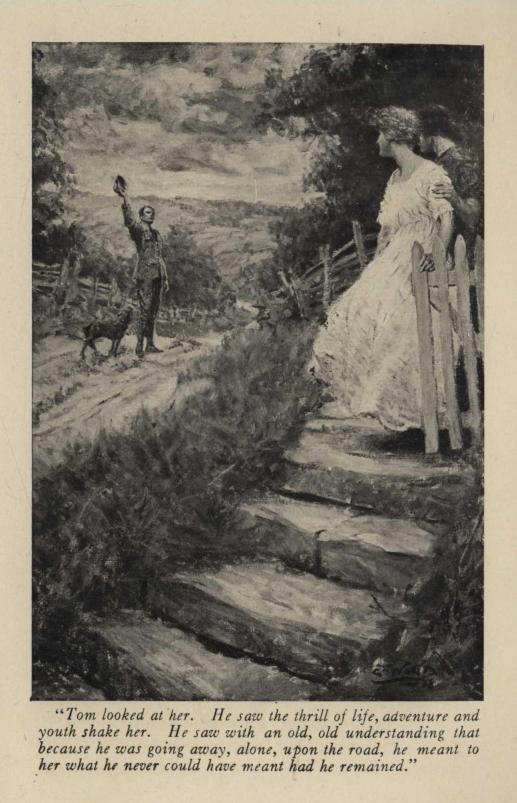
"Tom looked at her. He saw the thrill, of life, adventure and youth shake her. He saw with an old, old understanding that because he was going away, alone, upon the road, he meant to her what he never could have meant had he remained."
And then Tom bent and kissed her. He could in all honour because something deep in his heart told him that he was indeed bidding her good-bye.
"When I come back," he was saying, while he felt far, far away, "we'll just try the road, Donelle. I know you'll do your part. And always keep this in mind: when I look back home I'll see you at the other end of the road, girl. Your eyes will have the yellow light in them that will brighten the darkest night I'll ever tramp through. I had to tell you that."
"Thank you, Tom."
"It wasn't the honest thing to marry you the way I did. I had no right."
"Yes, you had, Tom. Yes. Yes!"
"No. I think we could have found a better way, if we had taken time, but I was sort of blinded."
"And so was I, Tom, blinded and crazed."
"Donelle—"
"Yes, Tom."
"I've got to tell you something—now that I'm going. He—he came back that night. He came to me and he would not believe, until I let him look in the window to see you as you lay there asleep. He wanted to tell me something, and I wouldn't let him! But, Donelle, before God, I think we need not hate him and if he ever gets a chance let him tell you what he wanted to tell me."
"Tom, oh! Tom!" Donelle was weeping now in Gavot's arms. "Thank you, thank you, my own good Tom! And when you come back, I'll be waiting for you, no matter what I hear."
But Tom understood. Again he bent and kissed her pretty hair, her little white face, then gently pushed her toward Jo.
"Mam'selle," he said and smiled his good smile: "I'm going, with heaven's help, to make up to my mother."
"You have, Tom, you have!" Jo rushed to him. "You have by your clean, fine life and they have no right to take that young life; they have no right, no right!"
But Tom went away, smiling, with the little company of Point of Pines' men. The women watched the going with still faces and folded hands. Those boys going on, on to what, they knew not; just going! Some looked self-centred, proud, senselessly uplifted. Others looked grim, not knowing all, but sensing it.
Tom looked at his group, his father, Marcel, Longville, Jo, and Donelle, turned a last glance at the white, set face of Father Mantelle, and so said good-bye to Point of Pines.
Together Jo and Donelle returned to the little white house. It was like going back from a freshly made grave.
"I'll not help the bad business, no, not I!" vowed Mam'selle, the hard look still upon her face. Donelle looked piteously at her.
"It is a great evil, a damnable sin; no words can make it right. For us to work and forgive is but to help the sin along. I will not stand for the cursed wrong."
"Mamsey, it is all wrong, but it is not their wrong, Tom's and all the other boys. They are just doing what they have to: holding to that something that won't let go of us. Mamsey, we must go along with them. We cannot leave them alone. I don't quite see yet what we can do, but Mamsey, we, too, must hold on. See, here is the loom. Spin, spin, dear Mamsey."
"No, the loom stands still!" Jo shut her lips. But Donelle led her forward.
"Mamsey, it will save us," she said, "save us. We must work all the time; spin, weave, knit. We've got to. It is all we can do."
"Yes. And because we have always spun and woven and knitted, they are going off there, those boys! Donelle, I will not touch the loom!"
But Donelle was placing her fingers on the frame.
Suddenly, groping for the threads, Jo said, while her voice broke:
"Where's Nick, child?"
"He's following Tom as far as he can, Mamsey. I did not call him back."
At that Jo bent her head until it rested on the loom.
"That's all dogs and women can do!" she moaned; "follow them as far as they can."
"Yes, Mamsey, and catch up with them—somehow. We will, we will."
The two women clung together and wept until only grief was left, the bitterness melted.
And afar in Egypt Anderson Law heard the summons and saw the blackening cloud.
"I'm too old to take a gun," he muttered grimly, "but my place is home! Every man to his hearth, now, unless he can serve his neighbour."
It was October when Law reached New York. In his long-deserted studio lay much that claimed his immediate attention. Norval had had a key to the apartment and had seen that it was kept ready for its absent master. A mass of mail lay upon the table, among it a note from Norval himself.
ANDY, when you can, go to Point of Pines. If any man in God's world can mend the mischief I made there, it is you! I went innocently enough and at a time when I was down and out. I managed to evolve about as much hell as possible. I don't expect you will ever be able to excuse or, in any sense, justify my actions. I am only thinking of that little girl of Alice Lindsay's, the only love of my life.
Law was petrified. This was a letter Norval had written from Point of Pines, it had got no farther than New York, for Norval in his abstraction had addressed it there.
For an instant even the war sank into insignificance as Law read on:
The divorce that Katherine desired was about to be consummated. I reckoned without Katharine's sense of justice and duty, which got active just when I thought the road was clear. Well, Andy, you know how damnable truth can become when it is handled in the dark? Katherine came to Point of Pines; saw Donelle alone. Need I say more? Only this, Andy: I did not wrong the girl, I only loved her.
I've left a picture. I want you to see it before you leave for Canada. You'll find it by your north window.
I'm going to the Adirondacks with Katherine. She's developed tuberculosis, this is her only chance, and, short or long, I've sworn to go the rest of the way with her.
Law went across the room to his north window. With fumbling hands he uncovered the canvas standing there and placed it on an easel before he dared look at it.
A bit of paper was attached to the picture. Law read:
"Fairer than morning, lovelier than the daylight."
Then standing in his coldest, most critical attitude, Anderson Law feasted his eyes upon Donelle!
Not only the sweet, appealing beauty of the rare, girlish face held Law, but the masterfulness of the hand that had reproduced it, clutched his senses. Such colour and light! Why, for a moment it seemed almost as if there were movement.
"Good God!" muttered Law. "I stayed in Egypt too long."
It was like him, however, to make ready at once to go to Point of Pines. He did not write to Norval; how could he? Of course he disapproved heartily of what he knew and suspected. No man, he reflected, has a right to take chances at another's expense. Norval was a fool, a damned fool, but he was no merely selfish wretch. That he could swear to. But the girl—well, how could a man keep his senses cool with those eyes fixed upon him?
"That white-flame sort," mused the man in the still room, "is the most far reaching. There's so much soul along with the rest."
A week later the River Queen, rather dignifiedly, puffed up to the wharf of Point of Pines. The sturdy boat was doing her bravest bit that summer. She went loaded down the river; she panted back contemplatively, knowing that she must bear yet other loads away. Away, always, away!
"I want Mam'selle Jo Morey's," Anderson Law said as he was deposited, with other freight and bags on the dock. "She takes boarders?"
Jean Duval frowned.
"She took one," he replied, "but he ran away. I'm thinking the Mam'selle Jo is not reaching out for more."
"Then I will go to her," said Law in his most ingratiating manner; "she shall not reach out for me."
Jo was in the barn, but Donelle stood by the gate, her fair, uncovered head shining in the warm October light.
"I am Anderson Law!"
Donelle turned and her wide eyes grew dark.
"I have come late, I'm afraid, child," Law saw that his name was familiar to the girl, saw her lips quiver, "but I'll do my best now to mend the trouble. You must accept me for Alice Lindsay's sake."
Bluntly, but with grave tenderness, he put out his hand.
There are some people who come into the world for no other reason, apparently, than to lighten the burdens of others. The mere sight of them is the signal for the shifting of heavy loads. Weary, lost ones know their deliverers. Donelle gave a long, long look, her eyes filled with sudden and sadly-suppressed tears. All the weight she had borne since the time she had entered the Walled House cried out for support.
"Oh! I am so glad you've come. So glad!"
And Donelle's hands lay in Law's.
And so Mam'selle found them, clinging to each other like shipwrecked souls, when she came up with Nick wheezing at her heels. Nick wheezed now, there was no denying it.
"And, sir, you are——?" she said, standing with her feet astride, her hands reaching down to where her father's old pockets used to be.
"A boarder, Mam'selle, heaven willing."
"I can take no more boarders, sir. But I can hitch up Molly and drive you to Captain Longville's."
"Mam'selle Morey, I am Alice Lindsay's friend, Anderson Law."
Then Jo, who had always been a burden-bearer herself, scented another of her kind. She came a step nearer. Her lifted brows disclosed her wonderful eyes, the eyes of a woman who had suffered and made no cry.
Law held her by a long glance; a searching glance.
"Mam'selle," he said; "I half believe you will reconsider and take me in."
"I half believe I will!" Jo's lips twitched.
Her instinct guided her.
"The upper chamber is ready," she added, "and the noon meal is about to be set on the table."
"And I'll show you the way!" Donelle went on before Law, a new look upon her face, a gladder look than had rested there for many a day.
CHAPTER XXI
DONELLE AT LAST SEES TOM
"The greatest wrong Norval did was to leave you in the dark."
Law and Donelle sat in the wood-cabin, and the room was warm and bright. Norval's deserted pictures were hung in good light and now some of Law's own had also found a place on the rough walls.
"You are woman enough to have understood."
"Yes, I would have understood," Donelle replied from her seat near the window. She was knitting; knitting, always knitting.
"Love is a thing you cannot always manage. I would have understood. Love just came to us and when it got hurt, I did wrong in going to Tom Gavot, my husband. But you see he had helped me before. It was wrong, but there did not seem to be any other way. I think I felt I had to make it impossible—for—for Mr. Norval to do anything."
"But, my child, of course—Norval wronged you by withholding the whole truth. Still, I wish he could have spoken for himself, not left it for me."
"You have done it beautifully, Man-Andy!"
The name fell lingeringly from Donelle's lips. Law had urged her to call him by it.
It was February now and still Law lingered. He could hardly have told why, but Canada seemed more homelike to him than the States. He was one of the first to resent his country's holding back from entering the terrific struggle that was sucking the other countries into its hellish maw.
"If I cannot bear a gun," Law often vowed in Jo's upper chamber, "I'll hang around close to them who are bearing them. The boys will be coming back soon, some of the hurt chaps, I'll lend a hand here in Canada."
So he remained and the little white house was happy in its welcome.
Law went among the people. He became a constant visitor in Father Mantelle's house; went with the old priest to the homes, already bereaved, because of the son or father who had marched away and would never come back. The war dealt harshly with the men of Canada who, counting not the cost, went grimly to the front and took the heavier blows with no thought of turning back.
"And, Man-Andy," Donelle was talking quietly while Law smoked by the fire, "I have often thought that Mr. Norval"—the stilted words were shy—"might have felt that I came first. He might have."
"I think he might." The cloud of smoke rose higher. "That would have been like him."
"But it wouldn't have been right. The big love we couldn't help, but he once told me that it was our part to keep it holy. If—if—he forgot for a minute, Man-Andy, it was for me to remember. I think I was afraid I might not, and that was why something drove me to Tom, my husband."
Law winced at the constant reiteration of the "husband." It was as if she were forcing him to keep the facts clearly in mind.
"I wouldn't have had my love be anything but what I knew him, Man-Andy. And now I am almost happy thinking of him doing what is right. It's better, even if it is hard."
"Yes, I suppose so!" And Law knew whereof he spoke.
"But you?" he lifted his eyes to Donelle's white, sweet face.
"I? Why, it is all right for me, Man-Andy. You see, there are many kinds of love, and Tom, my husband, why, I love him. He is strong, and oh! so safe. When his country does not need him any more, I will make him happy. I can. I am sure I can, for Tom is not one who wants all. He has had so little in his life that he will be glad, very glad with me. He has the big love, too, Man-Andy."
"You are quite beyond me!" muttered Law. "You and your Mam'selle, you are a pair."
"I love to think that. Mam'selle has been more than a mother to me. I am so glad you know all about us."
Law did know, from Father Mantelle.
"I feel, wrong as it may seem," the priest had once confided to Law, "like making the sign of the cross whenever I come in the presence of Mam'selle Morey."
"Well, crosses have apparently been quite in her line," Law laughed back, "she'd naturally take it as a countersign."
Law had a habit that reminded Jo of Langley, of Donelle and, indeed now that she reflected, of others besides, who knew her more or less intimately. He would sit and watch her while she worked and then, without rhyme or reason, smile. Often, indeed, he laughed.
"Am I so amusing?" she asked Law once.
"Not so amusing, Mam'selle, as consumedly comical."
"Comical, Mr. Law?" Jo frowned.
"No good in scowling, Mam'selle. I mean no reflection. The fact is, you've taken us all into camp, we might as well laugh."
"Camp, Mr. Law?" The brows lifted.
"Yes, you made us look like small beer and then you forgive us, and label us champagne!"
"Mr. Law, you talk!" Jo sniffed.
"I certainly do, Mam'selle."
"I do not understand your tongue."
"I'll wager a dollar to a doughnut that Donelle does."
"Umph! Well, then, Donelle, just you tell me what he means."
They were all sitting around the hot stove, a winter storm howling outside.
"I'm afraid I cannot very well, Mamsey. But I know what he means."
"Do your best, child. I hate to be kept guessing."
"Well, it is something like this:" Donelle looked at Law, getting guidance from his eyes, "some people, not as blessed as you, Mamsey, might not have forgiven all those years when no one knew! You were so big and silent and brave, you made them all look pretty small. And now when they do know, you somehow let them do the large, kind things that you make possible, and you stand aside, praising them."
"Nonsense!" Jo snapped. "Who's blowing my horn, I'd like to know?"
"Oh! Mamsey, it's your horn, but you let others think it isn't. Who was it that made Father Mantelle come out and compel his people to go overseas?"
"That's silly, Donelle. When he came to his senses, he saw he'd be mobbed if he didn't."
"Oh! Mamsey, you bullied him outrageously. And who sees to old Pierre?"
"You, child. You can't see your husband's father want, when it's rheumatism, not bad whiskey, that's laying him low."
"Oh! Mamsey! And who got Marcel little flags to put on—on those graves on the hill because it would make her feel proud?"
"Donelle you are daft. Marcel felt she had to do something to make it her war, too, and she's too busy to weave and knit. Why"—and here Jo turned to Law whose eyes were twinkling through the smoke that nearly hid his face—"in old times the people around here used to light fires on St. John's Day in front of their houses, to show there had been a death. I told Marcel about that and she herself thought of the flags. She would have given her children if they had lived; she's brought herself, like the rest of us, to see there is nothing else to do but give and give!"
Mam'selle choked over her hurried words and Law suddenly changed the subject.
"Mam'selle," he asked, "is there a chimney place behind this red-hot monster?" he kicked the stove.
"There is, Mr. Law, one about twice too large for the house."
"Let's take the stove down and have the chimney place!"
"Take the stove down?" Jo dropped ten stitches. "Take that stove down! Why, you don't know what it cost me! I—I am proud of that stove."
"Really, Mam'selle?"
"Well, I used to be prouder than I am now. It is a heap of trouble to keep clean, but it's going to stay where it is. When things cost what that did, they stay. It's like Nick and the little red cow——"
"And me!" put in Donelle softly.
"You ought to be ashamed, Donelle," Jo turned indignant eyes upon her, "putting yourself beside stoves and dogs and cows."
"And other things that cost too much. Oh! Mamsey."
And still Law stayed on, the peace in his eyes growing each day deeper, surer. He felt, in a vague way, as Norval had, the sense of living for the first time in his life. The wood-cabin he called the co-operative workshop. In time he got Donelle to play there for him. At first she tried and failed. Weeping, she looked at him helplessly and put her violin aside.
"You have no right," he said to her with infinite tenderness, "to let any earthly thing kill the gift God gave you."
The philosophy that had upheld poor Law had given him courage to pass it on to others. It now drove Donelle to her duty.
Old Revelle had prophesied that suffering would develop her and her talent; and it was doing so. Her face became wonderfully strong and fine as the months dragged on and the Fear grew in waiting hearts. In forgetting herself she made place for others and they came to her faithfully. Her music was heard in many a hill cabin; down by the river, where the older men worked, while their thoughts were overseas. She taught little children, helped make the pitiful black dresses which meant so much to the lonely poor who had given their all and had so little with which to show respect to their sacred dead.
Jo watched her girl with eyes that often ached from unshed tears.
"It will be the death of her," she confided to Anderson Law. "She'll break."
"No," Law returned, "she will not break. She's as firm and true as steel; she's getting ready."
"Ready for what?" Jo's voice shook.
"For life. So many, Mam'selle, simply get ready to live. Life is going to use this little Donelle."
"Men have caused a deal of trouble for women," Jo remarked irrelevantly.
"Ah! there you have us, Mam'selle. The best of us know that we're bad bunglers. Most of us, in our souls, are begging your pardon."
"Well, you're all boys, mere children." Jo was clicking her needles like mad. "Sometimes I think it would settle the whole question if we could bunch all the men in one man and give him a good spanking."
Law's eyes twinkled.
"And after that, after the spanking, Mam'selle, what would you do?"
"Give him an extra dose of jam, like as not. We're fools, every last one of us, God help us!"
"Yes, thank God, you are!"
It was March when a letter came from Norval that sent Law to the wood-cabin and to his knees.
ANDY:
It's over! Poor Katherine! I'm going to leave her body here under the snow and the pines. It came quite suddenly at the last. She just could not stand it.
I'm glad I went the rest of the way with her. I never could have done it except that you showed me the path. You've been here with me close, old friend, all these months. I wonder if you can understand me when I say that I am glad for Katherine, for her alone, that she is safe under the snow? It is easier to think of her so, than to remember the losing battle she waged for her health. I'm sure my being here made her less lonely, and she grew so tender and generous, so understanding.
She begged me to return to Point of Pines. She never knew about Gavot.
And now, Andy, before you get this, I will be on my way over-seas to offer what I have to France. I'm strong, well, and have nothing to hold me back. I can do something there, I'm sure.
Law looked at the date on the letter, then noticed that the postmark was nearly a month later. There was no need to hurry back; Norval was gone.
Law did not tell Donelle or Jo of his news. Everything was being tossed into the seething pot; the outcome must be awaited with patience and whatever courage one could muster.
When spring came the little River Queen came regularly to the dock. She came quietly, reverently, bearing now her children home: the sick, the tired, the hopelessly maimed, the boys who had borne the brunt of battle and had escaped with enough mind and body to come back. Some of them had news of others; they had details that waiting hearts craved. Under the soft skies of spring they told their brave stories so simply; oh! so divinely simply. The bravado, the jest were stilled; they had seen and suffered too much to dwell upon glory or upon the tales of adventure.
Poor old Pierre went from one to another with his question:
"Tell me about my Tom."
Tom had been transferred here, there, and everywhere. Only an occasional comrade who had left home with him had been near him overseas. But one or two had stories about Tom that soon became public property.
"Old Tom was always talking about being afraid," said one. "In the trenches, while we were waiting for orders, he'd beg us to see that if he were a coward his home folks might not know the truth. He always expected to be the cur, and then, when the order came, up the old duffer would get and scramble to the front as if he was hell-bound for suicide. It got to be a joke and the funny part was, when it was over, he never seemed to know he'd done the decent thing. He'd ask us how he had acted. He'd believe anything we told him. After awhile we got to telling him the truth."
Marcel wept beside her little row of graves after hearing about Tom and wished, at last, that a son of her own could be near that poor Tom of Margot's.
Jo's eyes shone and she looked at Donelle. She felt the girl's big heart throb with pity, but she knew full well that even in his tragic hour of triumph Tom had not called forth Donelle's love.
Sometimes she was almost angry at Donelle. Why could not the girl see what she had won, and glory in it? What kind of reward was it to be for Tom to have her "keep her promise?"
"Women were not worthy of men!" she blurted out to Anderson Law. "Think of those young creatures offering all they have to make a world safe for a lot of useless women!'
"They ought to be spanked, the useless women," Anderson remarked solemnly.
"That they should!" agreed Jo.
"Ah, well, Mam'selle," Law's face grew stern, "we are all, men and women, getting our punishment alike. But what has the rebel, Donelle, now done?"
"She will not see Tom Gavot, her husband, as he is! She only sees him as a brave soldier. Instead, he is a man!"
"Ah! Mam'selle Jo, wait until he comes home and needs her. Then she will give him the best she has to give. Is that not enough?"
"No!" Jo exploded. "No! it is not. She ought to give him, poor lad, what she has not in her power to give."
Then they both laughed.
It was full summer when the word came that Tom Gavot had made the supreme sacrifice.
Law brought the official announcement, the bald, hurting fact. He had, on his way past Dan's Place, rescued Pierre before he had begun drinking.
"Come to Mam'selle Morey's," he commanded calmly. "I have news of your boy."
"And he is still brave? It is good news?"
Gavot shuffled on beside Law.
"He's still brave, yes."
"That's good; that's good. Tom was always one who began by trembling and ended like iron."
Jo was at her loom, Donelle at her knitting, when the two men entered the sunny home-room of the little white house.
"This has come," said Law, and reverently held up the envelope.
They all knew what it was. In Point of Pines the bolt had fallen too often to be misunderstood. By that time every heart was waiting; waiting.
"It's Tom?" asked Donelle and her face shone like a frozen, white thing in the cheerful room.
Law read the few terrible words that could not soften the blow, though they tried hard to do so.
"The war office regrets to announce——"
Pierre staggered to his feet.
"It's a lie!" he said thickly, "a lie!" Then he began to weep aloud like a frightened child.
Law went to him and shook him roughly.
"Stop that!" he said sternly. "Can't you try to be worthy of your boy?"
"But—but I wanted him to know how I have been trying, even when I couldn't quite make it. And now——"
"Perhaps he does know," Law spoke more softly, "perhaps he does."
Jo did not move, but her eyes seemed to reflect all the misery of her stricken country.
"Mam'selle, can you not help us?" Law spoke from his place beside the groaning Pierre.
"I—I'm afraid not, Mr. Law. Not just now." Poor Jo; for the first time in her life she was overpowered. "I somehow," she spoke as if to herself, "I somehow thought I understood how it felt when I saw the others. But I didn't; I didn't." Then she turned to Donelle. "Where are you going?" she asked.
"Mamsey, I'm going down to—to Tom's hut. It seems as if he will be there."
Then Jo bent her head.
"Go, child," she said with a break in her hard voice. "Go."
And later Law found Donelle there in the little river-hut. She was sitting by the open door, her face, tearless and tragically white, turned to the river whose tide was coming in with that silent, mighty rush that almost took away the breath of any one who might be watching.
"Dear, little girl!" said Law soothingly, taking his place at her feet, "I wish you would cry."
"Cry? Why, Man-Andy, I cannot cry."
She was holding an old coat of Tom's, the one he had discarded for the uniform of his country.
"I wish we could have known just how he went—my Tom!"
"We may some day, child. But this we both know: he went a hero."
"Yes, I'm sure of that. He would be afraid, but he would do the big thing. He was like that. I think such men are the bravest. Listen, Man-Andy!"
Law listened. The strange, swift, silent, incoming tide filled his ears.
"I have been thinking," Donelle whispered, "thinking as I sat here of a wide, shining road and a great many, many men and boys rushing along it making the sound of the river. I think it is that way with the many boys who have died so suddenly; so soon. They are hurrying along some safe, happy road; and oh! Man-Andy, it seems as if it were Tom's road. All the afternoon as I have been sitting here in the only place he ever knew as home," Law glanced back into the pitiful, plain, empty room, "I have seen Tom at the head of the great crowd going on and on. He seems to be leading them, showing them the way over the road he loved."
The water was covering the highest black rocks, the rushing, still sound was indeed like the noise of boyish feet hurrying eagerly home.
Law stood up and took Donelle in his arms. She frightened him by her awful calm.
"Little girl," he whispered, "try to cry. For God's sake, try to cry!"
"But, Man-Andy, how can I? If only I could have kissed him just once so he could have remembered——" And then Donelle broke down. She relaxed in Law's arms; she clung to him sobbing softly, wildly.
"Why, Man-Andy, I'm going to remember always that I couldn't give him what he deserved most in all the world."
"My dear, my dear! You gave him of your best, he understands that now as he could not before."
"And oh!" here Donelle lifted her tear-stained face, "I'm so thankful I did not bar the door against him."
Law thought her mind was wandering.
"What door, child?" he asked.
"This door, the night we were married. He—he knew, I am sure he knew, as he watched outside, that I trusted him."
Law's eyes dropped.
"Your husband was a big man," was all he said.
CHAPTER XXII
NORVAL COMES BACK
Anderson Law was sawing wood behind Mam'selle's little white house. He was mighty proud of his success in manual labour; to help Jo with her wood pile was a delight, altruistically and vaingloriously.
The summer with its heart throbs had made people indifferent to the winter on ahead, but the days were growing colder and shorter and even the most careless were aware that some provision must be made at once if one were to escape needless suffering.
Law was thinking as he worked, and occasionally wiped the perspiration from his brow. There were so many things to think about in Point of Pines; to think about, smile about tenderly, and grieve about.
There was old Pierre, the Redeemed, he was called now. Since Tom's going the wretched father had ceased drinking, was housed by Father Mantelle, and had fallen into a gentle, vague state that called forth pity and tolerance.
Early and late he was on the highway with his shovel or rake making the road easy for the feet of his boy!
If any one came over the hill into Point of Pines the wandering, bleary eyes would be raised and the one question would break from the trembling lips: "Have you seen my Tom?"
If any one went away over the hill, Pierre had a message:
"Tell my Tom I'm filling in the ruts. He won't find it such hard travelling when he comes back."
Anderson Law often kept old Gavot company—for Tom's sake. Even Mam'selle had forgiven him and, quite secretly, helped the priest in his generous support.
The Longvilles, the Captain at least, had forsaken Pierre. Marcel, poor soul, gave what, and when, she could.
As Law bent to his task at the wood pile, the priest hailed him from the road.
"I go now," he explained as he declined the invitation to enter, "to pray for rain. The forest fires are bad, but until the crops were in I would not pray."
So simply did the curé say this that Law refrained from smiling, but he did say, looking afar to where the heavy smoke-cloud hung above the trees:
"Ah! well, Father, now that the harvest is in, you had better give the Lord a free hand or there will be a sad pay-day on ahead."
"I go to pray," Mantelle rejoined and passed on.
Amused and thoughtful, Law looked after the tall, thin, bent figure. He recalled how the patient old soul taught and encouraged the children, held the older ones—children too, in their simplicity and superstition—to the plain, common paths of life with what success he might; remembered how day or night he travelled near and far to watch with the dying or comfort those from whom death had torn their sacredest and best.
"At such," Law thought, "one cannot scoff."
And just then a fragrant odour came to Anderson Law. Pleasant and welcome it was. He looked up and, at a little distance, saw Mam'selle at her outdoor oven, pushing into its yawning mouth a tray of noble loaves of bread.
Down went Law's saw, out came his sketching pad; Jo before that oven was a sight for the reverent.
"Eighteen loaves!" called Mam'selle, not realizing that she was becoming immortal, "eighteen loaves at a lick, Mr. Law, and but a drop in the bucket. The boys, whatever else was knocked out of them over there, managed to keep their stomachs. There's no filling the lads up, but the good Lord knows that it's little enough for us to do, trying to fill them."
"To-morrow will be Friday," cried a cheery young voice from the highway, "so we must fish to-day, Mam'selle. I'm off to the river, but I swear I cannot get past the smell of your oven. And I wanted to tell you, I have my old job back. Hereafter I swing the light from the dock."
Law and Jo turned. A boy in the garb of a great country stood leaning on his crutches, smiling; smiling, but with that look in his eyes that was never to depart. The look the trenches had put there; the hall mark of the world's wrong to its young.
"Ah! it's that nice boy, Jean," laughed Jo eagerly. "Wait, son," the wounded and sick were all "sons" to Mam'selle now, "wait, here is a large, brown, hot loaf. Take it along to munch while you catch your fish. And it's glad I am about the job, Jean. No one ever swung the lantern as you did. The River Queen will perk up when she sees you back."
Jean laughed and patted his hot loaf of bread.
"Ah! Mam'selle. And to think I used to run from you when I was a silly lout of a kid. I did not know your great heart then, Mam'selle," he said.
The boyish eyes were lifted to Jo's face as she pressed the crisp loaf in his bag.
"It's my turn to run after you now," she said softly. "It is worth the run, though, son. You're good sorts, the lot of you."
Law was watching and listening. Jo affected him strangely. Lately he was aware of a glow whenever he got to thinking of her. If he meant ever to escape from Point of Pines he had better make a hasty retreat. That was what the glow meant. As if to challenge this state of mind Jo now came toward him.
"It's a noble pile you've cut, Mr. Law," she said. "For a painter-man you're not the useless truck one might expect. Mr. Law, I'll think of you often when I burn this wood. And now that I'm rather soft in my feelings for your sex—those hurt boys have pleaded for you—I might as well tell you that I'm going to put my stove in the outhouse and open up the chimney in the living room."
"Mam'selle! This is surrender indeed! A triumph of soul over matter!" cried Law.
"This winter you can think of me toasting my shins and shivering up the back, Mr. Law." Jo smiled broadly.
Anderson Law threw his head back and laughed. Jo's plain, unvarnished Anglo-Saxon was like a northwest wind to his mind.
And just then the postman jogged in sight, reading the postcards with relish and letting his old horse find his own way along the road.
"Where is Donelle?" Law was asking as the mail man paused at the gate. Jo's eyes darkened.
"Knitting and thinking down in the river-cabin. Nick's with her. Mr. Law, there are times when I think that dog has a soul."
"I never doubt it, Mam'selle. One look in his eyes is enough. But what, now, about Nick?"
"When he thinks the child has been alone long enough he goes after her. She says he tugs at her skirt until she follows. He cries if she holds back. Mr. Law, I fear Donelle is—is—taking to Tom's road."
Poor Jo turned away.
"Nonsense, Mam'selle."
Law often thought this, too, so his denial was doubly intense.
"We'll find a way yet to get Donelle on the road that belongs to her. Ah! a letter," he broke in, seeing the postman waving an envelope from the cart.
Law went forward and took the letter, tore it open, and read the few words enclosed. It was from his lawyer. For a moment Anderson Law could not speak. The bright day seemed suddenly to darken. Then he said slowly, though his thoughts were swift:
"Mam'selle, Jim Norval is back in New York. He's not able to see just now; something's gone wrong with his eyes, and his legs, too. There's hope, but I must go." Then, as if inspired, "Mam'selle, I must take Donelle."
"No!" Jo sprang back as if Law had hit her.
"Mam'selle, I must take Donelle. Have these hurt boys, here, not taught you a lesson?"
"But, Mr. Law, this is not decent."
"Norval's wife died last summer, Mam'selle. He went abroad because there was nothing else for him to do. Now may I have Donelle?"
Jo reflected.
"But it will kill her," she said half-heartedly, "the strangeness. And what may happen."
"It will cure her," Law went on; "no matter what happens. She's part of it all; she must bear what is hers."
"Mr. Law——"
"Ah! Mam'selle," and here Anderson Law took Jo's hand, "there is so little, after all, that we older ones can do for them. May I have Donelle?"
"Yes. God help us all, Mr. Law." And poor Jo bowed her head.
"Thank you, Mam'selle. The conventions have all crumbled, we're all stripped down to our bare souls. We cannot afford to waste time looking forward or back. Keep that fire burning on the opened hearth, Mam'selle. Some of us will come back to you, God willing, soon. We must hurry. See! there is the child coming up the Right of Way, Nick clinging to her skirt. Donelle!"
Law called to her and went to meet her.
"Child, I'm going to take you to the States with me. Norval needs you!"
Just for an instant the white face twitched and the yellow eyes darkened.
"When do we go?" was all the cold lips said. Never a doubt; never a pause.
"What did I tell you?" Law turned to Jo. "Conventions be damned!
"To-day we start, Donelle. And, Mam'selle, just you 'tend to that fire!"
When Norval had been landed in New York he was taken to a hospital—to die. But he did not die, though he tried hard enough, and gave no end of trouble to his doctors and nurses.
"Whom shall we send for?" he was asked when, helpless and blinded, he lay in the small, quiet, white room.
"Am I going west?" The phrase clung like an idiom of a foreign language.
"Good Lord, man, no! You're getting on rippingly." The young house doctor was tireless in his service to this stricken man.
"Then send for no one. I'm not eager to have a chance acquaintance gaping at my useless legs and sightless eyes."
"But you're going to come around all right. It's the effect of shock, you know. How about your relatives?"
"Haven't got any, thank the Lord." Norval's chin stiffened. The young doctor gripped the clasped hands on the counterpane.
"I wish you'd try a bit to buck up," he said.
"What for?"
"Well, just for your country's sake."
"My country! Why isn't my country where I have been, helping to lower the temperature of hell?"
The bitter tone rang through the words. Norval was glad for the company of this young doctor; glad to have someone, who, really did not matter, share with him the moments when the memory of horrors he had witnessed overwhelmed him.
"Our country is going to be there soon!" The doctor's voice was strained. "A big country like this has to go slow."
"Slow be damned! This is no time to put on brakes. Are they, are they actually steaming up, Burke? You're not saying this to—to quiet my nerves?"
"No. Your nerves are settling into shape. Yes, our country is heaving from the inside."
"Thank God!" Norval sighed.
"And you bet, Mr. Norval, I'm going on the first ship if I have to go as a stoker. If there's one blessed trick of my trade that can help fellows like you, lead me to it!"
"Burke, you're a devilish good tonic."
A week later Norval had young Burke again to himself.
"Old man, I feel that I am not going west. It's rotten bad form for me to be holding down this bed any longer. I suppose I could be moved?"
"Yes, Mr. Norval. It would do you good, I think you ought to make an effort.
"I don't see why, old chap, but—here goes! Send for this man," he named Law's lawyer. "There is only one person in God's world I care to have see me now. Let them send for him."
So the lawyer came to the hospital, viewed Norval with outward calm; felt his heart tighten and his eyes dim, then wrote the short, stiff note that reached Anderson Law by Mam'selle's wood pile.
From that moment events moved rapidly. Taken from the still place where death seemed to have crushed everything, Donelle aroused herself slowly. She simply could not realize the wonderful thing that was happening; the marvellous fact that life still persisted and that she was part of it.
"He—he will not die?" she asked Law over and over again, apparently forgetting that she had put the question before.
"Die? Jim Norval? Certainly not," vowed Law with energy born of fear and apprehension.
"And," here Donelle's eyes would glow, "he did his duty to, to the last! I am so glad that he stayed with her, Man-Andy, until she needed him no longer. Then I'm glad he went over there to help. There will be nothing to be sorry for now. It was worth waiting for. And does he know about Tom, my husband?"
The word husband seemed to justify the rest.
"He does not, Donelle. And see here, child, we've got to go slow. Norval is going to come around all right and God knows he needs you, though he may not know it himself."
"But why, Man-Andy? And what is the matter with him, exactly? You have not told me."
There had been so much to say and do that details had been artistically eliminated.
"Well, his legs are wobbly." Law sought for the least objectionable symptoms.
"Wobbly? But he has them, hasn't he?" Donelle thought of the boys of Point of Pines who—had not.
"Legs? Jim Norval? Well, I should say so! But they've rather gone back on him for the moment. And his eyes——"
"His eyes?" Donelle clutched Law. "What about his eyes?"
"Now, see here, Donelle. I'm taking you to Norval because I believe you alone can cure him; make him want to live, but you've got to behave yourself. My girl, I don't know much myself, they've simply sent for me."
The river steamer was nearing New York. It was early morning and the gray mysterious mists were hiding the mighty, silent city. It was like a dream of a distant place. A solemn fear that strengthened and hardened Donelle rose in her at Law's words. She groped for, found, and held his hand like a good comrade.
"Whatever it is, Man-Andy," she whispered, "I'm ready. If—he never walks again, I can fetch and carry. If—if his dear eyes can never see the—the things he loved, he shall use my eyes, always."
Law then understood that the girl near him drew her strength and force from hidden sources. He knew that he could depend upon her. He tightened his clasp of the little hand.
"And now," he explained, gulping unvoluntarily, "you'll understand why I cannot take you right to Norval."
"Yes, Man-Andy." The white face grew set.
"I'm going to have him moved from the hospital to my studio. I've got plenty of room and he'd like it there."
"Yes, have him moved, have him moved." Donelle said the words over as if learning a lesson. She was trying to visualize the helpless man.
"As for you, little girl, I'm going to send you to Revelle. He's waiting for you. I telegraphed from Quebec. There's a nice young body keeping house for him, a Mary Walden, who once mistook love of art for art. She got saved and is now making a kind of home for—well, people like you and old Revelle. She's found her heaven in doing this and you'll be safe and happy with her until you can come to Norval."
"Yes. Quite safe and happy, Man-Andy."
And through the days that followed Donelle made no complaint; no demands. She kept near Revelle; listened to his music with yearning memories; grew to love Mary Walden, who watched over her like a kind and wise sister.
Law came daily with his happy reports. Norval was gaining fast; had been overjoyed at the change from hospital to the studio; had borne the moving splendidly.
But still there was no mention of Donelle going to him, and the girl asked no questions.
At last Law was driven into the open. He was in despair. He'd got Norval to the studio, but there he seemed to find himself up against a wall.
He took Donelle into his confidence.
"Perhaps if we could get him to Point of Pines," she suggested, her own longing and homesickness adding force to the words. The noise and unrest of the city were all but killing her.
"No," Law shook his head. "I touched on that but he said he'd be hanged, or something to that effect, if he'd be carried like a funeral cortege to Point of Pines."
"Doesn't he ever speak of me?" The question was heavy with heartache and longing.
"No, and I wonder if you can get any happiness out of that? You ought to."
The deep eyes were raised to Law's.
"Yes. I see what you mean," Donelle smiled. Then: "Man-Andy, there are times when I think I must go to him. Fling everything aside and say 'here I am!'"
"There are times when I've wished to God you could, Donelle, but I asked the doctor and he said a shock would be a bad thing. No, we must wait."
Then he turned to Mary Walden, who was quietly sewing by the window. The plain, comfortable little woman was like a nerve tonic.
"Mary," he said, "I'm going to ask you to do something for me."
"Yes, Mr. Law." The voice in itself restored poise to the poiseless.
"I'm tuckered out, I want you to come for two or three hours each day and read to Norval. My voice gets raspy and he absorbs books like a sponge. Besides, I want to paint. I've got an idea on my chest. Revelle can take care of Donelle while you are with me."
And then, so suddenly that Law fell back before the onslaught, Donelle rushed to him.
"Why can't I go?" she demanded. No other word could describe the look and tone. "He could not see me!"
"But, good Lord, he still has his hearing, devilish sharp hearing."
"I could talk like Mary Walden! Why, Man-Andy, always I could act and talk like others, if I wanted to. Mamsey could tell you. I used to make her laugh. Please listen——"
And then in a kind of desperation Donelle made an effort, such a pitiful one, to speak in the calm, colourless tones of Mary Walden. They all wanted to laugh, even Revelle who, at the moment, entered the room, but the strained, tense look on the girl's face restrained them.
But a week later Donelle made a test. From another room she carried on quite a conversation with Law and, until she showed herself, he could have sworn he was talking to Mary Walden.
"Now, then!" Donelle exclaimed, confronting him almost fiercely, "you've got to let me try. Mary Walden and I have worked it all out. I'm to wear a red wig and a black dress with white collar and cuffs. If the bandages should slip, and he happened at that moment to see, he wouldn't know me. My voice is—is perfect, Man-Andy, and besides," here Donelle quivered, "I'm going to him, anyway!"
"In that case," and Law shrugged his shoulders, "I'll surrender. You're a young wonder, Donelle."
Then Law laughed, and laughs were rare treats to him those days.
And that night he broke the plan to Norval in the following manner:
"See here, boy, I'm willing to go on with this job of getting you on your feet provided I have my usual half holidays."
"I know I'm using you up, Andy. Why not put me in a home for incurables?"
"Nothing doing, Jim. They'd discover you even in this disguise."
"It's a sin not to have a law that permits the demolishing of derelicts." Norval's chin looked grim.
"So it is, but there you are!"
There was a pitiful pause. Then Law brought forth his suggestions as to a certain Mary Walden.
"She could read you to sleep while I daub, Jim."
"She? Good heavens! What is it, a pretty young female thing yearning to do her bit?"
"On the other hand, she's as plain as a pipe stem and is an equal wage advocate. She's red-headed," Law had seen the new wig, "dresses for her job, and is warranted to read without stopping for three hours at a stretch."
"Good Lord." Norval moved uneasily.
"Shall we corral her, Jim?"
"Yes, run her in mornings, I can smoke and snooze afternoons, and the evenings are your best times, Andy. You're almost human then. Yes, engage the red head."
So Donelle, after a few days of further practice in mimicking Mary Walden's calm, even voice, went to Norval.
CHAPTER XXIII
BOTH NORVAL AND DONELLE—SEE
When Donelle stood on the threshold of Anderson Law's studio and looked within, her courage almost deserted her. There, stretched on the steamer chair, was Norval, his eyes bandaged, his helpless legs covered by a heavy rug. He was very still and his long, thin hands were folded in a strange, definite way that seemed to say eloquently, "Finis."
The tears rose to Donelle's eyes, overflowed, and rolled down her white cheeks. She stretched out her empty, yearning arms toward the man across the room. Law, standing by, shook his head warningly. He feared the beautiful, dramatic plan was about to crumble, but in another moment he realized that the strength of Donelle lay in her depths, not her surfaces.
"Jim," he said, "here's Miss Walden."
Norval was alert on the instant. Making the best of things, as both Donelle and Law saw, he smiled, put out a hand, and said:
"Glad to see you, Miss Walden. It's awfully good of you to spend hours making life a little less of a bore to a fellow."
Donelle tried her brand-new voice:
"One has to make a living, Mr. Norval. This is a very pleasant way to do it."
Mary Walden had framed that speech and had coached her pupil. Then:
"May I go in the inner room and take off my hat?"
"Law, show her, please. You see, Miss Walden, I'm a squatter. This is Mr. Law's place."
In ten minutes Donelle was back, red wig, trim gown, white collar and cuffs, a demure and tragically determined young person.
Law began to enjoy the sport now that he knew Donelle was not going to betray him.
"I'm going over to the north end of the room," he said, "and daub. There's a book on the stand, Miss Walden, that Norval likes. There's a cigarette stump between the pages where we left off."
"Reading will not disturb you, Mr. Law?" Donelle was reaching for the book when suddenly Norval started up as if an electric current had gone through him. Donelle shivered, that cigarette stump had made her careless.
"What is the matter, Mr. Norval?" she asked in Mary Walden's most casual and businesslike tones.
"Oh! just for a moment, please excuse me, but you made me think of someone I once knew. The blind are subject to all sorts of fancies. Law, did you notice——" but Norval stopped short and Anderson Law waved frantic hands at Donelle.
She did not let go of herself after that for many days; not until her assumed voice became so familiar to Norval that those undertones lost their power over him.
Donelle read tirelessly, her practice with Jo stood her in good stead. Books, books, books! Greedily Norval demanded them, motionless he lay upon his couch, and listened while Law at the north window painted and dreamed, and then painted his dreams. He got Jo at the oven on canvas for the spring exhibit. Donelle silently wept before it, kissed the blessed face, and gave Law a bad half hour painting off the kiss!
Always while life lasted Donelle was to look back upon those studio days as a sacred memory. Life was using her and she was ready to pay—to pay. New York, until years later, meant to her only three high notes: terror of its bigness and noise, patience while she waited with Mary Walden until she was used, glory as she served the man she loved.
The flights through the city streets grew to be mere detail. She neither saw nor heeded the bustle and unrest. She was like a little, eager soul seeking, unerringly, its own.
There was to be a time when Donelle would know the splendour and meaning of the City, but not then. She was conscious at that time only of the crude joy of existence near her love.
He depended upon, watched for her; the maternal in her was so rapidly developed that at length Norval, from his dark place of helplessness, confided in her!
"Your voice is tired," he said one day; they had been reading Olive Schreiner's "Dreams."
"Oh, no, I'm not tired, only the little Lost Joy sort of filled me up." That was an expression of Jo's.
"But it's infernally true," Norval went on, "these 'Dreams' are about as gripping as anything I know of. If we cannot have exactly what we want in life, we are as blind as bats to, perhaps, the thing that is better than our wishes." Then, so suddenly that Donelle drew back in alarm, he asked:
"Are you a big young person, or a little one?"
"Why, I'm thin, but I'm quite tall." The voice was sterner than Mary Walden could have evolved.
"You think me rude, presuming?"
"Oh! no, Mr. Norval. I was only wishing I was, well—rather nicer to talk about."
Law, by the north window, went through a series of contortions that lightened the occasion.
"You know, here in the dark where I live now, one has to imagine a lot. Lately I've wanted to know exactly—exactly as words can portray, just how you look. Andy?"
"Yes, Jim. What's up?"
"Come here."
Law came forward, smudgy and dauby, pallette on thumb.
"Tell me how Miss Walden looks. I want to place her. She has a ghastly habit of escaping me when I'm alone and thinking her over. I can't seem to fix her."
"Well," Law stood off and regarded Donelle seriously, "She's red headed and thin. She ought to be fed up. I don't believe she can stand the city in summer. She doesn't walk very well, she's at her best when running."
"Oh! Mr. Law." Donelle found herself laughing in spite of herself.
"Well, you are. I've caught you running two or three times on the street. You looked as if you had your beginnings in wide spaces and could not forget them."
"I—I am a country girl," the practical young voice almost broke. "I hate the city. Maybe I do run sometimes. I always feel that something is after me."
"What?" asked Norval, and he, too, was laughing.
His old depression seldom came now when his faithful reader was present.
"I cannot describe it. I read a child's story once about a Kicker. It was described as a big, round thing with feet pointing in every direction. One didn't stand a chance when the Kicker got after him. The city seems like that to me. The round thing is full of noise, noise, noise; it just hurls itself along on its thousands of feet. I do run when I get thinking of it."
Norval leaned his head back with a delighted chuckle.
"Law," he asked presently, "does Miss Walden ever remind you of any one?"
Law looked at the red wig.
"No," he said contemplatively, "she doesn't."
A week after that, it was a warm, humid day, the windows of the studio were open.
"I suppose you'll go away when summer comes?" Norval asked.
"And you?" Donelle laid down her book.
"No. I'll stay on here. I mean to get a man to look after me. I'm going to send Law on an errand."
"I wish," Donelle's eyes were filled with the yellow glow so like sunlight. "I wish, Mr. Norval, that you would try to walk. Your masseur says you are better."
"What's the use, Miss Walden? At the best it would mean a crutch or a cane. I couldn't bring myself to that. A dog would be better, but I never saw but one dog I'd cotton to for the job."
"Where is that dog, Mr. Norval?"
"The Lord knows. Gone to the heaven of good, faithful pups, probably."
"Mr. Norval?"
"Yes, Miss Walden."
"I wish, while Mr. Law is out every morning for his airing, that you would try—you could lean on my shoulder—to walk! Just think how surprised he'd be some day to find you on your feet by the north window."
"Would that please you, Miss Walden, to act the part of a nice little dog leading a blind man?"
"I'd love it! And you must remember, your doctor says your eyes are better. Mr. Norval," here the words came with almost cruel sternness, "I think it is—it is cowardly for you not to try and make the best of things. Even if you can't see very well, or walk very well, you have no right to hold back from doing the best you can! It is mean and small."
Ah! if Norval could have seen the eyes that were searching his grim face.
"You may be right. I begin to feel I am not going to die!" Norval drew in a deep breath, his lips relaxed.
"The shock is passing," Donelle's voice softened. "You will recover, I know you will—if you are brave."
"The shock! Good God, the shock! It was like hell let loose. For months I heard the splitting noise, the hot sand in my face——!"
It was the first time Norval had spoken of the war, and the drops of perspiration started on his forehead.
"Don't talk of it, Mr. Norval. Please let me help you to your feet. Just a few steps."
Donelle was afraid of the excitement she had aroused.
In self-defense Norval let her help him. He would not lie still and remember. His self-imposed silence, once broken, might overpower him. Something dynamic was surging in him.
"I cannot stand," he said weakly. "You see?"
"Of course the first time is hard. You may fall halfway, but I'll catch you, and I—I won't tell."
Norval laughed nervously.
"You're a brick," he faltered.
"Now then, Mr. Norval. Put your hand on my shoulder, the other hand on this chair. Why, you're not falling. Come on!"
Two, three steps Norval took, while the veins stood out on his temples.
"Good God!" he muttered under his breath, "I'm not crumbling, that's a sure thing."
The next day he did a little better; the tenth day he reached the north window with the aid of the chair and the little shoulder, that felt, under his hand, like fine steel. They kept their mighty secret from Law.
"What's on the easels?" Norval asked on the morning of the fourteenth day when he felt the breeze from the north coming in through the half-opened window.
"One easel has a girl on it; a girl with a fiddle."
Norval breathed hard, then gave a laugh.
"Fairer than morning, lovelier than the daylight," he whispered.
"Yes. Why, yes, Mr. Norval. Those words are on a piece of paper hanging from the frame. How did you know?"
"Miss Walden, I painted that picture. You may not believe it, but I did. It is a portrait of about the purest soul I ever met."
"Can you tell me about her?"
"No, she's not the kind to tell about."
"I beg your pardon, Mr. Norval." But Donelle's face was aglow.
"And the other easel?" Norval was asking. "What's on that?"
"Such a dear, funny woman. She's standing by a big oven, an outdoor oven; she's got loaves of bread on something that looks like a flat spade."
Norval's face was a study.
"Where do they use those ovens?" Donelle asked.
"Oh! somewhere in Canada."
"Did you ever know this dear, funny woman, Mr. Norval."
"She's not the kind one knows. I've seen her, thank heaven! I'm glad to be able to recall her when I'm alone."
"Yes—she looks like that kind." Donelle threw a kiss to the pictured Jo.
Another week and then the chair was discarded. Quite impressively Norval, his hand on the small, steady shoulder, did the length of the studio.
"It's great," he said like a happy boy. "Miss Walden, you ought to have the cross, iron, gold, or whatever it is they give to brave women."
"I have," Donelle whispered delightedly; "I have."
"What is it made of, Miss Walden, this cross that you have won?"
"You'll have to guess."
"You're a pert young secretary if that is the title your job goes by. Aren't you afraid I'll bounce you?"
"I'm going to bounce myself."
"What!" The hand on the shoulder tightened. "You're going away?"
"Yes, I cannot stand a summer in the city. That Kicker almost caught me this morning."
"You treat me like a spoiled child, Miss Walden. Amusing me, coaxing me; you'll be bringing me toys next."
"You're a strong man, now, Mr. Norval, that is why I'm going away. Soon you will not need me. The doctor told Mr. Law yesterday that surely you would see."
"Did he? Don't fool me, Miss Walden. I do not want to be eased up. Did he say that?"
"Yes, I heard him."
A growing excitement stirred Norval and that afternoon he met Law halfway across the room! Not even the little shoulder aided him. He stretched out his hand and said:
"Andy, here I am!"
For a moment Law reeled back. Of late he feared that Norval would defeat all their hopes by his indifference.
"You—you've done this?" he said to Donelle, who stood behind Norval, her trembling hands covering her quivering lips.
"No, he did it quite by himself, Mr. Law. He's been so brave," she managed to say, the tears in Law's eyes making her afraid that she might lose control over her own shaking nerves.
"Lord, Jim!" Law was gripping Norval's hand. "I feel as if—well, as if I'd seen a miracle."
The next day the specialist confirmed what Donelle had said about the eyes.
"You're going to see again, Norval," was the verdict. "You'll have to go slow, wear dark glasses for awhile, but most of all, forget what brought this about. Your nerves have played the deuce with you."
"Yes," Norval replied, "for some time I've had that line on my nerves, ever since Miss Walden bullied me into walking."
The afternoon of that same day Norval surprised Donelle by announcing that he was dead tired of reading.
"I want to talk," he said. "Where is Law?"
"He went to—to see Professor Revelle. He said he wanted some music; that you," the pale face broke into a pathetic smile, "that you had got on his nerves. Unless he got out he'd be——"
"What, Miss Walden? What, exactly?"
"Well, he'd be damned! That is what he said, exactly."
"He's beginning to treat me like a human being, Miss Walden. I love Law when he's at his worst. I suppose I've been a big trial, moping here. Have I injured your nerves?"
"No—o! Not for life."
"You're a comical little codjer. Excuse me, Miss Walden. There are times still when you remind me of someone to whom I once dared to speak my mind."
Then, quite suddenly:
"Where are you going this summer?"
"I have not decided yet, Mr. Norval. Why?"
"Nothing, I was only thinking, but I'll have to speak to Law first. One thing is sure, I'm not going to be an ass much longer. See here, Miss Walden, you're a sturdy sort; you've stuck it out with me at my lowest. I'm going to repay you for the trouble I've made you by making more for you. I'm going to go away this summer, too. I've wanted to go lately. I've got to dreaming about it. I'm going to a little place hidden away in Canada. I have something to do there."
"Yes?" The word was a mere breath.
"For a time I couldn't contemplate it; I was too proud to show my battered hulk. Now it seems that I have no longer any right to consider myself. I was going to ask Mr. Law to carry a message for me to a young girl there; the girl on that canvas by the window. Instead—I'm going to carry it!"
Donelle's hands gripped each other. She struggled to keep her voice steady, cold.
"I think you ought to carry your message yourself, if you can. You have no right to consider only yourself," she faltered.
"I wasn't, entirely." This came humbly from Norval. "The girl to whom I am going is the sort who would be deeply sorry for me; she'd go to any lengths to make up to me, if she could. Of course, you understand, I would not let her, but I'd hate to make life harder for her."
"Perhaps she has a right to—to judge for herself." Donelle was holding firm.
"Well, I don't know, Miss Walden. Such a woman as you might judge wisely—even for yourself. She wouldn't. She's the kind that risks everything; she's what you might call a divine gambler."
"Poor girl!"
"Yes, that's what I often say of her—poor girl!"
It was twilight in the quiet studio; there was no one to see Donelle's tears.
"I'm going to tell you something," Norval said suddenly, "something that has been troubling me lately. At first it didn't seem vital, it seemed rather like a detail. I'm wondering how a woman would consider it."
"I'd love to hear unless you'd rather have me read to you, Mr. Norval."
"No, for a wonder, I'd rather tell you a story."
CHAPTER XXIV
THE GLORY BREAKS THROUGH
And then Norval told Donelle about Tom Gavot.
"You see that girl in Canada is married—was married, I mean; the young fellow is dead. He lies under French earth in a pretty little village that's been battered to the ground. Some day it will rise gloriously again. I like to think of that Canadian boy sleeping there, waiting.
"He was a surveyor and, before a dirty sniper got him, he used to prowl about the desolated country and lay out roads! In his mind, you know. He was a fanciful chap, but a practical worker.