Front matter (continued 4)
Reading edition
"I came to meet you, Tom."
"Has anything gone wrong?" His face darkened; poor Tom never expected things had gone right. His life had not been formed on those lines.
"No, but I wanted you, Tom. There are so many things to talk about, wonderful things. I've gone to your cabin, Tom, and made it ready for you. Every day I've lighted a fire the nights are cold. I thought you might come at night."
Donelle had lighted a fire of which she knew nothing, and Tom could not tell her!
"You're kind," was all he said as he looked at her. Then: "I never had a home until I got that cabin, Donelle. While I am away, I see the curtains you and Mam'selle made and the bedspread and all the rest. When I've been shivering in camp, I saw the fire on my own little hearth, and I was warm!"
Donelle smiled up to him.
"Tell me about your road," she said.
"Well, there's going to be one! I meant to come back ten days ago, but something happened and I decided to start work this fall, not wait for spring, so I stayed on. There was sickness at a settlement back in the woods. Many people almost died, some of them did, because they couldn't get a doctor and proper care. It's criminal to put women and children in such a hole; there's got to be a road connecting those places with—help! A man is a brute to take a woman with him under such conditions. What he wants goes! He never thinks of her part."
"But, Tom, maybe she, the woman, wants to go."
"He ought not to let her, he knows."
"But if she just will go, what then, Tom?"
"It doesn't make it right for him, he knows."
"But it might be worse to stay back, Tom. A woman might choose to go."
"But she doesn't know; he does."
"But she may want to know, and be willing to pay."
"Donelle, you're a crazy little know-nothing."
Tom looked down and laughed. He was wondrously happy. "Always wanting to pay for what isn't worth it."
"You're wrong, Tom. It is worth it."
"What?"
"Why, the thing that makes a woman want to go into the woods with a man, even when there are no roads; the thing that makes her willing to pay before she knows."
Tom breathed hard.
"I suppose it is—love, Tom."
"It's something worse, often!" Gavot turned his eyes away from the upturned face.
"Lately, Tom," Donelle came close to him and touched his arm as she walked beside him, "I've been thinking about such a lot of new things and love among them."
"Love!" And now Tom stood still, as if an unseen blow had stunned him.
"Yes, and I had no one to talk to. I couldn't speak to Mamsey. Always I think of you, Tom, whenever thoughts come. You see everything, just as you see your roads in the deep woods. Are you tired, Tom?"
"No," Gavot got control of himself, "no, not tired."
"You see," and now they were going on again, "the big feelings of life just come to everyone. They don't pick, and when you are young, you have young thoughts. That is the way it seems to me, and often, Tom Gavot, the very things that you ought to have an old head to think about come when you haven't any sense at all." This tremendous truth fell from the girlish lips quite irrelevantly. "And then you just take and pay what you must, but often you have to pay more than you ought, because—well, because you are young when you bought——"
Donelle sobbed. "I've been thinking of Mamsey," she ended pitifully. Tom stopped short. He flung his pack on the ground and laid his strong, work-hardened hands on Donelle's shoulders.
"You don't have to pay for Mam'selle," he said in a whisper; "she's paid, God knows."
"But I've got to pay for my father, Tom."
"What do you mean?"
"Why, you see, lately I've known that I must be like my father more than like, like Mamsey. She learned and stayed and paid, he ran away. Oh, Tom, it's good to be able to say this to you, out here under the trees, alone. It has been choking me for days and days. You see, Tom, a big feeling comes up in me that wants and wants. And, always, too, there is another feeling. I do not want to pay, as Mamsey did. It would be easier to run and hide! But, Tom, I'm not going to, I'm not! I'm going to pay for my father!"
"What ails you, Donelle? Has any one been talking?" Tom still held her, his hungry heart yearned to draw her close, but he held her at arm's length.
"No, it is only—thoughts that have been talking. I just cannot settle down by Mamsey, and know I'm to stay here without that running away feeling. Then I say: 'I don't care, I want to go and I'll go,' and then—why, I cannot, Tom, for I know I must pay for my father."
"Go where?"
"Go, Tom, where my fiddle would take me. Go where people do not know; go and learn things, and then if any one did find out—pay!"
Poor Tom was weary almost to the breaking point. Nights in rough camps, days of wood tramping had worn upon him, the fire of which Donelle knew nothing sent the blood racing through his veins. Her touch on his arm made him tremble.
"See here, Donelle," he said; "would you come along my road with me? Would you, could you, learn enough—that way?"
But Donelle smiled her vague smile, "I think I must have my own road, Tom. The trouble is I cannot see my road as you see roads. I only feel my feet aching. But, Tom, surely you must have seen life a little in Quebec, tell me: could a great big strong love keep on loving even if it knew about me and Mamsey?"
"Yes." The word was more like a groan.
"Even if it had to keep Mamsey from knowing that we know?"
"Yes."
"Why, Tom, dear Tom, you make me feel wonderful. You always do, you big, safe Tom. I just knew how it would be; that is why I had to come and meet you."
She rubbed her cheek against the rough sleeve of his jacket. "I think your mother would just worship you, Tom."
Then Gavot laughed, laughed his honest laugh, and picked up his pack.
"Donelle," he said presently, "you ought to make your music again. You have no right not to."
"You, you really mean that, Tom?"
"Yes, I do."
"Well, I think I'll get the fiddle out some day, soon, and come to your cabin. While you draw your roads on your paper, I'll see if the tunes will come back."
But Donelle did not speak of Richard Alton.
The autumn lingered in Point of Pines; even the gold and red clung to the trees to add to the delusion that winter was far off. The mid-days were warm, and only now and then did the frost nip.
Norval kept saying to himself, as he lay on that wonderful bed in Jo Morey's upper chamber, "I must go back!" But he made no move southward. The quiet of the woods, the lure of the river held him, and then he began to ask why he should go back?
Law was still in Egypt, Katherine was undoubtedly in her bungalow; why not have what he always had wanted, a winter away from things?
Then a letter forwarded by his lawyer clarified his thoughts. It was from Katherine, who had discovered a new set of duties and was hot-footed to perform them.
She wrote:
JIM, until you are willing to die for something, you have never lived. In letting loose what really was never mine, my own came to me. I have a new book out. Shall I send you a copy? I've called it "The Soul Set Free." I do not want to be too personal, but I find the world loves the close touch.
You have not said one word, Jim, about a divorce and I have waited. I think you owe me assistance along this line, and now I must insist. For, Jim, with the rest of what is my own has come a startling realization, that love, understanding love, is to be mine, too. Until I hear from you I will not name the man who discovered my talent before he saw me. He read the manuscript of my first book, he had never heard of me then. Only recently has he come to California. He is my mate, Jim, I know that, and I owe him a great duty. I must go as I see duty, but I must go with a clear conscience. I owe him that, also.
Norval read this amazing letter lying on a couch before a blazing fire in his wood-cabin. He read and reread it. He felt as he might have felt had a toy dog—or a fluffy kitten, risen up and smitten him. Katherine had been giving him a series of tremendous thumps ever since she had shown him her awakened soul. Little by little she had receded from his understanding of her; but to come forth now in this stupefying characterization of the untrammeled woman, was—— Norval laughed, a hard, bitter laugh.
Then he went to his improvised desk, the cabin was filled with his attempts at furniture making; it was a remarkable place.
He wrote rather unsteadily:
KIT, do you remember the story of the mouse that ran in the whiskey drippings, licked his legs, got drunk, and then took his stand, crying, "Where's that damned cat I was so afraid of yesterday?" Well, you make me think of that. You were once, unless I was mistaken, a nice little mouse of a thing, pretty well scared of the conventional cat—the world, you know. Then came the whiskey lickings, your talent. I'm afraid you're drunk, child, drunk as a lord. But there you are, all the same, with your back up against the wall, defying the cat. Well, you're thirty-two, and although you were afraid of the cat, you certainly know something about the animal. I agree with you that we were not suited to one another, and I'm ready to let your soulmate have a show. I do not quite know how to do it, but if you think you will not be defrauding him too much—and if your sense of duty will permit, give me time to get my breath and I swear I'll think up some sort of "cause" that will set you free. Just now I am hidden away in the woods, painting as I used to paint when Andy stared and stared. I can tell quality now. I'm on the right road and do not want to be jerked back until I've made sure. Perhaps the law in California would make it easy for you. Anything short of making a villain of me, I'm willing to consider.
Then Norval, having written, stalked down to the Post Office, sent his ultimatum off with the Point of Pines official stamp on it, and went to Dan's Place for no earthly reason but to forget. He drank a little, scorned himself for taking that road out of his perplexity, drank a little more with old, grimy Pierre Gavot, and then started back to the wood-cabin. He did not want to face Jo Morey—or Donelle. He felt unclean; he was, in a befuddled way, paying for Katherine.
The sun was setting in a magnificent glory of colour and cloud banks. There was a flurry of snow in the clouds, and until it fell there would be that chill in the air that was vicariously cooling Norval's hot brain.
He wanted the seclusion of the cabin more than he wanted anything else just then. He had left a fire on the hearth, he could stretch himself on the couch for the night. He did not want food, but he was frantic to get to his canvas; he had begun a few days ago a fantastic thing, quite out of his ordinary style. While there was light enough he could work. So he pressed on.
The clouds quite unexpectedly gave up their burden, and Norval was soon covered with snow as he flew along, taking a short cut to the cabin. But having given up the snow, the clouds disappeared and the daylight was lengthened. Pounding the snow from his feet, shaking himself like a bear, Norval entered the cabin and saw—Donelle standing transfixed before the easel!
She did not turn as he came in; she was rigid, her hands holding her violin case.
"You—you said you were a painter!" she gasped when she felt Norval was near her.
"And you think I'm not?" Something in the voice startled her, she looked at him.
"You said you painted houses and barns and——"
"People sometimes and trees. I spoke the truth, but you think I'm no painter?"
"Why, I've been—I've been thinking I was dreaming until just now. See these woods," she was gazing at the unfinished thing on the easel, "They are my woods. I know the very paths, they are back of the lumber cutting. See! is there a face, somewhere in the dark, a face back of those silver birches, is there?"
Norval, with the Joan of Arc conception in mind, had painted those woods while Donelle's face had haunted him.
"Can you see a face?" he asked. He was close to the girl now, so close that her young body touched him.
"Is it only a fancy?"
"Look again, Donelle. Whose face?"
"I—I do not know!"
But she did know, and she looked mutely at him.
"Donelle, why did you come here?"
"I promised I was going to—to play for you."
"Then, in God's name, do it! See, go over there by the window." Norval had folded his arms over his breast. He was afraid of himself, of the madness that Katherine and Dan's Place had evolved. "Play, and I'll finish this thing."
"I can play best if I move about."
"Move, then, but fiddle!"
"You are sure you want me? I can come again. You are strange, I should not have stolen in, but once I had seen—I couldn't get away."
"Donelle, you are to stay. Do you hear? For your sake and mine you are to stay. Now, then."
He turned his back on her, flung off his coat, and fell to work.
Donelle tuned her violin, tucked it under her chin, and slowly walking to and fro, she played and played until the hunger in her heart grew satisfied. Like a little pale ghost she passed up and down the rude room, smiling and happy.
After half an hour Norval looked at her; he was haggard, but quite himself.
Then Donelle turned and, nodding over her bow, said:
"It's all right, the joy of it has come back and—— Oh! I see the face among the trees. What a beautiful picture! It's like a wood with a heart and soul; it's alive like Tom Gavot's road. Now we must go home, Mr. Richard Alton. We're tired, you and I.
"Home?" Norval laughed. "Home?"
"Yes, to Mamsey. I always am so glad of Mamsey when I'm tired."
"Donelle, I meant to stay here to-night."
"But instead, you are coming with me!" Donelle put out her hand, "Come!"
Norval raised the hand to his lips.
"You little, white wood-spirit," he said, "they did not teach you to play, they only let you free. Donelle, are you a spirit?"
"No," and now the yellow eyes sought and held his, "I'm a—woman, Mr. Richard Alton."
CHAPTER XV
THE LOOK
And Donelle began to know what love was. Know it as passionate, daring natures know it. She thought of her father, of Mamsey, in a new light. She grew to understand her supposed mother with a tragic realization and she shuddered when she reflected upon her father.
"To go and leave love!" she thought. "Oh! how could he?"
Then Donelle took to gazing upon Jo with the critical eyes of youth, and yet with pity.
What manner of girl had Jo been? Had she always been plain?
The word caused Donelle pain. It sounded disloyal to Jo; but it sent her to her mirror in the little north chamber beside Mam'selle's.
The face that looked back at Donelle puzzled her. Was it pretty? What was the matter with it?
The eyes were too large, they looked hungry. The mouth, too, was queer; it did things too easily. It smiled and quivered; it turned up at the corners, it drooped down, all too easily. The nose was rather nice as noses go, but it had tiny freckles on it that you could see if you looked close. Those freckles were, in colour, something like the eyes.
"I like my hair!" confessed Donelle, and she smoothed the soft, pale braids wound about her delicately poised head. "My throat is too long, but it's white!"
Then she tried on her few dresses, one after the other, and chose a heavy dark blue one. Jo had woven the material, it was very fine and warm.
"I think I will take my fiddle and go up to the wood-cabin," thought Donelle, and then her face grew bright and rose-touched.
But instead, Donelle went to Tom Gavot's hut.
Once outside the house, she simply could not go to the wood-cabin. She knew Alton was there, he painted constantly when he was not tramping the sunny forests or sitting with Jo and Donelle, reading in the smothering heat of the overworked stove.
"Some time when he is away, then I'll go."
But oh! how she wanted to go. The very thought of Alton made her thrill. Sometimes she saw him looking at her, when Jo was bent over her loom or needles, and the look always called something out of Donelle; something that went straight to Alton and never returned!
On that winter day, a still white day, Donelle carried her violin under her long fur coat; she must play to somebody, and Jo had gone to the distant town for the day.
The door of Tom's hut was closed, but a curl of smoke rose from the chimney so Donelle knocked rather formally.
Tom's step sounded inside, he took down the bar which secured the door and flung it open. His eyes were dark and his brow scowling.
"Why, Tom," laughed Donelle, "who are you locking and barring out? Maybe you do not want company?"
"I don't, but I want you."
"Tom, who do you call company?"
"Mam'selle's boarder, that Mr. Alton." Tom had run across Norval once or twice since his return.
"Don't you like him, Tom?"
Donelle had come inside and taken a chair by the hearth, now she flung her coat aside and laid the violin on her knee.
"Yes, I like him well enough, and that's the trouble. I don't want to like people unless there is a reason. I can't find a reason for this man."
Donelle laughed.
"What is he here for anyway, Donelle?"
"Why don't you go up to his wood-cabin and see, Tom? He's asked you." She had heard Norval do so rather insistently.
"Yes. But I'm not going."
"Why, Tom?"
"I'm too busy."
"I wish you would go, Tom. I wish you could see his pictures. Why, Tom, you'd feel like taking the shoes off your feet."
Tom laughed grimly.
"Not while the weather's so cold," he said.
"But, Tom, that's the reason for Mr. Alton. He is getting our woods and skies and river safe on his canvases. He's going to take them back to people who have never seen such things."
"Why don't they come and board here, then, and see them for themselves?" Tom threw a log viciously on the fire. "You don't mean he's doing this to give a lot of people pleasure?"
"Tom, he sells his pictures; he gets a great deal of money for them."
"Umph!" Then, "Has he ever put you in the pictures, Donelle?"
There was a slight pause. Remembering the faint suggestion in the first picture she had ever seen in the cabin, Donelle said softly:
"No, Tom."
"I'm glad. I'd hate to have a lot of strangers staring at you."
"Tom, you're scrouchy. Let me play for you."
And, while she played, growing more rapt and absorbed as she did so, Tom took his drawing board to the window and bent over his blueprints. Gradually the look of doubt and irritation left his face, a flood of happiness swept over him. He began to see roads. Always roads. He wanted to go to Quebec in the spring and tell his firm about something he had discovered lately; and it was on Mam'selle Morey's land, too. If there were a road back among the hills over which to haul that which he had found, haul it by a short cut to the railroad, by and by Mam'selle and Donelle would not have to take objectionable strangers into their home and——
Donelle played on unheedingly, but Tom started as a knock fell on the door!
"I will not open it!" he thought savagely. "Let him think what he damn pleases."
The tune ran glidingly on.
"You like this tune, Tom?" Donelle was far away from the still cabin.
"Yes, I like it, Donelle, but play something louder, faster."
"Well, then, how about this?" and with a laugh Donelle swung into a new theme.
Again the knock! This time softer but more insinuating.
Then all was quiet, but the mad music was filling the warm room.
Just then the visitor at the door stepped around the house and came in full view of the window before which Tom sat, rigid and defiant. It was Norval, and he paused, came nearer and stood still. Tom got up, and the movement attracted Donelle's attention. She turned and saw the two men glaring at each other, the glass between.
"Curse him!" muttered Tom, "curse him!"
Norval vanished instantly, but not before Donelle had caught the expression in his eyes.
"Tom," she said affrightedly, "what did he think?"
"What does it matter what he thought?"
"But, Tom, tell me, what did he think to make him look like that? Perhaps, perhaps he thinks I should not be here, alone with you."
"Damn him. What right has he to stare into my place?"
"But, Tom, his eyes, I cannot bear to think of the look in his eyes. It—it was laughing, but it hurt."
"Who cares about what he thought?" Tom was savage.
"I do," Donelle whispered. She was putting her violin away. "I do. I couldn't stand having a man look at me like that. Why, Tom, it made me feel ashamed."
Again Gavot cursed, but under his breath.
"You going?" he asked. "Wait, I'll come with you. Wait, Donelle."
But the girl did not pause.
"I'd rather go alone," she called back.
But she did not go directly home, she took a round-about way and reached the hill back of the little white house. The tall pines rose black from the untrodden snow, the winter sky was as blue as steel, and as cold. In among the trees, where it was sheltered, Donelle sat down. There she could think!
The power of a look is mighty. The mere instant that Norval had gazed upon Donelle through the window was sufficient to carry the meaning in the man's mind to the sensitive girl.
It took her some time to translate the truth as she sat under the trees on the hilltop, but slowly it all became clear.
"He does not know, but he thinks wrong of me." Donelle spoke aloud as if repeating a lesson.
"Why should he think wrong?" questioned the hard teacher.
Then Donelle remembered her father and Jo, and the word with which Pierre Gavot had polluted her life.
"That's why he laughed," shuddered the girl. Her own secret interpreting the hurting look though knowing him only as Richard Alton, she had no reason to believe he knew her story.
Then the relentless teacher pointed her back to the look in Dan Kelly's eyes, the look that had frightened her and had made Jo send her away to the Walled House.
"Unless I save myself," moaned Donelle, "no one can keep people from looking—those looks!"
Quietly she got up and walked down the hill, a tall, slim, ghostly form, with eyes haunted by knowledge.
That night after the evening meal Norval stayed in the bright living room and tortured Donelle. He knew he was brutal, but something drove him on. He was suffering dumbly, suffering without cause, he believed. Why should he care that a girl about whom he knew too much should hide herself away with a rough young giant behind a locked door in a lonely hut?
Then he concluded it was because he knew how Alice Lindsay and Law might feel, that he suffered. They would be so shocked.
"After all," Norval tried to reason himself into indifference, "blood will cry out. The world may be damned unjust to women, but there is something lacking when a girl like this makes herself—cheap."
Then it was that Norval began his torture. Jo was in the kitchen at the moment, Donelle was clearing the table.
"Where were you this afternoon?" Norval was carefully filling his pipe, sitting astride his chair.
"Part of the time I was in the woods on the hill," Donelle glanced at Jo through the open door.
"That's odd!" Norval puffed slowly and Donelle's eyes pleaded unconsciously. For no real reason she did not want Jo to know she had been with Tom. She was haunted by the look!
"Why don't you come up to my cabin and play to me?" This in a tone so low that Mam'selle could not hear.
"I—I don't know. I might be in the way while you work."
"On the contrary. Come up to-morrow, Donelle, I'll paint you with your fiddle. You'll make the town stare, the town back home."
The colour rose to Donelle's face. She remembered Tom's words.
"I do not want strangers staring at my face," she said with some spirit.
"Why not? It's a pretty face, Donelle."
Then the girl crossed the room and stood before him.
"If you talk and look like that," she warned in an undertone, "I'll make Mamsey send you away."
Norval laughed.
"I don't believe you will," he said, and reached out toward her.
And, for hours that night, after everything was still, Donelle lay in her dark room and cried while she struggled with her confused emotions.
"He shall go away! He shall not dare to look at me so, and whisper!"
Then she tossed about.
"But he must not go until I make him ashamed to look at me—so. But how can I? How can I?"
Toward morning sleep came and when Donelle awoke, Norval had had his breakfast and gone.
After the morning's work was finished Jo asked Donelle to go on an errand. A poor woman back among the hills was ill and needed food of the right sort.
"I have a crick in my back, Donelle," Jo explained, "I don't believe I could walk there, and the road is unbroken. Molly is too old to force her way through. If you take the wood path, it won't be too far."
"I'd love to go, Mamsey. It's such a still day, and did you ever see such sunlight?"
The release was welcome, poor Donelle still was thrashing about in her confused emotions. She was grateful that Alton was gone; she yearned to see him, and so it went.
"I'll be back as soon as I can, Mamsey. Is the basket packed?"
It was only eight o'clock when Donelle set forth. She wore her long, dark fur coat, a cowl-like hood of fur covered her pale hair, her delicate, white face shone sweetly in the soft, dusky setting. The eyes were full of sunlight but her mouth drooped pathetically.
Jo remembered the look long after the girl had departed.
"I mustn't keep her here," she reasoned; "I'm going to write again to that Mr. Law. I will wait until spring; he couldn't come now. I'm going to ask him to come up here and talk things over."
Then Mam'selle went to her loom and worked like a Fate; there were piles of wonderful things to sell. Surely they would help Donelle to her own! And so Jo worked and dreamed and feared, while Donelle made her way over the crusty snow, through the silent, holy woods, over the shining hill to the sick woman in her distant cabin.
For an hour the girl worked in the lonely house. She built a roaring fire, carried in a store of wood, fed and cheered the poor soul on her hard bed, and then turned her face toward Point of Pines.
Almost childishly she dallied by the way, trying to set her feet in the marks she had made on the way up. So interested did she become in this that it made her almost forget that queer, sad feeling in her heart.
"I'll make a new path," she decided, and that caused her to think of Tom Gavot and Alton and—the Look!
Then she forgot all else and drifted far away. She was unhappy as the young know unhappiness; no perspective, no comparison. Never had there been such a case as hers! Never had any one suffered as she was suffering because no one had ever had the same reason!
When Donelle recalled herself, she found that she was on the highway several miles beyond Point of Fines. The sun was sloping down, the west was golden, and a solemn stillness, almost deathly, pervaded space.
There was a tall cross close beside Donelle. Black it rose from the unsullied snow, white tipped it was and shining against the glowing sky. Beneath it someone had evidently knelt, for the crust of the snow was broken. What meaning all this had for Donelle, who could tell? But the confusion and hurt of the last few hours clutched at her heart, and she who had never been urged by Jo Morey to consider religion in any form went slowly to the cross and sank down!
The teachings of St. Michael's claimed her, the memory of little Sister Mary with the lost look clung to her; then a peace entered into her soul.
"No one could hurt me there," she sobbed. "No one could look at me—with that look." Then, at the foot of the cross, her head bowed and her tears falling, Donelle shivered and prayed.
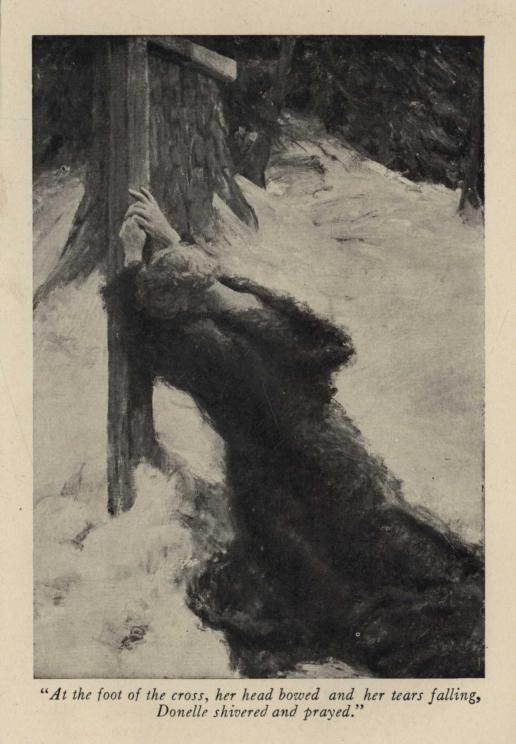
"At the foot of the cross, her head bowed and her tears falling, Donelle shivered and prayed."
Presently she raised her face; it was calm and pale. There was a round teardrop on her cheek that had not fallen with the others. She turned and there by the roadside stood Norval. How long he had been there he could hardly have told himself.
When he had gone to the white house for his noon-day meal, Jo had told him, quite inconsequently, of Donelle's errand and he had followed her, for what reason God only knew.
"Donelle!" he said, "Donelle!"
The terrible look in his eyes was gone, gone was the mocking smile of the night before. Pity, divine pity, moved him.
"Donelle!"
"Yes, Mr. Richard Alton." The poor girl strove to be her teasing self, but her lips trembled and suddenly a strange, almost an awful, dignity and detachment overcame her. Standing with clasped hands, in her nun-like garb, she seemed to have taken farewell of the world that women crave.
"What are you doing, Donelle, by that cross?" Norval did not draw near, and a distance of several feet separated them.
"Thinking and praying."
"Thinking what? And praying for what?"
The trouble in his eyes met the trouble in hers and called for simple truth.
"I was thinking of how you looked at me yesterday when I was in Tom Gavot's hut and of how you made me suffer last night. And I was praying to God to help me, help me to stop loving you."
So naïve and direct were the words that they made Norval breathe hard. In a flash he saw the true nature of the girl before him. She was old, gravely, inheritedly old; and she was, too, a young and pitiful child.
People had only touched the outer surface of her character and personality. Alone she had learned the primitive and desperate lessons of womanhood.
"Stop loving me?" Norval repeated the words slowly.
"Yes, I was beginning to love you very much, more than everything else. Then, when you looked as you did yesterday, I remembered and all night I was afraid. Oh! I am glad you did not get to loving me. It hurts so!"
"How do you know that I have not got to loving you? How do you know but that it was because I love you that I looked as I did yesterday?"
"Ah, no, Mr. Richard Alton, you couldn't have looked so had you loved me." Donelle tried to smile and made a pitiful showing.
"You don't know men, Donelle."
"But I know love."
Now that she had taken her last leave of it, Donelle could talk of it as little Sister Mary might have done, for she had vowed beside the cross to go back to St. Michael's. Long ago Sister Angela had said that she would find peace there. Then she spoke suddenly to Norval.
"You see, maybe you have heard something about Mamsey and me, but you did not quite understand and you felt you had a right to look as you did. I wonder why men want to make it harder for—for women, when women try to forget?"
Norval winced; the shaft had sunk into its rightful place.
And still the white-faced girl stood her distance, and tried to smile.
"I am going to tell you all about Mamsey and me," she said. "I will tell you as we walk along."
CHAPTER XVI
THE STORY
How little she really knew of life! But how the last year of suffering and renunciation had filled the void with a young but terrible philosophy. Norval did not speak. With bowed head, hands clasped behind him, he walked beside Donelle as she went along, bearing her cross and poor Jo's.
"You see I could not let Mamsey know that I knew. I could not hurt her so. She would have made me go away, and always I would have remembered her here alone where my father left her. And Tom Gavot has helped me keep the people still. He stays here, and he wanted to go way, way off, and be something so different. That is why I can play for Tom in his cabin. He knows and understands; he couldn't hurt Mamsey and me, he couldn't! Women like Mamsey and me feel a hurt terribly, that's why I am telling you this, I want you to be kind. Don't make things harder, they are bad enough!"
"Donelle, for God's sake, spare me!"
The words were wrung from Norval, but he did not look up.
"I'm sure now that you know, you never will hurt us again," Donelle's voice soothed and caressed unconsciously. "I!—I wanted to be happy just as if nothing had happened, before I was born, to keep me from being happy. I thought about love, just as girls will. They cannot help it. Then you came and I wanted you!"
A quivering fierceness shot through the words. Norval gave a quick glance at the face near him and saw that the purest, most primitive statement of a mighty truth held the girl's thought. If she had said, she, the first woman, to him, the first man:
"You are mine, I want you," she could not have said it more divinely.
"I wanted to make you happy; to play for you while you painted your beautiful pictures, and then when you were tired and I was tired, why, our big love would bring us more and more happiness. Then, well, then you looked at me through Tom Gavot's window and somehow I understood!"
Donelle and Norval were nearing the little white house, they could see the smoke rising from the chimney. Norval's thoughts were racing madly ahead, crowding upon him, choking him. He meant to make the future safe for this young girl, safe from himself and the sacredest passion of his life which, he now acknowledged, had mastered him. Reason, world-understanding, had no part in it, he wanted her. He must have her, and was prepared to clear the path leading to an honest love. But he could not tell her of Katherine, of himself, there was no time; no time and her experience could not possibly have prepared her for bearing it.
"I am going to tell you a great secret," Donelle half whispered, "back there by the cross I remembered what the Sisters at the Home used to tell me. They knew, but I did not—then. For girls like me—well, I am going back to St. Michael's-on-the-Rocks and teach the babies. That's why I could tell you what I have just told you."
Then Norval turned and took her in his arms. So swiftly, so overpoweringly did he do this, that Donelle lay quiet and frightened, her white face pressed against his breast, her wonderful eyes searching his stern, strange face.
"No, by God! You are not going back to St. Michael's!" he whispered. "You little white soul, can't you see I love and adore you? Can't you see it was because I couldn't bear another man to—to have you, that I was a brute to you? Do you think that any wrong others have done can keep you from me, from letting me take you where you belong? Donelle! Donelle, kiss me, child."
Only the deep eyes moved; they widened and grew dark.
"May I—kiss you?"
"No." And Norval did not kiss her!
"But you are mine, Donelle, and all the powers in the world cannot alter that. I am going to make you believe me. What do I care for anything but this? You have driven everything but yourself from sight. When you play, great heavens, Donelle, when you play to me, moving about as you did that first and only time in my cabin, you took me into a Great Place. Don't tremble, little girl, don't. Every quiver hurts me. I am going to make you forget the brute in me; I'm going to meet your love, dear heart, with one as fine, so help me God! Trust me, Donelle, trust me and when you can tell me that you do trust me, we will go to Mam'selle. She will understand, she has the mighty soul. Oh, Donelle!"
Norval leaned over the tender face, almost touched it with his lips, but did not.
"My little white love!" he whispered. "But you will come and play for me?" he pleaded.
"Yes."
"And you will, you will give me a fair show?" She smiled wanly.
"If I ever give you cause again to fear me, I hope——"
Then Donelle raised her hand and laid it across his lips.
"I am so afraid of this wonderful thing that is happening to me," she said, "and you mustn't say—well! what you were going to say just then."
"Don't fear the love, my darling. It's the sacredest thing in the world." Norval had taken the hand from his lips and now held it in his own. "And we'll keep it holy, Donelle. That is our part."
"Yes, yes; but to think, to think!"
"Don't think, sweet, here. Come close and try to—to—love for a moment without remembering."
"Why, how can I?"
"Try."
And so they stood with the golden light of the west on their faces. Norval did the thinking. He thought of the quickest possible method of setting Katherine free and making it right for him to kiss Donelle. He thought of the wild realization of his true nature—a nature that had been distorted and contracted by inheritance and training. He did not want the beaten tracks, that had always been the trouble. He wanted the unbroken trails, God! how he had thirsted and hungered for just what this little, wild, sweet thing in his arms represented. Love, simple, primitive love, music, understanding! And then Norval thought of Anderson Law! Thought of him, longed for him at that moment as a blind man might long for guiding, not to the right path, but on it.
"You may kiss me now!" This in a whisper.
The quick surrender startled Norval. He bent his head, still thinking of Law.
"My woman," he said to that uplifted face, "when I have the right, that somehow I forfeited, I will kiss you."
"But you said we were not to think; when you think, you remember."
"Yes, Donelle, we remember and we look ahead with faith."
Gently Norval let her free. He smiled at her, and the look in his eyes made her stand very straight, but she smiled back.
"I am so happy," she said simply. "And I thought I was never to be happy again."
"And I—why, Donelle, you've taught me what happiness means. And you will keep your promise about coming to the wood-cabin?"
"Yes, Mr. Richard Alton." Donelle made a courtesy.
"And you'll bring the fiddle?"
"Of course."
"And Donelle, before you, dear child, I beg the pardon and forgiveness of Tom Gavot."
"I wish he could know that you are what you are," Donelle's eyes saddened.
"He shall, child. That, I swear. Next to Mam'selle," here, almost unconsciously Norval raised his cap, "next to Mam'selle, Tom Gavot shall know. Come, little girl, here's home!"
And together they went up to Jo's house. It was marvellous how they managed the great thing that had happened. Never outwardly did it overcome them.
The winter grew still and hard, the people shrank into their houses. There were trodden paths, like spokes of a wheel, leading from most of the houses to the hub, which was Dan's Place; there were more or less broken paths reaching to the river, where, under the ice, fish were obtainable.
Tom Gavot just at that time was called to duty and left his father with money enough to keep him silent; and food and fuel enough to keep him safe.
Jo, with a growing content and happiness, cooked for her boarder, revelled in his society during the long evenings, and was perfectly oblivious of the stupendous thing that was going on under her very eyes.
Norval sent for books, many of them. Books of travel; Jo grew breathless over them.
"I can sit in this rocker," she often said to Marcel Longville, "shut my eyes, and there I am in those far places. I see palm groves and I hear the swishing of the sea. Mercy! Marcel, just fancy a body of water as long as the St. Lawrence and as wide as it is long!"
"I can't," said Marcel. "And I wouldn't want to. Water isn't what I take to most. But I do like the palm countries, Mam'selle. They are, generally speaking, warm. Sometimes I feel as if I never would be warm again as long as I live."
While Norval read aloud to Jo and Donelle, he would often lift his eyes to find Donelle looking at him. Over the gulf of silence that separated them they smiled and trusted.
Norval wrote to his lawyer, instructed him to take legal steps at once, upon whatever ground he could, legitimately, select. "Leave my wife and me free," he said; "with as decent characters as our stupid laws permit. I don't see why society should feel more moral if we are sullied."
But Norval did not write to Katherine. He left that for his lawyers to do. He did, however, send a pretty fair statement of the case of himself and his wife to Anderson Law who, at that time, was basking under Egypt's calm skies, wandering in deserts, forgetting, and pulling himself together.
And according to her promise Donelle went often to the cabin in the woods. Because it was winter and Point of Pines in a subnormal state, no one knew of the secret visits. Not even the joyous notes of the violin attracted attention. Norval painted as he never had in his life before. His genius burned bright. He knew the difference now; it made him humble and grateful. He painted the winter woods with an inspired brush. They were asleep, but not dead. His sunlight was alive; his moonlight, pure magic. He caught the frozen river with its strange, shifting colours; he dealt appealingly with the lonely, scattered houses; they seemed, under his hand, to ask for sympathy in their isolation.
Guided by Donelle's interpretation, he painted a road full of mystery and delight. A long road leading to a hilltop.
"Oh!" Donelle cried when she stood close and beheld the picture. "Now I see what Tom saw long ago, but you had to teach me. The road is alive, it is a—a friend! You just would not want to hurt it or make it ashamed. Oh! how the sunlight lies on it. I believe it moves!"
Norval lifted his face, his yearning eyes claimed the love he saw in Donelle's.
"Sweetheart, trot around and play for me," he would suddenly say, his lips closing firm, "play and play while I make Tom Gavot's road ready for him. Child, when I give Tom Gavot this picture, I'll make him understand many things."
"And you will give him the Road? He'll be so happy." Donelle was moving about, her eyes dreamy.
"I wonder!" breathed Norval.
"Wonder what?" Donelle paused.
"About a thousand things, my sweet."
By and by Norval painted his love; painted it in the splendid picture that afterward hung in a distant gallery and was known as "Fairer than morning, lovelier than the daylight."
In it sat Donelle where the western glow fell upon her. With a rapt expression in her yellow eyes, her violin poised, the bow ready, she was looking and smiling at the vision that had caught and held her.
"I seem to be looking at you," Donelle whispered as, standing beside him, she gazed at the canvas. "Waiting for you to tell me what to play. I believe, I believe you are saying to me, 'play our pretty little French song.' Shall I play it now?"
"Yes, my beloved, and then," Norval was sternly intent upon his brushes, "then we'll go for a tramp with Nick. That infernal little scamp is like an alarm clock. Look, Donelle, he's coming up the path, coming to tell us the evening meal is ready. Sometimes I wonder if Mam'selle guesses?"
After some delay a letter came from Norval's lawyer.
It said:
I think by summer we can bring everything to a satisfactory conclusion. I can take no definite steps at present because Mrs. Norval's lawyer writes that she has been quite ill and has gone to the mountains to recuperate.
Norval frowned, he was getting impatient of delay, he wanted to take Donelle to Egypt in the early summer. He wanted Law to set his seal of approbation upon her.
But Donelle saw no reason for perplexity; she existed in so glorious a state that no disturbing thing ever entered. It was enough for her to waken in the morning and to know that her love was in Jo's upper chamber, safe and near. It was joy for her to look at Jo herself and think that the world could no longer hurt her. How could it, with the big love holding them all?
When Norval touched her, Donelle felt the thrill of trust and understanding. She never doubted now and often she would laugh as she remembered her vow by the cross and thought of St. Michael's-on-the-Rocks.
"Oh! but it is the magic that has caught me!" she whispered to herself, hugging her slim body and wishing, with happy tears, that all the world, her little world, could know.
She wanted Jo to know, and Tom Gavot! She couldn't bear to have Tom nursing a hate while he was away making his roads. She wanted everyone in Point of Pines to know, even old Pierre.
She wished, almost pathetically, that Mrs. Lindsay and Professor Revelle could know.
"For they made me just a little more like my dear love," She said to herself. "They brightened me and gave me the music. My dear loves me to be pretty and he loves my music."
But it was not all so easy for Norval. There were times when, alone with Donelle in the wood-cabin, the crude side of love made its tremendous claim.
How desirable Donelle was when, casting her violin aside, she flung herself in a chair by the hearth and said:
"Come, put the paints away and wipe the brushes carefully. Come tell me a story and then, dear man, I'll stir you some maple and put in a lot of nuts. Oh! but I will make it good."
Norval, at such commands, felt his strength departing.
"There's one story I'd like to tell you, little woman," he once flung back to her desperately.
"And that is what?"
"A story of a man and woman."
"Go on, go on," Donelle urged. "That will be the best of all."
"You bet it will!" Then Norval tossed his brushes aside.
"I'm coming over to take you in my arms and kiss you, sweet!" he warned, but did not move.
"Well, why don't you? And then we can tell Mamsey."
Norval frowned.
"Shall I come to you, dear man?"
Oh! how she lured and tempted from her safe, innocent love. "I trust you now. I beg your pardon because I once did not. I will come half the way."
"My sweet, when I take you in my arms to tell you the story I mean to tell you, I will come all the way! Now stir the syrup, you hard little bargainer. Throw in an extra handful of nuts for the crimes you commit but know not of."
"And now you are laughing!" cried Donelle.
"Far from it, I'm thinking of swearing."
"At what?" Donelle was cracking the nuts.
"At the absolute stupidity of——Good Lord, child"—Norval sprang toward her—"your skirt was on fire! He crushed the sparks and held her for a moment.
"If anything happened to you," he muttered.
"What would you do?" Donelle trembled a little in his arms.
"I'd go—don't look at me that way, Donelle—I'd go to St. Michael's-on-the-Rocks."
CHAPTER XVII
THE BLIGHTING TRUTH
Then spring came softly, fragrantly up the hill from the river. Almost every day a new little flower showed its head. Tom Gavot came back grim, tired, and eager. He found his cabin swept and shining, a fire upon the hearth, and a bunch of timid snow blossoms in a cracked mug on the table—that made him laugh. But at the sight of them Tom's weariness vanished and he sat down by his own fireside with a sigh of complete content.
Jo sang at her work that spring, actually sang "A la Claire Fontaine." She sang it boldly, without reservations, and Nick forgot his years and a growing dimness of the eyes. He smelled around among the delectable new things in the woods, found the scent for which he was searching, and trotted off gaily, feeling young and dapper once again. Molly, the sturdy horse, felt her oats; she almost ran away once, tossing Jo from the shaft into the muddy road.
But Jo only laughed aloud. It was all so absurd and natural.
"The little red cow," Jo said to Donelle that spring, "is old, old. I really do not know that it's wise to keep her longer. She eats her head off."
"But you are going to keep her, Mamsey, aren't you? You just couldn't send her away? Think of all her pretty calves, and she has been so faithful."
Suddenly Mam'selle recalled the night before Donelle came: when she and Nick had bided with the little red cow.
"Of course," she blurted out, "I am going to keep her. I was only supposing."
"Oh! Mamsey, you are such fun, and you never hide any more. You're really getting to be handsome. Do you know Mr. Alton, Mr. Richard Alton, says he'd like to paint you as 'The Woman With the Hoe.' He says you'd show the man—I don't know who he means—what a hoe can do for the right sort."
"Well, Mr. Richard Alton isn't going to mess me up in his paints. It's an awful waste of time for a full-grown man to make pictures all day. I wonder when he's going home?"
"I wonder?" whispered Donelle.
"We'll never have another boarder like him, child."
"Oh! never, Mamsey."
"I wish he'd stay through the summer. I'd like to fling him in the teeth of Marcel's boarders."
"Oh! Mamsey."
"The Captain says he's all ready for folks now; he's opened sooner because Father Mantelle prophesies an early summer."
Then one night, after everyone was in bed, the River Queen sneaked up to the wharf—there is no other word for her action—and a lone figure, with several bags and a trunk, was deposited.
Jean Duval, who had swung out the lantern from the pole, took charge.
"I'll just take you up to Captain Longville's," he said. "The Captain can manage."
The following morning Donelle found, upon going to the living room, that Alton had departed at daybreak.
"He wanted to see the sunrise on the river," Jo explained; "he took lunch enough to feed a dozen; fried chicken and doughnuts and pickles. He's the biggest pickle eater I ever saw," Jo laughed. Then added: "Donelle, I'm going to the village to-day with my linens. The man in the shop over there has offered a tidy sum for them. I don't think I can get back to-night. Molly acts like a colt, but her staying powers are nothing to boast of. You better go to Marcel——"
"But I hate to, Mamsey."
"Child, I'd rest easier——"
"Then I'll go, Mamsey. I'd even go to that dirty old Pierre's or to the Kelly's if you would rest easier, Mamsey. Isn't life just like a book?"
"It is!" murmured Jo with conviction. "It certainly is wonderfully like a book."
After Jo had gone and Donelle had put the little house in order she closed the door and windows and whistled to Nick.
"Come on, you old dear," she said, "and how thankful I am you can't talk, Nick. You can look and thump your tail all you want to; no one understands that. Nick, when he gets back, he'll be tired. We'll be there to meet him. Come on, Nick!"
The sun was warm and bright, it filtered through the trees and reached the brave spring flowers showing in the moss and the rich, black earth.
"Don't step on the flowers, Nick. Where are your manners?" Donelle gave a laugh and Nick made wide circles. And so they came to the wood-cabin and went inside. Donelle left the door open for she meant to make a rousing fire, and the day was too fine to be shut out. Nick pattered around the room for a few moments and then curled up in the window seat.
"There, now," said Donelle at last, "I think everything is right and cosey, I can finish that book."
So she took the story she and Norval had been reading and, buried in the deep chair, with her back to the door, she was soon absorbed.
She heard a step outside, smiled, and made believe she was asleep.
Someone entered, saw her, and quickly drew conclusions; bitter, cruel conclusions, but conclusions that drove an almost defeated sense of duty to the fore.
"Good morning. Is this Mr. Norval's—" there was a pause—"studio?"
Donelle sprang up as if she had been shot. A thin, desperately sick-looking woman in rich velvet and furs confronted her. The incongruous garments, the strangely haunting name, made Donelle stare.
"Is this Mr. Norval's—studio? I asked." The thin, sharp voice seemed to awaken Donelle at last.
"No," she replied, "this cabin is where Mr. Richard Alton paints his pictures."
"Indeed! He's changed his name, I see. I—" and now the stranger came in and closed the door after her, closed it with an air of proprietorship—"I am Mrs. James Norval," she said, sitting down. "And you, I suppose, are—let me see if I can recall your name, it is rather an odd one. Now I have it, Donelle Morey. That's right, isn't it?"
"Yes." Donelle stood staring. She was not quite sure that she was awake, but—yes, there was Nick snoring on the window seat and the lovely river picture was on the easel. Besides, like a stab, the name she had just heard became vividly familiar, it belonged to the Walled House.
"Yes, I'm Donelle Morey," she managed to say faintly.
"I know all about you. Mrs. Lindsay was my friend. I thought Mr. Law was going to look after you. Has he been up here, Mr. Anderson Law?"
Katherine Norval was glancing about the room, her keen eyes taking in the pictures. How splendid they were!
"No, Mr. Law has never been here."
Donelle was groping, groping among other familiar names in this suddenly quickened moment.
"I suppose he sent Mr. Norval?"
A righteous anger seized upon Katherine Norval; she felt she understood. Anderson Law had urged her husband to act for him. Norval had come, disguised, and had taken his own method of solving matters. He was making "cause" for his divorce undoubtedly, while at the same time he was deluding an innocent and trusting girl.
A stern sense of duty arose in her. "I will save the girl as far as I can," she thought, "but what a dastardly thing!"
"My dear," she said, "I do wish you would sit down. You make me feel quite uncomfortable." Katherine meant to disregard, before Norval's victim, what she really believed.
Donelle groped toward a chair and sat down.
"I quite understand your surprise," said Katherine. "You have known my husband as—as Richard Alton. You see, Mr. Law was going abroad; he was to have carried out Mrs. Lindsay's wishes for you, but he sent my husband instead. I suppose Mr. Norval wanted to know you well before he disclosed his errand."
Donelle was experiencing the same sensation she had felt when Pierre Gavot, upon the lonely road, had spoken the terrible word years and years before!
"I see I have surprised you, child?"
Katherine Norval was growing restive under the look in the wide, glowing eyes fixed upon her. "It is always a bit of a shock to find that someone has—played with you. But I'm sure my husband meant no harm, at first; and then he would not know how to get out of his scrape. That would be like him, too." A laugh followed the words, a hard, thin, but sweet laugh.
Still Donelle sat looking straight before her and keeping that awful silence which was becoming irritating.
"Perhaps you do not believe me," Katherine said rather desperately and with a distinct sense of the absurdity of her position. "See here!"
Taking a locket from her bosom she opened it and held it before Donelle's staring eyes.
"These are my husband and baby!"
The picture of Norval was perfect; the child, young and lovely, seemed to be smiling trustfully at him.
"It's a pretty baby," Donelle said, and her voice seemed to come from a long distance. Then she got up quickly.
"Where are you going?" asked Katherine Norval.
"I—I don't—— Oh! yes, I'm going to Tom Gavot's."
"Don't you think you better wait here with me until—until Mr. Norval returns? He will speak openly to you then and explain everything."
"No, oh, no, I couldn't!"
A great fear rose in Donelle's eyes.
"My dear, I am very sorry for you!" And Katherine spoke the truth. She was sorry, deeply so, but she was more shocked and indignant than she had ever been in her life before. It was to Norval's credit that she did not believe the worst of him. She concluded that stupidity, rather than viciousness, had led him on to deceive this simple girl without realizing what the actual result would be.
"And so you will not wait with me?" She watched Donelle cross the room. "I am so sorry, child. I wish now that I had come before."
"Good-bye!" Donelle gave her a long, sad look. Then she whistled to Nick and went out, closing the cabin door behind her as one does who leaves a chamber of death.
She walked along slowly, feeling nothing keenly, but noticing with a queer sort of concentration the flickering shadows; there were clouds coming up, it was growing darker. She was glad that she had closed the little house before leaving. If there were a storm all would be safe. Presently she came to Tom Gavot's hut and went in, thankful that it was empty, though she knew Tom would soon be coming.
She made a fire, brushed the hearth, and sat down upon the floor, trying hard to think—think! But she could not get very far. Round and round the one fact her thoughts whirled. The man she loved, the man she had trusted, had wronged her in the deadliest way. He had killed something in her, something that had made her happy and good. She did not want to remember anything now; she wanted to put herself beyond the reach of the look Norval had once given her, and of his later words—words which had made her trust him. Donelle grasped at the thought of St. Michael's with a yearning that hurt her. If little Sister Mary were there, she would understand. Donelle was sure the lost look in Sister Mary's eyes would make her understand. But St. Michael's was a long way off, and Donelle meant to place herself out of reach of more hurt before Norval could see her. Pride, love, shame, and then—desperation swept over the girl. Everything had failed her, everything, and all because her father had left her mother! That was why people dared to—to play with her.
And just then Tom Gavot came in, shaking the wet of a sudden shower from his fuzzy coat.
"Well!" he cried, looking at Donelle with startled eyes; "what's the matter?"
"Tom, I wonder if you would do—something for me? It's a big thing, and you'd just have to trust me more than any man ever trusted a girl before." A feverish colour flamed in Donelle's cheeks.
The light flickered in Gavot's eyes, his lips twitched as he looked at her.
"I guess you know there isn't anything I wouldn't do for you, Donelle," he said, coming close and standing over her protectingly.
"It—it isn't fair to you, Tom, but I'll live my whole life making it up to you. And you know I can keep my word."
"What is it, Donelle?"
"Tom, I want you to—to marry me. Marry me, now, this very afternoon!"
"My God!" murmured Tom and sat down, leaning forward over his clasped hands.
"It's this way," Donelle went on slowly, as if afraid she might not make herself clear and yet fearing more that she might wrong another in her determination to reach safety. "It is Mr. Richard Alton. He—he isn't Mr. Alton at all, he's Mr. Norval. Mrs. Lindsay used to talk about him, and he came here to—to get to know me without my knowing him. And then—something happened!"
"What?" The word issued from Tom's lips like a snarl.
"We loved each other very much, Tom. We couldn't help it, but you see I am the kind of girl that makes it seem as if it did not matter very much, I guess. I am sure he didn't mean to hurt me; it just happened, and neither of us could help it, Tom."
"God! I'll kill him."
"Oh! no, Tom, you will not, you shall not hurt him. You will just help me, and then he'll think, I—I—did not care very much, that I was playing, just as he was. I want him to think that, more than anything else, for then everything will be easy. He must not think I care!"
"Did he tell you that he would marry you?" asked Tom with a terrible understanding in his eyes.
"Well, not exactly," Donelle tried to be very just, very true, "it was the big love, you know, and I just thought of being always with him."
"Why have you stopped thinking so?"
"Well, Tom, I will tell you. I was up in his cabin, waiting for him this morning, and his wife came. I know about her, too. When I heard her name I knew everything. And she told me many things and she showed me their baby's picture. It is such a pretty baby—oh! Tom."
The misery on Donelle's face roused in Gavot a cruel hate.
"Blast his soul!" he cried, then took Donelle's face in his cold hands and looked deep into her eyes. His soul revolted at the question he was about to put, it was like giving poison to a child: "Donelle, tell me before God, has he done to you what—what your father did to Mam'selle Jo?"
For an instant Donelle repeated the words in her inner consciousness until the meaning was quite plain. Her lovely eyes never faltered, but suddenly a new knowledge rose in them.
"No," she whispered, "no, Tom, not that. It was only—the love."
"Thank God, then, I've got you in time."
"Yes, in time, Tom. That's what I meant. He would never hurt me that way, Tom—never! But I do not want him to know that he could hurt me at all! Don't you see, Tom, if he thought that I was caring for you all the time and just playing with him, it——"
The quivering face writhed in Tom's hands.
"Oh! Tom, I know it is wicked for me to ask you to do this for me, but all my life long I will repay you!"
The man looked down at the girl, who was pleading with him to take that for which his soul hungered—at any price! Full well he knew that she would keep her bargain, poor little hurt thing. And he could slave and work for her—he could shield her from harm and make her safer than she could be in any other way. The devil tempted him, and for the moment, claimed him.
"Yes, by God!" he cried. "I will take you to Father Mantelle's now! We'll make our future beyond the reach of that infernal scoundrel, Norval, or whatever his name is!"
"Tom, never any more must we talk about him. We must just begin from now—you and I. All these years Mamsey has let people think well—of my father. I think I am a little like Mamsey, Tom, and from now on, it is just you and I. You must promise or I could not marry you."
"Come on, Donelle! See, it is raining, you must wear this heavy coat, it will quite cover you. Come!"
Tom had appropriated her, taken command. His face was almost terrible in its set purpose.
She followed him mutely, obediently, as any little hill woman might have done. Her face was ghastly, but she did not tremble. Side by side they made their way to Father Mantelle's; the rain poured upon them, their steps sloughed in the soft earth, and behind them trudged Nick, looking old and forsaken!
Father Mantelle did his duty—as he saw it. He made sure that Tom fully understood what he was undertaking; he made sure that Donelle was wiser than he had believed her. He winced as she confessed that her love for Mam'selle Morey had, after full comprehension of their relation, brought her back and kept her silent. She had known about herself all along.
"And that's why," Tom put in, "that we insist upon silence now. I'm going to run things hereafter."
And so Father Mantelle married them and put the blessing of the Church upon them.
It was quite dark when they left the priest's house; dark and still storming in the quiet, persistent way that spring knows.
"Was Mam'selle going to leave you in the house with—with that man to-night?" Tom asked suddenly.
"No—I was going to Marcel's. But, Tom, I must go and feed the animals." Almost Donelle had forgotten the helpless creatures. She was terribly afraid that she might encounter the man she most dreaded in the world, for he was quite one of the family and often made his own meal when Jo and Donelle were away. But if he had gone to the wood-cabin first, she argued, he would not come to the little white house. Of that she felt sure!
So she and Tom fed the animals and made them safe for the night. In doing the homely, familiar tasks Donelle felt a certain peace, but she had not yet recovered from her terrible shock; she was spiritually numb.
"Come, now!" Tom said at last. "We must get back to the hut, you're wet to the skin and I haven't eaten since morning."
"Tom!" Donelle was aghast; and then she remembered that she, too, had fasted since breakfast.
So, silently, stolidly they went down the Right of Way to the river-hut. The fire was still burning on the hearth, the room was hot and still.
"Come in, Nick!" called Tom to the dog who had kept close to them; "come in!"
Wet and bedraggled Nick slouched in and, eyeing Donelle as if she were a stranger, passed to the far side of the room and lay down, his head upon his paws, his eyes alert.
Tom brought out food and they all ate, Nick condescending to come nearer.
The heat, the weariness and suffering of the day, began to tell upon Donelle and presently a terror seized her—a terror she had never known in her life before. She looked at Tom with wide eyes, her face became livid.
The rain outside beat against the window and pattered on the roof.
The devil that had tempted Tom earlier was taking control of the situation. His face was tense, his eyes burning. He was thinking, thinking, and his thoughts scorched. He was thinking of women, women, his mother, Mam'selle Morey—even that unknown woman, the wife of the man who had all but ruined Donelle. Then he thought of Donelle herself, but he dared not look at the pale little thing by the fire. She was his! She had done him a great injustice, it was only fair that he should hold her to her bargain. She had only thought of herself, how to save herself, she ought to pay for that.
Pay—pay—pay! The word was hateful and ugly. Again Tom thought of his mother, and her face rose sharply before him.
Then the finest thing that Tom ever did in his life he did at that moment.
In the still, hot room, with eyes at last resting upon Donelle's bowed head, he vowed to his God that she should not pay, not if it cost him all that life held dear! If the time ever came when she could give—Tom breathed hard. Then he spoke.
"Donelle," his voice was deep and solemn, "you're tired, done almost to death, but you're safe—safer than you know. I want you to go to that bed"—Gavot pointed to his cot in the far corner by the side of which Nick lay curled—"and you are to sleep. I'm going to pile the fire high, and——"
"Tom, let me go to Marcel's just for to-night, please, Tom!"
The agony in Donelle's eyes made Gavot shudder.
"I guess I'd rather have my wife stay here," he said. Then added, "You must do what I say, Donelle. I've done my part, you've got to do yours."
"I will, Tom. I will."
Gropingly she walked across the room, while Tom piled wood on the fire. In the dark shadows she waited. Then Tom rose up, took his heavy coat, his fur cap, and went toward the door.
"Good-night," he said. It was like a groan. "Good-night, and you're safe, Donelle, so help me God! After I am gone, draw the bar across the door."
Then Donelle was alone with Nick. She stood and looked blankly after Tom. Then she tiptoed across the room, took the bar in her hand, paused, lifted it, and—let it fall! Proudly she went back, her eyes were aflame, her heart beat until it hurt. She lay down upon the wide cot, drew over her the heavy blankets Mam'selle had donated for Tom's comfort, and fear left her.
"Nick," she whispered, "Nick, come here!"
The dog came close, licked the hand reaching out to him in the darkness, then lay down close to the bed.
For an hour Donelle listened, waited, then she began to suffer. But she made no moan and always no matter how she thrashed the matter over, she saw St. Michael's-on-the-Rocks. It seemed like home after a hard journey; her home, the place where she belonged. The only place to which she had a right to go.
CHAPTER XVIII
TOM GAVOT SETTLES THE MATTER
The rain had detained Norval. He had watched the sunrise on the river and he had caught as much of it as his soul could take in. He had eaten a hasty lunch at noon and then became absorbed by the beauty of the gray mists that were rising, where, but a little time before, the glory had controlled everything. He painted until mid-afternoon, then a raindrop caused him to glance up.
"Hello!" he said, and scrambled for his belongings. In a few minutes he was on his way back, but to protect his sketches, he had to pause every now and then, when the downpour was heaviest.
He had meant to go right to Jo's and get dry clothing, but by skirting the road he could reach the cabin en route, leave his paints and canvases, and the rest did not matter. It was after five when he came in sight of his cabin.
"By all that's holy," he said, and laughed, "that little rascal is there, she's made a fire. Of course this is all wrong, she mustn't—— But to think she has no fear!" Somehow this elated Norval considerably. He hastened on, meaning to get Donelle and start out at once for Mam'selle's, as it was growing very dark.
He opened the door with an amused smile on his face, then he fell back.
"My God! Katherine," he said, "what does this mean?"
"I think, Jim, you better come in and close the door. I cannot go out in this rain and we can have our talk here." Katherine spoke as if her presence there was the most natural thing in the world; her voice was hard and even. She knew her duty; she had even acknowledged, during the hours she had sat alone after Donelle went, that part of the blame for all this confusion rested upon her. She had fallen short in her estimate of her original duty to Norval. She had deserted him, not without some cause to be sure, but no matter what his selfishness and indifference had been in the past they had not made it right for a wife to forsake the sacred tie that bound her.
After Donelle had left the hut Katherine went over and over the matter from the day when with her "Awakened Soul" in her hands she had demanded a freedom that it was in no man's power to bestow. It had taken her a long time to learn her lesson, but once having learned it, having come back, her path of duty was, to her, quite plain. She gave not a moment's thought to the shock her sudden appearance would give Norval; she was rallying from the effects of the shock that Donelle had given her. She must make sure, of course, but the more she considered, the more confident she became that no real harm had been done. She had come in time.
Self-centred, incapable of wide visions, Katherine Norval had leaped over non-essentials and had arrived at safe conclusions. But her husband was unnerving her; he made her feel as that white slip of a girl had and she resented it.
Norval was deliberately taking off his wet coat. Having done this he put on an old velvet jacket, came to the fire, leaned his arm on the mantel-shelf and looked down upon his wife. That she was still his wife he had to confess, though she seemed the merest stranger.
"I don't suppose there is a chance that I am dreaming?" he said grimly in an effort to relieve a situation that was becoming hideously awkward. "You don't happen to be an optical illusion, do you?"
"I'm quite myself, Jim. Is it such an unusual thing for a wife to come and see her husband, especially when she has much—much business to discuss? And your work——" Katherine was struggling with the growing impression that she was bungling something, though absurdly enough she did not quite know what. "You've worked to some purpose, Jim."
Norval ignored her reference to his work.
"It's a bit queer to have my especial kind of wife here," he said. "You see, Katherine, I had every reason to believe that you desired to eliminate me; I'd taken every step possible to assist you. I simply cannot account for you, that's all."
Norval noted her pallor and thinness, then he remembered that she had been ill.
"Jim," she said suddenly, her sharp little chin raised, her cold, clear eyes searching his, "before we go any further I must ask you a question: This girl, this Donelle Morey, what is she to you? What are you to her?"
"What right have you to ask that?" Norval grew rigid. "How did you manage to get here? How did you know I was here, anyway, Katherine?"
"You sent a letter once with the postmark on it. Then I remembered! For awhile, I did not care. Then things became different. Jim, I must know, I have a right to know, has this girl any claim upon you? I could make nothing of her, I——"
"Good God! Have you seen her?" Norval sprang a step forward. "Have you talked to her?"
"Why do you glare at me so, Jim? Of course I have seen her, talked to her. I came last night. I am staying at a house down the road. I heard that a painter by the name of Alton lived with Mam'selle Jo Morey, made pictures in a cabin in the woods; I put things together. I went to Mam'selle Morey's, found the house empty. I came here and found the—the young girl quite at home, apparently waiting for you."
The cold voice was calm and deadly distinct, the eyes were indignant—but just.
"And then you talked!" There was a sneer in Norval's voice. "I suppose you felt it your duty to talk? What did you talk about, Katherine?"
Norval was in a dangerous mood, but his wife had never been afraid of him and she knew no fear now. Besides, she had the whip hand. He knew it; she knew it!
"I told her your name, for one thing. I do not question your conscience, Jim. I leave that to you."
"Thank you, and what next did you tell her?"
"I told her the truth. Are you afraid of the truth? Are you afraid of the truth, Jim? You were flying under false colours, were you not?"
"Yes."
"I told her Anderson Law sent you; he did, did he not, Jim?"
"He asked me to come, yes."
"And you think you have fulfilled your duty to Anderson Law? You think he would approve?"
Norval winced.
"I ask you again, Jim, has this girl any hold on you?"
"If you mean the vile thing I fear you mean, no! As God hears me, no!" Norval spoke in a still fury. "If you mean has she the highest claim a woman can have on a man, yes. Katherine, it may be best for us to get this over as soon as possible. If I seem brutal, you'll have to forgive me. I'm pretty far gone in my capacity of self-control. I dare say you've spoken nothing but the truth to the girl you found here. I make no excuse for her or myself. Think what you please, patch it up anyway you can. Whatever wrong has been committed is mine, not hers. She never knew of your existence until you informed her. She is as simple as a child, as wonderful as a woman can be before the world has spoiled her. I love her and she loves me. I meant to tell her everything when I was free; she could not understand before. My only desire is to—to marry her and know the first pure joy of my life. But I suppose your plain, damnable truth has killed her. If it has, I swear——"
"It has not killed her, Jim." And there was a glint in Katherine's steely eyes. "She said she was going to a Tom Gavot, whoever he may be. And, Jim, doesn't it sound a bit, well, peculiar, for you to speak as you have just spoken to—to your wife? For, after all, I still am your wife."
"But that tie will soon be broken. Why did you come here; why, in heaven's name?"
An impotent fear held Norval. Katherine was there, and Donelle had gone to Tom Gavot! That was about all he could take in. Suddenly Katherine Norval's face softened, her head dropped, she looked terribly ill and haggard.
"Please, Jim," she pleaded, "sit down, I must tell you something I came here to tell you, and I'm not very strong."
Norval sat down, still repeating in his clogged thoughts:
"Donelle has gone to Tom Gavot."
"I suppose," Katherine's words ran along, at times sinking into Norval's confused brain, "I suppose I had to pass through a certain phase of life, as many do. I had been so sheltered, so, well suppressed by my training and experience. Then, when I believed I could write, I felt I could not resist the thing that rose up in me. I almost hated you because you seemed to stand between me and my—my rights. Then for a time I was bewildered by my success, and when he, the man I told you about, came into my life, I was driven astray! He seemed to see only me, my life. He subjugated everything to my wishes. He was getting for me what I did not know how to get for myself; recognition and—and a great deal of money. Jim, I, who had never earned a penny! It was wonderful! Then, I was taken ill and he wanted me to get my divorce and marry him at once. I tried to, I really felt it was right, I wanted to, but as soon as I saw him in the light of a husband, Jim, a dreadful revulsion came. I kept seeing you, in him. I wonder if you can understand? When he came to my room I saw you and when I saw him I was afraid. It seemed so fearfully wrong.
"I was sent away into the hills where it was cold. I had had pneumonia and the doctors thought I should have the mountain treatment. I would not let him come, Jim. I went alone, and I was so lonely; so miserable——" Katherine was weeping desolately and sopping the tears up with her delicate handkerchief.
"Often I longed to die and be put under the snow, where it would be warmer and I could forget. And then I began to think of you, Jim, as I never had before. I saw you always patient with my moods, always kind. I saw you so humble about your great talent, trying so hard to hide it and live down to me! Yes, Jim, down to me. And then I hated myself and the silly ideas I had had. I was afraid to die until I told you. I was afraid to go to our—our baby, until you understood. And so I came back, Jim, and I found that girl—here. Oh! Jim, I may have only a little while to stay, please go with me for the rest of the way!"
Katherine stretched out her thin hands.
But Norval did not move. He stood looking at the woman before him with compassionate eyes, but his soul saw Donelle. Alone in the midst of all this trouble stood Donelle who had done no wrong, who had come into her great love with trust and purity. Must she be the sacrifice? She, for whom he hungered and thirsted with the best that was in him?
And yet, if he defended Donelle's claim, could he hope to make Katherine, make any one, believe that he was not seeking his own ends first, Donelle's afterward? The easiest thing to do may often be the bravest, and after a moment Norval made his choice.
"Katherine," he said, "this is heart-breaking, incomprehensible. Things have gone too far for us to retrace our steps as simply as you think. You must try to believe that I do not want to hurt you, but I fear I must. You and I were never fitted for each other, though I did not realize it until you took your stand. Your decision knocked life all out of gear for me and I wandered about like a lost soul. I came here to see this young girl for Andy Law's sake and with no other intention than doing him a good turn and learning all I could. I grew to love Donelle Morey and learned to know what love was for the first time in my life. Oh! I know what you, what our world would say; she's not your kind, their kind. But before God, she's my kind! I cannot set her aside. I did not oppose your wishes, Katherine, even before I saw this girl. I felt I had no right to stand in your way. Have you a right to stand in mine, now? Is there no justice in my case? Katherine, you think only of yourself. You are a selfish woman!"
Dumbly Katherine looked at Norval. She was capable of drawing only one conclusion—he was a man! He felt no duty, no sacred relationship. She was ill, desperate; he wanted to be free and seek love where youth, health, and fascination were. She felt she understood and she must save him from himself.
"Jim, think of our child!" She thought she was putting herself aside, she resented the thing Norval had called her.
"I do think of him, Katherine. I have never forgotten him. I was glad he was dead when, when you went away."
"But, Jim, has the past no hold upon you? No claims?"
"Yes, and because it has, I dare not make any further mistakes. Listen, Katherine, I am going to tell this—this young girl, Donelle, the whole ugly, confused thing. I'm going to lay my soul, yours, too, if I can, open before her and she shall decide. She, young as she is, has a spirit that can face this tremendous situation, and she has a mighty love that can save us all. May I take you to your boarding-place, Katherine, or will you wait here? I must go to Donelle."
"Jim, Jim, what are you thinking of? Dare you burden this child with this hideous decision?"
"Yes." Norval strode toward the door.
Katherine wept afresh. "I will wait here. I'm tired and I cannot endure the long walk in this storm."
And then Norval was gone out into the night, closing the door behind him with a sound so final that the woman by the hearth moaned.
Crashing through the thicket Norval went to Gavot's cabin only to find it empty. But the fire burned freshly upon the hearth.
"She's been here and made his place ready for him," thought Norval, "and then she went back home."
So up the Right of Way Norval plodded to Mam'selle's house. He went into the living room and lighted the lamp. There on the table lay one of Jo's queer notes of instruction.
"I can't get back to-night. There's chicken and stuff in the pantry. Donelle's staying with Marcel Longville."
Norval smiled at the note and clutched it close. How trustingly it had been left. And Donelle was safe with the Longville's. There was a gleam of comfort in the blackness.
Norval walked to the kitchen and took two glasses of milk. He then went upstairs, changed his wet clothes, came down, extinguished the light and, with cap drawn over his face, hands plunged in his heavy coat pockets, set forth in the drizzle on the three-mile walk to Longville's. Before he reached the house he paused. What had his wife told them? Did he dare present himself? He stood still on the road to consider. Just then Marcel came to the door, candle in hand, and spoke to the Captain, who was behind her in the room.
"It's queer that that Mrs. Norval don't come back, Captain. I wonder if she's lost. I wonder if we oughtn't to set out and look her up?"
"Like as not she's found Mam'selle and Donelle more to her taste. You told her how to reach them, didn't you? She's safe enough. Her kind hates water as a cat does, she's under shelter. Mam'selle will look after her, try to keep her like as not, now that she's out for business."
"It's early for the boarding season, anyway," murmured Marcel, going within, "too early by far."
"I must go back to Gavot's!" thought Norval, and turned wearily to retrace his way over the wet, slimy road.
It was nearly nine when he reached Tom's place and he was just in time to see Gavot come out of the house with bowed head and stumbling step. He went close and spoke before Tom realized that any one was near.
"Gavot, in heaven's name, have you seen Donelle Morey?"
Tom reeled back against a tree.
"You dare come here?" he growled under his breath. "Damn you!"
"Hold on, Gavot, you're too big a fellow to judge a man unheard. I know things are black against me; I'm going to try to explain. It's your due and I can trust your common sense. Can we go inside and have it out?"
"No, I want none like you to enter my house."
"Then you shall hear what I have to say here." Norval drew nearer.
"Not so fast, you!" Tom warned him off. "Answer me a few questions first, no talk, just plain answers. Then we'll argue about the rest, I'm thinking. Is your name what you've held it to be, Richard Alton?"
"No, Gavot——"
"Are you a married man?"
"Gavot, in God's name, let me——"
"Answer me, or I swear I'll try to kill you."
"Don't be an ass, Gavot."
"Have you a wife?"
"Yes, but——"
"And you made a girl love you, with all this in your soul? Well, she came to me, curse you, before—before much harm was done. When she heard what she heard this morning, her eyes were opened and she came where she rightfully belonged. Donelle came to me! She told me, and we were married an hour ago. I've always wanted her, she knew that, and when she knew about you, she came to her senses."
"You lie!" Norval made a movement toward Gavot, but Tom stayed him.
"If you touch me," he said threateningly, "I'll do my best to end you. Go to Father Mantelle, if you doubt my word. But first, look here; look through the window you spied through once before."
Like thieves the two men went to the side of the house. Just then, in the fireplace a large log fell, the sparks lighting up the room inside. In the glow Norval saw Donelle curled up on the bed, her hand on the head of faithful Nick. A deep moan escaped him, he turned to Gavot like a stricken man.
"By all you hold holy," he whispered, "deal with her as you hope for God's mercy. She was driven to you when she was beside herself. I cannot help her, but it lies in your power, Gavot, to keep her out of hell."
"I know what to do with my own, you! See to it that you do the same." Tom glared at Norval.
Then Norval turned and went back to the wood-cabin. His face had grown old and stern, his eyes hard. Katherine was awake; she was still crying.
"Jim—what—what—is it to be?"
"I'm going the rest of the way with you, Katherine. And as you value the future, let us bury everything here. To-morrow, we must take the boat back to New York."
Early the next morning Norval, he and Katherine having passed as comfortable a night as possible in the cabin, went to Mam'selle Jo's and hastily packed most of his clothing. He sent a boy to Longville's for Katherine's luggage, giving them no explanations, left a brief note for Jo, and—drifted from Point of Pines.
Mam'selle returned from her business trip late in the afternoon. Marcel stopped her as she passed.
"I think you'll find company at your house," she said, quite excitedly for her. "A boarder came here day before yesterday; she walked down to Point of Pines the next morning. She knows your boarder. The storm must have kept her. I daresay Donelle made her comfortable."
"Donelle?" Jo stared. "Wasn't Donelle with you last night, Marcel?"
"No."
Jo waited to hear no more. She laid the whip on Molly's surprised back and bent over the reins.
CHAPTER XIX
THE CONFESSION
Jo was not one to take any step hurriedly. Though her heart broke, she was cautious. Upon entering her quiet house she found a note from Alton. It merely said that Donelle would explain. Going to the room above, Jo saw that a hurried but orderly departure had evidently been made.
"He hasn't messed much," she muttered vaguely, while a great fear rose in her heart, she knew not why.
"Well, there's nothing to do but wait for Donelle," she concluded, and began the waiting.
She went to the stable and sheds. The animals had evidently been fed the night before, so Jo milked the cow, did the chores, and whistled aimlessly for Nick. She was comforted by his absence, he was with Donelle. But where was Donelle? The sun was setting, what should be done?
Jo decided to wait until the sun had gone wholly down before she took any steps. She was not one to set tongues wagging.
It was nearing sundown when Marcel Longville, standing by her kitchen window, saw Donelle coming toward the house. The Captain was at Dan's Place. Donelle walked slowly, and when she saw Marcel, smiled wanly and opened the door.