Chapter IV · THE MAD TEA-PARTY.
Reading edition
There was a table set out under the lindens in front of the house, and the Blonde Beast and the News Wolff were having tea at it; a Citizen was sitting between them, very much depressed, and the other two were using him simply as a means of support, resting their elbows on him, and talking above his head. “Very uncomfortable for the Citizen,” thought Alice; “only I suppose he’s accustomed to people looking down on him.”
The table was almost entirely in the shade, but the three were all crowded together in the one sunny corner of it. “No room! No room!” they cried out when they saw Alice coming.
“There’s plenty of room!” said Alice indignantly, and she sat down in a comfortable armchair.
“Heard the news?” the Blonde Beast inquired in an encouraging tone.
“No,” said Alice, beginning to get interested. “What is it?”
“There isn’t any, stupid!” said the Blonde Beast.
“Then it was very rude of you to ask me,” said Alice angrily.
“Rude!” chuckled the Blonde Beast. “Why, I could say things compared to which that is the peroration of an encomium!”
Alice had no idea what he meant, so she let the matter drop. There was a long pause, and the Blonde Beast began to whistle the “Wacht am Rhein,” very flat and with a lot of wrong notes.
“Liar!” said the News Wolff suddenly. He had been looking at Alice for some time with great curiosity, and this was his first speech.
“You should learn not to be impertinent,” Alice said with some severity.
“I said it first,” answered the News Wolff, quite unabashed.
“But I wasn’t going to say it,” Alice replied.
“Weren’t you,” said the News Wolff, looking very surprised. “Why not?”
This was another difficult situation, and a prolonged silence was only broken by the News Wolff.
“What is the difference between a Kaiser and a Cannibal?” he inquired.
“Come, we shall have some fun now,” thought Alice. “I’m glad they’ve begun asking riddles. I believe I can guess that,” she added aloud.
“Do you mean that you think you know?” said the News Wolff.
“Exactly so,” said Alice.
“Then you should say what you mean,” the News Wolff went on.
“I do,” Alice hastily replied; “at least—at least I mean what I say—that’s the same thing, you know.”
“Not the same thing a bit!” said the News Wolff. “Why, you might just as well say that ‘His head’s in the air’ is the same thing as ‘The air’s in his head’,” and he stared pointedly at the Blonde Beast, who stopped whistling immediately, and remarked:
“You might just as well say that ‘I swallow all I hear’ is the same thing as ‘I hear all I swallow’,” and he took a very noisy gulp at his tea.
“You might just as well say,” added the Citizen dreamily, “that ‘I’m told what to believe’ is the same thing as ‘I believe what I’m told’.”
“It is the same thing with you,” said the News Wolff; and here the conversation dropped, and the party sat silent for a minute, while Alice thought over all she could remember about Kaisers and Cannibals, which wasn’t much.
The Blonde Beast was the first to break the silence. “What year is it?” he said, turning to Alice; he had taken a clock out of his pocket, and was looking at it uneasily.
Alice considered a little, and then said: “Nineteen fourteen.”
“Forty-four years wrong!” sighed the Blonde Beast. “I told you not to preserve dates in it,” he added, looking angrily at the News Wolff.
“They were the best dates,” the News Wolff meekly replied.
“Yes; but you must have forgotten the raisins,” the Blonde Beast grumbled. “You know,” he went on, turning to Alice, “you should never fix on a date without having good raisins.”
“You mean reasons, don’t you?” said Alice, a little mystified.
“No, I don’t,” said the Blonde Beast.
“The Citizen is depressed again,” said the News Wolff. “Cheer up! Cheer up! Great victory everywhere! London destroyed! Paris fallen! Queen Anne dead! Hurrah! Hurrah!”
The Citizen gazed round blankly, and spoke as if he had been hypnotised: “Of course, of course; just what I was going to remark myself.”
“Have you guessed the riddle yet?” the Blonde Beast said, turning to Alice again. “What is the difference between a Kaiser and a Cannibal?”
“No; I give it up,” Alice replied. “What’s the answer?”
“There isn’t any,” said the Blonde Beast.
“Any what?” asked Alice, puzzled.
“Answer!” replied the News Wolff.
“Difference!” grunted the Citizen.
“News!” said the Blonde Beast.
This brought them back to the beginning of the conversation, and Alice began to think that their idea was to talk a lot without really saying anything.
“It’s nice to have tea in the open air, isn’t it?” she remarked, feeling that she ought to make conversation.
“Air!” said the News Wolff contemptuously. “Why, I’ve known airs compared to which you’d call this a vacuum!”
“I’m sure I shouldn’t,” Alice contradicted, “because it is air, you know!”
“It isn’t it, it’s them!” said the Blonde Beast. “You should see our Kaiser put on airs—lots of them.”
“I don’t like them when they are that kind,” said Alice.
“It isn’t them,” said the News Wolff; “why, we’ve got an heir-apparent who’s It!”
“But that’s a different sort of air,” said Alice, who was getting quite puzzled.
“Talking of airs,” said the News Wolff, “I used to know several myself—all different. I remember at the Kaiser’s concert I had to sing ‘The good ship Goeben put to sea.’
“You know the song, perhaps?”
“I don’t think so,” said Alice rashly.
“It goes like this, you know,” said the News Wolff:
“The good ship Goeben put to sea, Because they told her to. A terror to her foes was she, And also to her crew. Chock full of guns from stern to stem, Equipped to do and dare, Or emulate the fighting Tém— The fighting Téméraire. “The Captain quavered, ‘Close without Lie foes of metal tough; I feel there’s not the slightest doubt The sea is rather rough. But, wet or fine, we’ll steam across, Full speed ahead, and thus Approach the Turk, for he’s the Boss— For he’s the Bos-phor-us.’ “The band blared forth the ‘Wacht am Rhein,’ Each man was at his post; A finer sight was seldom seen, Than when she left the coast. And no unlucky chance befell To cheat them of their want. So now I hear they’ve gone to Hell— They’ve gone to Hellespont.
“Well, I hadn’t really finished the last verse,” said the News Wolff, “when the Kaiser jumped up and bawled out: ‘He’s speaking the truth! He’s betraying the Fatherland! Imprison him! Torture him! Have him cultured!’”
“How dreadfully savage!” exclaimed Alice.
“Not at all,” said the News Wolff hurriedly, noticing that the Citizen seemed to be pricking up his ears. “He has the fiery temper of all true aristocrats, the high determination of all great monarchs. His people love him and respect him. He is noble; he is magnificent; he is——” At this point he gave a violent dig at the ribs of the Citizen, who muttered “Hear! hear!” very hastily.
“That sort of stuff may be all right in the papers,” remarked the Blonde Beast, “but it’s no good to me. I vote the young lady tells us a story.”
“I’m afraid I can’t do that,” said Alice hastily, “but I think I could repeat some poetry.”
“Very well,” said the Blonde Beast, “repeat ‘Father William.’”
Alice folded her hands and began:
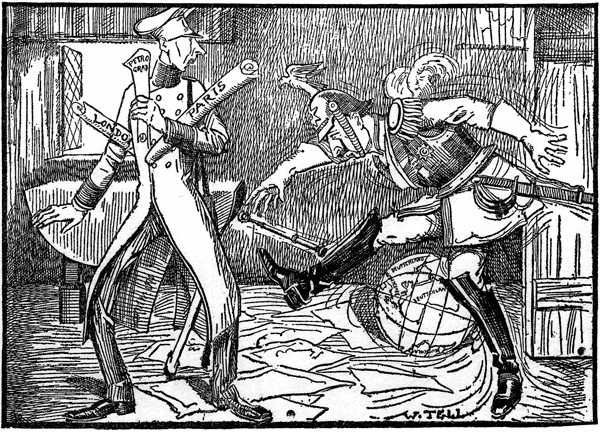
“
‘And yet you attempt, like an eagle, to soar—’
”
“‘You are old, Father William,’ the young man said, ‘And the end of your life is in sight; Yet you’re frequently patting your God on the head— Do you think, at your age, it is right?’ “‘In my youth,’ said his sire, ‘I established my case As a being apart and divine; And I think if I try to keep God in his place, He ought to support me in mine.’ “‘You are old,’ said the youth, ‘as I mentioned before, And flight is exceedingly tiring; And yet you attempt, like an eagle, to soar— What made you so very aspiring?’ “‘From my youth,’ said the sage, ‘I was never the thing; My conduct was always absurd; And now I feel certain, unless I take wing, That Europe will “give me the bird.”’ “‘You are old,’ said the youth, ‘and a bit double-faced, And your head is too large for your hat; Yet you try to remodel the world to your taste— Pray what is the meaning of that?’ “‘In my youth,’ said his sire, ‘from the day of my birth, Such merit through culture I got, That its blessings I’d force on the whole blooming earth, If it meant killing off all the lot.’ “‘You are old,’ said the youth, ‘as I think you’re aware, For it’s certainly time that you knew it; Yet I see you throw bricks, and not buns, to the bear— Do you think it is tactful to do it?’ “‘I have answered three questions, and that is enough,’ Said his father, ‘and now I have done; Do you think I can listen all day to such stuff? Trot along, and steal pictures, my son!’”
“That’s all wrong,” said the News Wolff angrily.
“Perhaps it is,” Alice retorted; “but it’s true, anyway!”
“Truth has nothing to do with it,” said the News Wolff.
“She’s no good,” the Blonde Beast interrupted. “The Citizen shall tell us a story.”
“Yes, please do!” said Alice.
“And be quick about it,” added the News Wolff, “or you’ll be depressed again before it’s done.”
“What about?” asked the Citizen grumpily.
“Something about birds or butterflies,” Alice suggested.
“I don’t know anything about them,” said the Citizen, “my surroundings are too dull for them.”
“Well, then, moths,” Alice put in. “You know,” she added, “those things that are attracted by a candle.”
“Once upon a time there was a Goth—a death’s head Goth,” the Citizen began in a great hurry, “and he was attracted by a Vandal, and their names were Anathema and Maranatha, and they lived in the German States——”
“Which States?” the Blonde Beast interrupted.
“Sometimes in a State of Savagery, and sometimes in a State of Intoxication, and sometimes both,” said the Citizen, after thinking a minute or two.
“And what did they live on?” said Alice, who always took a great interest in questions of eating and drinking.
“They lived on the wing—the right wing, I think it was,” the Citizen went on.
“On the wing?” Alice repeated, very much confused. “Of a chicken, or what?”
“What,” said the Citizen.
Alice tried a little to fancy to herself what such an extraordinary way of living would be like, but it puzzled her too much, so she went on: “But how did they spend their time?”
“I want a fresh place,” interrupted the Blonde Beast; “let’s all move on one.”
He moved on as he spoke, and the Citizen followed him obediently; the News Wolff pushed into the Citizen’s place, and Alice rather unwillingly took the place of the News Wolff. The Blonde Beast was the only one who got any advantage from the change, as he had new opportunities of making a dirty mess; and Alice was a good deal worse off than before, as the News Wolff had been smearing butter over a fiasco to make it look like a victory.
Alice did not wish to hurt the Citizen’s feelings, so she asked again, “How did they spend their time?”
“They didn’t,” said the Citizen, “they spent other people’s; and, when the Vandal went out, the Goth went out too; and, when the Vandal was very bright, the Goth singed his wings.”
“And did they go to school?” Alice inquired.
“Yes,” said the Citizen; “and they had a French master who tried to teach them to write.”
“To write what?” Alice inquired.
“The wrong,” said the Citizen; “but they didn’t want to do it. And they learnt to draw.”
“What did they draw?” asked Alice.
“They drew swords,” said the Citizen, “and when the swords were out they drew fire, and when the fire got too hot they drew away, and when they lost the way they drew maps.”
“So they drew lots of things,” said Alice encouragingly.
“Yes,” said the Citizen, “they drew lots, and the ones that won got Iron Crosses, and the ones that lost got cultured, and——”
“And it was a glorious victory,” shouted the News Wolff, “and the whole of the enemy’s fleet was sunk!”
“How?” Alice inquired.
“By mine!” said the News Wolff. “You don’t suppose we could sink them any other way, do you?”
“No,” said Alice, “I don’t think——”
“You look it,” said the Blonde Beast.
This piece of rudeness was more than Alice could bear; she got up in great disgust and walked off. The Citizen looked very depressed again, and neither of the others took the least notice of her going. The last time she saw them they were trying to smother the Citizen in the teapot.
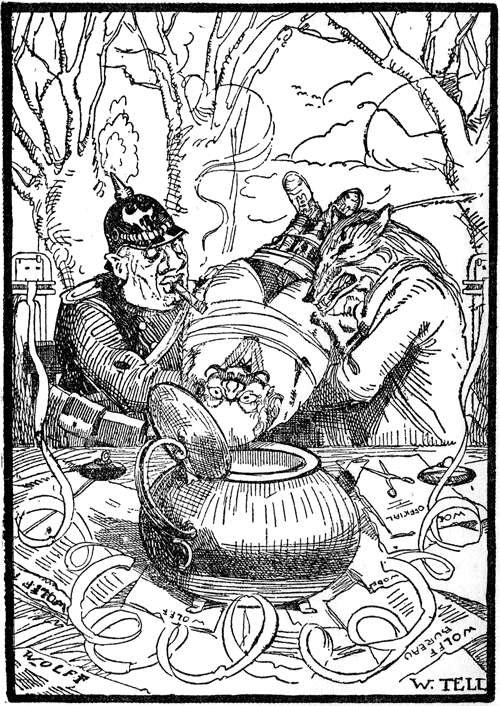
“
They were trying to smother the Citizen in the teapot.
”
“Poor thing,” said Alice to herself as she picked her way through the wood. “But perhaps it’s kinder to keep him in the dark, so that he won’t know what’s really going on.”