Chapter III · LIMELIGHTERS AND RUMOUR.
Reading edition
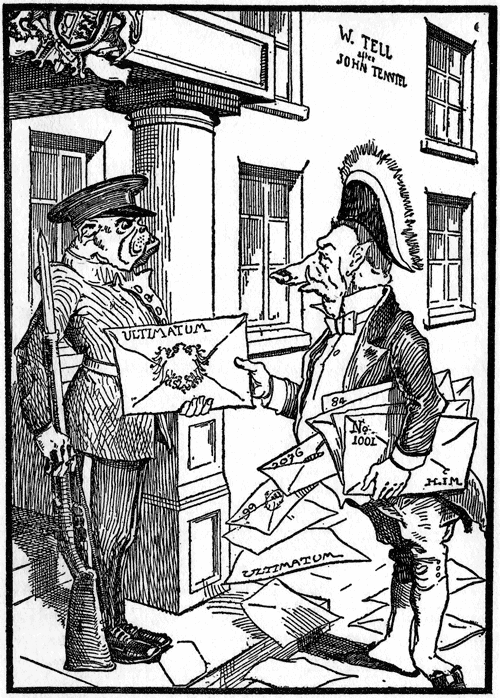
For a minute or two she stood looking at the house, and wondering what to do next, when suddenly a footman came running out of the wood—she considered him to be a footman because he was in livery; otherwise, she would have called him a pig—and rapped loudly on the door. It was opened by a sentry in uniform, with a face like a Bull-Dog.
The Pig-Footman began by producing from under his arm a large and very dirty letter, with crowns stamped all over it, and this he handed to the other, saying in a solemn tone: “For the Duchess. An ultimatum from the Kaiser to expire at midnight.” The Dog-Sentry repeated, in the same solemn tone, only changing the order of the words a little: “From the Kaiser. An ultimatum for the Duchess to expire at midnight.” Then they both bowed very low; the Pig-Footman ran back into the wood with his arms full of a lot more big letters, and the Dog-Sentry stood at attention on the top of the steps.
“
The Pig-Footman began by producing a large and very dirty letter.
”
“Why does the Kaiser want the Duchess to expire at midnight?” Alice asked politely.
“Have you met the Duchess?” said the Dog.
“No,” said Alice; “I haven’t had the pleasure.”
“I don’t know about pleasure,” said the Dog; “but if you had you wouldn’t ask silly questions.”
“Is she very objectionable then?” Alice inquired.
“She’s a Limelighter,” said the Dog, as if that settled the matter.
“What does that mean?” asked Alice.
“It means,” said the Dog, “a person who gets into the limelight—and sticks in it, too. Duchesses aren’t all Limelighters, and Limelighters aren’t all Duchesses; but, anyhow, they are the nastiest things we’ve got in the house. And if you want to know any more you’d better go and ask her. Why don’t you ring the bell?”
Alice did as he suggested, but got no reply.
“Keep on ringing,” said the Dog; “and you might keep your eye on the wood at the same time. I want to have a look at the news.”
He sat on the steps and took a big newspaper out of his pocket. “Very interesting,” he remarked after a pause, “listen to this—
“‘Some Boers from the Cape Have got into a scrape Through attending to treacherous liars; But I’m credibly told They are bound to be sold, Now that Botha is out after Beyers.’”
“And here’s some more,” he added, turning over the paper; “I’ll read it to you,” and he began—
“RESULT OF GREAT (BLANK-DASH) ATTACK.
[FROM OUR OWN EXPERT AT THE BACK.]
(Submitted to the Press Bureau, Who will not swear it’s true, although They do not think its publication Will jeopardise the British nation.)
A Town in Europe, (Blank) o’clock, November (dash). A fearful shock Of arms occurred at (blank) to-day, And I’m at liberty to say That the result was (blank-dash-blank), For which we have the (blanks) to thank. The whole (dash) Corps of (censored) Huns, Supported by (omitted) guns, Advanced at daylight, and were faced By (here a passage is erased), Who held a very strong position Resting upon (a long omission). The (blanks) were able to advance And occupy (a town in France); But presently the (blank) Division Attacked the trenches of (excision), And soon (blank-blank), and then (dash-dash), (Dash-blank, dash-blank) a fearful crash (A paragraph omitted here), As a result of which it’s clear That further efforts will (the rest Of the report has been suppressed).”
“That’s very interesting, isn’t it?” said the Dog after a pause.
“Very,” Alice agreed. “It will help people to understand the war, won’t it? The Censor, or Nonsensor, or whatever they call him, must be a great stimulus to recruiting.”
Alice rang the bell again.
“It’s no good ringing,” remarked the Dog, “the Duchess is much too busy to attend to business. If I were you I’d walk straight in.”
This seemed to be the best thing to do, so Alice pushed open the door and went into the house.
Inside were a lot of passages, with offices on each side, and in the offices were heaps of people all very busy. “Much too busy to talk to me,” Alice thought; “I’m sure they wouldn’t like to be interrupted.” Fortunately, at intervals along the passages there were illuminated notices saying, “This way to the Duchess,” and presently she came to a door labelled, “Walk in and see what the Duchess is doing. Interviewers and photographers especially welcome.” Alice opened the door and went in.
She found herself in a big room like an office, but full of very brilliant lights, all arranged so as to shine on the Duchess, who was sitting in a revolving chair before a desk in the middle, nursing a baby dressed in red tape and looking very puny and neglected. She was evidently trying to pose for a Cinematograph Operator who was working his machine in one corner.
“There’s certainly too much light in this room,” Alice said to herself, rubbing her eyes.
Now and then the Operator lit a piece of magnesium wire, and the glare made even the Duchess blink; as for the Baby, it screwed up its eyes and howled piteously. The only thing in the room that seemed quite indifferent was a large brown bear that was wandering round and round very silently.
“Please would you tell me,” said Alice a little timidly, “why your bear is so restless?”
“It isn’t mine,” said the Duchess. “It’s a Russian bear, and that’s why.”
“I didn’t know that Russian bears——” Alice began.
“They don’t,” the Duchess interrupted. “But it isn’t a real one; it’s only a rumour. It annoys me very much, first turning up in one place and then in another, and then disappearing just when I have begun to believe in it, and have started dozens of Committees to look after it.”
“But can’t it look after itself?” Alice asked.
“Of course it can,” said the Duchess; “but in that case where do I come in? Why, I’ve started a Society to provide it with hot tea at Inverness and a foot-warmer on the journey down, and it doesn’t come that way! And I’ve formed a Committee to scrape the snow off its paws, and there isn’t any; And I’ve talked about it to everyone, and said I know it’s true, and it turns out to be only a rumour. It’s a horrid ungrateful beast, and I can’t get any credit out of it!”
“Never mind,” said Alice, trying to comfort her, for she looked as if she might burst into tears at any moment; “after all, you’ve got your nice house and your dear little baby.”
“Dear!” cried the Duchess; “expensive, you mean! It’s a nasty, useless little nuisance.”
“What is its name?” asked Alice, who was very fond of babies, even ugly ones.
“It’s name is all right,” said the Duchess; “in fact, it’s a good name. It’s called ‘The International Society of Unqualified War-nuts.’ But it doesn’t get on, and I don’t understand it, and I wish I’d never seen the sickly little brat!”
“Then why don’t you get someone to look after it who does understand it?” Alice inquired.
“That’s all very well,” said the Duchess, “but where should I come in?
“I don’t know how to handle the wretched thing,” she went on.
Alice was inclined to think she was speaking the truth, as she was certainly holding it the wrong way up, and had got it into a terrible mess.
Just then the baby began to cry again, and the Duchess started to sing a sort of lullaby to it, giving it a violent shake at the end of each line:
The limelight falls In crowded halls On platforms duly elevated; The public haste To praise my taste For patriotism unabated. Blow, trumpet, blow! Set the glad news a-going. Blow, trumpet! Answer echoes, growing, growing, growing.
While the Duchess sang the second verse of the song she kept tossing the baby violently up and down, and the poor little thing howled so that Alice could hardly hear the words:
O hark! O hear! How loud and clear The hangers-on repeat the story! By blatant bluff, And pictured puff, My reputation leaps to glory. Blow! and who cares if blue-black ink is snowing! Blow, trumpet! Answer echoes, growing, growing, growing.
“Here! you may nurse it a bit, if you like!” the Duchess said to Alice, flinging the baby at her as she spoke. “It’s getting so thin that I’m ashamed to take it into the limelight, for fear of people seeing through it.”
Alice caught it with some difficulty, and carried it out into the open air.
It was in a terribly tangled state, and when she had straightened it out a bit she found that there was really hardly anything there but red tape, and it certainly had no backbone. However, she carried it along for some time, hoping that it would improve, but it got lighter and lighter, until it faded out of existence altogether.
“Well, it’s no use hanging on to a lot of red tape,” said Alice to herself, and she put it down by the side of the path, and walked on into the wood.
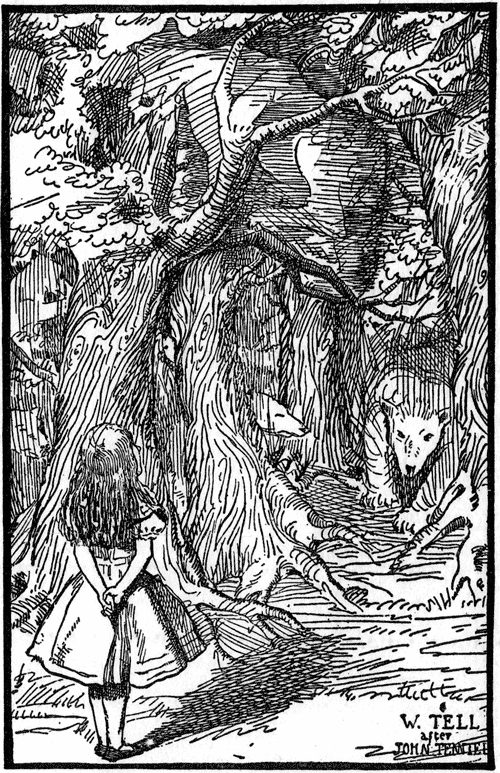
Presently she came to a place where a great many paths diverged in all directions, and she was just wondering which way to go when she was a little startled by seeing the Russian Bear sitting on a bough of a tree a few yards off.
“
She was a little startled by seeing the Russian bear.
”
It looked good-natured, she thought; still, it had very long claws, and a great many teeth, so she felt that it ought to be treated with respect.
“Russian Bear,” she began, rather nervously, “would you please tell me which way to go?”
“It doesn’t matter,” said the Bear, “because you won’t get there, anyway. Now I started from Russia and landed in Scotland, and went by Great Northern, North Western, and Midland; and I landed at Avonmouth and went by Great Western; and I did the whole journey by the North Sea; and I came round by Siberia and Canada; and I changed my uniform in France; and then where do you think I was?”
“I’m sure I don’t know,” said Alice politely.
“Why,” said the Bear, “in Russia, of course.”
“How annoying for you!” Alice exclaimed.
“Not at all,” said the Bear; “I should get along nicely enough if interfering people would leave me alone, and not call me a steam-roller, and wrap me up in rumours, and see me where I’m not. That old Duchess is the worst of the lot!”
“What is she doing now?” asked Alice.
“Oh, she’s very busy,” said the Bear. “She’s getting up a show of Tableaux Vivants for the Blind.”
“But they won’t see them!” Alice objected.
“Oh, that’s all right,” said the Bear; “they are going to do them in Braile. Besides, her schemes never amount to anything.”
“Then why does she trouble about them?” asked Alice.
“Oh, she wants to get the credit for doing something,” said the Bear, “and if she can’t, she wants to make sure that no one else will get it. But I must be bobbing up in a new place. Good-bye!” And it vanished suddenly.
Alice was not much surprised at this, she was getting so used to queer things happening. While she was looking at the place where it had been, it suddenly appeared again. “By-the-bye, what became of the baby?” said the Bear. “I’d nearly forgotten to ask.”
“It dissolved into thin air,” Alice said.
“I thought it would,” said the Bear. “It was always a transparent farce.”
“How did you get there again?” Alice asked; “I didn’t see you coming.”
“No, I always travel with the blinds down,” said the Bear, and vanished again.
Alice waited a little, half expecting to see it again, but it did not appear, and after a minute or two she walked on until she came to a sign-post labelled: “This way to the News-Wolff. All the latest fables. Complete satisfaction guaranteed.” The other arm was labelled: “To the Blonde Beast. Crimes committed on easy terms. Special this day—Murders and Arson.”
“Well, they neither of them sound very pleasant,” said Alice to herself, “but I think the News-Wolff will be the least objectionable.” As she said this she looked up, and there was the Bear again, sitting on a branch of a tree.
“I shall hope to see you in Berlin,” said the Bear.
“Thanks very much,” replied Alice; “and I wish you wouldn’t keep appearing and vanishing so suddenly; you make me quite giddy.”
“All right,” said the Bear; and this time it vanished quite slowly, beginning with an official statement and ending with a rumour, which was still very persistent for some time afterwards.
“Well! I’ve often seen a bear without a rumour,” thought Alice, “but a rumour without a bear! It’s the most curious thing I ever saw in all my life.”
She turned along the path towards the News-Wolff, and presently arrived opposite to a little house surrounded by a pretty garden.