Introductory material
Mary Morison translation
THE EMIGRANT LITERATURE
The passage of the eighteenth into the nineteenth century was accompanied in France by social and political disturbances of hitherto unknown force and magnitude. The new seed sown by the great ideas and events of the Revolution at first made little or no growth in literature. It was unable to shoot up, for, with but brief interval between, two destroying tyrannies, the dictatorships of the Convention and of the Empire, passed over France, annihilating all personal freedom as they went. The first terrorism cowed, exiled, or guillotined all whose political colouring did not accurately match the then prevailing shade of popular opinion. Aristocracy, royal family, priests and Girondists alike succumbed to it, and men fled to the quiet of Switzerland or the lonely prairies of North America to escape the fate which had destroyed their nearest and threatened themselves. The second terrorism persecuted, imprisoned, shot, or exiled all who would not submit to being silenced (a silence which might only be broken by cheers for the Emperor). Legitimists and Republicans, Constitutionalists and Liberals, philosophers and poets were crushed under the all-levelling roller, unless they preferred, scattered in every direction, to seek a refuge beyond the boundaries of the empire. No easy matter in those days, for the empire followed swiftly upon their heels, rapidly growing, swallowing Germany and Italy in great gulps, until no place seemed secure from its armies, which overtook fugitives even in Moscow.
During both these great despotisms it was only far from Paris, in lonely country places where he lived a life of death-like stillness, or beyond the frontier, in Switzerland, Germany, England, or North America, that the French man of letters pursued his calling. Only in such places could the independent intellects of France exist, and it is by independent intellects alone that a literature can be founded or developed. The first French literary group of the present century, then, a group brought together from all points of the compass, is distinguished by its oppositionist tendency. I do not mean that its members are united on certain fundamental principles, for they are often utterly at variance, but they are all united by their hatred of the Reign of Terror and the Napoleonic autocracy. Whatever they may originally have been, and whatever they become after the restoration of the monarchy, whether literary reformers, reactionary Legitimists, or members of the Liberal Opposition, they are at the beginning of the century one and all opposed to the prevailing order of things. Another thing they all have in common is their difficult position as heirs of the eighteenth century, whose last bequest to them is that Empire against which they protest. Some of them would fain renounce the inheritance and its liabilities, others are ready to accept it if they can repudiate the liabilities, all feel that the intellectual development of the new century must be based upon other assumptions than that of the old. The folding-doors of the nineteenth century open; they stand gazing in intently; they have a presentiment of what they are to see, and believe they see it, and the new shapes itself for each and is interpreted by each according to his gifts and desires. Thus as a body there is something premonitory, precursory about them: they are the bearers of the spirit of the new age.
There was a wider sphere for a literary revival in France than in any other European country, for in France in the eighteenth century literary art had developed into formalism. Social and academic culture had laced it in the iron corset of so-called good taste, into stiff, meagre, regulation proportions. France has long presented the contradiction of being a country with a feverish desire for change in all external arrangements, unable, once it determines to gratify this desire, to keep within the bounds of moderation, and of being at the same time remarkably stable in everything that regards literature—acknowledging authority, maintaining an academy, and placing rule and regularity above everything. Frenchmen had instituted a Republic and overturned Christianity before it occurred to them to dispute the authority of Boileau. Voltaire, who turns tradition upside down and uses tragedy as a weapon against the very powers whose chief support it had been, namely the autocracy and the Church, never ventures to allow his action to last more than twenty-four hours, or to pass in two different places in the same play. He, who has little respect for anything in heaven or earth, respects the uniform caesura of the Alexandrine.
It was another people than the French, a people to whom Voltaire had scornfully wished more wit and fewer consonants, who remodelled literature and re-created poetry, while Frenchmen were overturning political systems and customs. The Germans of that day, of whom the French scarcely knew more than that, in humble, patriarchal submission to their petty princes, they drank their beer, smoked their pipes, and ate their sauer-kraut in the corner by the stove, made far greater conquests in the intellectual world than Frenchmen achieved in the geographical. Of all the nations of Europe none save the Germans had had their literary blossoming time in the eighteenth century. It was the second half of that century which witnessed the notable development of poetry between Lessing and Goethe, and the energetic progress of metaphysics between Kant and Schelling. For in Germany nothing had been free save thought.
The French literature of the beginning of the century is, naturally, influenced by Germany, the more so as the nations now first begin to enter into unbroken intellectual communion. The great upheavals, the wars of the Republic and the Empire, jostled the peoples of Europe together, and made them acquainted with each other. But the men most profoundly influenced by foreign surroundings were those for whom these great events meant long, in some cases life-long, exile. The influence of the foreign spirit, only fleeting as far as the soldier was concerned, was lasting and momentous in the case of the émigré. Exiled Frenchmen were obliged to acquire a more than superficial acquaintance with foreign tongues, if for no other reason, in order to be able to give French lessons in the country of their adoption. It was the intelligent émigré who diffused knowledge of the character and culture of other lands throughout France, and in seeking a general designation for the literary phenomena of this period, it would scarcely be possible to find a better than the one I have adopted: "The Emigrant Literature."
The name must not be taken for more than it is—a name—for it would be foolish not to class along with the works of émigrés proper, kindred writings by authors who, though they did not live in Paris, perhaps not even in France, yet were not exiles; and, on the other hand, some of the works written by émigrés are distinctly not products of the renovating and fertilising literary movement, but belong to the anti-liberal literature of the Restoration period.
Nevertheless the name may fitly be applied to the first group of French books which ushers in the century. The émigré\ as already remarked, inevitably belongs to the opposition. But the character of his opposition varies, according to whether it is the Reign of Terror or the Empire to which he objects, and from the tyranny of which he has escaped. Frequently he has fled from both, in which case the motive of his opposition is of a compound nature. He possibly sympathised with the Revolution in its early stage as curtailing the power of the monarchy, and his desire may be a moderate republic; in this case he will be inspired by a more passionate ill-will towards the Empire than towards the old Reign of Terror. Whatever the nature of the compound, a double current is discernible in the emigrant literature.
Its direct reaction is against certain mental characteristics of the eighteenth century, its dry rationalism, its taboo of emotion and fancy, its misunderstanding of history, its ignoring of legitimate national peculiarities, its colourless view of nature, and its mistaken conception of religions as being conscious frauds. But there is also an unmistakable undercurrent in the direction of the main stream of the eighteenth century; all the authors carry on the great war against petrified tradition, some only in the domain of literature, others in each and every intellectual domain. They are all daring, enterprising natures, and for none of them has the word Liberty lost its electrifying power. Even Chateaubriand, who in politics and religion represents the extreme Right of the group, and who in some of his writings is positively reactionary, takes "Liberty and Honour" as his motto; which explains his finally going over to the Opposition. The double current is everywhere discernible, in Chateaubriand, in Sénancour, in Constant, in Mme. de Staël, in Barante, Nodier, &c., and to this subtle correlation of reaction and progress I shall draw attention from the first.
In speaking of the spirit of the eighteenth century it is generally Voltaire's name which rises to our lips. It is he who in most men's minds embodies and represents the whole period; and in as far as the émigrés bring about a revulsion against him, they may certainly be said to represent the reaction against the preceding century. Even those among them who are closely related to him intellectually, compulsorily join in the reaction against him, compelled, that is to say, by the spirit of the age; as, for instance, Constant in his book On Religion. But among the writers of the eighteenth century there is one who was Voltaire's rival, who is almost his equal, and whose works, moreover, in a much higher degree than Voltaire's, point to an age far ahead of that in which they were written. This man in many ways inspires the Emigrant Literature, and in as far as it descends from Rousseau, and to a certain extent perpetuates his influence, it may be said to perpetuate the preceding century and the Revolution. It is astonishing to what an extent the great literary movements in all the principal countries of Europe at the beginning of the nineteenth century were influenced by Rousseau. Among his spiritual progeny in France in the eighteenth century had been men so unlike each other as St. Pierre, Diderot, and Robespierre, and in Germany geniuses and men of talent like Herder, Kant, Fichte, Jacobi, Goethe, Schiller, and Jean Paul. In the rising age he influences, among others, Chateaubriand, Mme. de Staël, and later, George Sand, in France; in Germany, Tieck; and in England, Byron. Voltaire influences minds in general, Rousseau has a special power over productive talents, over authors. These two great men exercised an alternating influence upon posterity well-nigh into our own day, when both have been supplanted by Diderot. At the close of last century, Voltaire yielded his sceptre to Rousseau; fifty years later his name returned to honour in France; and now in some of the most eminent writers of that country—take Ernest Renan as an instance—a twofold intellectual tendency is discernible, something of Rousseau's spirit combined with something of Voltaire's. But it is in the writings of Rousseau alone that the great spiritual streams which flow from other countries into France at the beginning of the nineteenth century have their source, and to Rousseau is it due that the literature produced by Frenchmen living in remote provinces or foreign countries, in spite of its antagonism to the spirit which produced and upheld the imperial despotism, remained in touch with the eighteenth century, and was based upon originally French theories.
I
CHATEAUBRIAND
The year 1800 was the first to produce a book bearing the imprint of the new era, a work small in size, but great in significance and mighty in the impression it made. Atala took the French public by storm in a way which no book had done since the days of Paul and Virginia. It was a romance of the plains and mysterious forests of North America, with a strong, strange aroma of the untilled soil from which it sprang; it glowed with rich foreign colouring, and with the fiercer glow of consuming passion. The history of a repressed, and therefore overpowering and fatal love, was depicted upon a background of wild Indian life, the effect of the whole being heightened by a varnish of Roman Catholic piety.
This story of the love and death of a Christian Indian girl was so admired that its principal characters were soon to be seen adorning the walls of French inns in the form of coloured prints, while their waxen images were sold on the quays of Paris, as those of Christ and the Virgin usually are in Catholic countries. At one of the suburban theatres the heroine figured in savage attire with cock's feathers in her hair, and a farce was given at the Théâtre des Variétés in which a school girl and boy, who had eloped, talked of nothing but alligators, storks, and virgin forests in the style of Atala. A parody published under the title of "Ah! là! là!" substituted for the long, gorgeous description of Mississippi scenery an equally lengthy and detailed description of a potato patch—so strange did it seem at that day that an author should devote several pages to the description of natural scenery. But though parodies, jests, and caricatures rained upon the author, he was not to be pitied, such things being symptoms of fame. With one bound he had risen from complete obscurity to the rank of a celebrity. His name was upon all lips, the name of François René de Chateaubriand.
The youngest of ten children, he was born of an ancient and noble house in St. Malo, Brittany. His father was a stern, dry, unsociable and silent man, whose one passion was his pride of race; while his mother, a little, plain, restless, discontented woman, was God-fearing to the highest degree, a church-goer and a patroness of priests. The son inherited a mixture of both natures.
Sternly brought up in a home where, as he himself expressed it, the father was the terror and the mother the scourge of the household, he was reserved and shy, an obstinate, excitable, melancholy child, early familiar with the unrest of the sea and the music of its storms, never reconciled to the discomfort and coldness of his home. His sister Lucile, the nearest him in age, was his one friend and confidante. Like him, she was of a morbid and passionate temperament, year by year more prone, like Rousseau, to suspect every one of conspiracy against her, and to regard herself as persecuted. In her childhood it was to her brother, in later life to religion, that she turned for protection in these troubles and dangers. At first plain and shy, like her brother, she afterwards became very beautiful; with her pale face and dark hair she was like a lovely angel of death. She passed the greater part of her life in convents; was passionate in her sisterly love, and passionately Catholic; she had considerable poetic talent, and in shyness and romantic excitability she seems to have been the feminine counterpart of her brother. Another sister, Julie, having passed her youth as a gay woman of the world, ended her life in the most saintly self-renunciation. The tendency towards Catholicism seems to have run in the blood of the whole family.
The great constraint of young Chateaubriand's upbringing induced in him a wild longing to be free and his own master, while the perpetual surveillance under which he suffered created an overwhelming, misanthropic desire for solitude. When he ran alone down the stairs of the old manor-house, or went out with his gun, he felt all the passions boiling and seething within him in wild ecstasy at being able to dream and long unrestrainedly. Ill at ease in the society of others, he plunged when alone into dreams of happiness and ambition, the dreams of a poet. In this half-sensuous, half-spiritual dreaming and longing, he created the image of a supernaturally charming woman, a youthful queen, bedecked with flowers and jewels, whom he loved and by whom he was beloved in the balmy, moonlit nights of Naples or Sicily. To awake from these dreams and realise the insignificant little Breton that he was, awkward, unknown, poor and possibly without talent, was torture to him. The contrast between what he was and what he longed to be overwhelmed him.
He was at first intended for the navy, but his unconquerable aversion to discipline proved an insurmountable obstacle, and his thoughts turned to the Church, from which, however, a conviction of his unfitness for a life of renunciation made him draw back. In the depth of his despondency he attempted to commit suicide. An irrevocable family decision put an end to his vacillation; he was given a commission as sub-lieutenant in the army, and found the life to his liking. As a cadet of a noble family he was presented to Louis XVI., at whose court he witnessed the last glimmer of the old splendour and ceremony of royalty. Two years later the Revolution broke out, and in 1790 rank, titles, and feudal rights were abolished. Chateaubriand gave up his commission, and, as no occupation offered itself under the new order, or disorder, he conceived the fantastic plan of travelling to America to discover the North-West Passage. Without any of the requisite information, without interest or money, he was inevitably soon obliged to abandon this project. But if he did not find the North-West Passage, he did discover a new race, fresh conditions, and new scenery. In his early youth, after reading Rousseau, he had conceived the idea of writing the Epic of Primitive Man, a description of the ways of the savages of whom he knew nothing. Now he was upon their own soil, in their world, and though they were not as untouched by civilisation as he had imagined, it was not difficult to reconstruct their original condition. The first impression he received of them was undeniably a strange one. On the way from Albany to Niagara, when his guide led him for the first time into the virgin forest, he was seized by one of those transports of delight in his independence which he had felt in his early youth when he went hunting in Brittany. He wandered from tree to tree, to right and left, saying to himself: "Here are no roads, no towns, no monarchies, no republics, no men." Imagining himself to be alone in the forest, he suddenly came upon a score of half-naked, painted savages with ravens' feathers in their hair and rings in their noses, who—marvellous to relate!—were dancing quadrilles to the sounds of a violin played by a little powdered and frizzed Frenchman, once kitchen-boy to a French general, now retained as dancing-master by these savages for a consideration of beaver-skins and bear-hams. What a humiliating introduction to primitive life for a pupil of Rousseau! Subsequent impressions were, fortunately, simpler and more beautiful than this. Chateaubriand purchased clothes and weapons from the Indians, and lived their life for some weeks at least. He was presented to the Sachem, or chief, of the Onondagas (as Byron at a later period was presented to Ali Pasha); he rode through the country, coming here and there upon little European houses, with their pianos and mirrors, close to the huts of the Iroquois; he saw the Falls of Niagara; and in two charming Florida girls found the models for his famous characters, Atala and Celuta.
It was in America that Chateaubriand planned his two brilliant short tales, Atala and René, and also the long, somewhat slovenly work of which they form part, Les Natchez, a great romance dealing with the destruction of an Indian tribe in its struggle with the whites. Atala was the first to be completed. After a brief stay in France, where he arrived in January 1792, recalled by the news of the fall of the monarchy and the dangerous position of Louis XVI., he again emigrated, this time to London. He made the first rough drafts of Atala and René sitting under the trees in Kensington Gardens, and when he joined the emigrant army on the Rhine, his knapsack contained more manuscript than linen. Atala was revised during the halts of the army, and repacked in his knapsack when the march was resumed, his comrades teasing him by tearing the protruding leaves. In the action in which he was wounded in the thigh by a splinter of shell, Atala proved the means of saving his life, for two spent bullets glanced off his knapsack. He arrived at Brussels after the destruction of the emigrant army, wounded, emaciated, and ill with fever; his brother, with wife and father-in-law, having meanwhile perished on the scaffold in Paris. His mother and two sisters, of whom Lucile was one, had been imprisoned for a time after his flight. In London, in 1797, he published his Essai historique sur les Revolutions, which was written in a comparatively liberal and, as regards religion, a distinctly sceptical spirit. It was the death of his mother, he tells us, which led him back to Christianity, but the reactionary spirit of the times probably contributed quite as much to his change of attitude, and when he returned to France in 1800, after Bonaparte had quelled the Revolution, he carried with him his great work, Le Génie du Christianisme, in which René was included, and the publication of which coincided with Bonaparte's restoration of Christian worship in France. The book harmonised too well with the plans of the First Consul not to bring its author into favour with that autocrat; Chateaubriand, however, broke with his government after the judicial murder of the Duc d'Enghien in 1804.
These are the principal incidents in the youthful career of the man who became famous in 1800 as the author of Atala. His character was even more remarkable than his career. High-spirited, ambitious, vain, and shy, perpetually wavering in his faith in his own powers, he was not only endowed with the self-consciousness of genius, but with an egotism which ignored with absolute indifference all that did not immediately concern himself. He came too late into the world, and was educated under too peculiar circumstances, to have faith in the Revolution or the eighteenth century philosophy which partly inspired it. He came into the world too soon to make acquaintance with the science of the nineteenth century, and through it to win a new faith and a new standpoint. He therefore became a kind of Nihilist in the service of the past, a spirit who, as he repeatedly observes, believed in nothing. He adds, when he remembers to do so, "except religion"; but a man is, according to his nature, either a believer or a sceptic, and the idea that it is possible to be a believer in the matter of religion when one believes in nothing else, is a mere delusion, to which the half-educated are specially liable.
Chateaubriand's Mémoires are full of the sort of tirade on the vanity of name and fame which we so often meet with in Byron. There is undoubtedly a good deal of affectation in these outbreaks, but they nevertheless betray genuine ennui and persistent melancholy.
"Unable to believe in anything except religion, I am distrustful of all else.... The trivial and ridiculous side of things is always the first to show itself to me. In reality neither great geniuses nor great deeds exist for me.... In politics the warmth of my conviction does not outlast my speech or pamphlet.... In the whole history of the world I do not know a fame that could tempt me. If the greatest honour in the world lay at my feet and I had but to stoop and take it up, I would not take the trouble. If I had been my own creator, I should probably have made myself a woman, out of passion for the sex; or if I had chosen to be a man, I would first of all have bestowed beauty upon myself; then, to provide against ennui, my worst enemy, I would have been a great but unknown artist, using my talent for myself alone. If we set aside all humbug and examine into what it is that gives life real worth, we find only two things of value, religion in combination with talent, and love in combination with youth, that is to say the future and the present; all the rest is not worth the trouble of thinking about.... I have no belief in anything except religion. If I had been a shepherd or a king, what should I have done with my staff or sceptre? I should have been equally weary of glory and genius, work and rest, prosperity and adversity. Everything irks me. I drag my weariness painfully after me all day long, and yawn my life away (et je vais partout bâillant ma vie)."[1]
How much passion had he not wasted upon fantastic imaginings and poetic dreams before he was reduced to this utter boredom! In Atala the passion still wells up like a hot spring, and its spray stings and scalds.
The old Indian, Chactas, tells the story of his youth to a young Frenchman to whom Chateaubriand has given his own second name, René. Chactas, taken captive by a hostile tribe, is condemned to death upon the pyre. The daughter of the chief of the tribe takes a fancy to him and approaches the place where he lies bound. He mistakes her for the maiden whose part it is to solace the prisoner in the last hour before the consummation of the death sentence; but her intention is to release, not to console. He conceives a sudden passion for her, and entreats her to fly with him and be his; she refuses, and, delayed by her opposition, he is recaptured. He is already adorned for the pyre, crowned with flowers, his face painted blue and red, and beads attached to his ears, when Atala delivers him for the second time and escapes with him. The greater part of the book describes this flight, Chactas's desire, and the mingling of passion and reserve in Atala which makes her constantly vacillate between resistance and surrender. Her behaviour is explained when she tells Chactas that her mother, who was seduced by a white man, had her baptized and made her swear to remain unwed. In her anguish at the vow and her despair of being able to keep it, she takes poison, and dies in her lover's arms, comforted by the old missionary in whose hut the pair have taken shelter.
A full impression of the burning passion and lyrical exaltation of the book can only be gained by reading it, nor can we obtain any idea from descriptions and quotations of the power with which the wonderful scenery is described. It is an easy matter, however, to show how much and how instinctively Chateaubriand relied upon a mingling of the terrible with the erotic to obtain his effects. In the principal love scene we have not only a lavish musical accompaniment of the rattle of snakes, the howling of wolves, the roaring of bears and jaguars, but also a storm which shatters the trees, and impenetrable darkness, torn by flash upon flash of the lightning which finally sets fire to the forest. Round about the lovers the pines are blazing like wedding torches, and Atala is about to yield when a warning flash strikes the ground at her feet. It is after this she takes poison, and the burning passion of her last words to Chactas are in harmony with the conflagration of the forest:
"What torture to see thee at my side, far from all mankind, in these profound solitudes, and to feel an invincible barrier between thee and me! To pass my life at thy feet, to wait upon thee as thy slave, to prepare thy repast and thy couch in some forgotten corner of the universe would have been my supreme happiness. This bliss I had actually attained to, but could not enjoy. What plans have I not planned! what dreams have I not dreamed! Sometimes, looking upon thee, I have been tempted to form desires as wild as they were guilty. I have sometimes wished that thou and I were the only living creatures on earth; sometimes, conscious of a divinity which arrested my horrible transports, I have wished that divinity annihilated, that, clasped in thy arms, I might fall from abyss to abyss amid the ruins of God and the world."
Remarkable as these outbursts of irresistible passion are, and novel as is the scenery which throws them into relief, we feel that both would have been impossible if Rousseau had never lived, and if his literary work had not been carried on by another and greater intellect of another nationality.
II
ROUSSEAU
Rousseau's chief work as an imaginative writer is La Nouvelle Héloïse.
The novelty of the book lay, in the first instance, in the fact that it gave the death-blow to gallantry, and, consequently, to the theory of the French classical period on the subject of the emotions. This theory was that all noble, fine emotions, and chief among them love, were the products of civilisation. It is obvious enough that a certain degree of civilisation was necessary before such a sentiment as love could arise. Until they wore womanly garb women did not exist, but only females, and until there were women there was no love. From this perfectly correct idea had resulted (in the pre-Rousseau period) the belief that the veiling of passion ennobled it and made it worthy. The more it could be shrouded in circumlocutions, hints, and suggestions, the less coarse it was. The morality and the literature of that period were the products of social culture, a culture confined to the highest circles. We need but read Marivaux's plays to find literary evidence of the extent to which courtly formality and refined sentiment were preferred to nature and passion. Marivaux's lovers are always each other's equals in culture, and, what is of still greater importance, in rank. We never find, as in the dramas of our century, the aristocratic lady who loves a man of lower social station, nor such a character, for instance, as Ruy Blas, the lackey who finds favour in the eyes of a Queen. In Marivaux, if a gentleman is disguised as a lackey, or a young lady as a waiting-maid, they always divine each other immediately in spite of their disguise. Their conversation is an incessant pursuit and flight, advance and retreat; it is full of ambiguities and hints and evasions, masked confessions and suppressed sighs, love-sickness expressed in a becomingly conventional manner. In Rousseau's eyes these mannerisms are as ridiculous as they are artificial. He prefers love, like everything else, in its natural state, and to him love in its natural state is a violent, irresistible passion. In his books we are very far removed from those scenes in Marivaux in which the kneeling lover never forgets to preserve a graceful attitude while pressing the tips of a glove to his lips. For all his chivalry and virtue, St. Preux is an electric battery charged with passion; the first kiss in the Grove of Clarens produces the shock, the conflagration of a thunderbolt; and when Julie, bending towards St. Preux and kissing him, swoons away, it is no coquettish faint of the days of the periwig, but the effect of the overwhelming might of passion upon a young and healthy child of nature.
The second novelty in the book is the inequality in station of the hero and heroine. Julie is the daughter of a nobleman, St. Preux is a poor tutor, a plebeian. Here, as in the Sorrows of Werther, the passion of love is connected with the equality-loving plebeian's determination to make a name for himself. This is no chance connection, for passion creates equality, whereas love in fashionable society has a tendency to develop into gallantry.
A third significant feature in La Nouvelle Héloïse is that, just as we have passion in place of gallantry and inequality of station in place of similarity of rank, we have also the moral conviction of the sanctity of marriage in place of that honour grounded on aristocratic pride and self-respect, which stood for virtue in fashionable literature. This word, Virtue, little in vogue until now, became with Rousseau and his school a watchword which was in perfect harmony with their other watchword, Nature; for to Rousseau virtue was a natural condition. Following the example of society, French literature had been making merry at the expense of marriage; Rousseau, therefore, defied the spirit of the times by writing a book in its honour. His heroine returns the passion of her lover, but marries another, to whom she remains faithful. Here, as in Werther, the lover proper loses the maiden, who is wedded to a Monsieur Wolmar (the Albert of Werther and the Edward of Kierkegaard's Diary of a Seducer), a man as irreproachable as he is uninteresting. The moral conviction which is vindicated and glorified in Rousseau as Virtue, is the same as that which in Chateaubriand, under the influence of the religious reaction, takes the form of a binding religious vow.
Note, finally, that the watchword Nature is to be taken in its literal meaning. For the first time, out of England, we have the genuine feeling for nature in fiction, superseding love-making in drawing-rooms and gardens. Under Louis XV. and the Regency, people passed their time (in real life as well as in books) in boudoirs, where light conversation and light morals were in place. The rooms, like the verses of Voltaire's Poesies Fugitives, were adorned with endless multitudes of Cupids and Graces. In the gardens goat-footed Pans embraced slender white nymphs by the side of artificial fountains. In their pictures of the fêtes-champêtres of those days, Watteau and the less-gifted Boucher and Lancret have preserved for us these gardens with their shady walks and quiet corners, where courtly gentlemen and gay ladies, clad as Pierrots and Columbines, coquetted and whispered, conscious of being on the right stage for such free and frivolous masquerading. Turn from these to the scenery of La Nouvelle Héloïse.
Rousseau's statue stands at this day on a little island lying in the Lake of Geneva, at its narrow southern extremity. The spot is one of the loveliest in the world. Pass the island and cross another bridge and you see the Rhone rush, impetuous and foaming white, out of the lake. A few steps further and you can see its white stream joined by the grey snow waters of the Arve. The rivers flow side by side, each retaining its colour. Far away between two mighty ridges you discern the white snow-caps of Mont Blanc. Towards evening, as those mountain ridges darken, the snows of Mont Blanc glow like pale roses. It would seem as if Nature had gathered together all her contrasts here. Even in the warmest season as you approach the grey, foaming mountain torrents, the air becomes icy cold. In the course of a short stroll you may feel the heat of summer in some sheltered nook, and a few steps farther on encounter harsh autumn with its cutting winds. One can form no conception of the cool freshness and strength of the air here. Only the sun and the brilliant shimmer of the stars at night recall the south. The latter are not the bright points in a distant sky which they appear to be in the north; they seem to hang loose in the air; and the air itself, as one inhales it, feels like a strong massive substance.
Sail up the lake to Vevey. Behind that town the Alpine slopes are clad with the trees and vineyards of southern lands. On the farther side of the lake rise great walls of blue rock, solemn and threatening, and the sun plays in light and shade down the mountain-side. No waters are so blue as those of the Lake of Geneva. As you sail down it on a beautiful summer day, it shines like blue satin shot with gold. It is a fairyland, a dreamland, where mighty mountains cast their blue-black shadows down into the azure waters and a brilliant sun saturates the air with colour. Sail a little farther up the lake to Montreux, where the rock fortress of Chillon, the prison in which mediæval cruelty collected all its instruments of torture, projects into the water. This witness to wild and terrible passions lies in the midst of scenery which may well be called enchanted. The lake is more open here, the view less peculiar, and the climate more southern than at Vevey. One sees sky, Alps, and lake, all melting together in a mysterious blue light. From Montreux walk to Clärens and pause in the chestnut grove which is still called the Bosquet de Julie. It is situated on a height from which you look down upon Montreux, lying sheltered and hidden in its bay; look round and you will understand how it was from this spot that the love of nature spread throughout Europe. We are standing in Rousseau's country, upon the scene of his Nouvelle Héloïse. This was the scenery which supplanted that of the Regency.
It is not difficult to trace the relation between Chateaubriand's first work and Rousseau's famous romance. First and foremost Chateaubriand inherits the love of nature; his strongly coloured pictures of North American scenery have their progenitors in those descriptions of Swiss nature. But there is this difference between Rousseau's and Chateaubriand's landscapes, that the latter's are much more dependent upon the mood of the hero and heroine. If stormy passions rage in their hearts, the storm rages without also; the characters are blent with their natural surroundings, which they permeate with their passions and moods in a manner quite unknown to the literature of the eighteenth century.
The hero and heroine themselves, being savages, have even less suspicion of gallantry about them, are far more the children of nature than Rousseau's lovers; and although expressions occur again and again which are absurd coming from the lips of a Red Indian, yet many of the love-speeches have a touch of primitive poetry in them, a genus of literature which was entirely unknown in France in the eighteenth century. Take for an example the warrior's love-song beginning with the words: "I will fly so fast that before the day has touched the mountain tops I shall have come to my white dove among the oaks of the forest. I have bound a necklace of beads about her neck—three red beads to speak of my love, three violet beads to speak of my fear, and three blue beads to speak my hope," &c.
The inequality of position between Rousseau's lovers, so typical of that revolutionary time, finds its equivalent in Atala in the difference of religion, a matter which in the new century, with its reaction against Voltaire, acquires new importance. The religious reaction also explains the fact that a Catholic vow to remain unwed plays the same rôle in Chateaubriand's story which the dictate of morality does in Rousseau's. We have, then, progress in colouring, in the development of character, in the comprehension of the spirit and racial peculiarities of an uncivilised people, but we have also a deliberate step backward, in the substitution of Catholic conventual piety, with its unnatural renunciation, for morality. Passion is whetted, so to speak, on the altar of Catholicism, and its unnatural suppression creates that unnatural frenzy which causes Atala, the charming young Indian girl, who has so long held the desire of her heathen lover in check, to die with a wish on her lips for the annihilation of God and the world, if at that price she can be clasped for ever to his heart.
III
WERTHER
La Nouvelle Héloïse appeared in 1761. Thirteen years later, in another country and in very different environments, a youthful genius, who possessed little in common with Rousseau, but who wrote under the influence of his romance and his ideas, published a little book which contained all the merits and none of the defects of La Nouvelle Héloïse, a book which stirred thousands upon thousands of minds, which awoke lively enthusiasm and a morbid longing for death in a whole generation, which in not a few cases induced hysterical sentimentality, idleness, despair, and suicide, and which was honoured by being proscribed by a fatherly Danish government as "irreligious." This book was Werther. St. Preux has changed his costume, has donned the famous Werther garb, the blue coat and yellow waistcoat, and Rousseau's belle âme has passed into German literature as die schöne Seele.
And what is Werther? No definitions can give any real idea of the infinite wealth of an imaginative masterpiece, but we may briefly say that the great importance of this story of ardent, unhappy love, lies in its being so treated that it gives expression not merely to the isolated passion and suffering of a single individual, but to the passions, longings, and sufferings of a whole age. The hero is a young man of the burgher class; he is artistically gifted, and paints for pleasure, but by profession he is Secretary to a Legation. Goethe has involuntarily made this young man see, and feel, and think as he himself did in his youth, has endowed him with all his own rich and brilliant genius. This transforms Werther into a great symbolic figure; he is more than the spirit of the new era, he is its genius. He is almost too rich and great for his destiny. There is, perhaps, actually a certain discrepancy between the first part of the book, in which Werther's mind manifests itself in its energetic, youthful health and strength, and the second part, in which he succumbs to circumstances. In the first half there is in Werther more of Goethe himself, who certainly did not commit suicide; in the second, more of that young Jerusalem whose unhappy death inspired the book. But such as he is, Werther is a type. He is not only the child of nature in his passion, he is nature in one of its highest developments, genius. Losing himself in nature, he feels its whole infinite life within himself, and feels himself "deified" thereby. Turn, for instance, to that wonderful entry in his journal written on August 18, 1771. It is as powerful and full of genius as a Faust monologue. Read that description of how "the inner, glowing, holy life of nature" opens before him, of how he perceives the "unfathomable powers working and creating in the depths of the earth," of how he yearns to "drink the surging joy of life from the foaming cup of infinity, in order that, as far as his narrow limitations permit, he may taste one drop of the bliss of that being which produces everything in and by itself," and you will understand how it is that, when he begins to feel like a prisoner who sees no way of escape, he is seized by a burning, so to speak, pantheistic, desire to fling his human life away, that he may "rend the clouds asunder with the storm-wind and grasp the billows;" you will feel the justification for his dying exclamation: "Nature! thy son, thy friend, thy lover, approaches his end."
A soul which demands so much room must inevitably be an offence to society, especially when society is hedged in by as many rules as it was at the close of the most social of all centuries. Werther abhors all rules. At a time when poetry was fettered by them, he reduces all its laws to one: "Know what is good and dare to put it into words." An artist, his views on painting are as heretical as his views on poetry. He meets a young brother artist, fresh from the schools, who deafens him with the doctrines of all the famous theorists, Winckelmann and Sulzer amongst others. This fellow is a perfect terror to him. "Nature alone," he writes, "fashions the great artist. Much may be said in favour of the laws of art, about as much as may be said in praise of the laws of society. The artist who observes them will never produce anything bad or absolutely valueless, just as the man who submits to the control of convention and decorum will never be an unbearable neighbour or a remarkable scoundrel; nevertheless, every rule, say what you will, tends to destroy true feeling for nature and to prevent its sincere expression." Werther's detestation of rules explains his abhorrence for all technical and conventional expressions. He gnashes his teeth with annoyance when the prince, who has no artistic taste, brings out some æsthetic platitude in reply to an eager remark he himself has let fall on the subject of art, and he is enraged by the string of ready-made social judgments which Albert has at his fingers' ends. "Why," he cries, "must you people, when you speak of a thing, immediately say, 'it is stupid' or 'it is clever,' 'it is good' or 'it is bad'? What do you mean? Have you investigated into the inner significance of the action? Have you traced its causes, divined its inevitability? If you had, you would not be so ready to pass judgment!" He revolts against the pedantry of the ambassador who cavils at the style of his secretary's despatches, he wishes misfortune may befall the theological blue-stocking who has cut down the pretty hazels in the rectory garden, and he is unreasonably embittered by the arrogance of antiquated erudition, by all lifeless, solemn ceremonial, and by the claims which those of a certain rank in society make on the submission and obedience of their inferiors.
He seeks refuge with children, who "of all things upon earth are nearest to his heart," and with uncultured souls, whose genuine feelings and genuine passions give them a beauty in his eyes which nothing can surpass. Watching the girls fetch water from the well reminds him of patriarchal times, of Rebecca and Eleazer, and when he cooks his own green peas he lives in thought in those Homeric days when Penelope's haughty suitors killed and prepared their own food. Nature enchants and captivates him. If he is not a Christian, if, as he expresses it, he is not one of those who have been given to the Son—something in his heart telling him that the Father has reserved him for Himself—it is because to him that Father is Nature; Nature is his God.
Wherever he goes in society he offends against its cold and formal regulations. He is ejected in the most insulting manner from an aristocratic gathering; he, the plebeian, all unwitting of offence, having remained in his chief's drawing-room after the arrival of distinguished guests. Himself ardently, hopelessly in love, he does what he can to save an unfortunate youth whom an unconquerable and not unrequited passion has driven to offer violence and to murder a rival. Werther's petition is not only rejected by the representatives of the law, but he is himself compelled by the law to bear witness against the man he would so willingly shield and save.
All this, however, is mere minor detail. The woman he loves, and whom he could so easily have won, had no plighted word stood between them, becomes the wife of another; this is the shock that breaks his heart.
This book represents the full heart, right or wrong, in collision with the conventions of everyday life, its craving for infinity, for liberty, which makes life seem a prison and all society's partition walls seem prison walls. "All that society does," says Werther, "is to paint them for each individual with fair perspectives opening to a wide horizon. The walls themselves are never broken down." Hence this dashing of the head against the wall, these long sobs, this deep despair which nothing but a bullet through the heart can still. On the occasion of their meeting, Napoleon reproached Goethe for having mixed up the love-story with the revolt against society; the reproach was unreasonable, for the two are indissolubly connected; it is only together that they express the idea of the book.
Unlike La Nouvelle Héloïse, Werther is no glorification of the triumph of virtue and deistic piety over natural instincts and passions; it represents passion running its predestined course. In this tragedy of the human heart, the law-defying being and the lawless passion meet their inevitable doom. The termination to the story, however, was not of Goethe's invention; he made use of a manuscript describing the death of young Jerusalem (vide Kestner's book on Goethe and Lotte). In its last lines he only altered a single word, as being too vulgar. The manuscript runs, "Barbiergesellen trugen ihn"; in the book we read, "Handwerker trugen ihn, kein Geistlicher hat ihn begleitet." This sentence in its cutting brevity intimates that a life is at an end, that a human being at war with himself and society, mortally wounded in his deepest sympathies, has succumbed. Mechanics bore him to the grave, middle-class society held pharisaically aloof; no priest accompanied him, for he was a suicide, and had defied the laws of religion; but he had loved the people and had associated with the uncultured, so they followed him to the grave.
It is well known to what an outburst of sentimental literature this work gave rise; how its passionate emotion turned into heavy sentimentality, as in the case of Clauren, Lafontaine, and Rahbek, the Dane, or was diluted into sickly platonism, as in Ingemann's feeble imitation, Varners Vandringer, But Werther was not responsible for all this; absorption in feeling and emotions is only one feature of the book. There wells forth from the very midst of this absorption such a healthy love of nature and of life, such a hearty, revolutionary ire at conventional society, its prejudices, its compulsory regulations, its terror of genius, whose stream might possibly overflow its banks and flood the "tulip beds and kitchen-gardens," that the main impression which the work leaves on our minds is that of the impulse towards originality and poetry which it depicts, arouses, and satisfies.
What an advance we have here upon La Nouvelle Héloïse! In the first place, there is a far deeper and purer feeling for nature than in Rousseau. The additional fact, that scenery is looked at from a new point of view, is to be ascribed to the influence of a literary event which occurred in 1762, and made a great impression; namely, the publication of Ossian. The Scottish bard so melted even Napoleon's hard heart that he much preferred him to Homer. At this time the authenticity of Ossian had not been called in question; at a later period men turned from these poems with the pique which people who have been raving about the singing of a nightingale would show if they discovered that some rascal hidden among the bushes had been imposing on them. In the hearts of his contemporaries, Macpherson succeeded in supplanting Homer. Among others he influenced Goethe, which accounts for our finding the healthy Homeric view of nature which prevails in the first half of Werther, superseded in the second by the Ossianic mist pictures which harmonise with the increasing morbidity, restlessness, and lyrical passion of the tale.
Rousseau's chief female figure is drawn with uncertain touch. Like most French heroines, she is wanting in womanly simplicity. In genuineness and sincerity of passion she falls far short of her namesake, the real Héloïse, whose every word comes from the heart. Julie's utterances are cold; she perpetually relapses into lectures on Virtue and the Supreme Being. She makes such observations as the following: "To such a degree are all human affairs naught, that with the exception of the being which exists by itself, there is no beauty except in that which is not." She means in our illusions. Julie dissects feelings, and reasons in high-flown language. In contrast with her how naïve and natural is the vigorous Charlotte! Think of the latter, for instance, in the famous scene where she is cutting bread and butter for her little sisters and brothers. If she offends it is not by declamation, but by a touch of sentimentality, as, for instance, in the scene where her thoughts and Werther's meet, when, looking out into the rain through the wet window-pane, she utters the word: "Klopstock!"
From St. Preux to Werther the advance is equally great In the former there was, as his name implies, some reminiscence of the ideal knight. It is Goethe, the poet of the modern era, who finally disposes of this ideal. In his heroes, physical courage, which never fails in its effect on naïve readers, is almost too much ignored. It is so in the case of Wilhelm Meister and Faust. And Werther too is no knight, but a thinking and feeling microcosm. From his limited point in space he embraces the whole of existence, and the trouble in his soul is the trouble which heralds and accompanies the birth of a new era. His most enduring mood is one of limitless longing. He belongs to an age of anticipation and inauguration, not to one of abandonment and despair. We shall see his antithesis in Chateaubriand's René. The main source of Werther's unhappiness is to be found in the disparity between the limitations of society and the infinity of the heart. In early days the heroes of literature were kings and princes; their worldly position harmonised with their spiritual greatness; the contrast between desire and power was unknown. And even after literature had widened its bounds, it still admitted only those whose birth and wealth raised them above the low toils and troubles of life. In Wilhelm Meister Goethe indicates the cause. "O thrice happy," he cries, "are they who are placed by birth on the heights of humanity, and who have never dwelt in, have never even travelled through, the valley of humiliation in which so many an honest soul spends a miserable life. They have scarcely entered existence before they step on board a ship to take the great common journey; they profit by every favourable breath of wind, while the others, left to their own resources, swim painfully after, deriving but small benefit from the favouring breeze, and often sink when their strength is exhausted to a miserable death beneath the waves." Here we have one of the blessings of life, namely, wealth, praised in eloquent terms, and what may be said of wealth, the lowest in order of life's outward advantages, may be said with still more reason of all the other external forms of happiness and power.
It is at the change of the century that we first come upon this strange incongruity, a personality who is a sort of god and ruler in the spiritual world, whose capacity of feeling is such that by means of it he draws into his own life the whole life of the universe, the demand of whose heart is a demand for omnipotence (for omnipotence he must have in order to transform the cold, hard world into a world after his own heart), and who, along with all this, is—what? A Secretary of Legation, perhaps, like Werther, with a few hundred thalers a year, a man who is so needy that he is glad when the Hereditary Prince makes him a present of twenty-five ducats, who is confined half the day to his office, who is debarred from all except bourgeois society, and looks for the fulfilment of all his desires of happiness in the possession of a girl who is carried off from under his nose by a commonplace prig. Would he cultivate a talent, there are obstacles in his way; would he gratify a desire, some conventional rule restrains him; in his longing to follow his ardent impulses, to quench his burning spiritual thirst, he passionately stretches out his hands, but society peremptorily says: No. It seemed as if there were a great and terrible discord between the individual and the general condition of things, between heart and reason, between the laws of passion and those of society. The impression that this was so had taken deep hold of that generation. It appeared to them that there was something wrong with the great machinery of existence, and that it would soon collapse. Nor was it long before they heard the crash, before that time came when all barriers were broken down and all forms done away with; when the established order was overthrown and distinctions of class suddenly disappeared; when the air was filled with the smoke of gunpowder and the notes of the "Marseillaise" when the ancient boundaries of kingdoms were changed and re-changed, kings were dethroned and beheaded, and the religion of a thousand years was abolished; when a Corsican lieutenant of artillery proclaimed himself the heir of the Revolution and declared all careers open to the man of talent, the son of a French innkeeper ascended the throne of Naples, and a quondam grenadier grasped the sceptres of Sweden and Norway.
It is the longing and the vague unrest of anticipation that distinguish Werther. A revolution lies between him and the next great type, the Frenchman, René. In René the poetry of prophecy is superseded by that of disillusionment. In place of pre-revolutionary discontent we have anti-revolutionary dissatisfaction. All those great changes had been powerless to bring man's actual condition into harmony with the cravings of his spirit. The struggle for the human rights of the individual appeared to have resulted solely in a new tyranny. Once again we meet the young man of the age in literature. How changed he is! The fresh colour has gone from his cheek, the ingenuousness from his mind; his forehead is lined, his life is empty, his hand is clenched. Expelled from a society which he anathematises because he can find no place in it, he roams through a new world, through primeval forests inhabited by savage tribes. A new element, not to be found in Werther, has entered into his soul—the element of melancholy. Werther declares again and again that nothing is so obnoxious to him as ill-humour and despondency; he is unhappy, but never melancholy. René, on the other hand, is lost in an idle grief which he is unable to control. He is heavy-hearted and misanthropical. He is a transition figure, standing midway between Goethe's Werther and Byron's Giaour and Corsair.
IV
RENÉ
Chateaubriand was not, like Goethe, a man of peace. A star of destruction stood above his cradle; he was born in the same year as Napoleon, and the cruel and dark spirit of that age of the sword is apparent in his writings, and imparts to them a peculiar, wild poetry.
But, it may be objected, has he really anything at all in common with Goethe and Rousseau? Did he actually learn anything from them? I regard it as certain that not only he but the whole age was moulded by the books we have just criticised. A species of proof can be adduced. When Chateaubriand reproaches Byron for never mentioning his name, for ignoring all that Childe Harold owes to René, he emphasises the fact that it is not so with himself, that he will never deny the influence which Ossian, Werther, and St. Preux have exercised upon his mind. Again, describing Napoleon's Egyptian campaign, he writes: "The library he carried with him contained Ossian, Werther, La Nouvelle Héloïse, and the Old Testament; sufficient indication of the chaos reigning in his brain. He mixed realistic thought with romantic feeling, systems with dreams, serious studies with fantasies, and wisdom with madness. It was out of the heterogeneous productions of this century that he fashioned the empire."[1] I give this pronouncement for what it is worth, but so much is clear, that if Rousseau's Héloïse, Goethe's Werther, and Ossian's poems were so much in the air that they seemed to a contemporary to be important factors in the creation of the empire, they must indubitably have had part and lot in the epoch-making literary works which appeared at the same period.
Comparing Chateaubriand's talent with the contemporary genius of Napoleon, it seems to us as if the new century had concentrated all its energy and spirit of enterprise in its great general and conqueror, leaving none to spare for the young contemporaries who did not follow him on his warlike path. The procession of men of action and warriors passes them by and leaves them standing irresolute and dissatisfied.
René is supposed to live in the days of Louis XV., but the description given of that period would apply equally well to the time of Chateaubriand's youth. It was, says René, a time when people had relapsed from the reverence for religion and the austere morality which had hitherto prevailed, into a condition of impiety and corruption, when genius had degenerated into mere nimbleness of wit, and the serious and right-minded felt ill at ease and lonely. All this applies very accurately to the close of the eighteenth century as it would be seen by Chateaubriand.
In Atala Chactas had told René the story of his life; now René in return relates his past history to Chactas. He describes his childhood in the old manor-house of the remote province, he tells how ill at ease and repressed he felt in the presence of his father, and how he was only happy in the society of his sister Amélie. Brother and sister, both by nature melancholy, and both poetically inclined, are early left orphans and obliged to quit their home. René's great longing is for the peace of the cloister; but he is changeable in his longings; they presently take the form of a desire to travel. This desire he gratifies. He finds food for his melancholy among the ruins of Greece and Rome, and discovers as much forgetfulness of the dead among living peoples as upon the soil of past nations; the workmen whom he questions in the streets of London know nothing of that Charles the Second at the foot of whose statue they stand. What, then, is the value of fame? He travels to Scotland to live in the memory of the heroes of Morven, and finds herds of cattle grazing on the spots where Ossian sang and Fingal conquered. He returns to Italy and studies its monuments of art, but finds that for all his pains he has learned nothing. Past and Present are two incomplete statues; the one has been dug up from the earth in a mutilated condition, the other stands unfinished, and can only be completed by the Future. Nature has as little power as history to soothe his disordered soul. He climbs Mount Etna, and, standing on its summit, sees on one side the sun rise above the horizon, with the whole of Sicily spread out far beneath, surrounded by the great sea, and looking so small that its rivers resemble the lines on a map; on the other side he looks down into the crater of the volcano, with its burning glow and its black smoke. This situation he considers to be exactly typical of his own character and life. "All my life long," he says, "I have had a widespread and yet insignificantly small world before my eyes, and at my side a yawning abyss."
So volcanic and pretentious a nature was, naturally, out of place in the land that had given it birth. It is in vain that Chateaubriand attempts to conform in his modes of expression to the standards of that society to which he considers himself, spiritually, infinitely superior; he is invariably treated and spoken of as an esprit romanesque for whom life has no use. Here we come for the first time on the term which in a slightly different form was to become so familiar in France as the denomination of a whole school. There is, undoubtedly, something of the Romanticist before the days of Romanticism in this mysterious suffering, which is so conscious of being interesting. From all these half-forgotten memories of vanished grandeur, all these impressions of the vanity of name and fame, these transports of indignation at the baseness and littleness of mankind, René has distilled an obstinate conviction that there is no such thing as happiness, and a persuasion of the weariness and emptiness of life even while he feels its healthy glow tingling in his veins. His favourite expressions are: "La folie de croire au bonheur; dégoût de la vie; profond sentiment d'ennui," &c.
In all this misery, the thought of his sister is his only solace, but on his return to France he notices with surprise and grief that she avoids him; she repeatedly declares that she is unable to meet him, and has apparently forgotten all his love for her. Once only, when she divines that he is contemplating suicide, does she draw near to him again for a moment. He has already added this coldness of his beloved sister to the list of his bitter experiences of the faithlessness of mankind, when news of her intention of entering a convent makes him hasten to her. He arrives just in time to take part in the dreary ceremony, to see Amélie's hair fall under the scissors, and to kneel by her side, while she, as the ceremony prescribes, lies prostrate like a corpse on the marble floor of the church. He hears her murmur a prayer for forgiveness for the "criminal passion she has felt for her brother," and, grasping the reason of his sister's conduct towards him, falls in a swoon. As soon as he recovers consciousness he determines to leave Europe and travel to the New World. The night he quits the French coast a terrible storm rages. "Did Heaven," he asks, "mean to warn me that tempests must always attend my steps?" One thing is certain, that to Chateaubriand René's career was as unimaginable without an accompaniment of thunder and lightning as Atala's love tale had been.
We have here an exceptional character encountering an exceptional destiny. And it is from this character that the melancholy and misanthropy of the new literature may be said to emanate. This melancholy and this misanthropy differ from any previously known. Molière's Alceste, for instance, the finest and most profound of his masculine characters, is only misanthropical in so far that he is troubled to the depths of his being by the meanness, the servility, the frivolous or cowardly duplicity which prevail at a corrupt and worldly court; but he is not melancholy, there is nothing morbid in his temperament, he does not bear the mark of Cain upon his brow.
The melancholy of the early nineteenth century partakes of the nature of a disease; and it is not a disease which attacks a single individual or a single nation only, it is an epidemic which spreads from people to people, in the manner of those religious manias which so often spread over Europe in the Middle Ages. René's is merely the first and most marked case of the disease in the form in which it attacked the most gifted intellects.
René bears that mark of Cain already alluded to, which is, withal, the mark of the ruler. The seal of genius, invisible to himself, has been set on his brow. Behind the mournful self-accusations of which his confession consists, lies the proud feeling of superiority which filled the writer's breast. If we read Chateaubriand's Mémoires attentively, we cannot resist the impression that the fiction of Amélie's love for René veils a kind of confession, an admission of the passionate love his sister Lucile cherished for her remarkable brother. How much in the way of confession may not the remainder of the book contain?
René's sufferings are the birth-throes of genius in the modern soul. He is the moment in which the chosen spirit, like the Hebrew prophet of old, hears the voice that calls him, and timidly draws back, shrinking despairingly from the task, and saying: "Choose not me, O Lord; choose another, my brother; I am too weak, too slow of speech." René is this first stage, the stage of unrest, of election. The chosen waits to see another follow the call; he looks around but sees none arise, and the voice continues to call. He sees all that he loathes and scorns triumph, and all that worsted for which he would so willingly sacrifice everything if another would but lead the way. With amazement and dread he realises that there is not one who feels as he does; he wanders about seeking a leader and finding none, until at last the certainty is borne in upon him that, as none appears, as he can discover no helper, no guide, it must be because it is he himself who is destined to be the guide and support of weaker souls. At last he follows the call; he sees that the time for dreaming and doubting is past, that the time to act has come. The crisis leaves him, not, like Werther, prepared to commit suicide, but with a firm resolve and a higher opinion of himself. Genius, however, is always a curse as well as a blessing. Even the greatest and most harmoniously constituted natures have, all their lives, been aware of the curse it carries with it. In René, Chateaubriand has shown us the curse alone. His own nature and the position in which he stood to the ideas of his time caused genius, as he knew it, to seem merely a source of lonely suffering, or of wild, egotistical pleasure, marred by the feeling of its emptiness and worthlessness.
Chateaubriand, the inaugurator of the religious reaction of the nineteenth century, himself possessed no faith, no enthusiasm, no real devotion to an idea. The ideas of the eighteenth century were beginning to suffer an eclipse, to look like fallacies; the great ideas of the nineteenth had not as yet taken scientific shape, and, placed and constituted as he was, Chateaubriand was incapable of anticipating them. Hence he became the leader of the reaction, the champion of Catholicism and the Bourbons. With the genius's instinctive inclination to seize on the great principle of the new age, but without the genius's infallible prevision of its real nature and faith in its final victory, he took hold of the ideas which a temporary revulsion in men's mood and sympathies had brought to light, and championed them with obstinacy, with magnificent but often hollow eloquence, with great talent but without warmth, without that conviction which permeates the whole individual and makes of him the enthusiastic, indefatigable organ of the idea. Whilst Voltaire, with all his restlessness and all his faults, sustained his life's battle freshly, unweariedly, and invincibly to the last, because he never for a moment wavered in his faith in his ideals, Chateaubriand was consumed by ennui, incredulity, and cynicism. In one direction only, namely as a poet, and more especially a colourist, did he break new ground; and hence it was only his youthful poetical efforts that satisfied and inwardly rewarded him. But of all his creations, René, the picture of the intellectual type to which he himself belonged, was the most successful.
A genius of René's type may employ religious phraseology, but he never truly merges himself in a higher being; his melancholy in its inmost essence is only the egoist's unsatisfied craving for enjoyment. As a genius René knows that the Deity is with and within him, and he can scarcely distinguish between himself and the Deity. He feels that his thought and his words are inspired, and where is the boundary between that which is of him and that which is not of him? He demands everything—the homage of the public, the love of women, all the laurels and roses of life—and it never occurs to him that he is in duty bound to make any return. He accepts love without loving again. Is not his a privileged nature? is not he a prophet hastening through life like a fugitive, a fleeting fire which illuminates, consumes, and vanishes?
In these traits the author has simply described his own nature. Chateaubriand's Mémoires contain, especially in their silences, sufficient witness to the studied coldness with which he accepted love and admiration. Some of his private letters to which Sainte-Beuve had access show with what icy egotism he at times attempted to enveigle with promises of a consuming passion. Even at the age of sixty-four he wrote to a young lady from whom he was soliciting a rendezvous in Switzerland: "My life is merely an incident; of that incident take the passion, the perturbation and the suffering; I shall give you more of these in one day than others in long years." One looks back and remembers the touching tenderness shown by Voltaire to his Emilie even after he knew that he was being grossly deceived by her, and the so-called Lucifer of the last century seems as innocent as a child in comparison.
The picture of René was not finished in the book which bears his name; he plays an important part in Les Natchez, a romance written about the same time, but published later. His behaviour in it completes the portrayal of the character. Conforming to Indian custom, he takes to himself a wife, Celuta, who is passionately devoted to him. But it goes without saying that life with her does not heal the wounds of his heart. "René," we read, "had longed for an uninhabited country, a wife, and liberty; he had got what he longed for, but something marred his enjoyment of it. He would have blessed the hand that at one blow freed him from his past suffering and present felicity, if felicity indeed it were. He tried to realise his old dreams. What woman could be more beautiful than Celuta? He carried her into the heart of the forest, and strove to strengthen the impression of his freedom by exchanging one lonely dwelling-place for another, but whether he pressed his young wife to his heart in the depths of the forest or high on the mountaintop, he did not experience the happiness he had hoped for. The vacuum that had formed deep down in his soul could not be filled. A divine judgment had fallen upon René—which is the explanation both of his suffering and his genius. He troubled by his presence; passion emanated from him but could not enter into him; he weighed heavy on the earth over which he impatiently wandered, and which bore him against his will." Such is the author's description of René as the married man.
These experiments of the hero with his young bride, these attempts to enhance the attraction of her love by the added zest of peculiar natural surroundings, are extremely characteristic. But it is all in vain! The unnatural passion he had once inspired, and to which the very fact of its being unnatural, and, according to human laws, criminal, communicated a strength and a fire which harmonised with the fiery strength of his own nature, has half infected him, has, in any case, made it impossible for him to love again. In his very remarkable farewell letter to Celuta he says that it is this misfortune which has made him what he is; he has been loved, too deeply loved, and that mysterious passion has sealed the fountains of his being although it has not dried them up. "All love," he says, "became a horror to me. I had the image of a woman before my eyes whom none could approach. Although consumed by passion in my inmost soul, I have been in some inexplicable fashion frozen by the hand of misfortune...." "There are," he continues, "some existences so miserable that they seem an accusation against Providence, and should surely cure any one of the mania for life."
Even the innate desire to live, the deeply-rooted natural love of life itself, is scorned by him half affectedly, half weariedly, as a mama, and is supplanted by a wild Satanic lust of destruction. "I take it," he continues to Celuta, "that René's heart now lies open before you. Do you see what a strange world it is? Flames issue from it, which lack nourishment, and which could consume creation without being satiated, yea, could even consume thee!"
In the next breath he is religious again, humble again, trembling at God's wrath. In the solitude he hears the Almighty cry to him as to Cain: "René! René! what hast thou done with thy sister? The one wrong which he accuses himself of having done to Celuta is, that he has united her destiny with his. The deepest sorrow this connection has caused him lies in the fact that Celuta has made him a father; it is with a species of horror that he sees his life thus extended beyond its limits. He bids Celuta burn his papers, burn the hut built by him in which they have lived, and return home to her brother. He wishes to leave no traces of his existence upon earth. It is evident that he would fain also require her, after the manner of Indian widows, to lay herself upon his funeral pile; for the same species of jealousy inspires him which prompted many a mediæval knight to kill his favourite horse. This last letter to his wife ends with the following characteristic farewell:—
"If I die, Celuta, you may after my death unite yourself with a more tranquil soul than mine. But do not believe that you can accept with impunity the caresses of another man, or that weaker embraces can efface those of René from your soul. I have pressed you to my heart in the midst of the desert and in the hurricane; the day when I bore you across the stream, it was in my mind to plunge my dagger into your heart in order to secure that heart's happiness, and to punish myself for having given you this happiness. It is thou, O supreme Being, the source of love and happiness, it is thou alone who hast made me what I am, and only thou canst understand me! Oh, why did I not fling myself into the foaming waters of the torrent! I should then have returned to the bosom of nature with all my energies unimpaired.
"Yes, Celuta, if you lose me you will remain a widow. Who else could surround you with the flame which radiates from me even when I do not love? The lonely spots to which I imparted the warmth of love, would seem icy cold to you by the side of another mate. What would you seek in the shades of the forest? For you there is no rapture, no intoxication, no delirium left. I robbed you of all this in giving you it all, or rather in giving nothing, for an incurable wound burned in my inmost soul.... I am weary of life, a weariness which has always consumed me. I am left untouched by all that interests other men. If I had been a shepherd or a king, what should I have done with my shepherd's crook or my crown? Glory and genius, work and leisure, prosperity and adversity, would weary me alike. I have found society and nature irksome in Europe as in America. I take no pleasure in my virtue, and should feel no remorse were I a criminal. I would that I had never been born, or that I were eternally forgotten."[2]
Thus powerfully was the dissonance first sounded which was afterwards repeated with so many variations by the authors of the "Satanic" school. Not satisfied with depicting, with a sure hand and in the grand style, a self-idolatry bordering upon insanity, Chateaubriand throws it into relief on the dark background of a sister's guilty passion. So impelled is he to make René irresistibly seductive, that he does not rest until he has inspired his own sister with an unnatural love for him. This criminal attachment between brother and sister was a subject which occupied men's minds considerably at that time. Not many years previously, Goethe, in his Wilhelm Meister, had made Mignon the fruit of a sinister union between brother and sister; and both Shelley and Byron treated the same subject in Rosalind and Helen, The Revolt of Islam, Cain, and Manfred. It was a favourite theory with the young revolutionary school that the horror of incest between brother and sister was merely based upon prejudice.
But René's melancholy is too innate and profound to be caused by Amélie's unhappy passion alone. The reader feels all the time that this passion only provides an occasion for the outburst of the melancholy. René's despondency, his egotism, his outward coldness and suppressed inward fire, are to be found independently of this external cause in many of the gifted authors of that period, and in a number of their best-known characters—Tieck's William Lovell, Frederick Schlegel's Julius, Byron's Corsair, Kierkegaard's Johannes Forföreren, and Lermontov's Hero of our Own Time. They constitute the European hall-mark with which the heroes of literature are stamped in the early years of the nineteenth century.
But what marks René as being more especially a product of the nascent reaction is the aim of the story—an aim which it has in common with only one of the above-mentioned works, Kierkegaard's Johannes Forföreren. Forming part of a greater whole which has a distinctly moral and religious tendency, it professes to be written for the express purpose of warning against the mental condition it portrays, of showing the glory and the indispensability of Christianity as a refuge for the disordered soul, and more particularly of proving by means of Amélie's example that the re-establishment of convents is imperative, because salvation from certain errors is only to be found in the cloister. The pious intention of the book and its very profane matter conflict in a manner which is not particularly edifying. But this too is a typical trait of the reaction; we find it again, for instance, in the first parts of Kierkegaard's Enten-Eller and Stadier. The prevailing tone is a wild longing of genius for enjoyment, which satisfies itself by mingling the idea of death and destruction, a sort of Satanic frenzy, with what would otherwise be mild and natural feelings of enjoyment and happiness. It avails little that this work, like Atala, has an avowedly Catholic, even clerical, tendency; its undercurrent is anything but Christian, is not even religious.
But this undercurrent, however impure and diluted it may be in the individual writer, springs from a spiritual condition which is the result of the great revolution in men's minds. All the spiritual maladies which make their appearance at this time may be regarded as products of two great events—the emancipation of the individual, and the emancipation of thought.
The individual has been emancipated. No longer satisfied with the place assigned to him, no longer content to follow the plough across his father's field, the young man released from serfdom, freed from villenage, for the first time sees the whole world lie open before him. Everything seems to have become suddenly possible; the word impossible has lost its meaning now that the drumstick in the soldier's hand may, by a series of rapid changes, turn into a marshal's baton or even a sceptre. The powers of the individual, however, have not kept pace with his possibilities; of the hundred thousand to whom the road is suddenly thrown open, only one can reach the desired goal, and who is to assure the individual that he is that one? Inordinate desire is necessarily accompanied by inordinate melancholy. Nor is it every one, without exception, that can take part in the great wild race. Those who for some reason or other feel themselves bound up with the old order of things, and the finer, less thick-skinned natures, the men who are rather dreamers than workers, find that they are excluded; they stand aside or emigrate, they are thrown back upon themselves, and their self-communings increase their self-centredness and thereby augment their capacity for suffering. It is the most highly developed organisms which suffer most.
Add to this, that the collapse of the old order releases the individual from a wholesome pressure which has kept him within certain social bounds and prevented his thinking himself of too much importance. Now self-idolatry is possible, wherever the power of self-restraint is not as strong as the control formerly exercised by society. And at the same time that everything has become possible, it seems as if everything had become permissible. All the power which the individual had given up, had voluntarily transferred to his God or his king, he now reclaims. Just as he no longer raises his hat to the gilded chariot for whose gilding he himself has paid, so he no longer bows to any prohibition whose human origin he can plainly discern. To all such he has an answer ready, an answer which is a question, a terrible question, one that is the beginning of all human knowledge and all human freedom, the question "Why?" It is plain that even these aberrations of fancy upon which we have just dwelt, these excursions into the domain of unnatural passions and unnatural crimes, are only a symptom; they are one of the mistakes made in the great, momentous struggle of the individual to assert himself.
Thought has been emancipated. The individual, released from tutelage, no longer feels himself part of a whole; he feels himself to be a little world which reflects, on a diminished scale, the whole of the great world. So many individuals, so many mirrors, in each of which the universe is reflected. But though thought has gradually acquired courage to understand, not fragmentarily, but in this universally comprehensive manner, its capacity has not grown along with its courage; humanity stumbles on in the dark as before. To the old questions, Why is man born? Why does he live? To what end does it all lead? the answer, as far as it can be made out, seems unsatisfying, discouraging, a pessimistic answer. In times gone by men had been born into a distinct, unquestioned creed, which provided them with answers believed to have been supernaturally communicated, full of comfort and promise. In the eighteenth century, this creed having been abandoned, they were born into an almost equally dogmatic, at any rate equally inspiring, belief in the saving power of civilisation and enlightenment; they lived on the promises of the happiness and harmony which should spread over the earth when the doctrines of their philosophers were universally accepted. In the beginning of the nineteenth century this ground of confidence also was undermined. History seemed to teach that this path also led nowhere, and the confusion in men's minds was like the confusion of an army which receives contradictory orders in the midst of a battle. The standpoint even of those who try to turn thought back into the old religious grooves is not the standpoint of the old religion, for they themselves were but a few years ago either Voltaireans or adherents of Rousseau's deism; their new piety has been painfully reasoned out and struggled for. This explains the cribbed, constrained character of the intellectual movement among the writers who usher in the new century. In a very striking image Alfred de Musset has expressed the impression they produce. "Eternity," he says, "is like an eyrie from which the centuries fly forth like young eaglets to skim through the universe each in his turn. Now it is our century which has come to the edge of the nest. It stands there glaring, but its wings have been clipped, and it awaits its death gazing into the infinite space out into which it is incapable of flying."
V
OBERMANN
A striking contrast to René, egotistical and imperious as he is despite his weariness of life, is presented by the next remarkable variant of the type of the age.
Obermann, a work produced in the same year as René, was also written in exile. Its author, Étienne Pierre de Sénancour, was born in Paris in 1770, but emigrated in the early days of the Revolution to Switzerland, where a long illness and various other circumstances compelled him to remain. In his quality of émigré he was banished from France, and could only now and again venture secretly over its frontiers to visit his mother. Under the Consulate he returned to Paris without permission, and for the first three years lived the life of an absolute hermit in order not to attract the attention of the authorities. He afterwards gained a scanty livelihood by writing for Liberal newspapers and editing historical handbooks. His was a lonely, quiet life—the life of a deeply-feeling stoic.
Sénancour's first work, the title of which, Meditations on the Original Nature of Man, proclaims the pupil of Rousseau, appeared in 1799. His psychological romance, Obermann, was published early in 1804. This book created no particular stir on its first appearance, but at a later period it passed through many editions; successive generations perused its pages, and in France it was long classed with Werther and Ossian. It was studied by Nodier and Ballanche, and was Sainte-Beuve's favourite work, he and George Sand doing much to bring it into public notice.
Obermann in France, like Werther in Germany, has been in the hands of many a suicide; it was constantly read by Victor Hugo's unhappy friend, Rabbe, known to the public through Hugo's life and poems, and a certain clique of young men, Bastide, Sautelet (who committed suicide), Ampère, Stapfer, made a regular cult of the book. As René is the elect, Obermann is the passed by. Some of the ruling spirits of the century recognised themselves in René, Obermann was understood and appreciated by highly-gifted, deeply-agitated spirits of the finest temper. The book begins as follows: "In these letters are to be found the utterances of a spirit that feels, not of a spirit that acts." Here we have the kernel of the matter. Why does he not act? Because he is unhappy. Why is he unhappy? Because he is too sensitive, too impressionable. He is all heart, and the heart does not work.
It was the age of rule, discipline, military despotism, the age in which mathematics was the most esteemed of all the sciences, and energy, accompanied by a capacity for unqualified submission, the most esteemed of all the virtues. By no single fibre of his being does Obermann belong to this period; he abhors both discipline and mathematics as heartily as could any future Romanticist. He despises the Philistines who take the same walk every day, turning daily at the same place. He does not wish to know beforehand how his feelings will be affected. "Let the mind," he says, "strive to give a certain symmetry to its productions; the heart does not work, and can only produce when we exempt it from the labour of fashioning." We feel that this unreasonable principle is applied in his letters, which form a heavy, diffuse, serious, badly written book; they produce the effect of improvisations, to which the author, regarding them as the children of his heart, has not chosen or else not been able to impart an attractive form. It is true that nuggets of gold are hidden in the ponderous ore, but they must be laboriously sought for; a man with real literary talent would have gilded the whole mass with them.
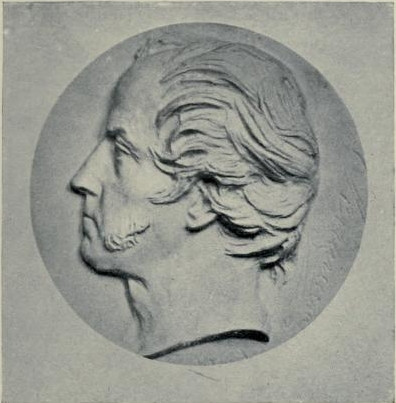
DE SÉNANCOUR
The hero of the book is one of those unhappy souls who seem created for the shady side of life and never succeed in getting out into its sunshine. There is, as Hamlet says, along with many excellent qualities some "one defect" in their nature which prevents the harmonious interplay of its parts. In the delicately balanced works of a watch some little spring, some little wheel breaks, and the whole mechanism comes to a standstill. Obermann has no settled occupation, no sphere of activity, no profession; it is only in the last pages of the book that he makes up his mind that he will be an author; the reader feels no assurance, however, that success awaits him upon this path. The author who has been successful with ever so small a work sees, on looking back, what an almost incredible variety of circumstances have favoured him, what an extraordinary number of obstacles, great and small, have had to be overcome; he remembers how carefully he had to watch his time, how eagerly to seize the opportune moment, how often he was on the point of giving it all up, how many paroxysms of despair he lived through, all to attain this paltry end. The most insignificant book which is born alive speaks of ten thousand triumphs. And what a combination of favourable circumstances is demanded to prevent its dying immediately after birth! As many as in the case of a living organism. The book must find some unoccupied space into which it fits, the interest awakened by it must not be interfered with by other, stronger, interests, or the talent displayed in it outshone by greater talent. It must not recall any previous work, must not even accidentally resemble anything else, and yet must, in one way or other, be associated with something already familiar, must follow a path already struck out. It is of special importance that it should appear at the right moment. There are works which are not actually weak, but which appear so in the light of some contemporaneous event or in comparison with some contemporaneous production; they are made to seem old-fashioned, poor, pale, as it were.
It is probable that Obermann, as an author, will belong to the same class of writers as his creator, Sénancour, namely those who believe that there is something of a magical nature in the secret of success.
His letters provide us with full particulars of his spiritual life and history. The latter is epitomised in the following words: "Oh! how great one is, so long as one is inexperienced! how rich and productive one would be if only the cold looks of one's neighbours and the chill blast of injustice did not shrivel up one's heart! I needed happiness; I was created to suffer. Who does not know those dark days towards the coming of winter, when even the morning brings dense mists and the only light is in some burning bars of colour in the clouded sky? Think of those veils of mist, that wan light, those hurricane gusts whistling among bending, trembling trees, that steady howl, interrupted by terrific shrieks; such was the morning of my life. At midday the colder, steadier storms; towards evening gathering darkness; and man's day is at an end."
To so morose a temperament a regularly ordered life is insupportable. The most difficult, distressing moment in a young man's life, that in which he must choose a profession, is one which Obermann cannot face. For to choose a calling means to exchange complete liberty and the full privileges of humanity for confinement resembling that of the beast in its stall. It is to their freedom from the stamp of any calling that women owe part of their beauty and of the poetry of their sex. The stamp of a calling is a restraint, a limitation, a ridiculous thing. How then could a man with a nature like Obermann's possibly choose a profession? At once too intense and too weak for real life, he hates nothing more than dependence! The whole constitution of society is repellent to him: "Thus much is certain; I will not drag myself up step by step, take a place in society, be compelled to show respect to superiors in return for the privilege of despising inferiors. Nothing is so imbecile as these degrees of contempt reaching down through society from the prince, who claims to be inferior to God alone, to the poorest rag-picker who must be servile to the woman from whom he hires a straw mattress for the night."