Introductory material (continued 4)
Mary Morison translation
When we remember how powerful is the prejudice which, in every country without exception, makes it a crime for the individual to deny that his nation is in possession of all the virtues which it ascribes to itself, and which so many a sanctimonious Jack-in-the-box finds it to his advantage to assure it daily that it possesses, we shall understand what courage Mme. de Staël displayed in attacking French national vanity at such a period.
There is one great idea that is more fatal than any other to the coercive power wielded by the established beliefs and customs of any given society. It has nothing to do with the logic of the matter. One would imagine that logic, let loose among the whole stock of prejudices ruling in any given country at any given time, would work the same havoc as a bull in a china-shop; but such is not the case; pure logic does not affect the majority of mankind at all I No! if you would really awaken and astound the generality of men, you must succeed in making it plain to them that what they consider absolute is only relative—that is to say, must show them that the standards which they believe to be universally recognised, are only accepted as standards by so and so many similarly constituted minds; whereas other nations and other races have an entirely different conception of the befitting and the beautiful. In this manner the general public of a country learn for the first time that the art and poetry which they despise are regarded by whole races as the highest, while their own, which to them seem the finest in the world, are held in slight esteem by other nations; learn, moreover, that it is vain to take refuge in the thought that all other nations are mistaken in their judgment, seeing that each one of these other nations believes that all the rest are mistaken. If I were asked to define in one word the service rendered by Mme. de Staël to French society, to its culture and literature, and through these to Europe in general, I should express myself thus: By means of her writings, more particularly her great works on Italy and Germany, she enabled the French, English, and German peoples to take a comparative view of their own social and literary ideas and theories.
Count d'Erfeuil, in Corinne, is a cleverly drawn type of French superficiality and vanity in combination with some of the most charming and characteristic of French virtues. One does not really appreciate the character until one has repeatedly reflected on the amount of courage that was required to introduce into a circle of foreigners, as the sole, and properly accredited, representative of France, such an extremely narrow-minded personage as D'Erfeuil. He is a young French émigré, who has fought with singular gallantry in the war, has submitted to the confiscation of his large estates not merely with serenity, but with cheerfulness, and has with great self-sacrifice tended and supported the old uncle who brought him up, who like himself is an émigré and who without him would be absolutely helpless—in short, there is a foundation of chivalry and unselfishness in his character. When one talks to him, however, one feels it impossible to believe that he is a man of much and sad experience, for he positively seems to have forgotten all that has happened to him. He talks of the loss of his fortune with admirable frivolity, and with equal, if less admirable, frivolity on all other subjects.
Oswald meets him in Germany, where he is nearly bored to death; he has lived there for several years, but it has never occurred to him to learn a word of the language. He intends to go to Italy, but anticipates no pleasure from travelling in that country; he is certain that any French provincial town has more agreeable society and a better theatre than Rome. "Do you not mean to learn Italian?" asks Oswald. "No," he replies; "that is not part of my plan of study;" and he looks as serious when giving this answer as if something very important had led him to the determination. In Italy he does not vouchsafe the landscape so much as a glance. His conversation turns neither on outward objects nor on feelings; it hovers between reflection and observation as between two poles, neither of which it touches; its topics are always society topics; it is garnished with puns and anecdotes, is chiefly about his numberless acquaintances, is indeed in its essence nothing but society gossip. Oswald is astonished by this strange mixture of courage and superficiality. D'Erfeuil's contempt for danger and misfortune would have seemed admirable to him if it had cost more effort, and heroic if it had not been the outcome of the very qualities which render him incapable of deep feeling. As it is, he finds it tiresome.
When D'Erfeuil for the first time sees St. Peter's in the distance, he likens it to the dome of the Invalides in Paris—a comparison more patriotic than apt; when he sees Corinne at the Capitol he feels a desire to make her acquaintance, but no reverence for her. He is not surprised that her heart has remained untouched in a country where he finds no good qualities in the men, but he cannot help flattering himself with the hope that she will be unable to resist the charms of a well-bred young Frenchman. When she speaks to others in his presence in Italian or English (languages he does not understand), he says to her: "Speak French. You know the language and are worthy to speak it."
When he sees that Corinne loves Oswald he does not take it amiss, though his vanity is wounded; but he thinks her passion foolish, because of the improbability of its bringing her happiness. At the same time he most strongly advises Oswald not to enter into a life-long union with an unpresentable woman like Corinne. With all his daring, he bows to the supreme authority of established custom. "If you will be foolish," he says to Oswald, "at least do nothing irreparable;" reckoning among irreparable follies marriage with Corinne. His ideas on literary, correspond to his ideas on social subjects. In Corinne's house the conversation frequently turns upon Italian and English poetry. D'Erfeuil, starting from the premise that French poetry from the time of Louis XV. onwards forms the unquestioned standard, is naturally very severe in his judgment of all foreign productions. To him the Germans are barbarians, the Italians are corrupters of style, and "the taste and elegance of French style" are law-giving in literature. "Our stage literature," he remarks, "is admittedly the finest in Europe, and I do not think that it occurs even to the English themselves to compare Shakespeare with our dramatists." In a company of Italians he shrewdly enough, if without much delicacy, defines Italian drama as consisting of ballets, silly tragedies, and wearisome harlequinades; to him the Greek drama is coarse, Shakespeare formless. "Our drama," he says, "is a model of refinement and beauty of form. To introduce foreign ideas among us would be to plunge us into barbarism."
D'Erfeuil considers the antiquities of Rome altogether overrated. He is not going to fatigue himself, he says, by toiling through all these old ruins. He makes his way northwards, but is as bored by Alpine scenery as he was by Rome. In the end he goes to England, where he assists Corinne in her misfortunes; his deeds have ever been nobler than his words. He cannot, however, when he sees how miserable her love for Oswald has made her, deny his vanity the satisfaction of ringing the changes upon "I told you so;" and he considers it a duty to himself not to let the opportunity slip of offering himself as Oswald's successor. For all this, it is true and unselfish devotion that he displays, and Corinne is distressed by her inability to be more truly grateful to him; but he is so careless and scatterbrained that she is constantly tempted to forget his generous deeds just as he himself forgets them. "It is very charming, no doubt," observes the authoress, "to set little value on one's own good deeds, but it may be that the indifference with which some men regard their own noble actions has its origin in their superficiality." Without regard for anything but what she considers the truth, she thus derives some of the most conspicuous virtues of her countrymen from weaknesses in their character.
By means of this typical character of D'Erfeuil, Mme. de Staël shows how in France all good feelings are held in check by one vice, that fear of society which has its origin in vanity. It seems to her as if all feeling, the whole of life, indeed, were ruled by esprit, by the desire to appear to advantage, and by a fear which may be expressed in the words, "What will people say?" An author who writes not long after Mme. de Staël, the acute and original Henri Beyle, is of the same opinion. His name for Frenchmen is les vainvifs and he asserts that all their actions are dictated by the consideration, Qu'en dira-t-on? the fear, that is to say, of the unbecoming or ridiculous. The French were then, what the Danes are still, very proud of their keen sense of the comical; it was this which led them to describe themselves modestly as the wittiest nation in the world. Corinne maintains that this sense of the ridiculous, with the corresponding fear of being ridiculous, destroys all originality in manners, in dress, and in speech, prevents all free play of imagination, and stifles natural expression of feeling. She maintains that feeling, that every kind of intellectuality, is obliged to take the form of wit instead of the form of poetry, in a country where the fear of becoming the victim of wit or mockery makes each man try to be the first to seize those weapons. "Are we," she asks D'Erfeuil, "only to live for what society may say of us? Is what others think and feel always to be our guiding star? If this be so, if we are intended to imitate each other for ever and ever, why has each one of us been given a soul? Providence might have spared itself this unnecessary outlay."
The national prejudices of France are typified in D'Erfeuil; in Oswald we have a personification of all the prejudices which have been part of England's strength and England's weakness throughout the centuries. Powerful nations are always unjust, and their injustice both adds to their power and limits it. It was upon this injustice that Mme. de Staël considered it her mission to throw a very strong light.
The story of the book turns upon the attempt of a woman to regain, by means of a man's love, that place in English society which she has forfeited by too great independence, by entering the arena of public life; consequently what the authoress chiefly dwells upon in her delineation of English character is the narrowness of the English conception of ideal womanhood. From this conception, with which he has been brought up, Oswald makes sincere but fruitless efforts to free himself. When, in Italy, he sees Corinne admired and loved for her great gifts, without a thought being given to her sex or her enigmatical past, he is greatly perplexed. There is something repulsive to him in a woman's leading this public life. He is accustomed to look upon woman as a sort of higher domestic animal, and for long cannot reconcile himself to the idea of society forgiving her the crime of having talent. He feels himself as it were humiliated and exasperated by the thought; he regards it as impossible that a woman with such a well-developed, independent mind should be capable of binding herself faithfully to one man and living contentedly for him alone. And though, in spite of everything, Corinne loves him, loves him with a passion beside which all that he has seen or heard of pales, and which is so unselfish that it leads her to risk her reputation for his sake without demanding anything whatever in return, he forgets her, her great gifts, her nobility of mind and soul, the moment he stands once again upon English soil, inhales English mists and prejudices, and meets a fresh young girl of sixteen, the very perfection of a wife after the English recipe, reserved, ignorant, innocent, silent, a fair-haired, blue-eyed incarnation of domestic duty.
The authoress tracks the prejudice which explains Oswald's conduct to its source, which she finds to be the English conception of home. Oswald's principal difficulty in coming to a decision about Corinne is expressed in the words: "Of what use would all that be at home?" "And home is everything to us—to the women, at least," remarks an Englishman to Oswald; and the authoress herself remarks elsewhere: "Though it is possible for an Englishman to find pleasure for a time in foreign ways and customs, his heart invariably returns to the impressions of his childhood. If you ask the Englishman you meet on board ship in foreign climes whither he is bound, he answers, if he is upon the return journey: 'Home.'"[1] It is to this English love of home that she attributes both the superstition that the independent intellectual development of woman is absolutely incompatible with the domestic virtues, and the English idolatry of these virtues. And, strange as it may seem to us to see the Italian woman, nowadays so indifferent to everything intellectual, set up as a model of independence, there is no doubt that Mme. de Staël is right. The ideal of well-being conveyed by the word home, is a genuine Northern, Teutonic conception, originally so foreign to the Latin races that the English word home has passed into the Latin languages, because these possess no equivalent. To this conception of home corresponds the word "cosiness" (untranslatable into any Latin language), which was created to express the pleasure of being able to sit warm and comfortable within four walls. We have not far to seek for the origin of this ideal. The inhabitant of Northern Europe, living in a raw climate, amidst cold, harsh natural surroundings, finds the same pleasure in the thought of sitting by a warm hearth whilst snow and rain beat impotently on the window pane, which a Neapolitan feels in the thought of sleeping under the warm, glorious, starry sky, or passing the cool night in dance, play, and song, in the open air. But to each of these different ideals of well-being and happiness corresponds a different conception of virtues and duties, which the nation that possesses or enforces them regards as the universal conception. It considers itself the first among nations because it exacts the fulfilment of these particular duties and possesses these particular virtues (which is not surprising, seeing that both are naturally entailed by the national character), and it moreover censures all the nations whose conceptions differ from its own.
Speaking of England, Oswald asks Corinne: "How could you leave the home of chastity and morality and make fallen Italy the country of your adoption?" "In this country," Corinne replies, "we are modest; neither proud of ourselves like the English, nor pleased with ourselves like the French." It gratifies her to put both the Puritanic arrogance of the Northerner and the vain Frenchman's fear of ridicule to shame, by comparing them with the frank naturalness which the people of Italy even in their humiliation have preserved. She describes, delicately and truthfully, the touching naïveté with which the latter display their emotions. There is no stiff reserve, as in England, no coquetry, as in France; here the woman simply desires to please the man she loves, and cares not who knows it. One of Corinne's friends, returning to Rome after an absence of some duration, calls upon a distinguished lady. He is informed by the servant that "the Princess does not receive to-day; she is out of spirits, she is innamorata." Corinne tells how indulgently a woman is judged in Italy, and how frankly she owns her feelings. A poor girl dictates a love-letter to a writer in the open streets, and the man writes it with the utmost seriousness, never omitting to add all the polite forms which it is his business to know; hence some poor soldier or labourer receives a letter in which many tender assurances occupy the space between "Most honoured contemporary!" and "Yours with reverential respect." Corinne is perfectly correct. I have myself seen such letters. And, on the other hand, it seems as if learning had not been at all unusual among the Italian women of those days. A Frenchman in Corinne who calls a learned woman a pedant, receives the reply: "What harm is there in a woman's knowing Greek?"
Neither does Corinne fail to perceive that the official recognition and support of duty and morality in the North is accompanied by the greatest brutality in all cases in which the laws of society have once been transgressed. She shows how the Englishman respects no promise or relation which has not been legally registered, and how in strict England the sanctity of marriage and an irreproachable home life exist side by side with the most shameless and bestial prostitution, just as the personal devil exists side by side with the personal God. She remarks, with womanly circumspection and modesty, but yet quite plainly: "In England it is the domestic virtues which constitute woman's glory and happiness; but, granted that there are countries in which love is to be met with outside the bonds of holy matrimony, then undoubtedly among all these countries Italy is the one in which most regard is shown to woman's happiness. The men of that country have a code of morality for the regulation of those relations which are without the pale of morality—a tribunal of the heart." It is the same tribunal as that of the mediæval Courts of Love. Byron is greatly impressed when he comes to Italy and finds this complete moral code, exactly the opposite of the English. Mme. de Staël as usual tries to explain the milder morality by the milder climatic conditions; she says: "The aberrations of the heart inspire a more indulgent compassion here than in any other country. Jesus said of the Magdalen: 'Her sins, which are many, are forgiven; for she loved much.' Those words were spoken under a sky as beautiful as ours. The same sky invokes for us the same Divine mercy."
Corinne, who is herself a Catholic, teaches the Scottish Protestant who loves her, to understand Italian Catholicism. "In this country, Catholicism, having had no other religion to combat, has become milder and more indulgent than it is anywhere else; in England, on the other hand, Protestantism, in order to annihilate Catholicism, has been obliged to arm itself with the utmost severity of principle and morality. Our religion, like the religion of the ancients, inspires the artist and the poet; is a part, so to speak, of all the pleasures of our life; while yours, which has had to adapt itself to a country where reason plays a much more important part than imagination, has received an imprint of moral severity which it will always retain. Ours speaks in the name of love, yours in the name of duty. Although our dogmas are absolute, our principles are liberal, and our orthodox despotism adapts itself to the circumstances of life, while your religious heresy insists upon obedience to its laws without making any allowance for exceptional cases."
She shows how, in consequence of this, there is always a certain dread of genius, of intellectual superiority, in Protestant countries. "It is a mistaken fear," she says; "for it is very moral, this superiority of mind and soul. He who understands everything becomes very compassionate, and he who feels deeply becomes good."
"Why are great powers a misfortune? Why have they prevented my being loved? Will he find in another woman more mind, more soul, more tenderness than in me? No, he will find less; but he will be content, because he will feel himself more in harmony with society. What fictitious pleasures, what fictitious sorrows are those we owe to society! Under the sun and the starry heavens all that human beings need is to love and to feel worthy of each other; but society! society! how hard it makes the heart, how frivolous the mind! how it leads us to live only for what others will say of us! If human beings could but meet freed from that influence which all collectively exercise upon each, how pure the air that would penetrate into the soul! how many new ideas, how many genuine emotions would refresh it!"—"Receive my last salutation, O land of my birth!" cries Corinne in her swan song in praise of Rome—and one feels the bitterness of the exile and the thrust at Napoleon in the words that follow: "You have not grudged me fame, O liberal-minded people that do not banish women from your temples, that do not sacrifice immortal talent to passing jealousies! You welcome genius wherever you recognise it; for you know that it is a victor without victims, a conqueror that does not plunder, but takes from eternity wherewith to enrich time."
This sketch of the contrast between the emotional life of Catholicism and that of Protestantism prepares for a digression on the contrast between their respective views of art. On this latter point the book makes a decided attack on Protestant arrogance and want of all understanding of art, as exhibited by Oswald, who represents the narrowest English ideas.
In the midst of this plastic and musical people, who are so good-natured, so childlike, so careless of their dignity, and, according to English ideas, so immoral, Oswald, who is accustomed to regard it as the aim and end of existence to live up to certain insular conceptions of duty and dignity, feels himself very ill at ease. Devoid of all artistic feeling, he judges art now by a literary, now by a moral, now by a religious standard; his prejudices are constantly offended; he understands nothing. He notices some reliefs on the doors of St. Peter's, and great is his amazement to find that they represent scenes from Ovid's Metamorphoses, Leda with the swan, and the like! What is this but pure paganism! Corinne takes him to the Colosseum, and (in this resembling his contemporary Oehlenschläger) his one thought is that he is standing in a gigantic place of execution, his one feeling, moral indignation at the crimes here perpetrated against the early Christians. He enters the Sistine Chapel and, ignorant of the history of art, is greatly outraged that Michael Angelo has ventured to portray God the Father in ordinary human form, as though he were a Jupiter or a Zeus. He is equally scandalised on finding in Michael Angelo's prophets and sibyls none of that humble Christian spirit which he had looked for in a Christian chapel.
All this the authoress has drawn from life. Italy presupposes in her visitors a certain amount of artistic, or æsthetic, taste. There are three ways of looking at everything—the practical, the theoretical, and the æsthetic. The forest is seen from the practical point of view by the man who inquires if it conduces to the healthiness of the district, or the owner who calculates its value as firewood; from the theoretical, by the botanist who makes a scientific study of its plant life; from the æsthetic or artistic, by the man who has no thought but for its appearance, its effect as part of the landscape. It is this last, the artistic, æsthetic view, that Oswald is unable to take. He has no eyes; his reasoning power and his morality have deprived his senses of their freshness. Therefore he cannot lose sight of the substance in the form, therefore the Colosseum awakens in him only the remembrance of all the blood so wickedly spilled there. In Corinne's vindication of the æsthetic view we feel the influence of Germany, more particularly of A. W. Schlegel, the first exponent of the awakening romantic spirit in that country. For, however differently Romanticism may develop in different countries, one thing which it invariably maintains is, that the beautiful is its own aim and end, or Selbstzweck, as it was called in Germany; an idea borrowed from Kant's Kritik der Urtheilskraft; the vindication of beauty as the standard and true aim of art. In France this theory was expressed by the formula l'art pour l'art, and it makes its appearance for the first time in Denmark in certain of Oehlenschläger's poems.
But it is not only the art, but the people and the life of Italy, that must be seen with the artist's eye to be understood and appreciated. Nothing is more common than to meet in Italy, Englishmen, Germans or Frenchmen, who, seeing everything from their national point of view, have nothing but blame for everything. In the eyes of the Germans the women lack that timid modesty, that maidenliness, which is their ideal; Englishmen are shocked by the want of cleanliness and order; Frenchmen are dissatisfied with the social intercourse, the absence of conversational ability, and express contempt for the Italian prose style.
Corinne points out that the beauty of Italian women is not of a moral, but of a plastic and picturesque kind; that to appreciate it we must have an eye susceptible to colour and form, not dulled by too much poring over printed books. She contrasts Italian improvisation with French conversation, and finds it equally admirable.
A sensible people like the English cultivate and appreciate practical business qualities; an emotional people like the Germans cultivate and love music; a witty people like the French cultivate conversation—that is to say, the best in them is brought out in intercourse, in converse with others; an imaginative people like the Italians improvise—that is to say, rise naturally from their ordinary feelings into poetry. Corinne says: "I feel myself a poet whenever my spirit is exalted; when I am conscious of more than usual scorn for selfishness and meanness, and when I feel that a beautiful action would be easy to me—then it is that my verses are best. I am a poet when I admire, when I scorn, when I hate, not from personal motives, but on behalf of the whole of humanity." And she does not rest content with defending the light nightingale-song which was what the Italians at that time understood by lyrical poetry; she also accounts for the exaggerated importance attached to style and rhetorical pomp in Italian prose. She explains it partly by the love of the South for form, partly by the fact that men lived under an ecclesiastical despotism which forbade the serious treatment of any theme; they knew that it was not possible for them to influence the course of events by their books, and so they wrote to show their skill in writing, to excite admiration by the elegance of their composition—and the means became the end.
Another of the things which had shocked Oswald was Michael Angelo's representation of the Divinity and the prophets in the Sistine Chapel. In the mighty human form of Jehovah he does not recognise that invisible, spiritual divinity into which the passionate national God of the old Hebrews has been transformed by the Protestantism of the North; and where among all these proud forms with which Michael Angelo has covered the ceiling in his Promethean desire to create human beings, where among those defiant, enthusiastic, despairing, struggling figures, is to be found the humility, the meekness he expected to see? Corinne reads her countrymen a lesson, a lesson needed in other countries at this day, and especially in one like ours, where so much unintelligent talk is to be heard on the subject of Christian art and Christian æsthetics.
The passionately violent attack made by Sören Kierkegaard towards the end of his life upon so-called Christian art does not surprise us, coming as it did from a man destitute of all artistic culture. He first invests the painters of the Renaissance with his Protestant, nay, his personal, conception of religion, and is then shocked because, with this conception in the background of their consciousness, they could paint as they did. Oswald behaves in much the same way. He does not realise that the painters of the Renaissance stood in a different relation to their subjects from the painters of our day; that whereas the artists of to-day seek to gain a real understanding of their subject, and study it either from the antiquarian, the ethnological, or the psychological point of view, the artist of the Renaissance took his subject as he found it, and made of it what he fancied—that is to say, what harmonised with his character. Herein is to be found the explanation of what surprises and shocks the North—ener in the old masters. For, just as a small selection of themes taken from the Iliad and the Odyssey provided the whole of Greek art—sculpture, painting, and drama—with its subjects (it is always the same story, of Paris and Helen, of Atreus and Thyestes, or of Iphigenia and Orestes), so a score of themes from the Old and New Testament (the Fall, Lot and his Daughters, the Nativity, the Flight into Egypt, the Passion) keep brush and chisel at work in Italy for three centuries. It is such subjects alone which artists are commissioned to paint, and for long it is only for the purpose of painting such subjects that study from the nude is permitted. Men's minds develop, the subjects remain the same. The pious, naïve faith of old days is superseded by the enthusiastic humanism and reviving paganism of the Renaissance; but it is still Madonnas and Magdalens that are painted, with this difference, that the stiff Queen of Heaven of Byzantine art is transformed into an idealised peasant girl of Albano, and the woefully emaciated and remorseful sinner of Andrea del Verocchio into the voluptuous Magdalen of Correggio; the apostles and martyrs too are still depicted, but the stoned and crucified saints of olden times, painted for the purpose of exciting compassion and devotional feeling, are transformed into the St. Sebastians of Titian and Guido Reni, the beautiful young page glowing with health and beauty, the dazzling white of whose flesh is thrown into relief by one or two drops of blood which drip from an arrow-head inserted becomingly between the ribs.
Oswald is taught by Corinne to admire the liberal spirit of Italian Catholicism, which in the days of the Renaissance permitted each artist to develop his talent or genius with perfect independence, even when he only made his Christian or Jewish subject a pretext for the representation of his own personal ideal of man or woman. This brings us to another of Oswald's stumbling-blocks, namely, that blending of the Christian and the pagan which so offended him in the reliefs by Antonio Filarete on the doors of St. Peter's. The same thing is to be observed everywhere; everywhere the pagan material has been preserved and employed. The old basilicas and churches are built with the pillars of antique temples. A simple cross superficially christianises the obelisks, the Colosseum, and the interior of the Pantheon. The statues of Menander and Posidippos were prayed to as saints all through the Middle Ages.
Corinne shows Oswald that it is to this often childish, but always unprejudiced position towards the pagan and the human, that Catholicism owes the artistic glory with which it will always shine in history, a glory which will never be dimmed by the artistic performances of Protestantism. Protestantism tears down from above its altars the beautiful Albano peasant women with smiling babes at their breasts, tinder the pretext that they are Madonnas, whitewashes all the glowing pictures, and glories in bare walls.
The Italy of the Renaissance divested Christianity of its spirit of self-renunciation, of its Jewish-Asiatic character, and transformed it into a mythology, fragrant of incense, wreathed with flowers. Italian Catholicism allied itself with the civic spirit in the cities, and with all the fine arts when art was born again. Thus its interests were quite as often promoted from patriotic as from religious motives. It was in Tuscany that the Renaissance began. There humanity was born again after its fall, its renegation of Nature. There the first Italian republics were founded. There men once more willed; houses congregated and formed small, proud, indomitably liberal states, each a town with its surrounding district. Towers and spires rose into the air, erect and proud as the bearing of a free man; fortified palaces were begun, churches were completed; but the church was far more a state treasure-house, a witness to wealth, perseverance, and artistic taste, a valuable item in the rivalry between state and state, between Siena and Florence, than a dwelling-place of "Our Most Blessed Lady." Much more was done in honour of Siena than in honour of God. A Tuscan church, such as that of Orvieto, with its mosaics inlaid in gold, or that of Siena, with its façade of sculptured marble resembling the lace robe of some youthful beauty, is to us much more of a jewel-casket than a church.
Or think of the Church of St. Mark in Venice. The first time one sees it, one feels momentarily surprised by its oriental façade, its bright cupolas, its peculiar arches resting on pile upon pile of short, clustered pillars of red and green marble. After casting a glance from the piazza at the mosaics of the outside walls, rich colours on a golden ground, one enters, and one's first thought is: Why, this is all gold, golden vaulting, golden walls! The minute gilt tesseræ composing the mosaic background of all the pictures form one great plane of gold. A sunbeam falling upon it produces sparkling flecks upon the darker ground, and the whole church seems aflame. The floor, undulating with age, is composed of a mosaic of red, green, white, and black marble. The pillars, which are of reddish marble, have capitals of gilded bronze. The small arched windows are of white, not stained glass; coloured windows would be unsuitable with all this magnificence; they are for less gorgeous churches. The pillars are alternated with enormous square columns of greenish marble, at least six yards in diameter, which support gilded half-arches; each cupola rests upon four such half-arches. The smaller pillars which support altars, &c., are, some of green and red speckled marble, some of transparent alabaster. All the lower-lying marble, that, for instance, of the seats and benches running along the sides of the church and surrounding the columns, is of a bright red colour. The whole church, as seems only natural in a town whose school of painting so entirely subordinated form to colour, impresses by its picturesqueness, not by its architectural grandeur. With its gilded ornaments, its inlaid stalls, its lovely bronzes, its golden statues, candelabra, and capitals, San Marco lies there like some luxurious Byzantine beauty, heavily laden with gold and pearls and sparkling diamonds, the richest brocade covering her oriental couch.
Such a church as this was undoubtedly originally an expression of religious enthusiasm, but in the palmy days of the Renaissance, as the building became ever more and more richly ornamented, religious feeling was entirely supplanted by love of art. Very significant of this is the one inscription in the church, which is to be found above the principal entrance: "Ubi diligenter inspexeris artemque ac laborem Francisci et Valerii Zucati Venetorum fratrum agnoveris tum tandem judicato." (When you have diligently studied and considered all the art and all the labour which we two Venetian brothers, Francesco and Valerio Zucati, have expended here, then judge us.) A caution by the artists against hasty criticism.
The brothers Zucati were the masters in their art who in the sixteenth century executed most of the mosaics in the church, entirely, or principally, after designs by Titian. Such an inscription, which, instead of being an invitation to worship, a greeting to the faithful, a benediction, or a text of Scripture, is an appeal to the beholder to examine carefully and seriously the artistic work executed in the service of religion, would be an impossibility in or on a Protestant church.
When the Catholic faith disappears, as it is doing to-day in Italy, from the Catholic Church, when Inquisition and fanaticism become a legend, when the ugly animal in the snail-shell dies, the beautifully whorled shell will still remain. There will still remain the magnificent churches, statues, and paintings; there will still remain Michael Angelo's Sistine Chapel, Raphael's Sistine Madonna, St. Peter's at Rome, the cathedrals of Milan, Siena, and Pisa. Protestantism has shown itself incapable of producing any great religious architecture; and, though iconoclasm has long been a thing of the past, Rembrandt remains the one great master in whose pictures it has shown capacity to give artistic expression to its religious sentiments.
It has been necessary to dwell a little upon the fact that Corinne, the art-loving poetess, always takes the part of Catholicism against Protestant Oswald, because here again the influence upon Mme. de Staël of her intercourse with Germans may be clearly traced. Here again we feel, and this time more forcibly, the approach of Romanticism, with its loathing of Protestantism, as unimaginative, uncultured, dry, and cold, and its steadily increasing affection for Catholicism, a faith whose æsthetic proclivities, and close and warm relations with imagination and art, gave it an unexpected new lease of life and power in the beginning of the nineteenth century, after the prosaic reasonableness of the "enlightenment" period. We have here a most distinct attack upon the France of the eighteenth century, which, with Voltaire at its head, had persecuted and scorned Catholicism, and which, without any love for Protestant dogma, had yet expressed a distinct preference for Protestantism, with its independence of Papal authority, its married clergy, and its hatred of the real or pretended renunciations of conventual life.
XII
NEW CONCEPTION OF THE ANTIQUE
There is another part of this book on Italy where the influence of Germany makes itself profoundly felt, and where we are also sensible of the transition from the creative mood which produced Corinne to that which produced the book on Germany. I refer to Corinne's conception of the antique and of the position in which modern art stands towards it. Reflections on this subject naturally suggested themselves when she was acting as Oswald's guide in Rome.
For Rome is the one place in the world where history is, as it were, visible. There successive ages have deposited their records in distinct layers. One sometimes comes upon a single building (one of the houses in the vicinity of the Temple of Vesta for example) in which the foundation belongs to one period of history, and each of the three superimposed stories to another—ancient Rome, imperial Rome, the Renaissance, and our own day. It is to the most ancient period that Corinne first introduces her friend. It must be confessed that while she looks at the ruins, he looks at her. But the significance of this part of the book lies in the fact that it introduces a new view of the antique into French literature.
Of the two great classic peoples, it was really only the Romans that were understood in France. Some Roman blood flows in Frenchmen's veins. A true Roman spirit breathes in Corneille's tragedies. It was, thus, not surprising that the great Revolution revived Roman customs, names, and costumes. Charlotte Corday, of the race of the great Corneille, is penetrated by the Roman spirit. Madame Roland moulded her mind by the study of Tacitus; and David, the painter of the Revolution, reproduced ancient Rome in his art—Brutus and Manlius are his heroes.
But the Greeks had never been rightly understood. The French, indeed, still flattered themselves that their classical literature continued the tradition of Greek literature, and actually surpassed it; but since Lessing had written his Hamburgische Dramaturgie it had been no secret to the rest of Europe that Racine's Greeks were neither more nor less than so many Frenchmen; it had been discovered that Agamemnon's immortal family consisted of disguised marquises and marchionesses. It was of no avail that the costume had been altered in the Théâtre Français, that since Talma's day its Greeks had appeared in classic draperies instead of with perukes, powder, and small-swords; from the moment that the critical spirit awoke in Germany, the French conception of the antique became the jest of Europe.
It is Mme. de Staël who has the honour of being the first to introduce her fellow-countrymen, in her book on Germany, to the bold scoffer, Lessing, who had dared to make the arch-mocker himself, his own teacher and master, Voltaire, the butt of his wit, in this case sharpened by a personal grudge. She paves the way for doing so in Corinne, by making her heroine's conversation with Oswald a résumé of all the results produced in the mind of Germany by the new study of the antique, and by the doctrines propounded in Laokoon on the subject of the relation between poetry and sculpture.
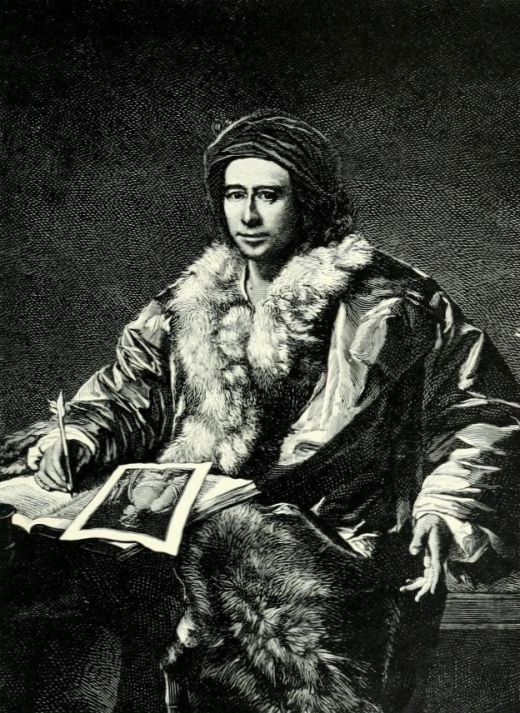
WINCKELMANN
In Germany too, a thoroughly French conception of Hellenism had prevailed, the conception apparent in Wieland's clever, frivolous romances, Agathon and Aristippos, and in his poems, Endymion, Musarion, &., which are severely handled by Mme. de Staël in her book on Germany. But a new era had dawned. A poor German school-master, Winckelmann, inspired by genuine, pure enthusiasm, succeeded, after encountering innumerable difficulties, in making his way to Rome to study the antique. Against his convictions, and in spite of the opposition of his friends, he adopted the Catholic religion to facilitate his stay there. He eventually fell a victim to his love of art, for he was foully murdered by a scoundrel who wished to obtain possession of his collection of valuable coins and precious stones. It was this Winckelmann who, in a long series of writings, beginning with the appeal to the German nobility and ending with the great history of art, opened the eyes of his fellow-countrymen to the harmony of Greek art. His whole work as an author is one great hymn to the re-discovered, the recovered antique. All who are acquainted with his writings are aware that the Apollo Belvedere, the Venus of Medici, and the Laocoon group represented to him the supreme glory of Greek art; nor could it be otherwise, seeing that no work of art of the great style had as yet been discovered. The Teutonic neo-Hellenic development took place prior to the discovery of the Venus of Milo. Even Thorwaldsen was an old man when he first saw this statue. But in spite of this one great deficiency and of his many historical inaccuracies, it was from Winckelmann that the mighty influence went forth which inspired Lessing, Schiller, and Goethe. Lessing's work is a continuation of Winckelmann's. Endowed with an unrivalled critical faculty, he sketched the first plan of a science of art and poetry with Winckelmann's theory of art as a foundation. All who are familiar with Goethe's life know how great an influence these twin spirits, Winckelmann and Lessing, had upon his artistic development. The new, grand, genial conception of the antique finds its first expression in Goethe's sparkling little masterpiece, Götter, Helden und Wieland. I give a few specimen speeches. Wieland's ghost stands, nightcap on head, and is being utterly crushed in an argument with Admetus and Alcestis when Hercules appears.
H. Where is Wieland?
A. There he stands.
H. That he? He is small enough, certainly. Just what I had pictured him to myself. Are you the man that is always prating about Hercules?
W. (shrinking away). I have nothing to do with you, Colossus I
H. Eh! What? Don't go away.
W. I imagined Hercules to be a fine man of middle height.
H. Of middle height! I?
W. If you are Hercules, it was not you I meant.
H. That is my name and I am proud of it. I know very well that when a blockhead cannot find a suitable bear or griffin or boar to hold his scutcheon, he takes a Hercules. It is plain that my godhead has never revealed itself to you in a vision.
W. I confess this is the first vision of the kind that I have ever had.
H. Then take thought, and ask pardon of the gods for your notes to Homer, who makes us too tall for you.
W. In truth you are enormous; I never imagined anything like it.
H. Is it my fault, man, that you have such a narrow-chested imagination? What sort of a Hercules is the one you are for ever prating about, and what is it he fights for? For virtue? What's the motto again? Have you ever seen virtue, Wieland? I have been a good deal about in the world too, and I never yet met such a thing.
W. What! You do not know that virtue for which my Hercules does everything, ventures all?
H. Virtue! I heard the word for the first time down here from a couple of silly fellows who couldn't tell me what they meant by it.
W. No more could I. But don't let us waste words upon that I wish you had read my poems; if you had, you would see that at bottom I don't care so very much about virtue myself—it is an ambiguous sort of thing.
H. It is a monstrosity, like every other phantasy which cannot exist in the world as we know it. Your virtue reminds me of a centaur. So long as it prances about in your imagination, how splendid it is, how strong! and when the sculptor represents it for you, what a superhuman form! But anatomise it, and you find four lungs, two hearts, and two stomachs. It dies at the moment of birth like any other monstrosity, or, to be more correct, it never existed anywhere but in your brain.[1]
W. But virtue must be something, must be somewhere.
By the eternal beard of my father, who doubted it? Meseems it dwelt with us, in demigods and heroes. Do you suppose we lived like brute beasts? We had splendid fellows among us.
W. What do you call splendid fellows?
H. Those who share what they have with others. And the richest was the best If he had more muscular strength than he needed, he gave another man a good thrashing; and of course no good man and true will have anything to do with a weaker man than himself, only with his equals, or his superiors. If he had a superfluity of sap and vigour, he provided the women with as many children as they might wish for—I myself begot fifty men-children in a single night. And if Heaven had given him goods and gold enough for a thousand, he opened his doors and bade a thousand welcome to enjoy it with him.
W. Most of this would be considered vice in our day.
H. Vice? that is another of your fine words I The very reason why everything is so poor and small with you is, that you represent virtue and vice as two extremes between which you oscillate, instead of thinking the middle course the ordained and best, as do your peasants and your men-servants and maid-servants.
W. Let me tell you that in my century you would be stoned for such opinions. See how they have denounced me for my little attack on virtue and religion.
H. And what had you to do attacking them? I have fought with horses, cannibals, and dragons, to the best of my ability, but never with clouds, what shape soever it pleased them to take. A sensible man leaves it to the winds that have blown them together to sweep them away again.
W. You are a monster, a blasphemer.
H. And you can't understand. Your Hercules stands like a beardless simpleton, hesitating between virtue and vice. If the two jades had met me on the way—see! one under this arm, one under that, off I'd have gone with them both.
Here we have Goethe's early and vigorous new conception of the antique contrasted with Wieland's Frenchified one; and we have at the same time the poetical confession of faith of the man whom his contemporaries called the Great Pagan. This is the philosophy of Spinoza in the form of a daring jest. But Goethe did not retain this bold, naturalistic view of the antique. When his youthful ardour had exhausted itself in Werther, in Götz, and in his enthusiastic treatise on Gothic architecture, he abruptly turned his back upon the Gothic and upon enthusiasm; and when he returns to the Greeks, it is their serenity and their lucidity, their simple harmonies and their sound common sense which captivate him. All that was passionate, full of colour, and realistic, he put aside and ignored; what was popular, burlesque, sensational, he only admitted in his allegorical farces, such as Die klassische Walpurgisnacht in Faust; and for what was wildly bacchantic or darkly mystical his eyes were closed.
With an increasing aversion for Christianity, which finds its chief expression in the Venetian Epigrams, was associated such a repugnance for the Gothic and all Christian art, that when he was at Assisi, a place so rich in famous Christian mementoes, Goethe did not even visit the beautiful Church of St. Francis, but devoted his attention exclusively to the insignificant ruins of the Temple of Minerva. It was in this frame of mind that he wrote his Iphigenia, a work which may be looked upon as typical of the whole Germanic-Gothic renaissance of the antique, and which played an important part in the formation of the art theories of the nineteenth century. It was regarded by German æstheticism under the leadership of Hegel, and by French æstheticism under the leadership of Taine, as a species of model work of art. Hegel considered that only the Antigone of Sophocles was worthy to be compared with it. The spirit by which it is inspired is the same spirit which inspired all Schiller's neo-Hellenic poems, Die Götter Griechenlands, Die Künstler, Die Ideale, Das Ideal und das Leben. Men were actually inclined at that time to accept, as representative of the life of the Greeks, Schiller's description of the life of the gods:
"Ewig klar und spiegelrein und eben Fliesst das zephyrleichte Leben Im Olymp den Seligen dahin."
It is this entirely one-sided conception of the antique which is gradually evolved from that expressed in Götter, Helden und Wieland, and which finally leads Goethe to write Homeric poems like Achilleïs. Thorvaldsen's position to the antique is influenced by the same ideas and presents a succession of almost parallel movements. In some of his earliest bas-reliefs—Achilles and Briseïs, for example—we observe that greater daring in the rendering of the antique with which Goethe started; but all his later representations of Greek subjects have been inspired by the ideal of peaceful, subdued harmony which superseded the vigorous tendency.
This new, Germanic-Gothic conception of Hellas is that with which all my (Danish) readers have been brought up, which they have imbibed from conversation, from newspapers, from German and Danish poetry, and from the Thorvaldsen sculptures. It is the conception which with us is not only regarded as the Danish and German, but as the only, the absolutely correct one.
The view which I venture to express here for the first time is, that the Greece of Winckelmann, Goethe, and Thorvaldsen is almost as un-Greek as that of Racine and that of Barthélemy in Le Jeune Anacharse. Racine's style has too strong a flavour of the drawing-room and the court to be Greek; Goethe's and Thorvaldsen's (framed on Winckelmann's theories) is, in spite of the surpassing genius of these two great men, too chastened, too limpid, and too cold to be Greek.
I believe that the time will come when Goethe's Iphigenia will not be considered appreciably more Greek than Racine's, when it will be discovered that the German Iphigenia's dignified morality is as German as the French Iphigenia's graceful refinement is French. The only question that remains is, whether one is more Greek when one is German or when one is French. I am perfectly aware that I am dashing my head against a wall of Germanic-Gothic prejudice when I declare myself on the side of the French. I am not ignorant of the firmly-rooted conviction that of the two European streams of culture one is Latin, Spanish, French, the other Greek, German, Northern. I know of the plausible arguments, that German poetry with Goethe at its head has an antique bias, and is more or less Hellenic; that Germany has produced Winckelmann, the re-discoverer of the antique, and the philologists who have interpreted Greece to us; while France has only produced Racine, who turned the Greek demigods and heroes into French courtiers, and Voltaire, who considered Aristophanes a charlatan.
And yet, when in comparing the two Iphigenias I asked myself the question: Which of the two, the Frenchman's or the German's, more resembles the Greek? the answer I gave myself was—The Frenchman's.
The spirit of the French people resembles the Greek spirit in its absolute freedom from awkwardness, its love of lightness, elegance, form and colour, passion and dramatic life. No reasonable person would dream of ranking the French with the Greeks. The distance between them is so great as to be practically immeasurable. Still one must maintain their right to the place of honour against those who assert that the Germans stand nearer to the Greeks.
The Germans who more immediately influenced Mme. de Staël, the leaders of the Romantic School, cherished a firm conviction of the vanity of literary and artistic attempts to reproduce the antique. A. W. Schlegel perpetuated Lessing's antagonism to the so-called classical poetry of France, exalting at its expense the poetry of the Troubadours, which did not depend for support on Greek or Latin literature; and he was very much colder in his criticism of Goethe's neo-Hellenic poems than of those which dealt with more home-like and more varied themes. To such influence is to be ascribed Corinne's dictum (i. 321) that, since we cannot make our own either the religious feelings of the Greeks and Romans or their intellectual tendencies, it is impossible for us to produce anything in their spirit, to invent, so to speak, anything in their domain. We do not need the footnote referring to an essay by Fr. Schlegel to tell us whose suggestion the authoress has here followed. And we almost feel as if we were reading the work of one of the Romantic critics when, in De l'Allemagne, we come upon the following development of the same thought: "Even if the artists of our day were restricted to the simplicity of the ancients, it would be impossible for us to attain to the original vigour which distinguishes them, and we should lose that intensity and complexity of emotion which is only found with us. Simplicity in art is apt with us moderns to become coldness and unreality, whereas with the ancients it was full of life."[2]
I believe that this utterance hits the mark. And just as the German reproduction of the antique is German, so the Danish renaissance of the antique is Danish and not Greek; that is to say, it is too Danish to be properly Greek, and too Greek to be genuinely Danish and really modern. One is never more conscious of this than when one sees a work of Thorvaldsen's side by side with an antique bas-relief; when, for instance, one compares the Christiansborg medallions with the metopes of the Parthenon, or, as in the Naples Museum, sees a bas-relief of the most vigorous Greek period beside Thorvaldsen's most beautiful bas-relief, his "Night."
Thorvaldsen's "Night" is only the stillness of night, the night in which men sleep. Night, as a Greek would conceive of it, the night in which men love, in which they murder, the night which hides under its mantle voluptuousness and crime, it certainly is not. It is a mild summer night in the country. And it is this idyllic spirit and sweet serenity which is the specially Danish characteristic of this production of the Northern renaissance of the antique. The peculiar rustic beauty of the charming figure is as essentially Danish as the severe grandeur and nobility of Goethe's Iphigenia are German.
Like Goethe's, Thorvaldsen's revival of the antique is the expression of a reaction against the French-Italian rococo style, which, in spite of its justifiableness, was not a successful reaction. For, even where the rococo style is most ridiculous, there is always this to be said for it, that it has the strongest objection to repeat the old, to do over again what has already been done, and that, though its attempts frequently result in ugliness and distortion, they nevertheless evince a passionate, personal endeavour to find something new, something that shall be its own. Hence Bernini, in spite of his sins against truth and beauty, is really great in his best works, such as his St. Theresa in Santa Maria della Vittoria in Rome, and his St. Benedict at Subiaco—so great that we understand the enthusiasm he aroused, and feel that he far excels many modern sculptors, who never produce anything distorted, but also never produce anything original.
By his abrupt return to the antique, Thorvaldsen as it were ignored the whole development of art since the days of the Greeks. It would be impossible to divine from his work that such a sculptor as Michael Angelo had ever lived. He was drawn to the antique by precisely the same qualities which attracted Goethe—its serenity and quiet grandeur.
It is possible to share Mme. de Staël's and the Romanticists' view that the neo-Hellenic style in modern art (that offspring of a disinclination to be one's self, i.e. modern, and an attempt to be the impossible, i.e. antique) is in itself an abortion—exactly as the Romanticists' own medieval hieratic style was one—and at the same time, without any self-contradiction, warmly to admire Goethe's Iphigenia and Thorvaldsen's finest works. This is, indeed, only what the German Romanticists and Mme. de Staël herself did. But Mme. de Staël has failed to observe, that in every case in which a work that is the result of the study of the antique is a work of real, lasting importance, it is so because the artist's or poet's national character and personal peculiarities show distinctly through the more refined, but less robust, classicism which is the result of his endeavour.
The attacks made in Corinne and De l'Allemagne upon spurious classicism were an expression, in the first instance, of the reaction against the eighteenth century; but, so far as France was concerned, they applied also to an earlier period, were attacks upon the great names of the seventeenth century, of the classic period of Louis XIV., which A. W. Schlegel, following in Lessing's steps, had so severely criticised. Here, where Mme. de Staël was running the risk of wounding French national pride, she shows all possible circumspection, only repeats the remarks of others, and qualifies where she can. She justly maintains, however, that the spirit of this criticism is not un-French, since it is the same as that which inspires Rousseau's Letter on French Music, the same accusation of having supplanted natural expression of the emotions by a certain pompous affectation.
When the Germans of those days desired to give a tangible example of the French conception of the antique, they pointed to the portraits of Louis XIV., in which he is represented now as Jupiter, now as Hercules, naked or with a lion's hide thrown over his shoulders, but never without his great wig. But when Madame de Staël, following their example, praises German Hellenism at the expense of French, she scarcely does her countrymen justice. The art of David had already proved that Frenchmen were capable of discarding the periwig without foreign suggestion. Besides, she over-estimates German neo-Hellenism. There is no doubt that the Germans, whose literature is so critical, whose modern poetry is actually an offspring of criticism and æstheticism, have understood the Greeks far better than the French have done, and that this understanding has been of value in their imitation of them. But one never resembles an original nature less than when one imitates it. The Germans favour restriction and moderation in all practical matters, but are opposed to the restriction of either thought or imagination. Therefore they triumph where plastic form vanishes—in metaphysics, in lyrical poetry, and in music; but therefore also there are conjectures in their science, their art is formless, colour is their weak point in painting, and the drama in poetry. In other words, they lack exactly that plastic talent which the Greeks possessed in the highest degree. If France is far from being a Greece in art, Germany is still farther. Of all the gods and goddesses of ancient Greece, the Germans have only succeeded in acclimatising one—Pallas Athene, and in Germany she wears spectacles. Mme. de Staël might have observed to Schlegel that an Athene with spectacles is not much more beautiful than a Jupiter with a wig.
XIII
DE L'ALLEMAGNE
The strongly opposed and long suppressed book on Germany is the most mature production of Mme. de Staël's culture and intellect. It is the first of her longer works in which she so entirely loses herself in her subject as to have apparently forgotten her own personality. In it she gives up describing herself, and only appears to the extent that she gives an account of her travels in Germany and reproduces her conversations with the most remarkable men of that country. In place of self-defence and self-exaltation, she offers her countrymen a comprehensive view of a whole new world. The last information Frenchmen had received regarding the intellectual life of Germany was, that there was a king in Berlin who dined every day in the company of French savants and poets, who sent, his indifferent French verse to be corrected by Voltaire, and who refused to acknowledge the existence of a German literature. And now, not so many years later, they learned that this same country, which their conquering armies were in the act of treading under foot, had, in the course of a single generation, produced, as if by magic, a great and instructive literature, which some had the audacity to rank with the French, if not above it. The book gave a complete, comprehensive picture of this foreign intellectual life and literary production. It began with a description of the appearance of the country and its towns; it noted the contrasts between the character of Northern and of Southern Germany, between the tone and morals of Berlin and of Vienna; it gave information on the subject of German university education, and of the new life which Pestalozzi had imparted to the training of children. From this it passed on to a general survey of contemporary German poetry, made doubly intelligible by many translations of poems and fragments of drama; and the authoress did not even flinch from putting the climax to her work by giving a sketch of the evolution of German philosophy from Kant to Schelling.
The impressions of German naïveté, good-nature, and straightforwardness which prevailed in France until 1870 were due to Mme. de Staël's book. She made the acquaintance of the people who had caused Europe to resound with the clash of their arms throughout the Thirty Years' War and during the reign of Frederick the Great, at the moment of its deepest political and military degradation, and this led her to conclude that the national character was peaceful and idyllic. It seemed to her that the warmth of the stoves and the fumes of ale and tobacco gave the atmosphere in which this people moved a peculiar, heavy, dull quality; and it was her opinion that their strength lay exclusively in their earnest morality and their intellectual independence.
She never wearies of praising the integrity and truthfulness of the German men, and only very occasionally does she hint at a pretty general lack of refinement and tact. We feel that their conversation often wearied her, but for this she blames the social customs and the language. It is impossible, she says, to express one's self neatly in a language in which one's meaning as a rule only becomes intelligible at the end of the sentence, in which, consequently, the interruptions which give life to a conversation are almost impossible, it being also impossible always to reserve the pith of the sentence for the end. It is natural, she thinks, that a foreigner should sometimes be bored by the conversation in a society where the listeners are so unexacting and so patient; where no one consequently has that dread of boring which prevents circumlocution and repetitions. Even the custom of perpetually repeating insignificant and lengthy titles necessarily makes conversation formal and cumbersome.
The German women she describes with warm sympathy, but not without a touch of sarcasm, as follows:—
"They have an attraction peculiarly their own, touching voices, fair hair, dazzling complexions; they are modest, but less timid than Englishwomen; one can see that they less frequently meet men who are their superiors. They seek to please by their sensibility, to interest by their imagination, and are familiar with the language of poetry and of the fine arts. They play the coquette with their enthusiasms as Frenchwomen do with their esprit and merry wit. The perfect loyalty distinctive of the German character makes love less dangerous to women's happiness, and possibly they approach the feeling with more confidence because it has been invested for them with romantic colours, and because slights and infidelity are less to be dreaded here than elsewhere. Love is a religion in Germany, but a poetic religion, which only too readily permits all that the heart can find excuse for.
"One may fairly laugh at the ridiculous airs of some German women, who are so habitually enthusiastic that enthusiasm has with them become mere affectation, their mawkish utterances effacing any piquancy or originality of character they may possess. They are not frankly straightforward like Frenchwomen, which by no means implies that they are false; but they are not capable of seeing and judging things as they really are; actual events pass like a phantasmagoria before their eyes. Even when, as occasionally happens, they are frivolous, they still preserve a touch of that sentimentality which in their country is held in high esteem. A German lady said to me one day with a melancholy expression: 'I do not know how it is, but the absent pass out of my soul.' A Frenchwoman would have expressed the idea more gaily, but the meaning would have been the same.
"Their careful education and their natural purity of soul render the dominion they exercise gentle and abiding. But that intellectual agility which animates conversation and sets ideas in motion is rare among German women."
Mme. de Staël was necessarily much impressed by the intellectual life of Germany. In her own country everything had stiffened into rule and custom. There, a decrepit poetry and philosophy were at the point of death; here, everything was in a state of fermentation, full of new movement, life, and hope.
The first difference between the French and the German spirit which struck her was their different attitude to society. In France the dominion exercised by society was absolute; the French people were by nature so social that every individual at all times felt bound to act, to think, to write like every one else. The Revolution of 1789 was spread from district to district merely by sending couriers with the intelligence that the nearest town or village had taken up arms. In Germany, on the contrary, there was no society; there existed no universally accepted rules of conduct, no desire to resemble every one else, no tyrannical laws of language or poetry. Each author wrote as he pleased, for his own satisfaction, paying little heed to that reading world around which all the thoughts of the French writer revolved. In Germany the author created his public, whereas in France the public, the fashion of the moment, moulded the author. In Germany it was possible for the thought of the individual to exercise that power over men's minds which in France is exercised exclusively by public opinion. At the time when the French philosopher was a society man, whose great aim was to present his ideas in clear and attractive language, a German thinker, living isolated from the culture of his time at far-away Königsberg, revolutionised contemporary thought by a couple of thick volumes written in a language saturated with the most difficult technical terms. A woman who had suffered all her life from the oppression of a narrow-minded social spirit could not but feel enthusiasm for such conditions as these.
The next great contrast with French intellectual life that struck Mme. de Staël was the prevailing idealism of German literature. The philosophy which had reigned in France during the last half of the eighteenth century was one which derived all human ideas and thoughts from the impressions of the senses, which, consequently, asserted the human mind to be dependent upon and conditioned by its material surroundings. It was certainly not in Mme. de Staël's power to estimate the nature and the bearing of this philosophy, but, like a genuine child of the new century, she loathed it. She judged it like a woman, with her heart rather than her head, and ascribed to it all the materialism she objected to in French morals, and all the servile submission to authority she objected to in French men. Taking Condillac's sensationalism in combination with the utilitarianism of Helvetius, she pronounced the opinion that no doctrine was more adapted to paralyse the soul in its ardent, upward endeavour than this, which derived all good from properly understood self-interest. With genuine delight she saw the opposite doctrine universally accepted in Germany. The ethics of Kant and Fichte and the poetry of Schiller proclaimed exactly that sovereignty of the spirit in which she had believed all her life. These great thinkers demonstrated, that inspired poet in each of his poems proved, the spirit's independence of the world of matter, its power to rise above it, to rule it, to remould it. They expressed the most cherished convictions of her heart; and it was in her enthusiasm for these doctrines, for German high-mindedness and loftiness of aspiration, that she set to work to write her book De l'Allemagne (as Tacitus in his day had written De Germania), for the purpose of placing before her fellow-countrymen a great example of moral purity and intellectual vigour.
Mme. de Staël had always looked upon enthusiasm as a saving power. She had said in Corinne that she only recognised two really distinct classes of men—those who are capable of enthusiasm and those who despise enthusiasts. It seemed to her that in the Germany of that day she had found the native land of enthusiasm, the country in which it was a religion, where it was more highly honoured than anywhere else on earth. Hence it is that she ends her book with a dissertation on enthusiasm. But this belief in enthusiasm, in the power of imagination and the purely spiritual faculties, led her to many rash and narrow conclusions. In her delight in the philosophic idealism of Germany, she treats experimental natural science with the most naïve superiority—is of opinion that it leads to nothing but a mechanical accumulation of facts. Naturphilosophie, on the other hand, which has made the discovery that the human mind can derive all knowledge from itself by the conclusions of reason—which, in other words, regards all things as formed after the pattern of the human mind—seems to her the wisdom of Solomon. "It is a beautiful conception," she says, "that which finds a resemblance between the laws of the human mind and the laws of nature, and which looks upon the material world as an image of the spiritual." In her pleasure in the beauty of this idea she fails to perceive how untruthful it is, to foresee how barren of all result it is soon to prove. She extols Franz Baader and Steffens at the expense of the great English scientists, and, following the example of her Romantic friends, has a good word to say for clairvoyance and astrology—for every phenomenon, in short, which seems to prove the prevailing power of the spirit.
Many years before this a French pamphlet written against Mme. de Staël had been entitled L'Antiromantique. Her Romantic tendency had in the interval become more and more marked. Spiritualism, as such, seemed to her the good, the beautiful, the true, both in art and in philosophy. This explains both her over-indulgence towards the abortions of the Romantic school, especially the dramas of her friend Zacharias Werner, and her misunderstanding of Goethe, whose greatness rather alarms than delights her, and whom she now excuses, now quotes with the remark that she cannot defend the spirit of his works. She prefaces her prose translation of Die Braut von Corinth with the words: "I can certainly neither defend the aim of the poem nor the poem itself, but it seems to me that no one can fail to be impressed by its fantastic power;" and she concludes her otherwise excellent criticism of the first part of Faust with these words: "This drama of 'Faust' is certainly not a model work. Whether we look upon it as the outcome of a poetic frenzy or of the life-weariness of the worshipper of reason, our hope is that such productions will not repeat themselves;" adding only by way of compensation a remark on Goethe's genius and the wealth of thought displayed in the work. Thus irresistibly was even such a mind as hers affected by the spirit of the day in her native country, with its tendency to religious reaction. In the intellectual life of Germany she had perception and sympathy for Romanticism alone; German pantheism she neither sympathised with nor understood; it alarmed her; the daring spirit which had sounded so many abysses, recoiled tremblingly from the verge of this one.
And yet here lay the key to the whole new intellectual development in Germany. Behind Lessing's brilliant attack upon ecclesiastical dogma there had lain, unperceived by his contemporaries, the philosophy of Spinoza. Immediately after the great critic's death the literary world received a double surprise. The controversy between Mendelssohn and Jacobi elicited the appalling fact that Lessing had lived and died a Spinozist, and also showed that even Jacobi himself was of the opinion that all philosophy logically carried out must inevitably lead to Spinozism and pantheism. He endeavoured to extricate himself from the difficulty by pointing out that there is another way of arriving at knowledge of the truth than by conclusive argument, namely, the way of direct intuitive perception. But from this time onwards pantheism was in the air, and from the moment that Goethe, enraptured by his first reading of Spinoza, declares himself a Spinozist (a faith from which he never wavered to the end of his long life), it reigns in German literature; and this spirit of the new age, with its rich dower of poetry and philosophic thought, weds that antique beauty which has been brought to life again; as Faust, in the most famous poetical work of the period, weds Helen of Troy, who symbolises ancient Greece.
The great pagan renaissance which had been inaugurated in Italy by such men as Leonardo and Giordano Bruno, and in England by such men as Shakespeare and Bacon, now finds its way to Germany, and the new intellectual tendency is strengthened by the enthusiasm for pagan-Greek antiquity awakened by Winckelmann and Lessing. Schiller writes Die Götter Griechenlands, Goethe, Die Diana der Epheser and Die Braut von Corinth. After the glory of Greece had departed, a mariner, voyaging along her coast by night, heard from the woods the cry: "Great Pan is dead!" But Pan was not dead; he had only fallen asleep. He awoke again in Italy at the time of the Renaissance; he was acknowledged and worshipped as a living god in the Germany of Schelling, Goethe, and Hegel.
The new German spirit was even more pantheistic than the antique spirit. When the ancient Greek stood by some beautiful waterfall, like that of Tibur near Rome, he endowed what he saw with personality. His eye traced the contours of beautiful naked women, the nymphs of the place, in the falling waters of the cascade; the wreathing spray was their waving hair; he heard their merry splashing and laughter in the rush of the stream and the dashing of the foam against the rocks. In other words, impersonal nature became personal to the antique mind. The poet of old did not understand nature; his own personality stood in the way; he saw it reflected everywhere, saw persons wherever he looked.
Precisely the opposite is the case with a great modern poet like Goethe or Tieck, whose whole emotional life is pantheistic. He, as it were, strips himself of his personality in order to understand nature. When he in his turn stands by the waterfall, he bursts the narrow bonds of self. He feels himself glide and fall and spin round with the whirling waters. His whole being streams out of the narrow confines of the Ego and flows away with the stream he is gazing on. His elastic consciousness widens, he absorbs unconscious nature into his being; he forgets himself in what he sees, as those who listen to a symphony are lost in what they hear. It is the same with everything. As his being flows with the waves, so it flies and moans with the winds, sails with the moon through the heavens, feels itself one with the formless universal life.
This was the pantheism which Goethe indicated in the biting epigram:—
"Was soll mir euer Hohn Ueber das All und Eine? Der Professor ist eine Person, Gott ist keine."
This was the pantheism to which he gave expression in Faust, and which lies so deeply rooted in the German nature that even the Romantic school, with its antagonism to the revival of the antique and its secret leaning to Catholicism, is as pantheistic as Hölderlin and Goethe. The worship of the universe is the unchecked undercurrent which forces its way through all the embankments and between all the stones with which an attempt is made to stay it.
Mme. de Staël did not perceive this. Her German acquaintances drew her with them into the movement that was going on upon the surface, and she saw and felt nothing else. This surface movement was the Romantic reaction.
The violent attempt to be that which was really unnatural in the modern German, namely antique and classical, produced a violent counter-movement. Goethe's and Schiller's ever more determined and strict adherence to the antique ideal in art led them at last, in their attachment to severity and regularity of style, to take a step in the direction of that school against which they had been the first to rebel, namely French classical tragedy. Goethe translated Voltaire's Mahomet, and Schiller, Racine's Phèdre; and thus, through the action of these two greatest of German poets, the French and the German conception of the classical entered into league with one another. But this alliance, as was inevitable, gave the signal for revolt. The antique was so severe; men longed for colour and variety. It was so plastic; they longed for something fervent and musical. The antique was so Greek, so cold, so foreign; who had the patience to read Goethe's Achilleïs, or Schiller's Die Braut von Messina, with its solemn antique chorus? Had they not a past of their own? They longed for something national, something German. The antique was so aristocratic; enthusiasm for the classical had actually led to the revival of the old court poetry of the period of Louis XIV. But surely art should be for all classes, should unite high and low? Men wanted something simple, something popular.
These classical efforts were, in the last place, so very dull. Lessing's genial rational religion had, under the treatment of Nicolai the bookseller, turned into the same sort of insipid rationalism which was in favour in Denmark at the close of the century. Goethe's pantheism could not warm the hearts of the masses. Schiller's Die Sendung Moses could not but be an offence to every believer. And after all, the word "poetic" did not necessarily mean "dull." Men wanted to be roused, to be intoxicated, to be inspired; they wanted once again to believe like children, to feel the enthusiasm of the knight, the rapture of the monk, the frenzy of the poet, to dream melodious dreams, to bathe in moonlight and hold mystic communion with the spirits of the Milky Way; they wanted to hear the grass grow and to understand what the birds sang, to penetrate into the depths of the moonlit night, and into the loneliness of the forest.
It was something simple that was wanted. Weary of ancient culture, men took refuge in the strange, rich, long-neglected world of the Middle Ages. A thirst for the fantastic and marvellous took possession of their souls, and fairy-tale and myth became the fashion. All the old, popular fairy-tales and legends were collected, and were re-written and imitated, often as excellently as by Tieck in his Fair Eckbert and Story of the Beautiful Magelone and Count Peter of Provence, but also often with a childish magnification of the poetical value of superstitions which in reality possess only scientific value as distorted remains of ancient myths. Novalis, in a spirited poem, prophesied that the time would come when man would no longer look to science to solve the riddles of life, but would find the explanation of all in fairy tale and poetry; and when that time came, when the mystic word was spoken, all perversity and foolishness and wrong would vanish. All foolishness and wrong, all that the French Revolution in its foolhardiness had sought to put an end to by wild destruction and bloody wars, was to vanish as in a dream or a fairy-tale, at the sound of a spoken word, when men had become children again! They were to be regenerated by turning from ideas that were redolent of powder and blood to ideas redolent of the nursery.
It was something popular that was wanted. The seed was sown of the same popular movement which was started in Denmark by Grundtvig, after he, like so many others, had been powerfully impressed by the youthful ardour with which the doctrines of the new Romantic School were proclaimed by Steffens and received by the rising generation, in those days when there was still youth in Denmark. Men rightly regretted the great gulf which had been fixed between the educated and the uneducated by the extremely rapid advance of the vanguard and the exclusion of the poorer classes from culture, and rightly appealed to the man of science and the artist to clothe their thoughts and feelings in the simplest and most easily comprehensible form. But the movement went astray, by making the insane attempt to recall the advanced guard for the sake of the laggards; they would hardly have minded sabring the foremost for the sake of keeping the army together.
With the renunciation of the mainspring of action—belief in progress—the fatalistic tragedy, with its follies and superstitions, came into vogue. In Werner's tragedy, The Twenty-Fourth of February, whatever happens on that particular day reminds the heroine of a terrible crime and curse. This is carried so far that when a hen is killed that day, she cries: "It seemed to scream a curse at me; it reminded me of my father with the death-rattle in his throat." Yet this play is praised by that usually discerning critic, the authoress of De l'Allemagne! The affectedly childlike tone of the satirical dramas gave them the character of puppet plays; naïveté became more and more the fashion; in their terror of the salons of the eighteenth century men took refuge in the nursery.
The leaders of the school were Protestants by birth, but their bias towards the pious simplicity of the Middle Ages of necessity brought about a movement in the direction of Catholicism.
In that essay on the difference between neo-classical and popular art by which Mme. de Staël showed herself influenced both in Corinne and De l'Allemagne, Friedrich Schlegel, after demonstrating that it is impossible for genius to preserve its freshness, its impetuosity, when it chooses subjects the treatment of which demands erudition and exercise of the memory, observes: "It is not so with the subjects which belong to our own religion. From them artists receive inspiration; they feel what they paint; they paint what they have seen; life itself is their model when they represent life. But when they attempt to return to the antique, they must seek what they are to reproduce, not in the life they see around them, but in books and pictures."
The false implication lies in the words "our own religion." Which was "our own religion"? Protestantism had developed into an idealistic philosophy that had long made common cause with the Revolution. In the year 1795, two young men, whose names were to attain world-wide celebrity, had gone out to a lonely field and, in their naïve enthusiasm for the Revolution, planted a Tree of Liberty. These two were Schelling and Hegel.
There was, then, a return to Catholicism. But the spirit of Italian Catholicism was still too classic, too antique. A huge, light church like St. Peter's at Rome was not sufficiently mysterious; it was, as Lamartine observed, fitted, when all dogmatic religion should have disappeared from Europe, to become the temple of humanity. In Italy it was with the pre-Raphaelite painters alone that the Romanticists felt themselves akin; in Spain they found a kindred spirit in Calderon, whose mysticism they soon set high above their earlier favourite, Shakespeare's, realism and liberal-mindedness. Even Heiberg ranks Calderon above Shakespeare. There is a regular cult of the Gothic in art. Men turn with renewed admiration to the great monuments of their native land, to that style begotten of the deep feeling and the superstitious terrors of northern barbarians—Frenchmen, however. Albert Dürer, genuinely German, popular, simple-minded, but above all (with his stags bearing crosses between their antlers, and all the rest of his symbolical fancies) mystic, was canonised by the German Romanticists; even with us, Oehlenschläger and his sister persisted in seeing more in Dürer than other people could see. The infection was so universal that even the poet of the Gulnares, Alis, and Gulhyndis imagined himself a devotee of mysticism. Men's hearts were certainly not agitated by the religious agonies and hopes of the old pious times; but the strangeness of the Gothic style, and the extravagance which betrays itself in its artistic symbolism, harmonised with the unnaturalness and restlessness of their morbid modern imaginations. It may be related, as not without significance, that when Oehlenschläger first came into the presence of the leaders of the Romantic School, in whom he had naïvely expected to find a set of eager, emaciated ascetics, he was somewhat taken aback by the sight of Friedrich Schlegel's "satirical fat face shining cheerfully at him."
It was, however, in the course of the ardent struggle against the neo-classical tendency that Friedrich Schlegel rendered his one true, and also really great, service to science: he introduced the study of Sanscrit, and thereby opened up to Europeans an entirely new intellectual domain. He laid the foundation, first of one new linguistic science, the Indo-Oriental, which henceforth developed alongside of the Greco-Roman, and then of a second, namely, comparative philology.
For the moment it was Hindu indolence, the contemplative life, the plant life, that was the ideal. It is this ideal which is extolled in Schlegel's Lucinde and which somewhat later is appropriated by the French Romanticists, re-appearing with variations in Théophile Gautier's Fortunio. We trace it in Oehlenschläger's inspired idler, Aladdin, and it is the ideal always present to the mind of the æsthete in Enten-Eller, who, like Kierkegaard himself, was brought up on the German Romanticists. Note his words: "I divide my time thus: half the time I sleep, the other half I dream. When I sleep I never dream, for to sleep is the highest achievement of genius."
Goethe, as an old man, sought refuge in the East from the turmoil of the day, and wrote his West-östlicher Divan. The Romanticists did but follow in his track. Presently, however, their doctrines were placed on a philosophical basis by Schelling, who had been alarmed and converted by the religious and political aberrations of the French. As Goethe had sought refuge in far-off Asia, Schelling sought refuge from discordant surroundings in the far-off past, and discovered there the sources of life and truth. In contradiction to the belief of the "enlightenment" period that humanity had laboriously raised itself from barbarism to culture, from instinct to reason, he maintained that it had fallen—fallen, that is to say, from a higher state in which its education had been superintended by higher beings, spiritual powers. There was a fall; and in the degenerate times following upon that fall, there appeared but few of those teachers, those higher beings, prophets, geniuses of the Schelling type, who strove to lead men back to the old, perfect life. We of to-day know that science has justified the pre-Revolutionists and proved Schelling wrong; we, who live in the age of Charles Darwin, no longer accept the possibility of an original state of perfection and a fall. There is no doubt that the teaching of Darwin means the downfall of orthodox ethics, exactly as the teaching of Copernicus meant the downfall of orthodox dogma. The system of Copernicus deprived the heaven of the Church of its "local habitation"; the Darwinian system will despoil the Church of its Paradisaic Eden.
But in those days this was not recognised, and Schelling directed men back to that primeval world whose myths of gods and demigods were to him historical facts; he ended by extolling mythology as the greatest of all works of art, one which was capable of infinite interpretation; and infinite in this context means arbitrary. We have here the germ of Grundtvig's myth-interpretation—with its unscientific and untrustworthy presentment of Scandinavian mythology.
But the loss of all interest in the life of the day is still more markedly shown in Schelling's absorption in nature. As the mystics held that it was the working of the imagination of God which created the world, so Schelling held that it was the corresponding power in man which alone gave ideal reality to the productions of his intellect.
It is, then, this essentially artistic force, the so-called "intellectual intuition" (which may be defined as the entire imagination working according to the laws of reason), of which Schelling, clearly influenced by the æsthetic criticism of the day, maintains that it alone opens the door to philosophy, to the perception of the identity of thought and reality. Nay, this "intellectual intuition" was not only the means, it was the end. This confusing of the tool with the work marks the beginning of a general, complete confusion in Romantic poetry and philosophy. Philosophy begins to encroach on the domain of art; instead of research we have fancy and conjecture; poetry and the fine arts, on the other hand, invade the domain of philosophy and religion; poems become rhymed discussions and their heroes booted and spurred ideas; works of art seek vainly to disguise their lack of corporeal form by a cloak of Catholic piety and love. Men imagined that the new Naturphilosophie was to make all experimental study of nature superfluous henceforth and for ever; but we, who have seen the absolute impotence of the Naturphilosophie, and who live in an age in which experimental science has changed the aspect of the earth and enriched human life by unparalleled discoveries and inventions—we know that in this case also reactionary endeavours led to defeat, and that life itself undertook the refutation of the fallacy. The interest of the above doctrine to us Danes lies especially in its energetic vindication of the divine imagination as the source of creation, and of the human imagination as the source of all artistic production; for here we have the idea that gave birth to Aladdin, and feel the heart-beat which in 1803 drove the blood straight to that extremity of the great Germanic-Gothic body which is known by the name of Copenhagen.
It is easy to understand how inevitable it was that these new theories should make a strong impression on Oehlenschläger. The Romanticists exalted imagination above everything in the world—it was the peculiarly divine gift. Whom could this impress more than the man through whom inventive power had in Danish literature supplanted the clever manipulation of language which had distinguished Baggesen and the eighteenth century? The Romanticists looked upon the world of myth as the highest, as the real world; there he was, with a whole new mythology, the Scandinavian, ready to his hand, waiting to be used. Fr. Schlegel and Novalis had cried in chorus: "We must find a mythology which can be to us what the mythology of the Greeks and Romans was to them!" But they sought in vain, or found only the old Catholic legends. Oehlenschläger alone had no need to seek; "the orange fell into his turban." The Romanticists believed in a greater past from which the race had fallen; and he dwelt among a people whose past far outshone its present, a people that desired to forget the darkness of to-day and to see itself glorified in the glorification of the dreams of its childhood and the achievements of its youth. Thus it was that it only needed a word from Steffens to break (to the surprise of Steffens and every one else) the spell by which his tongue was tied.
It was one of the unmistakable deserts of the Romantic School that it endeavoured to widen the narrow circle of subjects provided by classical literature, and to teach men to appreciate what was admirable and characteristic in modern foreign nations as well as in their own country. This made the school a patriotic school, and patriotic in every country. It is to be observed that there already existed in Germany that inclination to make excursions into foreign regions which characterised French Romanticism in the days of Victor Hugo. We notice it first in Herder, with his admirable appreciation of the characteristically national intellectual productions of different countries. Then came A. W. Schlegel, with his criticism and translations. Schlegels famous lectures on dramatic literature, published just before the entry of the Powers into Paris, expound the Greek, English, and Spanish drama sympathetically, but contain the most violent, bitter attacks upon French taste and the French drama. Not content with attacking the tragedians, he treats even Molière with foolish contempt. It is instructive to compare this book with Mme. de Staël's De l'Allemagne. Schlegel's misunderstanding and dislike of France are as great as Mme. de Staël's understanding and appreciation of Germany. He makes amends by expounding both Shakespeare and his own discovery, Calderon, with profound and subtle sympathy. His criticism of these two poets has, however, along with one great merit, one great defect.