Magic (continued 3)
Reading edition
While all attention is drawn to the table the duplicate thimble is dropped into the profonde.
The Mysterious Tambourine.—It is generally understood that, should the silk hat go out of fashion, conjurers would be at a loss for a suitable article wherewith to work the numerous "production" tricks. Should such a calamity ever befall the profession the mysterious tambourine will, to some extent, come to the rescue.
The apparatus consists of two nickel-plated brass rings, eight inches in diameter and one inch deep; the one fitting easily over the other. (See Fig. 39.) The tambourine is constructed by placing a sheet of paper between the two rings, and pressing the upper one down over the lower, the edges of the paper being afterward trimmed round with scissors. Thus prepared it is shown back and front.
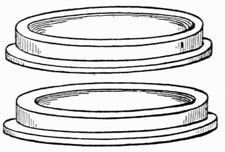
Fig. 39.—Tambourine Trick
The prestidigitateur then makes a small hole in the centre of the paper with his wand, and immediately commences to twist out yard after yard of colored paper ribbon, sufficient being obtained to fill a large clothes basket. If the performer desires to add to the effect of the trick the production of the ribbon may be preceded by that of a number of handkerchiefs, also a quantity of spring flowers and other articles of a like nature. Finally a rabbit or a large bird cage containing a live bird may be produced from the pile of ribbon.
The explanation is very simple. The tambourine is put together at the rear edge of the table, and when taking it up prior to trimming the edges, the coil, which was on the servante or suspended at the back of the table, is brought away under cover of the paper and pressed into the ring. The back of the colored coil should be rubbed over with chalk to match the white paper used in the construction of the tambourine, which can then be shown back and front, but will still appear empty.
The flowers should be done up in three packets of twenty each and laid on the coil, being covered with the handkerchiefs, which should be folded up neatly. The packet is then tied together with thin cotton, which can easily be broken when required.
The rabbit is in readiness in the profonde on the right side, and is introduced into the ribbon when picking it up from the floor.
The cage, which should be a folding one, is suspended behind the back of a chair, over which the ribbon would be thrown while performing a simple trick with one of the handkerchiefs. In the act of taking the ribbon from the chair opportunity would be found for introducing the cage unobserved.
The Bran and Dove Plates.—The trick about to be described, in its primary form, consists of changing a quantity of bran or flour into a live dove. It can, however, like the tambourine, be made available for the production of various articles, and is especially suitable for the magical distribution of bonbons, sweets, etc.
The performer comes forward with an ordinary soup plate filled to overflowing with bran, a portion of which is scattered over the stage to prove its genuineness. The bran is then covered with a second plate, which on being removed reveals a live dove, the bran having entirely disappeared.
The explanation is as follows:—One of the plates is fitted with a tin lining, enamelled white on the inside to represent the china. (See Fig. 40.) The supposed bran is really this tin lining turned upside down with bran gummed all over it; a handful of loose bran being thrown on the top. It is hardly necessary to say that the dove is already in the plate concealed by the bran shape.
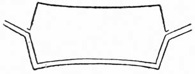
Fig. 40.—Trick Plate
The false heap of bran is now covered with the second plate, and while talking the performer, in a careless way, turns the plates over several times, finally placing them on the table in such a manner that the one that was formerly uppermost shall now be at the bottom. All he has to do now is to remove the uppermost plate and take out the dove. The inside of the bottom plate should now be shown, when it will appear perfectly empty.
In place of the dove the plate may be loaded with sweets and small toys, for distribution; or with a list of articles similar to those produced from the tambourine. If a coil of ribbon be used it should be a colored one, with one side rubbed over with chalk so that the inside of the plate may be shown prior to its production.
By using two pairs of these plates, and being provided with two doves exactly alike, the bran in one may be made to, apparently, change places with the dove in the other.
The Wandering Stout.—The feat bearing this title consists of causing a glass of stout to pass through the crown of a borrowed hat. Having obtained the loan of two hats, the performer places them on the table mouth to mouth, and stands the glass of stout on the crown of the uppermost one, covering it with a paper cylinder of the same height as itself. On removing the cylinder it is shown to be perfectly empty, the glass being immediately taken from the lower hat.
For the performance of the trick the operator must be provided with a glass three and one-fourth inches high by two and one-half inches in diameter at the mouth, tapering very slightly toward the bottom. The kind known as picnic glasses will be found the most suitable. In addition to the glass and the paper cylinder a piece of glass tubing of the same height as the tumbler, and large enough to pass easily over the same, will also be required. This piece of tubing must be blackened on the inside to within one inch of the top, and finished with a little white paint to represent froth, when, thus prepared, it will readily pass for a glass containing stout.
The paper cylinder, containing the sham glass, being on the table, the performer comes forward with a bottle of stout and fills the tumbler. He then takes up the cylinder and passes his wand right through it, as if to prove that it has not undergone any preparation, after which he places it over the glass of stout. He then puts the glass, still covered with the cylinder, into one of the hats, with the remark "I will now cause the tumbler to pass from one hat to the other," then, as if struck with a sudden thought, changes his mind, saying, "No, perhaps it would be more effective if I place the hats one over the other, and pass the glass through the crown of the uppermost one." Saying this he, apparently, takes the tumbler, still under cover of the cylinder, from the hat, and places it in the required position. Really, however, the stout was left behind, the cylinder and counterfeit glass alone being removed.
Now, in order to satisfy the spectators that the stout is actually on the crown of the hat, the performer lifts the cylinder and exposes the sham glass, which every one believes to be the genuine article. The cover is then replaced and the tumbler commanded to pass into the lower hat, after which it is again raised, together with the counterfeit, and the wand passed through it as before. The hats are then separated and the glass is produced from the lower one.
A Crystal Water Mystery.—Chemical tricks, Fig. 41.—Water Trick as a rule, do not meet with much favor at the hands of professional conjurers. The reason is pretty clear, as, in the majority of cases, the modus operandi is too palpable. The one here described, however, owing to the number of changes produced, is an exceptionally good one, and is to be found in the repertoire of the leading performers of the day.
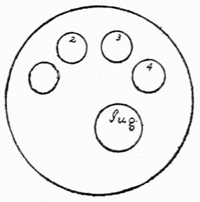
Four empty glass tumblers, together with a glass jug full of water, are arranged on a tray as shown in Fig. 41.
Water poured from the jug into—
No. 1, is seen to be clear.
No. 2, changes to stout.
No. 3, is seen to be clear.
No. 4, again changes to stout.
Nos. 1 and 2 mixed equal stout.
Nos. 3 and 4 mixed equal water.
Nos. 1 and 2 put back into the jug give all stout.
Nos. 3 and 4 put back into the jug give all water, as at first.
The explanation, although by no means obvious, is very simple. Glass No. 1 is perfectly clean. No. 2 contains a small portion of pyrogallic acid, about the size of a pea. No. 3 is prepared with half a teaspoonful of sulphuric acid. No. 4 contains the same quantity of pyrogallic acid as No. 2. The jug contains clear water, into which a teaspoonful of sulphate of iron is dropped just before the trick is commenced. The iron should not be placed in the water until actually required for use, as the solution changes rapidly to a yellow color, in which condition it would not very well pass for water. For the same reason the jug should be removed immediately after the trick.
Some performers prefer to use the following chemicals in place of those enumerated above. I will give them in the same order, and then the magician may choose for himself. Glass No. 1, as before, is quite clean; No. 2 contains a few drops of muriated tincture of iron; No. 3, a teaspoonful of a saturated solution of oxalic acid; and No. 4 is prepared in the same manner as No. 2. A teaspoonful of tannic acid should be added to the water in the jug prior to the commencement of the experiment.
I myself always use the sulphuric acid, as I believe it produces the best result, but in the case of a spill it is very dangerous, and on this account the latter method is to be preferred. The changes, in either case, are quite instantaneous, hence the trick produces a most extraordinary effect.
The Wizard's Breakfast.—The magical production of steaming hot coffee has always been a favorite trick with the juveniles, especially when the beverage is handed round for their consumption, and various pieces of apparatus have been designed for effecting this purpose. The most up-to-date method, however, is the one hereafter described:
Two boxes, without lids, sizes about twelve inches by eight inches by eight inches, usually fitting one within the other for convenience in traveling, and containing respectively cuttings of blue and white paper, are introduced to the audience. Two pint goblets, in metal, are then filled, one with blue and the other with white paper from the boxes, after which they are covered with small silk handkerchiefs. On removing the handkerchiefs the blue and the white papers are found to have been transformed respectively into hot coffee and hot milk. The performer then pours a portion of each fluid into a breakfast cup, and makes a motion as if throwing the whole over the audience, when nothing falls but a shower of blue and white paper cuttings, every vestige of the coffee and milk having disappeared.
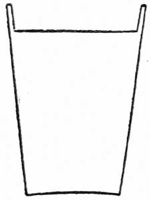
Fig. 42.—Trick Tumbler
There are in reality four goblets employed in the trick, two of which, containing the fluids, are concealed in the boxes unknown to the spectators. These two are provided with shallow trays fitting loosely within them at the top, each tray being filled with paper of the required color. (See Fig. 42.)
When presenting the trick the performer comes forward with the box containing the white paper, and throwing a handful in the air, calls out, "Out in the cold," which remark is perfectly justifiable, as the paper gives a faithful representation of falling snow. Placing this box on the table, and taking up that containing the blue paper, he scatters a handful over the stage with the remark, "This is the same as the white, only the wind blue it." He now takes one of the goblets from the table and appears to fill it with white paper, but really, while in the box, an exchange is made for the one containing the milk, which, owing to the presence of the shallow tray, will appear to be full of paper. This is then covered with a handkerchief, after which the second goblet is treated in like manner.
The shallow trays have each a piece of wire projecting from their upper edge to enable the performer to remove them under cover of the handkerchiefs. The handkerchiefs are thrown in a careless manner over the sides of the boxes, into which, if sufficient paper has been provided, the trays may be allowed to fall.
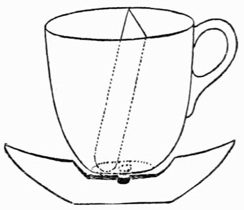
Fig. 43.—Cup and Saucer
The cup and saucer will next require our attention. These are of metal in imitation of the genuine article, the saucer being made double, with a small hole in the centre of its upper side, for a purpose that will presently appear. The cup is provided with a perpendicular division nearly in the centre, a small hole being drilled in the bottom of that side next to the handle. (See Fig. 43.)
The front and larger side is filled with a mixture of blue and white paper cuttings, and thus prepared, together with the saucer, it is placed on the table. When pouring the coffee and milk into the cup the performer takes care that it goes into the space provided with the small hole, through which it immediately runs into the body of the saucer.
It is usual to bring the trick to a conclusion by apparently throwing the fluid over the audience as already described, but should the performer be provided with a number of small cups and a tray, that portion of the beverage not used may be handed round as refreshments.
The Hydrostatic Tube.—This is a trick of comparatively recent invention. It requires very careful handling, and the performer must be possessed of almost superhuman nerve to present it successfully to a critical audience. It produces, however, a most extraordinary effect, and on this account is to be recommended.
A piece of paper is placed at the bottom of a glass tube or chimney used for gas, which is then filled with water, while the top of the tube is covered with a second piece of paper. The right hand is then placed on the top paper and the position of the tube reversed. The papers are then, each in turn, removed, but the water does not fall from the cylinder; on the contrary, it remains suspended without visible means of support. The papers are now replaced, and the top one is pierced with a hatpin, when, on the pin being withdrawn, the water at once falls into a basin placed ready to receive it under the tube.
This surprising result is due entirely to a well-known natural law, viz., the pressure of the atmosphere, and is nothing more nor less than a modification of the old schoolboy trick of keeping a glass of water inverted by means of a sheet of paper. The new arrangement will, however, require special explanation.
Each end of the cylinder is fitted with a glass cap, grooved to fit into and over it at the same time; this is necessary to avoid slipping. The ends of the tube, also the edges of the caps, must be ground, so that the point of juncture shall be air-tight. One of the caps has a small hole drilled through the centre. (See Fig. 44.)
When about to present the trick the two glass caps are laid on the bottoms of two upturned tumblers, where they are quite invisible. The performer then draws attention to two square pieces of paper, which he dips into the water contained in the bowl, afterward laying them down on the glass tumblers, and over the glass discs. He next shows the tube, passing his wand through it to prove that it has not undergone any preparation. Then taking one of the papers, and at the same time secretly securing one of the discs (not the one with the hole in it), he places it at the bottom of the tube, which is forthwith stood on the palm of the left hand. The tube is then filled with water and covered with the remaining piece of paper and glass cap.
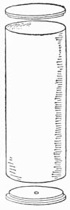
Fig. 44.—Hydrostatic Tube
The position of the tube is then reversed, after which it is taken by the centre and both papers are removed. The water will not run out from the small hole in the bottom cap owing to the fact that no air can get in at the top. The glass caps being absolutely invisible, the water will now appear to be suspended in the tube without any natural means of support.
The papers are again placed on the ends of the tube, where, being wet, they readily adhere. The hands are now placed one on each end and the tube is reversed; this is necessary to bring the cap with the hole in it to the top. The top paper is then pierced with the hatpin, which, passing through the hole in the cap, gives the impression that there cannot be anything but the paper covering the ends of the tube. When the pin is withdrawn the air rushes into the tube, and, as a natural consequence, the paper and disc fall from the bottom, liberating the water. The bowl should be half full of water when the cap falls, to avoid fracture of the glass. The cap is then brought away from the top of the tube under cover of the piece of paper, and both are dropped into the bowl, when the tube can be once more given for examination.
The Hydrostatic Tumbler.—This trick, which is similar in principle to that immediately preceding it, is preferred by some as being less cumbersome; it is also easier to work and consequently entails less anxiety on the part of the performer. The effect, however, although pretty, is not quite so startling.
The necessary apparatus consists of a glass tumbler with a small hole drilled in the side one inch from the bottom, the mouth of which must be fitted with a glass cap in the same manner as the tube in the preceding trick. (See Fig. 45.)
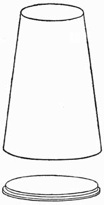
Fig. 45.—Hydrostatic Tumbler
The performer having drawn attention to the tumbler, also a small piece of paper, dips the latter into a bowl of water, and lays it down over the glass cap. The tumbler, held with the thumb covering the small hole, is then filled with water from the bowl, and covered with the piece of paper under which, unknown to the audience, is the glass disc. The glass is then inverted and the paper withdrawn, the water remaining suspended without visible means of support. The tumbler can now be turned about in any direction, without the least fear of the water escaping, so long as the thumb is kept over the small hole in its side. It can also be stood on the table, the hand being removed entirely; the water cannot escape through the small hole owing to the presence of the cap.
The tumbler is once more raised and inverted, when the performer undertakes to cause the water to fall at any given number counted by the audience. This last effect, which adds considerably to the trick, is brought about by very simple means; all the performer has to do is to remove the thumb covering the small hole, when the air rushes in and causes the disc to fall. The bowl, as before, should be half full of water, to provide a cushion for the falling disc, which under these circumstances will not be injured, nor its presence detected.
Paper Cone, Watch, Rabbit, and Boxes.—The effect of this excellent stage trick is as follows: A watch is borrowed and dropped into a conical paper bag held by one of the spectators. The performer then loads the magic pistol with a small silk handkerchief; this he fires in the direction of the bag, after which the bag is opened and found to contain the handkerchief, the watch having disappeared. Attention is next drawn to a box, which has been hanging over the head of the performer from the commencement of the entertainment, and which on being opened is found to consist of a nest of six boxes, the smallest of which contains a rabbit with the borrowed watch tied round its neck.
The main secret of the trick lies in the paper bag, which is really double, consisting of two pieces of paper gummed together round the edges, the corner of one piece being removed, as in Fig. 46.
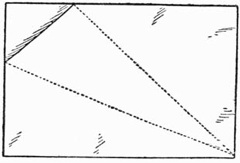
Fig. 46—Paper Cone
At the commencement of the trick a small silk handkerchief is hidden between the two pieces of paper. When making the bag it must be so arranged that the corner at which is the opening is at the top. Under cover of the point of the bag the handkerchief is removed from its place of concealment and dropped into the bag proper, the double side being immediately pulled over to the opposite side of the bag to again conceal the handkerchief. If the bag is well made, and this side well creased over, a casual glance into its interior will reveal nothing suspicious. In this condition the bag is given to a spectator to hold, and he is then requested to drop the watch into it, which he does, as he thinks, into the bag proper, but really the watch falls into the position previously occupied by the handkerchief. The top of the bag is then folded over.
The performer now loads a duplicate handkerchief into the pistol, and, having disposed of it in the usual way, fires in the direction of the bag. He then unfolds the bag and shakes out the handkerchief, being careful to hold the watch so that it does not fall at the same time. He then crumples up the paper in his hands, and in the act of doing so tears out the watch, which is forthwith palmed, the paper being thrown away.
The box, which should be suspended with two cords over pulleys, is then lowered; and when taking it in his hands to place it on the table the performer is able to secretly attach the watch to a swivel hook which is hanging on the side most remote from the audience. This swivel hook is attached to the ribbon round the rabbit's neck, the arrangement being as follows:—The ribbon is tied round the rabbit, which is then placed in the smallest box, the ribbon being allowed to hang outside the box when the lid is closed. The box is then placed in the next larger one, the ribbon still being allowed to hang outside. This is continued until the ribbon is left hanging on the outside of the last box.
The solution will now be clear. As the boxes are removed one after the other the watch is suspended behind that last exposed; and when the rabbit is taken out it will be impossible to tell that the watch was not actually removed from the same box.
The Magical Production of Flowers.—Whenever possible, it is always best to lead up to an elaborate trick with a succession of smaller illusions of the same nature. This is well illustrated in the "Marvelous production of Flowers," which in good hands is a most pleasing and mysterious experiment. Flower tricks always take well, especially with the feminine part of the audience, and ambitious amateurs should strive to have at least one good illusion of this character on their programmes. The magician comes forward, with the announcement, "Ladies and gentlemen, I notice that in my hurry I have neglected to provide myself with the customary buttonhole bouquet, but, fortunately, I have here a quantity of magic seed capable of producing a rose garden if required." Show a small box, which is supposed to contain the seed, while in reality it is empty. "You see I have only to place a single seed here in my buttonhole and after breathing on it a moment, to supply the necessary heat, I touch it with my wand and instantly we have a beautiful rose. Now, if some gentleman will kindly loan me a silk hat for a moment, I will show you a method by which bouquets may be produced while you wait. I only have to place the hat over this glass goblet, which, you see, is quite free from deception, and here we have a handsome bouquet." Remove the hat and find the goblet still empty. "How is this? Ah, I remember now, I neglected to put any of the magic seed in the goblet. I will just put in a pinch of various kinds and try again." Place hat over the glass again and instantly raise it, and discover a large bouquet. "You perceive the seed acts instantaneously."
While saying this brush the hat carefully and walk down as if to return it, still holding the box of seed. Once among your audience you exclaim, "What is that? You don't believe me? Why, see here; by just putting a pinch of the seed into this hat and breathing on it, thus, I will produce bouquets for all present." Show hat nearly full of small bouquets and distribute them. Then return hat saying: "I thank you, sir, for the use of your hat, which seems particularly fitted for raising flowers."
Now for the explanation:—To prepare for producing a flower in the buttonhole, take a piece of black elastic cord about a foot in length and put one end of it through the centre of an artificial rose, from which the stem has been removed, knotting the end to keep it from slipping through. Pass the other end through the buttonhole, also through a small hole made in the coat just behind the buttonhole, and then down and fasten to the suspender button on the back of your trousers. Draw the flower away from the buttonhole and conceal it under the left armpit, and as you touch the spot with the wand raise the left arm slightly, freeing the flower, which will instantly fly to the buttonhole.
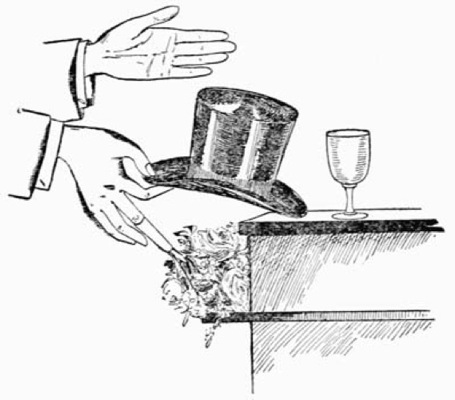
Fig. 47.-Production of Flowers
After borrowing the hat place it over the glass, as above, and after removing let the brim rest on the table a second while looking at the glass. During this brief time slip your finger into the little cardboard tube which serves as a handle to the bouquet, which lies on the shelf at the back of your table and just beneath the hat. By closing the fingers the bouquet is brought into the hat. (See fig. 47). This takes only a fraction of a second, and as all are looking for the bouquet in the glass the movement is entirely invisible. As soon as the hat is "loaded" raise it quite a distance above the table and hold it there while you pretend to put the seed in the glass. As soon as the bouquet is shown in the glass, let the hat rest on the table as before, and introduce the small bouquets, which are tied together with a weak thread and are provided with a tube like the large bouquet. When you appear to put the seed in the hat, break the thread and shake up the bouquets loosely, and they will nearly fill the hat. Of course you must keep your eyes fixed on the goblet while loading the hat, and never allow yourself to glance toward the left hand which holds the hat, as that would give your audience a hint that something was going on in that quarter.
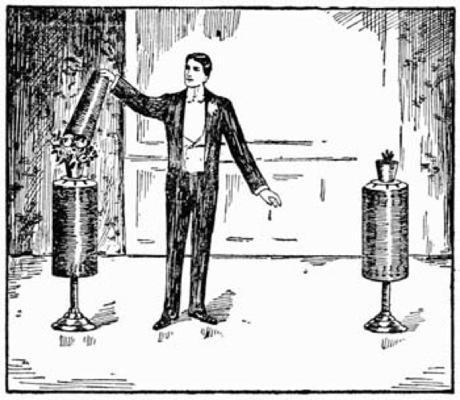
Fig. 48.—Production of Rose-Bushes
We now come to the production of rose-bushes from flower-pots which contain nothing but a small quantity of white sand. It is Kellar's most famous illusion. Two small tables, draped within a foot or more above the floor, are seen on the conjurer's stage. On each table is a miniature stand on which are flower-pots, (Fig. 48). After the pots have been examined by the spectators, the performer places them on the stands, and plants seeds in them. A pasteboard cone, open at both ends, is exhibited, and placed for a second over flower-pot No. 1. When it is removed a green sprig is seen, which the magician declares has just sprouted. He then places the cone over flower-pot No. 2. Removing it a full grown rose-bush appears, covered with buds and roses in full bloom. A second rose-bush is then produced from flower-pot No. 1. The roses are culled and presented to the ladies in the audience. The following is an explanation of the trick:
The tables are open at the back, the drapery not extending completely around them. Attached to the leg of each table is a small shelf, which is of course concealed by the drapery, (Fig. 49). The bushes are Fig. 49.-Table for Flower Trick stumps, to the branches of which are tied the roses. Each bush has as a base a circular piece of lead, which fits into the flower-pot. The bushes are suspended inside of the cones, (Fig. 49 a) which are placed on the secret shelves above described. The performer covers the first pot with the cone in his hand, and drops from his palm the green sprig which sticks into the sand. As attention is being called to the sprout, the magician drops the empty cone, just shown, down behind the table over the prepared cone and rose-bush and brings them up under cover. The loaded cone fits closely into the empty one, but as an additional security is held in place by the fingers of the performer. He goes to the second table and places the cone over the flower-pot. The rose-bush is allowed to drop into the pot, the thread which fastens it having been detached. The bush is now shown. As soon as the cone is removed the hand naturally and carelessly drops behind with it over the next prepared cone on the shelf, and the performer produces a rose-bush from the first flower-pot. He now has three cones, one inside of the other. To facilitate the picking up of the cones in succession the back part of each table top is cut out in crescent shape.
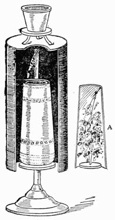
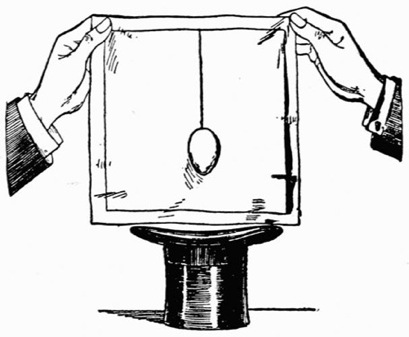
Fig. 50.—Magic Incubation
Magic Incubation.—To produce a quantity of eggs from an empty handkerchief is a favorite experiment with magicians. It is a modification of the old egg-bag trick, but far more effective and but little known. The materials used are easily procured:—a blown egg, to which is attached a piece of thread, and a silk handkerchief. Fasten the egg to the handkerchief by means of the thread, as shown in Fig. 50. Spread out the handkerchief, when exhibiting the trick, and show that both sides are free from preparation. To do this you must keep the egg concealed in your right hand, and at the moment let it fall in the position depicted in the illustration, (Fig. 50). The thread will hold it in the centre of the handkerchief. But remember to keep the handkerchief waving slightly, otherwise the impact of the falling egg against it might betray the secret of the trick. It is hardly necessary to say that the "egg-side" of the handkerchief is turned toward yourself. Explain to the audience that you are going to magically produce an egg. Take the right hand corner of the handkerchief in your mouth and hold the left corner with your left hand. Now place the forefinger of the right hand against the upper part of the handkerchief, the side facing yourself, and fold the handkerchief over, grasping the two upper corners with your left hand. Next hold the lower corners with your right hand and bring the handkerchief to a horizontal position. Tilt one end of it over a hat and an egg will be seen to fall, (Fig. 51). Shake out the handkerchief and repeat the above described operation of producing eggs until the hat is apparently full, after which you may turn it over and show it empty. This trick neatly executed never fails to elicit well deserved applause from the audience. Perhaps a better way to conclude the trick would be to show that the hat really contained a number of eggs, which of course must be loaded into it prior to commencing the trick. The best way to do this is to have the eggs in a black silk bag which you conceal inside your vest. After having borrowed the hat and while your back is turned to the spectators during your journey to the stage, slip the bag full of eggs into the hat. Then begin your handkerchief feat. It is a weak point, in my opinion, to show the hat empty, after having apparently placed so many eggs into it. Some acute spectator is apt to jump to the conclusion that there was but one egg used during the experiment.
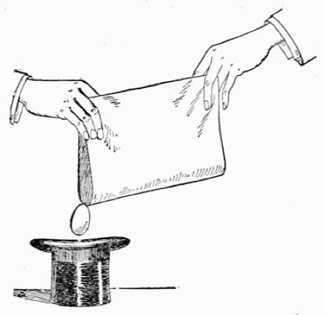
Fig. 51.—Incubation Trick
The Wizard's Omelet.—The recipes for making a magical omelet are numerous and varied. Some magicians produce the eggs from the mouth of a negro assistant following the example of Alexander Herrmann, and make the omelet in a borrowed hat. I once saw a clown in a French circus produce an omelet in a small frying-pan, without using eggs at all—or more properly speaking, without the apparent use of eggs. He stirred his wand about in the pan, holding the latter over a spirit lamp, and presently turned out into a dish an excellent omelet, smoking hot and very palatable. He cut up the omelet and passed it around among the audience. Those who partook of it pronounced it to be delicious and worthy of the chef of the Hotel Grand. This is the way the trick is accomplished: There is no preparation about the frying-pan; that is all fair and square, as well as round. It may be examined by the spectators ad libitum. Not so the magic wand, which is hollow and filled with the contents of several eggs. One end of the wand has an opening which is stopped up with a piece of butter. When the pan is heated the butter melts and the beaten-up eggs run out of the wand and are speedily metamorphosed into an omelet. The stirring of the pan with the wand, supposed to be a part of the conjurer's performance, is really necessary to the trick. The wand is usually made of tin. It must be an exact imitation of the wooden wand used during the course of the entertainment.
The Wonderful Production of Ribbons At the Finger-tips.—This is an excellent little trick and one very suitable as an introduction to a complete "production" trick, where objects of ever-increasing size, in a compressed condition, are produced under cover of similar objects, of a smaller size, but displayed to the best advantage. The performer having shown both hands unmistakably empty, commences to pull yard after yard of real colored silk ribbon from the extreme tips of the fingers.
The secret depends upon the little accessory illustrated in Fig. 52. This is a shield made to fit the second finger of the right hand, Fig. 52.—The Accessory provided with a lid to keep the four coils in position, also with a corresponding number of slots on the front through which the ribbon may be withdrawn. Each piece of ribbon should be about two yards long and Fig. 53.—Production of Ribbon of a width to readily pass the slot. Ribbon drawn from the apparatus when in position, see Fig. 53, will seem to come from the finger-tips.
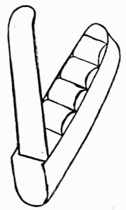
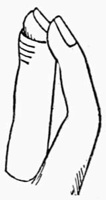
After a quantity of ribbon has been produced in this manner, the magician may very well bring out a larger supply from his vest under cover of gathering up the mass of material. An excellent winding up of the trick would be the production of a dove from breast pocket.
Japanese Bird Vanish.—The old Mouchoir du Diable, or Devil's Handkerchief, for vanishing small objects will be known to the majority of my readers: at the best it was but a clumsy expedient for producing a magical disappearance, and on that account was very little, if ever used.
The New Devil's Handkerchief, as used by Japanese conjurers to cause the disappearance of a bird, will, on the contrary, I feel sure, be found of practical utility to the magical fraternity. In practice it is merely held by the four corners, ostensibly in the most careless manner possible, and any object as an egg, ball, orange, bird, etc., dropped into the bag thus formed instantly disappears, the handkerchief being immediately shaken out and both sides shown.
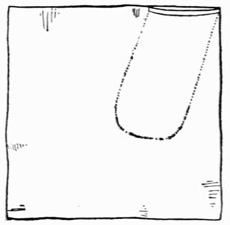
This seeming prodigy is thus explained.—Two handkerchiefs, preferably of soft silk and rather large (neck handkerchiefs for instance), are Fig. 54.—Bag for Vanishing sewn together all round their edges, with the exception of a portion at one corner as shown by the dotted lines in Fig. 54. The handkerchiefs are also sewn together from the said corner to the centre as further indicated by the dotted lines in the figure. A bag is thus formed into which the object is actually dropped. The introduction of the object into the bag is facilitated by the insertion of a couple of whalebone strips in the silk at the mouth of the bag. These strips keep the mouth of the bag closed until pressure be applied at their ends, when the bag will open, receive the object, and, on the pressure being removed, will close again, keeping all secure.
New Fire Trick.—The writer is indebted to Mr. Martinka for this novel experiment. A thin glass tube, in the end of which is secured a small piece of metallic potassium, is pasted between two pieces of tissue paper. So prepared the paper is shown from both sides, being apparently a plain piece of white paper. This is rolled into a cylinder, not unlike an exaggerated cigarette. The performer opens his mouth to show that nothing is concealed there, and then proceeds to blow through the paper tube, when the far end bursts into a flame of more or less intensity.
Explanation.—While pretending to blow through the paper cylinder, the performer brings some saliva into the glass tube. When blown through the tube, the saliva comes in contact with the potassium, which ignites and sets fire to the paper. To produce a larger flame and sparks, a small piece of gun cotton, sprinkled with powdered aluminum can be placed near the end of the tube. The potassium metal has to be kept in a bottle and covered with kerosene. Whenever required for the trick a piece is cut off with a knife. Care must be taken not to make the mistake of putting the wrong end of the tube in the mouth. When the paper bursts into flame it is crumpled into a ball and dropped on a plate. The thin glass tube is crushed into small bits by the above operation, and is not seen by the audience.
The Ring On The Wand.—A very pretty and graceful parlor trick is the ring on the wand. Suspend a plain gold ring to the centre of a handkerchief by means of a short piece of silk thread. Come forward with the handkerchief in your pocket, and borrow a ring as much like your own as possible. Pretend to wrap up this ring in your handkerchief, but substitute for it the fake ring. Give the handkerchief with ring in it to some one to hold and ask him if he still feels the ring contained therein. He will reply in the affirmative. You now get your wand from a table. While doing this take the opportunity to slip the borrowed ring which you have in your hand over one end of the wand, keeping it concealed. Approaching the individual who holds the handkerchief request him to place it over the middle of your wand which you hold horizontally by its centre, having slid your hand (with the concealed ring) along its smooth surface. Now request two spectators to hold either end of the wand tightly. Explain that you will cause the ring in the handkerchief to appear upon the wand, despite the fact that the latter is firmly held by two persons. Remove your hand from the wand and take hold of the handkerchief. With a hey presto, give the handkerchief a quick jerk and shake it out. The borrowed ring on the wand will spin around in lively fashion, as if it had really left the handkerchief and by some magical means appeared upon the wand. Your handkerchief with the fake ring attached must be pocketed as speedily as possible. It might be well to borrow a plain white handkerchief from some one in the audience and exchange it for your prepared handkerchief.
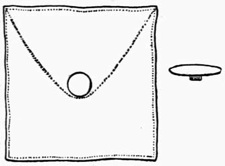
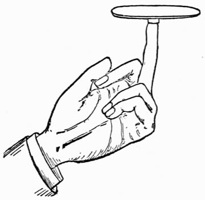
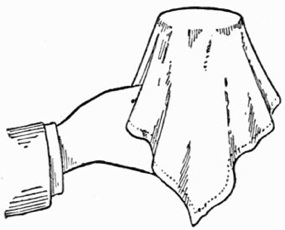
Disappearing Glass of Water.—This clever illusion is a favorite with many performers, and is particularly adapted to drawing-room entertainments. It was invented by Colonel Stodare, originator of the famous "Sphinx" trick. Since Stodare's time many improvements have been made in it, one idea, emanating from the fertile Fig. 55.—Silk Handkerchief brain of Dr. Elliott. Stitch two silk handkerchiefs, preferably of a dark color, together in the manner shown in the diagram (Fig. 55), having first inserted in the triangular space between them a disc of thin tin, of the same diameter as the mouth of the glass used. Now to the middle of the under surface of the tin fake solder a little band of tin just large enough to snugly fit over the tip of the second or index finger of your left hand, (Fig. 56). This constitutes Elliott's improvement. Exhibit the handkerchief to the spectators, calling Fig. 56.—Fake on Finger attention to the fact that it contains nothing. Twist it rope fashion, and pull it through your left hand, thereby demonstrating that nothing could possibly be concealed in it. This you are enabled to accomplish by grasping the tin fake and retaining it in the right hand. Finally shake out the handkerchief, releasing the disc, which will now fall to the centre of the handkerchief and be kept in position by the triangular stitching. At the rear end of your table you have a glass filled with water. Spread the handkerchief over the glass, bringing the tin shape over the mouth of the same. Lift up the fake, and under cover of the handkerchief lower the glass upon the shelf behind the table. The handkerchief, distended by the tin disc, will present the appearance of having the glass of water under it. Now step forward as though holding the glass of water. Place the left hand beneath the handkerchief, and quickly insert the index finger into the little band Fig. 57.—Handkerchief in Position soldered beneath the disc, the right hand bearing down at the time to facilitate matters. To an audience it will seem that you hold the glass of water on the palm of your left hand, presenting a very illusory appearance indeed, (Fig. 57). To vanish the glass completely all you have to do is to catch one corner of the handkerchief with your right hand, give it a sudden flick in the air, which releases the hold of the finger of the left hand, when lo and behold! the glass of water has melted away. To reproduce it, take a duplicate glass of water from your coat-tail pocket. "But!" says the dubious reader. Ah, we are coming to that! There is no danger of spilling the water, for the mouth of your glass is tightly closed with a rubber cover. All you have to do is to remove the cover before exhibiting the glass.
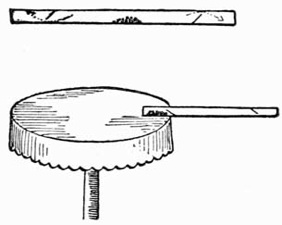
Anti-gravity Wand.—The use of the wand has been sufficiently explained to the student. In calling attention to the fact of its being endowed with peculiar properties, similar to the magic wand of Bulwer's "Coming Race," the conjurer might execute a few tricks with it as a prologue to his programme. The "Anti-gravity wand," invented by that clever magician, Dr. Elliott, would prove useful in the above instance, (Fig. 58). It consists of a piece of brass tubing made to correspond Fig. 58.—Anti-Gravity Wand with the performer's ordinary wand but with square ends. In one end of this tubing is inserted a cylindrical lead weight made to fit nicely. At each end of the weight is glued a piece of felt, so as to prevent noise while the fake is working. With this trick wand you can apparently defy the law of gravity. It is divided internally into three compartments, two small ones at either end, and a larger one in the centre, by means of the partitions, which do not, however, extend completely across the wand. A quantity of quicksilver is inserted in the wand and the ends sealed up. In the normal condition, this will remain in the central space, but if the wand is tilted either way, the mercury will flow into the little pocket at the lower end. Should this end be laid upon the table, the weight of the fluid metal would more than counterbalance the remaining portion of the wand, and it would therefore be suspended apparently in space. By reversing the wand, the other end would perform a like phenomenon.
CHAPTER X
STAGE TRICKS
This is a chapter devoted to stage illusions, dependent mainly for their effects upon ingenious mechanical appliances, and not to skilful manipulation of the performer. Most conjuring exhibitions conclude with some large illusion. They add zest to the entertainment. One of our leading conjurers, Kellar, makes a specialty of them. He presents them with fine scenic effects.
Aërial Suspension.—The trick of the aërial suspension, presented by Herrmann under the name of the "Slave Girl's Dream," has been, and still remains a great favorite with many conjurers. In this experiment a lady floats in the air with no apparent support but that afforded by a pole upon which her right arm rests. While suspended in this fashion she is draped in various pleasing costumes, finally awakening from her pretended mesmeric trance under the passes of the magician, and bowing herself off the stage. The explanation is as follows:—The lady's body is encased in a strong framework of Fig. 59.—The Harness finely tempered steel, into a socket of which the pole enters and is rigidly fixed.
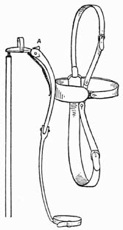
Figure 59 very correctly represents the harness worn by the lady in performing this trick and the manner in which it is attached to the rigid pole. This frame is composed of the finest steel, and when belted and strapped on the body makes it perfectly rigid, so far as any side motion is concerned. At A is a hinge, which is operated by ratchet and pawl, and this bears nearly the whole strain of the lady's weight, which, in a horizontal position, is about 1,500 pounds, or about ten times the actual weight. At the centre of the curved steel bar is a plain hinge. This is intended to allow the lady to use her right thigh and knee in walking on and off the stage.
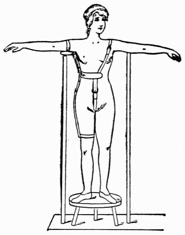
Fig. 60.—Harness Adjusted
Figure 60 shows the position of harness and poles after being adjusted, the drapery being dispensed with in order to show the working of the trick. The upright pole on which rests the lady's right hand is a substantial affair, and is securely fitted into a hole in the platform. On the top there is a hole, into which fits a stout slot in the short bar, as shown in Fig. 59. This short bar is concealed by a sort of flap, which appears to be a portion of the lady's costume, tacked on at the shoulder. The pole at her left has nothing to do with the trick, and is only introduced to distract the attention of the audience. The left-hand pole and stool are removed, and the beautiful slave girl is suspended, as shown in Fig. 61, the whole strain coming on the pole and the steel work of the harness.
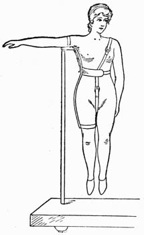
Fig. 61.—Girl Suspended
The performer now lifts the lady into a horizontal position (Fig. 61), where she is maintained by a check which drops into one of the teeth of the ratchet at A. While in this aërial sleep she is adorned in various costumes. Finally she is placed in the first position, and awakes from her supposed mesmeric slumber. Herrmann improved this apparatus by causing the lady to assume the horizontal position without his intervention. This was accomplished by machinery beneath the stage, a sort of windlass affair worked by a stage assistant. The well-known Fakir of Ooloo still further improved this trick by knocking both poles away. Says Arprey Vere on this subject: "What, then, will you ask, becomes of all the machinery? The two poles were seemingly taken away. The poles used consisted of brass bars. The calcium light beamed upon the figure of the sleeping lady, while the rest of the stage was comparatively dark. Thus, when the conjurer apparently took away the only support the figure had, the audience did not and could not perceive that he really took away the brass case of the secured pole, leaving another, the actual pole on which the framework was fixed, and which was of the same color as the drapery of the stage. It was for the purpose of deceiving the eyes of the audience that the pole was encased in a brass shell in the first instance. He refixed the case before the stage was relit, and the lady woke up from her sham mesmeric trance."
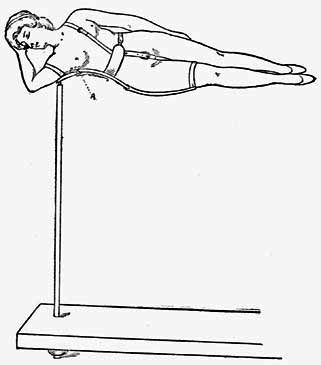
Fig. 62.—Girl in Horizontal Position
New Vanishing Performer Illusion.—The writer is indebted to Mr. William E. Robinson, for many years assistant to the late Alexander Herrmann, for this simple but remarkably effective illusion called by him the "Vanishing Performer." The effect of the trick is as follows: The performer standing upon a stool, placed in front of a screen, holds up a shawl in front of himself. Hey presto! a pistol is fired, the shawl is dropped, and the magician is seen to have melted away into thin air, as it were. Presently he comes running down the centre aisle of the theatre.
The principal requisite in the arrangement of this trick is a large screen, which should be decorated in panels on each fold, and be a threefold one. In the centre fold the panel must be hinged, so as to open, and made to fit nicely the better to conceal its existence from the audience. This panel must be about twelve inches above the base of the screen, and if possible have spring hinges. This screen should be preferably of a dark color.
When the magician steps on the stool he out-stretches his arms and hooks the shawl on a fine thread, which is placed across the stage at the right height. He leaves the shawl suspended so that the ends hang over, giving the appearance of the performer's fingers being under them. Under this cover he quickly steps off the stool and goes through the panel in the screen at the back. As the shawl does not reach to the ground, the performer's legs and shoes would be seen by the audience. To obviate this a piece of stuff the same color as the screen is used as a kind of carpet on which the affair takes place, and when this reaches to about twelve inches from the screen, the edge is turned up about twelve inches. The conjurer in getting off the stool steps down behind this carpet. A pistol is fired, and the performer, or his assistant, pulls the end of the thread, which thus breaks and causes the shawl to drop, as if first let go from the hands. The shawl should be about six feet square. It should rest about nine inches from the stage when hung up. Practice to let as few seconds as possible elapse between the moment of suspending the shawl and dropping it. The reappearance of the performer is easily accounted for.
The Blue Room.—One of the cleverest illusions performed with the aid of mirrors is that known as the "Blue Room," which has been exhibited in this country by Kellar. It is the joint invention of Prof. John Henry Pepper, of Ghost illusion fame, and James J. Walker, both of England. It was patented in the United States by the inventors. The object of the apparatus is to render an actor, or some inanimate thing, such as a chair, table, suit of armor, etc., visible or invisible at will. "It is also designed," says the specification in the patent office, "to substitute for an object in sight of the audience the image of another similar object hidden from direct vision without the audience being aware that any such substitution has been made. For this purpose employ a large mirror—either an ordinary mirror or for some purposes, by preference, a large plate of plate-glass—which is transparent at one end, and more and more densely silvered in passing from this toward the other end. Mount this mirror or plate so that it can, at pleasure, be placed diagonally across the stage or platform. As it advances the glass obscures the view of the actor or object in front of which it passes, and substitutes the reflection of an object in front of the glass, but suitably concealed from the direct view of the audience. Fig. 63.—Graduated Mirror
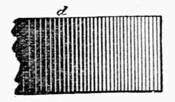
Fig. 64.—Diagram for Blue Room "When the two objects or sets of objects thus successively presented to the view are properly placed and sufficiently alike, the audience will be unaware that any change has been made. In some cases, in place of a single sheet of glass, two or more sheets may be employed.
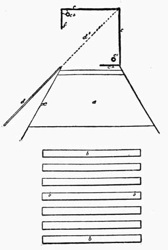
"In the drawings, Fig. 63 represents a plan view, and Fig. 64 an elevation, of a portion of the mirror, designed to show its graduated opacity.
"a is a stage. It may be in a lecture-room or theater. b b are the seats for the audience in front of the stage. c c is a small room—eight or ten feet square and eight high will often be sufficiently large; but it may be of any size. It may advantageously be raised and approached by two or three steps from the stage a.
"d is a vertical mirror, passing diagonally across the chamber c and dividing it into two parts, which are exact counterparts the one of the other. The mirror d is so mounted that it can be rapidly and noiselessly moved diagonally across the chamber in the path represented by the dotted line d1, and be withdrawn whenever desired. This can conveniently be done by running it in guides and upon rollers to and from a position where it is hidden by a screen, e, which limits the view of the audience in this direction.
"In consequence of the exact correspondence of the two parts of the chamber c, that in front and that behind the mirror, the audience will observe no change in appearance when the mirror is passed across.
"The front of the chamber is partially closed at cx by a shield or short partition-wall, either permanently or whenever required. This is done in order to hide from direct view any object which may be at or about the position c1.
"The illusions may be performed in various ways—as, for example, an object may, in the sight of the audience, be passed from the stage to the position c2, near the rear short wall or counterpart shield f, diagonally opposite to and corresponding with the front corner shield cx, and there be changed for some other. This is done by providing beforehand a dummy at c´, closely resembling the object at c2. Then when the object is in its place, the mirror is passed across without causing any apparent change. The object, when hidden, is changed for another object externally resembling the first, the mirror is withdrawn, and the audience may then be shown in any convenient way that the object now before them differs from that which their eyesight would lead them to suppose it to be.
"We prefer, in many cases, not to use an ordinary mirror, d, but one of graduated opacity. This may be produced by removing the silvering from the glass in lines; or, if the glass be silvered by chemical deposition, causing the silver to be deposited upon it in lines, somewhat as represented by Fig. 63. Near one side of the glass the lines are made fine and open, and progressively in passing toward the other side they become bolder and closer until a completely-silvered surface is reached. Other means for obtaining a graduated opacity and reflecting power may be resorted to.
"By passing such a graduated mirror between the object at c2 and the audience, the object may be made to fade from the sight, or gradually to resolve itself into another form."
Hopkins in his fine work on "Magic, stage illusions, etc.," thus describes one of the many effects which can be produced by the Blue Room apparatus. The curtain rises, showing "the stage set as an artist's studio. Through the centre of the rear drop scene is seen a small chamber in which is a suit of armor standing upright. The floor of this apartment is raised above the level of the stage and is approached by a short flight of steps. When the curtain is raised a servant makes his appearance and begins to dust and clean the apartments. He finally comes to the suit of armor, taking it apart, cleans and dusts it, and finally reunites it. No sooner is the suit of armor perfectly articulated than the soulless mailed figure deals the servant a blow. The domestic, with a cry of fear, drops his duster, flies down the steps into the large room, the suit of armor pursuing him, wrestling with him, and kicking him all over the stage. When the suit of armor considers that it has punished the servant sufficiently, it returns to its original position in the small chamber, just as the master of the house enters, brought there by the noise and cries of the servant, from whom he demands an explanation of the commotion. Upon being told, he derides the servant's fear, and, to prove that he was mistaken, takes the suit of armor apart, throwing it piece by piece upon the floor." Fig. 65.—Diagram of Blue Room
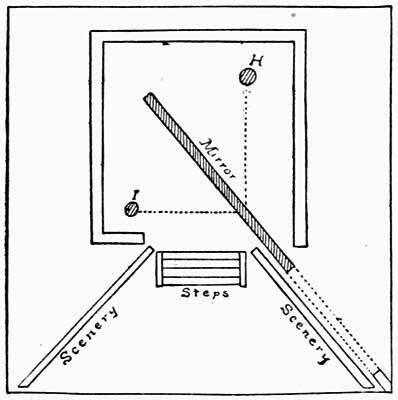
It is needless, perhaps, to explain that the suit of armor which becomes endowed with life has a man inside of it. When the curtain rises a suit of armor is seen in the Blue Room, at H, (Fig. 65). At I is a second suit of armor, concealed behind the proscenium. It is the duplicate of the visible one. When the mirror G is shoved diagonally across the room, the armor at H becomes invisible, but the mirror reflects the armor concealed at I, making it appear to the spectators that the suit at H is still in position. An actor dressed in armor now enters behind the mirror, removes the suit of armor at H, and assumes its place. When the mirror is again withdrawn, the armor at H becomes endowed with life. Again the mirror is shoved across the apartment, and the actor replaces the original suit of armor at H. It is this latter suit which the master of the house takes to pieces and casts upon the floor, in order to quiet the fears of the servant. This most ingenious apparatus is capable of many novel effects. Those who have witnessed Prof. Kellar's performances will bear witness to the statement. When the illusion was first produced in England, a sketch was written for it by the famous Burnand, editor of "Punch." It was entitled "Curried Prawns." A plethoric old gentleman who had been indulging in a midnight dish of curried prawns goes to bed, and is visited by a soul-terrifying nightmare. Mephistopheles suddenly appears to him, and introduces him to the mysteries of the nether world.
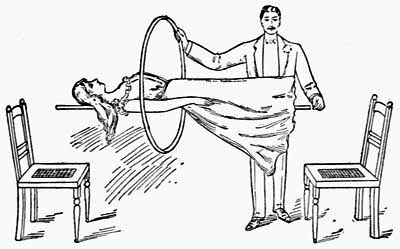
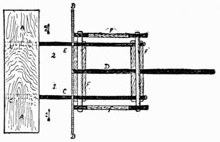
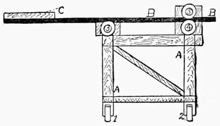
Levitation.—The performer places a board on the tops of two Fig. 66.—Levitation Act chairs. A lady is laid on the board, and pretended mesmeric passes made over her by the magician. The chairs are now removed one after the other, and the lady is seen floating in the air (Fig. 66). The performer then walks completely around her. In order to show still more conclusively that she is not supported by any arrangement of wires, etc., he passes a large solid iron hoop, previously given for inspection to the spectators, over her; beginning at her head. This seeming miracle, vaunted as a Hindoo mystery, is accomplished in the following manner: The board, A, A (Fig. 67), upon which the lady reclines, is about three feet distant from the back scene. This background is provided with a slit through which an assistant pushes three iron rods (c, d, e), beneath the board. Another important part of the apparatus is a small car, to which the rods are attached, the construction of which is explained in Fig. 67 and Fig. 68, which gives a side view of the car. Nos. 1 and 2 are the Fig. 67.—Top View of Apparatus wheels on which the car is propelled. The iron bars, of which only one is shown in the diagram, run in front over a roller, 3, and at the back between two rollers, 4 and 5, so that the assistant can easily push the bars under the board, c, which holds the lady. The extreme ends of the bars, at the back, are counterbalanced in order to equalize the weight. To enable the performer to go behind the floating lady, also to pass Fig. 68.—Side View of Apparatus the hoop about her, the assistant pulls away the iron bar at one end. As soon as the performer and the hoop have cleared the first bar, it is pushed back into place again, and the next bar withdrawn, allowing free passage to the third bar, which is also withdrawn, after the centre bar has been pushed back. The arms of the lady overhanging the board and her dress conceal effectually the iron bars from view of the audience.
The Saratoga Trunk Mystery.—A lady is put into a bag and locked in a trunk, on top of which a gentleman takes a seat. Two assistants hold a cloth in front of the trunk for a few seconds. On taking away the cloth the lady is seen sitting on the trunk while inside of it, after unlocking the same, is found the gentleman tied in the bag.
The actors in this illusion have to work with extreme quickness.
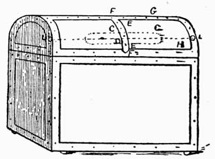
The bag in which the lady is tied has at the bottom a false seam, made Fig. 69.—Section of Trunk of wide stitches, so that when one end of the thread is pulled the whole comes out easily leaving the bottom of bag open.
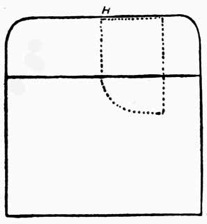
In this way the lady escapes from the bag without injuring the ties in any way. The lid of the trunk is prepared so that one section of it opens inward (Fig. 69 h). The frame (Fig. 70) is solid, whereas the strip F which runs across the top can be pushed sideways. To open the Fig. 70.—Frame of Trunk trunk the strip F is pushed aside, which releases a concealed mechanism that keeps the false panel shut. The gentleman opens the panel, in the manner above described, whereupon the lady gets out of the trunk. She assists the gentleman to get into the bag, and closing the panel, takes her seat on the top of the trunk.
CHAPTER XI
SHADOWGRAPHY
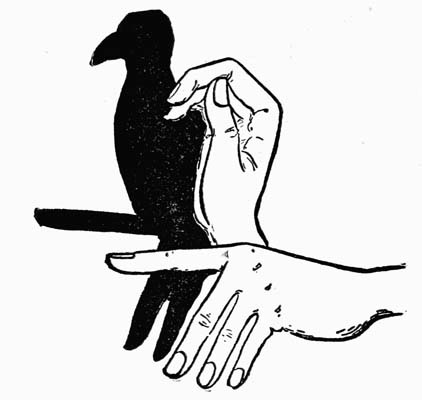
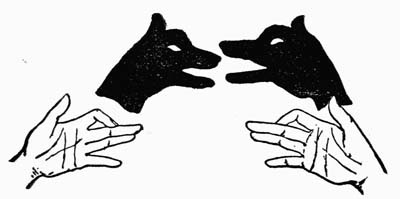
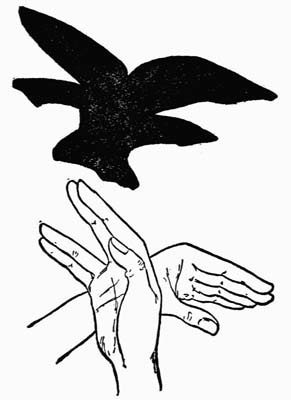
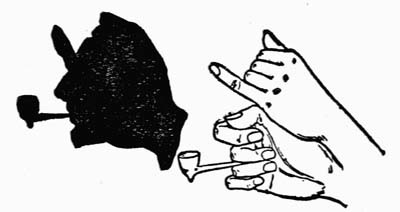
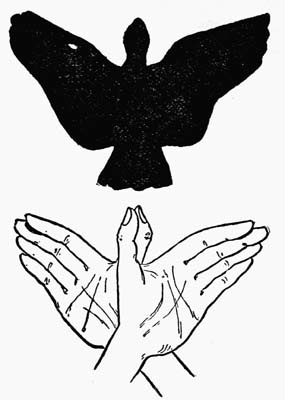
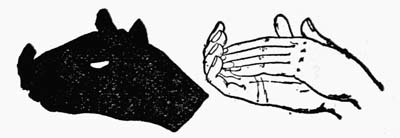
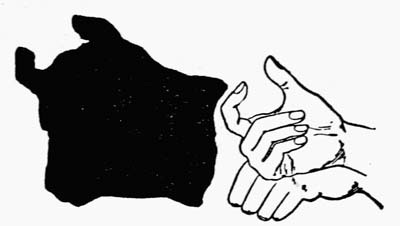
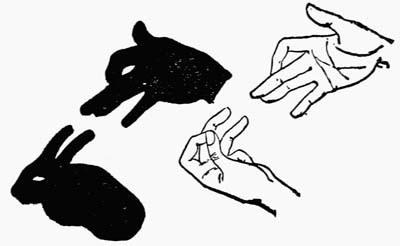
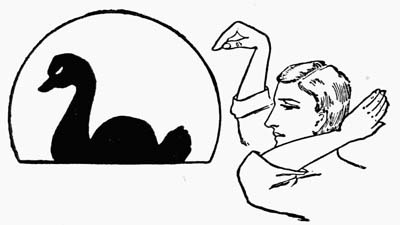
The idea of projecting silhouettes with the hands on a wall or illuminated screen is an old one, but it has been brought to great perfection by the celebrated French conjurer and juggler, M. Félician Trewey, and his English confrères, David Devant, Ellis Stanyon, and Hilliar. Notable among the American exhibitors of shadowgraphy is Clivette, the "Man in Black," whose clever fingers have added many new and amusing figures to the already long list. The above named artists enact little pantomimic scenes, such as a fisherman in a boat, going through the usual evolutions of a disciple of Izaak Walton; a policeman making love to a servant girl; a concierge quarreling with a belated lodger; a lover serenading his sweetheart, etc.
These shadows are best made on a screen, which is illuminated by "a single lamp inclosed in a projecting apparatus throwing very divergent rays. The lens must consequently be of very short focus. The electric light or oxyhydrogen lamp necessary in a theatre may be replaced at the amateur's house by a lamp, or better, by a wax candle." Various little accessories such as pieces of cardboard, fashioned to represent head-gear and the like, are used in the formation of many of the more elaborate figures. The use of such material is depicted in the illustrations. Makers of magical apparatus manufacture these accessories, but the clever amateur can cut them out from sheets of cardboard without going to the expense of purchasing them.
A cheap and easy way of manufacturing a silhouette of a friend is to have him pose in front of a sheet of paper hung against a wall which is illuminated by a candle. All you have to do is to outline with a pencil the shadow cast by his face, and afterward fill in the white space with black paint or crayon. The famous Levater constructed an ingenious device for making silhouettes. It is thus described in his work on physiognomy: "The shadow is projected upon a fine paper, well oiled and dried, and placed behind a piece of plate-glass supported in a frame secured to the back of the chair. Behind this glass the artist stands, and holding the frame with one hand, draws with the other." A candle furnished the necessary light.
During the French Revolution, it was a dangerous thing to possess a likeness of the martyred King Louis XVI. The scions of the nobility, resident in Paris in disguise, living, as it were, in the shadow of the guillotine, carefully hid all souvenirs of the king and royal family, until better days should dawn. To be found in possession of a portrait of the ill-fated Louis meant denunciation and death. Finally a clever wood carver of royalist persuasion succeeded in fashioning a cane which would throw a silhouette upon a wall—a likeness of Louis XVI. He drove a great trade among the aristocrats, who carried these walking sticks about with impunity, flourishing them under the very noses of the revolutionists. Nobody could possibly suspect a cane. Chessmen were also made on similar principles. When the tables were turned and Louis XVIII came to his own again, it was a dangerous thing to indulge in Napoleonic relics. A carver in wood, possibly an old soldier of the Imperial Guard, constructed a silhouette cane for the suppressed Bonapartists.
The illustrating of books and magazines with silhouette pictures has recently come into vogue. It is especially popular in Paris, where the famous caricaturist Caran d'Ache, has done much to elevate the art. After working at silhouettes for some time, he conceived the clever idea of cutting figures out in zinc and casting them upon an illuminated screen; fashioning them in sections so that they could be made to work by means of cords operated by assistants. His first exhibition was given at the Chat Noir, a café much frequented by artists and literary men. Finally a special representation was gotten up at the Theatre d'Application, and crowds flocked to see the silhouettes. M. d'Ache is very successful in representing military scenes. He projects upon the screen the battles and triumphal marches of the Emperor Napoleon.
PARROT
TWO FOXES FIGHTING
VULTURE
COUNTRYMAN
PIGEON
RHINOCEROS
BULL
FOX EATING RABBIT
SQUIRREL
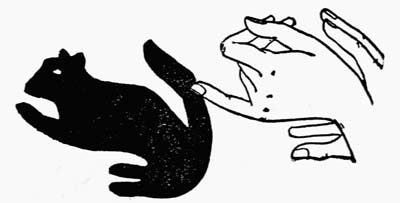
BUTCHER
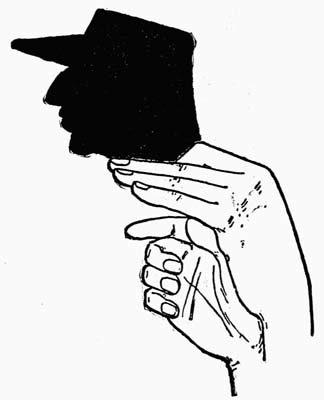
JOCKEY
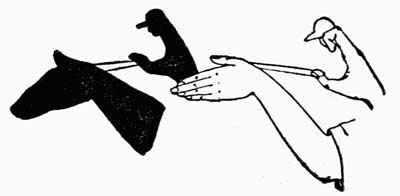
MEPHISTOPHELES
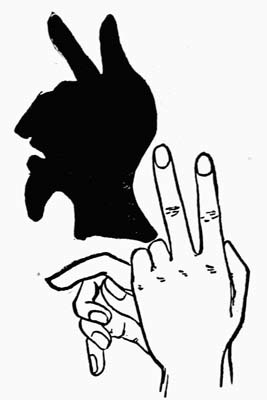
GRIMACER
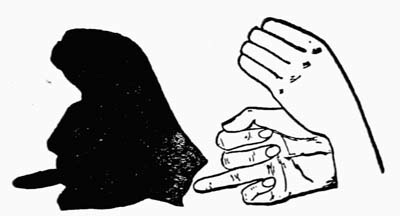
CLOWN
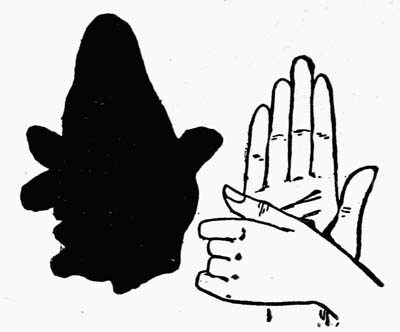
GOAT
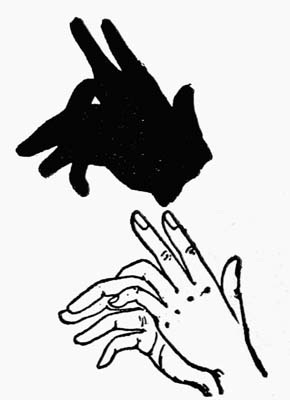
SHEEP
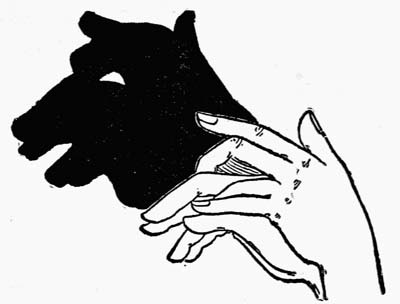
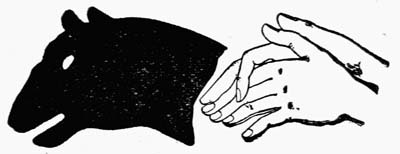
TIGER
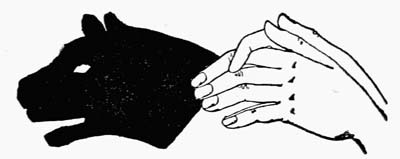
BEAR
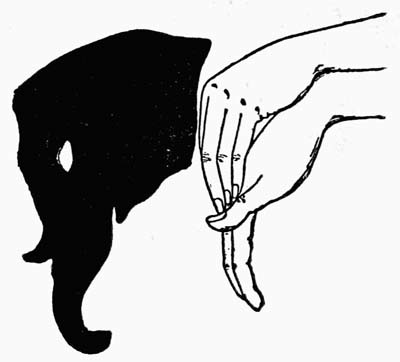
ELEPHANT
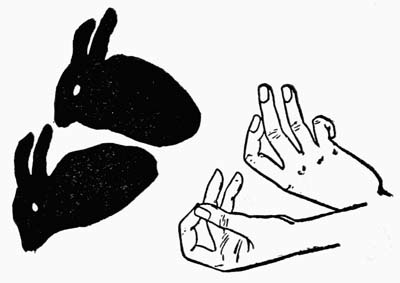
RABBITS
PREACHER
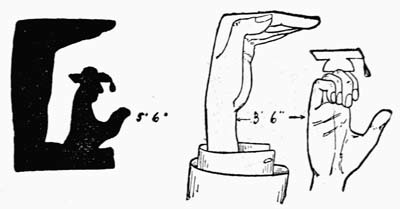
FISHERMAN
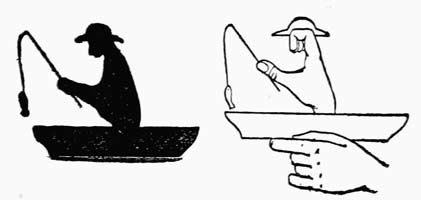
SNUFF TAKER
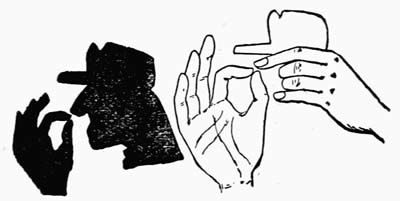
BULL DOG
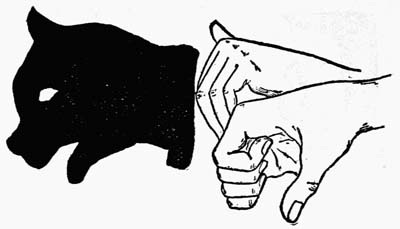
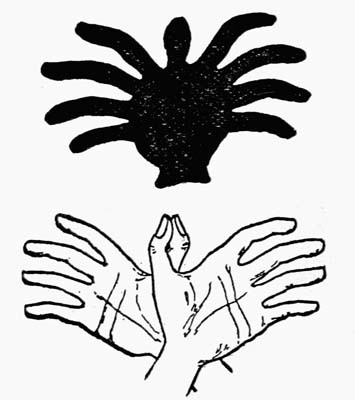
SPIDER
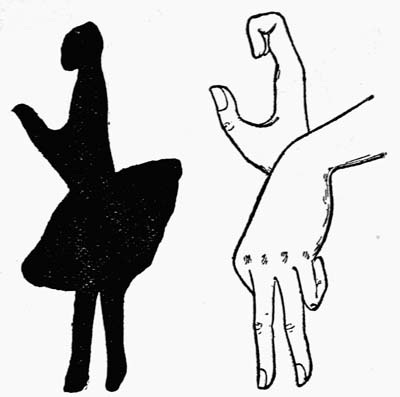
DANCING GIRL
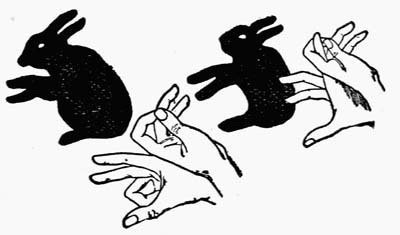
RABBIT (2 METHODS)
GRIMACER
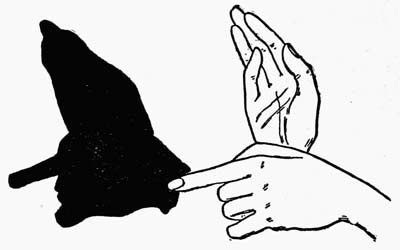
THE SWAN
POPULAR HAND-BOOKS
Some books are designed for entertainment, others for information. ¶ This series combines both features. The information is not only complete and reliable, it is compact and readable. In this busy, bustling age it is required that the information which books contain shall be ready to hand and be presented in the clearest and briefest manner possible. ¶ These volumes are replete with valuable information, compact in form and unequalled in point of merit and cheapness. They are the latest as well as the best books on the subjects of which they treat. No one who wishes to have a fund of general information or who has the desire for self-improvement can afford to be without them. ¶ They are 6 × 4½ inches in size, well printed on good paper, handsomely bound in green cloth, with a heavy paper wrapper to match.
Cloth, each 50 cents
THE PENN PUBLISHING COMPANY 923 Arch Street, Philadelphia
ETIQUETTE By Agnes H. Morton
There is no passport to good society like good manners. ¶ Even though one possess wealth and intelligence, his success in life may be marred by ignorance of social customs. ¶ A perusal of this book will prevent such blunders. It is a book for everybody, for the social leaders as well as for those less ambitious. ¶ The subject is presented in a bright and interesting manner, and represents the latest vogue.
LETTER WRITING By Agnes H. Morton
Why do most persons dislike to write letters? Is it not because they cannot say the right thing in the right place? This admirable book not only shows by numerous examples just what kind of letters to write, but by directions and suggestions enables the reader to become an accomplished original letter writer. ¶ There are forms for all kinds of business and social letters, including invitations, acceptances, letters of sympathy, congratulations, and love letters.
QUOTATIONS By Agnes H. Morton
A clever compilation of pithy quotations, selected from a great variety of sources, and alphabetically arranged according to the sentiment. ¶ In addition to all the popular quotations in current use, it contains many rare bits of prose and verse not generally found in similar collections. ¶ One important feature of the book is found in the characteristic lines from well known authors, in which the familiar sayings are credited to their original sources.
EPITAPHS By Frederic W. Unger
Even death has its humorous side. ¶ There are said to be "sermons in stones," but when they are tombstones mere is many a smile mixed with the moral. ¶ Usually churchyard humor is all the more delightful because it is unconscious, but there are times when it is intentional and none the less amusing. ¶ Of epitaphs, old and new, this book contains the best. It is full of quaint bits of obituary fancy, with a touch of the gruesome here and there for a relish.
PROVERBS By John H. Bechtel
The genius, wit, and spirit of a nation are discovered in its proverbs, and the condensed wisdom of all ages and all nations is embodied in them. ¶ A good proverb that fits the case is often a convincing argument. ¶ This volume contains a representative collection of proverbs, old and new, and the indexes, topical and alphabetical, enable one to End readily just what he requires.
THINGS WORTH KNOWING By John H. Bechtel
Can you name the coldest place in the United States or tell what year had 445 days? Do you know how soon the coal fields of the world are likely to be exhausted, or how the speed of a moving train may be told? What should you do first if you got a cinder in your eye, or your neighbor's baby swallowed a pin? This unique, up-to-date book answers thousands of just such interesting and useful questions.
A DICTIONARY OF MYTHOLOGY By John H. Bechtel
Most of us dislike to look up a mythological subject because of the time required. ¶ This book remedies that difficulty because in it can be found at a glance just what is wanted. ¶ It is comprehensive, convenient, condensed, and the information is presented in such an interesting manner that when once read it will always be remembered. ¶ A distinctive feature of the book is the pronunciation of the proper names, something found in few other works.
SLIPS OF SPEECH By John H. Bechtel
Who does not make them? The best of us do. ¶ Why not avoid them? Any one inspired with the spirit of self-improvement may readily do so. ¶ No necessity for studying rules of grammar or rhetoric when this book may be had. It teaches both without the study of either. ¶ It is a counsellor, a critic, a companion, and a guide, and is written in a most entertaining and chatty style.
HANDBOOK OF PRONUNCIATION By John H. Bechtel
What is more disagreeable than a faulty pronunciation? No other defect so clearly shows a lack of culture. ¶ This book contains over 5,000 words on which most of us are apt to trip. ¶ They are here pronounced in the clearest and simplest manner, and according to the best authority. ¶ It is more readily consulted than a dictionary, and is just as reliable.
PRACTICAL SYNONYMS By John H. Bechtel
A new word is a new tool. ¶ This book will not only enlarge your vocabulary, but will show you how to express the exact shade of meaning you have in mind, and will cultivate a more precise habit of thought and speech. ¶ It will be found invaluable to busy journalists, merchants, lawyers, or clergymen, and as an aid to teachers no less than to the boys and girls under their care.
READY MADE SPEECHES By George Hapgood, Esq.
Pretty much everybody in these latter days, is now and again called upon "to say a few words in public." ¶ Unfortunately, however, but few of us are gifted with the power of ready and graceful speech. ¶ This is a book of carefully planned model speeches to aid those who, without some slight help, must remain silent. ¶ There is a preliminary chapter of general advice to speakers.
AFTER-DINNER STORIES By John Harrison
The dinner itself may be ever so good, and yet prove a failure if there is no mirth to enliven the company. ¶ Nothing adds so much zest to an occasion of this kind as a good story well told. ¶ Here are hundreds of the latest, best, brightest, and most catchy stories, all of them short and pithy, and so easy to remember that anyone can tell them successfully. ¶ There are also a number of selected toasts suitable to all occasions.
TOASTS By William Pittenger
Most men dread being called upon to respond to a toast or to make an address. ¶ What would you not give for the ability to be rid of this embarrassment? No need to give much when you can learn the art from this little book. ¶ It will tell you how to do it; not only that, but by example it will show the way. ¶ It is valuable not alone to the novice, but to the experienced speaker, who will gather from it many suggestions.
THE DEBATER'S TREASURY By William Pittenger
There is no greater ability than the power of skillful and forcible debate, and no accomplishment more readily acquired if the person is properly directed. ¶ In this little volume are directions for organizing and conducting debating societies and practical suggestions for all who desire to discuss questions in public. ¶ There is also a list of over 200 questions for debate, with arguments both affirmative and negative.
PUNCTUATION By Paul Allardyce
Few persons can punctuate properly; to avoid mistakes many do not punctuate at all. ¶ A perusal of this book will remove all difficulties and make all points clear. ¶ The rules are plainly stated and freely illustrated, thus furnishing a most useful volume. ¶ The author is everywhere recognized as the leading authority upon the subject, and what he has to say is practical, concise, and comprehensive.
ORATORY By Henry Ward Beecher
Few men ever enjoyed a wider experience or achieved a higher reputation in public speaking than Mr. Beecher. ¶ What he had to say on this subject was born of experience, and his own inimitable style was at once both statement and illustration of his theme. ¶ This volume is a unique and masterly treatise on the fundamental principles of true oratory.
CONVERSATION By J. P. Mahaffy
Some people are accused of talking too much. But no one is ever taken to task for talking too well. ¶ Of all the accomplishments of modern society, that of being an agreeable conversationalist holds first place. Nothing is more delightful or valuable. To suggest what to say, just how and when to say it, is the general aim of this work, and it succeeds most admirably in its purpose.
READING AS A FINE ART By Ernest Legouvé
The ability to read aloud well, whether at the fireside or on the public platform, is a fine art. ¶ The directions and suggestions contained in this work of standard authority will go far toward the attainment of this charming accomplishment. ¶ The work is especially recommended to teachers and others interested in the instruction of public school pupils.
SOCIALISM By Charles H. Olin
Socialism is "in the air." ¶ References to the subject are constantly appearing in newspapers, magazines, and other publications. ¶ But few persons except the socialists themselves have more than a dim comprehension of what it really means. ¶ This book gives in a clear and interesting manner a complete idea of the economic doctrines taught by the best socialists.
JOURNALISM By Charles H. Olin
What is news, how is it obtained, how handled, and how can one become a Journalist? ¶ These questions are all answered in this book, and detailed instructions are given for obtaining a position and writing up all kinds of "assignments." ¶ It shows what to avoid and what to cultivate, and contains chapters on book reviewing, dramatic criticism and proofreading.
VENTRILOQUISM By Charles H. Olin
Although always a delightful form of entertainment, Ventriloquism is to most of us more or less of a mystery. ¶ It need be so no longer. ¶ This book exposes the secrets of the art completely, and shows how almost anyone may learn to "throw the voice" both near and far. ¶ Directions for the construction of automatons are given as well as good dialogue for their successful operation. ¶ Fully illustrated.
CONUNDRUMS By Dean Rivers
Conundrums sharpen our wits and lead us to think quickly. ¶ They are also a source of infinite amusement and pleasure, whiling away tedious hours and putting everyone in good humor. ¶ This book contains an excellent collection of over a thousand of the latest, brightest, and most up-to-date conundrums, to which are added many Biblical, poetical, and French conundrums.
MAGIC By Ellis Stanyon
There is no more delightful form of entertainment than that afforded by the performances of a magician. ¶ Mysterious as these performances appear, they may be very readily learned if carefully explained. ¶ This book embraces full and detailed descriptions of all the well known tricks with coins, handkerchiefs, hats, flowers, and cards, together with a number of novelties not previously produced or explained. ¶ Fully illustrated.
HYPNOTISM By Edward H. Eldridge, A.M.
There is no more popular or interesting form of entertainment than hypnotic exhibitions, and everyone would like to know how to hypnotize. ¶ By following the simple and concise instructions contained in this complete manual anyone may, with a little practice, readily learn how to exercise this unique and strange power.
WHIST By Cavendish Twenty-third Edition
"According to Cavendish" is now almost as familiar an expression as "according to Hoyle." ¶ No whist player, whether a novice or an expert, can afford to be without the aid and support of Cavendish. No household in which the game is played is complete without a copy of this book. ¶ This edition contains all of the matter found in the English publication and at one-fourth the cost.
PARLOR GAMES By Helen E. Hollister
"What shall we do to amuse ourselves and our friends?" is a question frequently propounded on rainy days and long winter evenings. ¶ This volume most happily answers this question, as it contains a splendid collection of all kinds of games for amusement, entertainment, and instruction. ¶ The games are adapted to both old and young, and all classes will find them both profitable and interesting.
ASTRONOMY: The Sun and His Family By Julia MacNair Wright
Can you tell what causes day and night, seasons and years, tides and eclipses? Why is the sky blue and Mars red? What are meteors and shooting stars? ¶ These and a thousand other questions are answered in a most fascinating way in this highly interesting volume. Few books contain as much valuable material so pleasantly packed in so small a space. ¶ Illustrated.
BOTANY: The Story of Plant Life By Julia MacNair Wright
The scientific study of Botany made as interesting as a fairy tale. ¶ It is better reading than such tales, because of the profit. ¶ Each chapter is devoted to the month of the year in which plants of that month are in evidence. Not only is the subject treated with accuracy, but there is given much practical information as to the care and treatment of plants and flowers. ¶ Illustrated.
FLOWERS: How to Grow Them By Eben E. Rexford
Every woman loves flowers, but few succeed in growing them. With the help so clearly given in this book no one need fail. ¶ It treats mainly of indoor flowers and plants—those for window gardening; all about their selection, care, soil, air, light, warmth, etc. ¶ The chapter on table decoration alone is worth the price of the book. ¶ While the subject of flowers is quite thoroughly covered, the style used is plain, simple, and free from all technicalities.
DANCING By Marguerite Wilson
A complete instructor, beginning with the first positions and steps and leading up to the square and round dances. ¶ It contains a full list of calls for all of the square dances, and the appropriate music for each figure, the etiquette of the dances, and 100 figures for the german. ¶ It is unusually well illustrated by a large number of original drawings. ¶ Without doubt the best book on the subject.
ASTROLOGY By M. M. Macgregor
If you wish to obtain a horoscope of your entire life, or if you would like to know in what business or profession you will best succeed, what friends you should make, whom you should marry, the kind of a person to choose for a business partner, or the time of the month in which to begin an enterprise, you will find these and hundreds of other vital questions solved in this book by the science of Astrology.
PHYSIOGNOMY By Leila Lomax
How can we judge whether a man may be trusted to handle money for us? ¶ How can a woman analyze a man who would marry her? ¶ Partly by words, partly by voice, partly by reputation, but more than all by looks—the shape of the head, the set of the jaw, the line of the mouth, the glance of the eye. ¶ Physiognomy as explained in this book shows clearly how to read character with every point explained by illustrations and photographs.
GRAPHOLOGY: How to Read Character from Handwriting By Clifford Howard
Do you know that every time you write five or six lines you furnish a complete record of your character? Anyone who understands Graphology can tell by simply examining your handwriting just what sort of a person you are. ¶ There is no method of character reading that is more interesting, more trustworthy, and more valuable than that of Graphology, and it is the aim of this volume to enable anyone to become a master of this most fascinating art.