Magic (continued 2)
Reading edition
Offer the strip to the owner of the handkerchief, saying that it is no fault of yours that it has been ruined. She will naturally refuse to accept it. Then remark: "Very well, the only thing I can do is to buy you a new one, next bargain-counter day, but in the meantime let us see what we can do with this mutilated mouchoir." Return to the stage, pick up the lemon, which has been placed on the table by your assistant, and announce that you will shoot the strip of linen into the lemon. Load it into your funnel-pistol and fire at the lemon. Then cut open the fruit and take out the dummy handkerchief. Start towards the lady as if to return it, but stop suddenly and remark, "This handkerchief smells rather strong of lemon. Shall I perfume it for you, madam?"
Without waiting for an answer place the handkerchief on a plate and pour perfume over it, but accidentally put on too much. Pick it up, and show it wet. Say you will dry it a little before returning it. Light a candle, and while holding the handkerchief over the flame it ignites. Drop it on the plate and offer it to the owner. Of course she will refuse to accept it. Smother the fire and again offer the burned remnants to the lady, making all sorts of excuses for the accident. As she again rejects your offer, say that you will put the ashes in a paper for her. Lay the plate on the stage, and go to your table for a piece of newspaper. In the meantime your assistant creates a small diversion by endeavoring to pick up the hot plate and place it on the table. Several times he burns (or pretends to burn) his fingers, dropping the plate, but finally succeeds. By this time you have come forward with the piece of newspaper. Roll up the ashes in the paper, and remark, "Here, madam, is what is left of your handkerchief. I present it to you as a small souvenir of the entertainment. What, you won't receive it?" Tear open the paper and take out the handkerchief fully restored. Present it to the lady with your best compliments, and you will be greeted with applause.
The following is the secret of this ingenious trick:
Take a lemon and prepare it by cutting a plug-shaped piece out of one end. Now dig out all the pulp. Stuff an old handkerchief or piece of square linen into the lemon, after which replace the plug and secure it with pins. Palm the lemon in your right hand, holding the lapel of your coat the better to conceal the fruit as you come down among the audience. Under the waistband of your vest, on the left side, you have secreted a bundle of about a dozen pieces of white muslin—say, three inches square—and on the right side a strip of about three inches wide and a yard long. On your table have a double piece of newspaper, about a foot square, pasted together on three sides, so that it forms a sort of bag, but appears like a single thickness. Also have on the table two plates, a magic pistol, a perfume bottle filled with alcohol, a candle and a candle-stick. After producing the lemon from the gentleman's whiskers, take the lady's handkerchief in the left hand. As you turn toward the stage to throw the lemon tuck the handkerchief under your vest in the middle and pull out the pieces and long strip from under the vest. Give the pieces to the gentleman who is to assist you, but retain the slip. A judicious use of the wand will enable you to better conceal the palmed linen, and to effect the several changes in an indetectible manner. While explaining to the gentleman how to restore the handkerchief, substitute the pieces for the long strip and give him that to hold. Get rid of the pieces in your profonde. All is now plain sailing until you arrive at the incident of the newspaper. While your assistant is working with the supposedly hot plate, you will have ample opportunity for stuffing the original handkerchief into the paper bag, smoothing it out as flat as you can. Wrap up the ashes, and finally tear open the paper through the outer thickness. The ashes will be concealed by the inner cover. Crumple up the paper and throw it carelessly on the stage.
Some performers go behind the scenes to obtain the paper, and effect the concealment of the original handkerchief, but this is unnecessary, besides it detracts from the effect of the experiment. The diversion created by your assistant with the hot plate will afford you ample opportunity to get the handkerchief into the paper.
CHAPTER V
TRICKS WITH BALLS
Creation, Manipulation, Multiplication, and Annihilation of Billiard Balls.—For the series of tricks hereafter described, you will require two solid billiard balls, and a case to contain one of the balls, consisting of two hemispheres of thin spun brass hinged together. When closed this case will represent a solid ball, but when open and held in the hand with the thumb over the hinge, will appear as two balls. The balls, together with the case, should be enameled red. When about to present the trick, come forward with the case containing a solid ball in the left breast pocket, and the other solid ball under the left armpit.
Creation.—Pull up the right sleeve and then the left one, which gives you the opportunity of taking the ball in the right hand unperceived. You now execute what is known as the "Change-over Palm" to show both hands empty, and then produce the ball from the back of the right hand. This palm is made as follows: Having gotten the ball into the right hand draw attention to the left with the fingers of the right, showing it back and front. When doing this you will be standing with your right side toward the audience. Now make a sharp half turn to the right and show the right hand in the same manner. This you will be able to do, as when making the turn the palms of the hands very naturally pass over each other, and the ball is transferred from the palm of the right hand to that of the left.
The ball is now found on the back of the right hand.
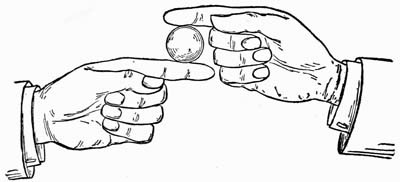
Fig. 24.—Revolving Ball
Manipulation.—The amount of manipulation possible with a single ball is considerable, and limited only by the dexterity of the performer. The principles of sleight of hand as described in Chapter II. will, with few exceptions, be found equally adaptable to this branch of the mystic art. For the benefit, however, of those of my readers who have not hitherto made sleight of hand a study, I append a few examples.
1. Having obtained the ball from the back of the right hand, place it between the two forefingers, (Fig. 24). Then twist the fingers round and round, which will cause the ball to revolve with them. This produces a very pleasing and puzzling effect, and is to all appearance a feat of dexterity. It requires, however, very little practice.
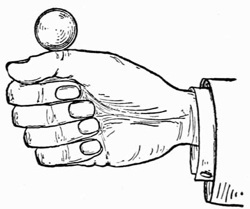
Ball in Position on Right Hand
2. Close the right hand and place the ball on the top, (Fig. 25). From this position appear to take it in the left hand, really allowing it to sink down into the palm of the right, where it is retained. Vanish the ball from the left hand in the usual manner, and produce it from the left elbow.
3. Roll the ball between the palms of the hands as if you were trying to make it smaller. When the left hand is underneath, seem to close it over the ball, really palming it in the right hand. The left hand is now brought down rather smartly on the back of the head, and the ball produced from the mouth.
4. Place the ball between the teeth and, apparently, give it a smart rap with the right hand as if to force it into the mouth. The ball, however, is palmed in the right hand, and immediately taken from the back of the head. When producing the ball, pass it up the back and over the top of the head, and let it fall into the left hand.
5. Appear to take the ball from the left hand, as in "Le Tourniquet" with a coin. Then apparently pass it through the left knee, producing it from underneath.
6. Throw the ball several times from one hand to the other, and finally, when appearing to throw it into the right hand, palm it in the left. Vanish the ball; place the left hand to the nose; and let the ball fall into the right hand. To all appearances it actually comes from the nose.
7. Stand with the left side to the audience, and throw the ball into the air several times. At the third time palm it in the left hand; the effect being that the ball is vanished into thin air. Now perform the "Change-over Palm," described above, and find the ball at the back of the right knee.
8. Apparently transfer the ball from the right hand to the left, really palming it. Place the palm of the right hand (containing the ball) on the right breast, and thence extend it over in the direction of the left sleeve. In the act of doing this, the ball leaves the palm and is held between the forearm and the body; the hand, turned palm toward the audience, then pulls up the sleeve. You then blow on the left hand to vanish the ball, and show the hand empty.
To regain possession of the ball, all that is necessary is to reverse the motion of the arm, when the ball will find its way into the palm of the hand, and can be produced as fancy suggests.
If the ball is not produced, the above forms an excellent final vanish to any billiard-ball trick.
If used as a vanish, after having regained possession of the ball, you stand with the hands one on each lappet of the coat, bow, and retire.
This pass, which I have found practical in every way, was given to me by Mr. George Newman, a very clever amateur conjurer.
The following explanations will to some extent be given in the "vernacular," it being assumed that the student has become familiar with the various passes.
Multiplication.—You must now obtain possession of the trick ball, which can be done by means of the following ruse. Appear to place the ball in the left hand, vanish, and take it from the left breast pocket. In doing so you take out the trick ball, leaving the solid one behind.
For two balls.—Take the trick ball in the left hand, and, waving the hand up and down, open the shell, placing the thumb over the joint, when you will appear to have two balls in the left hand. To show these as two solid balls, one in each hand, take the ball out of the case, which forthwith close. This can easily be done under cover of the right hand. Draw attention to the ball in the left hand, and remark, "One, and this one" (ball in right hand) "make two." As you say this you appear to place the ball in the left hand, really opening the case to represent two balls, and palming the solid one in the right hand.
For three balls.—Produce the ball you have palmed from behind the left knee, and really place it with the two others (case open) in the left hand. Wave the left hand up and down, and under cover of the movement allow the solid ball to slip into the case. Then produce the ball previously left in the breast pocket, and you will seem to have passed a ball up your sleeve.
For four balls.—Draw attention to the two balls now in the left hand (case open, with a solid ball in one half) and remark, "Two, and this one" (ball in right hand) "make three." Saying which, you apparently place the ball in the left hand, really palming it as before, and dropping the ball out of the case under the cover of the right hand. You now find the palmed ball at the left elbow, and really place it with the other three in the left hand. You will now appear to hold four solid balls.
Annihilation.—Appear to take a ball in the right hand, really allowing one to fall into the case. Vanish this ball in the act of throwing it to the audience. You now actually take another solid ball in the right hand and exclaim, "I will vanish this one into thin air. Watch me." Actually throw the ball into the air several times, and while doing this lower the left hand, and drop the solid ball out of the case into the profonde, making a movement that the audience cannot fail to notice. Thinking they have caught you, some one is sure to remark, "I saw him put one in his pocket that time." To which you will reply, "Oh, no, I did not put any in my pocket. I would not deceive you in such a manner. Two and one" (the one in the right hand) "make three." You now really place the ball in the left hand.
Again appear to take a ball in the right hand, letting it fall into the case as before. Then vanish it in the act of apparently throwing it into the air. Wave the left hand up and down, and under cover of the movement close the case, which will dispose of the third ball.
Finally, make believe to take this last ball in the right hand, standing with your right side to the spectators. Instead of doing this, however, the case is opened, under cover of the right hand, and the solid ball extracted. The right hand is then closed over the ball so that it cannot be seen, and the left hand quietly places the case in the profonde. It is well to again let this movement be suspected. Then, looking at the right hand, remark: "I have now only to dispose of this last ball." At this point some one is almost sure to say, "Oh! but I saw you put it in your pocket." You will then cause considerable amusement to the spectators, and bring derision on the party with the voice, by showing the ball in the right hand.
To cause the disappearance of the last ball make use of the pass described under Example 8 (p. 97).
Billiard Balls and Basins.—For the purpose of this trick you will require two small basins and two tea plates. The plates are to act as covers for the basins. In addition to these paraphernalia you will require two india-rubber balls to match in size and color the ordinary billiard balls.
The effect of the illusion is as follows:—The two basins are shown empty, and each is covered with a plate. In the course of the preceding billiard-ball trick, or a portion of the same, two balls are vanished, afterward appearing in the basins.
To prepare for the trick, place one of the basins, containing one of the balls, on the table, and cover it with one of the plates. On the top of this plate place the other basin, containing the second ball, covering the same with the remaining plate.
When about to present the illusion, you take the top plate in the left hand, and the basin in the right, fingers inside and thumb out. This enables you to grasp the ball, and conceal it in the fingers, while holding the basin so that the inside can be inspected. Place the basin on the floor, retaining the ball in the fingers, and immediately take the plate in the right hand, which again conceals the ball. Show the left hand empty, also both sides of the plate. Then pass the plate back into the left hand, taking the ball with it, and show both sides of the right hand. Cover the basin with the plate and in doing so secretly introduce the ball.
You must now go through the same movements with the other plate, ball, and basin, and the trick is practically finished. All that remains for you to do now is to vanish two balls and find them in the basins.
The india-rubber balls are essential for silence when dropped into the basin. Ordinary wooden balls would rattle and thus betray their presence.
Color-Changing Billiard Balls.—There is a very old trick similar to what I am about to describe, known as the "Chameleon Balls." In this form of the trick the ball is caused to change by palming on, or off, as occasion may require, half shells of different colors. I will now explain a method of producing a result analogous to the old trick, but brought about by entirely different means.
The necessary accessories are a red, a black, and a white billiard ball, all solid. Place the white ball in the profonde, and the black one in the pochette, on the left side. Having arrived at the point in Annihilation (p. 100) where all the balls have been disposed of with the exception of the last solid one, you throw this in the air as if to vanish it in that direction. While all eyes follow the ball in its upward flight you lower the left hand and take the white ball from the profonde, palming it. In doing this you would of course stand with the right side to the audience.
The Change to White.—Make a half turn to the right and take the red ball in the fingers of the left hand, in which you have the white ball palmed. Then show the right hand back and front. Now take the visible red ball in the fingers of the right hand, and, at the same instant, make the "Change-over Palm." This brings your right side again to the auditorium and enables you to show the left hand empty.
To execute the change you place the red ball in the fingers of the left hand, and then stroke it with the palm of the right; palming the red ball and leaving in place of it the white one. Again make the "Change-over Palm" showing the hands empty, with the exception of the white ball.
The Change to Black.—You take the ball in the right hand, and turning to the left bring it down rather smartly on the table, to prove its solidity. This gives you the opportunity of dropping the red ball into the profonde and taking the black one from the pochette.
To change the white ball to black you will proceed as in the previous change, disposing of the palmed white ball at the earliest opportunity, or it can be produced with good effect from the bottom of the trousers. Then lay both balls down on the table.
To appreciate and thoroughly understand the effect of the above, it is necessary to actually practice the various movements with the balls in front of a mirror.
The Diminishing Billiard Balls.—The trick under notice has for its effect the apparent diminution of an ordinary billiard ball, first to half its original size, secondly to one-quarter its original size, and finally to a very small ball, with which several amusing passes are made, and which afterward disappears entirely.
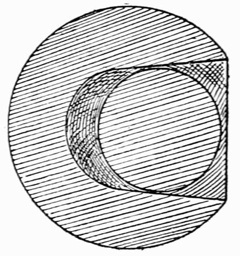
Fig. 26.—Trick Balls
In this case a trick ball is used of a size equal to half that of the ordinary one, and hollowed out so as to contain a solid ball of a diameter equal to half that of itself, (Fig. 26). The hollow ball must be so constructed that the small one pinches slightly into it, but can be instantly released by simply passing the ball of the thumb over it. A duplicate of this small ball should be placed in the right hand waistcoat pocket for use in the latter part of the trick.
The trick ball is placed in the left pochette, whence it is obtained and used according to the instructions given in the "Color-changing Balls." To produce the smallest size, hold the trick ball in the left hand, having previously loosened the small one, and in the act of stroking it with the right hand, palm off the hollow ball, and dispose of it as soon as possible.
With the small ball you now execute the pass as described under Example 4 on p. 96. Then actually place the ball in the mouth, pretend to swallow it, and produce the one from the vest pocket, which will appear to be the same.
You now seem to place the ball in the left hand, really palming it; then bring the left hand down with apparent force on the top of the head, showing the ball between the teeth. Here raise the right hand as if to take the ball from the mouth, but really push it back and show the palmed one. Then repeat the same pass, but this time actually let the ball fall from the mouth into the left hand, the right disposing of the palmed ball into the profonde.
I have seen a series of passes, including the above, performed with two eggs in place of the small balls, but unless the performer be endowed with a colossal cavity between the upper and lower jaws, I should not advise him to attempt this.
The Handkerchief Ball.—This forms a very good introduction to a billiard ball trick, all that is required being a ball of the usual size, hollowed out so as to take a handkerchief, with an opening one inch in diameter on the surface. This ball is suspended behind the top rail of a chair by means of a pin.
After performing any trick in which a handkerchief has been employed, carelessly throw it over the back of the chair while you roll up your sleeves. If you do not care to roll up the sleeves, perform any small trick before proceeding with the present one, otherwise it might be too palpable that the handkerchief was thrown over the chair for a purpose. Then take up the handkerchief (secretly securing the ball) and gradually work it into the ball, being careful to keep the ball out of sight as much as possible until the handkerchief has totally disappeared. Finally throw the ball into the air, which can safely be done providing it and the handkerchief are both of the same color, which would not admit of the hole being observed.
At this point, should you desire to proceed with a billiard ball trick, you can do so by changing the hollow ball for a solid one in the same manner that you changed the solid ball for the trick one in the "Multiplying Billiard Balls."
The Dissolving Billiard Ball.—This forms an excellent conclusion to a billiard ball trick. A glass tumbler three parts filled with water is given to a gentleman to hold. A ball is then covered with a handkerchief and given to the gentleman with a request that he will hold it over the glass and at the word "three" will allow it to fall into the water. This is done, and upon the handkerchief being removed from the tumbler, nothing remains but the fluid, which is perfectly transparent, the ball having apparently been dissolved therein.
The secret of this lies in the fact that the performer is provided with a half shell of clear glass. This shell is secretly slipped over the ball in the act of covering it with the handkerchief, and when handing it to the gentleman the solid ball is palmed away by the performer. The gentleman is not at all likely to discover that he holds only a half ball, as, being hampered with the glass of water, he is effectually prevented from making an examination.
It is well to be provided with a tumbler the bottom of which is shaped somewhat to fit the form of the shell, and ornamented slightly, but this latter feature is not absolutely necessary.
Fancy Sleight with a Small Ball.—A small ball is generally used for this pass, but it is applicable to any object that can be conveniently placed in the mouth. In effect it is as follows: A ball, for instance, is rubbed into the left elbow and passed thence up into the hand. The hand is then brought down rather smartly on the back of the head, the ball being immediately afterward taken from the mouth.
The sleight is thus executed: The performer takes the ball in his right hand and commences to rub it into his left elbow. At this point he apparently meets with an accident, dropping the ball on the floor. The dropping of the ball, however, apart from being an accident, is absolutely essential to the success of the illusion. After having picked up the ball and while still in a stooping position with his back toward the spectators, the performer quickly throws it into his mouth, immediately facing round and drawing attention to the right hand the fingers of which must seem to close round the object. The rubbing at the elbow is again commenced and the right hand eventually shown empty. The performer then makes a sign indicative that the ball has passed up into the left hand, which is then brought down with apparent force on the back of the head. The ball in the mouth is then revealed, when it will appear to have actually traveled to that position.
This sleight can very well be introduced at the close of the Diminishing Billiard Balls.
I am indebted to Mr. Ross Conyears, an exceedingly dexterous magician, for the above.
Rouge et Noir.—This pretty trick consists of causing two balls, one red and one black, wrapped in pieces of paper and placed in borrowed hats, to change places at command. The diameter of the balls should be four and one-half inches.
The solution of the problem lies in the construction of the papers with which the balls are covered. They are arranged thus: Take two pieces of newspaper and paste them together all round the edges, having previously inserted between them a layer of red glazed paper of the same shade as the ball. The other one is prepared in exactly the same way, but contains a layer of black glazed paper to represent the black ball.
The two balls are now wrapped in the papers, care being taken to cover the red ball with the paper containing the black layer, and vice versa. After this has been done the performer feigns a slip, mixing up the packages, and thereby confusing the audience as to the relative positions of the balls. As if to satisfy them on this point he tears a small hole in the outer covering of one of the parcels, exposing say the layer of black paper. The parcel is then placed in the hat on the supposition that it contains the black ball.
The other package is now treated in the same manner, after which the supposed transposition of the balls will be easily understood.
Ball, Handkerchief, and Tumbler.—This is a very good combination trick, and as such will serve as an example for the arrangement of others. A billiard ball is placed in a small tumbler, which is in turn wrapped in a piece of newspaper and deposited in a borrowed hat. The performer then takes a small silk handkerchief and rolls it up in his hands, when it is seen to have become transformed into a billiard ball. The glass is then taken from the hat, and, on the paper being removed, is found to contain the handkerchief. The ball, handkerchief, and tumbler, together with the piece of paper, are then caused to vanish, one at a time, from the hands of the performer, who immediately afterward produces them from the hat.
The modus operandi is as follows:—A duplicate tumbler containing a handkerchief, and wrapped in paper, must be secretly introduced into the hat prior to the commencement of the trick. (See Hat Tricks.) The tumbler containing the ball and wrapped in paper is then placed in the hat. The performer now takes up a duplicate handkerchief, and under cover of the same the hollow ball already described. The handkerchief is worked into the ball, which is shown in due course, and laid on the table, opening downward. The duplicate tumbler is then removed from the hat, and found to contain the handkerchief. These articles, including the piece of paper, are then laid on the table by the side of the ball.
The performer now goes to the hat, and, under pretense of moving it further away, turns it over, thus proving, in conjurer's logic, that it is empty. This can easily be done by taking the hat fingers inside and thumb out, the fingers being inserted in the top of the tumbler. The performer then returns to the table and proceeds to dispose of the articles thereon.
The piece of paper rolled up, and the ball, are caused to vanish by any of the means already explained. To cause the disappearance of the glass you must be provided with a handkerchief, silk by preference, consisting of two handkerchiefs sewn together round the edges, in the centre of which is fixed a disk of cardboard of the same size as the top of the tumbler. The tumbler being covered with this handkerchief, the performer, as if to satisfy the spectators that it is still there, strikes it several times on the back of a chair, and under cover of the movement allows the glass to fall into the network servante. The handkerchief, however, owing to the presence of the disk, still appears to contain the glass, the ultimate disposal of which will now be readily understood.
In conclusion, the performer takes the handkerchief lying on the table and vanishes it by palming in the ordinary way; the right hand being immediately dived into the hat and the handkerchief produced. The other articles should be removed one at a time, not forgetting to crumple the paper into a ball before taking it out.
CHAPTER VI
HAT TRICKS
The uses to which that piece of headgear, the much abused silk hat, lends itself in "l'art magique" are almost innumerable. The chief, however, and the one immediately under consideration, is the production therefrom of a host of heterogeneous articles, of which the following list will give an idea:
Fifty yards of sash ribbon, eight inches wide.—The ribbon should be folded over and over, in large pleats, so that it can be readily taken from the hat.
Two dozen fancy cardboard boxes, three and three-fourth inches by two and one-half inches by two and one-half inches.—These are made to fold flat, the size of the parcel when ready for introduction being five inches by three and three-fourth inches by one and one-half inches.
Two hundred flowers, known as spring flowers.—Each flower when closed is very little thicker than brown paper, but immediately on being released expands to the size of a full-brown tulip. One hundred of these flowers, when closed, can easily be hidden in the hand.
A string of sausages.—These, it is hardly necessary to remark, are imitation, being made in silk of the required color.
A bundle of wood.—This is made hollow, consisting of a cardboard case with pieces of wood glued on the outside and on one end, the other being left open. It is usually filled with baby linen, together with a feeding-bottle containing milk.
One hundred yards of narrow, colored ribbon.—This is made in coils, machine rolled, similar to that used for telegraph purposes. A coil of this ribbon can very well be placed in the bottom of the sham bundle of wood. When producing the coil it should be unrolled from the centre.
Four pound weight of playing cards.—These make a tremendous show when strewn about the stage. A good plan, also, is to have a number joined together in a long string by means of cotton.
A cannon ball.—This is usually made in zinc, five inches in diameter, hollow, and provided with a sliding lid. It can be filled with various soft goods, such as handkerchiefs, ribbons, etc., also sweets and bonbons for distribution.
A solid wooden cannon ball.—This should have a three-quarter inch hole, two inches deep, bored in it toward the centre, for facility in introducing it into the hat.
A barber's pole, about thirty feet long and four inches to five inches thick at the base.—This is made with stout colored paper, and pulls out from the centre. If the pole be constructed of red, white, and blue paper the performer, when introducing the trick, may announce that he is about to erect the American Colors at the North Pole.
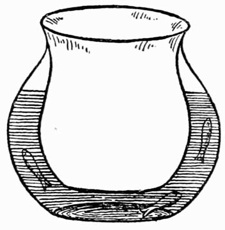
Fig. 27.—Bowl of Gold Fish
A bowl of gold fish.—This really consists of two bowls, one within the other. The space between the two contains the water and fish, which are inserted through a hole in the bottom of the outer bowl, the latter being afterward corked. The inside bowl is filled with bonbons, etc. (Fig. 27). The fish used are imitation, being made from pieces of carrot cut to shape.
A large cage containing a live canary.—The cage, which is telescopic in action, the upper part sliding down into the lower, is nearly twice the height of the hat, and when once taken out cannot be put back. This is owing to the fact that the seed boxes, which in their normal position are on the inside, revolve on spring pivots, as the cage is withdrawn, thus making it impossible to return it to the hat until they are replaced.
Twenty pint tumblers, ruby and green.—These are made in celluloid and fit one in the other. They are all of the same size, but being very thin occupy very little more space than a single one.
Six champagne bottles.—These are not quite so substantial as they look, being merely half-bottles in thin metal, japanned black, and decorated with labels taken from the genuine article. A bottle with a horizontal division in the centre, the upper part containing wine, and the lower part a tumbler, is generally introduced with the shells.
A small rabbit.
A Chinese doll.—Obtain a doll's head, five inches in diameter, from any Oriental store, and drape it with a silk skirt. If a hole be cut in the top of the head it can be utilized in the same manner as the cannon ball.
A skull which rises spontaneously from the hat.—This is a model in papier-maché, and being hollow, is very serviceable. It is caused to rise from the hat by means of a black thread, which is carried through a staple in the flies immediately over the performer's table, thence through another staple behind the wings, and down to the assistant.
It is not my intention to give directions for making these goods, as they can be bought at a very small cost from any of the dealers in magical apparatus. I have found by experience that this is the best course to pursue. Amateur work is, as a rule, very commendable, but scarcely so as regards conjuring, clumsy and ill-made apparatus being absolutely useless, and consequently dear at any price. Apart from this I have another, and what I believe to be a more important object in view, viz., that of giving instruction in the actual working of the trick.
It will be at once obvious to the reader that the chief element in the magical production of articles from a borrowed hat, is the manner in which they are secretly introduced, as, should this be detected, the trick would fail ignominiously. The main secret lies in the combination of the looks and gestures of the performer to misdirect the audience. The articles for the most part are introduced under cover of natural movements, quickness being of little or no avail.
I will now describe one or two methods employed to effect this desideratum.
Loading.—Under this heading I shall endeavor to give the working of a hat trick as actually presented to an audience, using for the purpose articles selected from the preceding list. The following preparations must be made:—
A small rabbit is placed in the right hand profonde, and a billiard ball and a small dinner plate are laid on the table.
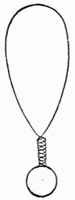
Fig. 28.—Double Wire Loop
A packet of one hundred spring flowers, secured by a band of tissue paper, must be in the hands of the assistant at the right wing; and another similar packet must be placed in the profonde on the left side.
The sash ribbon, folded as instructed, is tied round the fancy boxes together with the string of sausages, with black tape. The parcel is suspended behind the back of a chair by means of a pin and a double loop of florist's wire (Fig. 28), the tape being passed through the small loop, which is then hung on the pin. This leaves the large loop, the use of which will be noted in due course, sticking up over the back of the chair, where, however, it is quite invisible at a few paces.
The twenty pint tumblers are wrapped up in a piece of colored sash-ribbon and tied round with tape to which is attached a loop of wire. Thus prepared they are placed in the capacious breast pocket on the left side, the loop projecting so that the thumb of the right hand can be passed through it and the package withdrawn.
The bundle of wood, containing the coil of ribbon, baby linen, and feeding bottle, must be in readiness on the servante at the back of a second chair.
The skull, cannon ball, or globe of gold fish, whichever the performer intends to use, is located on the servante at the back of the table.
The next thing to do is to obtain the loan of a hat, and having done so, it is well to perform a preliminary experiment with the same. A very good one is that known as
The Magnetized Hat.—The performer places his hand, perfectly empty, on the crown of the hat, which forthwith adheres to the palm, and in this position it can be moved about and turned over in any direction. The finger tips are then used in place of the palm with the same result. Finally, a silk handkerchief is thrown over the hat, and the palm of the hand placed thereon, but the effect is still the same.
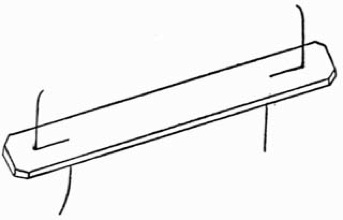
Fig. 29.—Apparatus for Magnetized Hat
This seeming impossibility is accomplished with the aid of the little piece of apparatus illustrated in Fig. 29. It consists of a brass plate fitted with two bent pins as shown, the whole being painted black. The pins should be situated so that by placing the two middle fingers between them the hat can be raised. The working of the trick will now be readily understood. The clip must be pressed into the crown of the hat while returning with it to the stage, the pin on the left of the figure being inserted first. The clip is removed, with the handkerchief, in the final stage of the trick.
The ball and plate are now given for examination, and while all attention is riveted on these two articles, ample opportunity will be found to introduce the rabbit unobserved, which should be done while amongst the audience. The hat is then covered with the plate, in which condition it is carried back to the stage, and placed on the table.
The performer now takes the ball, and vanishes it by palming; appearing to pass it through the plate into the hat. The plate is then removed, and the ball taken from the hat with the right hand, followed immediately by the rabbit.
The hat is now taken in the left hand, and the rabbit handed to the assistant at the wings with the right. The assistant takes the rabbit, and at the same time, under cover of the wing, gives the performer the packet of flowers; the hat being immediately placed in the right hand to conceal their presence.
While drawing attention to the outside of the hat, the tissue paper is broken with the fingers, and the flowers are released. They are then shaken out slowly on to a large sheet of black alpaca, which should be spread over the stage to receive them. While this is being done, the package is obtained from the profonde, the hat being changed over into the left hand, and the second load thus introduced.
When the flowers have all been shaken from the hat, take it in the right hand, fingers inside and thumb out, and approach the chair (this should be on your right) on which is the bundle of ribbons, etc. Take the top of the chair in the hand holding the hat, and in doing so, push the forefinger through the loop of wire. Now move the chair away a few paces, and when removing the hand from the back bring away the load, which will fall into the hat unobserved. Leave the hat on the chair, and take up the alpaca containing the flowers, putting it on one side.
Up to this point, no one will suspect that the hat contains anything, as what you have done has been but natural in the preparation of the stage for the next trick.
The boxes are now taken from the hat and placed on the table, followed by the sausages. When removing the latter, some amusement may be caused by referring to them as "an indefinable, condimental amalgamation of membranaceous disintegrations."
The ribbon is next pulled from the hat in long lengths with the right hand, and when the hand contains a large quantity, the thumb is slipped through the wire loop attached to the tumblers in the breast pocket. These are introduced when inserting the hand to take out the next length of ribbon. The introduction of the tumblers cannot be detected, owing to the presence of the ribbon in which they are wrapped. When the whole of the ribbon has been extracted, it is thrown over the back of the chair, behind which is the bundle of wood.
The tumblers are now taken from the hat, and placed on the table.
The performer then takes up the ribbon from the chair, and makes an effort to return it to the hat, thereby drawing attention to its great bulk, and remarking, "Now, how do you suppose I am going to get home with this? Why, I shall require at least two cabs."
It is needless to say that under cover of the ribbon the bundle of wood is introduced into the hat. The baby linen, feeding bottle, and coil, are now produced, and finally the wood itself. It is usual when taking the ribbon from the hat to spin it out on the wand.
Holding the hat by the brim, fingers inside and thumb out, the performer lowers it for an instant to the rear edge of the table, and by inserting the middle finger of the hand into the hole in the cannon ball scoops it up into the hat, which is forthwith raised and placed crown downward on the table.
This movement should be executed with the left hand while the right lays the bundle of wood down on the table, and, if necessary, makes room for the next production.
The fish bowl, or skull, would of course be worked in a similar manner.
From the foregoing it will be seen that with a little expenditure of ingenuity and trouble a hat trick can be carried on to an almost indefinite period. It should not, however, in any case exceed fifteen minutes. I have taken the preceding list simply as an illustration of the way in which the various movements are combined to appear natural and thus avoid detection, also as a basis on which the student may arrange a hat trick of his own. Any articles can, of course, be substituted for those given, or the list may be supplemented by others, or cut down as occasion may require. An amount of sang froid and boldness, only acquired from years of actual practice, is necessary to execute a good hat trick faultlessly; but this should not disconcert the reader, as it is only in accordance with what must be expected in the acquisition of an art.
To Produce a number of Eggs from a Hat held Crown upward.—For this purpose you must be provided with a black linen bag, oval in shape, and large enough to contain the required number of eggs. To one end of this bag is sewn an ordinary tie clip, the other end being cut off and provided with a piece of elastic so that eggs placed therein cannot come out unless pressure be applied with the hand. The bag is loaded into the hat by one or other of the methods described, and attached to the lining of the same by means of the clip. Under these circumstances the production of the eggs from the inverted hat will be an easy matter. The eggs used should be blown ones.
The bag should be allowed to remain in the hat after the last egg has been taken from it, and removed later under cover of some other article.
CHAPTER VII
ANTI-SPIRITUALISTIC TRICKS
The Climbing Ring.—The performer having obtained the loan of a lady's ring, passes it over the end of his wand, which he then holds in a perpendicular position. The ring now commences to climb up the wand very slowly, stopping or descending at command; finally it jumps right off the wand and is caught by the performer, who immediately hands it back to the lady.
This pretty experiment depends entirely upon a black silk thread, about twice the length of the wand, to which it is fixed at the uppermost end. The means by which the thread is attached may vary, but a good plan is to make a very small knot in the end of the thread, which is then passed through a fine slit cut in the end of the wand, the knot making all secure. The thread is then passed down the side of the wand, in which position it will not be noticed. The ring is now dropped over the wand, and consequently over the thread, by the manipulation of which it may be caused to rise or fall, or, in response to a sharp tug, to jump right off the wand. The wand is usually held in the left hand, while the right, in which is the end of the thread, holds the lapel of the coat, when all that is necessary to obtain the desired result is to move the left hand to or from the body as required.
The Mysterious Name.—This is a capital trick, and one that can be introduced at any time. The performer borrows a visiting card from any stranger in the company, and, holding it between the thumb and the second finger of the hand, he waves it about very slowly, at the same time asking some one to call out the name of any celebrity. This having been done the card is almost immediately handed back to the owner, who finds the selected name written thereon.
This ingenious trick is accomplished with the aid of a small accessory in the shape of a thimble, to the end of which is attached a small piece of pencil about a quarter of an inch in length. This thimble having been placed on the forefinger of the hand, it will be found, by experiment, that the name may very easily be written on the back of a card held as instructed.
Prior to, and immediately after the trick, the thimble may be palmed as instructed elsewhere.
A New Postal Trick.—This is very useful, as it can be employed in conjunction with any trick where a word, message, total of sum, etc., is to be produced in a magical manner. An ordinary postcard is handed to a spectator with a request that he will tear a small piece from one corner, and having done so, hand both portions back to the performer. The corner is laid on the table and the card torn up into small pieces which are then placed in the magic pistol (see p. 61), and fired at a borrowed hat. The card is afterward produced from the hat covered with writing, and fully restored with the exception of the corner, which on being fitted to the card is found to correspond in every way.
The trick is accomplished with the aid of a second card prepared with the necessary writing, and from which a corner has been removed. This card is secretly introduced into the hat when returning with it to the stage. The performer, having palmed the portion missing from the card in the hat, makes an exchange when laying the corner on the table. The plain card is then torn into fragments, and together with its corner is placed in the pistol, which is then fired at the hat. It is well to place a piece of paper in the mouth of the cone to receive the torn pieces of card, as by this means the danger of dropping any on the floor is obviated.
An additional effect may be obtained by having previously placed in the body of the pistol a piece of paper containing a powder for producing colored fire, when, after having disposed of the cup containing the torn card, you appear to overhear a remark to the effect that you have put something in your pocket, to which you reply, "No, I certainly did not put anything in my pocket. See, here is the paper containing the card" (really the package of colored fire). The package of powder is then laid on a plate and fired, after which the card is removed from the hat.
New Slate Tricks.—Under this heading will be noticed several methods, all of recent invention, for performing the well-known slate trick.
First Method.—Two ordinary school slates are given into the hands of a spectator, who, after making a careful examination, ties them together with stout cord, in which condition they are placed in the cabinet. Writing is immediately heard, and when it ceases the slates are at once handed out to the performer, who on separating them finds the required message.
The secret lies in the fact that the medium is provided with two small wooden wedges; also an umbrella rib, to which at one end is fitted a minute piece of pencil. All he has to do, therefore, is to force the wedges between the slates on one side until sufficient space is provided for the insertion of the rib, when the writing of the message will be found an easy matter.
Second Method.—In this case the two slates, after examination, may be actually screwed together with iron bolts, but in spite of this precaution writing is obtained as before.
Under these circumstances the performer is provided with a piece of prepared chalk—not the conventional commodity as sold by every chemist, but prepared by coating a piece of steel, about the size of a pea, with chalk paste, which is then allowed to dry. The piece of chalk is placed between the two slates, which are then bolted together and put into the cabinet; when, under the influence of a powerful horseshoe magnet passed over the outside of one slate as required, the prepared chalk will produce the spirit writing.
Third Method (one slate only).—After examination the slate is held by the performer above his head, when almost immediately writing is heard; and on the slate being turned round it is found to contain the desired message.
The slate, a small one for preference, is provided with a loose vulcanite flap covering one side, and concealing the writing which is already there. The performer hands the slate round for examination (keeping the flap in position by means of the fingers), and asks a spectator to initial it in one corner to satisfy himself that it is not exchanged. This having been done, and while returning to the stage, the performer removes the flap under cover of his body and places it in the vest, or in the large pocket in the breast of the coat. He then holds the slate above his head, fingers in front and thumbs behind. The sound of writing is produced by scratching with one thumb on the back of the slate, and when this has been continued long enough the message is revealed.
Fourth Method (one slate only).—In this instance the slate, which is an ordinary one, is shown to be clean on both sides, in which condition it is given to a spectator to hold. The performer then takes a pistol and, at a few paces, fires direct at the slate, on which, immediately after the report, the message is discovered.
To produce this startling effect all that is necessary is to write the message on the slate with glycerine just before commencing the trick, and to load the pistol with a small charge of powder, on the top of which is placed a quantity of powdered chalk.
The Spirit Handkerchief.—The effect of this trick, which is exceptionally good, is as follows:—Several knots having been tied in a large silk handkerchief borrowed from a member of the audience, it is thrown on the floor of the stage when it immediately begins to act as if it were a live snake, twisting and twirling about in every conceivable form. The performer passes his wand over, under, and all round the handkerchief, thus proving to the satisfaction of the most astute that there are no connections.
It is hardly necessary to say, however, that in spite of such convincing proof to the contrary, connection is actually made with the handkerchief, and it is done in the following manner:—A fine black silk thread is stretched across the stage from one wing to the other, the ends being in the hands of two assistants. Having obtained the loan of the handkerchief, the performer, standing behind the thread, takes it diagonally by two corners and twists it up rope fashion. He then ties three knots in it, one a little below the centre, one a little above the centre, and the third at one end. While this is being done the assistants raise the thread round which the last knot, forming the head of the snake, is actually tied; but owing to the thread being invisible this will pass unobserved.
Having made the last knot the performer drops the handkerchief on the floor, when its emulation of a live snake will depend entirely on the adroit manner in which the assistants manipulate the thread. Finally, it should be made to jump into the hand of the performer, who should at once hand it, with the knots still tied, to the owner. This is managed by the assistant at one end dropping the thread and the other one pulling it clear of the handkerchief.
The Mysterious Communication.—This trick, which is a very good one, is performed by a method very little known. The effect is as follows:—Any person writes on a piece of paper any word or series of words to form a short sentence, and having done so, folds the paper and puts it in his pocket. At this stage the performer introduces a reel of telephonic wire, the end of which, containing a loop, is handed to the writer, with a request that he will place the loop over the ball of the left thumb. This having been done, the performer places the reel against his forehead, and, after a few seconds' thought, writes the message, or an answer thereto, on the blackboard.
To obtain this result, all that is necessary is to be provided with a piece of paper smeared over on one side with white wax, or common washing soap; also a slab of plate glass by way of writing board. The paper is placed on the glass, waxed side downward, in which condition the assistant takes it to a gentleman in the audience. When writing on the paper a very faint impression, invisible to any one who does not actually look for it, is obtained on the glass. In the act of taking the glass back from his assistant the performer obtains the desired cue. The use of the wire is optional, but, of course, it adds much to the effect of the trick.
The Great Dictionary Trick (new method).—This is an improvement on the old trick under this name, as any dictionary may be used, whereas formerly the trick depended entirely upon a dictionary composed of one page repeated throughout. The effect is as follows:
The performer hands a sealed envelope to a spectator, asking him to take care of it, and not break the seal until requested. A dictionary is then given for examination, after which a lady inserts in it, at any page, a playing card. A counter bearing a number, say twenty-seven, is taken from a bag containing fifty, all numbered differently; the dictionary is opened at the page containing the card, and due note is taken of the twenty-seventh word indicated by the counter, and which is, we will suppose, "Magic." The gentleman is next requested to open the envelope, and on doing so finds to his astonishment that it contains a card on which is written "Magic, n, sorcery; enchantment," in exact accordance with the word chosen, apparently by chance, from the dictionary.
The seeming mystery is easily explained. Obtain a new twenty-five cent pocket dictionary, and, having opened it somewhere about the middle, bend the covers right back until they touch each other. Any new book used thus will ever afterward, unless otherwise maltreated, open readily at the same page. After the dictionary has been examined the performer allows it to fall open at this page, into which he secretly introduces a playing card previously palmed in his right hand. The book is then closed.
The performer, still holding the book, gives a card, identical in every respect with the other one, to a lady, with a request that she will insert it between the leaves in any position and push it right into the book. The performer, of course, takes care that the two cards do not clash. In this condition the dictionary is laid on the table.
A small bag, preferably of silk, is next introduced, from which the performer takes a handful of counters numbered from one to fifty and gives them for examination, after which they are returned to the bag. Any person is now allowed to place his hand in the bag and remove one counter, but it is needless to say, however careful he may be, the number chosen will be twenty-seven, which is accounted for by the fact that the bag is provided with a division through its entire length, forming two pockets, one of which contains the counters numbered one to fifty, and the other, fifty counters all bearing the same number, i. e., twenty-seven.
The dictionary is now opened by the performer at his own page, which every one will take to be the one chosen by the lady; some one is asked to note the twenty-seventh word on that page as indicated by the counter, the trick being brought to a conclusion as already described.
The performer can always ensure the left-hand page of the opening being read, by holding the book, with the card, in such a position that the twenty-seventh word on the right-hand page cannot be seen. Care must also be taken not to expose the duplicate card.
By way of variation the chosen word may be produced with the sympathetic ink, or it may be revealed by the method employed in "A New Postal Trick."
For the above trick, in the form described, I am indebted to Mr. Maurice Victor, a most skilful exponent of sleight of hand.
Long-distance Second Sight.—Two performers, usually a lady and a gentleman, are required for this séance. The gentleman introduces the lady, who is then escorted by a committee, chosen from the audience, to a room in a different part of the house, in which she is secured under lock and key. Several of the committee then guard the room, while the others return to the concert-hall and give the performer the following particulars:—Time shown by any watch (not necessarily the proper time); initials of any person in the room; any number of four figures; any word of four or five letters; number of cigarettes in any case, and kind of case; amount of money in any purse, and kind of purse. After this has been done a member of the committee takes pen, ink, and paper to the lady, who immediately writes down the time, initials, number, etc.; these, on examination, are found to be correct, although she has never left the room, neither has the performer left the stage, and no connection of any description exists between them.
This inexplicable performance is thus accomplished: The performer is provided with a small writing pad, three and one-half inches by two inches, consisting of a piece of cardboard, on which are held, by means of two elastic bands, several cigarette papers. This pad, together with a small piece of soft lead pencil, is placed in the right-hand trousers pocket. As the various items are called out, the performer stands with his right hand in the pocket, a perfectly natural attitude, and appears to be thinking deeply; but he is really writing down the particulars, one under the other, on the cigarette paper, which, with a little practice, can be done quite legibly. He then tears off the paper and rolls it into a small ball between the fingers.
A piece of plain paper is now obtained from any member of the audience, in order to prove that a prepared piece is not used, and together with a fountain pen, supplied by the performer, is taken, by one of the committee, to the lady. While the paper is being obtained the performer has ample time to remove the cap from the pen, and, before placing it on the opposite end of the pen in the place provided for it, he inserts in it the small ball of paper, which is thus secretly carried to the lady. On receipt of the pen and paper the lady requests to be left alone for a few seconds, as otherwise she will not be able to obtain the aid of "the spirits," and in the absence of the committeeman she takes a hairpin, and with it extracts the ball of paper from the pen, reads, and writes out the required information.
It is necessary that the order in which the various items are called out should be known alike to the performer and medium, as otherwise the "time" might be mistaken for the "number," and other errors might occur. A number of letters to indicate the various kinds of purses and cigarette cases, as "L" for leather, "S" for silver, etc., should also be agreed on between the two parties.
It will be obvious that the above trick is subject to much variation according to the taste of the performer, and may be elaborated if desired. A throw of dice; a person's age; or the name of a selected card (write "8 D" for eight of diamonds, etc.) may be substituted for any of the items given above.
CHAPTER VIII
AFTER DINNER TRICKS
In introducing to my readers a series of simple, but effective, tricks in magic, I would state that it has been my life study to popularize the art of sleight of hand, simply because, at the outset, I was impressed with the idea that, while having no desire to emulate the skilled professional magician, certain very novel and entertaining tricks were within the reach of all persons possessed with the least desire to amuse their friends.
Every one is not musical; every one cannot sing or recite; but every one can, with but little practice, learn to perform the following tricks, and thus put themselves in a position to brighten what might otherwise prove to be a dull evening.
The Chinese Cross.—The only properties required for this excellent little trick are six stout straws of the kind used for lemonade, and the small metal accessory shown at A in Fig. 30. The straws are fashioned into the form of a cross as shown in the figure, which is about half the actual size. It will be observed that pins are passed longitudinally, through the three straws at each extremity of the structure; this is done with a view to keeping it perfectly flat, otherwise the binding where the two pieces intersect would not be effectual. The piece of metal is next pushed into the centre straw at the foot of the cross in such a manner that it will not readily fall out, and so as to be entirely covered with the exception of the sharp needle point. The cross is laid on the palm of the left hand; the right hand makes a few passes over it, when it is suddenly seen to stand erect, and to rise or fall at command.
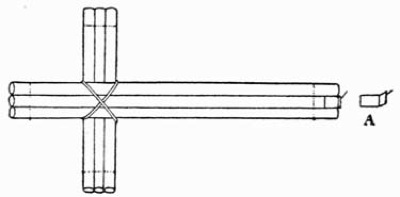
Fig. 30.—Chinese Cross
The method of working is as follows:—The cross is laid on the hand in such a manner that its foot, carrying the metal fake, point upward, comes in contact with the base of the middle finger; the point is now inserted in the hard flesh at the base of the said finger, when it will be found that to cause the cross to lie flat on the hand the fingers must be bent at an angle of about sixty degrees to the palm. If the hand be now straightened out very slowly the cross will rise gradually until it assumes a perpendicular position—or ninety degrees. By a slight movement of the fingers, practically imperceptible, and if noticed at all raising no suspicion, the cross is caused to rise and fall as often as desired.
In view of the possibility of the cross being "snatched" by a person overanxious to discover the secret, care should be taken to see that the metal fake is attached to the hand more firmly than to the centre straw. Perhaps the better way would be to work the trick with the fake attached to the hand from the commencement, then the cross may be given for examination at any time.
The Floating Metal Disc.—Here a metal disc about the size of a quarter is caused to sink or swim at command in water contained, for convenience, in a shallow glass tray.
The secret in this case depends upon duplicity; in reality there are two discs, the one an exact duplicate of the other in appearance, but considerably lighter in weight. Aluminium and zinc are alike in appearance and afford the necessary disparity in weight.
The zinc disc is given for examination, and a member of the audience is requested to float it on the water; he, of course, fails. On receiving back the zinc disc the performer "rings" it for that in aluminium and proceeds to surprise the company. I have arranged a special sleight of hand change for the trick as follows:—You carry a handkerchief in the left breast pocket and the aluminium disc palmed in the left hand. On receiving back the zinc disc in the right hand, you forthwith seem to place it in the left hand, really palming it and showing its prototype. The right hand now takes the handkerchief from the pocket and proceeds to dry what seems to be the wet zinc disc. This latter action gives an excuse for the transfer of the disc from one hand to the other, while the handkerchief effectually conceals the "palm."
The disc is now floated. The handkerchief and the zinc disc are now transferred in a careless manner to the left hand, which forthwith returns the handkerchief (handkerchief only) to the pocket.
The performer is now in a position, at the conclusion of the floating, to repeat the exchange above, dry the disc, and once more hand it for examination.
It is not absolutely necessary to give the metal for examination a second time, in which case the duplicate may, after the first "change," be disposed of entirely under cover of returning the handkerchief to the pocket.
When apparently wiping the disc dry be careful that it is never once completely hidden from view, or an exchange may be suspected.
The Balanced Coins.—No particular dexterity is necessary to perform the trick I am about to describe, although considerable care must be exercised for its successful execution. The performer, having obtained the loan of three pennies, lays them in a row on the palm of the left hand, in which position they may be inspected by all present. He then, with the thumb and second finger of right hand, grasps the edges of the outermost coins and raises all into a perpendicular position.
The trick is performed with the actual borrowed coins; the secret depends upon the introduction of a little accessory in the shape of a thin strip of wood one-quarter of an inch wide, and in length about one-sixteenth of an inch longer than the combined diameter of the three coins. At the commencement this strip of wood is held concealed in the left hand, being held between the base of the thumb and the first joint of the middle finger. The performer receives the coins in the right hand, then transfers them to the left hand, secretly placing them in the required position: the coins effectually hide the strip of wood and all may be examined. Now by grasping the coins, together with the strip of wood, (as explained above) no difficulty will be found in securing the desired effect. In conclusion the coins are again laid carefully in the left hand, then tossed with apparent carelessness into the right hand and forthwith handed to the owner.
The strip of wood is of course "palmed" in the left hand (as described above) in the act of tossing the coins into the right hand.
Mutilated Cigarette Paper.—A pretty little trick of an impromptu nature, in which a cigarette paper having been torn into a number of pieces, the pieces being rolled up into a little ball, is afterwards found completely restored.
First Method.—The performer is smoking a cigarette; this is an indispensable condition of the trick. By the side of the cigarette, on the right, concealed between the lips, is a little paper ball made from a duplicate whole paper. When presenting the trick, as when smoking in the ordinary way, the cigarette is occasionally taken between the forefinger and thumb of the right hand; experiment will also show that the little paper ball may be removed and replaced, quite secretly, by holding it between the finger and thumb of same hand. (See Fig. 31.)
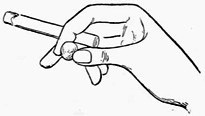
Fig. 31.—Cigarette Trick
Thus prepared, the performer hands packet of papers to a gentleman, with a request that he will take one, mutilate it, and roll up the fragments into the form of a little ball. While this is being done the performer casually shows both hands empty, occasionally removing the cigarette from his mouth, and finally securing duplicate ball. Now, under the pretense of showing the gentleman the proper way to roll the paper, he takes it between the finger and thumb of the left hand, and having rolled it about a little, passes it over to right hand, where, under cover of the manipulations, it is passed to the rear, the duplicate whole paper taking its place. (See Fig. 32.) The performer now returns the paper (the whole one) to the gentleman with the right hand, and forthwith, with the same hand, takes cigarette from mouth, thus concealing duplicate ball between fingers (see Fig. 31) without exciting suspicion. Finally the torn pieces are placed in the mouth when returning cigarette, and kept there until an opportunity arrives for removing them in secret.
Second Method.—This is no less interesting than the method described above. In this case the packet of cigarette papers is prepared beforehand by rolling up one into a little ball, and fixing it on the underside, near the edge at one end, of the second in order from the top.
Thus prepared, the performer removes the packet from his pocket, and tearing off top paper, hands same to a gentleman with a request that he will tear it into small pieces. Says the performer, "I will take one and show you what I mean; tear it as I do." Saying this, he removes second paper, and with it the duplicate ball. While tearing the paper the little ball is kept concealed between the forefinger and thumb, by no means a difficult matter, and occasionally passed from one hand to the other that the hands may be shown empty alternately. When the tearing is complete, the performer screws up paper with the remark, "Now roll the pieces into a little ball like this—thank you, that will do nicely." While giving these instructions he passes his torn paper to the rear, where it is completely concealed by being pressed tightly between first joint of finger and thumb; the duplicate ball being presented at the extreme tips of same fingers. (See Fig. 32.)
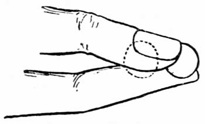
Fig. 32.—Cigarette Trick
Continuing, the performer remarks, "Now please take this little ball and give me yours." This is done, care being taken not to expose secreted ball. Performer now accuses gentleman of retaining one of his pieces; this of course leads to an examination, whereupon the gentleman and all present are surprised to find the paper completely restored. Finally the performer unfolds the pieces of gentleman's paper, with which he also mingles his own, with the remark, "You evidently don't quite understand the trick, sir."
To read the Whole of the Cards in a Pack just Shuffled (new method).—The performer gives pack of cards to be shuffled, and when returned places them behind his back and calls out the name of a card. He brings the card forward and throws it on the table, and continues in this manner to name every card in the pack.
The secret is exceedingly simple. A second pack of cards, prearranged in a given order, is substituted, as hereafter explained, for the pack shuffled by the audience. All the performer has to do then to make the trick a success is to acquire a thorough knowledge of the order of the cards in the prepared pack. The order of the fifty-two cards can be learned in five minutes by the aid of the following mnemonic:
Five Kings wanted (one ten), six Knaves. For (four) twenty-three (two three) ladies (queen) or eighty-nine (eight nine) slaves (seven).
The above gives the order of the values of the cards only; the suits must, of course, follow in regular sequence, say: Diamonds, clubs, hearts, spades. Example: On the table, face upward, place the five of diamonds, on this the king of clubs, on this the ace of hearts, on this the ten of spades, on this again the six of diamonds; and so on throughout the pack. Thus arranged, the pack may be cut to any extent without disturbing the order of the cards.
The exchange of packs is carried out under cover of a natural movement, as follows:—Performer receives the shuffled pack in the left hand and forthwith places it behind his back, resting the hand on the hip. The right hand is now placed to the rear, ostensibly for the sole purpose of removing the handkerchief from the left tail pocket, with which the performer is subsequently blindfolded; the right hand, however, first relieves the left hand of the shuffled pack and carefully lowers it into the pocket containing the handkerchief and prepared pack; these two latter are then removed together, the cards being placed in the left hand and the handkerchief brought to the front. Performer now requests some member of the audience to blindfold him in order to preclude the possibility of his obtaining assistance from mirrors or other reflecting surfaces. As he makes the request he turns round, thereby casually drawing attention to the cards still in the left hand, and which all present will readily believe to be those shuffled.
The solution will now be clear, but various little additions will, doubtless, suggest themselves in the working of the trick. For instance, the performer may undertake to pick out any card called for, which, with a little practice, will be seen to be easy of accomplishment. If the card asked for is out he will state the fact.
In making this reference I would state that the above doggerel rhyme has been arranged, quite recently, by myself. It will be seen that it gives a totally different order of the cards, a much-needed variation, from the now hackneyed rhyme which for ages has appeared in all works on card conjuring.
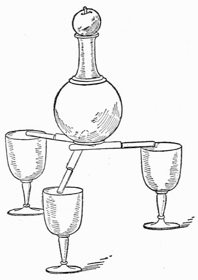
Fig. 33.—Balancing Knives
Balancing Feats.—Take three dessert knives and arrange them in triangular fashion upon three tumblers. Upon the triangular space formed by the intersection of the knife blades, deposit a water bottle, and upon the mouth of the bottle an apple, (Fig. 33). It seems quite an impossible feat, but it is readily accomplished.
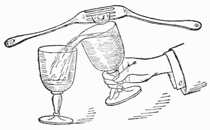
Another curious experiment in equilibrium is the following: Take a couple of forks and arrange them with their prongs one set over the Fig. 34.—Balancing Forks other, and stick a silver dollar between the middle prongs, thus uniting the two forks. This accomplished, place the coin flat on the rim of a tumbler, pushing it outward until the two circumferences touch externally. The coin with appendent forks will remain balanced much to the surprise of the company, (Fig. 34). You may follow this up by pouring the water steadily from the glass into a second glass, without disturbing the money or the forks, which remain in equilibrio. The above clever feats may properly be performed at the dinner-table after dessert has been brought on.
Walnut Shells and Pea.—This is an excellent table trick, and can be performed at close quarters without much fear of detection. The only articles required for the execution of the trick are three half walnut shells and a pea. The three shells are laid in a row on the table, the pea being placed under the centre one, from which position it disappears and is ultimately found under either of the end ones at the will of the performer. The table used must be covered with a cloth of some kind.
The secret lies in the pea, which is fashioned from a piece of india-rubber, but unless closely inspected cannot be distinguished from the ordinary everyday article. When presenting the trick the pea is actually placed under the middle shell. The shells are then, each in turn, commencing from the one on the left, pushed up the table about three inches. When moving the middle one the pea, owing to its nature and the concavity of the shell, will be found to work its way out, when it is instantly seized with the thumb and middle finger. This, however, cannot be suspected, as the hand retains a perfectly natural position. The third shell is then moved into a line with the other two.
The pea can now be caused to appear under either of the shells at pleasure, all that is necessary being to leave it on the table immediately behind the shell in the act of raising the same.
In effect this trick is identical with that known as "Thimble Rigging," which it is therefore needless to describe, but the secret is much prettier and calculated to deceive more thoroughly.
The Restored Cut.—This is a very interesting little trick, and is especially suitable for an after-dinner surprise. The performer takes a needle containing about a yard of thread, and passes it through an apple. The cord is then pulled backward and forward, after which the apple is cut in half with a table knife; both portions are shown, the cord having to all intents and purposes been severed. The two portions are then united and the cord is pulled backward and forward as before.
The performer prepares for the trick by passing the needle in at the side of the apple and bringing it out at the end opposite the stalk, in which condition it is laid on the table.
When about to present the trick the performer takes up both articles, which if held properly will appear to be separate, and announces that he is about to pass the thread through the apple. He apparently does so, but really inserts the needle at the point where it came out, passing it to the opposite side. The thread is now pulled backward and forward, when it will appear to actually traverse the centre of the fruit.
The apple is then cut in half, at right angles to the cord, which under the circumstances will remain uninjured. The parts are now handed round for inspection, care being taken to keep them together at the bottom, after which they are replaced and the cord shown to be intact. At the conclusion of the trick the thread should be withdrawn from the fruit and given for examination; this also prevents the discovery of the secret by any inquisitive spectator.
The Garter Trick.—This is a very old trick, and from its title will be recognized at once as common to the sharps who frequent race-courses. It is not, however, generally known, and as it forms a good table trick a description of it may not be out of place. It is usually performed with a piece of stiff half-inch tape; an ordinary inch tape measure will answer the purpose admirably. The tape is folded Fig. 35.—Garter Trick in half and coiled round and round on the table until it is almost impossible to tell for certain which is the loop proper, i.e., the point at which the tape was doubled. (See Fig. 35.) The bystander is then requested to place the point of his penknife in the loop, but however careful he may be in his selection he will fail, as the performer is able to pull the tape clear of the knife in all cases. The secret lies in the fact that the tape is not folded exactly in half, one end being left shorter than the other by about three inches. When uncoiling the tape, if the knife be actually placed in the loop, and both ends are pulled from the point A, it will not come away; but if the short end be passed round to the left and both ends pulled from the point B, it will be found to come clear of the knife. All the performer has to do, therefore, is to watch and see if the knife is really placed in the loop or otherwise, and to act accordingly. The short end is carried round under cover of the fingers while twisting the tape.
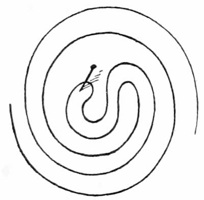
Fig. 35 is arranged for clearness, but in actual practice the tape would receive many more twists, which would also be of a more intricate nature.
CHAPTER IX
MISCELLANEOUS TRICKS
Flash Paper.—Having had occasion several times during the course of the present work to make use of "flash paper," I will now describe the manner in which it is prepared. It is not, however, practical to manufacture it at home, as it can be obtained in large quantities at a very small cost.
A mixture of nitric and sulphuric acids, one part of the former to two of the latter, is made, and allowed to stand for twelve hours before using. The experiment should be made in the open air. Ordinary tissue paper is then immersed in the fluid for a few seconds, after which it is taken out and washed well in clear water, until all trace of the acid has been removed. This can be ascertained by the use of blue litmus paper, which when dipped into the water will betray the presence of the acid by turning red. The paper should then be dried in a warm atmosphere, but not near a fire, and it is ready for use.
Flash handkerchiefs are prepared in a similar manner. For this purpose take a piece of fine cambric, wash it well in hot water to remove all grease and other impurities, and then treat it in the same way as the paper.
A New Fire Flash.—This forms a very good opening trick. The performer steps on the stage and, in what appears to be a careless manner, picks up a piece of paper from the floor, rolls it up in his hands, and throws it in the air, where it disappears in a flame, leaving no trace behind.
To produce this effect you must obtain some very fine glass tubing about the thickness of a darning needle, and having broken off several pieces about an inch long, fill them with sulphuric acid. This can be done with the aid of a long piece of india-rubber tubing, the acid being drawn into the glass by suction. The ends of the tube are then sealed hermetically in the flame of a spirit lamp. You must next prepare a powder composed of equal parts of chlorate of potass and powdered lump sugar. Wrap a very small quantity of this powder—about as much as will lie on a penny—together with one of the acid tubes in a piece of flash paper, and all is ready.
When rolling up the paper in the hands the tube is broken; the acid escapes and fires the powder, which in turn sets fire to the paper and produces the desired result.
Caution.—To prevent accidents never prepare the papers or even mix the powder, until actually required for use.
Conjurer's Ammunition.—The magic pistol described on p. 61 is usually loaded with a small charge of powder. This is excellent for stage purposes, but hardly suitable for the drawing-room, where some objection might be taken to the employment of powder, even in a small quantity. The pistol, however, need not be discarded, as it can still be used in a manner that will in no way detract from the charm of the trick. Load the pistol with a piece of flash paper, place a percussion cap on the nipple, and pull the trigger. The paper will take fire and be thrown from the pistol, vanishing in a sheet of flame at the opposite end of the room.
Again, the pistol need not be loaded at all, but just as you are about to fire you appear to understand that the ladies object, and remark—"Oh! I see the ladies object to the report—well in that case I will use the pistol as an air-gun." Saying this, you remove the conical tube and blow through it to cause the supposed transmission.
Smoke from Two Empty Pipes.—Two empty and clean clay pipes are passed round for examination and proved ostensibly to be unprepared. The bowls are then placed one over the other, when the performer, by simply inserting one of the stems in his mouth, commences to blow clouds of smoke from the pipes.
The solution of the mystery is as follows:—A few drops of hydrochloric acid (spirits of salts) are placed in one of the pipes, while the other is similarly treated with ammonia. The union of the two chemicals produces a thick vapor, which has all the appearance of smoke produced from tobacco.
A good combination trick may be formed by preparing a glass tumbler and the bottom of a tea plate, as above described; the plate is then placed over the tumbler, the whole being covered with a handkerchief. The smoke so mysteriously produced from the pipes may now be caused, apparently by some occult means, to find its way into the closed tumbler.
Fire-eating Trick.—This, although a very startling trick, is quite harmless, and can be performed by any one. Small balls of fire are placed in the mouth and, apparently, swallowed, being immediately afterward produced from the ears, or any part of the body that fancy may suggest.
The balls are small pieces of camphor cut to shape, and are lighted in the flame of a candle. They should be tossed from one hand to the other, and finally into the mouth, which should forthwith be closed. This, of course, extinguishes the balls, which should be secretly removed at the earliest opportunity.
The reproduction of the balls of fire is managed with the aid of the acid tubes mentioned on p. 160, which, together with a small quantity of the powder, should be wrapped up in flash paper, and deposited about the person as required. The best effect, however, is obtained by producing them from behind the ears; it is also a very convenient method, as the tubes are not so likely to be prematurely fractured.
Exploding Soap-bubbles.—This is a novelty, and will be found to produce a very good effect. The bubbles are blown in the usual way with an ordinary clay pipe, the only preparation necessary being that the bowl of the pipe must be filled with cotton-wool soaked in gasolene. Bubbles blown with a pipe thus prepared will be found to explode in a flame when approached with a light.
The Tube and Ball.—This is a very ingenious trick, and well worth the attention of the most fastidious performer. It can be used in several ways.
Fig. 36.-Tube and Ball
The apparatus consists of a piece of one and one-half inch brass tubing about seven inches long, with a cap of the same metal fitting loosely over one end; also two billiard balls about the size of the diameter of the tube. The audience, however, are not supposed to know of the existence of more than one ball. (See Fig. 35.) The tube and cap, together with the ball, are given for examination, attention being drawn to the fact that the ball will readily pass through the tube. After examination the tube is stood on one end on the table and covered with the cap. The operator then takes the ball and vanishes it by means of sleight of hand, when, on the tube being raised, it has to all appearance been passed underneath.
The secret lies in the fact that there is a very small dent in the side of the tube at the centre; also that one of the balls—that given for examination—is slightly smaller than the other. The small ball runs freely through the tube, but the large one will not pass the centre on account of the indentation.
On receiving back the tube the performer secretly drops the large ball into it, which, owing to the force of the fall, is pinched in the centre and will not fall out. In this condition the tube can be turned about in all directions and will still appear empty. When placing it on the table the performer is careful to bring it down rather smartly on the end at which the ball was introduced, when, owing to the concussion, the ball is released and falls on the table.
The tube can be used to cause the disappearance of a ball in the following manner:—Place the ball on a tea plate and cover it with the tube, which in turn cover with a second plate. By reversing the position of the structure the ball falls into the tube, where it is retained in the manner described, and after a little more twisting and turning, to add to the general confusion, the plates are removed and the ball is proved to have disappeared.
The ball can of course be reproduced if desired; or if two tubes are used it may be, apparently, passed from one to the other. In this case, however, it is suggested that round discs of wood be used in place of the plates, as the latter would be likely to get fractured in the act of bringing the tube down with sufficient force to dislodge the ball.
The Ubiquitous Thimble.—This is one of the prettiest sleight of hand tricks in existence, and requires very little practice. For the purpose of the trick, in its entirety, the performer must be provided with two thimbles exactly alike; but very many surprising passes can be made with one thimble only. The idea of the trick proper is to cause a thimble placed on the forefinger of the right hand to disappear and be found on the corresponding finger of the left hand, without the hands approaching each other. It is usual, however, in the first place, to execute a number of passes with one thimble only, as by this means the audience will be the less likely to suspect the introduction of the second one. The main thing necessary is to acquire the knack of holding a thimble in the fleshy portion of the hand at the root of the thumb, in which position it can be placed, or removed at pleasure, by simply bending the forefinger. (See Figs. 37 and 38.) This sleight must be executed with equal facility with both hands.
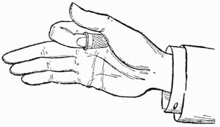
Fig. 37.—Thimble Trick
When about to present the trick the performer comes forward with a thimble on the forefinger of the right hand, the second one being in the left-hand trousers pocket. He now appears to place the thimble in the left hand, but really, when the right hand is in motion toward the left, it is palmed as described. The left hand is then brought down with some force on the head and the thimble produced from the mouth on the forefinger of the right hand. This can be done with perfect ease, as, so long as the hand is kept in motion during the recovery of the thimble, there is no fear of the movement being detected.
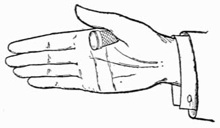
Fig. 38.—Thimble at Root of Thumb
The thimble is then apparently placed in the mouth, really being palmed as before, and afterward produced from the bottom of the vest. While doing this the performer stands with the left hand in the trousers pocket and palms the second thimble. Both hands are now held palms away from the spectators, and kept in continual motion. Under cover of this the right-hand thimble is palmed, and that in the left hand produced, when it will appear to have been passed from one hand to the other. This can be repeated as often as desired.
Finally the second thimble should be secretly disposed of, and the trick brought to a conclusion with a pass performed with the one only.
An additional effect may be obtained by the use of two thimbles, one fitting over the other. These should be made in thin metal so as to be, in point of size, as near alike as possible. The two thimbles, which appear as one only, are placed on the forefinger of the right hand, and covered with a small paper cone, with the remark, "You see the cone just fits the thimble; I will now show you a rather extraordinary experiment with the same." The cone is then removed, with slight pressure at the base, and placed on the table on the supposition that it is empty, but it really contains the uppermost thimble. The one left on the finger is then vanished, under cover of a throwing movement toward the cone, which is then removed by the apex and the thimble discovered.