Chapter IX · MACHINE GUNS IN THE ARMIES OF THE WORLD (continued 2)
Reading edition
Art. 69.—In the offensive in case of success: The machine guns will rapidly and boldly move to a favourable position to pursue the enemy with their fire and to make their infantry powerless to attempt a counter-attack. The energetic action of the machine guns after the position has been carried will force the enemy to scatter.
Art. 70.—In the offensive in case of failures: The machine guns will sacrifice themselves, if necessary, to cover their infantry. They will break down the morale of hostile troops by riddling them with fire without care for their own losses, and will thus facilitate the retreat of their own infantry.[70]
Machine Guns in the late War
All officers are enthusiastic about machine guns. All agree that their chief rôle is defence, even at night, and they are extremely useful in attack. During the battle of Mukden machine guns were used very much in the attack by the Japanese, but it seems that the casualties of the machine-gun detachments were very heavy indeed; one commander thought them especially useful in pursuit.[71]
Remarks by Lt.-Gen. Sir C. J. Burnett, K.C.B.
The value of machine guns is fully recognised. I had a long conversation with the brigade machine-gun officer. He has six machine guns formed as a separate detachment, extra-regimental, and attached to the brigade. Two guns under an officer form the subdivision of his command, and can be detached at will, but no machine gun is ever employed singly. The guns are usually kept at the disposal of the brigadier, and have been used more in defence than attack; they seldom open at long ranges unless on an exceptionally good target. It is rather the rule to reserve the machine-gun fire for decisive ranges. In many actions which cavalry officers described to me, the practice has been to allow the enemy to come within 600 yards before opening fire, and then suddenly to overwhelm him. The principle with such well-trained troops is sound, for the morale “knock-out” of a 10-per-cent. loss suffered in a few minutes is far greater than a similar loss spread over the advance from 1,000 to 600 yards, and the expenditure of ammunition is less. Concealment is an essential feature of the Japanese machine-gun tactics, and the officer told me he had not a single gun put out of action by opposing artillery. The guns have shields; the manipulators of the machine guns are very expert, and there is now seldom a jam. Like a good chauffeur, the Japanese machine gunner knows all the peculiarities of the weapon he fires, and can almost tell by instinct when anything is going wrong. Four thousand rounds is the most that has been fired in a day by three machine guns of the 1st Cavalry Brigade; the number is now increased to six. Throughout the Japanese Army the machine guns introduced during the war are very popular, and instead of three per regiment, six per regiment are being provided.
Report by U.S.A. Officers on Russo-Japanese War
These guns were highly thought of in the Japanese Army, and the propriety of attaching them to the infantry was never questioned. Four or six guns per battery and one battery per regiment were usually suggested, although good arguments have been heard for eight guns in a battery, and the wish for twelve was sometimes expressed.... On the outbreak of war the Japanese expected largely to limit the use of the machine gun to the defensive, but experience soon taught them to widen its field, and later it was used to great advantage on the offensive. Their rapid fire frequently silenced the fire of the Russian infantry, and caused the latter to crouch down in their trenches. When the guns stopped firing the Russians could be seen again popping their heads above the parapet. If the flanks of a line be weak, these weapons can be used advantageously to strengthen them. Six guns were generally recommended for a battery, thus permitting an assignment of two per battalion. One officer of high rank, however, who was heard to discuss this question ably, said he preferred eight guns, and that he would divide these into two equal sections and assign each section to a battalion, thus leaving the third battalion without any. His idea was to use these guns both on the offensive and defensive. On the offensive he would send them forward among the first lines of the battalion to which they were attached, or reinforce these lines by the guns at an early stage of the action. In this way he would use them as a substitute for infantry reinforcements. This system will enable the regimental commander to hold the third battalion much longer intact for a decisive effort when an opportunity offers. Officers who have had experience with machine guns were opposed to using them singly, saying that never less than two should be at any position not only to obtain volume of fire, but also because a gun can so easily be put out of action. In order to reduce the losses among the men from shrapnel fire to a minimum, they recommend that the guns in a platoon be separated by 20 metres and the platoons by 100 to 200 metres. Artillery fire is looked upon as the most dangerous foe of the machine gun, and in fact the most effective use of the latter on the offensive presupposes the enemy’s artillery has been silenced, or at least that its attention is well occupied by friendly batteries. The machine gun is believed to be especially useful in mountainous districts, where the elevated ground often discloses the close formation of the enemy. The Japanese frequently fired it from an elevated position over the heads of their infantry, and in this way, as their battalions advanced, they at times kept down the fire from the Russian trenches.
An officer who commanded one of these batteries at the battle of Mukden, and who later was detailed to lecture to the attachés with the First Army, said that on one occasion there he continued this fire until the advancing infantry had arrived within 30 metres of the enemy’s position. It is claimed the fire should almost invariably be directed against the opposing infantry. The gun is comparatively heavy, and when in action the battery is advancing with the infantry it is sometimes difficult to keep up with the latter, and moreover the men carrying the gun offer a good target; and for these reasons the guns should frequently remain in position as the echelons make their rushes, provided cover is provided and a free field of fire secured. It is not essential that they should be at all times immediately on the line occupied by the infantry, although when the latter, after a considerable advance, meets with determined opposition, some guns should be brought up. This will give a feeling of confidence, and if need be help to check a counter-attack. When advancing under fire, it is often a good plan to move one gun at a time. Battery commanders report good results when firing at long ranges—that is, between 1,200 and 1,800 metres. One thousand five hundred shots per gun is the greatest number I heard of being fired in one hour. These guns were sometimes attached to outposts. The loss among men serving machine guns is usually great, and this requires that a large number be trained in each regiment to use them. One officer of experience with these weapons thought all officers and men selected to work with them should be trained at division headquarters, or at some other central point, in order to secure uniformity of instruction and service.
On a previous occasion I reported that the shield was not generally desired. I wish to modify this statement, as further investigation showed that while different views were entertained on this subject, the consensus of opinion was favourable to the retention of the shield. The objections to it are that it offers a good target and is more or less difficult to handle on the offensive. Some officers were in favour of using it on the defensive, but not on the offensive. In general, however, it was thought that both on the offensive and defensive it gives material cover and adds confidence and composure. The guns were almost invariably transported on pack-ponies, except, of course, when effecting changes of position under heavy fire, when they were carried by hand. It is understood wheels were occasionally used in some parts of the army, but I never saw the guns transported that way....
Machine guns were also added to the cavalry after the outbreak of the war, there being six to each brigade, divided into sections of two guns under one officer. Sections may be attached to squadrons as required. The guns are used primarily for defence, and their fire reserved for short and mid ranges....
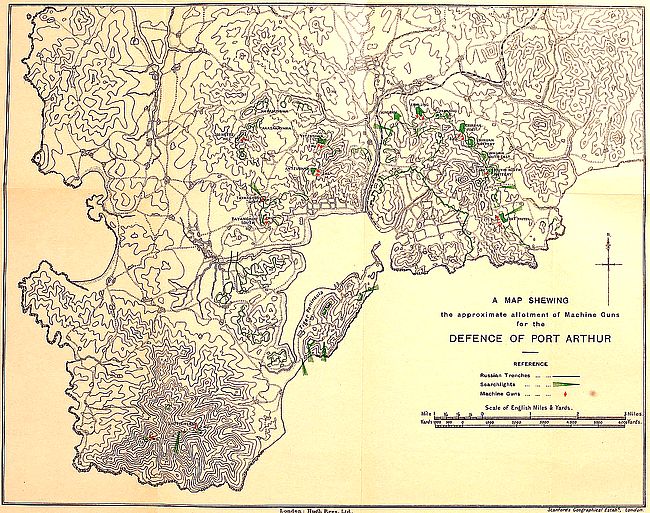
Machine guns played an important part in the siege of Port Arthur, being freely used by both sides. The Japanese gun was a single-barrelled gun of home manufacture, while the Russians used mainly the Maxim automatic. The Russian guns were used with telling effect against the Japanese in the numerous bloody assaults, being trained to cover all the approaches with a murderous fire.
PORTUGAL
On mobilisation machine-gun foot batteries are formed, the personnel being provided from the division to which the batteries are subsequently attached. Each battery consists of 6 guns, and is commanded by a captain. It is subdivided into 3 sections of 2 guns each, commanded by a subaltern.
The gun is provided with a shield and has a tripod mounting, the whole being carried on a wheeled carriage on the march. When coming into action the gun and tripod are taken out of the carriage and carried into position by 4 men.
The weight of the gun, tripod, and shield, amounting to about 175 lb., is unevenly distributed and renders rapid marching impossible, as it must be carried as one piece owing to the complicated attachment of gun and tripod.
The tripod is heavy and rather high, making the gun conspicuous in action, and on steep slopes the mounting is unstable.
The elevating and traversing gear do not give sufficient scope.
The cartridge belt contains 250 rounds. Each section (2 guns) has an ammunition wagon carrying 14,000 rounds for each gun.
RUSSIA
Guns.—Rexar and Maxim, but the former are being discarded and Maxims alone will be used in future. They are sighted up to 2,000 yards.
Organisation.—Each regiment (4 battalions) has 4 machine guns, and it is intended to increase this to 8 in the future.
The detail of the personnel to each battery of 4 guns is as follows: 2 officers, 50 N.C.O.’s and men, and 35 horses if the guns are on wheeled carriages (36 horses if the guns are carried on pack-horses).
The detachment is armed with the carbine.
For each gun 13 belts of ammunition are carried, each belt containing 450 rounds.
The weight of the gun is 68 lb., and of the tripod 45 lb.; the total weight carried by the pack-horse being 198 lb.
SPAIN
has 6 groups of Maxim and Hotchkiss guns, which have been recently subdivided into 2 sections. Two new sections were raised in September 1908.
The 14 sections are attached to the infantry brigades.
Pack transport has been adopted.
SWITZERLAND
There are 4 companies, each having 8 guns, which are subdivided into sections of 2 guns each.
The detachments are mounted and the guns are allotted to the cavalry.
The Maxim is the gun adopted by the Swiss Army, and in the Regulations three kinds of machine-gun fire are recognised, viz.:
(1) Salvoes, for range-finding.—The 2 guns of a section fire short salvoes of 20 to 25 rounds alternately to get the right range.
(2) Quick fire.—This is the normal method, and consists in firing about 100 rounds at a time.
(3) Rapid fire by individual guns.—Each gun fires as rapidly as possible; used only as a last resort, or against a specially favourable target.
The section (2 guns) is regarded as the unit, and the spirit of the Regulations is that the machine guns are particularly for use with cavalry, and must possess to the full the mobility and dash of that arm.
Dismounted action for the cavalry is not favourably regarded, and the machine guns are expected to relieve the cavalry of this duty.
PRINTED BY HAZELL, WATSON AND VINEY, LD. LONDON AND AYLESBURY.
View Larger Image Here.
A MAP SHEWING the approximate allotment of Machine Guns for the DEFENCE OF PORT ARTHUR