LULU'S LIBRARY, VOLUME III (continued 3)
Reading edition
"Never mind, dear, they don't mean to be rude; it's only our Yankee way of asking questions. I like all your things, and that hat is perfectly lovely."
"Indeed, yes! Dear mamma arranged it for me. I was thinking of her and longing for my morning kiss."
"Do you do that every day?" asked Fanny, forgetting herself in her sympathetic interest.
"Surely, yes. Papa and mamma sit always on the sofa, and we all have the hand-shake and the embrace each day before our morning coffee. I do not see that here," answered Sophie, who sorely missed the affectionate respect foreign children give their parents.
"Have n't time," said Fanny, smiling too, at the idea of American parents sitting still for five minutes in the busiest part of the busy day to kiss their sons and daughters.
"It is what you call old-fashioned, but a sweet fashion to me; and since I have not the dear warm cheeks to kiss, I embrace my pictures often. See, I have them all." And Sophie unfolded a Russia-leather case, displaying with pride a long row of handsome brothers and sisters with the parents in the midst.
More exclamations from the girls, and increased interest in "Wilhelmina Tell," as they christened the loyal Swiss maiden, who was now accepted as a companion, and soon became a favorite with old and young.
They could not resist teasing her, however,--her mistakes were so amusing, her little flashes of temper so dramatic, and her tongue so quick to give a sharp or witty answer when the new language did not perplex her. But Fanny always took her part, and helped her in many ways. Now they sat together on the rock, a pretty pair of mermaids with wind-tossed hair, wave-washed feet, and eyes fixed on the approaching boat.
The girl who sat in it was a great contrast to the gay creatures grouped so picturesquely on the shore, for the old straw hat shaded a very anxious face, the brown calico gown covered a heart full of hopes and fears, and the boat that drifted so slowly with the incoming tide carried Tilly Reed like a young Columbus toward the new world she longed for, believed in, and was resolved to discover.
It was a weather-beaten little boat, yet very pretty; for a pile of nets lay at one end, a creel of red lobsters at the other, and all between stood baskets of berries and water-lilies, purple marsh rosemary and orange butterfly-weed, shells and great smooth stones such as artists like to paint little sea-views on. A tame gull perched on the prow; and the morning sunshine glittered from the blue water to the bluer sky.
"Oh, how pretty! Come on, please, and sell us some lilies," cried Dora, and roused Tilly from her waking dream.
Pushing back her hat, she saw the girls beckoning, felt that the critical moment had come, and catching up her oars, rowed bravely on, though her cheeks reddened and her heart beat, for this venture was her last hope, and on its success depended the desire of her life. As the boat approached, the watchers forgot its cargo to look with surprise and pleasure at its rower, for she was not the rough country lass they expected to see, but a really splendid girl of fifteen, tall, broad-shouldered, bright-eyed, and blooming, with a certain shy dignity of her own and a very sweet smile, as she nodded and pulled in with strong, steady strokes. Before they could offer help, she had risen, planted an oar in the water, and leaping to the shore, pulled her boat high up on the beach, offering her wares with wistful eyes and a very expressive wave of both brown hands.
"Everything is for sale, if you 'll buy," said she.
Charmed with the novelty of this little adventure, the girls, after scampering to the bathing-houses for purses and portemonnaies, crowded around the boat like butterflies about a thistle, all eager to buy, and to discover who this bonny fisher-maiden might be.
"Oh, see these beauties!" "A dozen lilies for me!" "All the yellow flowers for me, they'll be so becoming at the dance to-night!" "Ow! that lob bites awfully!" "Where do you come from?" "Why have we never seen you before?"
These were some of the exclamations and questions showered upon Tilly, as she filled little birch-bark panniers with berries, dealt out flowers, or dispensed handfuls of shells. Her eyes shone, her cheeks glowed, and her heart danced in her bosom; for this was a better beginning than she had dared to hope for, and as the dimes tinkled into the tin pail she used for her till, it was the sweetest music she had ever heard. This hearty welcome banished her shyness; and in these eager, girlish customers she found it easy to confide.
"I 'm from the light-house. You have never seen me because I never came before, except with fish for the hotel. But I mean to come every day, if folks will buy my things, for I want to make some money, and this is the only way in which I can do it."
Sophie glanced at the old hat and worn shoes of the speaker, and dropping a bright half-dollar into the pail, said in her pretty way:
"For me all these lovely shells. I will make necklaces of them for my people at home as souvenirs of this charming place. If you will bring me more, I shall be much grateful to you."
"Oh, thank you! I 'll bring heaps; I know where to find beauties in places where other folks can't go. Please take these; you paid too much for the shells;" and quick to feel the kindness of the stranger, Tilly put into her hands a little bark canoe heaped with red raspberries.
Not to be outdone by the foreigner, the other girls emptied their purses and Tilly's boat also of all but the lobsters, which were ordered for the hotel.
"Is that jolly bird for sale?" asked Di, as the last berry vanished, pointing to the gull who was swimming near them while the chatter went on.
"If you can catch him," laughed Tilly, whose spirits were now the gayest of the party.
The girls dashed into the water, and with shrieks of merriment swam away to capture the gull, who paddled off as if he enjoyed the fun as much as they.
Leaving them to splash vainly to and fro, Tilly swung the creel to her shoulder and went off to leave her lobsters, longing to dance and sing to the music of the silver clinking in her pocket.
When she came back, the bird was far out of reach and the girls diving from her boat, which they had launched without leave. Too happy to care what happened now, Tilly threw herself down on the warm sand to plan a new and still finer cargo for next day.
Sophie came and sat beside her while she dried her curly hair, and in five minutes her sympathetic face and sweet ways had won Tilly to tell all her hopes and cares and dreams.
"I want schooling, and I mean to have it. I 've got no folks of my own; and uncle has married again, so he does n't need me now. If I only had a little money, I could go to school somewhere, and take care of myself. Last summer I worked at the hotel, but I did n't make much, and had to have good clothes, and that took my wages pretty much. Sewing is slow work, and baby-tending leaves me no time to study; so I 've kept on at home picking berries and doing what I could to pick up enough to buy books. Aunt thinks I 'm a fool; but uncle, he says, 'Go ahead, girl, and see what you can do.' And I mean to show him!"
Tilly's brown hand came down on the sand with a resolute thump; and her clear young eyes looked bravely out across the wide sea, as if far away in the blue distance she saw her hope happily fulfilled.
Sophie's eyes shone approval, for she understood this love of independence, and had come to America because she longed for new scenes and greater freedom than her native land could give her. Education is a large word, and both girls felt that desire for self-improvement that comes to all energetic natures. Sophie had laid a good foundation, but still desired more; while Tilly was just climbing up the first steep slope which rises to the heights few attain, yet all may strive for.
"That is beautiful! You will do it! I am glad to help you if I may. See, I have many books; will you take some of them? Come to my room to-morrow and take what will best please you. We will say nothing of it, and it will make me a truly great pleasure."
As Sophie spoke, her little white hand touched the strong, sunburned one that turned to meet and grasp hers with grateful warmth, while Tilly's face betrayed the hunger that possessed her, for it looked as a starving girl's would look when offered a generous meal.
"I will come. Thank you so much! I don't know anything, but just blunder along and do the best I can. I got so discouraged I was real desperate, and thought I 'd have one try, and see if I could n't earn enough to get books to study this winter. Folks buy berries at the cottages; so I just added flowers and shells, and I 'm going to bring my boxes of butterflies, birds' eggs, and seaweeds. I 've got lots of such things; and people seem to like spending money down here. I often wish I had a little of what they throw away."
Tilly paused with a sigh, then laughed as an impatient movement caused a silver clink; and slapping her pocket, she added gayly,--
"I won't blame 'em if they 'll only throw their money in here."
Sophie's hand went involuntarily toward her own pocket, where lay a plump purse, for papa was generous, and simple Sophie had few wants. But something in the intelligent face opposite made her hesitate to offer as a gift what she felt sure Tilly would refuse, preferring to earn her education if she could.
"Come often, then, and let me exchange these stupid bills for the lovely things you bring. We will come this afternoon to see you if we may, and I shall like the butterflies. I try to catch them; but people tell me I am too old to run, so I have not many."
Proposed in this way, Tilly fell into the little trap, and presently rowed away with all her might to set her possessions in order, and put her precious earnings in a safe place. The mermaids clung about the boat as long as they dared, making a pretty tableau for the artists on the rocks, then swam to shore, more than ever eager for the picnic on Light-house Island.
They went, and had a merry time; while Tilly did the honors and showed them a room full of treasures gathered from earth, air, and water, for she led a lonely life, and found friends among the fishes, made playmates of the birds, and studied rocks and flowers, clouds and waves, when books were wanting.
The girls bought gulls' wings for their hats, queer and lovely shells, eggs and insects, seaweeds and carved wood, and for their small brothers, birch baskets and toy ships, made by Uncle Hiram, who had been a sailor.
When Tilly had sold nearly everything she possessed (for Fanny and Sophie bought whatever the others declined), she made a fire of drift-wood on the rocks, cooked fish for supper, and kept them till moonrise, telling sea stories or singing old songs, as if she could not do enough for these good fairies who had come to her when life looked hardest and the future very dark. Then she rowed them home, and promising to bring loads of fruit and flowers every day, went back along a shining road, to find a great bundle of books in her dismantled room, and to fall asleep with wet eyelashes and a happy heart.
,, class:: center medium
II.
For a month Tilly went daily to the Point with a cargo of pretty merchandise, for her patrons increased; and soon the ladies engaged her berries, the boys ordered boats enough to supply a navy, the children clamored for shells, and the girls depended on her for bouquets and garlands for the dances that ended every summer day. Uncle Hiram's fish was in demand when such a comely saleswoman offered it; so he let Tilly have her way, glad to see the old tobacco-pouch in which she kept her cash fill fast with well-earned money.
She really began to feel that her dream was coming true, and she would be able to go to the town and study in some great school, eking out her little fund with light work. The other girls soon lost their interest in her, but Sophie never did; and many a book went to the island in the empty baskets, many a helpful word was said over the lilies or wild honeysuckle Sophie loved to wear, and many a lesson was given in the bare room in the light-house tower which no one knew about but the gulls and the sea-winds sweeping by the little window where the two heads leaned together over one page.
"You will do it, Tilly, I am very sure. Such a will and such a memory will make a way for you; and one day I shall see you teaching as you wish. Keep the brave heart, and all will be well with you," said Sophie, when the grand breaking-up came in September, and the girls were parting down behind the deserted bathhouses.
"Oh, Miss Sophie, what should I have done without you? Don't think I have n't seen and known all the kind things you have said and done for me. I 'll never forget 'em; and I do hope I 'll be able to thank you some day," cried grateful Tilly, with tears in her clear eyes that seldom wept over her own troubles.
"I am thanked if you do well. Adieu; write to me, and remember always that I am your friend."
Then they kissed with girlish warmth, and Tilly rowed away to the lonely island; while Sophie lingered on the shore, her handkerchief fluttering in the wind, till the boat vanished and the waves had washed away their footprints on the sand.
,, class:: center medium
III.
December snow was falling fast, and the wintry wind whistled through the streets; but it was warm and cosey in the luxurious parlor where Di and Do were sitting making Christmas presents, and planning what they would wear at the party Fanny was to give on Christmas Eve.
"If I can get mamma to buy me a new dress, I shall have something yellow. It is always becoming to brunettes, and I 'm so tired of red," said Di, giving a last touch to the lace that trimmed a blue satin sachet for Fanny.
"That will be lovely. I shall have pink, with roses of the same color. Under muslin it is perfectly sweet." And Dora eyed the sunflower she was embroidering as if she already saw the new toilet before her.
"Fan always wears blue, so we shall make a nice contrast. She is coming over to show me about finishing off my banner-screen; and I asked Sophie to come with her. I want to know what she is going to wear," said Di, taking a little sniff at the violet-scented bag.
"That old white cashmere. Just think! I asked her why she did n't get a new one, and she laughed and said she could n't afford it. Fan told me Sophie's father sent her a hundred dollars not long ago, yet she has n't got a thing that we know of. I do think she 's mean."
"She bought a great bundle of books. I was there when the parcel came, and I peeped while she was out of the room, because she put it away in a great hurry. I 'm afraid she is mean, for she never buys a bit of candy, and she wears shabby boots and gloves, and she has made over her old hat instead of having that lovely one with the pheasant's breast in it."
"She's very queer; but I can't help liking her, she's so pretty and bright and obliging. I 'd give anything if I could speak three languages and play as she does."
"So would I. It seems so elegant to be able to talk to foreigners. Papa had some Frenchmen to dinner the other day, and they were so pleased to find they need n't speak English to Sophie. I could n't get on at all; and I was so mortified when papa said all the money he had spent on my languages was thrown away."
"I would n't mind. It's so much easier to learn those things abroad, she would be a goose if she did n't speak French better than we do. There's Fan! she looks as if something had happened. I hope no one is ill and the party spoiled."
As Dora spoke, both girls looked out to see Fanny shaking the snow from her seal-skin sack on the doorstep; then Do hastened to meet her, while Di hid the sachet, and was hard at work on an old-gold sofa cushion when the new-comer entered.
"What's the matter? Where's Sophie?" exclaimed the girls together, as Fan threw off her wraps and sat down with a tragic sigh.
"She will be along in a few minutes. I 'm disappointed in her! I would n't have believed it if I had n't seen them. Promise not to breathe a word to a living soul, and I 'll tell you something dreadful," began Fanny, in a tone that caused her friends to drop their work and draw their chairs nearer, as they solemnly vowed eternal silence.
"I 've seen Sophie's Christmas presents,--all but mine; and they are just nothing at all! She has n't bought a thing, not even ribbons, lace, or silk, to make up prettily as we do. Only a painted shell for one, an acorn emery for another, her ivory fan with a new tassel for a third, and I suspect one of those nice handkerchiefs embroidered by the nuns for me, or her silver filigree necklace. I saw the box in the drawer with the other things. She's knit woollen cuffs and tippets for the children, and got some eight-cent calico gowns for the servants. I don't know how people do things in Switzerland, but I do know that if I had a hundred dollars in my pocket, I would be more generous than that!"
As Fanny paused, out of breath, Di and Do groaned in sympathy, for this was indeed a sad state of things; because the girls had a code that Christmas being the season for gifts, extravagance would be forgiven then as at no other time.
"I have a lovely smelling-bottle for her; but I 've a great mind not to give it now," cried Di, feeling defrauded of the bracelet she had plainly hinted she would like.
"I shall heap coals of fire on her head by giving her that;" and Dora displayed a very useless but very pretty apron of muslin, lace, and carnation ribbon.
"It is n't the worth of the things. I don't care for that so much as I do for being disappointed in her; and I have been lately in more ways than one," said Fanny, listlessly taking up the screen she was to finish. "She used to tell me everything, and now she does n't. I 'm sure she has some sort of a secret; and I do think I ought to know it. I found her smiling over a letter one day; and she whisked it into her pocket and never said a word about it. I always stood by her, and I do feel hurt."
"I should think you might! It's real naughty of her, and I shall tell her so! Perhaps she 'll confide in you then, and you can just give me a hint; I always liked Sophie, and never thought of not giving my present," said Dora, persuasively, for both girls were now dying with curiosity to know the secret.
"I 'll have it out of her, without any dodging or bribing. I 'm not afraid of any one, and I shall ask her straight out, no matter how much she scowls at me," said dauntless Di, with a threatening nod.
"There she is! Let us see you do it now!" cried Fanny, as the bell rang, and a clear voice was heard a moment later asking if Mademoiselle was in.
"You shall!" and Di looked ready for any audacity.
"I 'll wager a box of candy that you don't find out a thing," whispered Do.
"Done!" answered Di, and then turned to meet Sophie, who came in looking as fresh as an Alpine rose with the wintry wind.
"You dear thing! we were just talking of you. Sit here and get warm, and let us show you our gifts. We are almost done, but it seems as if it got to be a harder job each Christmas. Don't you find it so?"
"But no; I think it the most charming work of all the year," answered Sophie, greeting her friend, and putting her well-worn boots toward the fire to dry.
"Perhaps you don't make as much of Christmas as we do, or give such expensive presents. That would make a great difference, you know," said Di, as she lifted a cloth from the table where her own generous store of gifts was set forth.
"I had a piano last year, a set of jewels, and many pretty trifles from all at home. Here is one;" and pulling the fine gold chain hidden under her frills, Sophie showed a locket set thick with pearls, containing a picture of her mother.
"It must be so nice to be rich, and able to make such fine presents. I 've got something for you; but I shall be ashamed of it after I see your gift to me, I 'm afraid."
Fan and Dora were working as if their bread depended on it, while Di, with a naughty twinkle in her eye, affected to be rearranging her pretty table as she talked.
"Do not fear that; my gifts this year are very simple ones. I did not know your custom, and now it is too late. My comfort is that you need nothing, and having so much, you will not care for my--what you call--coming short."
Was it the fire that made Sophie's face look so hot, and a cold that gave a husky sort of tone to her usually clear voice? A curious expression came into her face as her eyes roved from the table to the gay trifles in her friend's hands; and she opened her lips as if to add something impulsively. But nothing came, and for a moment she looked straight out at the storm as if she had forgotten where she was.
"'Shortcoming' is the proper way to speak it But never mind that, and tell me why you say 'too late'?" asked Di, bent on winning her wager.
"Christmas comes in three days, and I have no time," began Sophie.
"But with money one can buy plenty of lovely things in one day," said Di.
"No, it is better to put a little love and hard work into what we give to friends, I have done that with my trifles, and another year I shall be more ready."
There was an uncomfortable pause, for Sophie did not speak with her usual frankness, but looked both proud and ashamed, and seemed anxious to change the subject, as she began to admire Dora's work, which had made very little progress during the last fifteen minutes.
Fanny glanced at Di with a smile that made the other toss her head and return to the charge with renewed vigor.
"Sophie, will you do me a favor?"
"With much pleasure."
"Do has promised me a whole box of French bonbons, and if you will answer three questions, you shall have it."
"Allons," said Sophie, smiling.
"Haven't you a secret?" asked Di, gravely.
"Yes."
"Will you tell us?"
"No."
Di paused before she asked her last question, and Fan and Dora waited breathlessly, while Sophie knit her brows and looked uneasy.
"Why not?"
"Because I do not wish to tell it."
"Will you tell if we guess?"
"Try."
"You are engaged."
At this absurd suggestion Sophie laughed gayly, and shook her curly head.
"Do you think we are betrothed at sixteen in my country?"
"I know that is an engagement ring,--you made such a time about it when you lost it in the water, and cried for joy when Tilly dived and found it."
"Ah, yes, I was truly glad. Dear Tilly, never do I forget that kindness!" and Sophie kissed the little pearl ring in her impulsive way, while her eyes sparkled and the frown vanished.
"I know a sweetheart gave it," insisted Di, sure now she had found a clew to the secret.
"He did," and Sophie hung her head in a sentimental way that made the three girls crowd nearer with faces full of interest.
"Do tell us all about it, dear. It's so interesting to hear love-stories. What is his name?" cried Dora.
"Hermann," simpered Sophie, drooping still more, while her lips trembled with suppressed emotion of some sort.
"How lovely!" sighed Fanny, who was very romantic.
"Tell on, do! Is he handsome?"
"To me the finest man in all the world," confessed Sophie, as she hid her face.
"And you love him?"
"I adore him!" and Sophie clasped her hands so dramatically that the girls were a little startled, yet charmed at this discovery.
"Have you his picture?" asked Di, feeling that she had won her wager now.
"Yes," and pulling out the locket again, Sophie showed in the other side the face of a fine old gentleman who looked very like herself.
"It's your father!" exclaimed Fanny, rolling her blue eyes excitedly. "You are a humbug!" cried Dora. "Then you fibbed about the ring," said Di, crossly.
"Never! It is mamma's betrothal ring; but her finger grew too plump, and when I left home she gave the ring to me as a charm to keep me safe. Ah, ha! I have my little joke as well as you, and the laugh is for me this time." And falling back among the sofa cushions, Sophie enjoyed it as only a gay girl could. Do and Fanny joined her; but Di was much disgusted, and vowed she would discover the secret and keep all the bonbons to herself.
"You are most welcome; but I will not tell until I like, and then to Fanny first. She will not have ridicule for what I do, but say it is well, and be glad with me. Come now and work. I will plait these ribbons, or paint a wild rose on this pretty fan. It is too plain now. Will you that I do it, dear Di?"
The kind tone and the prospect of such an ornament to her gift appeased Di somewhat; but the mirthful malice in Sophie's eyes made the other more than ever determined to be even with her by and by.
Christmas Eve came, and found Di still in the dark, which fact nettled her sadly, for Sophie tormented her and amused the other girls by pretended confidences and dark hints at the mystery which might never, never be disclosed.
Fan had determined to have an unusually jolly party; so she invited only her chosen friends, and opened the festivities with a Christmas tree, as the prettiest way of exchanging gifts and providing jokes for the evening in the shape of delusive bottles, animals full of candy, and every sort of musical instrument to be used in an impromptu concert afterward. The presents to one another were done up in secure parcels, so that they might burst upon the public eye in all their freshness. Di was very curious to know what Fan was going to give her,--for Fanny was a generous creature and loved to give. Di was a little jealous of her love for Sophie, and could n't rest till she discovered which was to get the finer gift.
So she went early and slipped into the room where the tree stood, to peep and pick a bit, as well as to hang up a few trifles of her own. She guessed several things by feeling the parcels; but one excited her curiosity intensely, and she could not resist turning it about and pulling up one corner of the lid. It was a flat box, prettily ornamented with sea-weeds like red lace, and tied with scarlet ribbons. A tantalizing glimpse of jeweller's cotton, gold clasps, and something rose-colored conquered Di's last scruples; and she was just about to untie the ribbons when she heard Fanny's voice, and had only time to replace the box, pick up a paper that had fallen out of it, and fly up the back stairs to the dressing-room, where she found Sophie and Dora surveying each other as girls always do before they go down.
"You look like a daisy," cried Di, admiring Dora with great interest, because she felt ashamed of her prying, and the stolen note in her pocket.
"And you like a dandelion," returned Do, falling back a step to get a good view of Di's gold-colored dress and black velvet bows.
"Sophie is a lily of the valley, all in green and white," added Fanny, coming in with her own blue skirts waving in the breeze.
"It does me very well. Little girls do not need grand toilets, and I am fine enough for a 'peasant,'" laughed Sophie, as she settled the fresh ribbons on her simple white cashmere and the holly wreath in her brown hair, but secretly longing for the fine dress she might have had.
"Why didn't you wear your silver necklace? It would be lovely on your pretty neck," said Di, longing to know if she had given the trinket away.
But Sophie was not to be caught, and said with a contented smile, "I do not care for ornaments unless some one I love gives me them. I had red roses for my bouquet de corsage; but the poor Madame Page was so triste, I left them on her table to remember her of me. It seemed so heartless to go and dance while she had only pain; but she wished it."
"Dear little Sophie, how good you are!" and warm-hearted Fan kissed the blooming face that needed no roses to make it sweet and gay.
Half an hour later, twenty girls and boys were dancing round the brilliant tree. Then its boughs were stripped. Every one seemed contented; even Sophie's little gifts gave pleasure, because with each went a merry or affectionate verse, which made great fun on being read aloud. She was quite loaded with pretty things, and had no words to express her gratitude and pleasure.
"Ah, you are all so good to me! and I have nothing beautiful for you. I receive much and give little, but I cannot help it! Wait a little and I will redeem myself," she said to Fanny, with eyes full of tears, and a lap heaped with gay and useful things.
"Never mind that now; but look at this, for here's still another offering of friendship, and a very charming one, to judge by the outside," answered Fan, bringing the white box with the sea-weed ornaments.
Sophie opened it, and cries of admiration followed, for lying on the soft cotton was a lovely set of coral. Rosy pink branches, highly polished and fastened with gold clasps, formed necklace, bracelets, and a spray for the bosom. No note or card appeared, and the girls crowded round to admire and wonder who could have sent so valuable a gift.
"Can't you guess, Sophie?" cried Dora, longing to own the pretty things.
"I should believe I knew, but it is too costly. How came the parcel, Fan? I think you must know all," and Sophie turned the box about, searching vainly for a name.
"An expressman left it, and Jane took off the wet paper and put it on my table with the other things. Here's the wrapper; do you know that writing?" and Fan offered the brown paper which she had kept.
"No; and the label is all mud, so I cannot see the place. Ah, well, I shall discover some day, but I should like to thank this generous friend at once. See now, how fine I am! I do myself the honor to wear them at once."
Smiling with girlish delight at her pretty ornaments, Sophie clasped the bracelets on her round arms, the necklace about her white throat, and set the rosy spray in the lace on her bosom. Then she took a little dance down the room and found herself before Di, who was looking at her with an expression of naughty satisfaction on her face.
"Don't you wish you knew who sent them?"
"Indeed, yes;" and Sophie paused abruptly.
"Well, I know, and I won't tell till I like. It's my turn to have a secret; and I mean to keep it."
"But it is not right," began Sophie, with indignation.
"Tell me yours, and I 'll tell mine," said Di, teasingly.
"I will not! You have no right to touch my gifts, and I am sure you have done it, else how know you who sends this fine cadeau?" cried Sophie, with the flash Di liked to see.
Here Fanny interposed, "If you have any note or card belonging to Sophie, give it up at once. She shall not be tormented. Out with it, Di. I see your hand in your pocket, and I 'm sure you have been in mischief."
"Take your old letter, then. I know what's in it; and if I can't keep my secret for fun, Sophie shall not have hers. That Tilly sent the coral, and Sophie spent her hundred dollars in books and clothes for that queer girl, who'd better stay among her lobsters than try to be a lady," cried Di, bent on telling all she knew, while Sophie was reading her letter eagerly.
"Is it true?" asked Dora, for the four girls were in a corner together, and the rest of the company busy pulling crackers.
"Just like her! I thought it was that; but she would n't tell. Tell us now, Sophie, for I think it was truly sweet and beautiful to help that poor girl, and let us say hard things of you," cried Fanny, as her friend looked up with a face and a heart too full of happiness to help overflowing into words.
"Yes; I will tell you now. It was foolish, perhaps; but I did not want to be praised, and I loved to help that good Tilly. You know she worked all summer and made a little sum. So glad, so proud she was, and planned to study that she might go to school this winter. Well, in October the uncle fell very ill, and Tilly gave all her money for the doctors. The uncle had been kind to her, she did not forget; she was glad to help, and told no one but me. Then I said, 'What better can I do with my father's gift than give it to the dear creature, and let her lose no time?' I do it; she will not at first, but I write and say, 'It must be,' and she submits. She is made neat with some little dresses, and she goes at last, to be so happy and do so well that I am proud of her. Is not that better than fine toilets and rich gifts to those who need nothing? Truly, yes! yet I confess it cost me pain to give up my plans for Christmas, and to seem selfish or ungrateful. Forgive me that."
"Yes, indeed, you dear generous thing!" cried Fan and Dora, touched by the truth.
"But how came Tilly to send you such a splendid present?" asked Di. "Should n't think you 'd like her to spend your money in such things."
"She did not. A sea-captain, a friend of the uncle, gave her these lovely ornaments, and she sends them to me with a letter that is more precious than all the coral in the sea. I cannot read it; but of all my gifts this is the dearest and the best!"
Sophie had spoken eagerly, and her face, her voice, her gestures, made the little story eloquent; but with the last words she clasped the letter to her bosom as if it well repaid her for all the sacrifices she had made. They might seem small to others, but she was sensitive and proud, anxious to be loved in the strange country, and fond of giving, so it cost her many tears to seem mean and thoughtless, to go poorly dressed, and be thought hardly of by those she wished to please. She did not like to tell of her own generosity, because it seemed like boasting; and she was not sure that it had been wise to give so much. Therefore, she waited to see if Tilly was worthy of the trust reposed in her; and she now found a balm for many wounds in the loving letter that came with the beautiful and unexpected gift.
Di listened with hot cheeks, and when Sophie paused, she whispered regretfully,--
"Forgive me, I was wrong! I 'll keep your gift all my life to remember you by, for you are the best and dearest girl I know."
Then with a hasty kiss she ran away, carrying with great care the white shell on which Sophie had painted a dainty little picture of the mermaids waiting for the pretty boat that brought good fortune to poor Tilly, and this lesson to those who were hereafter her faithful friends.
Chapter VII tailpiece
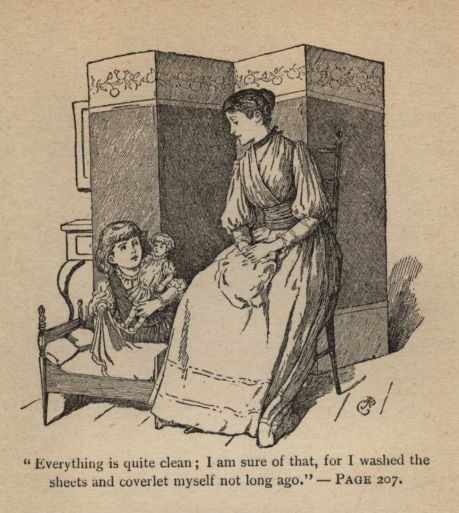
"Everything is quite clean; I am sure of that, for I washed the sheets and coverlet myself not long ago."--PAGE 207.
VIII.
DOLLY'S BEDSTEAD.
"Aunt Pen, where is Ariadne to sleep, please? I wanted to bring her cradle, but mamma said it would take up so much room I could not."
And Alice looked about her for a resting-place for her dolly as anxiously as if Ariadne had been a live baby.
"Can't she lie on the sofa?" asked Aunt Pen, with that sad want of interest in such important matters which grown-up people so often show.
"No, indeed! Some one would sit down on her, of course; and I won't have my darling smashed. You would n't like it yourself, aunty, and I 'm surprised at your proposing such a thing!" cried Alice, clasping her babe with a face full of maternal indignation.
"I beg your pardon! I really forgot that danger. I 'm not so used to infants as you are, and that accounts for it. Now I think of it, there's a little bedstead up garret, and you can have that. You will find it done up in a paper in the great blue chest where all our old toys are kept."
Appeased by Aunt Pen's apology, Alice trotted to the attic, found the bedstead, and came trotting back with a disappointed look on her face.
"It is such a funny, old-fashioned thing I don't know that Ariadne will consent to lie in it. Anyway, I must air the feather-bed and pillows first, or she will get cold. I wish I could wash the sheets too, they are so yellow; but there is no time now," said the little girl, bustling round as she spoke, and laying the little bed-furniture out on the rug.
"Everything is quite clean, my dear; I am sure of that, for I washed the sheets and coverlet myself not long ago, because I found a nest of little mice there the last time I looked," answered Aunt Pen, with her eyes fixed thoughtfully on the small bedstead.
"I guess you used to be fond of it when you were a little girl; and that's why you keep it so nicely now, isn't it?" asked Alice, as she dusted the carved posts and patted the canvas sacking.
"Yes, there's quite a little romance about that bed; and I love it so that I never can give it away, but keep it mended up and in order for the sake of old times and poor Val," said Aunt Pen, smiling and sighing in the same breath.
"Oh, tell about it! I do like to hear stories, and so does Ariadne!" cried Alice, hastily opening dolly's eyes, that she might express her interest in the only way permitted her.
"Well, dear, I 'll tell you this true tale of long ago; and while you listen you can be making a new blanket for the bed. Mrs. Mouse nibbled holes in the other one, and her babies made a mess of it, so I burned it up. Here is a nice little square of flannel, and there are blue, red, and green worsteds for you to work round the edges with."
"Now that is just splendid! I love to work with crewels, and I 'll put little quirls and things in the corners. I can do it all myself, so tell away, please, aunty." And Alice settled herself with great satisfaction, while Ariadne sat bolt upright in her own armchair and stared at Aunt Pen in a way that would have been very embarrassing if her round blue eyes had had a particle of expression in them.
"When I was about ten years old, it was the joy of my heart to go every Saturday afternoon to see my nurse, Betsey Brown. She no longer lived out, but was married to a pilot, and had a home of her own down in what we used to call 'the watery part' of the city. A funny little house, so close to the wharves that when one looked out there were masts going to and fro over the house-tops, and from the upper windows I could see the blue ocean.
"Betsey had a boy with club feet, and a brother who was deformed; but Bobby was my pet playmate, and Valentine my best friend. My chief pleasure was in seeing him work at his turning-lathe, for he was very ingenious, and made all sorts of useful and pretty things.
"But the best thing he did was to cure the lame feet of his little nephew. In those days there were few doctors who attended to such troubles, and they were very expensive; so poor Bobby had gone hobbling about ever since he was born with his little feet turned in.
"Uncle Val could sympathize with him; and though he knew there was no cure for his own crooked back, he did his best to help the boy. He made a very simple apparatus for straightening the crippled feet (just two wooden splints, with wooden screws to loosen or tighten the pressure), and with patience, hope, and faith, he worked over the child till the feet were right, and Bobby could run and play like other children."
"Oh, Aunt Pen, was n't that lovely? And did he really do it all himself? How clever he must have been!" cried Alice, puckering the new blanket in the pleasant interest of the moment.
"He was very clever for a lad of eighteen. But that was not all he did. Bobby's cure was a long one, and I only saw the happy end of it; yet I remember how we all rejoiced, and how proud Betsey was of her brother. My father wrote an account of it for some medical journal, and it was much talked about in our little circle; so much, indeed, that an aunt of ours who had a lame boy came to see Val and talked it all over with him.
"Val was much pleased, and offered to try and cure her son if she would let the boy come and live with him; for it needed great skill and constant care to work the screws just right, and tend the poor little feet gently.
"Aunt Dolly said no at once to that plan; for how could she let her precious boy go and live in that little house down in the poor part of the city?
"There was no other way, however, for Val would not leave his sister and his beloved lathe, and was wise enough to see how impossible it would be to have his own way with the child in a house where every one obeyed his whims and petted him, as such afflicted children usually are petted.
"So Val stood firm, and for a time nothing was done.
"I was much interested in the affair, and every time I saw my cousin Gus I told him what nice times I had down there; how strong and lively Bobby was, and declared my firm belief that Val could cure every disease under the sun.
"These glowing accounts made Gus want to go, and when he set his heart on anything he always got it; so in the end Aunt Dolly consented, and Gus went to board in the little house, much to the wonder of some folks.
"The plan succeeded capitally, however, and Gus thrived like a dandelion in springtime; for simple food, plenty of air, no foolish indulgence, and the most faithful care, built up the little lad in a way that astonished and delighted us all.
"The feet improved slowly; and Val was sure that in time they would be all right, for everything helped on the good work.
"Dear me, what happy days I used to spend at Betsey's! Sometimes Isaac, the jolly, bluff pilot, would take us out in his boat; and then what rosy cheeks and good appetites we got! Sometimes we played in Val's shop, and watched him make pretty things or helped him in some easy job, for he liked to have us near him. And, oh, my heart, what delicious suppers Betsey used to get us in the front room, where all sorts of queer sea treasures were collected,--shells, coral, and seaweed; odd pictures of ships and fish, and old books full of sailor songs and thrilling tales of wrecks."
"I wish I had been there!" interrupted Alice. "Is the house all gone, aunty?"
"All gone, dear, and every one of that merry party but myself," answered Aunt Pen, with a sigh.
"Don't think about the sad part of it, but go on and tell about the bed, please," said Alice, feeling that it was about time this interesting piece of furniture appeared in the story.
"Well, that was made to comfort me when Gus went home, as he did after staying two years. Yes, he went home with straight feet, the heartiest, happiest little lad I ever saw.
"I was heart-broken at losing my playmate, and mourned for him as bitterly as a child could, till Val comforted me, not only by the cunning bedstead for my doll, but by a hundred kindly words and acts, for which I never thanked him half enough.
"Aunt Dolly and my father were so grateful and pleased at Val's success with Gus that they helped him in a plan he had some years later, when he took a larger house in a better place, and with Betsey as nurse, opened a small hospital for the cure of deformed feet. It was an excellent plan; and all was going well, when poor Val wasted rapidly away, and died just as his work began to bring him money and some honor."
"That was very bad! But what became of Bobby and Gus?" asked Alice, who was not of an age to care much about the "sad part" of any story.
"Bob became a sea-captain, and was an excellent fellow till he went down with his ship in a storm after rescuing all his crew, even to the cabin-boy. I'm proud of Bob, and keep those two great pearly shells in memory of him, for he brought them to me after his first voyage."
Aunt Pen's eyes lit up, and her voice rose as she spoke with real pride and affection of honest Captain Brown, who to her was always little Bob.
"I like that, it was so brave and good; but I do wish he had been saved, for then I could have seen him. And maybe he would have brought me a big green parrot that could say funny things. What became of Gus?" asked Alice, after a moment spent in the delightful thought of owning a green parrot with a red tail.
"Ah, my dear, I wish I knew!" exclaimed Aunt Pen, so earnestly that Alice dropped her work, astonished at the change in that usually quiet face.
"Don't tell any more if you 'd rather not," said the little girl, feeling instinctively that she had touched some tender string.
But Aunt Pen only stroked her curly head and went on in a softer tone, with her eyes fixed upon a faded picture that had hung over her work-table ever since Alice could remember.
"I like to tell you, dear, because I want you to love the memory of this old friend of mine. Gus went to sea also, much against his mother's will, for the years spent in the little house near the wharf had given the boy a taste for salt water, and he could not overcome it, though he tried.
"He sailed with Captain Bob all round the world, and would have been with him on that last voyage if a sudden whim had not kept him ashore. More than this we don't know; and for seven years have had no tidings of him. The others give him up, feeling sure that he was lost in the wild hill-country of India, whither he went in search of adventures. I suppose they are right; but I cannot make it true, and still hope to see the dear boy back, or at least to hear some news of him."
"Would n't he be rather an old boy now, Aunt Pen?" asked Alice, softly; for she wanted to chase away the load of pain with a smile if she could.
"Bless my heart, so he would! Forty, at least. Well, well, he never will seem old to me, though his hair should be gray when he comes home." And Aunt Pen did smile as her eyes went back to the faded picture with a tender look that made Alice say timidly, while she laid her blooming cheek against her aunt's hand,--
"Would you mind if I asked if it was Gus who gave you this pretty ring, and was your sweetheart once? Mamma told me you had one, and he was dead; so I must never ask why you did n't marry as she did."
"Yes, he gave me this, and was to come back in a year or two; but I have never seen him since, and never shall, I fear, till we all meet over the great sea at last."
There Aunt Pen broke down, and spreading her hands before her face, sat so still that Alice feared to stir.
Even her careless child's heart was full of pity now; and two great tears rolled down upon the little blanket, to lie sparkling like drops of dew in the heart of the very remarkable red rose she was working in the middle.
Then it was that Ariadne distinguished herself, and proved beyond a doubt that her blue china eyes were worth something. A large, brown, breezy-looking man had been peeping in from the door for several moments, and listening in the most improper manner. No one saw him but Ariadne, and how could she warn the others, poor thing, when she had n't a tongue in her head? Don't tell me that dolls have n't hearts somewhere in their sawdust bosoms! I know better; and I am firmly convinced that Ariadne's was full of sympathy for Aunt Pen; else why should she, a well-bred doll, suddenly and without the least apparent cause, slip out of her chair and fall upon her china nose with a loud whack?
Alice jumped up to catch her darling, and Aunt Pen lifted her head to see what was the matter, and the big brown man, giving his hat a toss, came into the room like a whirlwind!
Alice, Ariadne, bedstead, and blanket, were suddenly swept into a corner by some mysterious means, and lay there in a heap, while the two grown people fell into each other's arms, exclaiming,--
"Pen!"
"Gus!"
I don't know which stared the hardest at this dreadful proceeding, Alice or Ariadne, but I do know that every one was very happy afterward, and that the precious little bedstead was not smashed, for I have seen it with my own eyes.
Chapter VIII tailpiece
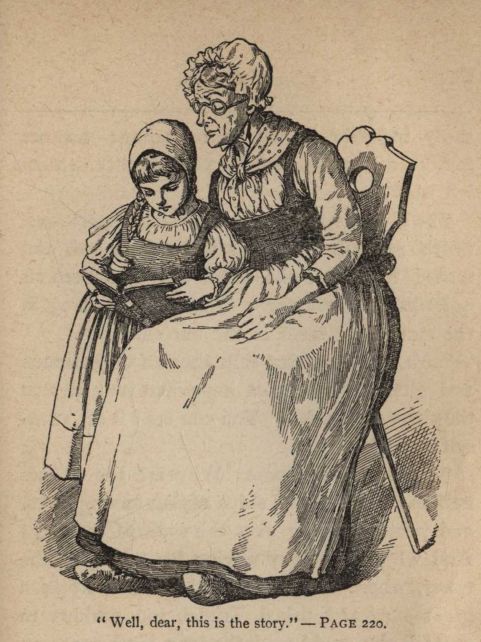
"Well, dear, this is the story."--PAGE 220.
IX.
TRUDEL'S SIEGE.
"Grandmother, what is this curious picture about?" said little Gertrude, or "Trudel," as they called her, looking up from the red book that lay on her knee, one Sunday morning, when she and the grandmother sat sadly together in the neat kitchen; for the father was very ill, and the poor mother seldom left him.
The old woman put on her round spectacles, which made her look as wise as an owl, and turned to answer the child, who had been as quiet as a mouse for a long time, looking at the strange pictures in the ancient book.
"Ah, my dear, that tells about a very famous and glorious thing that happened long ago at the siege of Leyden. You can read it for yourself some day."
"Please tell me now. Why are the houses half under water, and ships sailing among them, and people leaning over the walls of the city? And why is that boy waving his hands on the tower, where the men are running away in a great smoke?" asked Trudel, too curious to wait till she could read the long hard words on the yellow pages.
"Well, dear, this is the story: and you shall hear how brave men and women, and children too, were in those days. The cruel Spaniards came and besieged the city for many months; but the faithful people would not give up, though nearly starved to death. When all the bread and meat were gone and the gardens empty, they ate grass and herbs and horses, and even dogs and cats, trying to hold out till help came to them."
"Did little girls really eat their pussies? Oh, I 'd die before I would kill my dear Jan," cried Trudel, hugging the pretty kitten that purred in her lap.
"Yes, the children ate their pets. And so would you if it would save your father or mother from starving. We know what hunger is; but we won't eat Jan yet."
The old woman sighed as she glanced from the empty table to the hearth where no fire burned.
"Did help come in the ships?" asked the child, bending her face over the book to hide the tears that filled her eyes, for she was very hungry, and had had only a crust for breakfast.
"Our good Prince of Orange was trying to help them; but the Spaniards were all around the city and he had not men enough to fight them by land, so he sent carrier-doves with letters to tell the people that he was going to cut through the great dikes that kept the sea out, and let the water flow over the country so as to drive the enemy from his camp, for the city stood upon high ground, and would be safe. Then the ships, with food, could sail over the drowned land and save the brave people."
"Oh, I 'm glad! I 'm glad! These are the bad Spaniards running away, and these are poor people stretching out their hands for the bread. But what is the boy doing, in the funny tower where the wall has tumbled down?" cried Trudel, much excited.
"The smoke of burning houses rose between the city and the port so the people could not see that the Spaniards had run away; and they were afraid the ships could not get safely by. But a boy who was scrambling about as boys always are wherever there is danger, fire, and fighting, saw the enemy go, and ran to the deserted tower to shout and beckon to the ships to come on at once,--for the wind had changed and soon the tide would flow back and leave them stranded."
"Nice boy! I wish I had been there to see him and help the poor people," said Trudel, patting the funny little figure sticking out of the pepper-pot tower like a jack-in-the-box.
"If children keep their wits about them and are brave, they can always help in some way, my dear. We don't have such dreadful wars now; but the dear God knows we have troubles enough, and need all our courage and faith to be patient in times like these;" and the grandmother folded her thin hands with another sigh, as she thought of her poor son dying for want of a few comforts, after working long and faithfully for a hard master who never came to offer any help, though a very rich man.
"Did they eat the carrier-doves?" asked Trudel, still intent on the story.
"No, child; they fed and cared for them while they lived, and when they died, stuffed and set them up in the Staat Haus, so grateful were the brave burghers for the good news the dear birds brought."
"That is the best part of all. I like that story very much!" And Trudel turned the pages to find another, little dreaming what a carrier-dove she herself was soon to become.
Poor Hans Dort and his family were nearly as distressed as the besieged people of Leyden, for poverty stood at the door, hunger and sickness were within, and no ship was anywhere seen coming to bring help. The father, who was a linen-weaver, could no longer work in the great factory; the mother, who was a lace-maker, had to leave her work to nurse him; and the old woman could earn only a trifle by her knitting, being lame and feeble. Little Trudel did what she could,--sold the stockings to get bread and medicine, picked up wood for the fire, gathered herbs for the poor soup, and ran errands for the market-women, who paid her with unsalable fruit, withered vegetables, and now and then a bit of meat.
But market-day came but once a week; and it was very hard to find food for the hungry mouths meantime. The Dorts were too proud to beg, so they suffered in silence, praying that help would come before it was too late to save the sick and old.
No other picture in the quaint book interested Trudel so much as that of the siege of Leyden; and she went back to it, thinking over the story till hunger made her look about for something to eat as eagerly as the poor starving burghers.
"Here, child, is a good crust. It is too hard for me. I kept it for you; it's the last except that bit for your mother," said the old woman, pulling a dry crust from her jacket with a smile; for though starving herself, the brave old soul thought only of her darling.
Trudel's little white teeth gnawed savagely at the hard bread, and Jan ate the crumbs as if he too needed food. As she saw him purring about her feet, there came into the child's head a sudden idea, born of the brave story and of the cares that made her old before her time.
"Poor Jan gets thinner and thinner every day. If we are to eat him, we must do it soon, or he will not be worth cooking," she said with a curious look on the face that used to be so round and rosy, and now was white, thin, and anxious.
"Bless the child! we won't eat the poor beast! but it would be kind to give him away to some one who could feed him well. Go now, dear, and get a jug of fresh water. The father will need it, and so will you, for that crust is a dry dinner for my darling."
As she spoke, the old woman held the little girl close for a minute; and Trudel clung to her silently, finding the help she needed for her sacrifice in the love and the example grandma gave her.
Then she ran away, with the brown jug in one hand, the pretty kitten on her arm, and courage in her little heart. It was a poor neighborhood where the weavers and lace-makers lived; but nearly every one had a good dinner on Sunday, and on her way to the fountain Trudel saw many well-spread tables, smelled the good soup in many kettles, and looked enviously at the plump children sitting quietly on the doorsteps in round caps and wooden shoes, waiting to be called in to eat of the big loaves, the brown sausages, and the cabbage-soup smoking on the hearth.
When she came to the baker's house, her heart began to beat; and she hugged Jan so close it was well he was thin, or he would have mewed under the tender farewell squeezes his little mistress gave him. With a timid hand Trudel knocked, and then went in to find Vrow Hertz and her five boys and girls at table, with good roast meat and bread and cheese and beer before them.
"Oh, the dear cat! the pretty cat! Let me pat him! Hear him mew, and see his soft white coat," cried the children, before Trudel could speak, for they admired the snow-white kitten very much, and had often begged for it.
Trudel had made up her mind to give up to them at last her one treasure; but she wished to be paid for it, and was bound to tell her plan. Jan helped her, for smelling the meat, he leaped from her arms to the table and began to gnaw a bone on Dirck's plate, which so amused the young people that they did not hear Trudel say to their mother in a low voice, with red cheeks and beseeching eyes,--
"Dear Vrow Hertz, the father is very ill; the mother cannot work at her lace in the dark room; and grandma makes but little by knitting, though I help all I can. We have no food; can you give me a loaf of bread in exchange for Jan? I have nothing else to sell, and the children want him much."
Trudel's eyes were full and her lips trembled, as she ended with a look that went straight to stout Mother Hertz's kind heart, and told the whole sad story.
"Bless the dear child! Indeed, yes; a loaf and welcome; and see here, a good sausage also. Brenda, go fill the jug with milk. It is excellent for the sick man. As for the cat, let it stay a while and get fat, then we will see. It is a pretty beast and worth many loaves of bread; so come again, Trudel, and do not suffer hunger while I have much bread."
As the kind woman spoke, she had bustled about, and before Trudel could get her breath, a big loaf, a long sausage, and a jug of fresh milk were in her apron and hands, and a motherly kiss made the gifts all the easier to take. Returning it heartily, and telling the children to be kind to Jan, she hastened home to burst into the quiet room, crying joyfully,--
"See, grandmother, here is food,--all mine. I bought it! Come, come, and eat!"
"Now, dear Heaven, what do I see? Where did the blessed bread come from?" asked the old woman, hugging the big loaf, and eying the sausage with such hunger in her face that Trudel ran for the knife and cup, and held a draught of fresh milk to her grandmother's lips before she could answer a single question.
"Stay, child, let us give thanks before we eat. Never was food more welcome or hearts more grateful;" and folding her hands, the pious old woman blessed the meal that seemed to fall from heaven on that bare table. Then Trudel cut the crusty slice for herself, a large soft one for grandmother, with a good bit of sausage, and refilled the cup. Another portion and cup went upstairs to mother, whom she found asleep, with the father's hot hand in hers. So leaving the surprise for her waking, Trudel crept down to eat her own dinner, as hungry as a little wolf, amusing herself with making the old woman guess where and how she got this fine feast.
"This is our siege, grandmother; and we are eating Jan," she said at last, with the merriest laugh she had given for weeks.
"Eating Jan?" cried the old woman, staring at the sausage, as if for a moment she feared the kitten had been turned into that welcome shape by some miracle. Still laughing, Trudel told her story, and was well rewarded for her childish sacrifice by the look in grandmother's face as she said with a tender kiss,--
"Thou art a carrier-dove, my darling, coming home with good news and comfort under thy wing. God bless thee, my brave little heart, and grant that our siege be not a long one before help comes to us!"
Such a happy feast! and for dessert more kisses and praises for Trudel when the mother came down to hear the story and to tell how eagerly father had drank the fresh milk and gone to sleep again. Trudel was very well pleased with her bargain; but at night she missed Jan's soft purr for her lullaby, and cried herself to sleep, grieving for her lost pet, being only a child, after all, though trying to be a brave little woman for the sake of those she loved.
The big loaf and sausage took them nicely through the next day; but by Tuesday only crusts remained, and sorrel-soup, slightly flavored with the last scrap of sausage, was all they had to eat.
On Wednesday morning, Trudel had plaited her long yellow braids with care, smoothed down her one blue skirt, and put on her little black silk cap, making ready for the day's work. She was weak and hungry, but showed a bright face as she took her old basket and said,--
"Now I am off to market, grandmother, to sell the hose and get medicine and milk for father. I shall try to pick up something for dinner. The good neighbors often let me run errands for them, and give me a kuchen, a bit of cheese, or a taste of their nice coffee. I will bring you something, and come as soon as I can."
The old woman nodded and smiled, as she scoured the empty kettle till it shone, and watched the little figure trudge away with the big empty basket, and, she knew, with a still emptier little stomach. "Coffee!" sighed the grandmother; "one sip of the blessed drink would put life into me. When shall I ever taste it again?" and the poor soul sat down to her knitting with hands that trembled from weakness.
The Platz was a busy and a noisy scene when Trudel arrived,--for the thrifty Dutchwomen were early afoot; and stalls, carts, baskets, and cans were already arranged to make the most attractive display of fruit, vegetables, fish, cheese, butter, eggs, milk, and poultry, and the small wares country people came to buy.
Nodding and smiling, Trudel made her way through the bustle to the booth where old Vrow Schmidt bought and sold the blue woollen hose that adorn the stout legs of young and old.
"Good-morning, child! I am glad to see thee and thy well-knit stockings, for I have orders for three pairs, and promised thy grandmother's, they are always so excellent," said the rosy-faced woman, as Trudel approached.
"I have but one pair. We had no money to buy more yarn. Father is so ill mother cannot work; and medicines cost a deal," said the child, with her large hungry eyes fixed on the breakfast the old woman was about to eat, first having made ready for the business of the day.
"See, then, I shall give thee the yarn and wait for the hose; I can trust thee, and shall ask a good price for the good work. Thou too wilt have the fever, I 'm afraid!--so pale and thin, poor child! Here, drink from my cup, and take a bite of bread and cheese. The morning air makes one hungry."
Trudel eagerly accepted the "sup" and the "bite," and felt new strength flow into her as the warm draught and good brown bread went down her throat.
"So many thanks! I had no breakfast. I came to see if I could get any errands here to-day, for I want to earn a bit if I can," she said with a sigh of satisfaction, as she slipped half of her generous slice and a good bit of cheese into her basket, regretting that the coffee could not be shared also.
As if to answer her wish, a loud cry from fat Mother Kinkle, the fish-wife, rose at that moment, for a thievish cur had run off with a fish from her stall, while she gossiped with a neighbor.
Down went Trudel's basket, and away went Trudel's wooden shoes clattering over the stones while she raced after the dog, dodging in and out among the stalls till she cornered the thief under Gretchen Horn's milk-cart; for at sight of the big dog who drew the four copper-cans, the cur lost heart and dropped the fish and ran away.
"Well done!" said buxom Gretchen, when Trudel caught up the rescued treasure a good deal the worse for the dog's teeth and the dust it had been dragged through.
All the market-women laughed as the little girl came back proudly bearing the fish, for the race had amused them. But Mother Kinkle said with a sigh, when she saw the damage done her property,--
"It is spoiled; no one will buy that torn, dirty thing. Throw it on the muck-pile, child; your trouble was in vain, though I thank you for it."
"Give it to me, please, if you don't want it. We can eat it, and would be glad of it at home," cried Trudel, hugging the slippery fish with joy, for she saw a dinner in it, and felt that her run was well paid.
"Take it, then, and be off; I see Vrow von Decken's cook coming, and you are in the way," answered the old woman, who was not a very amiable person, as every one knew.
"That's a fine reward to make a child for running the breath out of her body for you," said Dame Troost, the handsome farm-wife who sat close by among her fruit and vegetables, as fresh as her cabbages, and as rosy as her cherries.
"Better it, then, and give her a feast fit for a burgomaster. You can afford it," growled Mother Kinkle, turning her back on the other woman in a huff.
"That I will, for very shame at such meanness! Here, child, take these for thy fish-stew, and these for thy little self," said the kind soul, throwing half a dozen potatoes and onions into the basket, and handing Trudel a cabbage-leaf full of cherries.
A happy girl was our little house-wife on her way home, when the milk and medicine and loaf of bread were bought; and a comfortable dinner was quickly cooked and gratefully eaten in Dort's poor house that day.
"Surely the saints must help you, child, and open people's hearts to our need; for you come back each day with food for us,--like the ravens to the people in the wilderness," said the grandmother when they sat at table.
"If they do, it is because you pray to them so heartily, mother. But I think the sweet ways and thin face of my Trudel do much to win kindness, and the good God makes her our little house-mother, while I must sit idle," answered Vrow Dort; and she filled the child's platter again that she, at least, might have enough.
"I like it!" cried Trudel, munching an onion with her bread, while her eyes shone and a pretty color came into her cheeks. "I feel so old and brave now, so glad to help; and things happen, and I keep thinking what I will do next to get food. It's like the birds out yonder in the hedge, trying to feed their little ones. I fly up and down, pick and scratch, get a bit here and a bit there, and then my dear old birds have food to eat."
It really was very much as Trudel said, for her small wits were getting very sharp with these new cares; she lay awake that night trying to plan how she should provide the next day's food for her family.
"Where now, thou dear little mother-bird?" asked the "Grossmutter" next morning, when the child had washed the last dish, and was setting away the remains of the loaf.
"To Gretti Jansen's, to see if she wants me to water her linen, as I used to do for play. She is lame, and it tires her to go to the spring so often. She will like me to help her, I hope; and I shall ask her for some food to pay me. Oh, I am very bold now! Soon will I beg if no other way offers." And Trudel shook her yellow head resolutely, and went to settle the stool at grandmother's feet, and to draw the curtain so that it would shield the old eyes from the summer sun.
"Heaven grant it never comes to that! It would be very hard to bear, yet perhaps we must if no help arrives. The doctor's bill, the rent, the good food thy father will soon need, will take far more than we can earn; and what will become of us, the saints only know!" answered the old woman, knitting briskly in spite of her sad forebodings.
"I will do it all! I don't know how, but I shall try; and, as you often say, 'Have faith and hold up thy hands; God will fill them.'"
Then Trudel went away to her work, with a stout heart under her little blue bodice; and all that summer day she trudged to and fro along the webs of linen spread in the green meadow, watering them as fast as they dried, knitting busily under a tree during the intervals.
Old Gretti was glad to have her, and at noon called her in to share the milk-soup, with cherries and herrings in it, and a pot of coffee,--as well as Dutch cheese, and bread full of coriander-seed. Though this was a feast to Trudel, one bowl of soup and a bit of bread was all she ate; then, with a face that was not half as "bold" as she tried to make it, she asked if she might run home and take the coffee to grandmother, who longed for and needed it so much.
"Yes, indeed; there, let me fill that pewter jug with a good hot mess for the old lady, and take this also. I have little to give, but I remember how good she was to me in the winter, when my poor legs were so bad, and no one else thought of me," said grateful Gretti, mixing more coffee, and tucking a bit of fresh butter into half a loaf of bread with a crusty end to cover the hole.
Away ran Trudel; and when grandmother saw the "blessed coffee," as she called it, she could only sip and sigh for comfort and content, so glad was the poor old soul to taste her favorite drink again. The mother smelled it, and came down to take her share, while Trudel skipped away to go on watering the linen till sunset with a happy heart, saying to herself while she trotted and splashed,--
"This day is well over, and I have kept my word. Now what can I do to-morrow? Gretti does n't want me; there is no market; I must not beg yet, and I cannot finish the hose so soon.
"I know! I 'll get water-cresses, and sell them from door to door. They are fresh now, and people like them. Ah, thou dear duck, thank thee for reminding me of them," she cried, as she watched a mother-duck lead her brood along the brook's edge, picking and dabbling among the weeds to show them where to feed.
Early next morning Trudel took her basket and went away to the meadows that lay just out of the town, where the rich folk had their summer houses, and fish-ponds, and gardens. These gardens were gay now with tulips, the delight of Dutch people; for they know best how to cultivate them, and often make fortunes out of the splendid and costly flowers.
When Trudel had looked long and carefully for cresses, and found very few, she sat down to rest, weary and disappointed, on a green bank from which she could overlook a fine garden all ablaze with tulips. She admired them heartily, longed to have a bed of them her own, and feasted her childish eyes on the brilliant colors till they were dazzled, for the long beds of purple and yellow, red and white blossoms were splendid to see, and in the midst of all a mound of dragon-tulips rose like a queen's throne, scarlet, green, and gold all mingled on the ruffled leaves that waved in the wind.
Suddenly it seemed as if one of the great flowers had blown over the wall and was hopping along the path in a very curious way! In a minute, however, she saw that it was a gay parrot that had escaped, and would have flown away if its clipped wings and a broken chain on one leg had not kept it down.
Trudel laughed to see the bird scuttle along, jabbering to itself, and looking very mischievous and naughty as it ran away. She was just thinking she ought to stop it, when the garden-gate opened, and a pretty little boy came out, calling anxiously,--
"Prince! Prince! Come back, you bad bird! I never will let you off your perch again, sly rascal!"
"I will get him;" and Trudel ran down the bank after the runaway, for the lad was small and leaned upon a little crutch.
"Be careful! He will bite!" called the boy.
"I 'm not afraid," answered Trudel; and she stepped on the chain, which brought the "Prince of Orange" to a very undignified and sudden halt. But when she tried to catch him up by his legs, the sharp black beak gave a nip and held tightly to her arm. It hurt her much, but she did not let go, and carried her captive back to its master, who thanked her, and begged her to come in and chain up the bad bird, for he was evidently rather afraid of it.
Glad to see more of the splendid garden, Trudel did what he asked, and with a good deal of fluttering, scolding, and pecking, the Prince was again settled on his perch.
"Your arm is bleeding! Let me tie it up for you; and here is my cake to pay you for helping me. Mamma would have been very angry if Prince had been lost," said the boy, as he wet his little handkerchief in a tank of water near by, and tied up Trudel's arm.
The tank was surrounded by pots of tulips; and on a rustic seat lay the lad's hat and a delicious large kuchen, covered with comfits and sugar. The hungry girl accepted it gladly, but only nibbled at it, remembering those at home. The boy thought she did not like it, and being a generous little fellow and very grateful for her help, he looked about for something else to give her. Seeing her eyes fixed admiringly on a pretty red jar that held a dragon-tulip just ready to bloom, he said pleasantly,--
"Would you like this also? All these are mine, and I can do as I like with them. Will you have it?"
"Oh, yes, with thanks! It is so beautiful! I longed for one, but never thought to get it," cried Trudel, receiving the pot with delight.
Then she hastened toward home to show her prize, only stopping to sell her little bunches of cresses for a few groschen, with which she bought a loaf and three herrings to eat with it. The cake and the flower gave quite the air of a feast to the poor meal, but Trudel and the two women enjoyed it all, for the doctor said that the father was better, and now needed only good meat and wine to grow strong and well again.
How to get these costly things no one knew, but trusted they would come, and all fell to work with lighter hearts. The mother sat again at her lace-work, for now a ray of light could be allowed to fall on her pillow and bobbins by the window of the sick-room. The old woman's fingers flew as she knit at one long blue stocking; and Trudel's little hands tugged away at the other, while she cheered her dull task by looking fondly at her dear tulip unfolding in the sun.
She began to knit next day as soon as the breakfast of dry bread and water was done; but she took her work to the doorstep and thought busily as the needles clicked, for where could she get money enough for meat and wine? The pretty pot stood beside her, and the tulip showed its gay leaves now, just ready to bloom. She was very proud of it, and smiled and nodded gayly when a neighbor said in passing, "A fine flower you have there."
Soon she forgot it, however, so hard was her little brain at work, and for a long time she sat with her eyes fixed on her busy hands so intently that she neither heard steps approaching, nor saw a maid and a little girl looking over the low fence at her. Suddenly some words in a strange language made her look up. The child was pointing at the tulip and talking fast in English to the maid, who shook her head and tried to lead her on.
She was a pretty little creature, all in white with a gay hat, curly locks, and a great doll in one arm, while the other held a box of bonbons. Trudel smiled when she saw the doll; and as if the friendly look decided her, the little girl ran up to the door, pointed to the flower, and asked a question in the queer tongue which Trudel could not understand. The maid followed, and said in Dutch, "Fräulein Maud wishes the flower. Will you give it to her, child?"
"Oh, no, no! I love it. I will keep it, for now Jan is gone, it is all I have!" answered Trudel, taking the pot in her lap to guard her one treasure.
The child frowned, chattered eagerly, and offered the box of sweets, as if used to having her wishes gratified at once. But Trudel shook her head, for much as she loved "sugar-drops," she loved the splendid flower better, like a true little Dutchwoman.
Then Miss Maud offered the doll, bent on having her own way. Trudel hesitated a moment, for the fine lady doll in pink silk, with a feather in her hat, and tiny shoes on her feet, was very tempting to her childish soul. But she felt that so dainty a thing was not for her, and her old wooden darling, with the staring eyes and broken nose, was dearer to her than the delicate stranger could ever be. So she smiled to soothe the disappointed child, but shook her head again.
At that, the English lassie lost her temper, stamped her foot, scolded, and began to cry, ordering the maid to take the flower and come away at once.
"She will have it; and she must not cry. Here, child, will you sell it for this?" said the maid, pulling a handful of groschen out of her deep pocket, sure that Trudel would yield now.
But the little house-mother's quick eye saw that the whole handful would not buy the meat and wine, much as it looked, and for the third time she shook her yellow head. There was a longing look in her face, however; and the shrewd maid saw it, guessed that money would win the day, and diving again into her apron-pocket, brought out a silver gulden and held it up.
"For this, then, little miser? It is more than the silly flower is worth; but the young fräulein must have all she wants, so take it and let us be done with the crying."
A struggle went on in Trudel's mind; and for a moment she did not speak. She longed to keep her dear tulip, her one joy, and it seemed so hard to let it go before she had even seen it blossom once; but then the money would do much, and her loving little heart yearned to give poor father all he needed. Just then her mother's voice came down from the open window, softly singing an old hymn to lull the sick man to sleep. That settled the matter for the dutiful daughter; tears rose to her eyes, and she found it very hard to say with a farewell caress of the blue and yellow pot as she gave it up,--
"You may have it; but it is worth more than a gulden, for it is a dragon-tulip, the finest we have. Could you give a little more? my father is very sick, and we are very poor."
The stout maid had a kind heart under her white muslin neckerchief; and while Miss Maud seized the flower, good Marta put another gulden into Trudel's hand before she hastened after her charge, who made off with her booty, as if fearing to lose it.
Trudel watched the child with the half-opened tulip nodding over her shoulder, as though it sadly said "good-by" to its former mistress, till her dim eyes could see no longer. Then she covered her face with her apron and sobbed very quietly, lest grandmother should hear and be troubled. But Trudel was a brave child, and soon the tears stopped, the blue eyes looked gladly at the money in her hand, and presently, when the fresh wind had cooled her cheeks, she went in to show her treasure and cheer up the anxious hearts with her good news.
She made light of the loss of her flower, and still knitting, went briskly off to get the meat and wine for father, and if the money held out, some coffee for grandmother, some eggs and white rolls for mother, who was weak and worn with her long nursing.
"Surely, the dear God does help me," thought the pious little maid, while she trudged back with her parcels, quite cheery again, though no pretty kitten ran to meet her, and no gay tulip stood full-blown in the noonday sun.
Still more happy was she over her small sacrifices when she saw her father sip a little of the good broth grandmother made with such care, and saw the color come into the pale cheeks of the dear mother after she had taken the eggs and fine bread, with a cup of coffee to strengthen and refresh her.
"We have enough for to-day, and for father to-morrow; but on Sunday we must fast as well as pray, unless the hose be done and paid for in time," said the old woman next morning, surveying their small store of food with an anxious eye.
"I will work hard, and go to Vrow Schmidt's the minute we are done. But now I must run and get wood, else the broth will not be ready," answered Trudel, clattering on her wooden shoes in a great hurry.
"If all else fails, I too shall make my sacrifice as well as you, my heart's darling. I cannot knit as I once did, and if we are not done, or Vrow Schmidt be away, I will sell my ring and so feed the flock till Monday," said the grandmother, lifting up one thin old hand, where shone the wedding-ring she had worn so many years.
"Ah, no,--not that! It was so sad to see your gold beads go, and mother's ear-rings and father's coat and Jan and my lovely flower! We will not sell the dear old ring. I will find a way. Something will happen, as before; so wait a little, and trust to me," cried Trudel, with her arms about the grandmother, and such a resolute nod that the rusty little black cap fell over her nose and extinguished her.
She laughed as she righted it, and went singing away, as if not a care lay heavy on her young heart. But when she came to the long dike which kept the waters of the lake from overflowing the fields below, she walked slowly to rest her tired legs, and to refresh her eyes with the blue sheet of water on one side and the still bluer flax-fields on the other,--for they were in full bloom, and the delicate flowers danced like fairies in the wind.
It was a lonely place, but Trudel liked it, and went on toward the wood, turning the heel of her stocking while she walked,--pausing now and then to look over at the sluice-gates which stood here and there ready to let off the water when autumn rains made the lake rise, or in the spring when the flax-fields were overflowed before the seed was sown. At the last of these she paused to gather a bunch of yellow stone-crop growing from a niche in the strong wall which, with earth and beams, made the dike. As she stooped, the sound of voices in the arch below came up to her distinctly. Few people came that way except little girls, like herself, to gather fagots in the wood, or truant lads to fish in the pond. Thinking the hidden speakers must be some of these boys, she knelt down behind the shrubs that grew along the banks, and listened with a smile on her lips to hear what mischief the naughty fellows were planning. But the smile soon changed to a look of terror; and she crouched low behind the bushes to catch all that was said in the echoing arch below.
"How did I think of the thing? Why, that is the best part of the joke! Mein Herr von Vost put it into my head himself," said a man's gruff voice, in answer to some question. "This is the way it was: I sat at the window of the beer-house, and Von Vost met the burgomaster close by and said, 'My friend, I hear that the lower sluice-gate needs looking to. Please see to it speedily, for an overflow now would ruin my flax-fields, and cause many of my looms to stand still next winter.' 'So! It shall be looked to next week. Such a misfortune shall not befall you, my good neighbor,' said the burgomaster; and they parted. 'Ah, ha!' thinks I to myself, 'here we have a fine way to revenge ourselves on Master von Vost, who turned us off and leaves us to starve. We have but to see that the old gate gives way between now and Monday, and that hard man will suffer in the only place where he can feel,--his pocket.'"
Here the gruff voice broke into a low laugh, and another man said slowly,--
"A good plan; but is there no danger of being found out, Peit Stensen?"
"Not a chance of it! See here, Deitrich, a quiet blow or two, at night when none can hear it, will break away these rotten boards and let the water in. The rest--it will do itself; and by morning those great fields will be many feet under water, and Von Vost's crop ruined. Yes, we will stop his looms for him, and other men besides you and I and Niklas Haas will stand idle with starving children round them. Come, will you lend a hand? Niklas is away looking for work, and Hans Dort is sick, or they might be glad to help us."
"Hans would never do it. He is sober, and so good a weaver he will never want work when he is well. I will be with you, Peit; but swear not to tell it, whatever happens, for you and I have bad names now, and it would go hard with us."
"I 'll swear anything; but have no fear. We will not only be revenged on the master, but get the job of repairing; since men are scarce and the need will be great when the flood is discovered. See, then, how fine a plan it is! and meet me here at twelve to-night with a shovel and pick. Mine are already hidden in the wood yonder. Now, come and see where we must strike, and then slip home the other way; we must not be seen here by any one."
There the voices stopped, and steps were heard going deeper into the arch. Trudel, pale with fear, rose to her feet, slipped off her sabots, and ran away along the dike like a startled rabbit, never pausing till she was safely round the corner and out of sight. Then she took breath, and tried to think what to do first. It was of no use to go home and tell the story there. Father was too ill to hear it or to help; and if she told the neighbors, the secret would soon be known everywhere and might bring danger on them all. No, she must go at once to Mein Herr von Vost and tell him alone, begging him to let no one know what she had heard, but to prevent the mischief the men threatened, as if by accident. Then all would be safe, and the pretty flax-fields kept from drowning. It was a long way to the "master's," as he was called, because he owned the linen factories, where all day many looms jangled, and many men and women worked busily to fill his warehouses and ships with piles of the fine white cloth, famous all the world over.