LULU'S LIBRARY, VOLUME III (continued 2)
Reading edition
Hidden behind the organ, Miss Grace and Mr. Constantine shook hands joyfully, for this was the sort of interest they wanted, and they knew that while the children clapped and threw flowers, the wet-eyed mothers were thinking self-reproachfully, "I must help this lovely charity," and the stout old gentlemen who pounded with their canes were resolving to go home and write some generous checks, which would be money invested in God's savings-bank.
It was a very happy time for all, and made strangers friends in the sweet way which teaches heart to speak to heart. When the concert was over, Lizzie felt many hands press hers and leave something there, many childish lips kiss her own, with promises to "help about the Kindergarten," and her ears were full of kind voices thanking and praising her for doing her part so well. Still later, when all were gone, she proudly put the rolls of bills into Mr. Constantine's hand, and throwing her arms about Miss Grace's neck, said, trembling with earnestness, "I 'm not a burden any more, and I can truly help! How can I ever thank you both for making me so happy?"
One can fancy what their answer was and how Lizzie helped; for long after the Kindergarten was filled with pale little flowers blooming slowly as she had done, the Blind Lark went on singing pennies out of pockets, and sweetly reminding people not to forget this noble charity.
Chapter IV tailpiece
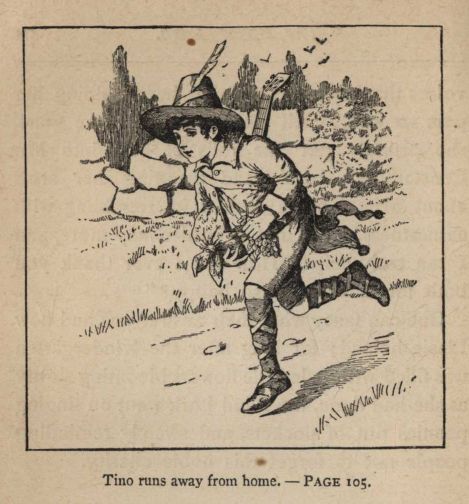
Tino runs away from home.--PAGE 105.
V.
MUSIC AND MACARONI.
Among the pretty villages that lie along the wonderful Cornice road which runs from Nice to Genoa, none was more beautiful than Valrose. It deserved its name, for it was indeed a "valley of roses." The little town with its old church nestled among the olive and orange trees that clothed the hillside, sloping up to purple mountains towering behind. Lower down stretched the vineyards; and the valley was a bed of flowers all the year round. There were acres of violets, verbenas, mignonette, and every sweet-scented blossom that grows, while hedges of roses, and alleys of lemon-trees with their white stars made the air heavy with perfume. Across the plain, one saw the blue sea rolling to meet the bluer sky, sending fresh airs and soft rains to keep Valrose green and beautiful even through the summer heat. Only one ugly thing marred the lovely landscape, and that was the factory, with its tall chimneys, its red walls, and ceaseless bustle. But old ilex-trees tried to conceal its ugliness; the smoke curled gracefully from its chimney-tops; and the brown men talked in their musical language as they ran about the busy courtyard, or did strange things below in the still-room. Handsome black-eyed girls sang at the open windows at their pretty work, and delicious odors filled the place; for here the flowers that bloomed outside were changed to all kinds of delicate perfumes to scent the hair of great ladies and the handkerchiefs of dainty gentlemen all the world over.
The poor roses, violets, mignonette, orange-flowers, and their sisters, were brought here in great baskets to yield up their sweet souls in hot rooms where, fires burned and great vats boiled; then they were sent up to be imprisoned in pretty flasks of all imaginable shapes and colors by the girls, who put gilded labels on them, packed them in delicate boxes, and sent them away to comfort the sick, please the rich, and put money in the pockets of the merchants.
Many children were employed in the light work of weeding beds, gathering flowers, and running errands; among these none were busier, happier, or more beloved than Florentino and his sister Stella. They were orphans, but they lived with old Mariuccia in her little stone house near the church, contented with the small wages they earned, though their clothes were poor, their food salad, macaroni, rye bread, and thin wine, with now and then a taste of meat when Stella's lover or some richer friend gave them a treat on gala days.
They worked hard, and had their dreams of what they would do when they had saved up a little store; Stella would marry her Beppo and settle in a home of her own; but Tino was more ambitious, for he possessed a sweet boyish voice and sang so well in the choir, at the merrymakings, and about his work, that he was called the "little nightingale," and much praised and petted, not only by his mates, but by the good priest who taught him music, and the travellers who often came to the factory and were not allowed to go till Tino had sung to them.
All this made the lad vain; and he hoped one day to go away as Baptista had gone, who now sang in a fine church at Genoa and sent home gold napoleons to his old parents. How this was to come about Tino had not the least idea, but he cheered his work with all manner of wild plans, and sang his best at Mass, hoping some stranger would hear, and take him away as Signor Pulci had taken big Tista, whose voice was not half so wonderful as his own, all had said. No one came, however, and Tino at thirteen was still at work in the valley,--a happy little lad, singing all day long as he carried his fragrant loads to and fro, ate his dinner of bread and beans fried in oil, with a crust, under the ilex-trees, and slept like a dormouse at night on his clean straw in the loft at Mariuccia's, with the moon for his candle and the summer warmth for his coverlet.
One day in September, as he stood winnowing mignonette seed in a quiet corner of the vast garden, he was thinking deeply over his hopes and plans, and practising the last chant Father Angelo had taught him, while he shook and held the sieve high, to let the wind blow away the dead husks, leaving the brown seeds behind.
Suddenly, as he ended his lesson with a clear high note that seemed to rise and die softly away like the voice of an angel in the air, the sound of applause startled him; and turning, he saw a gentleman sitting on the rude bench behind him,--a well-dressed, handsome, smiling gentleman, who clapped his white hands and nodded and said gayly, "Bravo, my boy, that was well done! You have a wonderful voice; sing again."
But Tino was too abashed for the moment, and could only stand and stare at the stranger, a pretty picture of boyish confusion, pleasure, and shyness.
"Come, tell me all about it, my friend. Who taught you so well? Why are you here, and not where you should be, learning to use this fine pipe of yours, and make fame and money by it?" said the gentleman, still smiling as he leaned easily in his seat and swung his gloves.
Tino's heart began to beat fast as he thought, "Perhaps my chance has come at last! I must make the most of it." So taking courage, he told his little story; and when he ended, the stranger gave a nod, saying,--
"Yes, you are the 'little nightingale' they spoke of up at the inn. I came to find you. Now sing me something gay, some of your folk-songs. That sort will suit you best."
Anxious to make the most of his chance, Tino took courage and sang away as easily as a bird on a bough, pouring out one after another the barcaroles, serenades, ballads, and drinking-songs he had learned from the people about him.
The gentleman listened, laughed, and applauded as if well pleased, and when Tino stopped to take breath, he gave another nod more decided than the first, and said with his engaging smile,--
"You are indeed a wonder, and quite wasted here. If I had you I should make a man of you, and put money in your pocket as fast as you opened your mouth."
Tino's eyes sparkled at the word "money," for sweet as was the praise, the idea of having full pockets bewitched him, and he asked eagerly, "How, signor?"
"Well," answered the gentleman, idly tapping his nose with a rose-bud which he had pulled as he came along, "I should take you to my hotel at Nice; wash, brush, and trim you up a little; put you into a velvet suit with a lace collar, silk stockings, and buckled shoes; teach you music, feed you well, and when I thought you fit carry you with me to the salons of the great people, where I give concerts. There you would sing these gay songs of yours, and be petted, praised, and pelted with bonbons, francs, and kisses perhaps,--for you are a pretty lad and these fine ladies and idle gentlemen are always ready to welcome a new favorite. Would you fancy that sort of life better than this? You can have it if you like."
Tino's black eyes shone; the color deepened in his brown cheeks; and he showed all his white teeth as he laughed and exclaimed with a gesture of delight,--
"Mio Dio! but I would, signor! I 'm tired of this work; I long to sing, to see the world, to be my own master, and let Stella and the old woman know that I am big enough to have my own way. Do you really mean it? When can I go? I'm ready now, only I had better run and put on my holiday suit and get my guitar."
"Good! there 's a lad of spirit. I like that well. A guitar too? Bravo, my little troubadour, we shall make a sensation in the drawing-rooms, and fill our pockets shortly. But there is no haste, and it would be well to ask these friends of yours, or there might be trouble. I don't steal nightingales, I buy them; and I will give the old woman, whoever she may be, more than you would earn in a month. See, I too am a singer, and this I made at Genoa in a week." As he spoke, Signor Mario pulled a well-filled purse from one pocket, a handful of gold and silver coin from the other, and chinked them before the boy's admiring eyes.
"Let us go!" cried Tino, flinging down the sieve as if done with work forever. "Stella is at home to-day; come at once to Mariuccia,--it is not far; and when they hear these fine plans, they will be glad to let me go, I am sure."
Away he went across the field of flowers, through the courtyard, up the steep street, straight into the kitchen where his pretty sister sat eating artichokes and bread while the old woman twirled her distaff in the sun. Both were used to strangers, for the cottage was a picturesque place, half hidden like a bird's nest in vines and fig-trees, with a gay little plot of flowers before it; travellers often came to taste Mariuccia's honey, for her bees fared well, and their combs were running over with the sweetness of violets and roses, put up in dainty little waxen boxes made by better workmen than any found at the factory.
The two women listened respectfully while Signor Mario told his plan in his delightfully gracious way; and Stella was much impressed by the splendor of the prospect before her brother. But the wise old woman shook her head, and declared decidedly that the boy was too young to leave home yet. Father Angelo was teaching him well; he was safe and happy where he was; and there he should remain, for she had sworn by all the saints to his dying mother that she would guard him as the apple of her eye till he was old enough to take care of himself.
In vain Mario shook his purse before her eyes, Stella pleaded, and Tino stormed; the faithful old soul would not give up, much as she needed money, loved Stella, and hated to cross the boy who was in truth "the apple of her eye" and the darling of her heart. There was a lively scene in the little room, for every one talked at once, gesticulated wildly, and grew much excited in the discussion; but nothing came of it, and Signor Mario departed wrathfully, leaving Mariuccia looking as stern as fate with her distaff, Stella in tears, and Tino in such a rage he could only dash up to the loft and throw himself on his rude bed, there to kick and sob and tear his hair, and wish there might be ten thousand earthquakes to swallow that cruel old woman up in the twinkling of an eye.
Stella came to beg him to be comforted and eat his supper, but he drew the wooden bolt and would not let her in, saying sternly,--
"I never will come down till Mariuccia says I may go; I will starve first. I am not a child to be so treated. Go away, and let me alone; I hate you both!"
Poor Stella retired, heart-broken, and when all her entreaties failed to change their guardian's decision, she went to consult Father Angelo. He agreed with the old woman that it was best to keep the boy safe at home, as they knew nothing of the strange gentleman nor what might befall Tino if he left the shelter of his own humble home and friends.
Much disappointed, Stella went to pray devoutly in the church, and then, meeting her Beppo, soon forgot all about the poor little lad who had sobbed himself to sleep upon his straw.
The house was quiet when he awoke; no lights shone from any neighbor's windows; and all was still except the nightingales singing in the valley. The moon was up; and her friendly face looked in at the little window so brightly that the boy felt comforted, and lay staring at the soft light while his mind worked busily. Some evil spirit, some naughty Puck bent on mischief must have been abroad that night, for into Tino's head there suddenly popped a splendid idea; at least he thought it so, and in his rebellious state found it all the more tempting because danger and disobedience and defiance all had a part in it.
Why not run away? Signor Mario was not to leave till next morning. Tino could easily slip out early and join the kind gentleman beyond the town. This would show the women that he, Tino, had a will of his own and was not to be treated like a child any more. It would give them a good fright, make a fine stir in the place, and add to his glory when he returned with plenty of money to display himself in the velvet suit and silk stockings,--a famous fellow who knew what he was about and did not mean to be insulted, or tied to an old woman's apron-string forever.
The longer he thought the more delightful the idea became, and he resolved to carry it out, for the fine tales he had heard made him more discontented than ever with his present simple, care-free life. Up he got, and by the light of the moon took from the old chest his best suit. Moving very softly, he put on the breeches and jacket of rough blue cloth, the coarse linen shirt, the red sash, and the sandals of russet leather that laced about his legs to the knee. A few clothes, with his rosary, he tied up in a handkerchief, and laid the little bundle ready with his Sunday hat, a broad-brimmed, pointed-crowned affair with a red band and cock's feather to adorn it.
Then he sat at the window waiting for dawn to come, fearing to sleep lest he be too late. It seemed an almost endless night, the first he had ever spent awake, but red streaks came in the east at last, and he stole to the door, meaning to creep noiselessly downstairs, take a good hunch of bread and a gourd full of wine and slip off while the women slept.
To his dismay he found the door barred on the outside. His courage had ebbed a little as the time for action came; but at this new insult he got angry again, and every dutiful impulse flew away in a minute.
"Ah, they think to keep me, do they? Behold, then, how I cheat the silly things! They have never seen me climb down the fig-tree, and thought me safe. Now I will vanish, and leave them to tear their hair and weep for me in vain."
Flinging out his bundle, and carefully lowering his old guitar, Tino leaned from the little window, caught the nearest branch of the tree that bent toward the wall, and swung himself down as nimbly as a squirrel. Pausing only to pick several bunches of ripe grapes from the vine about the door, he went softly through the garden and ran away along the road toward Nice as fast as his legs could carry him.
Not till he reached the top of the long hill a mile away, did he slacken his lively pace; then climbing a bank, he lay down to rest under some olive-trees, and ate his grapes as he watched the sun rise. Travellers always left the Falcone Inn early to enjoy the morning freshness, so Tino knew that Signor Mario would soon appear; and when the horses paused to rest on the hill-top, the "little nightingale" would present himself as unexpectedly as if he had fallen from heaven.
But Signor Mario was a lazy man; and Tino had time to work himself into a fever of expectation, doubt, and fear before the roll of wheels greeted his longing ears. Yes, it was the delightful stranger!--reading papers and smoking as he rode, quite blind to the beauty all around him, blind also to the sudden appearance of a picturesque little figure by the roadside, as the carriage stopped. Even when he looked, he did not recognize shabby Tino in the well-dressed beggar, as he thought him, who stood bare-headed and smiling, with hat in one hand, bundle in the other, and guitar slung on his back. He waved his hand as if to say, "I have nothing for you," and was about to bid the man drive on, but Tino cried out boldly,--
"Behold me, signor! I am Tino, the singing boy of Valrose. I have run away to join you if you will have me. Ah, please do! I wish so much to go with you."
"Bravo!" cried Mario, well pleased. "That is a lad of spirit; and I am glad to have you. I don't steal nightingales, as I told you down yonder; but if they get out of their cages and perch on my finger, I keep them. In with you, boy! there is no time to lose."
In scrambled happy Tino, and settling himself and his property on the seat opposite, amused his new master with a lively account of his escape. Mario laughed and praised him; Luigi, the servant, grinned as he listened from the coach-box; and the driver resolved to tell the tale at the Falcone, when he stopped there on his return to Genoa, so the lad's friends might know what had become of him.
After a little chat Signor Mario returned to his newspapers, and Tino, tired with his long vigil and brisk run, curled himself up on the seat, pillowed his head on his bundle and fell fast asleep, rocked by the motion of the carriage as it rolled along the smooth road.
When he waked, the sun was high, the carriage stood before a wayside inn, the man and horses were gone to their dinners, and the signor lay under some mulberry-trees in the garden while Luigi set forth upon the grass the contents of a well-filled hamper which they had brought with them, his master being one who looked well after his own comfort. The sight of food drew Tino toward it as straight as a honey-jar draws flies, and he presented himself with his most engaging air. Being in a good humor, the new master bade the hungry lad sit down and eat, which he did so heartily that larded fowl, melon, wine, and bread vanished as if by magic. Never had food tasted so good to Tino; and rejoicing with true boyish delight in the prospect of plenty to eat, he went off to play Morso with the driver, while the horses rested and Mario took a siesta on the grass.
When they set forth again, Tino received his first music lesson from the new teacher, who was well pleased to find how quickly the boy caught the air of a Venetian boat-song, and how sweetly he sang it. Then Tino strummed on his guitar and amused his hearers with all the melodies he knew, from church chants to drinking-songs. Mario taught him how to handle his instrument gracefully, speak a few polite phrases, and sit properly instead of sprawling awkwardly or lounging idly.
So the afternoon wore away; and at dusk they reached Nice. To Tino it looked like an enchanted city as they drove down to it from the soft gloom and stillness of the country. The sea broke gently on the curving shore, sparkling with the lights of the Promenade des Anglais which overlooks it. A half circle of brilliant hotels came next; behind these the glimmer of villas scattered along the hillside shone like fireflies among gardens and orange groves; and higher still the stars burned in a violet sky. Soon the moon would be up, to hang like a great lamp from that splendid dome, turning sea and shore to a magic world by her light. Tino clapped his hands and looked about him with all the pleasure of his beauty-loving race as they rattled through the gay streets and stopped at one of the fine hotels.
Here Mario put on his grand air, and was shown to the apartment he had ordered from Genoa. Tino meekly followed; and Luigi brought up the rear with the luggage. Tino felt as if he had got into a fairy tale when he found himself in a fine parlor where he could only sit and stare about him, while his master refreshed in the chamber beyond, and the man ordered dinner. A large closet was given the boy to sleep in, with a mattress and blanket, a basin and pitcher, and a few pegs to hang his clothes on. But it seemed very nice after the loft; and when he had washed his face, shaken the dust off, and smoothed his curly head as well as he could, he returned to the parlor to gloat over such a dinner as he had never eaten before.
Mario was in a good humor and anxious to keep the lad so, therefore he plied him with good things to eat, fine promises, and the praise in which that vain little soul delighted. Tino went to bed early, feeling that his fortune was made, and his master went off to amuse himself at a gaming-table, for that was his favorite pastime.
Next day the new life began. After a late breakfast, a music lesson was given which both interested and dismayed Tino, for his master was far less patient than good old Father Angelo, and swore at him when he failed to catch a new air as quickly as he expected. Both were tired and rather cross when it ended, but Tino soon forgot the tweaking of his ear and the scolding, when he was sent away with Luigi to buy the velvet suit and sundry necessary articles for the young troubadour.
It was a lovely day; and the gay city was all alive with the picturesque bustle which always fills it when the season begins. Red-capped fishermen were launching their boats from the beach, flower-girls hastening from the gardens with their fragrant loads to sell on the Promenade, where invalids sunned themselves, nurses led their rosy troops to play, fine ladies strolled, and men of all nations paced to and fro at certain hours. In the older part of the city, work of all sorts went on,--coral-carvers filled their windows with pretty ornaments; pastry-cooks tempted with dainty dishes; milliners showed hats fresh from Paris; and Turkish merchants hung out rich rugs and carpets at their doors. Church-bells chimed; priests with incense and banners went through the streets on holy errands; the Pifferoni piped gayly; orange-women and chestnut-sellers called their wares in musical voices; even the little scullions who go about scouring saucepans at back doors made a song of their cry, "Casserola!"
Tino had a charming time, and could hardly believe his senses when one fine thing after another was bought for him and ordered home. Not only the suit, but two ruffled shirts, a crimson tie for the lace collar, a broad new ribbon for the guitar, handkerchiefs, hose, and delicate shoes, as if he was a gentleman's son. When Luigi added a little mantle and a hat such as other well-dressed lads of his age wore, Tino exclaimed, "This also! Dio mio, never have I known so kind a man as Signor Mario. I shall serve him well and love him even better than you do."
Luigi shrugged his shoulders and answered with a disagreeable laugh, "Long may you think so, poverino; I serve for money, not love, and look to it that I get my wages, else it would go ill with both of us. Keep all you can get, boy; our master is apt to forget his servants."
Tino did not like the look, half scornful, half pitiful, which Luigi gave him, and wondered why he did not love the good signor. Later he found out; but all was pleasant now, and lunch at a café completed the delights of that long morning.
The rooms were empty when they returned; and bidding him keep out of mischief, Luigi left Tino alone for several hours. But he found plenty of amusement in examining all the wonders the apartment contained, receiving the precious parcels as they arrived, practising his new bow before the long mirror, and eating the nuts that he had bought of a jolly old woman at a street corner.
Then he went to lounge on the balcony that ran along the front of the hotel, and watched the lively scene below, till sunset sent the promenaders home to dress for dinner. Feeling a sudden pang of homesickness as he thought of Stella, Tino got his guitar and sang the old songs to comfort his loneliness.
The first was hardly ended before one after the other five little heads popped out of a window farther down the balcony; and presently a group of pretty children were listening and smiling as the nice boy played and sang to them. A gentleman looked out; and a lady evidently listened, for the end of a lace flounce lay on the threshold of the long window, and a pair of white hands clapped when he finished a gay air in his best style.
This was his first taste of applause, and he liked it, and twanged away merrily till his master's voice called him in just as he was beginning to answer the questions the eager children asked him.
"Go and dress! I shall take you down to dinner with me presently. But mind this, I will answer questions; do you keep quiet, and leave me to tell what I think best. Remember, or I pack you home at once."
Tino promised, and was soon absorbed in getting into his new clothes; Luigi came to help him, and when he was finished off, a very handsome lad emerged from the closet to make his best bow to his master, who, also in fine array, surveyed him with entire approval.
"Very good! I thought you would make a passable butterfly when you shed your grub's skin. Stand up and keep your hands out of your pockets. Mind what I told you about supping soup noisily, and don't handle your fork like a shovel. See what others do, smile, and hold your tongue. There is the gong. Let us go."
Tino's heart beat as he followed Mario down the long hall to the great salle à manger with its glittering table d'hôte and many guests. But the consciousness of new clothes sustained him, so he held up his head, turned out his toes, and took his place, trying to look as if everything was not very new and dazzling to him.
Two elderly ladies sat opposite, and he heard one say to the other in bad Italian, "Behold the lovely boy, Maria; I should like to paint him."
And the other answered, "We will be amiable to him, and perhaps we may get him for a model. Just what I want for a little Saint John."
Tino smiled at them till his black eyes sparkled and his white teeth shone, for he understood and enjoyed their praise. The artistic ladies smiled back, and watched him with interest long after he had forgotten them, for that dinner was a serious affair to the boy, with a heavy silver spoon and fork to manage, a napkin to unfold, and three glasses to steer clear of for fear of a general upset, so awkward did he feel.
Every one else was too busy to mind his mistakes; and the ladies set them down to bashfulness, as he got red in the face, and dared not look up after spilling his soup and dropping a roll.
Presently, while waiting for dessert, he forgot himself in something Mario was saying to his neighbor on the other side:--
"A poor little fellow whom I found starving in the streets at Genoa. He has a voice; I have a heart, and I adore music. I took him to myself, and shall do my best for him. Ah, yes! in this selfish world one must not forget the helpless and the poor."
Tino stared, wondering what other boy the good signor had befriended, and was still more bewildered when Mario turned to him with a paternal air, to add in that pious tone so new to the boy,--
"This is my little friend, and he will gladly come and sing to your young ladies after dinner. Many thanks for the honor; I shall bring him out at my parlor concerts, and so fit him for his place by and by. Bow and smile, quick!"
The last words were in a sharp whisper; and Tino obeyed with a sudden bob of the head that sent his curls over his eyes, and then laughed such a boyish laugh as he shook them back that the gentleman leaning forward to look at him joined in it, and the ladies smiled sympathetically as they pushed a dish of bonbons nearer to him. Mario gave him an indulgent look, and went on in the same benevolent tone telling all he meant to do, till the kindly gentleman from Rome was much interested, having lads of his own and being fond of music.
Tino listened to the fine tales told of him and hoped no one would ask him about Genoa, for he would surely betray that he had never been there and could not lie as glibly as Mario did. He felt rather like the little old woman who did not know whether she was herself or not, but consoled himself by smiling at the ladies and eating a whole plateful of little cakes standing near him.
When they rose, Tino made his bow, and Mario walked down the long hall with his hand on the boy's shoulder and a friendly air very impressive to the spectators, who began at once to gossip about the pretty lad and his kind protector, just as the cunning gentleman planned to have them.
As soon as they were out of sight, Mario's manner changed; and telling Tino to sit down and digest his dinner or he would n't be able to sing a note, he went to the balcony to smoke till the servant came to conduct them to Conte Alborghetti's salon.
"Now mind, boy; do exactly as I tell you, or I 'll drop you like a hot chestnut and leave you to get home as you can," said Mario, in a sharp whisper, as they paused on the threshold of the door.
"I will, signor, indeed I will!" murmured Tino, scared by the flash of his master's black eye and the grip of his hand, as he pulled the bashful boy forward.
In they went, and for a moment Tino only perceived a large light room full of people, who all looked at him as he stood beside Mario with his guitar slung over his shoulder, red cheeks, and such a flutter at his heart that he felt sure he could never sing there. The amiable host came to meet and present them to a group of ladies, while a flock of children drew near to look at and listen to the "nice singing boy from Genoa."
Mario, having paid his thanks and compliments in his best manner, opened the little concert by a grand piece upon the piano, proving that he was a fine musician, though Tino already began to fancy he was not quite so good a man as he wished to appear. Then he sang several airs from operas; and Tino forgot himself in listening delightedly to the mellow voice of his master, for the lad loved music and had never heard any like this before.
When Tino's turn came, he had lost his first shyness, and though his lips were dry and breath short, and he gave the guitar an awkward bang against the piano as he pulled it round ready to play upon, the curiosity in the faces of the children and the kindly interest of the ladies gave him courage to start bravely off with "Bella Monica,"--the easiest as well as gayest of his songs. It went well; and with each verse his voice grew clearer, his hand firmer, and his eyes fuller of boyish pleasure in his own power to please.
For please he did, and when he ended with a loud twang and kissed his hand to the audience as he always used to do to the girls at home, every one clapped heartily, and the gentlemen cried, "Bravo, piccolo! He sings in truth like a little nightingale; encore, encore!"
These were sweet sounds to Tino; and he needed no urging to sing "Lucia" in his softest tones, "looking like one of Murillo's angels!" as a young lady said, while he sang away with his eyes piously lifted in the manner Mario had taught him.
Then followed a grand march from the master while the boy rested; after which Tino gave more folk-songs, and ended with a national air in which all joined like patriotic and enthusiastic Italians, shouting the musical chorus, "Viva Italia!" till the room rang.
Tino quite lost his head at that, and began to prance as if the music had got into his heels. Before Mario could stop him, he was showing one of the little girls how to dance the Salterello as the peasants dance it during Carnival; and all the children were capering gayly about the wide polished floor with Tino strumming and skipping like a young fawn from the woods.
The elder people laughed and enjoyed the pretty sight till trays of ices and bonbons came in; and the little party ended in a general enjoyment of the good things children most delight in. Tino heard his master receiving the compliments of the company, and saw the host slip a paper into his hand; but, boylike, he contented himself with a pocket full of sweetmeats, and the entreaties of his little patrons to come again soon, and so backed out of the room, after bowing till he was dizzy, and bumping against a marble table in a very painful manner.
"Well, how do you like the life I promised you? Is it all I said? Do we begin to fill our pockets, and enjoy ourselves even sooner than I expected?" asked Mario, with a good-natured slap of the shoulder, as they reached his apartment again.
"It is splendid! I like it much, very much! and I thank you with all my heart," cried Tino, gratefully kissing the hand that could tweak sharply, as well as caress when things suited its owner.
"You did well, even better than I hoped; but in some things we must improve. Those legs must be taught to keep still; and you must not forget that you are a peasant when among your betters. It passed very well to-night with those little persons, but in some places it would have put me in a fine scrape. Capers! but I feared at one moment you would have embraced the young contessa, when she danced with you."
Mario laughed as poor Tino blushed and stammered, "But, signor, she was so little, only ten years old, and I thought no harm to hold her up on that slippery floor. See, she gave me all these, and bade me come again. I would gladly have kissed her, she was so like little Annina at home."
"Well, well, no harm is done; but I see the pretty brown girls down yonder have spoiled you, and I shall have to keep an eye on my gallant young troubadour. Now to bed, and don't make yourself ill with all those confections. Felice notte, Don Giovanni!" and away went Mario to lose at play every franc of the money the generous count had given him "for the poor lad."
That was the beginning of a new and charming life for Tino, and for two months he was a busy and a happy boy, with only a homesick fit now and then when Mario was out of temper, or Luigi put more than his fair share of work upon his shoulders. The parlor concerts went well, and the little nightingale was soon a favorite toy in many salons. Night after night Tino sang and played, was petted and praised, and then trotted home to dream feverishly of new delights; for this exciting life was fast spoiling the simple lad who used to be so merry and busy at Valrose. The more he had, the more he wanted, and soon grew discontented, jealous, and peevish. He had cause to complain of some things; for none of the money earned ever came to him, and when he plucked up courage to ask for his promised share, Mario told him he only earned his food and clothes as yet. Then Tino rebelled, and got a beating, which made him outwardly as meek as a lamb, but inwardly a very resentful, unhappy boy, and spoiled all his pleasure in music and success.
He was neglected all day and left to do what he liked till needed at night, so he amused himself by lounging about the hotel or wandering on the beach to watch the fishermen cast their nets. Lazy Luigi kept him doing errands when he could; but for hours the boy saw neither master nor man, and wondered where they were. At last he found out, and his dream of fame and fortune ended in smoke.
Christmas week was a gay one for everybody, and Tino thought good times had come again; for he sang at several childrens' fêtes, received some pretty gifts from the kind Alborghettis, and even Mario was amiable enough to give him a golden napoleon after a run of good luck at the cards. Eager to show his people that he was getting on, Tino begged Antoine, the friendly waiter who had already written one letter to Stella for him, to write another, and send by a friend going that way a little parcel containing the money for Mariuccia, a fine Roman sash for Stella, and many affectionate messages to all his old friends.
It was well he had that little satisfaction, for it was his last chance to send good news or exult over his grand success. Troubles came with the new year; and in one week our poor little jay found himself stripped of all his borrowed plumes, and left a very forlorn bird indeed.
Trotting about late at night in silk stockings, and getting wet more than once in the winter rains, gave Tino a bad cold. No one cared for it; and he was soon as hoarse as a crow. His master forced him to sing several times in spite of the pain he suffered, and when at the last concert he broke down completely, Mario swore at him for "a useless brat," and began to talk of going to Milan to find a new set of singers and patrons. Had Tino been older, he would have discovered some time sooner that Signor Mario was losing favor in Nice, as he seldom paid a bill, and led a very gay, extravagant life. But, boylike, Tino saw only his own small troubles, and suspected nothing when Luigi one day packed up the velvet suit and took it away "to be repaired," he said. It was shabby, and Tino, lying on the sofa with a headache and sharp cough, was glad no one ordered him to go with it, for the Tramontana was blowing, and he longed for old Mariuccia's herb tea and Stella's cosseting, being quite ill by this time.
That night as he lay awake in his closet coughing, feverish and restless, he heard his master and Luigi moving about till very late, evidently packing for Paris or Milan, and Tino wondered if he would like either place better than Nice, and wished they were not so far from Valrose. In the midst of his meditations he fell asleep, and when he woke, it was morning. He hurried up and went out to see what the order of the day was to be, rather pleased at the idea of travelling about the world.
To his surprise no breakfast appeared; the room was in confusion, every sign of Mario had vanished but empty bottles and a long hotel bill lying unpaid upon the table. Before Tino could collect his wits, Antoine came flying in to say with wild gesticulations and much French wrath that "the rascal Mario had gone in the night, leaving immense debts behind him, and the landlord in an apoplexy of rage."
Poor Tino was so dismayed he could only sit and let the storm pelt about his ears; for not only did the waiter appear, but the chambermaid, the coachman, and at last the indignant host himself, all scolding at once as they rummaged the rooms, questioned the bewildered boy, and wrung their hands over the escape of these dishonest wretches.
"You also, little beast, have grown fat upon my good fare! and who is to pay me for all you have eaten, not to mention the fine bed, the washing, the candles, and the coaches you have had? Ah, great heavens! what is to become of us when such things occur?" and the poor landlord tore his hair with one hand while he shook his other fist at Tino.
"Dear sir, take all I have; it is only an old guitar, and a few clothes. Not a centime do I own; but I will work for you. I can clean saucepans and run errands. Speak for me, Antoine; you are my only friend now."
The lad looked so honest and ill and pathetic, as he spoke with his poor hoarse voice, and looked beseechingly about him, that Antoine's kind heart was melted, and he advised the boy to slip away home as soon as possible, and so escape all further violence and trouble. He slipped two francs into Tino's empty pocket, and as soon as the room was cleared, helped him tie up the few old clothes that remained. The host carried off the guitar as the only thing he could seize, so Tino had less to take away than he brought, when Antoine led him out by the back way, with a good sandwich of bread and meat for his breakfast, and bade him go to the square and try to beg a ride to Valrose on some of the carriages often going thither on the way to Genoa.
With many thanks Tino left the great hotel, feeling too miserable to care much what became of him, for all his fine dreams were spoiled like the basket of china the man kicked over in the "Arabian Nights," while dreaming he was a king. How could he go home, sick, poor, and forsaken, after all the grand tales he had lately told in his letter? How they would laugh at him, the men and girls at the factory! How Mariuccia would wag her old head and say, "Ecco! is it not as I foretold?" Even Stella would weep over him and be sorry to see her dear boy in such a sad plight, yet what could he do? His voice was gone and his guitar, or he might sing about the streets, as Mario described his doing at Genoa, and so earn his daily bread till something turned up. Now he was quite helpless, and much against his will, he went to see if any chance of getting home appeared.
The day was showery, and no party was setting off for the famous drive along the Cornice road. Tino was glad of it, and went to lie on a bench at the café where he had often been with Luigi. His head ached, and his cough left him no peace, so he spent some of his money in syrup and water to quell the trouble, and with the rest paid for a good dinner and supper.
He told his sad tale to the cook, and was allowed to sleep in the kitchen after scrubbing saucepans to pay for it. But no one wanted him; and in the morning, after a cup of coffee and a roll he found himself cast upon the world again. He would not beg, and as dinner time approached, hunger reminded him of a humble friend whom he had forgotten in his own days of plenty.
He loved to stroll along the beach, and read the names on the boats drawn up there, for all were the names of saints; and it was almost as good as going to church to read the long list of Saint Brunos, Saint Francises, and Saint Ursulas. Among the fishermen was one who had always a kind word for the lad, who enjoyed a sail or a chat with Marco whenever nothing better turned up to amuse his leisure hours. Now in his trouble he remembered him, and went to the beach to ask help, for he felt ill as well as sad and hungry.
Yes, there sat the good fellow eating the bread and macaroni his little daughter had brought for his dinner, and a smile welcomed poor Tino as he sat down beside this only friend to tell his story.
Marco growled in his black beard and shook his knife with an awful frown when he heard how the lad had been deserted. Then he smiled, patted Tino's back, thrust the copper basin of food into one hand and a big lump of the brown-bread into the other, inviting him to eat in such a cordial way that the poor meal tasted better than the dainty fare at the hotel.
A draught of red wine from the gourd cheered Tino up, as did the good and kind words, and when Marco bade him go home with little Manuela to the good wife, he gladly went, feeling that he must lie down somewhere, his head was so giddy and the pain in the breast so sharp.
Buxom Teresa received him kindly, put him straight to bed in her own boy's little room, laid a cool cloth on his hot head, a warm one on his aching chest, and left him to sleep, much comforted by her motherly care. It was well the good soul befriended him, for he needed help sorely, and would have fared ill if those humble folk had not taken him in.
For a week or two he lay in Beppo's bed burning with fever, and when he could sit up again was too feeble to do anything but smile gratefully and try to help Manuela mend nets. Marco would hear of no thanks, saying, "Good deeds bring good luck. Behold my haul of fish each day thou hast been here, poverino! I am well paid, and Saint Peter will bless my boat for thy sake."
Tino was very happy in the little dark, shabby house that smelt of onions, fish, and tar, was full of brown children, and the constant clack of Teresa's lively tongue as she gossiped with her neighbors, or fried polenta for the hungry mouths that never seemed filled.
But the time came when Tino could go about, and then he begged for work, anxious to be independent and earn a little so that in the spring he could go home without empty pockets.
"I have taken thought for thee, my son, and work warm and easy is ready if thou wilt do it. My friend Tommaso Neri, makes the good macaroni near by. He needs a boy to mind the fire and see to the donkey who grinds below there. Food, shelter, and such wages as thou art able to earn, he will give thee. Shall it be?"
Tino gratefully accepted, and with hearty embraces all round went off one day to see his new place. It was in the old part of Nice, a narrow, dirty street, a little shop with one window full of the cheaper sorts of this favorite food of all Italians, and behind the shop a room where an old woman sat spinning while two little boys played with pine cones and pretty bits of marble at her feet.
A fat jolly man, with a shining face and loud voice, greeted Marco and the lad, saying he "was worn to a thread with much work, since that bad imp of a donkey-boy had run away leaving the blessed macaroni to spoil, and poor Carmelita to perish for want of care. Come below at once, and behold the desolation of the place."
With that he led the way to the cellar, where a small furnace-fire burned, and an old gray donkey went round and round, turning a wheel which set some unseen machinery in motion with a dismal creaking sound. Down through many holes in one part of the wooden floor overhead came long pipes of macaroni, hardening as they hung quivering in the hot air till stiff enough to be cut off in handfuls and laid to dry on wire trays over the furnace.
Tino had never seen the good macaroni made before, and was much interested in the process, though it was of the rudest kind. In a room upstairs a great vat of flour and water was kept stirring round and round and forced down to the place below by the creaking wheel which patient Carmelita turned all day. The cellar was dark but warm; and Tino felt that it would be comfortable there with the old donkey for a comrade, jolly Tommaso for a master, and enough to eat,--for it was evident the family lived well, so plump and shining were all the faces, so cheery the tempers of the old women and little lads.
There Marco left him, well satisfied that he had done his best for the poor boy; and there Tino lived for three months, busy, well fed, and contented, till spring sunshine made him long for the sweet air, the green fields, and dear faces at Valrose. Tommaso was lazy but kind, and if the day's work was done in time, let Tino out to see Marco's children or to run on the beach with little Jacopo and Seppi. The grandmother gave him plenty of rye bread, thin wine, and macaroni fried in oil; old Carmelita learned to love him and to lean her gray head on his shoulder with joyful waggings of her long ears as he caressed her, and each week increased the little hoard in an old shoe hidden behind a beam.
But it was a dull life for a boy who loved music, flowers, light, and freedom; and he soon grew tired of seeing only a procession of legs go by the low windows level with the street; the creak of the wheel was not half so welcome as the brisk rattle of the mill at home, and the fat little lads always climbing over him could not be so dear as sister Stella and pretty Annina, the wine-maker's daughter, at Valrose. Even the kind old woman who often saved an orange for him, and gave him a gay red cotton handkerchief on his birthday, was less to his taste than Mariuccia, who adored him in spite of her scolding and stern ways.
So he looked about for travellers going to Genoa; and one happy day as he returned from church, he saw, sitting under two red umbrellas before two easels beside the road, the two elderly ladies of the hotel. Both wore brown hats like mushrooms; both had gray curls bobbing in the wind; and both were painting away for dear life, trying to get a good sketch of the ruined gateway, where passion-flowers climbed, and roses nodded through the bars.
Tino stopped to look, as many another passer-by had done; and glancing up to see if he admired their work, the good ladies recognized their "Saint John," as they called the pretty boy who had vanished before they could finish the pictures they had begun of him.
They were so glad to see him that he opened his heart to them, and found to his great joy that in a week they were to drive to Genoa, and would gladly take him along if he would sit to them meantime. Of course he agreed, and ran home to tell his master that he must go. Tommaso bewailed his loss, but would not keep him; and as Marco's son Beppo was willing to take his place till another lad could be found, Tino was free to sit in a sheepskin for the Misses Blair as often as they liked.
It was a very happy week; and when the long-desired day came at last, Tino was so gay he danced and sang till the dingy cellar seemed to be full of birds in high spirits. Poor Carmelita gratefully ate the cabbage he gave her as a farewell offering; the old woman found her box full of her favorite snuff; and each small boy grew more shiny than ever over a new toy presented by Tino. Tommaso wept as he held him in his fat arms, and gave him a bundle of half-baked macaroni as a reward for his faithful service, while Marco and all his family stood at the hotel door to see the carriage depart.
"Really quite like a wedding, with all those orange-flowers and roses," said Miss Priscilla, as Teresa and Manuela threw great bunches of flowers into their laps, and kissed their hands to the departing travellers.
Sitting proudly aloft, Tino waved his old hat to these good friends till he could see them no more, then having, with some difficulty, bestowed his long bundle from Tommaso, his basket of fish from Marco, his small parcel of clothes, and the immense bouquet the children had made for him, he gave himself up to the rapture of that lovely April day.
The kind ladies had given him a new suit of clothes like the old ones, and paid him well besides; so he felt quite content with the picturesque peasant garments he wore, having had enough of fine feathers, and gayly jingled the money in his pocket, though it was not the fortune he had foolishly hoped to make so easily. He was a wiser boy than the one who went over that road six months before, and decided that even if his voice did come back in time, he would be in no hurry to leave home till he was sure it was the wisest thing to do. He had some very serious thoughts and sensible plans in his young head, and for a time was silent and sober. But soon the delicious air, the lovely scenery, and the many questions of the ladies raised his spirits, and he chattered away till they stopped for dinner.
All that long bright day they drove along the wonderful road, and as night fell, saw Valrose lying green and peaceful in the valley as they paused on the hill-top to enjoy its beauty. Then they went slowly down to the Falcone, and the moment the luggage was taken in, rooms secured, and dinner ordered, Tino, who had been quivering with impatience, said eagerly,--
"Dear signoras, now I go to my own people to embrace them; but in the morning we come to thank you for your great kindness to me."
Miss Priscilla opened her mouth to send some message; but Tino was off like an arrow, and never stopped till he burst into the little kitchen where Mariuccia sat shelling dry beans, and Stella was packing mandarinas in dainty baskets for market. Like an affectionate little bear did the boy fall upon and embrace the two astonished women; while Stella laughed and cried, and Mariuccia called on all the saints to behold how tall and fat and beautiful her angel had become, and to thank them for restoring him to their arms. The neighbors rushed in; and till late that night there was the sound of many voices in the stone cottage under the old fig-tree.
Tino's adventures were listened to with the deepest interest, and a very hearty welcome given him. All were impressed with the splendors he had seen, afflicted by his trials, and grateful for his return. No one laughed or reproached, but regarded him as a very remarkable fellow, and predicted that whether his voice came back or not, he was born for good luck and would prosper. So at last he got to bed in the old loft, and fell asleep with the same friendly moon looking in at him as it did before, only now it saw a quiet face, a very happy heart, and a contented boy, glad to be safe again under the humble roof that was his home.
Early next morning a little procession of three went to the Falcone bearing grateful offerings to the dear signoras who sat on the portico enjoying the balmy air that blew up from the acres of flowers below. First came Tino, bearing a great basket of the delicious little oranges which one never tastes in their perfection unless one eats them fresh from the tree; then Stella with two pretty boxes of perfume; and bringing up the rear, old Mariuccia with a blue jar of her best honey, which like all that of Valrose was famous.
The ladies were much delighted with these gifts, and promised to stop and see the givers of them on their return from Genoa, if they came that way. Tino took a grateful farewell of the good souls; Stella kissed their hands, with her dark eyes full of tender thanks, and Mariuccia begged the saints to have them in their special keeping by land and by sea, for their kindness to her boy.
An hour later, as the travellers drove down the steep road from the village, they were startled by a sudden shower of violets and roses which rained upon them from a high bank beside the path. Looking up, they saw Tino and his sister laughing, waving their hands, and tossing flowers as they called in their musical language,--
"A rivederla, signoras! Grazia, grazia!" till the carriage rolled round the corner looking as if it were Carnival-time, so full was it of fragrant violets and lovely roses.
"Nice creatures! how prettily they do things! I hope we shall see them again; and I wonder if the boy will ever be famous. Such a pity to lose that sweet voice of his!" said Miss Maria, the younger of the sisters, as they drove along in a nest of sweet and pretty gifts.
"I hope not, for he will be much safer and happier in this charming place than wandering about the world and getting into trouble as these singers always do. I hope he will be wise enough to be contented with the place in which his lot is cast," answered Miss Priscilla, who knew the world and had a good old-fashioned love for home and all it gives us.
She was right; Tino was wise, and though his voice did come back in time, it was no longer wonderful; and he was contented to live on at Valrose, a busy, happy, humble gardener all his life, saying with a laugh when asked about his runaway adventures,--
"Ah, I have had enough of music and macaroni; I prefer my flowers and my freedom."
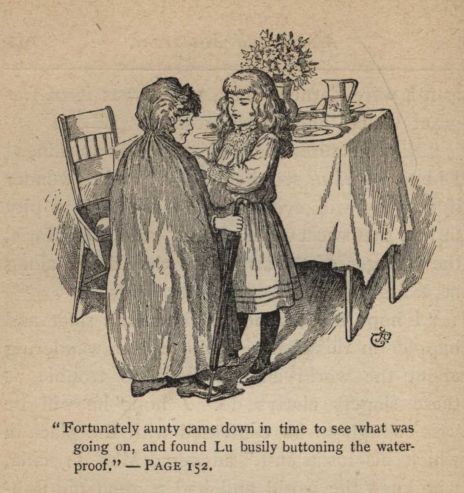
"Fortunately aunty came down in time to see what was going on, and found Lu busily buttoning the waterproof."--PAGE 152.
VI.
THE LITTLE RED PURSE.
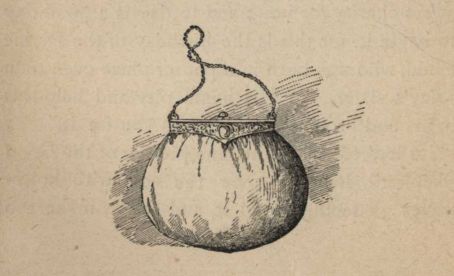
Among the presents which Lu found on her tenth birthday was a pretty red plush purse with a steel clasp and chain, just like mamma's, only much smaller. In it were ten bright new cents, that being the sum Lu received each week to spend as she liked. She enjoyed all her gifts very much; but this one seemed to please her even more than the French doll in blue silk, the pearl ring, or "Alice in Wonderland,"--three things which she had wanted for a long time.
"It is so cunning, and the snap makes such a loud noise, and the chain is so nice on my arm, and the plush so red and soft, I can't help loving my dear little purse. I shall spend all the money for candy, and eat it every bit myself, because it is my birthday, and I must celebrate it," said Lu, as she hovered like a bee round a honey-pot about the table where the gifts were spread.
Now she was in a great hurry to go out shopping, with the new purse proudly carried in her small fat hand. Aunty was soon ready, and away they went across the pleasant Park, where the pretty babies were enjoying the last warm days of autumn as they played among the fallen leaves.
"You will be ill if you eat ten cents' worth of candy to-day," said aunty.
"I 'll sprinkle it along through the day, and eat each kind seppyrut; then they won't intersturb me, I am sure," answered Lu, who still used funny words, and always got interrupt and disturb rather mixed.
Just then a poor man who had lost his legs came creeping along with a tray of little flower-pots to sell.
"Only five cents, miss. Help an unfortnit man, please, mum."
"Let me buy one for my baby-house. It would be sweet. Cora Pinky May would love to have that darling little rose in her best parlor," cried Lu, thinking of the fine new doll.
Aunty much preferred to help the poor man than to buy candy, so the flower-pot was soon bought, though the "red, red rose" was unlike any ever seen in a garden.
"Now I 'll have five cents for my treat, and no danger of being ill," said Lu, as they went on again.
But in a few moments a new beggar appeared, and Lu's tender heart would not let her pass the old woman without dropping two of her bright cents in the tin cup.
"Do come to the candy-place at once, or I never shall get any," begged Lu, as the red purse grew lighter and lighter every minute.
Three sticks of candy were all she could buy, but she felt that she could celebrate the birthday on that, and was ready to go home and begin at once.
As they went on to get some flowers to dress the cake at tea-time, Lu suddenly stopped short, lifted both hands, and cried out in a tone of despair,--
"My purse! my purse! I 've lost it. Oh, I 've lost it!"
"Left it in the store probably. Come and look for it," said aunty; and back they turned, just in time to meet a shabby little girl running after them with the precious thing in her hand.
"Ain't this yours? I thought you dropped it, and would hate to lose it," she said, smiling pleasantly.
"Oh, I should. It's spandy new, and I love it dearly. I 've got no more money to pay you, only this candy; do take a stick," and Lu presented the red barley sugar.
The little girl took it gladly, and ran off.
"Well, two sticks will do. I 'd rather lose every bit of it than my darling purse," said Lu, putting it carefully in her pocket.
"I love to give things away and make people happy," began Lu, but stopped to watch a dog who came up to her, wagging his tail as if he knew what a kind little girl she was, and wanted to be made happy. She put out her hand to pat him, quite forgetting the small parcel in it; but the dog snapped it up before she could save it.
"Oh, my last stick! I did n't mean to give it to him. You naughty dog, drop it this minute!" cried poor Lu.
But the beautiful pink cream candy was forever lost, and the ungrateful thief ran off, after a vain attempt to eat the flower-pot also. It was so funny that aunty laughed, and Lu joined her, after shaking her finger at the dog, who barked and frisked as if he felt that he had done a clever thing.
"Now I am quite satisfied, and you will have a pleasanter birthday for having made four people and a dog happy, instead of yourself sick with too many goodies. Charity is a nice sort of sweetie; and I hope you will buy that kind with your pocket-money now and then, my dear," said aunty, as they walked on again.
"Could I do much with ten cents a week?" asked Lu.
"Yes, indeed; you could buy a little book for lame Sammy, who loves to read, or a few flowers for my sick girl at the hospital, or a loaf of bread for some hungry person, or milk for a poor baby, or you could save up your money till Christmas, and get presents for children who otherwise would have none."
"Could I do all those things? I'd like to get presents best, and I will--I will!" cried Lu, charmed with the idea of playing Santa Claus. "I did n't think ten cents would be so useful. How long to Christmas, aunty?"
"About ten weeks. If you save all your pocket-money till then, you will have a dollar to spend."
"A truly dollar! How fine! But all that time I should n't have any candy. I don't think I could get along without some. Perhaps if I was very good some one would give me a bit now and then;" and Lu looked up with her most engaging smile and a twinkle in her eye.
"We will see about that. Perhaps 'some one' will give extra cents for work you may do, and leave you to decide which kind of sweeties you would buy."
"What can I do to earn money?" asked Lu.
"Well, you can dry and fold the paper every morning for grandpa. I will pay you a cent for that, because nurse is apt to forget it, and he likes to have it nicely ready for him after breakfast. Then you might run up and down for mamma, and hem some towels for me, and take care of Jip and the parrot. You will earn a good deal if you do your work regularly and well."
"I shall have dreadful trials going by the candy-shops and never buying any. I do long so to go in that I have to look away when you say No. I want to be good and help poor people, but I 'm afraid it will be too hard for me," sighed Lu, foreseeing the temptations before her.
"We might begin to-day, and try the new plan for a while. If it is too hard, you can give it up; but I think you will soon like my way best, and have the merriest Christmas you ever knew with the money you save."
Lu walked thoughtfully home, and put the empty purse away, resolved to see how long she could hold out, and how much she could earn. Mamma smiled when she heard the plan, but at once engaged the little girl to do errands about the house at a cent a job, privately quite sure that her pretty express would soon stop running. Grandpapa was pleased to find his paper ready, and nodded and patted Lu's curly head when she told him about her Christmas plans. Mary, the maid, was glad to get rid of combing Jip and feeding Polly, and aunty made towel hemming pleasant by telling stories as the little needle-woman did two hems a day.
Every cent went into the red purse, which Lu hung on one of the gilt pegs of the easel in the parlor, for she thought it very ornamental, and hoped contributions might drop in occasionally. None did; but as every one paid her in bright cents, there was soon a fine display, and the little bag grew heavy with delightful rapidity.
Only once did Lu yield to temptation, and that was when two weeks of self-denial made her trials so great that she felt as if she really must reward herself, as no one else seemed to remember how much little girls loved candy.
One day she looked pale, and did not want any dinner, saying she felt sick. Mamma was away, so aunty put her on the bed and sat by her, feeling very anxious, as scarlet-fever was about. By and by Lu took her handkerchief out, and there, sticking to it, was a large brown cough-drop. Lu turned red, and hid her face, saying with a penitent sob, "I don't deserve to be cuddled. I 've been selfish and silly, and spent some of my money for candy. I had a little cold, and I thought cough-drops would do me good. I ate a good many, and they were bitter and made me sick, and I 'm glad of it."
Aunty wanted to laugh at the dear little sinner and her funny idea of choosing bitter candy as a sort of self-denial; but she comforted her kindly, and soon the invalid was skipping about again, declaring that she never would do so any more.
Next day something happened which helped her very much, and made it easier to like the new kind of sweeties better than the old. She was in the dining-room getting an apple for her lunch, when she saw a little girl come to the lower door to ask for cold food. The cook was busy, and sent her away, telling her begging was forbidden. Lu, peeping out, saw the little girl sit down on the steps to eat a cold potato as if she was very hungry, and while she ate she was trying to tie on a pair of very old boots some one had given her. It was a rainy day, and she had only a shawl over her head; her hands were red with cold; her gown was a faded cotton one; and her big basket seemed to have very few scraps in it. So poor, so sad, and tired did she look, that Lu could not bear to see it, and she called out in her pitiful child's voice,--
"Come in and get warm, little girl. Don't mind old Sarah. I 'll give you something to eat, and lend you my rubber boots and waterproof to go home in."
The poor child gladly went to sit by the comfortable fire, while Lu with hospitable haste got crackers and cheese and cake and apples, and her own silver mug of milk, for her guest, forgetting, in her zeal, to ask leave. Fortunately aunty came down for her own lunch in time to see what was going on, and found Lu busily buttoning the waterproof, while the little girl surveyed her rubber boots and small umbrella with pride.
"I 'm only lending my things, and she will return them to-morrow, aunty. They are too small for me, and the umbrella is broken; and I 'd love to give them all to Lucy if I could. She has to go out in the rain to get food for her family, like a bird, and I don't."
"Birds don't need waterproofs and umbrellas," began aunty; and both children laughed at the idea of sparrows with such things, but looked a little anxious till aunty went on to say that Lucy could have these comforts, and to fill the basket with something better than cold potatoes, while she asked questions and heard the sad little story: how father was dead, and the baby sick, so mother could not work, and the boys had to pick up chips and cinders to burn, and Lucy begged food to eat. Lu listened with tears in her blue eyes, and a great deal of pity as well as admiration for poor little Lucy, who was only nine, yet had so many cares and troubles in her life. While aunty went to get some flannel for baby, Lu flew to her red purse and counted out ten cents from her store, feeling so rich, so glad to have it instead of an empty bonbon box, and a headache after a candy feast.
"Buy some nice fresh milk for little Totty, and tell her I sent it--all myself--with my love. Come again to-morrow, and I will tell mamma all about you, and you shall be my poor people, and I 'll help you if I can," she said, full of interest and good-will, for the sight of this child made her feel what poverty really was, and long to lighten it if she could.
Lucy was smiling when she went away, snug and dry in her comfortable clothes, with the full basket on her arm; and all that day Lu talked and thought about her "own poor people," and what she hoped to do for them. Mamma inquired, and finding them worthy of help, let her little girl send many comforts to the children, and learn how to be wisely charitable.
"I shall give all my money to my 'Lucy children' on Christmas," announced Lu, as that pleasant time drew near. "I know what they want, and though I can't save money enough to give them half the things they need, maybe I can help a good deal, and really have a nice bundle to s'prise them with."
This idea took possession of little Lu, and she worked like a beaver in all sorts of funny ways to fill her purse by Christmas-time. One thing she did which amused her family very much, though they were obliged to stop it. Lu danced very prettily, and often had what she called ballets before she went to bed, when she tripped about the parlor like a fairy in the gay costumes aunty made for her. As the purse did not fill as fast as she hoped, Lu took it into her head one fine day to go round the square where she lived, with her tambourine, and dance as some of the girls with the hand-organ men did. So she dressed herself in her red skirt and black velvet jacket, and with a fur cap on her head and a blue cloak over her shoulders, slipped out into the quiet square, and going to the farther corner, began to dance and beat her tambourine on the sidewalk before a house where some little children lived.
As she expected, they soon came running to the window, and were charmed to see the pretty dancer whirling to and fro, with her ribbons flying and her tambourine bells ringing, till her breath was gone. Then she held up the instrument and nodded smilingly at them; and they threw down cents wrapped in paper, thinking her music much better than any the organ men made. Much encouraged, Lu went on from house to house, and was doing finely, when one of the ladies who looked out recognized the child, and asked her if her mother knew where she was. Lu had to say "No;" and the lady sent a maid to take her home at once.
That spoiled all the fun; and poor Lu did not hear the last of her prank for a long time. But she had made forty-two cents, and felt comforted when she added that handsome sum to her store. As if to console her for this disappointment, after that day several bright ten-cent pieces got into the red purse in a most mysterious manner. Lu asked every one in the house, and all declared that they did not do it. Grandpa could not get out of his chair without help, and nurse said she never took the purse to him; so of course it could not be he who slipped in those welcome bits of silver. Lu asked him; but he was very deaf that day, and did not seem to understand her at all.
"It must be fairies," she said, pondering over the puzzle, as she counted her treasure and packed it away, for now the little red purse was full. "Aunty says there are no fairies; but I like to think so. Perhaps angels fly around at Christmas-time as they did long ago, and love to help poor people, and put those beautiful bright things here to show that they are pleased with me." She liked that fancy, and aunty agreed that some good spirit must have done it, and was sure they would find out the secret some time.
Lucy came regularly; and Lu always tried to see her, and so learned what she and Totty and Joe and Jimmy wanted, but never dreamed of receiving Christmas morning. It did both little girls much good, for poor Lucy was comforted by the kindness of these friends, and Lu learned about far harder trials than the want of sugarplums. The day before Christmas she went on a grand shopping expedition with aunty, for the purse now held three dollars and seven cents. She had spent some of it for trifles for her "Lucy children," and had not earned as much as she once hoped, various fits of idleness and other more amusing but less profitable work having lessened her wages. But she had enough, thanks to the good spirit, to get toys and books and candy for her family, and went joyfully away Christmas Eve to carry her little basket of gifts, accompanied by aunty with a larger store of comforts for the grateful mother.
When they got back, Lu entertained her mother with an account of the delight of the children, who never had such a Christmas before.
"They could n't wait till morning, and I could n't either, and we opened the bundles right away; and they screamed, mamma, and jumped for joy and ate everything and hugged me. And the mother cried, she was so pleased; and the boys can go to school all neat now, and so could Lucy, only she has to take care of Totty while her mother goes to work. Oh, it was lovely! I felt just like Santa Claus, only he does n't stay to see people enjoy their things, and I did."
Here Lu stopped for breath, and when she got it, had a fine ballet as the only way to work off her excitement at the success of her "s'prise." It was a trial to go to bed, but she went at last, and dreamed that her "Lucy children" all had wings, and were flying round her bed with tambourines full of heavenly bonbons, which they showered down upon her; while aunty in an immense nightcap stood by clapping her hands and saying, "Eat all you like, dear; this sort won't hurt you."
Morning came very soon; and she popped up her head to see a long knobby stocking hanging from the mantel-piece. Out of bed skipped the little white figure, and back again, while cries of joy were heard as the treasures appeared one by one. There was a tableful beside the stocking, and Lu was so busy looking at them that she was late to breakfast. But aunty waited for her, and they went down together some time after the bell rang.
"Let me peep and see if grandpa has found the silk handkerchief and spectacle-case I made for him," whispered Lu, as they passed the parlor door, which stood half open, leaving a wide crack for the blue eyes to spy through.
The old gentleman sat in his easy-chair as usual, waiting while nurse got his breakfast; but what was he doing with his long staff? Lu watched eagerly, and to her great surprise saw him lean forward, and with the hook at the end take the little red purse off the easel, open it, and slip in a small white parcel, then hang it on the gilt peg again, put away the cane, and sit rubbing his hands and laughing to himself at the success of his little trick, quite sure that this was a safe time to play it. Lu was about to cry out, and rush in, but aunty whispered, "Don't spoil his fun yet. Go and see what is in the purse, then thank him in the way he likes best."
So Lu skipped into the parlor, trying to look very innocent, and ran to open the dear red purse, as she often did, eager to see if the good fairy had added to the charity fund.
"Why, here 's a great gold medal, and some queer, shaky writing on the paper. Please see what it is," said Lu, very loud, hoping grandpa would hear her this time, for his face was hidden behind the newspaper he pretended to read.
"For Lu's poor's purse, from Santa Claus," read aunty, glad that at last the kind old fairy was discovered and ready for his reward.
Lu had never seen a twenty-dollar gold-piece before; but she could not stop to find out whether the shining medal was money or a locket, and ran to grandpa, crying as she pulled away the paper and threw her arms about his neck,--
"I 've found you out, I 've found you out, my dear old Santa Claus! Merry Christmas, grandpa, and lots of thanks and kisses!"
It was pretty to see the rosy cheek against the wrinkled one, the golden and the silver heads close together, as the old man and the little girl kissed and laughed, and both talked at once for a few minutes.
"Tell me all about it, you sly grandpa. What made you think of doing it that way, and not let any one know?" cried Lu, as the old gentleman stopped to rest after a kindly "cuddle," as Lu called these caresses.
"Well, dear, I liked to see you trying to do good with your little pennies, and I wanted to help. I 'm a feeble old man, tied to my chair and of no use now; but I like a bit of fun, and love to feel that it is not quite too late to make some one happy."
"Why, grandpa, you do heaps of good, and make many, many people happy," said Lu, with another hug. "Mamma told me all about the hospital for little children you built, and the money you gave to the poor soldiers in the war, and ever so many more good things you 've done. I won't have you say you are of no use now. We want you to love and take care of; and we could n't do without you, could we, aunty?"
Aunty sat on the arm of the chair with her arm round the old man's shoulder, and her only answer was a kiss. But it was enough, and grandpa went on quite cheerfully, as he held two plump hands in his own, and watched the blooming face that looked up at him so eagerly:
"When I was younger, I loved money, and wanted a great deal. I cared for nothing else, and worked hard to get it, and did get it after years of worry. But it cost me my health, and then I saw how foolish I had been, for all my money could not buy me any strength or pleasure and very little comfort. I could not take it with me when I died, and did not know what to do with it, because there was so much. So I tried to see if giving it away would not amuse me, and make me feel better about having wasted my life instead of using it wisely. The more I gave away the better I felt; and now I'm quite jolly, though I'm only a helpless old baby just fit to play jokes and love little girls. You have begun early at this pretty game of give-away, my dear, and aunty will see that you keep it up; so that when you are old you will have much treasure in the other world where the blessings of the poor are more precious than gold and silver."
Nobody spoke for a minute as the feeble old voice stopped; and the sunshine fell on the white head like a blessing. Then Lu said very soberly, as she turned the great coin in her hand, and saw the letters that told its worth,--
"What shall I do with all this money? I never had so much, and I 'd like to spend it in some very good and pleasant way. Can you think of something, aunty, so I can begin at once to be like grandpa?"
"How would you like to pay two dollars a month, so that Totty can go to the Sunnyside Nursery, and be taken care of every day while Lucy goes to school? Then she will be safe and happy, and Lucy be learning, as she longs to do, and the mother free to work," said aunty, glad to have this dear child early learn to help those less blessed than herself.
"Could I? How splendid it would be to pay for a real live baby all myself! How long would my money do it?" said Lu, charmed with the idea of a living dolly to care for.
"All winter, and provide clothes besides. You can make them yourself, and go and see Totty, and call her your baby. This will be a sweet charity for you; and to-day is a good day to begin it, for this is the birthday of the Divine Child, who was born in a poorer place even than Lucy's sister. In His name pity and help this baby, and be sure He will bless you for it."
Lu looked up at the fine picture of the Good Shepherd hanging over the sofa with holly-leaves glistening round it, and felt as if she too in her humble way was about to take a helpless little lamb in her arms and comfort it. Her childish face was very sweet and sober as she said softly,--
"Yes, I will spend my Christmas money so; for, aunty, I do think your sort of sweetie is better than mine, and making people happy a much wiser way to spend my pennies than in buying the nicest candy in the world."
Little Lu remembered that morning long after the dear old grandfather was gone, and kept her Christmas promise so well that very soon a larger purse was needed for charity money, which she used so wisely and so happily. But all her life in one corner of her desk lay carefully folded up, with the bit of paper inside, the little red purse.
Chapter VI tailpiece
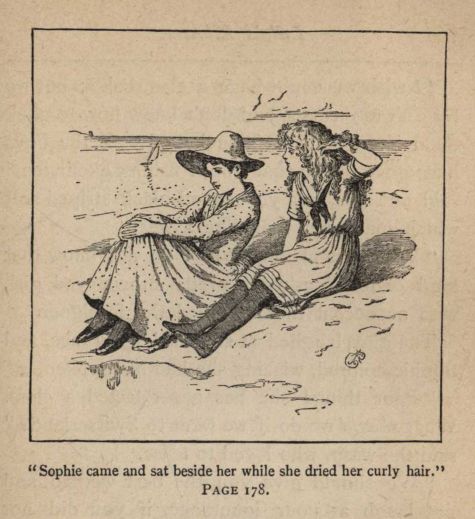
"Sophie came and sat beside her while she dried her curly hair." PAGE 178.
VII.
SOPHIE'S SECRET.
,, class:: center medium
I.
A party of young girls, in their gay bathing-dresses, were sitting on the beach waiting for the tide to rise a little higher before they enjoyed the daily frolic which they called "mermaiding."
"I wish we could have a clam-bake; but we have n't any clams, and don't know how to cook them if we had. It's such a pity all the boys have gone off on that stupid fishing excursion," said one girl, in a yellow-and-black striped suit which made her look like a wasp.
"What is a clam-bake? I do not know that kind of fête," asked a pretty brown-eyed girl, with an accent that betrayed the foreigner.
The girls laughed at such sad ignorance, and Sophie colored, wishing she had not spoken.
"Poor thing! she has never tasted a clam. What should we do if we went to Switzerland?" said the wasp, who loved to tease.
"We should give you the best we had, and not laugh at your ignorance, if you did not know all our dishes. In my country, we have politeness, though not the clam-bake," answered Sophie, with a flash of the brown eyes which warned naughty Di to desist.
"We might row to the light-house, and have a picnic supper. Our mammas will let us do that alone," suggested Dora from the roof of the bath-house, where she perched like a flamingo.
"That's a good idea," cried Fanny, a slender brown girl who sat dabbling her feet in the water, with her hair streaming in the wind. "Sophie should see that, and get some of the shells she likes so much."
"You are kind to think of me. I shall be glad to have a necklace of the pretty things, as a souvenir of this so charming place and my good friend," answered Sophie, with a grateful look at Fanny, whose many attentions had won the stranger's heart.
"Those boys have n't left us a single boat, so we must dive off the rocks, and that is n't half so nice," said Di, to change the subject, being ashamed of her rudeness.
"A boat is just coming round the Point; perhaps we can hire that, and have some fun," cried Dora, from her perch. "There is only a girl in it; I 'll hail her when she is near enough."
Sophie looked about her to see where the hail was coming from; but the sky was clear, and she waited to see what new meaning this word might have, not daring to ask for fear of another laugh.
While the girls watched the boat float around the farther horn of the crescent-shaped beach, we shall have time to say a few words about our little heroine.
She was a sixteen-year-old Swiss girl, on a visit to some American friends, and had come to the seaside for a month with one of them who was an invalid. This left Sophie to the tender mercies of the young people; and they gladly welcomed the pretty creature, with her fine manners, foreign ways, and many accomplishments. But she had a quick temper, a funny little accent, and dressed so very plainly that the girls could not resist criticising and teasing her in a way that seemed very ill-bred and unkind to the new-comer.
Their free and easy ways astonished her, their curious language bewildered her; and their ignorance of many things she had been taught made her wonder at the American education she had heard so much praised. All had studied French and German; yet few read or spoke either tongue correctly, or understood her easily when she tried to talk to them. Their music did not amount to much, and in the games they played, their want of useful information amazed Sophie. One did not know the signs of the zodiac; another could only say of cotton that "it was stuff that grew down South;" and a third was not sure whether a frog was an animal or a reptile, while the handwriting and spelling displayed on these occasions left much to be desired. Yet all were fifteen or sixteen, and would soon leave school "finished," as they expressed it, but not furnished, as they should have been, with a solid, sensible education. Dress was an all-absorbing topic, sweetmeats their delight; and in confidential moments sweethearts were discussed with great freedom. Fathers were conveniences, mothers comforters, brothers plagues, and sisters ornaments or playthings according to their ages. They were not hard-hearted girls, only frivolous, idle, and fond of fun; and poor little Sophie amused them immensely till they learned to admire, love, and respect her.
Coming straight from Paris, they expected to find that her trunks contained the latest fashions for demoiselles, and begged to see her dresses with girlish interest. But when Sophie obligingly showed a few simple, but pretty and appropriate gowns and hats, they exclaimed with one voice,--
"Why, you dress like a little girl! Don't you have ruffles and lace on your dresses; and silks and high-heeled boots and long gloves and bustles and corsets, and things like ours?"
"I am a little girl," laughed Sophie, hardly understanding their dismay. "What should I do with fine toilets at school? My sisters go to balls in silk and lace; but I--not yet."
"How queer! Is your father poor?" asked Di, with Yankee bluntness.
"We have enough," answered Sophie, slightly knitting her dark brows.
"How many servants do you keep?"
"But five, now that the little ones are grown up."
"Have you a piano?" continued undaunted Di, while the others affected to be looking at the books and pictures strewn about by the hasty unpacking.
"We have two pianos, four violins, three flutes, and an organ. We love music, and all play, from papa to little Franz."
"My gracious, how swell! You must live in a big house to hold all that and eight brothers and sisters."
"We are not peasants; we do not live in a hut. Voilà, this is my home." And Sophie laid before them a fine photograph of a large and elegant house on lovely Lake Geneva.
It was droll to see the change in the faces of the girls as they looked, admired, and slyly nudged one another, enjoying saucy Di's astonishment, for she had stoutly insisted that the Swiss girl was a poor relation.
Sophie meanwhile was folding up her plain piqué and muslin frocks, with a glimmer of mirthful satisfaction in her eyes, and a tender pride in the work of loving hands now far away.
Kind Fanny saw a little quiver of the lips as she smoothed the blue corn-flowers in the best hat, and put her arm around Sophie, whispering,--