Part 6 — CHAPTER XVIII PARAESTHESIA (continued 2)
Reading edition
A man of forty had always had homosexual impulses, as far back as he can remember. His stuprosæ acts were attached by mental images of men. The autoerotic fantasies are all of men. In his erotic dreams the images of men accompany the orgasm. The patient feels himself entirely like a woman and is attracted by physically well built men. Naked men in life or in sculpture have a great attraction for him. Women have never made the slightest impression on him. The mere sight of a naked woman disgusts him. Initus with women always failed for lack of erection, while homosexual acts afford complete satisfaction.
The patient has a disinclination to masculine pursuits. He does not drink nor smoke. His habitus is entirely feminine. The body is slight and non-muscular. The shoulders are narrow, the pelvis broad, the hands and feet decidedly small. The form is rounded with an abundant development of adipose tissue. He has few hairs on beard and mustache. His complexion is fine. His voice is feminine, he speaks in falsetto voice. His gait is rocking, womanly. He wears his hair quite long.
Since childhood he was actuated by the desire to put on female attire. He always wore female undergarments, such as shirts, drawers, corsets, etc. He generally wears bracelets on his arms. Whenever he can, he dresses up like a woman and takes long walks upon the streets in such costumes. Through his love for feminine attire he came in contact with several transvestites who form a kind of club in this city. But the latter who abhor homosexual practices soon discovered his motive for the desire of feminine attire and avoided his company. In his reveries, dreams and acts the patient always plays the pathicus. For some reason or other, unknown to the author, the patient committed suicide.
The female, suffering from the fourth degree of viraginity with bodily perversion, approaches in the form of her body that of men. For this reason she may easily masquerade as a man, associate with men, go through the marriage ceremony with a homosexual woman of the class suffering from the first three degrees of homosexuality, and she will never be found out until she dies. A few cases of this class were described by Krafft-Ebing.
The patient is a talented artist, twenty-five years of age. She has masculine features, a deep voice, a manly gait and small mammae. Early in her youth she preferred to play with boys. She never had a liking for dolls or needlework and found no pleasure in domestic duties. At fifteen years of age she began to menstruate. At the same time she began to fall in love with young girls. Her love was only platonic in nature. She is perfectly indifferent toward men. She is bashful only toward persons of her own sex. In her lascivious dreams females are on the scene where she herself plays the man’s rôle.
In another case of the same author, the patient, when a girl, had inclination for boys’ sports only. Once, when she was allowed to go to a theatrical performance, dressed as a boy, she was filled with bliss. Until her marriage, at the age of twenty-one, she was indifferent to men and women alike. She began to menstruate at the age of eighteen. Her engagement was a matter of utter indifference to her. Her connubial duties were first painful and, later on, loathsome to her. She never experienced sensual pleasure, yet she became the mother of six children. Her husband began at that time to practise onanism (coitus interruptus). At the age of thirty-six she had an apoplectic stroke. From this time on she felt that a great change has taken place in her. She was mortified at being a woman. Her menstruation ceased. Her feminine features assumed a masculine expression. Her breasts disappeared. The pelvis became smaller and narrower, the bones more massive, the skin rougher and harder. Her voice grew deeper and quite masculine. Her feminine gait disappeared. She could not wear a veil. Even the odor emanating from her person changed. She could no longer act the part of a woman, and assumed more and more the character of a man. She complained of having strange feelings in her abdomen. She could no longer feel her muliebria. The vaginal orifice seemed to close and the region of her genitals seemed to be enlarged. She had the sensation of possessing a penis and a scrotum. At the same time she began to show symptoms of the male voluptas.
In another case of Krafft-Ebing the patient, thirty-six years of age, commenced se stuprare manu at the time of puberty, when thirteen years old, and became homosexual when sixteen years of age. When twenty-six years old she had the feeling of transformation. She imagined muliebria sua turning into the male form and began to urinate like a man. She does not feel ashamed to undress in the presence of a man, but is shy to do it in the presence of a woman.
One of the best examples of the fourth degree of homosexuality is that of Murray Hall, who died in New York City in 1901. Her real name was Mary Anderson. Born in Scotland, she came to America, where she lived as a man for thirty years. Her features and her behavior were so entirely masculine in character that through all these years her real sex was not even suspected by her closest friends. She became distinguished as a Tammany politician and as a man about town who knew how to make money. She associated with politicians, drank to excess, swore a great deal, smoked and chewed tobacco. She was fond of pretty girls and liked to associate with them. She entered twice into matrimonial relations with other inverted women. Her first marriage ended into separation; the second lasted twenty years and was happy until the so-called “wife” died. The secret that “Mr.” Hall was really a woman was not discovered till after her death.
A similar case is that of De Raylan, who was assistant to the Russian consul in Chicago for twelve years. When he died in December, 1906, it was found that the assistant was a woman. She smoked constantly and was possessed of a discriminating taste for liquors with ability to withstand the effects of drink better than most men. She was married with the present “Mrs. De Raylan” for the last twelve years after having been married once before and divorced.
Transvestism.—The psycho-sexual anomaly of transvestism consists in the desire for cross-dressing. The male patient has the abnormal desire to dress like a woman, and the female patient longs to dress like a man. It is in this respect akin to the anomaly of homosexuality. In the degrees of effemination and viraginity, cross-dressing is a prominent symptom. The homosexual pathicus has naturally the impulsive desire to dress like a woman, and vice versa, the Lesbian woman longs to dress like a man.
Still, cross-dressing is a pathological entity by itself. Homosexuality is a morbid sex state of gross somatic experiences. It emanates from the crude, powerful sensation of sex. The individual’s longings extend to somatic sensations. These desires often rapidly reach an obsessional state. Transvestism, on the other hand, is a sexo-esthetic inversion of pure artistic imitation. Hence it occurs mostly in artists and in men of letters, i. e., in persons endowed with a highly developed artistic taste. Such persons are, as a rule, disgusted at the sight of the organs of the sex to which the individual by anatomical configuration belongs, while such sights offer to the homosexual individual additional charm and piquancy.
Transvestism tends to accent the esthetic sensibility. The patient’s experience of an increased comfort and well-being by the gratification of the pronounced impulse of cross-dressing, is more akin to the satisfaction of the artist, experienced by the successful expression of a certain symbolism. Transvestism is more in harmony with the basal esthetic demands. The patient harbors exalted ideas and is striving to secure artistic enjoyment in the appreciation of the beautiful. The attraction is in the mind and has nothing to do with the sex-organs. Hence transvestism seldom celebrates orgies of lascivious and voluptuous practices, as often found in homosexuality. If sensuous caressing does take place, it is with a person of the other sex. For the physical part of the sex activity is perfectly normal.
The following five cases of transvestism in menBF will illustrate these points:
The first patient was very delicate all the time up to four years of age. His father died when he was four years old, and the boy was brought up by his mother. As the youngest living child (Nesthäkchen, nestling) he was rather spoiled by her. He slept with his mother until he was fourteen years old. The patient’s looks were rather girlish. He always wore girl’s shoes, on account of his high instep. Up to twelve years of age the patient played with girls, made dolls’ dresses, cooked in girls’ cooking stoves, etc. The patient’s sister was a dress-maker and often used the patient as a model to drape or to try on dresses. Otherwise the patient was never seduced by anyone to irregular practices.
CUT XLIII.
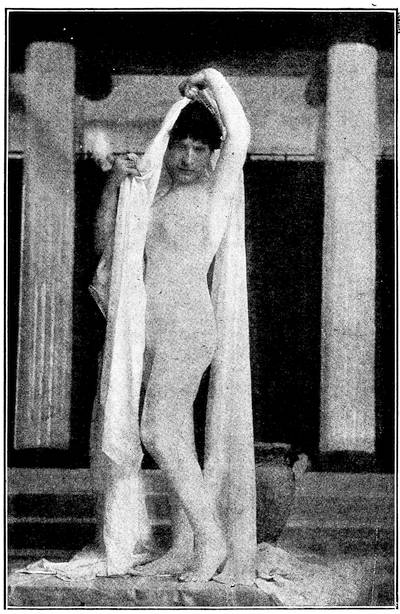
A characteristic picture of patient No. 1; posing in imitation of the celebrated painting “Psyche in Bath,” dressed in stockinet.
At puberty a certain change took place in the psyche of the patient. At this time, when about twelve years of age, he began to think how nice it would be if he could be changed into a girl. He never had any sexual desires for women. In stuprando manu he donned female attire, but his fancies had always women as the objects. When the patient is dressed like a man, no one would take him for a woman. There are no strongly pronounced feminine traits. The sex-organs are those of a normal man. The distribution of the hair on the body is almost the same as in any other man. The head is rather bald. On the arms there is no hair, but the hands are covered with hair. The hands are rather small, narrow, soft, well-shaped and artistic. The fingers are tapering. The legs and feet, when in dainty stockings, are rather feminine. The patient wears woman’s shoes. Otherwise when he is dressed like a man he looks like a normal man. But when the patient is in stockinet as in his photograph, “Psyche in Bath,” no one would take him for a man. When dressed like a woman, nobody would recognize a man in him. He has taken walks on streets unnoticed while so dressed. He never drew any attention, so perfectly does he look like a woman.
The patient’s behavior is quiet but not effeminate. His voice is low, of uncertain timbre. He tries to cultivate a female voice without resorting to falsetto. His writing is uneven, sometimes bold; mostly, however, it is a woman’s small handwriting. The gait is like that of a woman, swaying in the hips. The patient suffers from periodical hemorrhages of the nose, which he is inclined to consider as a kind of vicarious menstruation.
As far as the emotions are concerned there is a marked feminine sensibility. Tears come easily when watching emotional scenes. He smiles almost constantly when in conversation, but he rarely laughs outright. He is very sensitive to pain, but stoic enough not to complain. He blushes on the slightest pretext. He is possessed of feminine adaptability. He likes needlework and loves to do crochetting. He likes female amusements, such as “Kaffeeklatsch.” He is a freethinker in his creed.
The patient possesses normal love and admiration for the other sex. He is attracted by women, although his sexual feelings are very little pronounced. He takes the greatest pleasure in contemplating pictures of the female form. His day-dreams and fancies are only of women. He has no homosexual inclinations, but rather a profound repugnance against homosexual relationship. He never longed for a male instead of a female lover. Still he seems to want a man before whom he could expose the charms of his own person and who would kiss and caress him. His sexual desires are not developed. He never was in love with any women or men. His wife proposed to him. He may have remained otherwise single. He has three children, all perfectly healthy.
The peculiar anomaly the patient is suffering from is the desire to be a complete woman. From his childhood he had the wish to be a girl. His desire now is to live as a woman absolutely. He never had any dream where he saw himself as a woman; in fact, he never had any erotic dreams. He longs for the female form. He often wished to be castrated to be more like a woman.
The patient is attracted by beautiful women, but the instinctive feeling toward them is not the desire for possession, but more a feeling of envy that he cannot be one like them. The appeal of woman’s beauty to him is connected with the desire of inner or psychical or subjective identification of himself with the beautiful woman, the desire to be in her place—“Einfühlung, Miterleben,” as the Germans call it. He would do almost anything to see a girl in any condition of exposure, but he would experience only the desire of inner imitation. His desire to show himself in female attire is founded upon the impulse of being considered a full woman.
CUT XLIV.
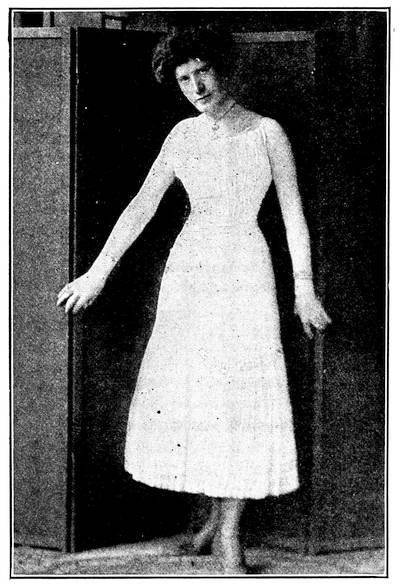
First patient.
From a legal point of view the patient’s inversion is mainly confined to the sphere of clothing. He has a profound longing for female clothes. He takes pleasure in the sight of female attire. Woman’s underclothing exercise a greater charm upon him than the woman herself. He especially attaches great importance to the corset. The patient is always dressed in female underclothes. He wears only a man’s coat, vest and trousers, or the clothes belonging to the outward cover. He wears woman’s shoes, shirtwaists, corsets, stockings, etc. The earlobes are pierced for earings, which he wears every night. He takes breakfast dressed as a woman.
When the patient is dressed as a woman, he has all a woman’s feelings and longings. For this reason he tries to dress as a woman at every opportunity. The desire to be dressed like a woman takes the form of an imperative impulse. When he cannot dress up he becomes restless. He would rather commit suicide than be without female apparel.
As a literary man and brain-worker, the patient can concentrate his thoughts better when in female attire. When dressed as a woman he feels himself to be in a normal condition and is cheerful. A feeling of absolute comfort and restfulness comes over him, when in female clothes, and his behavior is in full accordance with his feelings, while in male dress there is a kind of absent-mindedness about him; he is always thinking of his female dresses.
The second case is that of a gentleman of about sixty-two years of age living in the western part of our country. As a child he was known as mother’s boy, and his mother and he were very fond of each other. He has always done his best to please her, spent as much of his time with her as possible, and took great pleasure in the tasks she would give him, such as knitting, crochet work, or plain sewing. On most of all these occasions she would first put him in girl’s clothes. The hardest tasks would then be a pleasure to him. These practices continued up to his twelfth year of age.
From his earliest recollections his playmates were always girls and his playthings were dolls, ribbons, miniature housekeeping, furniture, etc. He was an expert doll maker and could cut and make doll clothes for his sisters and other little girls. At ten years of age he could cook and prepare a meal. He was known to have no lack of courage.
His inclinations are always towards strong-minded, energetic women of the masculine type. He also has an admiration for other men of his type when they are dressed like women. He never had any homosexual inclination. He always had an almost uncontrollable desire to wear woman’s attire. When so dressed he can always think more logically, feel less encumbered, solve difficult problems. But for the popular prejudices he would always wear female attire.
The skin of the patient is soft and clear, the hair on head and beard is soft and light. He has little hair on his body. His shoulders are square and his breasts quite large. His voice is high.
He blushes readily. He could never countenance vulgarity, such as smutty stories or obscene remarks. He is receptive. He is very sensitive to pain or pleasure. He is inclined to be stubborn. His intellect is keen, and he thinks logically.
When about fifteen years old his father forbade him to wear female clothes, so he kissed his mother good-bye and made his way to the far West. There he drove a team on construction work of a railroad and in the fall of the same year found himself hunting buffalo. In the five ensuing years he has done his part in winning of the West, with the result that he carries two Indian bullets in his legs. But he covers them up with petticoats, he says, as often as opportunity permits. Then he forgets all about them, as well as all other troubles. He has served as a detective in a United States marshal’s office, as a sheriff, and as a justice of the peace. He has been able to conquer almost everything except his uncontrollable passion for female attire. When the inclination to dress comes over him, he is unable, try as he may, to resist it.
This last characteristic in the case shows that the desire for cross-dressing may often assume the degree of a veritable imperative idea. If the desire is not satisfied, some patients are seized with anxiety, accompanied by cold perspiration and palpitation of the heart.
The third case is of a gentleman, thirty-two years of age, married. In his answer to a letter written by another transvestite asking him for his life history, the patient writes that he expected the letter, because Agnes M. had told him that he would receive one. This Agnes M. was a man, and it is characteristic of these patients to call each other by girls’ names. Our patient, too, signs his name, “Yours femininely, Blanche.” The part of the history of this “Blanche” that interests us most reads as follows:
The feminine instincts first appeared at the age of four years. He was then attending a small girls’ school in the country, his mother having a business in town. At about that age, it was suggested that it was time that he was put into knickers. When he first was dressed in boy’s dress, a horrid feeling assailed him. He fought so persistently against wearing these new apparel that his mother resolved to leave him dressed in girl’s attire for a few years longer. Thus he was able to wear frocks for the first eighteen years of his life.
At that time necessity made it imperative for him to earn a living, and he was forced to go out into the world dressed as a boy. He writes, he will never forget the great aversion which assailed him when he first went out in trousers. He seemed ashamed to look anyone in the face. He always wanted to hide his legs.
He never gave up feminine underwear, only outwardly he dresses as a man. In the house, when he returns from business, he always dresses as a woman. His mind is never contented during the daytime. When the evening comes, the first job on getting home is to don a petticoat and frock and to be for the rest of the evening in the garb which his mind tells him is the right one. He feels nothing but nausea in the garb of a man.
CUT XLV.
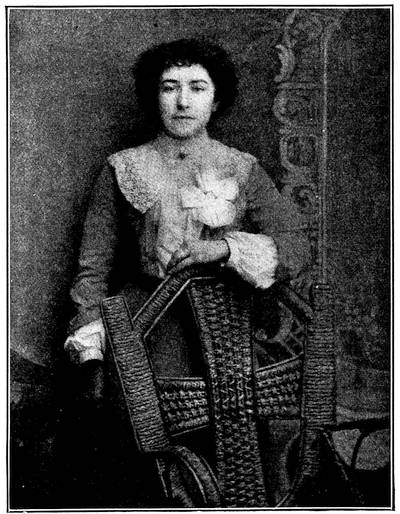
Third patient.
The last characteristic shows plainly the morbidity of the case. A normal woman, if forced by circumstances to wear men’s clothes, may have the feeling of being improperly dressed, but she would not have the feeling of nausea. Here we have a creature with a normal male body, but on account of the complete female mind he feels nauseated when wearing male clothes.
The fourth case is that of “Prof.” M., a female impersonator, who also addresses his transvestite friends by girls’ names. His history reads as follows:
The patient is sixty-two years of age, has a beautiful form, small hands and feet and a beautiful head of hair which he can do up in lady’s fashion by the aid of switches.
CUT XLVI.
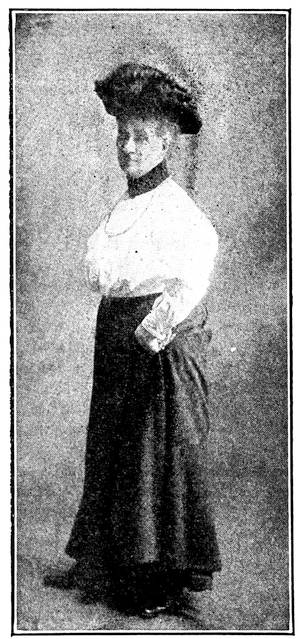
Fourth patient, dressed for the street.
His mother dressed him in girls’ clothes until he became a large-sized boy, and when she attempted to put him into boys’ clothes, he would kick and scream. Since that time, when opportunity presented itself, he would masquerade in female garb. There seems to be a peculiar fascination and pleasure to him when dressed in the clothes of the opposite sex. A sort of an irresistible impulse comes over him at times, and he cannot extricate himself. He can control his thoughts better, write and seemingly work better when dressed in skirts, and he is more contented.
His sexual organs are fully developed and do not differ from any other male organs. A number of years previously he was strong sexually and fond of the opposite sex. Nowadays he cares more for his own sex. Men look more attractive to him than women do. “It seems strange,” writes the patient, “but I think all female impersonators learn to have an abhorrence for the female sex, even a hatred in the course of time.” “Dear Miss S., as you and Maude (by the way, S. and Maude are both men) are in the same boat, I am free to tell all these things. I am pleased to find one who thinks as I do. The common herd does not understand me.”BG
This case throws a certain light upon the psyche of the woman impersonators. They do not become effeminate through the long habit of masquerading—that would be confounding cause and effect—but their innate anomaly leads them to choose impersonating as a profession. A normal man would hardly select such a profession as his life work.
The following case is that of a gentleman, aged thirty-six years, an artist painter who is about to marry. In his letter to a transvestite friend he protests against the insinuation of homosexualism. He writes as follows:
“The reason why I did not answer before is because it seems to me that our views on the matter mentioned are very diverging. As far as I can judge from your letter, it looks as if you consider man’s love for dressing in female clothes equal to homosexualism. I can tell you that homosexualism has always been an abhorrence to me, and that the sole reason for my desire to wear gowns is purely feminine love for what is beautiful and picturesque. In my relations to the other sex, I am just as normal as any other man.”
The longings for cross-dressing in our cases may be best explained, that the feminine strain, normally found in every male, exists here in a greatly exaggerated form. Every normal woman attributes an exaggerated value to clothes and, Narcissus-like, is more or less enamored with the female body.BH The same exaggerated value to female clothes is attributed by the male transvestites. The female transvestite, on the other hand, thinks of clothes more or less as men do. Yet, the male strain in her, being a morbid phenomenon, dressing is of more importance to her than it is to the normal man.
CUT XLVII.
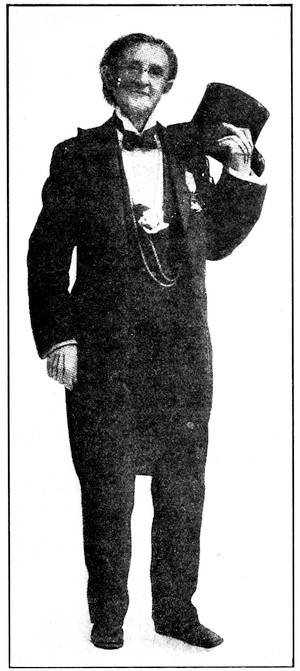
Dr. M. W., dressed in the masculine garb which she usually wears.
The case of the celebrated Dr. M. W. shows that even the female transvestite is greatly concerned in the question of dress.
She is always dressed in the masculine garb. She attributes great importance to the liberty of dress. She is constantly agitating for this liberty. In a letter to a male transvestite, written in Chicago, dated Jan. 12th, 1913, she says: “I have sent the bill to Albany, N. Y., and to Springfield, Ill., and expect to speak in both places on the right of clothes.” Then she continues: “The constitution of the U. S. gives right to life and liberty, and it makes no exception regarding ‘legs’ and ‘sex.’ It guarantees a republican form of government to every State, and it is not republican when the State puts the people in dress-chains.”
Zoöerastia.—One of the most peculiar and monstrous anomalies of the sexual impulse after homosexuality is zoöerastia or bestiality, where the individual se conjungit cum animalibus. The anomaly is as old as history. It was known already at Biblical times. The Mosaic lawgiver punishes the practice with death.BI
As a rule, bestiality is more due to a certain perversity than to a perversion. The fact that the zoöerasts are usually found among those who lack the opportunity for normal congressus (e. g., shepherds, segregated in the mountains for several months at a time) would tend to show that the practice is more a vice than a disease. Still a good many cases of bestiality show a diseased mentality. Even in the case of Gerstlaner (Arch. f. krim. Anthr. u. Krimin., xxxvi, p. 154), which looks more like a vice than a disease, the patient does not seem to be mentally sound.
A man was loitering about in the park of a certain town, where a savage big dog was often seen at large. By some means or other he managed to entice the dog to come near him. Quibusdam contrectationibus ei contigit ut voluptatem animalis concitaret. Tum nates nudavit, se flexit super scamnum, et canem adduxit ut coitum per anum perageret. During the act two policemen appeared on the scene who had great difficulty separare canem ab homine.
Such a case would look more like a vice than a disease. Still a man who can find sexual satisfaction in playing the rôle of the pathicus in any coitus per anum is sexually abnormal. The zoöerastic practices in the case of Sury (Archiv f. krim. Anthrop. u. Kriminalistik, xxxv, p. 314) are also due to a certain anomaly.
A man forty-seven years of age, twelve years married, was from the first day he married insatiable in his hunger for sexual activity. Præter maritam suam servis prædii sui concumbebat. Eodem tempore cum canibus ovibusque conjungebat et cotidie comprimebat porcam.
This man was apparently suffering from satyriasis with inclination to animals. The following two cases which came to the notice of the author also show at the first glance a certain anomaly:
In a certain village, every once and while, dead hens were found. Nobody could find the cause of this peculiar occurrence. One day, a man thirty-five years of age, of high social position, was discovered “in coitione cum gallina.” He always killed the hens in concarnatione. The contractions of the sphincter ani in the animal’s last throes increased his libido.
The circumstances in this case, where a wealthy man, who could easily reach the nearby city with all its opportunities for normal sex activity, still performs such abominable acts, show distinctly that the man was suffering from an anomaly.
The second case is that of a young man, twenty years of age. He began to feel uncomfortable and restless. Cold perspiration broke out all over his body. The knees began to tremble, and he felt a terrible pounding in his head. At the same time he had the imperative impulse cum anseribus jungendi. He often struggled against the desire but he always failed. He simply lost his reasoning power, and when he regained his reason, the act was committed.
No question this patient was suffering from a certain kind of epilepsy where the fits, necessary for the restoration of the patient’s equilibrium, were substituted by zoöerastic debauches. The paroxysmal attacks of psychic unrest and of intensity of feeling for certain experiences were morbid and due to the same fundamental factors, underlying the syndrom of epilepsy.
In women, zoöerastia, judging from the paucity of the cases reported, must be a rare anomaly or vice. The rarity of the occurrence of bestiality in women may be explained by the difficulty of making the animal take the active part in the performance. Still the small number of reported cases may also be due to the difficulty of proving the existence of bestiality in either sex.
When young girls, says Moll, are fond of taking canes in cubilia sua et stupre cum eis ludere, it will be very difficult to convict them of their vices except in surprising them in the very act, which can but seldom be accomplished.
The practice of bestiality by women is as old as history. Besides its mention in the Bible, there is the report by Plutarch that the Egyptian women who were segregated with the sacred goat Mendes practised sodomy with the animal. Herodotus himself saw the women submitting themselves openly to the embraces of the sacred goat.
Karsch relates that in Kamtschatka the women frequently conjungunt canibus.
Some cynics claim that the old maid’s love for dogs which appears so charming and touching, has some deeper reason than mere fondness for animals.
Moll knows of several cases where women keep dogs stupri causa, training the animals to practise cunnilingus on them. He cites a case from the annals of the court, where the woman was accused quod abusa est cane stupri causa movens animal lambere genitalia sua.
Pfaff records a case of a maid-servant on a farm who trained the watch-dog secum commisceri.
Maschka relates a case of a woman, forty-four years of age, who confessed in court se conjunxisse cum cane. Quondam die canis forte saluit inter femora sua et lambit vulvam feminae. Deinde femina inter nuda femora sua animal sumpsit et permulsit abdomen animalis, quoad penis erectus esset. Tum ad sellam nisa, canem ad se pressit et postquam penem inter labia posuit commovit animal ut motiones faceret, usque dum ejaculatio veniret.
Rosse reports the case of a young white, unmarried woman in Washington who was surprised in flagrante delicto with a large English mastiff, who in his efforts se solvere a puella caused an injury of such a nature that she died from hemorrhage within an hour.
All these cases do not reveal any kind of a perversion. The practices seem to have been due to vice or perversity. The following case, communicated to the author by Dr. C., of Tequisquipan, Mexico, who accidentally entered the patient’s hut while she was kneeling on her bed “in copulatione cum mulo suo,” shows distinctly its pathological nature:
The patient, a widow, thirty-six years of age, was married at the age of sixteen and had her first child a year later. Her husband died ten years ago. She had one other child five years ago which died in infancy. She had always been of a passionate nature. Jam undecim annos nata cum viris se conjunxit. Stuprum manu faciebat on and off all her life, especially at the time of menstruation, cum viri ea concumbere nollent. Concarnationes habebat sedecies una nocte, going the rounds of the different nightshifts at the mills. About three years ago she had the first time coitum cum animali. Suus canis erat. Inde sæpe commiscebatur cum canibus. About a year ago, while returning with her burro from a neighboring town, duos canes in conjugio vidit, quod se valde concitavit. Cum mane postmeridianum tempus esset virum celeriter invenire non potuit. Qua re mulum in casam sumpsit et coepit contrectare fascinum, donec emersit. Deinde in grabatum reptavit, posuit muli pedes priores in eo, et ipsa cubitis genibusque nixa est. “Tum femora muli in tergo suo posuit et postquam penem animalis inter labia inseruit; coitum solitum cum animali habuit, in quo ea ipsa motiones fecit celeres aut lentas, secundum necessitatem suam.” She now has the burro trained so that when she lets him enter the hut he commences at once to unsheath antequam potest posituram capere.
The examination of the patient showed nothing abnormal in the organs, except an extreme sensitiveness to touch. The mere separation of the labia induced orgasm. During the examination she had four to five orgasms.
There can be no doubt that this woman was suffering from nymphomania. Men could not satisfy her increased sexual desire, so she took refuge to animals.