Part 6 — CHAPTER XVI ANAESTHESIA
Reading edition
Under the caption of sexual anaesthesia will be treated here not only the deficiency of sexual emotion or the absence of the sexual feeling, i. e., the impotence of voluptas or the lack of erotic desire, but all other deficiencies, declines or abatements in the realm of sex, such as absence of experiencing satisfaction, impotency of copulation and of propagation.
Etiology of male impotence.—In the etiology of impotence three main causes must be taken into consideration. Impotence is almost always met with in congenital or acquired malformation. Such anomalies lie more in the province of surgery and need not be considered here any further. Impotence is also found as a symptom in certain constitutional diseases. The patients suffering from these troubles, are seeking medical advice more for their causative anomaly than for the symptom of impotence, which in these cases is of secondary importance. Hence the consideration of these cases may also be omitted. The anomaly of impotence par excellence and for which medical advice is mostly sought is nervous impotence. This impotence from nervous collapse is the commonest and complicates all other kinds.
The patients of this class have always been normal in their sex-life. Suddenly, one day, they find themselves impotent. The cause of this kind of impotence is, in the majority of cases, sexual excesses, and four different kinds of excesses may be taken into consideration, excesses in copulation, in masturbation, in mental erethism, or commonly called day-dreaming, and finally excesses in tactile eroticism, or the common sexual dalliance or caresses of young lovers.
Copulation excesses.—During coition all the parts of the genital apparatus are in a state of extreme congestion. If such congestions are too often provoked they have a more or less deleterious effect upon the organs. Especially the colliculus and the prostatic portion of the urethra are affected by such repeated congestions. While the other parts assume their normal state soon after ejaculation and the cessation of erection, the colliculus remains still in a state of turgescence for some time. Now, the prostatic urethra is very rich in sensible nerves, and by its congestion all the generative organs are kept in a state of erethism. The irritation of this area is also capable of deranging the spinal genital centres. It either increases excitability and causes ejaculatio praecox, or it decreases excitability, and erections are no longer evoked.
Besides affecting the special nerves, the repeated orgasm, through the mental vertigo, the muscular convulsion, the cardiac and respiratory excitement, must lead to nervous disorders. As a matter of fact, venereal excesses are followed by malaise, nervousness, mental depression, lassitude, fatigue, satiety, heaviness in the head, disposition to sleep, dulness of intellect, indisposition to exercise, want of decision, regrets and ill humor, and the other symptoms of general neurasthenia.
Masturbatic excesses.—Still excesses in copulation are not so harmful as excesses in masturbation. In the first place excesses in copulation are self-limited. Indulgence in intercourse requires the consent of the partner, and where a second person is needed, there is always a limit put to the will of the first party. Furthermore, excesses in coition require each time a complete erection, and abused nature will finally deny erections. If the young and vigorous individual should in the beginning be able to command quite a number of erections in one night, after a certain time, he will be glad if he could have one complete erection during a night, or even once a week. In this way Nature herself regulates such excesses and takes care that “the trees should not sweep the stars down.”
The case is different with masturbation. No limit is set here to the excesses. Self-abuse does not require cooperation of a second person, and what is of more importance, erection is not requisite. Thus even Nature is here powerless. Hence when there is a propensity to masturbatory excesses, there is nothing to prevent the individual from abusing its favorite pastime.
Besides the harm to the greater frequency, excesses in masturbation offers additional injury through the youth of the individual. Copulation excesses are indulged in by individuals after puberty, i. e., by persons with fully developed generative organs and in full virility. The practice of masturbation, on the other hand, is often begun by mere children, before the genital organs have had time to fully develop, and it is easily seen that excesses will cause greater damage to these undeveloped organs. Hence when young individuals are given to inordinate masturbation, they harm the organs in a higher degree than excesses in copulation.
Furthermore, ejaculation in masturbation is forced through purely local manipulation. There is only a local excitation of the nerves. The help of the psyche and phantasy is missing, and the lumbar centres are tasked to the utmost. When the masturbator tries to supply the psychic means, he relies on the fertility and the extravagance of the lewd images which he presents to his mind to increase the libido. Hence masturbation is more injurious because it is generally effected through the influence of an exalted imagination.
Very soon the masturbator discovers that visions, once sufficient to produce the requisite excitement, have lost their power, and that the images need to be of a more extravagant salacity. In this way, the masturbator accustoms himself to extraordinary means of sexual gratification, so that attempts of normal copulation are no longer successful. When he attempts coition, he finds that reality is so much less than his imagination has led him to believe and that it is incapable of rousing his appetite.
Another injury done to the character of the masturbator is the guilty conscience. Almost every masturbator seems to feel that his acts degrade his manhood.AR He seems to know by intuition that his practice is injurious to his health and is morally wrong, because it is not in accord with the general plan of the creative power in the universe. Still in spite of himself, he continues to indulge in it. The will seems to have entirely lost its control. The masturbator is thus engaged in a conflict between moral conviction and sensual indulgence. Herein lies one of the most harmful effects of masturbation. It is undermining the individual’s will-power and destroying his character. Every masturbator resolves again and again, after each exercise, to resist henceforth the inclination and to overcome the temptation,AS each time with the same futile result. A paralyzing sensation arises in him, a feeling of shame and self-contempt overtakes him, because he has again failed to show enough energy, has again been too weak to resist the impulse. Finally these disturbing and paralyzing sensations give rise to the conviction of his being lacking in will-power and to the feeling of being generally deficient in everything else in life. In this way, excesses in masturbation harm the generative organs not only directly but also indirectly by first injuring the individual’s entire nervous system, and the different kinds of impotencies are only symptoms of the general neurasthenia.
Mental erethism.—The other kind of sexual excesses, those of mental erethism and frustrate eroticism, are even more harmful than excesses in copulation and masturbation.
By mental erethism or, as it is generally called, or rather misnamed, mental masturbation, is understood the filling of the phantasy with lascivious pictures. The dreamers give themselves up to sensual thoughts, allowing the mind to dwell constantly on sexual ideas, or erotic subjects of connubial enjoyments, conjuring before the unruly imagination extravagant and voluptuous visions and bawdry portrayals. The mind is fixed on images of individuals of the other sex, all in lustful positions, on pictures of the nude and of their genitals and of couples in actione coeundi.
The voluptuous day-dreamers, not needing material manipulation, may busy themselves with their favorite thoughts while seemingly conversing with their friends or on the most solemn occasions, as when listening to a sermon, etc. These erogenous thoughts, these libidinous images, these constant broodings on sex-matters create a habit which secures such a hold upon the individual that he cannot overcome it. The habit becomes so rooted in some instances that it is impossible for the patients to free their thoughts from fancies and pictures of lustful situations, while alone. Not even with the greatest efforts are they able to rid themselves from imagining erotic scenes of various kinds. Their minds are constantly preoccupied with a single engrossing subject to the exclusion of all other topics and are perpetually turned on sexual subjects, so that they are unable to concentrate their attention upon any other matters.
These perennial broodings on sex subjects keep the genital organs in a permanent state of sexual excitation and erethism. While in masturbation the material congestion of the generative organs is removed with each ejaculation, in mental erethism relief by ejaculation is missing. In the first stage of the vicious habit, the morbid mental lubricity and the lascivious unlicensed thoughts may occasionally provoke an ejaculation. But later on, when the genitals have undergone a certain weakness, ejaculation is not brought on any longer by these images, and the genital organs remain in a continual state of material congestion and nervous tension. In this way not only the colliculus and prostratic urethra, as in excesses of copulation and masturbation, but all the genital organs are in a state of chronic inflammation, which in time becomes the cause of impotence.
Tactile eroticism.—Worse than mental erethism is tactile eroticism. By tactile eroticism is understood, keeping the genital organs constantly irritated by dalliance with individuals of the other sex, stopping short of the act of copulation. On a walk through the city parks, any summer evening, or on a trip on the Sunday excursion boats, young men and women may be observed lying in each other’s arms in a continual caress, kissing, hugging, and fondling each other for hours, scarcely confining themselves within the limit of decency. These couples are actually exercising the sexual act, although they do not obtain sexual congress. These tremors and ecstasies, these amorous ardors and intoxications, these sensual joys which stimulate with rapture the higher centres and infuse the mind with sexual gratification, are all a part of the chain of the sexual act. The interruption of this chain of impulses short of copulation may satisfy the moral conscience of the young people, but it does not make such excesses less injurious. On the contrary, the generative organs are deprived of the relief which ejaculation lends to these organs. The genital tube remains surcharged with blood, and the hyperaemia subsides but slowly. The normal outlet of the sex-activity has been cut off by a special process of repression. If these frustrate stimulations are frequently repeated, they perpetuate the genital congestion, and through the retention of the secretions, a catarrh of the genital organs ensues, just as inflammations often originate in the mammary glands through the accumulation of the milk after weaning the child.
These perennial congestions are the cause of prostatic inflammations not seldom met with in young men who never were infected by gonorrhoea. The ulcerations of the cervix so often found in young girls and young mothers of one child may often be attributed to no other cause than to frustrate eroticism in the young girls and to onanismAT in the young mothers. The cervix is damaged in the same way as the soil, burned by the sun, in the absence of a beneficent rain, cracks and slits.
The frequently repeated engorgements of the blood vessels which do not receive the normal physiological relief by ejaculation provoke in both parties an exaggerated sex-sense and produce the emotions, known as satyriasis in men and as nymphomania in women. The exaggeration is followed later on by exhaustion of the libidinous impulses, and the men become hypochondriacs and impotent and women neurotic and shallow.
The continual congestion in the genitals causes also a continued feeling of heaviness and discomfort in the lower abdomen. Urination becomes frequent in both sexes, and in women menstruation is irregular. The patients complain of profuse pains in the back, legs, sides, and of weakness, nervousness and sleeplessness. These troubles cause general debility and a complete breakdown of the nervous system.
The generative centres are particularly damaged by the constant congestion of the genitals. The frequent stimuli keep the lumbar centres in a condition of constant irritation. The nervous system, presiding over the function of erection, thus becomes worn out and exhausted, and the nerves do not respond even to the strongest stimulations, which would otherwise set them in action. In this way, the centres get accustomed, so to say, of not responding any longer with erection to the proper stimuli, or in other words, the consensualism between the genital nerves and their centres is broken.
Hence, besides the harm done to the nerves by the general debility, there is great damage done to the genital nerves and centres by the break in the chain of the reflex mechanism. In no other sex-activity, except in actual copulation, are the generative organs in such a constant and intense excitement as in dalliance with individuals of the other sex, no other erotic stimuli create such libidinous turgescence of the organs and such a high degree of sex-tension, exciting with rapture the higher centres, no other excitations cause such a consumption of nerve power as this gratification of the impulse of contrectation by tactile manoevres. The erections of penis and clitoris are vigorous and violent. The organs are set in a state of expectancy for the final act. If the act is not terminated within a certain limited time, the state of expectancy cannot last for ever. The mode of action is limited in length of time. Except in the abnormal state, known as priapism, the duration of erection is relatively short in the normal individual. Its beginning is synchronous with the onset of the material congestion and nervous tension of the genital parts, and its subsidence should normally be synchronous with ejaculation. If the latter be prevented, erection has to cease sooner or later, even when congestion and tension remain unabated. Hence after long and lasting amorous caresses the erections fail.
If these manœuvres are often repeated, the excitations finally do not effect the proper response, and erection fails from the outset. The strong and continuous stimulations render the nerves and their centres inert in reaction and weak in power. The centres of erection and ejaculation become blunted, the inhibitory centres get very sensitive, and erection cannot be provoked. When the nerve centres presiding over the function of erection get into the habit of not responding to the highest excitations of the tactile stimuli, they do not respond even to the stimulations concarnationis. The cooperating nerve-apparatus has been affected, and a perverted innervation is created. The close interdependence of the mechanism of erection and the centres is removed, and an abnormal reflex-excitability is produced. The consensualism between the corpora cavernosa and the centre of erection is interrupted.
Before the indulgence in frustrate caresses has become a habit, i. e., in the beginning of the practice, erections are vigorous and of considerable duration. But the duration diminishes with each repetition. After a few months or years of these nerve-destroying practices, according to the patient’s nervous constitution, there is no response by erection even to the strongest stimuli. The consentaneous action, which, otherwise, connects the excitement of the organs with erection and completion of the act, does not take place. This lack of consensualism on the part of the several factors which go to make up the orgasm leads finally to complete impotence.
Continence, if long continued, has been claimed to be the cause of impotence. But there is no valid reason for this belief. To prove the harmfulness of continence, an analogue is brought forward between the atrophy of a muscle in enforced idleness and the injury to the sex organs in enforced abstinence. But the proof is somewhat feeble. The essential organs of generation are not muscles but glands, and who has ever heard of a tear gland atrophying for lack of crying. Furthermore, abstinence does not condemn the generative organs to absolute rest. Every individual, especially when abstinent, has frequently nocturnal erections through the entire period of his sexual activity, and there is no reason why such erections should not keep the genitals in the required exercise and should not prevent the alleged atrophy. As far as the exercise to prevent atrophy is concerned, nocturnal erections ought to be of the same service as erections followed by intromissions. The nocturnal erections seem to be even more harmless. The engorgement of the colliculus is less pronounced in these erections. Micturition, on awakening with an erection, is immediately possible, while there is a pronounced inability of micturition after an erection and ejaculation either through initu aut stupro manu.
The histories of patients are cited to prove the deleterious effects of total abstinence. Cases are known of alleged abstinent neurasthenics, on the point of a complete breakdown, who recovered perfect health after marriage. But even this proof cannot stand a closer scrutiny. Who can prove the total abstinence of these patients? The layman is prone to regard the actual intromission only as sexual activity. If he has abstained from this final phase, he considers himself abstinent. But chastity is not continence by any means. Absolute continence is abstinence not only from the gratification of the impulse of detumescence concarnatione, but also from that of contrectation, i. e., from mental and tactile caresses and from all other abnormal practices. We must distinguish between chastity and abstinence. Those who are chaste out of fear of venereal infection or for lack of opportunity are not always abstinent. They are just the individuals who are indulging immoderately in mental erethism or even masturbation.
The mere assertion of the patient that he never indulged in unnatural practices does not count. The patient’s veracity is very questionable. All venereal troubles seem to exert an inhibitory influence upon the truth-centres. The propensity of the masturbator to conceal the truth is notorious. If such a patient claims that he has never masturbated, it is likely that he is still practising it. A special psychical element, associated with this habit, prompts the majority of patients to gross and intemperate prevarication.
But even if such a “rara avis,” who has abstained from actual manusturpation, should exist, still mental erethism cannot entirely be excluded. The elicitation of a history of mental erethism is connected with great difficulty. Masturbation with these patients means only the indulgence in manual practices; the voluptuous day-dreams are considered of no account, and the peculiar type of mendacity prevents them from revealing the truth even to him, upon whom they called to consult.
Hence the loss of sexual power in these patients may not have been effected by continence but, on the contrary, by continual erethism. The examination of such patients really shows, as a rule, the prostatic urethra in a state, which is usually caused by prolonged erethism. After marriage, with its regulated sexual activity and the removal of the inclination to the wild erotic fancies, the neurasthenia is soon cured, not because the patient has given up abstinence, as interpreted by the anti-abstinence advocates, but, on the contrary, because he has now become real abstemious from the excesses of mental erethism. Hence the cure of neurasthenia by marriage is no proof against sexual abstinence. The patients who seek medical advice for their neurasthenic troubles may be those who have only abstained from coition but have freely and immoderately indulged in the unnatural modes of sensualism, whence their troubles originated. The real continent individuals who avoid any kind of erotic practices remain sound and healthy and do not require medical help. Their cases remain hence unknown to the profession.
If total abstainers from every kind of sexual erethism should sometimes become neurasthenic, this fact would not prove yet that the nervous trouble was caused by total abstinence from the gross sexual gratification. Even the man about town may become neurasthenic for lack of the gratification of the impulse of permanent mating. The apologists of promiscuous intercourse forget or are ignorant of the fact that the impulse of permanent mating in normal men and women cannot be satisfied by promiscuity. The craving for a permanent mate, home and family unconsciously demands gratification even from him who leads a promiscuous sexual life. If this impulse is not gratified, as in cranky old bachelors or hysterical old maids, it may lead to severe attacks of neurasthenia. Such cases will not be cured by the association with venal women or by promiscuous sensuality, but they may be cured by a permanent mate, home, and family life. Hence the cure of the total abstainer from his nervousness by marriage is again no proof against total abstinence. The cause of the trouble may have been the unsatisfied impulse of permanent mating which has been now satisfied by marriage. Promiscuous relations would not have cured the neurasthenia, but marriage with its accompanying emotional tones.
There is, therefore, no valid proof of the harmfulness of total abstinence in a healthy individual without a hereditary taint. If total abstinence ever harmed anybody, the patient was either a congenial weakling or has acquired his lack of resistance through indulgence in early eroticism. A perfectly healthy man is never injured by abstinence. At least there is no sufficient proof that it ever did. But there are unmistakable proofs that total abstinence does not harm the individual. The best proof is furnished by many chaste and healthy women. Few women seem to suffer from total abstinence. The rejoinder that woman’s sexual desires are very feeble, that the female sex has no sexual needs, that it is more or less frigid, are mere masculine assertions without objective proofs. Women writers, who ought to know best the feelings of their own sex, claim just the opposite. Johanna Elberskirchen (in Sexualempfindung bei Weib und Mann) has well satirized the masculine impertinence which tries to teach woman what her emotions are or are not. The fact that many a young woman runs the risk, in the present state of sex-morality, of ruining her entire future by the indulgence in extra-marital sexuality, under conditions where pecuniary or other considerations are entirely out of the question, would tend to show that the sexual impulse is by no means so weak in women, as many would lead us to believe. It is simply incomprehensible that the female sexual needs should be less urgent than those of the male sex. Woman has by far the greater part of labor in the sex-performance. With the ejaculation the man’s biological part is at an end. He may leave now the scene of his activity, while the woman’s part just begins and is continued through nine months of pregnancy and about a year of nursing of the new being. Dr. M. Glasgow, as a woman perfectly competent to judge, says (Review of Reviews, 1912, p. 319): “The strong sexuality displayed by a sex whose contribution to the germ of the race is discharged in a brief moment of enjoyment must be greatly less than exhibited by the other party, whose contribution is made through long months of patient endurance.” The prominent part woman takes in the propagation of the race forces to the logical conclusion that her erotic needs are of necessity stronger, although, as Ellen Key puts it, they may be calmer than that of man’s. Woman is able in a quite extraordinary way to produce the impression that she herself is really non-sexual and that her sexuality is only a concession to man. But the seeming reluctance of the female is intended to increase the sexual activity in both mates. The passivity of the female throughout nature is only apparent, it is the passivity of the magnet. As a matter of fact, women experience during the orgasm an ecstasy of feeling greater than in men, involving the whole system in an ecstatic nervous erethism.
Still the normal woman can stand absolute continued continence without any injury to her body and mind (e. g. nuns). Hence there is no reason why the human male, if left to himself, and nothing comes to disturb the natural course of his sexual development, should be harmed by abstinence. Until the impulse of permanent mating enters into play, and this comes relatively late in life, abstinence will harm neither men nor women, if they live in an atmosphere free from the influence of artificial stimulation.
If the animal kingdom could be taken as proof for or against total abstinence in man, we find that pet animals, as canary birds or dogs, who rarely have the opportunity to exercise their sexual powers, are generally as healthy and live as long as those living in freedom.
Hence the claim that abstinence is the cause of impotence has absolutely no ground to stand upon. If the young man kept his thoughts pure and avoided exciting amusements which create emotional disturbances, impotence would be an unusual occurrence. If the young woman would avoid puttering over her genitalia, pelvic obsession with its accompanied hysterical conditions of hyperesthetic or paresthetic erethism would be rarely met with.
The only cause for impotence remains sexual excesses. They are very seldom the immediate cause of the impotence. But they leave such weakness in the genital organs and in the nervous system that it requires only the least disturbance to provoke total impotence. Such disturbances, as remorse over the formerly committed irregularities, or distrust in one’s powers, or the mental attitude of the woman to whom sexual approaches are a matter of real or assumed indifference, are sufficient to render the weakened neurotic man total impotent.
Next to excesses, gonorrhoea, in a great many cases, leaves the genitals in a similar weakened condition. Gonorrhoea often causes acute inflammation of the prostatic urethra, and the mucous membrane not seldom undergoes the changes characteristic of chronic catarrh. The sensory nerves reflexly keep the centres for erection and ejaculation in a condition of hyperesthesia. This condition finally leads to the paralysis of the centres and nerves, and reflex-erection cannot be produced.
Psychic causes of impotence are mental fatigue, overwork, preoccupation with mathematical or financial problems, fear,AU anger, grief, and disgusting sights or odors. Prolonged excitement before attempting coition may also lead to temporary impotence.
The other causes of impotence are the symptomatic ones. Impotence is met with in tabes dorsalis, diabetes, nephritis, obesitas, oxalic diathesis, haemorrhoids, fissures of the anus, seat worms, etc. Excesses in the consumption of certain drugs may also lead to impotence. Such drugs are alcohol,AV morphine, cocaine, tobacco and the bromides.
Etiology of impotence in women.—The same causes, at work in producing impotence in men, are also affecting impotence in women. The only modification lies in the fact that impotence of copulation, which is the impotence par excellence in men, is of a negligible quantity in women. The main mode of impotence found in women is that of experiencing libido. This impotence may be either idiopathic or also caused by excesses as the impotence of copulation in men. Idiopathic impotence of libido is oftener met with in women than in men. Still even in women this insensibility is much rarer than is generally believed. The explanation for the greater frequency of impotence of libido in women than in men has first been given by Freud (Sig. Drei Abhandlungen über Sexualtheorie).
The autoerotic activity of the erogenous zones in children is the same in both sexes. It may be asserted, says Freud, that the sexuality of the little girl has entirely a male character. The chief erogenous zone in the female child is the clitoris which is homologous to the male penis. The frequent spontaneous discharges of sexual excitement in little girls manifest themselves in twitching and erections of the clitoris. But while in the male the erogenous zone remains the same after puberty as before, namely in the penis, puberty is distinguished in the girl by a wave of repression of the clitoris-sexuality and in the change of the erogenous zones. The rôle of the clitoris is henceforth to conduct the excitation to the adjacent parts. It often takes some time to affect this transference. During this time the young woman remains anaesthetic to stimulations of the internal organs as vagina or cervix. This anaesthesia may become permanent if the clitoris zone refuses to transfer its excitability. This anaesthesia in women is often only apparent and local. They are anaesthetic at the vagina and cervix, but not at all unexcitable through the clitoris or even through other erogenous zones, such as the lips or the nipples. The women are impotent of experiencing libido in coition but potent when the clitoris is excited by any other stimuli.
The refusal to transfer the clitoris sexuality is, as a rule, caused by an excessive irritation of the clitoris by manusturpation during childhood. The excesses which cause impotence of libido in women are the same which cause impotence of copulation in men, namely excesses in copulation, masturbation, mental erethism, and tactile eroticism. In women the excesses in copulation are more harmful than in men. While in men these excesses are self-limited by the impossibility of provoking any erections, after a certain time of continuous indulgence; in women there is no limitation to the practice. Playing the passive rôle, she can stand congressum continuum for a considerable length of time and tire out a number of men in succession. The vaginal pavement-epithelial lining is very strong.
“Conteritur ferrum, silices teneantur ab usu. “Sufficit et damni pars caret illa metu.”
sings Ovid in his “Ars Amandi.” Hence when a woman has any proclivity for excesses in initu, there is no natural limit to her indulgence. Through the influence of the frequent irritation in copulative excesses, the vaginal mucous membrane undergoes considerable changes. It becomes a veritable skin, a stiff parchment, and thus loses sensitiveness.
The other cause for impotence of libido are excesses in masturbation. The evil results of these practices in women are fully as great as in men, although with women it is the orgasm alone that does the damage, since there is no seminal discharge or loss of vital fluids. Through the frequent application of friction to the parts, they become first hypersensitive and later hyposensitive and non-responsive to normal excitations. Accustomed to excite the genitals by manual stimuli, which may be kept up for a considerable length of time, the masturbator is, later on, impotent to reach the acme through the normal, relatively short excitations, as they take place through the internal organic events in the genitals in normal sex-activity.
In women, the same as in men, the greater damage through excesses in masturbation is done by the greater frequency, because it requires no help, from an outsider, because it is not bound by time and locality, and may be practised by the undeveloped child, and last but not least, because of the constant conflict and struggle of the masturbator between the sensual impulse and the inability to desist and the feeling of womanly unworthiness, dissatisfaction and shame.
Excesses in mental erethism and excessive dalliance with members of the other sex have no less injurious effects in women than in men. In the long run these excesses cause in the woman a number of nervous troubles which take the form of hysteria or assume the character of neurasthenia. These excessive practices of erethism or tactile eroticism are, also in women, worse than excesses in copulation and masturbation, because the former do not lead to the orgasm and to the relief of the nervous tension and material congestion.
Another cause of impotence of libido in women is onanism or the practice of withdrawal. This coitus interruptus which rarely leads to orgasm in the woman, has the same effect upon her as excessive mental erethism or tactile eroticism, because it does not lead to relief from the nervous tension and the congestion. Excesses in onanism are, therefore, very harmful in women, while they are of lesser consequence in men. The repeated congestions of the parts in all these practices lead first to chronic hyperaemia and stasis, and in its further progress to chronic inflammations of the tissues, known under the respective names of metritis, perimetritis, parametritis, endometritis, salpingitis, and ovaritis. The inflammations constantly irritate the nerves and their centres and in this way blunt their normal sensibility. Besides the dulling of the nervous elements, these conditions give rise to great pain in commixtione, and pain and fear are the greatest enemies of libido.
Other causes of impotence of libido in women are excesses in alcohol, bromides, cocaine, morphine and other narcotics and stimulants. Sometimes impotence of libido is the result of a hard confinement. During such confinements extensive lesions in the erectile tissues of the bulbs and in the sphincter cunni muscles are apt to occur. Now, the integrity of the vaginal bulbs, of the sphincter cunni, of the intermediary net of vessels, and of the clitoris is necessary for the normal experiencing of libido. If a serious lesion occurs, the blood current is interrupted, and the blood is prevented from leaving the bulbs and from entering the corpora cavernosa of the clitoris. The following case will serve as an illustration:
The patient, twenty years of age, married twenty months, has a baby ten months old. She states that since her confinement she has no libido during coition. Before this event she always found perfect gratification. The examination shows a first-degree laceration of the perineum.
Absence or smallness of the clitoris and an adherent prepuce may also often diminish the feeling of libido.
Pathology of male impotence.—The minute penetration into the different causes of sexual anaesthesia in the preceding pages was of particular importance, in order to fully understand the pathology of the different kinds of impotence.
The accomplishment of the physiological act of copulation and impregnation requires from the man the possession, first of the desire to associate with the other sex, or of the instinct of voluptas,AW secondly the power of effecting intromission or the potency of erection, thirdly the potency of ejaculating a healthy sperma for impregnation, and finally it requires that libido or pleasure accompanies the emission to assure the repetition of the act.
From these requirements it follows that the individual must command over four potencies, the potency of voluptas, which compels the individual to seek the society of the other sex, the potentia coeundi, which depends upon strong normal erections, the potentia generandi, depending upon normal secreting testicles, and upon the perviousness of the entire seminal canal, from the testicle to the meatus of the urethra, and finally over the potency of libido, which depends upon the intact centripetal nerves and normal centres of generation in the brain. If any of these potencies are missing, the individual will be impotent. Hence four kinds of impotencies may be distinguished in both sexes:
(1) The impotence of voluptas, or the absence of sexual desire.
(2) The impotence of immission, or absence of the power of erection in men and the anomalies at the entrance into the vagina in women.
(3) The impotence of impregnation, or the absence of spermatozoa in men and of ova in women.
(4) The impotence of libido, or absence of the ability to experience pleasure at the moment of emission.
Impotence of voluptas.—The impotence of voluptas, or male frigidity, unassociated with the two other impotencies of copulation and impregnation, is very rare in men.
Physiological impotence of voluptas exists in childhood and in old age. In the latter period the desires disappear pari passu with the power. Although the feeling of desire is of purely mental origin, the generative organs playing only a secondary part, still when these organs are powerless or absent, the desire is generally also absent.
Impotence of voluptas is found in eunuchs and in castrates,AX who have been operated upon before puberty. Such castrates, even if the penis has not been removed, show not only impotentia coeundi, but also complete frigidity. Their habitus and feelings differ entirely from those of normal men. Castrates, who have been operated upon later in life, retain the habitus of normal men and also the impulse of contrectation. The potency of immission is even greatly enhanced, at least for the first few years after the operation. In normal men erection subsides immediately after the ejaculation. In eunuchs ejaculation does not take place. Hence the erections may last for hours or even days. In the course of time the potentia coeundi even of these castrates begins also to decrease and later on becomes entirely extinct.
Impotence of voluptas is also found in severe cases of neurasthenia, where the entire nervous system is in a low state of efficiency. The history of the following case may serve to illustrate the symptoms of the neurasthenic impotence of voluptas.
Mr. B., 35 years of age, unmarried, had gonorrhoea several times, never lues. Since puberty until about two years ago he was a typical rounder and had an abundance of femininity at his disposal. He is now suffering from general debility and shows all the symptoms of severe neurasthenia, as headaches, pains in the back and abdomen, dyspepsia, constipation, anorexia, insomnia, etc. In addition he has lost all desire for sexual gratification. While in the days of unimpaired vigor his sensual activities were of great frequency, several initus almost every day, at present the necessity for concarnatio is entirely lacking. When he does associate cum muliere, erection and ejaculation are perfectly normal, but the sense of libido is greatly diminished. Sese injungit nowadays only once every three to four months, out of curiosity to try his potency, but not because he feels any necessity for the same.
The case is thus one of pure male frigidity combined with a certain diminution of libido.
Male frigidity or impotence of voluptas is also found among psychopathics, as low idiots and cretins. These patients lack the understanding of the opposite sex. No mental excitations will, therefore, have any effect upon them.
Sexual perversion is another psychosis connected with impotency of voluptas to the opposite sex.
Impotence of voluptas is also often found in dementia. Sometimes impotence of voluptas is congenital with an individual otherwise normal. The impotence is then analogous to colorblindness. Such cases are exceedingly rare.
Impotence of libido.—Similar to impotence of voluptas is the impotence of libido. Here the desire is powerful, the erections are vigorous, yet ejaculation takes place without the usual accompanied libido. It is analogous to the loss or impairment of the sense of taste. Idiopathic impotence of libido in men is very rare. It is mostly found as a symptom of some other anomaly.
Impotence of libido exists in cases of loss of testicles, as in castrates and eunuchs.
As a rule, impotence of libido is met with in men who have severely over-taxed their brains and hence are less impressionable than when in a normal state of health. The impotency is an indication of an exhausted brain where the centres for experiencing libido reside.
Sometimes the centripetal nerves which serve for transmission of the pleasurable sensations to the centres have their impressionability obtunded by excesses in venere. When the nerves are deranged, the desire is strong, the erectile power is sufficient, the mind is in concurrence, emission occurs at the right moment, yet scarcely a vestige of pleasurable sensation is experienced during emission. The following case may serve as a proper illustration of the nature of this anomaly.
Mr. X., fifty years of age, was seduced to the practice of manusturpation when about thirteen years old. The exercises were carried out daily. After puberty, from about sixteen to nineteen years of age, he was given less to these practices, still once a week he could not resist of indulging in his favorite pastime. At this time he began to associate with meretricious women. This activity alternated with manusturpation until he was forty years old. There were periods of months or even years, while living in localities where the opportunity for normal sex activity was entirely lacking, when he took refuge to weekly practices of manusturpation. At the same time he indulged in excesses of mental erethism. His day-dreams on his long walks and in sleepless nights were filled with images, all taken from the realm of sex. Sometimes he also indulged in excesses of tactile eroticism (manibus ludere cum genitalibus mulierum). At the age of forty he married a very attractive young woman, and although he is greatly in love with his wife and two children, who arrived in the course of time, and is leading a regular sex-life, still the pleasure experienced at the ejaculation is practically nil. What induces him to still keep up his sexual activity is to please his young wife.
Here is a case where the three potencies of voluptas, copulation and procreation are perfectly intact, and where the patient is only suffering from the impotency of experiencing pleasure or libido during his sex-activity. In another case the impotency of libido is complete every time the patient practises coition, but is less pronounced when the act is repeated within an hour after the first exercise.
Mr. N., thirty-five years of age, a prominent lawyer, is suffering from a severe attack of neurasthenia for the last three years, the greater part of which he spent in sanitaria. As a boy he practised masturbation to some extent, but quite moderately. The symptoms are greatly pronounced in the morning, and are manifested by a general malaise, pressure in the head, bulging of the eyes, tremor of the hands, pressure in the rectum, in the prostatic region, and burning at the tip of the penis after urinating. The pressure in the rectum is relieved the day following coition, but returns in aggravated form on the second day. At the same time a mucus-like sediment appears in the urine which, on repeated examinations, showed to consist of oxalate of lime.
For the last few years, ejaculation, in concarnatione, takes place without any trace of libido. But if the act is repeated within an hour, the patient experiences some pleasure. For this reason the patient always exercebat concubitum bis in hora which served to aggravate his neurosis.
In some patients the libido is only diminished. In extreme narrowness of the prepuce the pleasure incident to sexual relation is slight. The author had only recently performed on a man, thirty-two years old, circumcision to cure this anomaly, although, it is said, that in persons who have been circumcized for ritual considerations, the libido is much slighter than in those not circumcized. In the latter, the covering of the glans is almost a mucous membrane and is very sensitive, while in circumcized people the covering of the glans is almost a veritable skin and has lost its finer sensibilities.
Impotence of procreation.—The type of impotence, most frequently met with but rarely complained of by men, is the impotence of propagation. Almost fifty per cent. of all cases of absolute sterility in married couples are caused by this anomaly in men.
Congenital and acquired deformities of the genitals may often cause impotence of procreation. All castrates, even those operated later in life, as the Skoptzies in Russia, are, of course, impotent for procreation, although if the penis has been left intact, they are very vigorous sexually, for a certain time, and are very salacious. Anorchismus, cryptorchismus, atrophy of the testicles, tumors of the testicles, compression by hydrocele, inflammation, ossification, tuberculosis, and cancer of the prostate may cause impotence of procreation without impairing the power of copulation.
Some epispadias and hypospadias may cause impotence of procreation. When the opening is very far back, the emission will take place outside of the vagina.
Aspermia, whether idiopathic or acquired, will always cause impotence of procreation. In the congenital form of aspermia all the genital organs seem to functionate normally, still no ejaculation takes place.
In the acquired form of aspermia both ejaculatory ducts are obliterated, as a rule, through suppurative prostatitis or tuberculosis of the prostatic gland. In both diseases the glandular tissue is frequently destroyed.
Aspermia may also be due to neurasthenia as the following case may show:
Mr. S., twenty-four years of age, has been treated about two years previously for nocturnal pollutions. They happened every night once or twice and weakened the patient in such a degree that he was unable to perform any kind of work. Electric treatment, hydrotherapeutics, and some medicinal tonics restored him to health. The pollutions happened once in three to four weeks only. A year later the patient called again, this time complaining of weakness in sexual power. After a few weeks’ treatment the improvement was such that the patient was lost sight of.
Six months later the patient returned with the complaint of suffering from aspermia and lack of orgasm. He is erotic, and he has strong vigorous erections, but no matter how long he remains in initu, ejaculation does not take place. The patient falls back from sheer exhaustion, sometimes mentulato membro, without being able to bring it to an ejaculation and orgasm.
In this case the aspermia is due to a certain nervous weakness of a neurasthenic nature. The patient has no strictures, and his testicles are intact.
Aspermia is sometimes found in strictures of the urethra.
In such cases the semen flows backward into the bladder.
In comparison with azoospermia, as a cause of impotence of procreation, all the other described anomalies are of a great rarity.
In azoospermia ejaculation and orgasm are perfectly normal, but the semen shows, under the microscope, the absence of spermatozoa. Azoospermia is sometimes temporarily found after excesses in initu aut stupro manu.
CUT XLII.
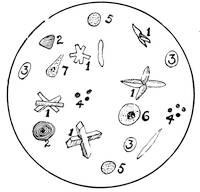
Azoospermia. 1, Boettcher’s crystals; 2, amyloid bodies; 3, hyaline bodies; 4, lecithin; 5, testicular cells; 6, prostatic epithelium; 7, urethral epithelium.
Permanent azoospermia is, as a rule, caused by inflammations of the testicles or of the epididymis. These bilateral inflammations of the testicles or of the vasa epididymis are almost always the result of gonorrhoea. The vasa deferentia are obliterated and impervious. The ejaculated semen consists only of the secretions of the seminal vesicles, of the prostatic glands and of the urethral glands.
The spermatozoa being absent, the sperma is much thinner than in the normal state. The absence of the spermatozoa and their movements is also the cause why the Boettcher’s crystals usually form much earlier; they appear within half an hour after ejaculation and in a considerable amount. They often cover almost the entire microscopical field. In the normal semen the movement of the spermatozoa prevents the early formation of the crystals; they appear after several hours’ standing and are fewer in number. The thin azoospermatic semen is more transparent and watery and contains more epithelia and fat than normal semen.
The patient is, as a rule, unaware of his anomaly. It is often discovered after his wife has undergone innumerable treatments for her supposed sterility. If the anomaly has been caused by gonorrhoea with the accompanying inflammation of the testicles, epididymitis, or spermatic funiculitis, the loss is almost irremediable. The revelation to the couple of their doom to childlessness is one of the many tragedies played in the doctor’s office.
Impotence of copulation.—The anomaly, most complained of, which drives the patient to seek medical help is the impotence of copulation. It is the anomaly which strikes the hardest blow to masculine vanity. It is a psychological fact that most men are proud of their potency of copulation and feel greatly humiliated when the same is impeded. A woman will not seldom discuss with her friends the double ovariotomy performed upon her, but the man deprived of his testicles will never mention the fact of his castration to his closest friends.
The impotence of copulation is best divided into four types:
1) Organic impotence.
2) Symptomatic, or paralytic impotence.
3) Psychic, a) transitory, b) relative, c) temporary impotence.
4) Atonic impotence.
Organic impotence may be congenital or acquired. Among the congenital forms are total absence of the penis. Smallness of the penis may also be the cause of impotence, although this cause has been somewhat exaggerated by most writers. The male generative organs on the Greek statues are in comparison with the size of the other parts quite small. Still, if the smallness goes beyond a certain degree it will cause impotence. In the same way enlargement of the penis beyond a certain degree will also result in impotence. Adhesions of the penis to the neighboring parts or torsion of the penis will render intromission impossible. Congenital absence of the testicles is always accompanied by loss of power.
Among the acquired deformities are counted neoplasms of the penis, elephantiasis, and the destruction of the penis through ulceration. Syphilis and tuberculosis of the testicles are generally destructive to virility. Removal of the testicles, even if operated later in life, is, after a certain time, followed by atrophy of the penis and impotence. Indurations and ossifications of the cavernous bodies lead, as a rule, to impotence.
Symptomatic impotence.—The organic type of impotence is relatively very rare. The other type, symptomatic impotence, is oftener met with. It is found in cerebral diseases, diabetes, tabes dorsalis, chronic nephritis, extreme obesitas, chronic rheumatism, chronic alcoholism and in the cachexies of anaemia, cholaemia and uraemia. But since the desire fails with the failure of power, such patients rarely seek medical aid for this anomaly. They consult the physician for their original ailment which is of far greater importance to them than the loss of power. They mention this anomaly only in the course of the anamnesis.
Symptomatic impotence is, as a rule, paralytic in form. Libido is more or less absent, and if emissions ever occur they take place without erection or pleasure. In the paralytic form of impotence nocturnal erections are absent, nor do erections occur at any other time. This sign is almost pathognomonic of this type. If the vagina is very wide, and intromission with semi-erection should be effected, ejaculation does not come in jets but slowly. The function of the bulbo-cavernosus muscle is impaired, hence no ejaculation with force in a jet is possible, but a slow dribbling from the meatus takes place.
In paralytic impotence the genitals are more or less withered. The skin of penis and scrotum is almost anaesthetic. The entire urethra is insensible, the sound passes into the bladder with the greatest ease. The skin of the thigh in the vicinity of the genitals is more sensitive to electric currents than that of penis and scrotum. The following history well illustrates a typical case of paralytic symptomatic impotence:
Mr. H., 45 years of age, a widower with one child, contracted lues fifteen years previously and was apparently cured after two years’ treatment. For the last two to three years he began to suffer from shooting pains around the abdomen (Gürtelschmerz) and in his legs. Micturition is frequently urging, and the stream is slow. The knee-jerks are greatly exaggerated. The patient’s gait is still normal, and he does not show any other sign of tabes dorsalis. About the time when the pains first appeared, he also noticed a certain weakness in erection and premature ejaculation. He began then to associate with meretricious women who practised on him fellatricia, or insertio fascini in os. From this time the impotence increased and is now complete. For the last two years he never had even nocturnal erections. The penis is in a state of atrophy, and is now of the size of a boy’s, fourteen to fifteen years of age. The skin of the penis is shriveled and cold. The glans is pale. The entire skin of the penis and scrotum is quite anaesthetic to the galvanic current. An application of about fifteen milliamperes in strength, which produced an ulceration by burning, was scarcely felt by the patient. The faradic reaction is normal.
Psychic impotence.—The mode of impotence known as psychic is a very frequent anomaly. It is the disease of the cultured classes. The action of the nervi erigentes is incomplete in psychic impotence, and the complete relaxation of the corpora cavernosa does not take place. Hence a sufficient quantity of blood can not enter the erectile tissue to exert pressure on the outgoing veins. The corpora cavernosa become smaller and harder at the critical moment and do not admit the entrance of the blood. The diameter of the penis becomes less than that of the glans. The penis feels cartilaginous, and the skin is found in transverse folds through the contraction of the corpora cavernosa. Hence erections are feeble or entirely wanting at the critical moment. When the patient is lying in bed alone he has, in distinction from atonic impotence, quite vigorous erections.
Psychic impotence is transitorily found also in healthy individuals when they are in a state of agitation. The more agitated the patient is, the more the penis shrinks. In psychic impotence, if the wife is of an exceedingly passionate disposition, she will make advances and may often evoke powerful erections, whereas the wife’s indifference would cause impotence.
In this way this form of impotence is often only relative. With one woman the inability injungendi is complete, while the virile power is exuberant in concarnatione with another. As a rule, the patient who has reached the critical age of fifty to sixty, does not succeed in his conjugal duties but is able commisceri meretricis auxilio. The indifference of the wife who, as a rule, is about forty to fifty years of age and has either passed or is very near the climacterium, accounts for the husband’s impotence in her company. Such men are able to perform the act only when the woman actively or at least cheerfully and willingly yields herself. The sullen, supine position of the frigid wife is not enough to hold a man’s love forever.
Temporary psychic impotence of short duration is sometimes met with in newly married men through lack of confidence. When about to be married, the broodings over things to come overstimulate the inhibitory centres in the brain. As a result, at the critical moment, the penis gradually shrinks, grows smaller and moves in a worm-like manner in the course of its diminution.
The following case may serve as an illustration for such cases:
Mr. S., 23 years of age, had suffered from gonorrhoea a few years previously. He has practised stuprum manu moderately at the time of puberty. Later on he associated cum meretricibus. He always considered himself healthy. The seminal discharge was somewhat precipitated, but the patient attributed this phenomenon to his extraordinary strength and was rather proud of it. When he became engaged to his present wife he abstained henceforth from illicit relations. Two days before the consultation the patient married and, upon approaching his young bride, found that the erection was too weak to transgress the virginal portals. After his first failure, every repeated attempt caused the penis to shrink almost half the normal size of the flaccid condition. The wife’s genitals were perfectly normal. She did not suffer from vaginism. Therapeutic suggestion and a medicinal tonic (ut aliquid fiat) removed the anomaly in a few days.
In this case the anaphrodisiac of fear after the first failure was the cause of the impotence.
Psychic impotence is sometimes present for a short time after long continued abstinence in men who for some reason have interrupted their regular sexual relations. Young men who have never had yet any sex relations are never affected by mere abstinence. Psychic impotence is not seldom found in men with a certain vocation requiring great mental strain, as literary men, bookworms, mathematicians, engineers, etc.
Extreme excitement and desire may cause temporary impotence. The number of stimuli arriving from the brain is too vast and paralyzes the centre of erection. A violent lover, who has for a long time repressed his desires, plunges his entire organism, in the moment of their realization, into a kind of ecstasy. His soul, i. e., the immaterial part of his being, concentrates in the object of his desires all his force and vitality. He appears entirely to forget his organs which ordinarily serve to transmit his desires. It is hence first necessary for him that everything be restored to the ordinary channel, that the moral over-excitation ceases or that it returns at least to the normal type of simple excitation, before the centre of erection will have power to exercise its function.
Want of responsiveness from the mate has sometimes a disadvantageous effect upon the man. Hence obstacles, on the side of the woman, will not seldom cause psychic impotence. The history of the following case is characteristic of this kind of disturbances:
A young medical student made the acquaintance of a young girl who had previously given birth to a child. The girl did not want to reveal her secret to her lover, and fearing that, as a medical student, he might discover her secret in initu, she refused to grant him her favor. One evening while alone with her in his room, he tried hard to accomplish his desire by persuasion, caresses, and other means. When just at the point to break her resistance, the erection suddenly ceased, and the penis shrunk to half its normal size. From this moment he suffered from complete impotence. Even nocturnal erections did not take place any longer. The impotence resisted every kind of treatment, until, one day, the girl wrote the patient that she was now willing to yield to his desires. At the first meeting following the letter, puella tentavit actively to arouse his passion, and he succeeded in having a powerful erection actionis peragendo. From this moment he was cured from his ailment and enjoyed his full virile power of former days.
This case shows the vast influence the psyche is wielding even upon the unconscious state of the brain during sleep. The stimulation of the inhibitory centre was so strong as to prevent even the occurrence of nocturnal erections.
In illicit relations, the fear of surprise or of infection, shame or loathing may have inhibitory effects upon the centre of erection and cause psychic impotence.
Violent shocks to the nervous system, as great fright, pain, or grief, etc., and all other strong emotions which often affect the urinary system by causing temporary frequent micturition, polyuria, or glycosuria, may also give rise to disturbances of the sexual functions and cause psychic impotence of a transitory nature.
Over-estimation of the difficulties of defloration sometimes causes temporary impotence in nervous newly married men. The timidity of inexperience may in the same way have the effect of an anaphrodisiac.
Sometimes the exaggerated veneration of his young wife may cause temporary loss of vigor in the young husband. The thought that such an exalted personality, as his young innocent wife, should have to submit to such an indignity (not a few have this strange opinion of the conjugal act), works as an inhibition of the proper performance of the act.
The most frequent cause of psychic impotence is the thought of failure. An accidental single failure through the temporary abuse of alcohol, tobacco, coffee, or tea or through intense desire may occur, some day, which in the healthy man would pass unnoticed. But the nervous man will begin to brood over this failure, and this brooding will prevent the formation of associative paths in the brain at every subsequent attempt of coition. In nervous men, the imagination, having once become impressed with groundless fears, may retain them with extreme tenacity and busy itself with constant brooding in solitude over the fancied ills. Thus a disorder of adjustment is established, and a psychic trauma is created, through the subconscious effects of cryptogrammic nerve-currents. This psychic trauma is translated into fear again. The subconscious cerebral processes lead to the formation of ideas, later recallable in memory. These morbid ideas become the substratum of future anxiety-attacks. A pathological state is thus induced where the natural course of erection fails to follow the sexual excitement. In this way a veritable disease is produced, where there is a strong desire without full power. Every additional failure provokes more intense broodings which are naturally again the cause of failure. Thus a vicious circle is created which may render an occasional innocent failure a permanent impotency.
Atonic impotence.—The most frequent form of impotence of copulation, in fact, the impotence “par excellence,” is the atonic impotence. This is the impotency which is generally caused by venereal excesses, either in copulation, masturbation, mental erethism, frustrate eroticism, or last but not least, conjugal onanism or coitus interruptus. These excesses cause the exhaustion of the centre of erection, irritation of the centre of ejaculation and a debilitation and enervation of the genital nerves. For when the lumbar centre of erection fails to respond, there is a deficiency in activity, excitability, mobility, and tonicity of the entire genital apparatus.
In the atonic form of impotence conditions of absolute impotency are quite rare. Absolute impotence is mostly found in the paralytic form which is caused by cerebrospinal and nervous diseases. In the atonic anomaly the vast majority of cases are of partial impotence.
The impotence due to weakness is distinguished by premature ejaculation and the subsequent immediate subsidence of erection. Sometimes a vigorous erection ceases suddenly before emission has occurred, and the penis becomes completely flaccid and shrivels to half its normal size before the entrance into the vagina. When ejaculation does later occur it takes place without erection or pleasurable sensations. Not seldom the entrance into the vagina is effected with good erection, but when about to begin the act, the penis suddenly wilts, the wilting either followed by ejaculation or not. The following case illustrates the ordinary symptoms:
Mr. L., 45 years of age, happily married, and father of several children, was always healthy and strong and had never had gonorrhoea or syphilis, but had freely masturbated when he was young. He always considered himself a powerful man. He is given to athletics, horseback riding, ball playing, swimming, rowing, etc. For the last year the patient noticed a certain weakness in his potency. As soon as he enters the vagina, ejaculation takes place at once and is followed by immediate flaccidity of the penis. Sometimes, while trying intromission, the erection ceases like a shot ante portas. When he does not try congressus the erection lasts much longer. The patient’s wife has been of a rather frigid nature, never asking or caring for concarnatio. But recently she seems at times to have rather a certain longing for the embrace. This fact makes the patient feel doubly miserable, not to succeed, when the partner seems to desire and enjoy the initus.
This case is one of those where objectively there is very little to discover. In some cases of atonic impotence the patients show neurasthenic or cerebrasthenic symptoms. The underlying cause of the impotence, as a rule, determines the symptom-complex of the case. If the cause of the impotence is excess in masturbation, the case will show all the symptoms of the typical masturbator. The latter is generally small, emaciated, hollow-chested, thin-necked and weak-kneed. He shows deep-set eyes and pale hollow cheeks. The penis and testicles are small. The penis is cold and shriveled. The patient has a bad taste in his mouth, and suffers from winds in his stomach. He also suffers from obstinate constipation and colicky pains in the bowels. He complains of palpitation of the heart, shortness of breath and of a burning sensation in his arms. He suffers from loss of memory and from tinnitus aurium. The patient also shows a certain moral abasement, incontrollable restlessness, carelessness in dress and person and shambling in gait. The history of the following case is that of a typical masturbator:
Mr. C. is 31 years of age and unmarried. At the time of puberty, when he was 14 years old, he began to practise stuprum manu. Se stuprabat manu three to four times daily. When twenty years of age he began to associate cum meretricibus. But the natural initus did not seem to satisfy him. Post omnem initum manu se stuprabat, in addition, as soon as he reached his residence. Three years ago he contracted gonorrhoea, from which he suffered a whole year. Since a year he noticed a certain weakness in his potency. He is able to effect intromission, but before he can begin the act, ejaculation without the least trace of libido takes place, followed by immediate flaccidity of the penis. He has some erections in the morning but they are not complete as in former times.
When the cause of the atonic impotence was venereal excesses or gonorrhoeal prostatitis, the long-kept-up congestion of the prostatic urethra and of the colliculus leads to general reflex excitability, to a high degree of nervousness, cerebrasthenia, and neurasthenia. The colliculus being an organ which finds its analogue in the female uterus, its constant irritation will show phenomena in men, usually found in intensely hysterical women only.
The impotent men generally change their entire psychic nature. They become timid, morose, solitary, melancholic, hypochondrical and despondent. They are discontented, peevish, ill-humored, and evince either blunted or inordinate sexual desires. They show profound agitation at the slightest excitement. The patients are troubled with insomnia or unrefreshed sleep and with a feeling of heaviness on rising. The mind is enfeebled and the memory impaired. The mental debility and dulness cause inability to collect their thoughts and thus enfeebles the mind in its power of concentration. The patients suffer from vertigo, singing in the ears, from a feeling of fulness in the head, from asthenopia, depression, anxiety and irritability. They often suffer from palpitation of the heart, sick headaches, coldness of the hands and feet, dull heavy feelings, a sense of fatigue and a loss of flesh. They also complain of creeping sensations in the loins, of pricking in the back, of twitching and jerking of the muscles, of muscular weakness, of lumbar pain and asthma. The intestinal canal shows a general derangement, as coated tongue, poor appetite, sense of weight in the epigastrium after eating, flatulence, sluggishness of the bowels and constipation. The general health of the patient is broken, the countenance is vacant and the gait feeble.
Besides the general symptoms, the genito-urinary organs are especially affected in atonic impotence. The external genitals show a certain flaccidity, shrinkage, paleness of the mucous membranes and a diminution of the sensibility and electrical irritability. The skin of the penis is cold, shriveled and somewhat insensible to electrical stimulation. The electrical irritability of the skin of the two halves of the scrotum is of a different degree, the right half being sometimes more sensitive than the left.
The testicles are often very painful and tightly drawn up against the external abdominal rings. The spermatic cord often shows an enlargement of the veins (varicocele). The vas deferens and the ampulla are in a state of inflammation.
The seminal vesicles are plainly felt indurated, nodular and distended with fluid. In a large proportion of cases the repeated congestion causes a veritable seminal vesiculitis. This inflammation is not seldom extended to the ejaculatory ducts and occludes the same. Through this occlusion spermatic colic, i. e., a severe pain in the region of the vesicles, often seizes the patient, especially after some sexual excitement, as dancing, caressing, and even flirting. After such excitement a dull pain in the region of the prostate and in the perineum as well as in the testicles, spermatic cords and in the rectum is very annoying to the patient. Ejaculation often removes these pains. For that reason the patient tries to relieve himself from the painful sensations by masturbation. Ejaculation also removes the irritations of the thighs, hips, anus, hypogastric region and in the smalls of the back.
The entire urethra is often in a state of hyperaesthesia and paraesthesia, and the prostatic portion shows congestion and not seldom an inflammation of the mucous membrane. Especially the colliculus is often in a severe inflammatory condition. There is thickening sponginess or puffiness of the parts immediately involving the ejaculatory ducts. The urethra manifests great sensibility. The introduction of a bougie produces unbearable pains. The withdrawal of the sound is often followed by several drops of blood. This hypertrophy and inflammation of the colliculus seminalis is the cause of the ejaculatio praecox in the beginning of the disease. Later on the condition provokes weak erections and finally ejaculation with flaccid member before entrance into the vagina.
The irritation of the urethra causes hypersecretion of the glands of Littré and Cowper which is manifested by the so-called urethrorrhoea. In urethrorrhoea the secretion is thin, transparent, perfectly clear and sticky. The secretion has no spermatic odor and does not stain the linen, but stiffens it. It is seen as a drop in the morning at awakening with an erection. The drop is sticky and tenacious. The meatus urethrae sticks together. The drop is not rarely found in healthy men after violent and continuous erections. The secretions show under the microscope nothing beyond free mucous and columnar and pavement epithelia.
Besides the hypersecretion of the urethral glands, there is also a hypersecretion of the prostate, especially in patients who have indulged in excesses in masturbation and in onanism (coitus interruptus). Masturbation as well as onanism do not give the same satisfaction as normal coition, hence constant hankering for more and overindulgence. Prostatorrhoea is often found after gonorrhoea, when the yellowish drop gradually becomes whitish, flocculent, and finally a colorless watery drop of clear, slightly viscid fluid. It is best seen when the lips of the meatus are held apart.
In prostatorrhoea the discharge is never milky, white or purulent as in pure prostatitis. Microscopically the slowly dried slide shows the characteristic crystals of sodium chloride, but no spermatozoa. In prostatorrhoea the orifice of the urethra shows constant moisture. The copious evacuations occur while straining in the water-closet. The patients are, as a rule, constipated. The discharge is attended with peculiar sensations, sometimes of a pleasurable nature, sometimes of a dropping sensation, weight in the region of the prostate, anus and rectum. Examination per rectum often shows hard points and nodules in the prostatic gland.
The most frequent anomaly caused by venereal excesses is spermatorrhoea and nocturnal pollutions. The excesses provoke a chronic hypertrophy of the prostatic gland, and this hypertrophy renders the ejaculatory ducts insufficient.
In spermatorrhoea there is an oozing of semen from the urethra without erection or pleasurable sensations. The rhythmic muscular contractions, found in normal ejaculations, are missing here. The failure of the normal contractions is due to a paresis of the muscular fibres of the ejaculatory ducts.
Spermatorrhoea usually takes place after micturition or during defecation. Sometimes spermatorrhoea is caused by the slightest excitement. The sight of a woman’s bust or of her leg, the touch of her hand, the smell of her perfume, the glance at a lascivious painting, or a voluptuous thought may cause a precipitate discharge, without an erection or with an imperfect erection. The discharge taking place at a complete relaxation of the ejaculatory ducts, the voluptuous sensations are, as a rule, entirely absent.
Spermatic discharges sometimes occur in affections of the central nervous system, where the usual inhibitions through consciousness are ineffectual.
Microscopically the discharge in spermatorrhoea shows amyloid bodies, lecithin and prostatic epithelia. The fluid has the seminal odor which is peculiar to the spermin reaction; the amount of spermatozoa is somewhat diminished.
The testicles and the skin of patients, suffering from spermatorrhoea, are less sensitive to electrical stimulation, while the urethra is hypersensitive.
Nocturnal emissions constitute the other anomaly of ejaculation. Physiologically all healthy continent men between the ages of fifteen to fifty, with very few exceptions, have nocturnal emissions at intervals of about four weeks (male menstruation). The pollutions arise during sleep and are accompanied by erotic dreams and erections. They usually awaken the sleeper. Normal pollutions occur only in sleep and are accompanied by vigorous erections, erotic dreams and orgasm. They also cause a sensation of relief. When pollutions are frequent, two or three times a week, they become pathological. They are then followed by lassitude, dizziness, faintness, dragging pains in the occipital region, mental depression, disinclination for mental effort, sense of fatigue, lessening of physical strength, pain in the back and reflex irritability. The patients are startled at the least noise. They change color every moment. The eyeballs run unsteadily. There is often found a disturbance of speech, difficulty in breathing, and palpitation of the heart.
The following case will best illustrate the symptoms in nocturnal pollutions:
Mr. A., 25 years of age, was always well and never had gonorrhoea or syphilis. When a boy he practised stuprum manu in a moderate degree, as he says. A few years ago he noticed a certain weakness in erection. The emission took place soon after the entrance into the vagina and was followed by the immediate flaccidity of the penis. Sometimes the ejaculation occurred ante portas. The patient, therefore, gave up trying intercourse. Since then he is suffering from nocturnal pollutions, which occur every night or at least three to four times a week. The following day the patient feels very weak, as to prevent him from performing his usual work in his trade. He suffers from headaches and pains in the lumbar region and in the legs. He is engaged to be married and is looking forward with great apprehension to the approaching time of this momentous event.
Pathological pollutions are caused by a paralysis of the circular muscular fibres of the ejaculatory ducts. This paralysis may be either of a purely nervous nature or caused through inflammatory processes. Atony of the mouths of the ejaculatory ducts not seldom produces nocturnal pollutions. Sometimes pollutions are also due to a spasm of the detrusors of the seminal vesicles.
When the seminal vesicles and the ejaculatory ducts are thus affected, very little is needed to cause a nocturnal emission. Any diurnal excitement will be followed by nocturnal erotic images and pollutions. Sleeping on the back, by causing a fluction of blood to the spinal cord, will also produce pollutions.
Besides the genitals, the urinary system is also greatly affected in atonic impotence. The hyperaesthesia and hyperaemia of the prostatic urethra and of the colliculus, usually found in atonic impotence, are the cause of a continual irritation of the bladder.
The irritation of the neck of the bladder provokes a spasm of the detrusor vesicae. To this spasm is due the frequent painless impulse to urinate, by day when under mental activity, and in sleepless nights.
Sometimes the detrusor is in a paretic condition. In paresis of the bladder the patient has to wait for the urine to come and has to use abdominal pressure to effect urination. The urine falls without force perpendicularly from the urethra. There is often desire to urinate, but never a feeling of satisfaction after urinating. When catheterization is attempted, there is a powerful resistance at the neck of the bladder, through a certain spasm of the sphincter.
In spasm of the sphincter of the bladder there is also frequent impulse to urinate. Not seldom such patients are unable to urinate in the presence of others. Sometimes the urine cannot be passed at all. The spasm of the sphincter creates a certain difficulty in starting the act of micturition. The stream is often interrupted and, at the end, a dribbling of urine takes place. Through the spasmodic contraction of the muscular fibres of the sphincter the urethra represents a rigid open tube in which one end is closed; it thus resembles a pipette which retains the fluid as long as one end is closed. When the relaxation takes place, the fluid contained in the urethral tube dribbles out of the meatus.
In paralysis or paresis of the sphincter the patient urinates often but in small quantities. In paresis of the sphincter there is no resistance to catheterization at the neck of the bladder. In the beginning of the paresis there is incontinence of urine during the night. Later on when the disease has progressed, and a perfect paralysis has ensued, the incontinence of the urine is constant even in daytime.
In enuresis nocturna, often found in masturbating children, there is an imperfect innervation of the sphincter, while the innervation of the detrusor of the bladder is perfect.
In all these anomalies the urethra is very sensitive. The passage of an instrument causes unbearable anguish. The patient acts as mad when the sound is introduced. There is often found a troublesome burning in the urethra, especially in the fossa navicularis, during or after micturition.
Besides the frequent urgency to urination, in all these troubles, there is not seldom an actual polyuria present. The urine is pale, clear, watery, with low specific gravity, often as low as 1002. The urine is not seldom loaded with phosphates. Sometimes oxaluria, with high specific gravities up to 1050, is discovered. Transient glycosuria as high as two to three per cent. is also found. At times vesical tenesmus is met with. Sometimes anuria is observed, although the kidneys are in perfect order.
The pathology of female impotence.—The same four kinds of impotencies found in men are also met with in women, with the only difference that the frequency of one or the other of the impotencies is different in the different sexes. They are: 1) impotence of voluptas, 2) impotence of copulation, 3) impotence of reproduction, and 4) impotence of libido.
Impotence of voluptas.—The entire absence of the sense of sex, or impotence of voluptas, where the individual has absolutely no sexual inclination to any individual of the other sex, is more frequently met with in women than in men. Still even in women this idiopathic frigidity, this insensibility where the woman is completely frigid by temperament, is much rarer than is generally believed. In fact, it is extremely difficult to find a woman who is without aptitude of sexual emotion.
Physiological frigidity exists in infants and in very old age. After a regular and satisfactory orgasm the woman is physiologically more or less anaesthetic for some time. The ablation of both ovaries before puberty causes total anaesthesia, while the operation after puberty produces, for a certain time, at least, only an impairment of libido, or orgasmus retardatus. Congenital degeneration of the ovarian glands will be accompanied by total absence of the sense of sex. As in men, the total absence of sexual desire is found in severe cases of neurasthenia, where the entire nervous system is in a low state of efficiency. Idiopathic impotence of voluptas is further found in low idiots and in dementia, where there is lack of understanding of the opposite sex. The sexual perversity of homosexuality, as a rule, causes total impotence of sexual desire for the opposite sex. Sometimes the cause for the anaesthesia lies in the centre, otherwise the patient is perfectly normal, as in the following case:
The patient, forty years of age, twenty years married, is a highly cultured lady. She never had a child or was pregnant while living with her two first husbands. A prominent gynaecologist, who had examined her several years previously, attributed the cause of her sterility to an infantile uterus. She has never, in her life, experienced any sexual desire and seems to be proud of it. She attributes this lack of passion to her great mental activity. An examination revealed a pregnancy of about four months.
Impotence of copulation, except in the anomaly known as vaginism, is very rarely found in women. Conjugation is, of course, impossible in the rare cases of total absence of the vagina. In hypospadia, where the vaginal orifice is situated within the rectum, vaginal conjugation is well-nigh impossible. Adhesions of the labia majora or minora, a rigid imperforated hymen, an extreme vaginal atresia near the orifice and elephantiasis of the vulva will cause impotence of conjugation. All acute inflammations of the vulva, vagina, rectum, uterus tubes, or ovaries may render approach painful and impossible. Urethral caruncles, urethritis, fissures at the neck of the bladder, rectal fissures or hemorrhoids may also render conjugation difficult. The tetanic contraction of the sphincter cunni and the tetanic spasm of the perineal muscles, constrictor cunni, transversus perinei, sphincter and levator ani which close tightly the orifices of the vagina and the entire vaginal canal will also be the cause of impotentia coeundi. The solitary tetanic contraction of the sphincter cunni, known under the name of vaginism, will make conjugation impossible until the hymen is removed. The following case operated by the author illustrates this anomaly:
Mrs. X., twenty-two years of age, for three months married to a physician, was unable to be approached by her husband. As soon as the penis touched the labia, the sphincter cunni contracted so tightly that there was an utter impossibility to transverse the virginal portals. During the examination, at the least touch of the nymphae, the sphincter could be observed contracting, just as seen in animals after defecation when the sphincter ani contracts. The ablation of the hymen cured the anomaly. This fact shows that it was only a reflex-irritation, started at the highly sensitive hymen. The sphincter itself was perfectly normal.
Impotence of reproduction.—More frequent than impotence of copulation is female impotence of reproduction. This anomaly is naturally found in all those cases where there is impotence of copulation. It is sometimes met with in excessive acid reaction of the vaginal contents, where the spermatozoa are killed before they reach the uterus.
When one lip of the cervix is considerably elongated, covering apron-like the external os, the spermatozoa will not be able to enter the cervix, and sterility will result. Sterility is also found in the obliteration of the cervical canal, produced by caustics or scars after tears during confinements and after curettings. Ectropion, stenosis of the external or internal os of the cervical canal, endocervicitis, causing an increased cervical secretion, and the swelling of the plicae palmatae may prevent the entrance of semen into the uterus and thus cause impotence of propagation.
The anomalies of the uterus are also sometimes responsible for sterility. Uterus foetalis and obliterations of the lumen of the uterus will result in absolute sterility. Uterus infantilis, hypoplasia of the uterus, atresia of the uterus or polypi, hypertrophic chronic metritis, degeneration of the uterus or uterine deviations may often be the cause of sterility.
The anomalies of the tubes which cause sterility are absence of the tubes, rudimentary tubes, total or even partial obliteration of their lumen, as in salpingitis nodosa, closing of the ends of the tubes in bilateral salpingitis, and adherences of the tubes to the neighboring parts, as found in pelviperitonitis, perimetritis, perisalpingitis, and perioöphoritis.
The anomalies of the ovaries, causing impotence of procreation, are absence of the ovaries, hypoplasia of the parenchymatous tissue of the ovaries, fibrous degeneration of the ovaries, alteration of their position, as extreme prolapsus and hernia of the ovaries.
All these anomalies may produce either absolute or relative sterility. In regard to frequency they are of slight significance in comparison with endometritis and pelviperitonitis after gonorrhoea. The gonorrheic infection is, therefore, the cause par excellence of the impotence of procreation in women as in men.
Impotence of libido.—While in men the common form of impotence is inability of conjugation, the common form of impotence in women is failure to experience the orgasm, or the impotence of libido. In this anomaly two grades may be distinguished, total anaesthesia and partial anaesthesia or orgasmus retardatus.
In absolute anaesthesia there is not even a vestige of a libidinous sensation during intercourse. The woman likes caressing, hugging, kissing, etc., because the potency of voluptas is intact. But there is no vestige even of the fore-pleasure, or the ant-orgastic libido. The woman is devoid of sexual sensation, her genitals have no more excitability for pleasurable sensations than her fingers. Hence no desire for coition exists. On the contrary, there is, as a rule, a pronounced disinclination to the act. Where there is complete absence of pleasurable feelings, the act becomes naturally loathsome to the individual. If coition is granted it is done either from a sense of duty or for gain.
Physiological anaesthesia exists in children until puberty, and in adults in old age. Even after menstruation has set in, the girl is, as a rule, anaesthetic in regard to libido, although she may be erotic. “The girl has to be kissed into a woman.” After the climacterium the woman generally becomes again more or less anaesthetic. Some women may continue to experience libido years after this period, and may manifest symptoms of great sexual excitement as seen in the following case:
Mrs. X., married to an elderly man, looked upon the marital relations more as a duty than as a pleasure during her entire married life. But since the climacterium has set in, the rare approaches of her husband are impatiently awaited and they cause her great sexual excitement and satisfaction, never experienced before during the entire period of her active sexual life.
Such cases are extremely rare. Generally there is a close connection between the activity of the generative glands and the degree of libido.
After a regular and satisfactory coition the woman is, physiologically, more or less anaesthetic for some time. The length of the neutral period varies in different individuals. Intense mental activity, emotional depression and long sexual continence also diminish the sensual pleasure.
Apart from this temporary anaesthesia, there are many women who are impotent to experience libido throughout their lives. There is a total absence of pleasurable feelings during coition or any other kind of sexual stimulation.
A young lady, twenty-two years of age, complains that while during the time of her engagement she greatly enjoyed her fiancé’s caresses and became sexually excited when fondled by him, since her marriage she is unable to experience any libido in coition, although her husband is possessed of great potency. The patient is a beautiful brunette, with fiery eyes, and is a picture of health. Examination shows a uterus infantilis.
The potency of voluptas in this case is wholly intact. The patient enjoys being fondled and caressed. The cause of the impotency of libido lies in the periphery, although uterus infantilis is seldom accompanied by impotence of libido.
In some cases the woman is normally developed in every respect, menstruates regularly and is frequently quite prolific. The power of procreation is sometimes even very great. The woman is generally quite erotic and falls in love easily. Yet she never experiences the least libido.
A young lady, twenty-eight years of age, mother of two healthy children, was sent by her family physician from Chicago to consult the author for her impotence of libido. The husband stated that he is sure of his wife’s attachment to him. She enjoys his company and likes to be caressed by him. Still during the eight years of their married life she never showed the least sign of libido at coition. She remains cold and indifferent, and only submits conjugationi to please her husband. The examination showed the genitals to be in perfect order.
In the following case, too, no cause whatsoever could be found for the anaesthesia in regard to libido.
Mrs. L., twenty-nine years of age, is seven months married. Her menstruation set in when she was fifteen years of age and was always regular of about six days’ duration. At that time she began to satisfy herself by manusturpation and found some libido in the manipulation. But soon she read in a book about the ill effects of this practice and stopped it.
In the beginning of her married life coitus caused her great pain, which diminished by degrees after a few weeks. At present, coition causes her only disgust. The day after she feels tired and weak.
The examination shows a feminine habitus, breasts well developed, clitoris normal. The hymenal rests are very sensitive to the touch. The painful sensation and the feeling of disgust increase when the anterior vaginal wall is touched. The uterus is enlarged to the size of a goose-egg, the cervix is soft, and the external os narrowly closed. Diagnosis, two months’ pregnancy.
In this case some traces of libido were present at the time of puberty, which later on entirely disappeared. In some cases the patient is very prolific, as the following history shows:
The author recently performed a perineorrhaphy on an otherwise healthy woman, mother of five children, who confided in him that she has never experienced the slightest libido in intercourse. Yet, she added, if her husband would not take precautions, she would give birth to a child every year, as was the case in the beginning of their married life.
Anaesthesia in women is, as a rule, due to inexcitability of the genital nerves and to lack of excitation at the centre of libido. Sometimes anatomical anomalies of the genitals may cause impotence of libido. The integrity and the free exercise of the generative organs are necessary for the integrity of the libidinous feeling, although sexual pleasure is experienced at the nervous centres, and the generative organs play only a secondary part. The vaginal bulbi and their muscle, the constrictor cunni, the intermediary net of veins between the bulbs and the clitoris, and the free part of the latter, the glans of the clitoris, must functionate normally in order to give full satisfaction in intercourse.
Hence diminution or extinction of the sense of libido will be caused by castration, degeneration of the ovarian glands, marasmus, sexual excesses and overindulgence in alcoholic beverages or cocaine.
In the following case the erotic feeling increased in such a degree after the castration, probably through the extinction of the libido, as to deceive the family physician and lead him to make the diagnosis nymphomania.
Miss X., a school teacher, over thirty years of age, was always chaste and indifferent not only to any carnal pleasure, but also to male company. On account of a uterine fibroid, a total extirpation of uterus and ovaries was performed. Since the operation the patient complains of great sexual excitability she had never experienced before the operation. She is so excited sexually that she is possessed of the almost imperative impulse to kiss every male person she meets on the street, and but for her position, she would have long ago yielded to this impulsive desire.
In another case of diminution of the potency of libido, only uterine inflammation and pregnancy could be discovered.
Mrs. M., thirty-five years of age, four months married, had always suffered pain in the back during menstruation. The patient complains that she only experienced libido twice since she has been married. Since the last experience in the first weeks of her married life, she has no pleasure at all. Coition, though not painful, causes her a disagreeable feeling. An examination revealed anteflexio uteri, enlargement and catarrh of the cervix, erosions and a three months’ pregnancy.
In the following case castration caused inability to experience libido.
Mrs. M., thirty-five years of age, for the last fifteen years married but sterile. When she was only two years married she began to suffer from attacks of headaches and vomiting, which repeated almost every other day. Her menstruation was regular. After having tried all the stomach specialists in the city without finding any relief from the vomiting spells, she consulted a gynaecologist, and he promptly found an ovary to be the cause of all her troubles. She had been previously operated upon for gall stones, which were not found and for appendicitis, when the presumably diseased appendix was removed. She now submitted to ovariectomy on the left side. Three months after the operation the vomiting spells returned, and she submitted again to a removal of the right ovary. But even this double castration did not relieve her. When she first consulted the author she was still suffering from these spells, especially before menstruation, which is still present although irregular. The patient declares that previous to the ovariotomies she experienced full libido and was able to induce orgasm. After the second ovariotomy this potency was lost. She gets excited during coition, but the orgasm cannot be produced. The following day she feels nervous and weak.
In another case of impotence of libido nothing else but anteflexio could be discovered.
Mrs. H., twenty-four years of age, four years married, was confined by the author a year ago of a healthy girl. The patient complains of never having experienced any libido. Before her confinement coition caused her great pain and misery. Since her confinement she suffers no more pain during the act, but libido is still absent. She complains of great dryness of the parts, so that vaseline has to be used to facilitate walking. At the examination there was found redness of the vulva, catarrh and erosion of the cervix and anteflexio.
In the following case of anaesthesia the author could discover no other cause but general weakness.
Mrs. W., twenty-six years of age, was always pale and weak. Menstruation set in at twelve years of age. At nineteen she was married, and ten months later gave birth to her first child. Four years later gave birth to another child. For the last year she complains of stomach trouble and weakness, pain in the back and abdomen. Menstruation is now four to six days ahead of time and lasts five days. She never experienced orgasm but twice. Both times the intercourse was followed by pregnancy. Other times coition only excites her but never brings full satisfaction. The following day she suffers from severe headaches. An examination only revealed a catarrh of the cervix. The patient received a tonic, and the husband was given some hygienic rules to observe in initu. Five weeks later the husband informed the author that the anaesthesia had disappeared.
Sometimes sexual anaesthesia is the result of a hard confinement producing lesion of the muscle bulbo-cavernosus or of the erectile tissue of the bulbs themselves. The blood is then prevented from leaving the bulbs and from entering the corpora cavernosa of the clitoris. In this way the erection of the clitoris, which is more or less necessary for the full and normal inducement of the orgasm, is rendered impossible.
The author recently treated a young lady, twenty years of age. She had her first menstruation when she was sixteen years old and was always regular. She had been married eighteen months, and her baby was eight months old. The patient called to be treated for leucorrhoea, but her husband called the following day and stated that his wife has no pleasurable feeling during initus since her confinement. Before this event, she found perfect gratification. An examination revealed nothing but a catarrh of the cervix and a slight enlargement of the left ovary.
Roubaud also relates the confidences of a patient who wished se stuprare manu a few days after her confinement, but could not, with all her manipulations, induce the desired orgasm. The normal potency returned only after a long rest.
The number of women afflicted with the anomaly of impotence of libido is considerable. It is claimed by many authorities that ten to twenty per cent. of all women are afflicted with this anomaly. The symptoms of total anaesthesia are subjective and objective. There is first the statement of the husband about his wife’s indifference and coldness during the conjugal embrace. The woman complains of lack of orgasm and ejaculation and of the immediate flowing off of the sperma after coition. The peristaltic contractions of the vaginal walls, beginning at the vaginal orifice, and the aspirating movements of the uterus, as they take place in the normal woman, during the orgasm, are missing here. Hence the sperma is immediately discharged from the vagina.
One of the most conspicuous objective symptoms is a relaxation of the entire genital tract. The glans of the clitoris is often undeveloped or wholly adherent to the prepuce. In some women old lacerations of the perineum are present. The genital muscles, the levator ani and constrictor cunni as well as the perineum, are languid and withered. The mucous membrane of the entire genital tract is in a state of hypersecretion, as in true chronic inflammations. The vagina is wide and flabby, the walls are lacking elasticity. The portio vaginalis uteri is flabby and pointed. The uterine walls are weak and soft, and the cavity is wide. The uterus is extremely movable and generally lies in retropositio, the relaxation of the uterine ligaments allowing it to fall downward and backward. The patient’s general health is often poor, she is anemic, nervous and weak. Sometimes there is only hypoplasia of some of the genital organs, otherwise the woman enjoys good health.